Book Review: Journal Bliss

Journal Bliss: Creative Prompts to Unleash Your Inner EccentricJournal Bliss: Creative Prompts to Unleash Your Inner Eccentric by Violette

My rating: 5 of 5 stars

Violette’s book has been in my to read stack for awhile. I was finally able to read this book when I took it with me on a trip. I found that it was a quick read. It might have been a quick read, but it was a powerful read as well. Violette, in this book, is a cheerleader, life coach, therapist and art teacher. She mixes in the right amount of words with pictures, the right amount of encouragement and support.

She dives in with a discussion about the reader’s inner critic. I was a little surprised that she would start out with this, but it was the right way to organize the book and she didn’t go on and on in that chapter.

She clearly describes a lot of techniques and a lot of different ways to do small but effective bits of embellishment. Her writing style makes the reader think that s/he can create borders, backgrounds and any of the techniques described. The one part that really intrigued me was the part about faces. Reading this section and looking at the pictures gave me confidence She makes drawing faces seem simple. I don’t mean simple as in stupid looking, but simple as in with a little practice everyone can do faces as well as she can.

Violette provides lots of examples of her artwork. The book is mostly drawings and examples of her written creativity. The majority of the book is not typeset, but embellished, drawn and colored. This style provides lots of examples of her. She shows it is simple. The drawings are not simple, but if the reader breaks them down and looks carefully at the lines, there is nothing tricky going on and the style is quite do-able.

One great suggestion Violette gives is to do a Gratitude journal page using a list rather than prose. I think that is a great idea for any kind of journal page, not only a gratitude page.

I really liked this book and think that it is one that will be a great reference book. I would like to try the various drawing techniques to spice up my journal pages, especially the border ideas. I also want to try making the faces.

View all my reviews, including my non-quilt reviews

Book Review: Quilting Art: Inspiration, Ideas & Innovative Works from 20 Contemporary Quilters

Quilting Art: Inspiration, Ideas & Innovative Works from 20 Contemporary Quilters Quilting Art: Inspiration, Ideas & Innovative Works from 20 Contemporary Quilters by Spike Gillespie

My rating: 4 of 5 stars
I have spent some time, after my initial perusal in November of 2009, reading this book and did enjoy it. There are lots of good photos. I enjoyed reading what artists think about various topics concerning making a living (or not) and creating art.

Spike Gillespie provides a really interesting introduction. I have gotten a lot better at reading the introductions to various quilt books and I have found it to be a worthwhile endeavor. One of the aspects she remarks on is “I was further inspired to remember how important it is to carve out time to pursue the passionate side of one’s calling and to heed one’s muse, both of which are too often too easily lost in the shuffle of doing what we to get by day to day(pg.10).” This is partially what the Creative Prompt Project is about: a small step to begin devoting time to creativity. Ms. Gillespie notes that “all demonstrated a drive that might, at times, be set aside temporarily for work necessary to pay bills and time needed to raise kids. But, in the end, the muse will not be silenced…(pg.14)”

She also faces the “is it a quilt or not” question head on. I often don’t want to hear that discussion rehashed, but I guess an author of this type of book has to at least acknowledge she is aware of the issue. She remarks that asking a random quilt show attendees to deem a work a quilt or not is a false argument. She reframes the question to be “how do you feel about the way quilts have progressed and moved into the art world? (pg.11)” This is a much better question, in my opinion, regardless of whether you think a particular quilt is an art quilt. It is a better question because of the way quilts are constantly evolving. The whole Modern Quilt Movement has been on mind lately and comes immediately to the forefront when I think of how the quilt world is changing and evolving.

Gillespie asks various artists about the word quilt and says that she “did not want to collect opposing points of view and then splice them together as if there were some big catfight going on in the world of quilt artists. The answers [she:] I received were offered not to suggest that one way of thinking is absolutely right and another is absolutely wrong. Instead, I felt myself invited to contemplate how the word helps or hurts artist working to get their pieces out there for the world to see.”(pg.11) This concept is addressed by the artists throughout the book. The variety of the opinions mirrors the variety fo the works. Some I agree with and some I don’t. Joan Dreyer’s comment describes how I feel pretty well: “I’m less concerned with putting a label on it. I almost don’t care in a way. I don’t feel other artists have to make the same choice. For me I just need to make it for the reasons I need to make it.” (pg.11)

After the introduction, Spike goes straight into a brief bio and discussion with each artist that includes a number of photos of their work and, in some cases, photos of their studio. I found that I had something in common with some of the artists. Deidre Adams, for example, enjoys “working in a series, of taking an idea and working it over and over and developing and exploring it. (pg.17)” She also gets out of a rut by taking scraps from previous projects and starts sewing them together.

Pam Rubert says that she views the world with a “strange mixture of astonishment, dismay, and amusement (pg.25).” She is into the “concept and story line (pg.29).” I agree that I like my quilts to be about the story of the quilt. Telling stories is important, which may be why people don’t understand some art quilts. Block quilts are easy to understand because of the color and repetition. Abstract quilts are not because, it seems to me, that a lot of what is made from the fabric comes from a reaction to what is going on in the artist’s head.

Mary Beth Bellah works full time and says “I give forty hours a week to my mortgage and kids. Whatever I come home and work on it whatever I want. I don’t have to sell it (pg.42).” I think acknowledging that creating something goes beyond its monetary value. Of course, we are often judged on how much money we make or how much our art is worth, so not feeling like she has to sell her work is a breath of fresh air.

This book introduced me to some new artists as well. Angela Moll loves the visuals of handwriting. One reason I love the act of handwriting is because forming the loops and dips of cursive letters gets close to drawing. Moll uses the artistry of the cursive to create interest in her quilts. She focuses on opportunities for visibility and not necessarily ones that are commercially more attractive. Moll also works in series.

Another pearl of wisdom came from Joan Dreyer who is “not interested in putting things together just for the sake of being different….Materials should serve the content of the piece. (pg.63)” This speaks to me, because I feel design is important and design choices should be thought through. The idea also speaks to the layout of the book. The book is beautifully laid out. The hardcover edition has large clear photos and subtle stitch looking illustrations on various pages.

I had a hard time with the interview with Dominie Nash. She was new to me. She says that she “didn’t want to make pieces fit together. That was too against my nature and my level of ability. What I do is collage work (pg.85).” This statement made me wonder if collage work is a way of saying “I am too lazy to learn the techniques?” Such as statement makes me ask if there is value in learning rules, or is it just too much of a hassle? Nash is, apparently, successful. Does that mean she is allowed to not learn the rules? If art sells, can you bypass the rules?

This book brought up issues and opinions that made me think. I questioned my own ideas about right and wrong in Quiltland as I read the various opinions. Nash didn’t give me the impression that she thought much of quilting. As she talks about the quilt groups to which she belongs, she says “…we’re still a little too polite when we do critiques (pg.86).” Nash attributes this overpoliteness to a “hangover from the days of quilting bees (pg.86.)” Right after she says that community is essential to her growth (pg.86).” I think quiltmaking groups are about community and everything else is a bonus, whether you make charity quilts, do show and tell or critique each other’s work. We don’t need a quilt group to produce work.

I don’t see much fun or joy in Nash’s work, but I have some respect for her. She did said “I go to my studio every day. Because one day I may go and the angel may be there. What if I don’t go and the angel comes (pg.83),” which I like a lot, though I would change ‘angel’ to ‘muse.’ Jeanne Williamson says something that adds to Nash’s practice “Not all of the small quilts were beautiful. There are tons of I think are ugly…but the point was to always make something, not always make something beautiful (pg.153)”

Commercial fabric is also discussed in this book. Malka Dubrawsky discusses using commercial fabric in her work. She admits to looking down on commercial fabric, but coming around again to using it. She implies that by not valuing commercial fabric you are not valuing someone else’s artwork, which I think is very interesting to think about.

I was surprised at the number of people interviewed who said that they started out in isolation not knowing anything about quiltmaking or other quiltmakers in their area. It is interesting to me how, despite the variety of resources we have (web, blogs, guilds, etc.), people teach themselves to make a quilt and work in isolation thinking they are the only one. Karen Kamenetzky is one of those artists. I really like the stitching and verticalness of the pieces depicted in her article.

This book has an excellent and detailed index. I didn’t like all of the work, but I appreciated the variety and the high level of discussion throughout the book.

My first, brief, review of this book was in November 2009.

View all my reviews, including my non-quilt reviews

Book Review: Journal Spilling

Journal Spilling: Mixed-Media Techniques for Free Expression Journal Spilling: Mixed-Media Techniques for Free Expression by Trout. Diana

Art journaling is a technique (tool??) that I have struggled with for a while. Part of the problem for me is the mess. I thought I didn’t like to make messes. What I found was that I don’t like to make messes that I have to clean up! The Purpose Journal showed me that under the right circumstances, I can really use this technique in a creative and satisfying way.

Journal Spilling by Diana Trout is a really encouraging and pleasant book to read. I read it, and thought about what was in it, but didn’t try any of the projects that are integrated into the various chapters.

The first thing that I liked was in the Welcome message.”Welcome” is much friendlier than “preface” or “introduction.” In her Welcome, Diana states that you don’t need to be an artist to be an artmaker. I have long refused to label myself an artist – for better or for worse. Like Wayne Thiebaud, I have decided to let history decide my artistic fate and concentrate on making. If history ignores me, so be it. Thus, Trout’s comment really hit home and make me feel like my decision was fine.

The author also has a sense of humor, which is infused throughout the book. On page 9, she says “…I once did a ‘highly scientific’ experiment to check the lightfastness of Portfolios alongside Caran d’Ache. They both held up remarkably well when exposed to sunlight for six months!” I love the idea of this ‘experiment’. It really made me smile.

Ms. Trout writes about things I have never heard described this way and find very useful. In her section, Stretch & Spill, she discusses ‘micromovements.’ About them she says “micromovements refers to a system of breaking down a large job into tiny parts. This is a great concept that addresses the biggest obstacle between you and your journal: Fear. It also helped me greatly with time issues. If you break down a job (or hope or dream), step by step it seems less scary and overwhelming.” I didn’t realize until I read this that I had been doing this with the Purpose Journal. Since I been, yet, able to face making a mess, I have been breaking down the steps, before I have to make the mess, into manageable bites that fit into my schedule and my comfort zone.

The book’s title, Journal Spilling, seemed a little confusing to me until I read the section on the generosity and hospitality of pouring sake. By creating that analogy, Diana gave me a picture in my mind with which to understand as I read the book.

Throughout the book, the author talks about continuously moving. At one point she refers to it as aerobics for creativity. Isn’t that a great mind image? The idea is to not think too much and keep moving creatively; to keep your hand moving. Some examples Ms. Trout gives are to draw boxes (good for writing in later!), circles, little houses and flowers. She also gives some advice on what to say to your mind if it starts to interrupt (which mine does all the time!!) : “…quietly tell it you are busy right now.” (pg.76). This was another thing that really made me smile.

I think that most people who make interesting objects have an inner critic. A very revealing and interesting section was about her inner critic. She names him, tells us how he looks and sounds. I thought this was a great technique, because things that you name are much less scary than the things which are unknown. In this section, Diana reminds the reader “My art does not have to be BIG ART.” This is wonderful. In a way I feel like I have been doing this with all of the sewn accessories I have been making: journal covers, pencil rolls, tote bags. They are mind sorbet, in a way, but they are also, for ME, small art. For me, small art is valuable as well. She follows that up by saying “I pick up my brushes and pens in the odd spaces of time that occur in the life, gently coaxing the art out into the light.” I think this could be used as an excuse to move on to a different project, creating another UFO, but for me it means sometimes things have to simmer a bit and by working often, the simmering happens a bit faster.

Ms. Trout uses the various sections to convey techniques through her various projects. At the same time, she drops little pearls of wisdom in various text of each section. The Secrets & Wishes section is, somewhat, about getting things out without revealing too much. In the introduction, she writes “Respect the power of the words you write and believe that writing them will fix them into your mind and, maybe, with some attention, some of your dreams will become a reality.” This makes me think that I should write down some of the things that I dream about. Perhaps the power of the word, which is so important to me, can help me identify my goals and make them a reality.

Lately, in general, creativity books are more interesting to look at. The days of plain white pages with text and a few photos seem to be gone. I have seen a lot of well designed, well laid out and visually appealing books of late. This book is not an exception. Not only are the photos appealing, the step outs clear, but the page layouts fit the theme of the book. It looks like we are looking at Trouts journal. There are watercolor strokes, bits of masking tape, scribbles, and doodles interspersed with the regular book information.

As I said above, the messes stop me from working in this technique. When Diana says (pg. 55) “write into the wet gesso” I stop cold. I have to say that working at a Work of Heart helped with this feeling. I just have not, yet, been able to translate to working at home.

I found this work to be really inspirational. As I read, I found myself inspired to create a quilt design or add something to my Purpose Journal. In the Personal Landscape section, the author suggests the reader go for a walk and think about the area in which s/he lives. She follows this suggestion up with an exercise to create a collage about your thoughts and feelings. I read this section and immediately  thought of the Women’s Work quilt. Reading the words made me imagine the next in the series, more of cityscape buildings, still using Gwen Marston‘s style.

In the same section, but also mentioned throughout the book, Trout talks about writing – spill writing – in her journal and then covering some of it up with her collage style. This appears to be something that she does frequently. I am not sure I want my words covered up. I may not want people to read them, but I feel like I might want to read them later. I can’t read them if I cover them up. This was also confusing, because of the power of words section she discusses in the Secrets & Wishes section.

The Drawing Games Section has perfect exercises for the CPP! She suggests exercise really clearly that would work for quick drawings of the words I suggest each week. For regular contributors, it might be a way to vary what you are doing or to break out of a rut. One exercise is to draw a “curved line from one of the paper to the other, three times. She, then, asks you to observe the shapes and take some further steps, which she outlines in the book.

Who Am I? Is the question that slammed into my head when I was partway through the Lifeline section. This section has discussions of writing your autobiography in a way that she found, she was able to handle. This feeling blew me away and I’ll have to consider a bit.

There are lots of things to try in this book: paper dolls, using book covers to make a journal, making glitter glue, using white out as an art supply, cutting rubber stamps, using regular household items to make marks, book making, and many other exercises and techniques. She also tells you how to make a traveling kit. In the end of the book are sections with various resources, such as quotes, supplies and materials inspiration and techniques.

I am planning on putting this book on my wish list.

View all my reviews, including my non quilt and creativity reviews

Book Review: Stamped Out

Stamped Out Stamped Out by Terri Thayer

My rating: 3 of 5 stars
I have had this book on my shelf for a long time and finally read it. I needed a break from all of the quilting, design and creativity books I have been reading.

I was really pleased with this book! I don’t know that much about rubber stamping, so I was concerned I wouldn’t get main portions of the book.. I think that Terri Thayer did a great job writing about stamping in a way that didn’t talk down to people who weren’t stamping experts. Yes, I still have questions; this isn’t a how to stamping book, after all and I wasn’t bored by stamping detail. I also didn’t finish it thinking that the author was talking down to me.

I liked the relationship between April and Deana as well. Not perfect, but a committed friendship. I felt that Thayer wrote well about April’s relationships with her parents. I think a lot of times authors make everything ideal. This book was more interesting, because the relationships were more realistic without the ‘gore’ of real life. 😉

I think that Thayer’s hard won writing experience shows as well. She had a few books under her belt by the time she wrote this one and I felt it was a lot clearer. I liked the way it started. It drew the reader in without a crisis. I had enough information about the characters to know what was happening and want to keep reading. Throughout the book I did not feel as confused as I have felt reading other mysteries.

I don’t have the sequel, but may have to buy it.

View all my reviews

Book Review: One Yard Wonders

One-Yard Wonders: 101 Fabulous Fabric Projects One-Yard Wonders: 101 Fabulous Fabric Projects by Rebecca Yaker

My rating: 4 of 5 stars
I heard about Rebecca Yaker and her book, One Yard Wonders, from Jennifer Ackerman-Haywood of CraftSanity. Jennifer did a podcast interview with Rebecca and I ended up with the book from the Library!

First, I love the look of this book. It is lay flat spiralbound with a hard cover. It is well designed in terms of color. Each page has a bit of fabric on the edge to add interest. I wasn’t that excited about the fabric chosen for the projects. It simply is not my style, however I found that the fabric chosen went well with the design and layout of the book.

The table of contents is pretty detailed. Each chapter is defined by the list of projects or elements included. I like that as I was able to flip to projects I wanted to look at immediately because of the detailed table of contents.

Second, the writing style has a sense of humor. The chapters are named things like ‘Dwell Redux’, ‘Household Affairs’, ‘From Head to Toe’, ‘Accessorize Your Little One’, etc. Yes, I like to be entertained!

The book has the obligatory chapter on equipment, notions, and sewing. I do like the stitch terminology section, which talks about what exactly the stitch means. That is useful. I never knew what a staystitch was, and this book defines it. “A staystitch is most often used when a fabric piece is cut on the bias or on a curve. it is a single stitch line on a single layer of fabric. Typically, a line of longer stitches is made at or just within the seam allowance, and helps to stabilize the fabric to prevent it from becoming stretched or distorted later when attached to another piece.” This section is 14 pages long and because of the length, I don’t mind it as much. I would have like to have seen some mention of where the reader can go to get more information.

I would have liked to have seen the chapter pages/section introduction include a list of the projects as well the text. It isn’t difficult to flip back to the table of contents.

The reason I have to put this book on my list to buy is that there are a number of projects that I want to make or use to modify something I already have. Some of the projects on my list are:

  • Framed Tack Board – I would use this project to modify some bulletin boards I already have
  • Lined Bookcase – (brilliant!)
  • Folding Chair Pinafore Cover – I would take the idea and modify it to fit my older dining room chairs
  • Organized Bed Pocket – great gift!
  • Smocked Pillow in the Round – would like to learn some of the techniques used to make this pillow.
  • Granny’s Clothespin Apron
  • Hey Hot Dish
  • Obi-Inspired Hot & cold Pack – I cannot make one of these soon enough and I also think it would make a great gift.
  • Hanging Wall Pocket
  • Origami Organizer – I would add a lid to this project

I wasn’t much interested in the clothes. I think that the clothes one can make with one yard of fabric are not the clothes that fit my style. Some of the pieces would be great gifts for my nieces or for friends who have babies and small children.

Another bonus is that this book has a pack of patterns rather than telling you to blow pieces up at the copy center to 5000%. I like the packs of pattern sheets better. I didn’t take them out of the envelope since this is a library book, but will once I buy (or receive as a gift!) the book. You do have to enlarge a few of the applique patterns, but they could be free hand drawn to a larger size as well. Yes, even those of you who do not consider yourself proficient drawers can do it with a little graph paper!

There is a glossary with more terms defined. The resource section includes fabric, inspiration, trims and forums, etc. I was glad to see the contributor bios section. The book was put together with the help of people around the blogosphere contributing projects and it is nice to see their names, a brief bio and a link to their website or blog. I was confused about why that section is organized by first name. Perhaps that is how the authors know the contributors?

There is also (YAY!) an index! Thank you, Storey Publishing for spending the money to include an index! This is the same publishing company that published the Sew What Bags by Lexis Barnes.

If you like to sew for your home or for gifts, I would recommend this book to you.

View all my reviews

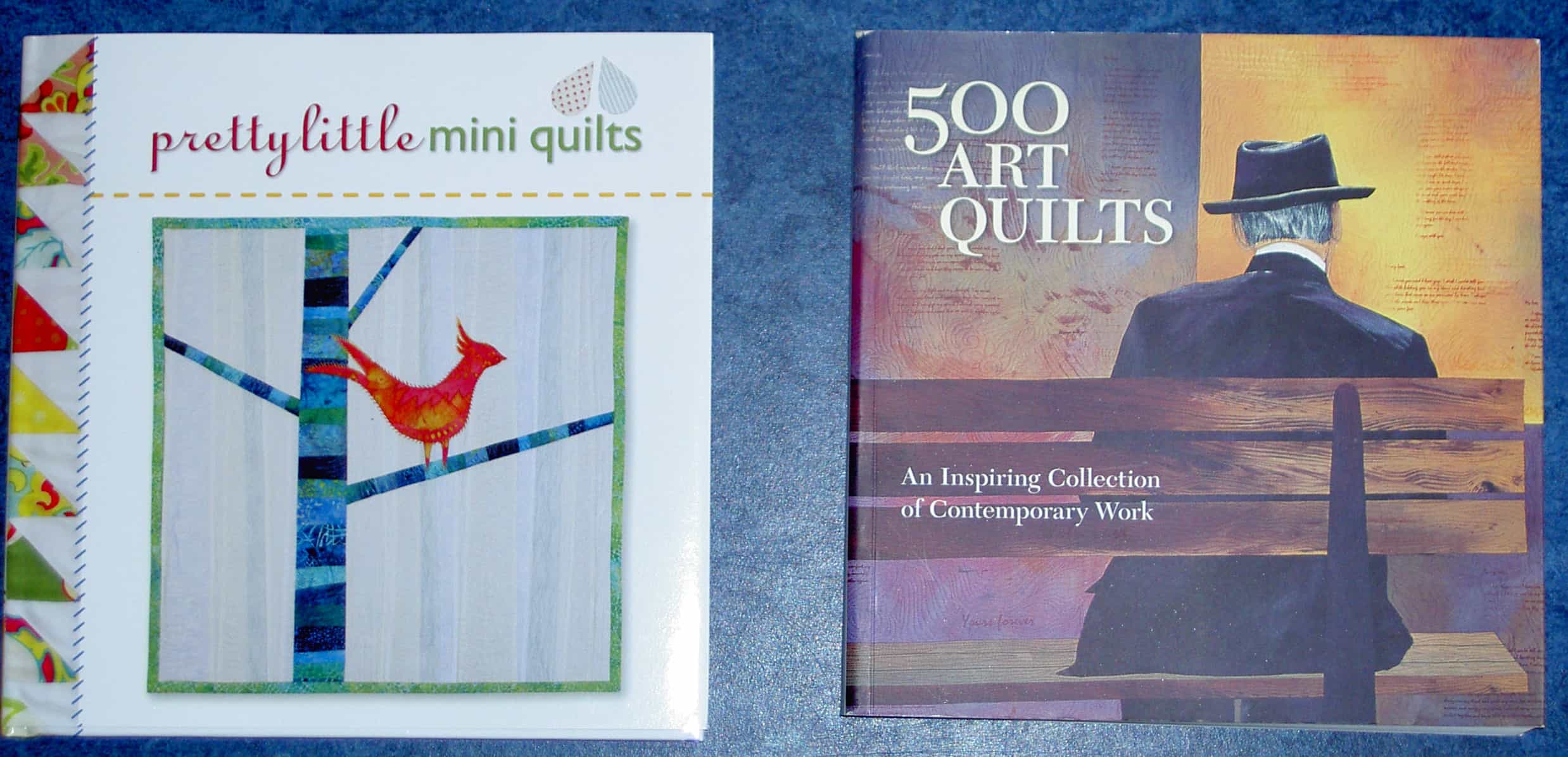
Book Review: 500 Art Quilts

500 Art Quilts 500 Art Quilts by Ray Hemachandra

My rating: 4 of 5 stars
Thanks to Lark Books for sending me this book to review. I love getting cool books for free. And this is a really cool book. It is part of Lark Books’ 500 Series, which they appear to have been working on for about 6 years. Taking a quick look a their webpage, it looks like this series would be wonderful if you are stumped for inspiration. They have a variety of titles in this series covering different types of art. Included are glass beads, rings, wooden boxes, polymer clay designs and beaded objects. The only one I have seen is the 500 Art Quilts book.

First off: NO patterns. I have nothing against patterns. They definitely serve their purpose, but I don’t need patterns and basic directions on how to make a quilt in every quilt book published. This book is pure inspiration. There is page after page of contemporary quilt eye candy, which, in certain circumstances, is just what the doctor ordered.

I was nervous that the book would be filled with the same old quilts that are always shown when books and articles are written about art quilts. There were one or two I had seen before, and a few quilts from the 1990s, but for the most part included were quilts that were new to me. I was also pleased to see that the quilts were relatively recent. I was also pleased to see that some new names had their quilts included.

Second, Karey Bresenhan was the juror. Whatever you think about her style, the woman has seen a few quilts in her day and knows good quilts. She has taken the opportunity to select a wide variety of contemporary quilts. There is something for every quiltmaker’s taste in this book. If you like contemporary quilts that jump off from classic patterns, take a look at Kathy York’s piece, Little Cities (pg.15) or Carol Taylor’s Dispersion on pg.366. If you like thread painting, one of the best pieces I have ever seen is Nancy Murty’s Greens for Dinner (pg. 351). For applique’ Kathy Nida’s Lost (pg.217) and Nancy S. Brown’s The Usual Suspects (pg.329) are excellent examples. There are also photo realistic quilts, dispersed dye quilts and everything in between.

Additionally, Bresenhan is a talented writer. Her introduction is wonderful. There is a lot of history, opinion and experience in the two pages allotted to this section. She puts to rest the art vs. craft debate very skillfully, easily links quiltmaking to the broader concepts of art that many trained artists learn in school and made me not want to wait to finish reading because I was so excited about the quilts. It is well written, interesting ans well worth the time to read it.

When I first started to look at this book, I began categorizing the quilt by “like” and “do not like”. Then I stopped, started over and began looking at the quilts purely for inspiration. Every quilt, with a few exceptions, have something I found to inspire me or gave me something to think about. I don’t mean that the quilts sent me a literal message. I was able to look at each page and find something I could look at and wonder how the artist accomplished that particular element. This is definitely a book where a website of further information on each quilt would be welcome.

Third, Lark includes an index of quiltmakers with their city and the page(s) on which their quilts are shown. I love indexes and this makes it much easier to see which artists were included and which ones have more than one quilt. I love seeing names I recognize and there are several acquaintances and one or two friends in the lists of artists. This index would have been improved by include each artists’ blog or website, but I understand the space constraints as well.

Fourth, having so many quilts gives the reader a wide variety from which to be inspired. Some of the quiltmakers have more than one piece in the book. Yvonne Porcella’s Paris View, Lou & Who, Two & Two jumped out at me, because it is so different that the style with which I normally associate her work: the bright colors and black and white checkerboards. The reader can flip between the above and her Dick and Jane (pg.61) to see her evolution as a quiltmaker. There are enough quilts in the book to see progress in people’s work without one person dominating the book.

Fifth, the detail shots the authors have included are well placed and thoughtfully selected. Philippa Naylor’s piece, Star Sign (pg.60) shows a detail of her quilting. The detail is so good, albeit small, that the reader can see the evenness of her stitching, the way she fills in areas and the color changes.

One of the oldest quilts I saw in the book was from 1995. It is Natasha Kempers-Cullen’s piece, Heart of Lightness (pg.43). The quilts are not chronological and, though, I specifically tried to find the oldest pieces so I could try to judge how many times I may have seen the quilts in the book, I don’t know that this piece is the oldest. My impression: most of them I had not seen. A few I have seen once.

While I am a visual person, I am often drawn to the text about a quilt. As a result, I often forget to look at the quilt. Initially I struggled with wanting to know more about the artists’ thoughts on the quilt. Finally, I reminded myself that these quilts are probably on the web somewhere and if I really wanted to find out more, I probably could. Bresenhan speaks to this when she says in her introduction “The goal with this type of work is to remove all distractions, so that the energy and spirit of the art can speak clearly to the viewer.” If she thought about this when selecting the quilts, then I feel I should just look at each page and let the pieces speak to me without interference from words.

There is a strong visual context in the quilts selected. That may sound strange, but since the pieces are reproduced in a book, pieces where the medium or a certain technique are preeminent would not be successful. These types of pieces seemed to be left for a different book or another method of presentation. The one piece in this genre that was included was Hooked on Caffeine by Penelope E. Mace. I love the shape of the fish. I couldn’t figure out why it looked so dirty until I read the materials and techniques list and saw that it was made from coffee filters. I have no doubt that this piece would have much more of an impact in person.

I was also glad to see that the authors did not feel obligated to include some prominent quiltmakers just because of their names. In addition to my own work, I enjoy seeing as much of other quiltmakers’ work as possible. There are tons of quiltmakers in this book whose work is new to me. What a pleasure to be exposed new pieces! Works from renowned quiltmakers were also included, but, again, they did not dominate the book. I was glad to see two of Susan Shie’s tarot deck quilts, one of Jane Sassaman’s pieces and a piece by Judy Coates Perez.

There is a lot of wonderful colorwork shown in this book, such as Faye Timmerman-Traudt’s Desert Blooms and Jan Elliott’s Shot in the Dark.

By now I have glanced through this book at least 10 times. Twice I went through it page by page and consciously looked at each image. Each time, I was able to find something new to look at. I am sure that I will have the same experience next time I look through it.

I think this book is well worth having in your library. I am really glad Lark sent it to me, because I would not have been able to buy it right away otherwise. I hope you will rush out and buy this book and encourage Lark to put together volume 2 in a few years!

Highly recommended!

View all my reviews , including non quilt book reviews

Too Many Books?!?

Must Read Books - March 2010These are the books that I MUST finish reading soon. Four of them (top 3 and bottom middle) are due back at the library. In fact, by the time you read this I will have already taken back the Design It Yourself Clothes book. I like the tone of the first part of this book even though I haven’t done anything about the actual making of clothes. I may buy this book so I can work through at my own pace.

Fortunately, I did write the review for Pretty Little Mini Quilts. that was on my mind since Lark Books sent me the book for free. Did you read it? I found the review hard to write. It is different writing reviews when I  get the books free from a publisher than when I get them out of the Library.

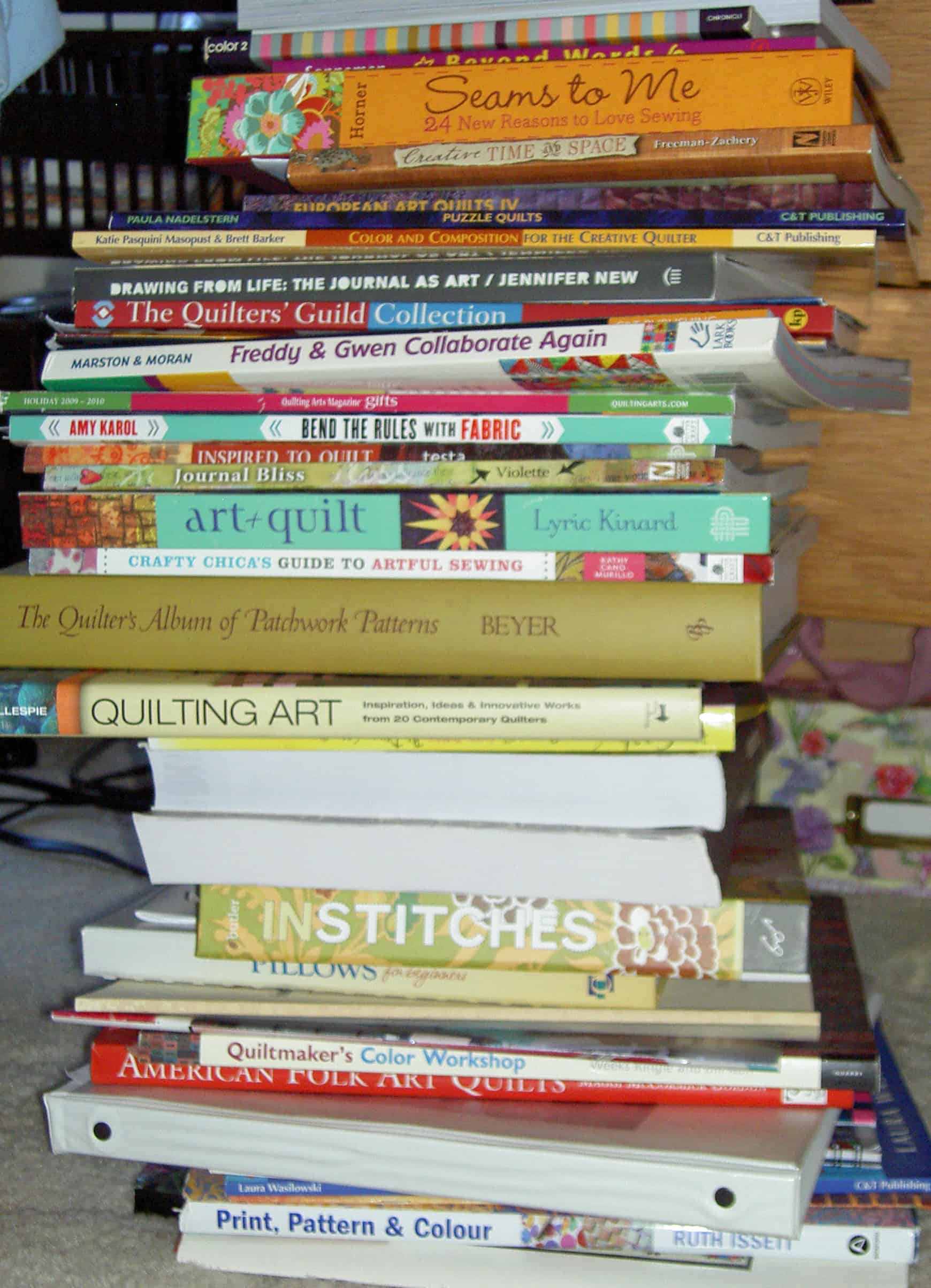
Leaning Tower of Book Pisa - March 2010Yes, this is the Leaning Tower of Book Pisa, as I like to call it. The Leaning Tower of Book Pisa books not only need to be shelved, but they also need to be cataloged and read. I have officially over reached my current shelf space for any kind of books. This pile makes me anxious. I want it to be neatly shelved, cataloged and have every book easy to find. I very rarely buy non-quilt books. My rule is that I have to get it from the Library and think I will read it again before I buy a copy of my own. I am only allowed to buy non-quilt books if it is hard to get from the Library.

Quilt books are a different story. I used to buy all the quilt books that came out, but there are simply too many now. Also, many of them are just pattern books and I have plenty of patterns. This past year or so, however, has been a great time for quilt books. I like to buy quilt books, because I make notes on the patterns or in the margins. I make notes about what I like or I underline (in pencil, don’t worry) bits that I want to come back and review again. I have only been, pretty much, putting quilt books on my wish list this year. As I mentioned, I have been fortunate in the past year to have received almost all of these books as gifts.

I still try to borrow them from the Library first to make sure I like the book. My local Library doesn’t have many fiber books, but it is in a network and one of the sister libraries has a lot of the titles I want. If I can’t find a quilt or fiber book in my library system, I go to The City system and can usually find it there.

I want to read all of the books in the Leaning Tower of Book Pisa. I am currently reading Design Explorations for the Creative Quilter by Katie Pasquini-Masopust. I read about a chapter of it a week. It is short, but is still taking me awhile to get through it, probably because, also, I am reading 3 other books at the same time. I am almost finished and will put up a review soon.

Book Review: Pretty Little Mini Quilts

Pretty Little Mini Quilts (Pretty Little Series) Pretty Little Mini Quilts by Ray Hemachandra

My rating: 3 of 5 stars
This book was sent to me for free by Lark Books unsolicited. I was pretty excited to receive it! It is part of the Pretty Little Series, which also includes another book about pillows. The ‘mini’ part of the title is defined, in the Introduction, as projects that are less than 36″ square. This size is appealing to people with small spaces to display their works and those that want to try a lot of different techniques.

This is obviously an inspiration book. The colors, shapes in the projects, and design of the book all make my mind swirl. The book has a high level of eye candy from the beginning. The photography is very well done. The layout and graphics were noticeable right away. What drew me in, immediately, was the hexagon piece, called Spanish Flowers (directions on pg.102-105) on the inside front flap. The colors are really vibrant and the piece has an interesting shape. It is different from the other hexagon pieces I have seen. Another element I really liked were the different colors on the page edges. The color for each chapter is different, adding interest and giving the reader an additional visual cue as to where they are in the book. The images of spools and stacks of fabric seen before page 7 are appealing as well.

This is another project book which tries to go it alone. It devotes the first quarter of the book to basics including information about different types of fabric and tools, what a fat quarter is and how to make a quilt. For the size of the section, it is a relatively comprehensive section. The paragraphs on tools are entertaining. For example, under the section entitled needle threader, “Folks with perfect eyesight and rock-steady hands can skip this tool. Otherwise, save yourself some frustration by using a needle threader.” The section continues and I like the tone. It isn’t dull and a bit Mark Lipinski-esque. I wonder if that is a new style of writing?

I didn’t like the references to “…thoughts of a quilting bee near that little house on the prairie” or “Unless you’re stitching up petticoats, nothing you’re sewing has stronger ties to the past than quilts” in the Introduction. Once I read the second paragraph I got joke, but the first couple of sentences put me off. I think clothes were probably made before quilts and I prefer not to read assumptions like the above without references to the source. This isn’t a historical tome, so I shouldn’t demand it, but such statements can perpetuate untruths and questionable “facts” and there are enough of those going around the quilting world.

I do think this book is one that can open the minds of readers to the possibilities of quiltmaking. the different stitching, both hand and machine as well as the colors and variety of techniques all show that quiltmaking is not boring. The book does show a 9patch (pg.45-47), but it also introduces the idea of scanning a photo and turning it into a quilt (pg.77-79). I am not that interested in photo realistic quilts, but I do think the photo of the “Portrait of Velma” piece shows a quilt that is pretty well done.

I really wish that major publishers would each write a basic sewing/quiltmaking book and refer back to it rather than recounting the same basic quiltmaking information over and over in every book they write. The idea of a book like this teaching a new sewist to quilt from a list of supplies and 12 steps in a project is crazy as well as potentially frustrating. I know little to nothing about the costs of producing a book, but I do know that publishers are under fire and want to appeal to as many readers as possible, which is why they use this kind of tactic. I would keep the layout the same, but refer back to a book with much more detail on how to make a quilt. A direction such as “Quilt the quilt using diagonal lines that run through all the large white squares and diagonal lines that run through all the checked squares” seems so easy. After all, whole books are written about machine quilting, such as those by Diane Gaudynski, Harriet Hargrave and Sue Nickels. The beginning section, as noted above, does have more information about the mechanics of quiltmaking, which are a big help. I think it would be a service to add a comprehenisve beginning quiltmaking book to a publisher’s line that they could keep in print over a long period of time and revise as needed. Such a book would also have an appeal to new quiltmakers over time.

There are a number of appealing projects in the book. My favorite is the Corner Store pattern (pg.51-53). This is the first pattern, which I noticed, that acknowledged that there is a quiltmaking community outside of this book. The designer refers the method of piecing as Gwen Marston‘s ‘liberated piecing’ technique. I think the book would have benefited from other references to the quiltmaking community. I like this project because of the red background. I also like the line drawing that was included to show what the designer meant about adding triangles to a squares. I have a lot of triangles which work for this project from cutting the FOTY 2010 diamonds and seeing that line drawing inspired me.

I liked the ‘Have a Cup’ project as well. The style of it gets ideas related to my various House and Garden quilts flowing. One thing I would have liked to see, in this quilt in particular, is a couple of versions of the quilt made in different colorways. My mom and I had a discussion about several of the projects and the discussion centered around the colors. I kept reminding her that she didn’t have to make the project in those colors, while she insisted that colors drew her in or repelled her. Again, I know the cost of the book is a factor, but that would have been a nice addition.

“Give me a Hand” (pg.114-117) is a good reminder that we can make our own patterns and redwork is especially conducive to family type quilts.

One project “Star & Cross” (pg.126-129) includes paper piecing, which is interesting. This book really tries hard to give the reader a full quiltmaking experience.

The other inspirational part of this book is the “about the designers” section. There are two pages worth of designers in this book and the editors have included a brief bio as well as links to their websites or blog. Really nice to be able to look up more of their work. I have heard of a number of the designers and am actually Internet acquaintances with two of them.

I was sorry to see that I would need to take the book to a copy store and enlarge the patterns. I prefer to have full sized patterns in a pocket in the back or download them from the publisher website.

The book also gets high marks for including an index and a comprehensive table of contents.

All in all I like this book for its inspirational qualities. I think it has the potential to help quiltmakers think outside the box.

View all my reviews, including non-quilt book reviews

LUCKY GIRL!!!!

OH  MY GOODNESS! You would not believe what happened to me on Friday morning. I was sitting at my DH’s computer (my laptop is dead), watching a Quilt Out Loud episode (Yes, I did find my login and password) and avoiding preparing the taxes.

The doorbell rang and I thought “who the heck is at our door midmorning?” People don’t generally come to visit us unexpectedly. Most of the people who come to visit just walk in while shouting “Haaaalllooooo!” The other group that routinely knocks are The Child’s friends. Kids are all in school (or should be!) at the time, so I knew it had to be a door-to-door sales person or a delivery. I couldn’t remember ordering anything and we don’t encourage people to send us things unsolicited to our house. I am not big on surprises, in general.

My best guess: door-to-door sales person. I hunkered down by the computer not wanting to be the one who gave the bad news that we wouldn’t be buying the new latest and greatest home security alarm system-vacuum cleaner combo today. Without me even saying anything or the doorbell ringing a second time DH ran down the stairs, and opened the door. I heard a brief chat with the person and the door close.

Hhhmm.  I was almost home free. Next I heard steps coming toward the laundry room (where the boy computers live). Uh-oh.

It was a package. A relatively large bulky package. My darling sister has been sending us weird things that she thinks we need (Waterpik showerhead last week) so whether she had sent us something was his first question. I looked at the label and it was addressed to me at Artquiltmaker Blog and was from someone I didn’t know.

Huh? I don’t really make a business of my blog at the moment, except for the Amazon thing (which is slow so far), so I handed it back to DH who  proceeded to open the package. He is good that way. He was pretty excited. I was excited, too, but more cautious than excited. I work in an environment where getting something for ‘free’ means that you are usually giving something (often large sums of money) away.

Out popped two books and a very nice letter from Ray Hemachandra of Lark Books. Yes, THE LARK BOOKS!!!! The  Publisher lark Books!!!! A Publisher sent ME something to my little corner of the country.

Two New Books
Two New Books

As the above was happening, which took a few minutes at most, I felt confused. I did not order books from Lark Books (remember I hadn’t read the letter yet) and one of them was probably one I wouldn’t order without getting it from the Library first. The art quilt book has been showing up in my Amazon recommendations, but I hadn’t really tried to find it at the library yet so I could take a look. I thought it might be a repeat of the same old art quilts and it wasn’t a high priority….blah blah blah.

WRONG!

WRONG!

WRONG!

Part of the letter says:

I am pleased to submit for your consideration two fantastic Lark Crafts quilt titles…”

and

I hope you enjoy the books. Please contact me if you any questions at all. I’d also appreciate being sent notification of any blog or website posting, a copy of your publication or a tear sheet (no idea what that is), if you choose to review any of the books…

I will do full reviews (of course, I will! They sent me FREE books! Why wouldn’t I??? I want to encourage more of the same), but first impressions are:

Pretty Little Quilts: great colors, different sorts of designs, interesting shapes, embellishment. I have to read the intro to see what the intent of this title is, but first glances tell me that Lark was thinking of smart quiltmakers. Yes, there are patterns, but again they don’t seem to be the same old pattern thing. There is beading included, hexagons with holes in the design, different types of thread work, etc.

500 Art Quilts: AWESOME format! No patterns. When I saw it on Amazon, I thought it would include  some more views of the seminal art quilts that I have seen over and over in other books such as Masters: Art Quilts: Major Works by Leading Artists or the book, The Art Quilt, by Robert Shaw. Nope. Wrong again. The quilts pictured look like quilts I haven’t seen before. There are some Name Quilters in it, but showing recent work. I also saw a lot of names I didn’t recognize and even a quilt from 2008. Again, I will do a more formal review soon-ish, but I am looking forward to getting more in depth with these books.

I know there has been much more squealing, yelling and excitement in this post than normal. It is so great to get a good surprise like this!

THANKS, LARK BOOKS!!!!

Book Review: An Artist’s Book of Inspiration: A Collection of Thoughts on Art, Artists, Creativity

An Artist's Book of Inspiration: A Collection of Thoughts on Art, Artists, Creativity An Artist’s Book of Inspiration: A Collection of Thoughts on Art, Artists, Creativity by Astrid Fitzgerald

My rating: 3 of 5 stars
This work is mostly quotations organized into themes. Each chapter has a different theme and the quotes fit into the theme.

The thing that struck me with this book was the preface. Often, not always, but often, I skip the preface just to get straight to the text. In this case, I only glanced through the text and really studied the preface.

I liked the preface because some of the quotes (below) made me think and question what I am seeing:

“Art constantly seeks to redefine itself, to find new and original modes of expression. But have we sometimes sacrificed meaning and essence on the altar of the innovative, the outrageous, and the politically correct?” p.xii

This part of the passage makes me wonder about the symbolism that we don’t understand anymore and whether it is valuable to know it still? For example, in years past, a portrait of a woman may have her holding a flower. Knowing the symbolism or meaning of that flower would give the viewer additional insight into the subject. As well, the items selected for still lives – e.g. the types of fruit – said something about the person who commissioned the work. Have we lost something by not knowing these meanings?

“We live in a postmodern era devoid of artistic standards. The movements of the last thirty years have successfully demystified art and the making of art. The role of art has not been clearly defined in recent times, and artists and students of art rarely gather to examine and discuss the call to creative work.” p.xii

As you can probably tell from my blog, I am glad that the making of art has been demystified and that everyone can make art now. I do worry about what we have lost, however, if anything. I also wonder about what is lost from people not gathering to discuss their calling to creative work? Do we discuss that in our blogs? Is it different from discussing in person? I think I am called to creative work by family tradition and by the need to do something completely different than my day job. I also think that I am called to my work because I can see patterns in improvement and progress, which is not always clear, or acknowledged, in my day job work.

“The art of our time seems to be self-destructive, broadening the gap between audience and the creative output. The eye of the artist has turned to the exterior, to the biennials and the market place, seeing direction, and thus we have art that moves further and further away from our inner nature. As a result, we have art that is based on concept instead of idea and inspiration, art that ends up comment on itself or upon the absence of values.” p.xiii

I find this part thought provoking as well. It makes me want to take another art history course and learn more about contemporary art. I know many contemporary works by their images (Wayne Thiebaud, for example) and not by meaning. A splatter piece of Jackson Pollack’s resides in my mind, but I don’t know the meaning behind it and whether it can be considered self-destructive. I do go to museums on a regular basis and often don’t understand the contemporary works just by looking at them. My impression is that a lot of contemporary work requires study.

This passage also provokes questions. “is art moving away from artists’ inner nature as more artists come on the scene and try to sell their work?” Does some external force (galleries, critics, Marketplaces like Etsy) encourage artists to move away from what they want to make towards what artists think they should make?

View all my reviews

Book Review: Ruth B. McDowell Design Workshop

Ruth B. McDowell's Design Workshop: Turn Your Inspiration into an Artfully Pieced Quilt Ruth B. McDowell’s Design Workshop: Turn Your Inspiration into an Artfully Pieced Quilt by Ruth B. McDowell

My rating: 3 of 5 stars
I love Ruth McDowell‘s books and have most of the books she has written. My favorites are Piecing:Expanding the Basics and Art & Inspiration: Ruth B. McDowell.

McDowell’s information is always good. I have to say that, initially, I was disappointed in this book. It seemed to be, mostly, a rehash of the Piecing book, which is one of my bibles, so I know it very well.

After sticking with the book (rather than abandoning it) I found a few good sections. Around page 50, McDowell discusses thinking through a different way of piecing her Muir Woods quilt, which she had done a couple of times before. I really like it when quiltmakers discuss their process and I am also pleased to see that McDowell is working in a series.

One section is about using fabric. Ruth McDowell has a lot of little gems about, which could be considered good ideas and rules to live by, including using and choosing fabric. This section has some commonalities with Lorraine Torrence‘s advice to “make visual decisions visually.” I think this is an interesting section because McDowell gives insight, again, into her process.

McDowell makes a comment [on page 61] that making a quilt is not taking a photo. YAY!! Finally, an author has the guts to come out and just say it. She follows that up with more advice on using fabric in landscapes.

I particularly like the “Flamingo Demonstration”. She really makes a good point about how foreground pieces can blend in to the background if you don’t take care to separate the foreground (in this case flamingos) pieces from the background pieces. McDowell says “regardless of your intentions you must be honest with yourself about what you really see.” It is a reminder to me that if I think “oh, this choice will be ok”, it means that I have been lazy and it will probably NOT be ok.

Ruth McDowell has an excellent discussion of background fabrics and creating backgrounds, especially creating light backgrounds. She talks about including what different scales and motifs adds to and takes away from a background.

Another thought about backgrounds that Ms. McDowell discusses is about balancing colors in the overall quilt. The backgrounds can be unrealistic if the fabrics are the right colors. She says that it is more important to balance the colors in a quilt than make a realistic quilt.

Ruth McDowell is a thoughtful quiltmaker. She really thinks about all aspects of the quilt and their design. After thoroughly discussing the foreground and background, the main portion of the quilt, McDowell launches into an excellent discussion of borders. You might think that borders are easy – just slap on a long piece of fabric and you are done, but McDowell shows how borders can add to the entire piece. She shows what a border is and how the border are part of the piece.

I really like the buffalo quilt on page 82. I am not a big fan of buffalo, necessarily, but I like and respect the way Ruth McDowell completes the composition by using a non-border border. The border in this quilt is so subtle that you don’t even know it is a border. She skillfully integrates the border into the overall composition. I love the fact that the quilt has a border, but it doesn’t scream border at me.

The book has the obligatory section on quilting, batting and binding. Fortunately, Ruth McDowell doesn’t try to teach people how to quilt, choose batting and bind in 3 pages or less. She makes this section her own by telling the reader what she does rather than trying to teach everything there was to know about quilting, binding, and batting.

I was also pleased to see a disclaimer saying that the fabrics may not be available.

Finally, this book has an index. Indexes are fabulous in any book with sections to which you might want to refer later.

View all my reviews

Book Review: Taking Flight by Kelly Rae Roberts

Taking Flight: Inspiration And Techniques To Give Your Creative Spirit Wings by Kelly Rae Roberts

My rating: 4 of 5 stars
When I first started reading this book, I immediately noticed the tone: kind, positive, inspirational and soft. Not disgustingly so, but in a way that made me really feel inspired.

My overall feeling of this book was it was a book that would be useful regardless of what the reader makes. This book is about having confidence, being inspired, getting rid of roadblocks and trying new things.

The format of the book incorporates the patterns/projects into the chapters, so they don’t seem slapped on because publishers think that “everyone must have projects if they are going to buy a book”. I didn’t try any of the projects as I cannot craft late at night in bed (too messy) and I didn’t have most of the supplies needed (too cheap). Still, I though the projects were interesting and would make good exercises for a class.

Kelly Rae Roberts has also peppered the book with interviews with other artists, such as Judy Wise, Mati Rose, and Christine Mason Miller. This feature  brings some liveliness and interest to the book.

Ms. Roberts was interviewed on the Notes from the Voodoo Lounge podcast, 17 November 2009. The podcast is a great companion to this book as it gives just a bit more insight into KRR.

The only thing I didn’t like about this book was size of the font. There is a lot of information crammed into this 128 page book, but you might go blind trying to read it.

I think this is a book that I would like to put on my wish list as I think it would be good to dip into on occasion.

View all my reviews , including my non quilt reviews

Book Review: Seams to Me

Seams to Me: 24 New Reasons to Love Sewing Seams to Me: 24 New Reasons to Love Sewing by Anna Maria Horner

I received this book as a 2009 birthday gift from wonderful friend. Today, I listened to Jennifer Ackerman-Haywood’s podcast interview with Anna Maria Horner again, which made me think about my review. I came to see what had when I first looked at the book. Shock! Horror! I didn’t write a review, nor did I even put it on my list. Shame! I have no idea what I was thinking. The first thing I like about this book is the pre-Table of contents. It is arranged in a very visual and 9 patchy way. It tells you what to expect and what the book contains. The layout alternates words with pictures, which keeps the reader’s eye moving around the page while giving some spots to rest as well. The next thing I like about the book, which Jennifer mentions in her interview also, is the nice tone Ms. Horner uses in the introduction. I found that the tone continues throughout the book, ebbing and flowing in different ways to achieve different points. When all of that glamor is said and done, this is a book that gets people started sewing. Horner goes through all different considerations from where to sew, what sewing machine to use, considerations when buying a sewing machine to notions, gadgets, tools, color and my personal favorite, fabric! While a lot of this section was not new to me, it was well laid out and clear. Anna Maria has some brief definitions about what different needles are for and also a needle size chart with fabric examples. The color wheel is fabulous and like no other I can remember seeing. It is a bunch of squares of fabric arranged like a color wheel. These are not Amish solids, either; they are prints. I am thinking about photocopying this page and hanging it up so I can be inspired. I buy tons of prints, after all, and need some help using them sometimes. This book is entertaining, too. The entertainment starts with the chapter headings, such as “A Place to Perch” and “Let’s Bolt” and continues on to the text with examples like “Tedious Terms” and “Width Wisdom.” Such touches tell me that Anna Maria Horner cared about the details and was confident enough to inject a bit of fun into her writing. Tucked into the section called “Tedious Terms”, the author has included a helpful conversion chart for yardage. You could copy it (again for personal use only!) and keep in in your handbag when you go fabric shopping so you know that when you ask for an 1/8 of a yard you are getting a piece of fabric 4.5″ wide. There are lots and lots of pieces of helpful information that make this a book that I will keep on the shelf very close to my machine so I can refer to it frequently when I want to clip curves, put in a zipper, make a french seam, stitch some piping, gather cafe curtains or make a decorative edging on a garment. As a result, there were quite a few things that I learned. The basic information was so beautifully laid out and written in a way that kept me interested so I was shocked to find that I had finished that section and was on to the projects. I am not much for buying project oriented books, but some of these projects intrigued me. One of the first was called “Cozy Cubes”. They are in the organizing section and I can see where these would be fun, beautiful and useful. I also want to make the Wall pockets, the “I’ll have one of Everything” bag, and am attracted by the “Playing Along” quilt. I also think the “Full Contact Cooking Apron” is fun and useful, though I suspect the fabrics make the piece. Some projects I would probably never make, though I hesitate to say never, because saying never guarantees I will end up making it! I am sure I could learn something from some of these projects as well. I am not excited about the big squares on the “Sideways Skirt,” nor do I find the “Smashing Smock” very smashing or the “Right off the Cuff” cuffs very practical. I might too old to appreciate some of these stylish projects! All in all, I was very pleased that I had gotten this book out again and look forward to working with it a little more.

View all of my reviews, including my non-quilt reviews

Book Review: Pat Sloan Color Book

This is a really short review that I may beef up later. Pat Sloan’s book on color is easy to read, though it will take more time if you go through the exercises.

Pat Sloan's Take the Fear Out of Color (Leisure Arts#4286) Pat Sloan’s Take the Fear Out of Color by Pat Sloan

My rating: 4 of 5 stars
I liked this book, because:
1. she had the same quilt pattern made in different fabrics. This is a great technique, because it is easy to dismiss a pattern when a quiltmaker doesn’t like the fabrics. By showing different fabrics, the reader can overlook one of the colorways that may not appeal.
2. she didn’t talk much about value. It isn’t that I don’t think value is important, but I think that people can get bogged down by value if they are just starting out with color. Pat really gives the reader confidence to make color choices.
3. she didn’t bad mouth other ways of choosing color. All ways are valid and Pat shows her way and doesn’t bill it as anything different.
4. she encouraged the reader to start with colors that s/he likes
5. she uses an inspiration notebook to start.

It is bright and cheerful book as well.

There are projects included which I just used to expand my view of what the author was saying.

View all my reviews, including non-quilt related reviews

Book Review: Knit the Season

Lydia Hirt, of Penguin Group, asked me to read this book and write about it on my blog. I was really flattered even if I am one of the legions offering free labor to write about this book, released today.

Knit the Season: A Friday Night Knitting Club Novel (Friday Night Knitting Club Novels) Knit the Season: A Friday Night Knitting Club Novel by Kate Jacobs

My rating: 4 of 5 stars
Lydia Hirt, of Penguin Group, asked me to read this book and write about it on my blog, Artquiltmaker.com. I was really flattered even if I am one of the legions offering free labor to write about this book, released today.

Kate Jacobs picks up the story of the Friday Night Knitting Club after James and Dakota have worked out some of their messy family issues, such as Dakota switching colleges. Dakota is older and more adult and that makes for a more interesting story line. One line in the book conveys one of the underlying themes of the book quite well, “Convincing everyone she was all grown up led to a hard-won realization: She had to act like an adult. She had to handle new responsibilities.”

The author focuses on Dakota and does a good job showing her trying to juggle school, her business, her dreams for changing and expanding her business, her family and all the things that adults have to do.

I think Jacobs has found her stride with this book. I found Knit Two hard to read, because so much was going on. I think Ms. Jacobs was trying to do get through too much of the story in that book. In Knit the Season, she has relaxed. I also have to thank her for not rehashing the entire previous two books in this book. This book stands on its own and Jacobs had the confidence to write it as such.

I also thought this book didn’t try to give all the characters equal time. Again, Jacobs shows confidence in her writing of this book. She doesn’t exclude Darwin and Lucy, but they receded into the background a bit to give space for Dakota, Gran, Bess and others. I think this was a good choice. Too many storylines can be confusing.

The backstory is also being developed. Jacobs employs a flashback technique to provide context and give Georgia a voice. Flashback writing can be dangerous in the wrong hands, but Kate Jacobs does a GREAT job. She uses restraint and the flashbacks she offers provide insight into the club, into Dakota and the other characters. Learning about the characters’ pasts as well as interactions between the different characters gave added dimension to the book. I also liked the flashbacks, because they gave voice to Georgia again. Georgia was a strong and important character in the Friday Night Knitting Club and she now has a new opportunity to say more.

Jacobs does use sentence fragments in some cases, which I really don’t think worked well. While they got the message across, I would have liked to have seen them punctuated differently. That being said, I was reading an uncorrected proof and those tidbits may have been changed in the version you have in your hands now.

This book has a lot of dialog. I think that it could have used a bit more description. One of the sections I thought needed some extra description was the part where Dakota brought groceries over to Peri’s apartment so she could cook Thanksgiving dinner for Peri. Peri has nothing, NOTHING, in her cupboards, and only root beer and nail polish in her fridge. I would have liked to know more about this phenomenon. Don’t New Yorkers want coffee or tea when they get up in the morning? It didn’t impact the story and I learned to love descriptions reading Rosamunde Pilcher‘s novels, so I may have a skewed view of the writing world in terms of descriptions.

I like books with take-aways. Take-aways are often quotes I can write in my quote book and read later. In one of the flashbacks, Georgia is giving advice to a much younger Dakota, “Don’t give up something you love jut because there’s an obstacle. Find a way to work around it. Be open to something unexpected. Make changes.” This is a great line and I hope it made it into the final version. I think it is one of those quotes that I could put on my wall and be inspired by forever.

Ms. Jacobs tidied up the ends of the story in such a way that if she decides to write another installment, there are enough interesting storylines for her to pick up and weave them in. If she moves on to something else, this book ends in a satisfying manner so the reader, at least this reader, doesn’t feel cheated.

This is a book that I would read again and it made me want to read The Friday Night Knitting Club and Knit Two again.

View all my reviews