ColorPlay: Soup Tureen

My recent trip to Austria was a complete feast for the eyes. Everywhere I looked I wanted to capture the images – the layering, the lines and especially the color.

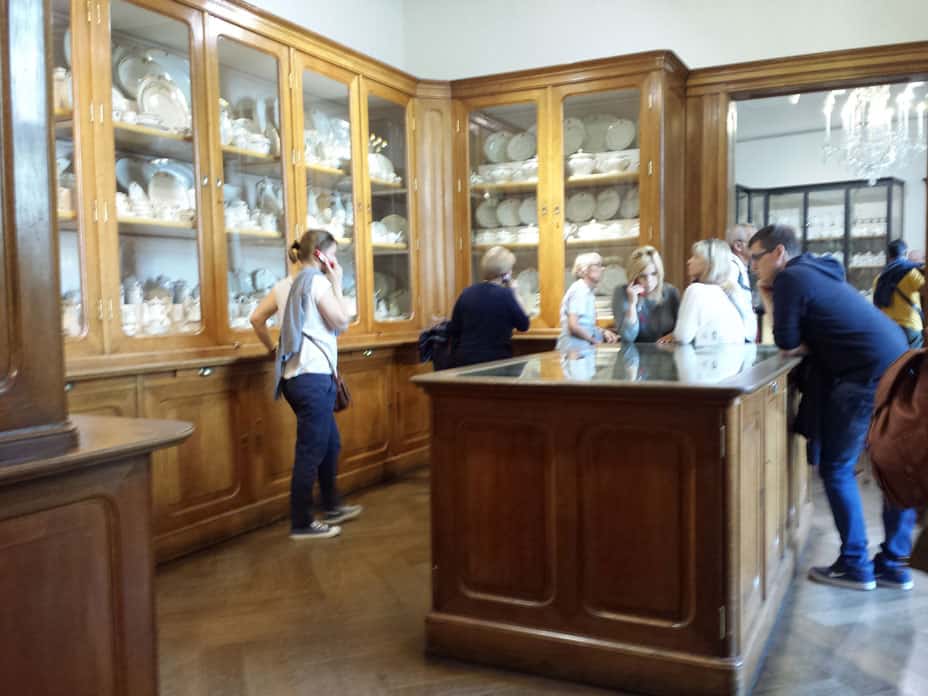
Silberkammer: pantry

It is hard to choose a favorite museum, but right now I am in love with the Silberkammer in Vienna. It is the museum of the Kitchens and Dining of the Hapsburgs. There are dishes, serveware and set tables everywhere. Above shows one of the rooms of the pantries that remain. There were several, but some are now used for other purposes. Ever since I saw the butler’s pantry at my friend Kathy’s childhood home in Upstate New York, I have wanted a pantry. Of course, the one shown above would take up half of the main floor of my house (kitchen, dining room and part of the living). To have somewhere to keep china, crystal and silver would be fantastic.

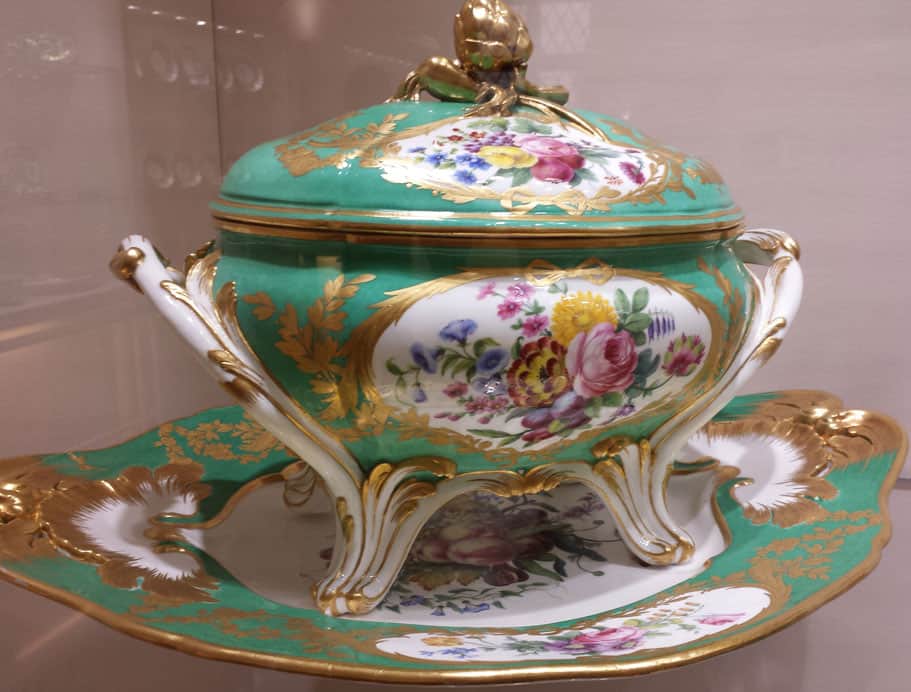
Silberkammer: Soup tureen

One of the sets of china includes a soup tureen decorated with a lovely jade color. I am using it as our color play today.

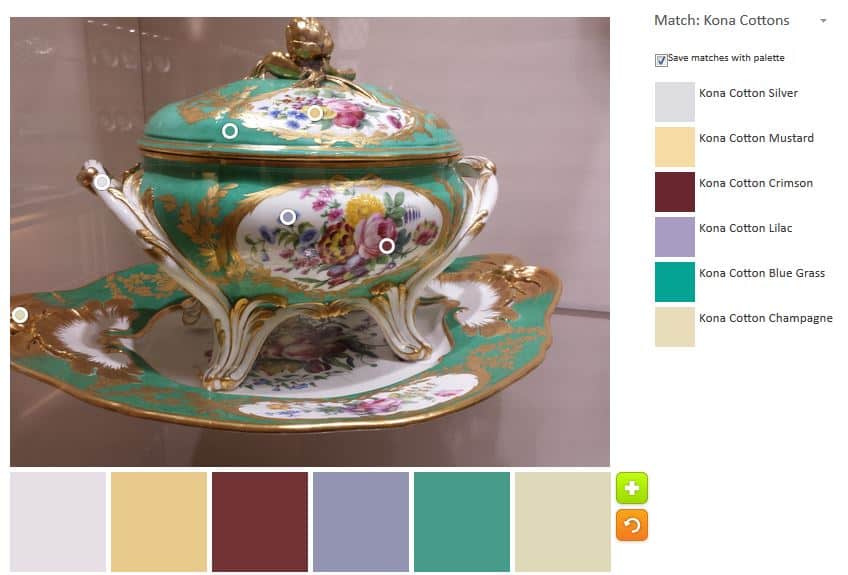
The color scheme the Palette Builder tool originated was all neutrals. That lovely green color was not included. I didn’t even save that palette. I moved all the circles around to come up with something better

Soup Tureen Palette
Soup Tureen Palette

It is interesting that the green is considered Kona Bluegrass. I’ll have to go and look up what color Kona Jade is, if there is such a color.

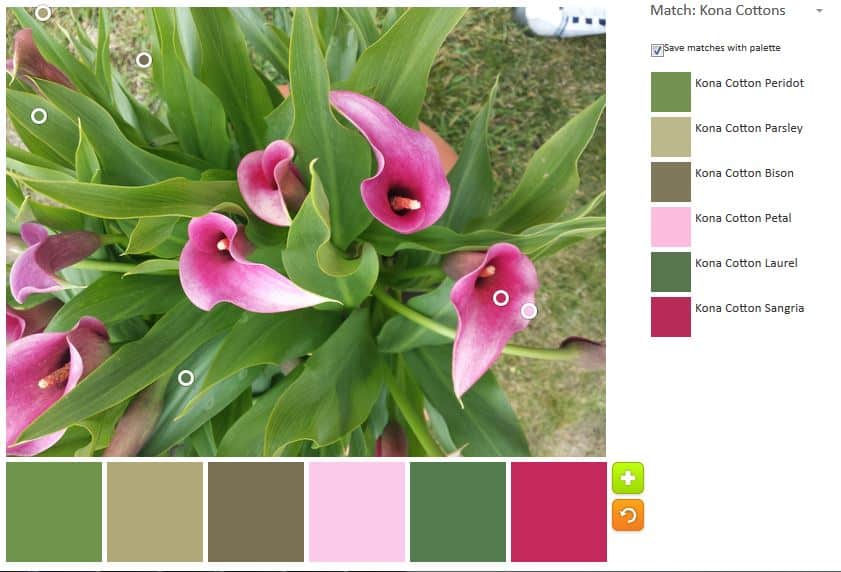
Again the tool had problems with the pinks/fuschias. I moved the little bubble around quite a bit and the Kona Crimson was the only red I could get. I think the angle of the photo had something to do with the results as well.

I would definitely change out some of the colors if I made a quilt with this color palette.

Let me know your thoughts or if you make something from this color palette.

ColorPlay Mountains

Once again, I used the palette builder to…well… build some palettes for you.

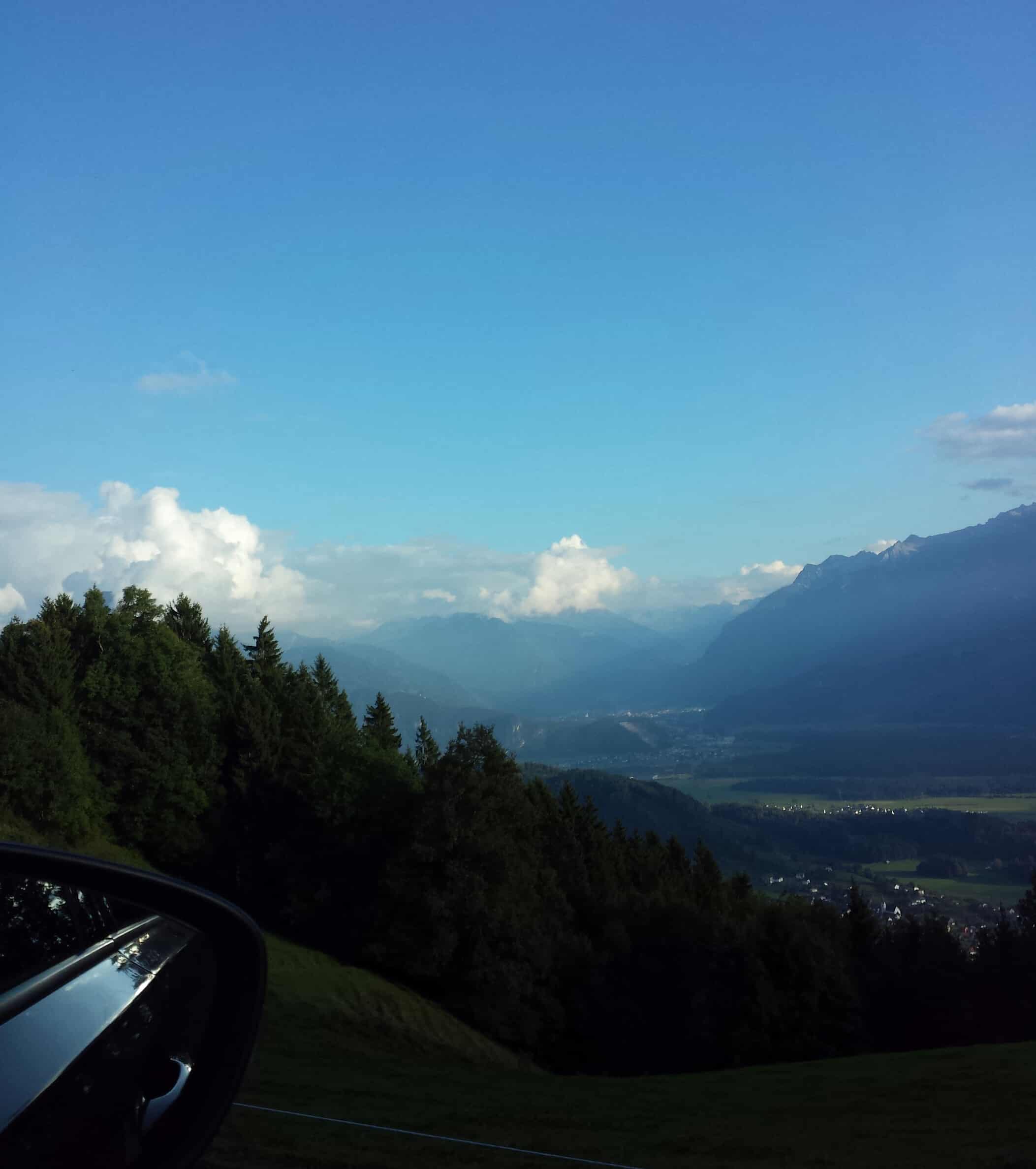
Mountain photo
Mountain photo

The photo is a photo I took from the car window as my friends drove me around GroBes Walser Tal in Vorarlberg, Austria. I chose this picture deliberately because there were a lot of blues and I wanted to see if the Palette Builder could deal with them.

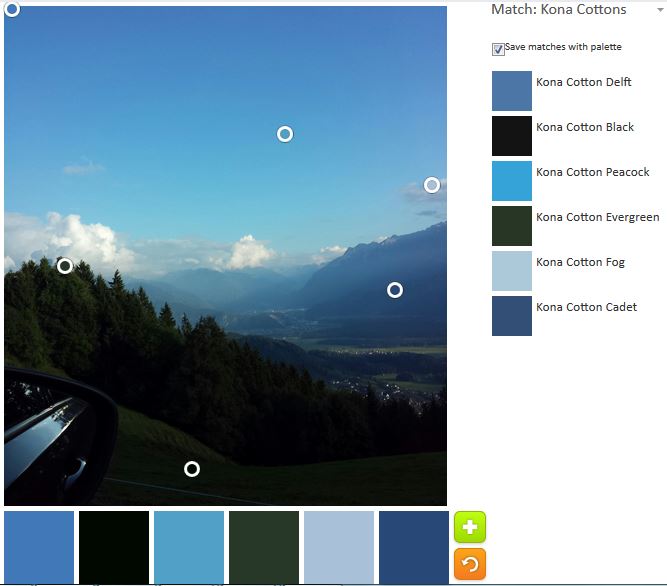
Mountains & Sky
Mountains & Sky

I am pretty pleased with the palette the tool built. I didn’t even move the circles around.

Mountains & Sky 2
Mountains & Sky 2

mtn-palette2I like some of the colors in the second palette, but I am not as excited about it overall. Peacock and Glacier are two of my favorite Kona solid colors. The others are ok.

This is a fun tool, as I have said, and I could make 50 more palettes with this one photo. Go and make a quilt with this palette.

ColorPlay Chocolate

Milka HaselnuB
Milka HaselnuB

Yes, I am going to torture you today. I am not really very sorry. It is helping me to remember my trip.

Milka is a brand of chocolate sold in Austria. Occasionally, I can buy it at World Market, but not regularly. It might be sold elsewhere, but it is not widely available here in the US. When I visit friends in Austria, I indulge.

Yes, chocolate snobs are sticking their noses up, because this bar is made from milk chocolate. I am also a dark chocolate fan, but this milk chocolate is no Hershey’s. It is so creamy and rich that it calms fretful children and makes grown men weep when they eat it.

Now that you are frantically rummaging through your desk drawers looking for chocolate crumbs, let’s get to the ColorPlay. 😉

I took the wrapper and ran it through the Palette Builder tool. If you still haven’t tried it, get some colorful photos and have some fun.

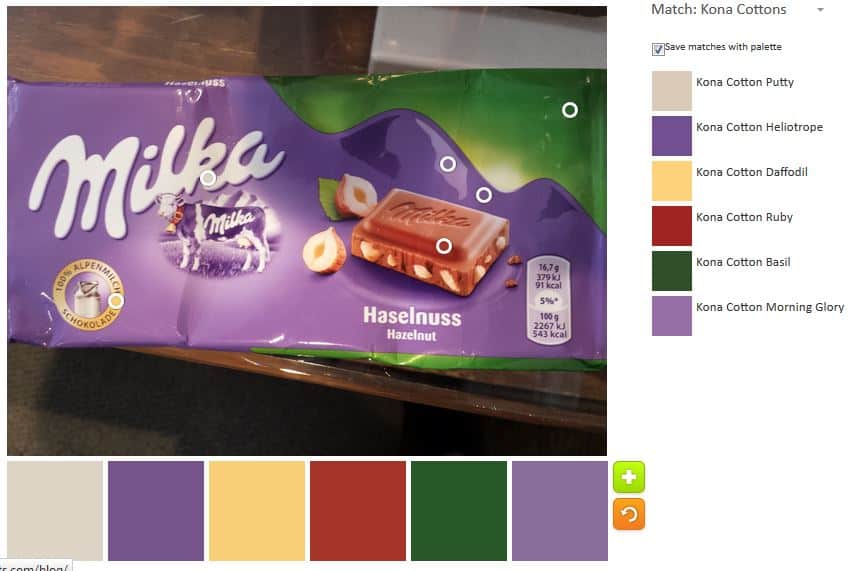
Milka ColorPlay
Milka ColorPlay

I didn’t crop this photo, but when I ran it through the tool, I moved the circles off the background and focused on the wrapper. Yes, I can control the colors to a certain degree, as you know, by moving the little circles around. The palette above is a little heavy with those particular shades of red and green. Thus, I decided to make a new palette and try to make it lighter.

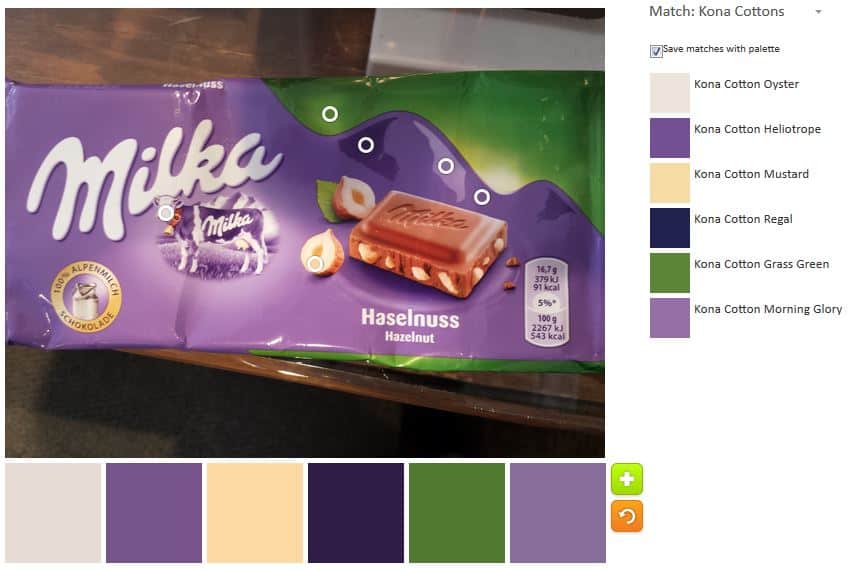
Milka HaselnuB 2
Milka HaselnuB 2

Perhaps the Daffodil and Ruby, in the middle photo above, add to the palette in ways that I cannot imagine without sewing. My favorite, however, is the second palette. Yes, there is a lot of purply tones, but it feels lighter and fresher to me. What do you think?

The whole idea is to give you ideas for palettes for your quilts, so let me know if you create a project with either of these palettes.

Creativity: Value and Worth

“We know that athletes, musicians, and actors all have to practice, rehearse, repeat things until it gets into the body, the ‘muscle memory’, but for some reason, writers and visual artists think they have to be inspired before they make something not suspecting the PHYSICAL ACT of writing or drawing is what brings that inspiration about. Worrying about its worth and value before it exists can keep us immobilized forever. Any story we write or picture we made cannot demonstrate its worth until we write it or draw it. The answer can’t come to us any other way” (Syllabus: Notes from an Accidental Professor, Lynda Barry, pg.163)


Truth? What do you think?

Creative Spark 5: Time

“Forever is composed of nows. Emily Dickinson” (pg.25)

Have you ever driven to work, to the grocery store or to your hair appointment and all the lights were green, there were no idiot drivers and you found a parking spot right in front of your destination? “If I am struggling with anything, I generally feel like I need to find a better way” (pg.25). The first page of this section confirms what I have thought – I know when I am on the right track because everything comes together easily.

When I saw the above quote on the page in the Bloomston book, I couldn’t stop thinking about what it meant. I don’t think it means don’t plan for the future. I do think it means don’t live in the future.

In finding time, it is important to do a little self reflection. Bloomston has some questions to answer, among them “What is your best time of day?” This is impoetant to know and often hard to be real about because of societal pressures and age. College students and young adults are often pressured by their peers to stay up late. Teenagers would rather be in bed at 8am than in the classroom.

I am a morning person. If I can focus, I can get a lot done in the morning. I am at my best then. Depending on the day, I either start out at the gym or with some work and then a walk. I try to get my work and errands done early, especially the “fixed” errands like grocery shopping. As the day moves on my mind starts to drift so I will do errands at about 3 or 4 pm, attend meetings or other random to dos. It kills me not to be able to work on my quiltmaking every morning. I know I would be able to churn out some fantastic work.

I am not in the habit of working on my quiltmaking during the week because I get so engrossed that I forget to work (paying work). Probably, I just make the decision to take the day off and damn the consequences. My boss is pretty lenient, but it makes my paychecks pretty thin. On the weekends I devote as much time as possible to quiltmaking. I have found, however, that late in the day during the week, before my people get home, is a good time to do prep work -not intensive thinking work – but prep work. Recently, I dragged out a bunch of pillowcase fabric and used about an hour to find cuff fabric, cut the body fabric and generally get the body ready to sew. This has helped me to relax after work and get a lot more accomplished on the weekends.

Bloomston writes “…so I had to tune in and not miss the opportunity” (pg.26). I think that the experience of working for 30 minutes-1 hour in the evenings during the week was an example of taking advantage of an opportunity. I took advantage of something that presented itself and it turned into something positive. I also created a process that ended with a big bang of work on the weekends.

“To squeeze the most out of his creative life, he found a way to squeeze it into his life. No doubt, this takes dedication, persistence, and sacrifice. We have to tune into our own lives to locate those precious hours” (pg.27). In order to get better, you have to work – and that applies to everything, including your quiltmaking and artwork. It’s not all about the inspiration, you have to work to get the process and the habit into muscle memory. Working also creates more work. Have you seen my Petrillo Bags? I did not, as you know, create the pattern. I made the first bag as written and I liked it. However, I looked at the bag and thought ‘I wonder what would happen if…’ which is always the best feeling, because it means that I am inspired to make a pattern different or better. Since the first one, I have made two more, each with some changes, hacks or tweaks. As you read recently, I finished the third one. Despite the fact that I have made many, many bag patterns I want to make a fourth Petrillo bag just to make that particular pattern a little more useful for me.  You have to take the time to make progress.

Because there is a finite amount of time in the day and I like my beauty sleep I try to add time to be creative into little pockets of the day. As I wrote the first draft of this blog post, I wrote it my journal with a lime green Sarasa pen. Writing is one aspect of my creatiivty but I try to make it a visual exercise by using a different colored pen every day so my journal is pretty while still being useful.

You need time.

You can find the time if you only look at what is important. Only read your social media while you are standing in line. Make menus and go grocery shopping once a week. You have to become the mistress (or master) of your time. There is only so much. Don’t waste it.

ColorPlay Fun and Inspiration

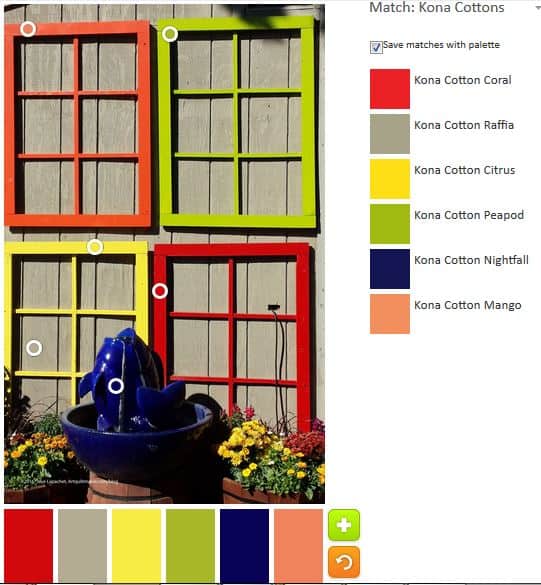
Alden Lane Window Frames

I found another good photo for this project in the Alden Lane photos. To my eye, there are limited colors. To the tool’s way of thinking there were many.

Colorplay-windows
Colorplay-windows

The Palette Builder chose the colors above. There are more warm colors than the tool usually chooses, but I think ‘choose’ is the wrong term. I like the two greens – Kona Peapod and Kona Cactus. If nothing else, I am getting a nice introduction to the Kona solids.

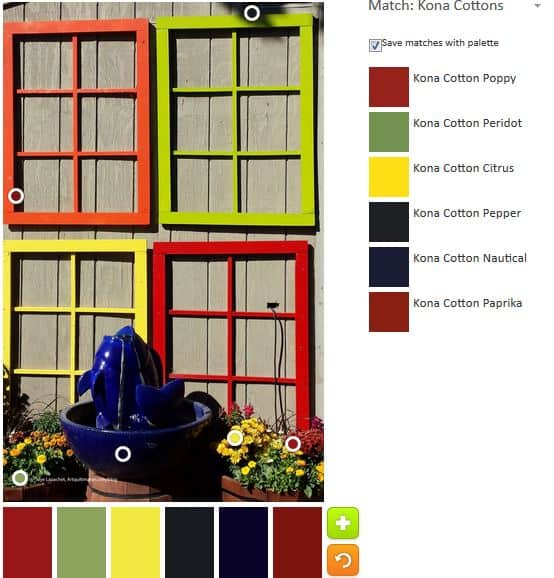
Colorplay-windows 2
Colorplay-windows 2

Of course, I decided to have my fun and play around with what other palettes I could find using this picture. I definitely had to get that dark blue from the fountain into the palette.

Colorplay-windows 3
Colorplay-windows 3

Finally, I moved the circles down to the flowers towards the bottom to see what changes I could make. I was surprised at how much darker the palette became.

Creative Spark: Chapter 4

The fourth chapter in The Creative Spark is called The Crazies. Many writers of creative inspiration write about the negative voices in our heads: the judges, the critics, naysayers, all the people who ever told you you couldn’t. Bloomston calls them The Crazies.

I am not surprised that Bloomston brings them up. They are as much a part of the creative process as paper and fabric. They are in our heads and we all hear them whether we acknowledge them or not. “The Crazies are programmed to trip you up” (pg.21).

I hear them. They often tell me I am not good enough, need to do better, need to do more, need to spend more time, etc. It isn’t always possible, but when they tell me I need to do better, I try to listen by work on improving my skills. I also try not to get depressed. Examples of things I do are:

  • Ripping out pillowcase cuffs when I sewed them on upside down
  • Matching seams better
  • Evening out topstitching
  • etc

Using what they say often involves a lot of ripping. From my vantage point, my work is better when I try harder to do better.

Still, I don’t always like hearing what the critics have to say. They are never nice about my work and it isn’t always possible to be Zen about their words.

I have never wanted to be a full-time artist; I have always wanted to make what I want to make when I want to make it. This attitude gets me off the hook for most of the comments about being irresponsible and dooming myself to a life of “poverty,  lack and struggle ” (pg.21). Still this work, especially since fabric and thread are so firmly  rooted in the female realm, is not valued and that is painful to me. Even not being a full-time artist, I feel I have to explain or justify the time I spend on my work and what I make.

Bloomston has great strategies for banishing the Crazies. Chief among them is writing them down and enclosing the voices somewhere.

Being organized is another one. “Life generally tampers with creativity because being a grownup requires a great deal of organization and management” (pg.22). Being a grownup doesn’t mean you have to give up your creativity or the art you make. It simply means you have choices with regard to your art. Don’t  let The Crazies become the buzzkill, the axman or the murderer of your dreams of art (pg.22), use their criticism to spur you on.

Bloomston also has great techniques for dealing with, if you can’t banish The Crazies: Play, Notice, box Them Up, Show Them the Door (pg.23).

And when you are being overwhelmed with the magnitude of the criticism, turn to your friends, your critique group, your sewing circle, for support.

If you work regularly you will succeed.

Book Review: Syllabus

It isn’t my intention to have very frequent book reviews in this Friday space. I think, however, that this book review feeds directly into my search for continuing creative inspiration. There are a lot of words in this review, but you will get more out of the book review, if you go buy the book (or find it at your local library). Definitely read and comment on my review, but go and get more out of it by looking at the illustrations and other materials in the book, too.

Syllabus: Notes from an Accidental ProfessorSyllabus: Notes from an Accidental Professor by Lynda Barry
My rating: 4 of 5 stars

I heard about this book when I listened to the Creative Mom podcast. This is not normally my kind of book, but I really enjoyed it. I was also very taken with the profound insights into the creative process and the thoughtfulness in nurturing creativity. The book is the product of a curriculum from one of Lynda Barry‘s classes and the content still has those qualities. I liked Barry’s idea of a curriculum: clear standards for the class that had more to do with production than perfect drawing. My favorite thing about this book is that it conveys the message that I was trying to convey with the Creative Prompt Project:

Just draw (or paint or sculpt or dance) and don’t worry if it looks imperfect or childish. Experience the act of making something with your hands/body.

The book looks like a composition notebook, one of those black and white marbled notebooks seen in massive stacks at stores during the back-to-school season. Barry uses very humble materials. They are not low quality, but humble — crayons (pg.87), Flair felt pen, etc. The title page and verso are not very obvious at all, which caught me, as a librarian, off guard. There is no table of contents and no index. The text just starts with the question “Is Creative Concentration Contagious?” There is a method to the seeming madness, however, and the book includes the story about the class Lynda Barry taught.

As I wrote the review, I wanted to go back and read all the pages over again. There is so much to see on the pages, I think it is possible to get something new no matter how many times you look at the pages. One part I cannot get out of my head is something I knew, but could never put into words. I was very glad when Lynda Barry wrote it down for me. “We know that athletes, musicians, and actors all have to practice, rehearse, repeat things until it gets into the body, the ‘muscle memory’, but for some reason, writers and visual artists think they have to be inspired before they make something not suspecting the PHYSICAL ACT of writing or drawing is what brings that inspiration about. Worrying about its worth and value before it exists can keep us immobilized forever. Any story we write or picture we made cannot demonstrate its worth until we write it or draw it. The answer can’t come to us any other way” (pg.163). I love the quote and think I will write it down and put it up where I can see it. It is so important to remember that inspiration is a must, but it is not everything. Practice. Practice. Practice.

There are a lot of slightly scary (I am not a horror person) and disturbing images in this book. A lot of the images are dark. This book is probably not appropriate for 5 year olds, but is perfectly fine for the tween to adult set. Also, it is a good reminder that not all drawings (or quilts or other artworks) are pretty in a conventional sense. This does not diminish other aspects of the piece (pg.29). The encouragement to just be creative regularly is the point.

The book discusses drawing a lot – not theoretical aspects, but the sheer magnitude of work the students are expected to create. Yes, you get better the more you practice, but you also have to have an “experience by hand” (pg.31), which has value. Barry writes “…what if the way kids draw — that kind of line that we call ‘childish’ — what if that is what a lines looks like when someone is having an experience by hand?” (pg.31). When I work, there is definitely something I gain by having fabric in my hands. It may be because my paid work is just stuff appearing on a screen while my quiltmaking is more of a whole body experience.

There is so much that translates directly to quiltmaking. I almost couldn’t take it all in. “I told them to color had in order to do it right. And go straight to use force — thinking I was showing them a short-cut — this took away the way of coloring they would have found on their own. By telling them just how to do it, I took the playing-around away, the gradual figuring out that bring something alive to the activity, makes it worthwhile, and is transferrable [sic] to other activities.” (pg.89) I love this passage. It makes me wonder if there is joy in using quilt patterns? Sure you have a quilt when you finish, but did the making of a design that someone else has already made bring joy to the quiltmaker? Perhaps this is the product vs. process question.

There are random and very interesting facts scattered throughout the book. “Every baby old enough to hold a crayon can already use and understand these 3 languages. Sometimes all at once.” (pg.14). She is talking about the relationship between pictures, music and dancing. This struck me as really amazing. She also talks about the relationship between hands, images and insights referring to using what is at hand to make art. One example is a child in bed interacting with his/her blanket as if it were alive. Another example is a of a homeless man acting out Romeo and Juliet with a cigarette butt and bottle cap as the main characters. (pg.15). This section is too insightful to include quotes. I would have had to type the entire section, which is why you should read this book. 😉

One good reminder (pg.19) is that even though we don’t like a piece of our artwork, it survives. This reminds me of finishing a quilt and being very glad to be done with it. Still, six months later, the quilt is one of my best. It is a good thing to remember that our work survives even if we don’t like it. Barry also states “Liking and not liking can make us blind to what’s there.” (pg.23). I make no secret of not liking brown and having a hard time appreciating Civil War reproduction fabrics. Some years ago, I forced myself to look more carefully at some of these types of quilts in order to appreciate something else about the quilt, such as the piecing and the design. While I have a hard time imagining such quilts in brights and dots, I can appreciate intricate and exact piecing.

The book is filled with tips, many of which dovetail with what I am trying to do with my blog. One states “I know if I can just keep them drawing without thinking about it too much, something quite original will appear…” (pg.21). I think it is very important to keep working, even if you make a lot of terrible work, because at some point, something great will happen that wouldn’t have happened if you hadn’t done so much mediocre or okay work. One tip is to use smaller spaces. Lynda has her students fold 8.5″x11″ sheets of paper into 16 squares and use those for their drawings. Friend Julie is making small square quilts as a weekly exercise. Is this something that would jolt my creativity? Your creativity?

Words in the book described as tips become profound when I think about them. One such group of words is something that I tried to espouse in the Creative Prompt Project. “Daily practice with images both written and drawn is rare once we have lost our baby teeth and begin to think of ourselves as good at some things and bad at other things. It’s not that this isn’t TRUE but the side effects are profound once we abandon a certain activity like drawing because we are bad at it. A certain state of mind (what McGilchrist might call ‘attention’) is also lost. A certain capacity of the mind is shuttered and for most people, it stays that way for life” (pg.115). This quote, idea hits close to home. I know I do it. It is easier to do things I am good at and avoid things I think I am bad at. I don’t do needle-turn applique’ because it is hard and I have to work at it. I want the time I spend to mean something more than ravelly edges on a piece of applique’. Still, what am I losing with this attitude?

One aspect of the ideas in the text that really struck me was about images. Lynda Barry writes “I was trying to understand how images travel between people, how they move through time, and if there was a way to use writing and picture making to figure out more about how images work. (pg.49) This idea has been rumbling around in my head, including the relationship to quiltmaking. We know that newspapers used to print patterns. We know that ladies would trade patterns. Now we have digital cameras and record quilt images that way. Still, we see images and they rumble around in our heads, morph and change before they become a quilt. Even when they become a quilt, changes are still possible.

The other thing about this book is the author encourages us to notice things. The composition book acts as a life note book. She encourages a small box to record things students did, saw, heard and then there is a space for a daily drawing. “what goes into your diary are things that you noticed when you became present — that is to say when the hamster wheel of thoughts and plans and worries stopped long enough for you to notice where you were and what was going on around you — little things…” (pg.61). This happens to me when I walk and am not listening to a book. This book makes me think I should just allow my mind to wander more often. What am I losing by not giving my mind that space?

Partway through the text, Barry writes “sometimes right before class I’ll see students rushing to finish the homework I gave them and I always feel sad. They’ll get nothing from the work without the state of mind that comes with it. It’s a thing Dan Chaon calls ‘Dreaming Awake’ – we can use writing and drawing to get to that state, but not by rushing” (pg.128). I think I get to this state when I am piecing a lot of the same types of pieces. It allows me to accomplish something in the quiltmaking world while my mind wanders off to other places to solve other problems. I don’t think we have enough of this type of time. While I like to have a basic plan in place when I start a quilt, often I just want to try something and that ends up as a quilt, like the Swoon did. I think there was an element of this type of working in the IRR as well. Lynda talks about this when she says “It’s a kind of picturing that is formed by our own activity, one line suggesting the next. We have a general direction but can’t see where we are until we let ourselves take a step, and then another, and then we move on to the third”(pg.136). There is an element of uncertainty when working this way, but also an element of excitement, because the maker does not know exactly where s/he is going.

Fixed places are a concept I cannot completely wrap my head around, but if what I think the author is talking about is true. I can identify at least one group of fixed places relevant to my life. Lynda B writes “Poets claim that we recapture for a moment the self that we were long ago when we enter some house or garden in which we used to live in our youth. But these are most hazardous pilgrimages, which end as often in disappointment as in success. It is in ourselves that we should rather seek to find those fixed places, contemporaneous with different years” (pg.181). I wonder how fixed places affect our lives. The point about failure and success is well taken. You can’t go back and we do look back on the past with rose colored glasses and forget the difficult parts.

Finally, Ms. Barry talks about journals. Journals, as you know, are near and dear to my heart. I have kept one for years and she gives voice to my thoughts on journals and writing in a journal when she says ‘the nature of notetaking by hand. Thinking of one’s compbook as a place. The practice of developing a place not a thing” (pg.194). For me, a journal is a place to think. It can be a mess. If I force yourself to make it beautiful I know it is less useful. I need a place to dump and my daily journal is that place.

Towards the end of this 200 page book, Barry tells a story “He said that during those years, as a child, he used to imagine that he was the son of the emperor of China, and the old, wise advisors of his father set a spell on him: he would have to experience all these terrible events so when he grew up and became the emperor himself, he would not make war. Since, I stopped thinking that art is decoration in life; for me, it is proof that art is essential to our surviving.” (pg.173). Using creativity to survive a terrible situation is so clever that I cannot think how this author thought of it except that he practiced and it was second nature.

I guess the thing about this book that I liked best was that it made me think in a different way. Barry’s book gives me a lot to think about. It made me wonder if I can to do more to develop my creativity? Practice more? Draw more? Dance more? More walking without headphones and an audiobook? Allow my mind to wander? There is a lot in what I have written in this review, but there is so much more. Go buy this book (shameless plug!!) and read it. Then read it again and again.

View all my reviews
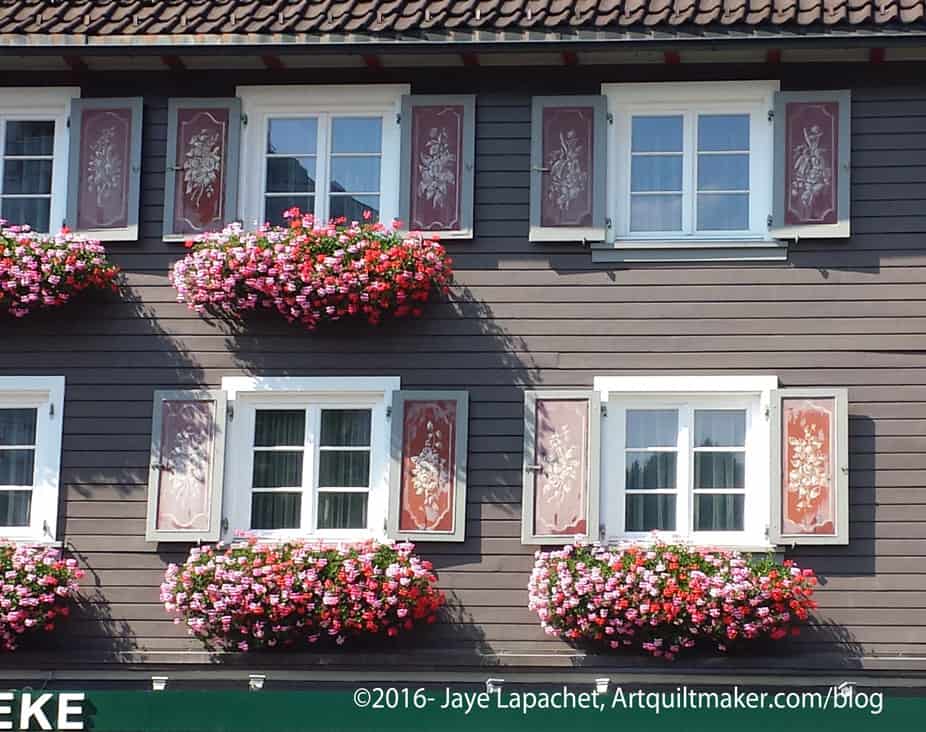
ColorPlay Inspiration

Last time I said that I needed to find some brighter colors. My screen saver is the photos from the Alden Lane Outdoor Quilt Show. I went a few years ago and took lots of inspirational pictures. Recently I saw some of the non-quilt photos and thought of you!

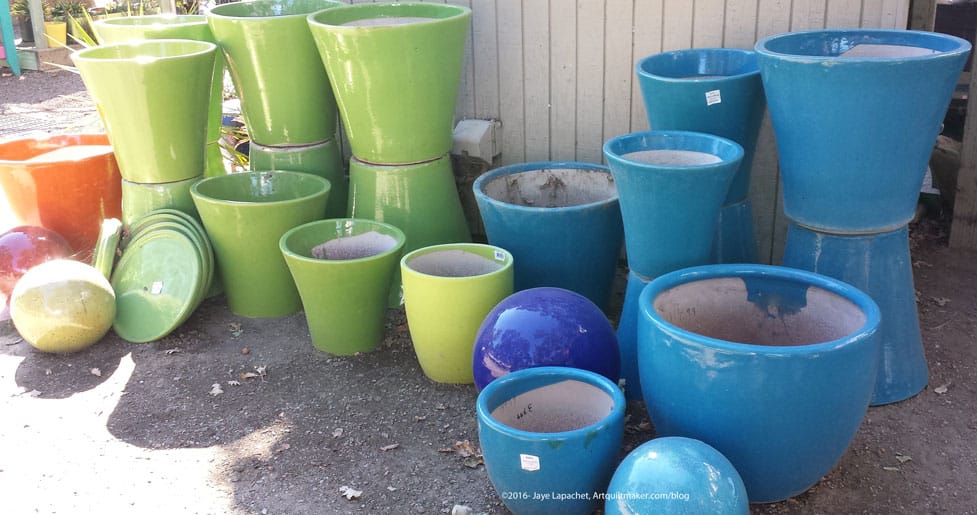
Alden Lane Nursery Stock

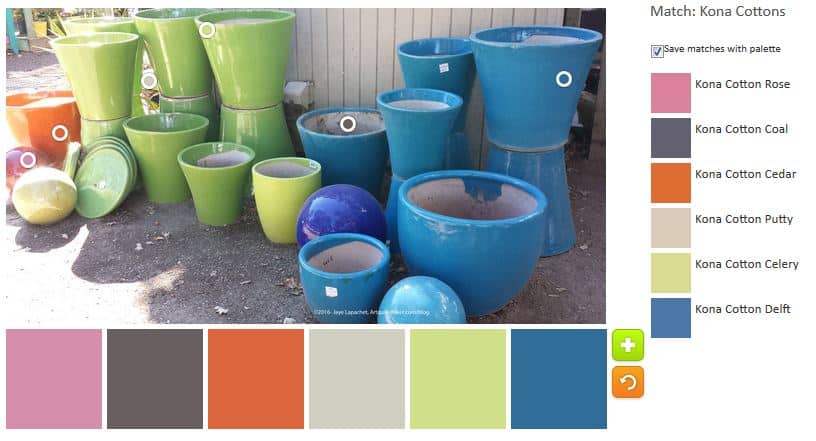
Alden Lane is a nursery, so I wasn’t surprised to see this group of pots. I was also thrilled because this is the kind of photo you see in magazines. Real people don’t find artfully arranged and pretty pots laying around waiting for me to photograph them. 😉

They also are bright and cheerful and make a good color palette.

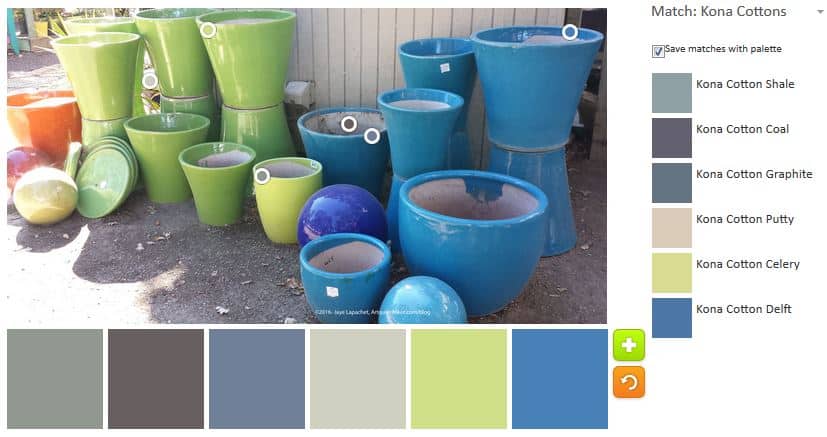
Alden Inspiration-Auto

First is the palette the tool chose. I wonder if it tends to choose cool colors? I like the palette, though I think the quilt could end up being a preponderance of depressing neutrals. It is saved by the blue and green. I suppose you could control the depressing nature of the colors by adding in a lot more of the Kona Celery and the Kona Delft than the Kona Coal.

Alden Inspiration
Alden Inspiration

I rearranged the color selecting circles to get a few more warm colors. I was surprised to see Kona Cotton Rose show up. I wonder if it was like the other time where the tool couldn’t read the fuschias and this time the issues extended to orange?

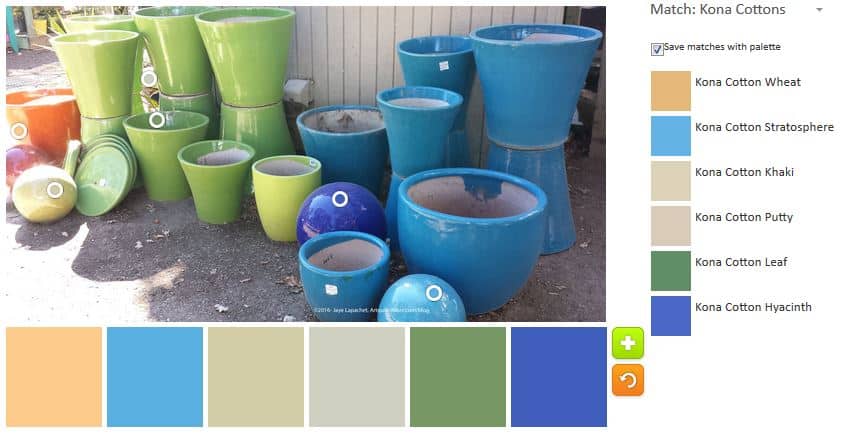
Alden Inspiration 2
Alden Inspiration 2

I made one more just because this is so fun. On this palette I do like the Kona Wheat and the Kona Stratosphere. Those two colors together (nearly opposites on the color wheel) look fabulous together. I am not such a fan of the Kona Khaki and the Kona Leaf, but I think the leaf works. I might change out the Khaki. To what? I don’t know. I could, as mentioned above, just put in a little bit.

Keep reading these color posts, but try the Palette Builder tool with your own photos and see if you find a palette from which you want to make a quilt.

ColorPlay Inspiration

It never ceases to amaze me that I see new things as I walk around the neighborhood. Then I realized that everything is mostly the same but the details are different. Different flowers are bloom, plants are different colors, people put new decorations up for different seasons and holidays.

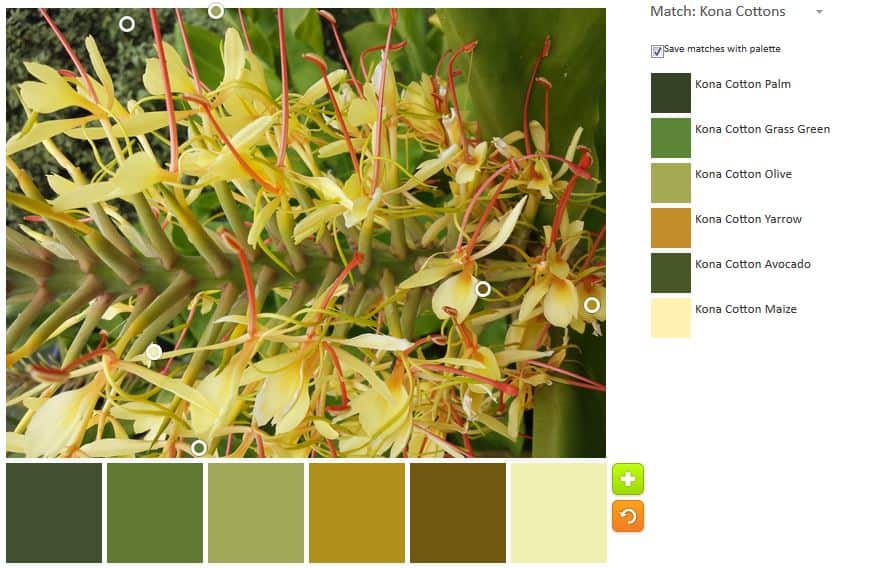
Because of the drought, people are using a lot more succulents. Succulents are not my favorite, but I am trying to see the beauty in them. I saw this yellow flower on a succulent and took a super close-up.

Yellow Spiky Flower Inspiration

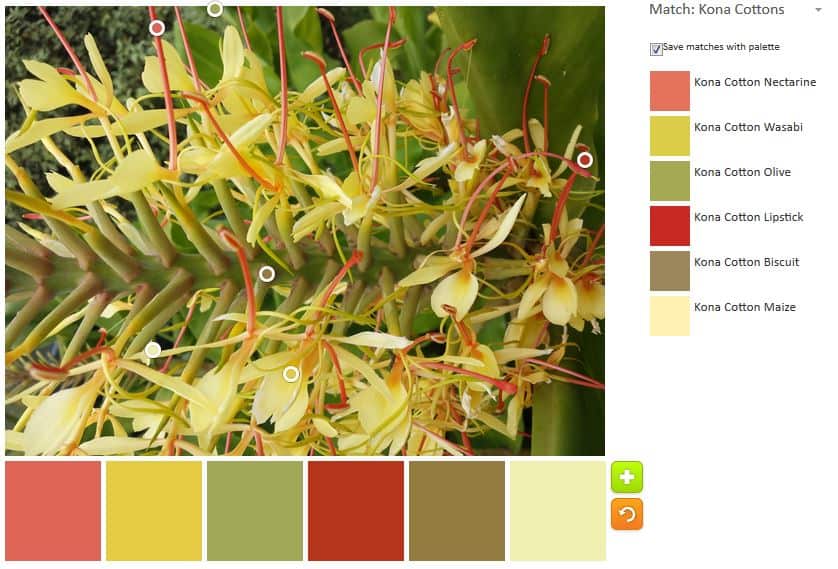
Because I can’t resist fiddling, I moved the circles and did a, mostly, different palette.

Yellow Spiky Flower Inspiration 2

There are little bits of warm colors – pinky reds and reds – and I capitalized on them. Still, this palette is not bright enough for me. I think I’ll need to find some tropical flowers and make some palettes out of them. 😉

Try out the Palette Builder on the Play-Crafts.com website

Creative Spark: Chapter 3

The third chapter in Carrie Bloomston’s book is called Take a Class, thus the third spark is about getting stimulation from an external source. Specifically, she talks about taking a class. I like taking classes, but I am choosy about the classes I take. Just because someone can sew doesn’t mean they can teach. Teaching is a skill that takes practice, though, yes, there are a few natural teachers.

Bloomston says “You get an amazing energy and buzz from taking a class. You learn about technique, craft, and process — the bones of a working practice.” I think this one line is so important.

Local adult schools and community colleges are good sources of classes. Your LQS definitely has a listing of classes that changes regularly. I like to take more arty classes, like color theory at community colleges, but LQSs can have those classes as well. Find out what other types of classes are available at local studios. Here in SF there used to be a sewing studio a few blocks from house. I took a fantastic pillowmaking class there and learned some fabulous techniques such as piping.

Of course, there are also online classes, which can be very good. If there are no local classes convenient to you, then definitely take an online class. I like the energy of an actual classroom and think it adds something to the experience. There are also DVDs with which you can learn some interesting techniques. I was inspired by a DVD I received for review by Sarah Ann Smith.

Bloomston provides a list of her favorite classes and then leaves a space for the reader to write down the classes in which s/he is most interested. She doesn’t include Craftsy, but Craftsy is available as well.

My advice:

  • Be choosy
  • Move outside of your medium
  • Do your best
  • Banish the “I can’ts” and the “I don’t knows” and all of those other negative self discussion from your class. There is no place for them when you are learning something new.
  • Buy the best supplies. If you create a masterpiece, it will last (this is something my mom tells her students)

I continue to want to encourage creativity and creative pursuits in YOU via a regular blog post, so this another effort using The Little Spark book. A few weeks ago, I posted about the first chapter of The Little Spark and how to start to use this book to spark your creativity. I also reminded you that I had reviewed the book in November 2015. If you haven’t bought the book, go buy it NOW.

I feel it is important to nurture creative endeavors in myself. If I can encourage creativity in others, I get a huge bonus. It is so easy to get sidetracked by work, housework, kids’ activities, the time suck that is the Internet and take no time for yourself. It is so easy to think that creativity is not important. Creative endeavors nurture your soul. If your soul is healthy all the other things you have to do in your life are easier and come out better.

Like in the Creative Prompt Project, any kind of art is appropriate for this creative exercise. If you are a potter or a cartoonist or a weaver, these reviews and exercises will work for you just as well as for someone who sews, makes quilts, draws or paints.

 

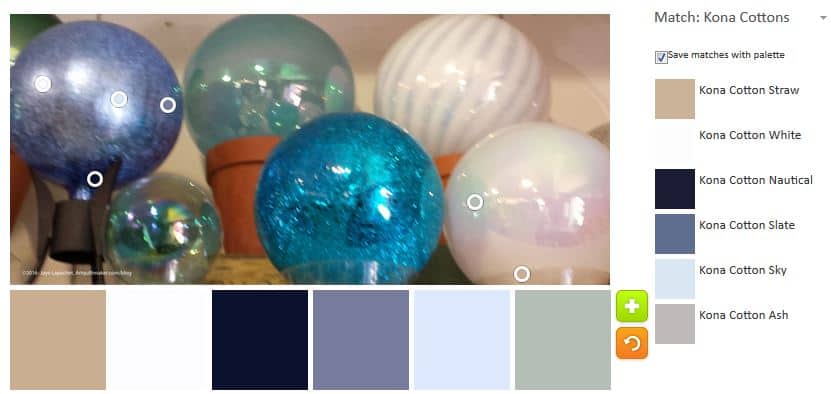
Color Globes Inspiration

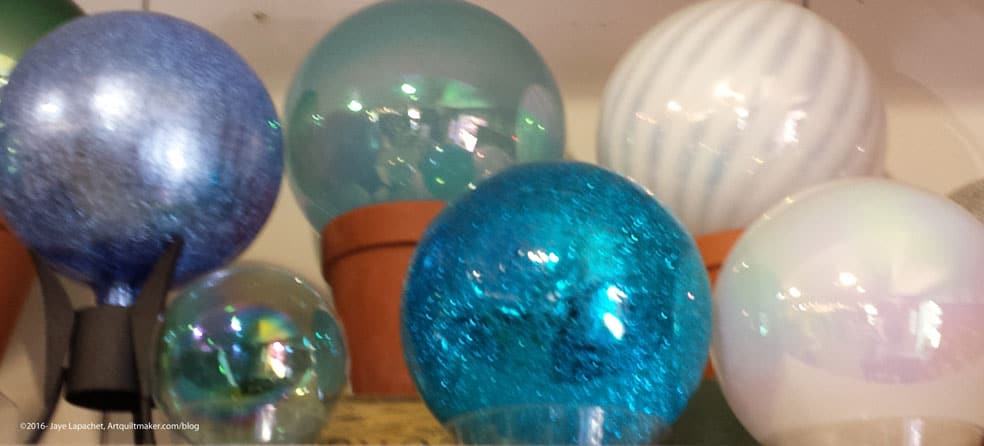
Globes at Quilt Show

I did something a little different today in that I was interested in how many different palettes I could create using the photo above. You can see that colors in the image are already limited.

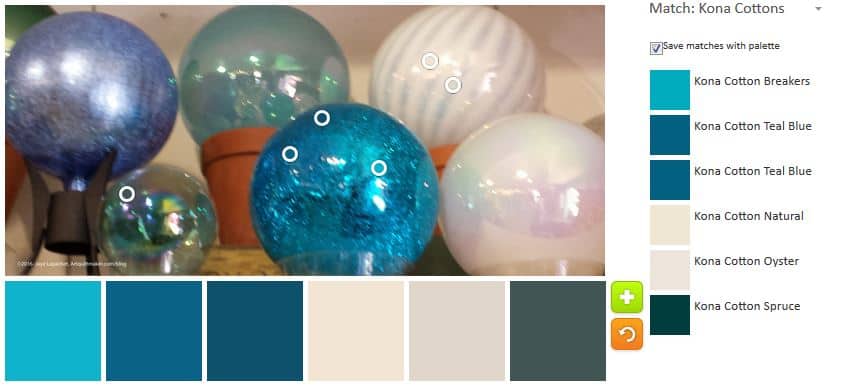
Color Globes - Palette 1
Color Globes – Palette 1

First, I focused on the turquoise globe. I was interested in some of the colors the Palette Builder showed when I first uploaded the photo. I am constantly fascinated with creating a palette that has the right mix of contrasting blues.

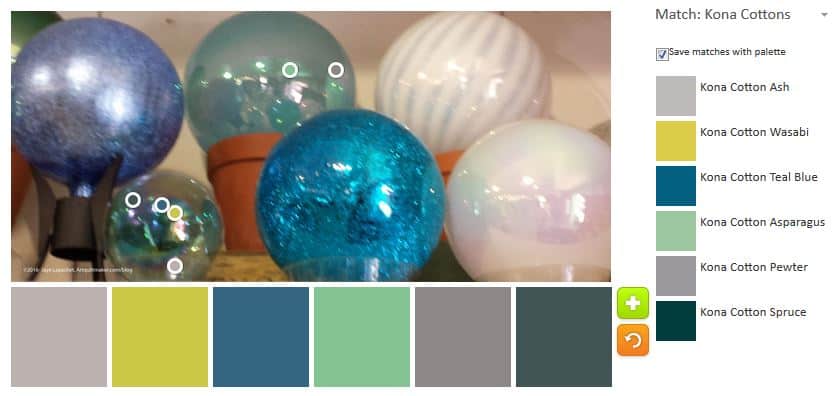
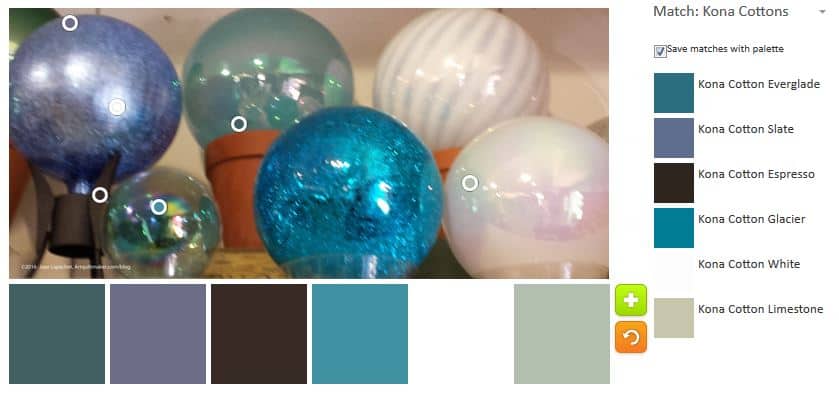
Color Globes- Palette 2

Next, I moved to the more green globes and focused the circles on them exclusively. You can see more green/yellows in the tones of the colors in the palette. It is interesting how many colors there are in this picture.

Color Globes - Palette 3
Color Globes – Palette 3

I could probably play with this one photo ad infinitem. I realized that after my third try and the tool doesn’t even have the color discernment that my eye does.

Color Globes- palette 4

I really couldn’t stop playing with this photo. The colors are relatively limited, but there is still enough of a difference, with the glare and light sources to make the colors slightly different.

I may work with this photo again.

I am wondering what a quilt would be like made from all the colors in the three palettes?

Color Globes - Palette 1
Color Globes – Palette 1
Color Globes - Palette 2
Color Globes – Palette 2
Color Globes - Palette 3
Color Globes – Palette 3
Color Globes- palette 4

What do you think?

More on Under the Sea

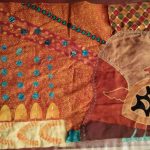
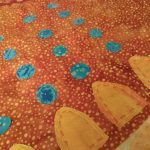
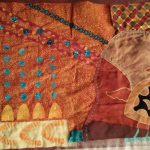
I have been working on Under the Sea pretty steadily in the evenings. It is soothing to do the handwork. I am also surprised at how quickly I can fill up an area with embroidery.

As I said a few days ago, I am pleased with the work. I am still pleased despite some design challenges.

  • I want the embroidery to be simple, so that limits the stitches.
  • I don’t have enough colors, but when will I have enough colors? This should not come as a surprise to anyone who reads regularly.
  • The browns, rusts and golds are not my favorite, but I am finding that I don’t dislike them enough to toss the project.
  • Beads or no beads?

I have been pretty tired or working on other things the past two nights, but I’ll get back to this soon.

Color Friday: Red?

Red Plant
Red Plant

This is another picture I took while doing one of my daily walks. These are not plants that I normally have much interest in, but the red color caught my eye. When I look at the plant, I see red. When I look at this picture with my eyes, I see red.

The computer sees something different. The computer sees more green and grey than I do initially. Of course, when I really look, I do see the greens and greys, which make me wonder about what catches my eye vs what catches they eyes of other people.

Click on the photos to make them larger. I was surprised that the color selections weren’t that different. The color names are different, but the colors look very similar.

Of course, this tool is too much fun, so I couldn’t stop with the above. I moved the circles around to highlight different parts of the photo to see what I could get. I have to be honest that I skewed the results towards the red tones to see what the tool would come up with. It is interesting to consider the palette without the greens and greys.

Despite the fuchsia issues I had before, I love this combination of pinks and reds.