New Donation Blocks

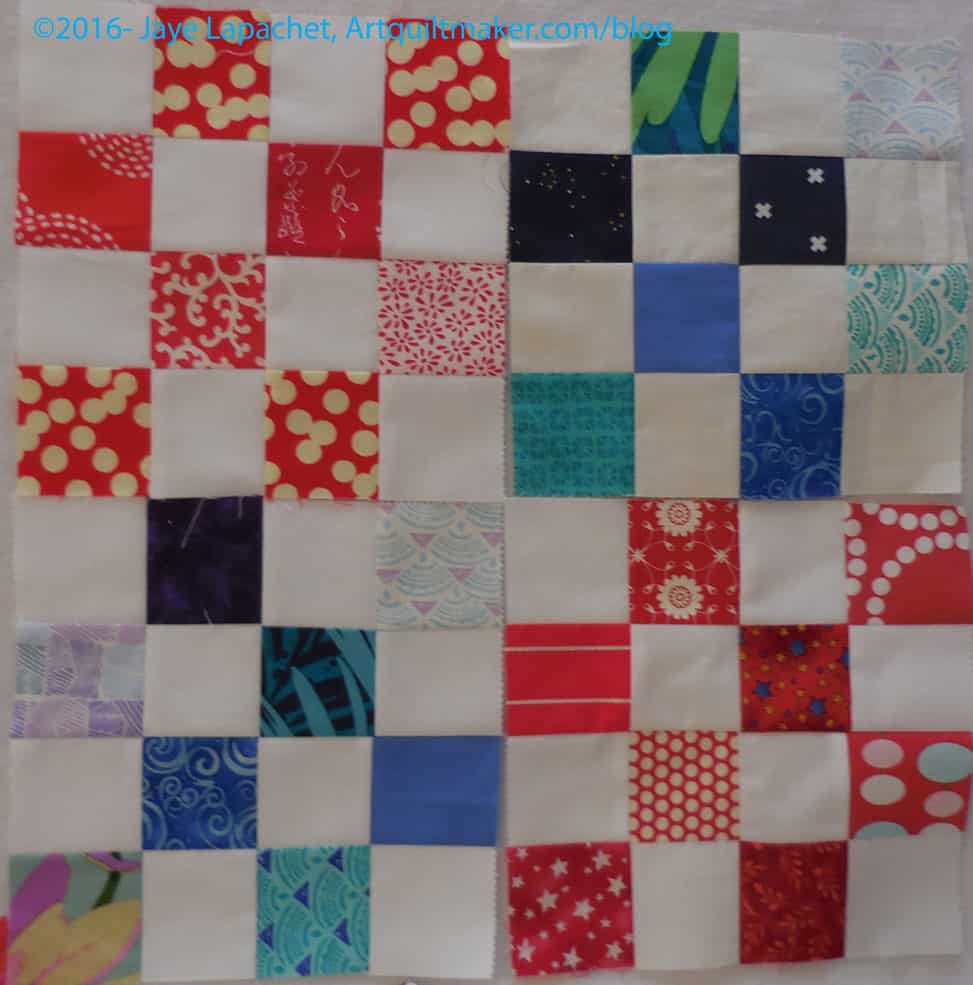
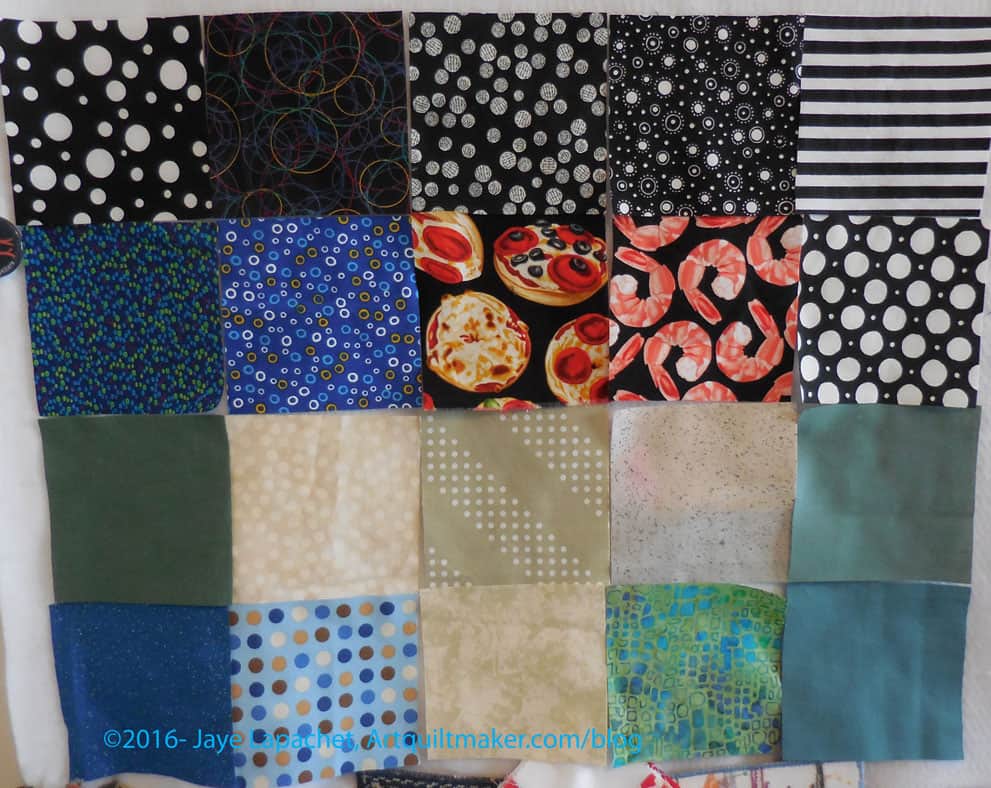
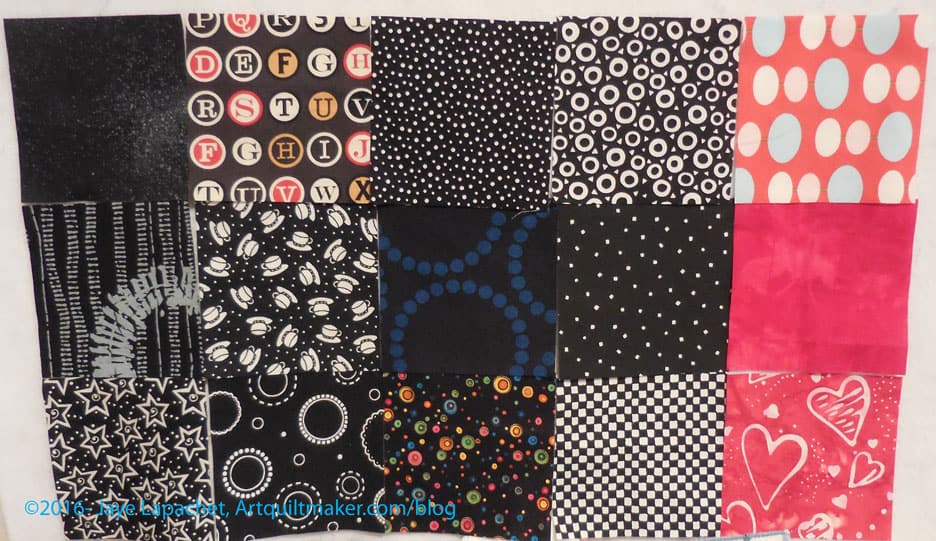
As mentioned in yesterday’s FOTY post, I need leaders and enders. Donation patches inevitably end up doing the job. I made a bunch and have an idea for a red and white donation quilt. I don’t have all the details in my head yet, but I am working on blocks using red fabrics to go with the plain whites.

Donation Blocks - April 2016
Donation Blocks – April 2016

I don’t have an unlimited selection of red 2.5″ squares cut, so I am also making donation blocks using other colors. I will donate those blocks to the Charity Girls and they can do something with them unless I have enough blue and green blocks and enough time to make a second donation top. We will see.

It was fun to make the donation blocks. I am playing with the arrangement of colors and different fabrics. The recipients may not know but I have fun and I hope the quilt absorbs my joy.

Fabric of the Year – Chunking

FOTY 2015 - Chunking
FOTY 2015 – Chunking

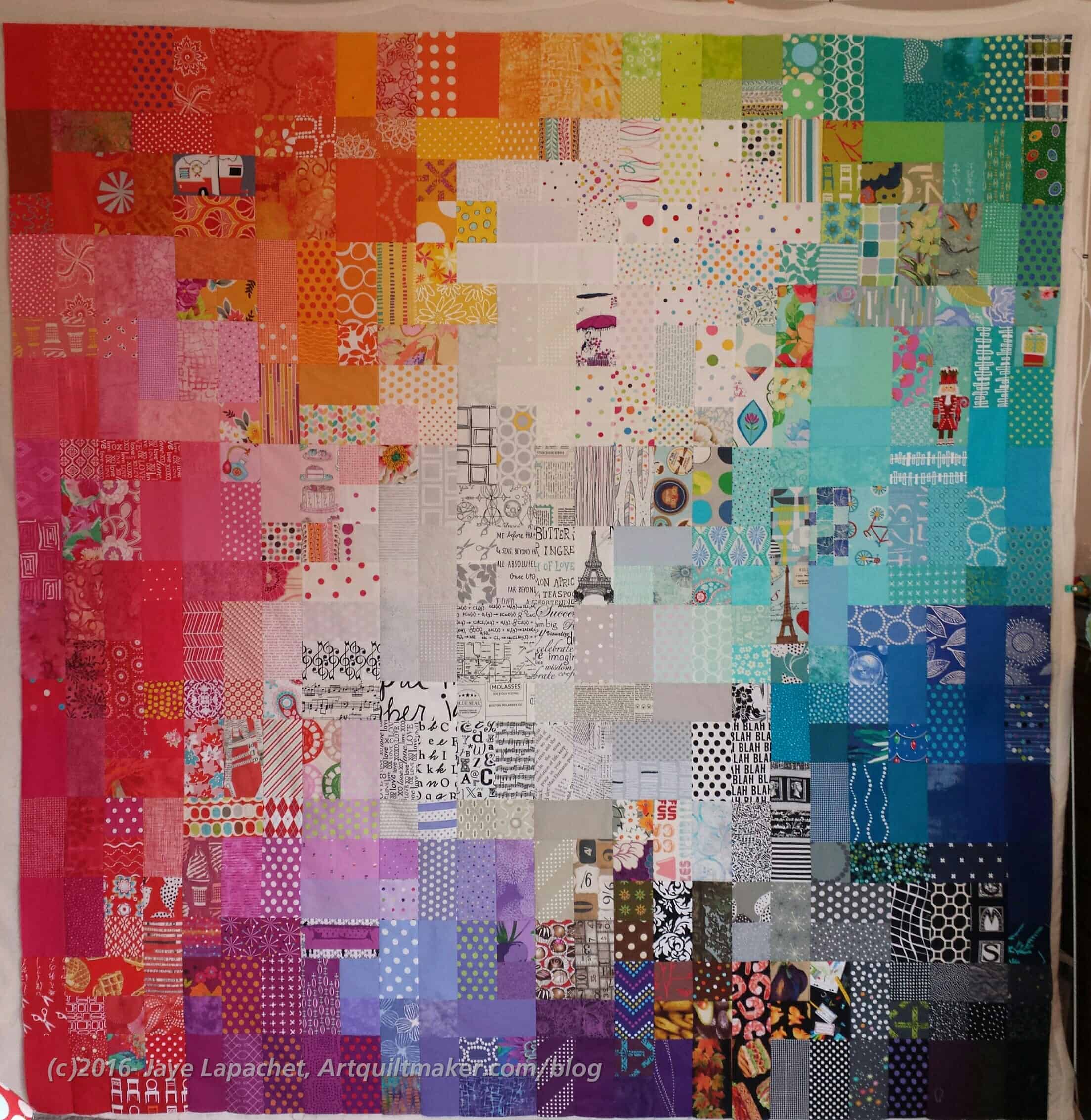
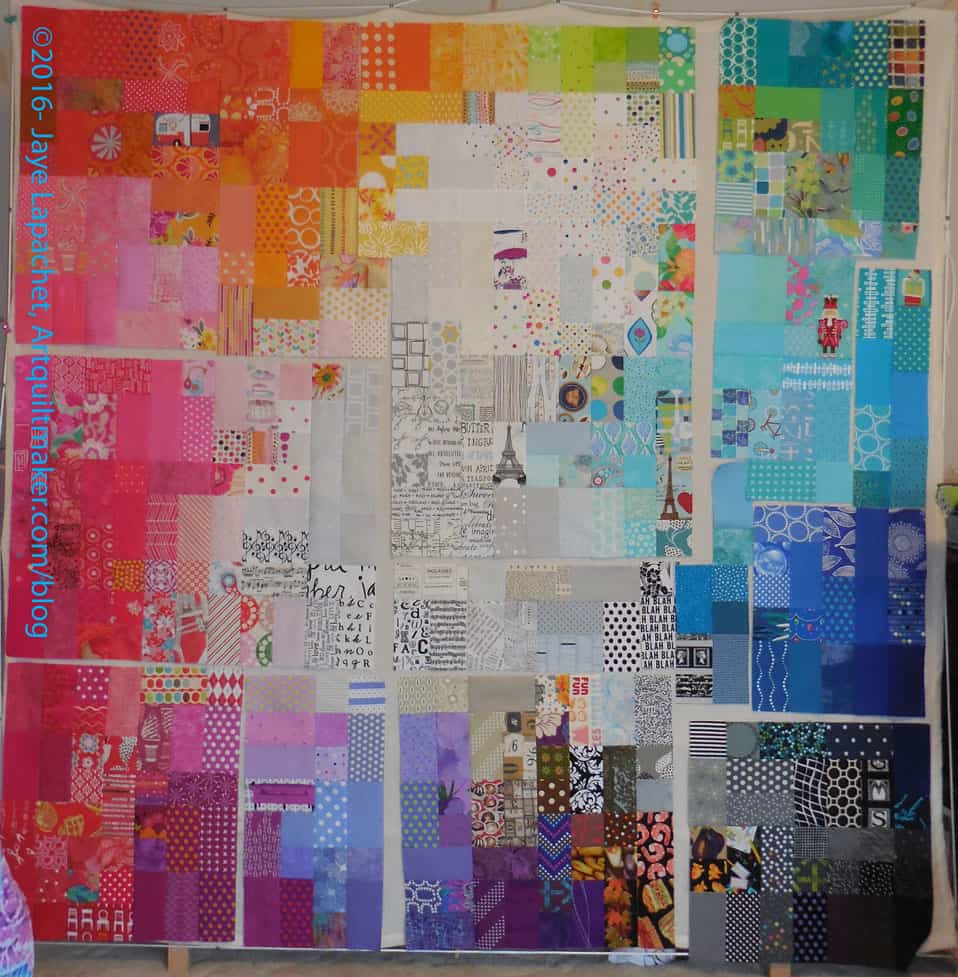
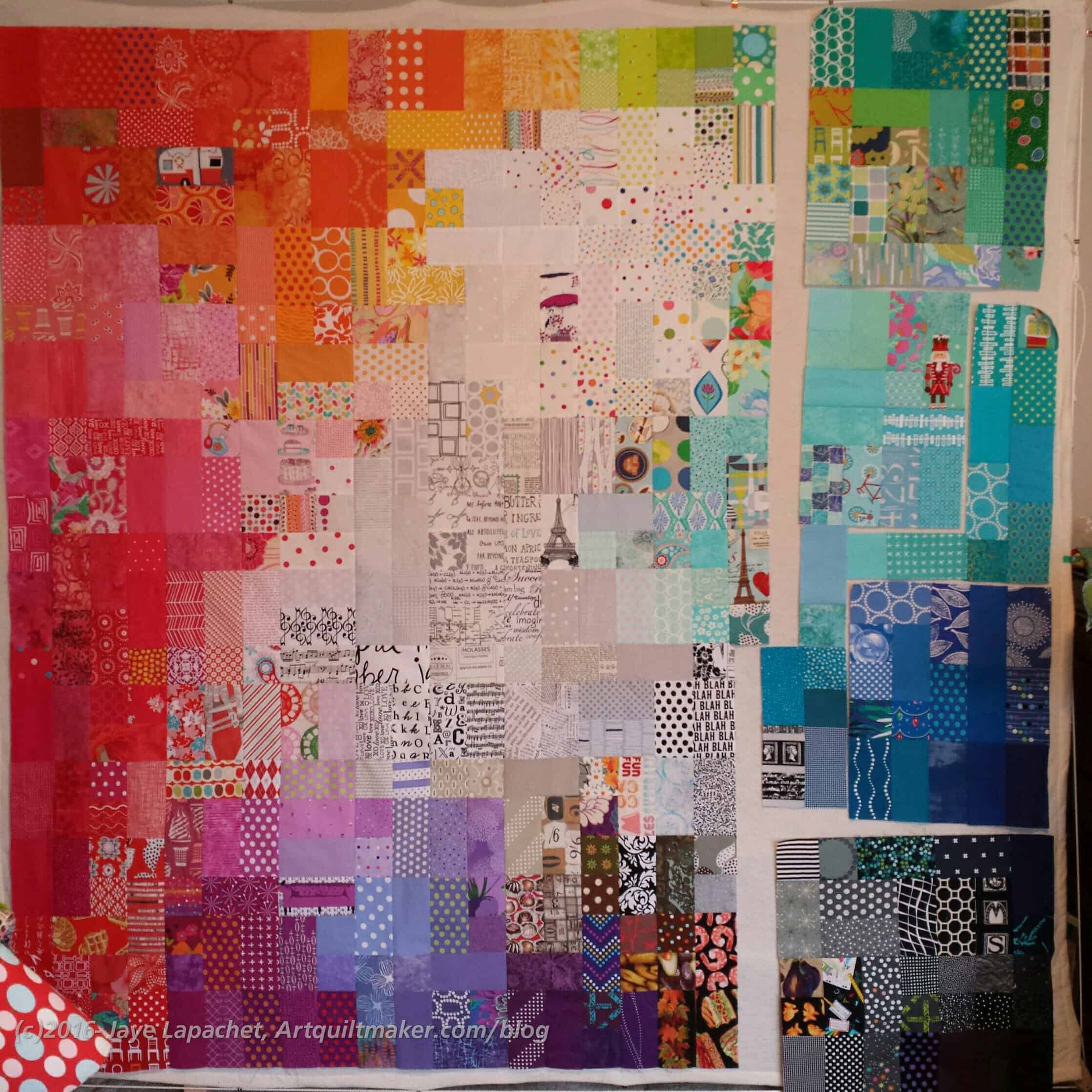
I blew through the layout stage and am on to piecing.

Well, relatively anyway.

I gave myself a certain amount of time to do the layout. The time period was about two weeks and during that time, I didn’t take my cutting table or other in-process projects out of the fabric closet. I only allowed myself to work on other projects as leaders and enders and focused on getting this laid out.

This year’s piece was harder to arrange, because the fabrics I used were really different colors than each other. I am not sure why, because individually they don’t look different. The differences in each hue don’t really show up until you put two oranges or pinks next to each other and try and decide which has a lighter and which has a darker value. It is very strange. If I had thought of it I would have kept track of manufacturers and designers to see if I bought different ones this year than last year. I didn’t know that this would happen. It would have also meant that I would have had to keep track last year as well. More data would be needed.

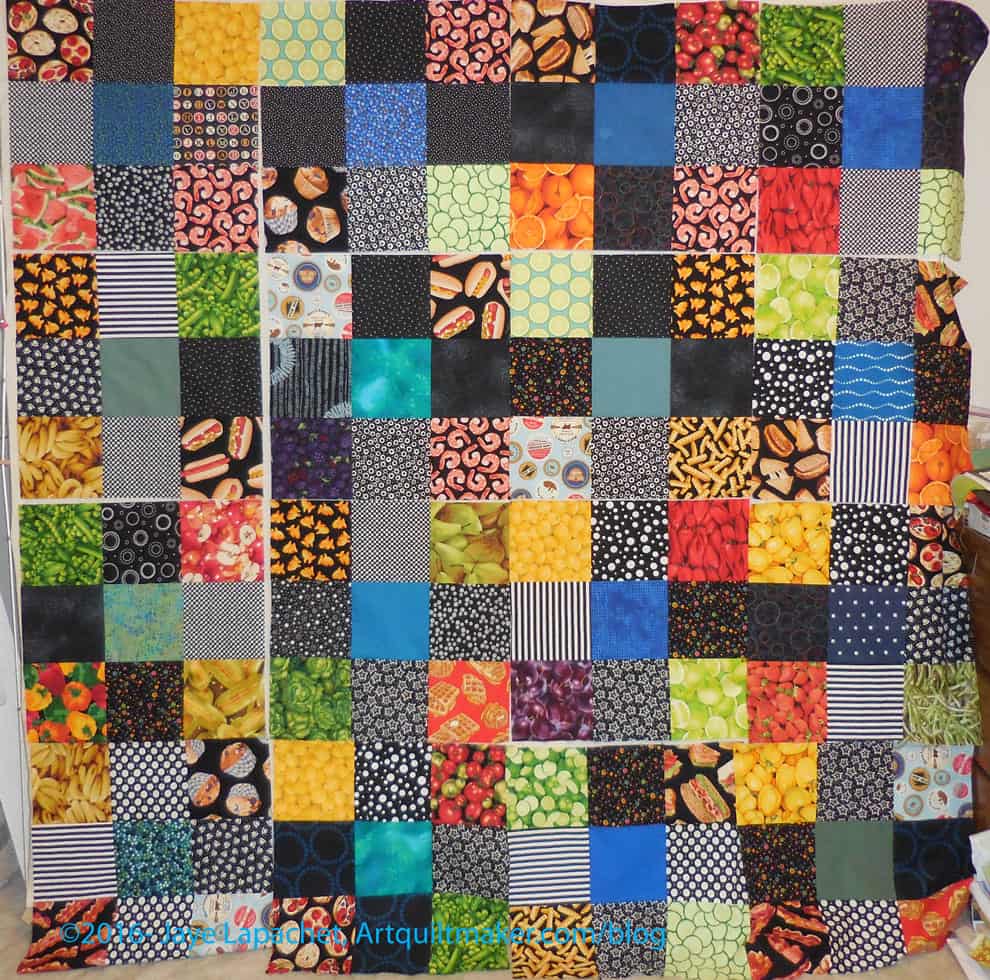
The too-small design wall was a real problem this year, I think. I did not cut the patches down to accommodate the design wall as I did last year. I just crammed them all on the wall. That means that I found some places where I was short. You can see some white spaces on the bottom (near right hand corner). This problem showed up when some of the fabric was taken up by seam allowances and I was able to line patches up more evenly. I have to rummage through my leftover pieces and find some to fill in.

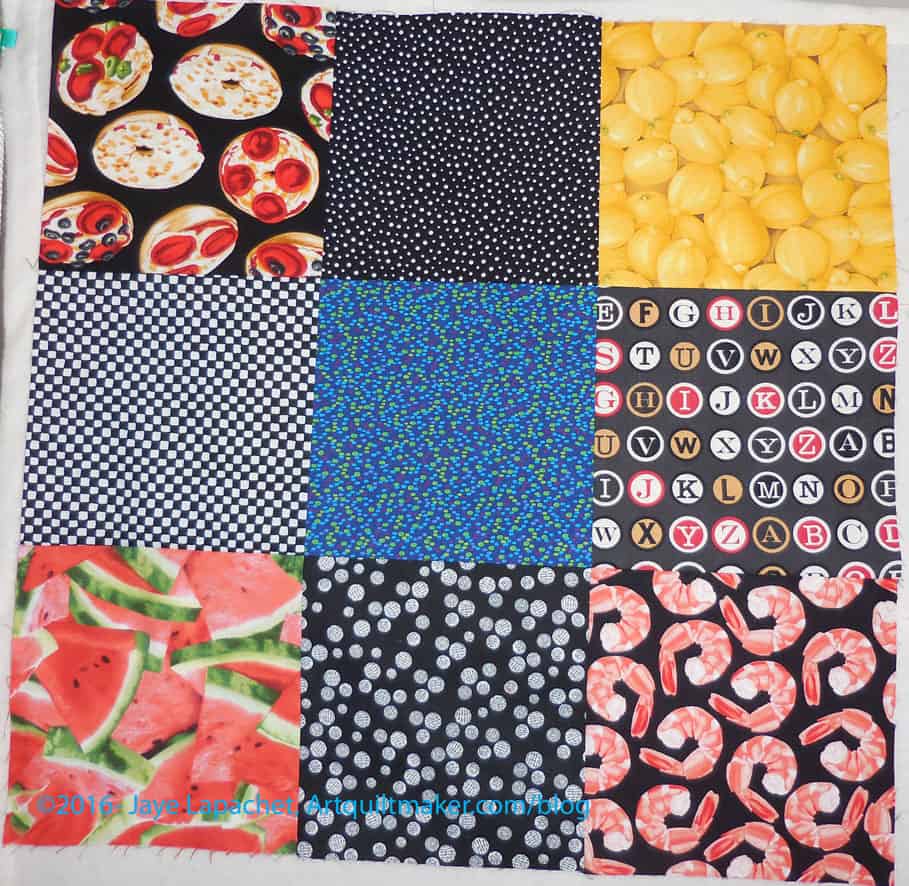
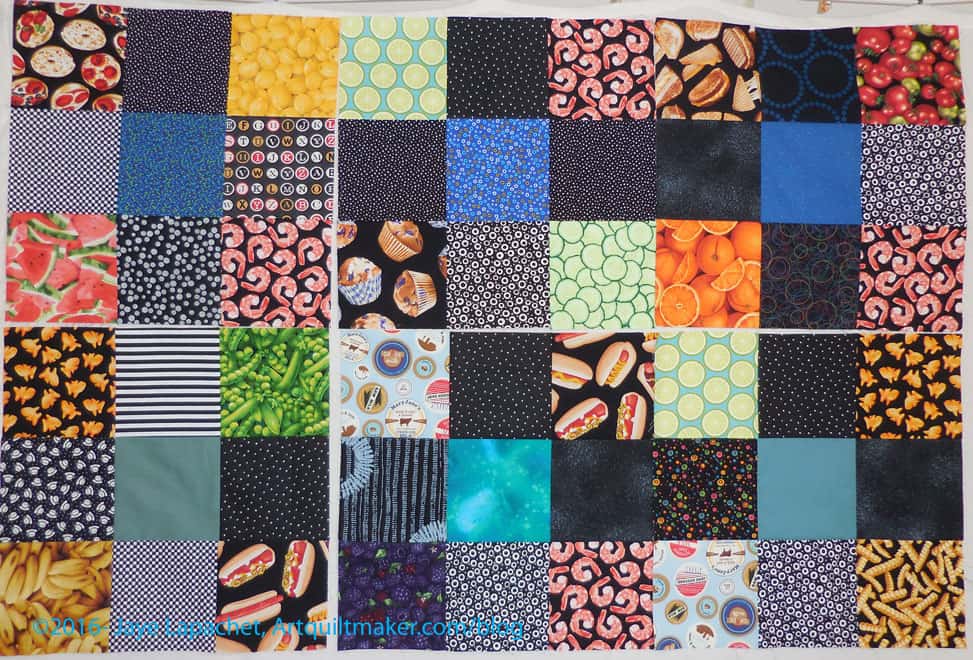
Most of the piece has been sewn into chunks. The chunks are not even because I had some rectangles arranged horizontally and some arranged vertically. With the squares it made for interesting piecing.

The difficulty was what it was and I got the feeling that it was done at some point and started sewing. I talked a little about the sewing when I posted about the Peacock. It is all about leaders and enders, because I only want two unsewn patches off the wall at a time to ensure the piece stays laid out the way I intended.

You can find out more about the FOTY quilts on the series page.

May 2016: 26 Projects List

In my last post on this topic, I was feeling as though I was on the verge of finishing several projects. I have two large quilt projects well in hand, but nothing else, really. I guess that means I am still on the verge or was mistaken or could have been experiencing a bout of wishful thinking.

Finished 2016 Quilt Projects

Cityscape/Red & Black Improv Quilt – I still have to put the sleeve on, but the binding is on, so it is ready to go.

Flower Sugar donation quilt (I feel odd putting this finish here as there is so much I didn’t do on this piece – still there isn’t anywhere else to put it)

Finished 2016 non-Quilt Projects

In Process
The  ‘In Process’ is used to denote projects on which I am actively working or pretending to stitch.

  • Carpenter’s Wheel blocks – I finished all of them and am working on the layout.
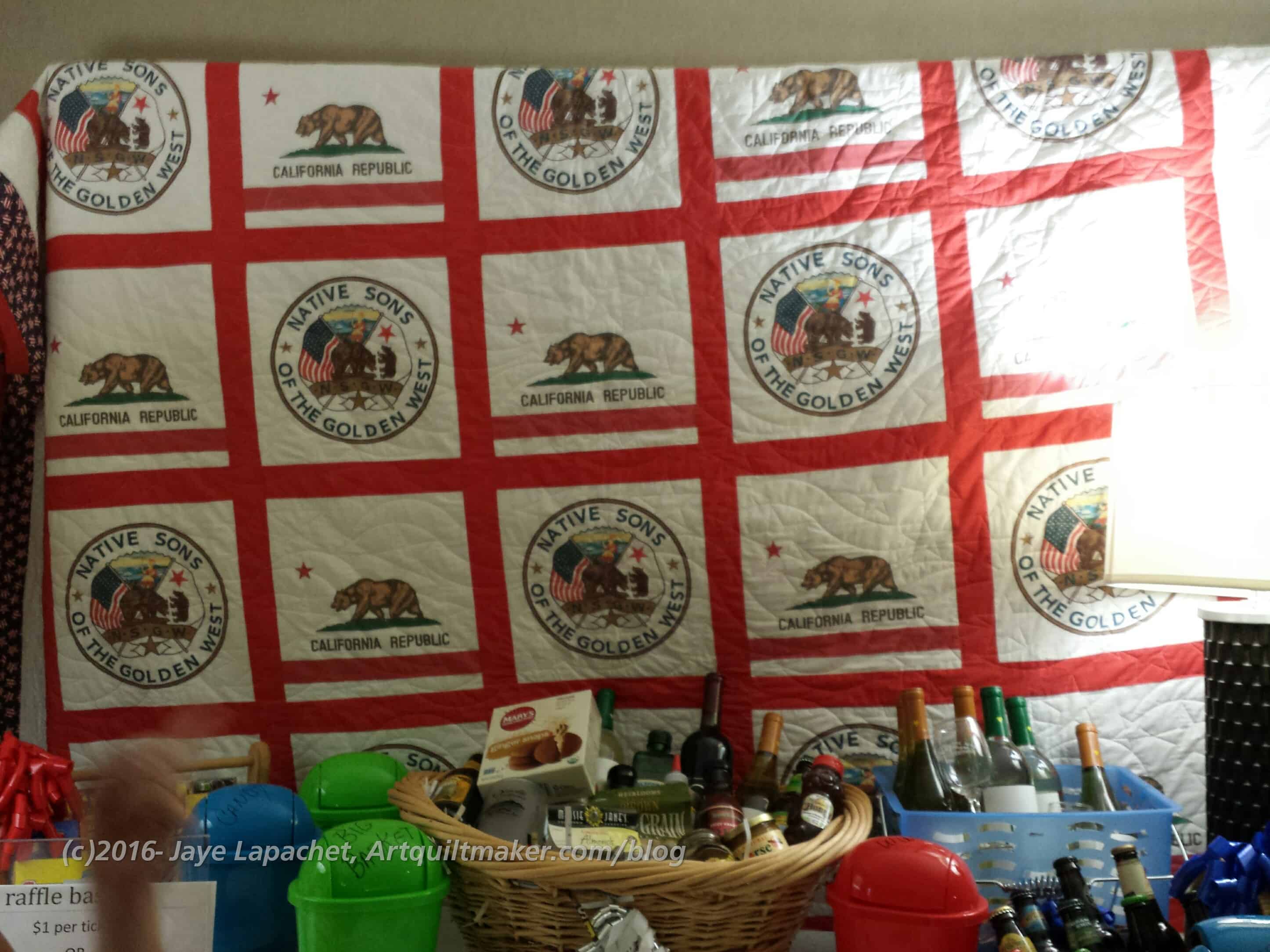
  • English Paper Piecing Project– half hexies – I finished adding another big section. I am excited about the La Passcaglia EPP project, so I may finish this up as….something and then move on. We’ll see. I had thought about this as my NSGW project and I may need to see that through.
  • Food Quilt #3 – food patches are cut. I went to start sewing and realized I didn’t have the center squares cut, so I have started to cut those. I haven’t made much progress, though I have purchased a few and may get busy as this would be a good quilt on which to make progress during the sewing of the FOTY 2015 patches.
  • Lobster – have more stitching to do and then I need to quilt it.
  • Horizon Midi Bag – have to finish top stitching
  • Octagon 9 Patch: ready to put together. Not sure what I am waiting for
  • Peacock Quilt – all of the large blocks are finished and I am working on the smaller blocks!
  • Pies and Points from Victoria Findlay Wolfe class. No further piecing progress, but I did buy more background fabric.
  • Stepping Stones #2 – I worked on this for awhile. I used the project as leaders and enders while I was sewing FOTY 2015. I need to measure the blocks I have and figure out where to go from here.

Still WIPs
I still have WIPs. Who doesn’t, after all? A project in the ‘UFO’ category means I am stalled. A nicer way of saying UFO, to me, is a WIP. The list is a lot shorter and the projects are newer, for the most part.

  1. Aqua-Red Sampler – I still have to work on the partial seaming tutorial.
  2. The Tarts Come to Tea: I still haven’t worked on this since April 2011, though, it is in a prominent location so I have easy access. I was thinking about how this was veering in the direction of being one of my ‘masterpieces,’ but now that it has languished for so long it just looks old and dated. :(
  3. Pointillist Palette #4: Fourth is a series of 6 quilts; needs tiny square patches sewn together. I still haven’t worked on this project either, but I do think about it.
  4. Self Portrait: started in 2006 at a class at Quilting Adventures in Richmond, Virginia. My career counselor breathed new life into this project for me. She asked a simple question and the end result was inspiration for this piece, but I kind of lost steam again after printing images on paper to try out different designs. Lately, I have stopped feeling like I need to finish this piece. I am not ready to give up on it yet. I think it really needs major surgery.
  5. Under the Sea: class project; like the design, but not the colors. Still a possibility for abandonment. Just can’t seem to pull the trigger.
  6. City Sampler/ Tale of Two Cities blocks. No progress despite the small group at BAMQG.
  7. Serendipity Lady Quilt

Ready for Quilting
Wow! Everything on this list is new, as in it was never on the original 26 Projects list.

  • 2 Thanksgiving tablerunners

In Quilting Process

Nothing being quilted.

Binding

  • Flowerburst

Hunting and Gathering

  • Blue Gradation Quilt: cutting 2.5″x 4.5″ blue rectangles
  • Blue Lemonade: cutting blue, green, purple 2″ squares
  • Food Quilt #3: cutting blue fabrics
  • Pink Gradation Quilt: cutting 2.5″x 4.5″ pink rectangles
  • Spin Wheel: really not started, but supplies gathered. I probably have enough fabrics and just need to decide to start.
  • Stepping Stones #3 using the Macaron pre-cuts from Hoffman. I have all the fabric in pre-cuts and am just waiting for space in my schedule.
  • Windmill quilt: Still hunting and gathering. I am supposed to be cutting a variety of greys for the background. The problem is that I mislaid the rotary template. Sigh. I may be able to cut the background greys on a Sizzix.

What’s on your list?

Flowerburst Returns

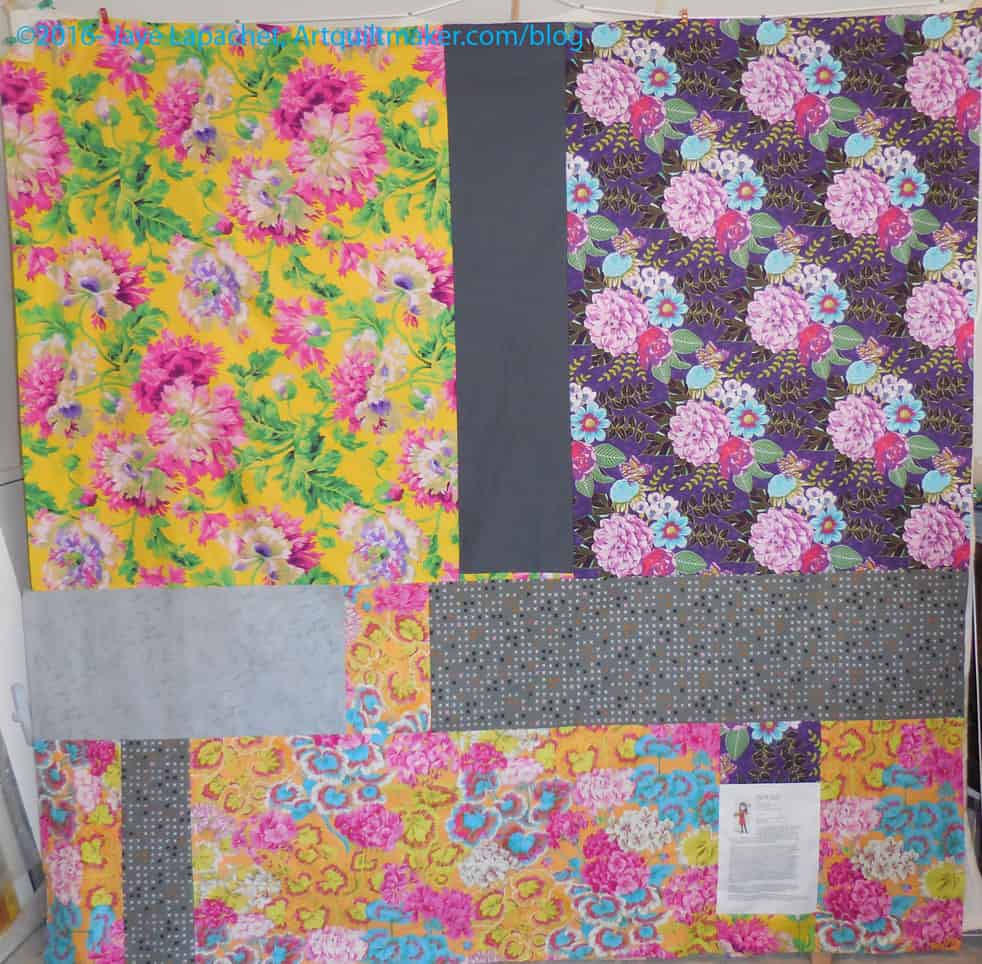
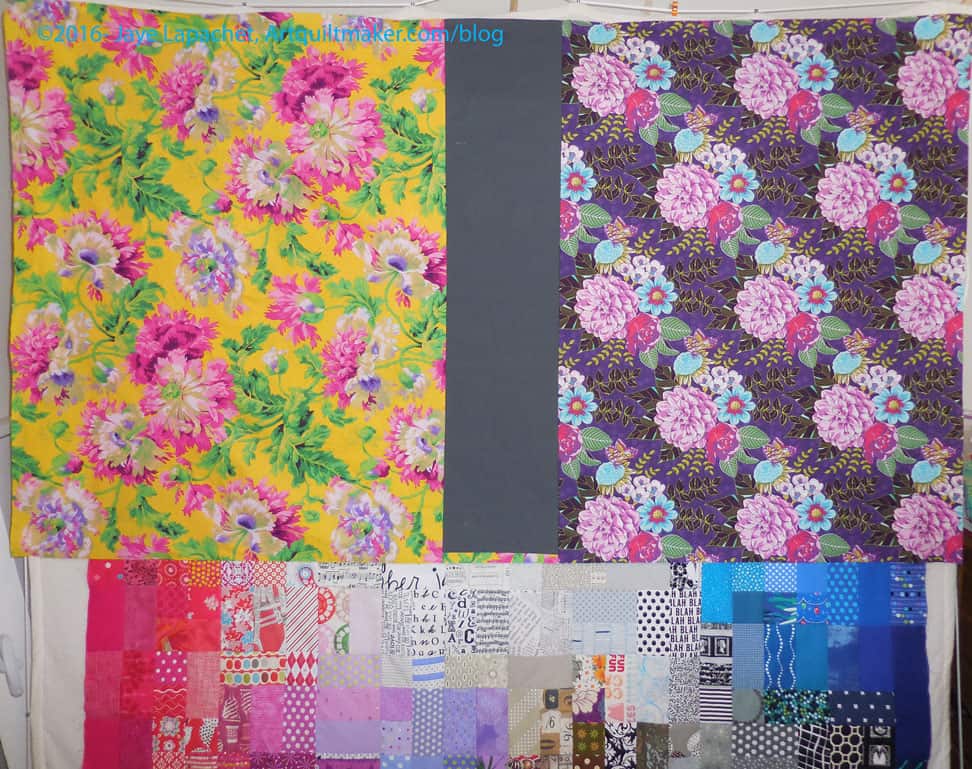
Flowerburst returned from the quilter about a week and a half ago. I have had so many other projects going on that I haven’t had time to post about it. I haven’t really worked on it either, so there hasn’t been much to say.

Flowerburst - ready to bind
Flowerburst – ready to bind

As you might remember, Flowerburst is a large quilt made from a pattern in Kathy Doughty’s book, Adding Layers. I wrote a review about that book. Have you read it?

The photo is a little odd as I had to lay the quilt out on my living room floor and take the photo from the upstairs hallway (I have an open plan, mid-century modern house). When I get my other quilt hanger back from college and the quilt is bound, I’ll take another photo.

This was supposed to be a quick project and it was relatively. I didn’t like the directions, mostly because I had to conserve fabric, so I used different methods to cut the backgrounds, which meant I didn’t have as many leftovers as I would have if I had used KD’s methods. I understand the reasoning behind her cutting directions: she had to write directions for everyone not just for me, the person with the fabric shortage.

Flowerburst - detail
Flowerburst – detail

I like the way this quilt turned out. I liked using my big prints on the front for a change even though I will be gifting this quilt and won’t get to see those lovely prints very often.

I really like the idea of combining different sized blocks and think this, or a variation of this, pattern has potential for other layouts. I am thinking that a slightly larger block in the center with the smaller block would have worked as well. I think there could have been some transparency work as well, if I were willing to do a larger quilt.

Flowerburst - detail
Flowerburst – detail

A couple of the prints are Martha Negley prints, but they go so well with the Philip Jacobs prints.

The print on sea green with the flowers and melons is a favorite and was close to being a dress. I decided at the last minute that I couldn’t risk a melon ending up on a breast or buttock! I do love those flouncy lavender flowers, though. I also love the cantaloupe color combined with the sea green. I don’t remember seeing that combination before and will have to remember it in future.

Flowerburst - detail
Flowerburst – detail

Finally, Colleen did a great job on the quilting. I wanted her to highlight the stars and she did different designs in each one and they look great. I can’t wait to bind this and see what my niece thinks.

Stepping Stones 2 Returns

As I said the other day in the latest donation blocks post, laying out FOTY 2015 doesn’t make for a lot of tangible production. While I enjoyed making the donation blocks, I did need a little variety and the Stepping Stones parts were handy.

Four Stepping Stones blocks - April 2016
Four Stepping Stones blocks – April 2016

I enjoy these blocks and seeing the way they will be laid out makes me very happy. Turning each on a little bit makes a huge difference.

Even though I may need the squares for the layout of the Carpenter’s Wheel blocks, I have used some of the low volume prints for the white space in these blocks. I have plenty of fabric for the [mythical] Carpenter’s Wheel layout and can always cut more.

6 Stepping Stones blocks - April 2016
6 Stepping Stones blocks – April 2016

Making a few blocks always leads to making more and the six shown give an idea of what the quilt will look like and makes me want to make more.

Based on the layout I devised for my nephew’s Stepping Stones quilt, it looks like I will only need two more blocks and then border blocks for the width. I thought I measured 8 blocks across my bed, which doesn’t account for border blocks. I want to make the border blocks to finish the design.  There are two blocks around the whole edge of the previous SS quilt and I could eliminate those if I thought the width was too big. Measuring next, I think.

I am really pleased with how the blocks look. Now to get FOTY 2015 off the wall so I can layout all the blocks I have and see what I am facing. After months of feeling meh about quiltmaking, I am finally excited about several projects! Yay!

More Fabric of the Year 2015 Layout

I know I just posted a few days ago and for you looking at a computer screen the changes to the piece are hard to see. I promise not to give you a patch by patch update.

FOTY 2015 - 4-17-2016
FOTY 2015 – 4-17-2016

Now is the time where the changes are very subtle and looking for changes in the shape of the areas of color are the best way to See the evolution. I worked quite a bit more on the red and pink areas. “Working on an area” means getting the darkest or lightest fabrics together and blending the mediums into a smooth transition between the two. Mostly it means deciding where a piece goes. As I have said that is not always easy and in this case, I am struggling with some of the off colors in each area with no way to smooth the transitions. Green is a particular problem for me this time around. Green, never a favorite, has a bunch of grey greens included this time and they don’t seem to fit in either grey or green.

That is the way of it, though, and at some point, I have to stop and say enough is a enough.

Creative Prompt #361: Uniform

military uniform

Uniform is a creative consultancy that works with organisations [sic] that want to re-imagine their business and go beyond the possible. Studios in Liverpool & London.

Innovative dairy farm management software for professional dairy farmers.

uniform distribution – In probability theory and statistics, the discrete uniform distribution is a symmetric probability distribution whereby a finite number of values are equally likely to be observed; every one of n values has equal probability 1/n.

Definition: “A uniform is a type of clothing worn by members of an organization while participating in that organization‘s activity. Modern uniforms are most often worn by armed forces and paramilitary organizations such as police, emergency services, security guards, in some workplaces and schools and by inmates in prisons. In some countries, some other officials also wear uniforms in their duties; such is the case of the Commissioned Corps of the United States Public Health Service or the French prefects. For some public groups, such as police, it is illegal for non members to wear the uniform. Other uniforms are trade dresses (such as the brown uniforms of UPS).” (Wikipedia)

continuous uniform – In probability theory and statistics, the continuous uniform distribution or rectangular distribution is a family of symmetric probability distributions such that for each member of the family, all intervals of the same length on the distribution’s support are equally probable. The support is defined by the two parameters, a and b, which are its minimum and maximum values. The distribution is often abbreviated U. It is the maximum entropy probability distribution for a random variate X under no constraint other than that it is contained in the distribution’s support.

2003 film

uniform convergence – In the mathematical field of analysis, uniform convergence is a type of convergence stronger than pointwise convergence. A sequence {fn} of functions converges uniformly to a limiting function f if the speed of convergence of fn to f does not depend on x.

school uniforms

A uniform is a standard set of clothing identifying the wearer as a member of an organisation.

Uniform may also refer to:

Post the direct URL (link) where your drawing, doodle, artwork is posted (e.g. your blog, Flickr) in the comments area of this post. I would really like to keep all the artwork together and provide a way for others to see your work and get familiar with your blog or website.

The Creative Prompt Project, also, has a Flickr group, which you can join to  post your responses. I created this spot so those of you without blogs and websites would have a place to post your responses.

We are also talking about this on Twitter and Instagram. Use the hashtag #CPP

Donation Blocks

The layout of FOTY 2015 is satisfying in some ways – it is great to see the piece emerge from a pile of patches. It is not satisfying in that no piecing gets done. I am trying to take Mark Lipinski‘s Slow Stitching to heart and enjoy the layout process.

Donation blocks - late April 2016
Donation blocks – late April 2016

I am only sort of successful. I want to see blocks emerge from scraps of fabric! In between moving patches around FOTY 2015, I sewed more donation blocks.

As you can see I am sort of making monochromatic blocks. Of course, to say monochromatic is a big stretch of the imagination, especially for the green on in the upper left hand corner, but I am trying out the idea. I really would like to put together an all red version of a donation quilt. At this point, I don’t have enough red squares, but I can always cut more.

Whether this concept will go anywhere, I don’t know. I am going to keep making blocks and we will see.

FOTY 2015 Last Patches

FOTY 2015 - Last Batch of Patches
FOTY 2015 – Last Batch of Patches

I found a picture of the last batch of FOTY 2015 patches. Even though I have already started and made progress on laying out the whole piece, I had to post these.

You can see the Sugar & Spice Donation quilt as well as the Half Moon Modern Chubby Charmer in these patches. That is one thing I love about this project: I can go back and see my work for the year in each Fabric of the Year quilt.

Peacock Quilt Progress

As I work on FOTY 2015, I also have to work on another project in between each two patches that I sew. I sew two patches from FOTY rows with two patches from something else. This helps me keep the FOTY pieces in order. If I get too many of them off the wall at once, the order is mixed up and all the work of laying them out is for naught. Of course, even having just two patches off the wall does not guarantee that they won’t get out of order, but I do my best and some ripping does come into play.

As you know I have been using donation blocks and the Stepping Stones blocks (look for a post soon) as leaders and enders. I got a little tired of the donation blocks and ran out of HSTs for the Stepping Stones, so I turned to the Peacock blocks.

I thought I thought I still had a gazillion seams left to finish the blocks, but since I hadn’t worked on it in over a month, I couldn’t really remember and just focused on getting the gazillion down to a billion. 😉

Last of the Big Peacocks

Amazingly, I really didn’t have that many blocks left to sew and I finished sewing the large blocks yesterday. Above there are 21 “big peacocks” and that is all of them. With the blocks I made last time, I have about 60 “big peacock” blocks.

Baby Peacock
Baby Peacock

This does not account for the smaller blocks, which I cut from a smaller strip and will see about using in some way. I have more of those to sew, but will do that when I sew the rest of the FOTY 2015 together. It will be nice to be able to leap into laying out another quilt right away.

At least I think it will be nice. It might be too much after the work on FOTY, but at least the blocks will be ready when I am.

Fabric of the Year 2015 Layout Continues

FOTY 2015 - Layout 4/17/2016
FOTY 2015 – Layout 4/17/2016

I achieved my goal of getting all of the patches onto the wall last Sunday. I was also able to start rearranging the patches into their final positions. To be honest I have about 5 patches that will not make it on to the front of the quilt. They will have to go on the back. Normally, I wouldn’t do that, and I don’t really like it, but I would have to cut about 22 additional patches in order to fit them into the quilt. I think putting 5 on the back is the lesser of two challenges. Also, the process is evolving and I am thinking of this as evolution.

As per usual, there are patches that are not in the right place. Moving the left side around gave me the advantage of putting that section into better, not perfect, but better, shape than it would be normally.

If you have ever tried to blend (gradate? Colorwash?) commercial fabrics into each, you will know it is not an easy task. It is a struggle and I am at the point where I wonder why I do it. Still, I see the value and will continue on.

Carpenter’s Wheel Layouts #2

In between other things going on here in the Artquiltmaker Workroom, I wrote the book review of Scraps Inc. As you may have read, I was lukewarm about the book in general, but everything can provide some inspiration.

Carpenter's Wheel Layout #8
Carpenter’s Wheel Layout #8

One quilt (from the related blog post) that I didn’t think should be included in the book** provided inspiration for the Carpenter’s Wheel layout, however. I don’t think I have quite enough blocks to make this layout work. I can’t really tell since the design wall isn’t large enough to give me a good sense and the proportions of this layout are off. I might try it on the living room floor since I can see it from the upstairs hallway.

Carpenter's Wheel Layout #9
Carpenter’s Wheel Layout #9

My SIL suggested a regular on-point 3-2-3 layout. I tried it. This might work without the bottom two blocks, but with those two blocks, it looks crowded and odd. If I do this layout, what will I do with the bottom two blocks?

I have more work to do on this piece, so stay tuned.


**Nota bene: There is nothing wrong with the quilt and it is very modern, but it uses very few scraps, thus I didn’t think it fit the definition implied by the book. YMMV.

Problem Children

In every version of the Fabric of the Year concept, there are problem fabrics. Every year I have crammed them into some place, usually a place that didn’t quite work. This year might be different.

FOTY 2015 - Problem Children
FOTY 2015 – Problem Children

The problem children this year have varying degrees of problems. all of them should get into the quilt, to be faithful to my rulers. Some of them will get in to the quilt, perhaps all. I am not making myself any crazier than I already am this year.

You might look at these fabrics and think I am a wimp. In some cases, I might be. The Philip Jacobs print (2d row, 2d from right) will probably fit nicely between the reds and pinks. The pinky red next to it should, too, but it is just off enough to have no compatriots in either pink or red.

The top row’s fabrics are the real demons. What color is that gold (top row, 2d from right)? Yes it is gold, but is it more brown than yellow? ERGH!

The big prints and modern prints like the Cotton & Steel Viewmaster fabric are real problems. They do not lend themselves to being blended in with any other fabrics. I constantly move them from white to color and back.

I will put as many of them on the front as I can, but the rest will go on the back. I just cannot make myself crazy.

Creative Prompt #360: Diamond

An American retired professional wrestler, fitness instructor, motivational speaker and actor.

diamond in the rough

girl’s best friend

Hope Diamond

drill bit

Definition: “In mineralogy, diamond (/?da??m?nd/ or /?da?m?nd/; from the ancient Greek ?????? – adámas “unbreakable”) is a metastable allotrope of carbon, where the carbon atoms are arranged in a variation of the face-centered cubic crystal structure called a diamond lattice. Diamond is less stable than graphite, but the conversion rate from diamond to graphite is negligible at standard conditions. Diamond is renowned as a material with superlative physical qualities, most of which originate from the strong covalent bonding between its atoms. In particular, diamond has the highest hardness and thermal conductivity of any bulk material. Those properties determine the major industrial application of diamond in cutting and polishing tools and the scientific applications in diamond knives and diamond anvil cells.

Because of its extremely rigid lattice, it can be contaminated by very few types of impurities, such as boron and nitrogen. Small amounts of defects or impurities (about one per million of lattice atoms) color diamond blue (boron), yellow (nitrogen), brown (lattice defects), green (radiation exposure), purple, pink, orange or red. Diamond also has relatively high optical dispersion (ability to disperse light of different colors).

Most natural diamonds are formed at high temperature and pressure at depths of 140 to 190 kilometers (87 to 118 mi) in the Earth’s mantle. Carbon-containing minerals provide the carbon source, and the growth occurs over periods from 1 billion to 3.3 billion years (25% to 75% of the age of the Earth). Diamonds are brought close to the Earth’s surface through deep volcanic eruptions by a magma, which cools into igneous rocks known as kimberlites and lamproites. Diamonds can also be produced synthetically in a HPHT method which approximately simulates the conditions in the Earth’s mantle. An alternative, and completely different growth technique is chemical vapor deposition (CVD). Several non-diamond materials, which include cubic zirconia and silicon carbide and are often called diamond simulants, resemble diamond in appearance and many properties. Special gemological techniques have been developed to distinguish natural, synthetic diamonds and diamond simulants.” (Wikipedia)

Diamond offers a complete multimedia solution featuring AMD Radeon graphics cards, TV tuners, USB display adapters, video capture devices, sound cards, modems, etc

The term diamond is another word for a rhombus. The term is also used to denote a square tilted at a angle.

The conditions for diamond formation to happen in the lithospheric mantle occur at considerable depth corresponding to the aforementioned requirements of temperature and pressure.

Diamond is a resource from vanilla Minecraft. It is found underground on layers 1-16 as Diamond Ore, as well as in chests in dungeons or abandoned mineshafts. As rare and precious items, diamonds are used for many middle-to endgame items.

Neil Diamond

solitaire

Diamond Pistols

The Diamond Empire

blood diamonds

Simon Diamond was inducted in 1995; PCW (Pennsylvania Champion Wrestling) United States title winning a Steel Cage Battle Royal (December 27, 1996)

diamond mining

Diamond Age by Neal Stephenson

Diamond no Ace

HTC Touch Diamond2

Diamond City is a city appearing in the WarioWare series. Wario claims that it is “his city” that he has made into a “sparkling gem of a metropolis.” Here, Wario and his friends have parties, and most of them reside here. It isn’t clearly known where Diamond City is located.

Diamond Resorts International

Diamond Naturals dog food

A song recorded by Barbadian singer Rihanna for her seventh studio album, Unapologetic.

A fictional character, a superhero that appears in the NEW-GEN comic books

Diamond grape – A white grape which is a cross between the Concord and Iona grapes.


Definition: “A diamond (from the ancient Greek ?????? – adámas, meaning “unbreakable”, “proper”, or “unalterable”) is one of the best-known and most sought-after gemstones. Diamonds have been known to mankind and used as decorative items since ancient times; some of the earliest references can be traced to India.

The hardness of diamond and its high dispersion of light – giving the diamond its characteristic “fire” – make it useful for industrial applications and desirable as jewelry. Diamonds are such a highly traded commodity that multiple organizations have been created for grading and certifying them based on the four Cs, which are color, cut, clarity, and carat. Other characteristics, such as presence or lack of fluorescence, also affect the desirability and thus the value of a diamond used for jewelry.

Perhaps the most famous use of the diamond in jewelry is in engagement rings, which became popular in the early to mid 20th century due to an advertising campaign by the De Beers company, though diamond rings have been used to symbolize engagements since at least the 15th century. The diamond’s high value has also been the driving force behind dictators and revolutionary entities, especially in Africa, using slave and child labor to mine blood diamonds to fund conflicts. Though popularly believed to derive its value from its rarity, today, annual global rough diamond production is estimated to be about 130 million carats (26 tonnes),[1]” (Wikipedia)

Post the direct URL (link) where your drawing, doodle, artwork is posted (e.g. your blog, Flickr) in the comments area of this post. I would really like to keep all the artwork together and provide a way for others to see your work and get familiar with your blog or website.

The Creative Prompt Project, also, has a Flickr group, which you can join to  post your responses. I created this spot so those of you without blogs and websites would have a place to post your responses.

We are also talking about this on Twitter and Instagram. Use the hashtag #CPP

Fabric of the Year 2015 Continues

I worked a lot on the piece over the weekend as well as on and off during the week. these blog posts are a little behind my actual process, so you can follow me on Instagram (check the sidebar) for more up to the minute news.

Even though I was on the fence about this year’s edition, I am enjoying the process. This is the ultimate in scrap quilts, even if the scraps were cut from yardage specifically for the process. Perhaps, more accurately, it is the ultimate in charm quilts.

FOTY 2015 - First Pass
FOTY 2015 – First Pass

I thought my first pass was really good, but as I walked around and past the design wall, I realized that the transition from dark to orange wasn’t working. I looked at FOTY 2013 and saw that I had transitioned from dark to red. That meant moving all of the pieces on the left side and reversing their positions.

Sigh.

I am trying to enjoy the process, a constant battle because the next project is always newer, fresher, more fun. Moving a few hundred pieces was not my idea of a fun day. That dreaded “it will be fine” phrase popped into my head and I knew I had to just start taking pieces off and repositioning them.

FOTY 2015 - Off and Back On
FOTY 2015 – Off and Back On

This exercise actually turned out to be a good one. I was able to restack the color groups and think about them again. I looked at the pieces in each color group in relation to each patch. I used it as a way to further refine the layout while the patches were off the wall.

FOTY 2015 - After the Swap
FOTY 2015 – After the Swap

I think this was valuable, as the left side looks a lot better, not only because the red is at the bottom and lighter colors more towards the top, but because the placement of patches within each color family is better.

My next goal is to get all the patches on the wall.