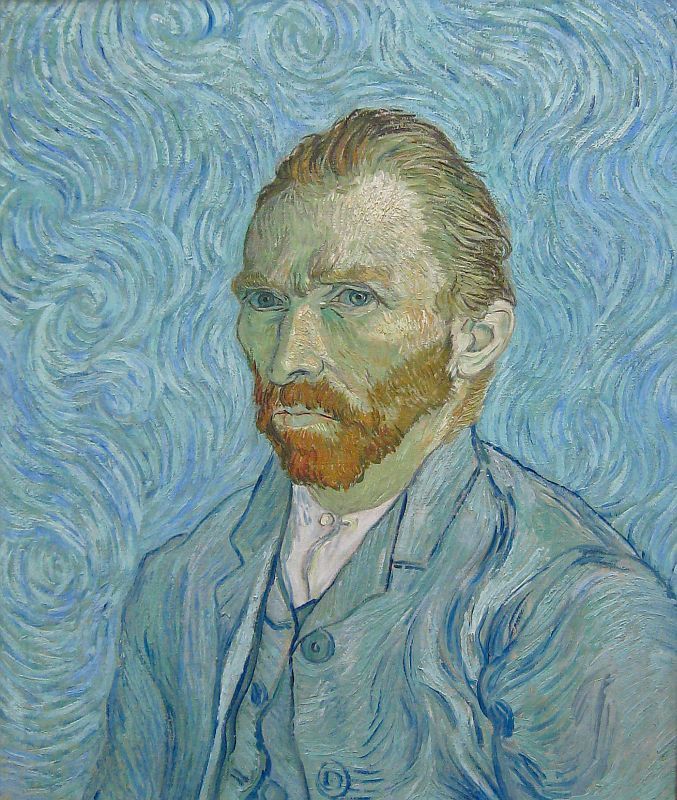
Sometimes I go back to look at a response and find that I am quite proud of it. I think distance can be a good thing.
This is my response to Creative Prompt #152. Take a look and see what you can come up with.
I really like the heads.
Commentary about works in progress, design & creativity
Sometimes I go back to look at a response and find that I am quite proud of it. I think distance can be a good thing.
This is my response to Creative Prompt #152. Take a look and see what you can come up with.
I really like the heads.
 Art Quilt Portfolio: The Natural World: Profiles of Major Artists, Galleries of Inspiring Works by Martha Sielman
I have been so remiss in reviewing this eye candy book by Lark Crafts! They sent it to me at least a month ago and I waited to have enough to write a review that would do the book justice. HAH! That will never happen, so here I am writing the review, finally. Hopefully, it is a good one.
This is a lush and lavish book. The photos are wonderful and there are plenty of them. The styles of the quilts are all different as well. Anxiety Won, 2006 by Ginny Smith has a folk art feel with the birds and improvisational cutting while I can’t even tell that Martha Cole’s piece, First Turning, 2007, is a quilt because it looks so much like a photograph.
This book is full of texture, paint, quilting, non-quiltmaking fabrics such as taffeta, embroidery, stenciling, which all flows together very well for a united whole. The color is rich and many of the quiltmakers nod at classic techniques and fabrics. There are regular quiltmaking fabrics that you and I probably have in our fabric closets. Piecing and quilting are used frequently by a variety of different artists to convey their message.
I have a love-hate relationship with representational works in the quiltmaking genre. I don’t like the quilts where an image is just printed on a piece of fabric and called a quilt. I believe in piecing and the symbology of some quilt blocks. I want some mystery. If someone wants to take a photo, go take a photo. I know that sounds harsh. Now you know one of my failings. Some of the quilts in this book are like that and I just had to ignore them. In spite of my own fault, there were so many other quilts with excellent designs and amazing imagery.
Unlike the Masters Quilts series, Masters: Art Quilts: Major Works by Leading Artists and book:Masters: Art Quilts Vol. 2: Major Works by Leading Artists, both of which I adored, this book goes into a bit more about the quilt artists, their process and some of the pieces. Judith Trager writes “I had been an avid gardener until about 2004 or 2005, when I discovered that I could no longer do the physical work. So I started making garden quilts” (pg.15). This is one example of a peek into the process. The other artists explain their work in different ways, sometimes talking about inspiration or process or how they got from there to here.
All of the artists’ sections are well illustrated and show a variety of work. I don’t know how any quiltmaker could fail to find something attractive. Cassandra Williams uses pieced diamonds and equilateral triangles as backgrounds in her quilt Dance of the Deep (pg. 81). Elsbeth Nusser-Lampe’s Struggle 2010 has the feel of Marie Webster’s Poppy quilt. The shimmer of some of the background fabrics is one of the elements that the artist uses to bring the feel into 2010. Aside from piecing, I also see the influence of other quilts in some of the pieces.
Threadpainting, which was mentioned in the Texture podcast from last week, and quilting are both very evident in this book. The photos are so good that they made feel I could reach out and many of the quilts. The reader is able to see the amazing quilting in many of the quilts. Vagabond Song by Elaine Quehl is one example.
This is an excellent book. I love the photos, the imagery and the accompanying text. Run, don’t walk to get this book. I am adding it to my collection!


I thought I would work on the Corner Store as my next project. It was calling to me during the dark time while I pieced the Renewed Jelly Roll Race. As soon as I turned my attention to it, it held no interest for me.
I worked a bit on the Garden, as I mentioned, but floundered a bit on Saturday. I made a couple of QuiltCon blocks, did a bit of piecing on the Swoon #6, but finally took myself in hand on Saturday night and planned out my Sunday.
On Sunday, I worked pretty steadily on the Flowering Snowball. Aside from some math issues, e.g. not being able to count, the process went pretty well. I had little to no trouble putting the hand pieced blocks together by machine. I do need a few more blocks, so I can’t finish the chunking until those are pieced. If all goes well, and I have counted properly, I should have them done by the end of next week. We’ll see. Don’t hold your breath.
I feel like doing another version of this pattern by machine with pink or aqua background. It has to wait, though, until many other projects are completed.
My camera seems to be taking fuzzy photos. I wonder what that is about?

This piece was started in a Pamela Allen class in 2009. I dreamed about it this week which encouraged me to pull it out of the closet (it usually hangs on the wall of my fabric closet, so I see it frequently) and I spent some time working on it over the weekend.

Basically, what I did was start machine quilting the background. I have a very straightforward style for quilting the piece: I start outside of the piece and go straight up and down until I am done with the section, then I move on to the next section.
I have the perfect green Aurifil for the green grass section, so I worked on that and got quite a bit done.
I also decided to use a variegated King Tut thread that I have had for awhile for the orange hand dyed sections around the turquoise flower. Really nice thread! I know I have used it before, because the wrapper was off the spool and I had a partial bobbin. I can’t remember which project, though. It gave me no problems and I really liked the look.
I want the piece to look like it was built in layers. At the moment, I am trying to figure out whether to also closely quilt the foreground (flowers, stems, leaves, etc) or if I will just use the Perl Cotton to quilt it. I have quilted the stems separately and at a slightly different angle to see if it looks different from the background.

Another layer of the piece is the different fabrics I used. Some of them are part of the same area, so I need to try to minimize the impact of the change of fabrics.
I should have quilted the foreground before I added the flowers, but in the course of a workshop, that sensible method just isn’t possible.
 Showcase 500 Rings: New Directions in Art Jewelry by Marthe Le Van
This is another book I received from Lark Crafts. Thanks, Lark! This particular book is another gem from the Lark 500 series. I love this series, because it is pure eye candy – no patterns, no basics, just fabulous photos of amazing pieces.
As I have mentioned many times, I am not a jeweler, however, I always love the opportunity to review shapes and motifs in a different format. I think it can inform my quiltmaking.
As the title advertises there are photos of 500 rings. I should say ‘rings’ because some of these pieces are more sculpture than the conventional idea of a wearable ring. I believe that artists in this medium are not making wearable art; they are making sculpture just as quilt artists are not making bed quilts. As I paged through the book, I was immediately struck by different shapes and motifs on the pieces: circles, drops, leaves, shells, confections and many others.
I also noticed the variety of materials. I see felted wool (??), knitted fibers, broderie perse type fabric pieces, paper, photographs, glass, silk, a clothespin, along with the normal metals and stones.
The contents page sports a photo of a ring that looks like a series of cross sections of colored pencils (also on pg.268), which drew me in right away. It is called 11 Ring 4 and is by Maria Cristina Bellucci. There is a piece that is morphing from ring into a glove (pg.80), which I think is an interesting evolution of this medium.
One of my favorites is Links Ring by Uranit Bar-Nes (pg.220). Of course the color (a sea blue) is one of my favorites, but I also like the color’s combination with silver and blue zircons. I also like Garden Pond Ring by Aurelio Castano (pg.216), which is a purely beaded piece with a huge stone in the middle. Another duo was Tangle Rings by Bridget Catchpole (pg.212). They are my aqua (tending towards turquoise), light green and white pieces where the shapes look like something that would be on top of a cake. The circles squished next to each other in Vina Rust’s Ring #1: Stained Cell Series (pg.171) is also a very appealing design.
If you need some inspiration, regardless of your primary medium, this book will provide you with some shapes, motifs and textures that will reinvigorate your artwork.

This block is related to last week’s block, #52 as well as Corner Squares in that I am working with squares and tall rectangles. I can really see this one going well with 2.5″ squares in the center. If anyone is interested I will post a pattern for that size (about 8″) as well.
Directions for 4 Columns with Squares are included.
If you have made blocks or a quilt from these patterns, please post a link in the comments section of the relevant block or on the AQ Block-a-Long Flickr group. I would love to see what you have made.
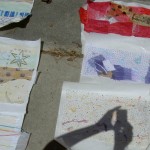
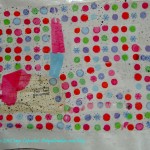
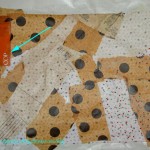
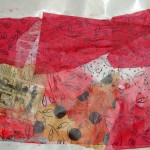
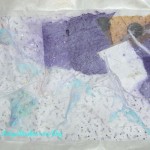
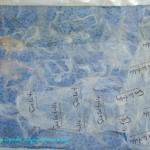
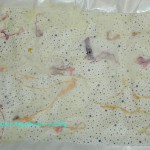
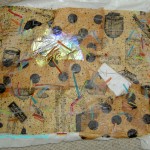
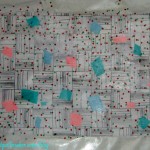
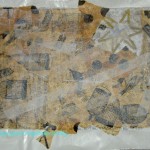
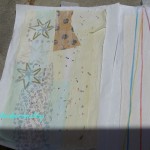
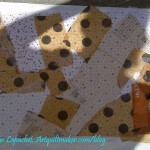
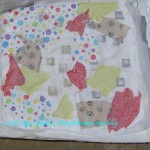
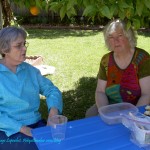
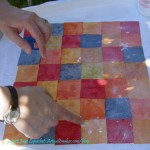
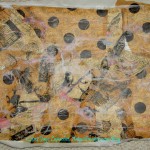
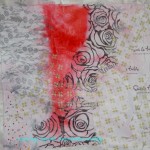
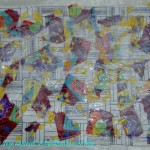
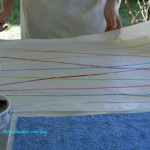
Last Saturday, CQFAers met at Sue’s house where she tried to teach us the secrets from Stitch Alchemy, a book by Kelli Perkins. The idea is to make fabric paper – a combination of fabric and paper. I hope to use mine for journal pages for journals like the Red Journal.

I don’t share well, but space was limited and Rhonda (of BAMQG fame – she plays with both teams 😉 )and I ended up next to each other. She is a great tablemate! We shared well and she is extremely creative. I felt like an idea-less boob next to her. She is like me in that we just got down to it. We also had fun.
During the time I thought of texture, because of the podcast I had just recorded with Sandy. I have a lot of schnibbles from pressing fabric so I brought that with me and adhered them to the paper. Sue wasn’t sure if it would work but it was worth a try.
The next step is to paint the fabric. We will do that at the next CQFA meeting.

The pieces for this project seem to be multiplying by leaps and bounds. It doesn’t seem like I am working with so many fabrics, but I am sewing relatively fast, so, perhaps, I am.

I am trying a new technique for pressing fabric. In between other pressing tasks, I am pressing the fabric I have washed recently. It means a steady stream of cutting and new fabrics to play with. In the second group (left), I was a little dot heavy. 😉
I was also trying to fussy cut bits from the larger floral patterned fabrics. There are also a group of solids for the QuiltCon challenge. I can’t decide whether or not to include a print in that project, so I have started with the solids and we’ll see how it goes.
 Heat, Color, Set & Fire: Surface Effects for Metal Jewelry by Mary Hettmansperger
This is another free book for review from Lark Crafts. Thanks, Lark! It is a large 8.5″ x 11″ book with gorgeous violet-lavender endpapers. In flipping through the tome, I noticed that earth tones dominate. Every once in a while there is a spark of color, which is used effectivelyl to catch the reader’s interest. I also noticed a lot of spiral motifs in the book.
After the introduction, which mostly sells the book and doesn’t introduce the author much, the book launches right into a section on materials (pg.8-27). This section is well illustrated and I particularly liked the subheading fonts. The section is also LONG and includes photos of items such as Liver of Sulfur, gloves and earplugs, disk cutter & punches, tripod for firing and a bench grinder. Interspersed with these scary looking tools are photos of jewelry, presumably to soften the blow for a new jeweler. 😉 The Basic Techniques section is also quite long (pg.29-51). Each part of the Basic Techniques section gives step by step instructions for creating a new texture or applying a technique and then shows an example of the end result. I am pleased the author and publisher thought it was worthwhile to document and illustrate these foundation sections so thoroughly.
There are 21 projects included, each spanning about 4 pages. Lots of illustrations and drawings are included with each project. Templates are frequently included as well and variations are shown in photos to spark creativity. I like the Colored Tin Collection project, the Mixed Metal Bracelet project, especially the variations, and the Orange Enamel Choker, though I might want to put the pendant on a different chain.
This seems to be a great book for adding texture to your metal projects.
escape paintball
Escape from Alcatraz
Escape from New York
a computer game
the Great Escape
escape fate
escape the maze
Definition: [ih-skeyp] Show IPAverb, es·caped, es·cap·ing, noun, adjective, verb (used without object). 1. to slip or get away, as from confinement or restraint; gain or regain liberty: to escape from jail. 2. to slip away from pursuit or peril; avoid capture, punishment, or any threatened evil. 3.to issue from a confining enclosure, as a fluid. 4. to slip away; fade: The words escaped from memory. 5. Botany . (of an originally cultivated plant) to grow wild. verb (used with object): 7. to slip away from or elude (pursuers, captors, etc.): He escaped the police. 8. to succeed in avoiding (any threatened or possible danger or evil): She escaped capture. 9. to elude (one’s memory, notice, search, etc.). 10. to fail to be noticed or recollected by (a person): Her reply escapes me. 11. (of a sound or utterance) to slip from or be expressed by (a person, one’s lips, etc.) inadvertently.
Ford Escape SUV
Her name escapes me
escape the room
escapism: is mental diversion by means of entertainment or recreation, as an “escape” from the perceived unpleasant or banal aspects of daily life. It can also be used as a term to define the actions people take to help relieve persisting feelings of depression or general sadness. (Wikipedia)
prison break
Escape”, a song by Journey from the album Escape
to elude
The Creative Prompt Project, also, has a Flickr group, which you can join to post your responses. Are you already a member? I created that spot so those of you without blogs and websites would have a place to post your responses. Please join and look at all of the great artwork that people have posted.
to succeed in avoiding
Sandy and I had fun talking about Texture, another element of design, a few days ago. It is so interesting to do the research for these segments as I learn so much. Check out Sandy’s podcast episode 89 on Texture.
Texture is an Element of Design
Definition:
Texture and Pattern are closely related.
Types of texture:
Some thoughts:
Use of Texture in General
Use of Texture in Quiltmaking
Notes:
Homework:
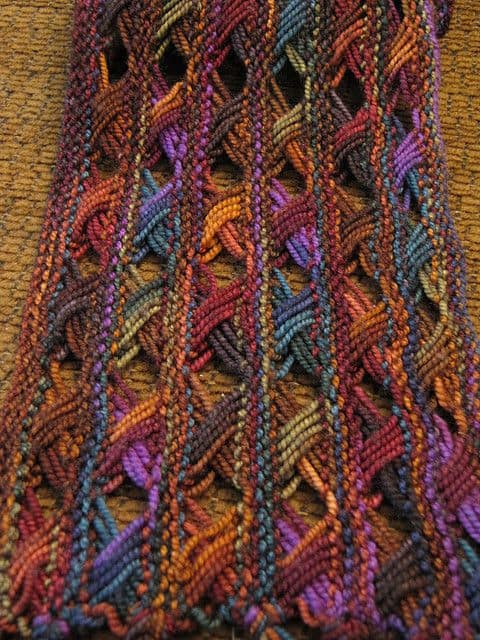
Source: ravelry.com via Jaye on Pinterest
The example above has great texture.
Resources
A Fiber Artist’s Guide to Color & Design by Heather Thomas
Adventures in Design by Joen Wolfrom
Art+Quilt by Lyric Kinard
Design Basics by Pentak & Lauer
Leaf embroidery: http://www.duitang.com/people/mblog/19374527/detail/ (note this is an Asian site written in characters. I don’t read this language, so don’t know what it says)
Ludmila Aristova Website – http://web.mac.com/ludmila.aristova/Ludmila_Aristova/Home.html
Piecing: Expanding the Basics by Ruth McDowell
Quilter’s Book of Design, 2d, by Ann Johnston

Here is the next Swoon block. As I mentioned, I have to finally admit that this is a project that will turn into a quilt. I am not quite happy with the blue, but I think it will be okay in the grand scheme of all of the blocks.

I am progressing well on the Flowering Snowball. I seem to be able to sew about a block a night. These are hand pieced, which is why they take so long.
I am trying to decide how to put the blocks together – by machine or by hand. I am thinking that I will put them together by hand and then go over them by machine. I am hemming and hawing because the hand stitching isn’t as precise in terms of seam allowance, so I have to sew on a line rather than lining up the seam allowance. I’ll try it out and see how it goes.
I am pleased with the progression and glad I took it up again. I am really liking the way the side and corner blocks look. Another good example of self bordering success.

This block is related to last week’s block, #51 as well as Corner Squares in that I am working with squares and tall rectangles. I can really see this one going well with 2.5″ squares in the center. If anyone is interested I will post a pattern for that size (about 8″) as well.
Directions for 4 Column Squares are included.
If you have made blocks or a quilt from these patterns, please post a link in the comments section of the relevant block or on the AQ Block-a-Long Flickr group. I would love to see what you have made.
I am not sure why I feel compelled to write at the moment , but I do. Perhaps I have been neglecting the thoughtfulness I try to put into my posts lately. Life is busy and that takes a toll on my quiltmaking and blog writing. I try to keep up, but usually it means a picture and a few words. I am still looking for an art patron to pay me to stay home and sew, if you know of anyone.
What I am Reading: Parallel Motions by John Anderson. It is a biography of Nevil Shute, the author of one of my favorite books, A Town Like Alice.
Audiobook on Tap: A Room with a View by E. M. Foerster. You are probably all familiar with the film. I could never get into the book, but it was a free audiobook at some point, so I thought I would try listening. I thought it would be good since I am enjoying Downton Abbey (better late than never) and read The Lady Julia Grey series, also set in Victorian England, earlier this year. I thought that it was the right time since I seem to be embroiled in Victoriana.
What I am Working on: Today, I spent time making blocks and doing the kind of things that need to be done to make progress later.
The Corner Store is in progress and I had to cut a bunch of squares to make more blocks. I have about 60 blocks so far, but they are very small, so to make anything larger than a placemat I need many more blocks. I have a lot of triangles, so I just cut the Kona Snow squares. I went through about 3/4s of a yard of Kona Snow and know that won’t be enough. I probably need another 120 blocks to make anything large enough to satisfy me.
I finished another Swoon block and have to admit that I have a project going. I think I will make another 3 blocks for sure and possibly another 6. I have plenty of fabric, of course. There is something about this project that is interesting to me in terms of color, so I am not quite done with this project yet.
I worked on the A-B-C Challenge blocks and started to prepare for the QuiltCon (what a stupid name, don’t you think?) block challenge. I have the fabrics, they are washed. They need to be pressed, but I need to plan the block.
I don’t feel like I accomplished much, but I know I was doing prep work that needs to be done.