The other night, I had the pleasure of a trip to the quilt shop and a meal with Susan from the History Quilter podcast. We had enough time, so I gave her the nickel tour the western part of the City, which is nearest the ocean before we went to dinner. I totally scored, because she had never seen the part of Golden Gate Park we drove around.
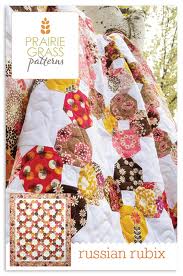
Russian Rubix
Before the tour, though, we visited the quilt store. It is really the only one near enough for me to actually visit without making a day trip. I thought Susan might enjoy a new quilt store and I want to encourage her to get going full force on her quiltmaking. I am dangerous to know in that way. ;-)We had fun walking around the store and looking at the books and fabric. I gave her a mini-lesson on how to select colors, because of a chance comment about how it wasn’t easy to pick out colors.
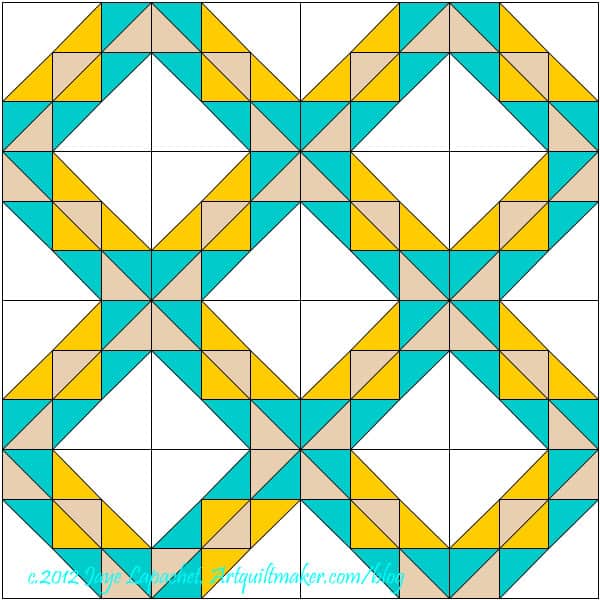
One of the things I skimmed over at the quilt store, but Susan keyed right into was a pattern called Russian Rubix. The pattern is by April Rosenthal and she has a shop called Prairie Grass Patterns. The quilt shop we visited had made up a sample and it was great.
What is different about the quilt is that the pieces (shown in color in the photo above) are octagons. Big deal, you say? Octagons not hexagons. I love hexagons, especially the Flower Sugar Hexagon on which I have been working. However, everyone creates with hexagons, but you don’t see octagons that often. The parts of the blocks have the octagons arranged in such a way that they look like wreaths. I was intrigued.
Susan, as I said, saw the uniqueness in the pattern originally. She decided to the buy the pattern and we looked at it during dinner. The more I saw of it, the more intrigued I became.
I think that the way the directions are described are not the only way to make the octagons. One can cut squares that will end up as octagons, sew smaller squares to the corners, eh voila! You have an octagon. The only problem is that the pattern doesn’t need squares. If I made squares, I wouldn’t be able to make the wreath shape.
One of the things I love about quiltmaking is the puzzle part of the process. I know I will make some test blocks and figure out the size and the construction method for this piece. I do that as a general practice. I will buy the pattern, but I don’t really need the pattern, because I can figure it out myself. However, I do think that the pattern designer deserves something for her efforts. I’ll get a copy when I go to the quilt shop next time.
Ms. Rosenthal has Rubix Too, a follow-up, quilt pattern in her shop.
Thanks to Doug88888 for allowing this to be shared.
This is part of my effort to help you “see” inspiration wherever you are.
I sometimes think I should get a fish tank just to keep me calm. I wouldn’t want to do the work to keep the tank clean and the fish alive, though. Sad, but true.
The servers where I host the Artquiltmaker blog were down yesterday when I had time to post, so this is a last minute post or a bonus Creative prompt post, if you want to think of it that way. What can you do it with it?
A few weeks ago, I wrote about my strategies for getting out of the Creative Desert. Getting out of the Creative Desert is different from seeking inspiration. Just because you are piecing a bunch of squares together doesn’t mean you are inspired. Piecing a bunch of squares together is good because you are working, but you are only at the first step back to your creative potential.
I find that if I need inspiration, it doesn’t work for me to go out and look for it at that moment. I can’t rush outside and look around and expect to be inspired JUST LIKE THAT. The world might be boring that day or I might not be able to see, really see. I have to be prepared. I have to be in the habit of looking for it every day as I go about my business. I have to accumulate possibilities so it is available when I need it.
Teaching yourself to see requires training. Fortunately, the training does not require you to spend time in the gym every night. It requires you to clear out your head for 5 minutes and look. Christi Friesen, a polymer clay artist, described what I am talking about really well in a recent Notes from the VooDoo Lounge podcast episode. She said your mind has to go into “screensaver mode” to get your best ideas. (a creative example of this can be found on writer Deanna Raybourn’s blog in a post from last week) That explains why I get my best ideas in the shower or right before I drop off to sleep. Thoughts about lunches for tomorrow, who has to be picked up from where and what’s for dinner are not on my mind and there is space to be inspired, to put together the bits and pieces of inspiration you have encountered into a logical whole. Listen to this episode, if it is not on your regular playlist. Exercise: go out at lunch, walk around the block with a clear mind. Don’t think about your next meeting or the assistant who won’t do your bidding. Look at the world around you.
1st: Identify: I know what I like: mosaics, leaves, color, architectural details are a few. You have to look at a lot of stuff to know what you like. It doesn’t matter what other people like, because if you don’t like something, you won’t be inspired.
2d: See. Walk around with your head up. Stop looking at your shoes; they are fine. Really. They are fine. Get out of your head and SEE what is around you. See what is really in front of you NOT what you EXPECT to be in front of you. Seeing is different than looking. We look at the things around us so we can avoid the slimeball from the sales department, not get hit by a car, and find the right coffee shop. Seeing is the next step after looking. Something deeper sparks your interest and you pay attention to the thing. The thing gets in your head and your mind starts playing with it, turning it over and translating it into a quilt design or a machine quilting pattern.
If you can’t go out or you live in an industrial wasteland, look at sites that provide you with inspiration that you don’t see in your every day life. Flickr and Pinterest can be black holes of creative doom, but they can also provide excellent inspiration. People share photos of their trips to exotic lands and interesting tidbits they see in their daily travels. Put some random words into the search box and see what you get. I found the above photo by putting “Thailand blue” into the Flickr search box. Gorgeous birds, aren’t they? Look at the color combinations! Check out the beaks. I love the feathered tail of the bird flying. Amazing!
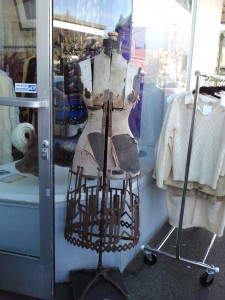
Piedmont Ave Mannequin
3rd: Document. Having a camera in my phone is the best thing ever. I take photos of the strangest things because of some little detail that sparked some interest. I have photos of half decayed leaves on the street because of the color. I have a corner of a magazine page, because of a star pattern that might be good in a quilt some day. I have a photo of a rack of vintage sweaters, because of the shape. I am focused on quiltmaking, so when I see a pattern or design that I like, I document it for a later quilt or machine quilting design. You may not see what I see, which is why you need to collect your own inspiration.
If you carry your camera around or have a smartphone, remember that your photos don’t have to be professional. The photo of the mannequin above has that commercial door in it, which looks stupid, but I want to photograph the whole mannequin without completely blocking the oh-so-narrow sidewalk traffic.
You don’t need a camera in your phone. If you don’t want to haul your camera around with you, bring a sketchbook. You don’t have to be Degas or Seurat. You aren’t drawing on the street or on the bus to win awards; you are drawing to remember something, for your own use. You don’t have to share. Commit to whipping out that sketchbook to record a line or design. This is your inspiration. What it looks like in your sketchbook will never look like the end result.
4th: Manipulate. Put your photo or sketch (after you scan) through Photoshop, Photoshop Elements or one of the free programs available online. Add filters. Change the pixels to a sketch or a different color. See what happens. Save your creation as a new file and compare to what else you have done.
5th: Use. The inspiration you are collecting will quickly become crap if you don’t use it. Look through your folders or boxes periodically. Don’t review your bits and pieces only when you are in need of inspiration. Look through folders regularly just because. If you can’t remember why you saved a shard, then it is time to toss it.
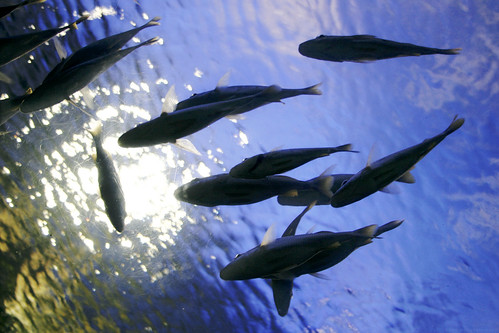
Sea by Cuba Gallery
6th: Organize. For every project, I keep all of my notes, swatches, and details in a file folder. Once you have decided to work on a project, put the shards of inspiration into that file folder with your calculations and fabric swatches. Have you ever seen the movie “Working Girl”? She uses her organizational system at the end to prove the deal was her own idea. You can tell where you are and how to move forward if all the pieces are in one place. Also, if they fall out of the folder, the way they land might provide further inspiration. If you let a project simmer for awhile, having your inspirational shards all together will help you get back on track quickly.
I have been looking for flowers for my front flower bed. I want something drought tolerant, but pretty. I saw these at Disneyland. Not only did I think that they might work for my garden, but I like the shapes-that usher hat shape in the middle, especially.
I walked down S. Michigan Street in Chicago towards the Art Institute of Chicago one day. I am a sucker for architectural details and saw tons. I was in a rush, though, because I only had a little while to check out the AIC.
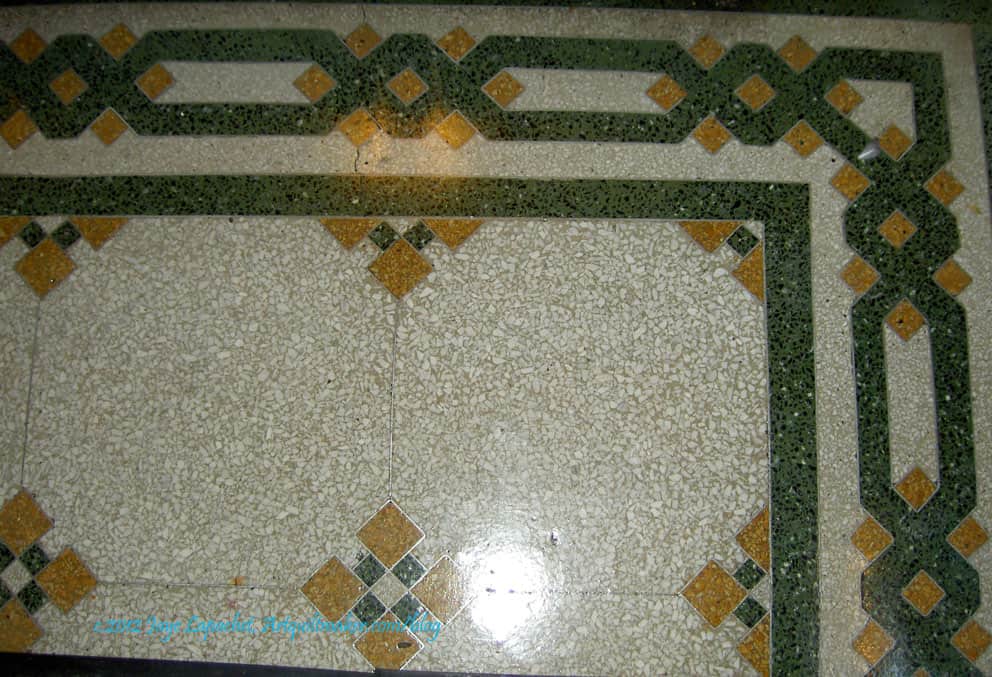
On my way back, I ducked into vestibules and lobbies to take photos. I was rewarded by this tile floor. I want to make this border. I need to figure out how to make this border!
Border detail
I think that the border could be divided up into blocks to make the piecing easier and more straightforward to piece.
Notice the little corner treatment inside the straight green inside border.
I even kind of like the green and gold, though I wouldn’t do all that piecing, then create a green and gold quilt with such an elaborate border.
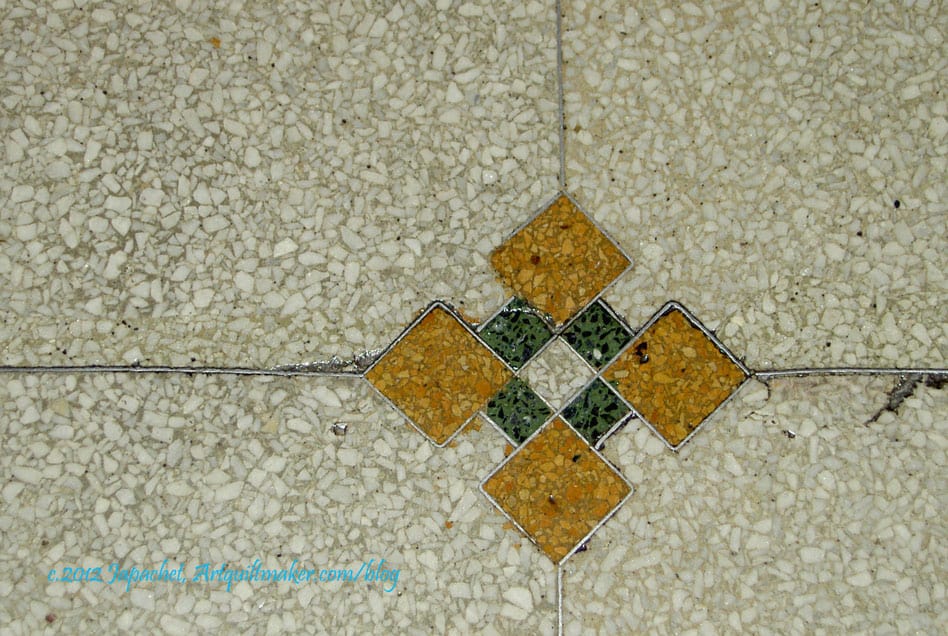
Nine Patch Reimagined
Several of these blocks are spread over the center of floor that has the border above. I glanced at it and thought “nine patch,” then I looked at it again and was intrigued because of the way the middle squares (green in this rendition) are smaller and part of the space disappears into the background. I really like the way the yellow squares are much larger. I’ll have to try making one of these.
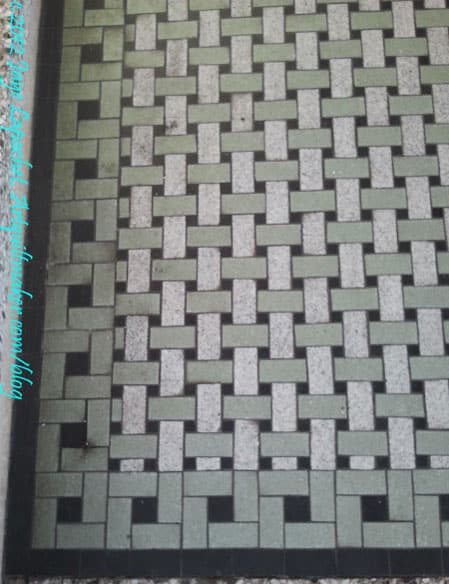
I am fortunate to live in a place where I can walk down the street and see a quilt pattern. Recently I saw this tile entryway and it reminded me of the Basketweave Baby pattern I mentioned some time ago.
This tile pattern is also similar to one I saw in Petaluma. I was lame and didn’t take a photo of the corner of that older entryway, but there may have been a reason. I do like to take photos of the corners, so if I decide to make such a pattern into a quilt pattern, I know what to do with the corner – or at least I know what someone else did.
There would be a lot of partial seaming if I made this as a quilt.
Do you see how the piece looks like there are curves. If you click on the photo to make it larger, you will see that there are no curves. That illusion is so interesting to me.
There should be a reality show called Vendors Behaving Badly. It couldn’t be any worse than the reality TV shows on channels today. When copious amounts of caffeine and chocolate didn’t work, I took myself off to the John Berggruen Gallery to look at the Wayne Thiebaud exhibit they have on display.
I love Wayne Thiebaud’s work.
I love the way his brushstrokes look. I love the way he paints regular things. The cakes and pies and other desserts are kind of special, but they are also normal. I strive to be a bit influenced by his work in my own drawings for the Creative Prompt Project.
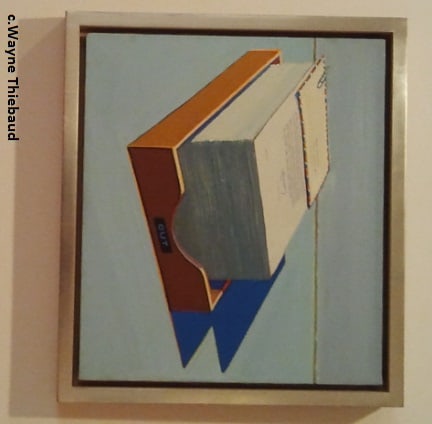
Letter Tray
One of the things I like about his painting of the out tray or letter tray (don’t know the real title) is the writing. The way he painted the writing really makes it look real, if a bit blurred. I am interested in his technique, because of my recent attempts at including writing in my Creative Prompt Responses, e.g. #141.
I tried to notice things about his work and not do just a “drive by” viewing. This was an interesting selection of his works. I had seen similar paintings, but I am not sure if I have seen these exacts images.
I prefer his cakes and desserts to his landscapes, so I made myself really look at the landscapes this time. I think of Mr. Thiebaud as using very thick paint. I didn’t see that as much in this exhibit in general, but also didn’t see it in the landscapes. I wonder if he uses a flatter painting technique with his landscapes? I was able to still see the brush strokes when I looked at the paintings at an angle. I couldn’t see 3 dimensionality, however, looking at the painting straight on. The strokes on the backgrounds were very vertical, which I think added to the sense of extreme hills.
The landscapes were almost a caricature of the City. He used subtle colors and different colors that one would expect for a landscape – blues in the trees, turquoise and yellow. The colors add interest and are effective.
There were a few paintings from the 1960s and some from 2004, 2007, etc. It was very interesting to see the evolution in his work, not only in technique, but also in the changes to his series.
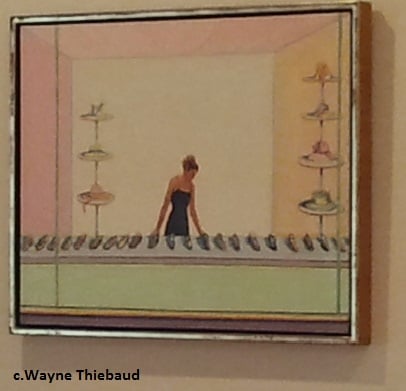
Hats and Shoes
One thing I noticed in the Hats and Shoes painting was the pink ceiling was a slightly lighter pink than the wall. Very effective.
I am pleased that I went. I would love to have the space as a studio!
I really can’t figure out how my mind works. Sometimes I like the way it works, because it sends me off in a new creative direction.
I was making the Northwind block for the Bay Area Modern Quilt Guild A-B-C Challenge and got to the point that you see in the top left photo. All I had to do was put some larger triangles on the sides and I would have a nice tidy square, but this shape stopped me in my tracks.
I have been wanting to make a Lozenge quilt for awhile, but it hasn’t come up high enough on the to do list yet, but seeing the way this shape went together made me think about that future piece a bit more.
You can easily make this into a square by adding triangles. In this case, the triangles will be part of the design, but they could easily be background as well.
I could change the colors around so that the piece would be really scrappy or use 80% of a line of fabric.
The piecing isn’t difficult – few half square triangles and you are in like Flynn.
Lozenge Example
So, this is an example of a quilt made with this shape/block.It is a quick and dirty EQ7 design and I can already see some changes that I want to make, but you get the idea of what you could with this block. I like the diamond shape. It reminds me of the Stepping Stones quilt.
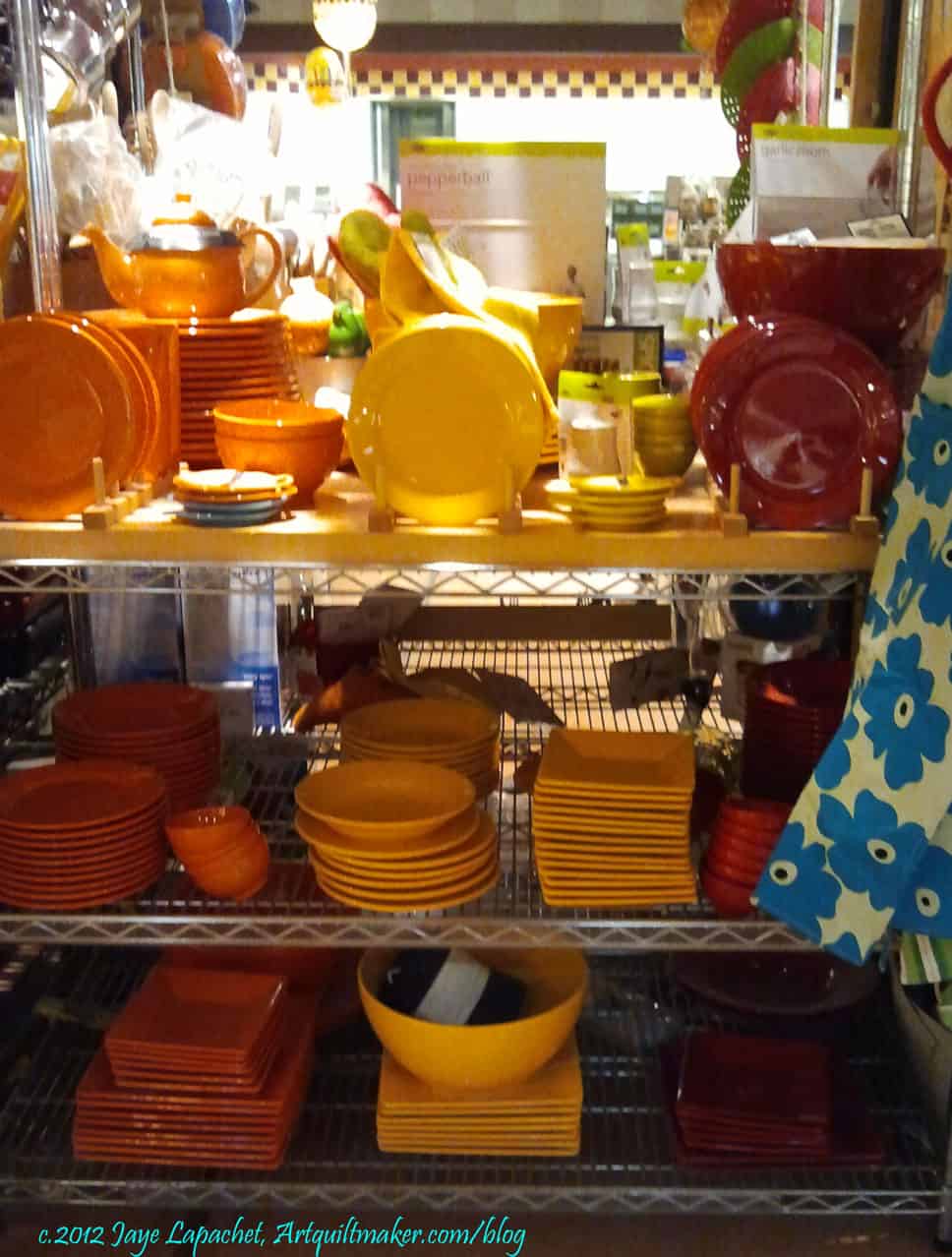
I stopped at Mollie Stones yesterday and saw this display of plates and dishes. I thought it looked so cheerful that I had to take a photo. If I had a country house, I would have cheerful dishes like this.