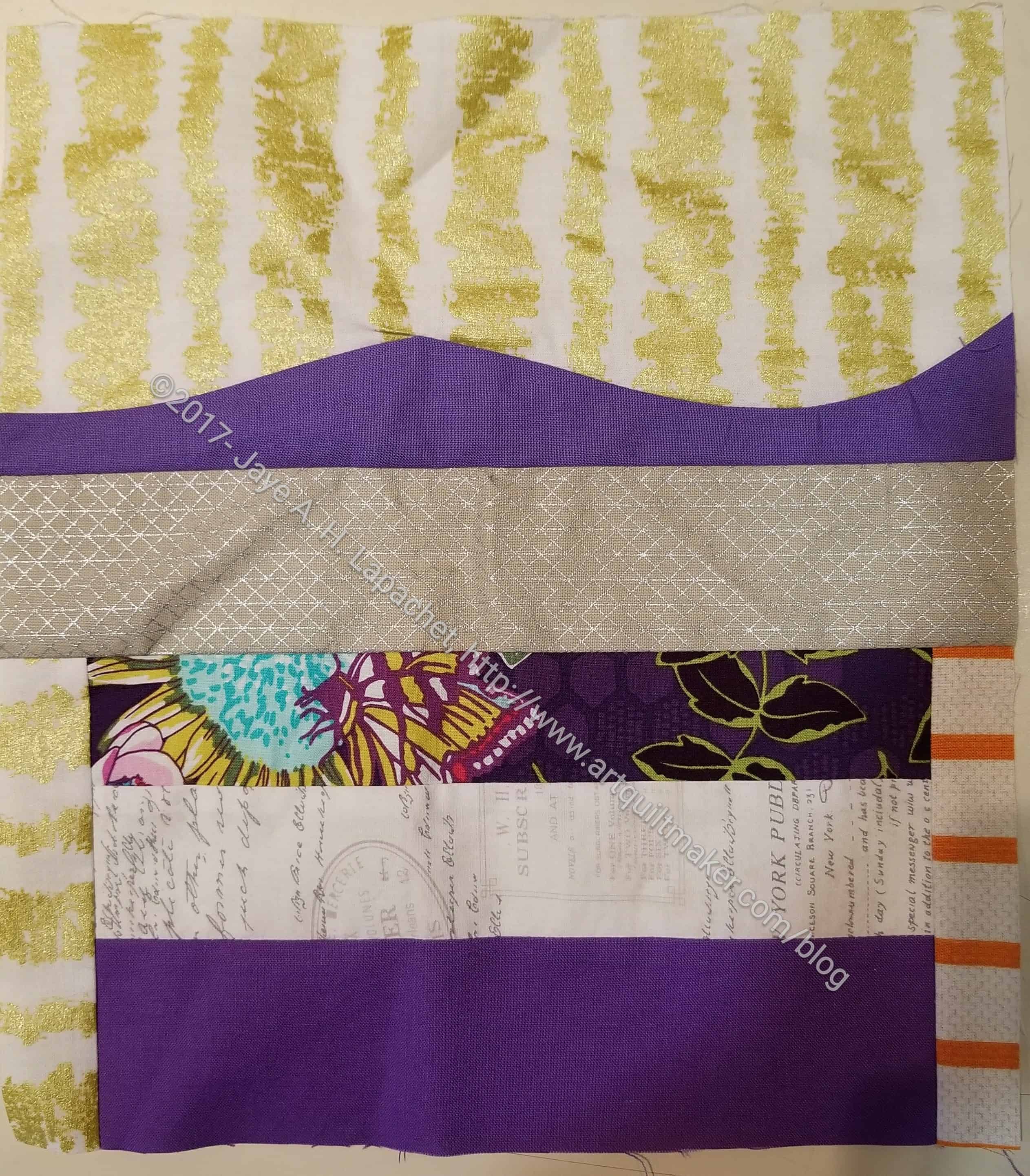
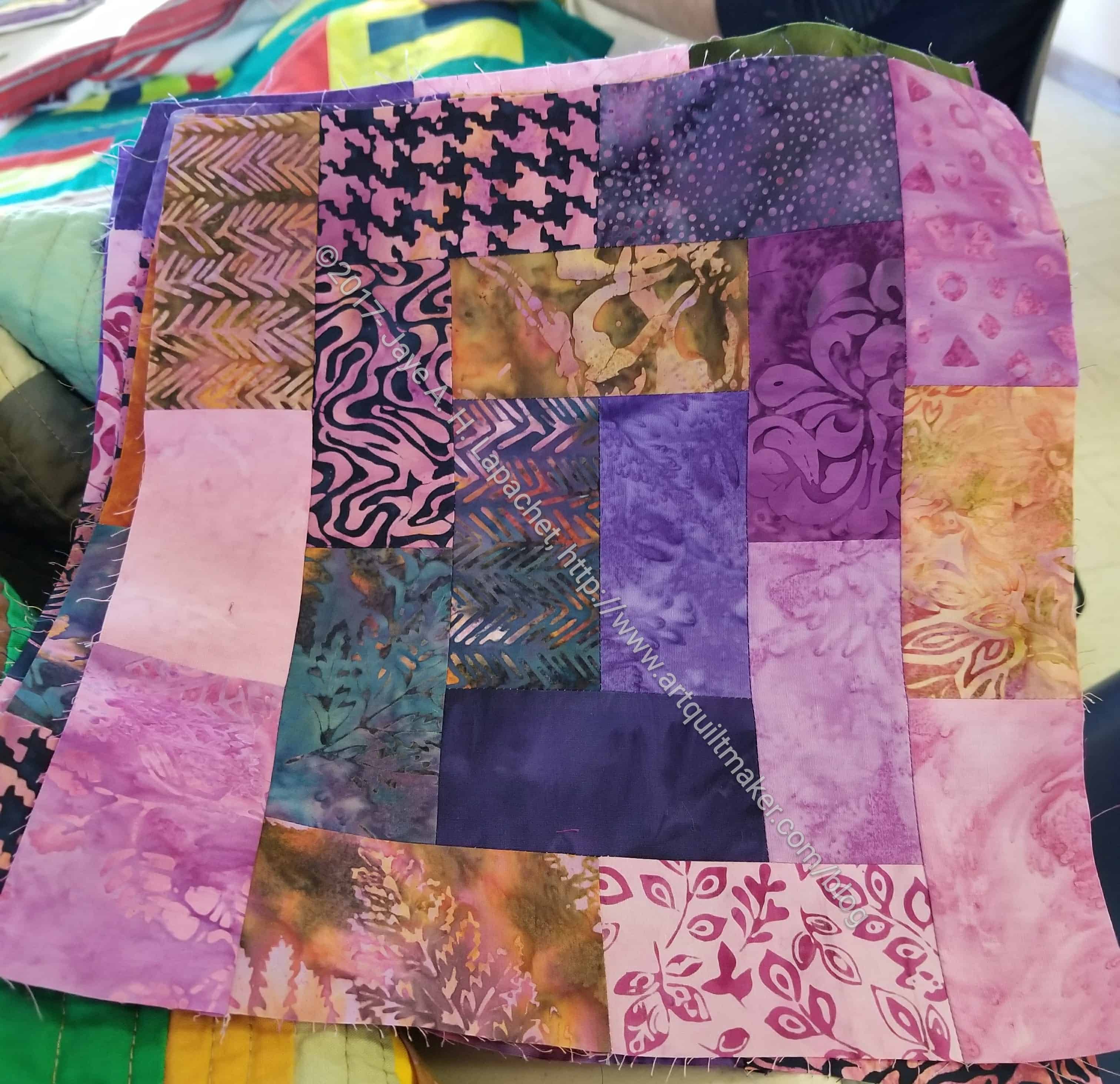
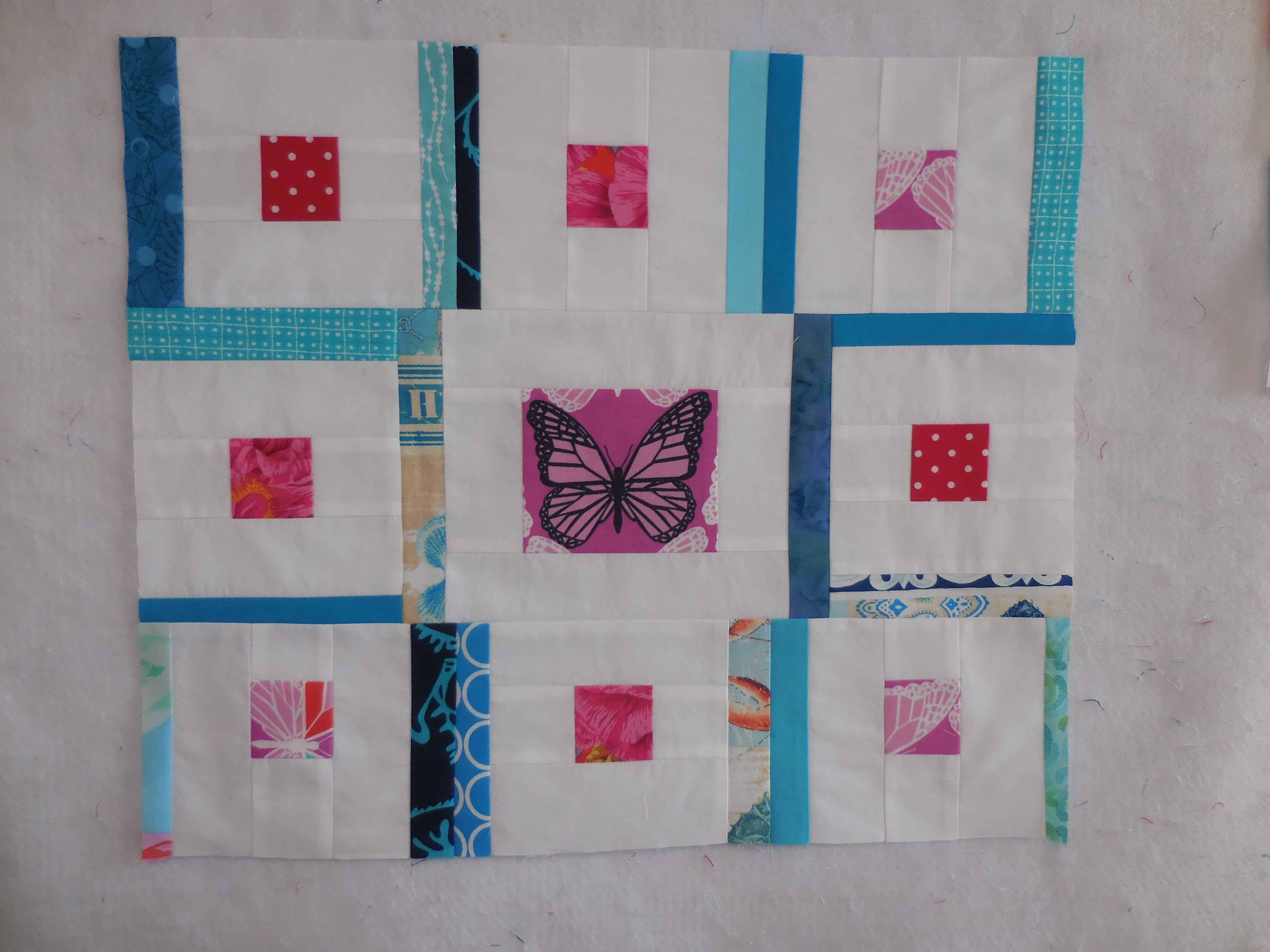
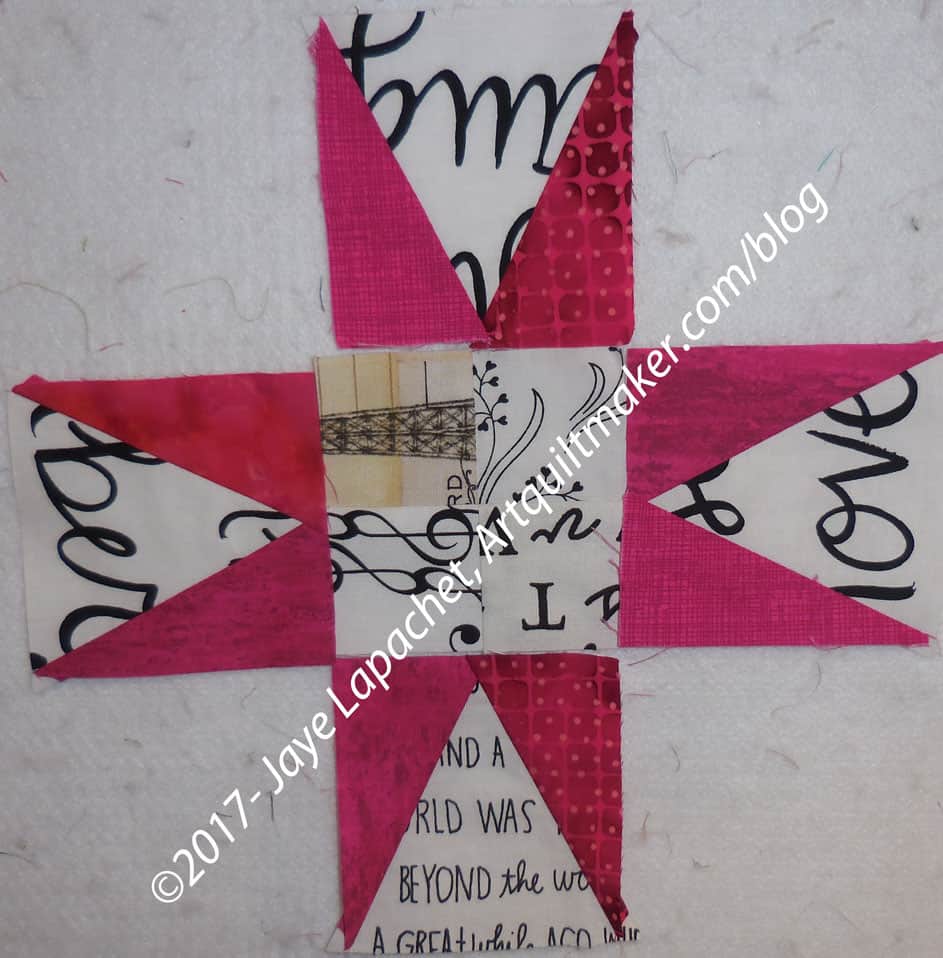
The Color My Quilt project reared it’s lovely head again and I got busy making something for Michelle. My goal was to use my scraps, though I was determined not to skimp and paw through the fabric closet if there were no appropriate scraps.
One of Michelle’s words was shiny and I found some fabric that had a lot of shine, so I grabbed that. I also found some perfect purples. I was embroiled very hard in another project and this little piece allowed me to play a bit.
Remember the Crazies in Spark #4? I think Doubt is related, but the Crazies prevents us from doing things while Doubt makes **me** think I can’t do something and should just continue on as I am. Doubt prevents me from taking risks. Not knowing the outcome is scary.
Bloomston says we have to trust the process. She says to “befriend your doubt…. Maybe even nicely ask your doubt to leave.” (pg.65). Hhmm. I have never tried this. She says that “When we are trying to get rid of something, we expend a lot of energy and we are unwittingly feeding it.” (pg.65). This is interesting and really makes me stop and think. If I have doubts, are they creating other doubts – inviting their friends to the party?
Bloomston has four ways of removing doubt: Rituals, Music, Affirmations and Talismans. Rituals spoke to me most. We do not “…have enough rituals in our modern culture…” (pg.65). To each his own, but I feel this is true for myself. I have created some quiltmaking rituals:
I turn on all of the switches and things in the same order.
I check all of my tools: are they in the right place? Are there any issues I need to resolve?
then I get started with the step I have set up unless I have been working through a construction problem in my mind and am ready to tackle it.
When I finish for the day, I always set up the next step so I can get started right away when I have a moment.
Perhaps I have more rituals, but I will have to think about what they are.
Carrie Bloomston describes a talisman as “…an object believed to contain certain magical properties that may provide good luck or fortune.” (pg.66). I definitely have talismen. I have a little shrine of photos of people closest to me. In that same space I have some objects that I care about: a shell, a smooth glass heart, some rocks with words – courage, peace, healing – carved into them. I also have a rotating ATC and a few other things there as well. There are a few places where I have placed things I care about. I guess these all could be called mini-shrines. I never really thought about it because I have created these instinctively, but these are my talismen.
What are your rituals?
What are your talismen?
Nota bene: we are working through Carrie Bloomston’s book, The Little Spark. Buy it. Support the artist. There is a lot more to each spark than what I am writing and the original chapters will help you. Go buy Carrie Bloomston’s book, so you get the full benefit of her fabulousness! You can see my book review, which is what started this flight of fancy.
You can find the last spark on the blog several weeks ago.
Belinda was making blocks for a donation quilt. I thought the design was great. It was great for all quilts, but especially for donation quilts.
The rectangles are 2.5″ x 4.5″, which is a size I am cutting for two future quilts, so not unfamiliar to me. The blocks can be made from any size rectangle as long as the rectangles are proportional.
Belinda used a Bali Pop, which looked really great. I thought that cutting rectangles from a variety of fabrics as I cut other fabrics up for my projects would be interesting as well – a scrappy look.
I figure that the blocks are about 12×12 finished, so making 9 would make a good sized donation quilt. I’ll see about making one once I have the other two, which are in process, finished.
I finished Gerre’s piece on Sunday. I was almost done on Saturday, but had a bit more to do.
This did not come out as I envisioned, but I still like it. I saw that butterfly and it made me think of Gerre.
On both pieces, I had blocks on the mind. I really didn’t feel Improv in my piecing plan this time, so blocks it was. I had some leftover bits that I didn’t use, so I included them with the packet as well.
This chapter is about finding the original flame of your creativity. So many people I meet see one of my quilts and say something like ‘I could never do that’ or ‘I am not creative like you.’
Baloney.
What I do isn’t that special. I may get special results from my choices, but anyone can sew a straight line. Really. ANYONE. The key in this chapter is to read the text and think about it. Remember ‘images of your creative life as a child.” (pg.61).
I was fortunate that there was always plenty of opportunities at my house to be creative. We painted plaster 3D objects, we made stained glass and painted canvasses. The theme was not perfection but to make stuff and keep trying. the items I make are not always perfect, but I don’t get discouraged; I keep trying.
People I meet or know use negative self talk as the basis of their life, it seems to me. The phrase: ‘I did that terribly, which makes me a bad person’ is one of I heard in various iterations a million times, many times from women friends. It is VERY important to “replace those negative messages with some others. Take each of the negative messages” you thought “and write the opposite.” (pg.63). Then practice positive self-talk. Anytime something negative starts to escape your lips, spit it out (quietly) and say the opposite. It doesn’t make you cool to degrade yourself.
This chapter is all about exercises. If you only buy the book for this, buy and do these exercises.
Nota bene: we are working through Carrie Bloomston’s book, The Little Spark. Buy it. Support the artist. There is a lot more to each spark than what I am writing and the original chapters will help you. Go buy Carrie Bloomston’s book, so you get the full benefit of her fabulousness! You can see my book review, which is what started this flight of fancy.
You can find the last spark on the blog last week.
The first thing I noticed about this chapter was the sidebar on the chapter’s image. It says “Phoenix, Arizona yoga teacher Anton Mackey encourages students to turn off their minds and look within by closing their eyes as they practice their yoga: ‘You don’t need to see the pose, you just need to feel it.’ Trust your body to take you where you need to go.” (pg.56).
What I thought it said was that the teacher could teach students to turn off their mind. I got a much more adamant message from the sidebar than what is actually there. I need someone to tell the way to turn off my mind, because when I am not listening to something (usually an audiobook), my mind is reeling. This chapter’s main message is that “…sometimes you just need to get out of your head.” (pg.57). I do need to get out of my head, but I also find that if I let my head roam free for awhile, it goes crazy at first and then settles down to some interesting and, possibly, enlightening commentary.
Some of this chapter is about moving your body. I don’t want to use the word exercise, which has a billion nasty connotations, but moving my body helps my mind. “Regular exercise increases the number of tiny blood vessels that bring oxygen-rich blood to the brain and body.”(pg.57). More blood to the brain means more creativity, right?
The whole package, blood, brain and quietening the mind, is about providing “…space between yourself and your thoughts.”… “For creativity, it is important to turn off the incessant chatter of your mind and to bypass the intellect…” (pg.57) I really believe this. I listen to audiobooks when I am sewing, but more and more I am turning off the story to just be with my fabric. Sometimes I get the monkey mind and incessant intercranial chatter. More and more, I get peace. It is practice.
Is it connected that I exercise regularly (and I am not trying to make anyone who doesn’t move as much as I do feel bad-I am not judging!)? “The mind often seeks the comfort of the rational solution, the safety of habits and the status quo. It’s filled with those dudes that limit us: critic, judge, axman of dreams.”(pg.58). These guys are quieter when I exercise. I don’t always push myself, but I do always get my heart rate up and sweat. The more I do those things, the quieter the monkeys tend to be.
“Creativity comes from innocence, openness, curiosity, and playfulness.” (pg.58) and there are other ways to achieve these things than exercise. Exercise, IMO, is kind of a shortcut. “Your rational mind doesn’t always serve you. It can impede your intuition and the strong messages you are receiving. Learn to turn it off so you can get to the business of tending to your soul,” (pg.58) improving your creative self and being creative more frequently and without fear.
Nota bene: we are working through Carrie Bloomston’s book, The Little Spark. Buy it. Support the artist. There is a lot more to each spark than what I am writing and the original chapters will help you. Go buy Carrie Bloomston’s book, so you get the full benefit of her fabulousness! You can see my book review, which is what started this flight of fancy.
You can find the last spark on the blog a few weeks ago.
Yes, I am starting another project. Mostly I am starting it because Daisy said I should and then the omens were good. I found a layer cake I liked at $15 off and found some American Made Brands background at a $1 off per yard. Perhaps this will be boyish enough for one of the nephews?
Alison Glass Sunprints from Fabric Depot
American Made Brands Charcoal from Yoder’s
I couldn’t have done it without my recent travel. I got the layer cake (left) at Fabric Depot in Portland. That place is huge-HUGE and they were having a pretty good sale. Yes, both new items add to my fabric usage totals, but I am hopeful that I’ll be able to finish something larger than a handbag soon.
The charcoal is from Yoder’s in Shipshewana, Indiana. They had the whole line, which was awesome! I got a bit more than I needed, but you know, mistakes. The fabric is now washed so I can start cutting.
The quilt is called the Layer Cake Explosion. You can find the free pattern on Craftsy. Also, check out Daisy’s blog for more information. I did look at the templates for the alternate block and I am thinking I might do something else. I am not a fan of the way that little triangle looks. We will see.
The pattern calls for the Creative Grids Stripology Ruler. There is a YouTube video which shows you how to use this ruler. As much as I love rulers, I don’t think I will be using it. I think I will use my Accuquilt, though it is possible I don’t have the right die for the strip size. Stay tuned.
“Retail, in our capitalist society, has cornered the market on creativity in so many ways” (pg.53). I have to say that the opening line makes me happy and sad. Sad, because retail=shopping=spending money, sometimes unnecessarily. Happy, because creative people work in retail who create beautiful environments that are free to peruse. We have to just keep a tight hold on handbags and wallets. The opening line is a double edged sword throughout the discussion of this topic.
ColorPlay: Tableware original
I always look into windows as I go past, especially in areas where there are small shops rather than chains. Some chains have great displays, but other all look the same.
The photo, left, used in a recent ColorPlay post, is an example of a great display I saw in Graz. In a way, it is an interesting example of repetition with variety. It is a display I enjoy looking at a fantasizing about buying and using at my house.
Additionally, “[t]he creative aspect of consumerism is that we are all curating our own story through the things we buy” (pg.53). While we can all curate our own story, stories from others creep in. Great Grandmother’s sewing cabinet has sentimental value. The antimacassars lovingly tatted by Aunt Margaret take up space in the linen cupboard. If you have someone with whom you have merged your life, their stories take up visual space as well. Also, we, usually, can’t buy everything in a line, so we have to fit in bits and pieces with the story we have already been creating at home. Sometimes, we get something home and it doesn’t fit at all with the story we have previously created. Then we have a choice of changing out everything or adding in an incongruous piece.
I find this to be true with fabrics. I love French General, but the colors don’t fit with my other fabrics. I get some of their dusky rose red home and find it looks dull and unappealing. I think this is why people like to buy lines of fabric. They know everything would go together.
I really like just wandering around a new city, looking in windows, checking out the various streets, photographing facades of buildings new to me.
Regardless, looking is free. Look, take a photo and be inspired by those who get paid to create beautiful environments. Commercial things I like to look at:
signs
window displays
whole display ‘rooms’ of furniture
wrapping paper
gift bags
repetition of items – like jars of candy, rolls of ribbon
I can’t use inspiration of the things around me if I don’t see them. “Being creative means wandering through your life like an openhearted warrior, paying attention to the world around you.” (pg.54).
Nota bene: we are working through Carrie Bloomston’s book, The Little Spark. Buy it. Support the artist. There is a lot more to each spark than what I am writing and the original chapters will help you. Go buy Carrie Bloomston’s book, so you get the full benefit of her fabulousness! You can see my book review, which is what started this flight of fancy.
You can find the last spark on the blog a few weeks ago.
The guild meeting was Saturday. It was a good time, but I wasn’t really in the mood for some reason. Last week was busy and I had a lot of people to deal with in stressful situations, so I might have just been overloaded with external stimulus. Still, I was glad I went.
I always feel like I am offloading a truck when I go to a BAM meeting. I hand off donation quilts, pet beds, donation blocks, free table items. At the meeting last weekend I also had a Color My Quilt piece to show and give.
Kelly’s group of Color My World chunks
It was Kelly‘s month and she she had an interesting idea. The responses were very cohesive, I thought, which was great. Some others seem to think we weren’t doing the challenge right, but I like cohesion in a quilt, so I thought this group was very successful.
My Color My Quilt Piece for Kelly
My piece is at the top and I was pretty happy with it. It was one of the largest, as you can see. As someone pointed out, I don’t make small quilts. 😉
I learned this technique when I took my second quiltmaking class at Fort Mason from Sonya Lee Barrington back in the Dark Ages. I really had fun using it this time. It was nice to make swooping curves. I didn’t want to use black and didn’t have the Pepper that Kelly suggested on her sheet, so I stayed with brights.
There was some discussion about ‘chunks’ at the meeting.I have used free form piecing on two of the pieces. I thought I used that technique on all of them, but I made a checkerboard for Cheryl’s. This has led me to think about what could be a chunk besides free form piecing. I know a strip of Flying Geese could be a chunk, but blocks seem to be out of favor in terms of chunks. If I get a month, it probably won’t be until next year, so I have a long time to think about it.
Kelly seemed pretty happy with her chunks. I talked with her about her thoughts regarding putting them together. Obviously, it is too soon to really know what she will do. In the course of the discussion, it occurred to me that I could make chunks to intersperse among those from friends and that could help to bring the different pieces together.
The picture on the title page of this chapter speak to me in a way that is hard to explain. The picture is of two full pottery jars, one of felt markers and one of colored pencils. The jars are full and the variety of each says that the person who sits near them has whatever they need to draw or color whatever they want to draw or color. Carrie Bloomston calls them ‘artful bouquets’ (pg.48), which I think is a fitting description.
Bloomston writes “No matter if your creative passion is playing guitar or glassblowing, you need a jar of markets or colored pencils on your dining table (or some other table that you sit at regularly)…..They sit in the center of the dining table where we eat every day, three times a day…., like an artful bouquet of creative possibility.” (pg.49) I adore this idea. I am sad I didn’t think of it when the YM was small. We had pens, felt tip markers, paint and paper galore, but we always had to get it out. There was never a moment of whim that could be fulfilled in an instant. “No matter what your creative fantasy is, you need ready access to writing, doodling, planning, and sketching tools. Creativity can strike at any moment, and you want to be ready for it when it does.” (pg.49)
She goes on to say that creative ideas are ephemeral and flit away as easily as they came. I am sure you have seen shower noteboards, which must mean that that rote activity is what people need to churn out ideas. I am amazed that office blocks don’t have shower cubicles yet. “the jar of pencils is a butterfly net for those fleeting thoughts and ideas. If you can capture them in their pure, raw state, you have the makings of a new idea, a new beginning.” (pg.49)
Carrie tells us that the jar of pens is an emblem, but it is also a reminder…”they “will quietly call to you, gently reminding you to listen to the call of your heart.” (pg.49). She shows reminders in other people’s studios: rolls of fabric, a bowl of embroidery floss.
I find that my cell phone camera is a wonderful tool, not for the pictures that it takes but for the reminder that I can take pictures and, therefore, must look at things I see in my daily travels in order to notice them so I could photograph them. Although Instagram can be a little bit of a competition, it is a tool that can be used to post reminders, if that works for you. Scrolling through the photos always reminds me to go and be creative, if for no other reason than so I can show something.
As with other chapters/sparks, this one has a to do list of things we must do to remind us to be creative.
Nota bene: we are working through Carrie Bloomston’s book, The Little Spark. Buy it. Support the artist. There is a lot more to each spark than what I am writing and the original chapters will help you. Go buy Carrie Bloomston’s book, so you get the full benefit of her fabulousness! You can see my book review, which is what started this flight of fancy.
You can find the last spark on the blog about a month ago.
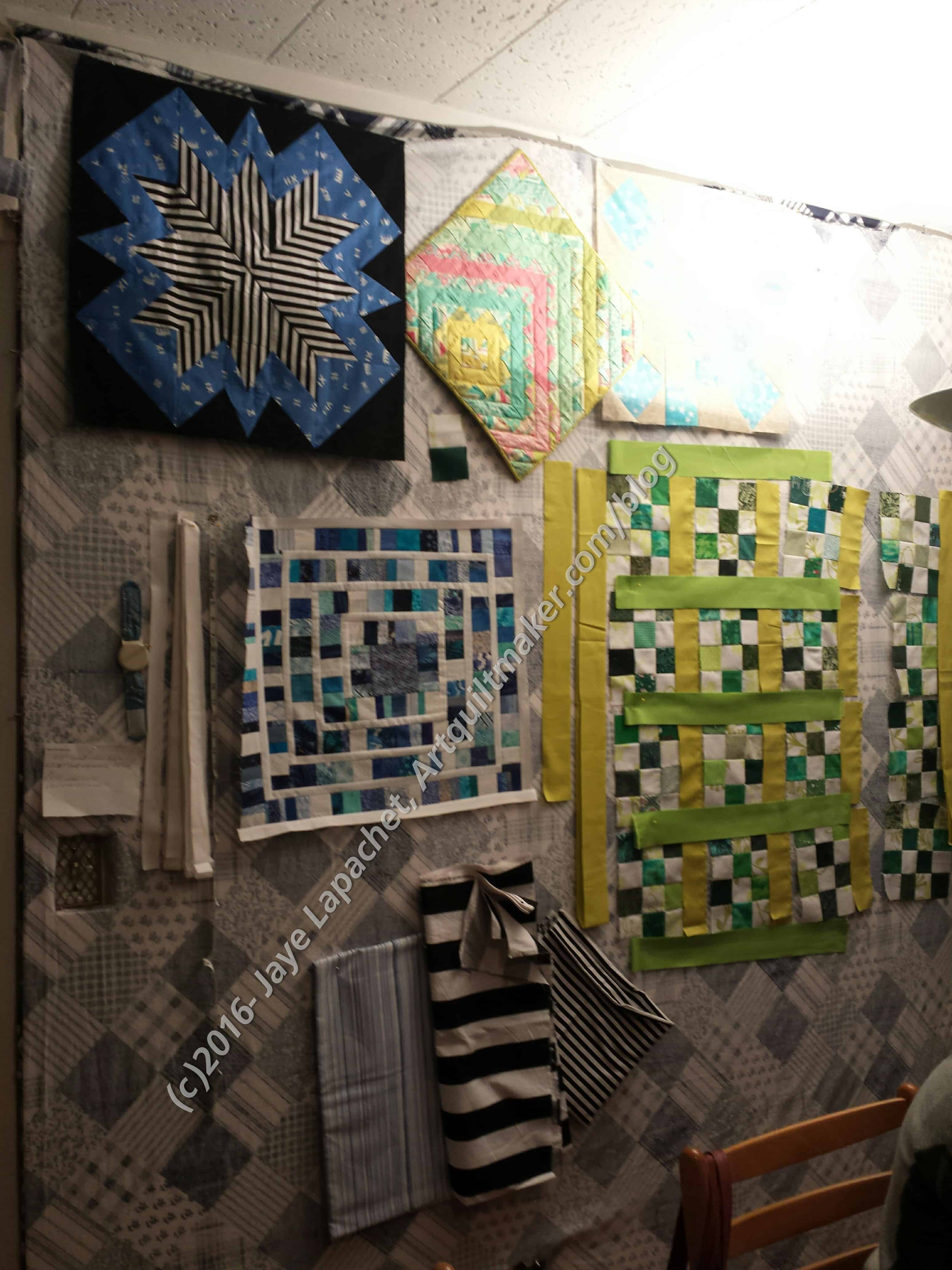
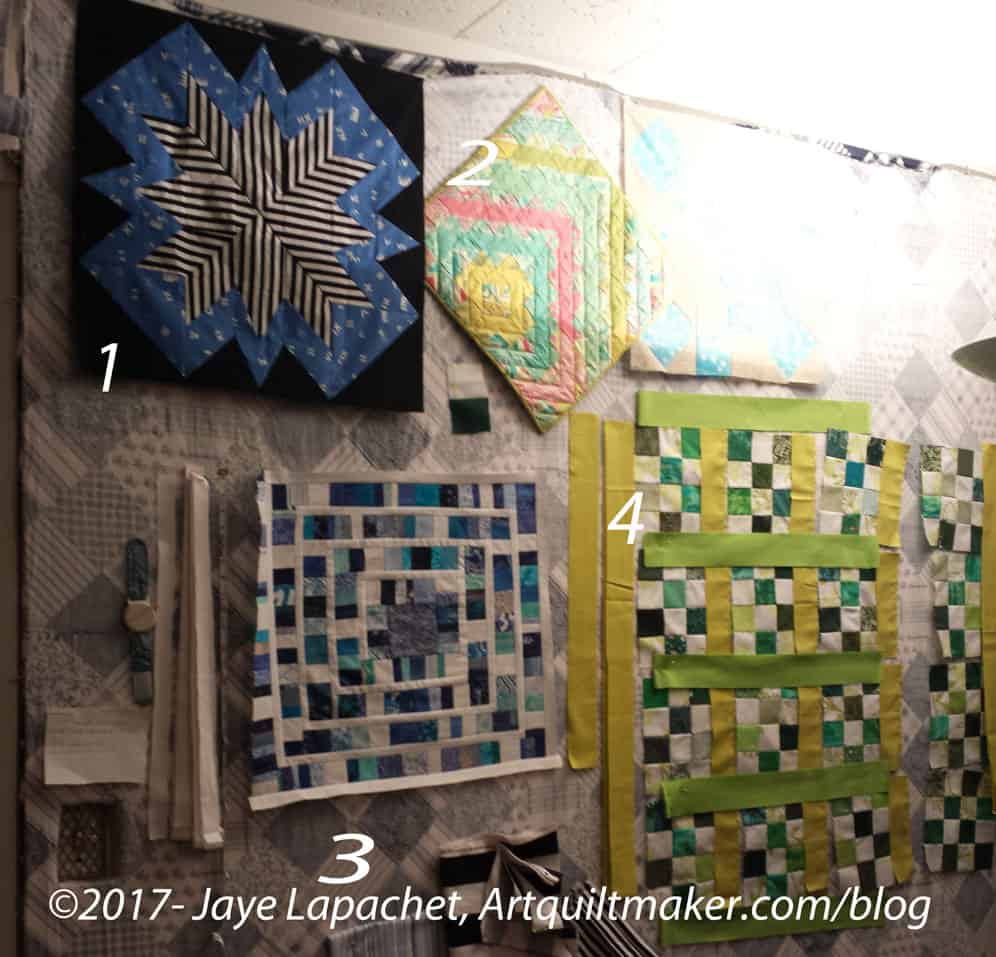
We had Craft Night at SIL’s the other night. Her design wall was awash with BAMQG projects.
One thing that is cool about this is that SIL never belonged to any guilds (that I remember her talking about) when she lived back East. The other thing is that she does more of the various challenges than I do.
SIL’s Design Wall n.2
The first project is the text project. SIL is smart and makes small projects for the challenges. The blue fabric is a text print and her piecing of the striped fabric is truly genius.
The green and pink piece is actually a quillow. That fabric was truly a challenge for SIL as she normally works in a different palette.
The blue and white square and rectangle piece is the latest challenge from BAMQG. This year’s theme is scraps and the first challenge has to do with using scraps to make a piece from squares and rectangles. I like the white as I think it adds a lot the the piece.
You might recognize the postage stamp blocks from the various posts I have written about donation blocks and quilts. SIL is using sashing on hers as I often do.
There is a certain cohesiveness on her design wall that appealed to me.
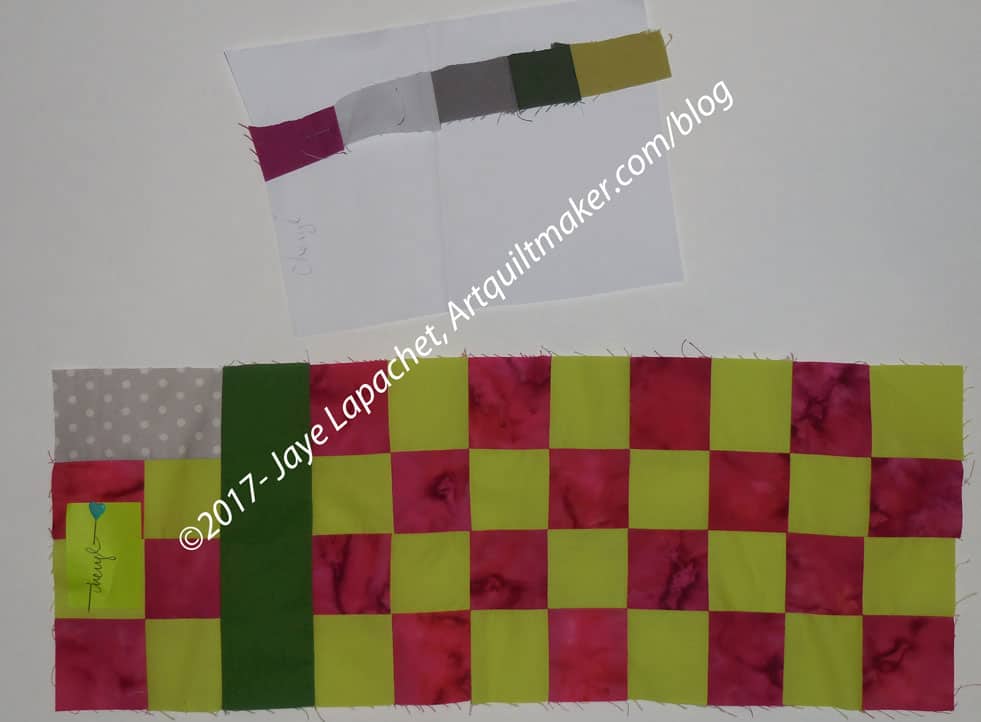
Cheryl was fortunate enough to grab the February spot and her piece was the second on which I worked. As I said Saturday, I had two pieces on which to work right off the bat. I missed the February meeting, but got my hands on the color sheet and made a piece.
Cheryl’s Color My World
For some reason I wanted to do something a bit more straight-laced and block-like. It couldn’t be too straight-laced, so decided on a checkerboard.
Kelly is next and I am curious to see what she comes up with as her colors.
I have making my own color sheet on my list. I have an idea in mind, but need to find a photo. I’ll wait a few months so I can see what other people bring to the meeting. I doubt my slot will come up before next year.
I have a very tiny update for the En Provence Mystery quilt. I have enough of the Peaky & Spike blocks finished to make 9 patches.
In fact, I may be completely finished with the Peaky & Spike blocks. I don’t know what goes in the corners and haven’t taken the time to look it up.
This block, the only one I have laid out, is not sewn. Laying it out, however, gets it closer to being sewn. I hope you don’t think this is a poor showing!
I have to say that it occurred to me that I might want to use the blues from the Blue Lemonade Hunting & Gathering box for the colored 4 patches. If the clue asks for 2 inch squares, I’ll be golden or In like Flynn. I have to find the clue and look it up.
The title should make a post unnecessary, but I am going to write anyway.
“You must disrupt your normal patterns so you can see the world with new eyes” (pg.45)
I don’t know about you, but I have a routine. Several, actually. I have a routine to get my day started, though it varies depending on the day. I have an evening routine and a work routine. If someone were to look at the week overall, they would see a larger routine overlaid on top of these other, daily, routines.
I am not sure about disrupting these patterns right at the moment, but my patterns for working on my quilts can, and, according to Bloomston, should be disrupted. One of the things Bloomston learned in her Drawing 101 class was to “seek surprises” (pg.45). I took down my design wall in order to sell it. The sale didn’t go through and I haven’t put it back up yet. It is a hindrance, but the surprising thing is that I am finding I work on more projects simultaneously than I did with the design wall up.
Huh.
Don’t get me wrong, I need my design wall. It is a vital tool, but at the stage I am in with my various projects, I can do without it.
Seeking surprises could mean using different fabrics. My SIL did this recently. She made a GREAT quilt, which is totally not in her colors.
There is a section in the chapter where Bloomston relates her experience learning to see art or a piece of art on which she was working ina different way. “We dove beneath expectation, convention, intention, and ego. We spoke about art as liberation from conscious thought. We discussed abstraction and pure form-pure mark making” (pg.46). I get a new view when I hear people talk about their perceptions of art.
“…seek the unexpected” (pg.46). This is the best advice.
There is another worksheet that is all about doing the unexpected. Do the unexpected. What does that mean for you?
Nota bene: we are working through Carrie Bloomston’s book, The Little Spark. Buy it. There is a lot more to each spark than what I am writing and the original chapters will help you. Go buy Carrie Bloomston’s book, so you get the full benefit of the fabulousness! You can see my book review, which is what started this flight of fancy.
You can find the last spark on the blog about a month ago.
As usual, I was #podcastdeliquent, but was resolved to make some progress so I listened to some podcasts interspersed with the book, Jane Steele. I had to intersperse the podcasts, because the beginning of Jane Steele was so dark* that I was feeling depressed.
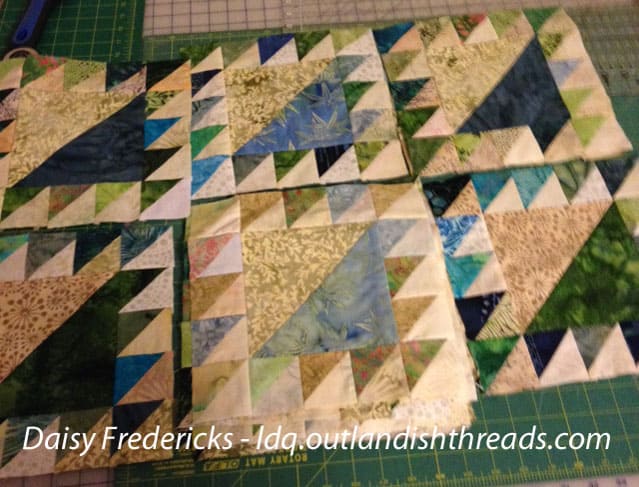
One of the podcasts to which I listened was Lazy Daisy Quilts (and Reads). She is the one who turned me on to Jane Steele. She has been working on Lady of the Lake quilt blocks. That is an old pattern. Since I didn’t see any photos on her show notes, I went and looked the block up in Jinny Beyer’s The Quilter’s Album of Patchwork Patterns**.
Daisy’s Lady of the Lake
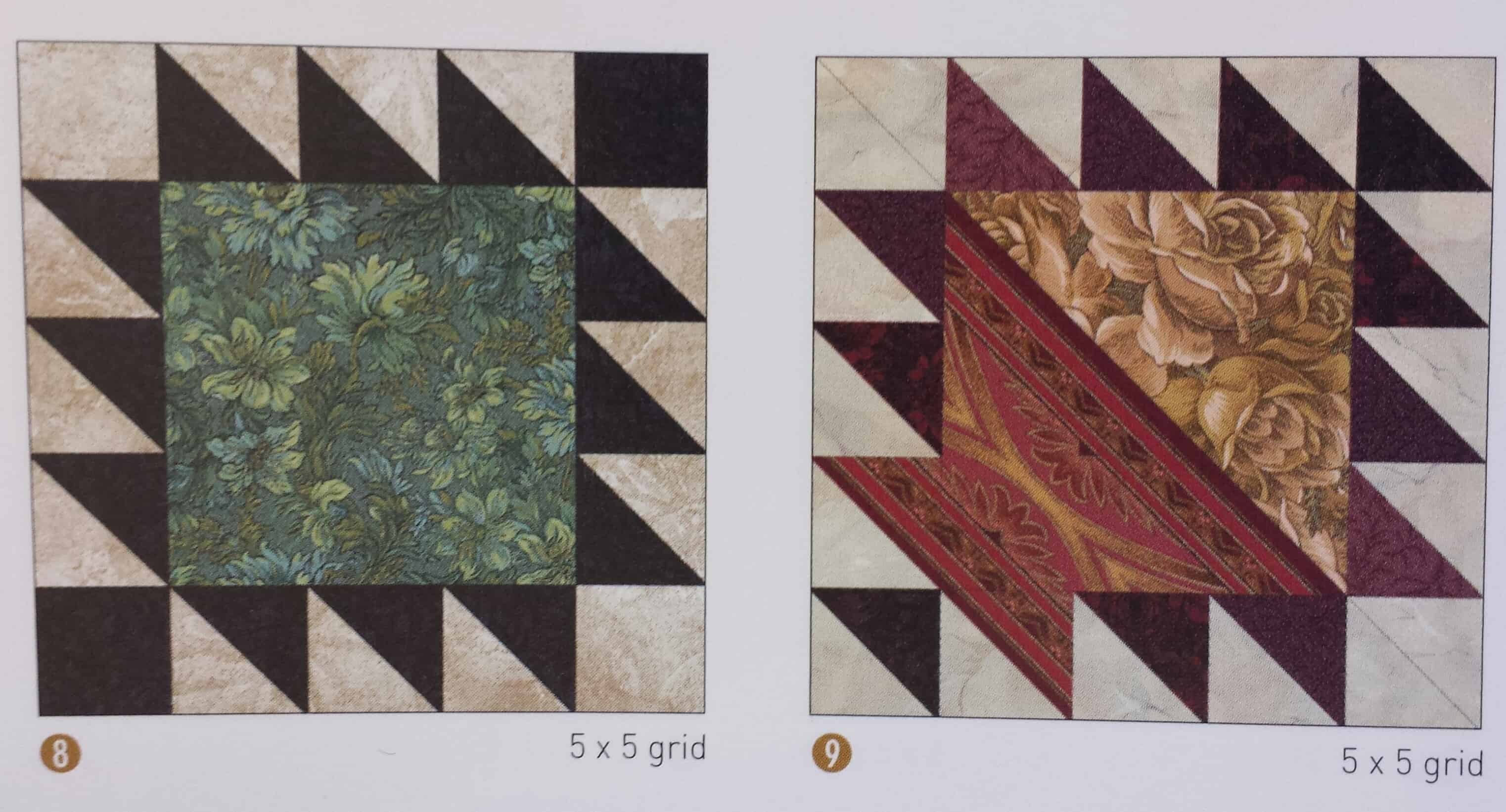
I was confused, because what I saw in the book didn’t jive with what I remembered of this block. I thought my memory was faulty. Still, what I saw was a cool block. Daisy was right when she said the block didn’t have a lot of other names, but it does have a few.
Lady of the Lake n.165-8, 165-9
First, I saw a Flying Geese type block. I see that there are HSTs****, but they look like half mad Flying Geese. Beyer says about 165-8: “Lady of the Lake, Finley, 1929. See 201-2, 201-3 [these are the same, or very similar, blocks from different sources]. ‘Lady of the Lake, named after the poem by Sir Walter Scott,published in 1810… The Lady of the Lake quilt appeared in a surprisingly short time after the publication of the poem, the one shown here having been made in Vermont before 1820… it is one of the few that seems never to have been known by other names.’ Finley, 1929.***
Beyer says about 165-9: “Lady of the Lake, Aunt Martha series: The Quilt Fair Comes to You, ca.1933. Also known as: Pennsylvania Pineapple, Aunt Martha series: The Quilt Fair Comes to You, ca.1933.
Lady of the Lake n.191-8, 191-9
Multiple listings were given in Beyer’s book, so I went on to the next one. These look like an evolution from the Cake Stand block, though I don’t know which came first, so I can’t say which evolved from which, if they did.
The above are more like Daisy’s block and more like what I was thinking Lady of the Lake looked like. Beyer writes about 191-8 “Double Sawtooth, Nancy Page, Birmingham News, Jul 16, 1940.” No AKA.
Beyer writes about 191-9 “Lady of the Lake, Ladies Art Company, 1987. Also known as: Hills of Vermont, Nancy Page, Birmingham News, Aug 9, 1938.”
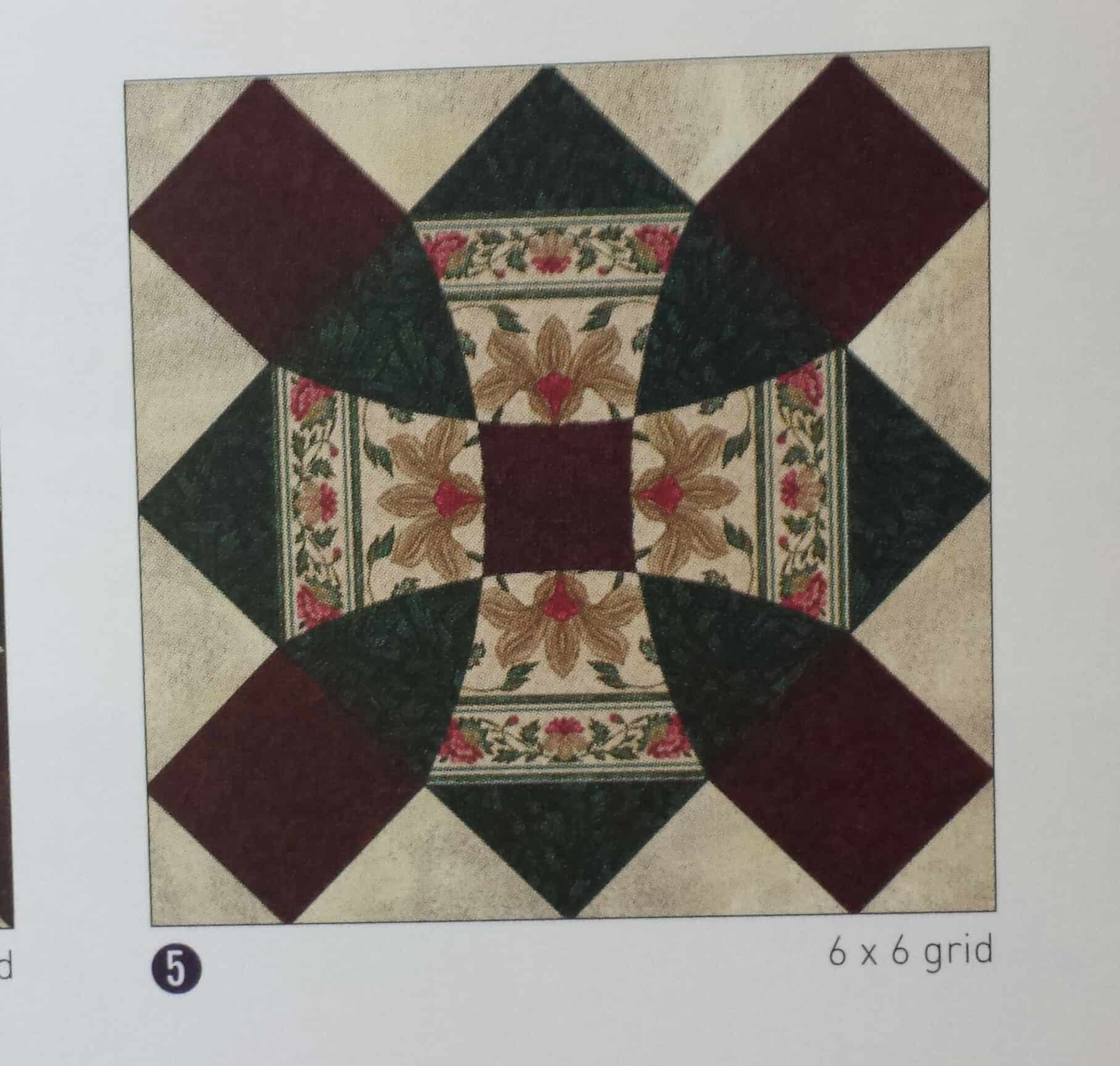
Lady of the Lake n.322-5
There is a final reference in Beyer’s book, n.322-5 and it is also named Lady of the Lake. Beyer writes “Lady of the Lake, Nancy Cabot, Chicago Tribune, Jun 17, 1933. Also known as: Galahad’s Shield, Nancy Cabot, Chicago Tribune, Oct 23, 1937.” I find it interesting that the alternative name also references the Arthur legend.
My little spiral into research led me away from the original questions, which was what Daisy’s blocks looked like. She was kind enough to send me the photo above so I could see.
*I did end up liking Jane Steele and would recommend you read it. Read Jane Eyre first. Though it is not necessary, Jane Steele refers often to the content of Jane Eyre. I enjoyed Jane Eyre and thought it was one of the better, and less confusing, of the classics.
**If you still haven’t purchased The Quilter’s Album of Patchwork Patterns, you really need to do so. It is such a great resources for inspiration and history. Go buy it NOW!
***While patterns may have been created much earlier, the references in Beyer’s book refers to the first time she was able to find a published reference.
****BTW, if you plan to make this block, check out the Triangle Technique to make eight at a time.