Creative Spark #9: Grace

Grace is something that I skitter around when I come across it. Grace is, of course, a name – a name used often in our family, by the way, though not in my branch – but I am talking about the personality trait. It is also a trait, or, perhaps, a series of traits that seems old fashioned in our fast-paced, car driving, mobile phone wielding, kid juggling life.

The definition of grace from Merriam Webster online is 1a :  unmerited divine assistance given humans for their regeneration or sanctification; b :  a virtue coming from God; c :  a state of sanctification enjoyed through divine assistance.

I prefer the American Heritage definition. It is more what was on my mind. It came up when I performed a search for ‘grace definition’:  “n. Seemingly effortless beauty or charm of movement, form, or proportion. n. A characteristic or quality pleasing for its charm or refinement. n. A sense of fitness or propriety.” This is more of what I was thinking. I think of well bred English ladies from the Edwardian and, possibly, the Victorian era who were strong, but had pleasing manners, welcomed visitors warmly, etc. I don’t mean this in a judgmental way.

I also think that thinking about grace and striving towards it as individuals is important -right now more than ever. Bloomston writes “we are programmed to think that work has to be hard to be valuable – that we are supposed to struggle in order to yield the most prized outcome….Creativity is a flowing thing. You can’t white-knuckle it into existence. Loosen your grip and give some space to flow” (pg. 41). I find a physical manifestation of this when I am doing balancing exercises in Pilates. If I am standing on one foot and completely tense, I tend to teeter and am more likely to fall. If I concentrate on loosening my muscles one a at a time, not only does the time of the drill melt away, but I am more stable.

I have felt tense and uptight as I worked through The Peacock. Mostly, I wanted the piece done and off the design wall so I could move on to something else. I was having a hard time giving myself over to the process. I talked a little about working on too many projects at once, trying to make sense of it. Stopping that, and finishing a couple of tops by a self imposed deadline helped a lot. Feeling tense and uptight does not make for good work. After The Morass, I tried to focus on the piece. First, I thought about what I was trying to achieve. Second, I thought about whether I wanted to finish it; whether it was worthwhile. Third, I recommitted to the piece and the process. For me, this was a glimmer of grace.

Bloomston writes “grace comes from not only being filled with purposefulness and spirit as we work, but also enjoying the moment and being present with the process” (pg.42). Of all she says in this spark, this hit me the hardest and has a lot of meaning for me. I often think about what is next, leaving the moment for the future. This makes moments go by unnoticed, which is sad. My interim talk with myself (above) for the Peacock helped me to find the purpose in the piece and be in moment as I worked on it.

I am still trying to get a firm image of grace in my mind. Bloomston provides several metaphors which inch me closer. “Grace is the hinge between effort and effortless. There is a moment in our creative flow in which we are utterly absorbed, content, focused, and present with the moment and everything in it” (pg.42). This is the place I strive for. I do think, however, that we can get snatches of it within each project when the stars align, but that actions we take outside of each project, though including each project help make those moments more and more frequent. For example, how we tidy up, where we find that one scrap we need, etc.

There is also an element of coats in this spark. “I told her that I was afraid to design my first line of fabric (and write my first book) because everyone I spoke to said it was hard when they did it. She looked at me, with her water-clear blue eyes, and said, ‘That’s their story-their experience: Each time someone tells you her story, you put it on and wear it like a coat. Many of those coast don’t fit you and yet you are wearing them. Why are you wearing everyone else’s coat?” (pg.42). This is amazing! How much do we not do because someone else had trouble with it? This reminds me of some of the technique tutorials I have in my quilt sampler class. I worked hard to show how to do Y seams, how to do machine applique’, how to put hexagons together and many other techniques. *I* feel these are valuable and can help when one wants to make a vision into a quilt. So often I hear that they are too hard so the quiltmaker won’t try. I suspect she has heard from her friend, who heard from another friend that Y seams are too difficult. Wear your own coat. Figure out your own story.

Like others, this spark has some worksheets.

Nota bene: we are working through Carrie Bloomston’s book, The Little Spark. Buy it. There is a lot more to each spark than what I am writing and the original chapters will help you. Go buy Carrie Bloomston’s book, so you get the full benefit of the fabulousness! You can see my book review, which is what started this flight of fancy. Also, take a look at Carrie’s website.

You can find the last spark on the blog about a month ago.
Creative Spark #8: Process

Bloomston's The Little Spark
Bloomston’s The Little Spark

“Each moment you spend tending to the Spark, the more your life will go in that direction” (pg.37). I like this line because it is all about process without saying ‘process.’ The whole first part of the chapter is about telling the reader that how we live our lives or spend our days has a direct impact on how our lives turn out. “…if you are frustrated and rushing to the next part of your day, then you are creating a life of hurry and frustration” (pg.37).

When I read that I saw myself in my old job straining to the weekend to get away from the unhappy and sour people around me. It was an eye opener! How could that image be so fresh in my mind after two years? I don’t want to be frustrated and rushing around. I want to be pinning a Peaky to a Spike while I talk with tech clients about why they can’t find their content. I want my life to be infused with creativity whether it has to do with Peaky and Spike or whether I am puzzling out a creative solution to a search algorithm.

I can’t infuse my worklife with creativity if I don’t have work. I have to remember that “…what feels productive doesn’t necessarily move me towards my goal” (pg.38). Part of the process is figuring out what your process is. Filling time to passing time isn’t necessarily productive in a money making sort of way. Filling time is filling time and you should recognize that. Recognize is for what it is and where it fits into part of your process.

My process is well described by Bloomston when she says “work as much as you can. Period. Be as mindful as you can about your process” (pg.39). My process is to have the next step in my mind and some pieces ready to sew. I don’t like wasting time figuring out what to do next if I have 10 minutes. When I have been sewing for a few hours I know what the next step is and can prepare it. Once it is prepared, the sewing is the easy part.

“…Enjoy the process free from choosing expectations. Be gentle as you find your voice and your wings” (pg. 39).

Bloomston has another worksheet in this chapter, which will help you define your process. Your process is YOURS. It is not better or worse than anyone else’s process. Know it. Document it. Honor it.

Nota bene: we are still working through Carrie Bloomston’s book, The Little Spark. Buy it. There is a lot more to it than what I am writing and it will help you. Go buy Carrie Bloomston’s book, so you get the full benefit of the fabulousness!


Creative Spark 7: Permission

Kind of ironic, huh, after yesterday’s posts?

Permission is an odd thing. Sometimes you need it to move forward. My husband has only once complained about the quilts we have at home. He helps me with quilt math and did all the figuring for the Triangle Technique chart. In these way he has given me permission to create.

He wasn’t, however, the first. We did a lot of creative things at home when I was a kid. My dad tied fly fishing flies and had us work along with him. My mom sewed and painted those plaster decorative pieces with us. My grandmothers all cooked and did needlework. We often received kits to make things as gifts. It was normal to be making at our houses.

I also remember various teachers who encouraged creativity and making. Mrs. Cole and Mrs. Kay created a entire play based on Fiddler on the Roof called Piddler on the Loose that included costumes, music and a completely rewritten script. There was also an art aspect to our learning in Mrs. Gellman’s class: kites when we studied Japan, a mission built by the entire class when we studied California history and something to color or glue in general.

Bloomston talks about her various teachers and how they inspired her. About one she writes “she gave her students nothing but space, time, materials and permission. She offered an open door to her wild studio filled with crazy, sophisticated materials and tools” (pg.33).

I don’t think we need “assignments, lectures or instructions” (pg.33). I think we need a sense of possibility and permission. Permission can be tricky, however. I don’t need someone to say “it is okay for you to go and sew today”. It is more that I need the space to be able to go and sew. My family giving me the mind space to make the decision to sew is a kind of permission.

Part of permission is the mindspace, but Bloomston points out that the “blessings and resources in our lives that allows us freedom – open doors, yesses, possibility” all have a hand in getting us to create. The good thing is that no matter how much money a person has, anyone can take a pen and draw lines on the least expensive piece of paper and make art.

Bloomston says “Seek out people who say yes. Seek out people who give you permission, whether teachers or friends” (pg.34).  One of the most important things that helps me to create are the people in my guilds. The fact that they show up and show their work inspires me so much! It makes me want to make that or this other project as well.

Bloomston has some worksheets in this chapter, which will help you focus on the things discussed in this chapter. Take a look at the book.

Nota bene: we are still working through Carrie Bloomston’s book, The Little Spark. Buy it. There is a lot more to it than what I am writing and it will help you. Go buy Carrie Bloomston’s book, so you get the full benefit of the fabulousness!

Creative Spark 6: Perfectionism & Messes

“Perfectionism is the enemy of the creative act.” pg. 29

The above quote cannot be learned. It has to be infused into your bones. The single thing that prevents it from being infused, possibly forever, is someone (mother, father, grandmother, well meaning person) crying “how did you get so dirty?” These simple, seemingly innocuous words can doom someone to a lifetime of cleanliness and perfectionism. I know this because I have only made some strides into messiness. When I am in the midst of projects, my workroom is terribly messy. The boys are scared to walk across the room lest they step on something important. The YM gives me dirty looks and stern admonishments as he walks through the bathroom he uses.

The strides I have not made are into dyeing and painting. I do both very occasionally, but they are just too messy. My godmother had a lot of good qualities, but encouraging and supporting messiness was not one of them.

However, it is important to encourage creativity and one way is to validate process and exploration. “Life is filled with opportunities and if you are worried about getting dirty or making a mess…then you will be limited in your possibilities” (pg.29).

Life isn’t a show. people are messy. Perfectionism “constricts and confines you” (pg. 29). Your life and work “doesn’t have to be tidy. It doesn’t have to be tidy. It doesn’t have to look perfect. But it does have to be true to you” (pg.30). I have started to get rid of fabric that I bought because people said I needed to add ugly fabric to quilts to make them sing. This is not my authentic style: out they go. I look at fabric in a quilt store in the context of the fabric I have at home not in the context of the quilt store, so I can bring home fabric that works with the fabric I have. Most fabric looks fantastic in a quilt store; not all fabric looks good in my workroom. I want the fabric I buy to be authentic to what I am making, so I can include it in quilts that will end up being my style.

The other thing is that allowing the messy part out allows you to grow as a person. “Allowing the messy part of the self-the unresolved part- to have a voice is a way of healing and a way of understanding yourself and the world” (pg.30). Not all of your work will be perfect. There will be tears and raw edges and corners that don’t match. You won’t ever get to perfect without these things.

In this Spark, I am reminded of the 10,000 hours. Someone said you had to do 10,000 hours worth of work in your chosen field in order to master it. I don’t know if that is true, but if things aren’t going well for me in my work, I think about that and tell myself I have to put in the hours.

I was reminded on Saturday, at the CQFA meeting, how much I enjoy hearing about people’s process and how they got to the piece they are showing. It shows work and a process and trying things out that might have sort of worked or didn’t work. It shows tweaking and thinking.

Anne Lamott wrote (and Bloomston shared) “Perfectionism is the voice of the oppressor, the enemy of hte people. It will keep you cramped and insane your whole life…Perfectionism is a mean, frozen form of idealism, while messes are the artist’s true friend” (pg.31).

Nota bene: we are still working through Carrie Bloomston’s book, The Little Spark. Buy it. There is a lot more to it than what I am writing and it will help you.


Final Napkins

Thanksgiving is next Thursday in the US.

Is the pie crust made?

No.

Pie filling?

No.

Rooms tidied of their pieces and piles?

Sort of.

Napkins - final
Napkins – final
Napkins - final
Napkins – final


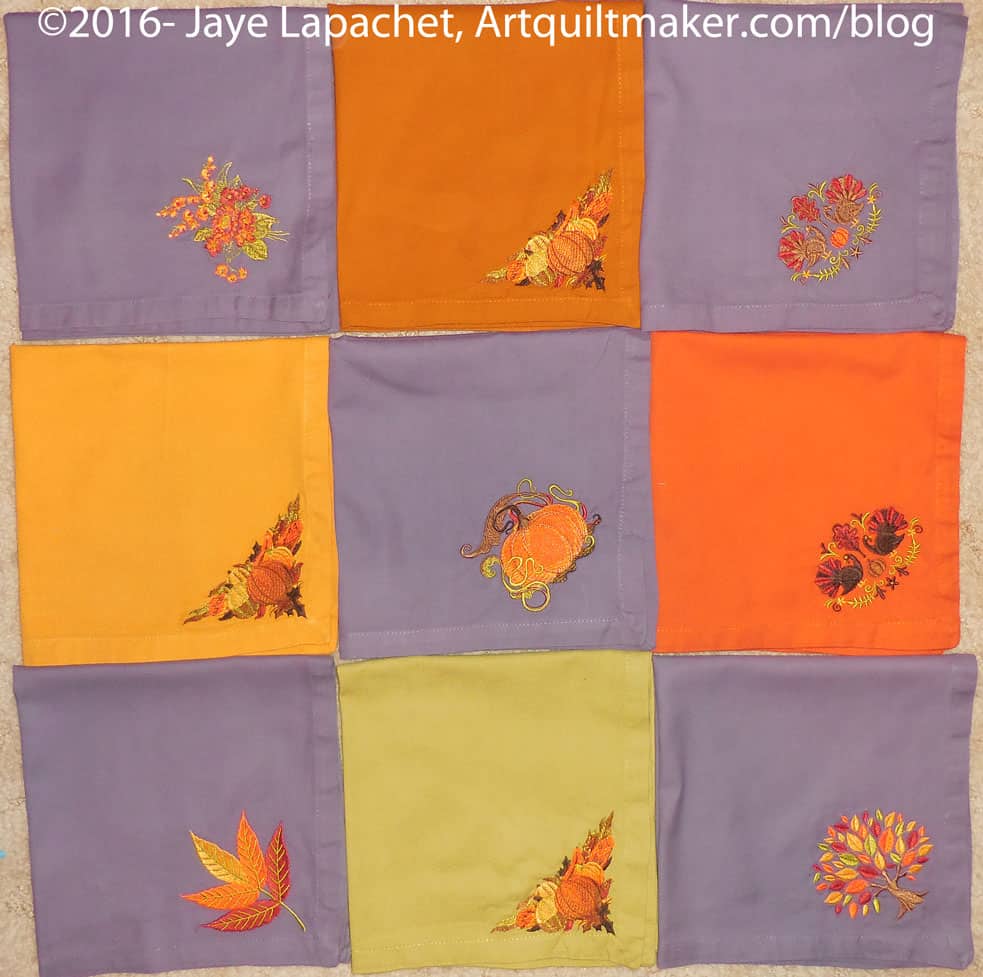
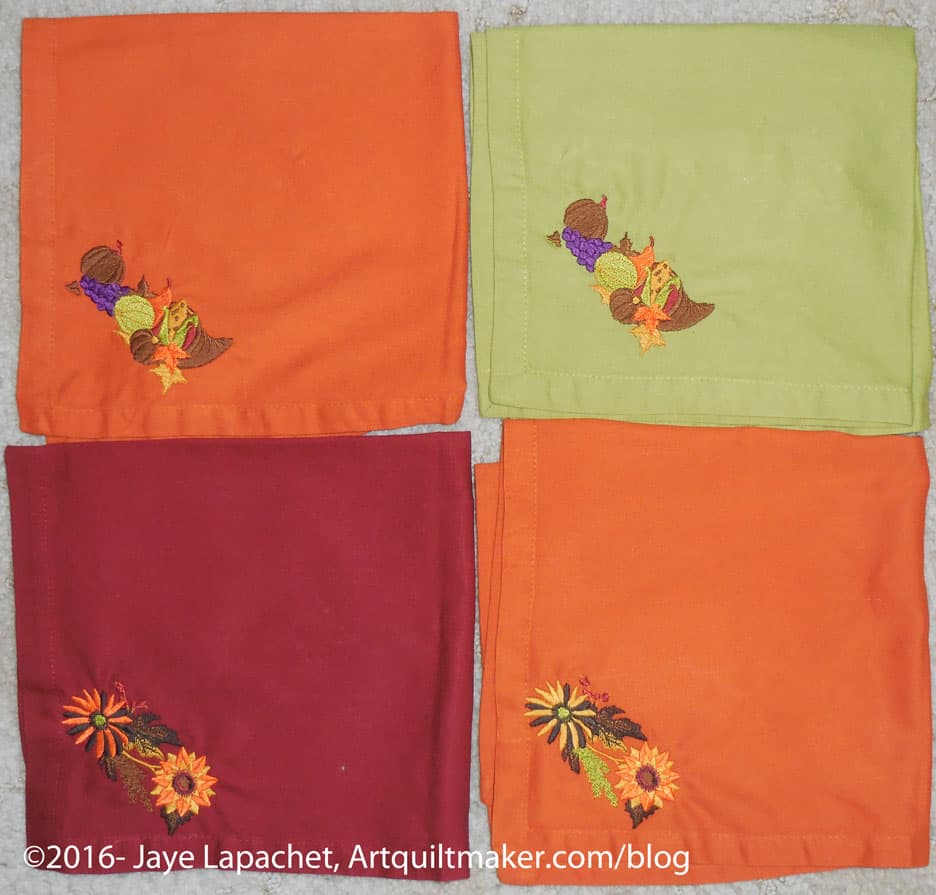
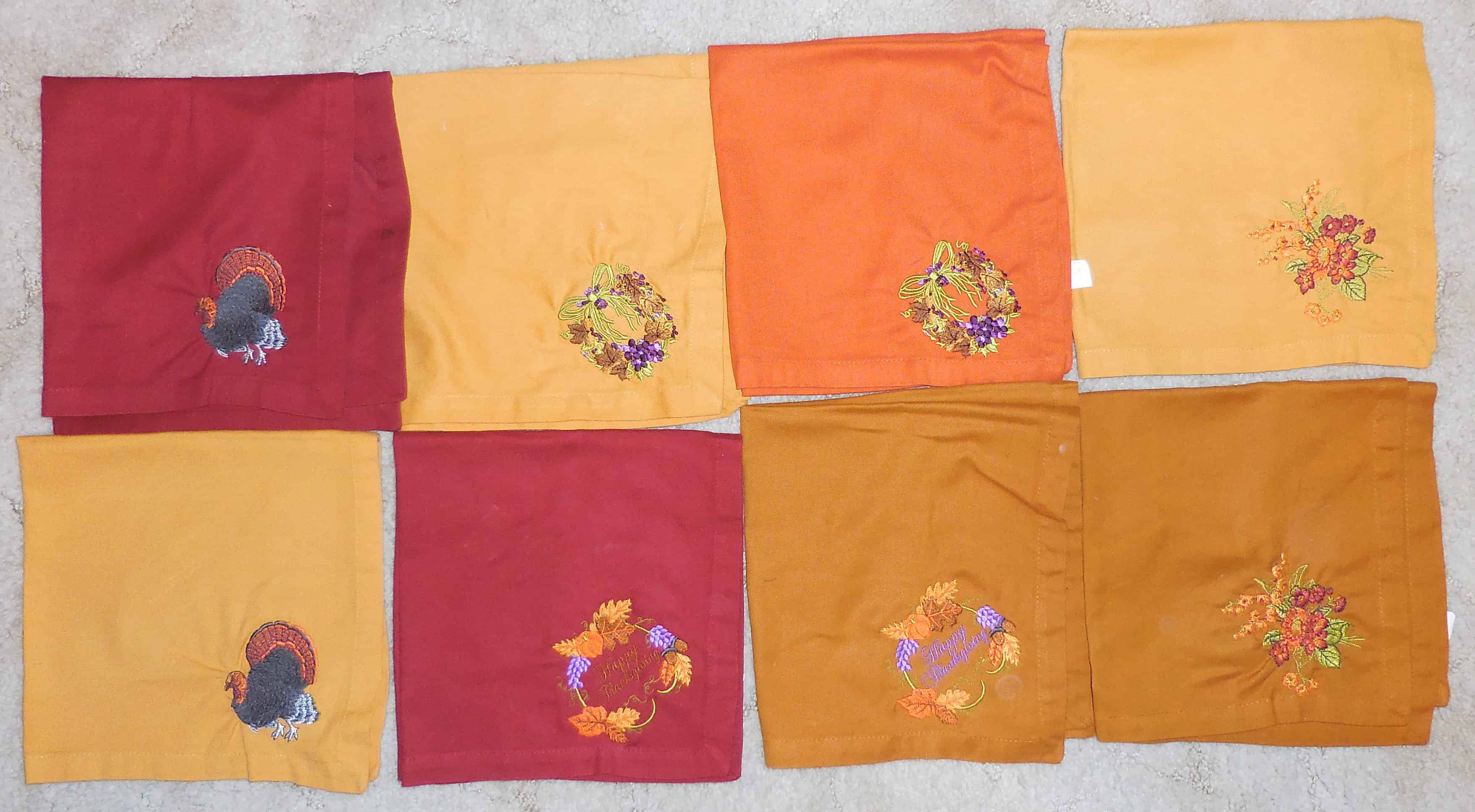
However! The napkins for Thanksgiving are done! As I mentioned last time, one got eaten so I went and bought another pack. The dusky purple was an inspired choice. All of the motifs turned out really well on that background.

Even the Pennsylvania Dutch style turkeys is appealing.

Thanksgiving Napkins

Thanksgiving napkins, October 2016

I think my last update about this project was in August. A lot has happened and I think we are nearing the end.

SIL and her machine have been working hard. She has to recolor all of the designs so use just 6 colors. Sometimes that is really hard and she has to make compromises. Still she has done a great job and I can’t wait to have the napkins out at Thanksgiving.

Thanksgiving Napkins, mid October 2016

My job has been to wash and press all of the embroidered napkins. I have had no bleeding or fading of the designs. I have used a lot of Flatter and Mary Ellen’s Best Press!

The embroidery machine had a hissy fit and ate one of the yellow napkins. While there were probably enough napkins for everyone, we decided to get one more packet (World Market Buffet napkins). I bought a dusty purple and these came out SUPER well. I am very pleased with them.

I really like all of the napkins. Not only are they pretty and festive, but they are also large enough to keep laps clean.

En Provence Announced

Bonnie Hunter announced her 2016 mystery quilt*, En Provence, today. I haven’t ever done one of her mystery quilts, but I always collect the instructions, thinking that I will do one some day, after the fact. I am pleased to watch Pam and Daisy and Valerie and others do the steps. They have made some gorgeous quilts.

I have a great deal of respect for Bonnie for creating a new mystery quilt every year. I just haven’t made the plunge. I did Scrapitude, which I love. That was a mystery quilt and I am not sure I could top it.

Normally, I am quite confident choosing colors for a quilt. One problem I have with mystery quilts is choosing the colors. Scrapitude was great because it was a scrap quilt and the background was clearly defined. In this one, I don’t know if the neutrals will be the background. I don’t know where the green and yellow will end up, though Bonnie says the two colors should have good contrast with each other. I appreciate her mentioning such tips and tricks. However, I don’t want to spend time on a quilt only to have it end up as a mushy mess at the end.

My color preferences are much brighter than hers. I always wonder if they would work. I did some Palette Builder work on her inspiration photos and was glad to see that she had made good choices.

So, I don’t know if I will make the mystery quilt. I will collect the directions and I did order the new and fancy ruler (I love rulers!), so I am ready to go. Stay tuned.


*As you may know, the link above will not work after ~June 2017. You will need to work along with her to get all the pieces.

Creative Spark 5: Time

“Forever is composed of nows. Emily Dickinson” (pg.25)

Have you ever driven to work, to the grocery store or to your hair appointment and all the lights were green, there were no idiot drivers and you found a parking spot right in front of your destination? “If I am struggling with anything, I generally feel like I need to find a better way” (pg.25). The first page of this section confirms what I have thought – I know when I am on the right track because everything comes together easily.

When I saw the above quote on the page in the Bloomston book, I couldn’t stop thinking about what it meant. I don’t think it means don’t plan for the future. I do think it means don’t live in the future.

In finding time, it is important to do a little self reflection. Bloomston has some questions to answer, among them “What is your best time of day?” This is impoetant to know and often hard to be real about because of societal pressures and age. College students and young adults are often pressured by their peers to stay up late. Teenagers would rather be in bed at 8am than in the classroom.

I am a morning person. If I can focus, I can get a lot done in the morning. I am at my best then. Depending on the day, I either start out at the gym or with some work and then a walk. I try to get my work and errands done early, especially the “fixed” errands like grocery shopping. As the day moves on my mind starts to drift so I will do errands at about 3 or 4 pm, attend meetings or other random to dos. It kills me not to be able to work on my quiltmaking every morning. I know I would be able to churn out some fantastic work.

I am not in the habit of working on my quiltmaking during the week because I get so engrossed that I forget to work (paying work). Probably, I just make the decision to take the day off and damn the consequences. My boss is pretty lenient, but it makes my paychecks pretty thin. On the weekends I devote as much time as possible to quiltmaking. I have found, however, that late in the day during the week, before my people get home, is a good time to do prep work -not intensive thinking work – but prep work. Recently, I dragged out a bunch of pillowcase fabric and used about an hour to find cuff fabric, cut the body fabric and generally get the body ready to sew. This has helped me to relax after work and get a lot more accomplished on the weekends.

Bloomston writes “…so I had to tune in and not miss the opportunity” (pg.26). I think that the experience of working for 30 minutes-1 hour in the evenings during the week was an example of taking advantage of an opportunity. I took advantage of something that presented itself and it turned into something positive. I also created a process that ended with a big bang of work on the weekends.

“To squeeze the most out of his creative life, he found a way to squeeze it into his life. No doubt, this takes dedication, persistence, and sacrifice. We have to tune into our own lives to locate those precious hours” (pg.27). In order to get better, you have to work – and that applies to everything, including your quiltmaking and artwork. It’s not all about the inspiration, you have to work to get the process and the habit into muscle memory. Working also creates more work. Have you seen my Petrillo Bags? I did not, as you know, create the pattern. I made the first bag as written and I liked it. However, I looked at the bag and thought ‘I wonder what would happen if…’ which is always the best feeling, because it means that I am inspired to make a pattern different or better. Since the first one, I have made two more, each with some changes, hacks or tweaks. As you read recently, I finished the third one. Despite the fact that I have made many, many bag patterns I want to make a fourth Petrillo bag just to make that particular pattern a little more useful for me.  You have to take the time to make progress.

Because there is a finite amount of time in the day and I like my beauty sleep I try to add time to be creative into little pockets of the day. As I wrote the first draft of this blog post, I wrote it my journal with a lime green Sarasa pen. Writing is one aspect of my creatiivty but I try to make it a visual exercise by using a different colored pen every day so my journal is pretty while still being useful.

You need time.

You can find the time if you only look at what is important. Only read your social media while you are standing in line. Make menus and go grocery shopping once a week. You have to become the mistress (or master) of your time. There is only so much. Don’t waste it.

Napkins Project Continues

More Thanksgiving Napkins

The good thing about machine embroidery is that it can happen while the maker is piecing since the machine works independently. Still, SIL is making crazy good progress. After a few napkins last week, she gave me a bunch this week.

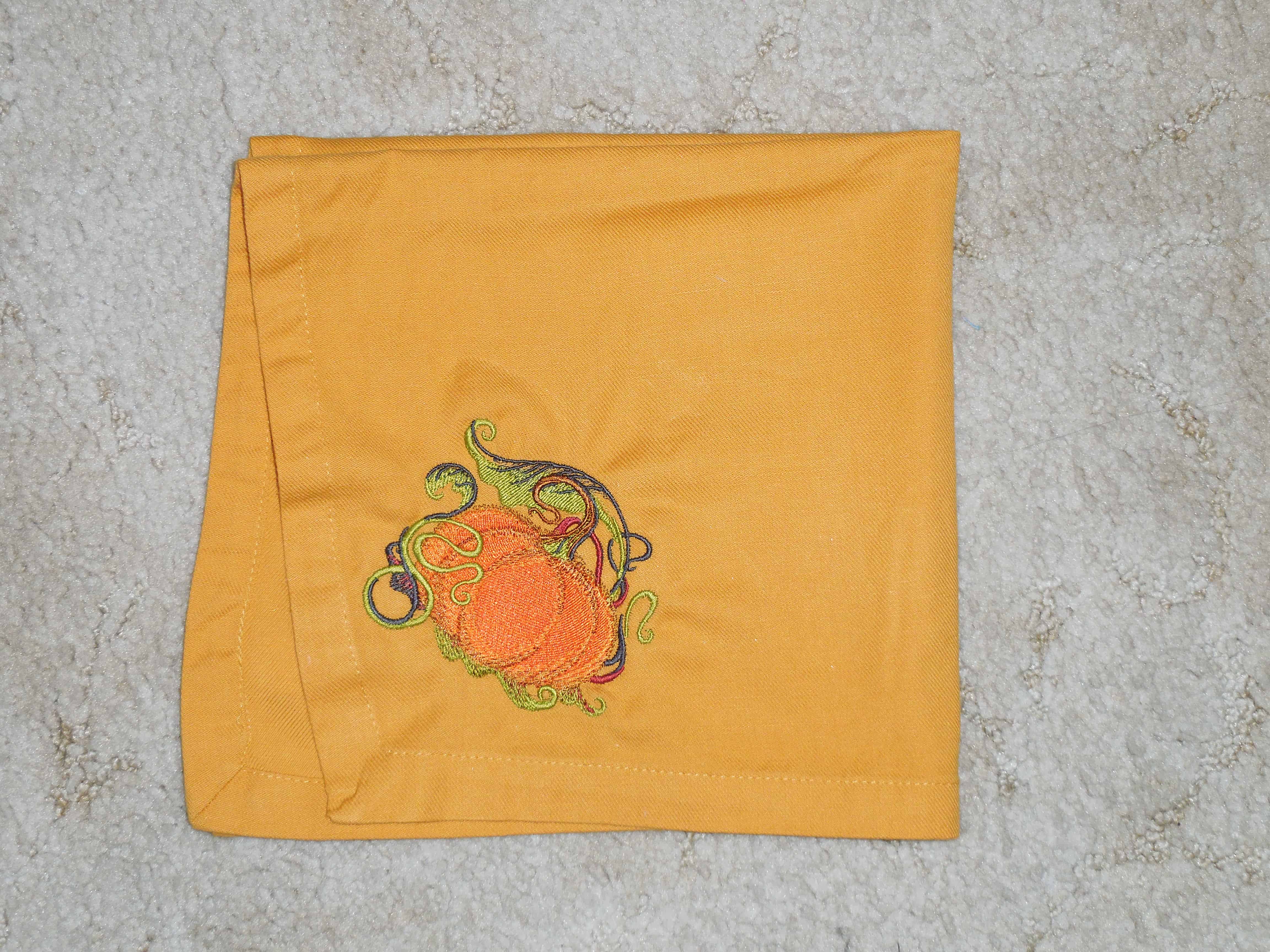
Pumpkin motif for napkins

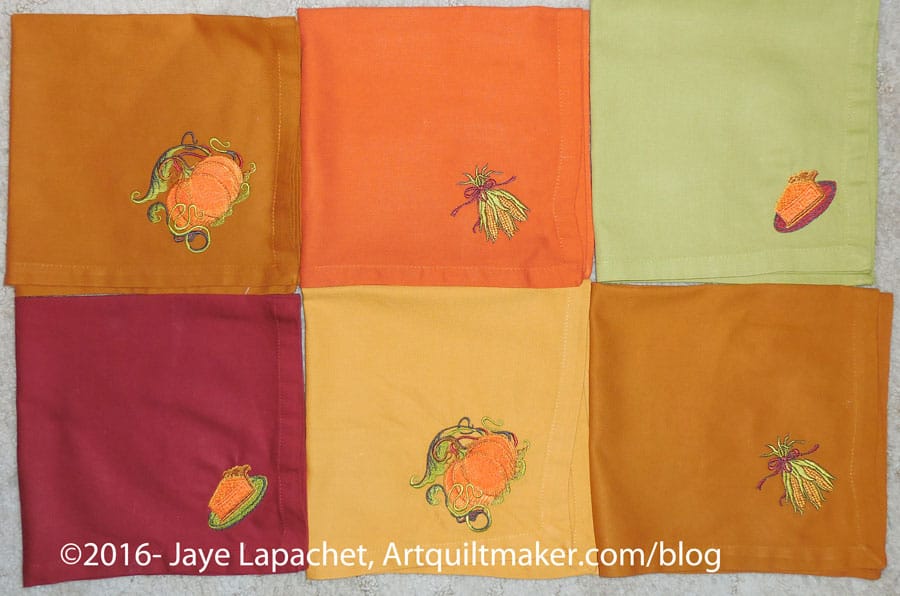
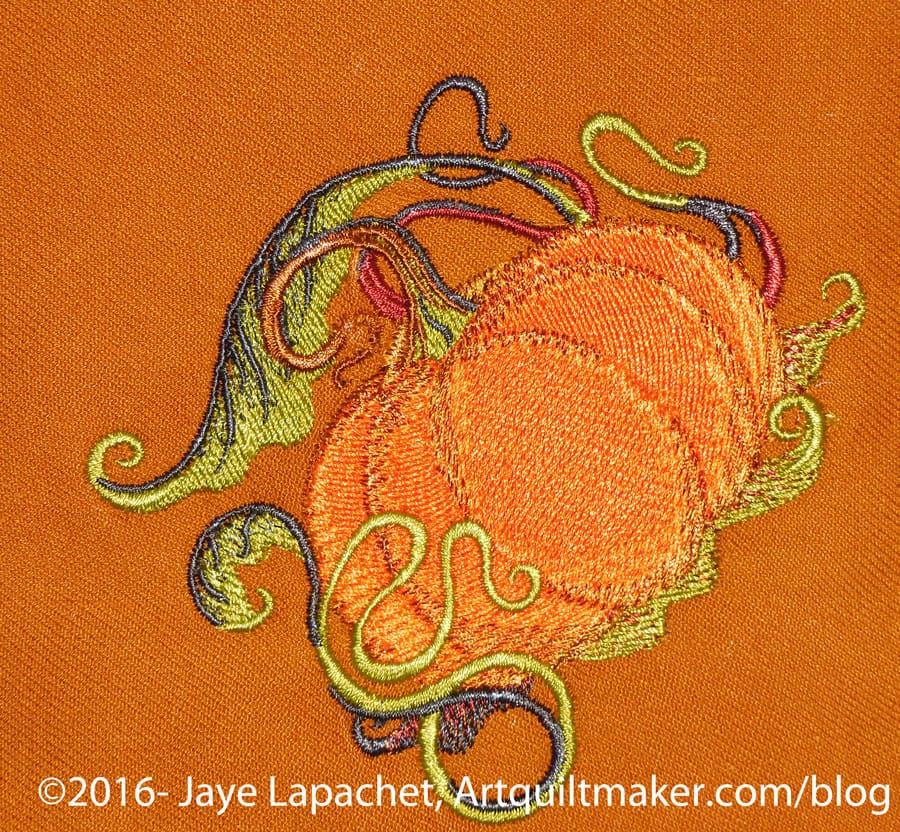
This group of motifs is fun. The pie and the corn, along with the pumpkin, which you saw last week, are two of my favorites. I took a close up of the pumpkin, so you could see what a nice design it is.

More Napkins

Napkins - early August 2016
Napkins – early August 2016

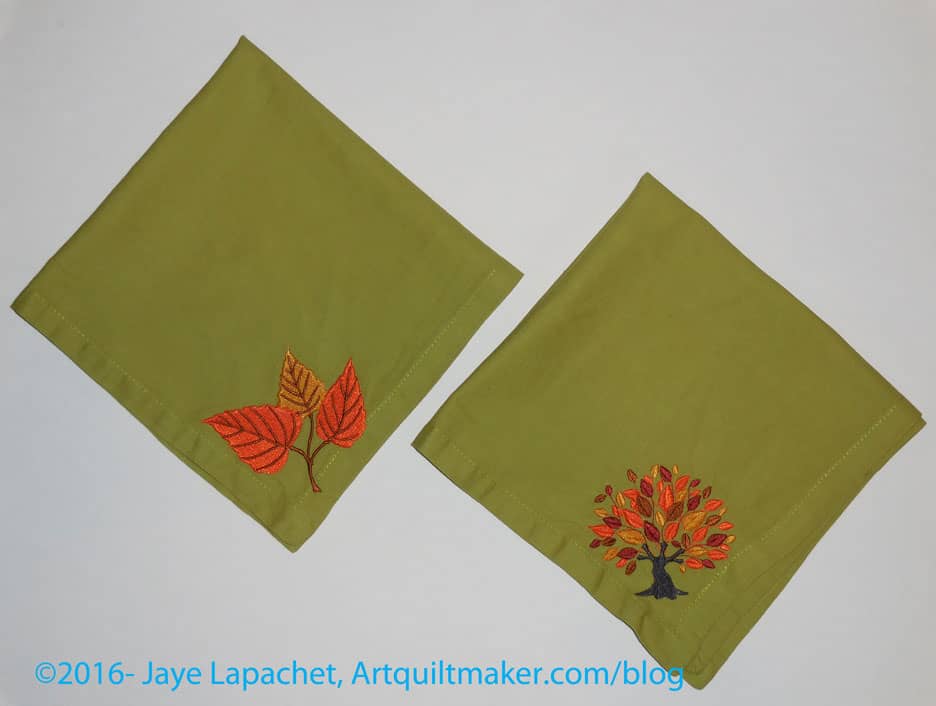
SIL is embroidering napkins for the napkin project at a furious pace. I need to get busy on the tablerunners. September will be here before we know it and October and November will be hard on its heels.

SIL has finished some more napkins.

Two motifs included in this most recent batch came out very well. I really like the tree and I, especially, like the pumpkin.

Pumpkin Napkin
Pumpkin Napkin

I think they are coming out very well and I will be happy to put them on my table at Thanksgiving.

More on the Stitch TV Pattern Launch

The Stitch TV Pattern Selection (Belinda)

As you know, I am not a big fan of patterns. Patterns weren’t available in large numbers, if at all, when I learned to make quilts and I never really learned to use them. Yes, of course, there were quilt patterns in magazines, but the packaged stand-alone quilt patterns were not available back in the dark ages.

I do admire the possibility of small business owners creating patterns and making them available. That there are so many indie / women-owned businesses is one of the great things about the quilt industry.

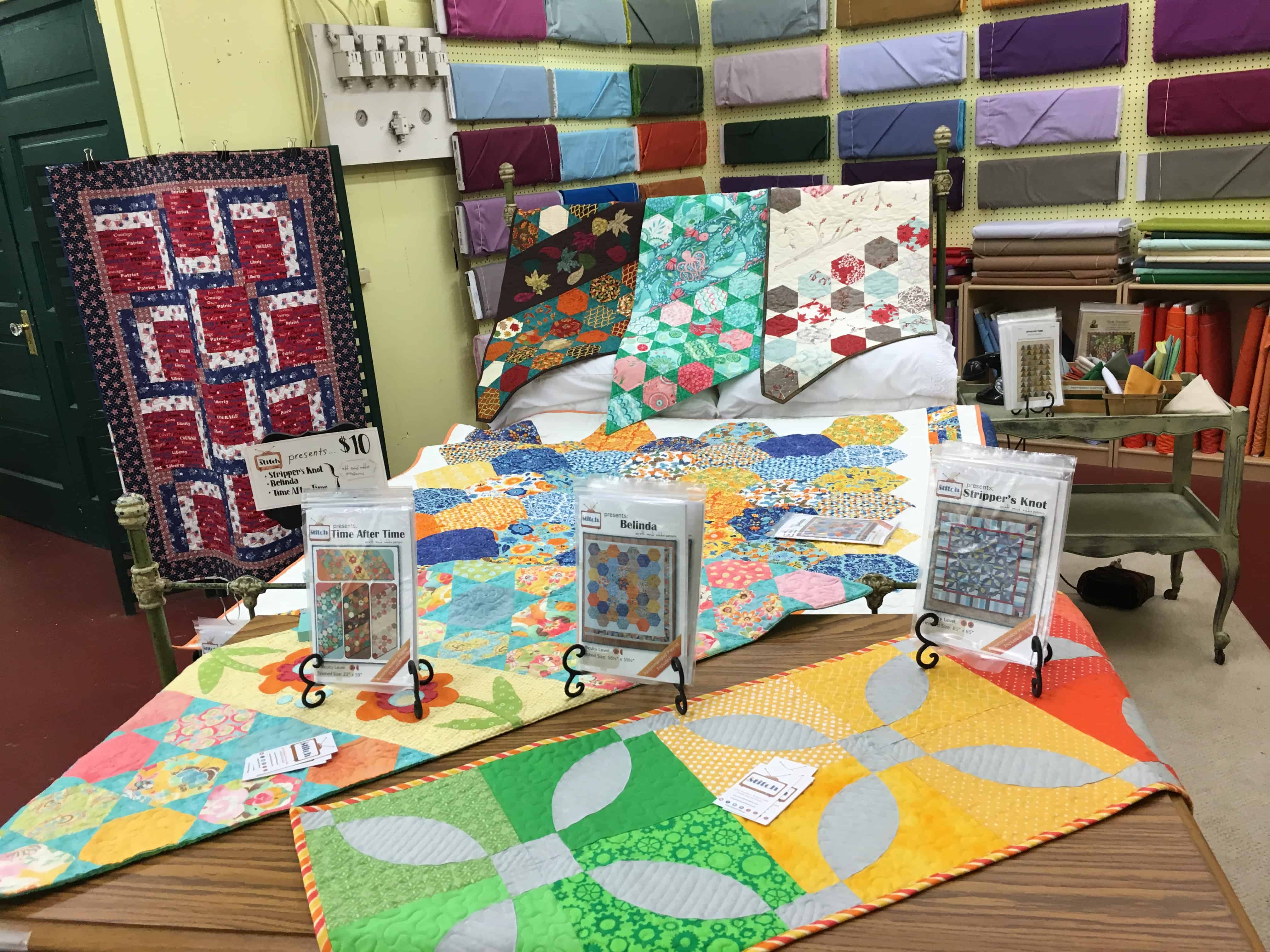
The StitchTV company, Ed & Eddie LLC, is one of those small businesses. One of the things I noticed about the Stitch TV pattern samples were the different fabrics used. In the photo above, you can see at least 4 different fabric groups. While this grouping does not comprise all the possible fabric combinations, it does give the shopper a good idea of how the design will look in different fabrics.

There are so many patterns now. All of us have a quilt ‘to do’ list that extends beyond our lifetime, so we have to be more choosy about adding new things to the list. Marketing patterns with a variety of samples is imperative now.

Great job, Pam and Lynn!

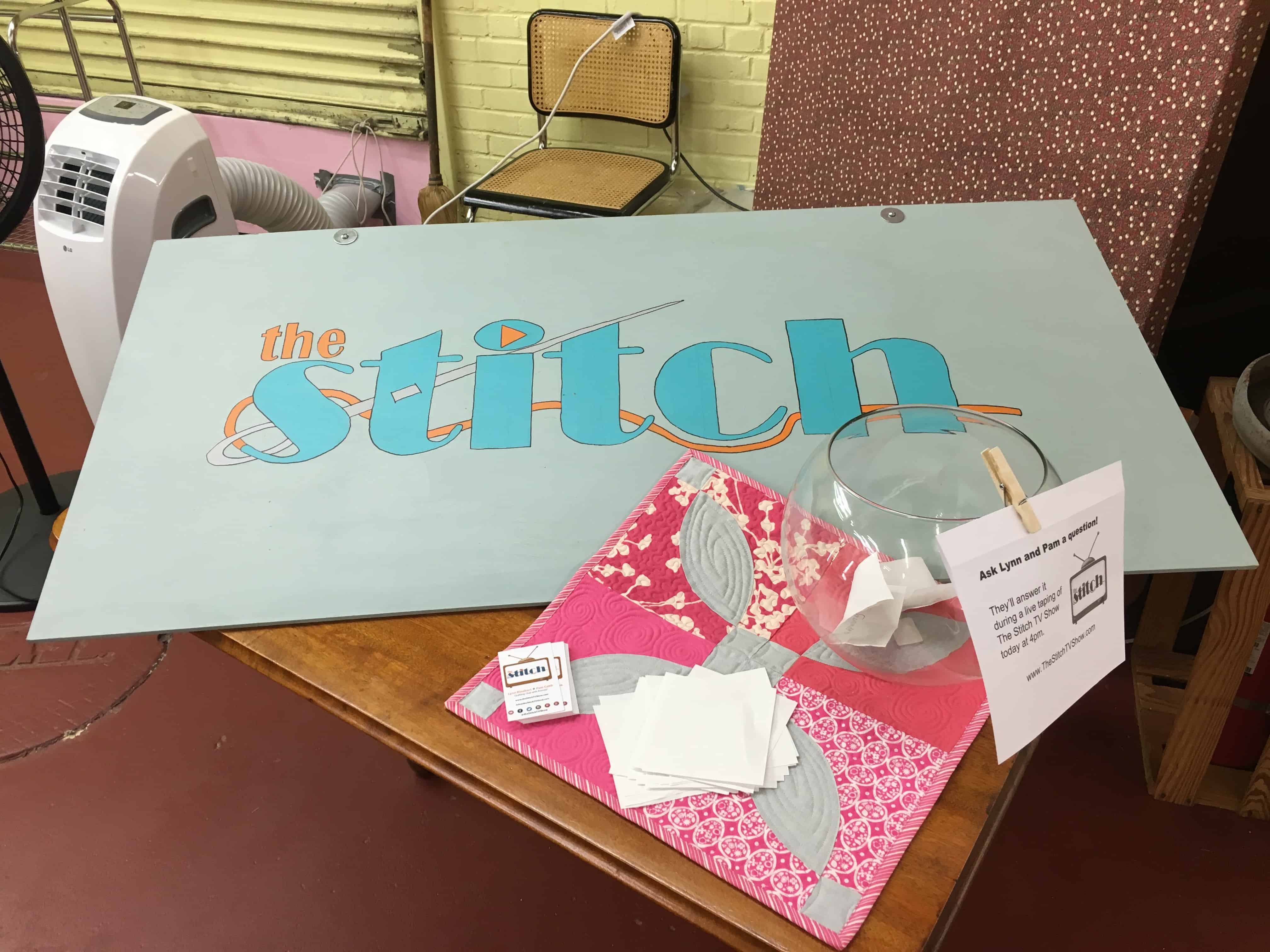
The Stitch TV Show Pattern Release at Red Hen Fabrics

Marietta, GA
July 16, 2016

Thanks to Holly Anne Knight, who blogs at String & Story, for reporting on the StitchTV Show Pattern launch (and telling us a little about herself!) when I couldn’t be there in person.
________________________________________

My name is HollyAnne Knight. I’m a wife and mama of two little boys, and I am a brand new quilter. After about 8 months of experience with rag-style t-shirt quilts, I decided it was time to give “real” quilting a shot. In May, I simultaneously discovered Pam Cobb’s Hip to Be a Square quilting podcast and her quilting talk show, The Stitch TV Show, which is co-piloted by Lynn Rinehart. I listened each night as I plugged away on my own projects, gleaning tips and sharing in the laughs. While I’ve been creative all my life, I’ve done most of my creating in isolation. Now, all of a sudden, I felt like I had friends—funny, encouraging, quilty-friends.

On the June episode of The Stitch TV Show, Pam and Lynn talked about the July Stitch-In and their pattern release which would be just a day apart. I gathered my courage and decided that I would attend both because I wanted to meet and begin getting to know these new friends. I was a little embarrassed at the stitch-in, with my beeping machine and loud trucks outside, but Pam, Lynn, and the others were so patient and welcoming. They laughed at my jokes and answered my questions, and I had a really lovely time connecting faces and voices and names.

Stitch Logo
Stitch Logo

Still encouraged from from what I decided to count as a “successful” introduction on the stitch-in, I gathered my 4 month old, Ian, and the diaper bag and drove the 20 miles to Red Hen Fabrics for the pattern release—determined to make some new friends and have a fun “big girl outing” with only ONE baby! Yippee! I must have frozen just inside the door because I remember one lady behind the counter motioning and saying, “Come on in!” Red Hen Fabrics was my first quilt shop experience, and I’m not sure if I enjoyed the fabric or the atmosphere more thoroughly.

Stripper's Knot Pattern
Stripper’s Knot Pattern

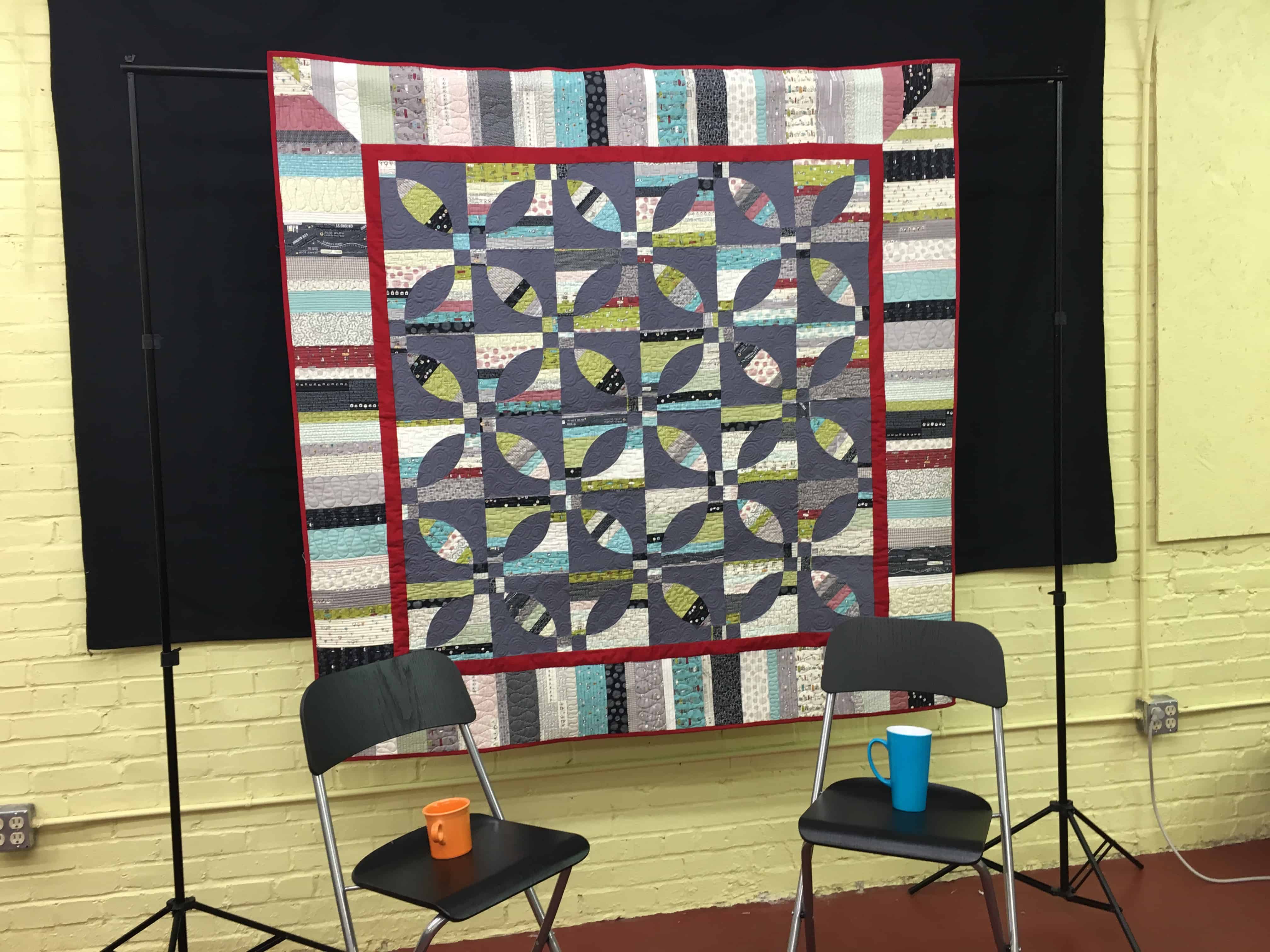
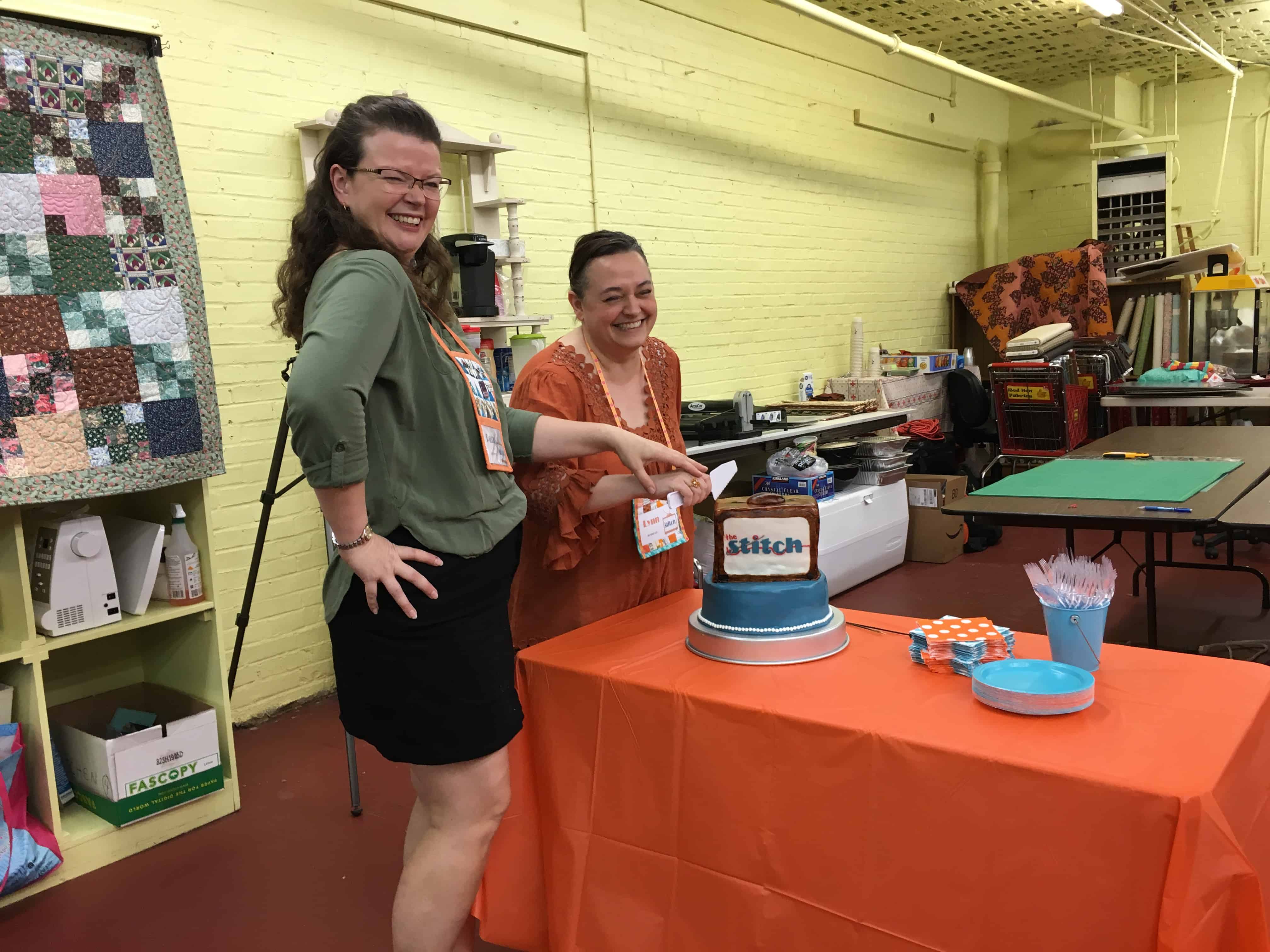
Pam and Lynn are engaging, funny, and kind, and their quilts are BEAUTIFUL. “The Stripper’s Knot” was hanging behind their Stitch TV Show set, and if I hadn’t been quite so self-conscious, I think I could have gotten lost in the piecing and quilting for hours. I loved seeing the variations of the “Time After Time” table runner and the asymmetrical border of “Belinda” (a copy of this pattern is hanging happily over my sewing machine now!). Rae, Kelly, and Mike comprise The Stitch’s production staff, and I enjoyed talking to them as well (over delicious cake no less!). Rae and I talked quite a bit about pattern editing and production. Speaking of, if you are an Indie designer looking for a way to get your quilt patterns into the world, go look her up at 77Peaches!

Pam and Lynn with cake

Before I left, I was sure to get some pictures of Pam and Lynn doing their thing—posing with quilts, laughing, and generally having a wonderful time. Congrats, y’all, on a fabulous pattern release, and thanks for welcoming this “newbie” into the party!

Bio:
HollyAnne Knight is a 20-something wife, mama, and artist. She has a life-long background in visual arts, over a decade of knitting experience, and training in several types on dance from classical ballet to ballroom to Zumba. She has been married to the Hubster (John) for 3 years, and they have two boys, Jem (December 2014) and Ian (March 2016). They live in the Greater Atlanta Area near Holly Anne’s parents and enjoy being outside, sharing meals and adventures with friends, and singing silly songs.

While Holly Anne’s first exposure to machine sewing was at the young age of 8, it was much more recently that she returned to it. She began with a t-shirt quilt for her Mama, and she continues to make t-shirt quilts for customers all over the United States. She also sews modern quilts and is the first Modern Impressionist Quilter, combining the imagery of art quilts with the functionality of other modern quilts. Her style of quilting is strongly influenced by her love of Impressionist and Post-Impressionist painters, her own work with paints, and her familiarity with knitting patterns

Holly Anne can be reached on Instagram at @mesaventureshak and at @stringandstory or via email at stringandstory [@] gmail.com.

Hunter’s Star

Cathy's Hunter's Star
Cathy’s Hunter’s Star

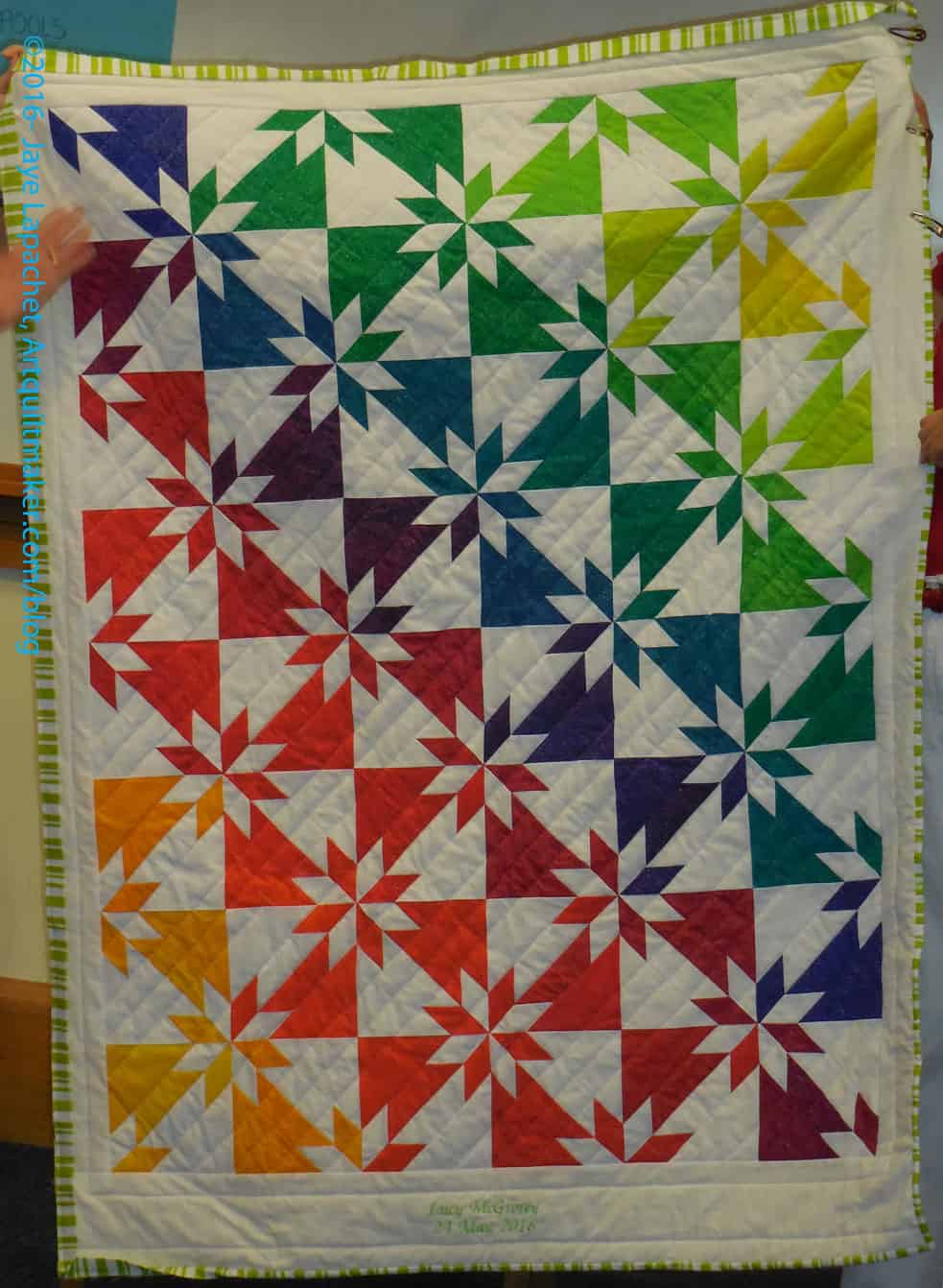
SIL made a Hunter’s Star. She did a really great job and it came out gorgeous. She used her Accuquilt Go! cutter to cut the pieces and said the piecing went really well. She used Pointillist Palette fabrics.

I really liked the way she combined the fabrics and did kind of gradated placement of the colors.

This is the first quilt she has made since moving back home.

Sharing Julie’s Thunder

Friend Julie and I went to drop off a quilt at Colleen’s last week. Thursday? Friday? One of those days. 

Julie's Tumbler
Julie’s Tumbler

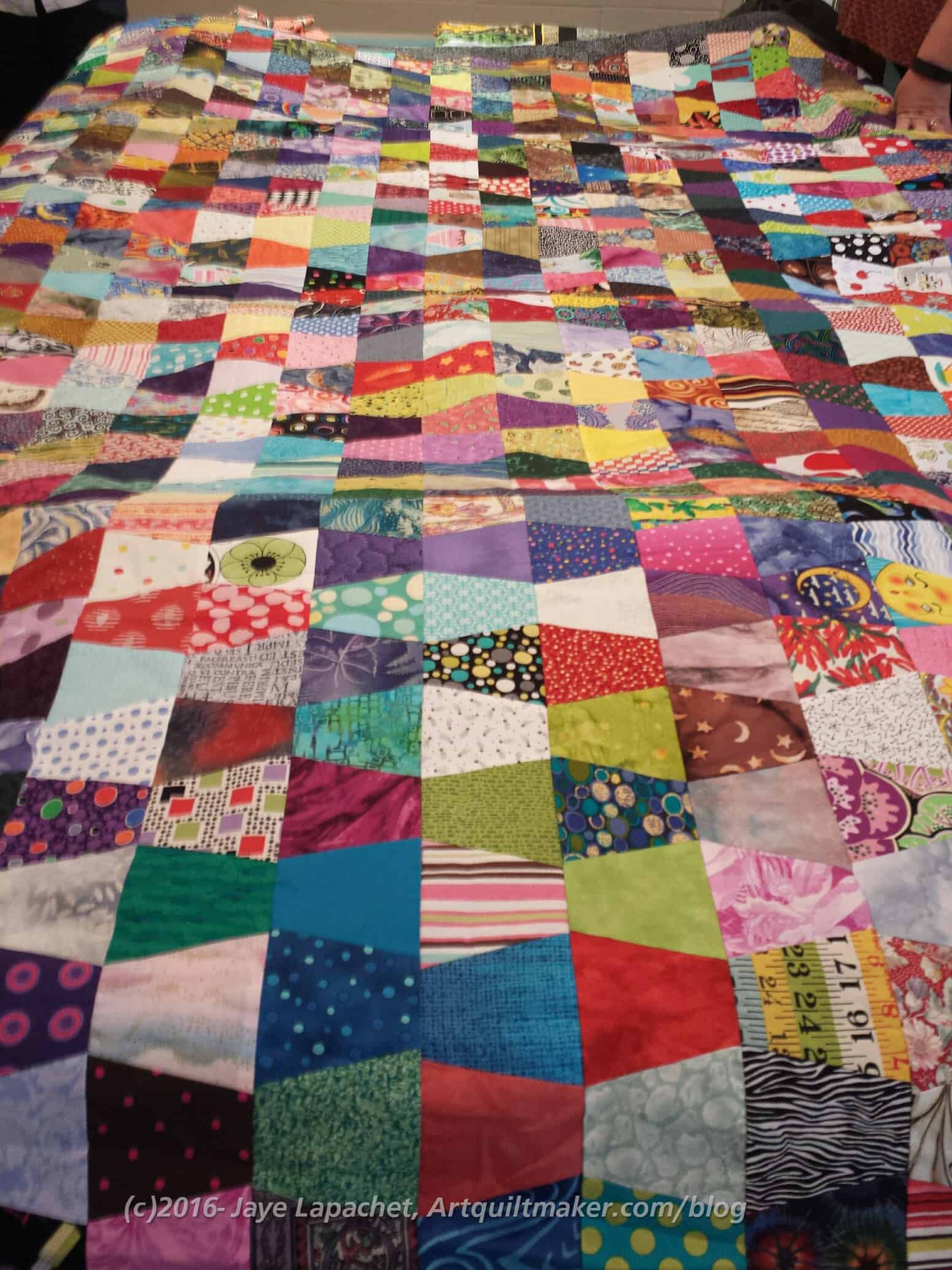
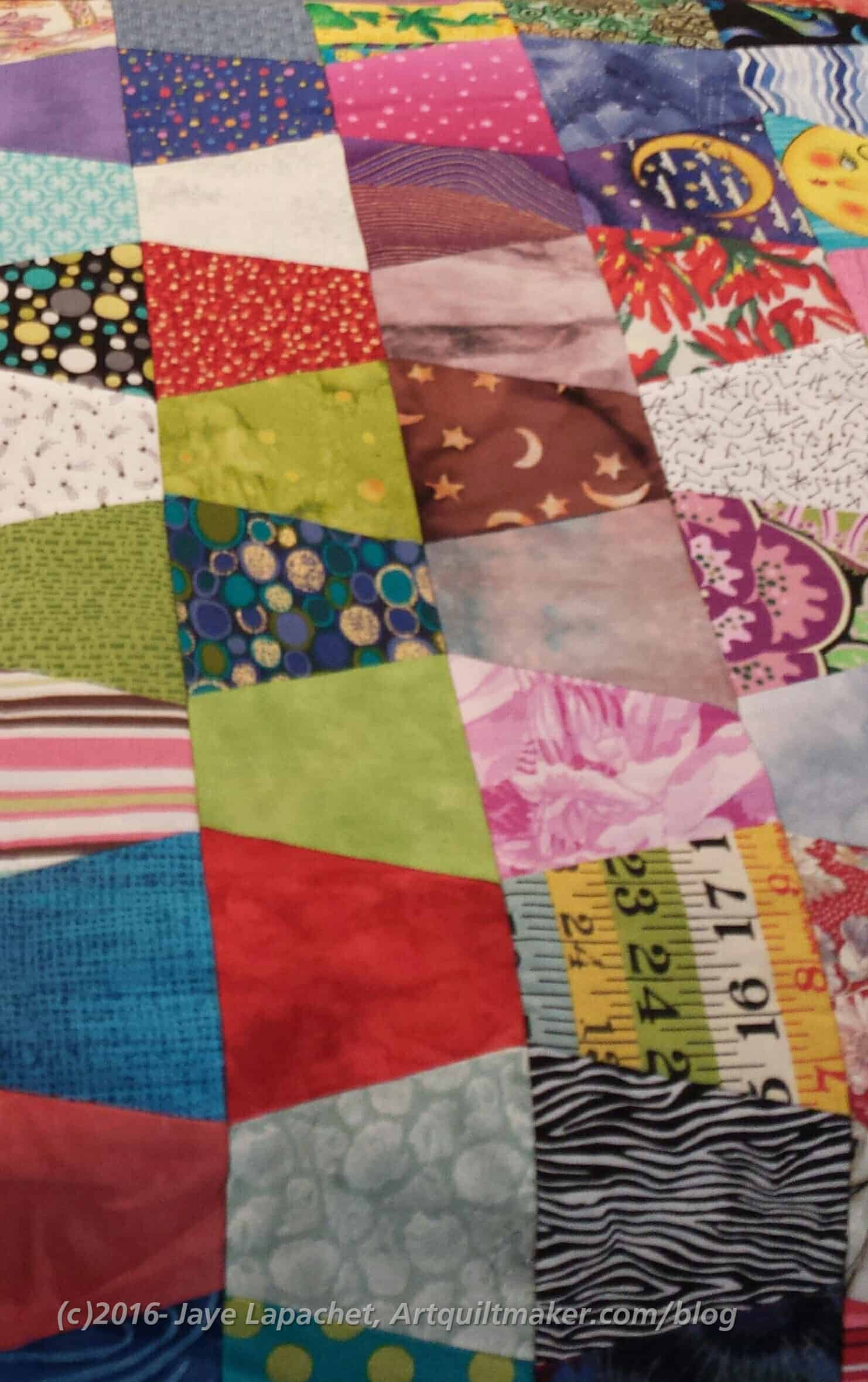
It wasn’t my quilt, but I do feel some ownership as I cut a lot of patches for the top in exchange for some Eye Spy patches.

I was pretty excited to see the piece. I really find scrappy quilts to be much more interesting, often, than super matchy-matchy quilts. It is pretty much a charm quilt as well. 


Colleen figured out that the top has over 1700 patches. Isn’t that amazing?