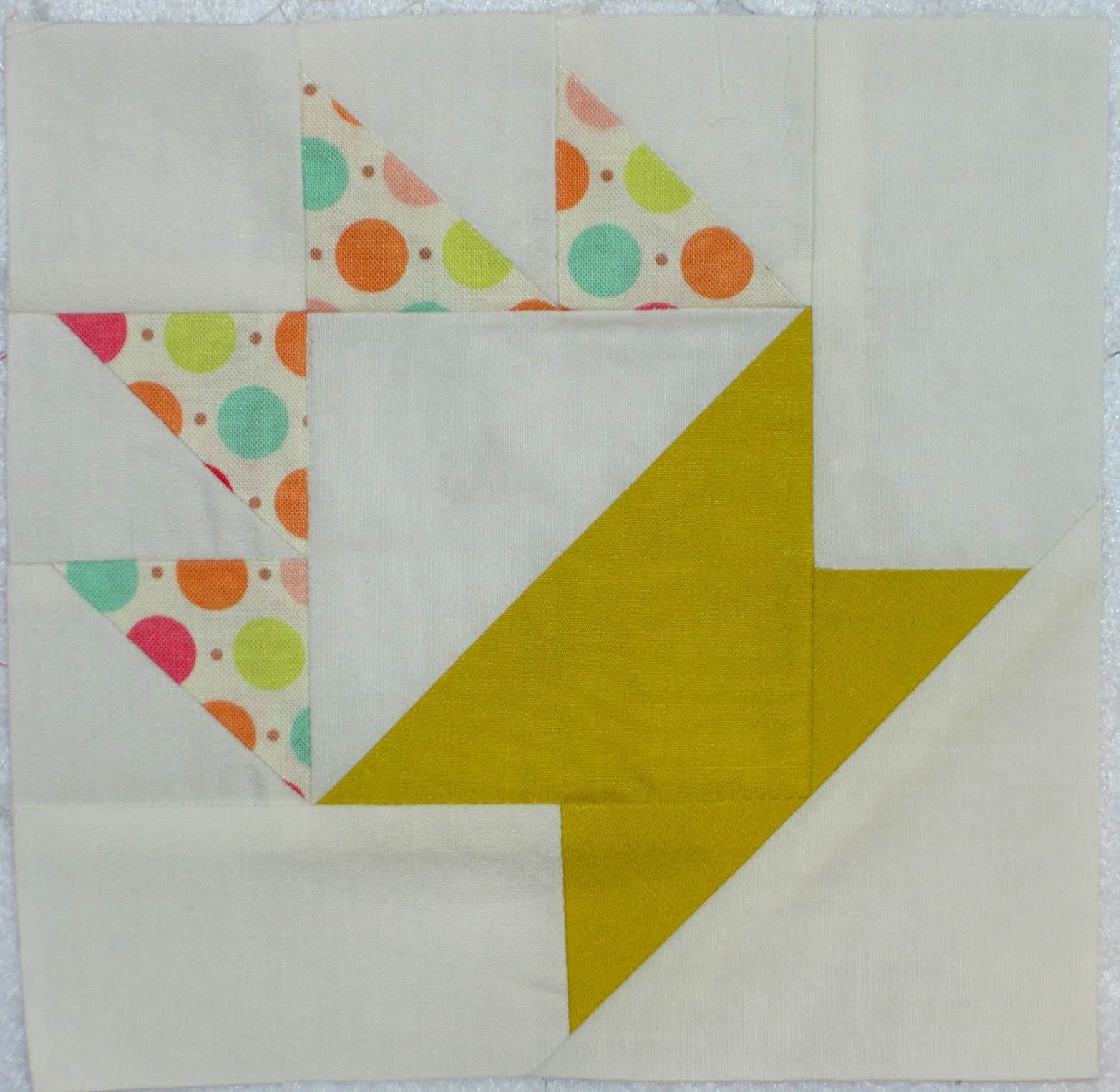
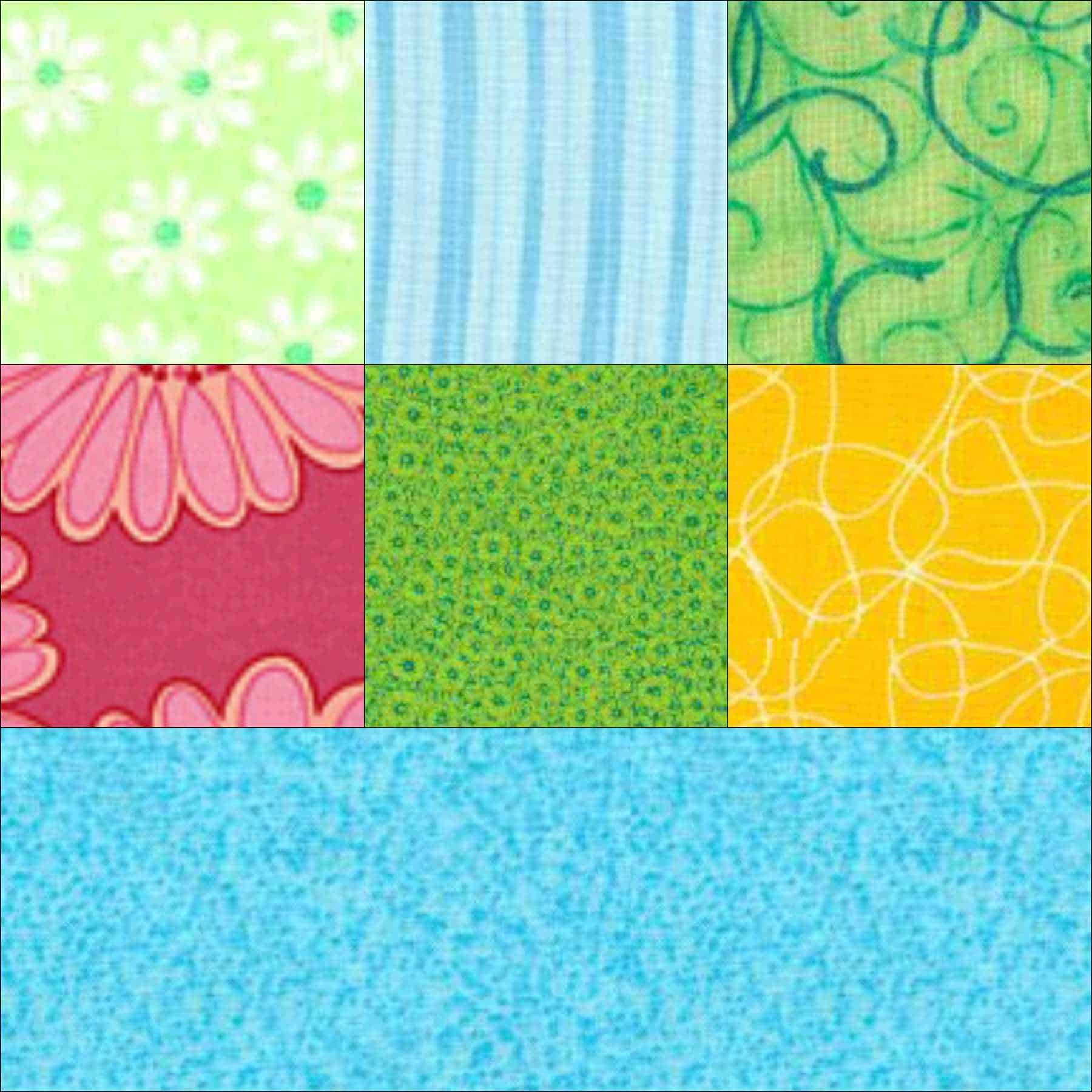
I am a sucker for basket blocks. Cake Stand is a classic. Even though I said I was going to use Around the Block Again and Once More Around the Block, I took a quick peek at Around the Block and couldn’t prevent myself from making this block. I have to admit that the templates that I mentioned in the last post about the project make me not want to use those books. They are not hard to use and it isn’t that I can’t measure the templates and cut them, but I just don’t want to be flipping back and forth. I will get over myself, because I don’t want to give real estate to books that I don’t use.
The gold color is, again, one of the Pat Bravo Pure Elements. I believe it is the Empire Yellow. It has kind of a green tinge to it. I used it, because it was next on my stack to be ironed and I want a bit of a challenge in this project. The dots are a bit light for the background, so I may try the block again with a different background, but we will see.
For the moment, I am still making one block for each letter. I may make seconds for some of the letters. I am going to kind of go with the flow and see how the project evolves.
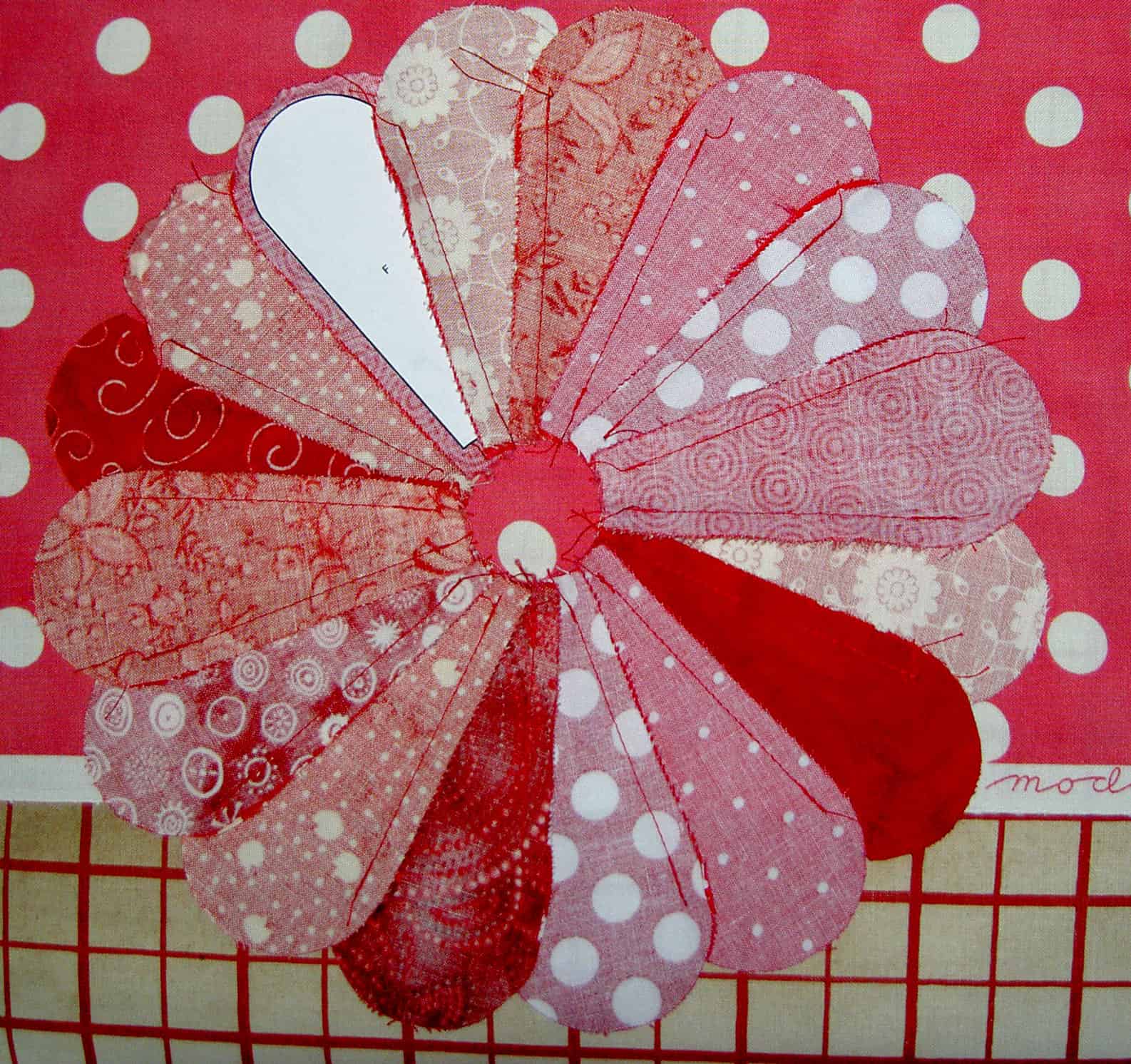
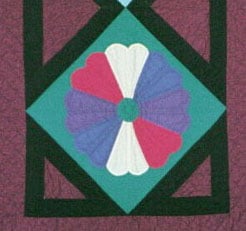
The next block is the Dresden Plate, which we are making using templates. If you would like to see a wide variety of Dresden Plates, you can do a Flickr search to see what others are doing.
Supply list:
pen
heat resistant template plastic
Glue stick
paper scissors
Pilot SCUF black thin point pen or Pigma Micron or Sewline pencil
magazine subscription postcard or small piece of scrap card stock
pins
12.5″x12.5″ or larger square rotary cutting ruler
fabric
Mary Ellen’s Best Press (or similar)
stiletto or similar (popsicle stick might work)
sharp fabric scissors
thread for piecing
sewing machine
basic sewing kit
Auditioning Fabric
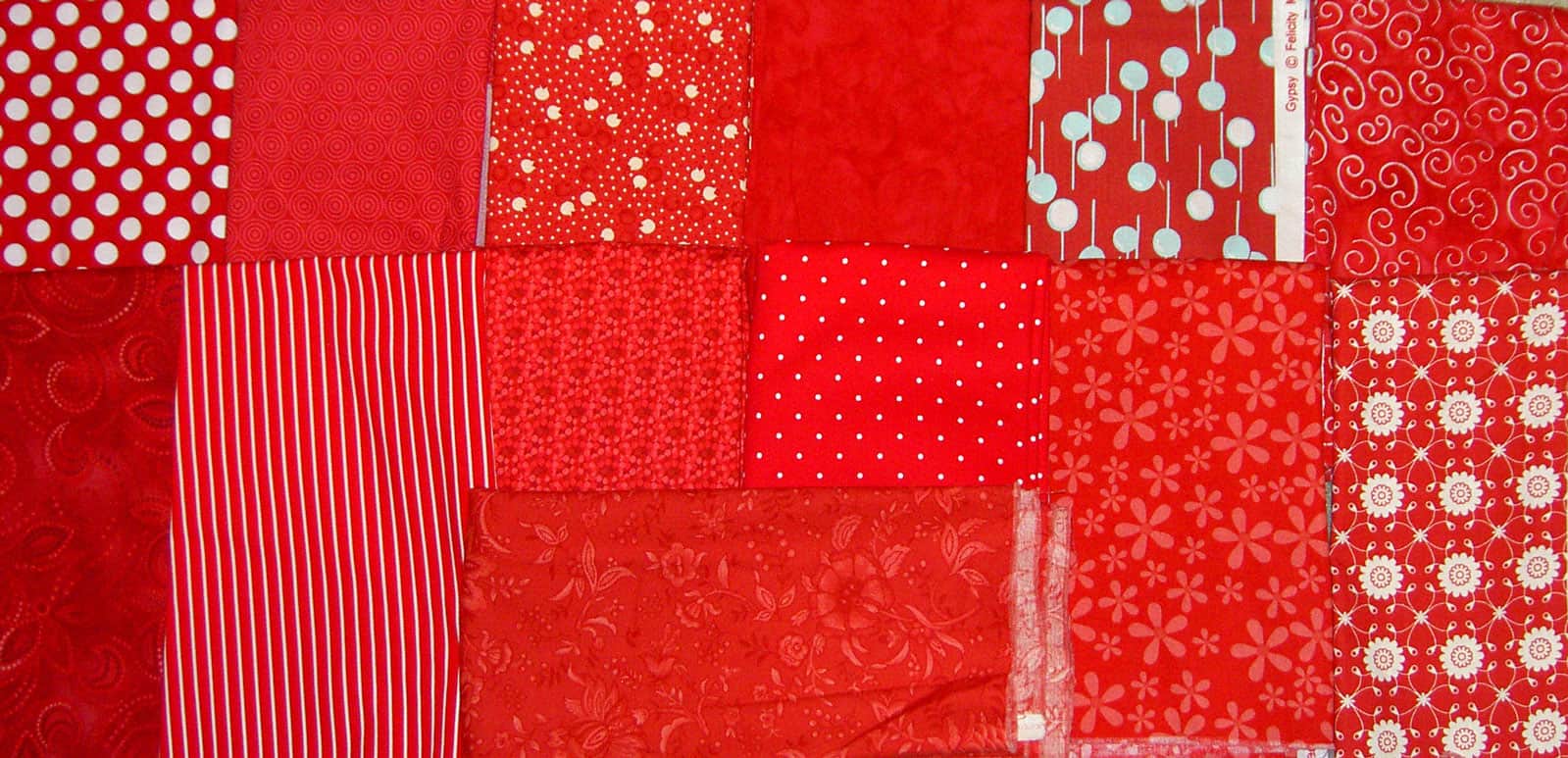
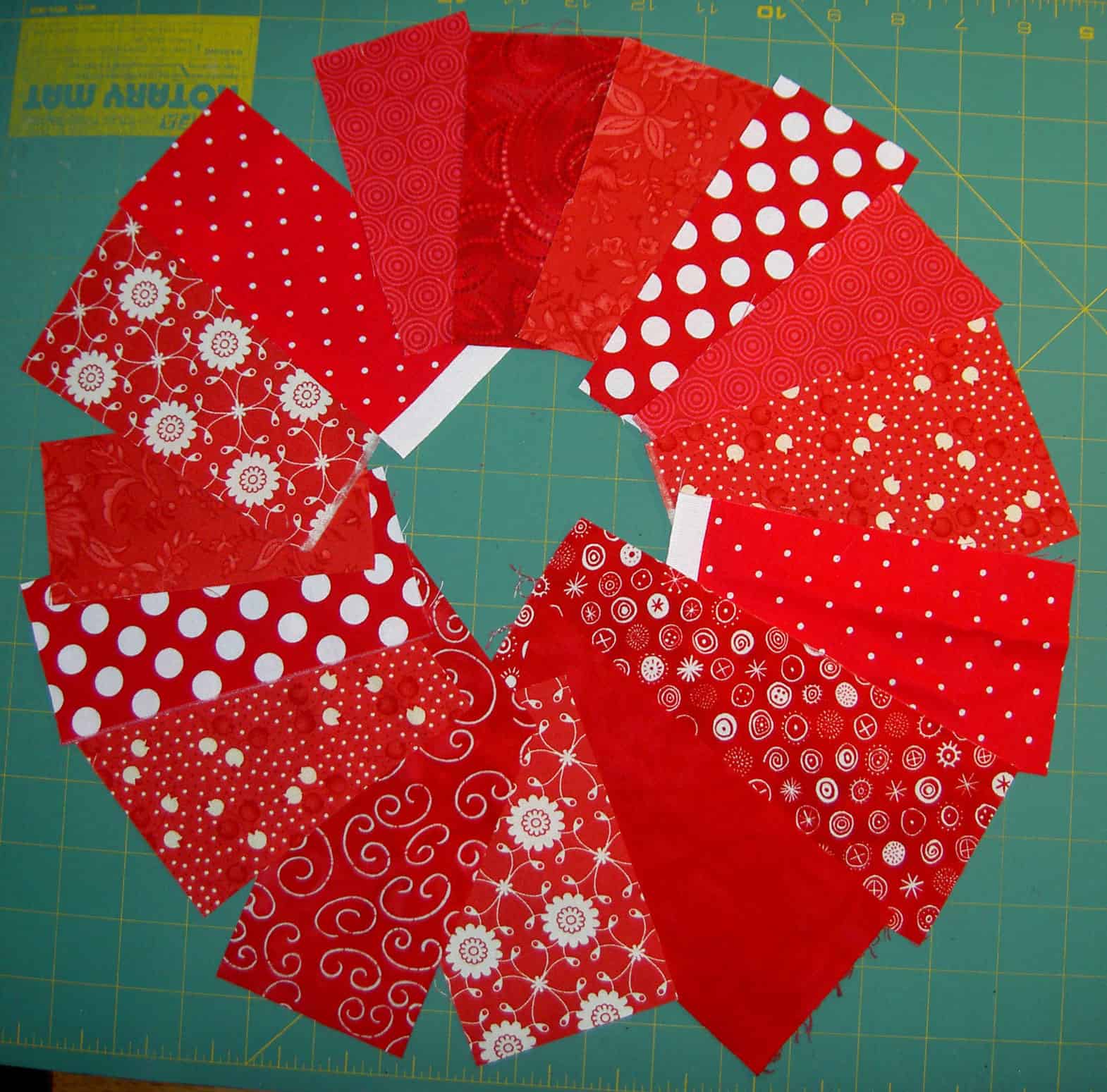
1. Select your petal fabrics. You can use 2 or many. You want to be able to see the work you have put into this block. Above are all of my options. I didn’t end up using all of them.
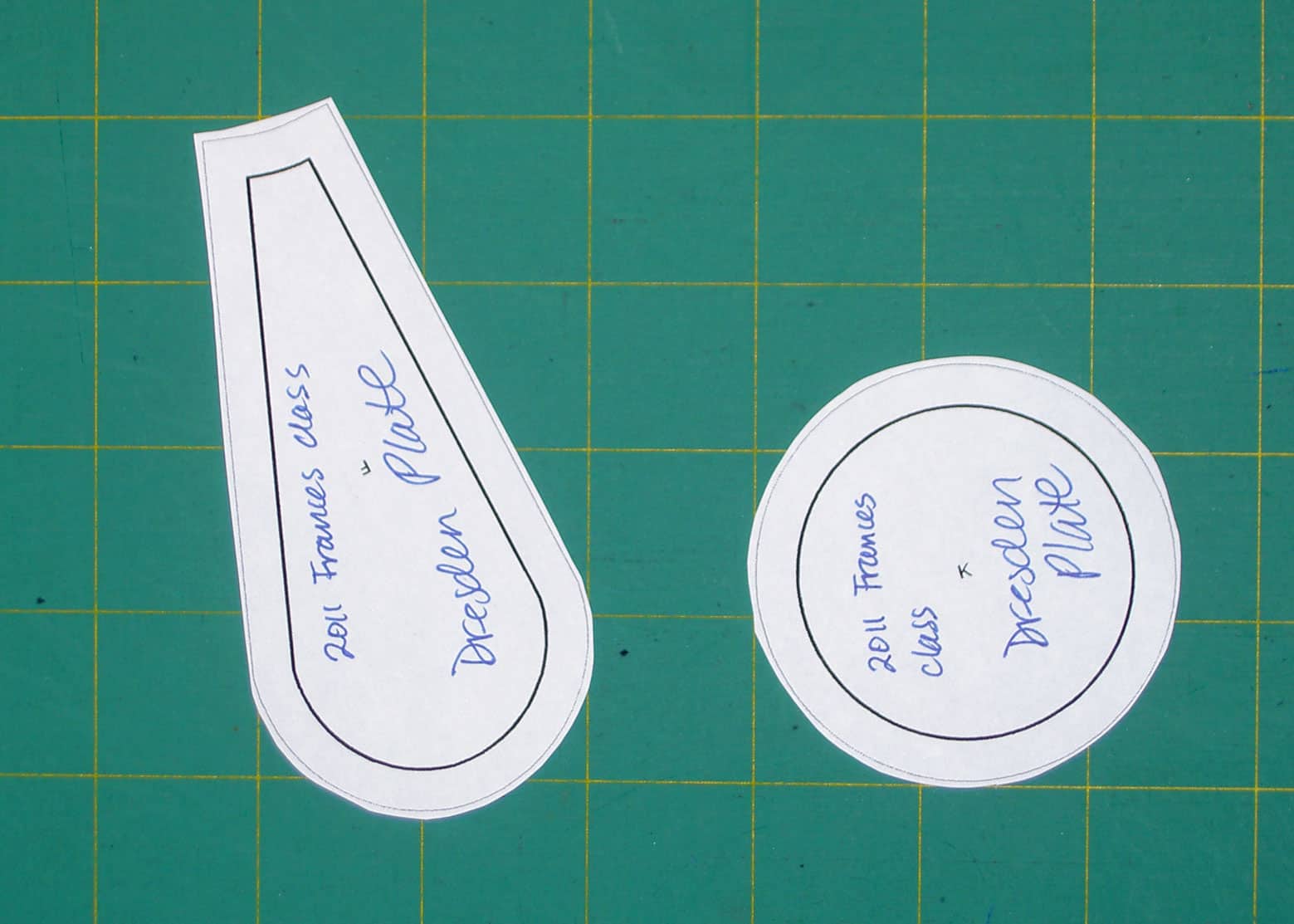
2. Print 3 copies of Dresden Plate Templates pattern. Two you will cut out and one you will keep for future reference.
Rough cut templates out of pattern sheet
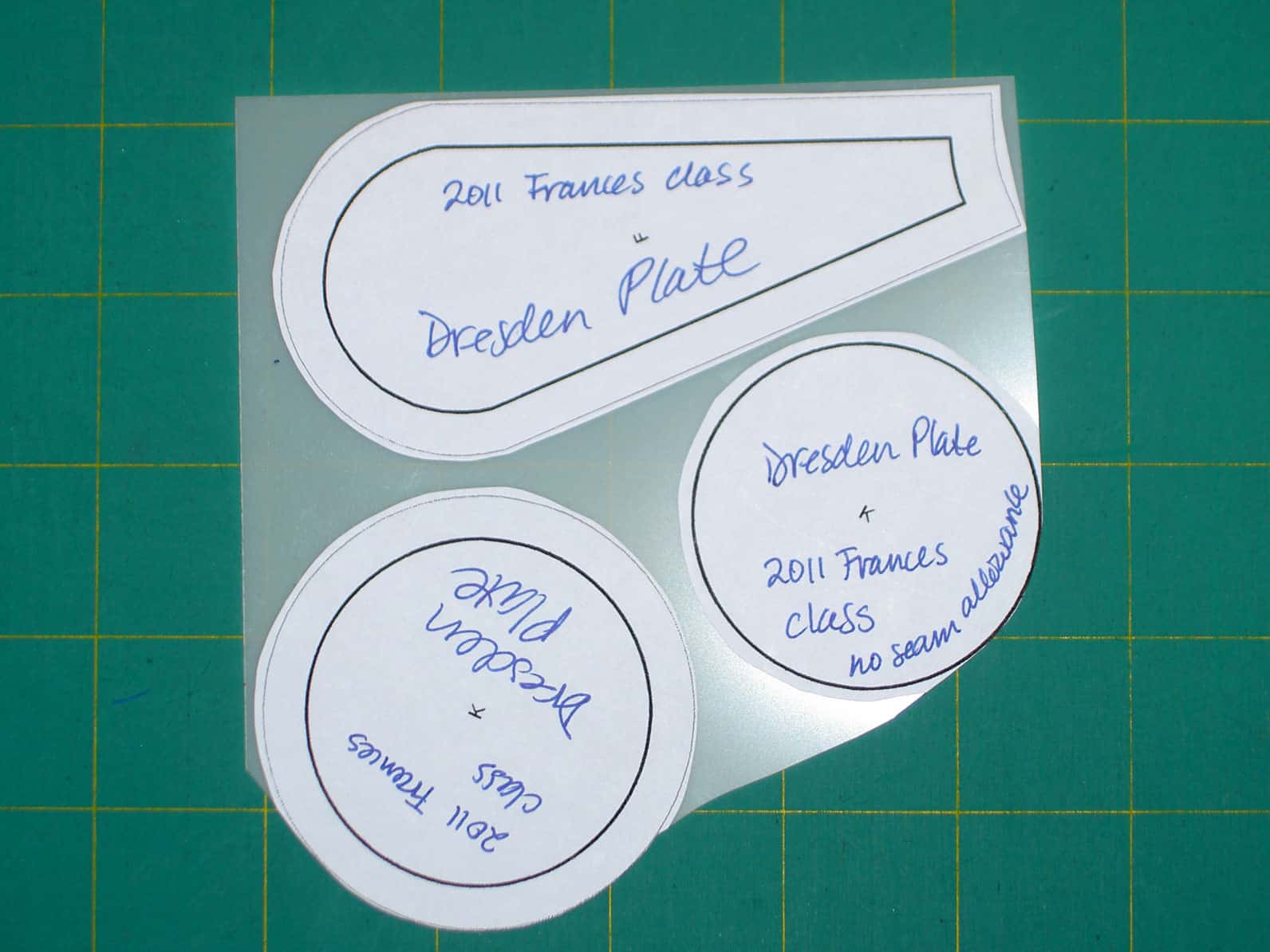
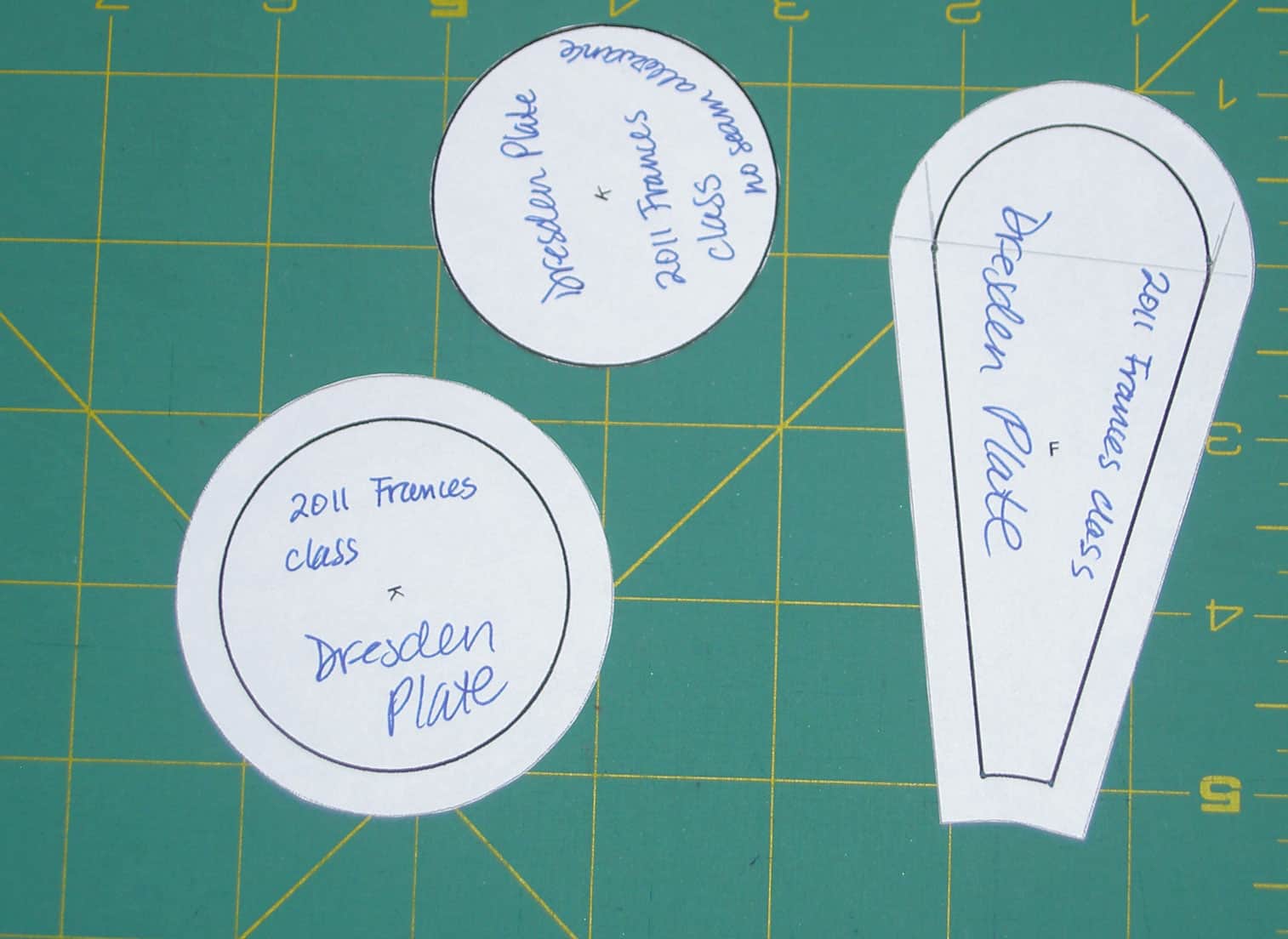
3. From one pattern sheet rough cut around the petal and the circle including the seam allowance.
4. From one pattern sheet rough cut around the circle template and the petal template excluding the seam allowance. On the petal, cut off the thick black line. For the circle, leave the thick black line on the template.
Optional: Write ‘Dresden Plate” on each piece (or some way of identifying why you made these templates for later). Make a notation on the circle with no seam allowance so you don’t it mixed up with the other circle.
Glue paper patterns to template plastic
5. Glue circle and petal templates to template plastic
Templates Cut Out
6. Carefully cut templates out of template plastic just outside of thin outside line.
Extend Lines
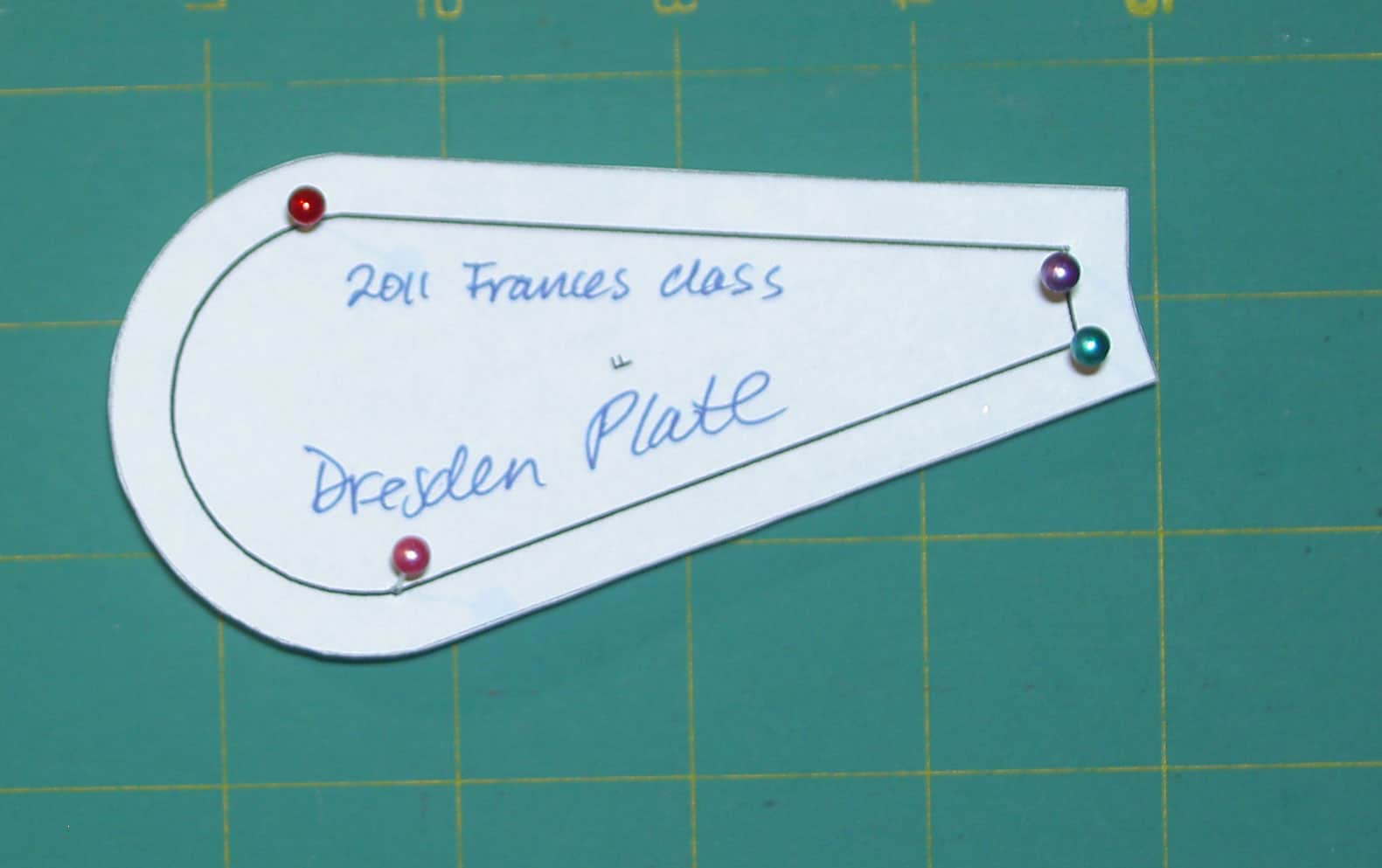
7. Extend the straight line into the seam allowance with a ruler and a very sharp pencil or pen.
8. Right where the curve starts to move away from the straight line of the template, draw a line between those two points.
Poke Corners
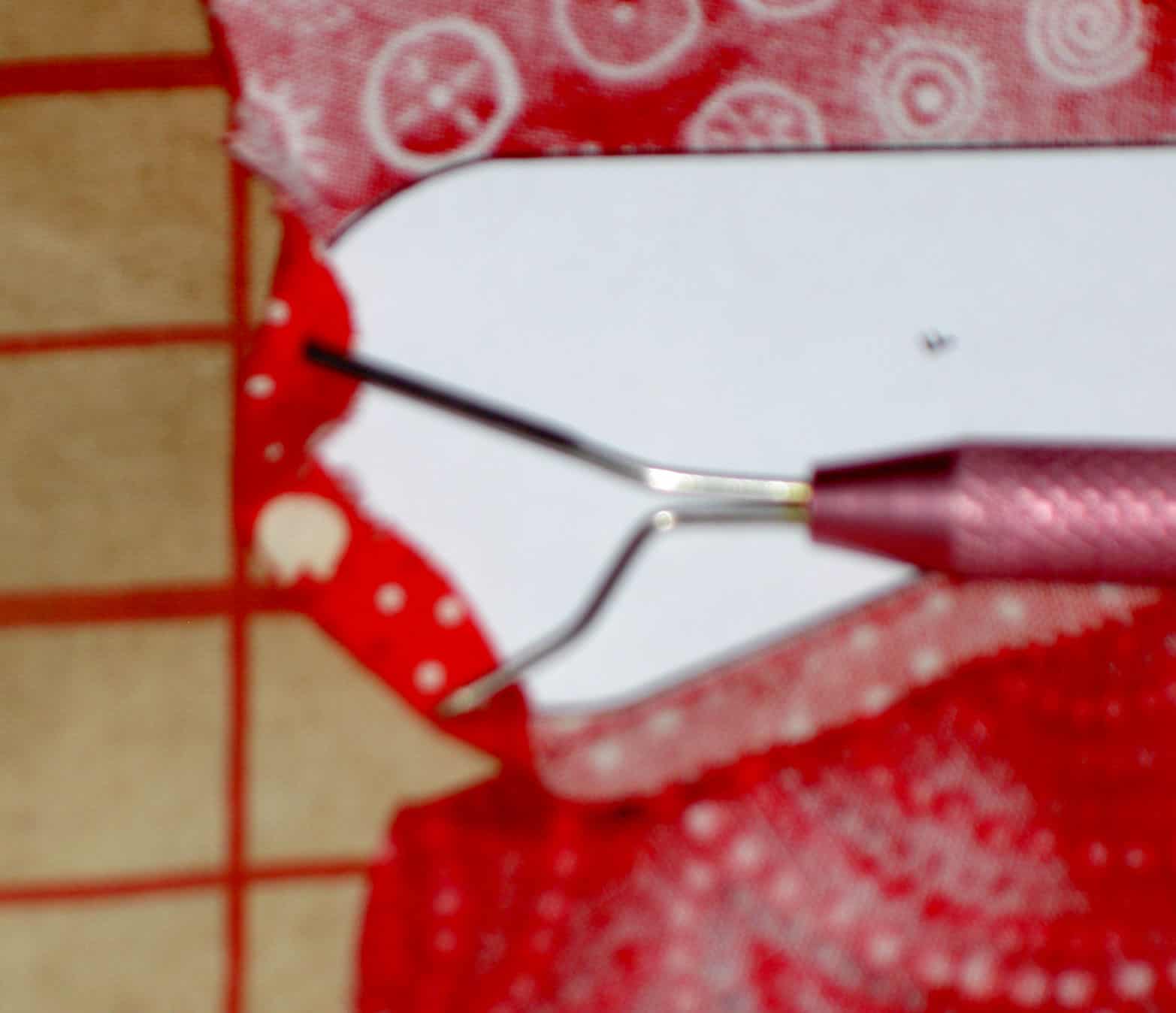
9. At the intersection, poke the corner of the petals to mark sewing start and stop points. I used a pin and then enlarged the holes with a seam ripper.
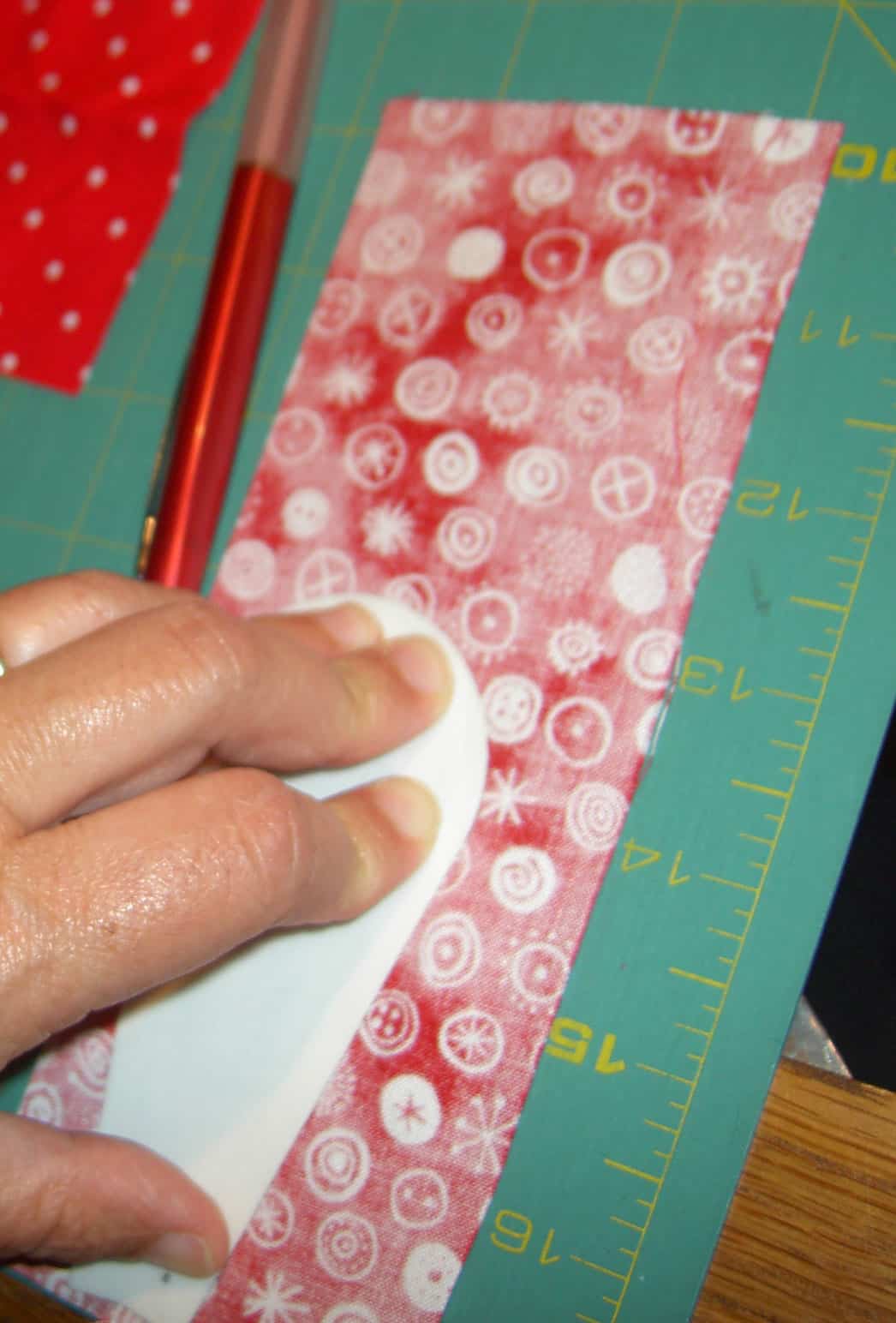
Optional: Spray rectangles of petal fabric with Mary Ellen’s Best Press to control the bias.
Trace Around Petal Templates
10. Trace around the petal template face down on the wrong side of the fabric. Hold the template tight down on the fabric with your fingers near where your pencil or pen is moving around the template.
Note: test to make sure that your quarter inch seam line covers the mark you made. If it doesn’t use a pencil.
Fabrics Ready to Trace
11. Use at least 2 different fabrics to trace 16 petals. You can use many more. You want to be able to see the work you have put into this block. If you use two, alternate them.
Trace Circle on Fabric for CenterCut out Center Circle
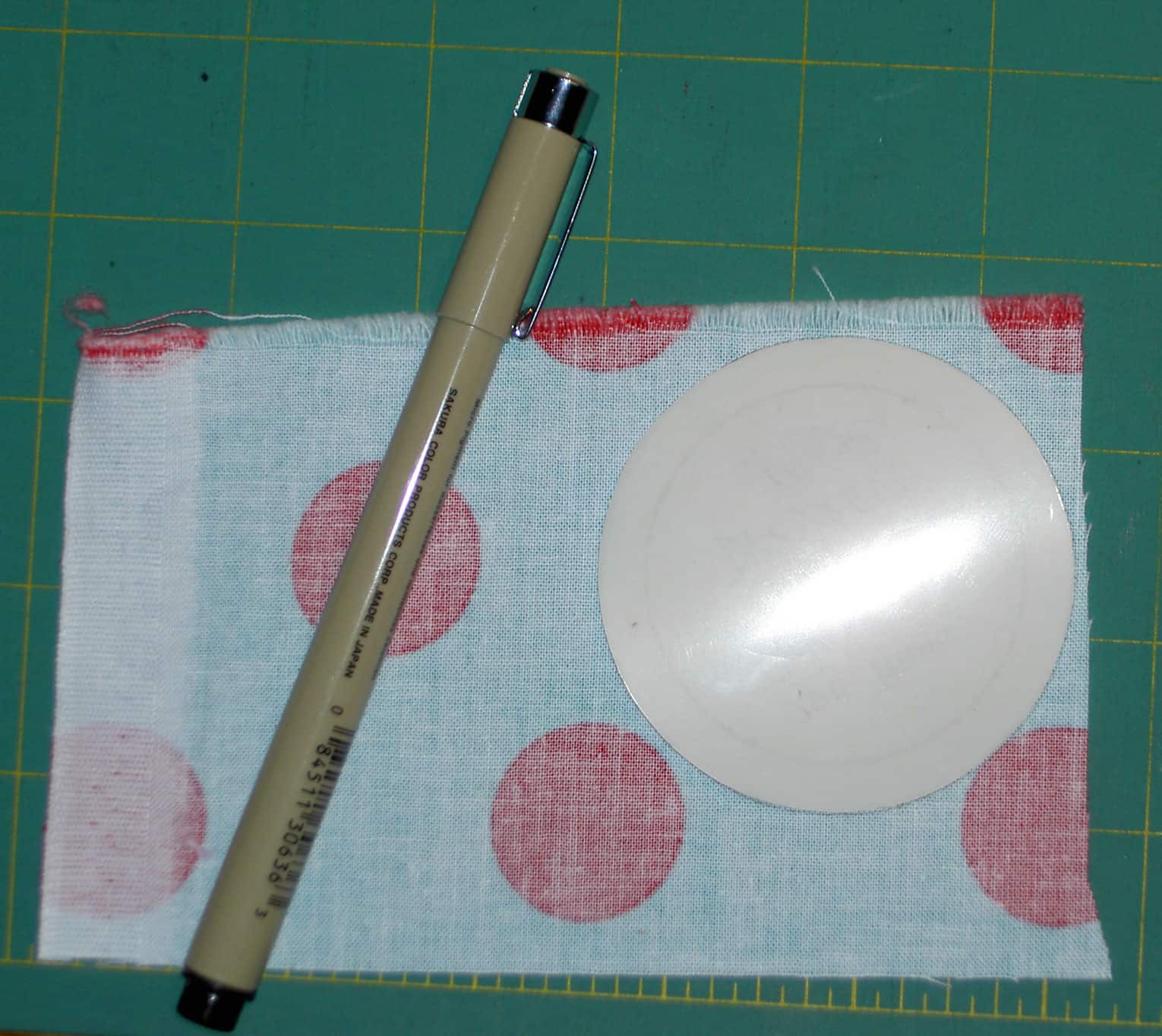
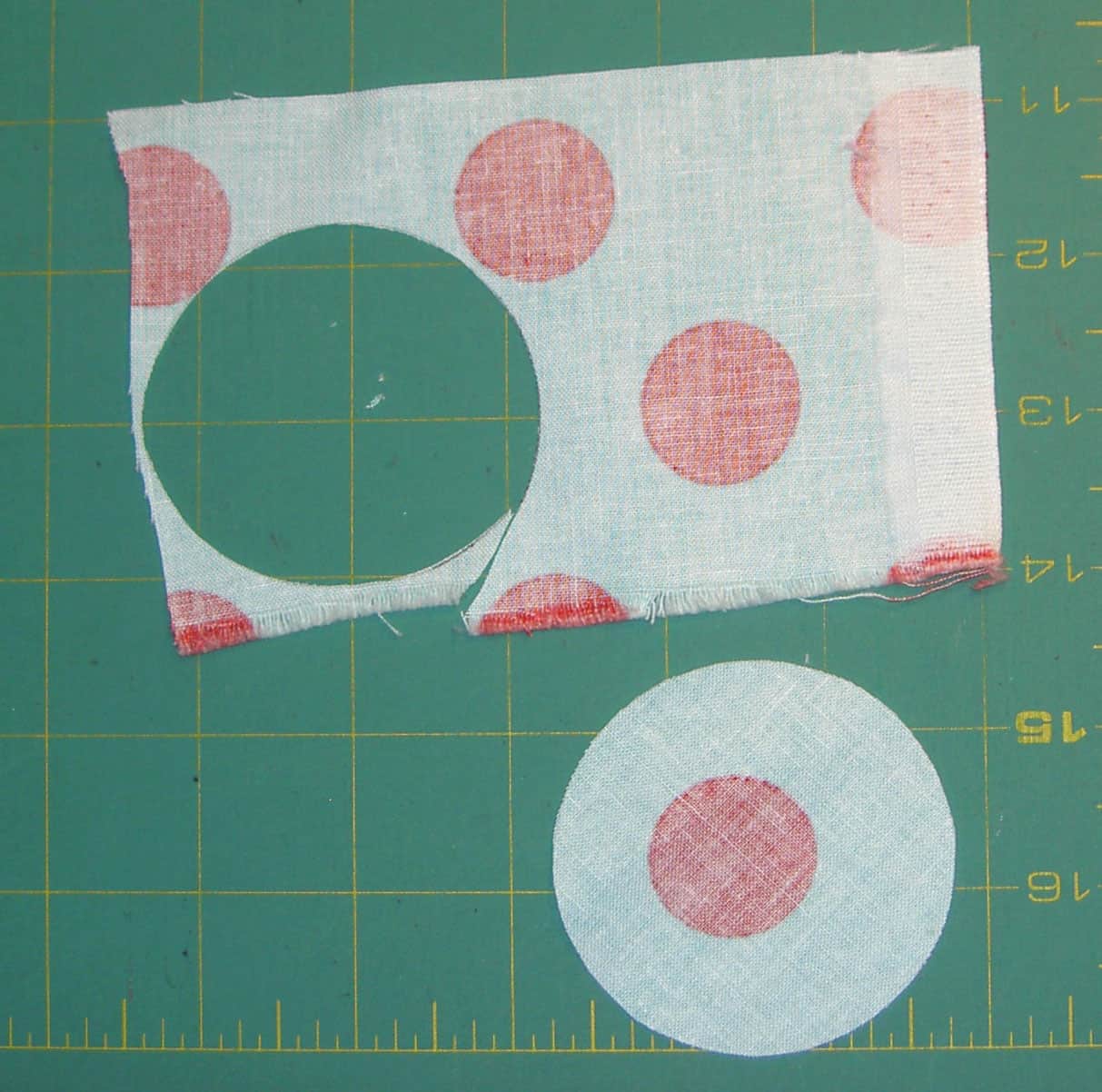
12. Trace a circle using the template with the seam allowance. Cut out the fabric circle with a generous seam allowance (more than 1/4″).
13. Cut fabrics using very sharp fabric scissors OR cut straight lines with rotary cutter and curved seams with fabric scissors.
Petals on DotsPetals on Flowers
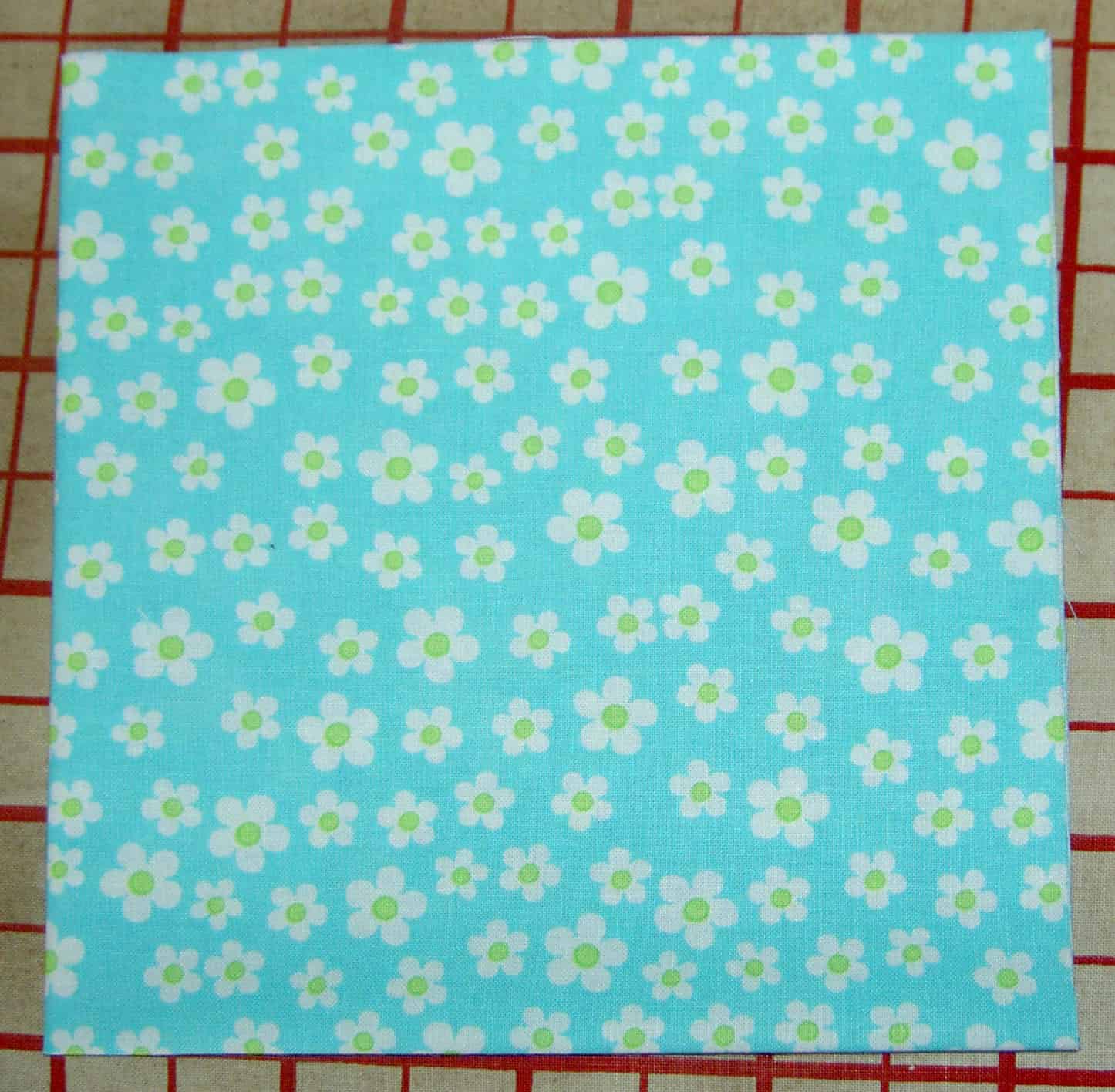
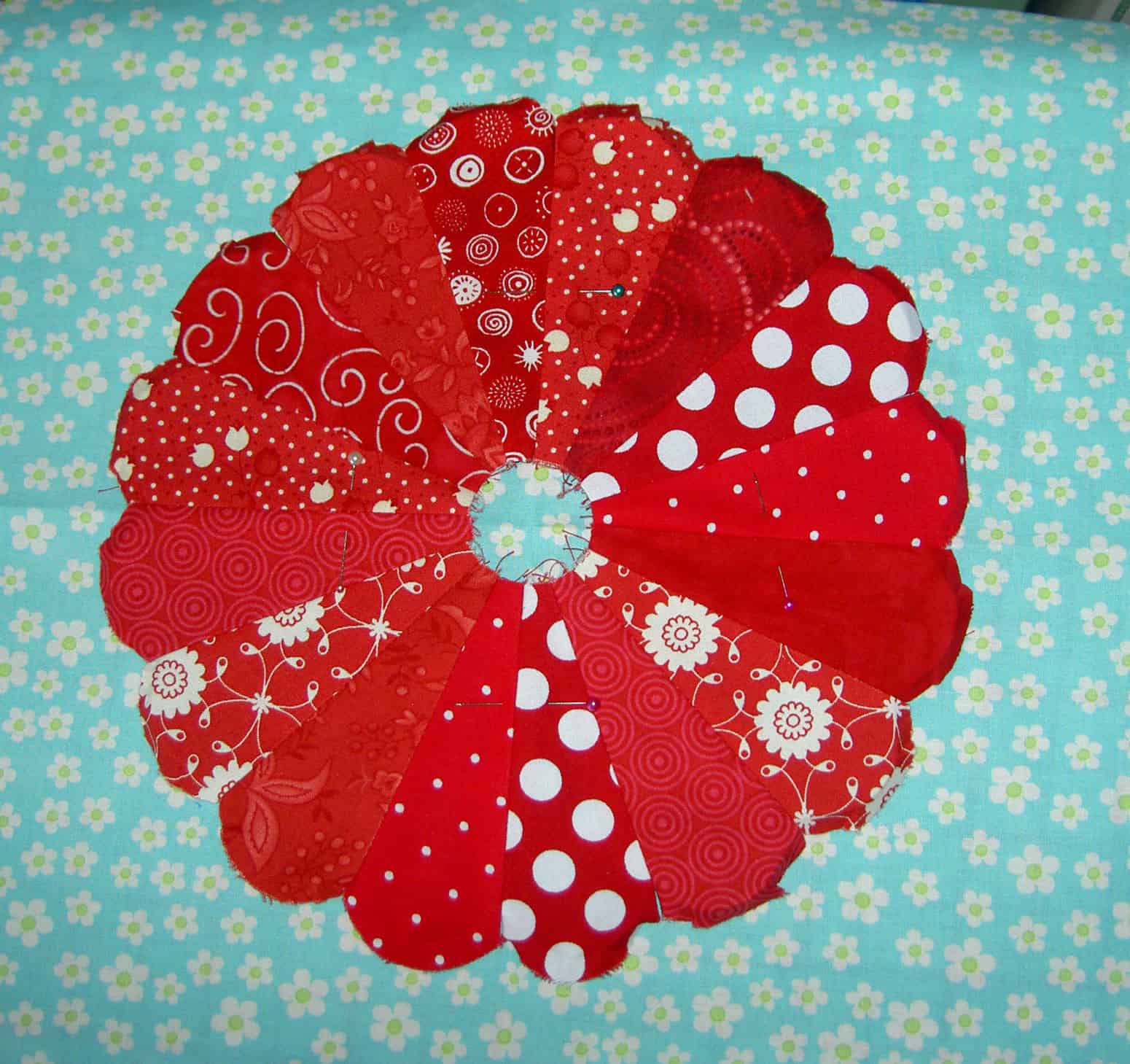
14. Choose your background fabric by laying the petals on the possible background fabrics, approximating the shape of the Dresden plate.
15. Cut a 13.5″x13.5″ background piece. Your Dresden Plate will be appliqued to this piece. Make sure it is square by using a 15″x15″or larger square ruler. You want to cut a larger block, because the sewing of the block may make it shrink up. You will trim the background piece once your block has been completed. Set this aside for now.
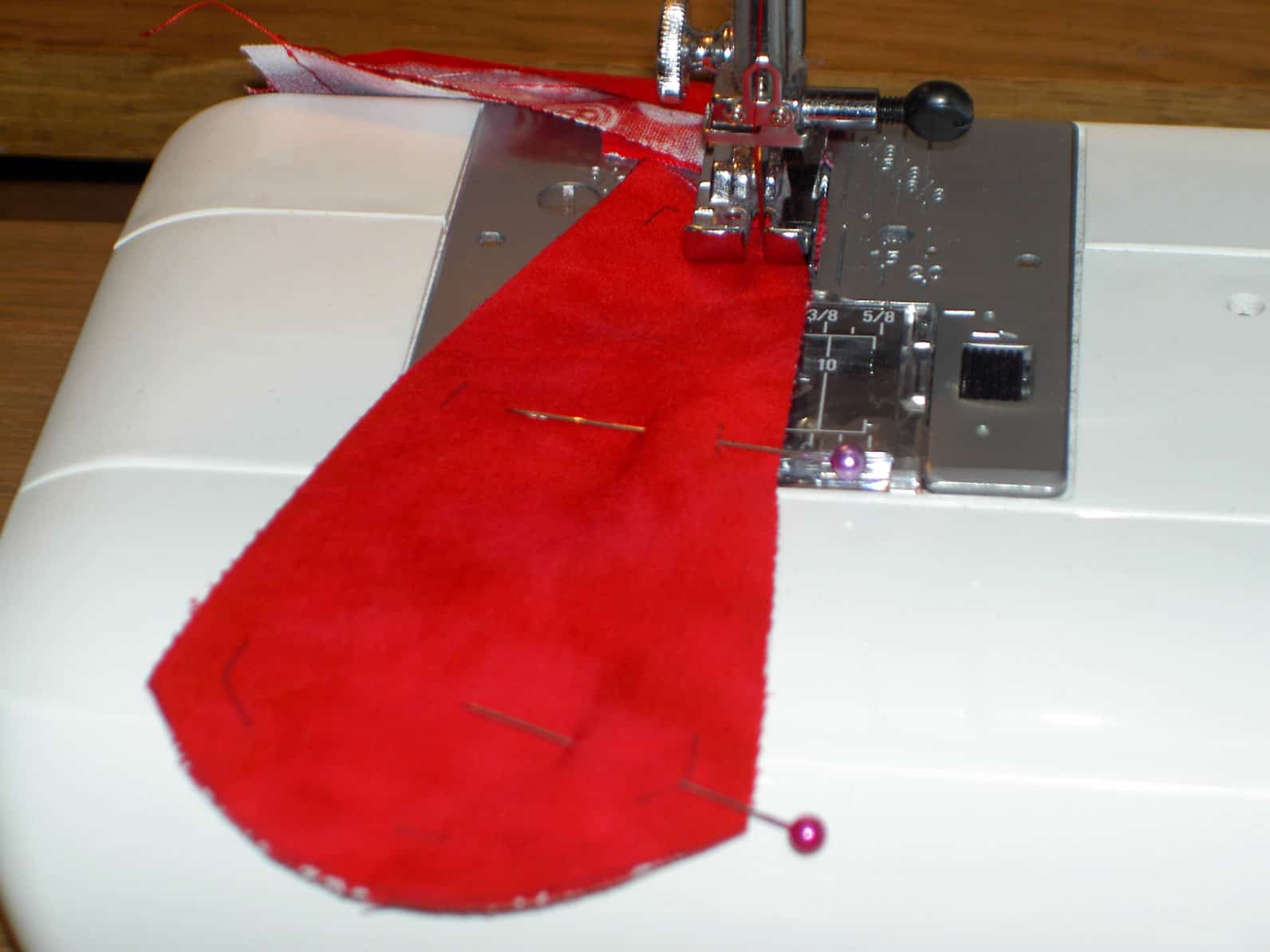
16. Line up two petals, right sides together.
17. Pin pieces together by lining up the holes you made when you traced around the template.
Sew from Point to Point
18. Sew from point to point, back stitching at each end. DO NOT sew into the seam allowance.
19. Press seams open.
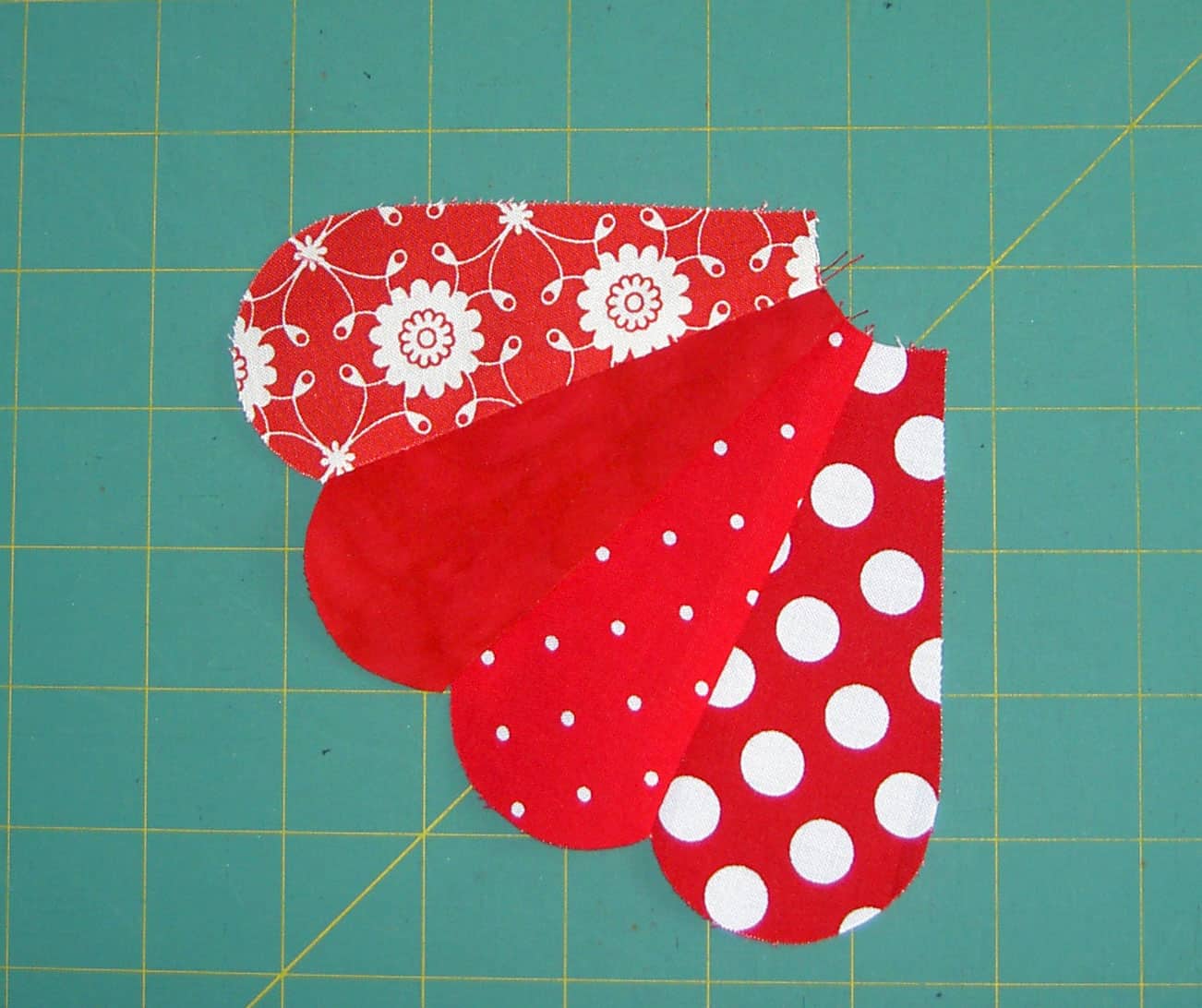
Group of 44 Groups of 4
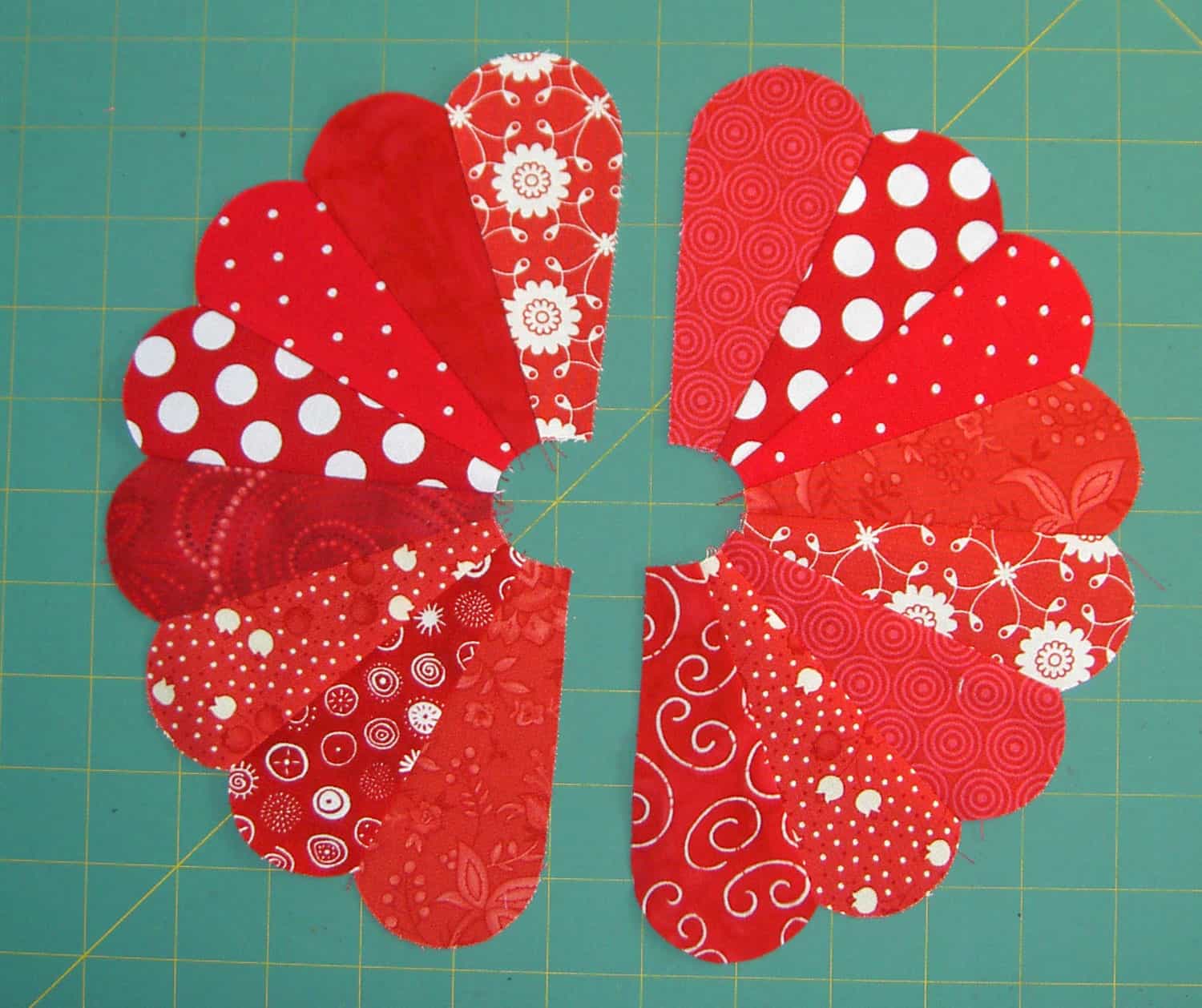
20. Sew petals together in groups of 2, then sew the groups of twos to each other to make groups of 4, etc.
21. Sew between points, back stitching at each end. DO NOT sew into the seam allowance.
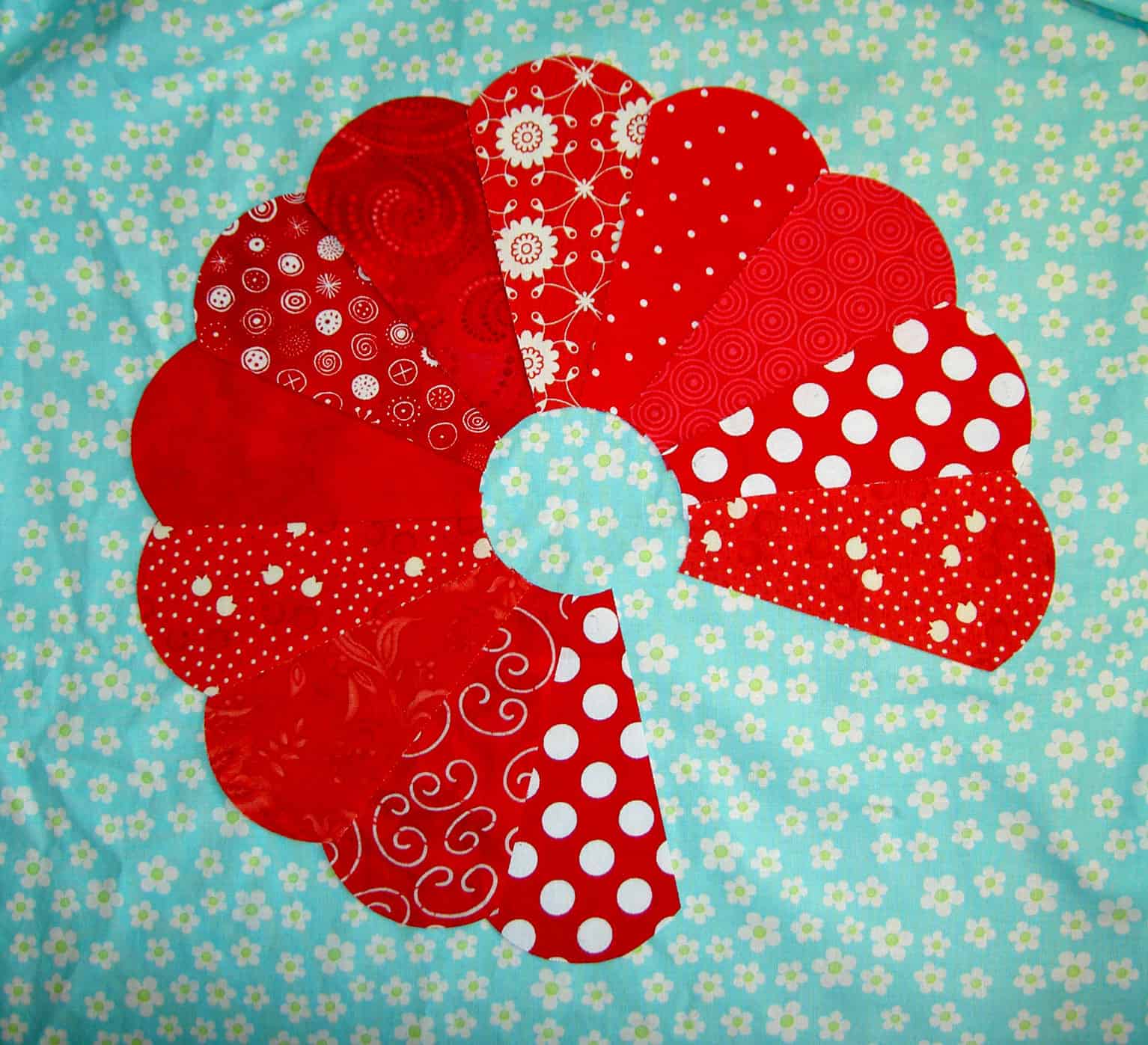
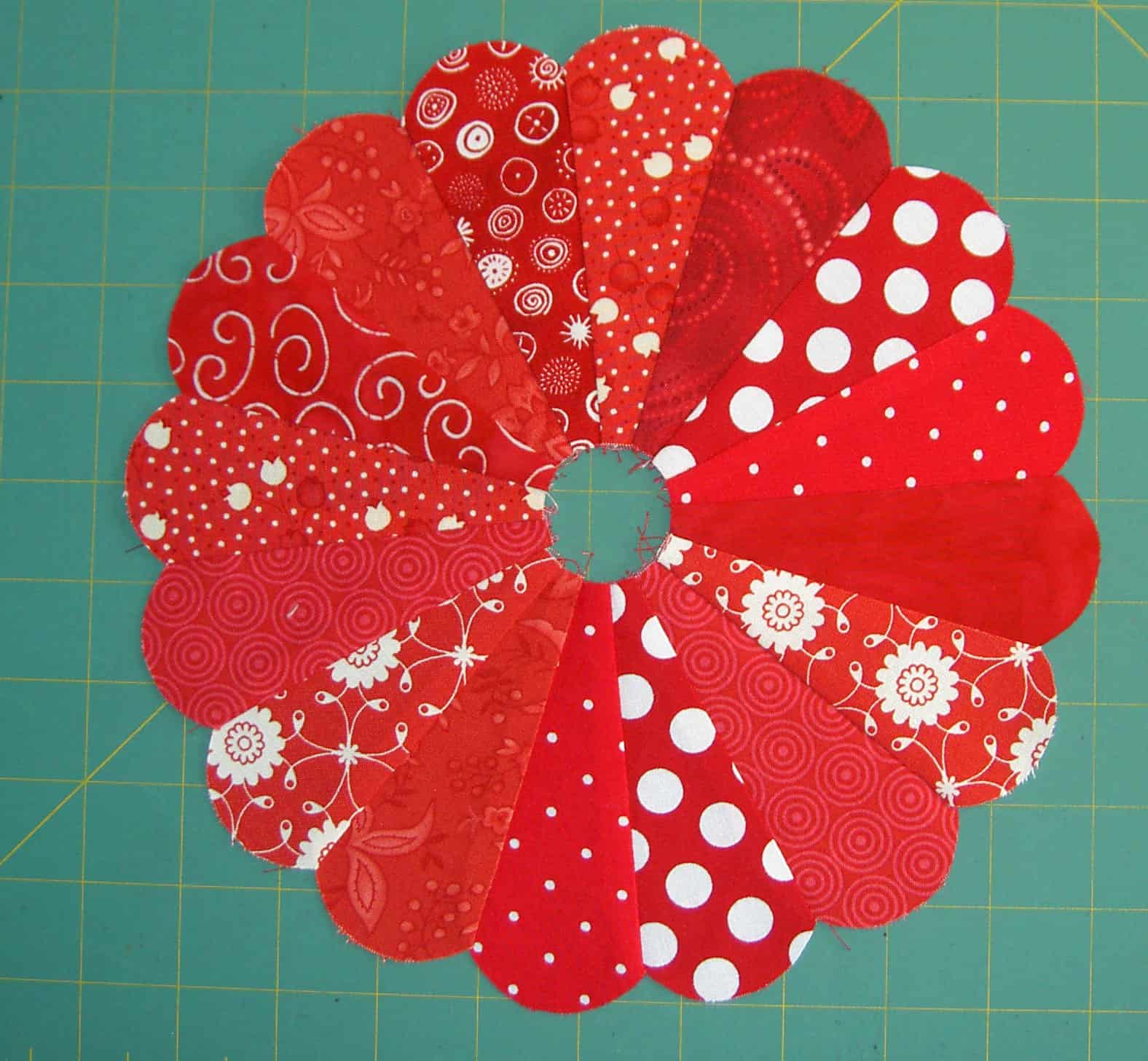
Completed Plate
22. Sew all petals to each other, back stitching at each end, making a ring.
23. Press all seams open.
24. Trim threads.
25. Lay petal ring face down on your ironing board.
Plate face down
26. Lay the petal template without the seam allowance (which must be made from heat resistant template plastic or cardboard. Don’t use something that will melt) on the back face up.
Press Curve
You probably won’t be able to get the seam allowances flat, but press enough so the fabric knows where the curve is. It will help you when you go to stitch it down.
Press CurveFinished Pressing all Curves
27. Press the curve into the outer edge of each petal. Use the stiletto to hold down the edge and iron right over the stiletto tip and the template. This is the miserable step, so intersperse some chocolate or some other sewing. Lay aside.
28. Take your cut piece of background fabric. Fold it in half and press lightly.
Fold Background in 1/2, then 1/4s
29. Fold your background fabric in half again (in quarters) and press lightly.
30. Open and you should be able to see the cross you have pressed into your background piece.
Center Plate on Background
31. Take your plate of petals and line up 4 of the seam allowances with the pressed cross on your background fabric. This will center the plate on the background. Make sure you pay attention to the vertical as well as the horizontal.
32. Pin in place
33. Use thread that matches the plate or is neutral for hand applique’ or a blanket stitch to sew plate to background. You can also machine applique’ the plate to the background. We will cover that technique in another lesson, but there are many other tutorials available.
Move Pins as you Stitch
34. Pin curved edges of plate as you move around the plate to applique’.
35.Know the thread so the knot does not pop through the background.
36. Bring the thread up from the back through the fold of the plate (where you pressed the seam allowance).
37. Tug gently and put the needle into the background, just catching it, and pull the needle tight through the fold of the plate again.
38. Go around the entire plate in this manner, using the needle to tuck in the seam allowance so it has a smooth round shape.
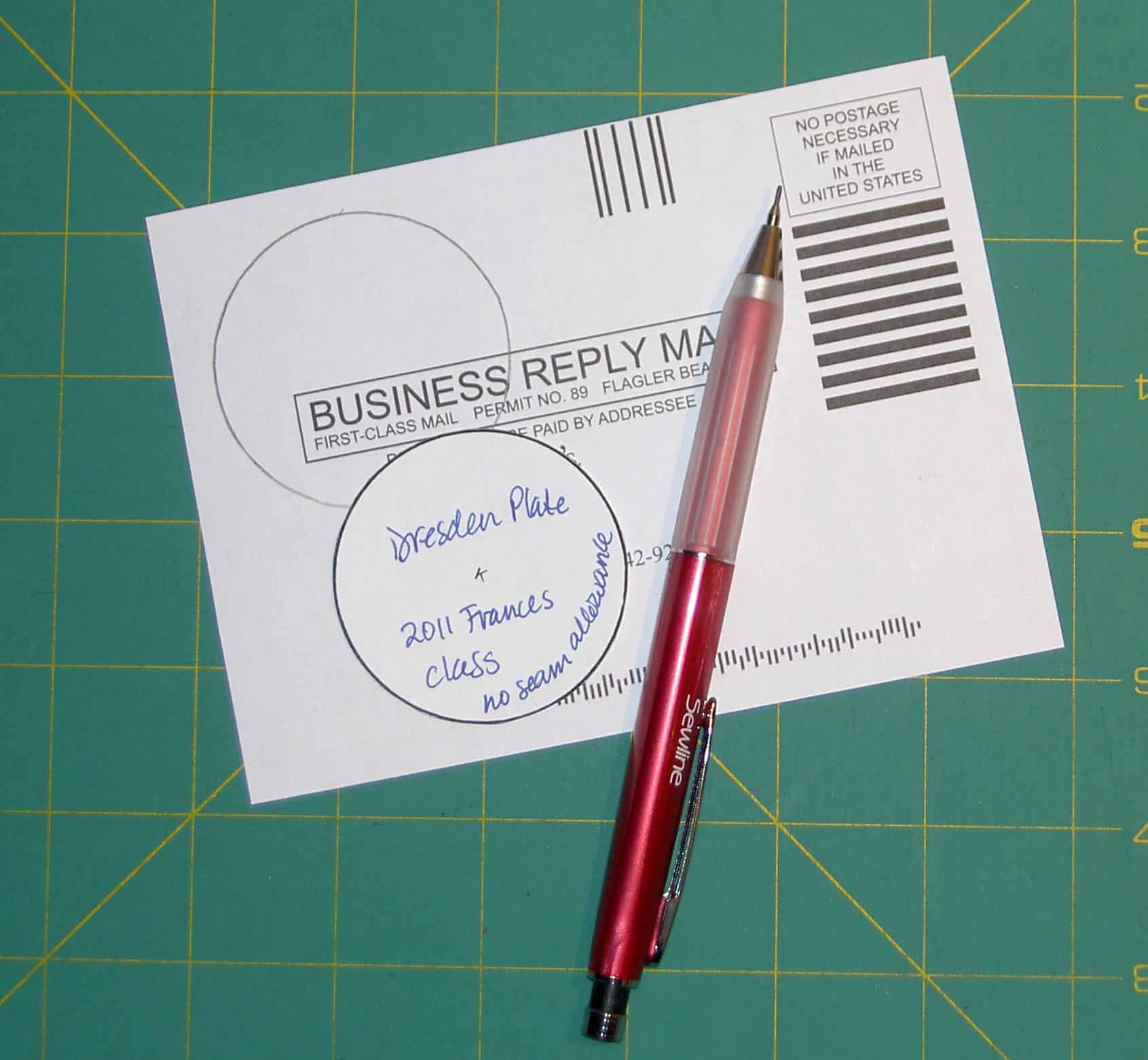
Trace
39. Trace the circle template without the seam allowance onto the magazine subscription card.
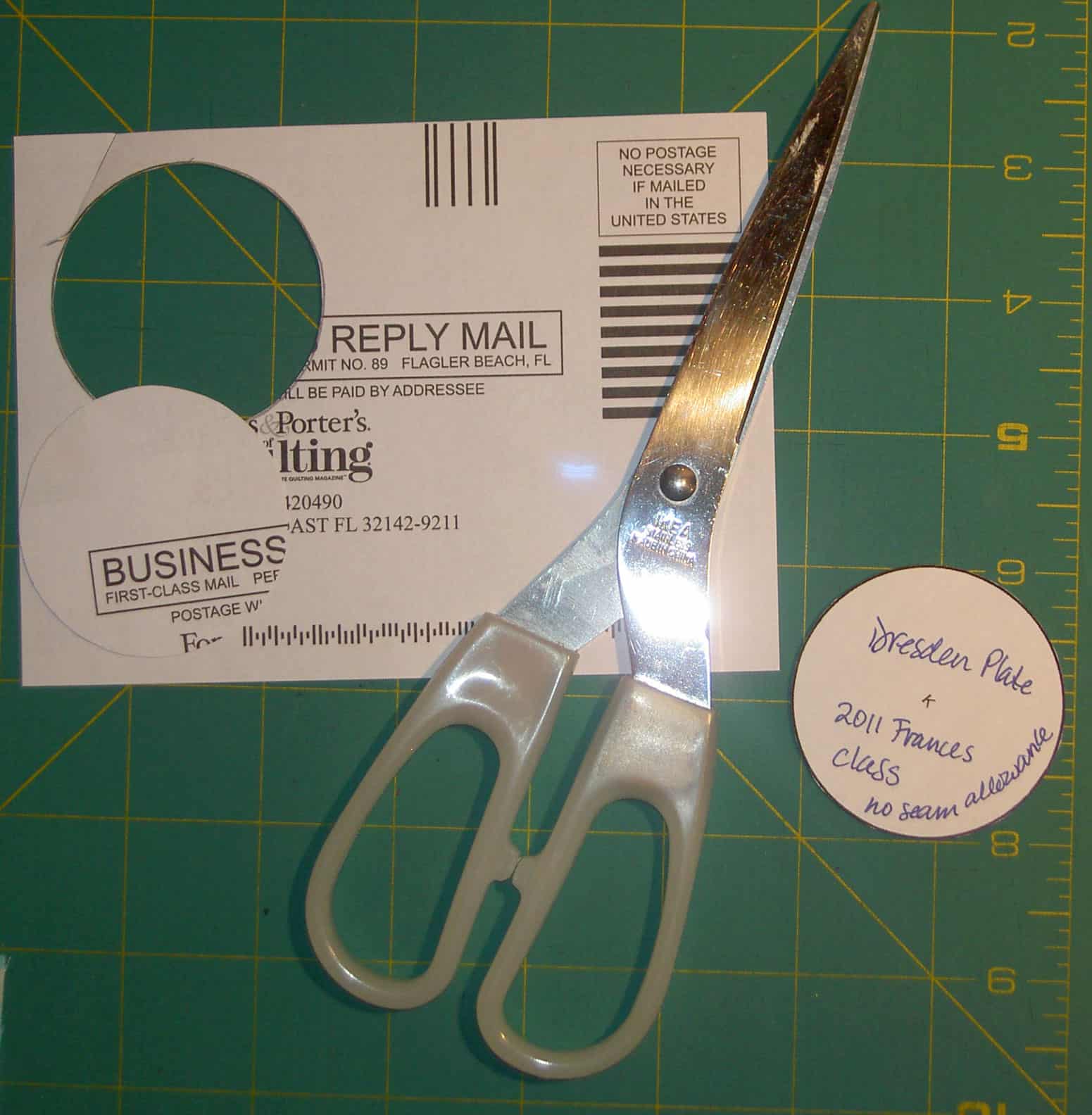
Cut out Circle
40. Cut out the magazine subscription card circle, being sure to cut off the pencil/pen line.
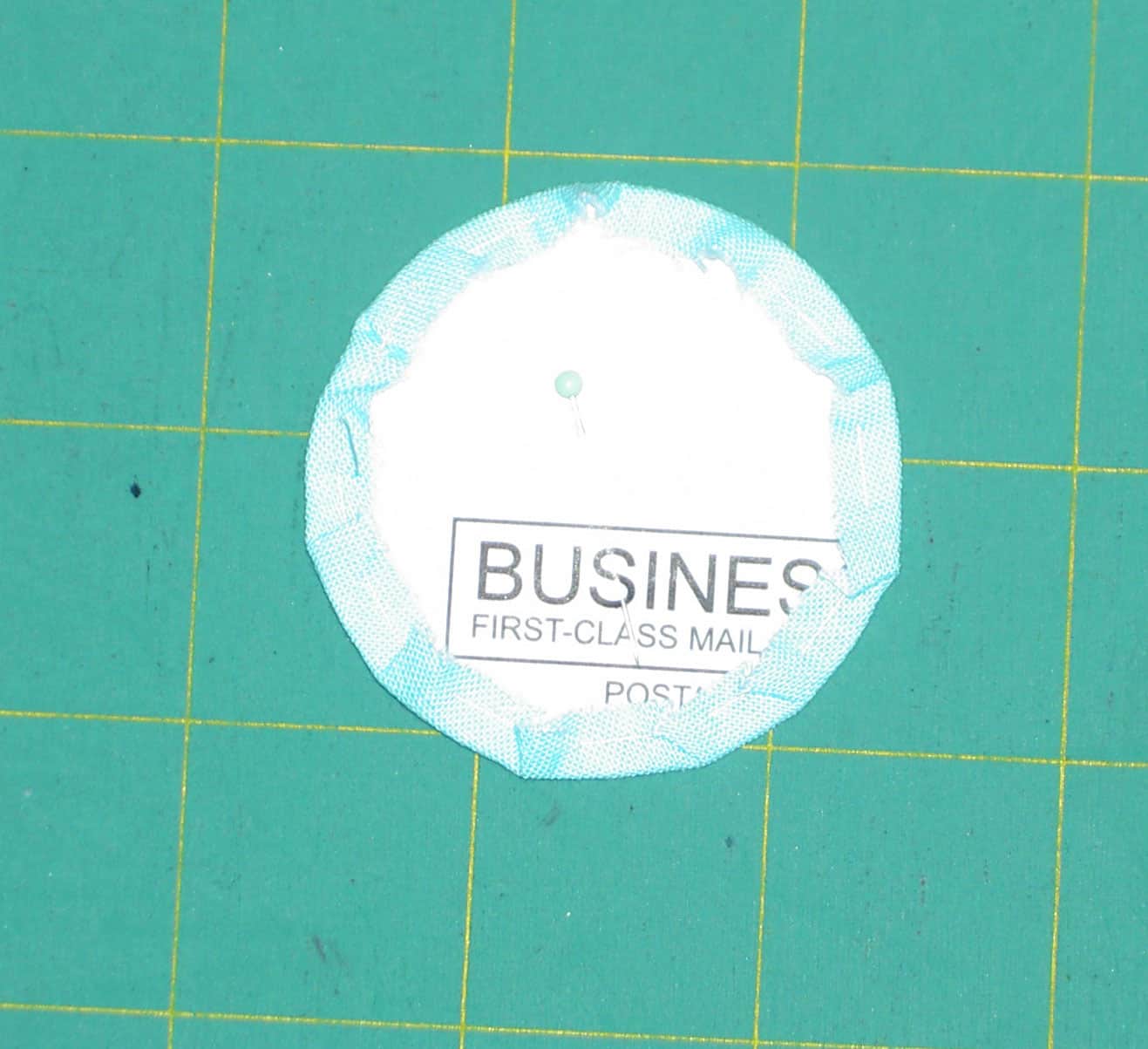
41. Take the circle fabric you have cut and wrap it around the magazine subscription card circle.
Use a Running Stitch to Draw up the Circle
42. Using any thread, take a running stitch in the seam allowance of the circle fabric and tighten it, keeping the magazine subscription card circle flat. If the magazine subscription card does not have enough body, you can also use the circle template without the seam allowance.
Pressed, Drawn up Circle
43. Press the drawn up circle well, so it is flat and a perfect circle. You will need to tug on the thread to draw the circle up as you press the first time. Once the fabric knows it needs be pressed you can pull the thread tight and make a knot.
Center Circle Ready to Applique'
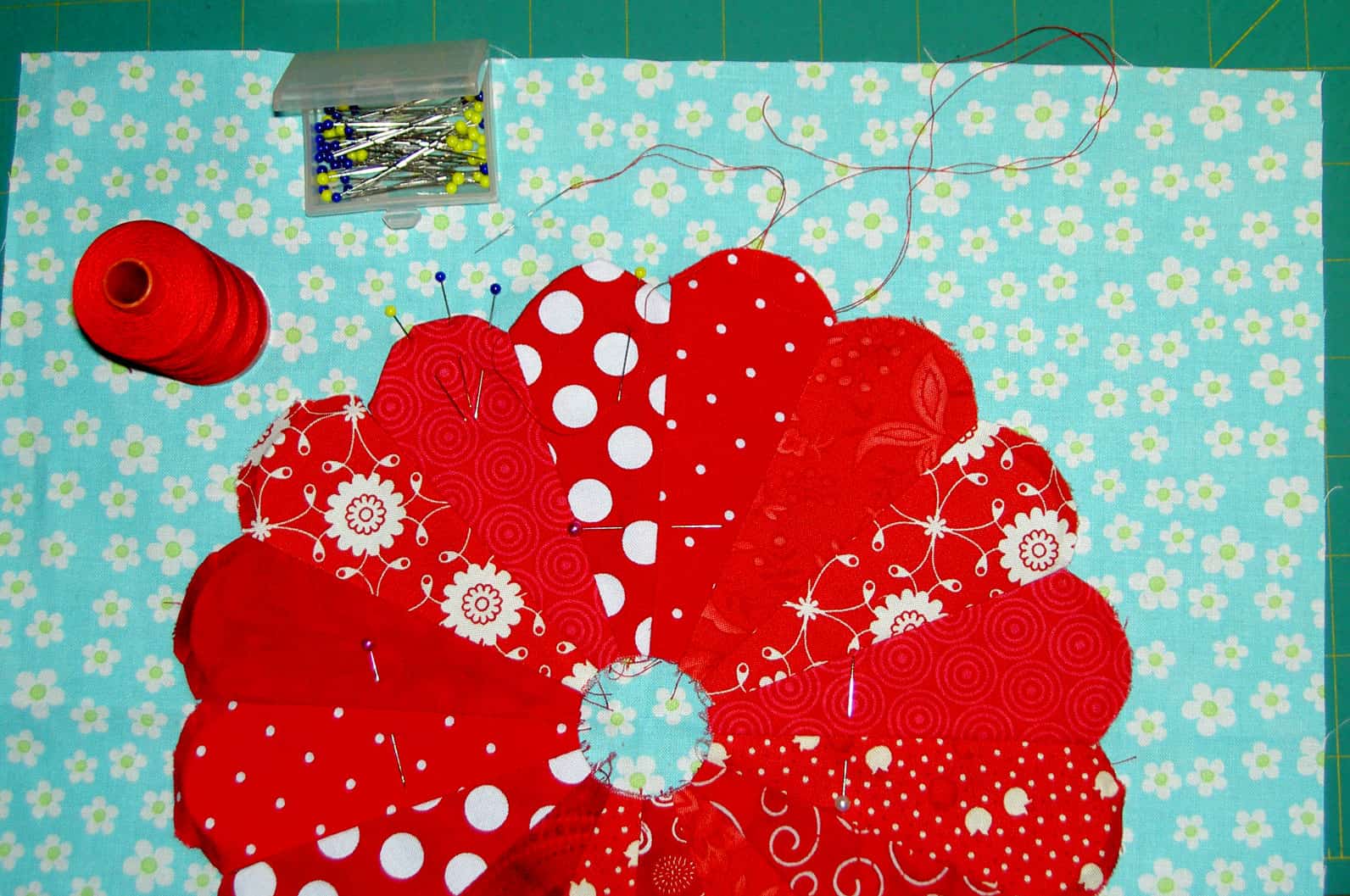
44. Pin the circle to the center of the block, covering the raw edges of the center petals.
45. Applique’ using the same directions you used to applique’ the plate.
46. Trim block to 12.5″x12.5″. You might want to wait until you start assembling the quilt.
Dresden Plate Sample
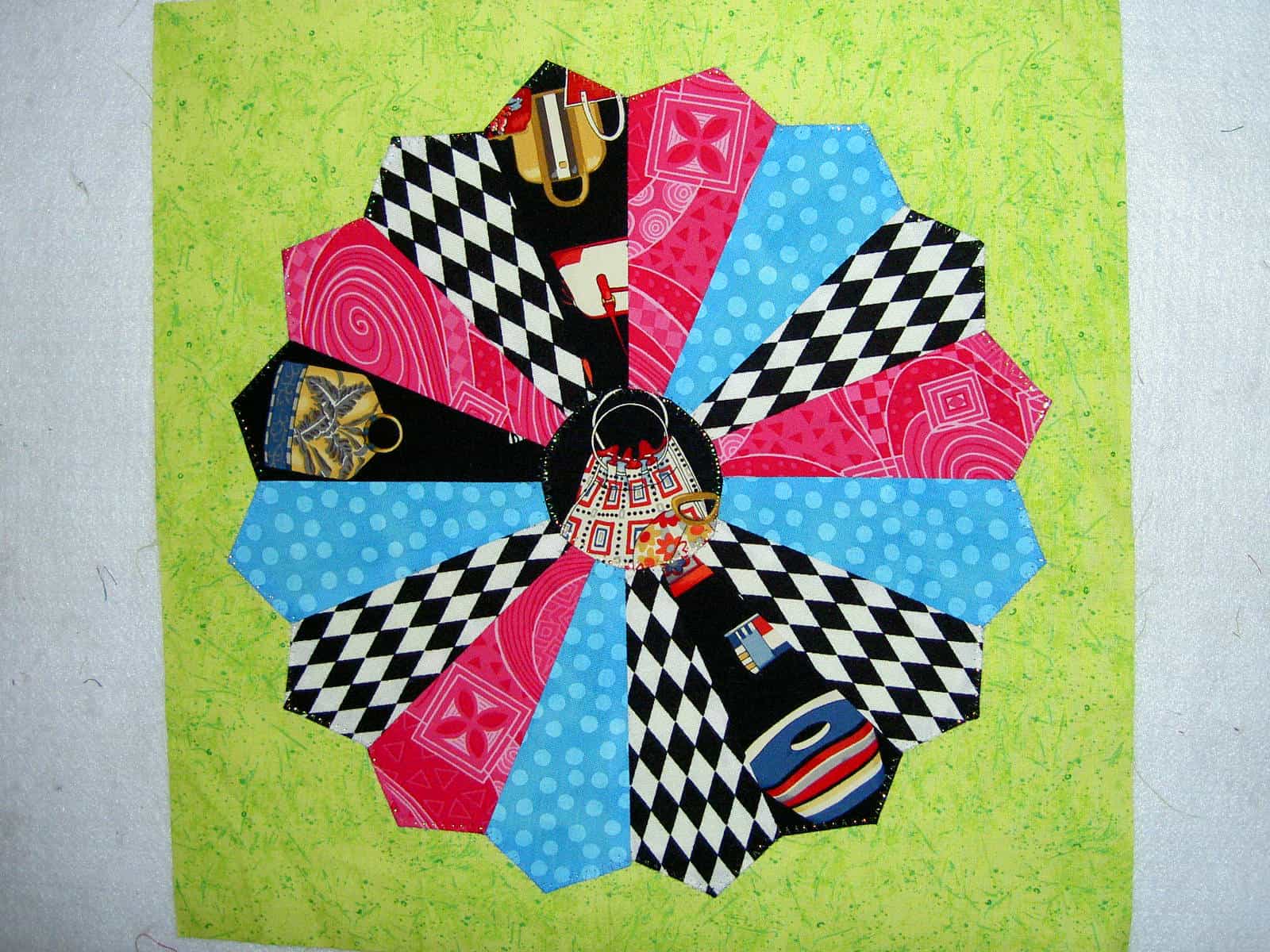
The green, turquoise, black and pink sample Dresden Plate was made for the class I taught in 2006/2007. I did this one a little differently. I machine stitched the plate to the background and the circle to the center.
As you can see, I also fussy cut fabrics to take advantage of larger spaces in the quilt block.
Dresden Plate detail
In the solid Dresden Plate, I placed like fabrics into groups of two for a slightly different look. The center circle was a good showcase for a bit of hand quilting.
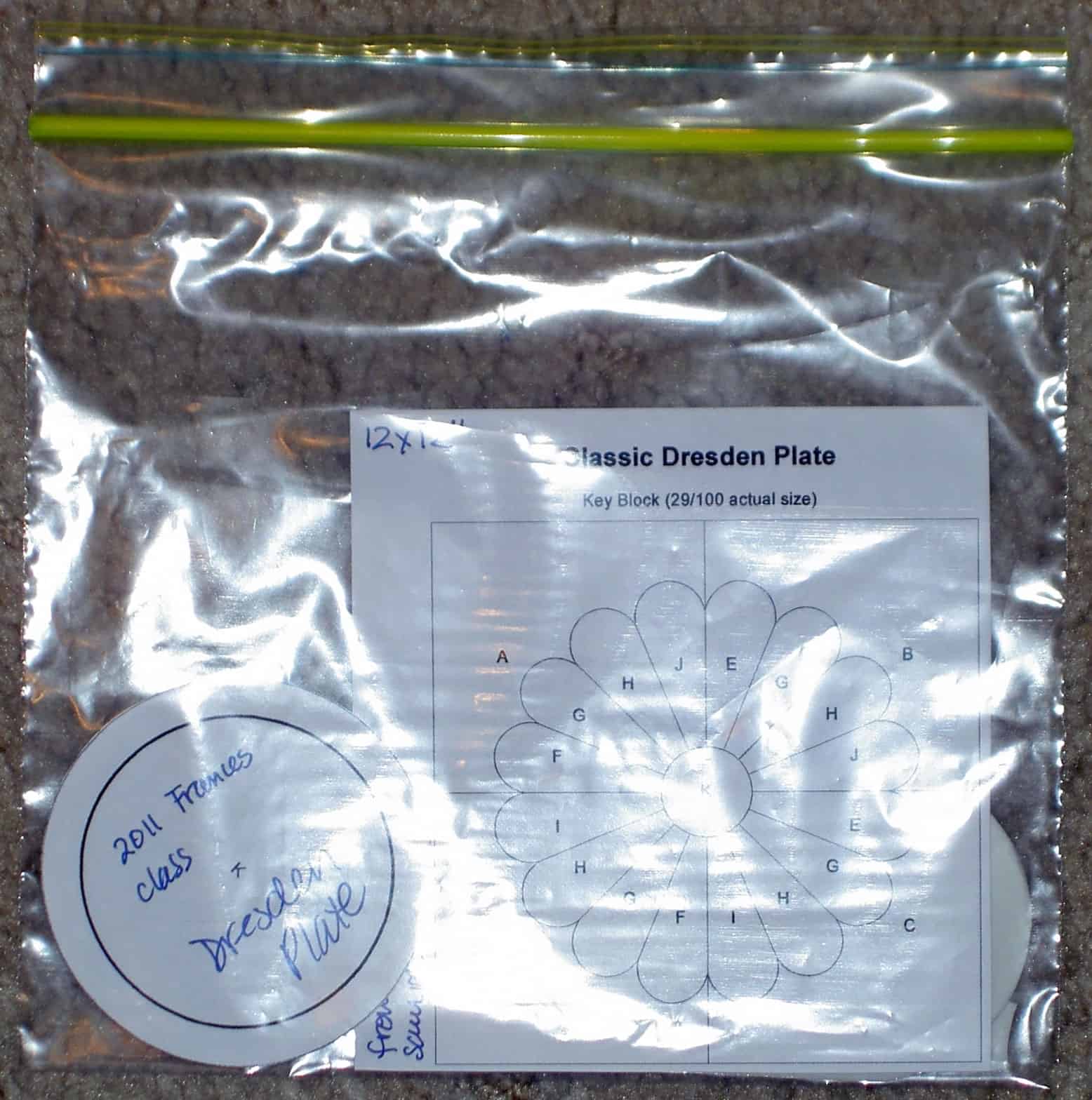
Store Templates in a Ziploc Bag
I may add some more photos to illustrate steps better and will link to this tutorial from the Artquiltmaker Info–>AQ Tutorials link under the header (see above).
I store my templates in a ziploc bag with a picture of the block or a label with the name and size of the block on it.
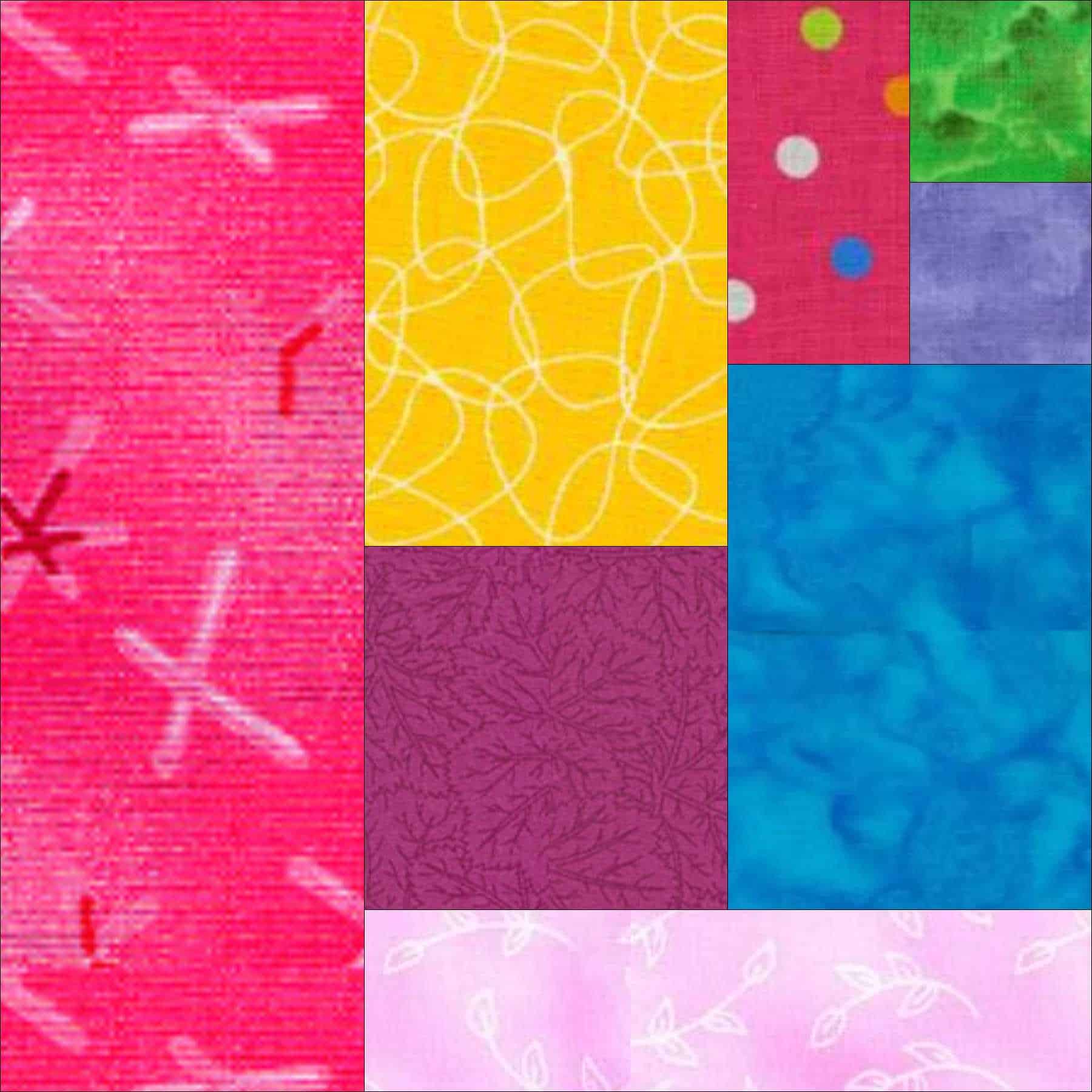
This block reminds me of a log cabin. If you look from right to left it has that feel. It is actually from Blockbase rather than one of my own design and is called #4117.
To make this block, please print or look at the rotary cutting guide and start piecing the elements of the block together from right to left.
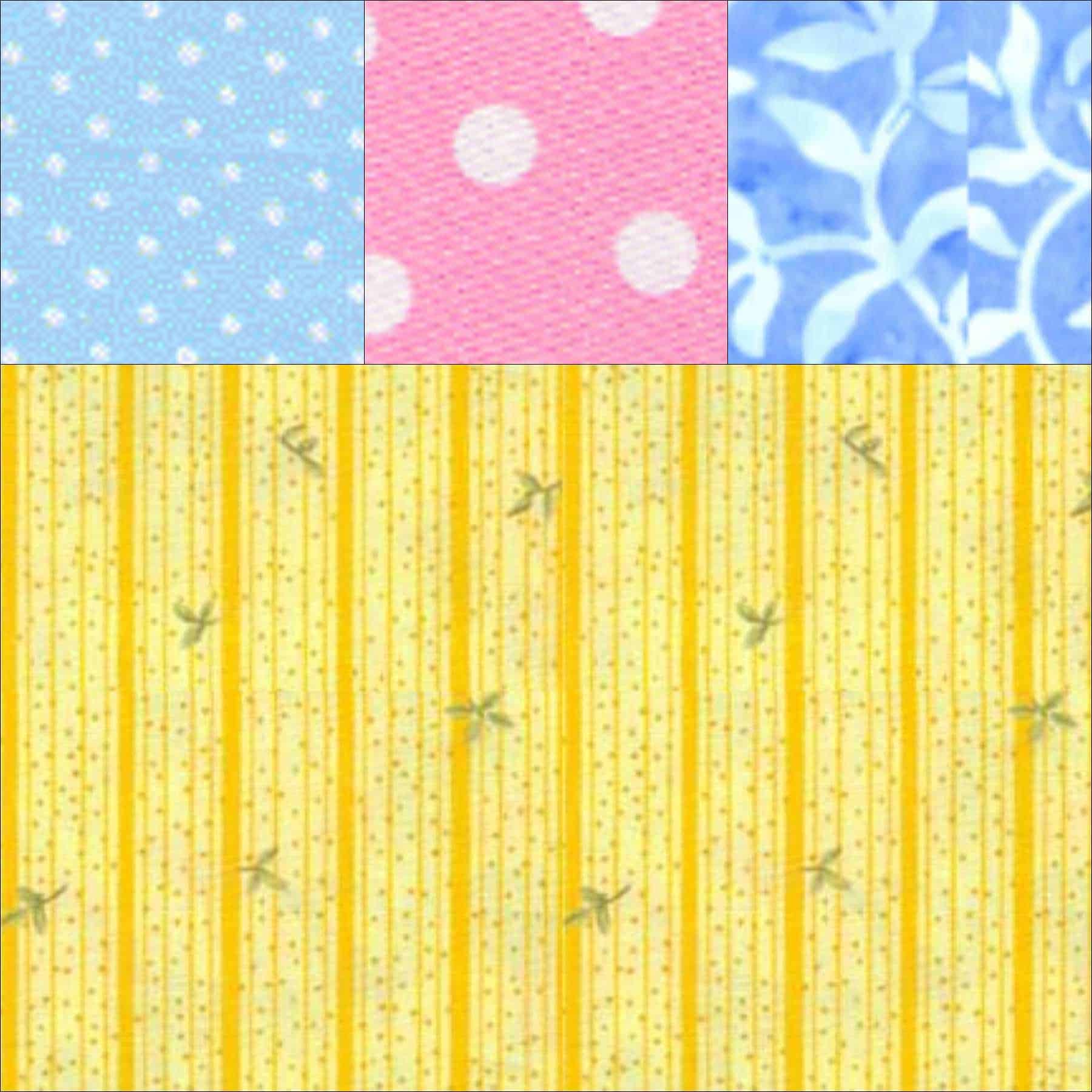
Make the small unit in the corner (made up of green, periwinkle and the pink dotted fabric), then piece that to the blue patch. Piece the yellow and purple together, then join that unit to the blue/corner unit. The pink is sewn to the those two units and the fuschia finishes it off.
New Log Cabin Quilt
Four of these blocks put together with the corner unit in the center would look really interesting. The example looks like it is spinning.
HAH! Fooled you! I just wanted to see if you were paying attention. Really, the blog was busy yesterday with the Primal Green information. Priorities, you know.
But, we are back in the Block-a-Long saddle. Thenewest block, which I named 9 Patch Foundation is a very similar block to the 9 Patch and the 9 Patch Go Round. Can you see how they relate to each other? Can you see that they are the same type of grid?
If you saved some strips or patches from either of those blocks, you can use them for this block. If you are brand new, I am providing the directions for your convenience.
I started cutting when I found myself starting to wash and iron food fabrics AND when I started to run short of leaders and enders.
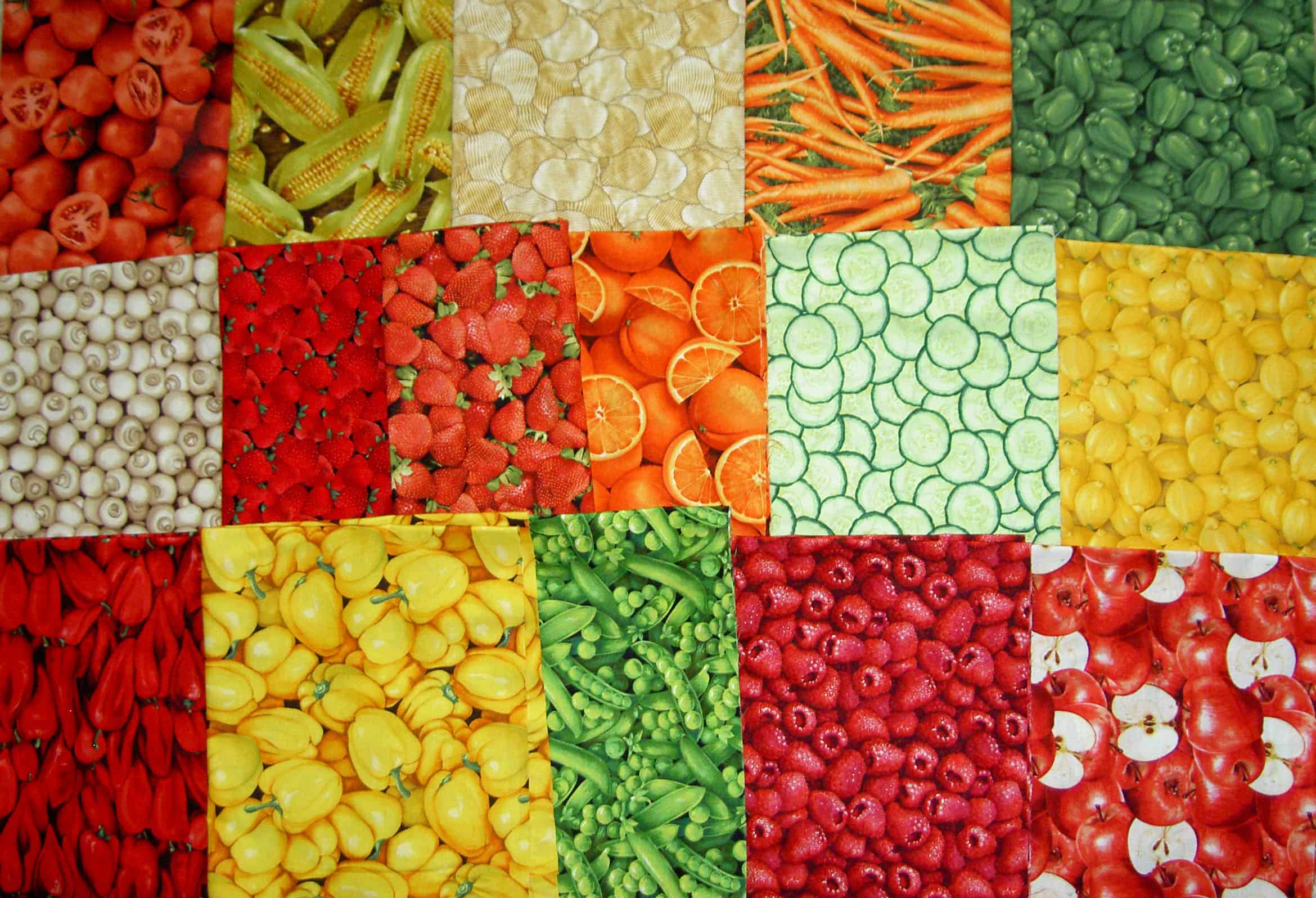
As you know I made an effort to get the Farmer’s Market fabrics put out by RJR. I was able to buy a nice selection in Pennsylvania. I also scrounged a bunch from my mom when she was done with her food quilts.
After that, it was time to do a test. I want to do a Disappearing 9 Patch. I saw Robin doing one at the CQFA 2011 Retreat and she got a lot of bang for her buck. I want something that won’t take forever, but won’t be boring. First, though I wanted to try it out.
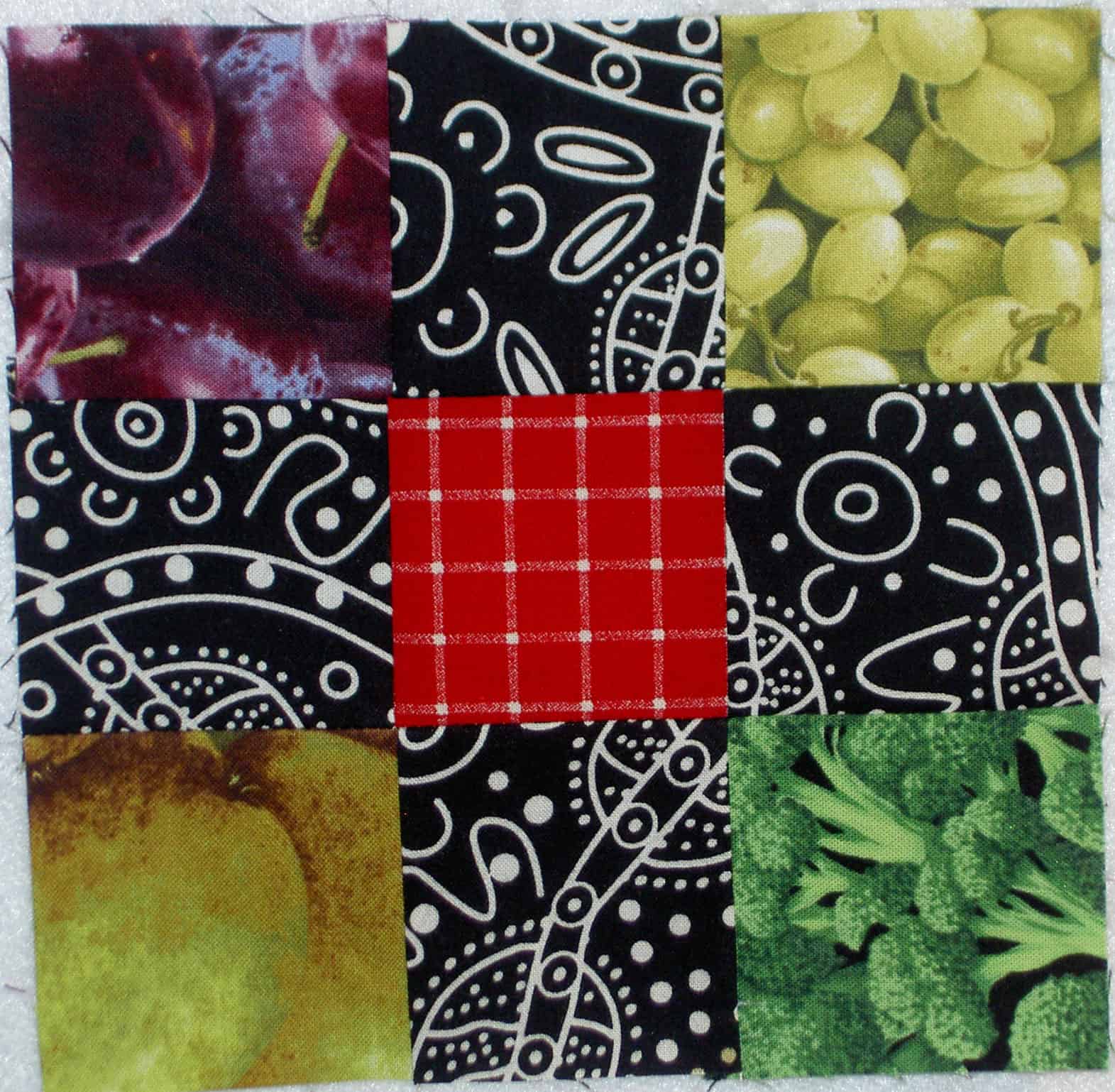
9 Patch Basic Layout
I am thinking I will make the real squares 6.5″. I didn’t want to commit that much fabric to a test, so I made the test group much smaller. The squares for each part of the test 9 Patch are 2.5″ cut. The above shows you the look I am thinking of using: food fabrics in the corners, white on black print on the middle outsides and red in the center. The Young Man gave his seal of approval, though wanted to know where the pizza fabric was, so I’ll have to rethink not including pizza fabric (it isn’t part of Farmer’s Market).
9 Patch Sewn9 Patch Cut & Rearranged
The blocks look good and I think my idea will work. As I said the real blocks will be on a much larger scale. I think that the rearrangement of the blocks in that kind of infinity pattern will look good as well. Things to which I need to pay attention:
not to many green food fabrics in the same block
cut up lots of reds and blacks, if I really want to get moving
9 Patch Alternate
This is another way I could arrange the block parts. It has kind of a self sashing thing going. I don’t think I would want to do this unless I added more sashing to the center, which would be a lot more work. I don’t see any reason to cut up the 9 Patch in the Disappearing 9 Patch manner if I am just going to add more sashing to the middle. I might as well cut squares and sash them.
I really should have put a quarter or a dime next to these blocks so you can get an idea of how large they are, but I didn’t think of it before I took the photos. As a result, I don’t know if you will be able to to tell how large the final cut patches are?
First 4 Real Sized Patches
As I iron fabric, I cut these large squares out and set them aside. I was finishing up Stars for San Bruno #2 when I first cut these, so I didn’t cut any black/whites or reds. I’ll get to it.
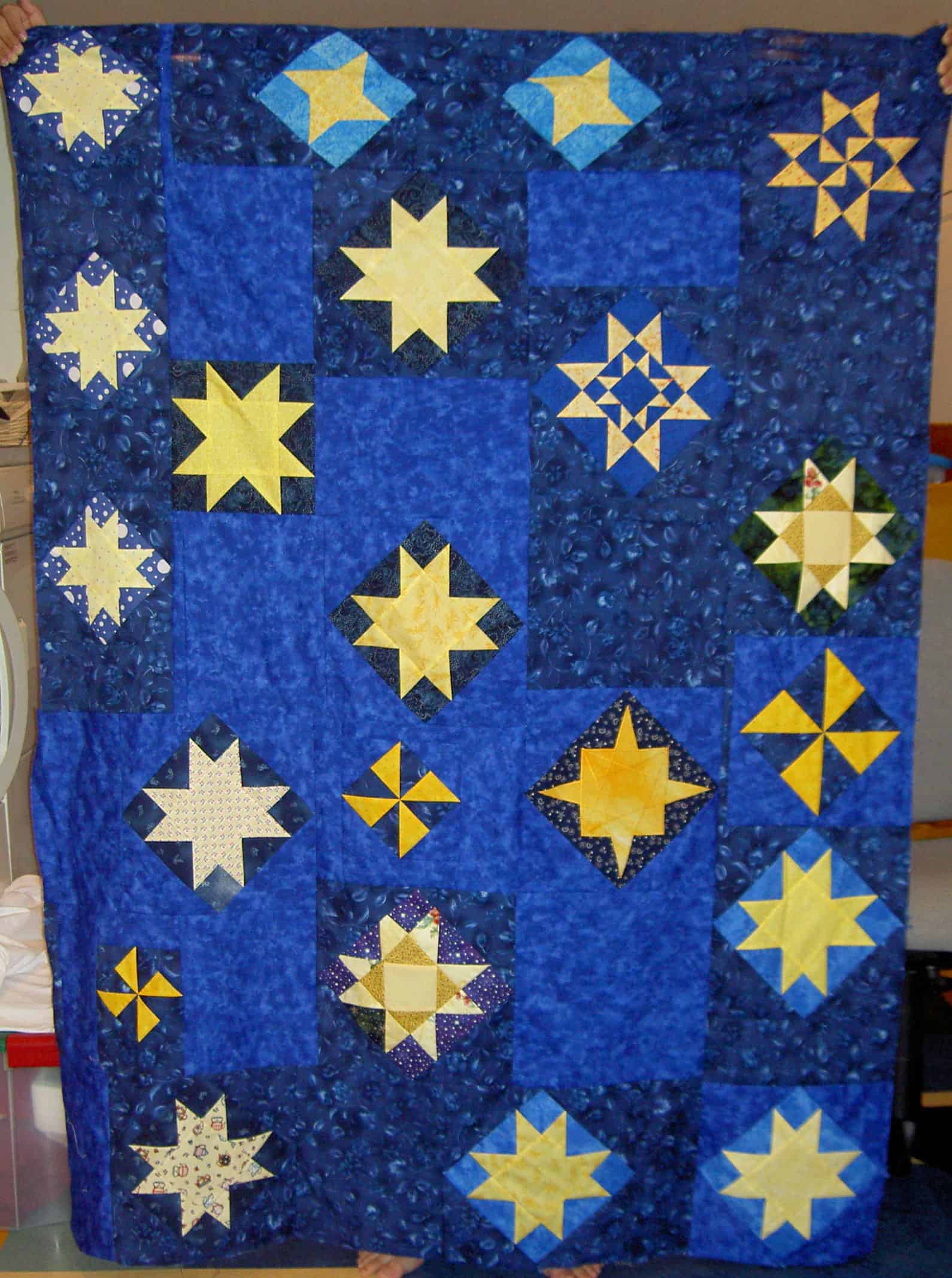
The ‘paint was barely dry’ on SfSB #1, but I got busy putting the Stars for San Bruno #2 quilt together on Sunday. I had done a few smaller projects on Friday and Saturday afternoon and decided that Sunday morning was the day for SfSB #2.
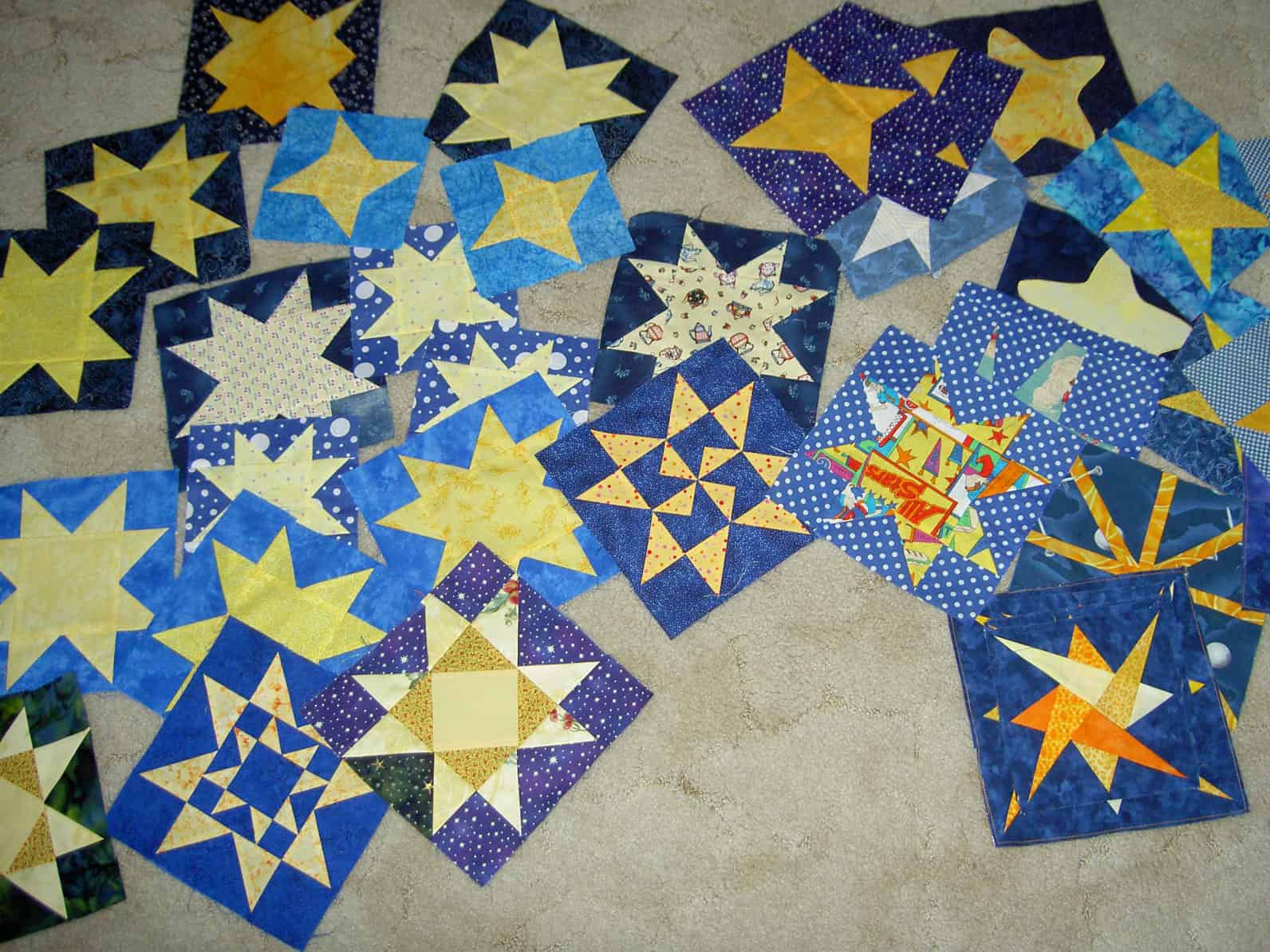
Putting all of the blocks on the floor and looking at them worked pretty well last time, so I did that again. I found that they logically divided themselves into 2 groups (generally right and left of the photo). Most of the blocks on the left are Sawtooth Stars and I decided to group them into one quilt. I saved the Stars on the right for the last quilt.
Auditioning Fabric
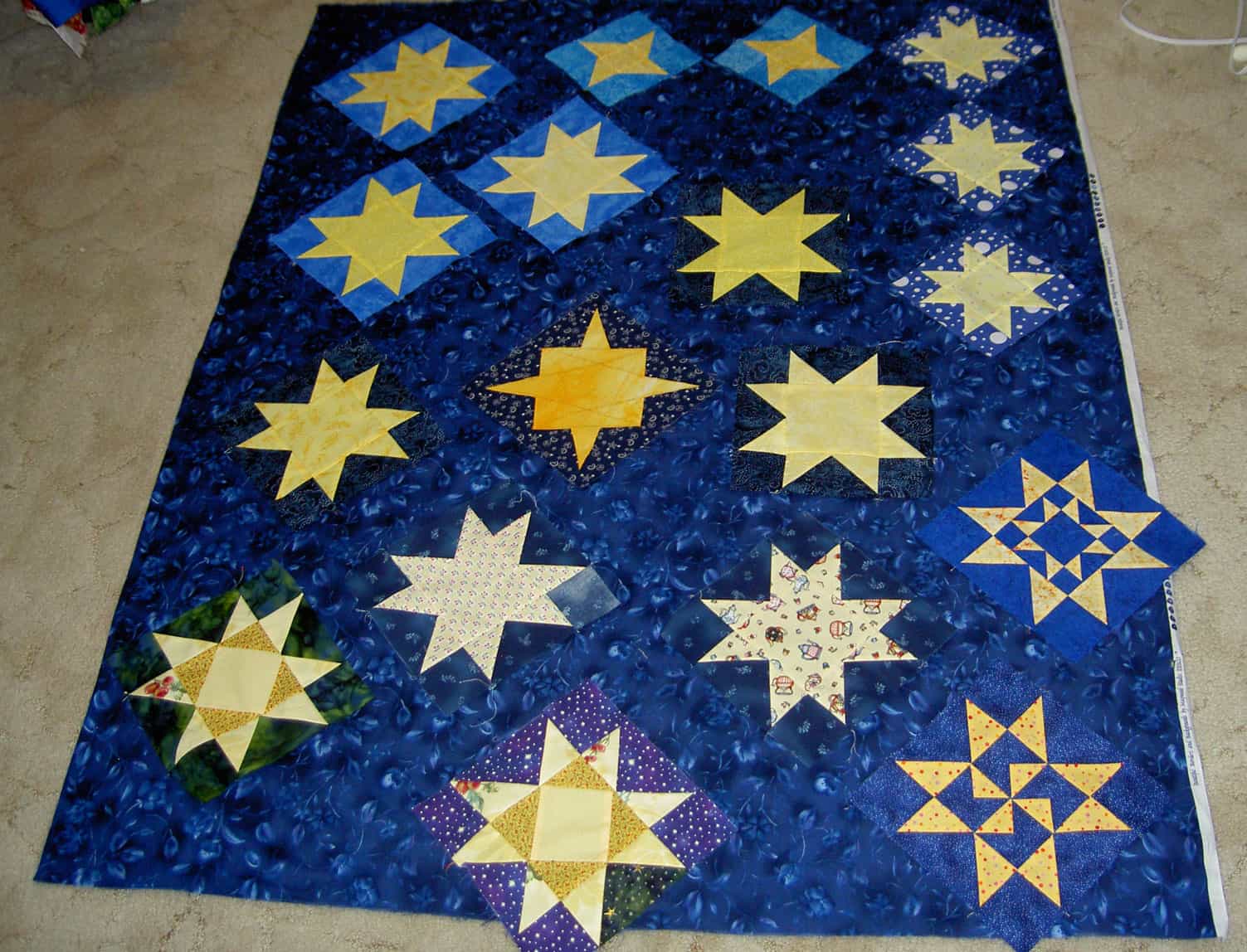
Once I had selected the blocks, I laid them out on some fabric that Sandy sent just to get an idea of what I was facing.
I could see right away that there would be a lot more open space in this quilt, because I didn’t have as many blocks left. This looks more like a starry night sky, I think.
The quilt didn’t really end up like this at all, but it was a starting point.
Borders and Layout
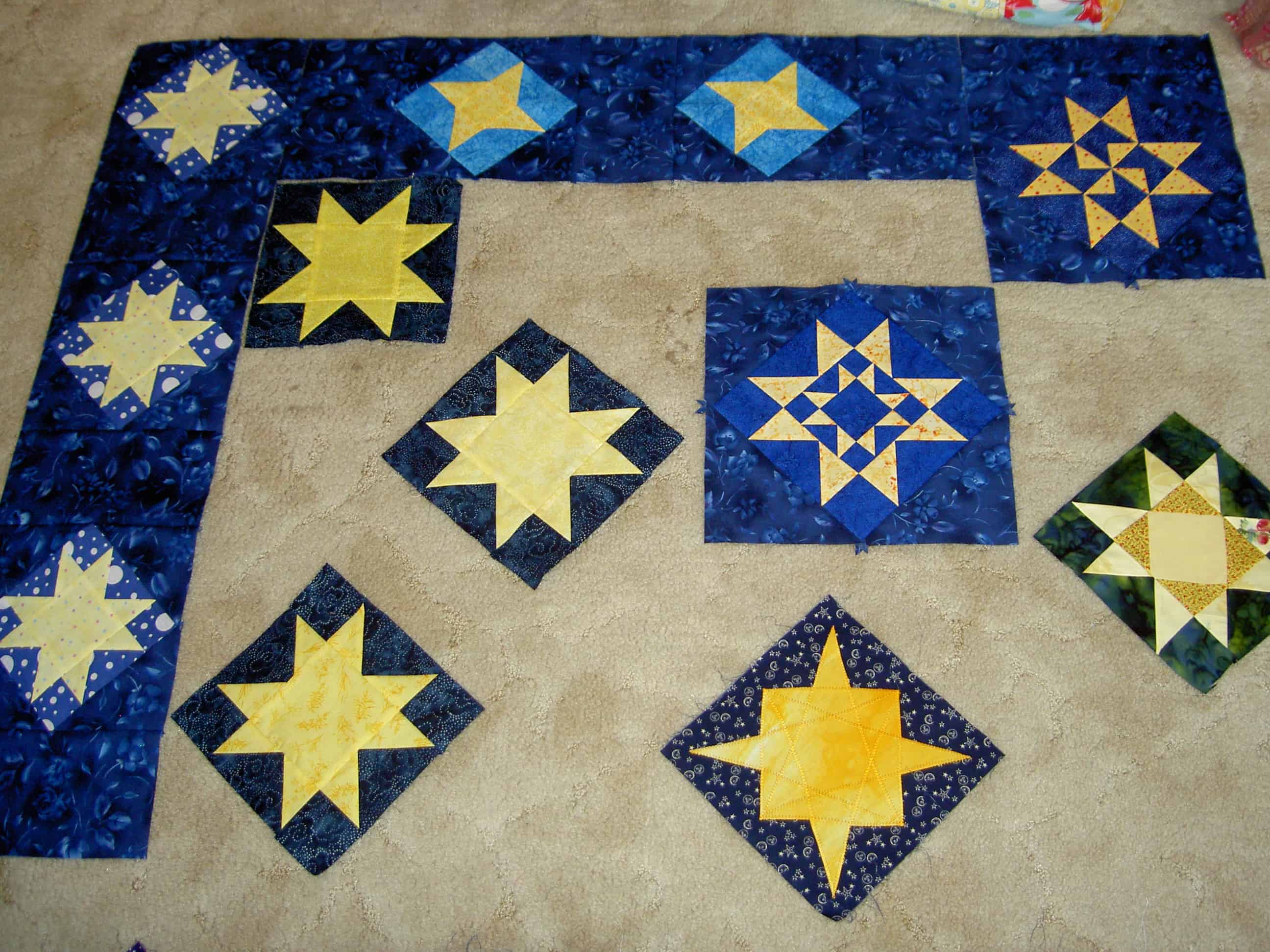
I could see from the layout above that I needed some of the blocks with the light background in lower corner.
More rearranging…
This is a technique that I call improvisational piecing. TFQ and I have used this process when working together on a quilt called She had to have her Latte, which was kind of a precursor to the Tarts Come to Tea. Isn’t it strange how I can relate all of my quilts to each other?
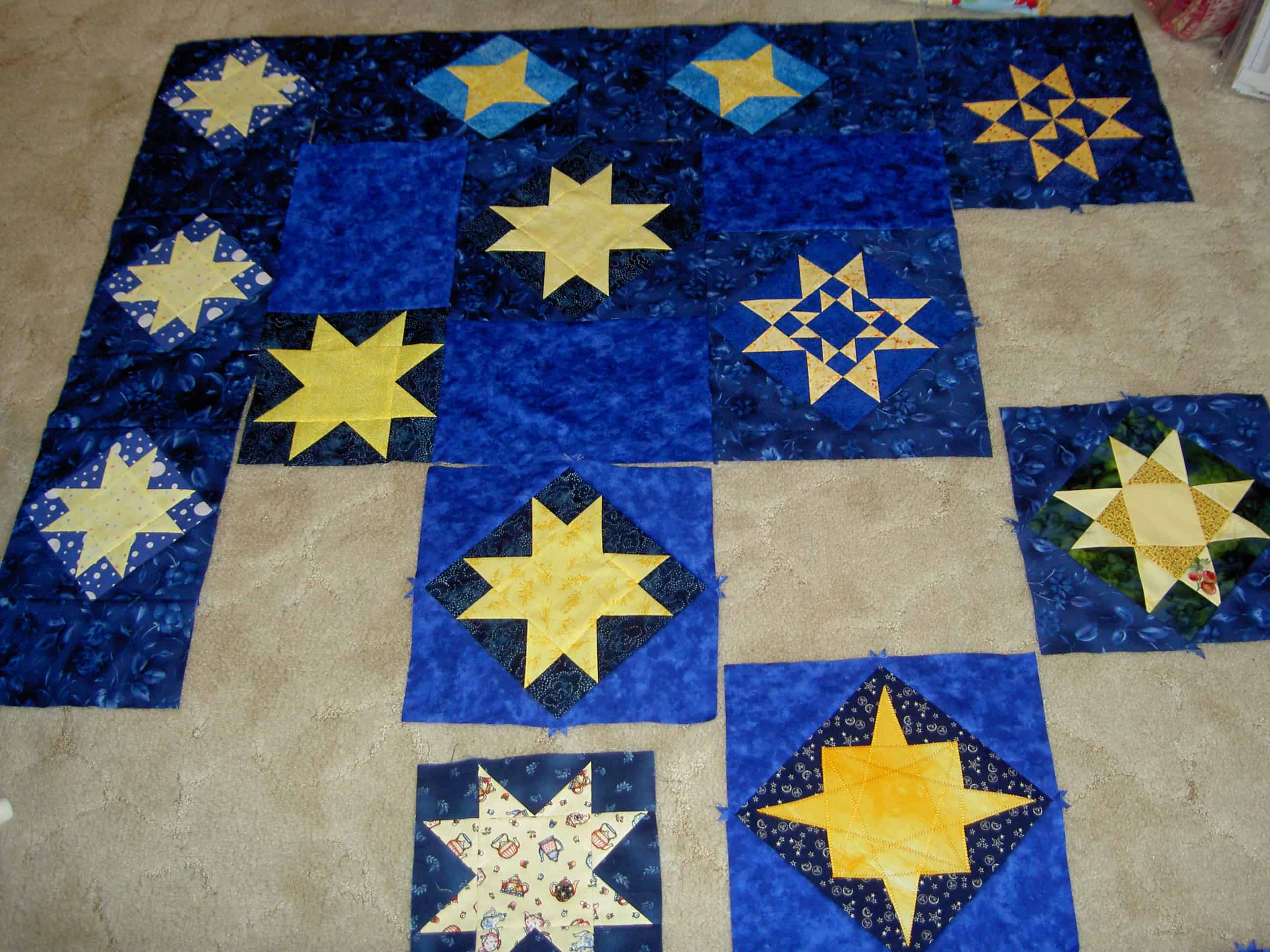
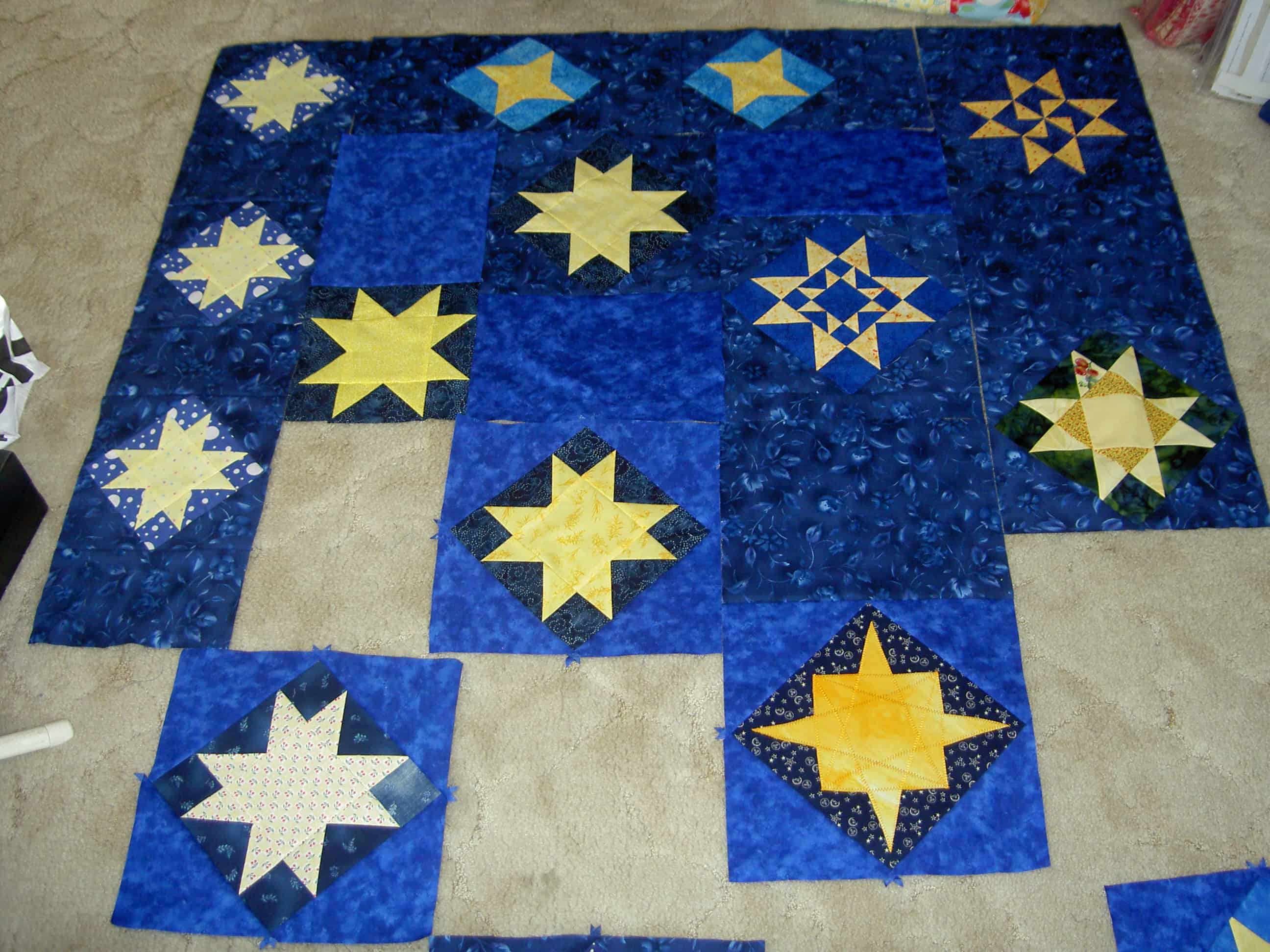
I kept rearranging disparate sized blocks and adding coping strips, corners and strips until the pieces fit together. This process is not for the faint of heart.
Rearranging ProcessMaking Progress
I decide where I am going to start and then march down or across the quilt.In this case, I started from the top and moved towards the bottom. I decided to put almost all of the blocks on point, so I added triangle corners to them. I also filled in the spaces with large pieces of fabric.
SfSB#2 Finished Top
I was able to finish the top last night. I wanted to get the parts off of my design floor and I didn’t want to have to remember what went where. There was a lot of partial seaming, so it was important to me to get the pieces together correctly.
As you can see, I added a few pinwheel blocks in different sizes. I was inspired by the very center of TFQ’s block (upper right), though I realized that I didn’t make them exactly like hers.
My first thought after sewing on the last line of blocks (right) and looking at the whole piece was that it needed a border. Sigh.
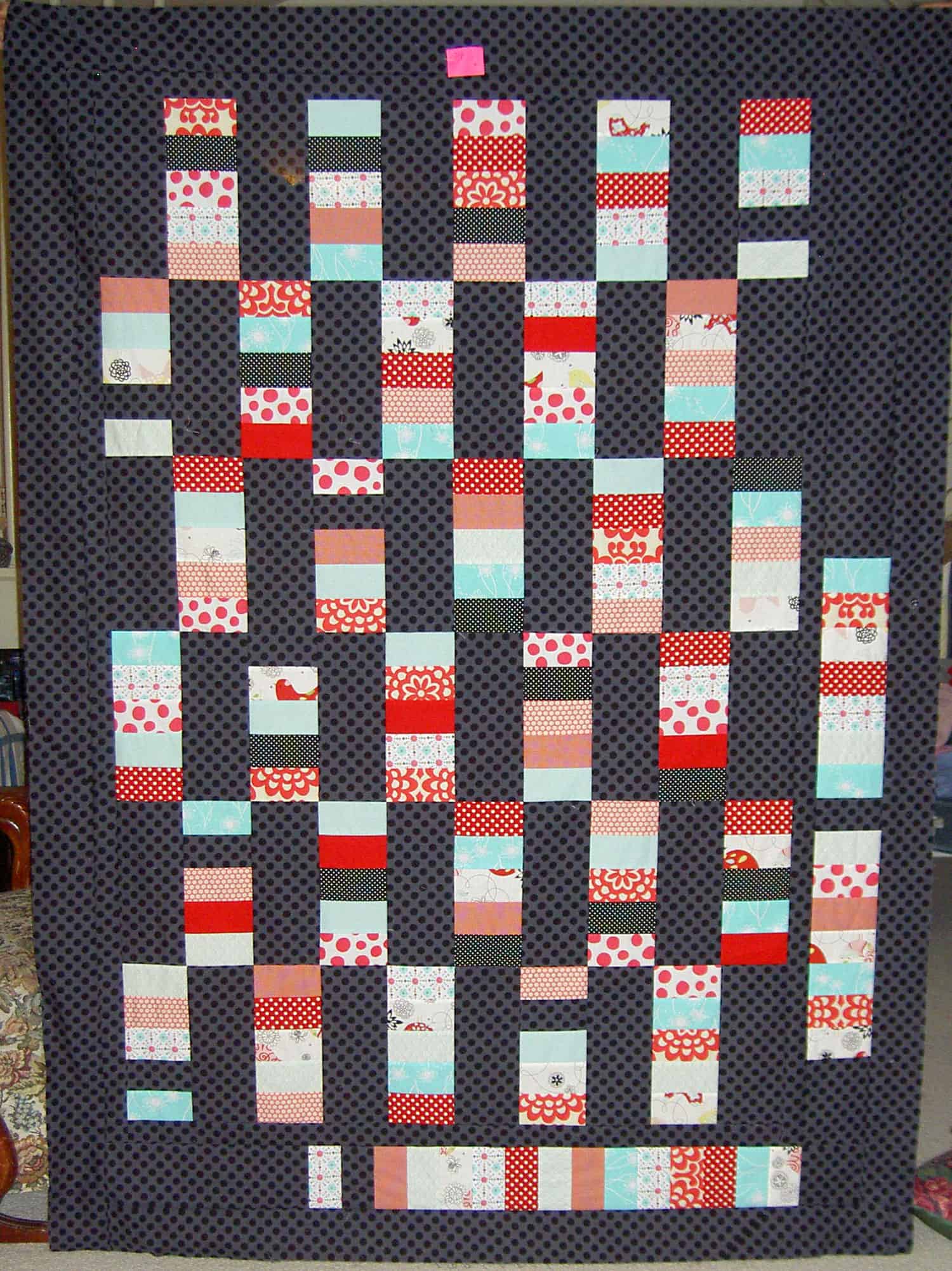
Pavers is ready to quilt. I am not sure the name suits, but that is what it is. It will be a gift.
Pavers - top
This pattern is based on a photo I saw on Flickr from Green Couch Designs and related to the Purple quilt I finished a few weeks ago. Both on the Purple Quilt and this quilt I wanted to work with asymmetrical borders. I wasn’t happy with the border on the purple quilt, so I tried again on this one. I think I want to work with the border a little bit more and will make one more quilt in this pattern.
This is an easy quilt to make and I basically finished all of the blocks by using them as leaders and enders.
The photo above has that lovely pink post-it on the top as a direction to the quilter. It just says what I have designated as the top. I do that for the back, too.
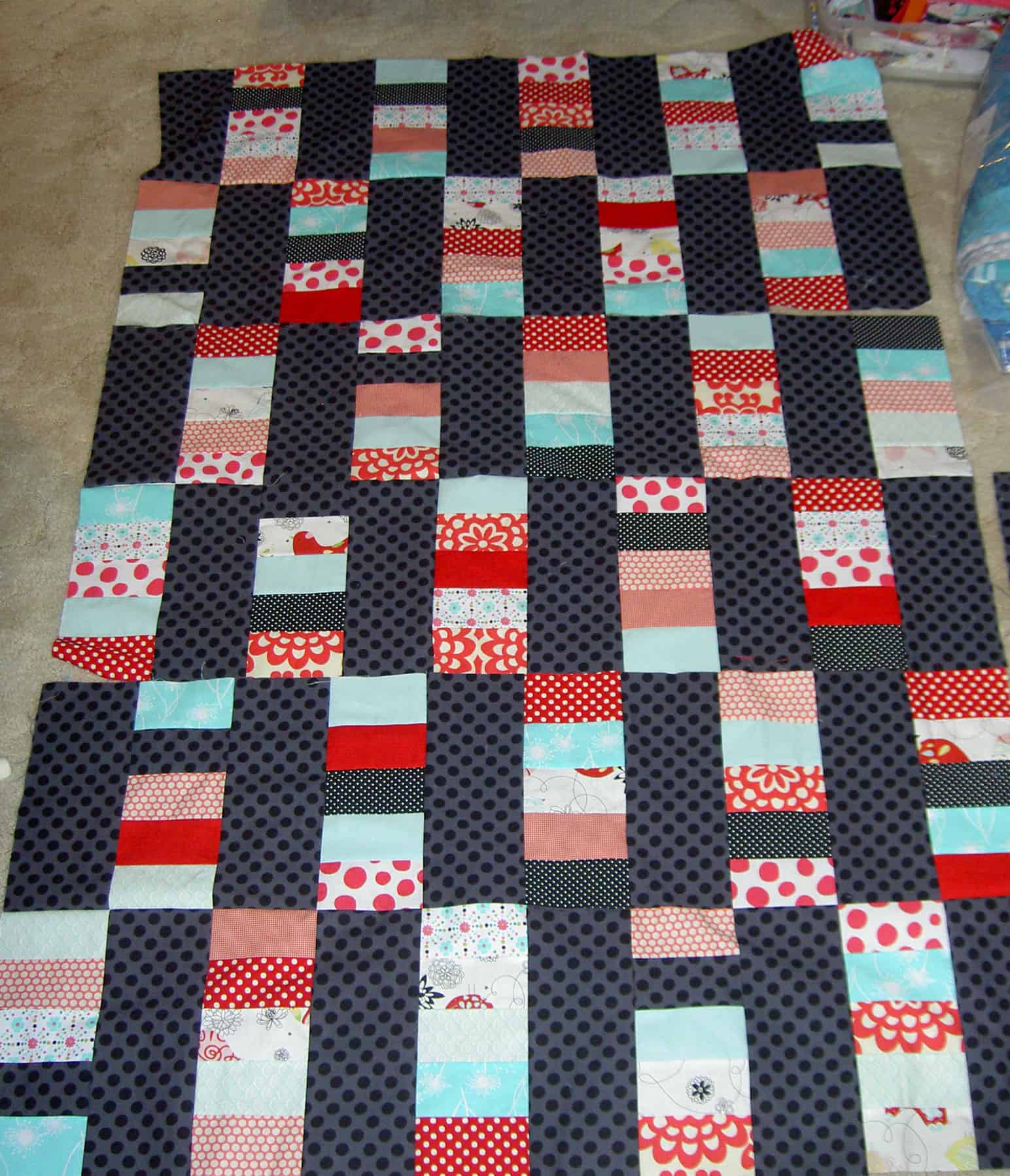
Pavers - no borders
Above is a picture of it laying on my ‘design floor’ before I put the borders on. I was amazed at how much better the piece looked sewn together. The duplicate fabrics near each other didn’t seem to matter and the whole thing just came together.
Angela is a new friend from the Bay Area Modern Quilt Guild. I have mentioned her a couple of times in conjunction with those meetings. She is the one that turned me on to the New Handmade book.
Angela participated in the Kona Challenge. She agonized and really worked hard on her design. I love her quilt. It shows her hard work and came out really well. Her agony paid off.
She wasn’t able to make this quilt from one charm pack. She bought extra fabric (don’t you think that is Robert Kaufman’s whole idea?). She played around with the pieces, drew designs, carried them around, cut and rearranged until she had something that was fabulous. It worked.
This is a thinking girl’s tutorial to making flying geese. Knowing how to make Flying Geese allows you to make Sawtooth Star blocks, Dutchman’s Puzzle blocks, borders and other parts needed for your quilts.
You are going to have to use the technique with your own measurements to make the geese that fit your project. There are many other ways to make flying geese.
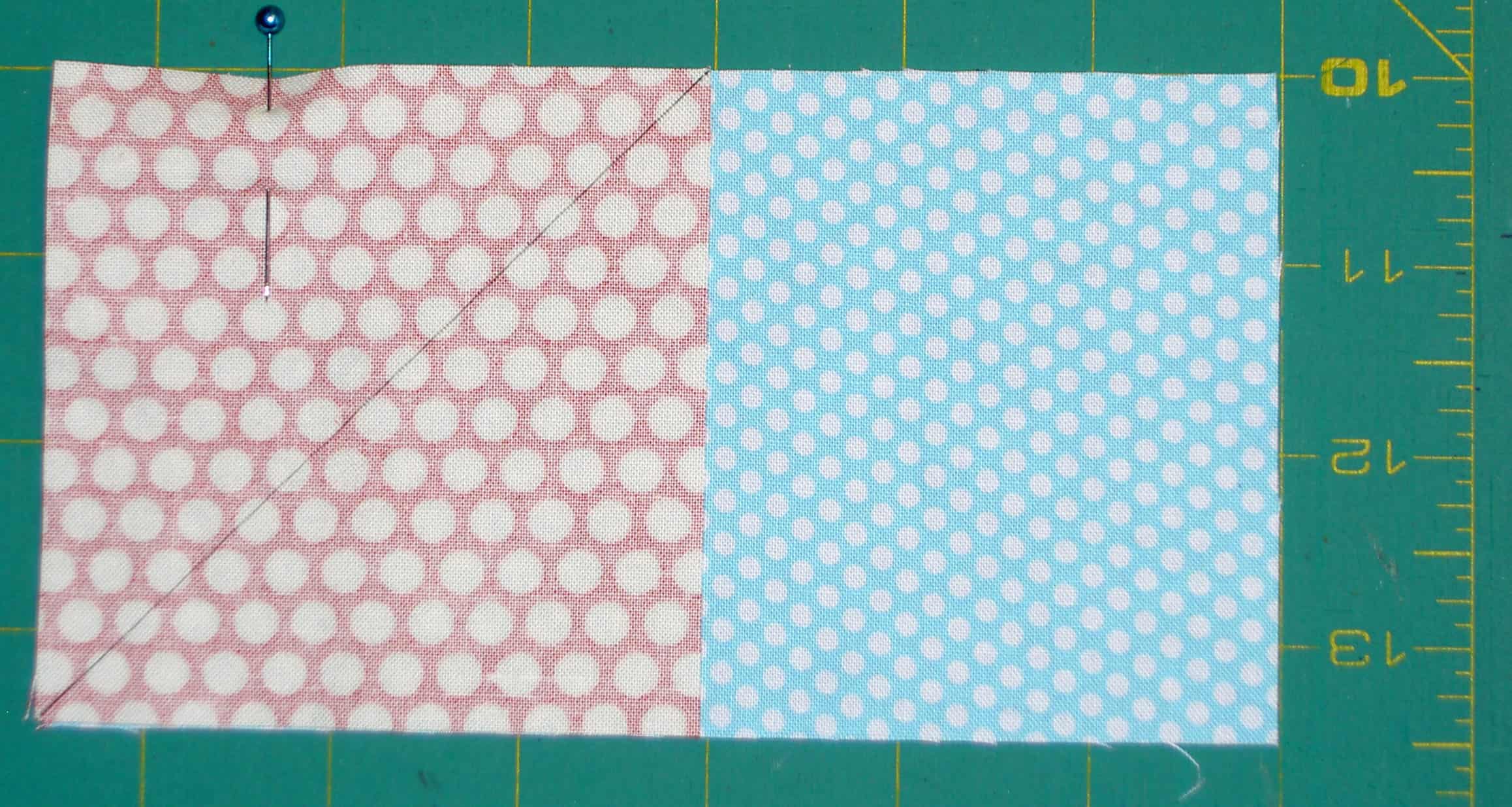
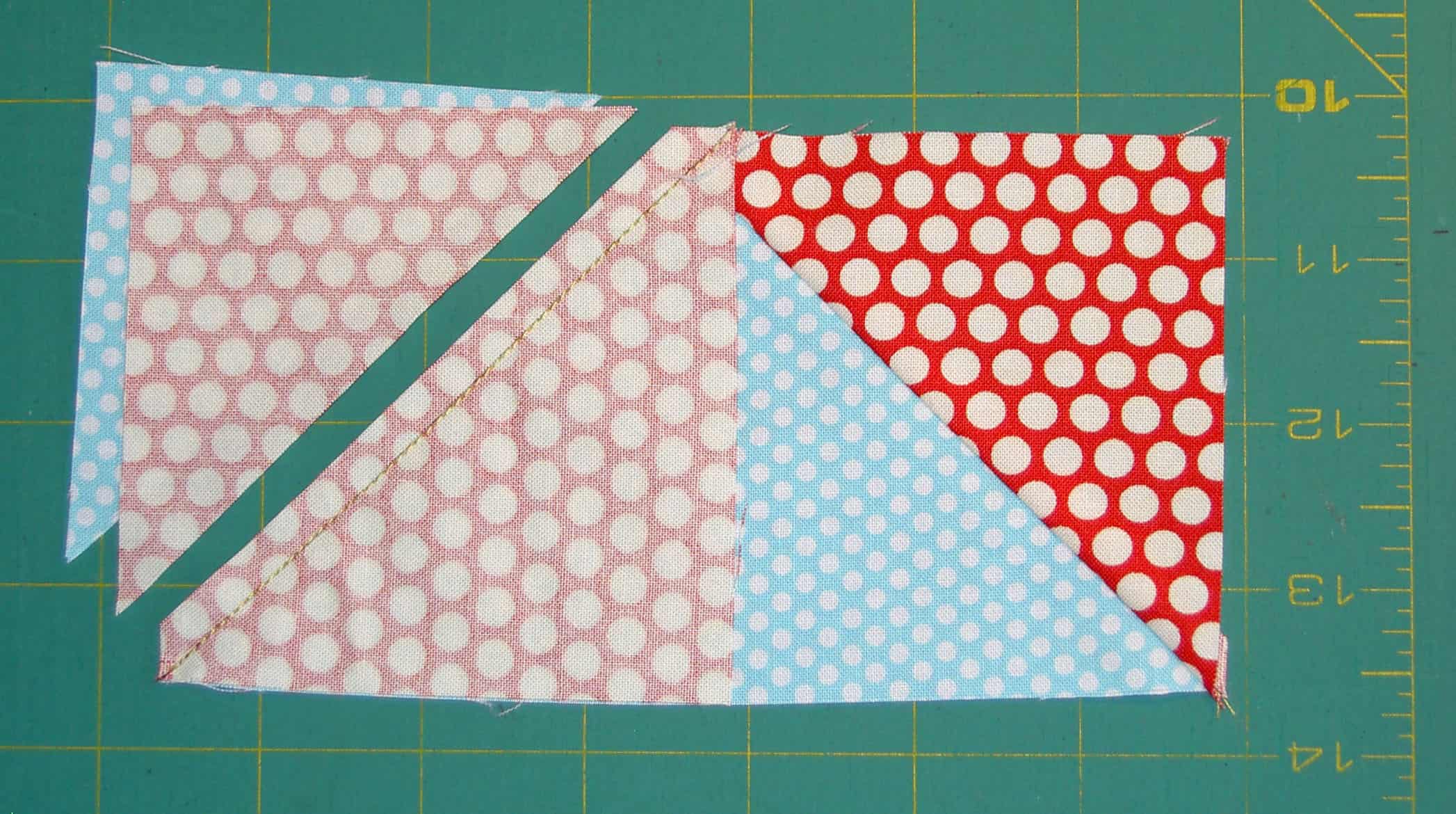
Cut 2 Squares for each Flying Geese Element
This fabric will be used for the ‘wings’.
Draw diagonal line from corner to corner
Turn the squares over and draw a diagonal line from corner to corner. You will need to do this on all of the squares for your Flying Geese.
Cut background
Cut background, or goose, fabric.
Lay wing 1 on goose
Lay first square that will be a wing on the goose (background) fabric and pin. Make sure the pin is out of the way. You will be sewing on that drawn line, so you will need to pin far enough away so the pin doesn’t interfere with the operation of the machine.
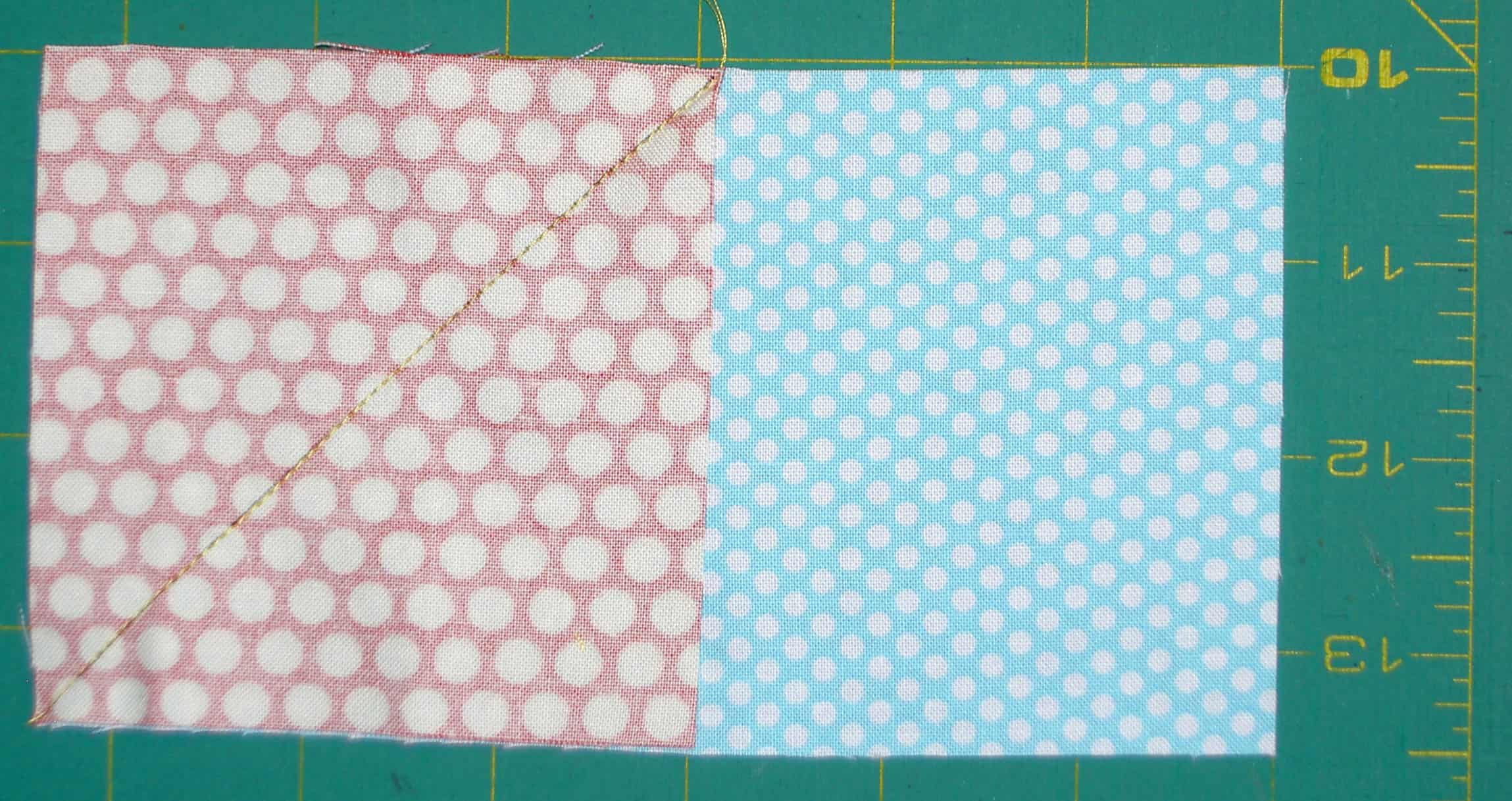
Sew along line
Sew along line and trim threads. I use a foot that has an arrow on it. I can line that arrow up with the drawn line and sew away.
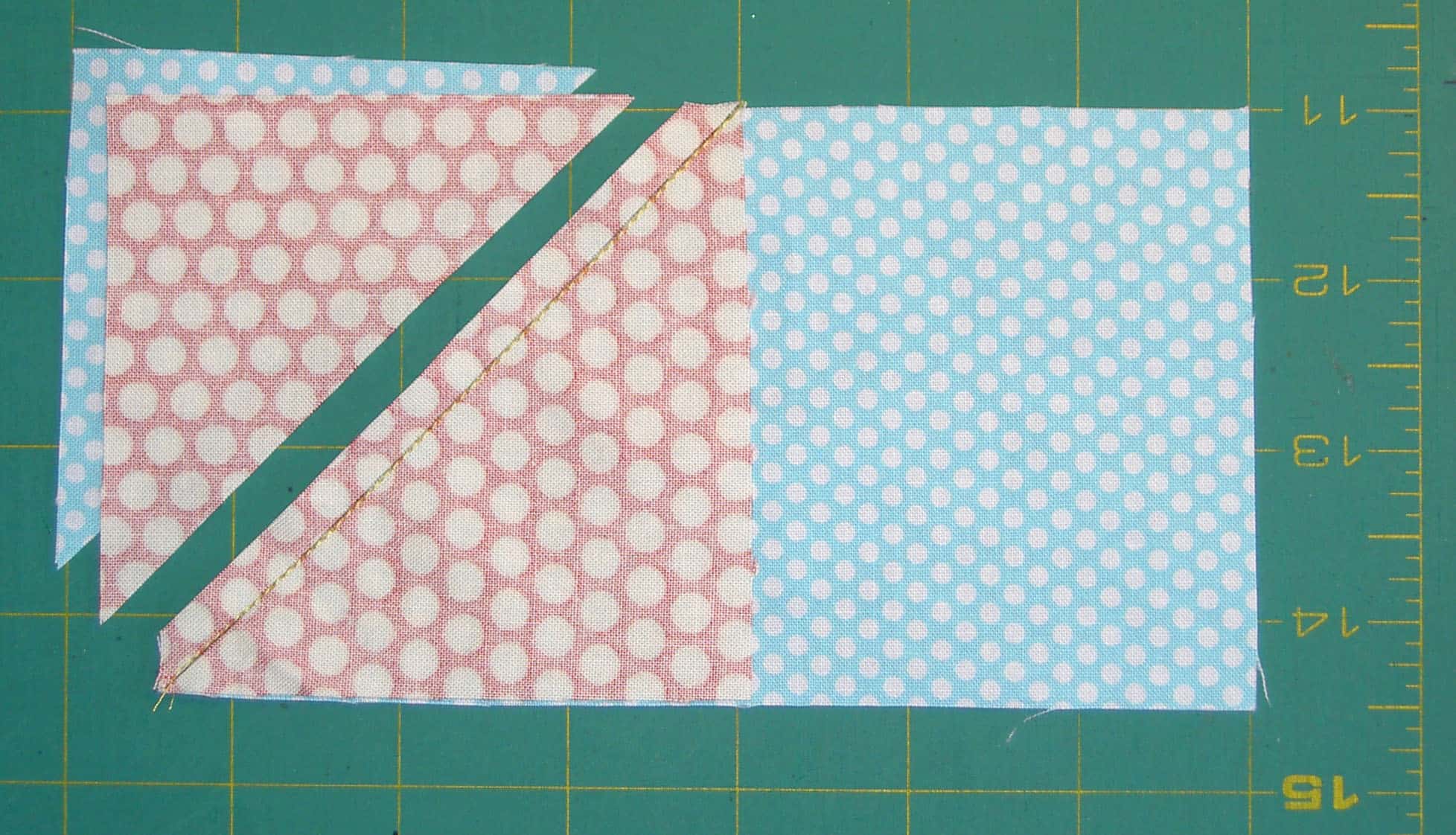
Trim
Trim 1/4″ through the wing and the goose away from the sewn line as shown above. Press the wing so the front of the wing fabric is showing.
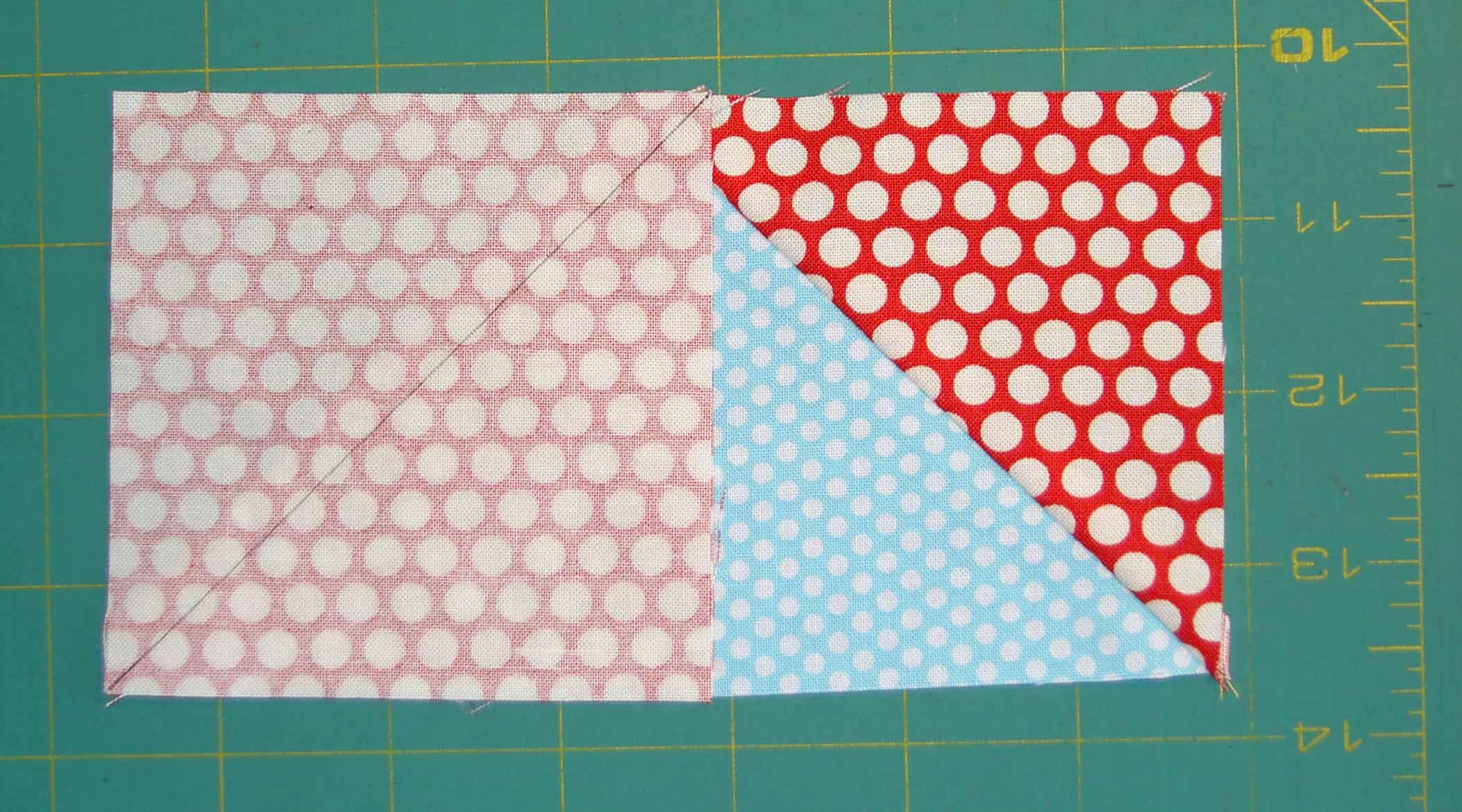
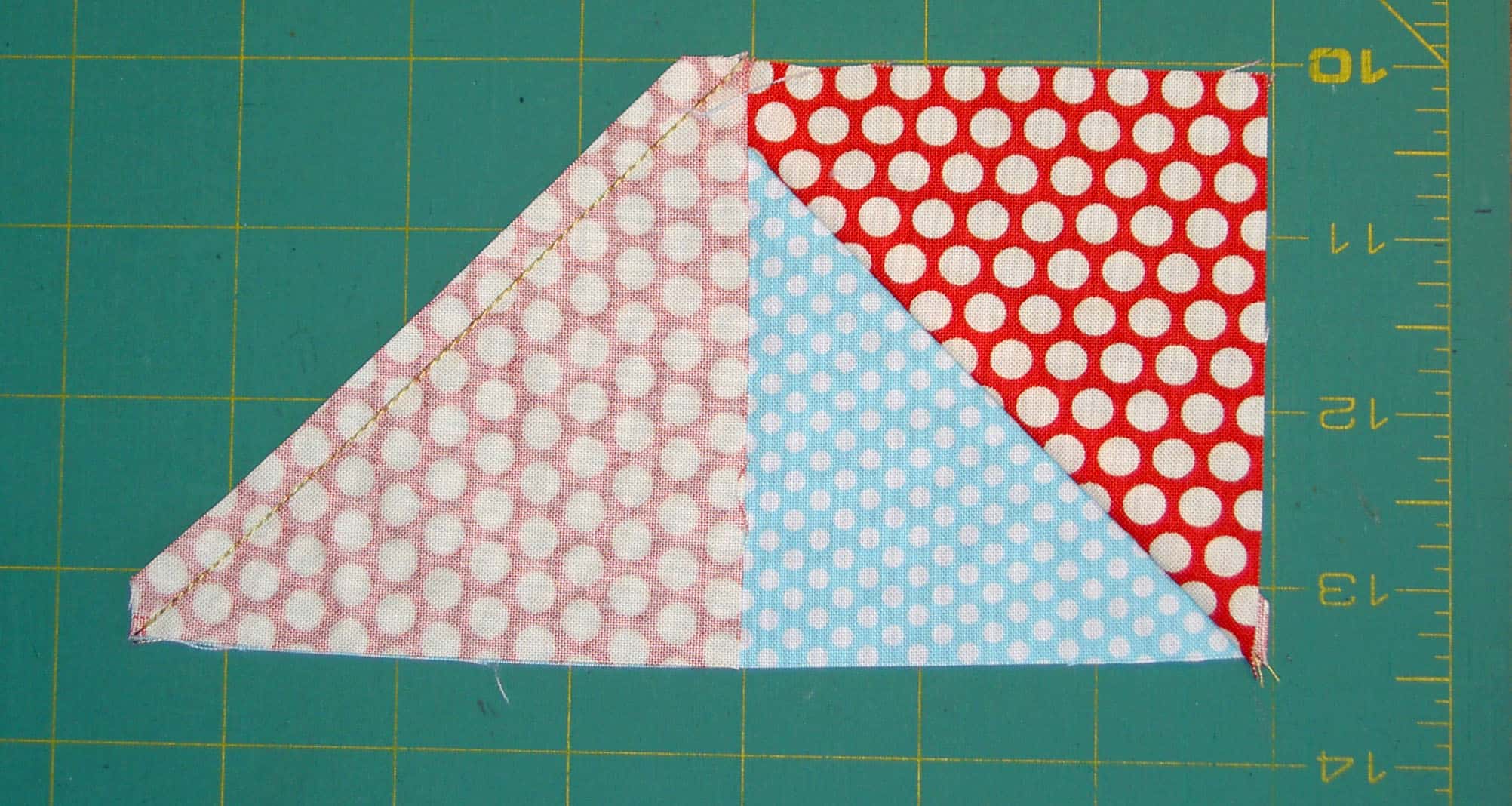
Lay 2d square on goose.
Place the second wing on the other side of the background fabric.
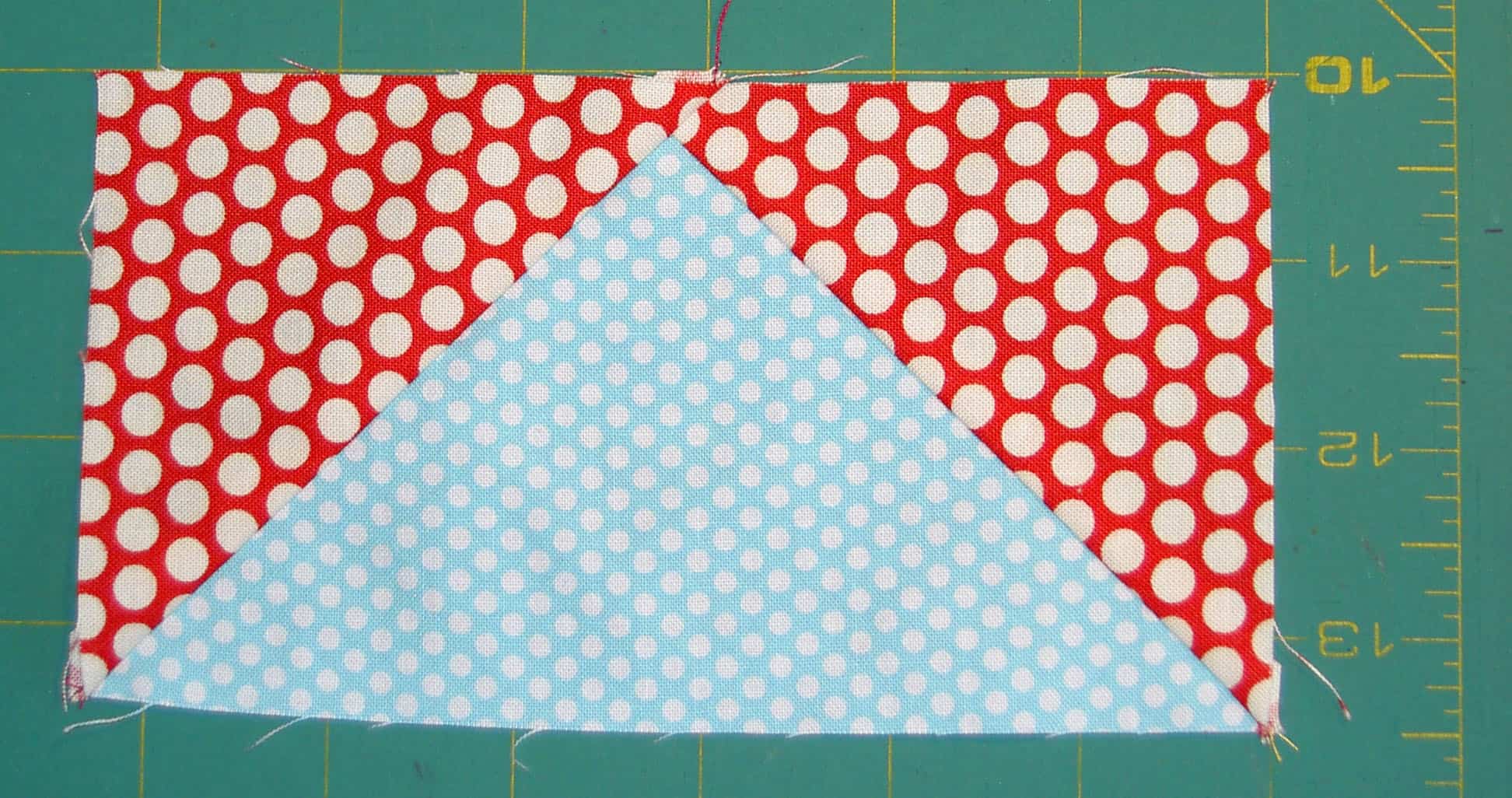
Trim 2d sewn wingSew and trim second wing
Sew and trim as above. Sew so that you cross the previous sewing line.
Press back 2d wing
Press back the 2d wing and, voila’, you have a Flying Geese element.
You need four of these to make a Sawtooth Star or eight of them to make a Dutchman’s Puzzle.
Here are so more triangles for FOTY 2011. I am not pressing and cutting them as fast since I am working on other projects, but I am working on them incrementally.
This post is kind of a roundup of the good and the bad. No ugly today, as I use GREAT fabric. 😉
This Sawtooth Star block is one I use to teach Flying Geese. I love the Dutchman’s Puzzle block, but think starting students out with 4 Flying Geese as opposed to 8+ is much kinder.
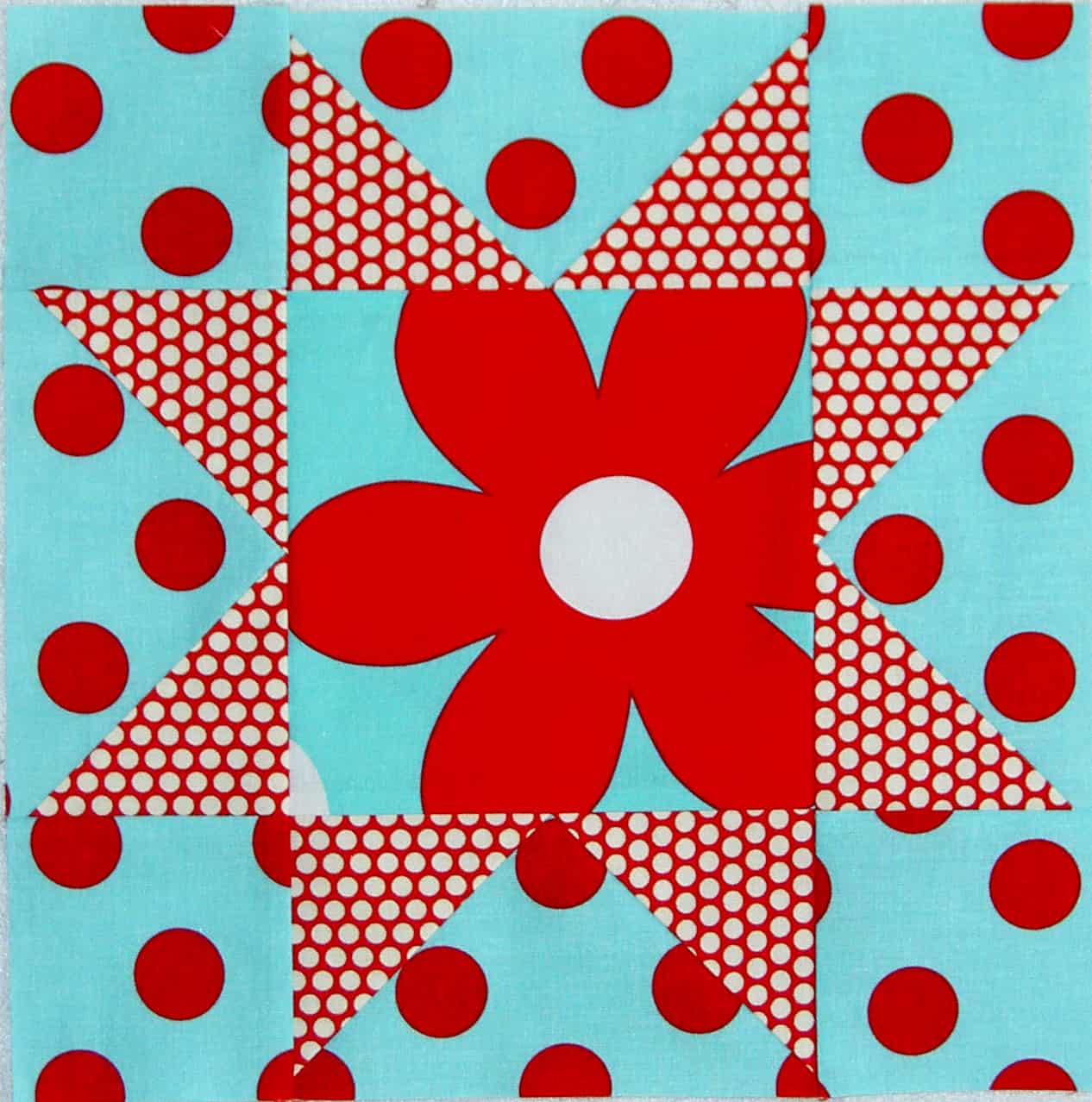
The larger blocks are weird for me to make, because I like to make 6″ or 8″ blocks mostly. The good thing about making these giant blocks is that there is a lot of potential for fussy cutting and the Big Plain Jane print worked really well in this block. I tried to position the flower a little off center to add a bit of interest while not showcasing the white flower that is near the red flower on the print. I am really pleased with how cheerful this blocks looks. I am glad I am working in a turquoise/aqua and red palette.
Card Trick
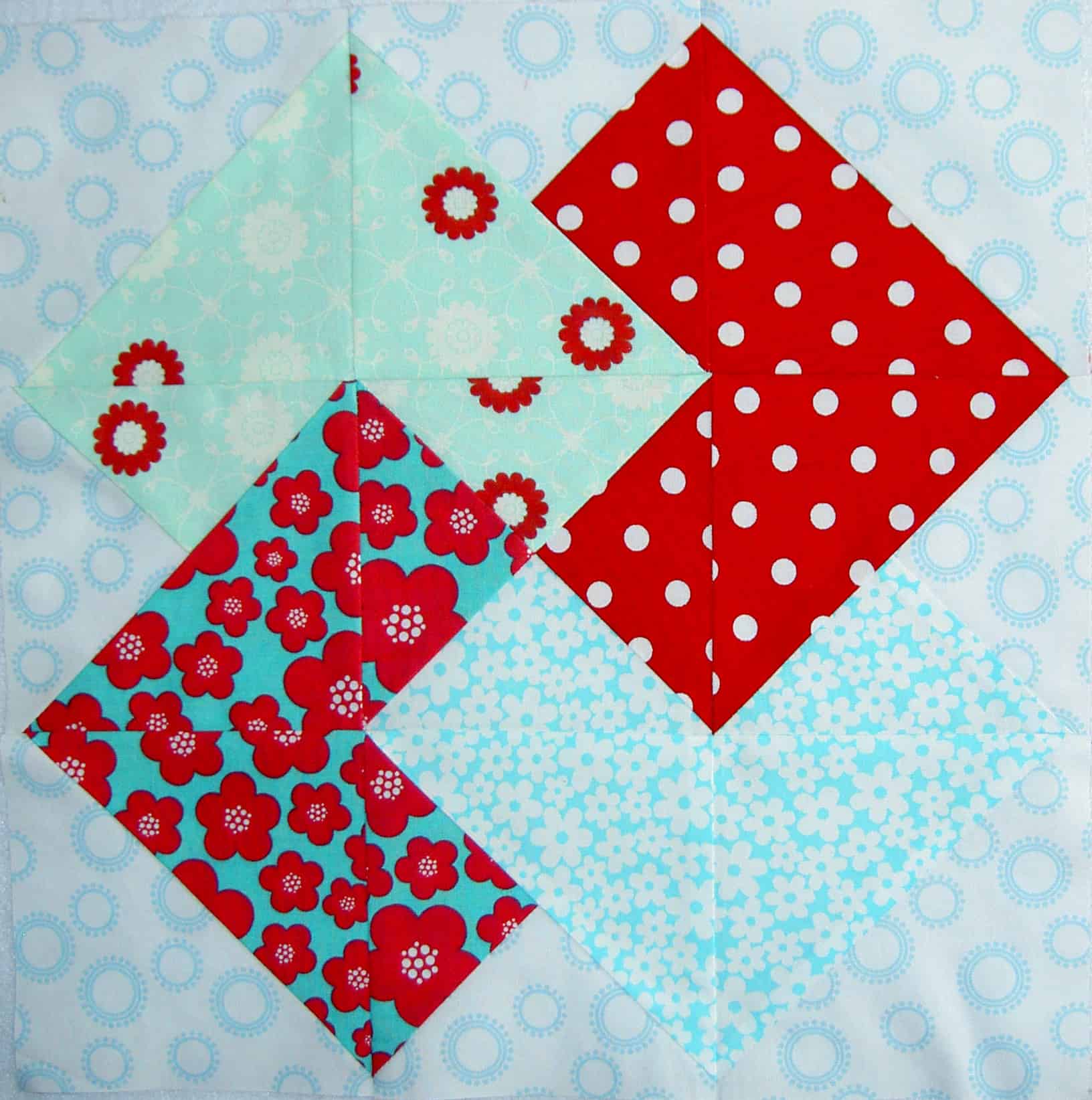
The Card Trick block is a great block for practicing triangles. It includes both half and quarter square triangles. If you haven’t tried the Card Trick, it is a great block as long as you pick the right fabrics. I, as you can see, did not build in enough contrast between the background and the light fabrics. There are a lot of seams and triangles in this block and you have to lay it out and piece carefully, because it is easy to get mixed up.
As I work on this project I see these blocks set on point with red cornerstones. We’ll see as the time gets closer.
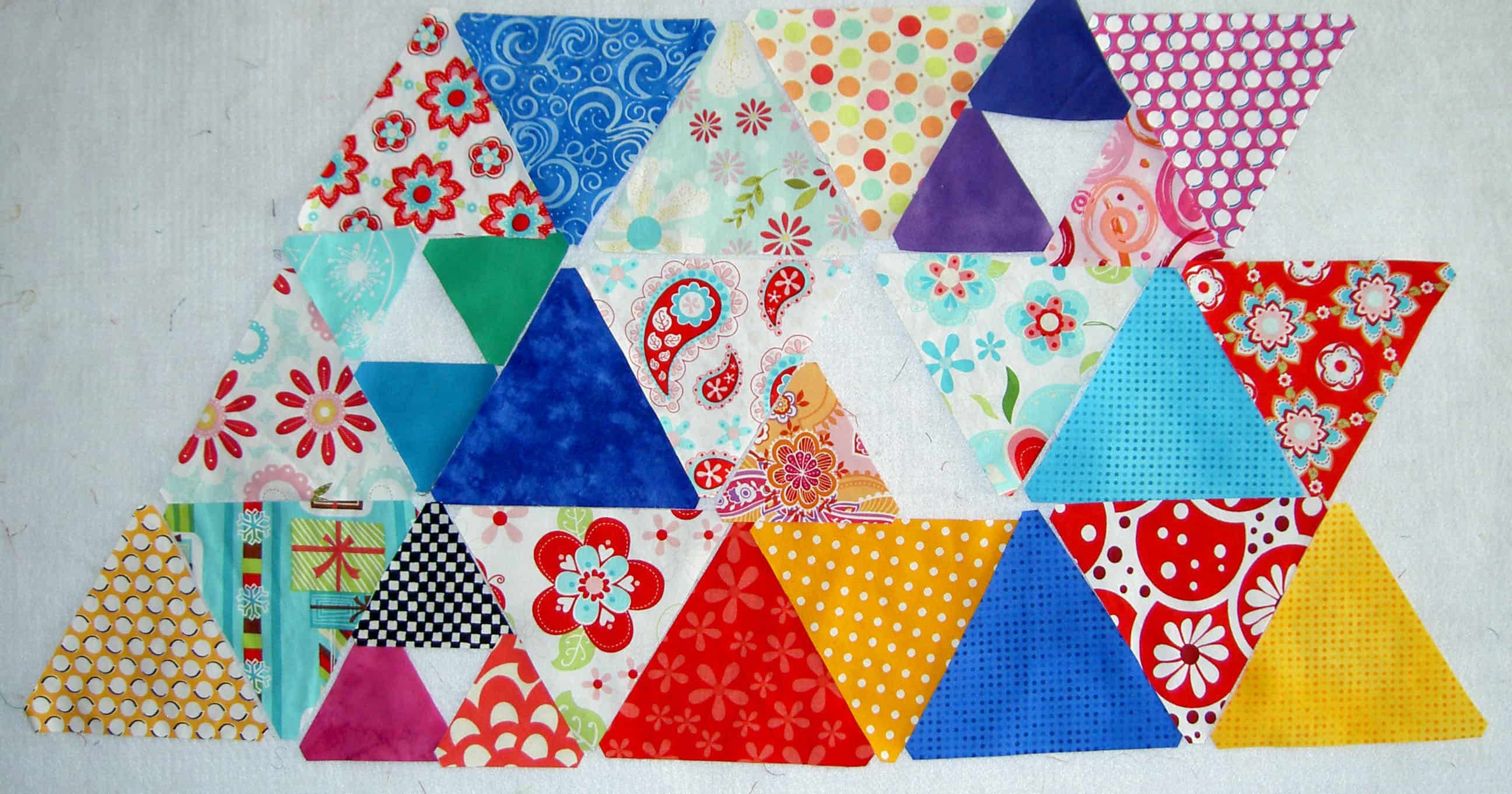
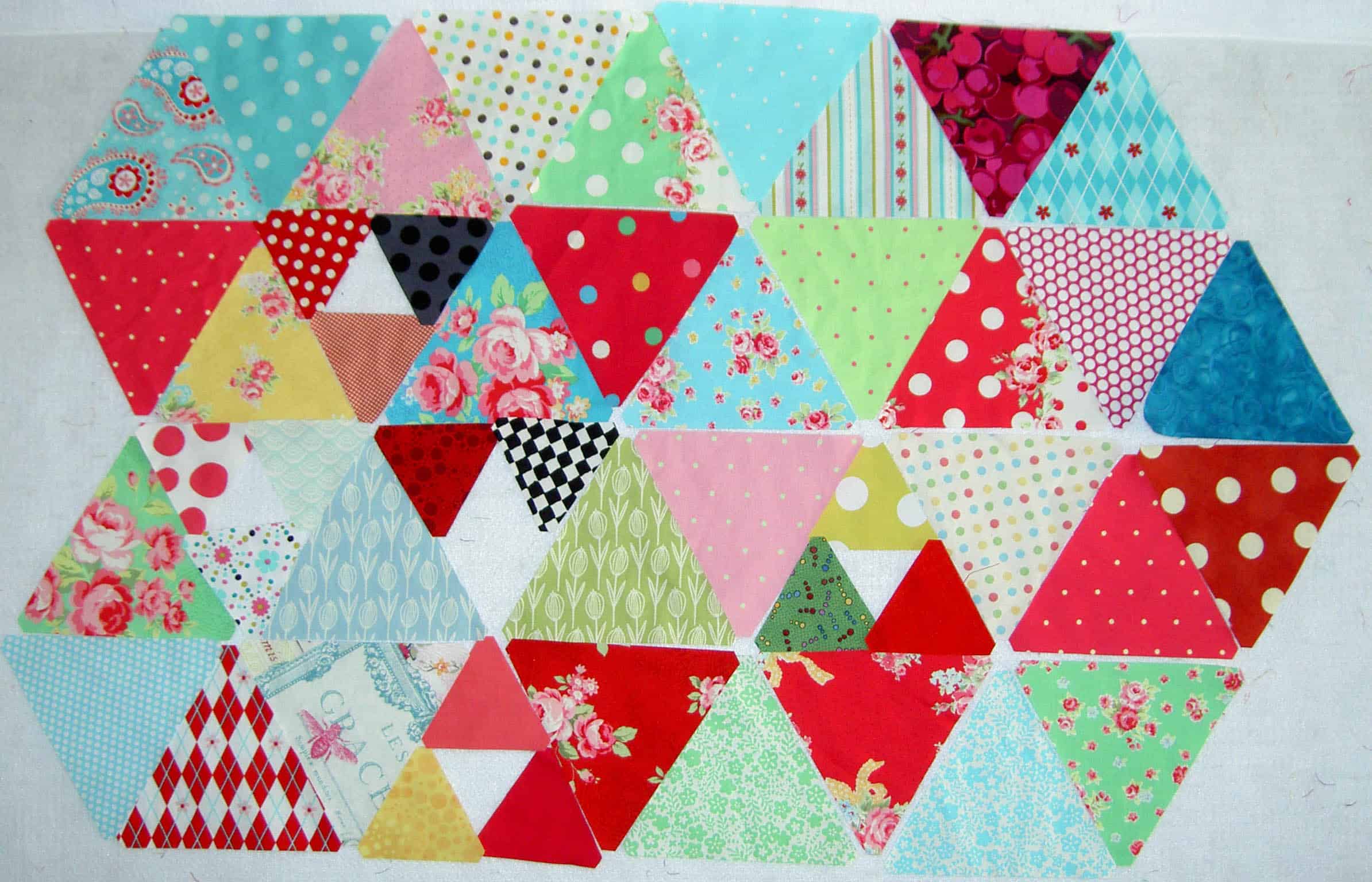
Here is the first group of triangles that will end up as Fabric of the Year 2011. I am doing something this year in that I am including many fabrics that I am using this year, but aren’t new. The large triangles are the new fabrics for this year and the small triangles are the fabrics that were already in my fabric closet, but were used in a quilt.
I have already realized that I am not going to be able to cut ALL fabrics that I use. I just am not organized enough. I haven’t developed the habit, but I am getting better.
I have the idea in my mind that I will make this more of a scrap quilt rather than arranging the fabrics carefully in a colorwash kind of order. I may not, though.
The other idea I have is to arrange it like Fons & Porter did in their Kalamkari Strippy.
We’ll see how I feel at the end of the year.
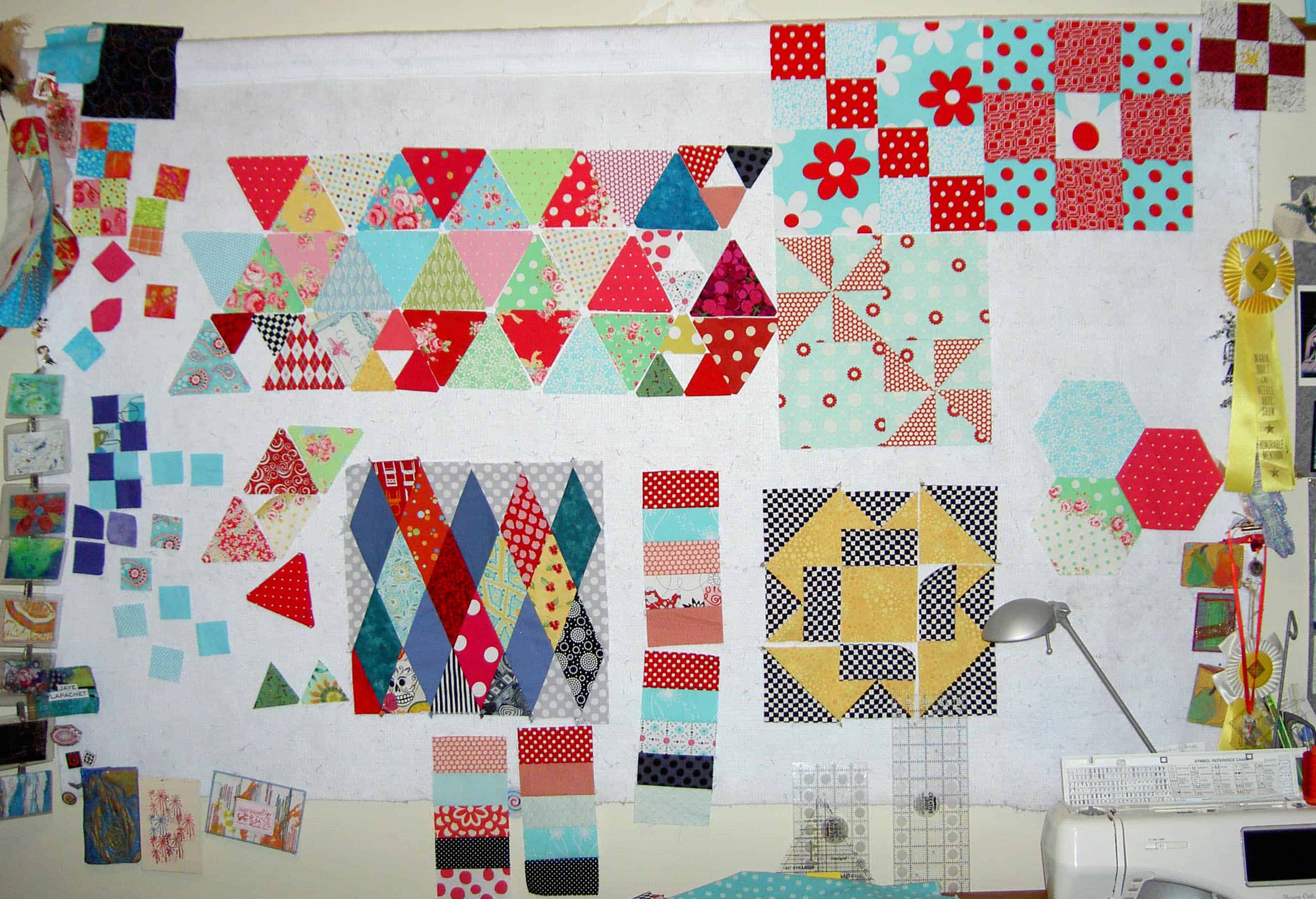
I have to clear off the design wall so I can create the samples and step outs for the quilt class. Taking a good look at the design wall made me realize that it is kind of being used as another dumping ground and more spring cleaning is required. So, before I clear it off, here is a tour.
Upper left: four patches. I cut scraps up into 2″ squares and sew them together into four patches. I use these patches as ‘Leaders and Enders’ a la Bonnie Hunter. This means that I sew together squares rather than just using scraps to start off my chain piecing. I do this so that I can accomplish something as I am starting and ending chain piecing.
Middle top: FOTY 2011 patches. More about these later.
Upper right: Sampler quilt patterns/red and aqua quilt. I may do something else with red and aqua, but the sampler is a good project for these fabrics since I can’t think of anything else.
Very upper right: Nine patch made by the Young Man when he was a Cub Scout. I want to do something significant with it, but haven’t decided what yet.
Lower left: more four patches in progress.
Middle middle: FOTY 2010 test piece. I would like to use it to test the border treatment I want to use for the Original Bullseye quilt. I think this test project will end up higher on the to do list sooner than I thought, because I need that space on the design wall.
Middle middle towards right: rectangles for another quilt like the purple quilt. Right now these bricks are being used as leaders and enders.
Next to this series of bricks is a Big T block that will be the front of a Teacher Pillow for the Science Teacher. I don’t like the name of that blocks. I don’t have a better name, but I think Big T is uninspired.
Bottom right: hexagon test piece.
Border: all around the border are things that I enjoy looking at. I have won 2 ribbons (right) in the far and distant past, but I like to look at them to remind myself that I am able to win ribbons.
ATCs 4/29/2011
I find that a good way to display ATCs is using those badge holders I get from conferences. It also prevents the badge holders from being thrown out. I like them for ATC display, because I can clip them together.The ATCs are small and this display makes more of an impact.
It is a little quilt art gallery that I can change easily. I can change both the configuration of the badge holders as well as the ATCs displayed very easily.
I have been on a finishing jag since my post about projects on my mind. I want things out of the half finished stage. I want to feel ok about starting new projects, not that that is really a problem.
I am not finished with anything completely yet, but I am in the process. Three quilts are at the quilter and in the past few days I have finished two more, which will be dropped off at the quilter on the 25th.
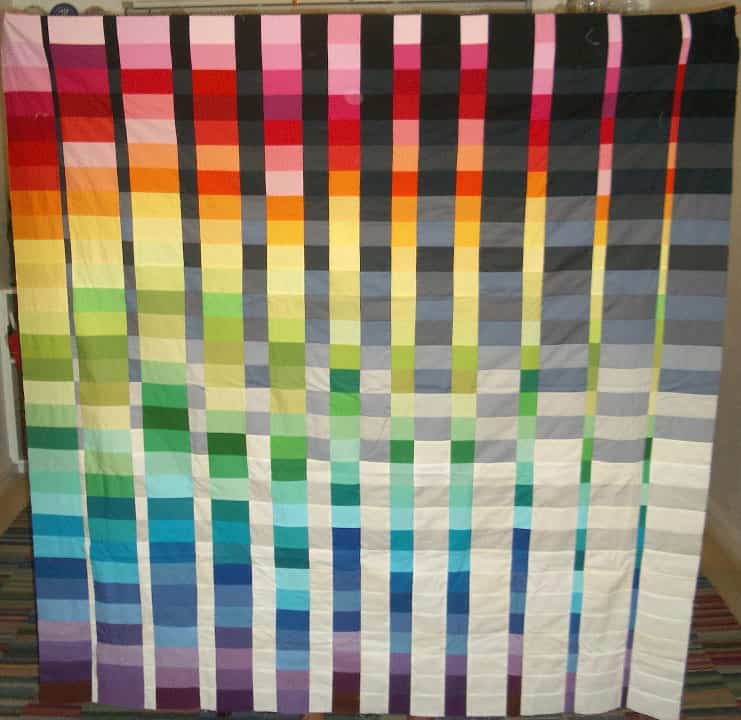
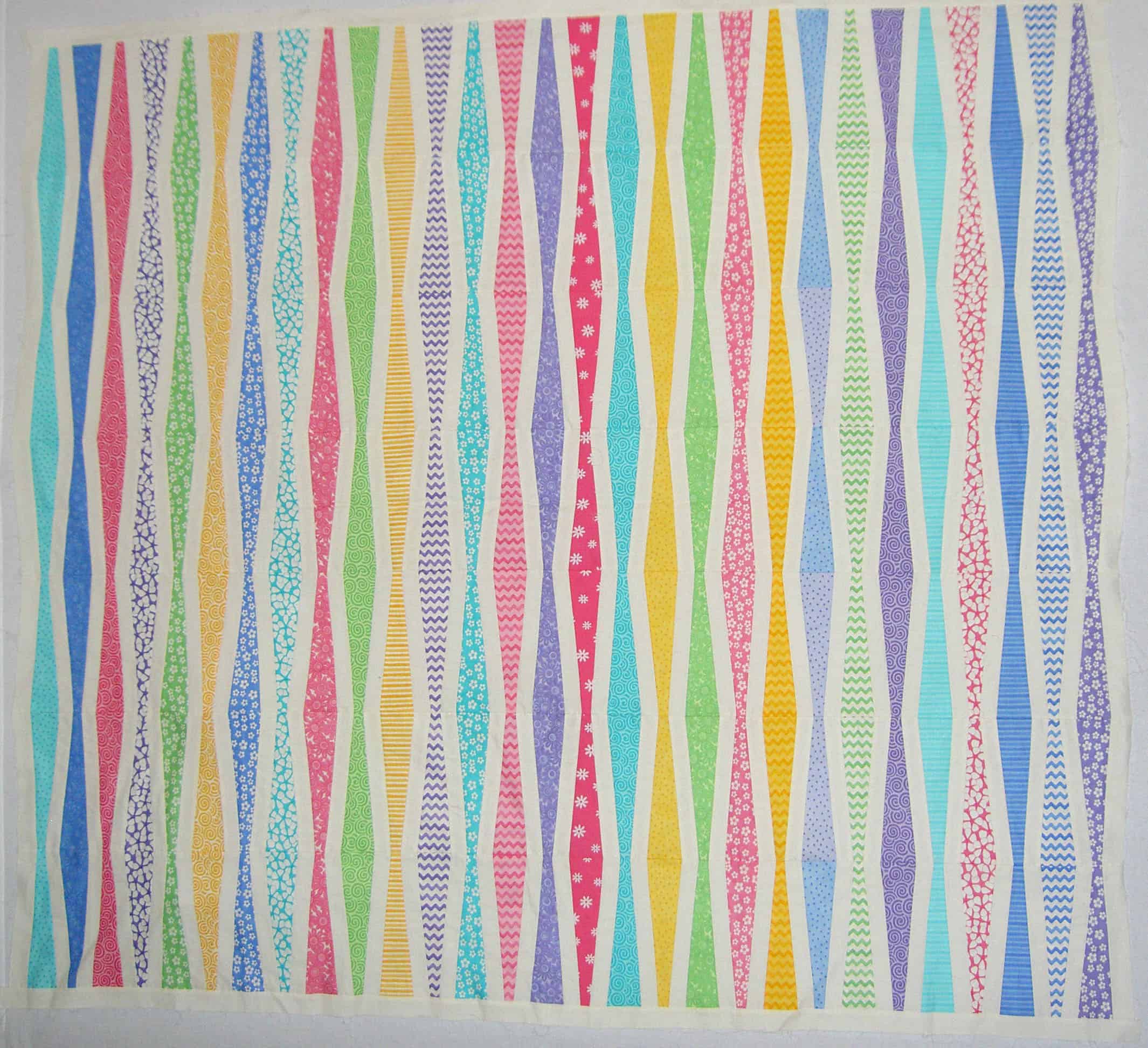
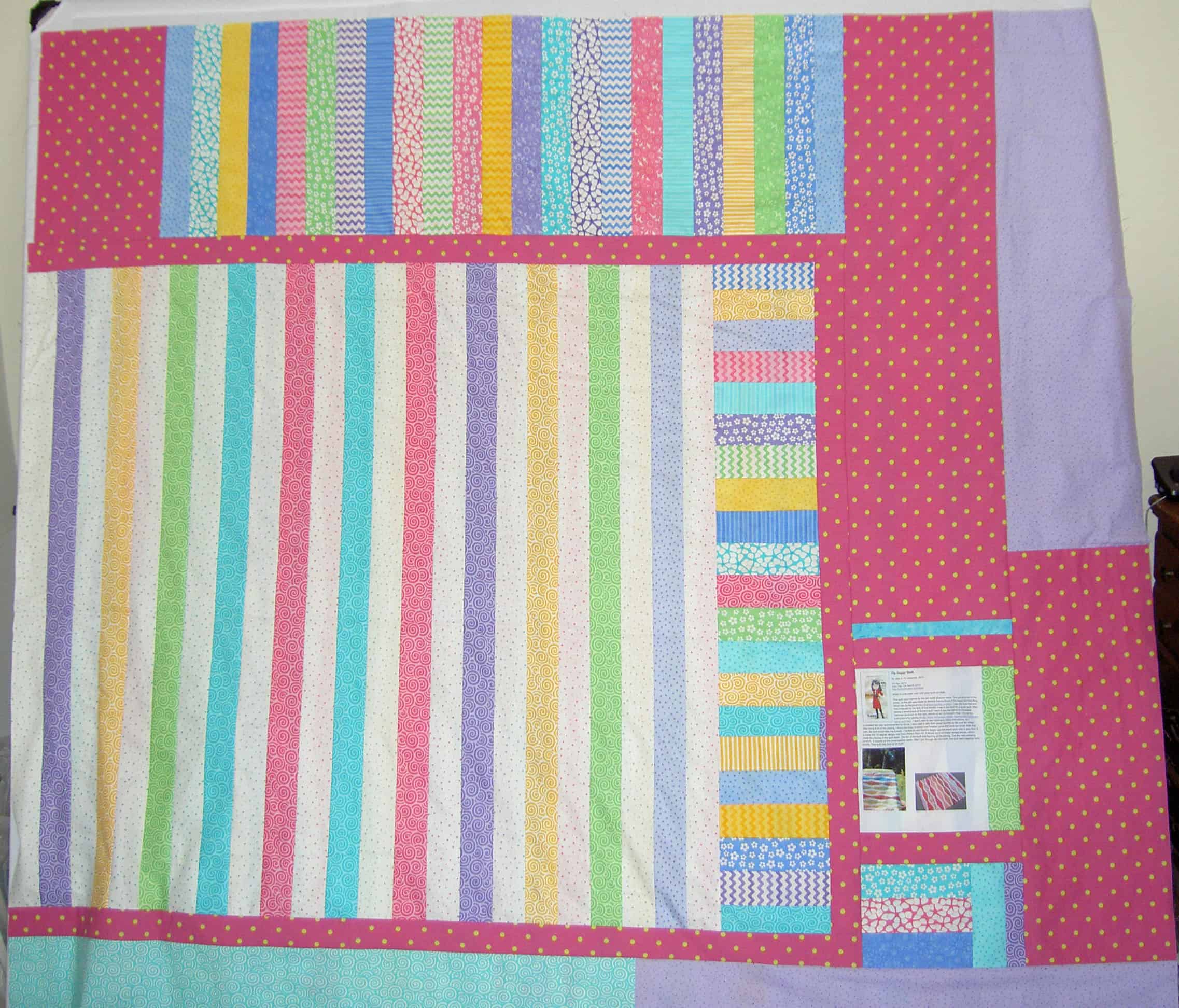
Zig Zaggy Back - Finished
I took the FOTY 2011 off of my portable design wall after finishing the back and, instead of taking the portable design wall down as planned, I put the Zig Zaggy quilt up. I have to say that I really, really like having 2 design walls. I only had two sides of the back to finish to make the back big enough to quilt the quilt. Since I was in finishing mode, I just sewed some extra pieces on to the back. Now I will make the binding and be done with it.
I like the front, and the back started out as a good idea, but I stopped working on it because sewing all of those leftover strips was a big pain. I am not doing that again. I am sure I can find a use for strips. I had a much better time finishing the FOTY 2010 back. I used large pieces and it was a lot easier. That is my new mantra for backs: big pieces of fabric.
Zig Zaggy Back - Finished
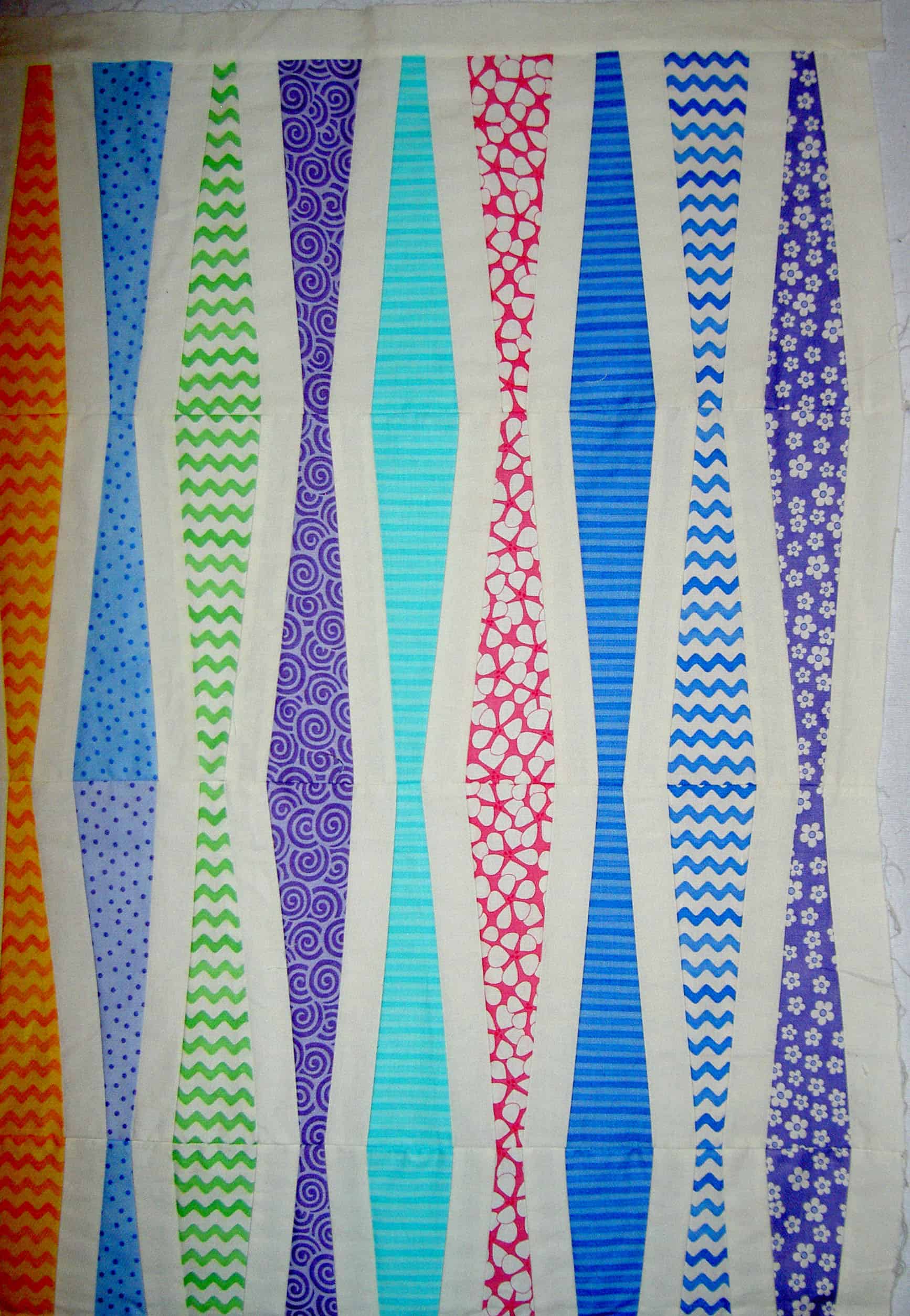
Here is a the detail of the top. The top came out smaller than I thought. When I was working on it, it seemed huge. Now it seems tiny. Compared to the FOTY 2010, it is small. I guess it is all about perspective.