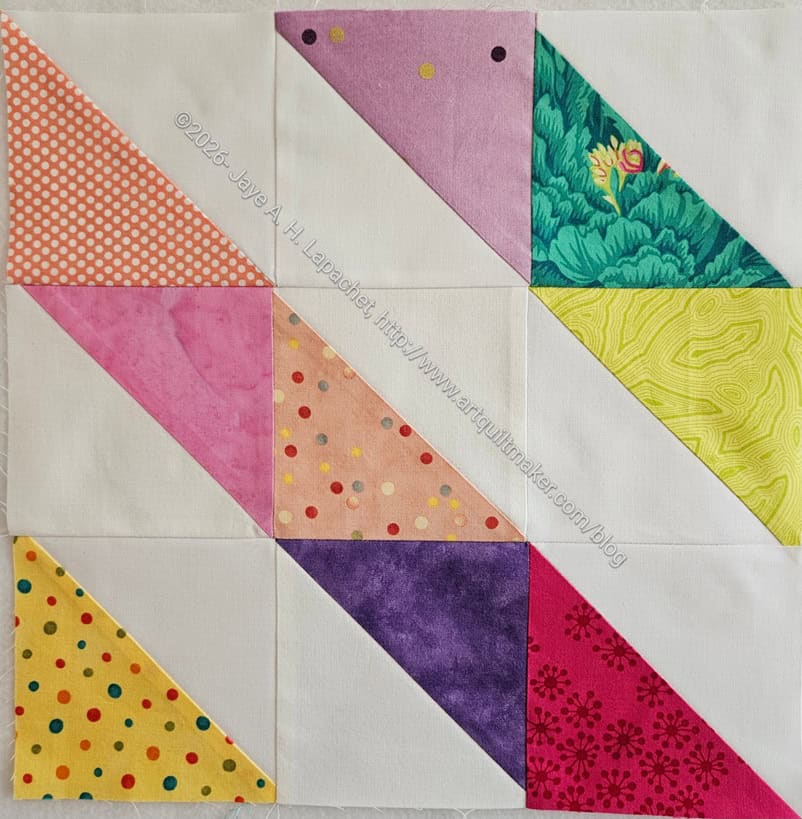
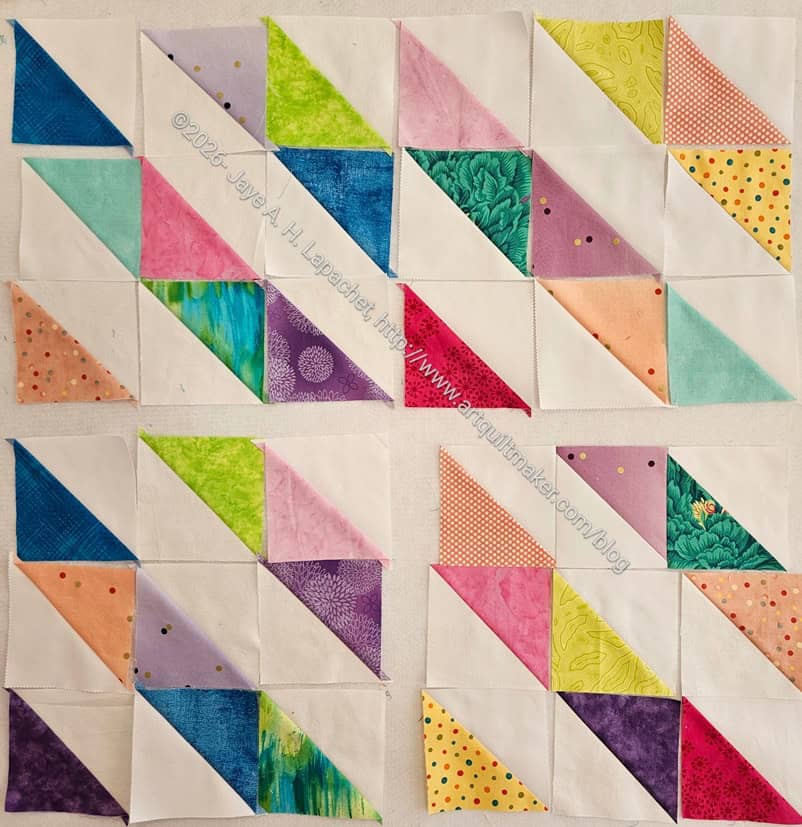
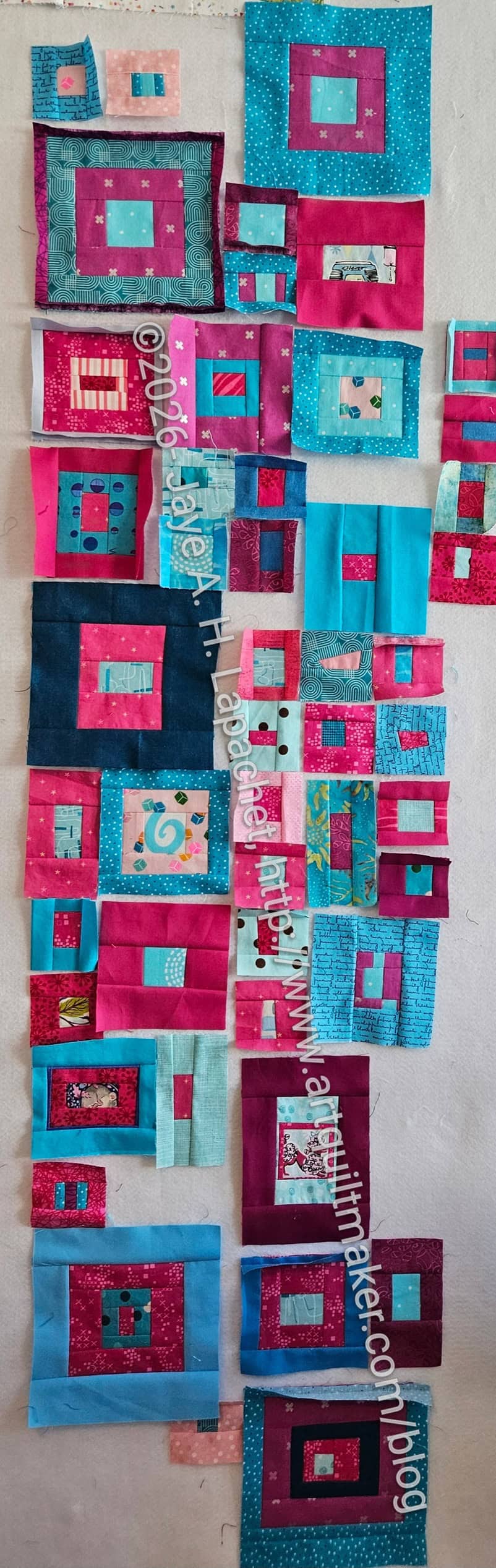
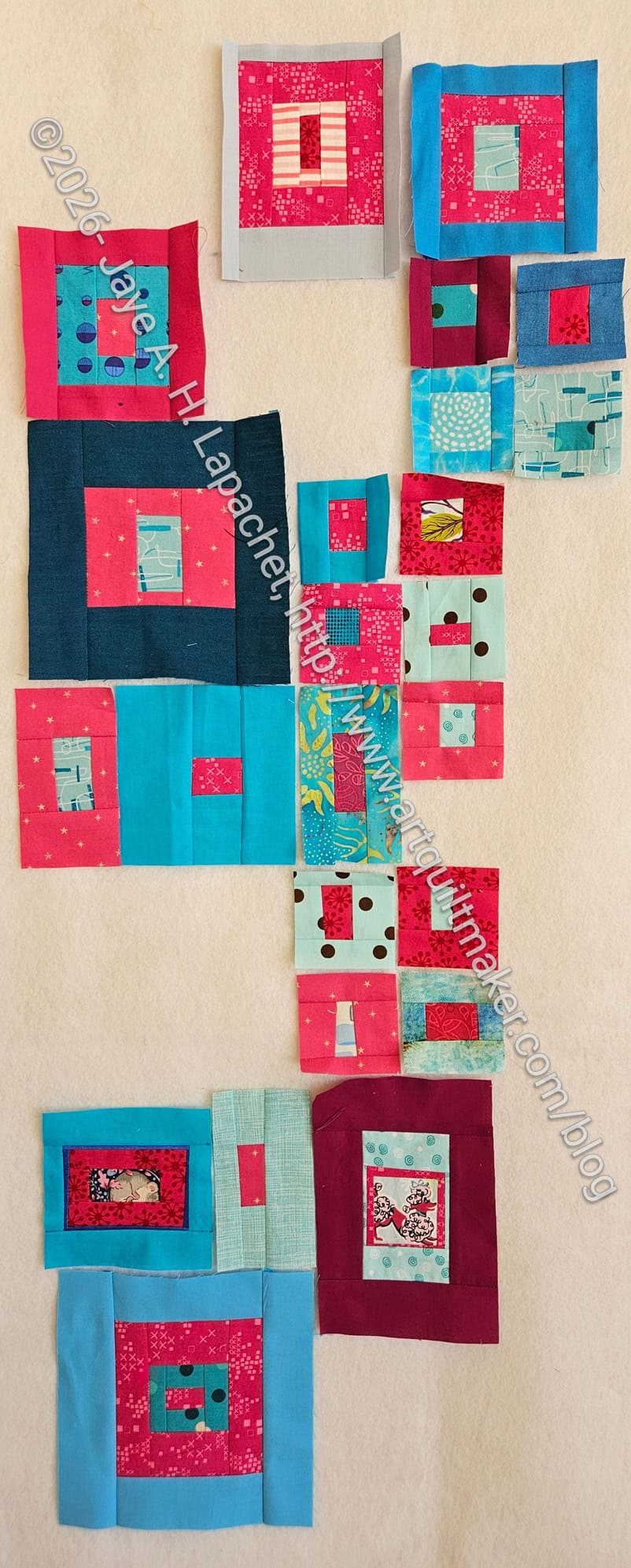
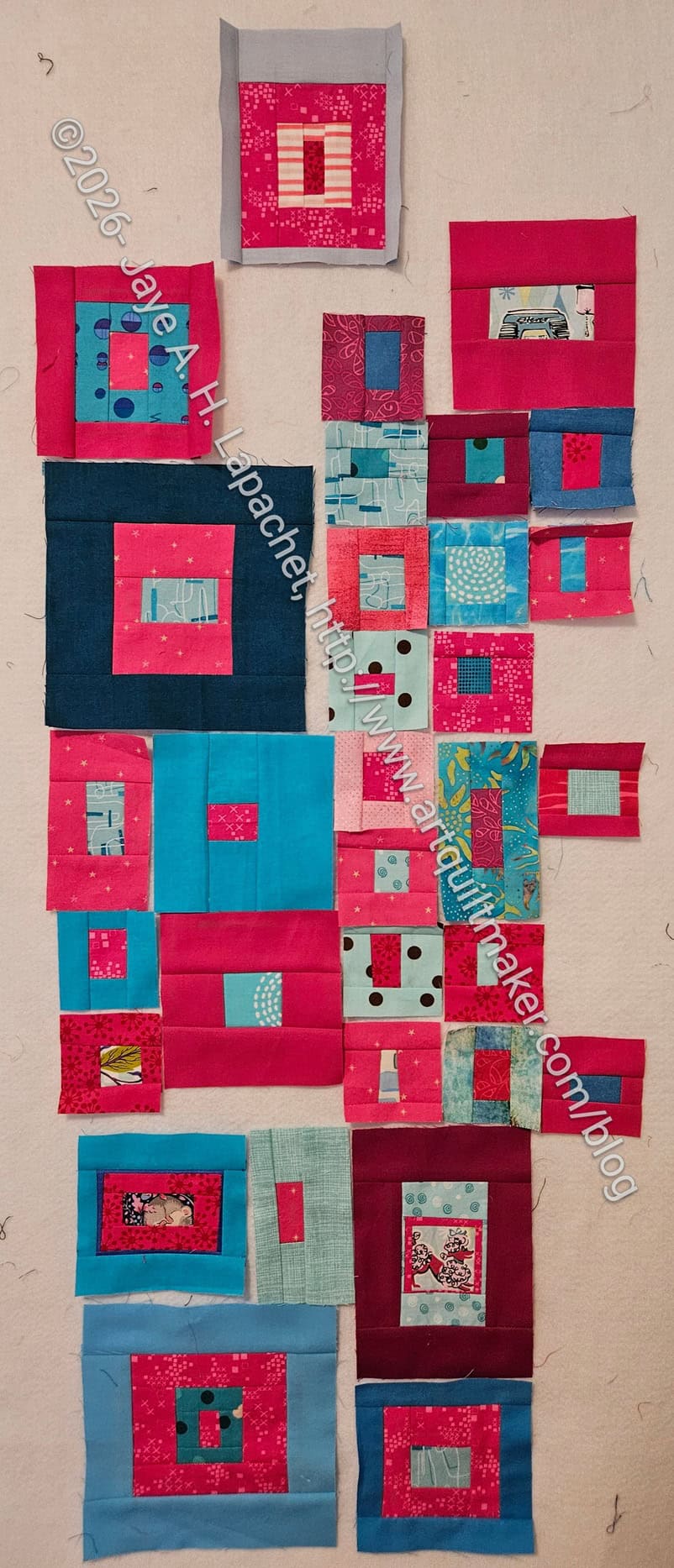
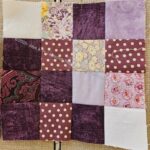
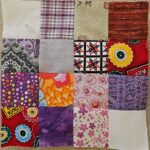
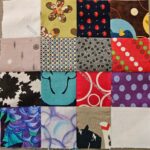
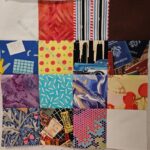
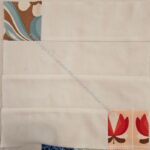
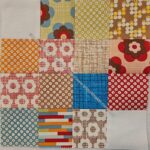
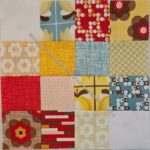
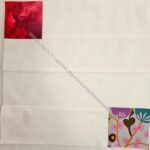
The Pacifica Quilter’s Club also has a donation block program called “Lucky blocks”. I missed the first round, but picked up the instructions at the last meeting. I have slowly been starting these blocks and over the weekend made some good progress.
I have to trim all the HSTs, so the work takes longer PLUS I am working on about 12 projects at a time.
Lucky Blocks waiting to assemble
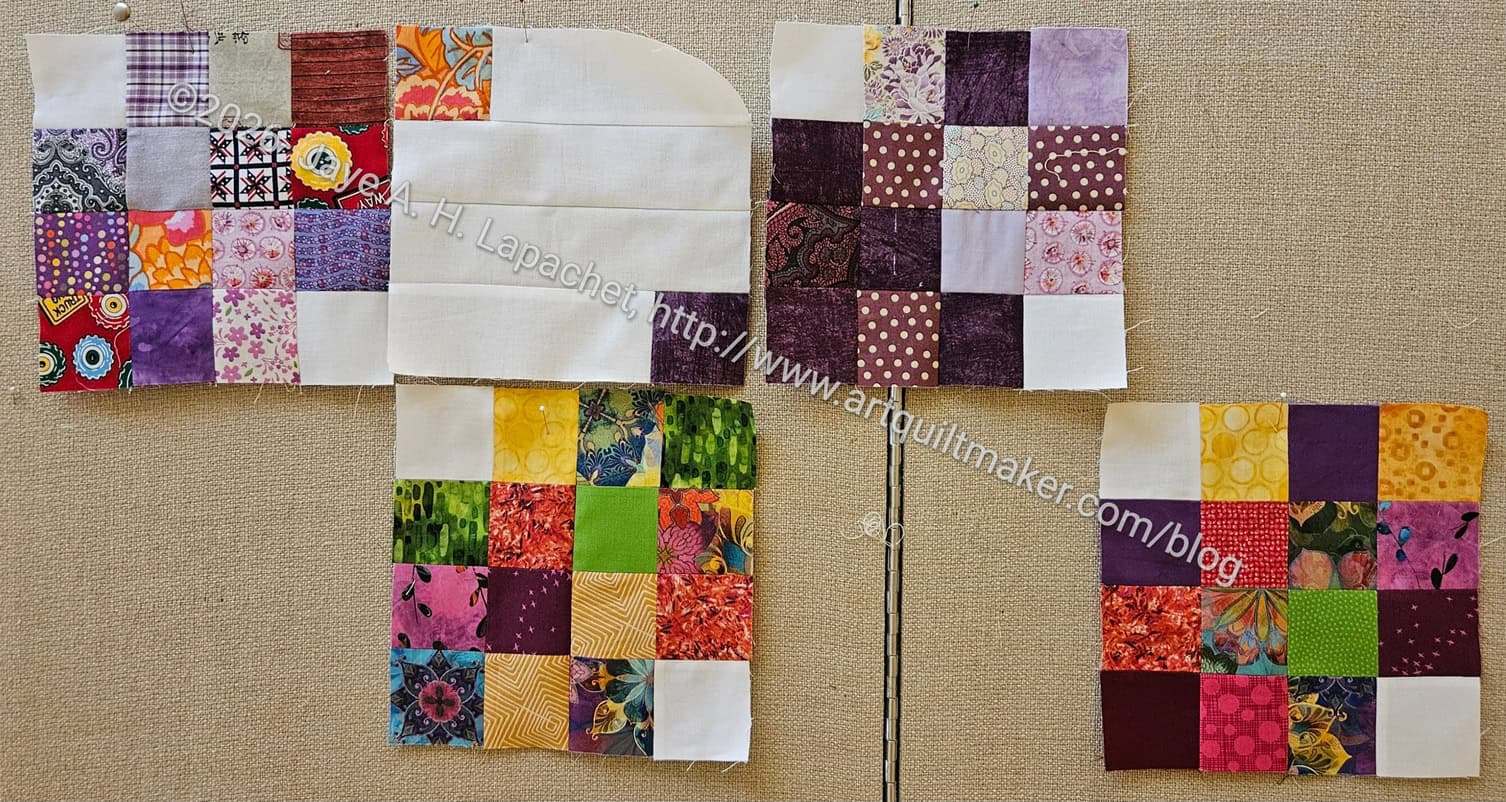
I accidentally cut 4 blocks. Either I didn’t read the instructions carefully or I skipped reading them. I made a bunch of HSTs and there were enough for 4 blocks. I’ll sew them together in time for the April meeting. If I can’t make it, I’ll drop them off with the coordinator.
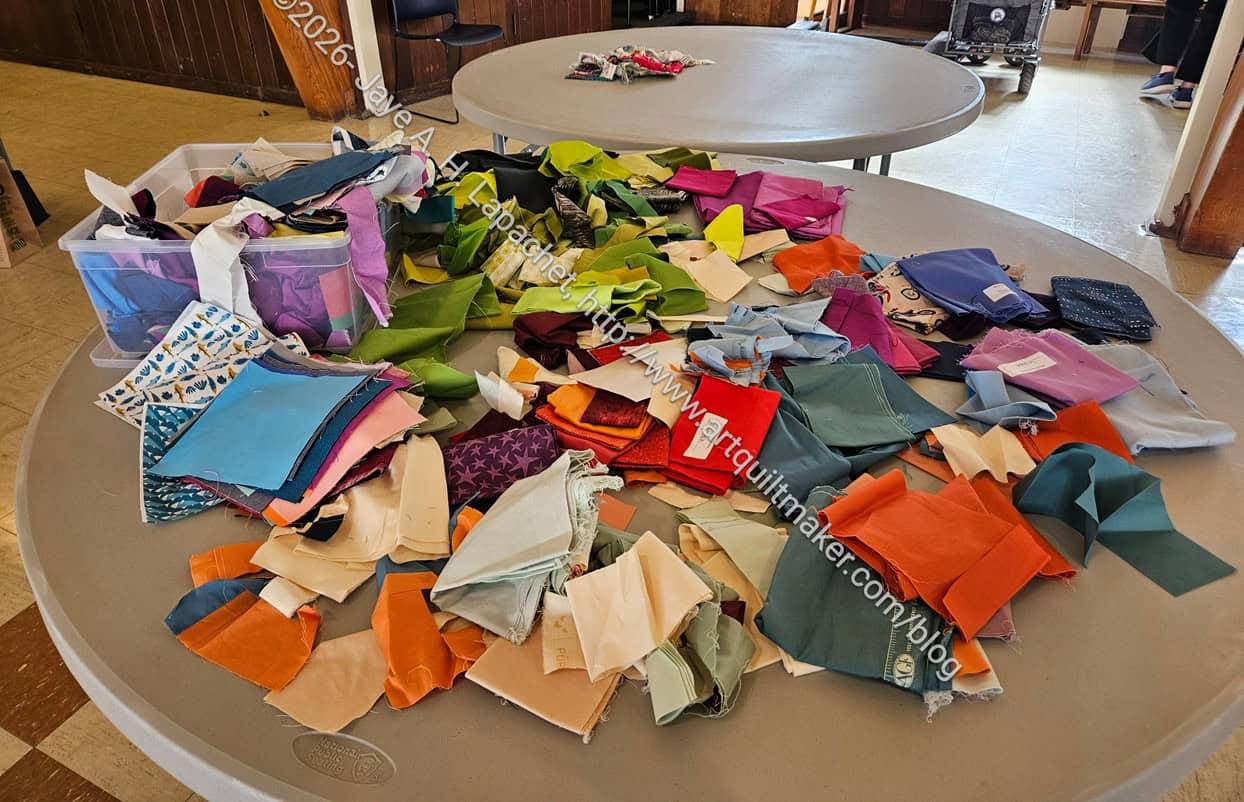
I was able to use some 5″ squares I had cut from scraps for this project, which made me very happy. That scrap processing effort isn’t wasted!
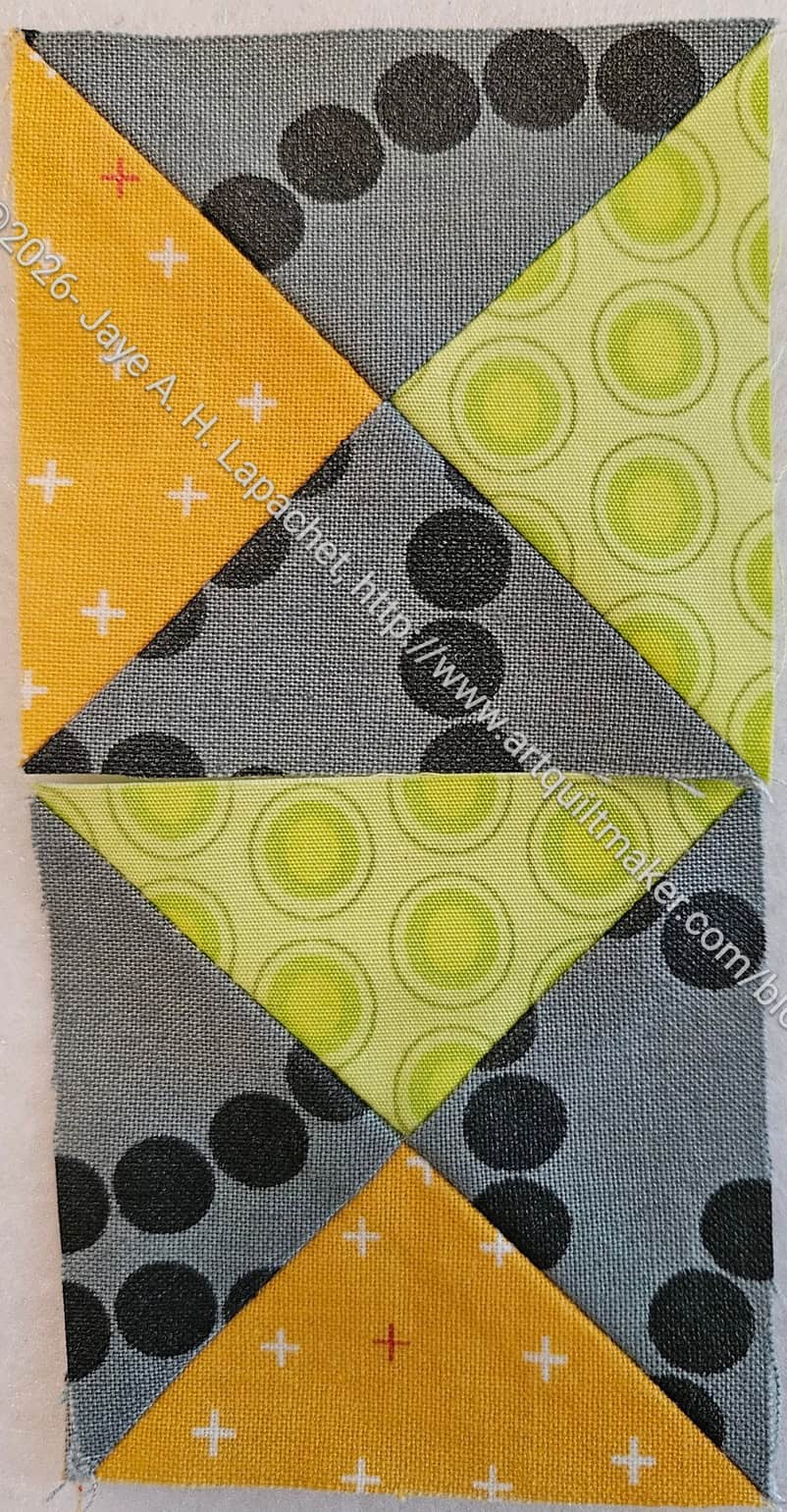
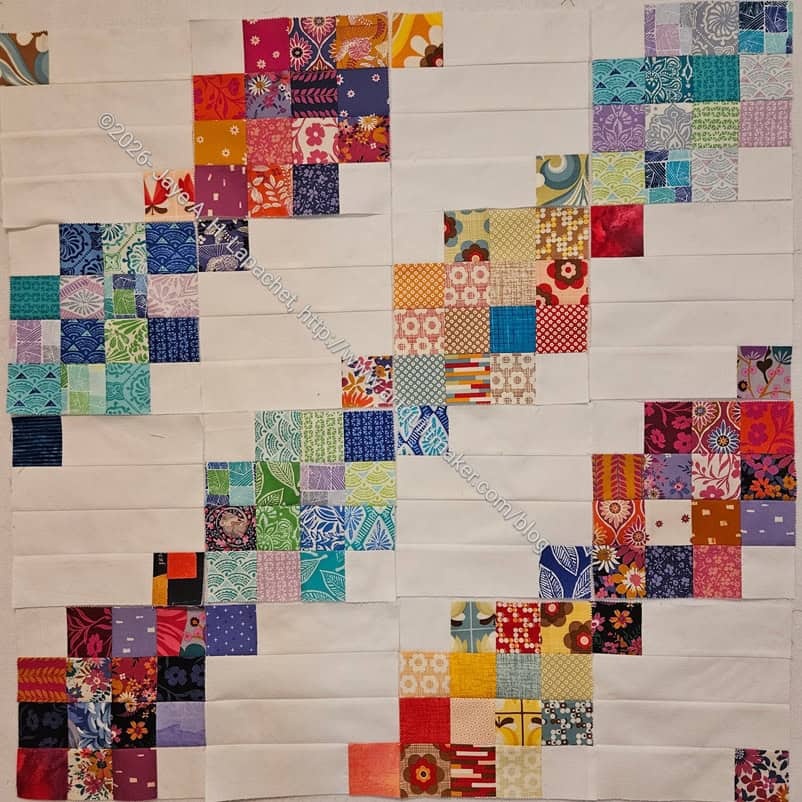
I found a tutorial for a 3 color quarter square triangle block while reading the Love of Quilting magazine. I decided to try it for my Bay Area Modern Block of the Month for March blocks.
The tutorial includes a 1.5 minute video with jaunty music.
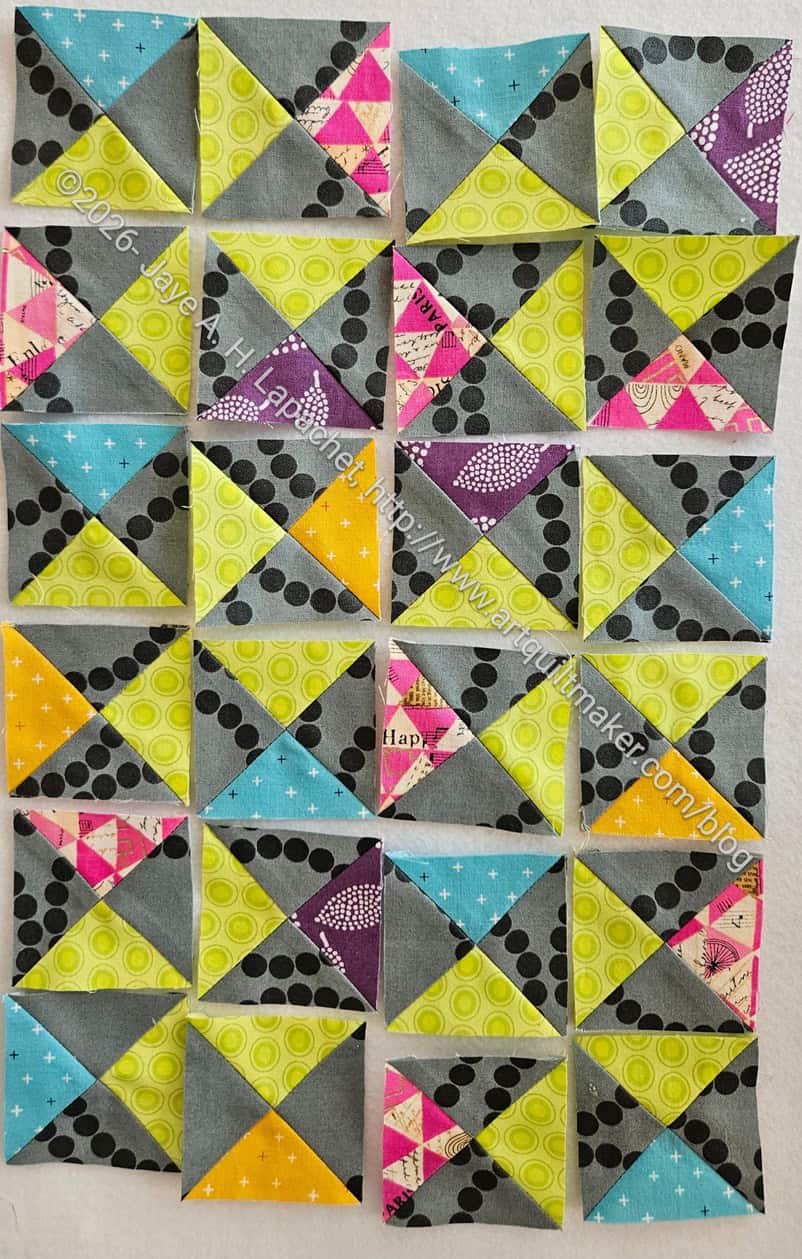
I made two first just to see what I thought of the technique. I thought it was fine and something different, so I cut some squares and went to work. I went a little crazy and made quite a few QSTs!
BAM BOM March QSTs
As I was laying them out I realized that I could make pinwheels since I used the lime green in all of the blocks. I don’t know that I’ll do that in the final layout of the quilt, but it was kind of fun to see what such a layout would look like.
I just got a Technique Sheet from Studio 180 Designs for the Split Recs Ruler**. I love that ruler and may make some Elongated Hourglass units. Stay tuned.
**Obviously, you should shop at local quilt shops and small businesses. However, if you are too busy or can’t find what you need there, I use Amazon affiliate links and may be paid for your purchase of an item when you click on an item’s link in my post. There is no additional cost to you for clicking or purchasing items I recommend. I appreciate your clicks and purchases as it helps support this website.
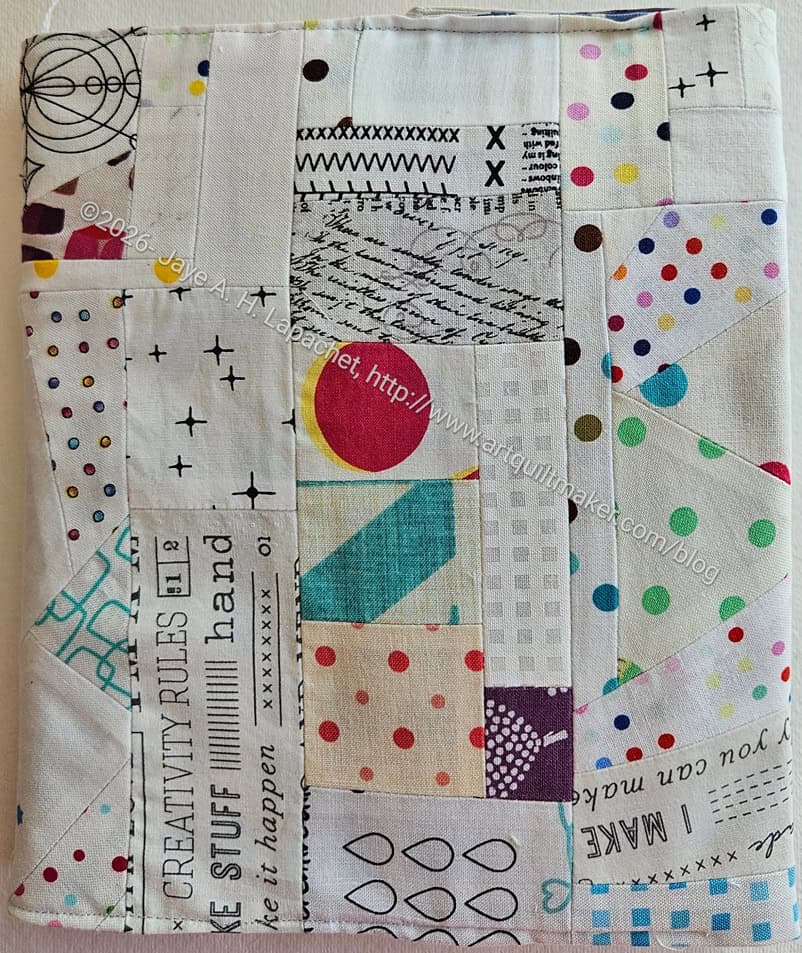
2016 seems like a long time ago, well, it is 10 years!. That is what I came up with searching the blog. It makes sense, though as I am not using the Miquelrius journals now. I also have a recollection of making one for an older journal that got lost in the shuffle last year.
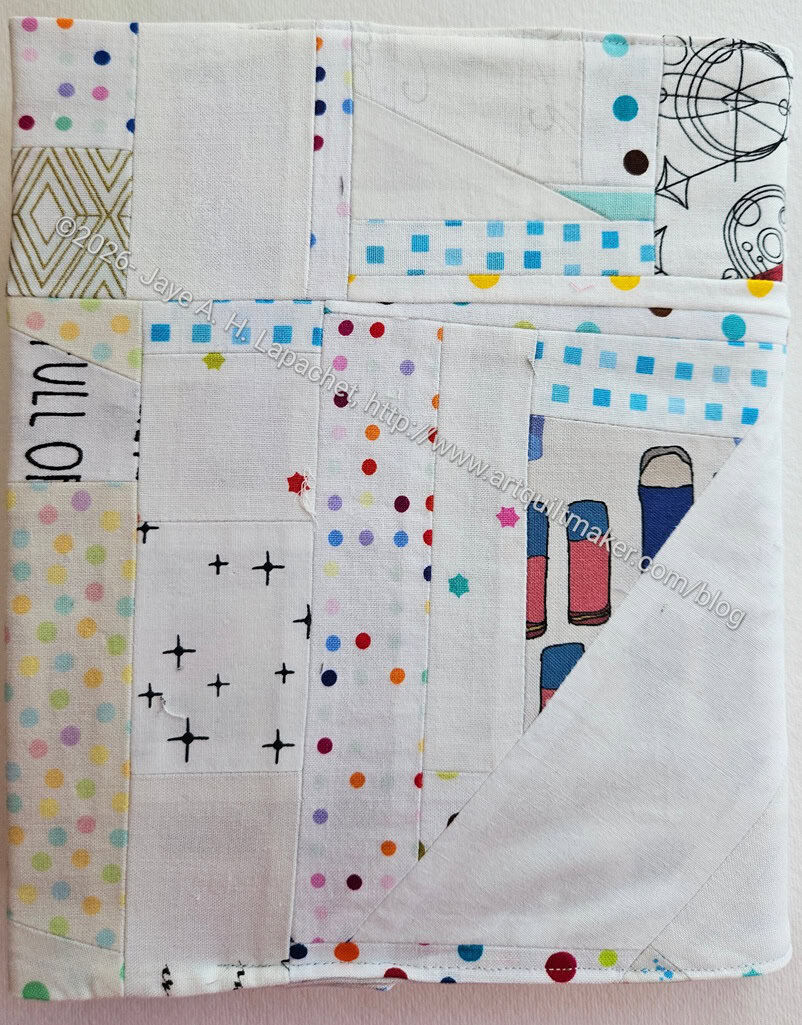
White Journal Cover #2 – back
This journal cover was actually mostly made when I pulled out the white drawer recently. I put a back (inside) on it and stuck the journal in. It was a bit small, but I made it work, since it isn’t going to be entered for any prizes. I wasn’t in the mood to rip it apart. I the fabric will stretch anyway.
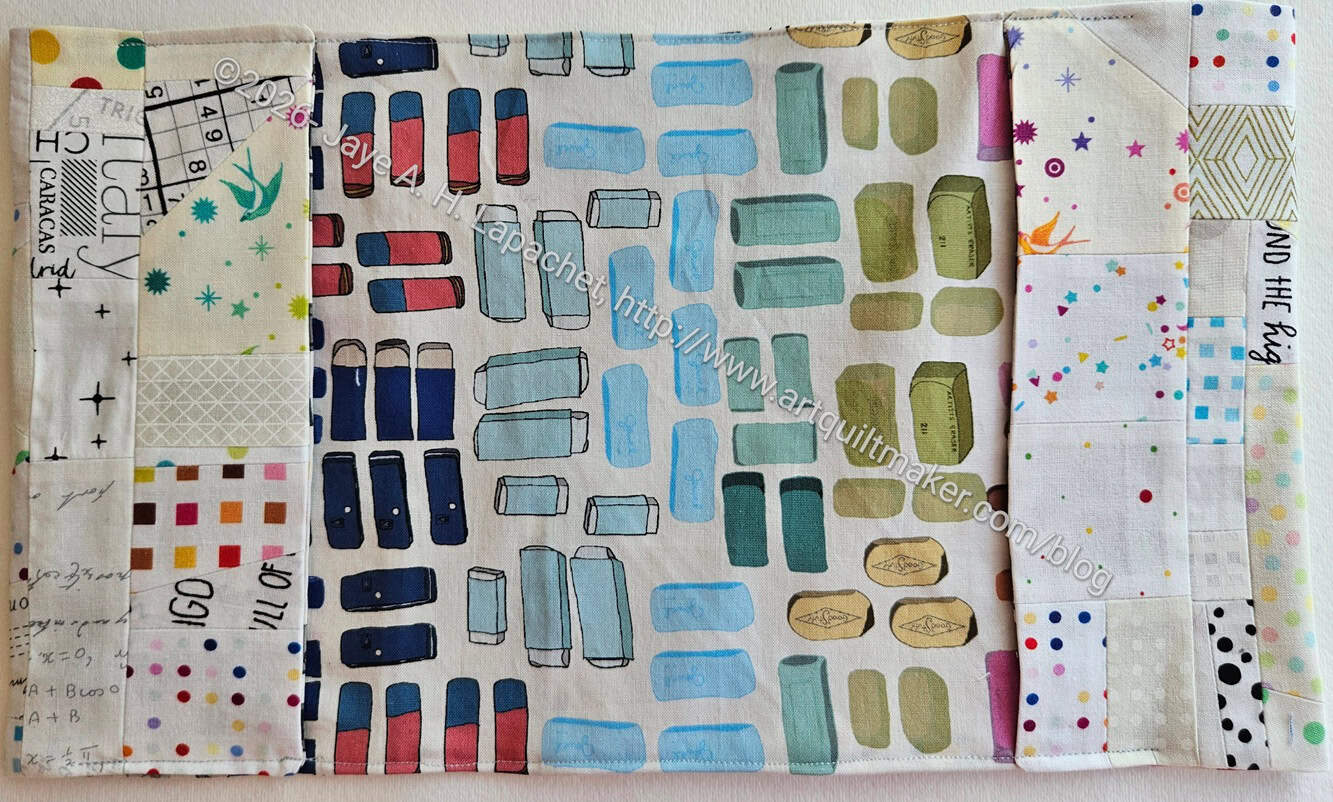
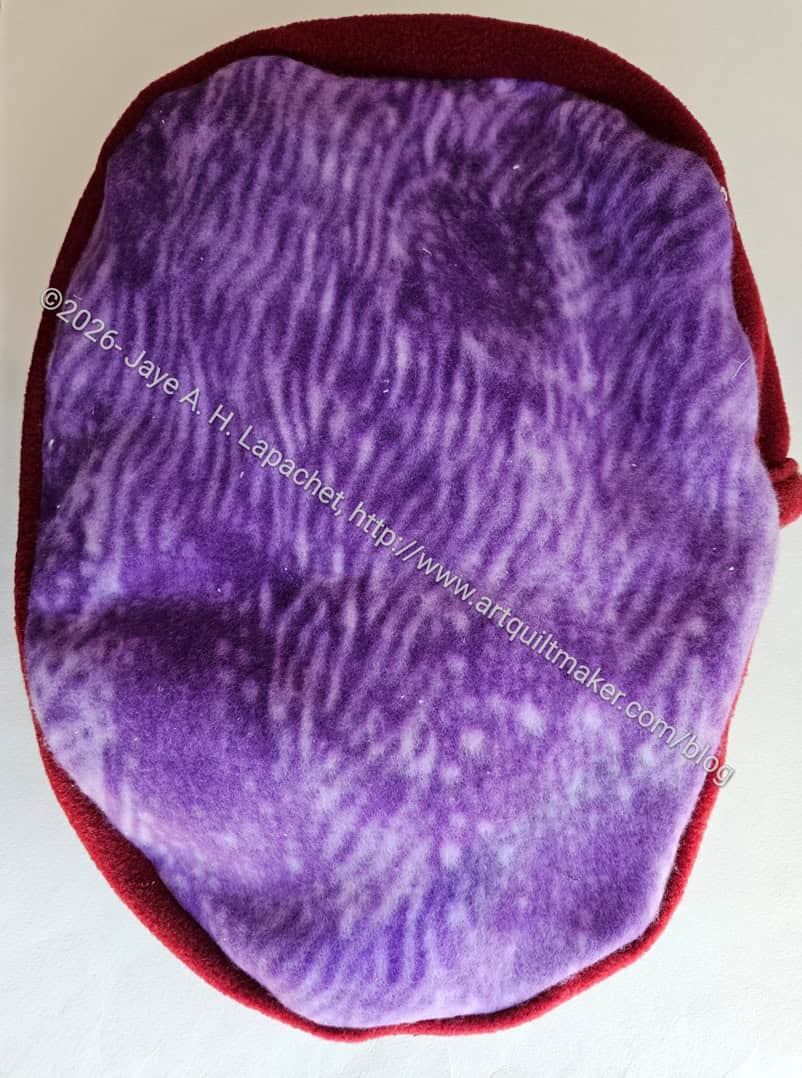
White Journal Cover #2 – inside
The inside fabric was a large piece of Crimson Tate eraser fabric that was in my scrap bin for some reason. I don’t usually put large pieces like that in my scrap bin. Who knows?
I have been working a bit at a time on more Mosaic blocks.
I think I need to sew some of them together, so I can figure out how many more I need and where.
I have added some more fabrics to vary the contrast and make each block stand out. A two color (ish) color palette can be tricky.
I have been working on making a ton of smaller (2.5 inch) blocks. Lorraine said we would need a lot of them. The size of the blocks I made after I got home from the workshop kept creeping up. I suddenly realized that I wouldn’t be able to put the thing together without more small blocks, so that is my current focus.
Friend Julie wrote a really good post about the workshop. She got some great photos that I neglected to take.
Table runners are a great project to make when you want to try out a technique or use up the bits and pieces from a class. I decided I didn’t want to make a whole quilt when I took the Jen Carlton Bailly class and made a table runner we love.
I am making a table runner from the 1-2-3 Mosaic class I took the other day and decided to do an inventory. What a bonanza!
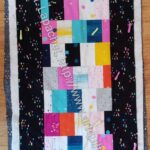
Cha Cha Cha table runner #2 in process
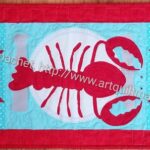
Lobster tablerunner
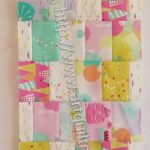
Cha Cha Cha table runner
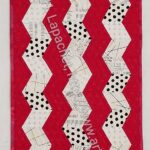
Red Text Table Runner
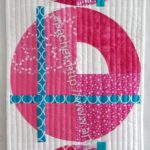
Finished: Circle tablerunner
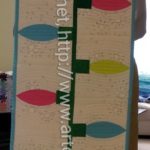
Mod Lights Table Runner
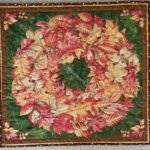
Finished: Thanksgiving tablemat
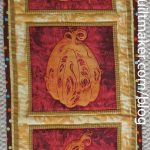
Pumpkin/gourd tablerunner
Thanksgiving Tablerunner
Thanksgiving Tablerunner detail
I have made a couple of table runners and given them away.
Bat Tablerunner: finished
Christmas Tablerunner
The bat table runner was for Amy. I just made it. She gave me all of the supplies. I think it was a kit or something.
The Christmas table runner was a gift for SIL#4. I saw that she used it during the Christmas season, which made me really happy.
I think I could make a table runner for each holiday. It is an opportunity, but I am not signing up for it at the moment.
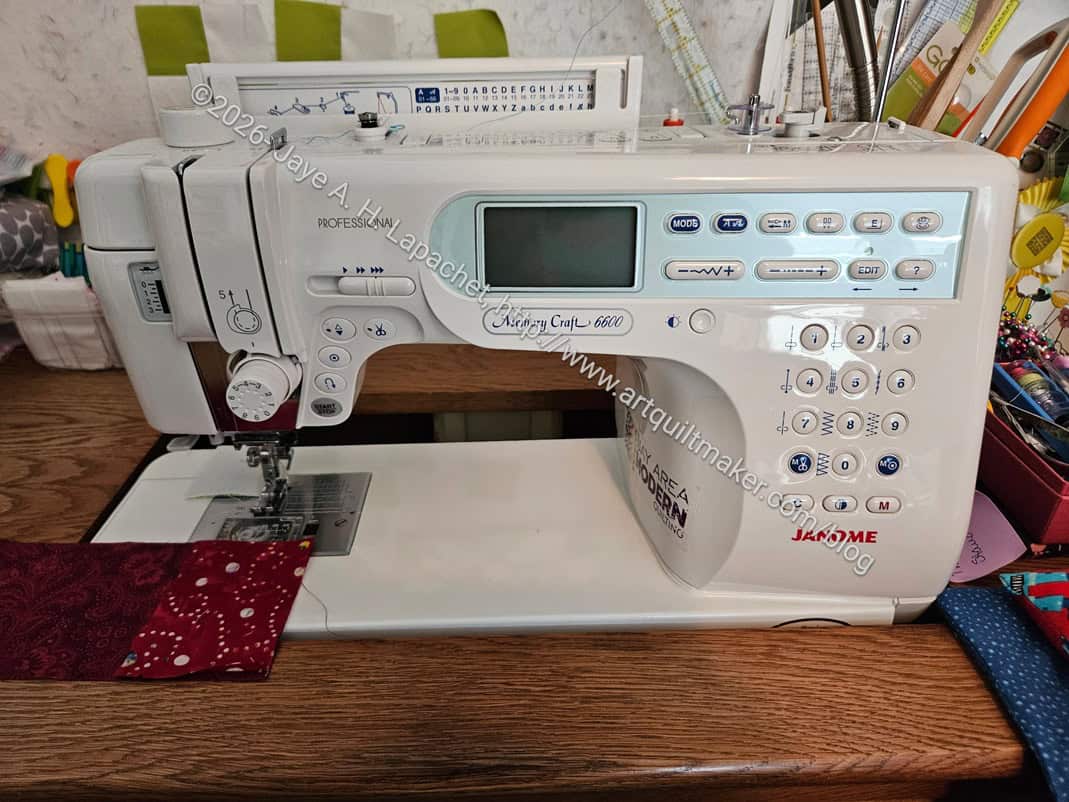
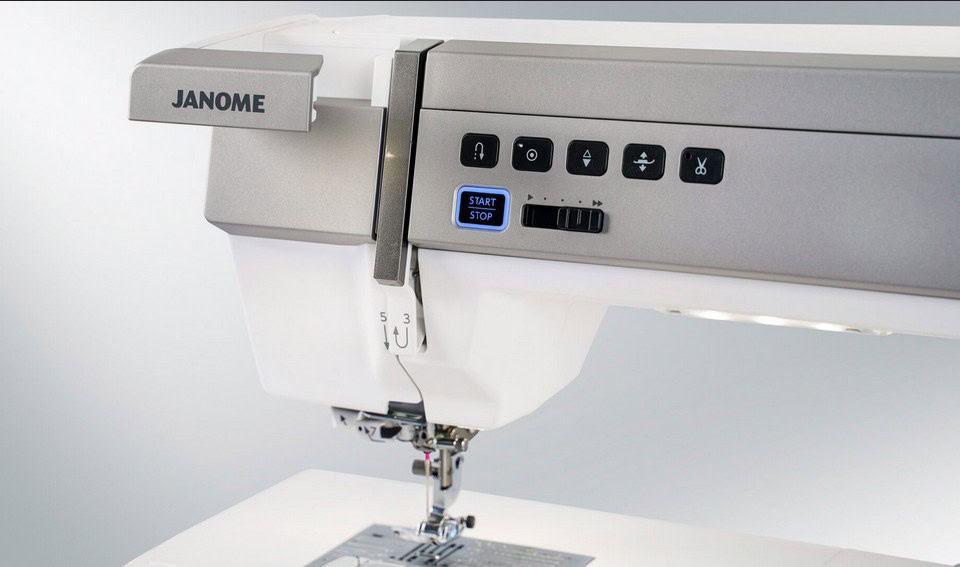
After finishing the Pandora Charisma and thinking about what I want to do next time, I decided to go sewing machine shopping. Kind of an extreme reaction, I know, but my machine has been bugging me. The stitch length has a problem that seems to only be a problem for me. Making the Pandora Charisma made the problem worse.
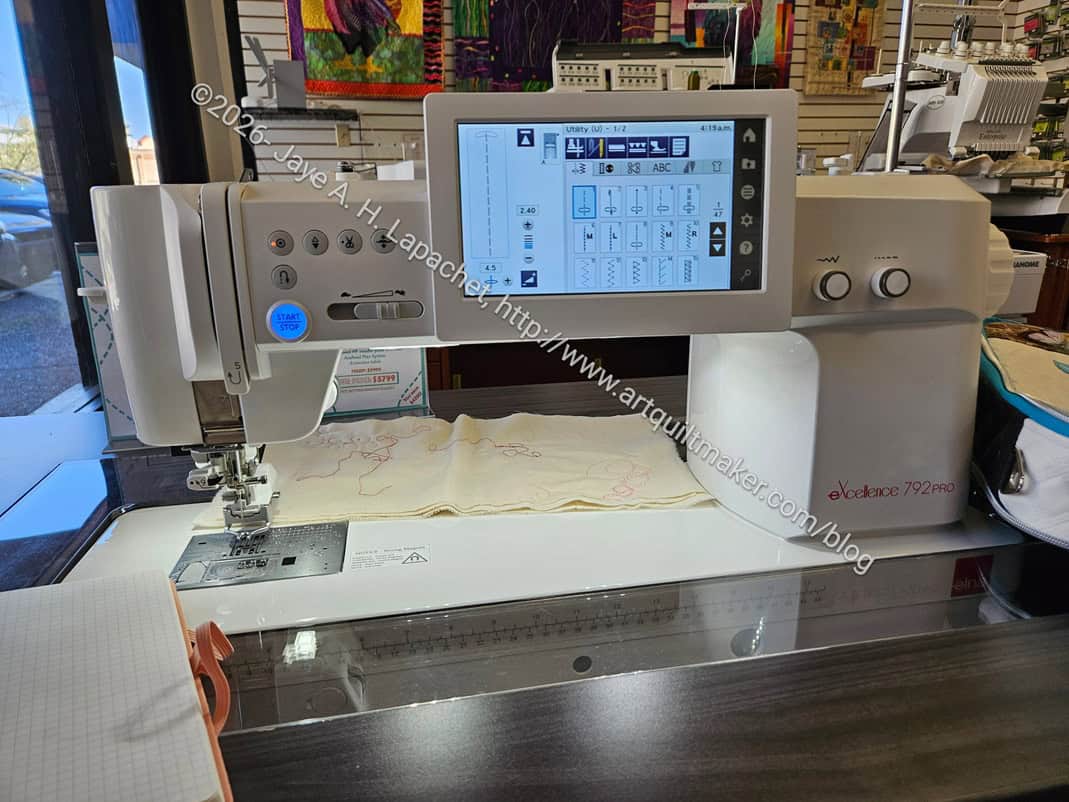
I have been out twice and have looked at 3 different machines, the Elna 792 Pro, the Janome Memory Craft 9480 QC and the Janome 6700, which is the newer model of the machine I have now.
The Janome 6700 is similar to the machine I have now. I looked at this machine on my first outing. It doesn’t have Accufeed capability, so I would basically be buying better stitches. I probably won’t buy this machine.
Yesterday, I went back to the same shop and looked at the Elna 792 Pro again and the Janome Memory Craft 9480 QC for the first time. Laura came with me to provide moral support. I am assured that the Elna 792 Pro is the exact same machine as the Janome M8, which I went in to look at. The differences are white vs. grey color of machine and the AccuSpark app. The Elna does not use the AccuSpark app. I probably wouldn’t think to use it anyway.
Elna 792 Pro
The Elna has 13.5 inches of throat space and is a flat bed machine. My current machine has 10 inches and is also a flat bed machine. I can tell the difference. It feels very spacious under the throat.A flat bed machine means that there is more space under the needle for the engineering/motor/mechanical bits. I learned that today, which I thought was interesting.
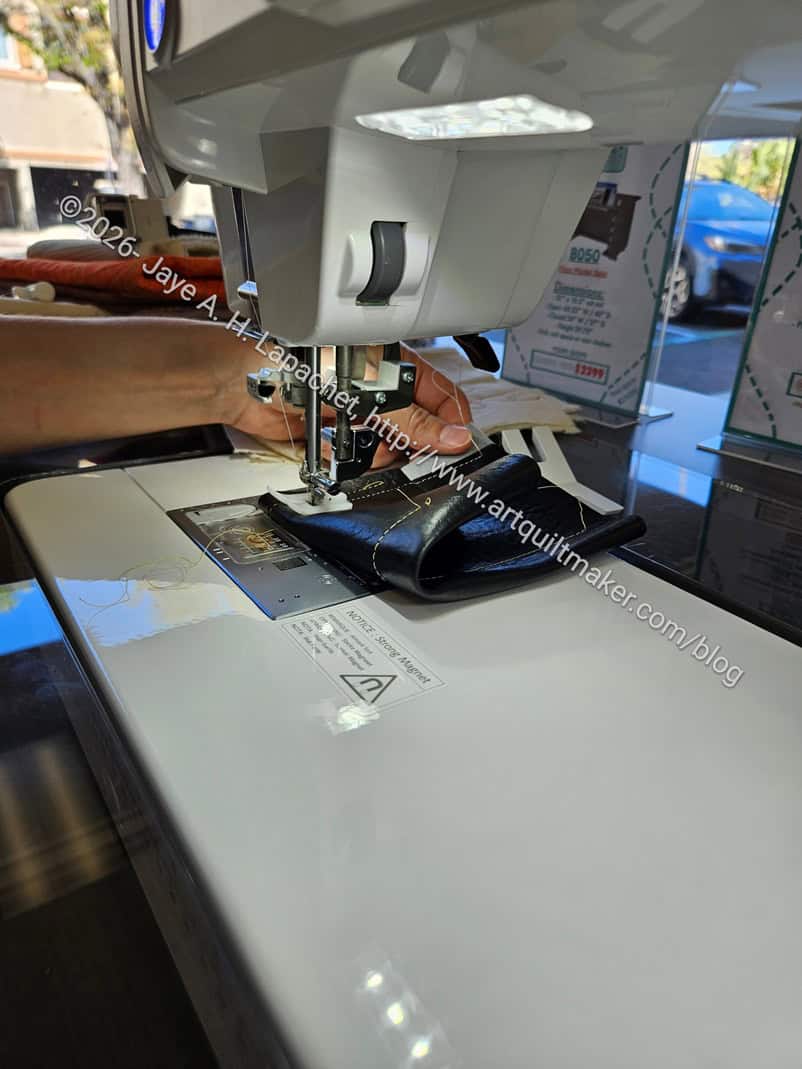
Sewing pleather on the Elna 792 Pro
There is a separate bobbin winder, which I enjoy now on my Janome MC 6600. The added bonus is there is a thread cutter that is part of the bobbin winder. I didn’t bring my own materials to sew. I meant to, but never got around to it. A, the person helping me, brought out some pleather and I was able to sew on it. The machine doesn’t come with a Teflon foot, but I can buy a Teflon foot and throat plate combination pack. It means that when sewing vinyl or pleather, both top and bottom will be slippery. We really put the machine through its paces with the pleather. It sewed a really nice stitch even with about 5 layers of pleather. The key is to keep the foot level. Someone told me that I should not be sewing fabric thicknesses that force the foot not to be level and I should never use a hump jumper**. ‘A’ said that that was why the machine came with a hump jumper. That made me feel better since I use my hump jumper all the time.
The machine comes with a lot of feet, though not all that I think I would want. It also comes with 3 stitch plates, which are SOOOO easy to change. What a difference between trying to unscrew the plate I have now. The stitch plates on the Elna automatically lift up when the button is pressed. The machine is very smart. It has a plate sensor so you can’t move the needle into a position that is incompatible with the stitch plate.
I tried a hand stitch ‘look’ stitch and that was amazing! It really looked good and I can see using as a top stitching.
‘A’ said that this Elna (or the Janome M8) is the strongest home sewing machine they sell without getting into industrial machines. I do not want an industrial machine. I think I can rent one at a local sewing store if I need one.
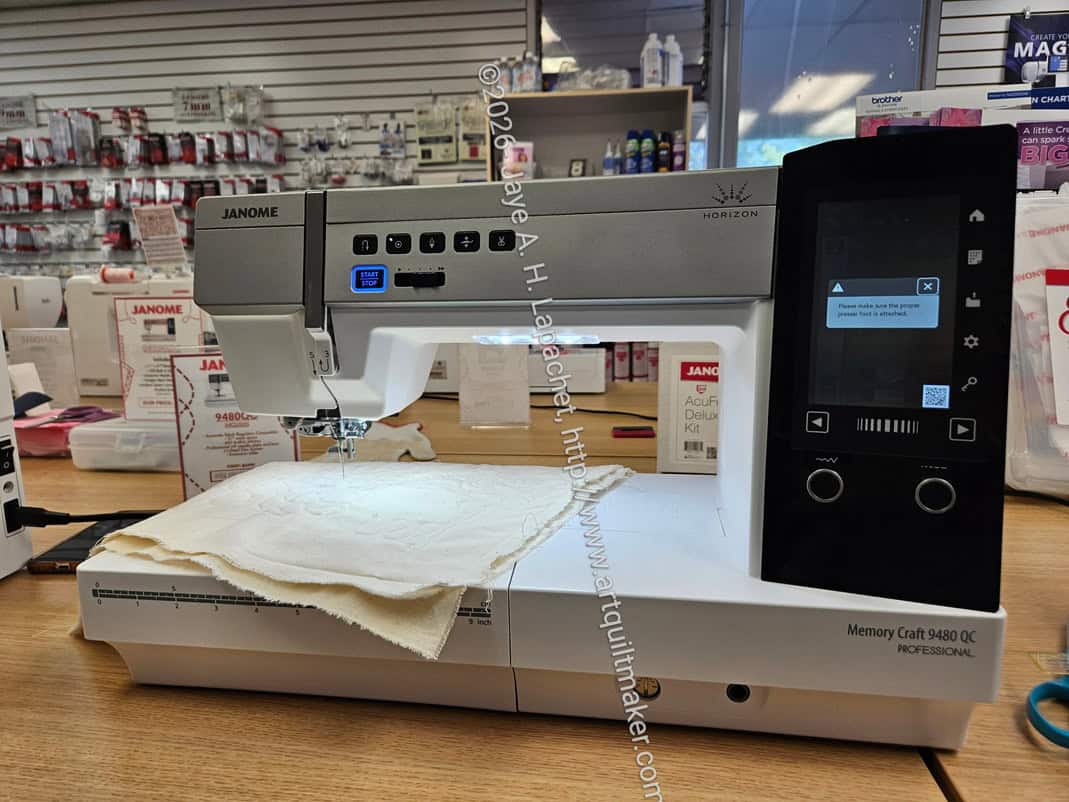
Janome 9480 QC
The Janome Memory Craft 9480 QC was the second machine I looked at yesterday. The motor isn’t as powerful as the Elna 792 Pro and there is an extra charge for the stitch regulator. It has 11 inches of throat space and I could tell the difference when compared with the Elna.
Janome 9480 QC-light
A bonus is that this machine has a pull out light that provides even more light than what is given in the throat space. There is no separate bobbin winder on this machine so I would have to un-thread, wind the bobbin and re-thread. Not earth shattering, but not ideal either.
The stitch plate is not electric, but pops off easier than the machine I have now. No screws required. This machine has the same accessories. It only has a horizontal thread stand, though a vertical option is available at an extra price.
Neither machine uses the AccuSpark app. I probably wouldn’t use it though you never know.
I have a lot to think about! What machine do you have? What is the best feature?
**Obviously, you should shop at local quilt shops and small businesses. However, if you are too busy or can’t find what you need there, I use Amazon affiliate links and may be paid for your purchase of an item when you click on an item’s link in my post. There is no additional cost to you for clicking or purchasing items I recommend. I appreciate your clicks and purchases as it helps support this website.
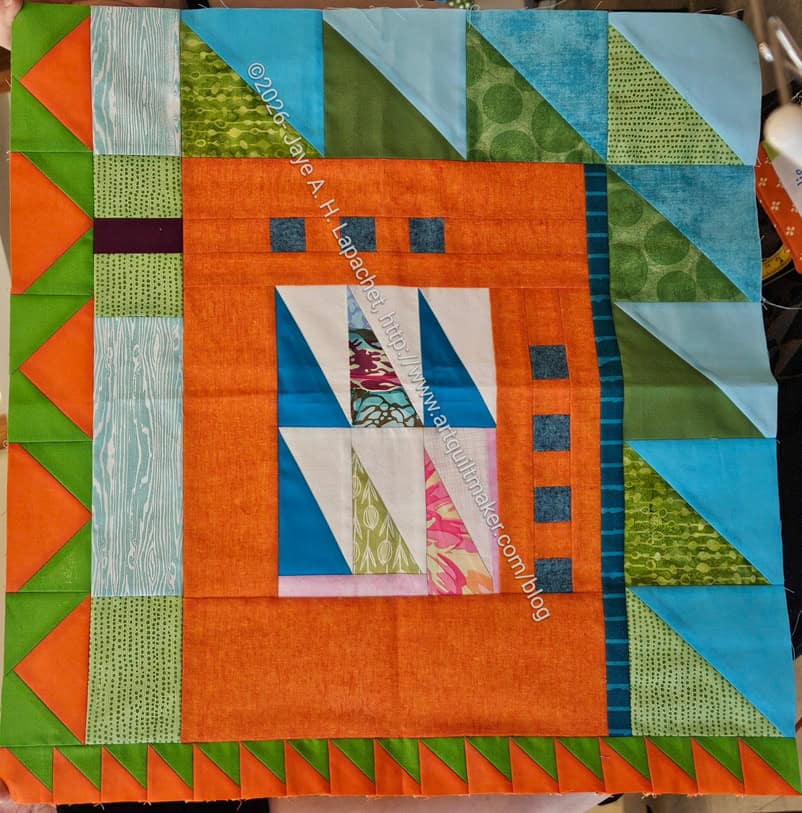
Joelle brought the January Creative Play packet to Saturday’s workshop to exchange with someone else.
Some interesting Flying Geese and Sawtooth border have been added since the last time I saw it. The orange has really taken off as a color. It is so fun to see what people do with a little piecing.
I spent Saturday with the guild and with Lorraine Woodruff-Long. The guild arranged for her to teach her 1-2-3 Mosaic workshop. I have to admit that I wasn’t excited, but I am pleased to report that I loved it. I created a lot of little jewels, which makes me very happy.
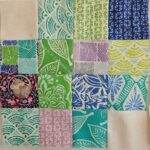
The photo, left, shows the blocks I made during the workshop.
After the workshop you end up with enough blocks (or almost) to make a 20 inch or 24 inch cushion cover. DDH has warned me off anymore throw pillows for our living room, but he has not said anything about table runners. As a result, I went into the workshop with the idea of making a spring/start of summer table runner for my buffet. Our buffet is probably our nicest piece of furniture and the top is still pristine. Anyway, I started out with the idea of making a tablerunner, which I will actually use.
As an aside, I am going to have to do a table runner inventory and see what I ‘need’. Thanksgiving and Christmas are well covered, but I could go for all the holidays and have an easy way to change the decor.
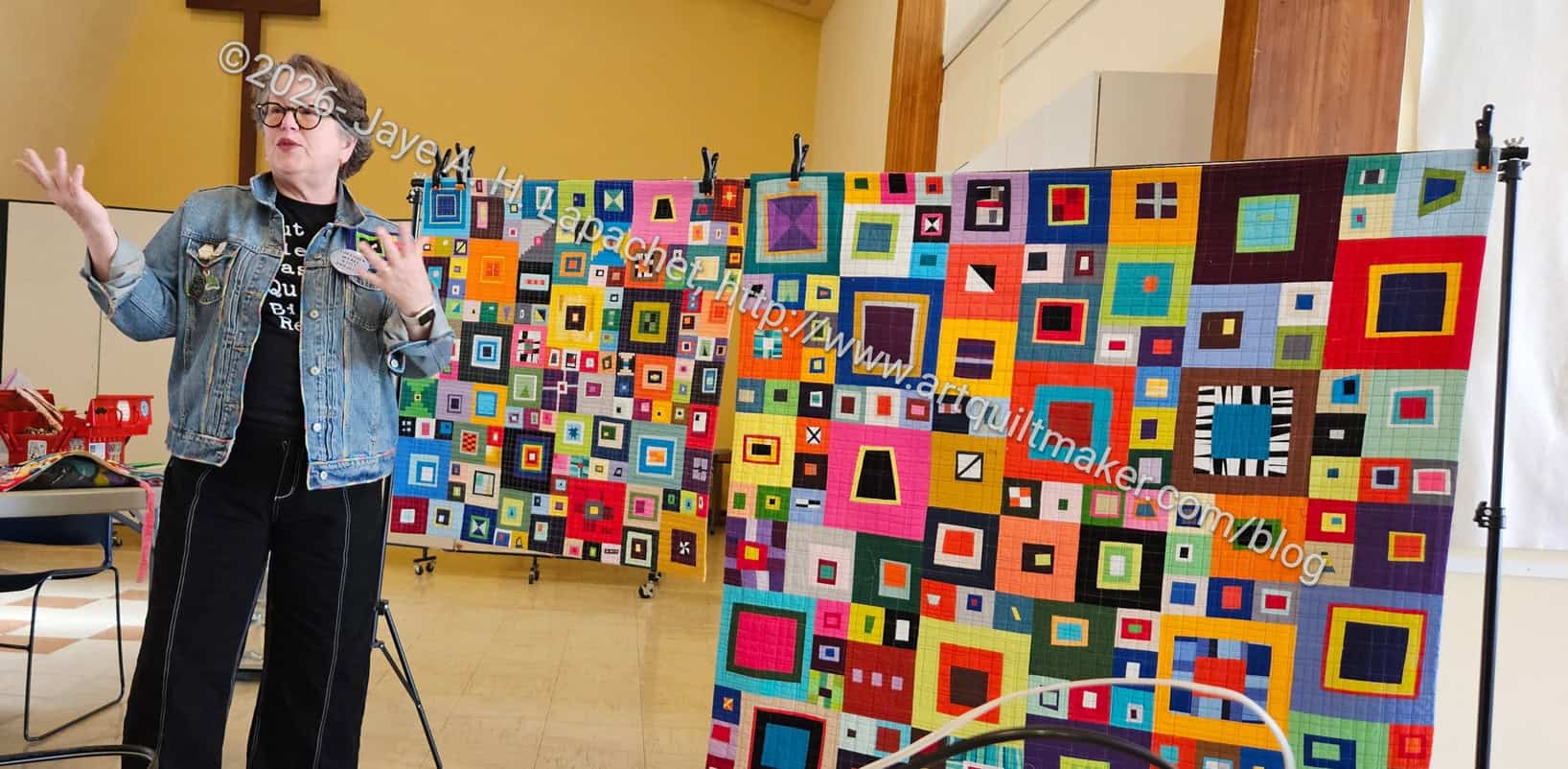
Lorraine teaching with her quilts
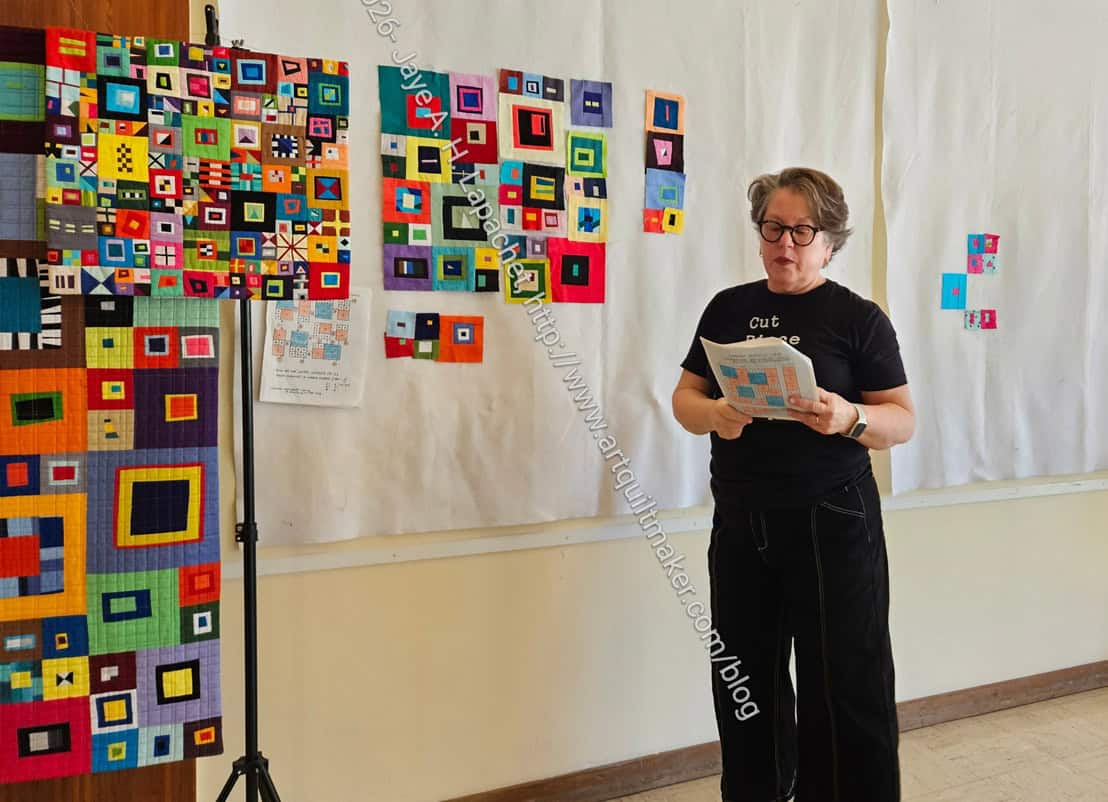
Lorraine did a nice job teaching.
She has clearly thought through the process and was clear about how to do it. I was super excited about the organization of the pieces to make the blocks. It is a game changer for chain piecing, no question. You really need to take this class!
1-2-3 Mosaic mistake
Lorraine said there were no mistakes, because the blocks could always be enlarged. I found a way to have to use a seam ripper. LOL!
I actually just cut the fabric after I sewed the correct piece on the correct side. I didn’t use a seam ripper all day, though I could have.
All the 1-2-3 blocks
I sewed a third batch of blocks at the very end of the day, but didn’t press them until I got home.
This is about the width I will use for the table runner, but I have to make it about three times as long.
I might sew blocks I like together into chunks so I can move them around more easily. We’ll see.
MaryC shared her scraps
MaryC brought a huge pile of ‘scraps’ (some were half yards!!) to share. I pulled some blues and pinks from that pile, so right now the piece is made up mostly of solids and tone-on-tones. I have a couple of fussy cut motifs in the center of blocks, but I think I need to break up the solids and tone-on-tones with some prints on the outside of a few of the blocks.
Gerre’s Jewels
Lynette’s gem
First batch of blocks
Lorraine with more examples
Above are a few of the blocks other people created as well as the first blocks that I made. Lorraine made an awesome video of all of us in her workshop. Check it and see how fun the guild is. You should join us. 😉
Copyright is only claimed on the photos. Permission is NOT granted to take any photos from this page and use them without permission. Designs of quilts and blocks are copyrighted by the creator.
This piece is a little different from #1 and #2, because of the red. I have been feeling like I have a lot of red fabric I am not using. I decided just to put some red sashing on this quilt and see what happened. It is not a favorite of the series, but it isn’t ugly either. Next time, I’ll stick with the monochromatic look.
I like making these strip quilts, as I have said, as they use up scrap and make great leaders and enders. The problem with the white is that I have A LOT of white scraps and I can’t seem to use them up quickly enough. I am pleased that I didn’t use any white background fabric in Lupine. It loaded up my black scrap drawer, but stayed away from the white.
A week ago was the Community Sew Day at the Guild. After doing some pre-sewing, I also sewed another quilt using the same pattern at Sew Day. SueG sat next to me and followed my lead on sewing blocks my way.
Sue used her own materials, which was a lot better for precision. We sewed quite a few blocks, but Lee Ann took them all to sew together before I could take a picture.
I tried to keep the packs I chose in the same color family as Sue’s blocks, but I was really distracted and am not sure I succeeded. when I get a photo from Lee Ann, I’ll share it.
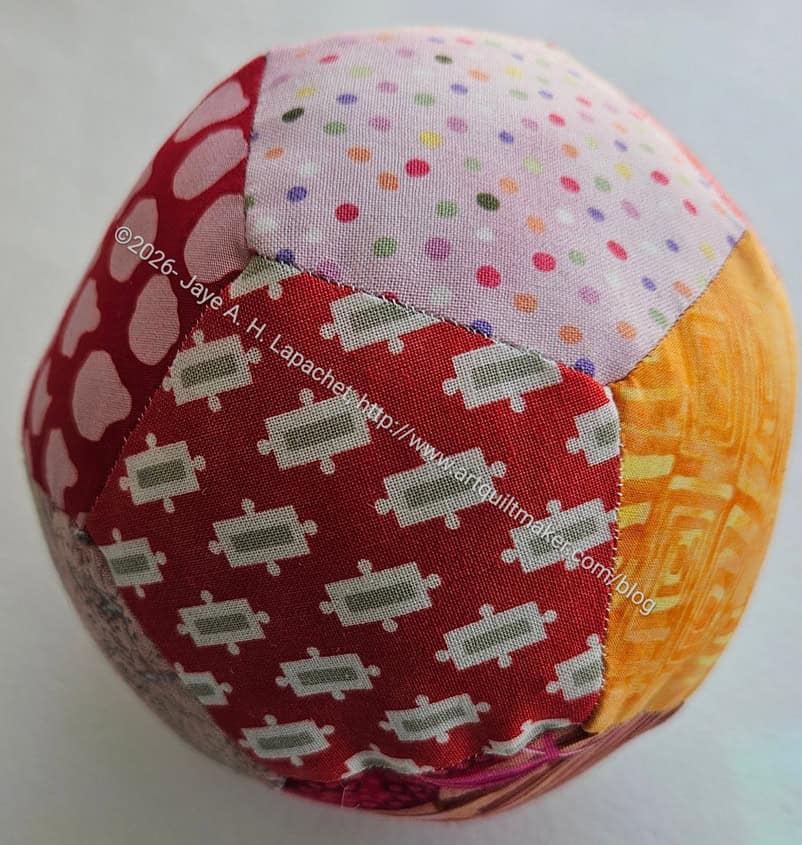
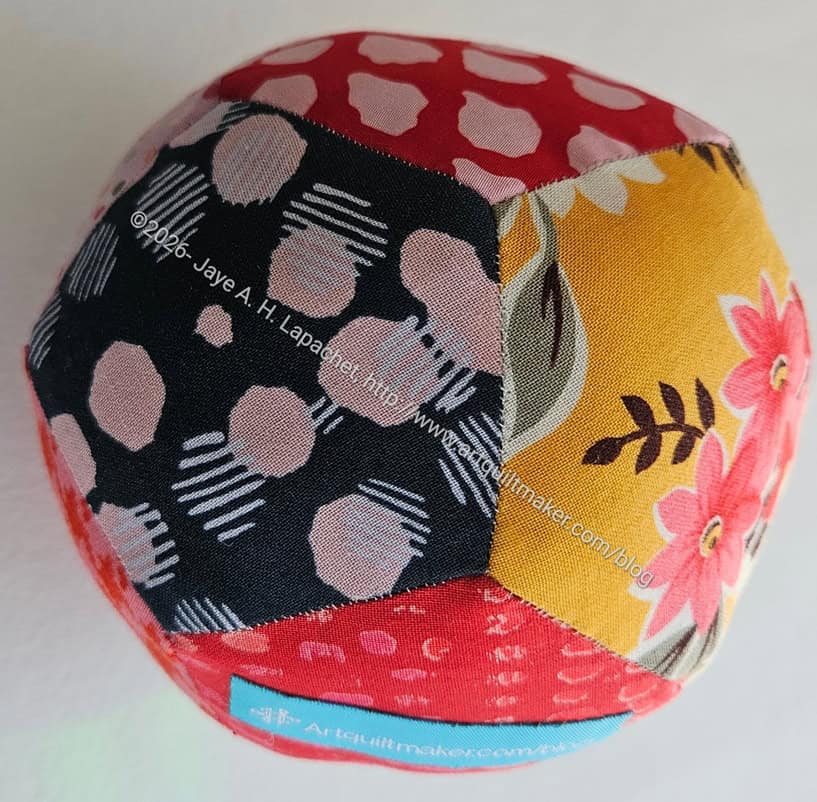
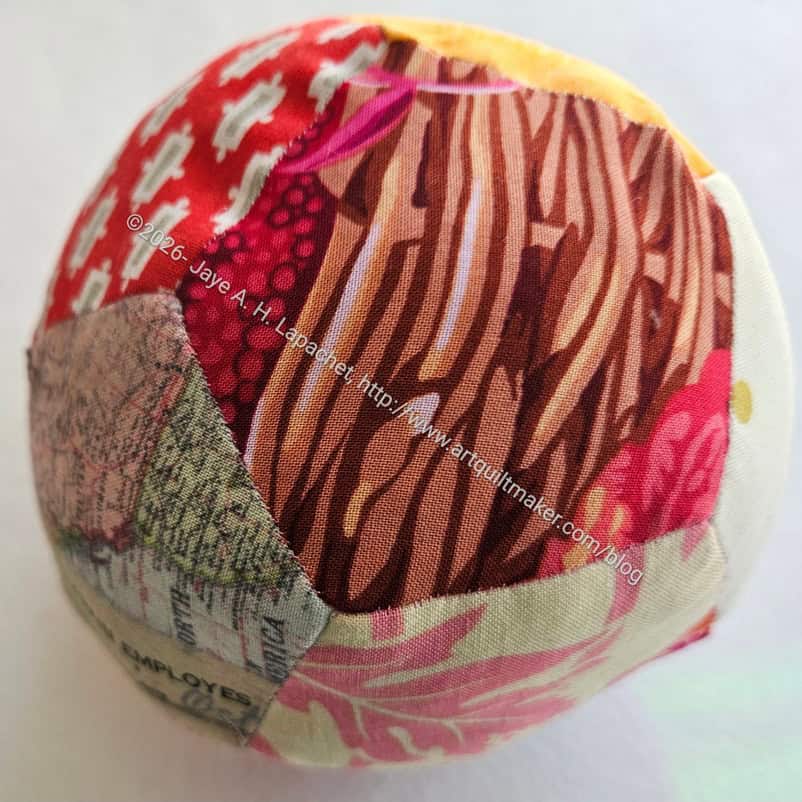
I finished another EPP Ball a week or so ago. This one is heading off to a Farmer’s market for my friend to sell. It’s a new adventure for me and we will see how it goes.
I have never wanted to sell my creations, because I love making things and want to continue to use it as a method of expressing my creativity as well a way to reduce stress.
EPP Ball #11: orange & pink
This foray has a fairly low commitment. I am sending her two items to sell. I priced them on the high side, so we will see. I don’t want to encourage orders or people telling me what colors to use.
This one does not have any Beanie Baby pellets inside it. I had a reason for not including them, but I don’t remember what it is. I am working on another one and will add the pellets.
EPP Ball #11: orange & pink
Working on this project has made me want to get back to La Passacaglia, which is languishing.
My preference at Community Sew Days is to bring a top (+back, etc) ready to be quilted and work on my own projects. Since I am now guild president, I decided I needed to be a good citizen and work on the project with everyone else. Still, I worked ahead to make some blocks.
I used 3 mini-charm packs and what’s left of my white fabric to make the blocks for the quilt top. I thought they would be incorporated with everyone else’s blocks, but I made the wrong pattern, so Sue and I put the rest of the blocks needed for a quilt together using this pattern.
I worked with the Community Quilts Team’s materials to start a second quilt and wasn’t as happy. I prefer my own cutting, so I know what problems I might encounter with cutting mistakes. I’ll go back to my original plan if there is another Community Sew Day.
When I sewed the Bone Enigma I followed the directions exactly with regard to rivets. The directions say to add rivets before assembly. The rivets can go anywhere, but I wanted to put them on the ends of the handle, just to reinforce it. It is at the stage of assembly shown in the photo where the directions say to add rivets.
Peony Enigma with rivets – full
This is great except for Enigma bags already completed. I decided I wanted rivets on my Enigma bag. The bag is already complete, so I consulted with Mary and we decided it could be done. We had to squish the top a little, but the overall procedure worked and my bag now has rivets on the handle.
Peony Enigma with rivets – detail
I wanted silver, but Mary thought a gunmetal finish would look better. I am pleased not to worry about ripping out the handle.
I have had the fleece for a Pet Bed sitting around for a long time. I finally sewed it together last week in order to bring it to Sew Day.
One of the things that spurred me on was the bits of batting I had laying around from the various quilts that I have mostly finished recently. The guild is not using schnibbles for pet beds any more as they don’t make for soft and comfy beds. Also, they are hard to wash. This is sad as I still have a lot of schnibbles. We are working out a plan for their use in another way.
This wasn’t my fabric so I don’t get any credit on my Fabric Used spreadsheet.
Megan’s Bone Enigma has been on my list for awhile. It doesn’t show up on any of my 26 Projects lists, because I hadn’t started cutting or sewing. It only shows up on my UFO Challenge list, because I have been wanting to make it for awhile and hadn’t quite gotten to it.
I could have waited to write the “All the Enigmas” post, but I will have to write another one as I am already cutting others out.
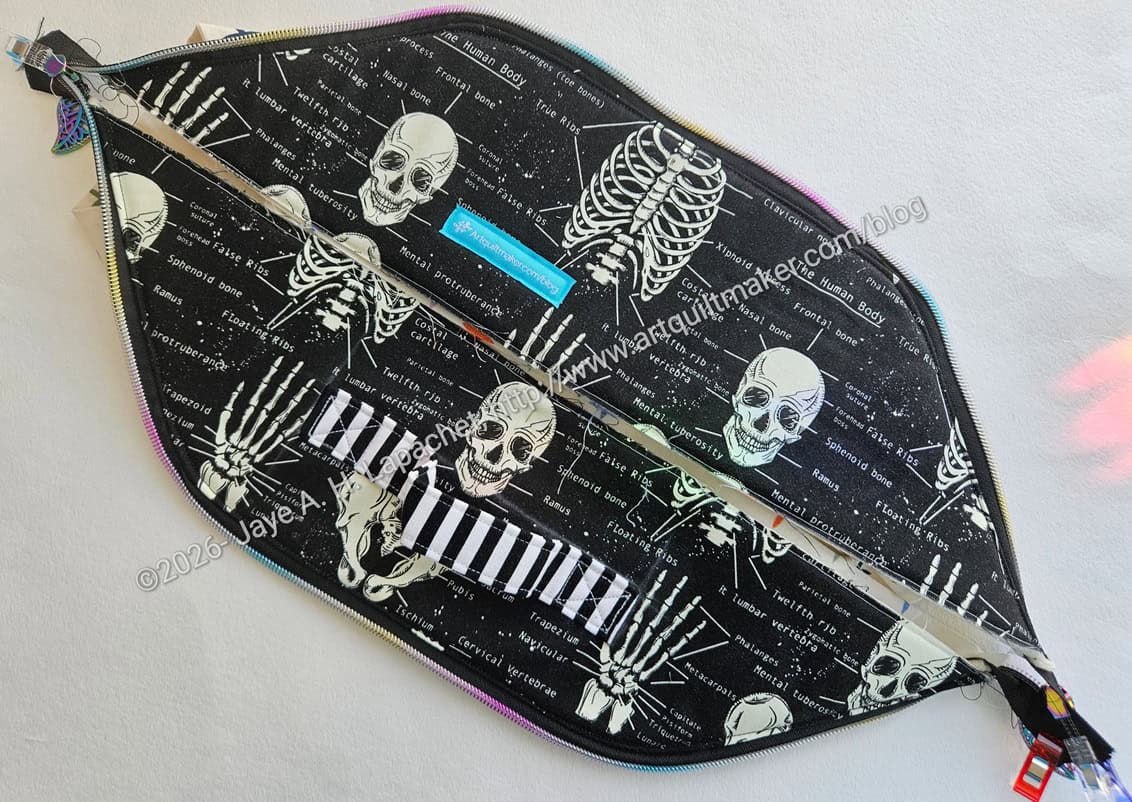
Megan’s Bone Enigma-interior
This bag goes with Megan’s Hand Bone Hackney. She said she liked this fabric and I hope that is true. I bought it for another purpose for which the fabric will not be used. I did make several projects from it, but still have at least 1.5 yards left.
One thing I did on the bottom, which are pieces that need to be quilted, was fuse the fabric, both lining and exterior, to the foam using MistyFuse**. I had forgotten to cut the lining and exterior larger before quilting and wanted to try and mitigate shrinkage. I think I could have left the bottom unquilted, because the MistyFuse really adhered well to the fabric. I was kind of surprised since the MistyFuse has been laying around my workroom for years.
I am pleased with how the center looks. I just feel like it came out really well. The fabric, a Birch Organic, looks really great.
Megan’s Bone Enigma-bottom
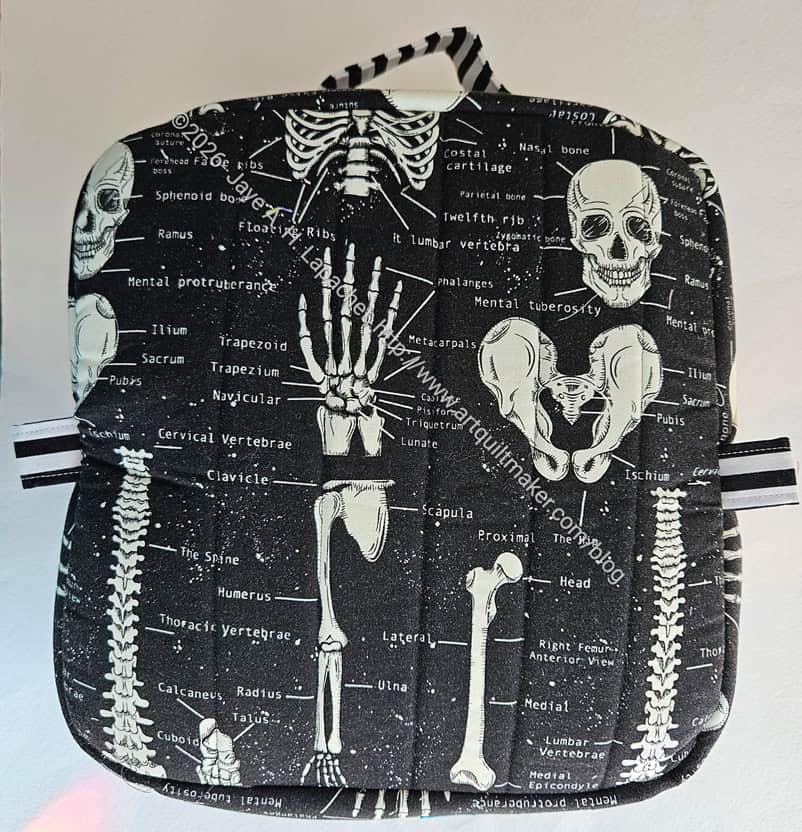
I tried really hard to line up the fabric so that the motifs were oriented in the right way.
In the photo of the bottom you can see how the motifs are oriented towards the top. See the handle? When the bag is closed the part of the bottom with the skull forms the back of the bag and that skull as well as the other motifs are right side up.
Megan’s Bone Enigma-bottom-> back – closed
Cool, huh? Sadly, I did not match up the motifs on the top piece with the back piece. I was pretty proud of myself for doing this much, though I don’t think anyone will notice. *I* notice and that is what is important!
Megan’s Bone Enigma-top closed
I am on the fence about the striped handle and pull tabs. I didn’t have any solid black at the time I cut those. The design works pretty well, but I think a solid black would have been better. Or maybe a black and grey stripe? Not sure, but I’ll have to think about it. I did use this same strip on the handle of Hand Bone Hackney, so that is something.
An unintended effect looking at the top is that the handle is enclosed by two hand bone motifs! It looks kind of cool.
I also used MaryC’s rivet press at Sew Day to put rivets on the handle. I am super excited about that!!
Megan’s Bone Enigma -side
Megan’s Bone Enigma -side
I still love the diagonal zipper. I thought the zipper tape I chose would be too large, but it worked out ok.
Well, even though that number hasn’t been picked in the UFO Challenge, I have finished it. I am giving it to Megan today, so needs must.
**Obviously, you should shop at local quilt shops and small businesses. However, if you are too busy or can’t find what you need there, I use Amazon affiliate links and may be paid for your purchase of an item when you click on an item’s link in my post. There is no additional cost to you for clicking or purchasing items I recommend. I appreciate your clicks and purchases as it helps support this website.