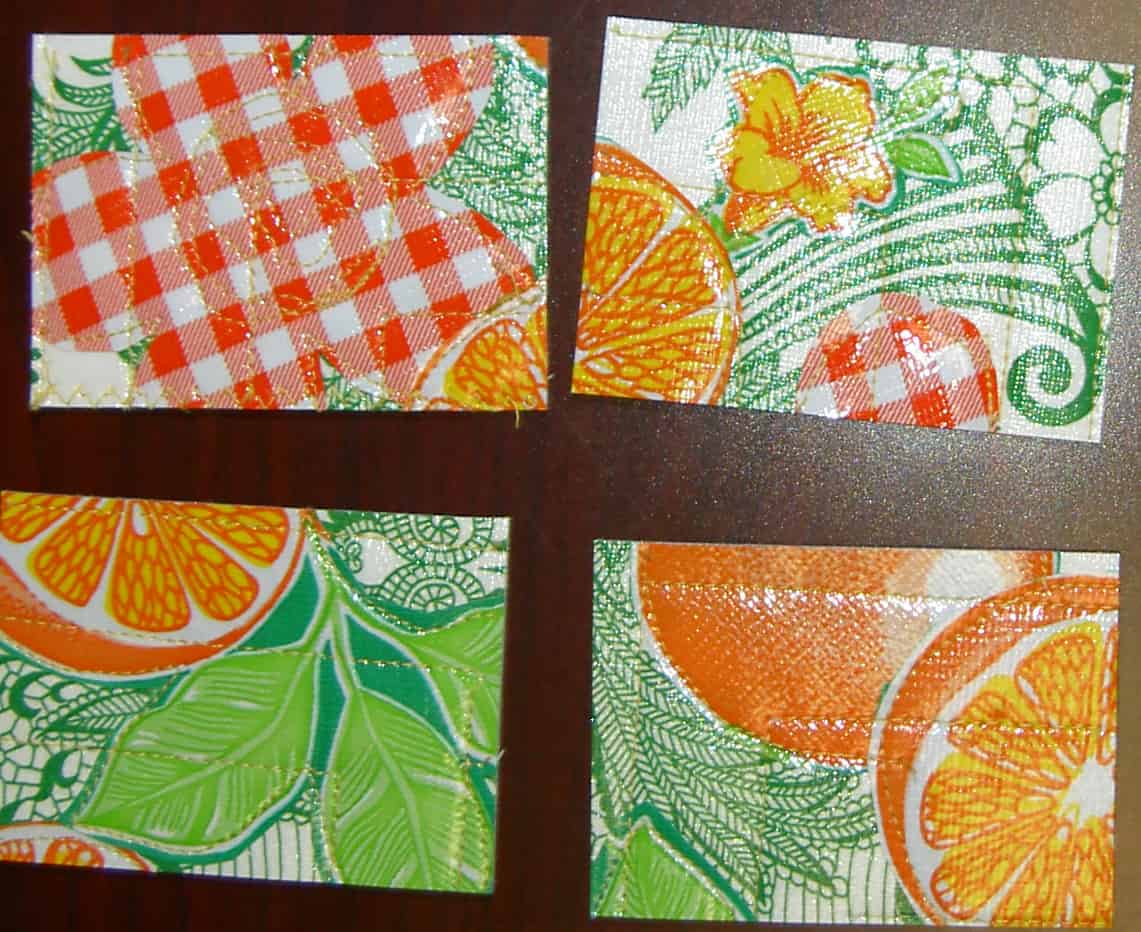
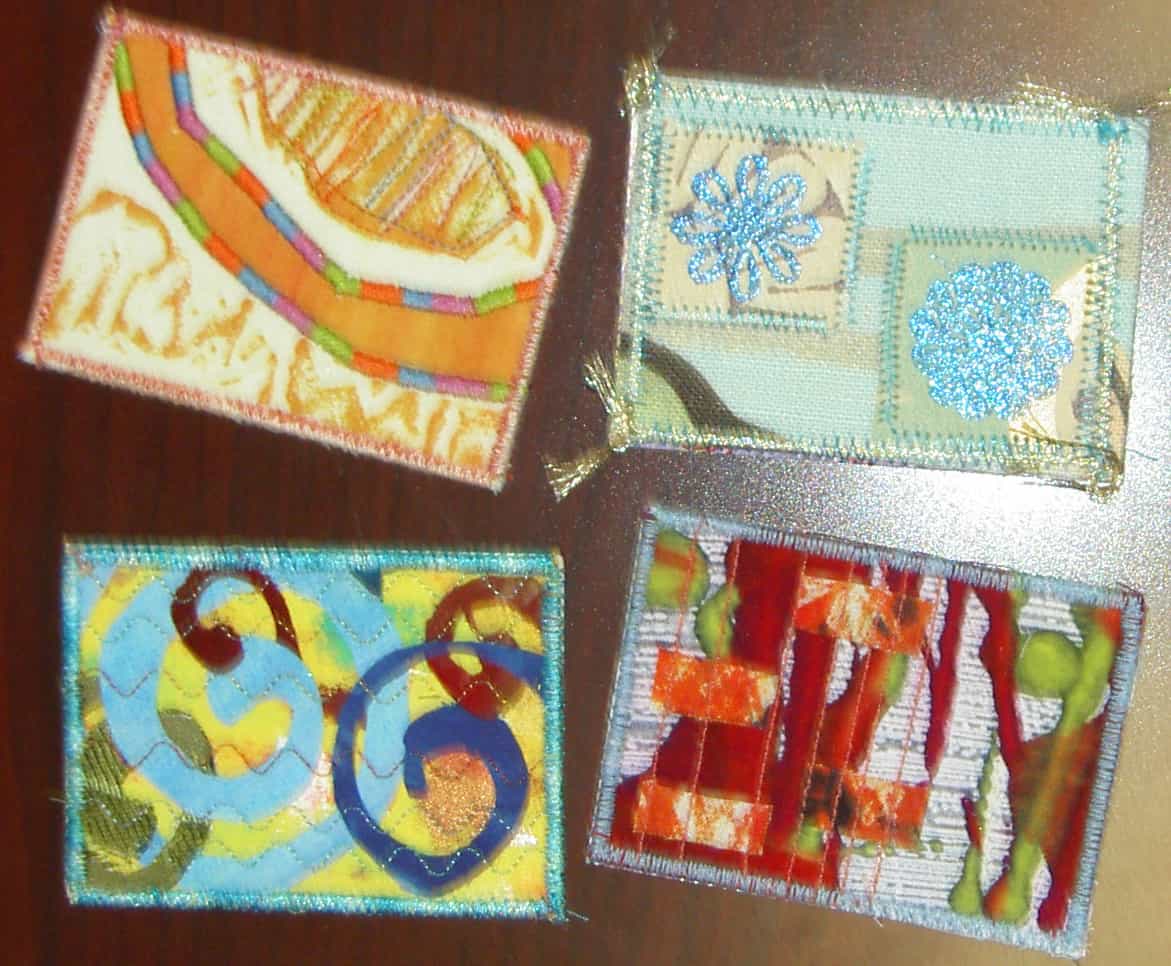
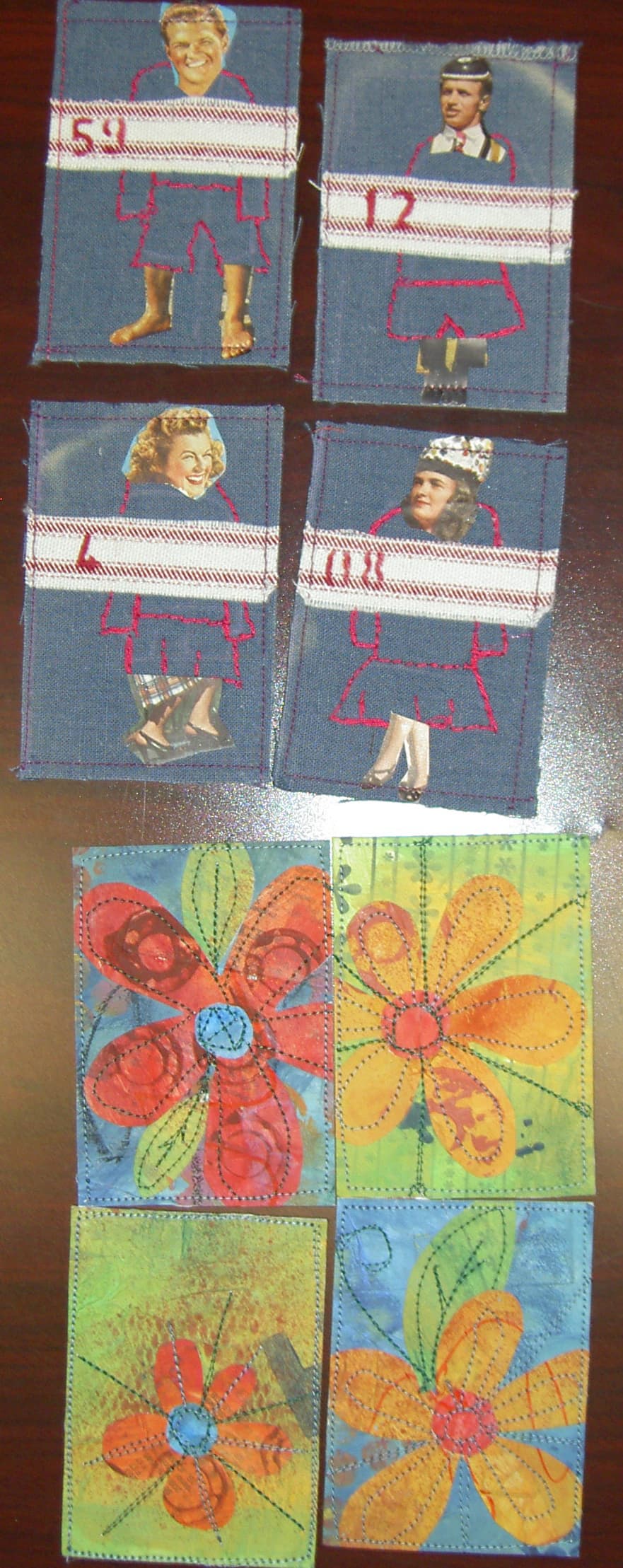
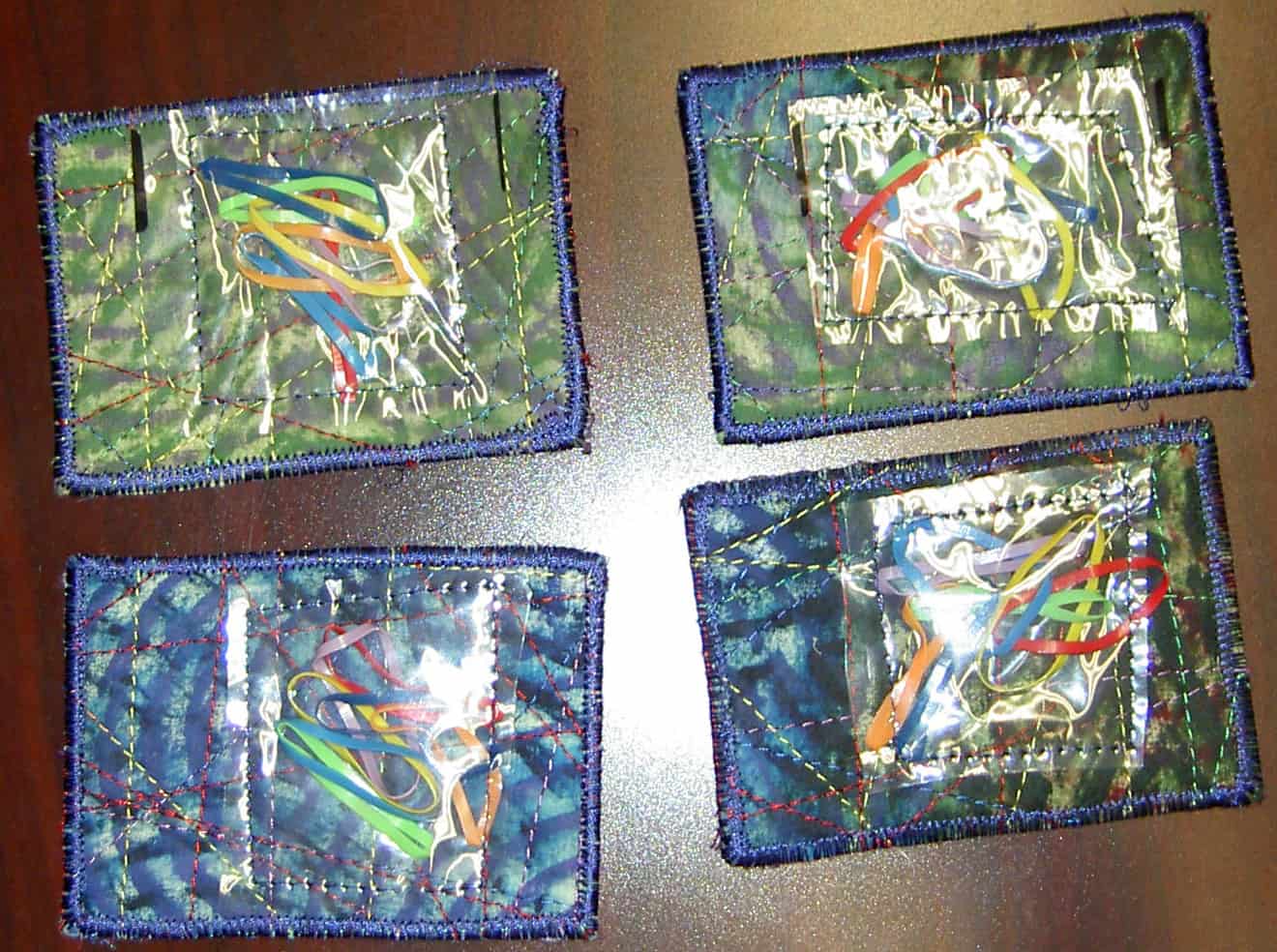
Stingray pool at the Academy of Sciences. What do you see?
Commentary about works in progress, design & creativity
I think the cycle is complete. For a couple of years, I have been trying to focus on the process of making rather than the finished object. I think the cycle is complete, because I am starting not to care that much about keeping things that I make. (there are no lines for the stuff I make, though) This could be a bad thing, because it is possible that I will just start and start and start projects and not worry about finishing. Let’s not go there.

Jill received her pencil roll yesterday. I have been waiting, for what seems like weeks, to tell you about about, especially since I am scraping the bottom of the barrel for blog posts, Jill’s Pencil Roll. Being sick really cut into my sewing time.
Anyway, Jill has been a loyal contributor to the Creative Prompt Project, along with SherriD, for the past year +. Jill has contributed a fabulous doodle response every week. I wanted to thank her for her contribution. It is a time commitment and I appreciate her gift to me of a bit of her time. I had hoped to post both gift posts together, but SherriD received hers the day after I sent it! (Thank you, USPS) Jill’s took a bit longer to arrive.
Back when I started the CPP, I didn’t plan to reward people for contributing. It is something that popped into my head a month or so ago and seemed like the right thing to do. When I decided I wanted to do this, I thought I would “borrow” some images from Jill’s blog and surprise her. At that time, she had a problem with someone else “borrowing” images. I decided that stealing was wrong and I should just ask. I didn’t give Jill all of the details, but she was very gracious, didn’t ask many questions and sent me some of her images from which I could choose.

I had an idea in my mind of what I would do, but in looking at the images, I decided on something else – what you see above. I don’t like rats, but I thought it was important to include this little guy to go along with Jill’s blog name.
This one was a little more challenging than some of the others I have made, because I had to fit the images in to a piece of fabric that would become the outside of the pencil roll. I went back to the days of piecing journal covers and took a page out of that book in terms of piecing the back. I didn’t want to piece the whole back, because I had a piece of FabMo fabric that screamed Jill at me.

The black and white is a designer sample that I got via Bron from FabMo. It wasn’t very large, so I thought adding the bit with the images would work and wouldn’t be too large and unwieldy. It worked out very well and I am pleased with how it came out.

Everything I use to make the Pencil Rolls is from supplies I already have or from FabMo fabric. You don’t need much more than fabric, ribbon and something to use as interfacing. I save ribbon, which I seem to get a lot of, so some of the pencil roll ribbons have odd words on them. Other things would work as ties as well. I just think it is nice to give these bits and pieces a new life.

I have also started to use a decorative stitch on the pocket of the pencil roll just to make it a little more special. It makes the pocket pucker a bit, so I think I start adding a bit of length to it to account for that puckering. It doesn’t pucker so much that I have had a problem sewing it within the seam allowance.

One thing I learned the hard way on Lil Sissy’s pencil roll was to use a binder clip to gather the ribbon tie out of the way. What is the hard way? Sewing the ribbon to the back as you sew along creating the pencil pockets. If you don’t have a binder clip, get one!
I am really happy that Jill liked the pencil roll. Thanks to everyone who participates in the CPP!. If you are quietly doing it alone, please post a direct link to your responses in the comments section of the prompt or to the Flickr group so we can ooooh and aah over your contributions!
Old Blue Eyes
Eyes are organs that detect light, and convert it to electro-chemical impulses in neurons. (Wikipedia)
eye of the storm
owl eyes
Eye color
eye makeup
Eye of the Hurricane
bionic eye
Goldeneye
irish eyes are smiling
glass eye
Eyes Open (Snow Patrol)
eye care
googly eyes
Pink eye
Bird’s eye view
Eyes are the window of the soul
eye shadow
Seeing eye to eye
shifty eyed
eye liner
See the Creative Prompt page if you have questions about this project.
Post the direct URL (link) where your drawing, doodle, artwork is posted (e.g. your blog, Flickr) in the comments area of this post. I would really like to keep all the artwork together and provide a way for others to see your work and/or your blog.
The Creative Prompt Project, also, has a Flickr group, which you can join to post your responses. I created this spot so those of you without blogs and websites would have a place to post your responses.
Quilting Art: Inspiration, Ideas & Innovative Works from 20 Contemporary Quilters by Spike Gillespie
My rating: 4 of 5 stars
I have spent some time, after my initial perusal in November of 2009, reading this book and did enjoy it. There are lots of good photos. I enjoyed reading what artists think about various topics concerning making a living (or not) and creating art.
Spike Gillespie provides a really interesting introduction. I have gotten a lot better at reading the introductions to various quilt books and I have found it to be a worthwhile endeavor. One of the aspects she remarks on is “I was further inspired to remember how important it is to carve out time to pursue the passionate side of one’s calling and to heed one’s muse, both of which are too often too easily lost in the shuffle of doing what we to get by day to day(pg.10).” This is partially what the Creative Prompt Project is about: a small step to begin devoting time to creativity. Ms. Gillespie notes that “all demonstrated a drive that might, at times, be set aside temporarily for work necessary to pay bills and time needed to raise kids. But, in the end, the muse will not be silenced…(pg.14)”
She also faces the “is it a quilt or not” question head on. I often don’t want to hear that discussion rehashed, but I guess an author of this type of book has to at least acknowledge she is aware of the issue. She remarks that asking a random quilt show attendees to deem a work a quilt or not is a false argument. She reframes the question to be “how do you feel about the way quilts have progressed and moved into the art world? (pg.11)” This is a much better question, in my opinion, regardless of whether you think a particular quilt is an art quilt. It is a better question because of the way quilts are constantly evolving. The whole Modern Quilt Movement has been on mind lately and comes immediately to the forefront when I think of how the quilt world is changing and evolving.
Gillespie asks various artists about the word quilt and says that she “did not want to collect opposing points of view and then splice them together as if there were some big catfight going on in the world of quilt artists. The answers [she:] I received were offered not to suggest that one way of thinking is absolutely right and another is absolutely wrong. Instead, I felt myself invited to contemplate how the word helps or hurts artist working to get their pieces out there for the world to see.”(pg.11) This concept is addressed by the artists throughout the book. The variety of the opinions mirrors the variety fo the works. Some I agree with and some I don’t. Joan Dreyer’s comment describes how I feel pretty well: “I’m less concerned with putting a label on it. I almost don’t care in a way. I don’t feel other artists have to make the same choice. For me I just need to make it for the reasons I need to make it.” (pg.11)
After the introduction, Spike goes straight into a brief bio and discussion with each artist that includes a number of photos of their work and, in some cases, photos of their studio. I found that I had something in common with some of the artists. Deidre Adams, for example, enjoys “working in a series, of taking an idea and working it over and over and developing and exploring it. (pg.17)” She also gets out of a rut by taking scraps from previous projects and starts sewing them together.
Pam Rubert says that she views the world with a “strange mixture of astonishment, dismay, and amusement (pg.25).” She is into the “concept and story line (pg.29).” I agree that I like my quilts to be about the story of the quilt. Telling stories is important, which may be why people don’t understand some art quilts. Block quilts are easy to understand because of the color and repetition. Abstract quilts are not because, it seems to me, that a lot of what is made from the fabric comes from a reaction to what is going on in the artist’s head.
Mary Beth Bellah works full time and says “I give forty hours a week to my mortgage and kids. Whatever I come home and work on it whatever I want. I don’t have to sell it (pg.42).” I think acknowledging that creating something goes beyond its monetary value. Of course, we are often judged on how much money we make or how much our art is worth, so not feeling like she has to sell her work is a breath of fresh air.
This book introduced me to some new artists as well. Angela Moll loves the visuals of handwriting. One reason I love the act of handwriting is because forming the loops and dips of cursive letters gets close to drawing. Moll uses the artistry of the cursive to create interest in her quilts. She focuses on opportunities for visibility and not necessarily ones that are commercially more attractive. Moll also works in series.
Another pearl of wisdom came from Joan Dreyer who is “not interested in putting things together just for the sake of being different….Materials should serve the content of the piece. (pg.63)” This speaks to me, because I feel design is important and design choices should be thought through. The idea also speaks to the layout of the book. The book is beautifully laid out. The hardcover edition has large clear photos and subtle stitch looking illustrations on various pages.
I had a hard time with the interview with Dominie Nash. She was new to me. She says that she “didn’t want to make pieces fit together. That was too against my nature and my level of ability. What I do is collage work (pg.85).” This statement made me wonder if collage work is a way of saying “I am too lazy to learn the techniques?” Such as statement makes me ask if there is value in learning rules, or is it just too much of a hassle? Nash is, apparently, successful. Does that mean she is allowed to not learn the rules? If art sells, can you bypass the rules?
This book brought up issues and opinions that made me think. I questioned my own ideas about right and wrong in Quiltland as I read the various opinions. Nash didn’t give me the impression that she thought much of quilting. As she talks about the quilt groups to which she belongs, she says “…we’re still a little too polite when we do critiques (pg.86).” Nash attributes this overpoliteness to a “hangover from the days of quilting bees (pg.86.)” Right after she says that community is essential to her growth (pg.86).” I think quiltmaking groups are about community and everything else is a bonus, whether you make charity quilts, do show and tell or critique each other’s work. We don’t need a quilt group to produce work.
I don’t see much fun or joy in Nash’s work, but I have some respect for her. She did said “I go to my studio every day. Because one day I may go and the angel may be there. What if I don’t go and the angel comes (pg.83),” which I like a lot, though I would change ‘angel’ to ‘muse.’ Jeanne Williamson says something that adds to Nash’s practice “Not all of the small quilts were beautiful. There are tons of I think are ugly…but the point was to always make something, not always make something beautiful (pg.153)”
Commercial fabric is also discussed in this book. Malka Dubrawsky discusses using commercial fabric in her work. She admits to looking down on commercial fabric, but coming around again to using it. She implies that by not valuing commercial fabric you are not valuing someone else’s artwork, which I think is very interesting to think about.
I was surprised at the number of people interviewed who said that they started out in isolation not knowing anything about quiltmaking or other quiltmakers in their area. It is interesting to me how, despite the variety of resources we have (web, blogs, guilds, etc.), people teach themselves to make a quilt and work in isolation thinking they are the only one. Karen Kamenetzky is one of those artists. I really like the stitching and verticalness of the pieces depicted in her article.
This book has an excellent and detailed index. I didn’t like all of the work, but I appreciated the variety and the high level of discussion throughout the book.
My first, brief, review of this book was in November 2009.
When TFQ comes to visit for two days, I get at least 5 blog posts out of it! Her visit, coupled with the organizational segment on QNN TV, made me think about organization ideas for my fabric closet, my projects and my workroom in general.
First, I keep all of the flat bits of a project in a file folder. As soon as I start a project (or a class), I start a file folder for it. This is great if everything is flat, but doesn’t work so well for yards of fabric.

TFQ mentioned project boxes. Project boxes are boxes you use to keep all of the bits and pieces of a project together. This concept came up while we searching for fabric for Sorbet. I heard it mentioned somewhere else or I read it somewhere recently and now it is on my mind. I need some project boxes and a place to put them. I have a couple of them, but they just happened by default. One is a box I threw the Pineapple strips into after the strip avalanche. Voila! A project box!
The above boxes are from the Container Store. I have 2-3 of them and they work pretty well for project boxes as long as not a lot of yardage is involved.

The other is a box in which I kept all of the fabric for the Tarts for the years it took me to finish that piece. They look similar to the boxes above. These are also similar to the boxes in which I keep my fabric. The problem with using the box for a project box is that I may get mixed up if I don’t have them labeled properly and redistribute the fabric. Now I have all the fabric for Sorbet in the box where the Tarts fabric used to be.
Not all boxes for Projects need to be purchased.

I sometimes purchase scones for breakfast. The variety I purchase comes in the plastic boxes (on the right). I found that they are great for collecting squares and triangles and other smallish patches. The box on the left is from lettuce that some one brought over for dinner. That particular box is a good size for the FOTY diamonds. As an added bonus, they are not too nasty after the food has been removed and I am not adding them to our local landfill.
TFQ and I talked about ziploc bags, which are great, but are very slidey, especially if you get too many of something in them. They also don’t stack well.
My quiltmaker SIL uses banker’s boxes for her fabric. I prefer to use something clear I can see through, but I have made some temporary shelving out of banker’s boxes (repurposed from when we moved), so there are a number of uses for those as well.
What do you use to organize your workroom or studio? How do you organize your projects?
The other day I was looking around the web to see if some company made solid charm packs. My mom is making a food quilt and wants to use the Corner Store design from Pretty Little Mini Quilts. I think that design must have another name, because I wasn’t able to find any photos of it by that name. I knew that one of my contacts had a photo so I have used that to show you the design. I have a lot of pattern names to look up!

Anyway, I feel like I have a long history with solids. In my first quilt class, the teacher sent us out to buy fabric. She told us to purchase a light, medium and dark from the same color (I chose blue) and a few other colors to go with it (see the pink, green, purple and muslin above?).
I was pretty overwhelmed when I arrived at the quilt store. Even back in the dark ages, there was a lot of fabric to choose from. The shop I visited had a room, yes an entire ROOM, full of solids. I chose solids for my first project to kind of keep the noise level low. You might notice one print. I went back later and got that print when I felt more confident and decided I kind of liked this quilting thing.
I have used solids on and off since I made the above sampler, but have never done a whole project with solids again. TFQ and I did an exchange where we would send each other a block. I made blocks in solids and she made blocks in tone on tones. This exchange was a good learning experience for me, because I learned how to use tone-on-tones and could compare the interest level in a block made with tone-on-tones versus one made with solids.
The fresh modern quilts seem to rely on, at least, some solids.

Cherri House (don’t you love that name?) has also come out with a book on using solids and their blog is filled with glowing quilts using solids. The Stash blog reviews it here. I need to reserve that book at the library and take a look. Pat Sloan interviewed Cherri House on one of her Toginet Radio shows
In my search, I found that Kona, which came out with a zillion solids a few years ago does have charm packs of their solids. They actually say on their website that they have 221 solid colors. I recently heard about Bella Solids from Moda (love the aqua, green and jade, BTW). P.S. I quilt mentions the Bella Solids, so they are definitely out there.
I think visiting the Amish Exhibit really put solids back on my mind. They had been rattling around in the back because of the Fresh Modern quilts, but now they are firmly ensconced. As I mentioned, those quilts glow. I haven’t decided whether I want to make a whole quilt with solids, but I think I would like to get them back into my repertoire. I did use one solid in one of the teacher pillows as a border. That is a start. I need to practice so I can make solid quilts that glow. I have a large piece of Kona Snow and, perhaps, that is a good place to start.
I am thrilled that solids are out there again; that people are paying attention to solids again. I like having a wide variety of colors, and the subtle variations, to choose from. I’d love to have 5 yard cuts of each of the Bella and Kona solids. Wouldn’t it be great to have that many colors to choose from? Of course, I would need a fabric HOUSE to deal with all of those cuts.
What is going on? What is it with solids all of sudden? Everything old is new again? I am interested to see where this is all going and what people will do with the solids.

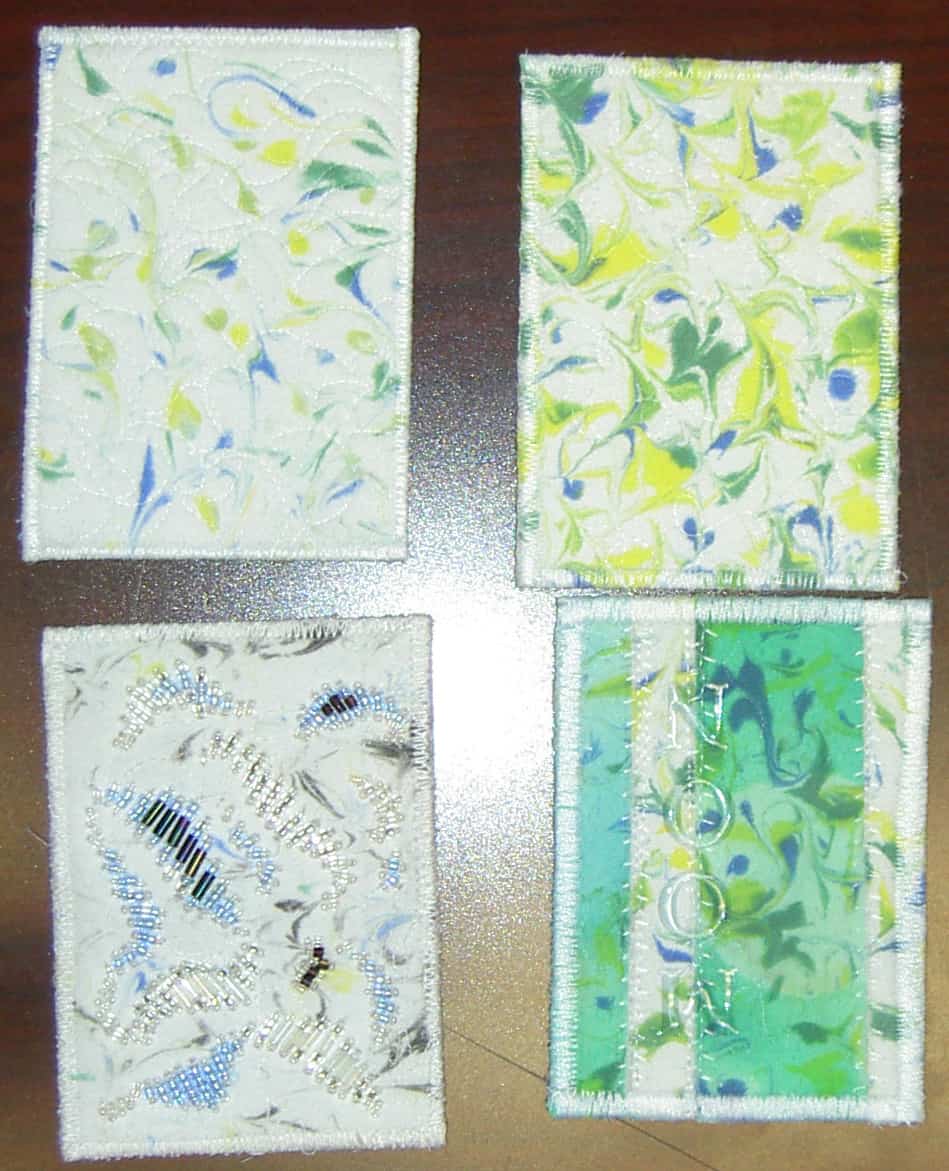
This pencil roll was made with FabMo fabric. I found the piece and it made me think of SherriD’s Renaissance Faire activities. I decided to make her a pencil roll as a thank you for participating in the Creative Prompt Project for the past year+.

If I haven’t mentioned this before, the FabMo fabrics are generally samples. They vary in size, but I can usually get only one piece of a particular design. I didn’t have enough to use for the inside, so I tried to pick some fabrics that would coordinate and give the feeling of history. The marbled fabric reminds me of the end papers in a book.
Yes, it is Teacher Pillow time of year. I had resolved to not leave it until the last minute, but being in bed with a nasty virus for over week did not assist me in my resolve.
I made one pillow last weekend after I was feeling a little better. I also made a block during the week for one of the pillow tops, but spent the better part of Friday finishing them up. School is out on Friday, so I had to get it done.

Above is the pillow for the Resource Teacher. She has been working with The Child for the past four years. She has made my life a lot better, because she gets The Child. She has provided support that I wasn’t getting from the lower school resource teacher (through no fault of his own). I will be VERY sad not work with her anymore.
Every year I pull out the same fabrics and make a different block. Now she has a set. I am thinking of making a quillow next year. I have never done that, but my SIL is an expert and I can draw on her expertise.
I was surprised to see that lozenge design show up in the middle of the block. I amy have miscolored the blocks when I sewed the pieces together. The block is called Crockett’s Cabin in Around the Block. That lozenge shape is very appealing and I am wondering if it would work for a FOTY piece?

As The Child has moved up in the grades, I spend less time in the classroom, thus I know the teachers less and less. I try to get a sense of the colors of the teachers and it is very difficult when I have only spoken to them 3-4 times. The literature teacher, who also happened to be The Child’s homeroom teacher had a hard year this year. She was out for four months at the beginning of the year, because of the death in her family. I thought The Child would have a hard transition when she came back to school, but he took to her like a duck to water. He liked her because “she doesn’t think she knows everything” and I found her to be a very intuitive teacher. I don’t know if the above colors or design are her style, but they are what immediately came to mind when I thought of her. I hope she likes it.

I force The Child to do a little drawing for each of his teachers. He had a hard time this year. He is getting out of creative practice and I have to get on him about that. (N.B. I blacked the names to protect the innocent!)
Making the backs fit is the most time consuming part. I couldn’t seem to get it right on any of them. This one is actually sideways on the pillow. I figured that nobody would care, if they even noticed.

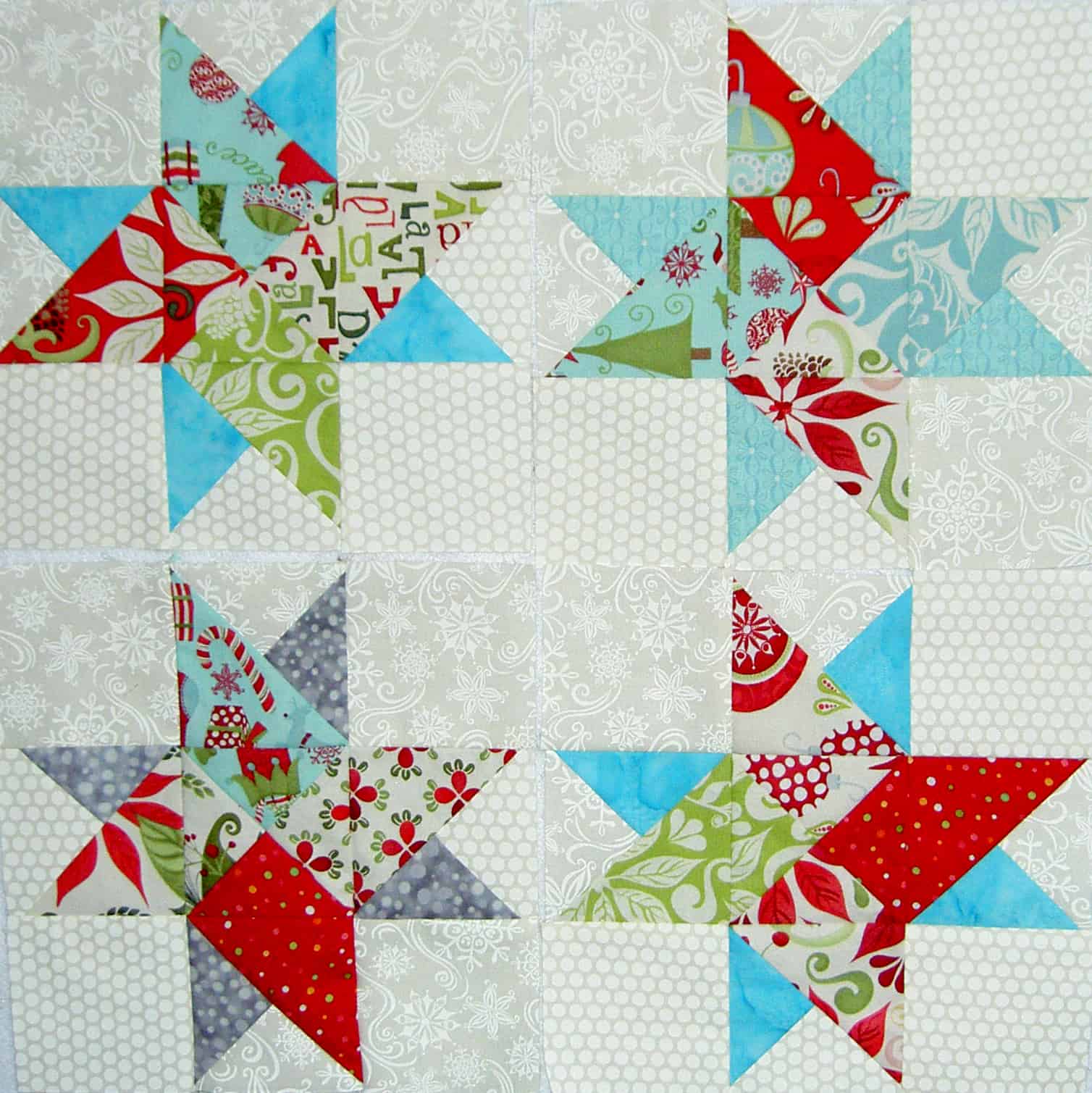
I really hope she doesn’t sincerely dislike purple. This block, in Around the Block, is called Star of Hope. It looks to me like a basic Ohio Star. I don’t really believe that blocks should have different names just because they have been recolored. I haven’t taken the time to look this up in the Jinny Beyer’s new book, The Quilter’s Album of Patchwork Patterns.

The Child kind of got into his drawing after a bit. He has a subtle sense of humor. I thought this drawing was very funny. Do you get it?

I mentioned on Tuesday that I found some fabrics I didn’t really like while I was cutting FOTY pieces. A couple of the above fabrics are those fabrics. However, the Science Teacher is male and I have not had the opportunity to make pillows for many male teachers. I found these fabrics to be great for a science man. I think they look a bit like rocks. I only had a fat quarter of each, so I had to add some others and I don’t have any to match next year, but may continue with the rock theme.

You can see that The Child got on to a roll with his drawings as he progressed through them.
The drawings are done on an 8.5×11″ piece of paper. First I fold the paper into quarters and then I draw pencil lines to mark the seam allowances. I also make a note as to which rectangle on the paper goes to which teacher. This year I also put in the name and the year. The Child knows now to keep within the seam allowance

In the past, The Child has chose the blocks for each teacher. This year he didn’t really care that much, so I mostly chose them. He was adamant about what he wanted for the math teacher. He saw the piece of pie I appliqued on the Tarts Come to Tea piece. He was adamant that he wanted that on the math teacher’s pillow. This is the first time I have done applique’ for a teacher.

The Child kept with the Pie/Pi theme for the back. Again with the sense of humor!
So done for another! YAY! I am going to a party today, but am going to find a fun project to work on tomorrow. I am glad I soldiered through and don’t have this project hanging around for tomorrow, except for the wrapping and the card writing.
I have to admit that I am sick of this project. There is only one year left and I am finished. I am not doing them for high school. I don’t think it is really appropriate and would embarrass The Child, but there are also too many teachers.
It is funny how you think something is a good idea and then a tradition and expectations start, which turns the fun into a chore.
I do enjoy looking through Around the Block and picking out the blocks to use. I am tempted to make blocks for next year’s pillows while I have the fabric out and just tuck them away until April or May so I have less to do next year. We’ll see.
|
Rachel Griffith, the power house behind p.s. i quilt has shop with the whole kit available. I have never bought a kit before aqnd am sorely tempted.
Color
fish
Salmon Protocol: Salmon aims to define a standard protocol for comments and annotations to swim upstream to original update sources
baked, grilled, smoked
Coho salmon
Farm salmon
bear food
Salmon: Salmon is the common name for several species of fish of the family Salmonidae. Several other fish in the family are called trout… (Wikipedia)
scales
Teriyaki salmon
wild salmon
endangered species
See the Creative Prompt page if you have questions about this project.
Post the direct URL (link) where your drawing, doodle, artwork is posted (e.g. your blog, Flickr) in the comments area of this post. I would really like to keep all the artwork together and provide a way for others to see your work and/or your blog.
The Creative Prompt Project, also, has a Flickr group, which you can join to post your responses. I created this spot so those of you without blogs and websites would have a place to post your responses.

I showed these blocks last week. I have a lot of finishing work to do, so they are still on my design wall, which means I keep looking at them.
My original thought was that they should but up against each other and kind of blend together. The more I looked at them, the more I thought the blending together idea wasn’t really working.

Since rearranging is free, I moved them a little apart and started looking at them. It is better having them farther apart, but I am going to reserve judgement until I make more blocks. I definitely need more fabrics to add interest, so I am glad that TFQ helped me pick additional colors and designs.
This quilt is not the mind sorbet project I thought it would be. I know I mentioned this in my last post on this quilt.
Ready for another ride that weaves in and out of the Internet and my mind?
Books, etc
I ran across the notice for Jane Brocket’s quilt book. I stopped reading her blog awhile ago, but was pointed to a link about ribbon, which I have on the mind lately.
A quote from the book via Amazon.co.uk:
“One of the great pleasures of doing anything repetitive by hand, whether it’s knitting, making bread, chopping onions or sowing seeds, is that the rhythm of the action allows your mind to wander.”
I bought this book. The US edition has come out, but I decided to buy the UK edition. I don’t mind those extra ‘u’ added her and there. There is nothing wrong with the US edition. I was pleased to see that the US edition came out relatively quickly after the UK edition debuted.
I bought the UK edition of the Gentle Art of Domesticity and was pleased with the service I received from the Book Depository, so I made my purchase from them again. The cover of the UK edition looks so much better. One fascinating thing about the Book Depository (which LoveAnna turned me on to) is that they have something like a live webcam where you see what books people are buying and where those buyers are from. It is mesmerizing to see people ordering so many books so quickly. I actually saw someone’s purchase of Cello: Grades 1-3 from China!
Embellishments
Anyway, back to ribbon. Somewhere I saw a link to ribbon. I looked at it, which led me to Jane Brocket’s blog, the new book – see above. The ribbon, though was gorgeous. So wonderful for embellishing bags and making markers for journals. LFN Textiles is the purveyor and the website has gorgeous photos. And they have dotted ribbons. What’s not to like?
Pam Rubert of PamDora blog fame recently tweeted a link to Sharon B’s Dictionary of Stitches for Hand Embroidery and Needlework. She has an index on the first page. If you click on one of the links, you see a picture of the finished stitch and where this stitch can be found. She shows step outs of the stitch and gives the reader tips and tricks. If you are browsing, there is a previous/next link at the top of the stitch screen, so that you can just click to another stitch without returning to the index. There are lots of great features of this site and it is great inspiration if you are using handstitching to embellish a quilt.
Journals
If you remember my fit of excitement over the 1000 Journals Project, this information will come as no surprise to you. I found the Artbook Coop via Julie and they are doing a sketchbook project. You can order (and pay for) a sketchbook, which will then be housed in a museum. I am not sure I could finish something like this, but my mind is swirling around it.
Blocks
Brenda Papadakis of Dear Jane fame has a series of block of the month blocks posted on her website for free. It looks like there is an applique’/embroidery block and a pieced block every month.
Media
Last week I had a virus that hit me hard. One day while I was thinking about going back to bed, I stumbled on a blog called Waking Up in Bavaria. It has a really nice clean look and beautiful photography. One of her recent posts is a review of Kaffe Fassett’s Simple Shapes, Spectacular Quilts. It is hard to read a blog from the beginning when you are years behind. Still I read a bit of her posts from last year and my mind spun into imagination land. I spent a formidable time in my life in that area of the world, though in Austria, not Bavaria, so the landscape is familiar. I also like the clean, spare look of her blog. My mind started to wander around the question of what if I woke up in Bavaria tomorrow?
If you need to organize your studio/workroom, the Quilted Cupcake has a podcast and a long blog post with a lot of resources and pictures of her space. QNN TV also has a segment on organization. The January episodes, segments 1&2, 3&4 take on the topic of organizing your studio from different angles. You have to be a member to watch the videos.
I signed up for QNN TV last year and hadn’t really watched the videos. Last week, while I was sick, I was clearing out my email. Some of the messages in there were notices about new QNN TV episodes being posted. Being fit only to lay in bed, I started watching them. I thought they were very entertaining. They have some cooking segments, which I skipped over, but I enjoyed the episode on specialty threads (January episode, Segments 5&6). They have two kinds of links to the shows. Each episode is broken into about 6 segments and two segments are posted each week. This means that you can watch the different segments or watch the whole episode. I have been watching them in segments.
The January episode takes place in Winterset, Iowa, partially at the Fons & Porter store. They also show the Bridges of Madison County, the county in which Winterset is located. I didn’t know that Fons & Porter had a store, so this was interesting to me. I wish they would have done a tour of the store, but they didn’t.
I really enjoyed the November episode. Jodie Davis hosts with Patrick Lose and they report from Houston Quilt Market. They talk about new products and interview people at the show. I was entertained. I think this was shot while Mark was working out the details of his contract with QNN TV. I thought it would be weird, but Jodie Davis handled his not being there with grace. She made it seem like he would be back soon.
I also enjoyed the February Door Knock episode where Mark interviews Liz Porter. It is great to see that she is real and has a real life. I went away from that interview with a lot more respect for her and what she has achieved.
I wasn’t planning to renew my membership, but I may do it. I will definitely watch the episodes as they come out rather than waiting until my inbox is too full before I get to them.
The Alliance for American Quilts had a contest recently called New From Old. They have posted a series of YouTube videos documenting the quilt entries as they arrive. I thought that was very clever! One of them was by Marie Johansen who sometimes reads this blog. I was pleased to see that Yvonne Porcella entered a quilt, which must mean that she is feeling better. There were a number of Dresden Plate entries and two that could be considered Baltimore Album style. Sunbonnet Sue, Grandmother’s Flower Garden and Grandmother’s Fan also made debuts. Some people put a lot of work into their entries and it occurred to me that throwing something together just to enter wouldn’t work for this contest. Then again, it doesn’t usually work for any contest.
If you ever feel like the quilts or ATCs or blocks or paintings you are making are not fit for the fireplace, take a look at the Bad Postcards site. Looking at the works on this site should a) give you a laugh; b) make you feel better about your own work; and c) make you wonder who ever thought it was a good idea to make matching apron, tablecloth and curtains (you’ll have to scroll down the site to get that one). As a bonus for you fabric lovers, there are some interesting fabrics shown in various postcards. It makes me wonder whether people will be laughing about the photos on this blog in 50 years?
Do artists go under Media or Out and About? I don’t know, so here is Michael Cutlip. Mostly I love his website and the way the gallery is laid out. He is the artist who did the picture in the Decor House, which I wrote about in a post a few weeks ago. The picture I took is crappy, but his work is not, so don’t judge him on my photo.
Out and About
You might have heard (or maybe read it here) that the V&A in London has a quilt exhibit up. They have also the release of a second set of patterns, V&A Pattern Series II. “Like the first box set—which included four books arranged by theme and titled William Morris, Indian Florals, Digital Pioneers, and The Fifties—the second series features four books available individually or as a group: Owen Jones, Novelty Patterns, Kimonos, and Garden Florals. In addition to page after page of color images of the textile designs, each hardcover book includes a CD of hi-res images of the featured patterns.”
Being here in the US, it is hard to get to the exhibit, though I am hoping for some kind of miracle (you know free first class tickets, or something), but until then I have been looking at the videos. My favorite so far is the one with Caren Garfen, which I looked at with TFQ. Her quilt is given a bit of short shrift int he book, but this video makes up for it. I wish it were downloadable to iTunes, so I could look at it again without being tethered to my computer.
My sister gets various creative “notions” in her head and her latest is organza flowers. She saw some she loved at Nordstrom. She said that you sew strips of fabric in a circle to a base down the middle of the strip. Have you ever done this? I may try it.
Kaffe Fassett and Liza Prior Lucy are having a blog tour. There are a lot of new and interesting blogs to look at.
My friend, Kathy, from Everyday Bliss, has a new blog called Everyday Mommy. It is new so I can’t tell you exactly how it turns out, but Kathy writes “Do you want to be a marvelous parent or just like watching others try? Join Everyday Mommy for a wacky and fun experiment! Each week we will delve into one of the parenting virtues, have some fun and hopefully become better parents in the process!” It is fun to watch my friend delve into cyberspace. I know that sounds strange since the web is not new. Before blogs I couldn’t tell how many emails people were sending or what websites they were going to. With all of the cross linking and comments, as well as FB, it is much easier.
Deirdre sent me a link to Woody Campbell’s Photo a Day blog. His photos are a bit large. Still, I like the photo of the refrigerator. I like the idea of documenting normal every day things. I don’t always do it, but I think about it. I read about a guy who took a photo of the same building across the street from his shop every day at the same time for something like 30 years. Do you ever do anything like that? I thought about it when I took a picture out the window of my workroom, but then I never followed up. I suppose it isn’t too late!

While TFQ was visiting, we had to attend a family event. She was invited, but declined to attend, so she stayed home and rested. One of the things she did while resting was iron the fabrics that I had washed, but had not yet pressed. TFQ is one of the fastest pressers I have ever seen! She made a neat pile for me and I needed to cut various pieces from them. The pile got moved a couple of times during the week because the ironing board needed to be used for the actual pressing of clothes!
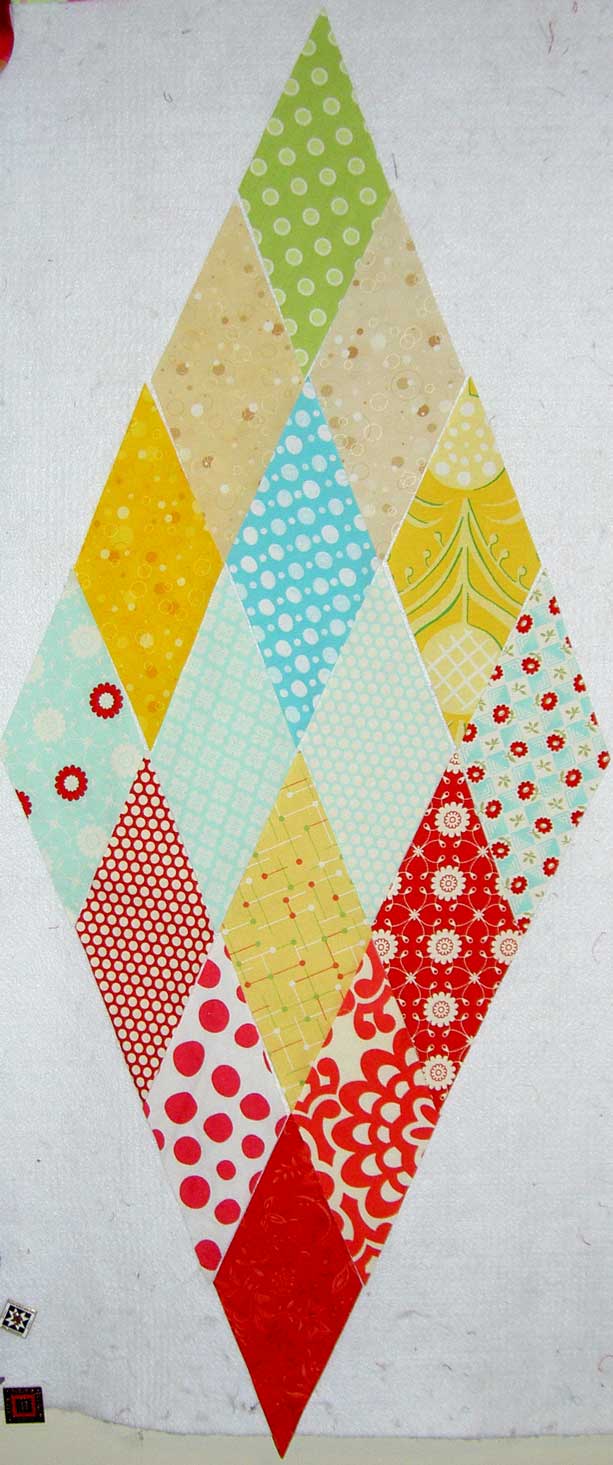
I was feeling a bit better on Sunday, and I didn’t want to have repress any of those fabrics so I went to work and cut various patches I needed from these pieces. The main shape I need is diamonds, as you know, for the FOTY 2010 quilt. I also cut some Tumblers and Eye Spy pieces and a few food fabric pieces for my mom.
This is the biggest group of diamonds I have added to the pile thus far. I have to say that there are distinct advantages to cutting into the fabric shortly after I buy it. I have mentioned that it is helpful to know that I like a fabric so I can go and buy more before the fabric manufacturers stop producing it.
The other advantage I found this time was that I know immediately if I don’t like a fabric. There are several in this group that I really don’t like. I have decided that I don’t like little tiny splotchy dots. It could be that the colors of the fabrics with those types of motifs in this group are not my colors. I might feel differently if they were turquoise and hot pink.
I have also been testing the ‘white water’ by buying more fabrics with white backgrounds. I have also decided that there are some fabrics where the ratio of white is too much. I love coffee fabrics, but the coffee cup fabrics above with the white background are really not my thing. Something about the orange and icky green combined with the white do not make me happy.
I also have to admit that I am a little scared of this year’s FOTY quilt. How am I going to do the edge? I don’t want to cut off diamonds, so I’ll have to cut half diamonds of some border fabric and do a self bordering type border. Will I need to organize that well before the CQFA retreat? I think so! Can I do it? I hope so. Yikes! What was I thinking?
I don’t always start a quilt and finish it right away. Often, I start a quilt in order to work through an idea and then I get stuck on one part. Putting it away is a good way to let the project and idea percolate. Such is the case with the Original Bullseye.

The Original Bullseye is back in my crosshairs, mostly because of the Dale Fleming class. If found some directions for the border I want to make in QNM (I think), but the directions were a little arduous, so I didn’t start right in. However, since taking the Dale Fleming class her wave directions have been rattling round in my mind. I think I am going to use them to make the border for this quilt.

I haven’t done it yet, because I still mulling over colors and whether to put more circles in the border.
One silly thing that is keeping me from doing this is whether I have enough freezer paper. That is not the main hinderance. I have some other quilts higher on the top of the list. I do feel like I am getting close to moving forward on this project.

We did a bunch of things at the CQFA meeting and one that I haven’t yet written about was the design exercises. We continued our design and creativity series (not sure if that is the name, but I had to make up something!). This time Friend Julie was the teacher. She used Color and Composition for the Creative Quilter: Improve Any Quilt with Easy-to-Follow Lessons by Katie Pasquini Masopust. I thought she was using the other book, so I told everyone the wrong thing, but no harm done in the end.
Julie decided to have us use paper instead of fabric and I think that got us to be a little freer. Julie was a great teacher! She gave clear directions, kept us on track and guided us skillfully.
The first exercise (upper left) was composing with line (pg.26 in Ms. Masopust’s book). Julie had us cut lines and choose a design from the “Nine Patch of Compositions.”
The second exercise was to break up the negative space with diagonal lines (upper right).
The next exercise allowed us to use curves (lower left). This is a design that reminds me of a quilt I have had on my inspiration board that is made of large feathers. I’ll make it someday.
Finally, we were allowed to use any of our scraps to create a final composition (lower right). The great part of this workshop was to work with others people and to see what they were making. It is fine line between seeing what people are doing and being influenced by what they are doing. I don’t think I was and I really enjoyed working with everyone.
Great job, Julie!