
The whole idea of the original post was to encourage you to think about what you thought of when you saw the photo. The blue bubbles really drew my attention.
Commentary about works in progress, design & creativity
The whole idea of the original post was to encourage you to think about what you thought of when you saw the photo. The blue bubbles really drew my attention.
This post is a companion to the Quilting…for the Rest of Us podcast episode on Balance.
As a reminder, the general design definition that we are using is: Design is a problem solving activity within all the arts, placing or creating subject matter so it is of visual significance and interesting to the artist. (from The Quilter’s Book of Design, 2d ed)
Balance is a Principle of Design.
Definition of balance:
You can affect balance by using some elements of design including size, placement, color and texture. (The Quilter’s Book of Design, 2d, pg. 4)
There are four main types of balance:
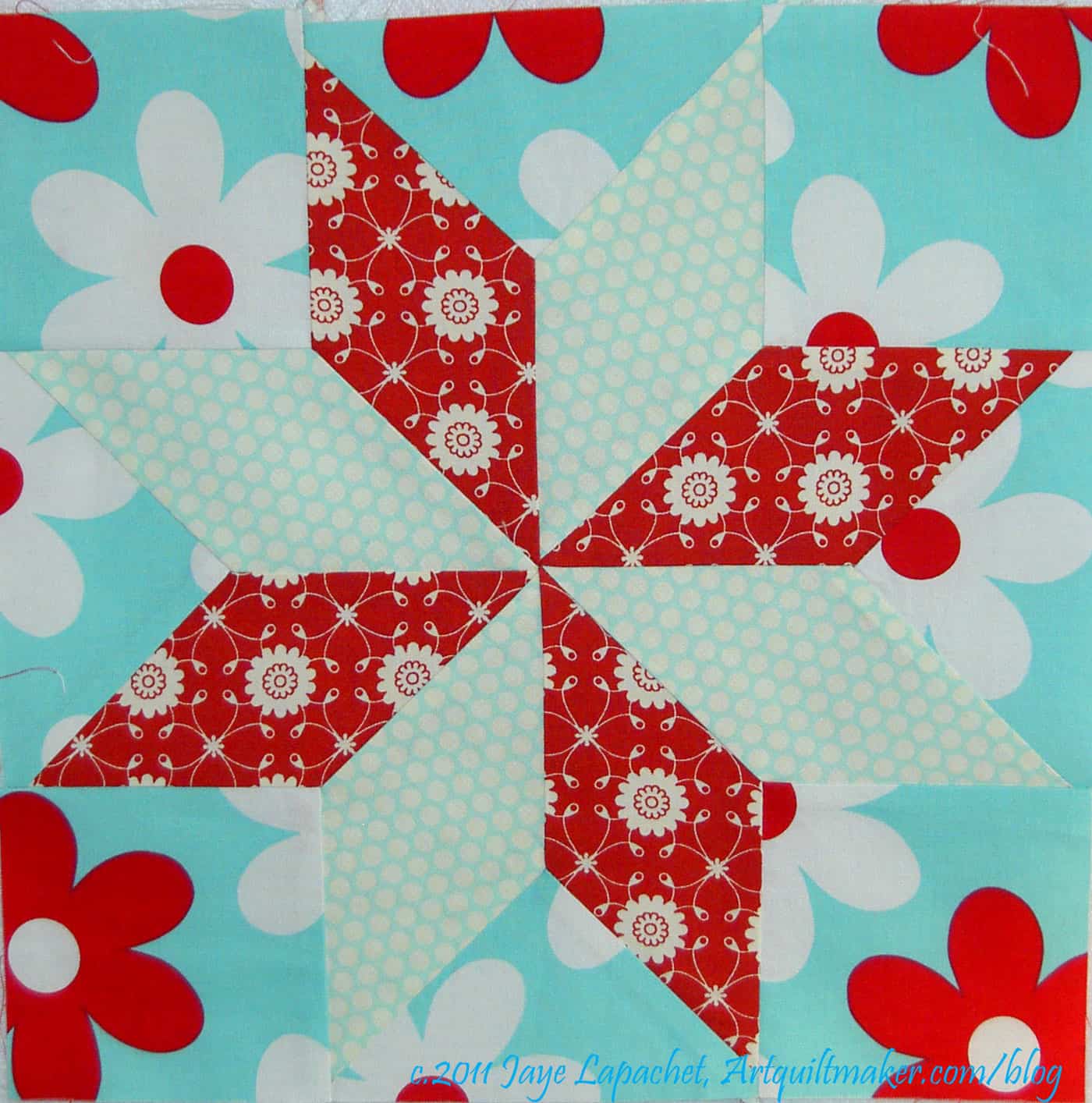
Symmetrical Balance:
“The formality of a grid can be used to lend some organization to a complex or busy image.” (The Quilter’s Book of Design, 2d, pg. 5)
“The formal quality in symmetry imparts an immediate feeling of permanence, strength, and stability. Such qualities are are important in public buildings to suggest the dignity and power of a government.” (Pentak & Lauer, 5th ed. pg.80)
“Symmetrical balance does not, by itself, preordain any specific visual result” (Pentak & Lauer, 5th ed. pg.81). You have to choose the elements that you put into a symmetrically balanced design.
Radial Balance
Radial balance is sometimes considered a refinement of symmetrical or asymmetrical balance “depending on whether the focus occurs in the middle or off center.” (Pentak & Lauer, 5th ed., pg.94)
The advantage of a radial design “is the clear emphasis on the center and the unity that this form of design suggests.” (Pentak & Lauer, 5th ed., pg.94)
Crystallographic Balance
Crystallographic balance is also considered a “refinement of symmetrical balance,” but it is “truly a different impression from our usual concept of symmetrical balance.” (Pentak & Lauer, 5th ed., pg.96)
“Many quilts use crystallographic balance in a grid. The block setting traditionally used for quilts lends itself to overall design balance.” (The Quilter’s Book of Design, 2d, pg. 7)
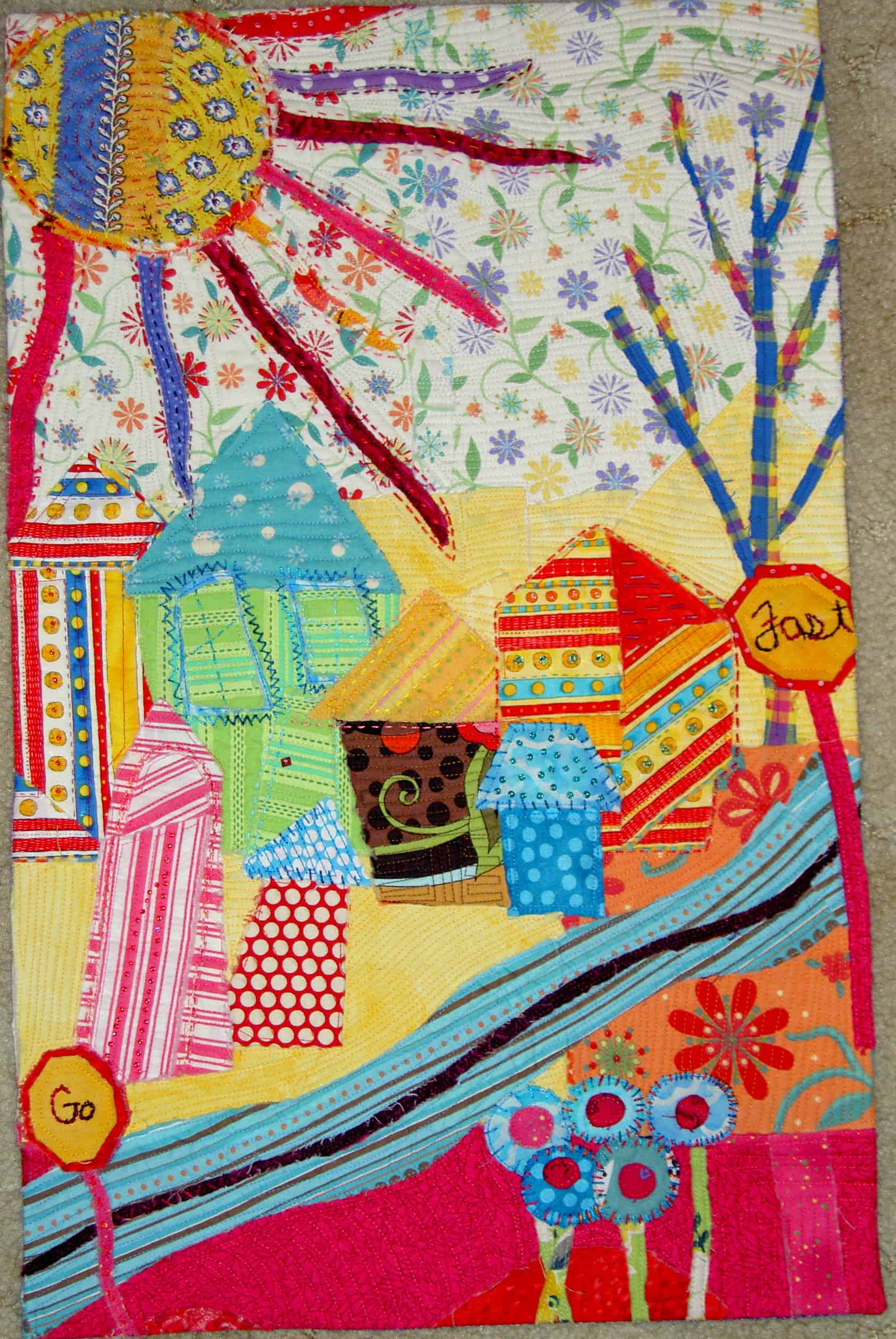
Asymmetrical Balance
Asymmetrical balance is the big unknown. This type of balance is where it is important to know about the elements of design so that you can use them to adjust the visual weight of your design. (The Quilter’s Book of Design, 2d, pg. 9)
“Asymmetry appears casual and less planned…,” but it is actually more intricate and complicated to use than symmetrical balance, because attempting to balance dissimilar items involves more complex considerations and more subtle factors. (Pentak & Lauer, 5th ed. pg.85). The quilt we talked about in this segment is called Fishermen’s Widows by Anna Faustino, 2008. It is pictured on pg.114 of Adventures in Design.
Structure
Structure is a helper concept to balance. You choose a structure to use within balance. There are four different major types of structure:
Focus structure has to do with placing elements of a design in such a way that the eye of the viewer focuses on it. You create focus by establishing the difference between the featured shape and its setting. (Adventures in Design, pg.117)
Circular structure uses a circular design “skeleton to move the eyes around the design in a clockwise manner.” (Adventures in Design, pg.118)
The basis of your design, in a triangular structure is a triangle (Adventures in Design, pg.119)
In an L structure “the major design focus should be along one of the arms of the L.” The best placement in this kind of structure is to place the major focus close to the intersecting point of the L.” (Adventures in Design, pg.119)
There is also horizontal and vertical structure, which is also called horizontal and vertical balance.
Horizontal and Vertical structure (or balance) (The Quilter’s Book of Design, 2d, pg. 4)
Unbalanced Designs
Notes
It is interesting how almost anything can inspire us to create a new design. Ruth McDowell was inspired to look into symmetry further when she was gallery sitting and ended up talking with a professor from a local Boston college who demanded to know why the designs only used 4 of the 17 types of Symmetry. (Symmetry, pg.8)
Crystallography is the science of the forms and structures of crystals (http://www.merriam-webster.com/dictionary/crystallography)
Homework
Exercise #1:
Supplies:
A note on your items: go to your junk drawer or your Extra Everything closet or just walk around the house and grab things of all different sizes, shapes, colors, thicknesses and weights. Make sure you have a piece of crumpled junk mail. You can include a marble, a ball, a spoon, a whisk, a statute, a postcard, a remote control. The items should be easy for you to handle (don’t try and move your TV!)
Take your items (a variety of sizes shapes and colors) and arrange them on the piece of paper or table or other clear space. Try to arrange them in pleasing way.
If you have a camera, take a photo and look at the photo.
Exercise #2:
Using the same items from above (see supply list and notes above) and pretend your items are quilt blocks.
Rearrange your items and answer the questions below:
Take a photo and share it in Sandy’s Flickr group or on your blog. If you post a photo on your blog, put a link to your blog in the comments section below.
Balance Resources
Design Basics, 5th ed. by David A. Lauer and Stephen Pentak, pg. 75-97
Elementary Crystallography: An Introduction to the Fundamental Geometric Features of Crystals by Martin Julian Buerger (1978)
Fearless Design by Lorraine Torrence, pg.17-23
The Quilter’s Book of Design, 2d by Ann Johnston, pg.4-11
Pattern on Pattern by Ruth McDowell
Symmetry by Ruth McDowell
Thank you!

Here is another four patch type block, so if you want to make a kind of four patch sampler, you have a few blocks to use.
This block is very similar to Squares and Rectangles. Actually, when I saw Squares and Rectangles again, I actually thought the design was the one I am posting today. The fabric in the upper right hand corner was a stripe that made that patch look split. When I looked closer, I realized it wasn’t but COULD be. And here we are. 😉
Again the directions for cutting are pretty easy. Here is arotary cutting worksheet for the One Squares & Rectangles block.
If you have made blocks or a quilt from these patterns, please post a link in the comments section of the relevant block or on the AQ Block-a-Long Flickr group. I would love to see what you have made.

I haven’t posted any responses lately, even though I have gotten back on the response horse and have been drawing.
See the original post.

The BAMQG blog does not seem to allow uploading of PDFs, so I am posting this here for members (and those of you that want to play along) who need a pattern for the A-B-C Challenge. This is one example of a block that starts with ‘F.’ There are multitudes.
PDF Rotary Cutting Directions for the Flower Pot.
World Oceans Day
salt water
Definition: An ocean (from Greek ???????, “okeanos” Oceanus[1]) is a major body of saline water, and a principal component of the hydrosphere. Approximately 71% of the Earth‘s surface (~3.6×10⁸ km2
) is covered by ocean, a continuous body of water that is customarily divided into several principal oceans and smaller seas.
Sailing the ocean
Ocean County, NJ
Arctic Ocean
ocean going vessel
Ocean Alliance
Pacific Ocean
More than half of this area is over 3,000 metres (9,800 ft) deep. Average oceanic salinity is around 35 parts per thousand (‰) (3.5%), and nearly all seawater has a salinity in the range of 30 to 38 ‰. Scientists estimate that 230,000 marine species are currently known, but the total could be up to 10 times that number.[2]
Ocean Beach, San Francisco
The Ocean Channel
Post the direct URL (link) where your drawing, doodle, artwork is posted (e.g. your blog, Flickr) in the comments area of this post. I would really like to keep all the artwork together and provide a way for others to see your work and/or your blog, and how your work relates to the other responses.
The Creative Prompt Project, also, has a Flickr group, which you can join to post your responses. Are you already a member? I created that spot so those of you without blogs and websites would have a place to post your responses. Please join and look at all of the great artwork that people have posted.
the beach
Atlantic Ocean
The earth’s oceans
Quilt Pattern: Ocean Waves
Ocean’s 11
NOAA
Ocean Conservancy
Indian Ocean
ocean waves
Ocean Spray cranberry juice

Another in the series of Double Four Patches. This block may not be original. It looks familiar, but I wasn’t able to find it in EQ7. If I find it, I will correct the name.
I have been using my color wheel a little bit to choose colors for the blocks. I am gearing up to research the color section of the Design Principles and Elements podcast that I do with Sandy over at Quilting…for the Rest of Us, so I am trying to get into the habit of using it.
Again the directions for cutting are pretty easy. Here is a rotary cutting worksheet for the Double Split Four Patch block
If you have made blocks or a quilt from these patterns, please post a link in the comments section of the relevant block or on the AQ Block-a-Long Flickr group. I would love to see what you have made.
rolling hills
The Hills TV Show
Between Two Hills by Carl Sandburg
The Sea and the Hills by Rudyard Kipling
Definition: A hill is a landform that extends above the surrounding terrain. Hills often have a distinct summit, although in areas with scarp/dip topography a hill may refer to a particular section of flat terrain without a massive summit (e.g. Box Hill, Surrey).
There are 47 named hills of San Francisco
Congressional newspaper
Coyote Hills Regional park
Cal State Dominguez Hills
Hills, Iowa
Black Hills of South Dakota
Post the direct URL (link) where your drawing, doodle, artwork is posted (e.g. your blog, Flickr) in the comments area of this post. I would really like to keep all the artwork together and provide a way for others to see your work and/or your blog, and how your work relates to the other responses.
The Creative Prompt Project, also, has a Flickr group, which you can join to post your responses. Are you already a member? I created that spot so those of you without blogs and websites would have a place to post your responses. Please join and look at all of the great artwork that people have posted.
I want to make another Anna Maria Horner Multi-tasker tote.
“But, Jaye,” you say “you have so many works in progress, don’t you want to finish them before you start something new?”
I did finish something!!!!

The top for the Stars for San Bruno #3 is pieced, the back is pieced, the binding is made. All the parts are hung up and waiting to go to the quilter.
I feel like I have made a significant step in the Stars for San Bruno Project. it feels SOOOO good to say: All of the piecing for all of the quilts in this project is COMPLETE!! Yes, I finished the piecing for Stars for San Bruno #3 on Sunday. I also made the back and binding.

The back took a lot of time. I have mostly used up the value of blue fabric that I planned to use in all of these quilts, so I spent a lot of time piecing bits of fabric together. It was soothing in a way, but as you can see, some of the fabrics are not blue. They were in the blue bin, so I counted them as available to use.
Also, a note on the photos. My quilt hanger’s wingspan is smaller than the quilt, so the photos aren’t terrific. Hopefully, you get the idea and will come back and continue to read and not be horrified by my terrible photography skills.
So, everyone, do a happy dance. The end is near.

After last week’s block, I thought I had better post a regular Double Four Patch. I should have posted this one first, but wasn’t thinking and had in my mind that I already had. I know you can handle the out-of-orderness.
Looking at this block and last week’s block, it makes me want to do a sort of Double Four Patch Sampler. I think I might get bored, though, with just two small blocks, but it would make a good Leaders and Enders project. Alternatively, I can think up some other Double Four Patch variations and have a variety to work with.
Again the directions for cutting are pretty easy. Here is a Rotary cutting worksheet for the Double Four Patch block
If you have made blocks or a quilt from these patterns, please post a link in the comments section of the relevant block. I would love to see what you have made.
Have fun!
#11
November 11, 2011
Ocean’s Eleven
Grade 11
After 10 and before 12
11 BC
The month of November
Junior in high school
from Wikipedia:
7-Eleven a convenience store in North America, South America, Europe, the Middle East, and Asia
11th grader
Carl Hubbell (Giants), Sparky Anderson (Tigers), Jim Fregosi (Angels), Luis Asparicio (White Sox), Paul Warner (Pirates) all wore #11
A football team, so-called because of the number of players on the team
Apollo 11, historic space mission which landed the first humans on the Moon
only 11 more miles
The Symbolism and Spiritual Significance of the Number 11, compiled by Dee Finney: “Number Eleven possesses the qualities of intuition, patience, honesty, sensitivity, and spirituality, and is idealistic. Others turn to people who are ‘Eleven’ for teaching and inspiration, and are usually uplifted by the experience.
In systems such as Astrology and basic Numerology, eleven is considered to be a Master Number. Eleven can also represent sin; transgression and peril. Ten being the perfect number, eleven represents the exceeding of both. It is interesting to note that eleven when broken down ( 1+1=2) comprises the Two of duality. Number eleven is a master vibration and as such should not be reduced to a single number.People with this number could be both idealistic and visionary, and they are attracted to the unknown.They can be both unusual, interesting and magnetic personalities.
Eleven bring[s] the gift of spiritual inheritance, is gifted as the “Light-Bearer”. It is the number of the Light within all. Strengthened by the love of Peace, gentleness, sensitivity and insight. Greatest facility is the awareness of Universal relationship. Is related to the energy of Oppositions and the Balancing needed in order to achieve synthesis. Eleven is The PeaceMaker… Colours : Gold, Salmon, Prune, White and Black.”

Yes, a delay in posting today. I thought I had more time, but somehow this day off just slipped away and I only marked one thing off my to do list. I did make progress on others, but didn’t finish them.
Anyway, I saw this block and remembered how much I liked it. I am a sucker for Double Four Patches. This this block is related to the Double Four Patch and also related to the Four Patch, which I posted as the first block in this series. Multiples of Squares & Rectangles would make a lovely scrap quilt.The pinks and turquoises are really making me happy right now.
Again the directions for cutting are pretty easy. Here is a Rotary cutting worksheet for the Squares & Rectangles Block
If you have made blocks or a quilt from these patterns, please post a link in the comments section of the relevant block or on the AQ Block-a-Long Flickr group. I would love to see what you have made.
Enjoy!

Post the direct URL (link) where your drawing, doodle, artwork is posted (e.g. your blog, Flickr) in the comments area of this post. I would really like to keep all the artwork together and provide a way for others to see your work and/or your blog, and how your work relates to the other responses.
The Creative Prompt Project, also, has a Flickr group, which you can join to post your responses. Are you already a member? I created that spot so those of you without blogs and websites would have a place to post your responses. Please join and look at all of the great artwork that people have posted.

I worked all Sunday and a couple of hours on Monday afternoon on the Stars for San Bruno #3. I am too small, so I asked the Young Man to hold it up to me, which, as you can see, didn’t work out very well.
The way I asked him to hold it is actually sideways. The plan was to make a row quilt with vertical rows of stars. If I would actually measure on occasion, I would have known that it would come out weirdly wide. Looking at it like this gives me a chance to see whether it will look ok with horizontal rows.
It definitely needs some kind of spacer on the [current] sides. I want something to separate the pieced stars from the embroidered stars I plan to use for the border.
Progress on one of the 26 Projects? Yes.
Happy Halloween!!!

I specifically did research so I would know how to draw a scary ghost only to be told my ghost wasn’t scary! I think he is scary and that is all that counts.
You can draw a scary ghost, too. Check out the original prompt and show us your fine work!