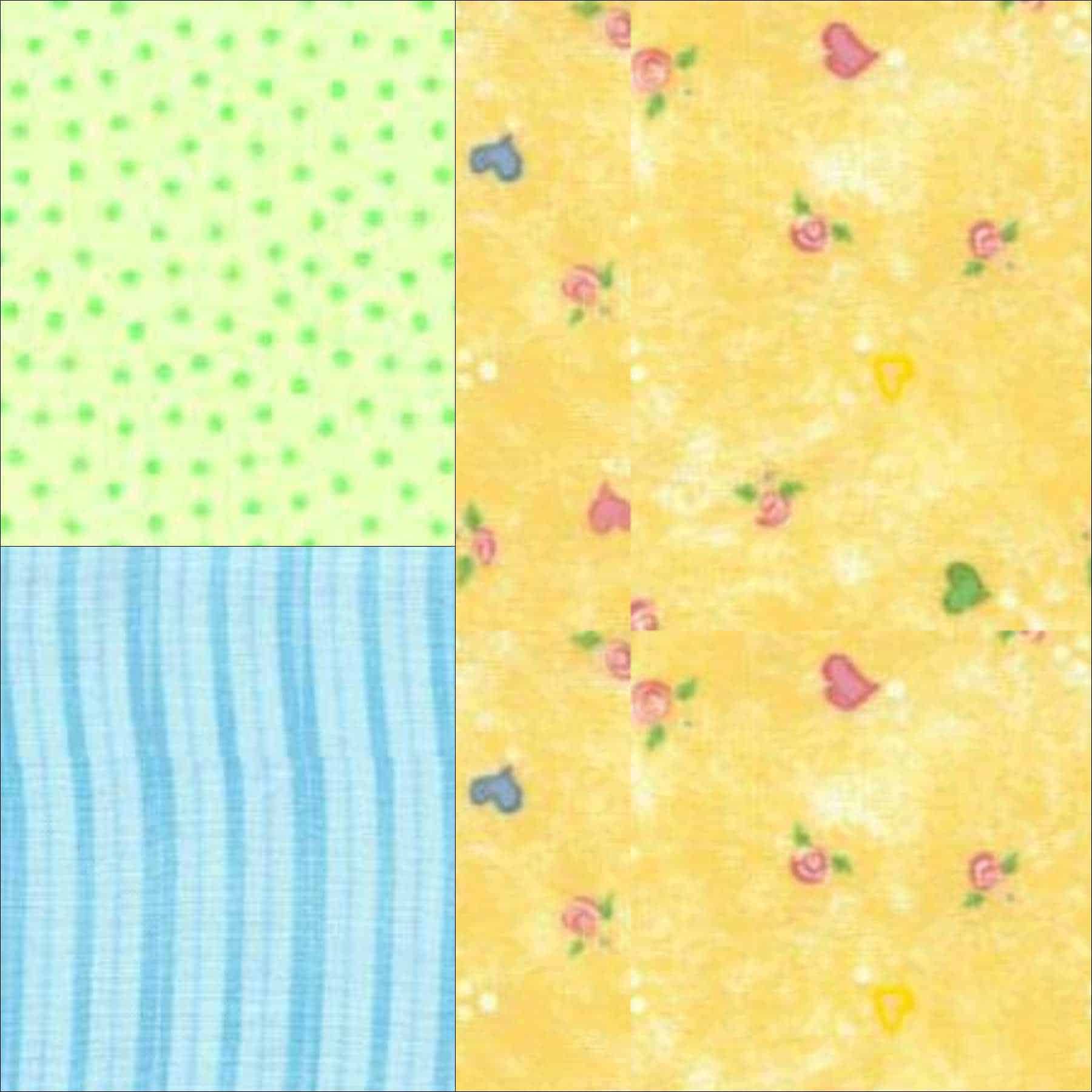
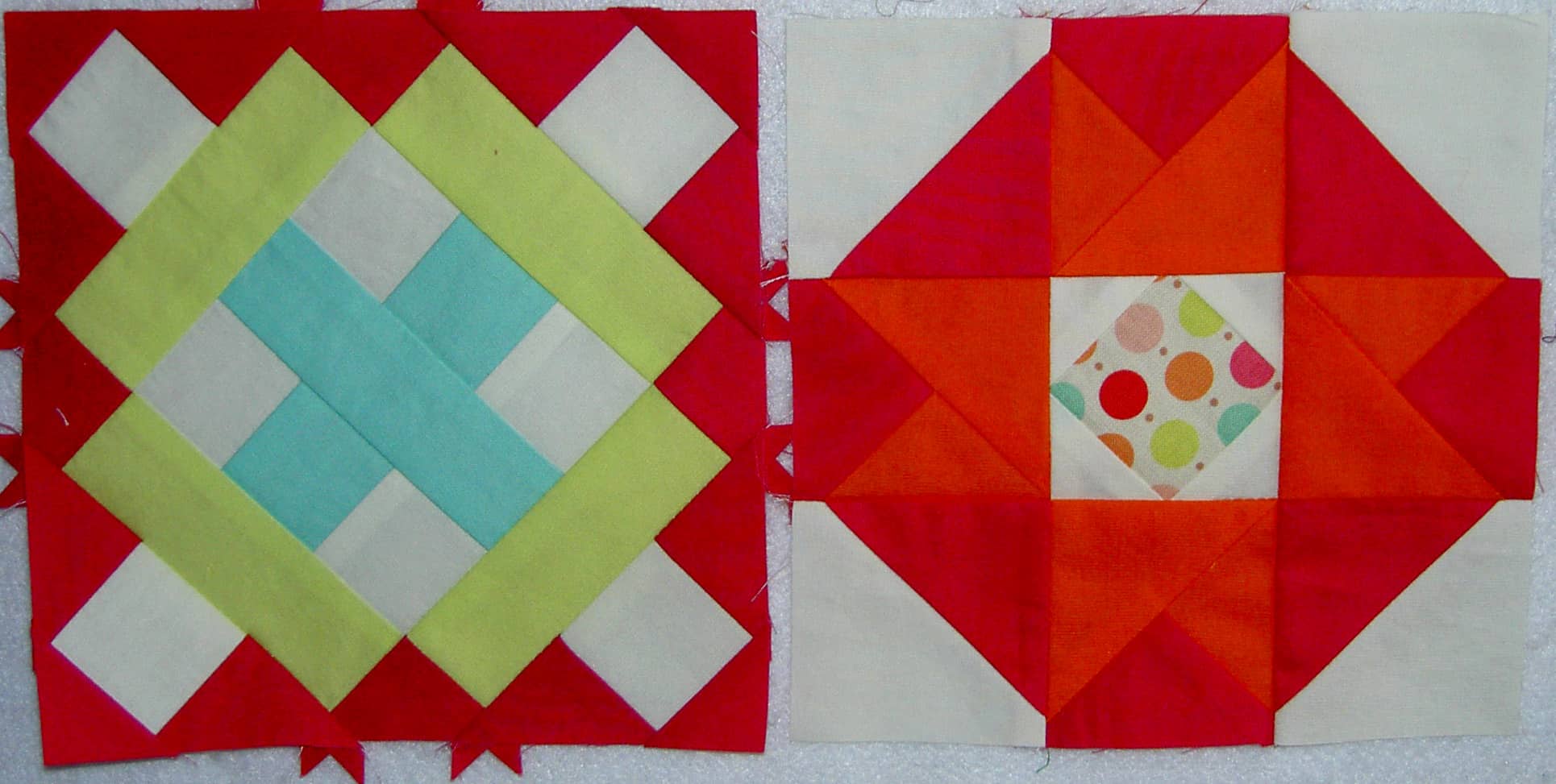
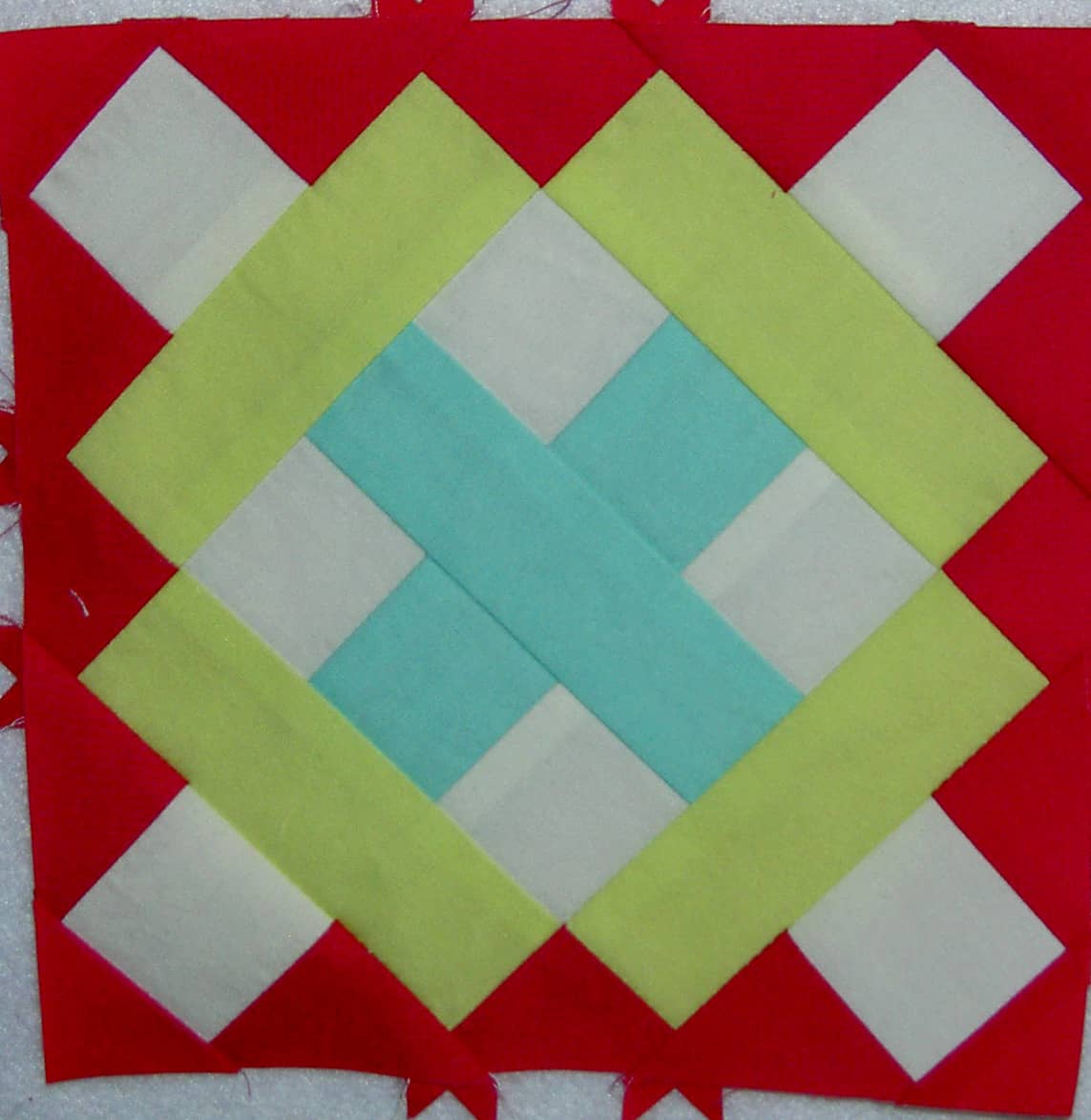
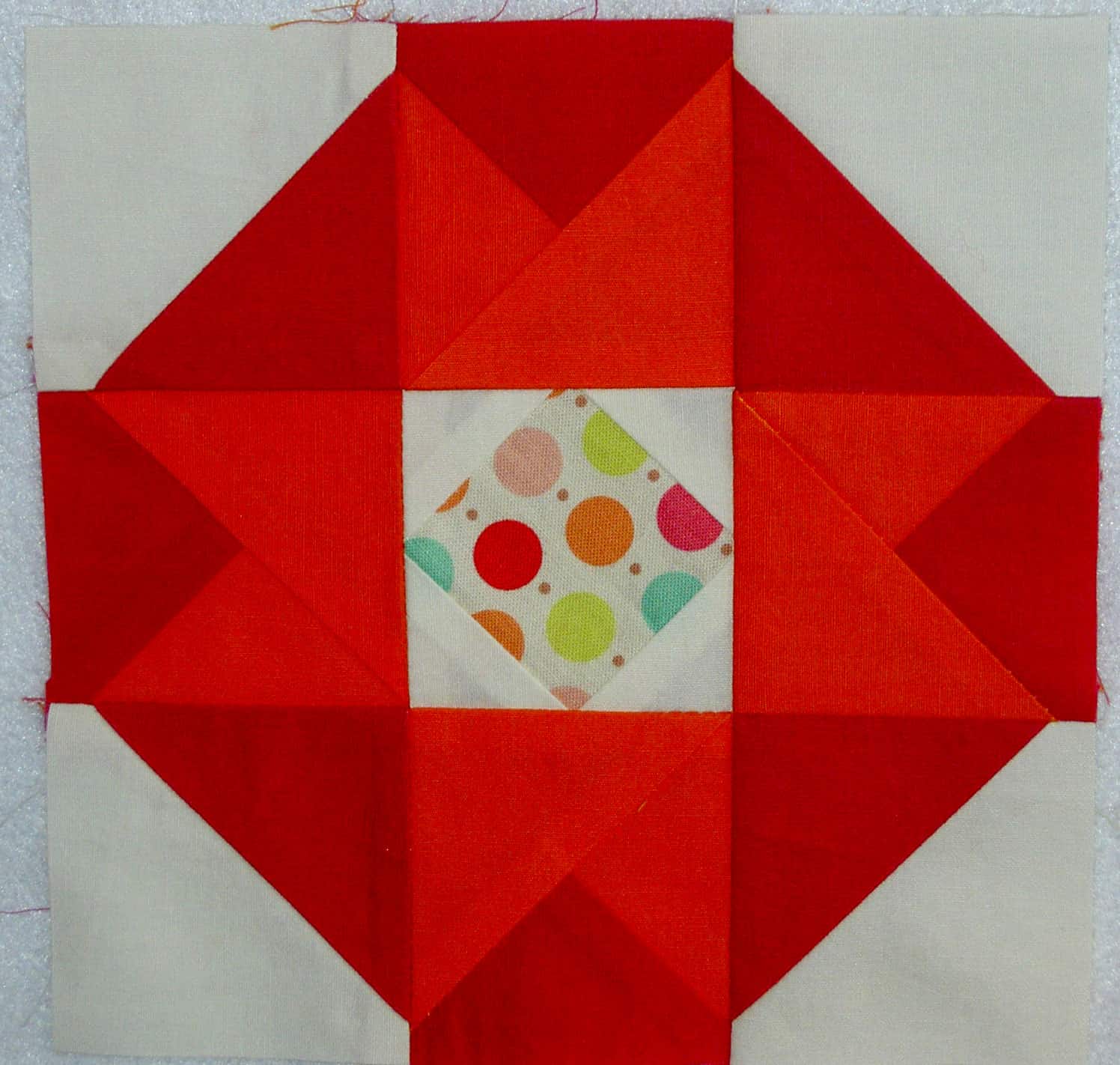
This blocks is similar to the four patch and the other rectangle block I have posted, which I called Rectangle Four Patch.
This blocks is slightly off center, so the squares and rectangle are slightly different sizes than what you have been cutting.
This block is also suitable for 3 fabrics.
If you have made blocks or a quilt from these patterns, please post a link in the comments section of the relevant block or on the AQ Block-a-Long Flickr group. I would love to see what you have made.
I worked on the LeMoyne Star today. I had some work, which languished while I was out of town,so I had to do that as well, but it was great to get back to sewing a bit.
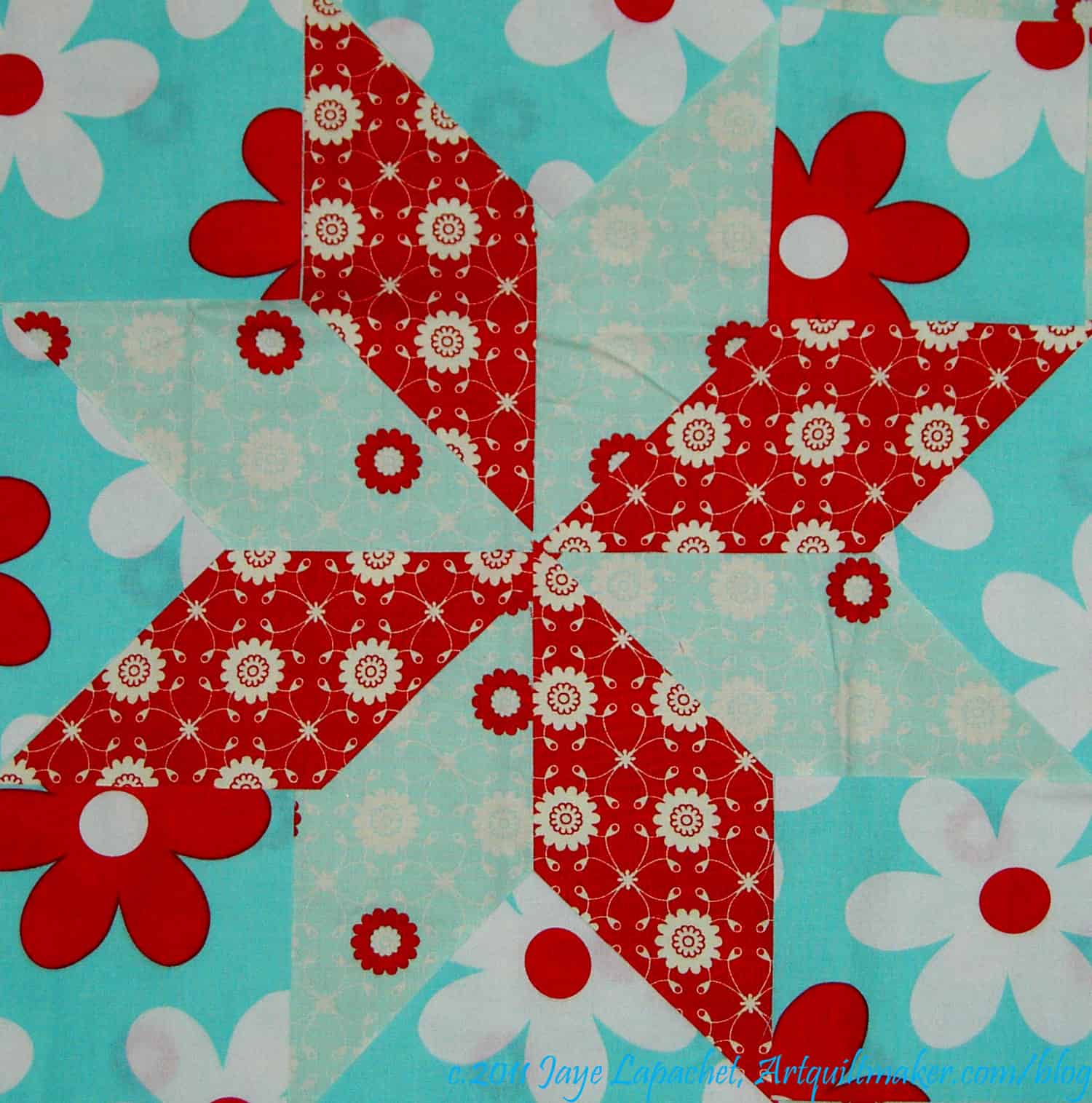
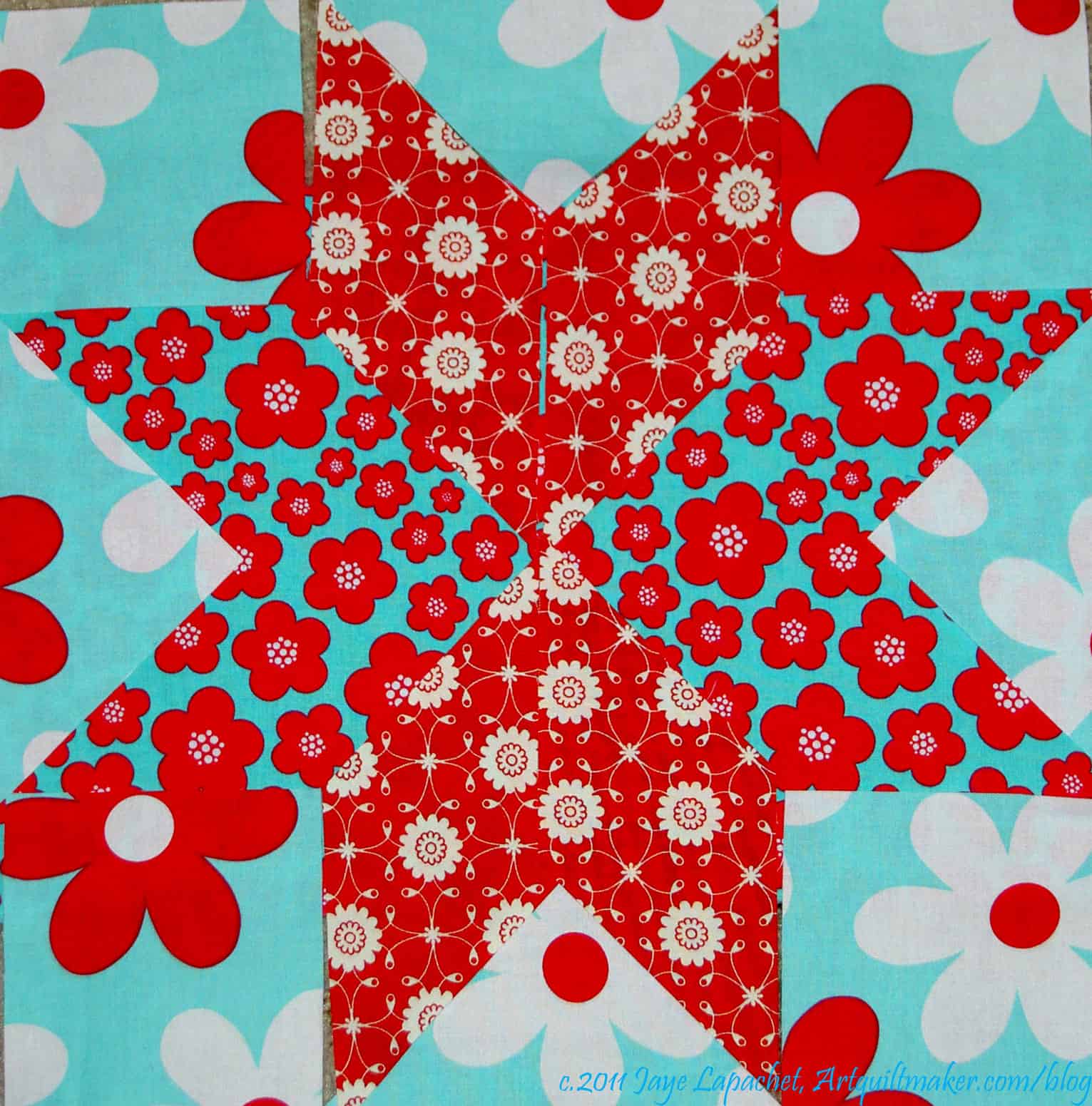
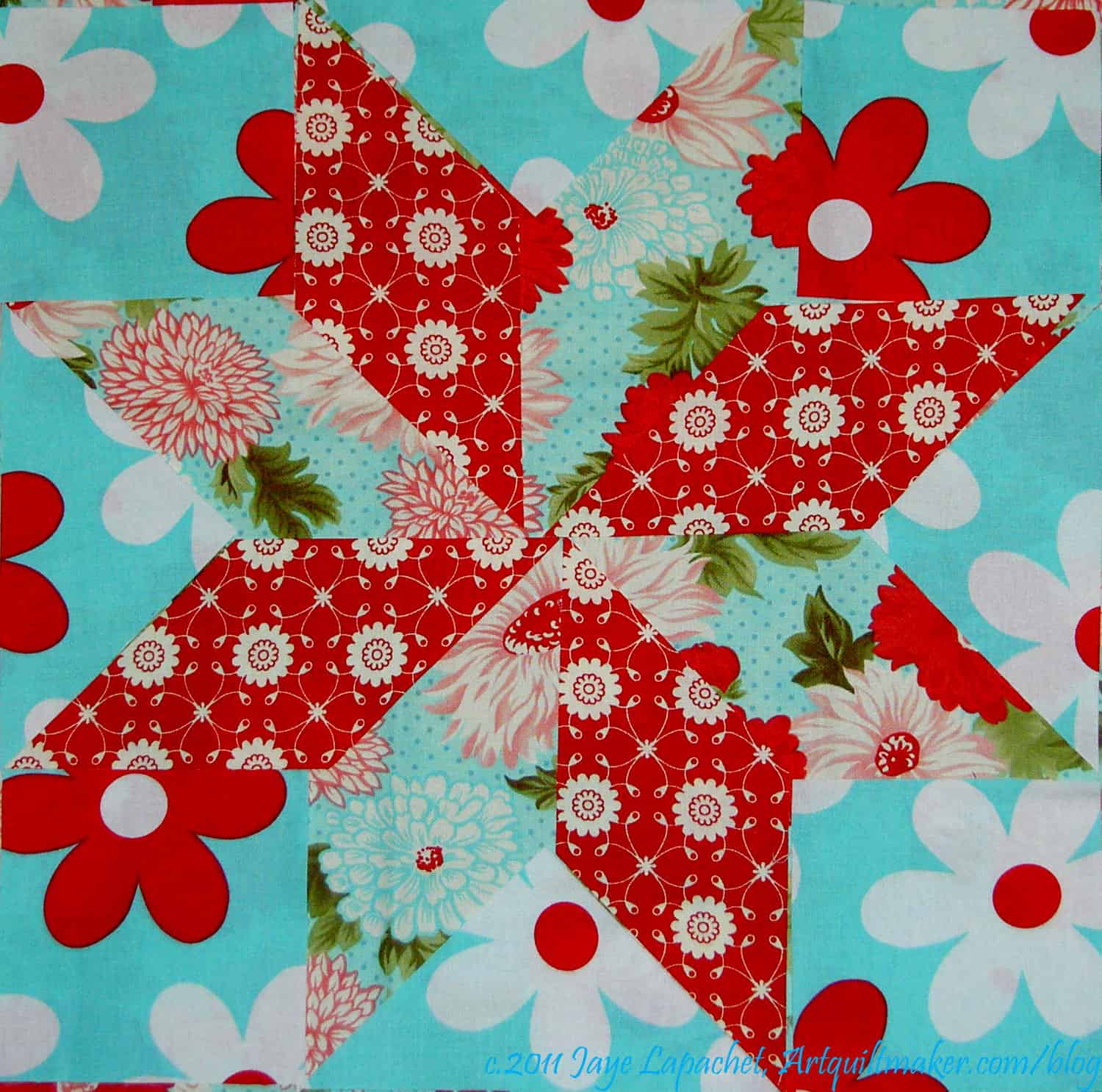
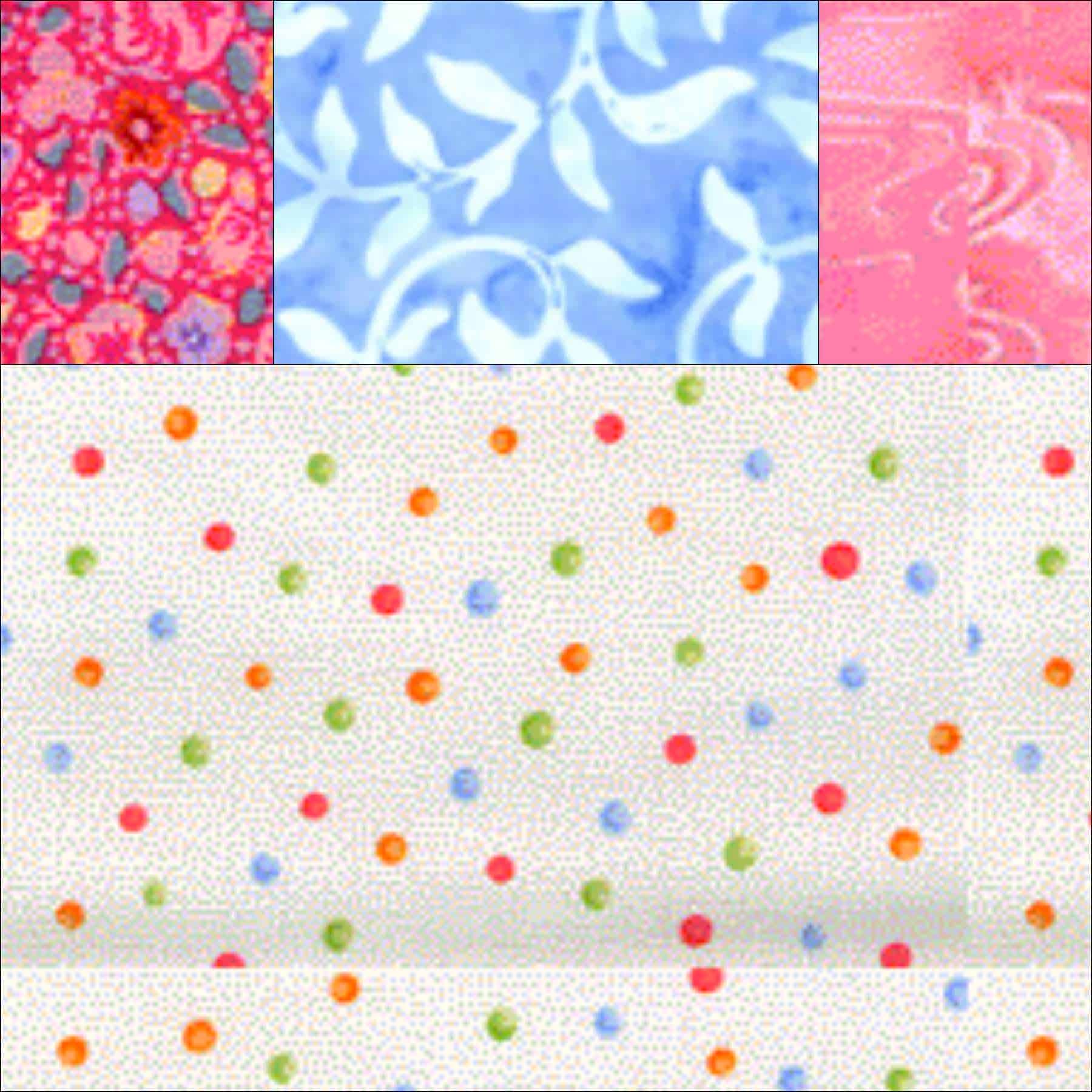
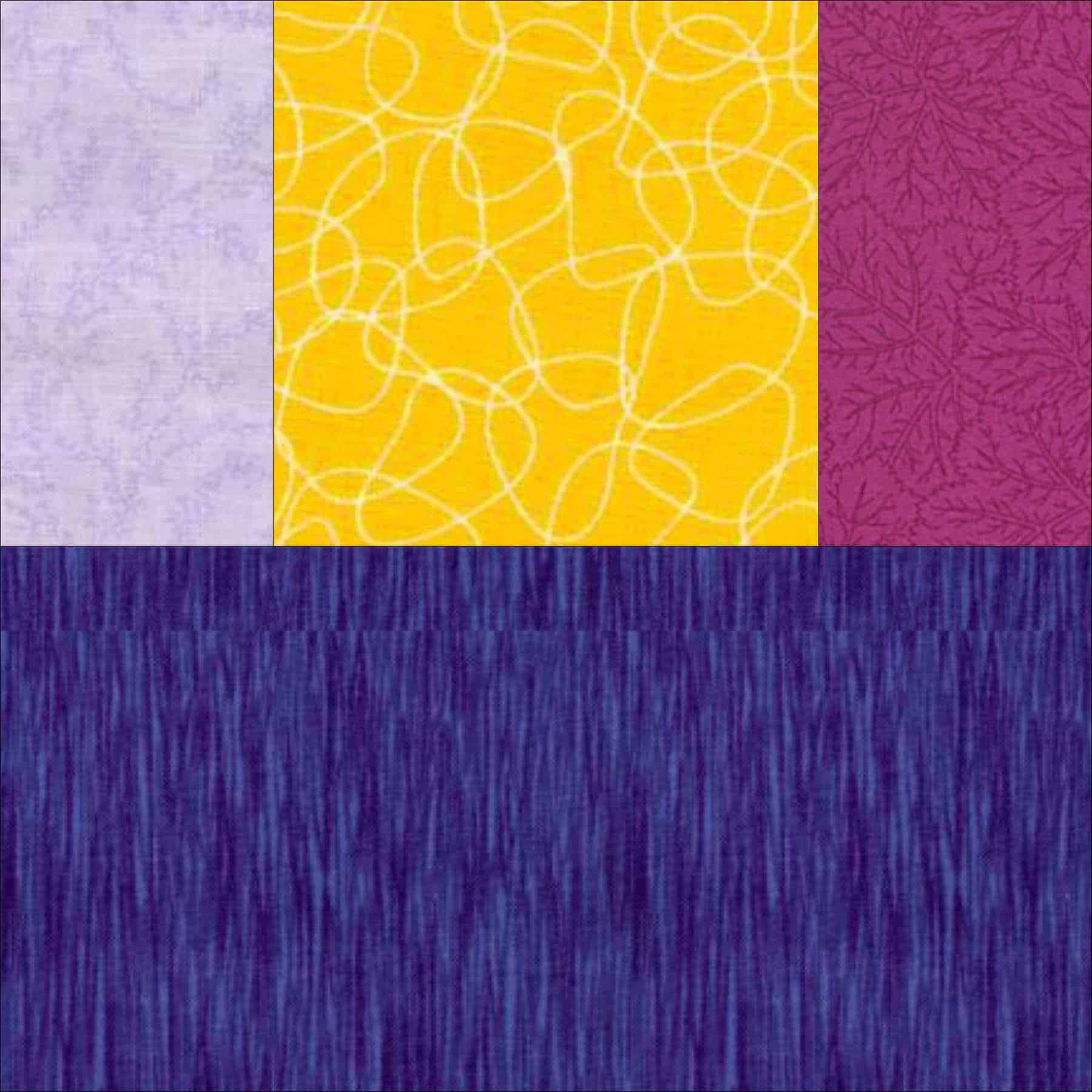
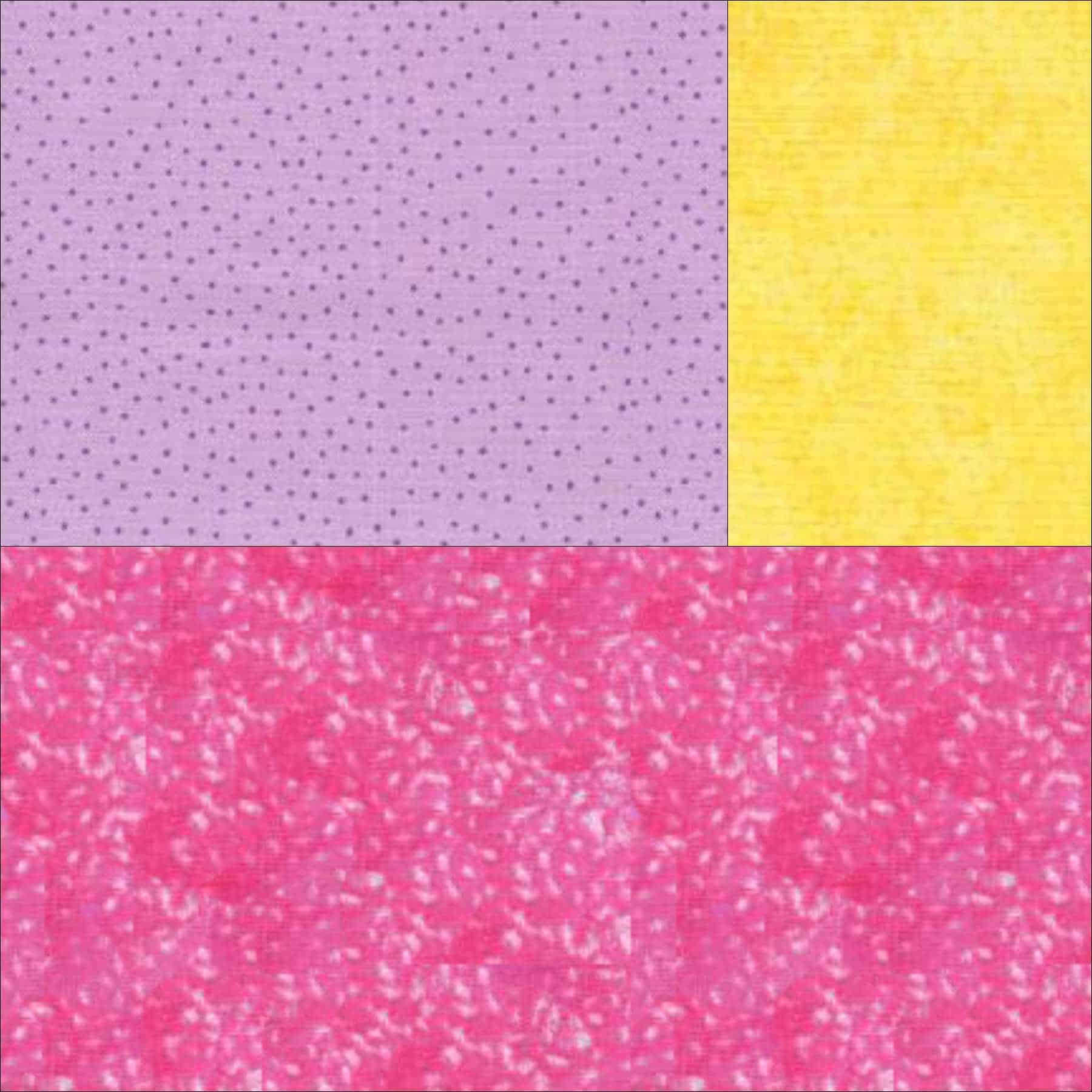
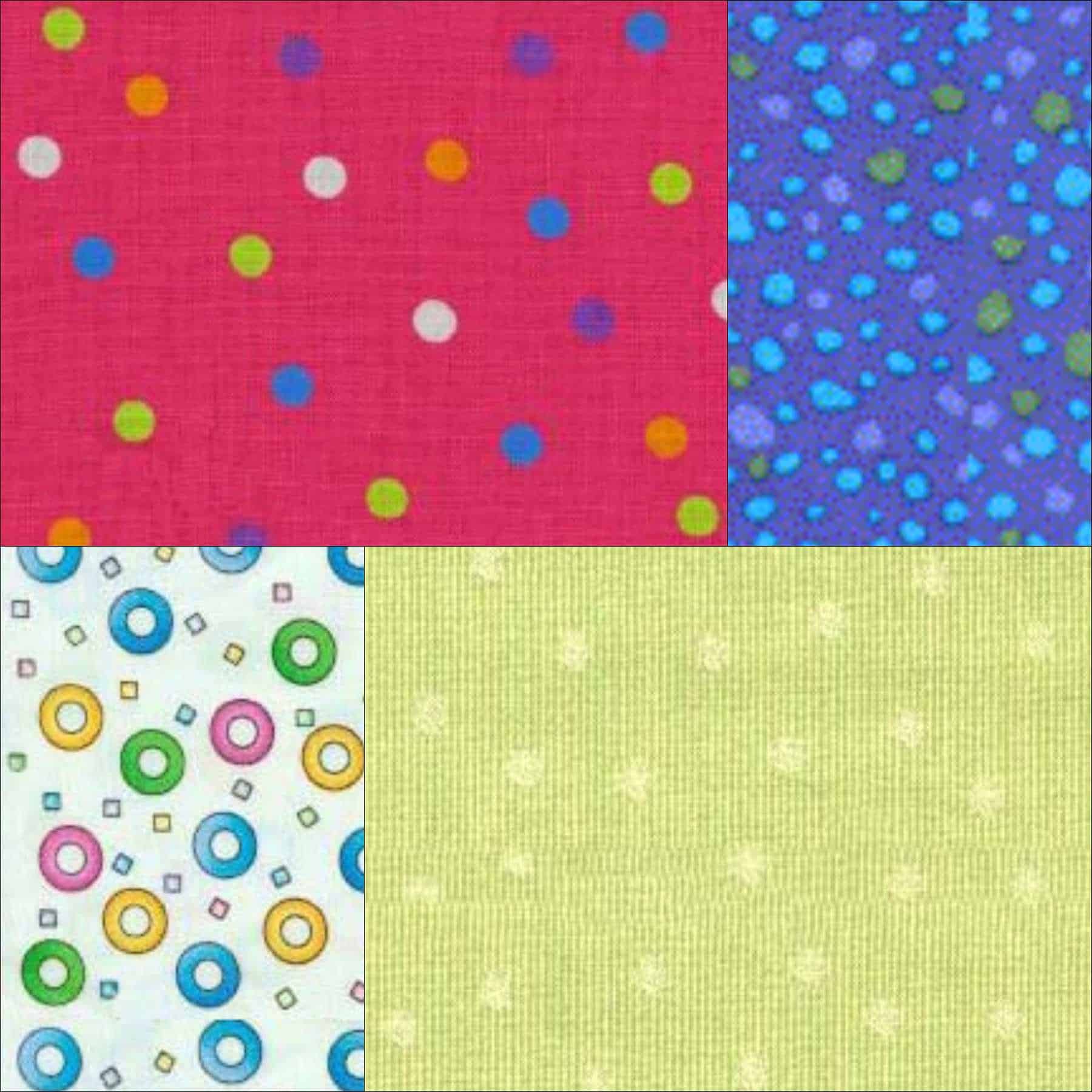
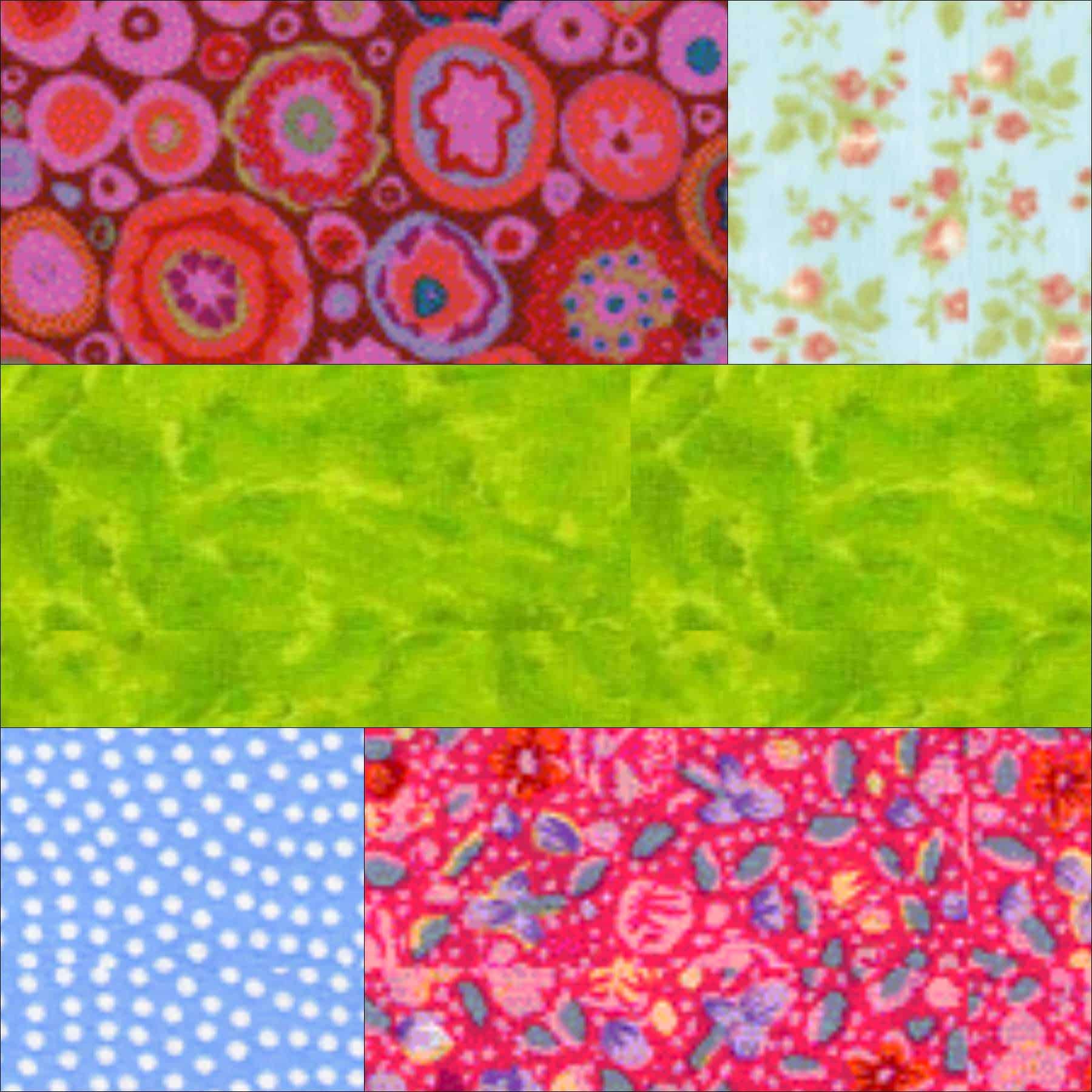
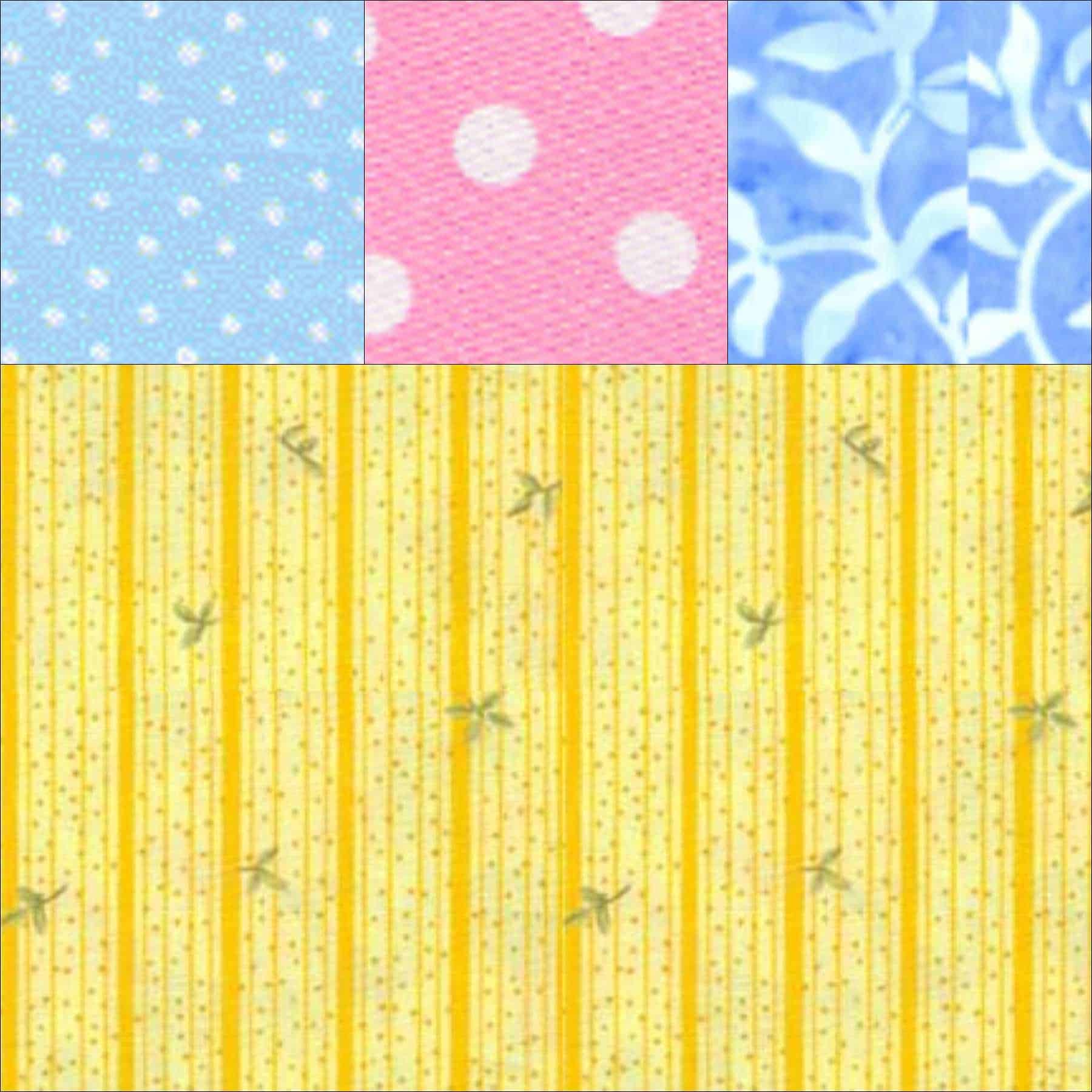
The LeMoyne Star has some tricks, but is not very difficult to piece. I took pictures as I pieced it and will work on a tutorial for a future post. The key trick is to NEVER sew into the seam allowances. I did sew into the seam allowances along the outside edge towards the end of the process, but otherwise, I stopped shy of the seam allowance, or moved it out of the way as I was sewing. My stilletto came in handy. Choosing fabrics was a key piece of the process and took longer than I expected. The ‘make visual decisions visually’ adage worked well, though, because what I thought would look good didn’t look good at all. Below are some of the choices I considered:
Alternate colorway from the Moda Bliss lineDots from Quilted FishBright FlowersAnother Bliss FabricAqua-Red Sampler Quilt Blocks -September 2011
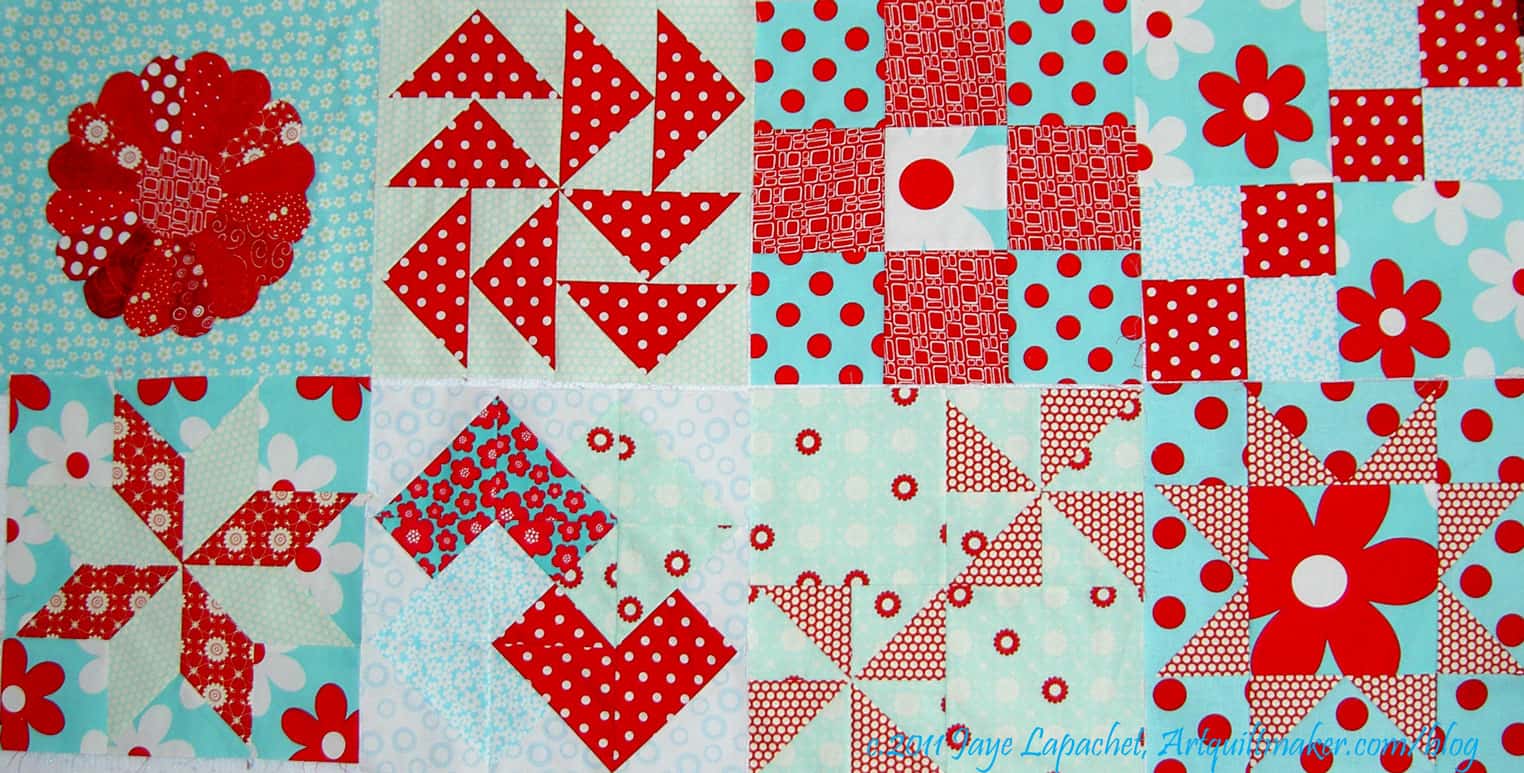
Above are all of the blocks I have made for the class so far. Don’t they look nice? They are hogging up space on my design wall, so I will need to take them down, but I am pleased with how they are coming out.
I had to be mean teacher to Frances. Do you know how hard it is to be mean to Frances? She is such a nice person and has such a lovely podcast that I found it difficult. I had to do it, though, because our class wasn’t progressing and we need to move on.
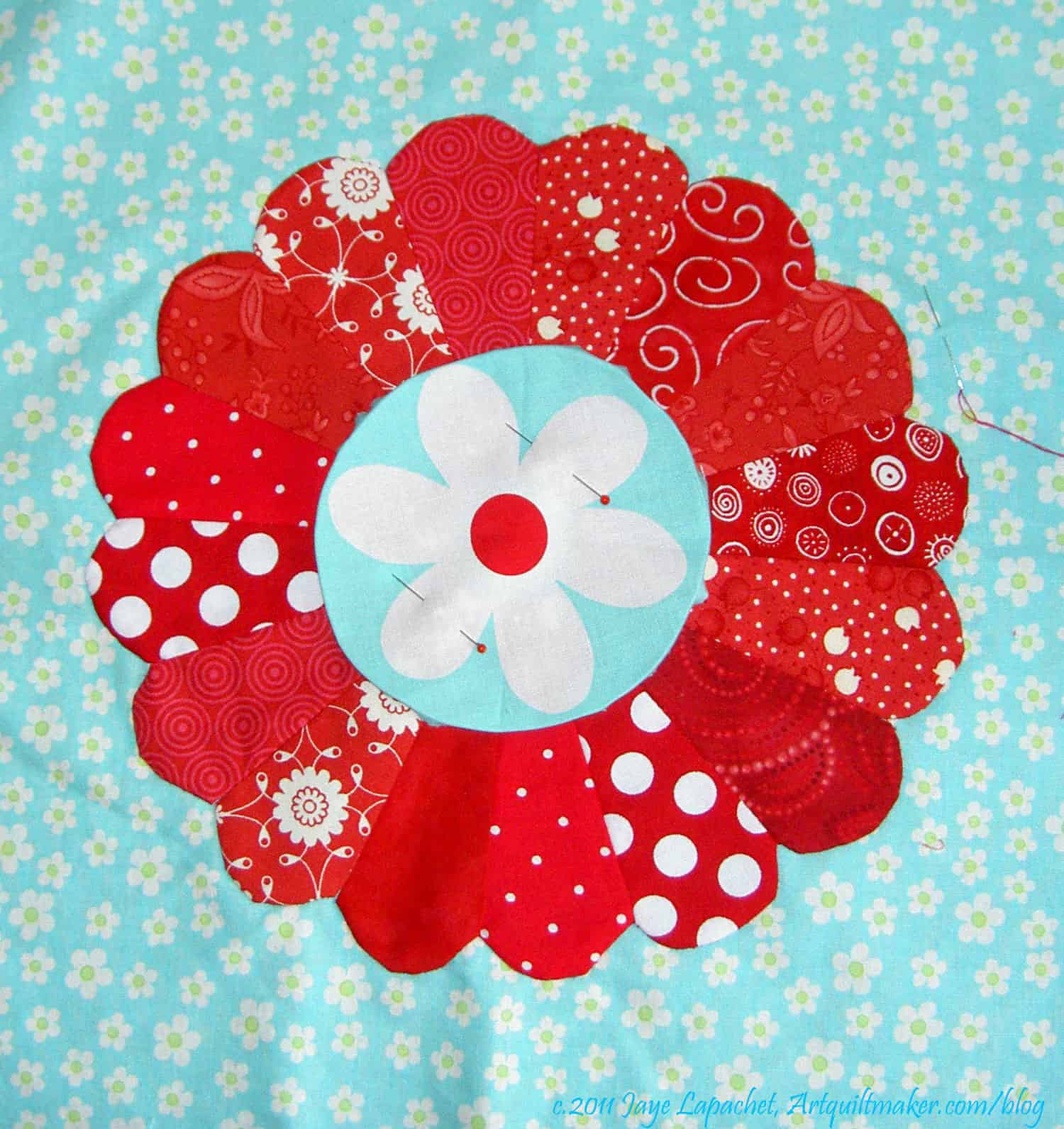
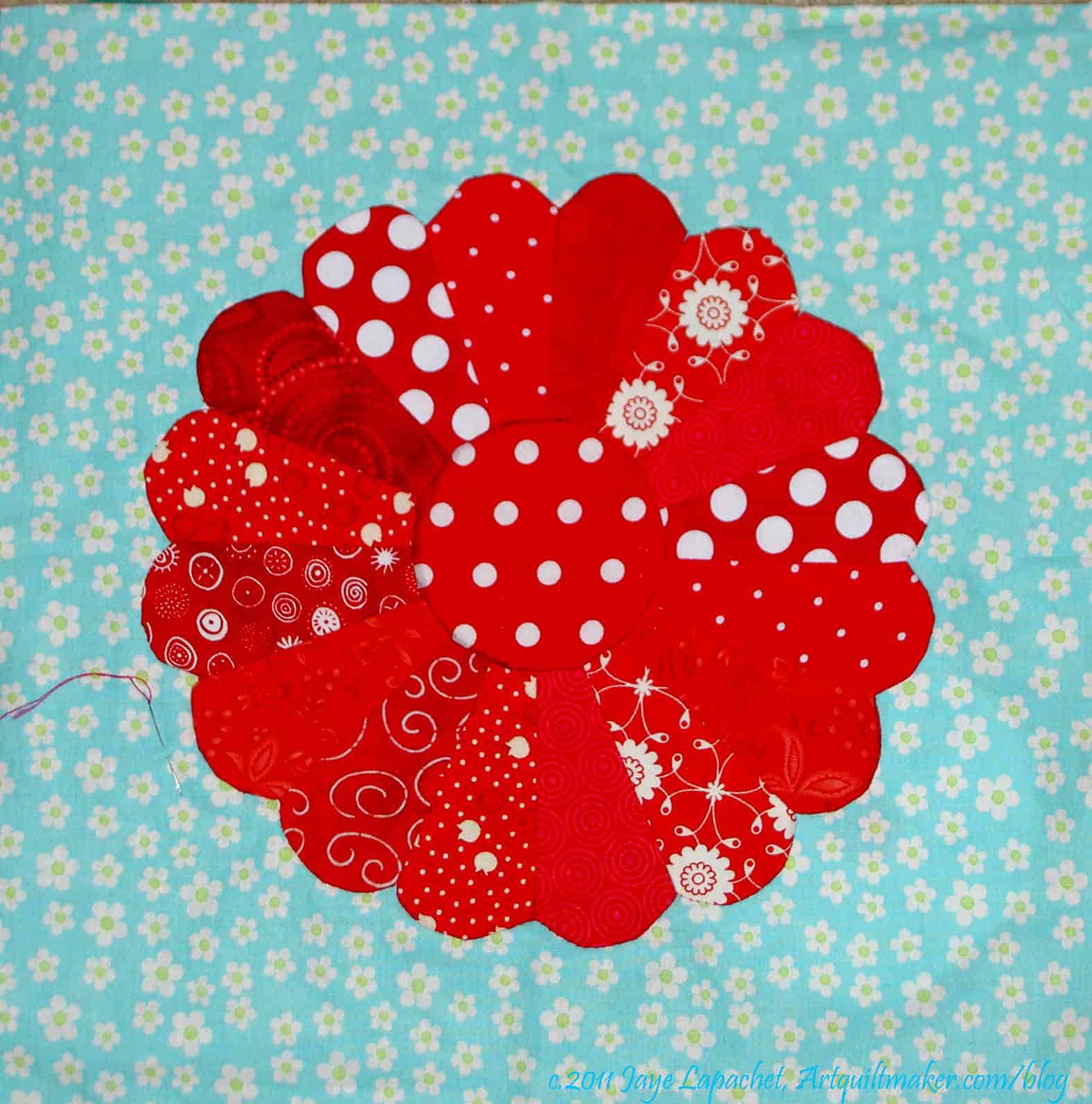
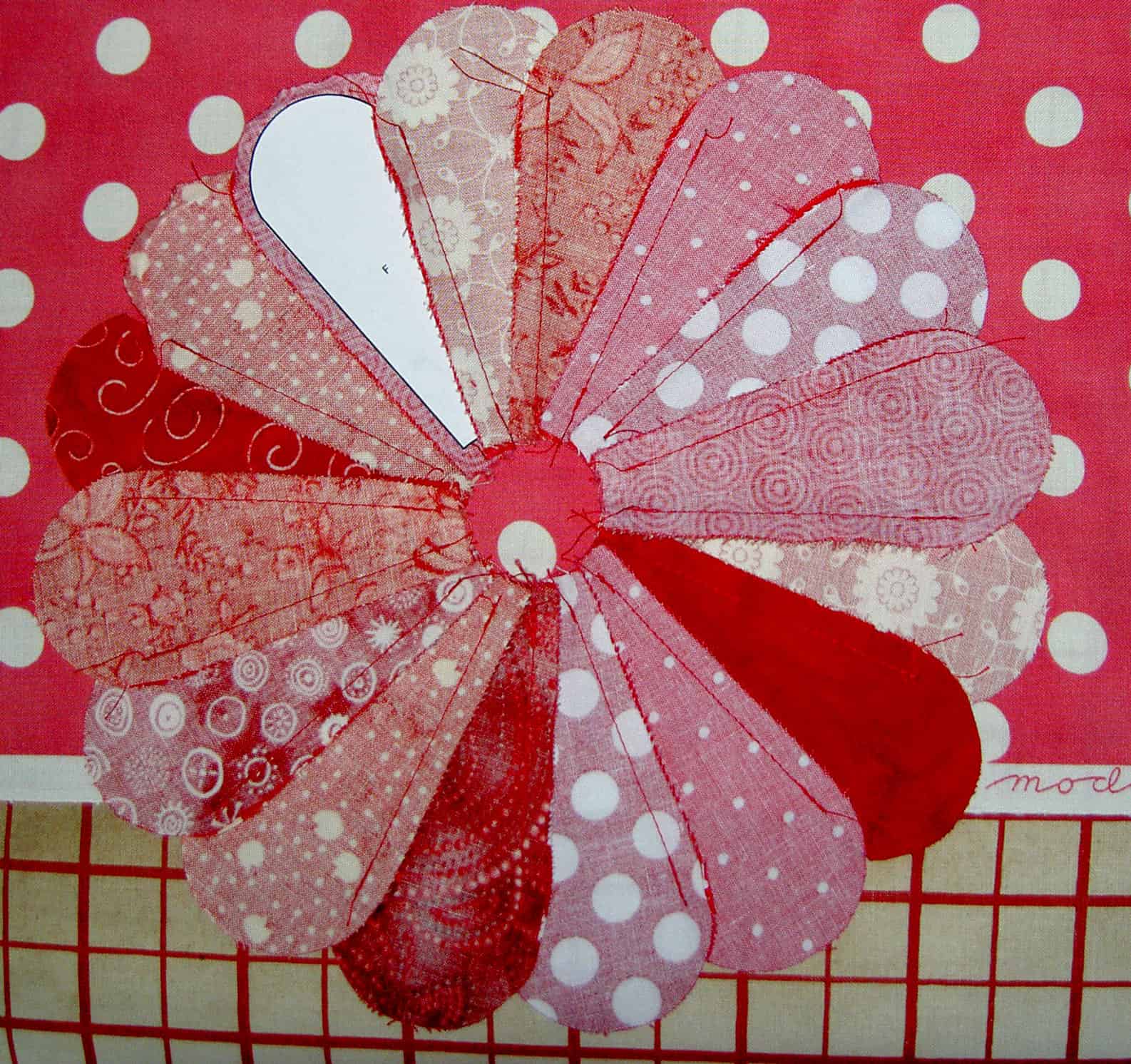
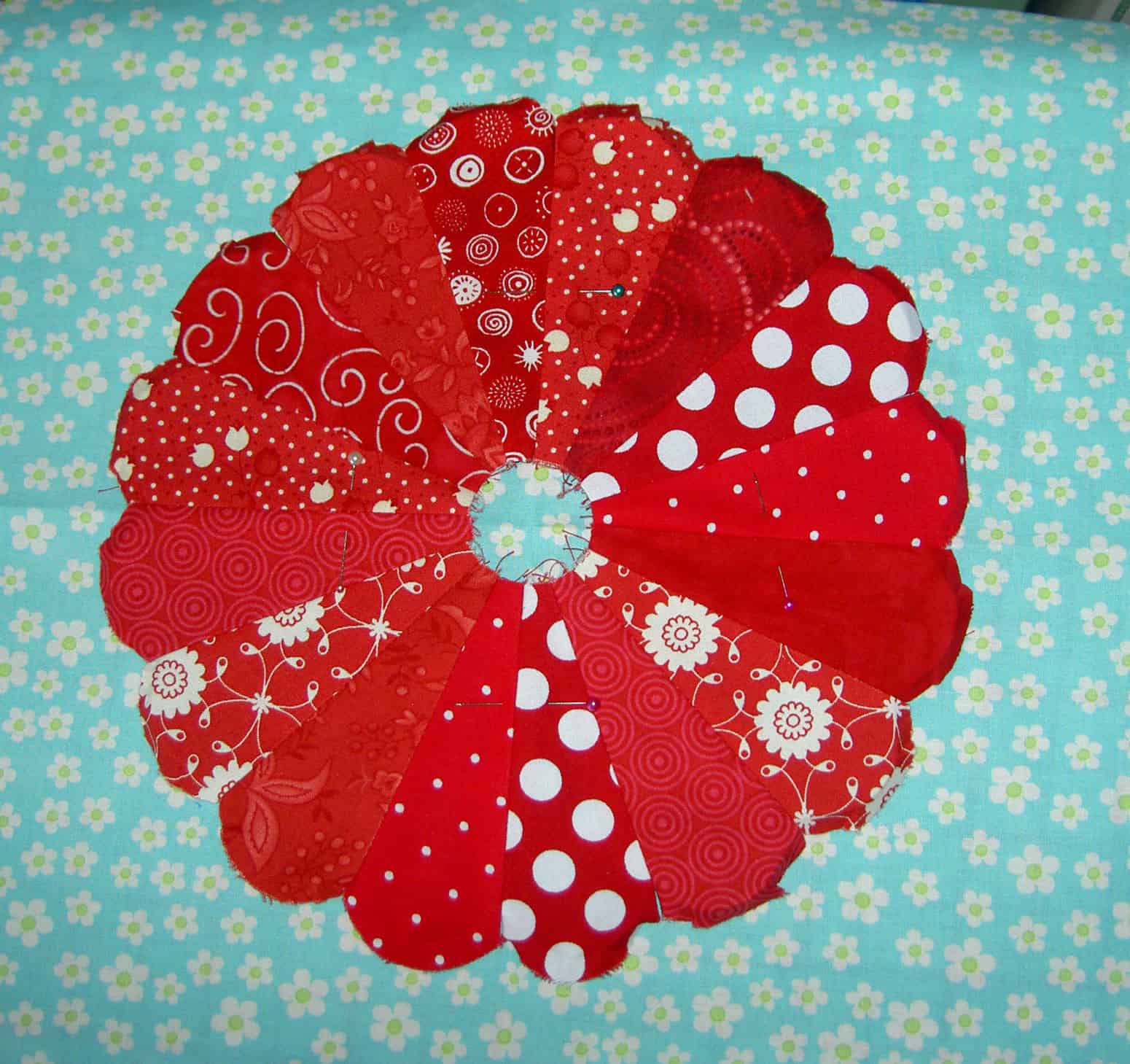
The irony is that when I spoke to her I hadn’t sewn (sewed?) down the middle circle for my DP either! I confessed and she was gracious about it. My problem is 1) I can’t decide the size of the circle I want to applique’ and 2) I can’t decide on the fabric. The 2 go hand-in-hand, I think. I thought I had figured out what I want with the lovely Little Plain Jane flowers from Michael Miller. As Lorraine Torrence says “make visual decisions visually,” so I cut one out, pinned it on (see above) and looked it. No go. I think the size of the Little Plain Jane flowers from Michael Miller is a little too big, but it might look ok in a different fabric. The fabric just wasn’t working for me in this context. I love it, don’t get me wrong, but not for the center of my Dresden Plate.
My next thought was to find another red that has a bit more white in the design and see if that works.
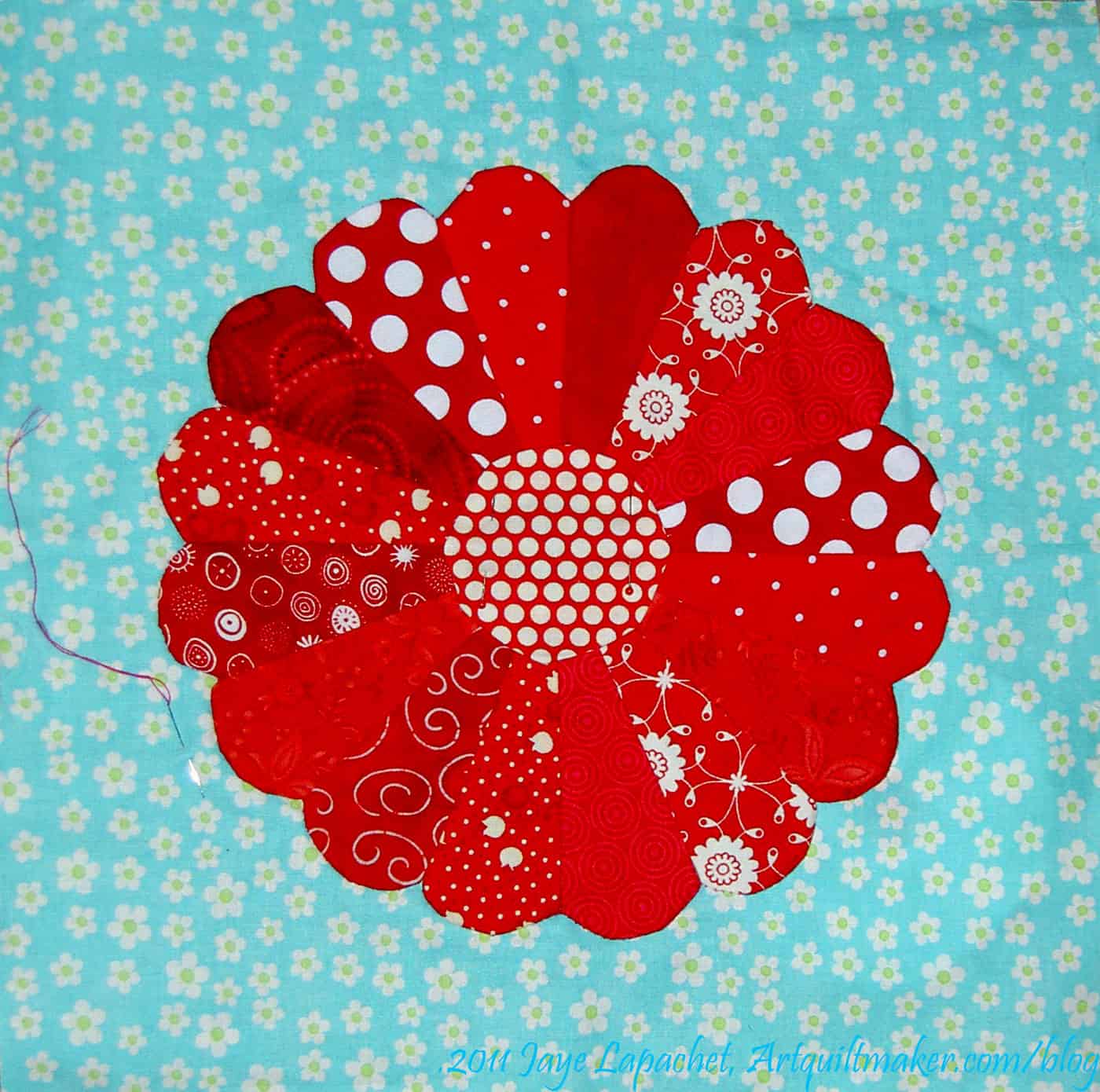
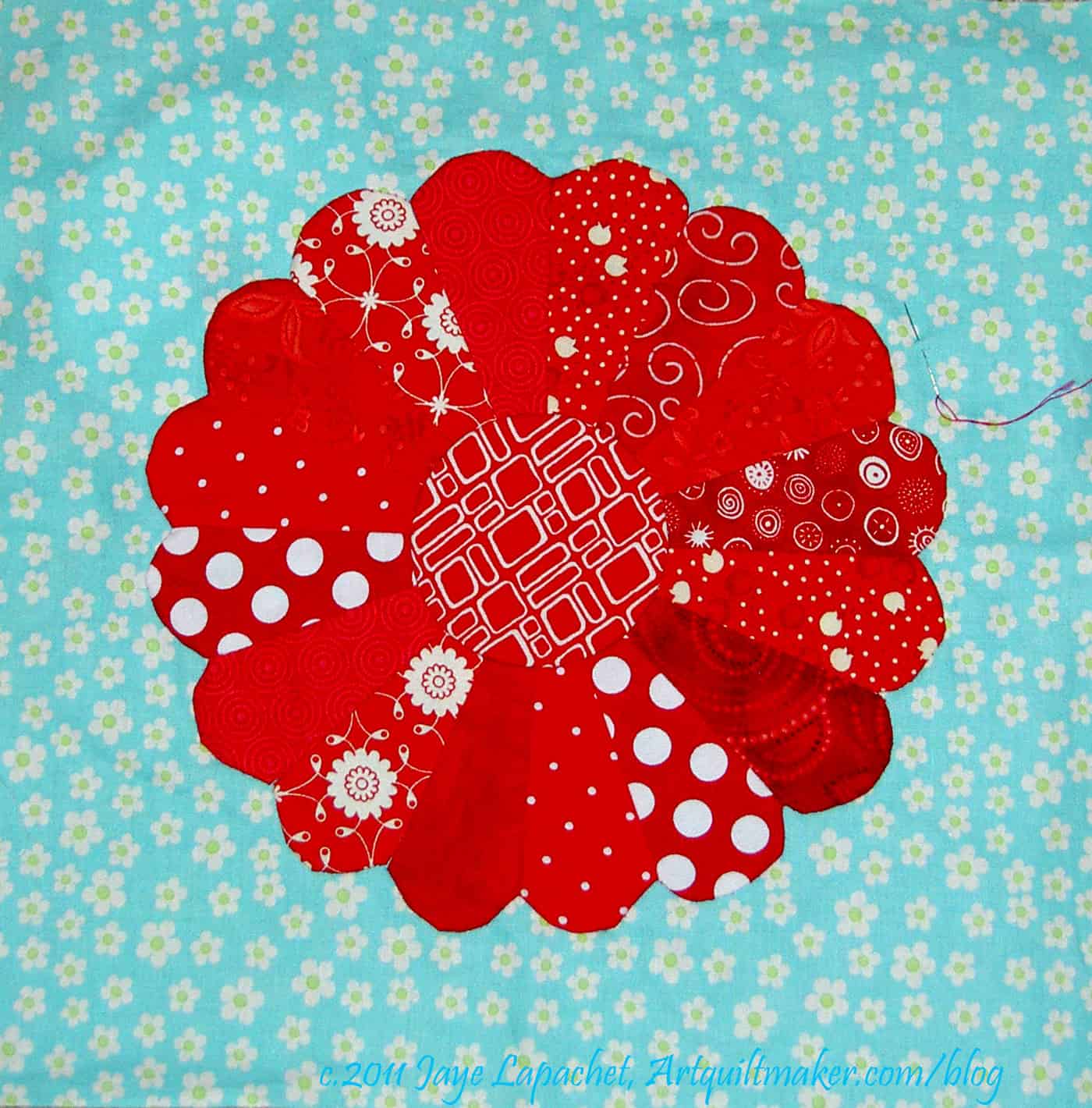
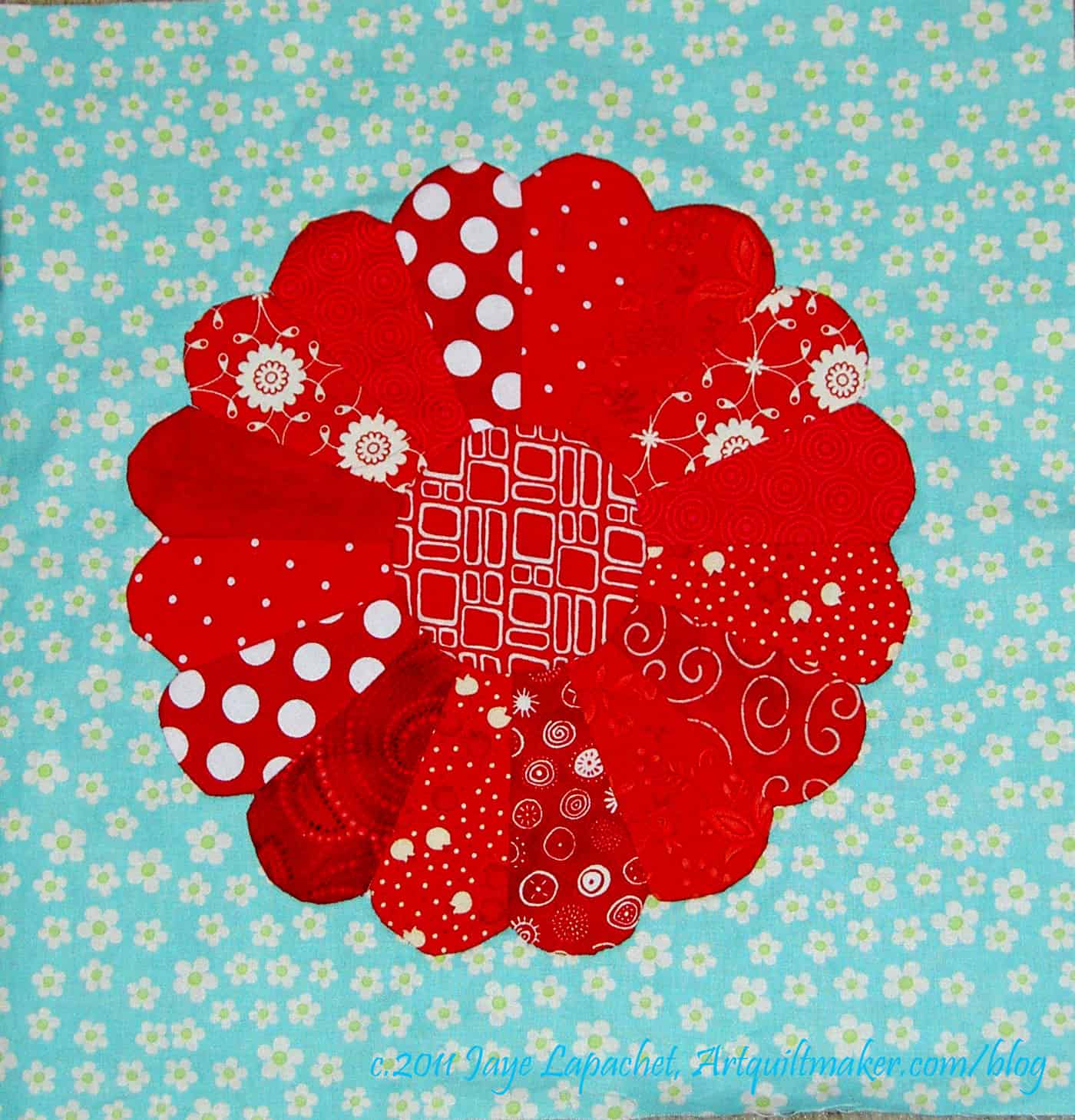
DP with Bliss dot circleDP with Bliss circleDP with Pimatex Basics Dot circleDP with an RK print, Mingle
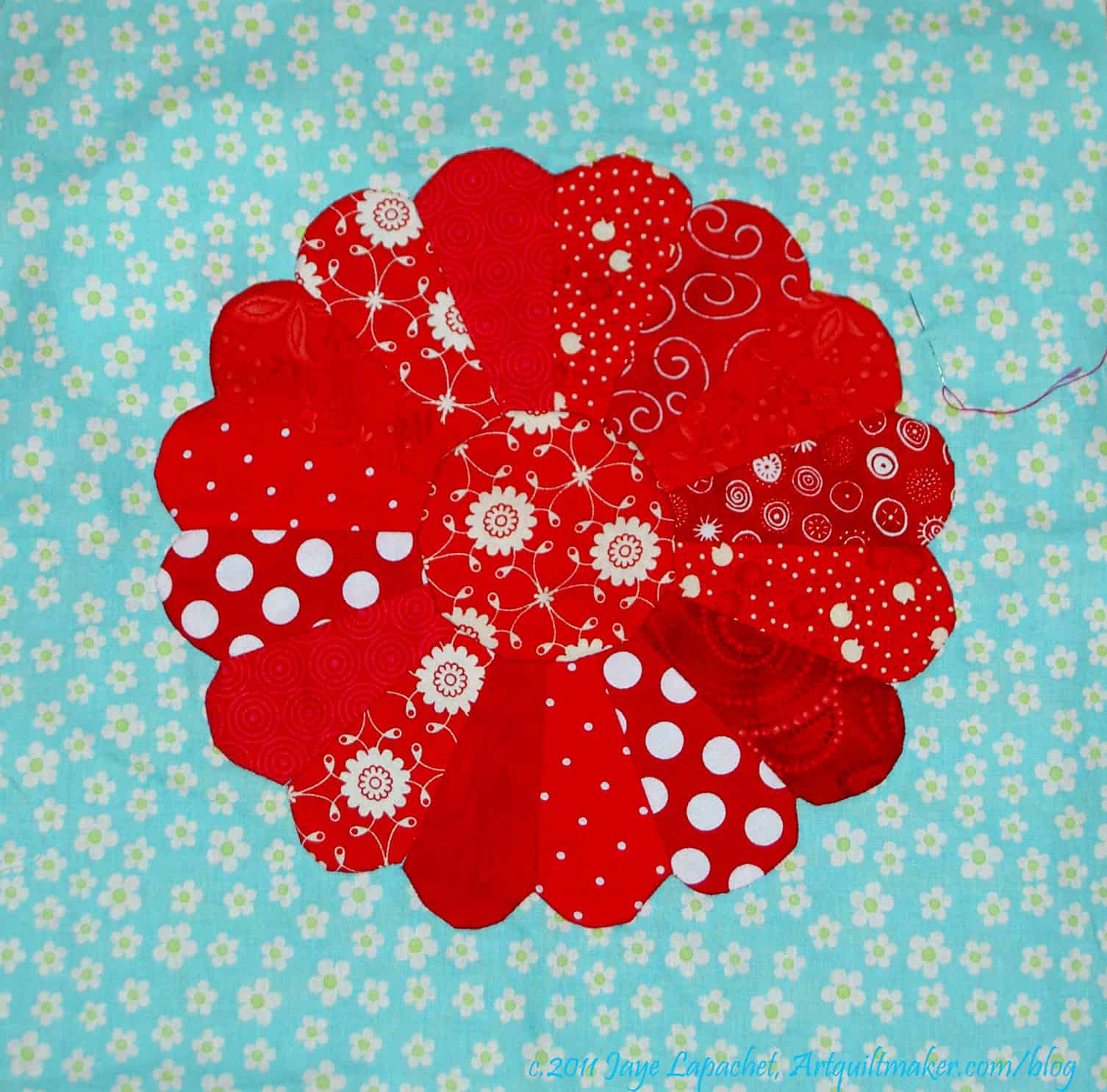
In different ways, I liked all of the choices, but I finally decided on the Mingle circle and appliqued that on.
Dresden Plate with Mingle Circle - Final
Just a note about the applique’. Hand applique’ is not my strong suit. Still, I firmly believe that a quiltmaker should learn all different techniques so s/he can select the appropriate technique when making quilts. I know that Frances struggled with the hand applique’, but at least she knows how to do it. This was the hardest lesson yet, because it really requires looking at someone actually doing the applique’. Frances is a trooper for trying.
Chris from Quilt Bits sent me the directions to make a cover for a composition book. I bought one to test the directions (which I am sure are perfect!), but haven’t done it yet.
DH & I thought that having a book where we could write things about the house would be a good idea. I further thought that I would use Chris’ directions to make a cover for the composition book and incorporate a Liberated Quilting house block into the cover. I haven’t done it yet, but that whole thought process led me to the name for this block.
I love the 4 patch block. Mostly I like the simplicity, but I also like how it can be used as a building block for other blocks and projects.
You can use two fabrics, placing them on the diagonal from each other or you can use 4 fabrics for a more scrappy look.
This is block number 20 (I put up the 9 patch twice and haven’t replaced it yet), so I have made a quilt from all the blocks in the project to show you.
The quilt is made from all 20 blocks and you can see how complex it looks, even though each block is pretty easy to piece.
20 Block Quilt
I probably wouldn’t put a black border on the quilt again, but it does contain the variety.
If you have made blocks or a quilt, post a link in the comments section of the relevant block or on the AQ Block-a=Long Flickr group.
You might think that the blocks are too simple, but when they are all put together in one quilt without sashing, they will make a very interesting quilt.
If you make this block, please put a link to it in the comments. If you do not have a blog or website, you can post it to the AQ Block-a-Long Flickr Group.
This very simple block reminded me of a flag motif, probably an American, Australian or Union Jack flag, since there is such a wide variety of flag designs. Also, the symmetry of various flag designs varies greatly. Another easy, small block. Backwards Flag are available.
All blocks are 6″ finished.
This block is probably best suited for 3 fabrics.
If you make this block, please put a link to it in the comments. If you do not have a blog or website, you can post it to the AQ Block-a-Long Flickr Group.
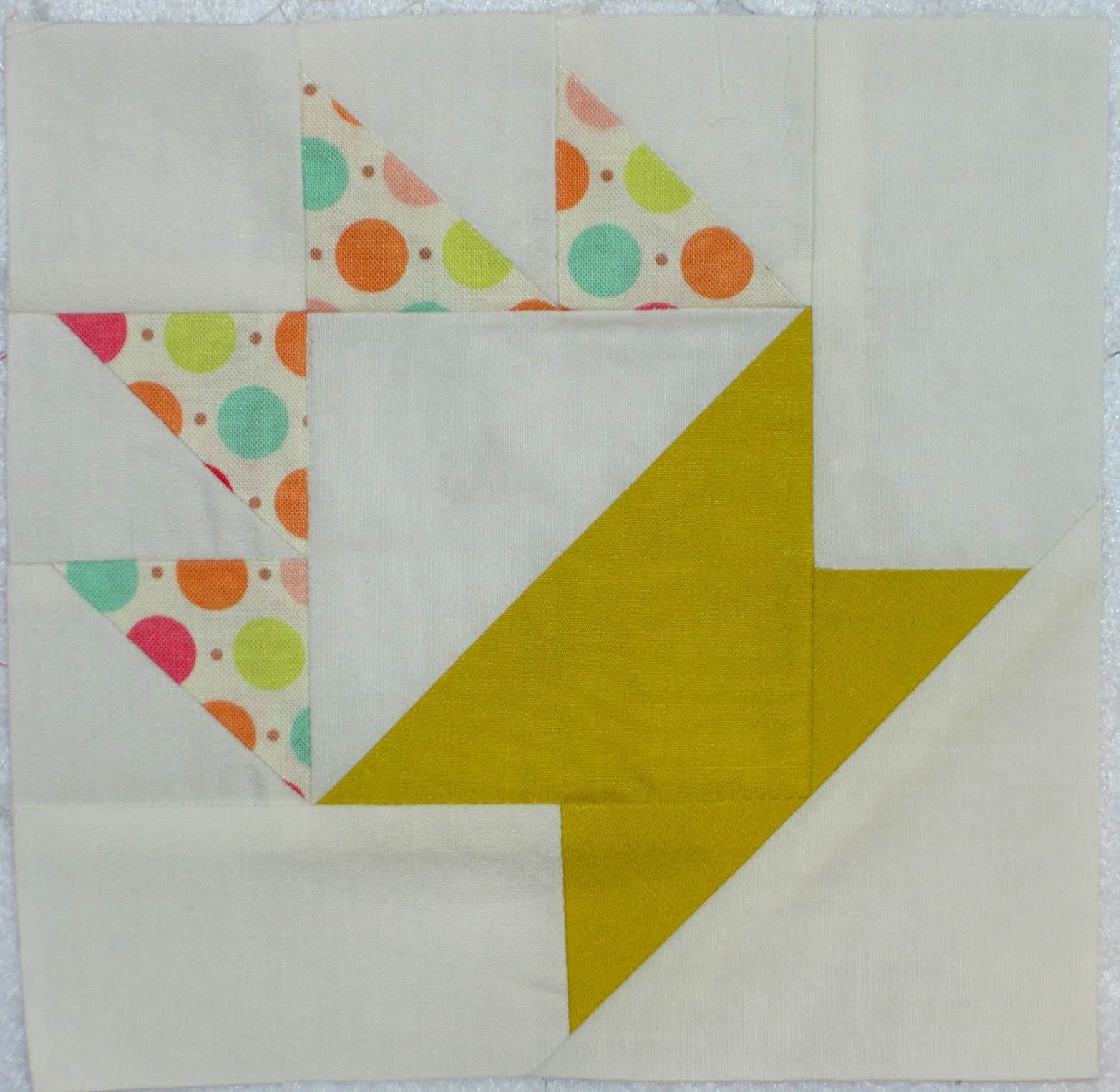
I am a sucker for basket blocks. Cake Stand is a classic. Even though I said I was going to use Around the Block Again and Once More Around the Block, I took a quick peek at Around the Block and couldn’t prevent myself from making this block. I have to admit that the templates that I mentioned in the last post about the project make me not want to use those books. They are not hard to use and it isn’t that I can’t measure the templates and cut them, but I just don’t want to be flipping back and forth. I will get over myself, because I don’t want to give real estate to books that I don’t use.
The gold color is, again, one of the Pat Bravo Pure Elements. I believe it is the Empire Yellow. It has kind of a green tinge to it. I used it, because it was next on my stack to be ironed and I want a bit of a challenge in this project. The dots are a bit light for the background, so I may try the block again with a different background, but we will see.
For the moment, I am still making one block for each letter. I may make seconds for some of the letters. I am going to kind of go with the flow and see how the project evolves.
This block reminded me of a part of a tile floor. I wanted to name it tile floor. I am trying to keep these blocks organized by grid. This is, essentially, a 9 patch grid and shares a lot of elements with the 9 Patch Go Round. You probably need at least 3 colors for this, but 5 would add interest.
I really did want to do the Farmer’s Wife Quilt-a-Long, the Summer Sampler Series and the ABC Challenge at BAMQG, but decided that I can’t do everything. I have other projects to get busy on, too. As much as I would like to just make blocks forever, I have to do other things. The most important group block project right now to me is the guild’s ABC Challenge. The group is doing two 12″ blocks every month. I am doing one 6″ block.I want to support the BAMQG, so, finally, after getting behind by 2 letters, I sewed two blocks on Sunday.
I might do two if I have time and find two block patterns I like, then I will do two. For now my parameters are:
6″x6″ blocks
One per month
Pat Bravo Pure Elements solids
Riley Blake Sweet Nothings by Zoe Pearn dot
I didn’t find any blocks I felt like making in my favorite block book, Around the Block, so I pulled out Around the Block Again and Once More Around the Block and found the two blocks I made in the former. I was shocked to find that some of the directions included ‘T5’ and ‘T42’ rather than a number of how to cut the patch. It turns out that there are templates in the back. I assume the author intends me to cut them out and use them that way. Instead I measured them and realized that she used templates, because the sizes are weird: 1 5/8, 2 7/8, somewhere in between 3 5/8 and 3 3/4, etc. I just cut to the nearest larger size and trimmed as I was making the blocks. Perhaps that is why I haven’t used this book much until now?
Basement WindowAir Castle
Yes, the blocks are bright. I want bright and I want to use some of the new fabric I have purchased recently. I may add other prints. I will use more of the Riley Blake/Zoe Pearn dots. For now, I am still experimenting with how much white works and how the solids I have look with each other. The next block may be different.
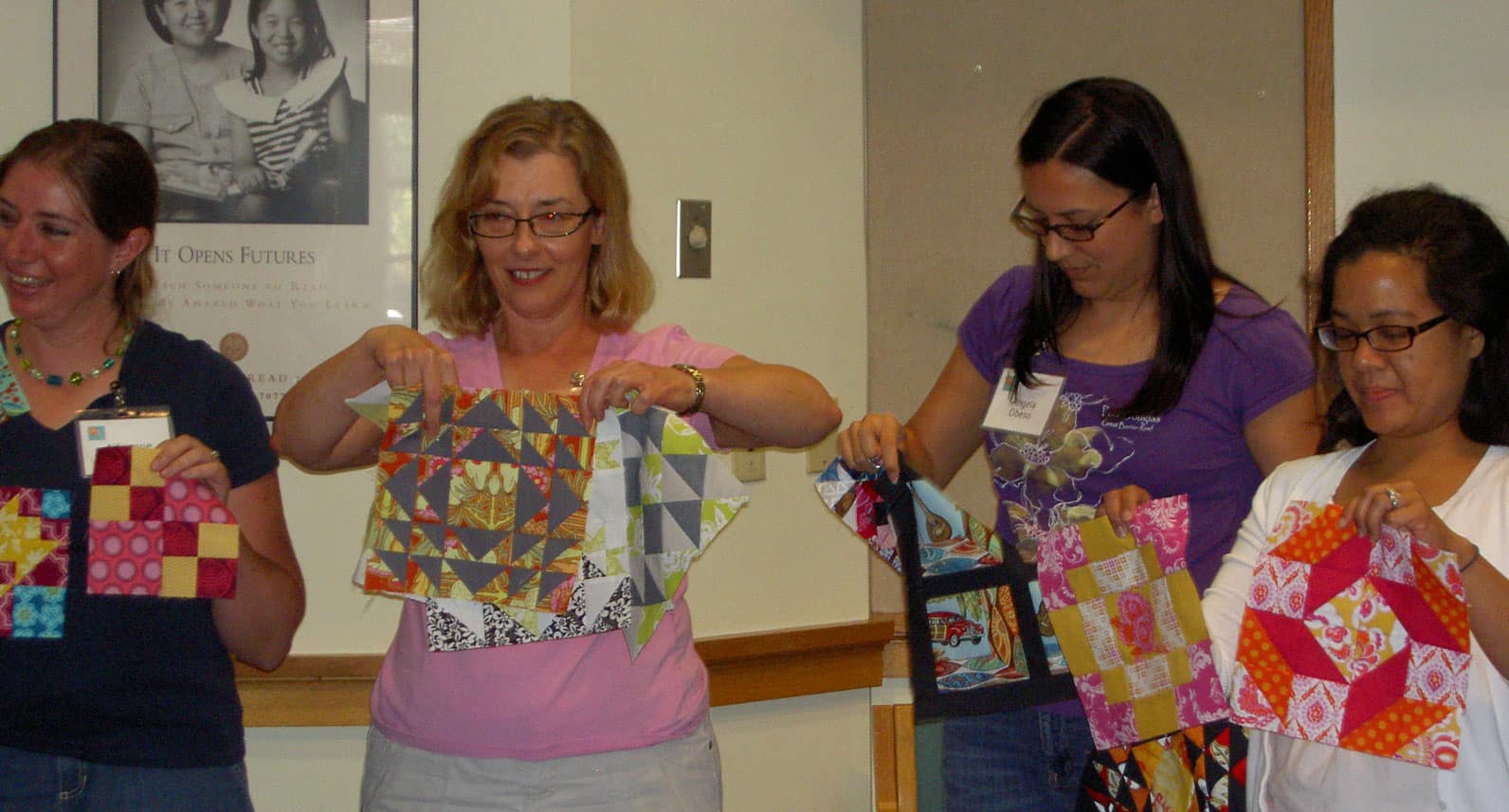
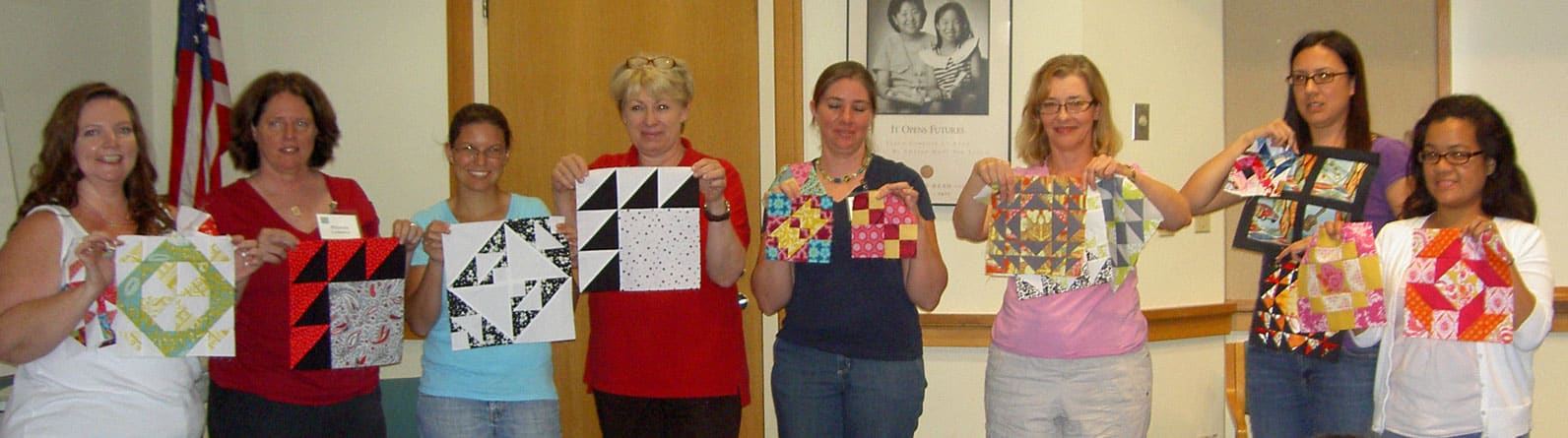
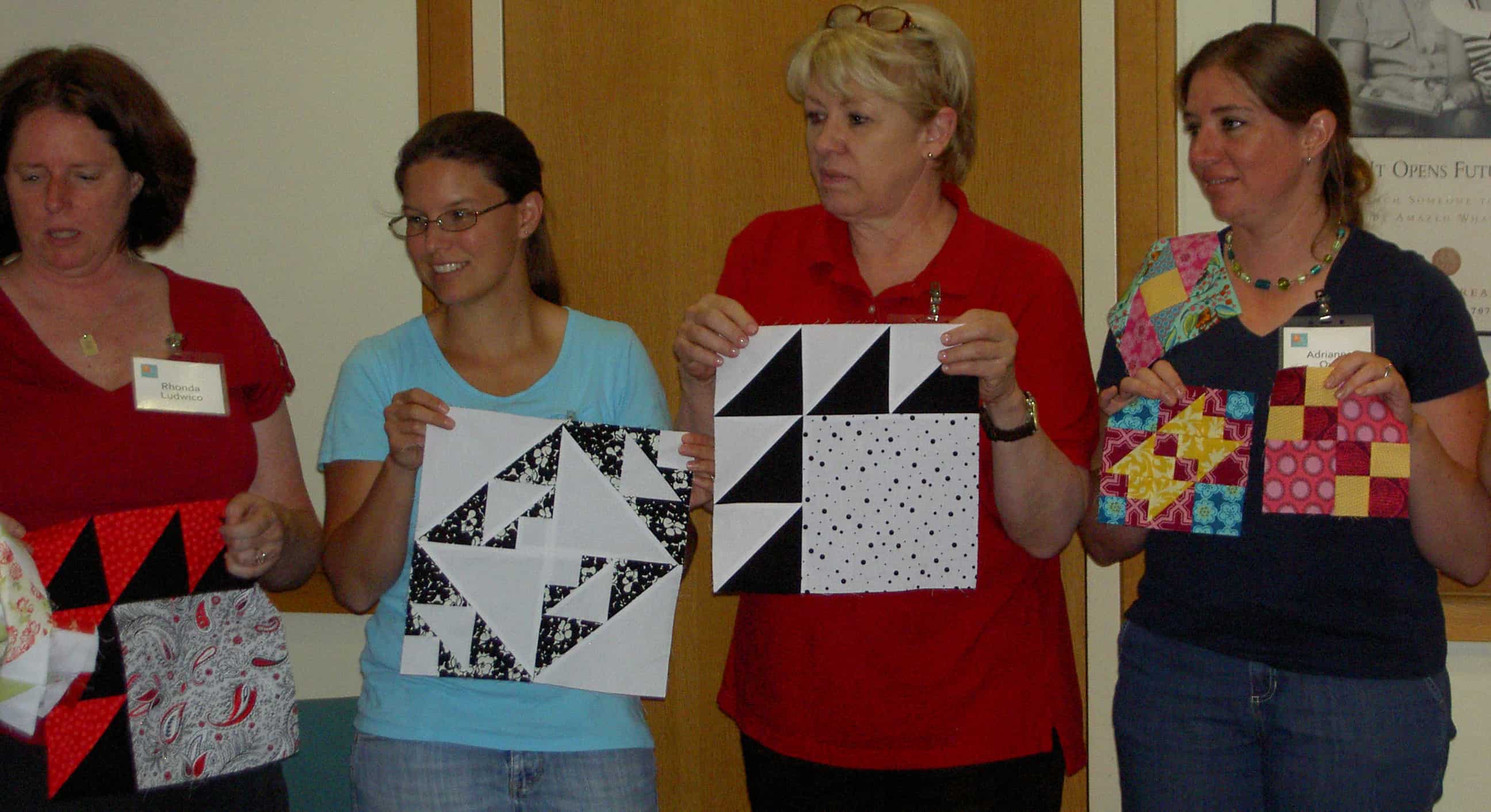
Some of the blocks that other members made are below.
I have always enjoyed making blocks. I don’t do it enough. As I have been walking past these blocks all week (they are displayed on my design wall) they are making me feel happy. Perhaps they don’t have as much interest as some blocks with other fabrics would, but they are really cheerful and are making me itch to get back to the sewing machine. I wonder what block is next?
The next block is the Dresden Plate, which we are making using templates. If you would like to see a wide variety of Dresden Plates, you can do a Flickr search to see what others are doing.
Supply list:
pen
heat resistant template plastic
Glue stick
paper scissors
Pilot SCUF black thin point pen or Pigma Micron or Sewline pencil
magazine subscription postcard or small piece of scrap card stock
pins
12.5″x12.5″ or larger square rotary cutting ruler
fabric
Mary Ellen’s Best Press (or similar)
stiletto or similar (popsicle stick might work)
sharp fabric scissors
thread for piecing
sewing machine
basic sewing kit
Auditioning Fabric
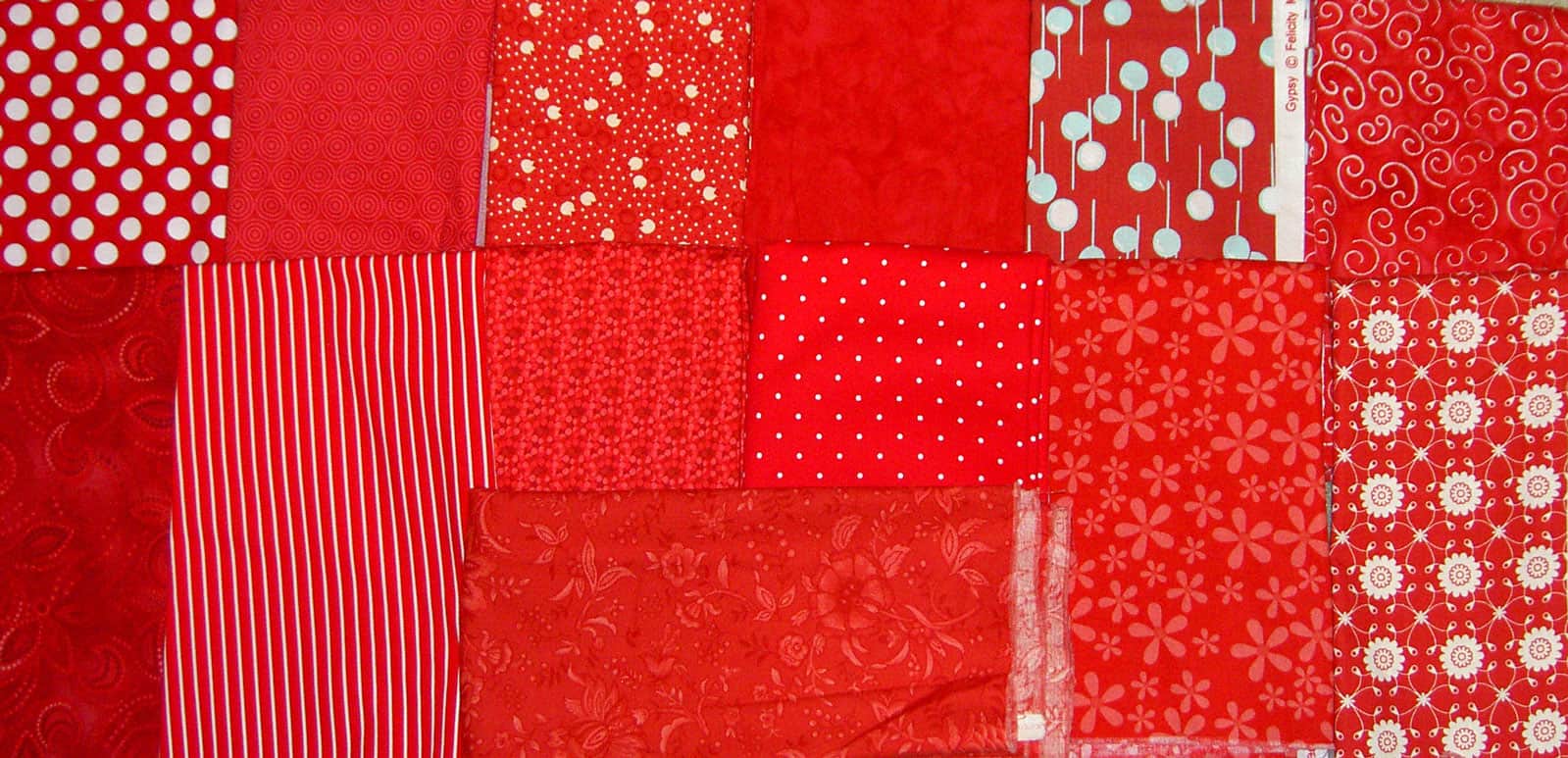
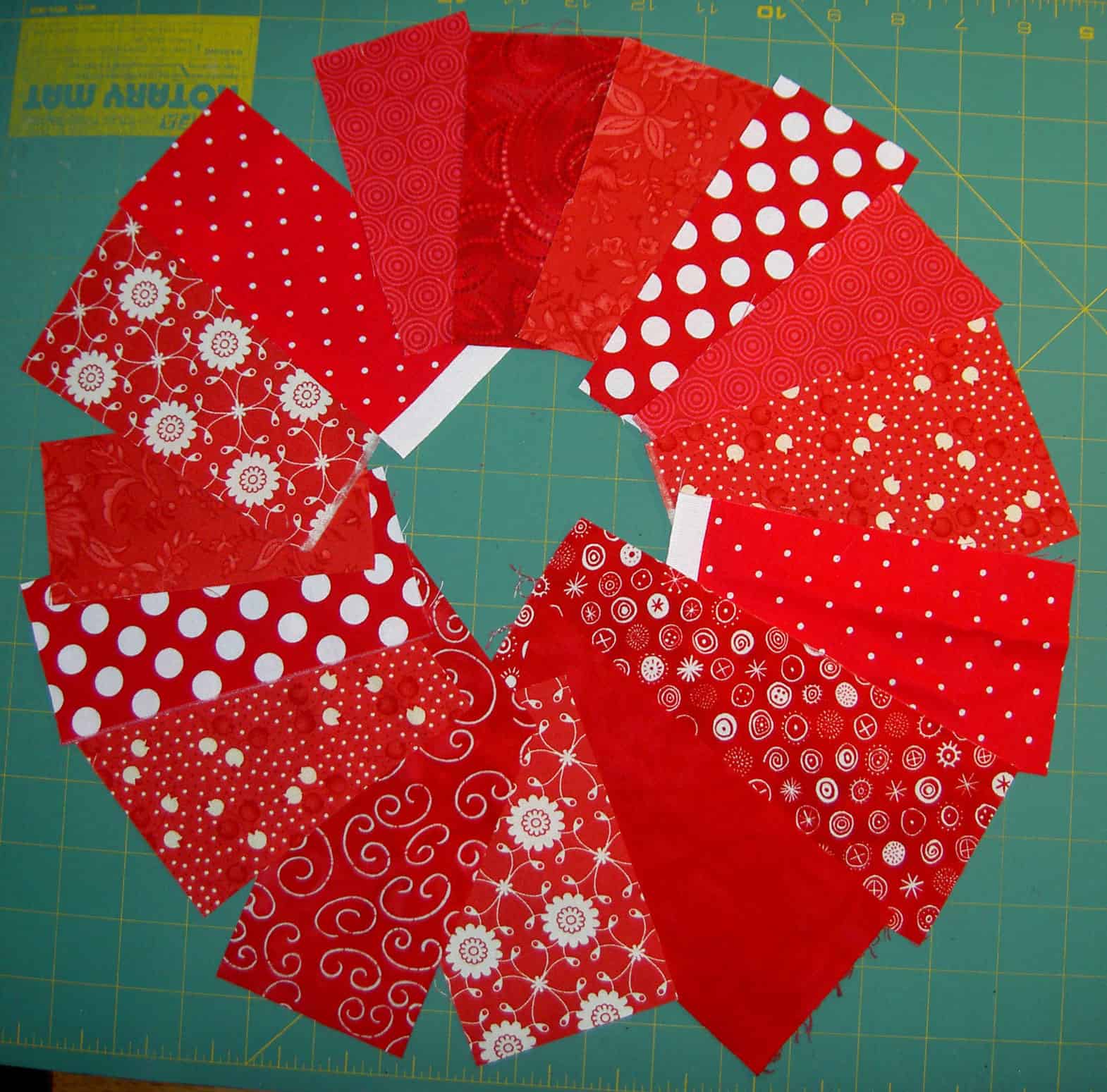
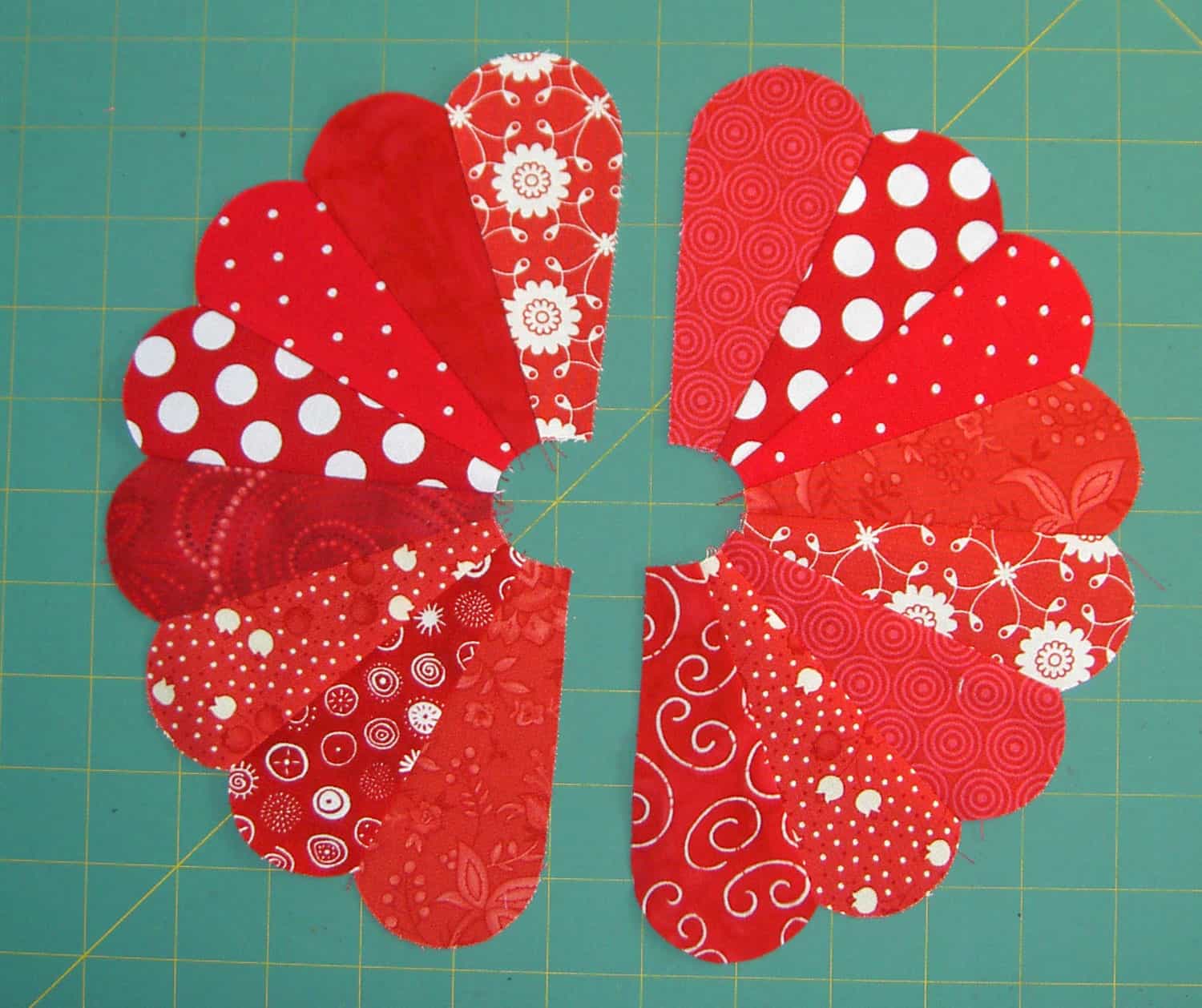
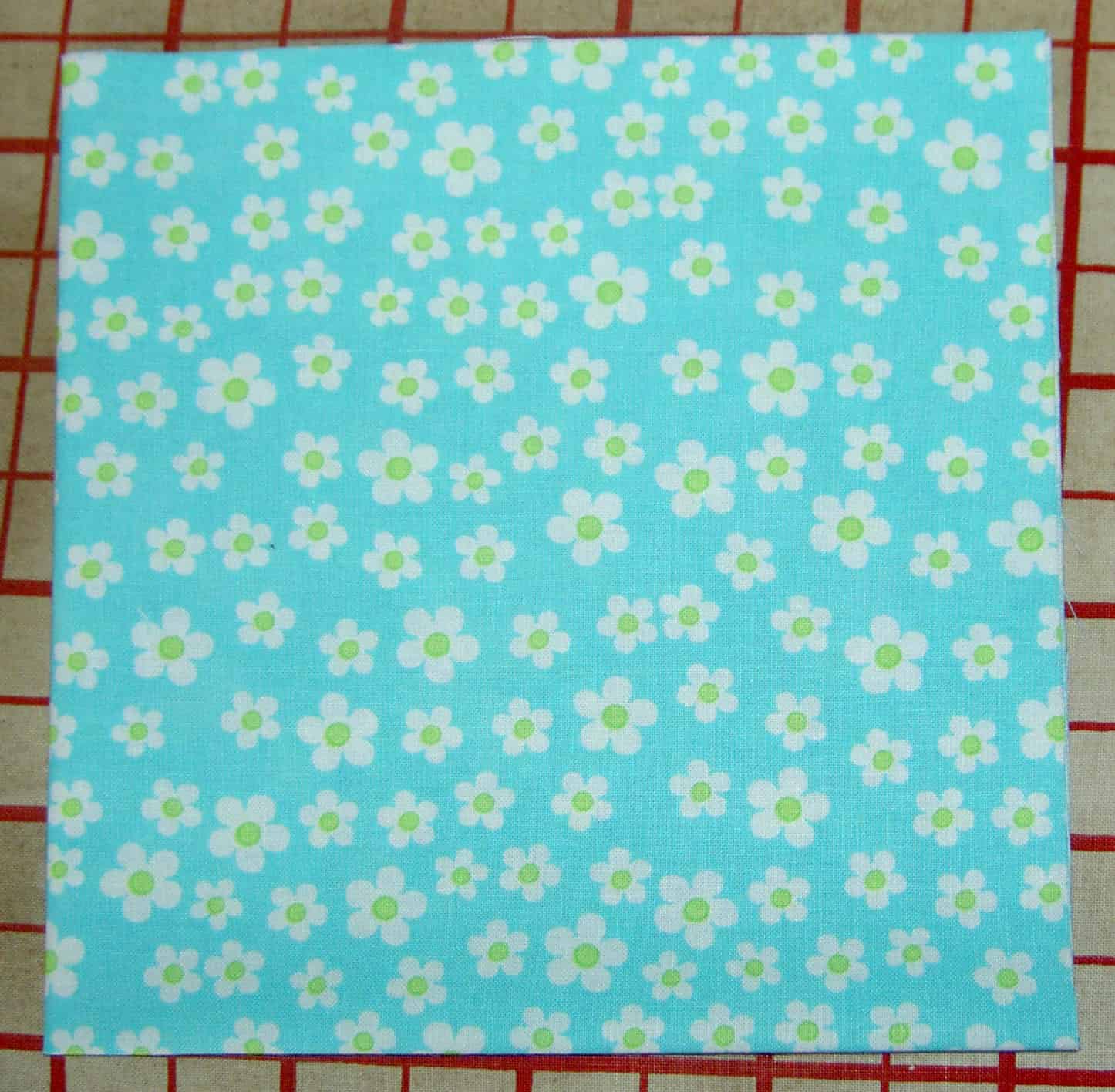
1. Select your petal fabrics. You can use 2 or many. You want to be able to see the work you have put into this block. Above are all of my options. I didn’t end up using all of them.
2. Print 3 copies of Dresden Plate Templates pattern. Two you will cut out and one you will keep for future reference.
Rough cut templates out of pattern sheet
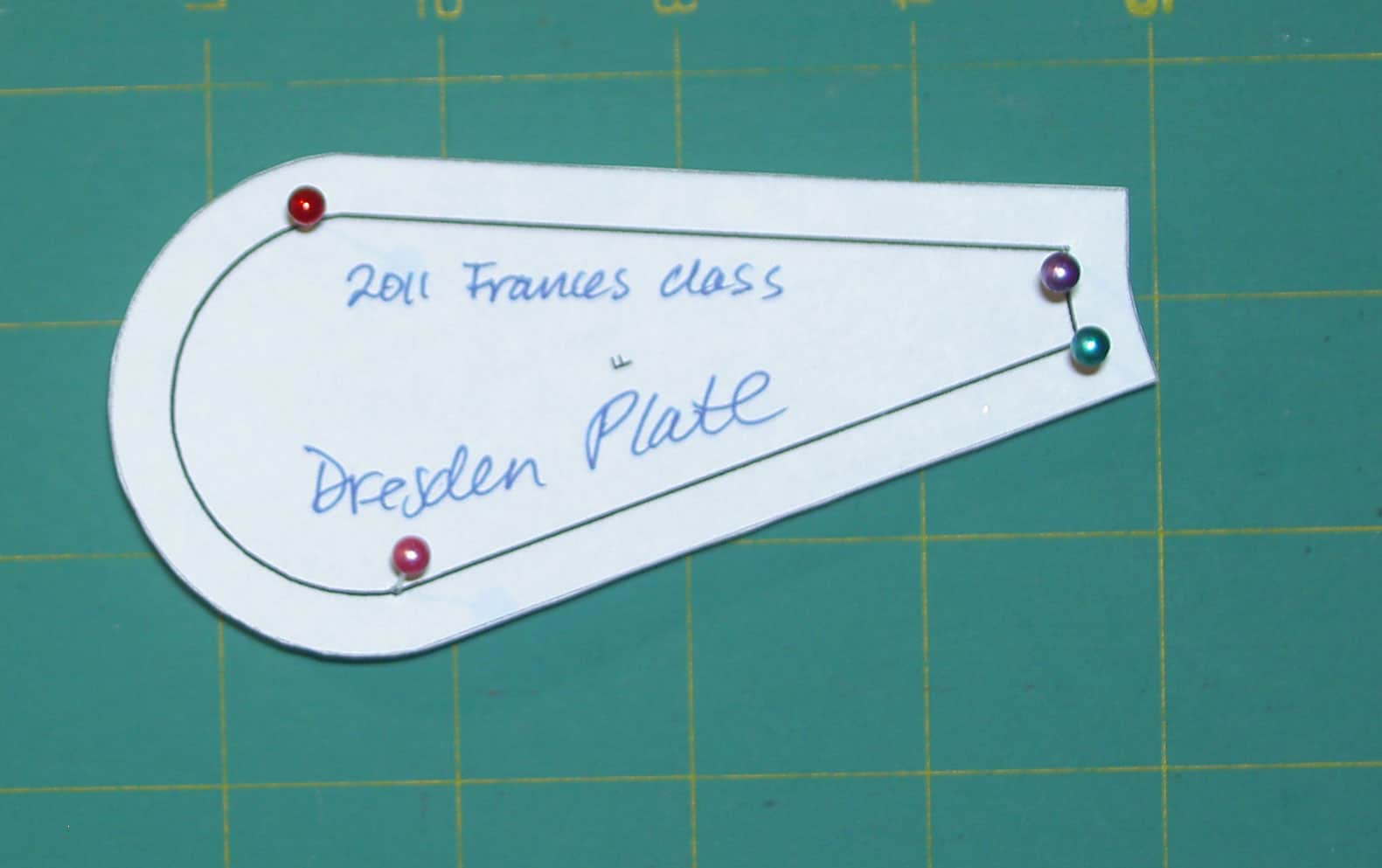
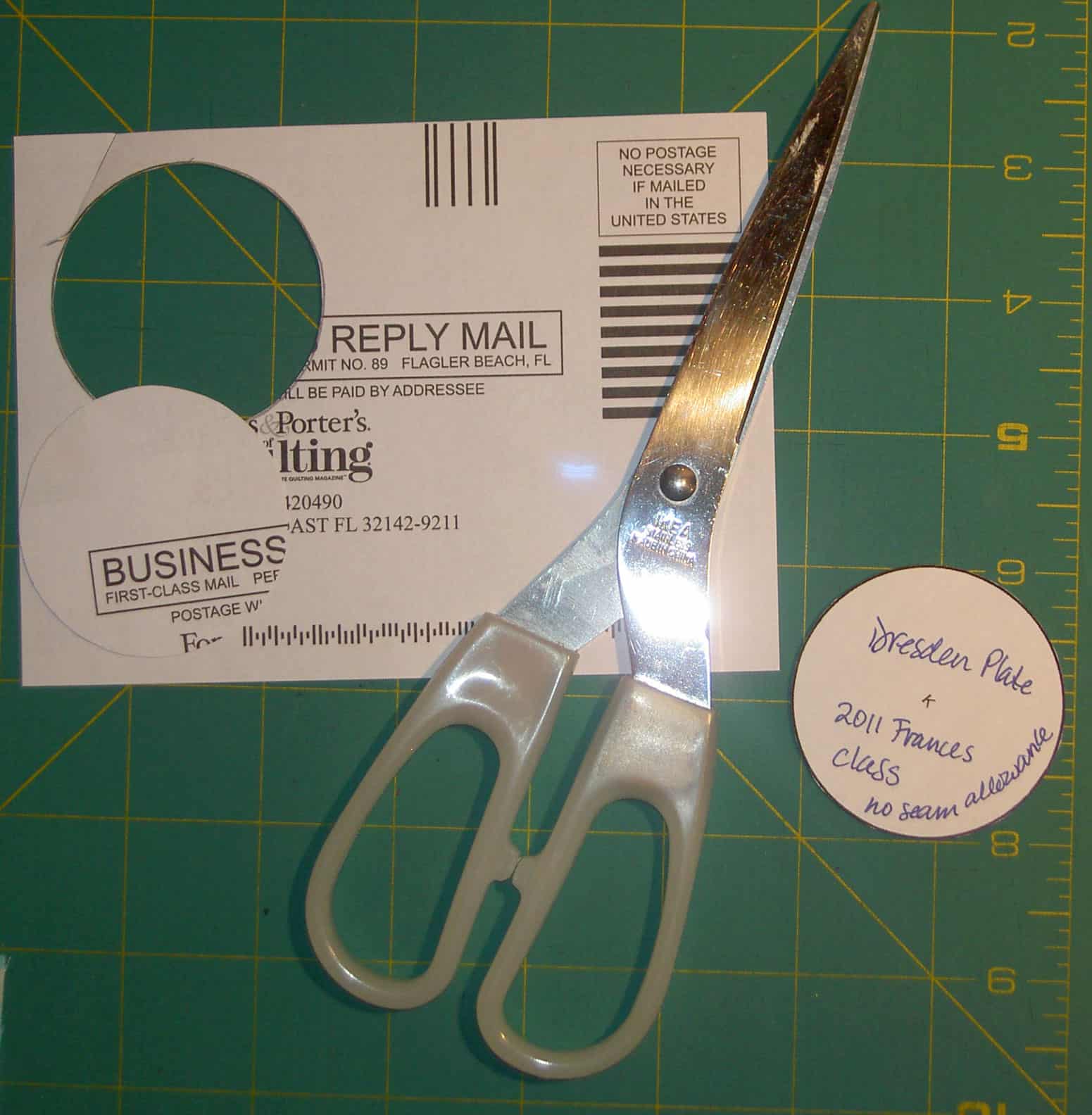
3. From one pattern sheet rough cut around the petal and the circle including the seam allowance.
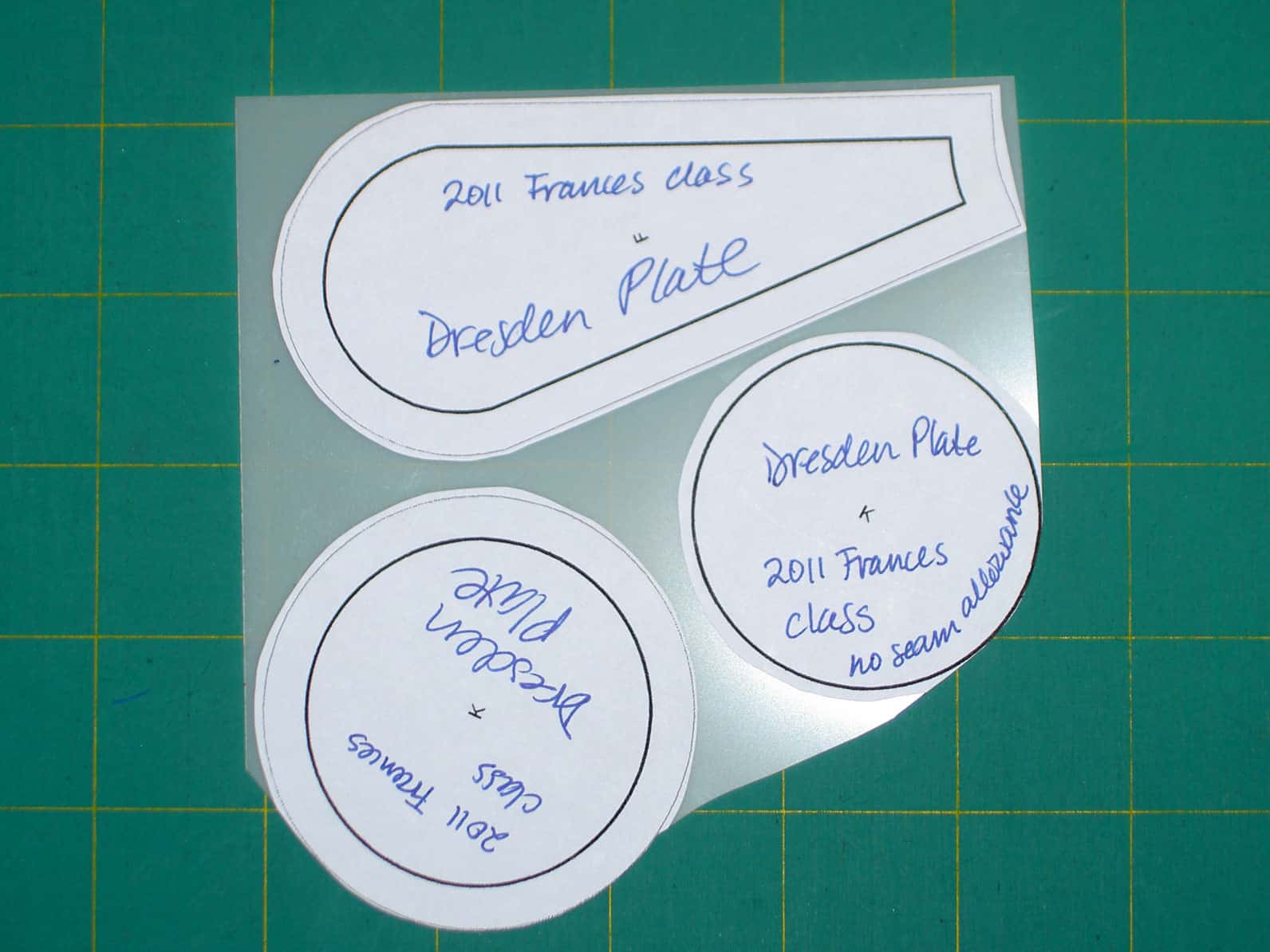
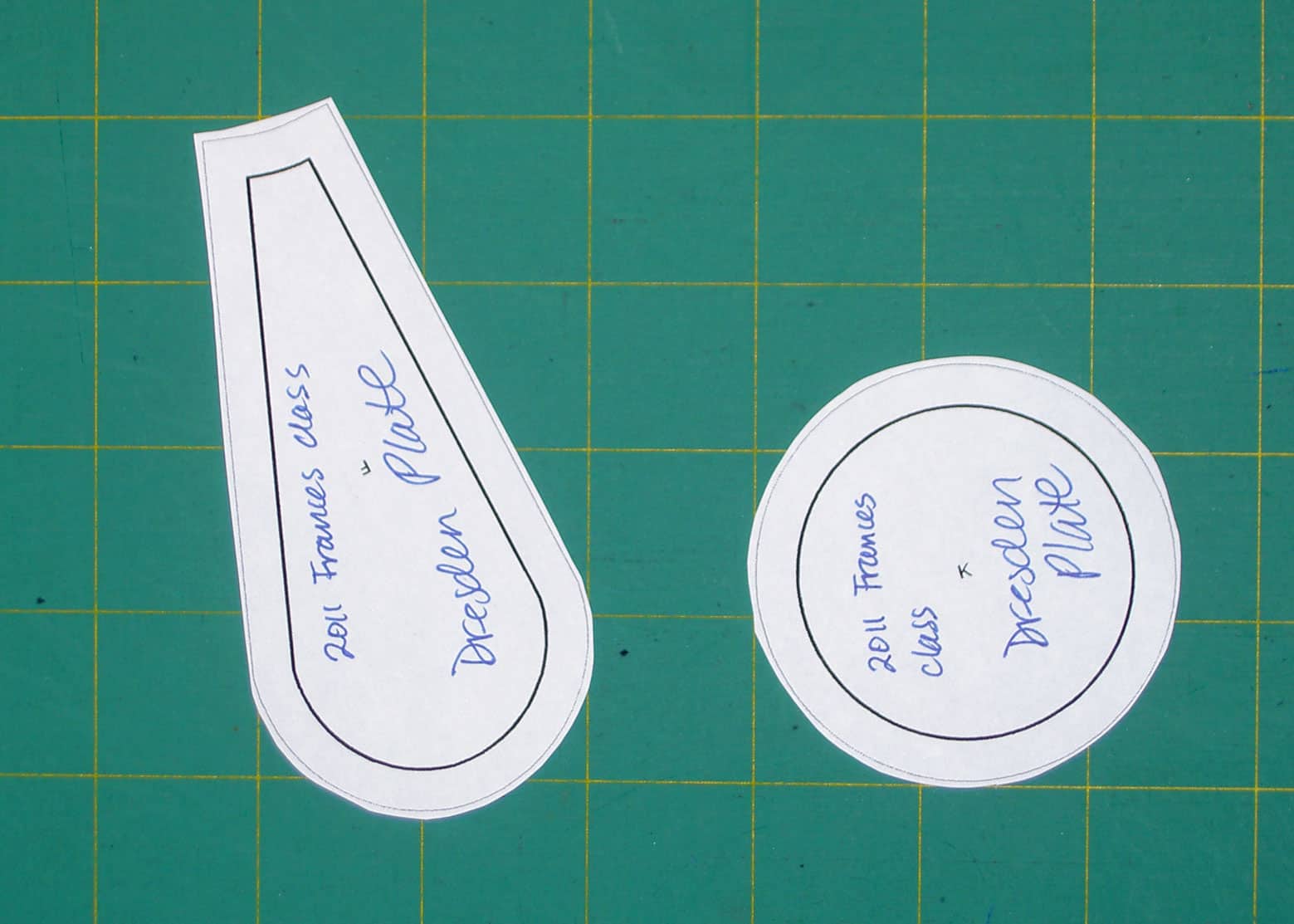
4. From one pattern sheet rough cut around the circle template and the petal template excluding the seam allowance. On the petal, cut off the thick black line. For the circle, leave the thick black line on the template.
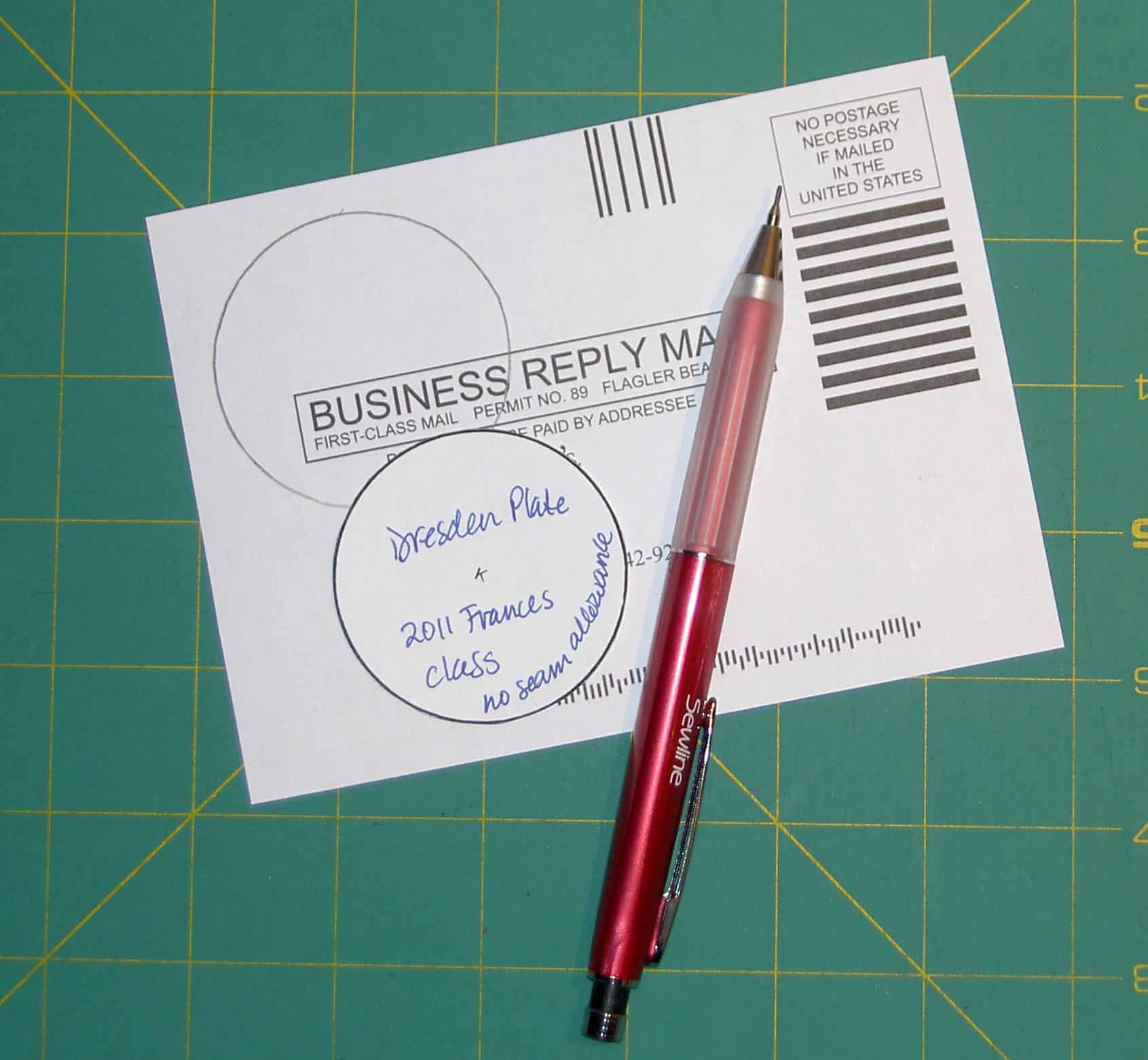
Optional: Write ‘Dresden Plate” on each piece (or some way of identifying why you made these templates for later). Make a notation on the circle with no seam allowance so you don’t it mixed up with the other circle.
Glue paper patterns to template plastic
5. Glue circle and petal templates to template plastic
Templates Cut Out
6. Carefully cut templates out of template plastic just outside of thin outside line.
Extend Lines
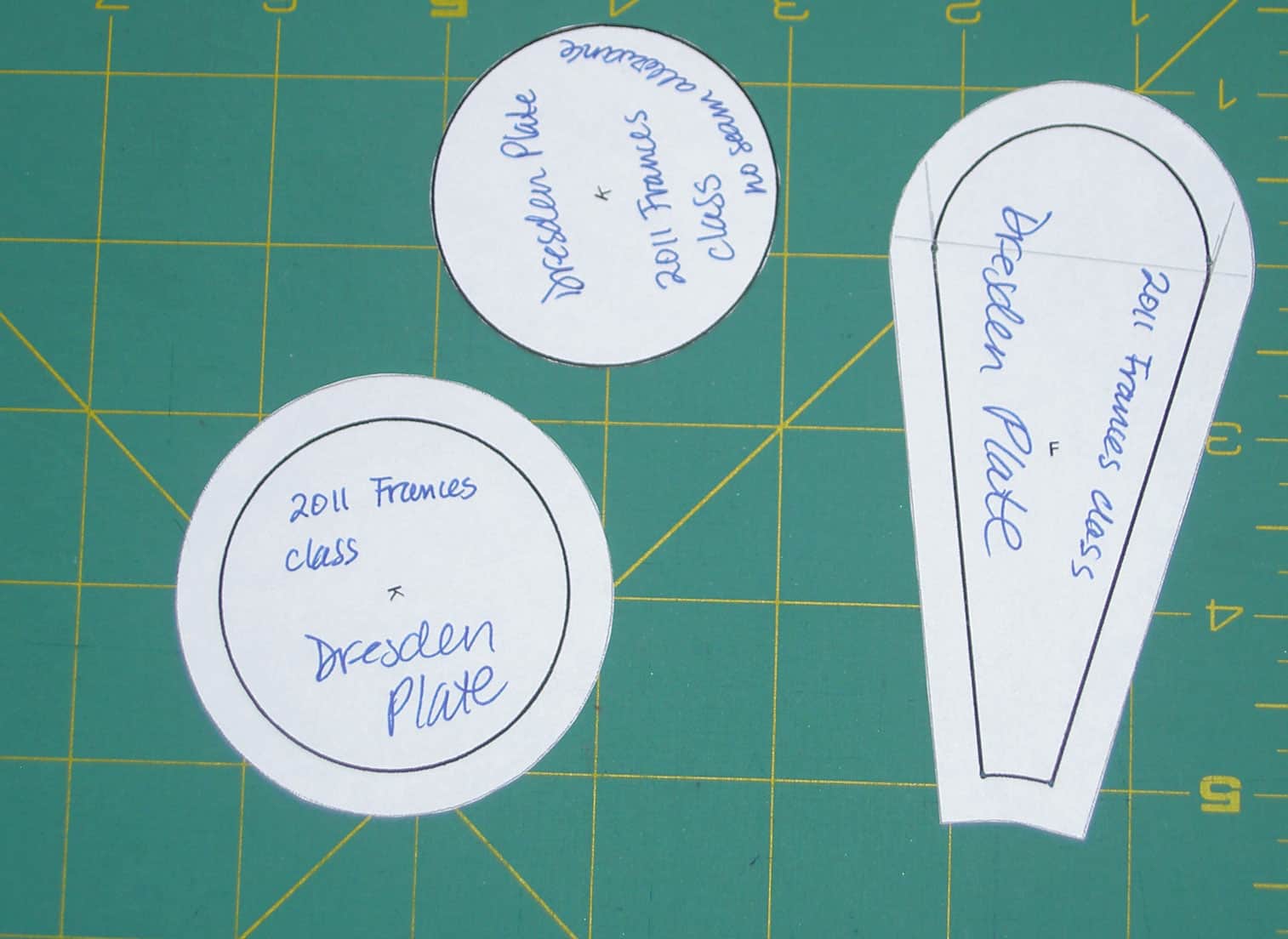
7. Extend the straight line into the seam allowance with a ruler and a very sharp pencil or pen.
8. Right where the curve starts to move away from the straight line of the template, draw a line between those two points.
Poke Corners
9. At the intersection, poke the corner of the petals to mark sewing start and stop points. I used a pin and then enlarged the holes with a seam ripper.
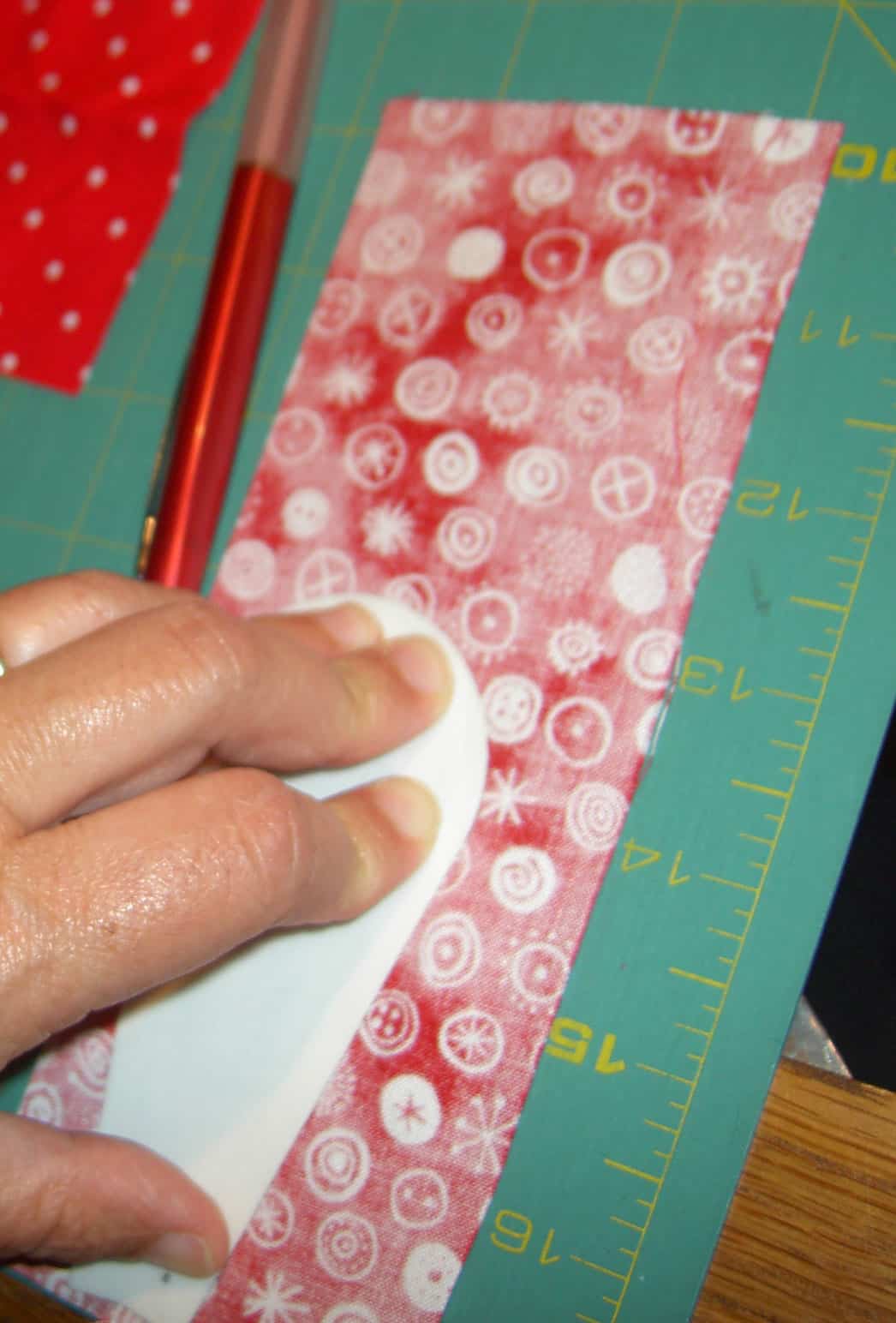
Optional: Spray rectangles of petal fabric with Mary Ellen’s Best Press to control the bias.
Trace Around Petal Templates
10. Trace around the petal template face down on the wrong side of the fabric. Hold the template tight down on the fabric with your fingers near where your pencil or pen is moving around the template.
Note: test to make sure that your quarter inch seam line covers the mark you made. If it doesn’t use a pencil.
Fabrics Ready to Trace
11. Use at least 2 different fabrics to trace 16 petals. You can use many more. You want to be able to see the work you have put into this block. If you use two, alternate them.
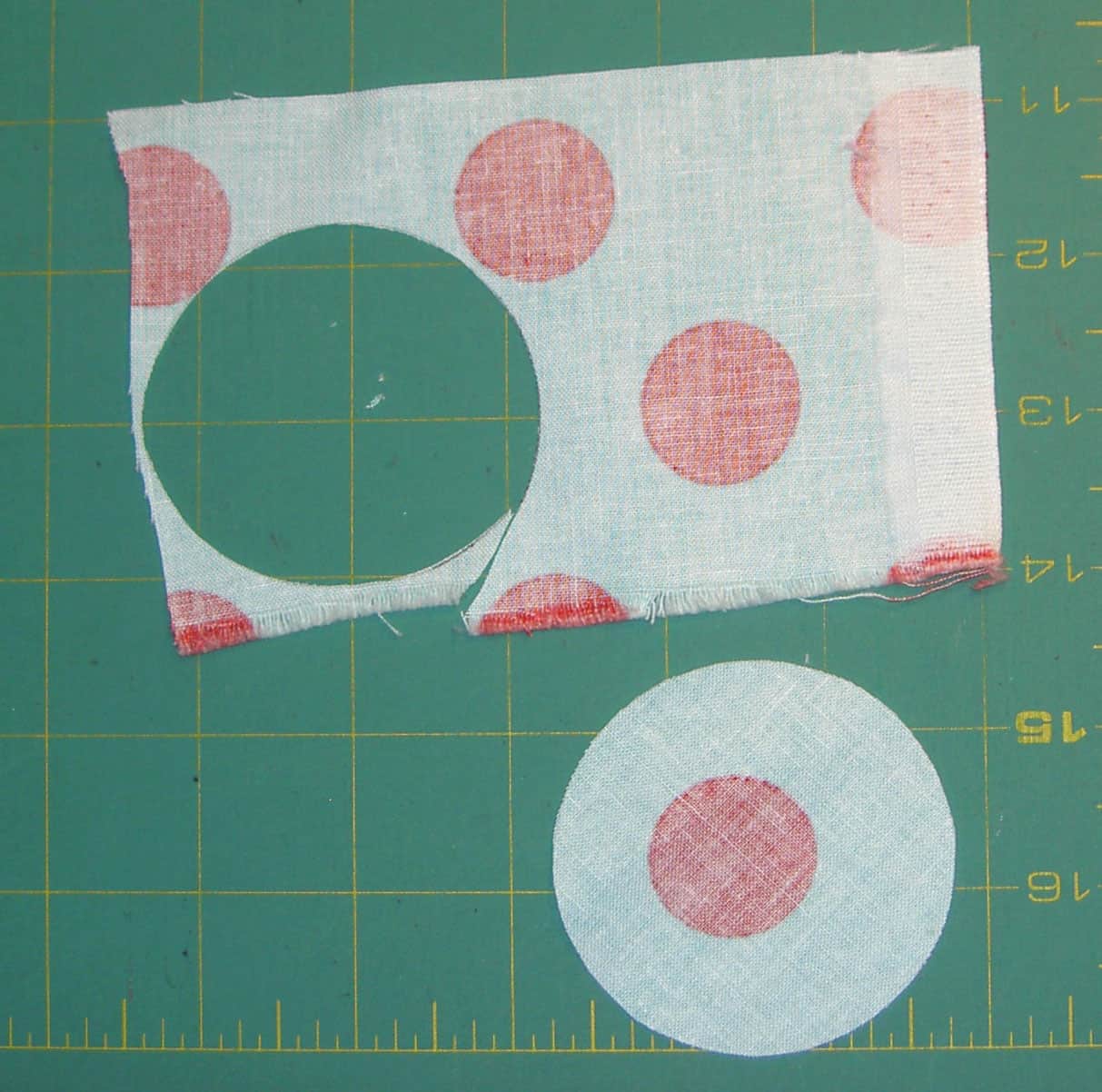
Trace Circle on Fabric for CenterCut out Center Circle
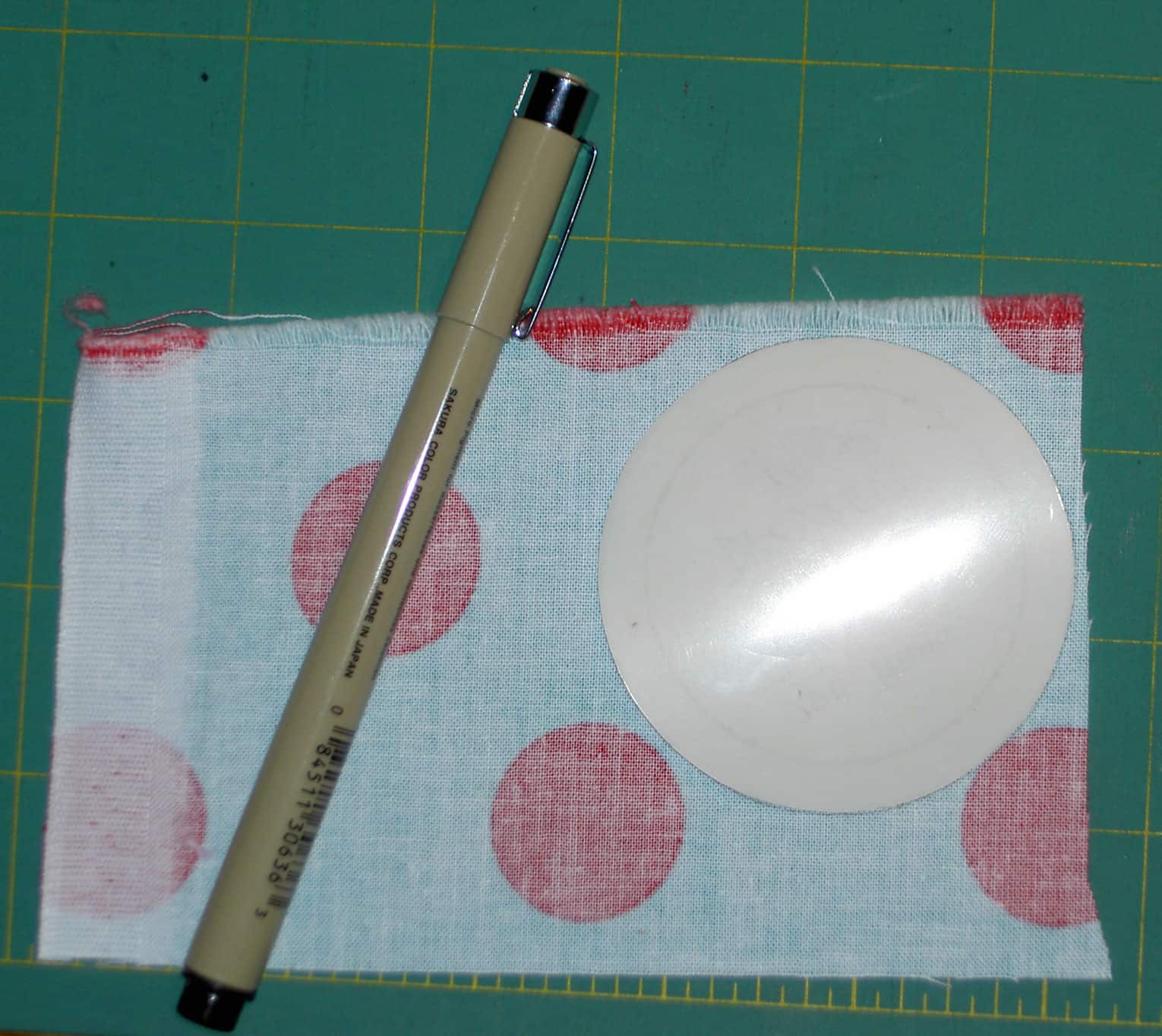
12. Trace a circle using the template with the seam allowance. Cut out the fabric circle with a generous seam allowance (more than 1/4″).
13. Cut fabrics using very sharp fabric scissors OR cut straight lines with rotary cutter and curved seams with fabric scissors.
Petals on DotsPetals on Flowers
14. Choose your background fabric by laying the petals on the possible background fabrics, approximating the shape of the Dresden plate.
15. Cut a 13.5″x13.5″ background piece. Your Dresden Plate will be appliqued to this piece. Make sure it is square by using a 15″x15″or larger square ruler. You want to cut a larger block, because the sewing of the block may make it shrink up. You will trim the background piece once your block has been completed. Set this aside for now.
16. Line up two petals, right sides together.
17. Pin pieces together by lining up the holes you made when you traced around the template.
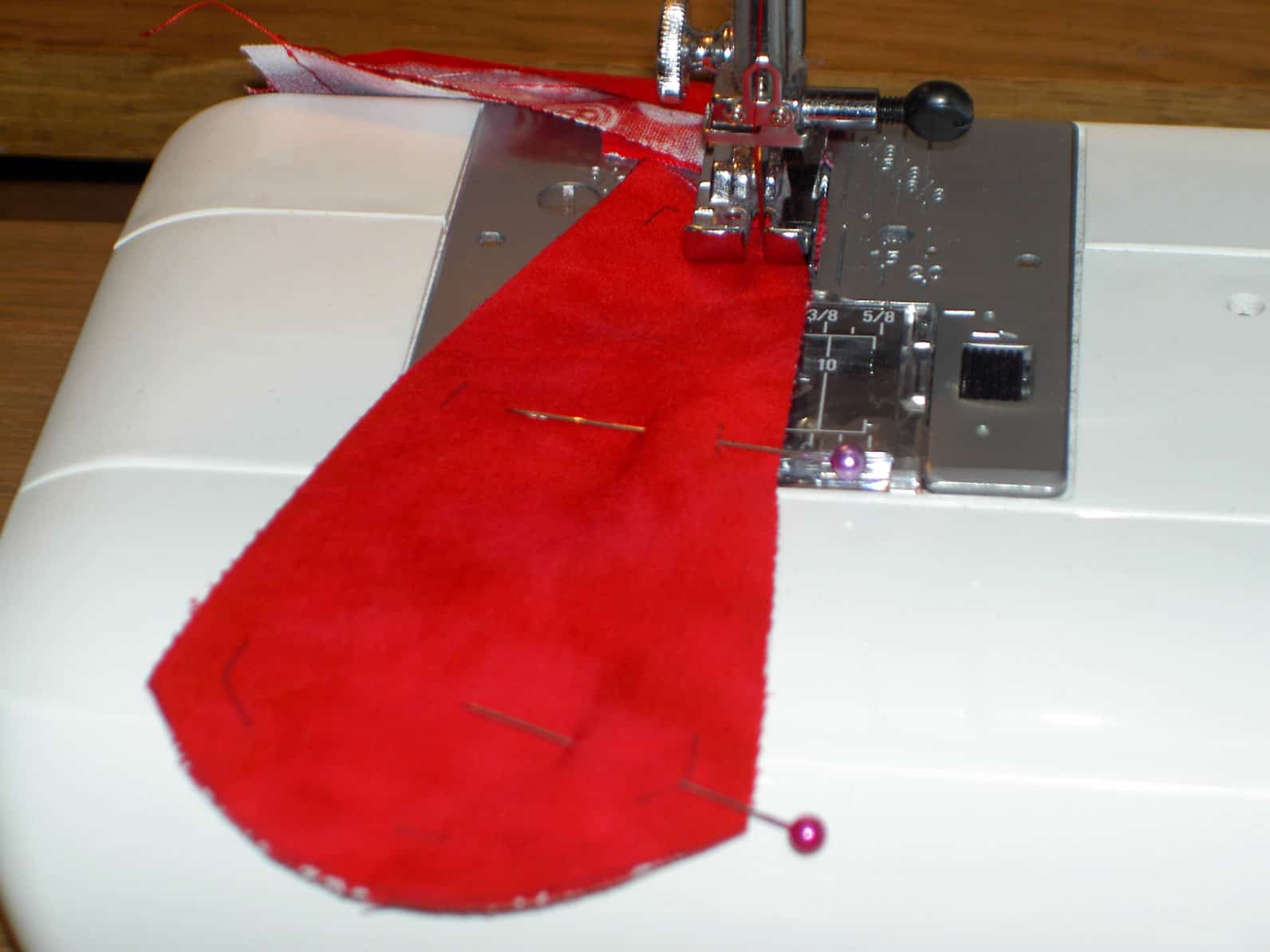
Sew from Point to Point
18. Sew from point to point, back stitching at each end. DO NOT sew into the seam allowance.
19. Press seams open.
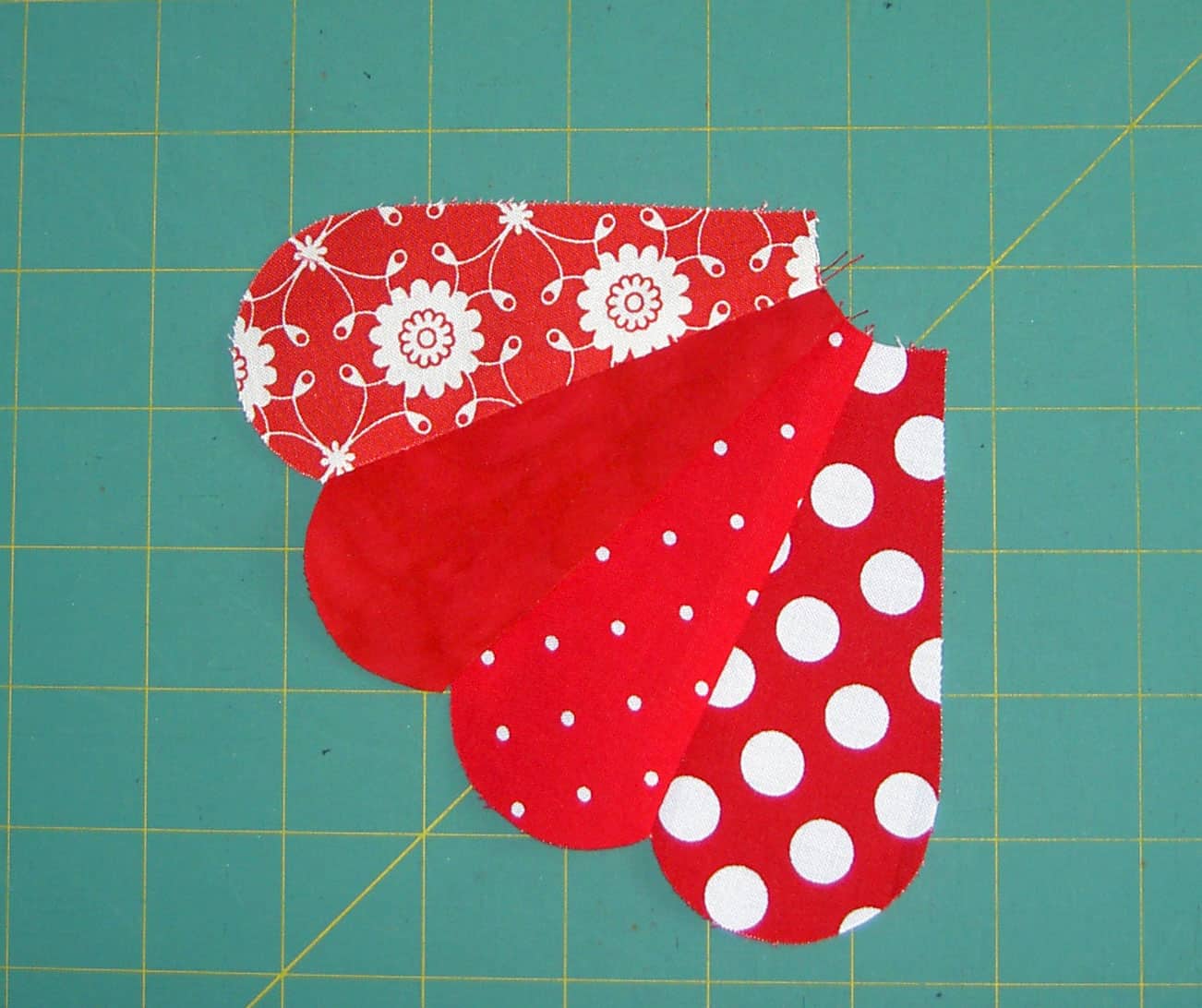
Group of 44 Groups of 4
20. Sew petals together in groups of 2, then sew the groups of twos to each other to make groups of 4, etc.
21. Sew between points, back stitching at each end. DO NOT sew into the seam allowance.
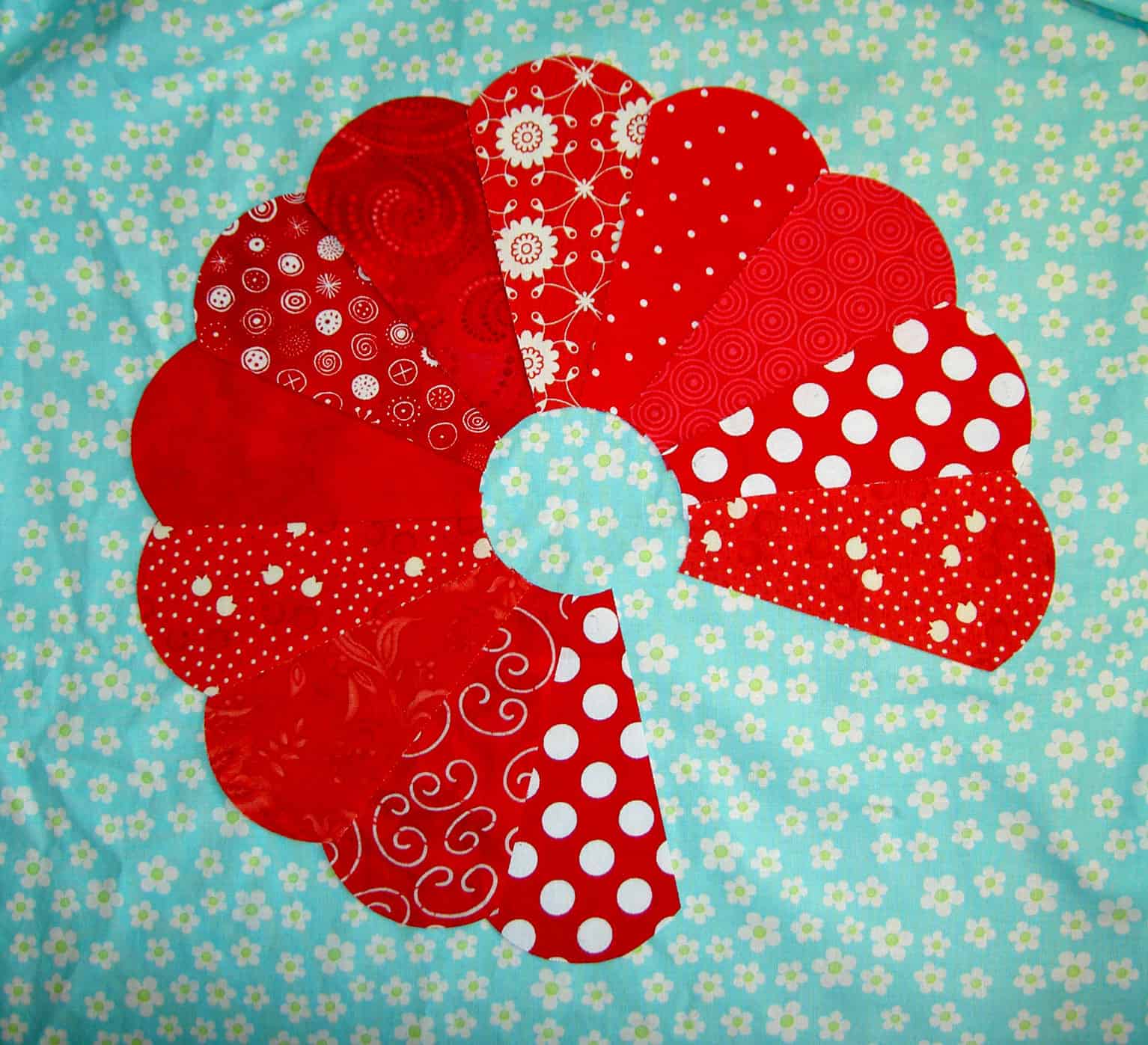
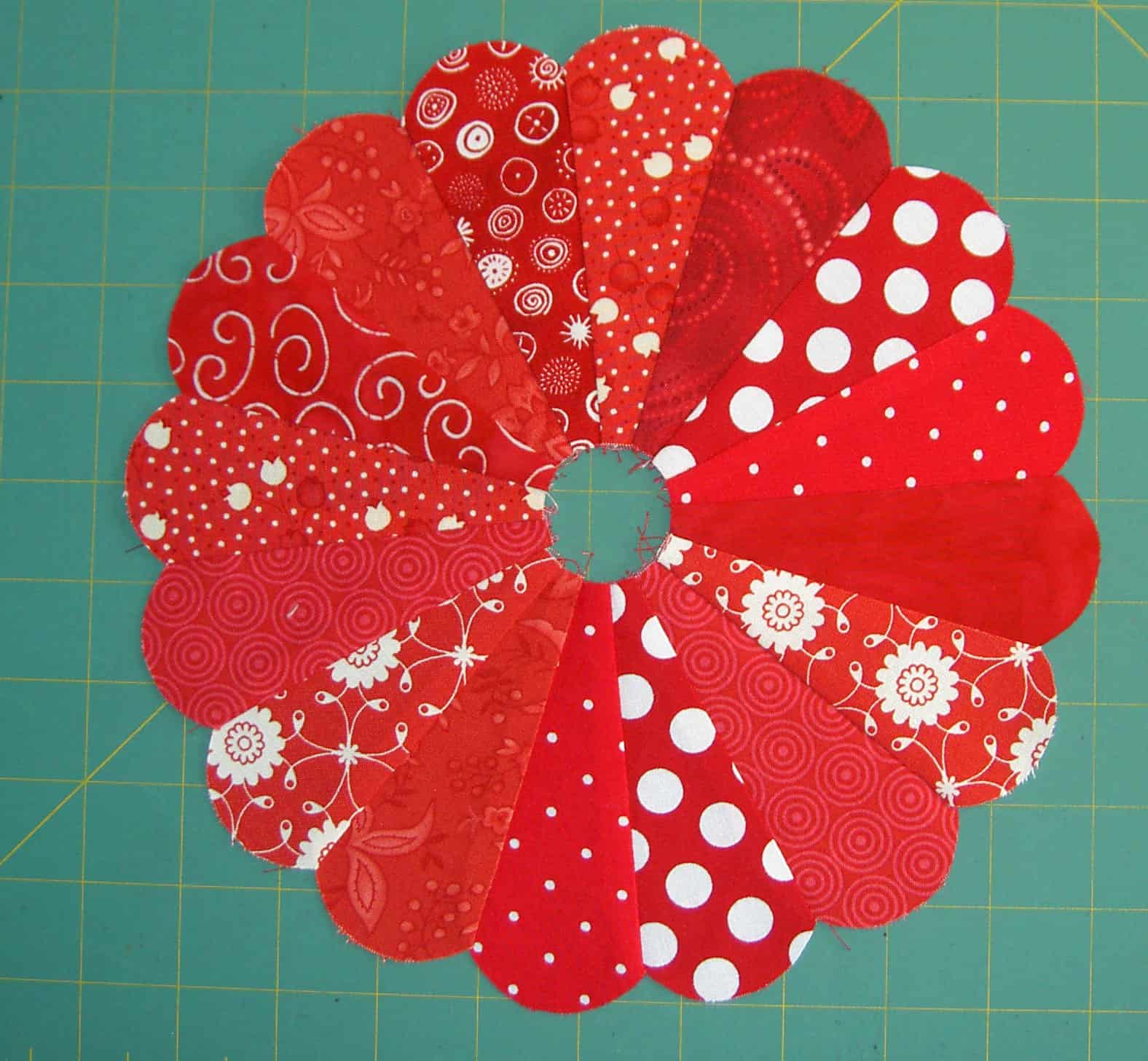
Completed Plate
22. Sew all petals to each other, back stitching at each end, making a ring.
23. Press all seams open.
24. Trim threads.
25. Lay petal ring face down on your ironing board.
Plate face down
26. Lay the petal template without the seam allowance (which must be made from heat resistant template plastic or cardboard. Don’t use something that will melt) on the back face up.
Press Curve
You probably won’t be able to get the seam allowances flat, but press enough so the fabric knows where the curve is. It will help you when you go to stitch it down.
Press CurveFinished Pressing all Curves
27. Press the curve into the outer edge of each petal. Use the stiletto to hold down the edge and iron right over the stiletto tip and the template. This is the miserable step, so intersperse some chocolate or some other sewing. Lay aside.
28. Take your cut piece of background fabric. Fold it in half and press lightly.
Fold Background in 1/2, then 1/4s
29. Fold your background fabric in half again (in quarters) and press lightly.
30. Open and you should be able to see the cross you have pressed into your background piece.
Center Plate on Background
31. Take your plate of petals and line up 4 of the seam allowances with the pressed cross on your background fabric. This will center the plate on the background. Make sure you pay attention to the vertical as well as the horizontal.
32. Pin in place
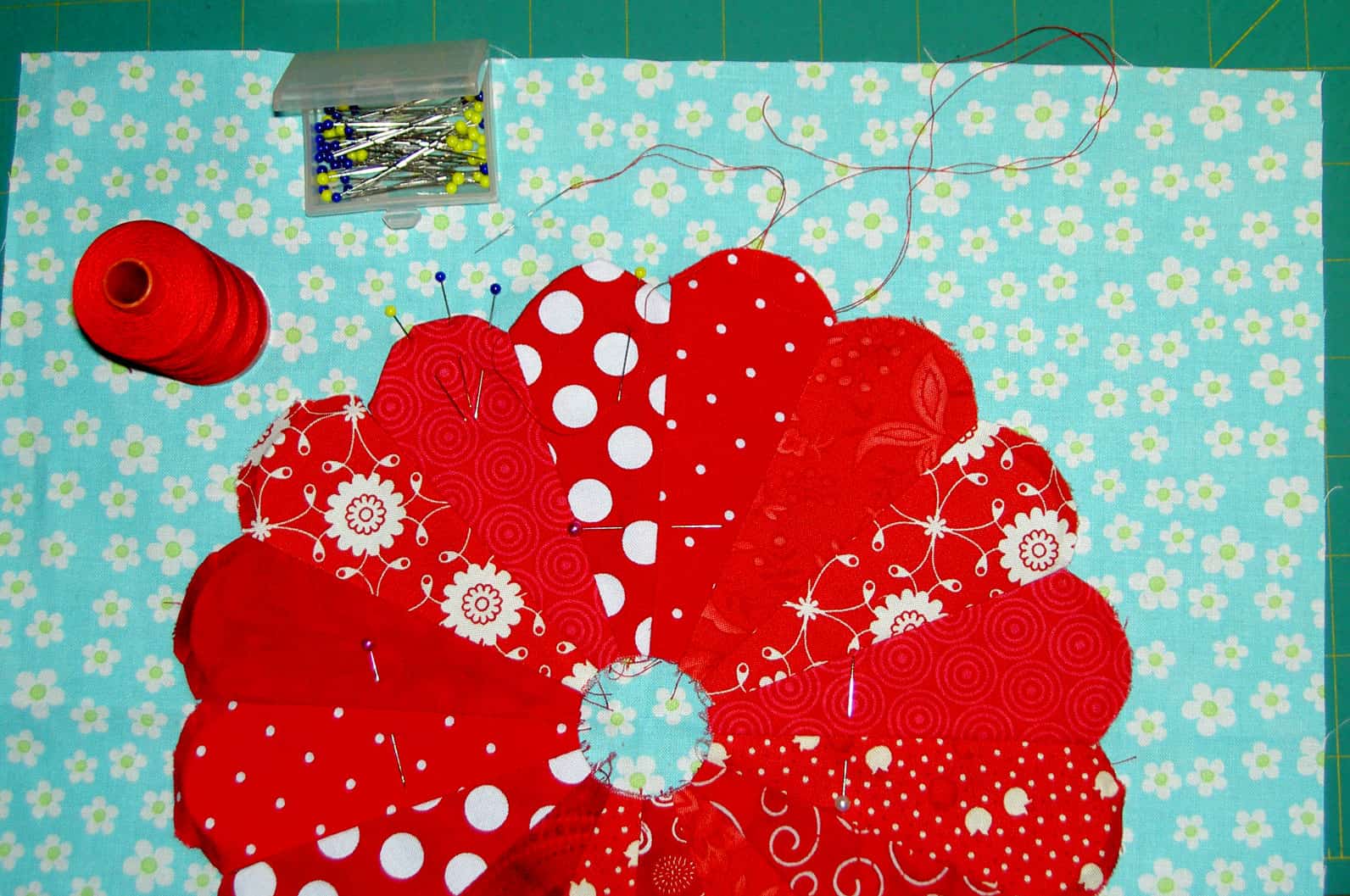
33. Use thread that matches the plate or is neutral for hand applique’ or a blanket stitch to sew plate to background. You can also machine applique’ the plate to the background. We will cover that technique in another lesson, but there are many other tutorials available.
Move Pins as you Stitch
34. Pin curved edges of plate as you move around the plate to applique’.
35.Know the thread so the knot does not pop through the background.
36. Bring the thread up from the back through the fold of the plate (where you pressed the seam allowance).
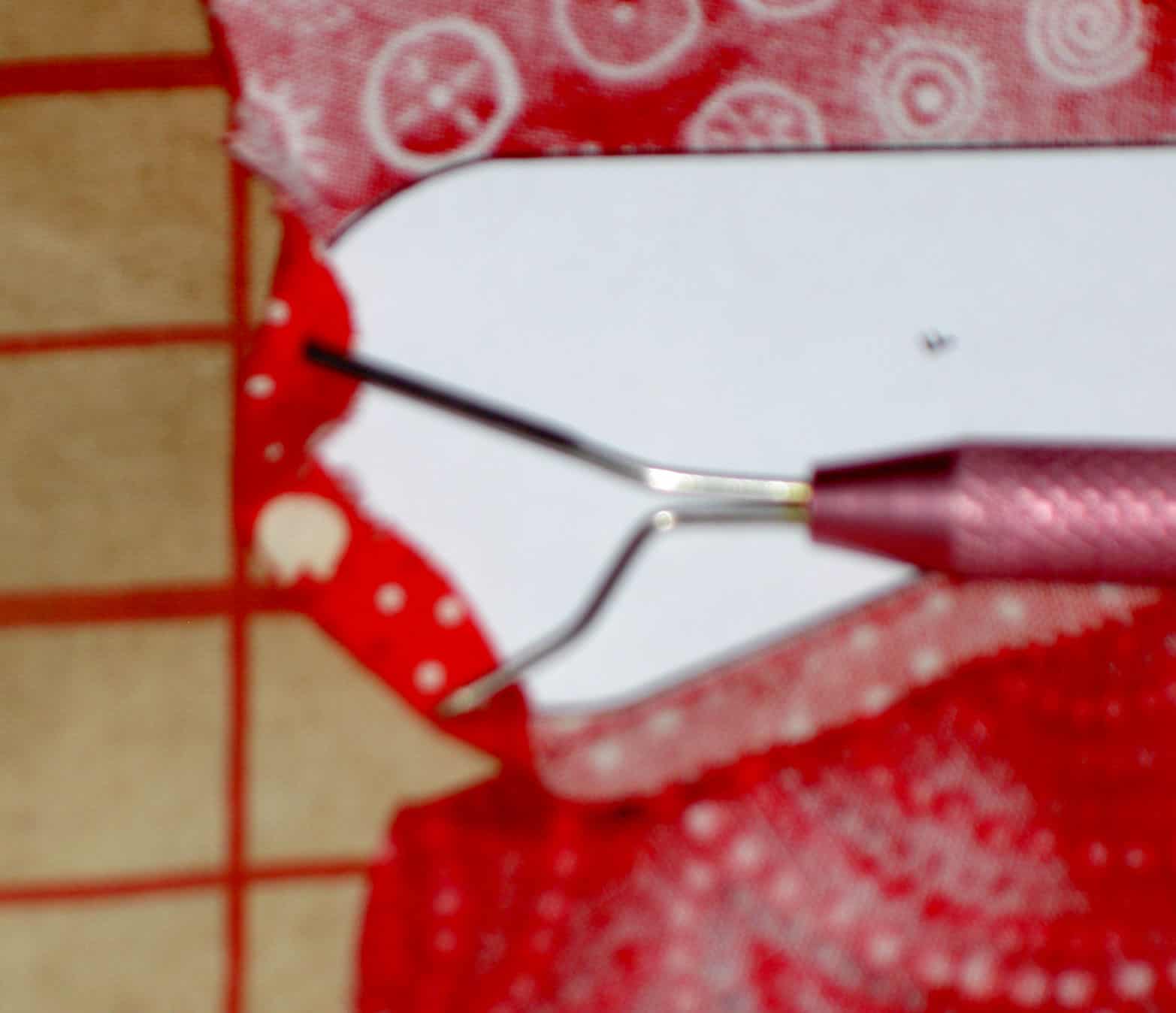
37. Tug gently and put the needle into the background, just catching it, and pull the needle tight through the fold of the plate again.
38. Go around the entire plate in this manner, using the needle to tuck in the seam allowance so it has a smooth round shape.
Trace
39. Trace the circle template without the seam allowance onto the magazine subscription card.
Cut out Circle
40. Cut out the magazine subscription card circle, being sure to cut off the pencil/pen line.
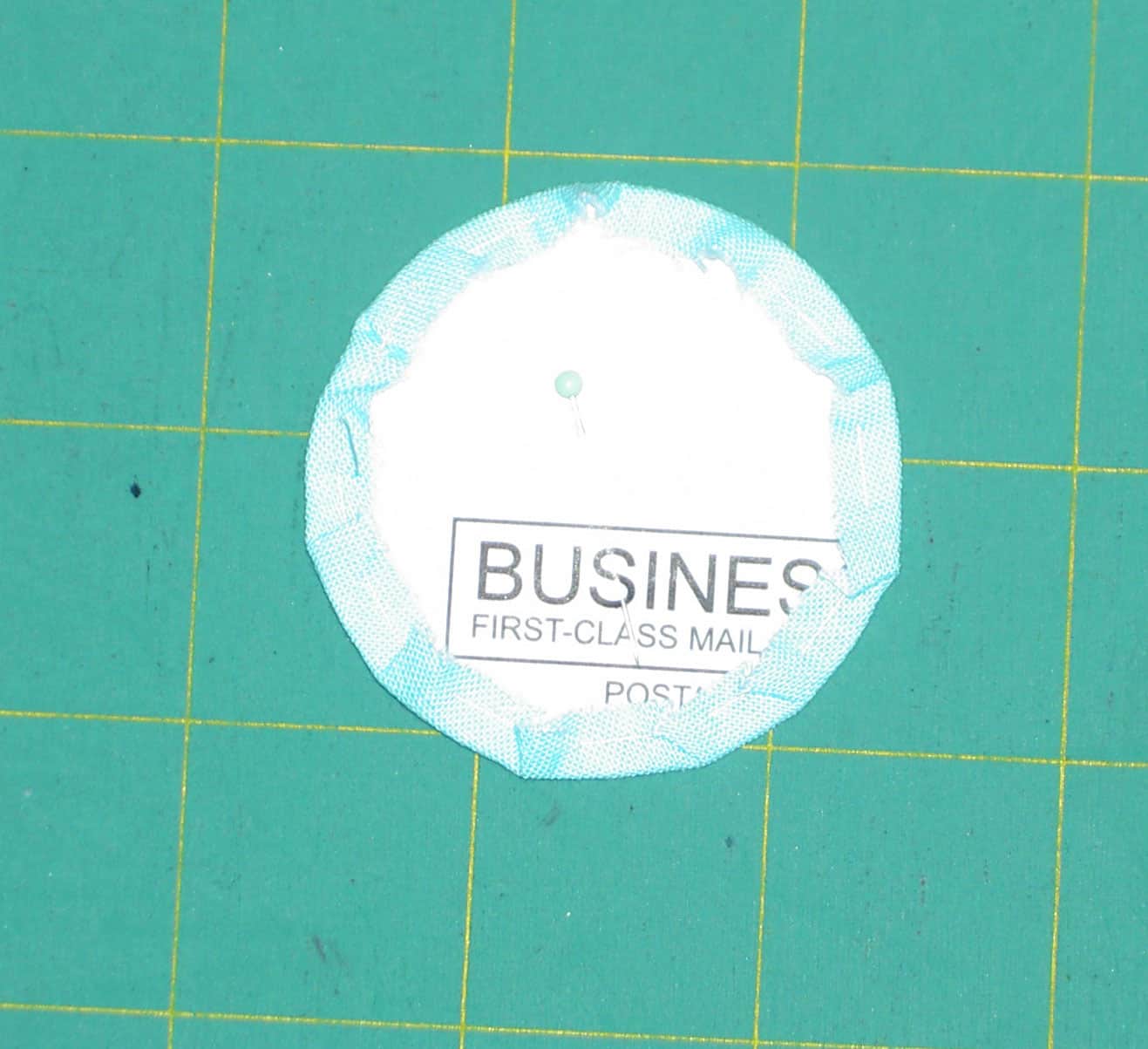
41. Take the circle fabric you have cut and wrap it around the magazine subscription card circle.
Use a Running Stitch to Draw up the Circle
42. Using any thread, take a running stitch in the seam allowance of the circle fabric and tighten it, keeping the magazine subscription card circle flat. If the magazine subscription card does not have enough body, you can also use the circle template without the seam allowance.
Pressed, Drawn up Circle
43. Press the drawn up circle well, so it is flat and a perfect circle. You will need to tug on the thread to draw the circle up as you press the first time. Once the fabric knows it needs be pressed you can pull the thread tight and make a knot.
Center Circle Ready to Applique'
44. Pin the circle to the center of the block, covering the raw edges of the center petals.
45. Applique’ using the same directions you used to applique’ the plate.
46. Trim block to 12.5″x12.5″. You might want to wait until you start assembling the quilt.
Dresden Plate Sample
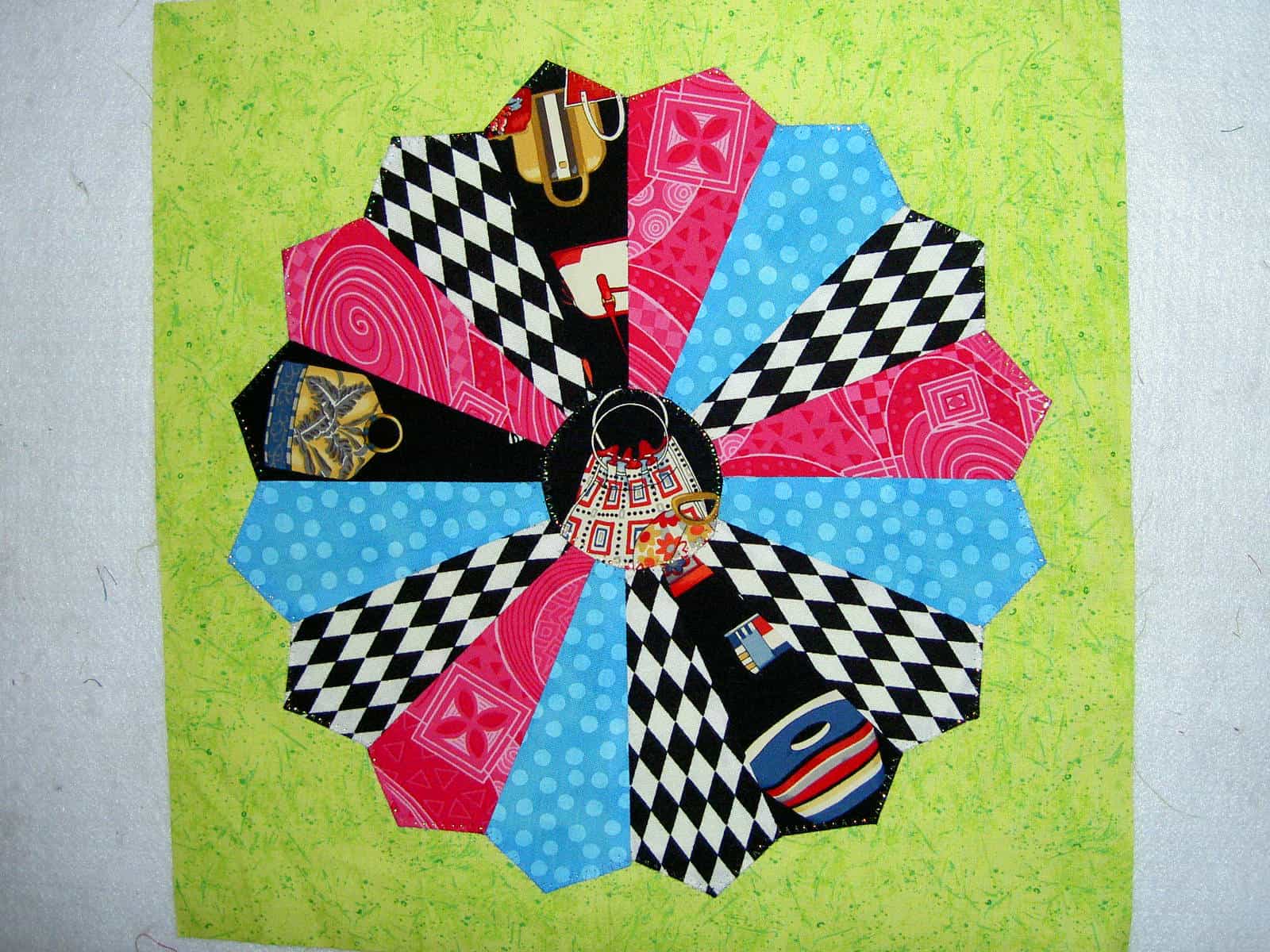
The green, turquoise, black and pink sample Dresden Plate was made for the class I taught in 2006/2007. I did this one a little differently. I machine stitched the plate to the background and the circle to the center.
As you can see, I also fussy cut fabrics to take advantage of larger spaces in the quilt block.
Dresden Plate detail
In the solid Dresden Plate, I placed like fabrics into groups of two for a slightly different look. The center circle was a good showcase for a bit of hand quilting.
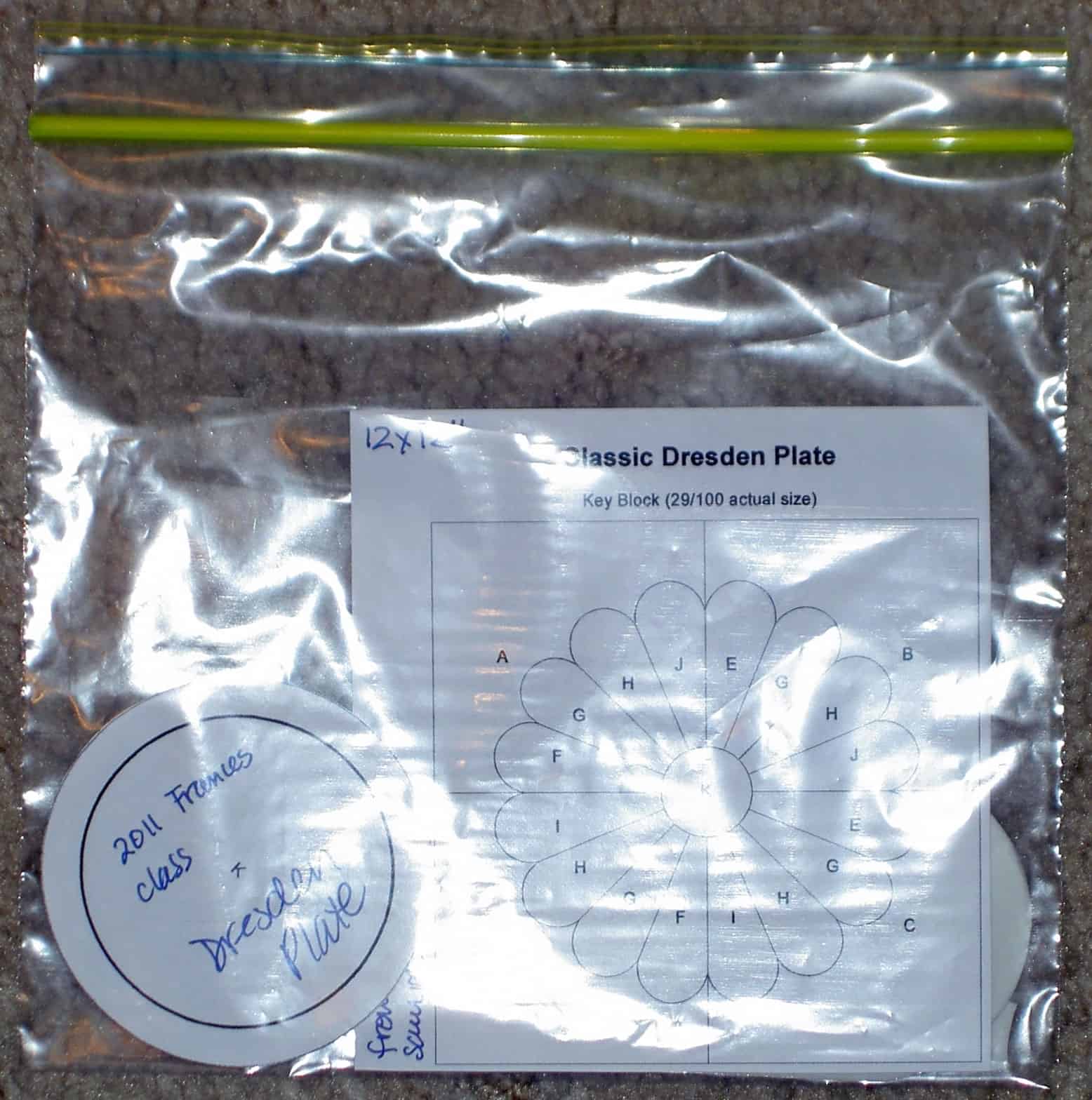
Store Templates in a Ziploc Bag
I may add some more photos to illustrate steps better and will link to this tutorial from the Artquiltmaker Info–>AQ Tutorials link under the header (see above).
I store my templates in a ziploc bag with a picture of the block or a label with the name and size of the block on it.
Save 20% this week from Cafe Press using the code TA0802. You can buy from any shop, but especially the Artquiltmaker Store. 😉
Learning
Everyone on the web seems to be way better at Photoshop Elements than I am. My friend, La, tries to give me little tips, but I forget by the time I get home. As result, I have helped to organize a class at Always Quilting on August 27, 2011, 10-4 and is taught by Lynn Koolish of C&T fame. It is open to everyone though the BAMQG and CQFA folks have had a two week headstart on sign ups. The class is now on the shop’s website. You can register via the website or by calling their shop at (650) 458-8580. Hope to see you there!
I was listening to an episode of Creative Mojo the other day (via podcast) and Mark was interviewing Patrick Doughty, an artist whose medium is sticks. I wasn’t terribly interested in the work, but find that I can always learn something. He said something really profound in response to a question about getting stuck. He said (paraphrasing) that it takes time to get into the groove of creating. He creates every day or only takes short breaks. this helps him not to have to get back into the groove, because he is already in the groove. This is a really important part of how I work. I think, write or read about quiltmaking every day I cannot be at the sewing machine. I cut, press, fold and organize fabric when I can’t sew (like last week when my machine was getting services). Every other time, I sew. I am always in the groove, because my work is in the forefront of my mind. I do get stuck on projects, but then I move to another project or cut, press, fold and organize my fabric.
Quilt-a-Longs
I think I talked about the Farmer’s Wife Quilt-a-Long. There are a lot of blog posts, discussions and projects blooming out of it. I saw on the ModaLissa site that the United Notions people are having a Hen Party (go read the post) that also has to do with FWQAL. Perhaps I do need to jump in…meaning ‘need’ in the broadest and most non-committal sense of the word.
Camille Roskelley of the gorgeous red dotted chair blog, ok the Simplify blog, has posted another group of her Farmer’s Wife blocks. I love them! Perhaps I do like grey after all. I think I have get out my Ultimate 3-in-1 color tool and see what I can learn from her color scheme.
How about my Block-a-Long? Have you made any blocks? Let’s see them? Are they boring?
Color
I am reading a book (review soon-ish) and I realized the author was not doing complicated piecing, but was creating complex color stories to tell in the form of a quilt. I am intrigued by this concept, especially after working on FOTY 2011. I ran across the Michael Miller site, which is doing color stories every week also. During the week of July 20 they had an aqua and red color way, which you know I love.
Media
I am feeling like Miss (Ms?) Popularity lately. I never was one of the cool kids at school so I am not quite sure how to handle it. I was recently interviewed on episode 2 of the SeamedUp podcast. It was fun to talk to the SeamedUp ‘girls’ and get to talk about design a little bit, my blog and life a little bit. They produce their podcast in a very professional way, I think, but laugh a lot along the way.
I was listening to a recent Annie Smith episode and heard about Cori Blunt. I took a look at her website and blog. Her drawings are really sweet, I especially like her bike pillow. Of course, I probably wouldn’t do any of those quilts, but I can admire them. I do like the way she did the sashing around the star blocks in the Cherry Tweets quilt. Very clever.
In conjunction with her episode #166, Amy of Creative Mom Podcast post GORGEOUS pictures of stairs with mosaics on the risers. Even if you don’t listen to her podcast (which you should!), go take a look at these photos. They are wonderful and make me want to do some mosaic work on my stairs.
I think I heard about GenerationQ magazine from Adrianne at some point in the not so distant past. I was reintroduced to it last week via an article they did on smartphone quilting apps. There are two that are interesting to me. One is block pattern app similar in concept to Around the Block, one of the most useful books in my library. The other, which constantly made me think of TFQ is the Fabric Stash by Blueshift Software app. She needs this app. This one does not get high marks, but the writers say that the portion where you can document your fabric stash works really well. It seems easy to photograph your fabric and keep it handy on your phone when I go shopping, especially for projects like the Food Quilt where I am trying to get one piece of many different fabrics. it is on the pricey side for apps, but it may be worth trying out. Now to get Blueshift together with SeamedUp so I can zap my fabric from my phone straight into SeamedUp. That would be awesome (at least in my head).
Other Artists
Lil Sissy passed on a good blog post from Kelly Rae Roberts. I think it worth reading and keeping in mind. Short version: there is a time to dream and a time to savor.
Vicki posted an Art Saves story on Crescendoh. I didn’t know about those stories until I saw a link on Vicki’s site and happened to click on it. Very interesting. I like the stories.
Fabric
Last week, Julie of The Intrepid Thread post some photos of new fabrics in her shop. She posted:
Sweet Treats http://fb.me/16eeAMWIt
Licorice Cloud http://fb.me/SdMcvn79
Cotton Candy http://fb.me/wwGp0deq
Sapphire http://fb.me/Ez55AJPA
Ruby http://fb.me/TwMwQ24o
Citrine http://fb.me/160LGuNQ8
They were some fabrics I saw when I was on my quilt journey a few weeks ago. When I saw them at New Pieces I thought that I couldn’t possibly use such fabrics, but when I saw the pictures Julie posted, I thought they might be fine if I cut them up. Is there a meeting point between fussy cutting and strip piecing that would allow the beauty of some of the larger motifs to come through? What do you think?
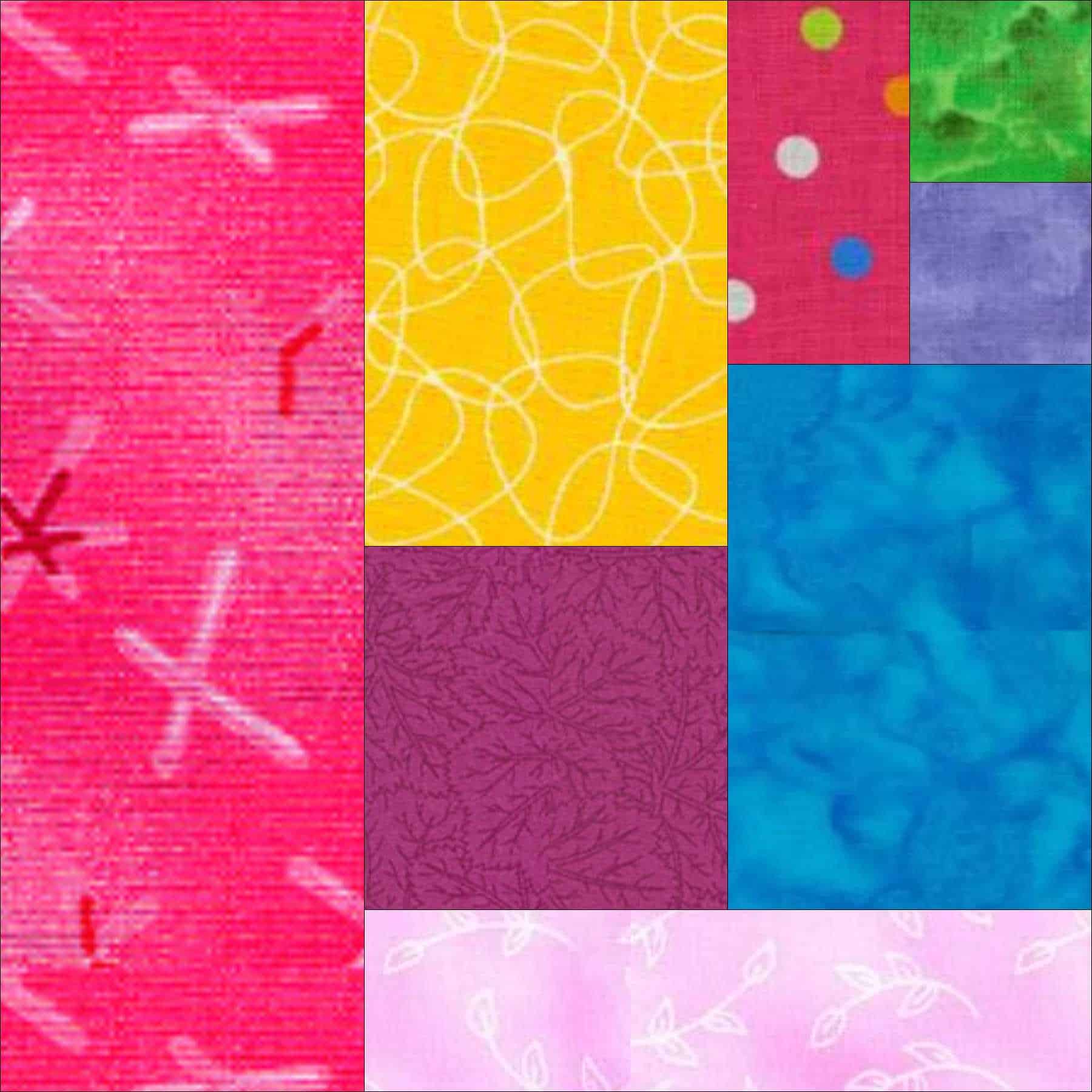
This block reminds me of a log cabin. If you look from right to left it has that feel. It is actually from Blockbase rather than one of my own design and is called #4117.
To make this block, please print or look at the rotary cutting guide and start piecing the elements of the block together from right to left.
Make the small unit in the corner (made up of green, periwinkle and the pink dotted fabric), then piece that to the blue patch. Piece the yellow and purple together, then join that unit to the blue/corner unit. The pink is sewn to the those two units and the fuschia finishes it off.
New Log Cabin Quilt
Four of these blocks put together with the corner unit in the center would look really interesting. The example looks like it is spinning.