Handkerchief Inspiration

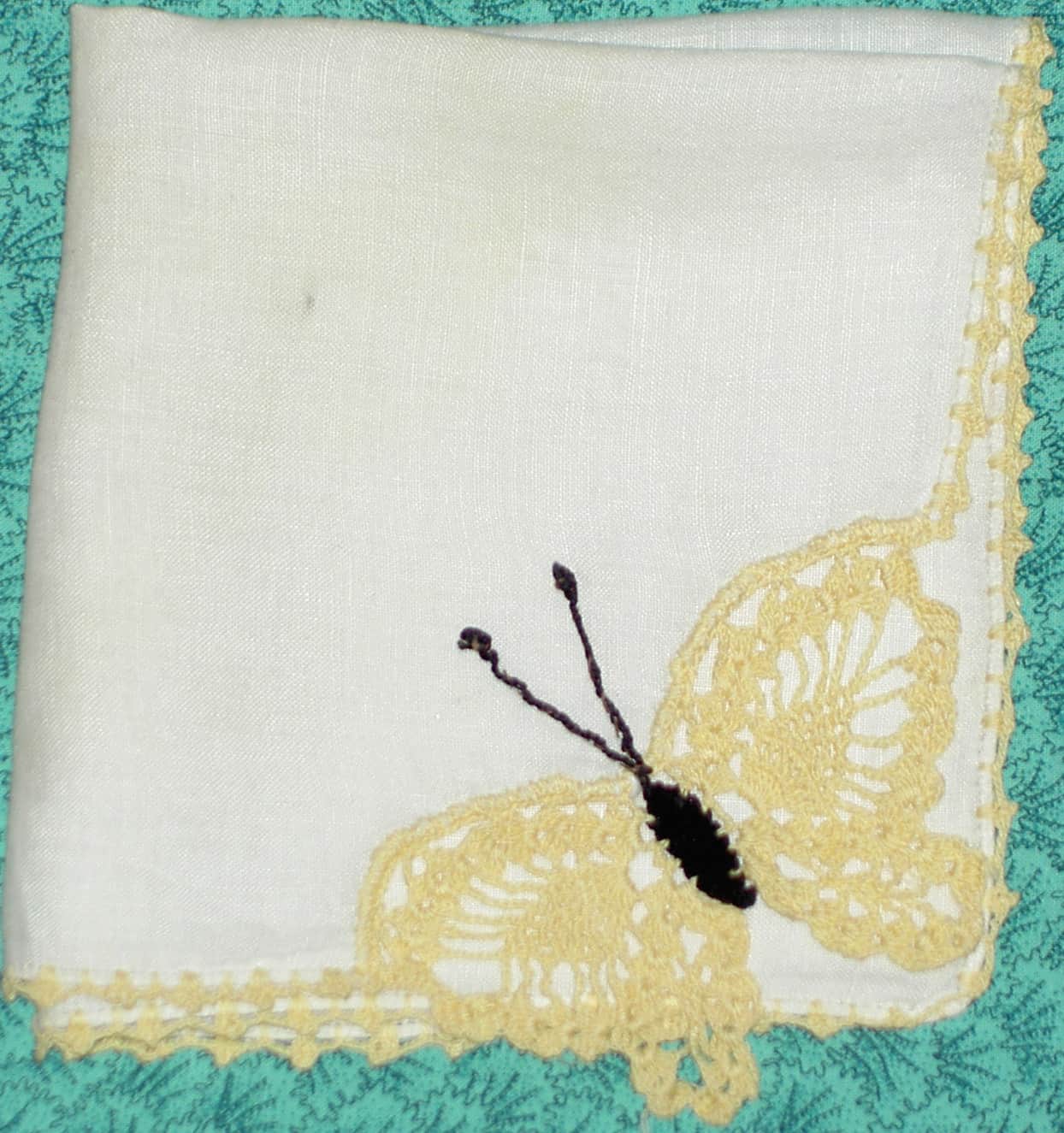
Butterfly Handkerchief

As my mom moves into her new house, she is unearthing all sorts of interesting things. She brought this handkerchief with her when she came to help me on Saturday. The butterfly is crocheted and we think there is a bit of tatting around the edge. This was made by either my godmother or my great grandmother. We both have significant amounts of similar needlework from both women. I want to find a project where these bits of needlework can be showcased.

Modern Quilt Guild Meeting

I went to the Bay Area Modern Quilt Guild Meeting on Monday night. It was a perfect confluence of events that allowed me to go. Thanks to DH who picked up the slack at home!

We did show and tell. The quilts were very modern, for the most part, and there was a wide range of experience and styles. I should have brought the Zig Zaggy top. It would have fit right in. I want to quilt it or get it quilted before I drag it out into the world. I don’t want people to be sick of seeing it. I brought It’s a Merry & Bright Wrap, because I wanted to work on the sleeve. I think I put in about 2 stitches. People admired it.

Mostly, the members seemed like people who had just started sewing again after a hiatus or were new to sewing/quiltmaking. There was some discussion of the tube method of binding and various shops – two I hadn’t heard of! One is along my beaten path, so I will have to check it out and take TFQ there when she visits again. It was a great group. I really enjoyed the people.

Someone brought some great books. I was able to take a look at the new Amy Butler bag book, Style Stitches, which is a beautiful book. There were two bags in it that sorely tempt me, though I am a bit scared to take on another Amy Butler pattern after the Sweet Harmony bag. I was also able to look at Elizabeth Hartman’s new book, The Practical Guide to Patchwork: New Basics for the Modern Quiltmaker (yay! quiltmaker in a title!). I liked the look of it and found some tips and tricks that might make it worth a purchase. I also took a quick look at I {heart} Patchwork, which I had never heard of. There was so much going on that I really only had a minute to look at it. I don’t know what Zakka is, but what I saw was interesting and worth another look.

Everyone was really friendly and welcoming. One person, Adrianne of Little Bluebell, went to Quilt Market! She has great pictures on her blog about the experience. I can’t believe that they accept bloggers as press! You have to show some effort at a business, but she said it wasn’t that hard to register. WOW! A whole new door has opened to me!

I saw Chris, again, and still didn’t get much of a chance to talk with her in person! I hope to see her again!

There was a guy there! George magically appeared at the beginning of the fabric exercise. I don’t know if I just didn’t see him or if he came in late. I liked hearing his perspective, partially because of all the press about guys and lately, but also because I am never around quiltmaking guys. He talked about his experiences in fabric stores. As a result, we asked him what fabrics he gravitated towards, which spawned an interesting discussion.

We did a GREAT fabric exercise. Ruth, who is the owner/convener/president/quilt maven of the group asked everyone to bring 20 pieces of fabric. She promised we would get them all back unscathed. I was reluctant, but threw a stack of reds and aquas into the bag just before I left.

BAMQG Fabric Selection

There were a huge variety of fabrics. Laying on the tables, a lot of the fabrics looked like the old Hoffmans. As people started digging around, I could see that they were what people consider to be modern. Without the Kona Snow, they look really different.

The first exercise was to pick one fabric, get together with someone (great ice breaker as well) and pick 6-8 additional fabrics for a quilt. Subsequent versions of the exercise ensued.

There were a number of great things about these exercises:

  • no cutting = no fear. We weren’t actually going to make the quilt.
  • working with fabrics that weren’t mine opened my eyes to different possibilities.
  • working with someone gave me different ways to look at fabric combinations and learn from them.
  • reminded me that a fabric avalanche might be an opportunity to see fabrics in a new way.
  • there is always more fabric, so put the fabrics together in interesting ways.
Fabric Combo
Fabric Combo

Above is the last group I put together with another quiltmaker. The grey is something I never would have added, but the exercise was to pick two fabrics and they had to be touching each other. I picked that lovely turquoise/aqua and white in the upper right hand corner next to the red/white plaid. It was touching a grey. I picked a couple of other greys and more red and aqua and I think the group works.

I think this is a group I could really feel comfortable with. The meetings are not convenient, which is a real shame. I am going to try and go again and see where my attendance and participation on the Ning part of the guild lead.

Liesl Backpack

Remember this bag? I was reading the Martha Stewart blog and saw it referenced again there. This version by Liesl of City Weekend fabric by Moda and her own company, Oliver + S. I am not a big fan of that green, but the whole look really works. I need to get the pattern out and make it! I have all hardware and have for awhile. Love those dots. I wonder if I have them? 😉
Good inspiration.
Liesl Backpack from makezine.com

Different Things

Displaying ATCs
Displaying ATCs

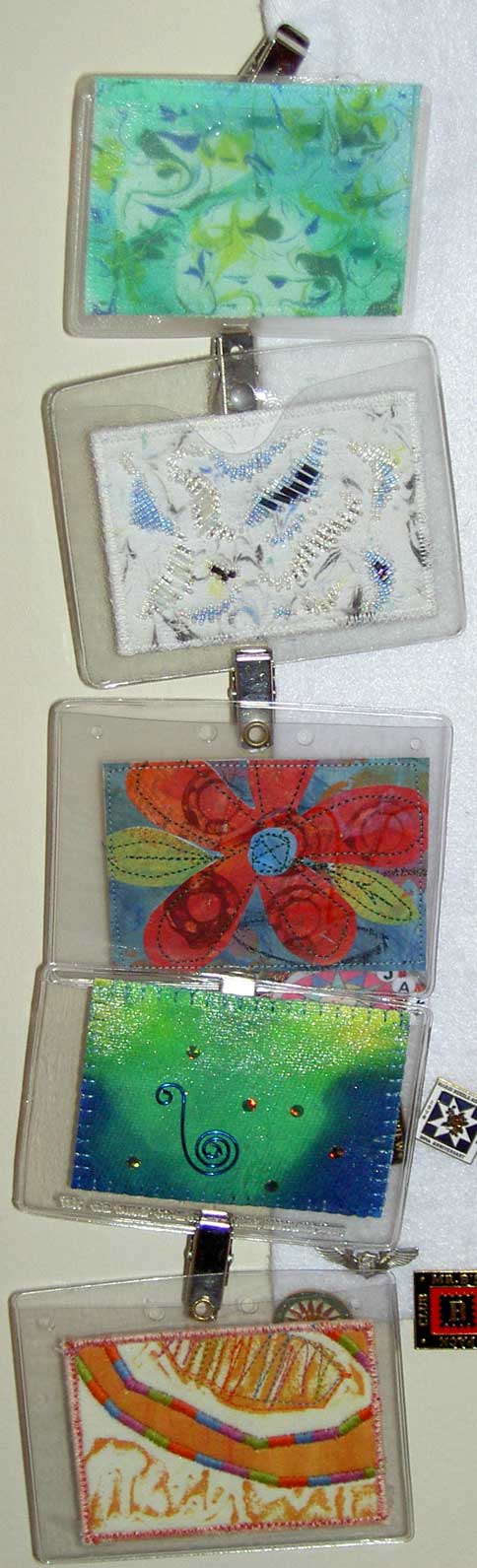
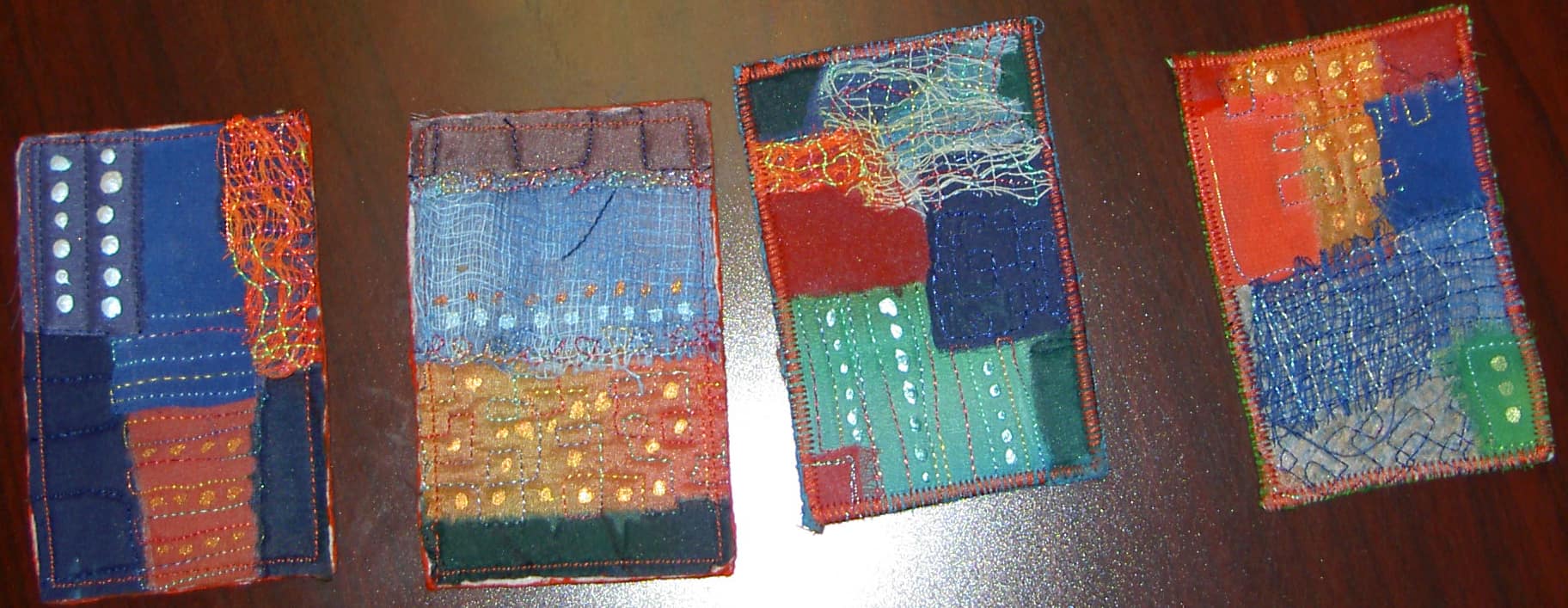
One of the work events I attended recently was a conference. I have a number of badge holders around the house and it occurred to me that they would make a very convenient ATC display system. A the moment I have, pictured on the left, four ATCs on display in my workroom. It is nice to see them hanging around. I have at least two more badge holders so I will fill those up with new ATCs. I have been working on ATCs for the upcoming show. I used some net from Baby Bels as part of the ATCs. I could do a lot more on them, but think I just need to stop. We will see. Photos to follow.

I sewed a good portion of the day on Saturday. I have three quilts nearing completion and I am determined to get the finishing work done. Since I finished the second binding I needed more handwork. I made two sleeves and one binding. I may never make a binding out of batik fabric again as I sewed the wrong sides together numerous times and had to unsew a lot! Now I have enough handwork to keep me busy while I watch TV.

I also cut a few more diamonds, so stay tuned for photos of those, which are coming to a blog near you! 😉

TFQ turned me on to the RØssie Blog. She is the creator of the Fresh Modern Quilt group on Flickr. We were talking about what a modern quilt actually is. She has a blog post about, what she calls, Mutant Quilting. Interesting.

C&T followed up on PIQF with a blog post that mentions some favorites, including Colleen Granger of Sew Little Time Quilting. I am glad she is getting some air time finally. They also mentioned that the Color Cascade exhibit was based on the 3-in-1 color tool (C&T product, I believe). I didn’t realize this and may have said that the makers used paint chips. Great idea. They also refer us to a blog post about the Color Cascade exhibit. This post tells how they organized the exhibit. I really enjoyed the exhibit and think it would be a great project to do on my own. I don’t know if I have the stamina to do it on my own. I know I don’t have it in me to coordinate a project.

It is probably too late to make a “going off to college” quilt for your child, but you might want to make an “I miss you” quilt or an “I know you are homesick” quilt. If so, one method of making a t-shirt quilt is posted on Frieda Anderson’s blog, Walks in the Woods.

I was talking to the Young Man recently and thinking about all the food fabric I bought for my mom to make her quilt. I asked him if he would like a food fabric quilt to take with him to college. I was thinking that the Eye Spy quilt might be a bit too babyish for him. He commented that he hadn’t received his quilt for this year yet! I was amazed at this comment and reminded him that he had just received his Eye Spy quilt. He looked at me in a way that only teenagers can look and told me that they Eye Spy quilt was last year’s quilt. I think I will make a Snowball quilt with food fabric for him. The College quilt? Who knows? I, apparently, have 4 quilts to make for him between now and then. Sigh.

While at a planning meeting for an upcoming quilt show, we were talking about something interactive to do at the reception. In the course of the conversation, we discussed a guy who sews for people downtown.  I found an article and thought you might also be interested in reading about his cool sewing machine on wheels.

Mille contacted me when she found I was making a Flowering Snowball quilt. We had a mini email exchang,e and then I received an email from her over the weekend showing her version of the Flowering Snowball. Her two color Flowering Snowball is wonderful! I have enough handwork at the moment, but feel like I need to get back to the Flowering Snowball.

Book Review: Creative Time and Space

Creative Time and Space: Making Room for Making ArtCreative Time and Space: Making Room for Making Art by Ricë Freeman-Zachery

My rating: 4 of 5 stars

This book is primarily about attitude, time and learning to say YES to creativity as a valuable part of life.

The author offers up the concept of living a creative life and interviews artists on how each of them deals with that concept as a lifestyle, a problem, a way of life. the reporting on their variety of approaches is excellent, because it forced me to think about what my approach is/would be. Seeing that different approaches work for different artists is a reminder that it is okay for me to craft my own solution. I can see that there are a lot of different ways to say yes.

After I finished reading this book, I went back to look over my notes and it became apparent that I had a list of tasks for myself to work through as a result of reading this book.

1. “…figure out what time means to you and how to establish a good relationship with it.”

Figuring out what times means is complicated for me, but not impossible to figure out. It can be figured out in steps. For example, blocking off a certain time to make art is one way to come to terms with time. Each artist gives his/her opinion of the various topics in each chapter based on his/her experience. Roz Stendahl explains “You get so absorbed in what you are doing that time as conventionally measured just ceases to exist. Time becomes very full and rich in ways I don’t feel capable of explaining. It’s like a deep, full, and calm breath” (pg.16). Throughout the book, Freeman-Zachery has exercises and little added bits of information. Not only are these sidebars helpful, but they also break up the pages. Play is also discussed with regard to time.

Everyone talks about not having the ideas because of time. The culmination of the section implies that we should all think about our creativity all the time, adding creativity facilitating media into every spare minute. When we can’t generate ideas, because the car is full of soccer bound children and the sink full of dishes is demanding your attention, ideas can be inspired by books, podcasts, magazines and other media that get you in the mood to create. The idea is that “being able to keep your brain up and humming is a first step toward having more time…” (pg.25) Many of the artists feel that their “creativity comes first and they make everything else fit in.” (pg.25) Pam Rubert thinks that “injecting creativity into anything I can”(pg.25) is really important. It definitely makes life more pleasant.

The artist share different techniques and strategies they use to “make” time, which is the theme of chapter 2. There are examples of lists and schedules and solutions. The bottom line seems to be that you have to figure it out for yourself and go with it. Rice Freeman-Zachery sums up a lot of the discussion by implying that it is important to acknowledge how you work, when your best time to be most productive and working with the strategies you have developed, such as making lists, flitting from one thing to another, to work your best.

Finally, in one of the ‘try this’ sidebars, the author suggests “writing down ideas reinforces the value of creative thinking and encourages your brain to spend more time in creative mode.” (pg.30) AHHHHH! License to dream! Thanks, Rice!

2. Think differently: while this wasn’t an explicit “to do” item from the book, it is definitely a theme that weaves its way in and out of the book. The daily life of vacuuming, carpool and doing laundry is addressed head on and one artist says “..so I remind myself to continue to find the joy in these activities”(pg.33), which is followed a few lines later with Rice Freeman-Zachery‘s reminder that the “everything else in your life – the day job, the childcare, the household chores, lawn work and shopping – doesn’t have to be an interruption or an imposition. As you train your brain to spend more time in its creative mode, you’ll find ways to encourage creative thinking, no matter what you’re doing.”(pg.33) A good reminder and mantra.

3. Practice patience and flexibility: I know that I am very hard on myself – constantly striving for perfection: the perfect seam, the perfect combination of fabric and design, perfect everything. Roz stendahl reminds us to wonder “What could I get accomplished today if I let go of perfect?” (pg.84) Change is ok, say the artists and change back is okay, too! Novel, don’t you think?

4. Do groups, classes and interactions with other artists add to my creative life? This part of the book was still talking about time, and specifically what can a person give up to make more time to make. Vacuuming? Groups occurred to me. To what groups do I belong and how are they contributing to my creative life? What classes help? Which ones distract?

The chapter ends with the reminder “you choose what’s important and where you want to put your energy because only you can figure out what you can live with and what you can live without.”(pg.41) Sigh. I wanted a magic pill.

5. Be kinder to myself: Judy Wise says, at the beginning of chapter 3 “I am very gentle with myself, very forgiving at this stage of life. When I was younger I was much more disciplined, but then I realized that was killing the joy for me.”(pg.42) Another good thing to remember is that “it’s not just about changing what you are doing; it’s also about changing how you look at what you’re doing.” (pg.75) I have to say that these two points hit home. It is not productive to criticize yourself all the time. Perhaps the work doesn’t live up to your imagination, but it is a step on the path. Look at it that way and you will make progress. I have found, recently, that I can see patterns in my work. I can see patterns in quilts that are, seemingly, completely unrelated. By studying them further, perhaps I can discern the kind of progress I am making.

In chapter 3 a lot of the artists have written out their schedules. In this way, we can see that there are different ways of getting things done, and the standards are different for different people. One good tip was to “keep a master list of projects that are current and for each try to list at least the next actionable step.” (pg.47) My WIP list acts like this for me. It is not ideal and I do keep folders of info I need and ideas or drawings or notes on difficult construction issues. The WIP list is constantly in flux even though you see it once a year.It does spur me on to keep working on projects or actively abandon them. It is also a good reminder of how much I have accomplished in any given year. I’ll have to think about whether a list like Pam Rubert describes would work for me.

6. Write your goals: I have always had problems with this (commitment, mostly), especially the larger goals, but the author makes a good point “to speak them or write them makes them even more powerful.” (pg.51). I noticed when talking about goals the male artists seemed much more goal oriented and the female artists seemed much more fluid.

7. Warm up: if you are cold, it is harder to move. If you have just woken up, your thinking will be a little fuzzy. The same is true for me in the making process. I need to warm up. Warming up to me means sewing some four patches, mosaic piecing, some kind of rote sewing, something easy that I don’t have to think about. Warming up is also related to getting your muse to come out and play. Many artists have rituals that put them in their making ‘space’.

8. Figure out what is my play? The idea is that if a maker gets stuck s/he can go play. I think my play is working in my journal gluing things down, but I am hesitant to put that activity out there since I don’t collage much. Experiments and trials are not wasting time, but we all seem to think that they are. It can really be a struggle to allow yourself to go with an idea — to test, to experiment. It’s hard to accept failure as progress when you have spent all of your free time on a project that is deemed a failure. “For artists, it means that you can pursue an idea however far you need to go without having to rein yourself in, counting the minutes you’re ‘wasting’ in experiments and trials…” (pg.18)

The first part of the mental space chapter is really good. There are three quotes (plus one a few pages later) that are really important for me:

  • “One of the biggest problems with granting creativity enough space in your thought and in your life is that it’s not seen as being valuable.” (pg.82)
  • “This is nonsense. Creativity is stunningly important, as important as almost anything else you can name except maybe food, water and shelter.”(pg.82)
  • “Your creativity is a vital part of you, one you need to be a fully functioning human being. Without it, you’re that proverbial shell of a person. You need it, and it needs you…” (pg.83)
  • “Perhaps you are like a lot of us in that your brain, when left to its own devices, can become, as the excellent writer Anne Lamott says, a bad neighborhood you don’t want to go into alone. Left alone with nothing to occupy it, it will begin to gnaw on the terrors of termites and taxes, death and toothlessness and whether you remembered to renew your car tags. Filling that interior space with ideas about light and color and texture and mixing tubes of paint is ever so much better.”(pg.90)

9. Work in my space, wherever that is: I am fortunate to have a space that is good sized. It isn’t ideal, but it works for me. As I mentioned a few days ago, it needs to be prettied up and offer up more creative nudges, but it is mine (mostly) and I don’t have to ask anyone to use it or store fabric there or anything. Creative Time and Space spends a bit of time discussing physical space. The artists all have different physical spaces from huge former peanut butter factories to kitchen counters and a small desk in the corner of the room. The mantra is the same “if you’re serious about wanting to make art, you can figure out a way to do it in whatever space you have.” (pg.107)

10. Figure out how I work: In the chapter on physical space, the topic of how people work creeps in. Physical space and how a maker works go hand in hand. If you splatter paint, your living room with new carpet probably isn’t the place for you. Along with this concept is the right and wrong way to work. The long and short “don’t try to force yourself to work in a certain way just because you think that’s the way you’re supposed to work. Figure out what works for you and go with it.” (pg.113)

I still have Twyla Tharp‘s book, The Creative Habit, on my nightstand. Creative Time and Space makes me want to pick it up again and finish it. I probably won’t create an improvisational dance, but I think I will finish the book. 😉

One thing I didn’t like about this book was that the page numbers were hard to find and there was no chapter information on the bottom of the pages within a chapter. When I was on page 40, I didn’t know if I was still in chapter 2 on Making Time or already in Chapter 3 on Corralling Time. I didn’t realize I used this information, but, apparently, I do.

One thing I found was that I spent too much time reading this book. What I mean is that a lot of the time during the months I was, ostensibly, reading it, it was mostly in my briefcase being carried around and not being read. I think I should have read it all at once. Still, I am glad I finally finished it. There is a lot of food for thought. It is definitely a book I would read again.

View all of my reviews
PIQF Photos

Fireworks by Jim Haws

I decided not to kill myself taking photos this year, so I browsed and took a few snaps. If you would like to see a few photos from the show, I have posted them on Flickr. I may post more, so you may want to go back to the set and look next week or this weekend.

The quilt posted is by Jim Haws and is one of the best I saw. Keep in mind I didn’t get to look at all the quilts. I saw a lot of autumn colored quilts, a number of quilts with complicated piecing, lots of special exhibits.

Odds and Ends Wednesday

WOW! I have been lackidasical about almost everything lately and was shocked to see how many comments I have and haven’t read! WOW! Thanks everyone! Keep them coming.

Media

Mark Lipinski’s Fabric Trends Magazine: the latest issue has a cool website. I tried to buy the new issue, but only could find the previous edition from before Mark started working on it. I’ll have to go back and look again in the near future.

Mark also has a new radio show on Toginet called Creative Mojo with Mark Lipinski. It is on iTunes. Mark seems to be working hard on getting his name and cute mug out there! Call 877-864-4869 to call into the show. Eric Anderson answers the phone from Dallas.

I listened to the first episode on iTunes and thought the discussion with Tula Pink about her fabric designs being ripped off via Walmart was interesting, because of the social networking aspect.

Mark also talked with Dr. Eric Maisel. I started to read one of his books and just couldn’t get through it. I think he had good things to say, but I couldn’t read them. I think, perhaps, Maisel’s other book, Coaching the Artist Within, might be better. One thing that intrigued me was his mention of a purpose statement. He briefly talked about a multi-step process he coaches artists through to create a purpose statement. Hhhmmm. Remember my Purpose Journal? It is time to get that baby out and a purpose statement might be an interesting reason to really start on it.

I also listened to the second episode. I liked the section with Mary Beth Maziarz, but thought that he went on a bit too long about being a hoarder with his professional organizing guest, Amara Wylie.

I am marginally interested in the Urban Homegoods Swap. Not in actually doing it, but getting ideas from it. A La Mode blog has a post with a number of the projects. They are a great source of inspiration and filled with clever ideas.

From Eye Candy section of the Media Department comes this gorgeous blog post that is a series of wedding photos. Don’t know the bride or the groom; I know the person who made the quilts that covered the hay bales guests sat on during the service. I also like the idea of giving preserves as a wedding favor.

Year of the Quilt!

From the City Quilter (NYC) Newsletter comes this excitement: “AMERICAN MUSEUM OF FOLK ART BIG quilting things are in store for us in what the AMFA is calling the “Year of the Quilt”, starting with the opening on October 5th of an exhibition of 35 quilts which will take up 3 floors at the Museum’s main 53rd Street location. This exhibition runs through April 24, after which “Part 2” will open on May 10. SUPER STARS is a parallel exhibit taking place at the Museum’s Lincoln Square branch that explores the role of stars in quilts. This opens Nov. 16 and runs till Sept 25! So mark your calendars, this is the year to see quilts in New York City!”
If you are in or around or near NYC, get thee to the shows, because I want to hear about them!

Learning

Have you heard of Unclasses.org? No? Me neither until a few days ago. It looks like people can create online classes there. There are a number of sewing classes posted.

Apartment Therapy Color Wheel

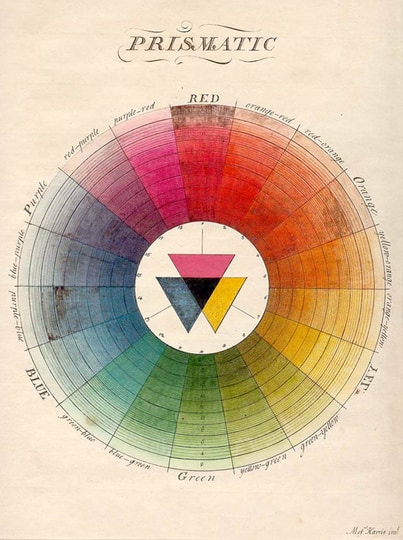
I saw this color wheel on Apartment Therapy. You know what? I want a large framed version of it to hang in my workroom. I think it is so cool, especially with the colored pencil like texture. I also really like the huge variety of different colors.

Just Do It!

We hear that catch phrase all the time. Nike might have trademarked it, but it is everywhere. I recently read a blog post by Michael Nobbs who draws. He wrote about microworking and I love his theories on how microworking helps our creativity, especially in our busy lives. Michael Nobbs draws and draws my attention to other artists who use drawing as their medium. He put me on to Nina Johanssen from Sweden, who did a great coffee sketch last year that I love. Michael is right.  A litte work all the time goes a long way.

Tupperware Freezer Mates

You can also help your creativity by being organized. I saw these great Freezer Mate storage containers from Tupperware when I was cruising their site. They are great for going to class kits and for organizing small things. I can also see them put to use for small projects you are taking to class, squares or other bits of fabric designated for a certain project or a multitude of thread. Perhaps they would be good for beads? I don’t know since I haven’t actually tried one out. I have a pink Tupperware box from the dark ages that I use for my class kit and it is great, because the lid never falls off. You can purchase them and help the preschool of my friend’s children by using this link. It’s 23½-cup capacity and $49.50 price tag are significant.

Tutorials

Have you see this interesting tote bag? It is called a Bagsket and Foofangel has a tutorial for making it. I first saw it on Linda M. Poole’s FB page, but she didnt’ have the link. I poked around and then someone found it, so I took a look. Linda made it with her Seahorse fabric collection and the bag is really cute.

I put up a page of tutorials that I have written. Check out the AQ tutorials page. It is under the AQ Info page.

Supplies

My iron died. I don’t think it is completely dead, but it was dead enough so I couldn’t

Black & Decker Classic Steam Iron

use it, which meant I couldn’t piece. I bought a new iron – a Black & Decker Classic Steam iron. I had been thinking of buying one and this was the perfect opportunity. It was a little over my normal iron budget ($20 or less), but I went for it.

UGH! I sincerely dislike this iron. There are a lot of good things about it. It has great heft. Wonderful steam. The bad part is that the thing does not glide over the fabric. Of course it doesn’t! The sole plate is not Teflon. UGH! I really didn’t like it, but felt like I was stuck with it until it died. I had already opened it and used it.

Machines are not my forte’. I can operate them, but I usually eschew knowing how they work. One day I was driving down the street and heard a clunk. When I stopped, I looked under the car and there was a piece hanging off of the exhaust system. Not in my plans for the day. I drove to my mechanic with my car making such a loud noise that I couldn’t hear the radio and had to endure the local homeless man, who hangs by the Methodist Church, pointing at me as I drove by (turnabout is fair play, I guess). My mechanic couldn’t fix it, but he wired the piece to the car and sent me to his colleague. I went. They said they could fix it and I should come back in half an hour. I was in a neighborhood full of fast food places, a computer repair shop, a notary/check casher/mortgage broker, a bank and a small Walgreen’s. Off I went to Walgreen’s. It doesn’t take a half an hour to peruse Walgreen’s, so I sloooowwwwllly walked up and down each aisle, carefully looking at each item. Finally, I came to a small housewares section.

Living Solutions Iron

Yes, I needed lightbulbs. Yes I needed an 18 foot extension cord in white and WOOHOO they had two irons. I looked at the two carefully and decided on the less featured filled Living Solutions model. I have been using it for a couple of weeks now and like it. It glides over the fabric, was less than $10, has steam and not auto shutoff. The lack of auto shutoff is a double edged sword. I need to make sure I unplug it EVERY time. It isn’t a GREAT iron, but it does the job.

Anyone need a classic steam iron? 😉

Kathy Sperino Gorgeous Quilting

A few days ago Kathy posted the quilt below on her blog, Finishing Lines. I love the way she has matched the thread to the piecing. I like to do that as well, so the quilting is a design element, but doesn’t overwhelm the piecing. Check out Kathy’s blog for some really cool inspirational pieces.

I have been tempted to ask Kathy to quilt the Tarts. We’ll see.

clipped from finishinglinesbyksperino.blogspot.com

surface tension . . .

blog it

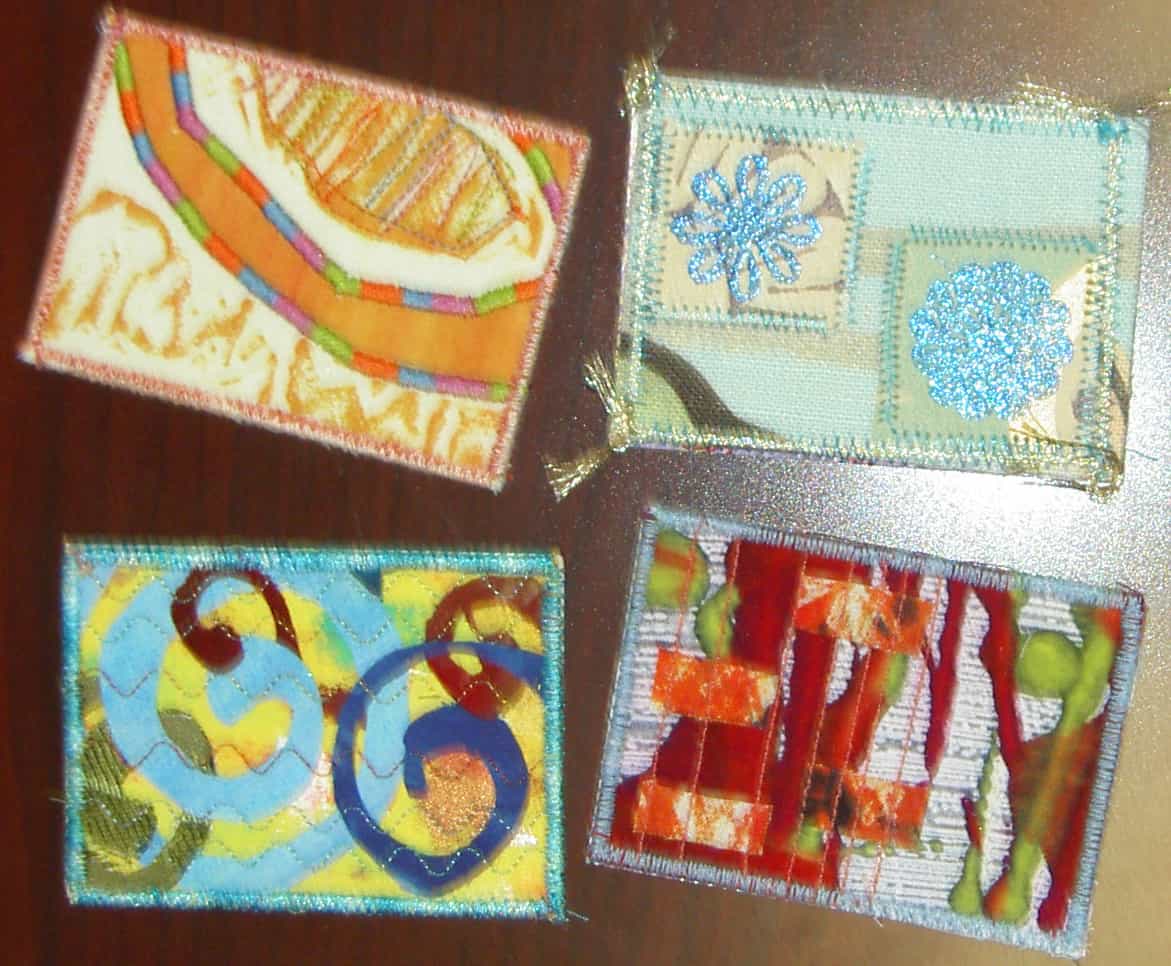
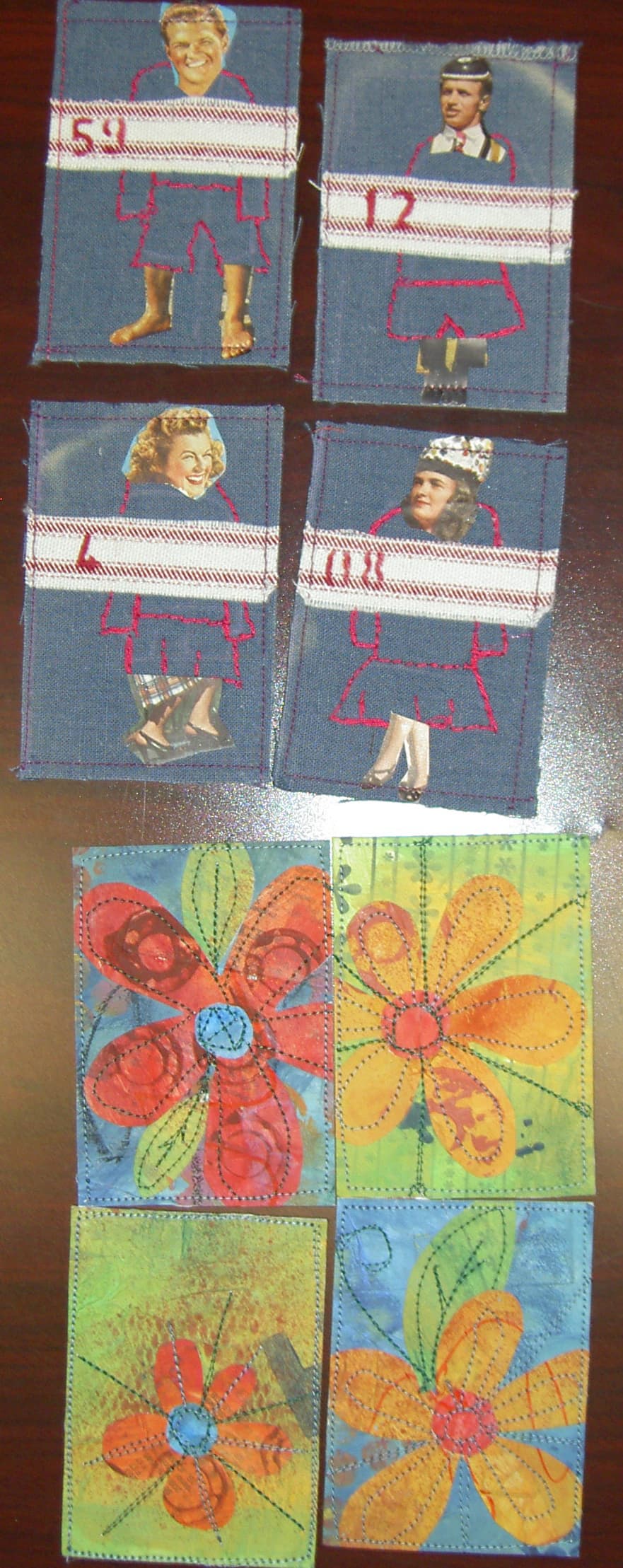
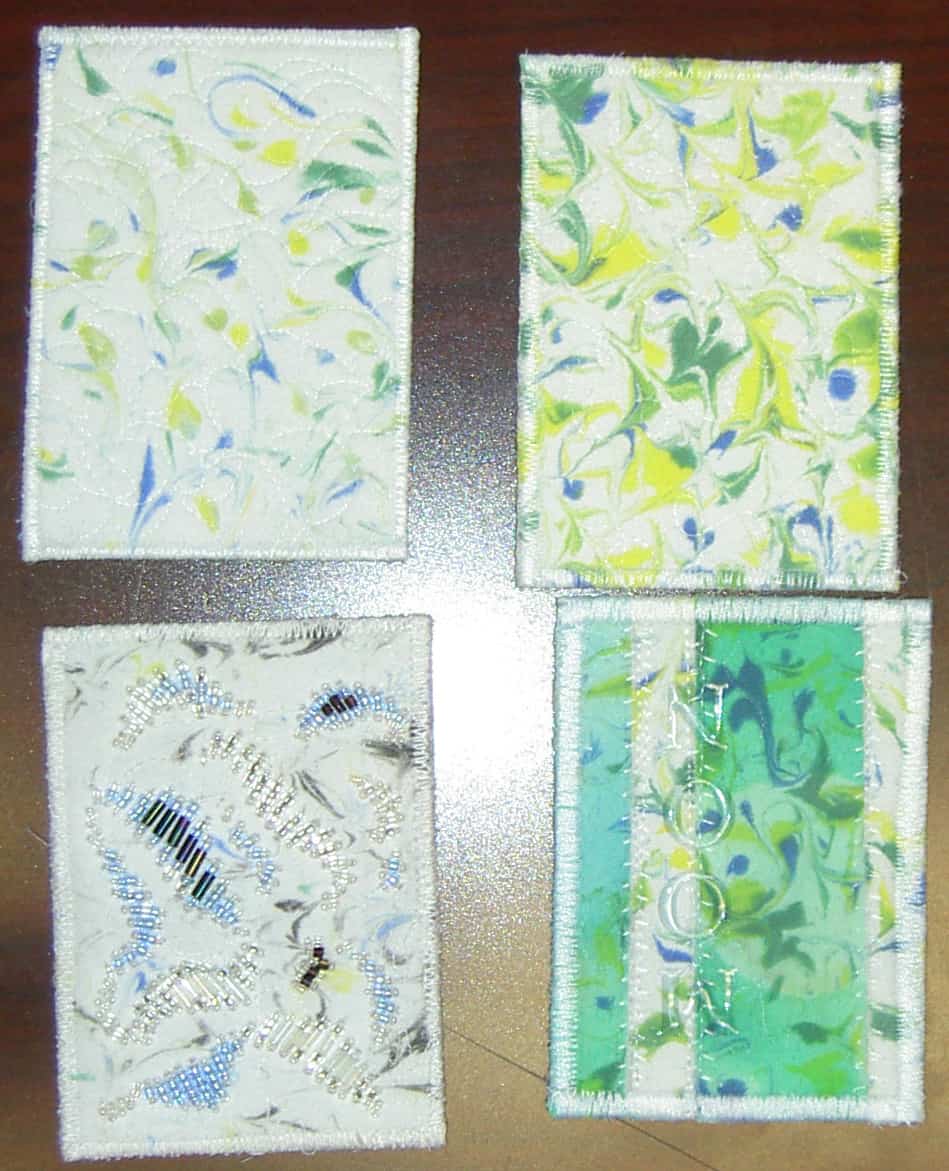
ATCs from CQFA

The other day I wrote about the CQFA meeting and the activities in which we participated. I finally processed all the photos. They aren’t great, because there were a lot of people swapping this time. I came into the room late and everyone was ready to go, so I had to be quick about the photography.

Caroline
Caroline

I picked the 2d one from the right. I liked the spiral.

Very Picnic-y
Very Picnic-y

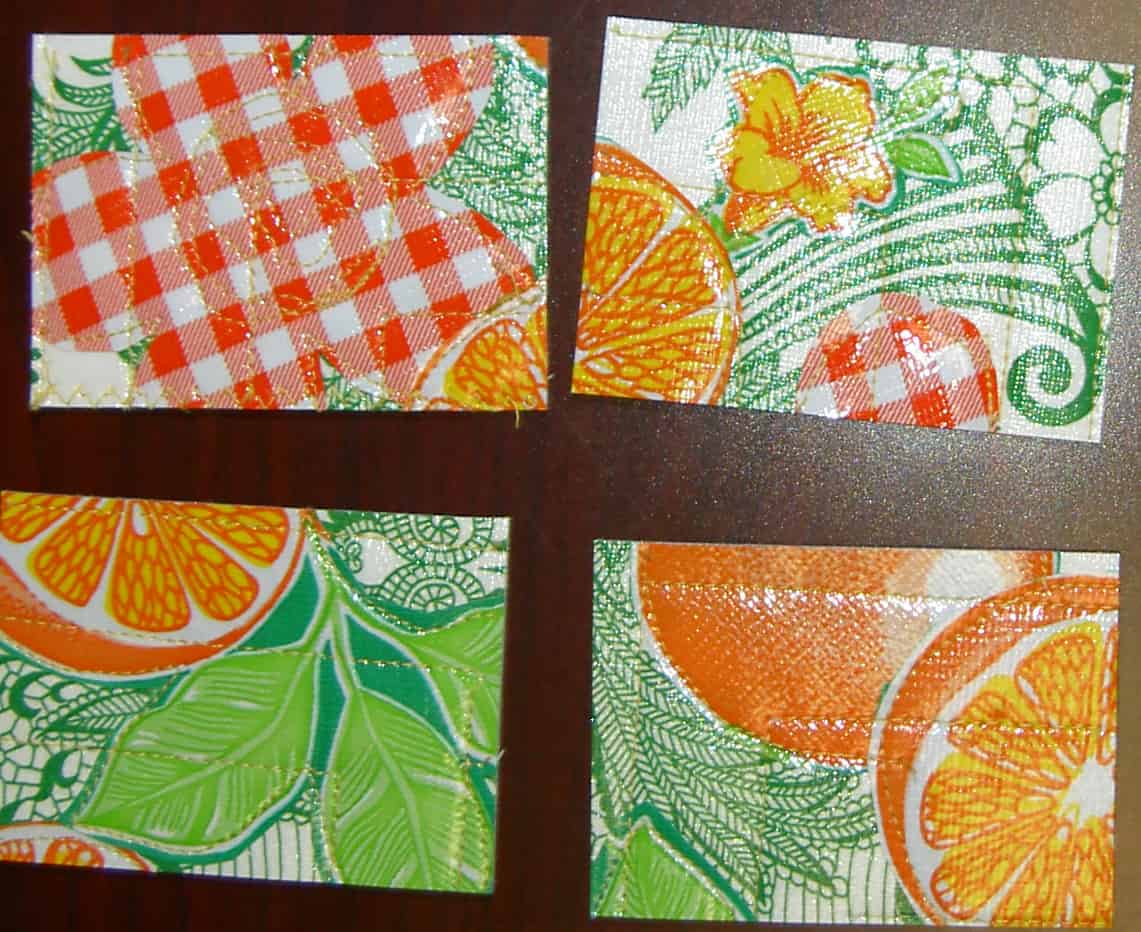
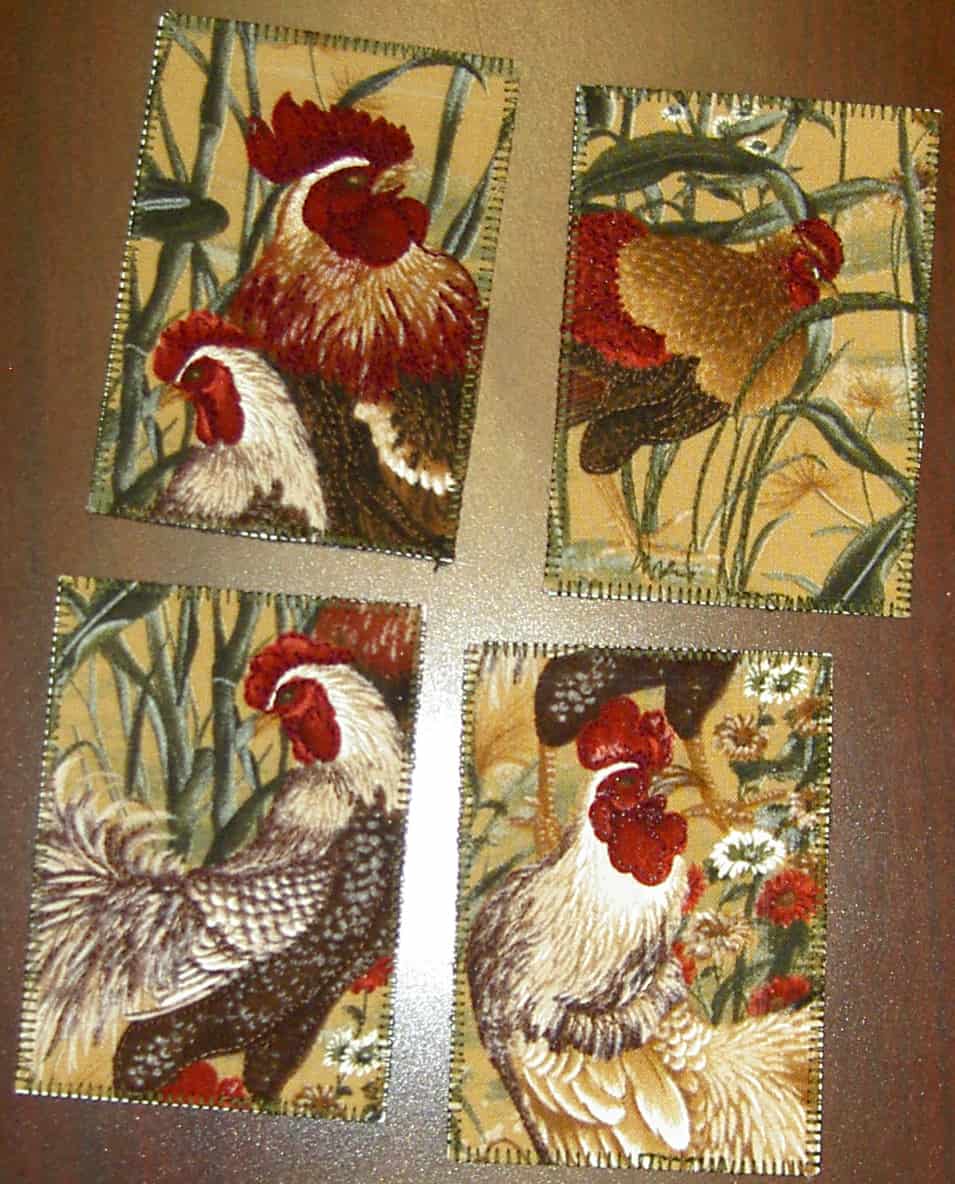
I don’t remember who made these, but they were made from oilcloth.

Maureen
Maureen

Maureen doesn’t usually make sets. I got one of hers as well: the one in the upper left hand corner.

Nancy?
Nancy?
Bron & Sue
Bron & Sue

I would have loved one of Bron’s paper dolls, but they went quickly!

Julie
Julie

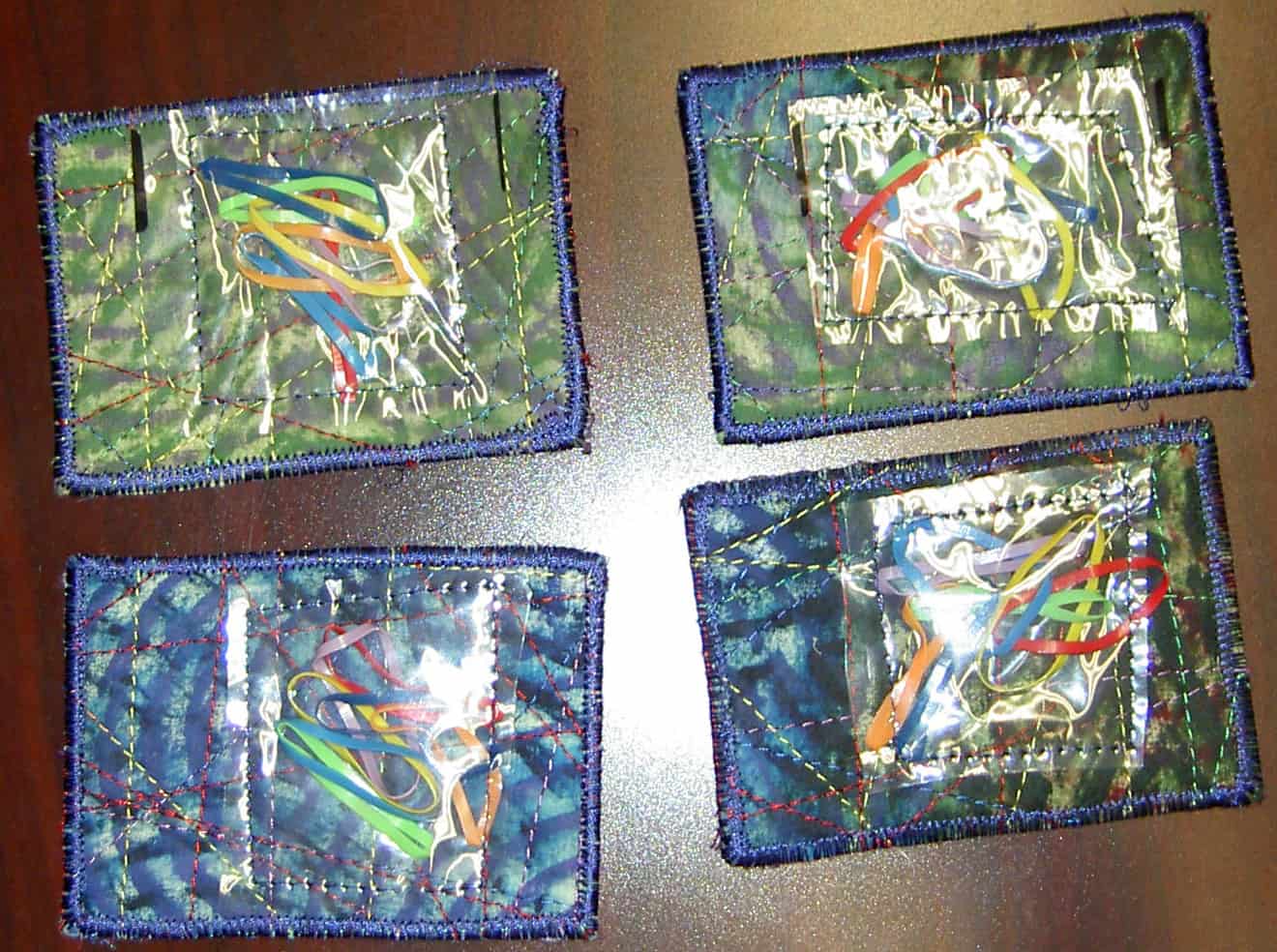
I also missed out on Julie’s. Hers had some plastic covering some loose art materials.

Virginia
Virginia

Virginia also made a bunch for the show.

Dolores
Dolores

Dolores always does fabulous work. I picked the one shown in the bottom left hand corner. I love her beading.

Sue - detail
Sue - detail

I was able to choose one of Sue’s as well. The one on the far left now lives at my house. she used a great technique. I wish I could remember the name. She might show us how to do it at an upcoming retreat.

Diane?
Diane?

Nobody really liked mine – or else everyone else’s were such high quality that my shaving cream marbling technique was overshadowed. I don’t know. I don’t think mine were crappy.

Tanya Whelan for Grand Revival Designs Bags

Did I say I need to stop buying tote bag patterns until I make some bags from the patterns I already have? I have resolved to do that.

However, I have never seen this designer or her bags and I really like them. Perhaps just one tiny pattern? Hhhmmm.

clipped from www.grandrevivaldesign.com

blog it

More Zentangles

I tried really hard not to get caught up in the Zentangles movement. I can no longer avoid it. Some of the work being done is phenomenal and it makes me so appreciative of QuiltRat who regularly shares her doodles with us as part of the Creative Prompt Project. Go to the Zentangles blog to see more fabulous work, including Zentangles quilts.
clipped from zentangle.blogspot.com

Quilt Surprise

You can see more of Pat’s quilting at her website.
blog it

CQFA Saturday

The past weekend seems like a zillion years ago. I have been across the country and back for work, had so many meetings, I had to arrange for my mom to attend one of them since I can’t be in two places at once. I know some of you think I can and I hope I haven’t shattered your illusions.

Frances, of the Off Kilter Quilt, talked about the first week of school and how exhausted she was. Our Young Man has been in school since August 25 and I feel like I live there, in addition to my work and quilt life. There isn’t enough of me to go around. Bleah.

CQFA is usually a great break with wonderful women, fabulous show and tell inspiration and, lately, great workshops. We are organizing a quilt show (~March 5-July 7, 2011) and I am the instigator of this endeavor, so how I feel is ALL MY FAULT. I started it. This is a professional event with a curatorial staff, professional signage, artists reception and symposium to go with the show. We spent a good portion of the meeting talking about the various committees, names for the show, copyright, lawyers and all other ephemera associated with a quilt show. I am thankful that everyone is interested and I am not alone in the organization, but the whole presentation sucked what little life there was left in me out.

The meeting didn’t give me the boost that it normally does and it wasn’t because of the show organization. It was me and the crazy schedule I had last weekend: CQFA, soccer, dinner, various school related functions. It was too much and I couldn’t get out of any of it.

My great sadness of CQFA was that the awesome Sonja was signed up to give a class and I had to leave part way through it. 🙁 She had me get out my kid watercolors and paint, which was fun and may have broken some barrier I had about using those watercolors. They are Crayola watercolors for kids, so I should have no hang ups, but I do.

I signed up for Carla Sonheim’s Drawing Silliness class (not sure of the exact name) and was pleased to find out that Sonja signed up for it as well. Perhaps I am not a complete lunatic.

We traded ATCs and mine were the last men standing. I have to admit that I liked the process when I did it at A Work of Heart, but they weren’t very successful in general. Oh well, not every piece can be a masterpiece. I have photos of the others, but I haven’t done anything with them yet, so look for a post on them later.

Odds and Ends Tuesday

“Be compassionate to yourself” is the message that stuck in my head after listening to Melanie Testa interviewed by Rice Zachary-Freeman on the Voodoo Lounge podcast. You have to listen to this podcast. it is very calming, Rice talks just enough, but not too much and she lets Melanie tell the listeners everything. It is a wonderful.

A few weeks ago, I talked about Christine Barnes. She has replicas of the color wheel I showed in the post on her website for sale. I mentioned it before, but took a look at some of the books and things she has for sale also. it was interesting to see the Interior Design books.

Malka Dubrowsky has a lovely Dresden Plate quilt she calls The Cupcake Quilt up on her site.

Did you see Vicki Welsh’s recent Field Tripping in Fiber? Aside from including my Chocolate Box, she has some other GREAT quilts. One is called the Cupcake quilt by Malka Dubrowski. I am not sure why she calls it a cupcake quilt, because it looks like a Dresden Plate variation to me, but who am I to judge? Cool name, regardless. there is also a pattern for a pleated handbag. I like the idea of pleats on a handbag. I am not sure if I like this particular handbag. I am so happy that she surfs quilt sites and compiles them in this newsletter like post.

Take a look at this orange sewing machine. Isn’t it cool looking? I would love more information, but I wasn’t able to see the name very well. I think it might be the Brother Innovis Quattro 6000d. Cool looking, if nothing else.

Periodically, I listen to a radio program called To the Best of Our Knowledge. I have gotten into discussions about whether the show is actually discussing the best of ‘our’ knowledge and whose knowledge that might be. Regardless of the philosophical meanings behind the name, I enjoy the show, because they discuss different topics with artists, physicists, philosophers, writers, professors and a whole host of other people I would never, otherwise, hear about. I missed the Superheros show a week or so ago, so, for the first time, I went to their website to see if the streaming would work. I was pleased that it opened right up and worked well with the Quicktime player. The Superheros show also included a segment on Wonder Woman’s new fashion look and the controversy surrounding it. The discussion was interesting and it made me, of course, think of the fiber involved. Does that new jacket hamper her flying?

There are a lot of other interesting shows on that site. You should check it out for good listening ideas when the podcasters on hiatus.

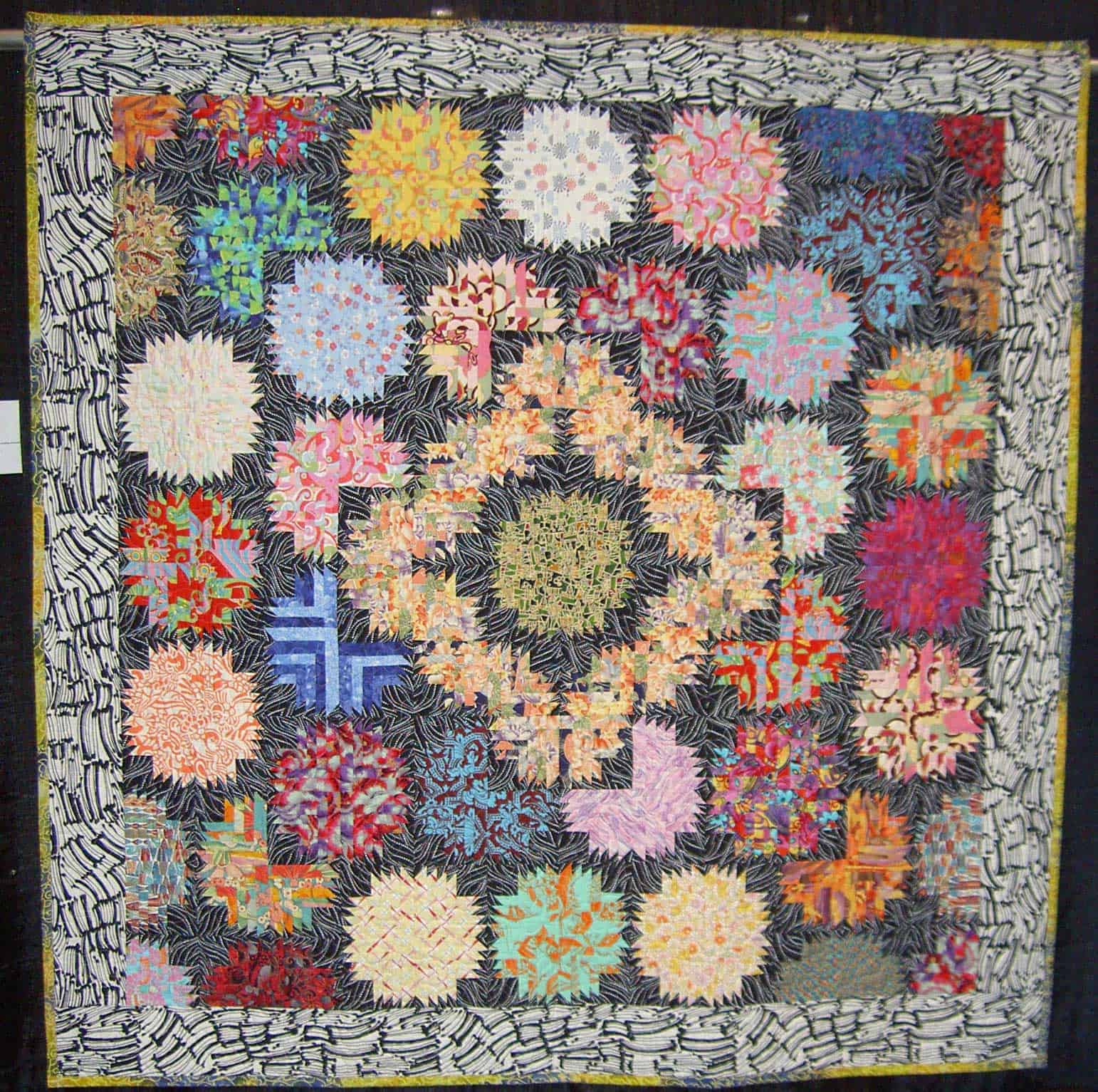
I am still thinking of a spiky border for my Zig Zaggy quilt. I saw one on Flickr that I really liked the other day. The problem is that I like the whole quilt as well as the border. I am still not sure if the Spiky border will go with the Zig Zaggy quilt.
The Textile Collection:  http://www.vads.ahds.ac.uk/collections/ST.html
VADS is the Visual Arts Data Service that contains over 100,000 images that can all be used in learning, teaching, and research.  The Textile Collection, from the University for the Creative Arts at Farnham, is one of 46 collections available on the website.  There are two ways for visitors to peruse the 1051 image collection.  There is the “View all images” link below the search box, and the browse method allows visitors to choose from such categories as “Function”, “Maker/Designer”, “Raw Materials”, “Cloth Structure”, and “Process”.  Process includes such categories as batik, knitted, machine woven, and wax resist.  Visitors should check out the “blocks for printing” under the “Function” category, to see many beautiful blocks that were once inked up and pressed onto fabric. These blocks were then deployed to produce patterned fabric for clothing, linens, and other items.
In case you didn’t hear, Bonnie Leman, founder of QNM died last week. I didn’t know she was sick and didn’t see an obituary. She did a lot for the quilt industry and her death is a huge loss to quiltmaking. We are fortunate to be the beneficiaries of the fruits of her labors. Fred Bloebaum also died last week. She was a teacher at a local school called the Sewing Workshop. She was also the creator of the La Fred pattern lines.

Birch Bundles Ideas

I trolled the web for some ideas for the Birch Bundles that I talked about yesterday. All of the photos are linked to their original locations.

Green Couch Designs has a great pattern/idea that I might be able to use:


Here is a detail:

It is simple, but effective. I am not sure if the fabrics from the pink and purple bundle will show up well enough in this design, because of the size of the pieces.

I also like this one from Cherry House:

The thing I like about the above pattern is the black strip (I would use something different depending on the color scheme), but it anchors all the blocks together. I am not sure the effect would be the same with different fabrics used for the blocks. Part of the effectiveness of this quilt is the solid colors. This is from the City Quilts book, which is making me consider buying it….very soon.

Samelia’s Mum has a very cheerful blog. I like the lower right hand corner of the quilt on a recent post.

I think I really like the top quilt, but would make it with slightly larger rectangles. What do you think?

SFQG: Christine Barnes Lecture

Barnes' Color Wheel
Barnes' Color Wheel

Christine Barnes spoke at a guild meeting last Tuesday. I got the notice and decided I would attend. My mom is still moving, so she couldn’t go with me. I have long admired Ms. Barnes work. I really enjoyed some work on luminosity done by her students, which I saw at the Monterey Quilt Guild Show. I’d like to sign up for that class. Barnes was teaching it at the Peninsula Quilt Guild last week, but work was crazy, so I couldn’t take off and had to miss it.

At the meeting, while waiting for the lecture to start, I went up to peruse her patterns, displays and other materials. I was impressed with her color work, but also with Ms. Barnes as a person. She came right up to me and started talking to me like a normal person. She came across as very real and not at all egotistical. She wore violet jeans! 😉 We talked about the magazine articles she had written or which had been written about her. One article had a picture of her kitchen, which is white and chartreuse! It was gorgeous. She also showed me a magazine I had never seen before: Fabrications. It is a UK publication and I will have to check it out.

Speaking and Showing

Christine has degrees in Costume Design, Textiles and Journalism. She lived in Palo Alto for years and was an editor at both Sunset Books and Martingale. She has taught and lectured about quiltmaking for more than 10 years, including 7 or 8 years at Empty Spools / Asilomar. She has a new book coming out with C&T called The Quilter’s Club. During her entire lecture, I got the impression that she LOVES fabric, loves making quilts, really enjoys working on her projects and just has fun. I loved that!

She calls the color wheel a magical tool for quilters, because it helps a quiltmaker go past using the focus fabric to add color to quilts. In her travels, she has found that many of the preeminent quiltmakers use a color wheel so often that they have one posted on their studio wall.

“Magic fabric” is a concept that Ms. Barnes talked about and uses in her work. A magic fabric is a fabric that makes blocks glow. They are shot with light, often gradated, create ethereal effects, have vitality and life to them. Often hand-dyes and batiks fit into this category. Chaos can reign if one includes too many magic fabrics in a block or quilt. They are side dishes in your projects, a place for your eyes to rest. She uses magic fabrics as backgrounds pretty often in her quilts.

Elin Noble, of Massachusetts, daughter of Maurine Noble, creates beautiful hand-dyes, which Ms. Barnes mentioned frequently. I had no idea, so I’ll have to go check out her work. We were warned that Noble’s fabrics are not cheap.

She talked about luminosity, transparency and depth as effects. She also gave examples of her use of those effects. Value was something she gave a simple definition for: value is about light, medium and dark fabrics; how light or dark a fabric is. Christine Barnes said that value creates the pattern in a quilt and creates a sense of depth. I have heard value described in different ways. I kind of like this definition, but need to think about it and look at some quilts with this idea in mind. Some other information she uses:

  • temperature: how warm or cool a color is – red, orange, yellow are all warm and come forward. Cool colors recede and include blue, green and violet.
  • intensity: saturated, pure, clear. Not about color.
  • proportion has an effect on the impact of the quilt.
  • Ms. Barnes thinks a lot about how light hits color when she is choosing fabrics.
Wash of Color
Wash of Color

She had some other things to say about fabric, which I thought were interesting:

  • stripes with gradations (especially batiks) can organize a design especially when there are a lot of curves in your block or quilt.
  • woven plaids can be luminous
  • bringing a little color into a neutral quilt can create success;
  • in general, brining in little bits of other colors will make a quilt/project sing
  • when in doubt, throw in some black and white (her friend, Velda Newman says 90% black, 10% white)

Christine Barnes obviously loves fabric. She knew designers and fabric lines. She appreciates hand-dyes, but also uses commercial fabrics. She also knows her way around a sewing machine. She spoke about using partial seams like it was a no problem technique. YAY!

One thing I LOVED about Christine’s lecture was her concept of cheap thrills. One cheap thrill is mitering a striped border so that the corners end up with a chevron kind of look in the corners of your quilt. Another one of her cheap thrills is making large simple blocks and then cutting them up into quarters and put different parts back together in different ways.

Most of the quilts she showed were geometric, but Barnes showed us one quilt which was an abstract depiction of Kilauea volcano. It looked to me like a quilt showing cloud cities. I liked seeing that she was not stuck in her ways and was stretching herself in other ways besides just color.

Her color wheel was made from P&B Basics fabric and has 12 segments. You can buy one from her website.

Speaking and Showing Quilts

I am really glad I could go to this lecture. I really enjoyed myself.