
And Passover and Bunny Day! This photo is too funny not to share. Have a great day. Hope you are sewing or spending it with family and friends that you like.
Commentary about works in progress, design & creativity
And Passover and Bunny Day! This photo is too funny not to share. Have a great day. Hope you are sewing or spending it with family and friends that you like.

I have to admit that I am enjoying just cutting squares and rectangles for FOTY 2012 so far this year. I am so glad to be using simple shapes and the squares and rectangles are making me feel much more creative with FOTY 2012. I have been playing with the layout of the little groups I cut as I go along.
I do not regret using the diamonds for FOTY 2010 or the triangles for FOTY 2011. I am pleased with the results. Both were great experiences and I am glad to have worked on them. I do think that it is good to simplify sometimes.
The aspect of FOTY 2011 that I am carrying forward to 2012 is the idea of using smaller pieces of the fabric I have used during the year, but didn’t buy this year, alongside the new fabric. I am being much more diligent about cutting fabric I have used and I have used a fair amount already this year. I love most of the fabric I have bought, regardless of when, so I want to give all the pieces an opportunity to shine. Also, in an ideal world, I would use more fabric than I would buy. Since I like to make decent sized quilts, that means that I would need to include more fabric. Definitely a wallet vs. idea war going on in my head.
memory book
The Persistence of Memory (Salvador Dali)
loss of memory
City of Memory – story map of NYC
memory album
Barbara Streisand – Memory
my memory is going
what a lovely memory!
random access memory
Definition: In psychology, memory is the processes by which information is encoded, stored, and retrieved. Encoding allows information that is from the outside world to reach our senses in the forms of chemical and physical stimuli. In this first stage we must change the information so that we may put the memory into the encoding process. Storage is the second memory stage or process. This entails that we maintain information over periods of time. Finally the third process is retrieval. This is the retrieval of information that we have stored. We must locate it and return it to our consciousness. Some retrieval attempts may be effortless due to the type of information.
computer memory
improve memory
American Memory from the Library of Congress
UCSF Memory & Aging Center
Memory (Cats Song): “Memory“, often incorrectly referred to as “Memories”, is a show tune from the 1981 Andrew Lloyd Webber musical Cats[1] sung by the character Grizabella, a one-time glamour cat who is now a shell of her former self. The song is a nostalgic remembrance of her glorious past and a declaration of her wishes to start a new life. Sung briefly in the first act and in full near the end of the show, “Memory” is the climax of the musical, and by far its most popular and well-known song.
Please post the direct URL (link) where your drawing, doodle, artwork is posted (e.g. your blog, Flickr) in the comments area of this post. I would really like to keep all the artwork together and provide a way for others to see your work and/or your blog, and how your work relates to the other responses.
The Creative Prompt Project, also, has a Flickr group, which you can join to post your responses. Are you already a member? I created that spot so those of you without blogs and websites would have a place to post your responses. Please join and look at all of the great artwork that people have posted.

I really can’t figure out how my mind works. Sometimes I like the way it works, because it sends me off in a new creative direction.
I was making the Northwind block for the Bay Area Modern Quilt Guild A-B-C Challenge and got to the point that you see in the top left photo. All I had to do was put some larger triangles on the sides and I would have a nice tidy square, but this shape stopped me in my tracks.
I have been wanting to make a Lozenge quilt for awhile, but it hasn’t come up high enough on the to do list yet, but seeing the way this shape went together made me think about that future piece a bit more.
You can easily make this into a square by adding triangles. In this case, the triangles will be part of the design, but they could easily be background as well.
I could change the colors around so that the piece would be really scrappy or use 80% of a line of fabric.
The piecing isn’t difficult – few half square triangles and you are in like Flynn.
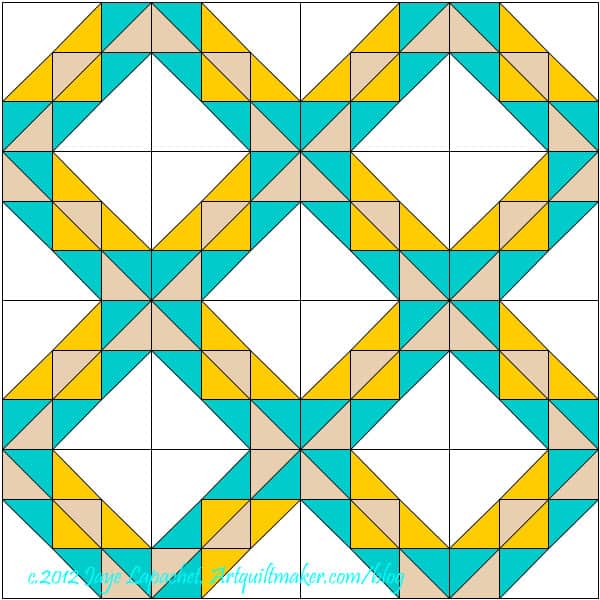
So, this is an example of a quilt made with this shape/block.It is a quick and dirty EQ7 design and I can already see some changes that I want to make, but you get the idea of what you could with this block. I like the diamond shape. It reminds me of the Stepping Stones quilt.
Fabric
I fell off the fabric wagon. I was trying really hard to be restrained (Nota bene: I am NOT saying “refrain from”) about buying fabric. I kept it up for awhile, then there was a sale and that temptress, Joyce at Quilting Adventures showed me some photos of my favorite (if I had to choose a favorite) designers, Philip Jacobs and Martha Negly. Now I see a link from Adrianne’s blog to the Mama Says Sew site where they have a new line of fabrics that I might-well, probably- need to buy. 😉 They would go with that nice piece of Circa 1934 (red background with numbers and letters) I have leftover from the Stepping Stones. Perhaps Stepping Stones #3? Sadly this line Mama Said Sew from Sweetwater won’t be available until August. Perhaps I won’t want it by then?
In case you were worried, the Vintage Modern precuts are now available for purchase at the Fat Quarter Shop. I am already getting some charm packs from Julie at Intrepid Thread, and I am sure she will have other/more precuts soon. I am going to hold off on yardage until I see what the prints are like and how they would go with what I already have (Ruby, Bliss, other aqua). I know I won’t buy Jelly Rolls.
Cat Beds
Speaking of fabric, Amanda has allowed me to post two tutorials (one short Simplified Cat Bed Tutorial, and one longer that I can’t post for some odd computer reason that I don’t understand) for cat beds. You might remember that I was saving my scraps for Amanda and her cat bed project. I was feeling very good about my additional recycling efforts and then Amanda got too much filling and not enough cat beds to stuff with the filling overflowing her garage so she stopped accepting filling. I thought that posting the directions here would encourage you to make some cat beds. The organization for which she is currently sewing these beds is called HCN – Homeless Cat Network. They are a small, non-kill shelter with a physical building up in the San Mateo/Burlingame area. They also have a foster home network. Amanda says that the very cool thing about this group is that every cat gets a bed, and when the cat goes to its new home, it gets to take the bed with it. So it has that double-extra niceness to it. HCN also has a very good feral cats program.
Quiltmaking and Copyright
The Emily Cier Scrap Republic issue, detailed in a post from several months ago, has been made more public. Todd Hensley of C&T wrote about their thoughts on the issue, as does Kate Spain, the designer in question, in a recent post. Public statements and some additional information are also listed on Emily Cier’s site. I found out that a resolution had been reached when Weeks over at Craft Nectar wrote about the issue from her perspective. Kim from TrueUp also put in her two cents with some interesting comments. Leah Day, not talking specifically about this Emily Cier/Kate Spain issue, has some good questions and a unique way of saying commenting on copyright. Amazon has a photo of the offending tote bag, but it is listed as currently unavailable. All of these posts are very thought provoking. Many people have things to say about this particular issue and copyright in general. I am not excluding anyone by not mentioning their post here. You can find more via any one of several search engines.
Everyone is entitled to their opinion, but if you are not a lawyer or do not have some special, intricate knowledge of copyright law, I would urge you to refrain from sending disparaging remarks to any of the parties. Ms. Spain also goes into more detail about why this came about. I think that she also details, very civilly, what she does to support (posting blogs, selling items made with her fabric on Etsy, etc). Ms. Spain also has an interesting graphic that shows how her business works. She includes, as part of her post, “If not, I would risk losing my livelihood.” It is my understanding that this statement is ultimately true, though a better statement might be that she is obliged to defend her right to license her designs or risk losing those rights and, yes, ultimately her livelihood.
Todd Hensley also has an interesting perspective. I was surprised to read on his blog post that they had admitted being wrong and tried to work something out with Ms. Spain when the issue was identified.
I think that the parties came to an equitable agreement and am glad the resolution didn’t seem to involve too many lawyers. However, if I had been directing traffic, I would have told them all to keep their mouths shut, and leave the PR statements to explain everything.
If you want some info about copyright, check the website law librarians rely on for their own purposes, CopyrightLaws.com. There was a great post recently called Copyright Facts for Librarians. I don’t think anyone will hit you if you are not a librarian and read it. 😉 The article starts off with “6 essential facts for librarians…”.
The overarching message of all of this seems to be to give credit where credit is due. I would urge all of you, regardless of whether you have a quilt business or not to give credit where it would be a nice thing to do – on your blog, on your quilt label, in forum postings, etc.
Around the Web
Quiltville‘s Bonnie K. Hunter interviewed Simon Beck about his snow designs that look like embroidery.
Jane Davila has a great idea to gain additional space in her workroom. I have seen the clipboard idea in Libby Lehman’s studio (via The Quilt Show – great episode, you should watch it), but read through Jane’s post and see how she made the clipboards pretty. I would take a few of those if anyone was giving them away. Or perhaps I can make some as gifts? Hhmmm.
You can join the ArtQuiltmaker page on FB, if you want.
I had no idea this Jane Pizar quilt was all the rage on the Internet. If Barbara Brackman says so, it must be true. It is from 1860 and was, in my quick Internet look (note that I do not say research), her marriage quilt. As an added bonus, Ms. Brackman talks about the age and the prints in her blog post, citing to other quilts as well. A real eye candy fest! It looks very intricate. I can see myself making one with a group of friends also making versions of their own. Is this the new Dear Jane?
Blog Problems
You may have noticed, if you use Google Reader, that intermittently it looks like I am trying to sell you P-r-e-d-n-i-s-o-n-e (trying to avoid more spam with my weird spelling) or some other crazy drug. Have no fear, I have not sold out to The Spam Man, but I have been having trouble with Google Reader replacing information in my blog posts. I am trying to ferret out the problem with the help of some fabulously tenacious people. One of the things I am doing is deleting widgets and replacing buttons with static images. I apologize to all who link to other sites from my buttons, but I have to try and eliminate all possible ways of infiltrating the site. If you see a problem on a certain day, especially if it is NOT via Google Reader, I would really appreciate a screen shot and some commentary about what you were doing. If you need a WordPress programmer who can talk to people, please let me know and I can give you a name.
Other, etc
I have created a Flickr Group for the EBHQ show I attended a few weeks ago.
I wrote for the SeamUp blog last week. It is a post called Future Quiltmaking: Guesses and Reality.
I entered the Modern Quilt Showcase and was disappointed not to get in. If you didn’t see my self pity and whining on FB, count yourself lucky. I was disappointed, because one of the few times I can get my act together to enter, I get rejected. I know it is a numbers game and I need to enter way more than once a year! I was also disappointed, because I thought the two quilts I entered, Chocolate Box and the Zig Zaggy Quilt, were both modern and innovative. After buying two books 😉 and calming down a bit I realized that it could have been anything – poorly written application, crappy photos, wrong look and feel. Until I see the quilts that were chosen I can’t say really whether mine would have fit in. It was really nice of some of you readers to take the time to tell me their thoughts and to make an effort to boost my morale. Thanks.
Completely not Quilt Related
Unless you listen to audiobooks while you are sewing. J.K. Rowling has finally gotten the Pottermore store up and running so you can the Harry Potter series in audiobook format now. And eBook format. I really like listening to audiobooks. I get a different experience. I am annoyed about having to go through a different site, though. I want everything to play nicely together and I have a feeling the audiobooks from Pottermore won’t. I hope I am wrong.

This block is related to two different previous blocks, #28 and #49.
Directions to this Large Table Squares #50 Directions.
If you have made blocks or a quilt from these patterns, please post a link in the comments section of the relevant block or on the AQ Block-a-Long Flickr group. I would love to see what you have made.
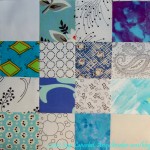
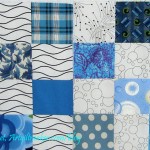
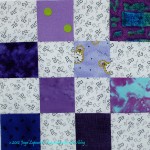
I made a few more donation blocks in between another project I am working on. I know I said this, but I enjoy making these blocks so much. I have only two more blue blocks to make until I have enough blocks to make a large enough Donation quilt.

Yes, I am working on the Flowering Snowball. It is a hand project (as I designed it to be) and I work on it when I watch TV.
I did a lot of cutting a few weeks ago, as I mentioned and the result is that I am putting segments together until there are none left and then putting other segments together until I can start sewing blocks together. At the moment I am working on sewing a foreground piece (the printed, colored fabric), which has been joined with a black on white piece to a different foreground piece that has been attached to a small black square.
So far, I have done three. When I looked at them the word ‘florets’ came to mind. Yes, like broccoli, but not broccoli. Nicer than broccoli-not that there is any thing wrong with broccoli, but fabric is much better. So I am calling these joined segments florets.
One of the things about this method is that I put all the squares together at once. I sew the same segments to each other until all of the blocks are done and then I move to the next segment. When I start finishing the blocks, they will be done quickly.
Definition: The word quatrefoil etymologically means “four leaves”, and applies to general four-lobed shapes in various contexts. In heraldic terminology, a quatrefoil is a representation of a flower with four petals, or a leaf with four leaflets (such as a four-leaf clover). It is sometimes shown “slipped”, i.e. with an attached stalk. However, it is not defined as a flower, but called a “foil”. In the U.S. Marine Corps, quatrefoil refers to a four-pointed decoration on the top of a warrant or commissioned Marine officer’s dress and service caps (see peaked caps, also known in the Marines as “barracks covers”). According to tradition, the design was first used with Marine officers on sailing ships so that Marine sharpshooters in the rigging did not shoot their own officers on the deck during close-quarters gun battles (as when crews of opposing ships attempted to board each other’s ship).
Quatrefoil Library in the Twin Cities
window
Phi Mu’s symbol is their sacred four-point quatrefoil. It is a unique shape and can be traced back to early European design. Phi Mus love to spot the popular shape in everyday use. Many wonder what the quatrefoil’s importance is to the fraternity but only a Phi Mu sister will know.
The quatrefoil is an ancient symbol of good luck, a Celtic symbol representing “
Please post the direct URL (link) where your drawing, doodle, artwork is posted (e.g. your blog, Flickr) in the comments area of this post. I would really like to keep all the artwork together and provide a way for others to see your work and/or your blog, and how your work relates to the other responses.
The Creative Prompt Project, also, has a Flickr group, which you can join to post your responses. Are you already a member? I created that spot so those of you without blogs and websites would have a place to post your responses. Please join and look at all of the great artwork that people have posted.

As I mentioned in my previous post on Swoon block, I am trying different ways of making these blocks. For this block, Swoon #3, I tried to make the yellow pieces one piece of fabric rather than cutting them into squares and half square triangles. I want to preserve the print as much as possible and not have those sections look choppy. I thought segments of the first Swoon block looked choppy.
I am very pleased with how this block turned out. The road was rocky, however, and I fiddled with it a lot. This block was on my design wall for a long time before I actually sewed it together.
First, I made the HSTs on the very outside of the block (pink dot and background) using my Triangle Technique.
Next, I cut 4.5″ squares for all the yellow pieces in the block (8 total).
Third, I cut 2.5″ squares out of the background fabric and the pink dot fabric. I sewed them on to the yellow, larger squares by drawing a line diagonally across the center of the smaller squares and sewing on that line. The goal was to fold the square back into a triangle.

After sewing the first one, I realized that sewing on the line was not the way to go. Folding back the square into a triangle did not cover the yellow 4.5″ square. I tried lining up the line on the small square with the inside edge of my 1/4″ foot, then I sewed just inside the line. That was just enough to make this technique work for me. I have tried to illustrate this part of the post with the photo of the piece (left) in the machine. Can you see how the foot is lined up with that drawn line?
There is a failure part of this blog post as well. In order to make sure the blocks would be large enough to cover the corners of the larger square, I cut the smaller (corner) squares larger than 2.5″ the first time around. I found, when I sewed them on that the idea was good, but didn’t work. The reason it didn’t work was because the squares were simply too big and went below the place they should have been. This meant that the quarter inch seam allowance was too large to produce good matching seams.
Once I had the correct size of squares down (thanks, TFQ!) and realized I needed to sew just inside the seam, the block flew together as much as an approximately 63 piece block can.
I am pleased with the look.
_____________________
First two Swoon blocks link
For the audio portion, check out Sandy’s page or iTunes
Rhythm is a Principle of Design
Rhythm is a design principle based on repetition (Pentak & Lauer, pg. 100)
Definitions:
“…repetition of an element creates visual rhythm.” (The Quilter’s Book of Design, 2d ed, pg.15)
The following relate back to unity, so be sure to review those notes and the podcast before you move to Rhythm
Types of Rhythm
Alternating Rhythm (The Quilter’s Book of Design, 2d ed, pg. 16)
Progressive Rhythm (The Quilter’s Book of Design, 2d ed, pg.16)
Staccato Rhythm
Static Rhythm
Syncopated Rhythm
Visual Rhythm
Examples of Rhythm
Notes:
Rhythm Resources:
**Obviously, you should shop at local quilt shops. However, I use affiliate links and may be paid for your purchase of an item when you click on an item’s link in my post. There is no additional cost to you for clicking or purchasing items I recommend. I appreciate your clicks and purchases as it helps support this blog.

I haven’t done anything with Fabric of the Year 2012 yet. I decided that I would go even more simple than last year, but would keep one of the elements of FOTY 2011. I decided that I would go with squares and rectangles. I will cut squares out of fabrics I have used this year (but not bought) and rectangles out of the new fabrics.
A lot of the fabrics in the photo are from the Flowering Snowballs foreground. I only used one piece from each of the fabrics in the Flowering Snowball blocks, but I figured it still counted. They are all great fabrics, aren’t they?

I really like the scrappy look, but think it will be even better when I start arranging the fabrics at the retreat in 2013. Seems like a long way off, but here it is already March, so I know it will be here sooner than I think.
From my brief comment, you might have inferred that I am also working on the Flowering Snowball. I am. More on that later.
 Japanese Beadwork with Sonoko Nozue: 25 Jewelry Designs from a Master Artist by Sonoko Nozue
Before this book is even opened, there is an air of exotica – a demure look by a young Asian woman shot in black & white. She definitely has a secret and as one delves into the book the reader finds that the secret is feminine, delicate, refined, exotic and wearable pieces.
The introduction, by Nathalie Mornu, gives background on the author, Sonoko Nozue including her inspirations, enticing personality traits, teaching projects and some biographical details. The information makes me, not much of a beader, want to meet the Ms. Nozue.
The basics section is a bit daunting at first glance. The necklaces and bracelets are intricate. Those photos are deceiving and should not scare entice the reader, though, because different types of beads, needles and thread are covered right away in the beginning of the basics section. I always enjoy reading the definitions of the beads. For example, “Matsuno beads are glass beads produced exclusively by the Matsuno Company, which was established in 1935. They can sometimes be difficult to find in Japan. Outside of Japan, they’re sold under the brand name MGB. Matsuno beads have thick walls and small holes. (pg.12)” You might be thinking “BFD!”, but I think it is interesting to know that this company has been in existence since before World War II as well as what I need to look for if I want to find these beads in the US. There is a also a chart of symbols; the same idea as knitting charts. The basics section continues with a section on techniques, illustrated by a small bag project with an inset cameo. The basics section wraps up with several pages of stitches.
Chapters on projects start immediately after the basics section. The projects are well illustrated and have beautiful photographs of models wearing the jewelry. My favorite projects are Cheerful Midafternoon (pg.22), a necklace that looks like one worn by Audrey Hepburn in Breakfast at Tiffany’s, and Dripping the Moon (pg.30), a pendant that resembles a small purse (mentioned above). Projects also have variations. Crystal Rose, a large and elegant necklace (pg.102) suggests mounting the pendant on a hair comb instead of hanging it from a rope (‘chain’).
There are so many illustrations that make up the directions in this book that quiltmakers can get inspired for machine quilting and embellishing from looking at the photos alone.
The book has a gallery in the back and an index, two of my favorites. This book is pure and simple eye candy. Take a look.

This block is related to #28. I am still intrigued by series of squares.
This block could be made with a group of scrappy squares, monochromatic squares or two different fabrics, like I have done in the example.
Directions for Table Squares #49.
If you have made blocks or a quilt from these patterns, please post a link in the comments section of the relevant block or on the AQ Block-a-Long Flickr group. I would love to see what you have made.

This has been a great couple of months for donation blocks. I made a few more the past few days in between sewing for the Renewed Jelly Roll Race. I am unreasonably pleased with these blocks. I find them so fun to make. I am not sure why. The only thing I can think of is that there is an opportunity to play with a bit of color.
Tother thing is that they go together so quickly using Bonnie K. Hunter‘s Leaders and Enders method. My only stumbling block right at the moment is I am out of the kits the Charity Coordinators made, so I am cutting my own patches from scraps and I seem to be constantly short of the right color or background. I used some various black on white prints for the blue block above and hope that will be ok and not ruin the look the Charity Coordinators are going for. I am about to get out my Accuquilt Go! 2.5″ square die and cut a bunch of backgrounds for future use.

This block has a weird background, because I took the photo on my bathroom rug. As hideous as the carpet is in my workroom, it does make a fairly inoffensive background for my photos. We had a fairly dramatic shower of sparks which heralded the demise of the overhead light in my workroom. I have some task lighting, but the floor was just too dark for photos. The bathroom floor is small black and white tile, which, I thought, would have been too busy.
Yes, it is a brown block. The boys need quilts, too, and brown works for them. Green and blue, too, I imagine. This fabric is from the scraps of the back of FOTY 2011. I tried to get some of the words for these squares, because I like words on quilts. Letters (as in the snailmail kind) are even better.

These greens are, mostly, more boyish also, if boys can be pigeon-holed into liking certain colors.The Young Man adores red, not the greyed or browned down reds, but scarlet-type reds.
The blue blocks are definitely the ones I will make the most of, but it is nice to make some other blocks in different colors as well.
The one yellow-green (with the x-es) looks quite out of place in this block. I am glad there is another slightly yellow-green square in it (upper left hand corner) so that it is looks a bit like it goes. I am not ripping it out.

You will see some of the same fabrics in this second blue block as you saw int he first one. I hope that the Charity Coordinators will receive enough blue blocks with different fabrics to mix my blocks into different quilts.
I did fussy cut a bit on this one, in order to get that cherry and whipped cream into the patch rather than in the seam allowance. I thought it would be fun.
I have a small stack of squares waiting to be sorted into color groups. I try not to duplicate a fabric in the same block unless all or most of the fabrics are the same. I also have lots of scraps to be cut. I am trying to decide if I should cut larger scraps into 2.5″ squares so I have more patches to use or if I should continue to cut one or two squares out of scraps and leave the rest of the scrap for another project?

I had an incorrectly cut hexagon from the Flower Sugar Hexagon quilt, so I measured and found it would yield one 2.5″ patch. I needed a green patch, so I cut it. Nice to have fabrics from a variety of projects show up in these blocks.
I think I have made 11 donation blocks so far in the past two months. I have one more close to being finished and I have at least another week before the meeting. I think that could be a whole quilt. If I had a wish, it would be that people did not need to be comforted by the quilts I am helping to make.
