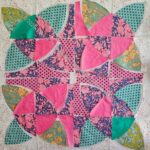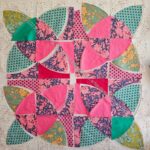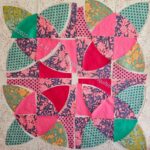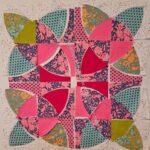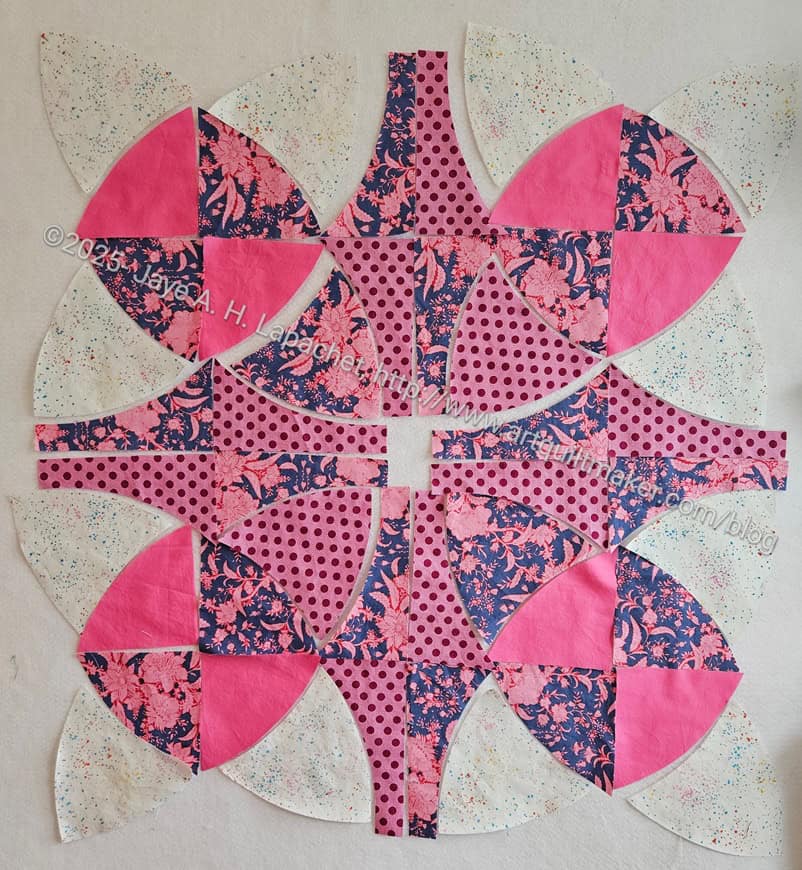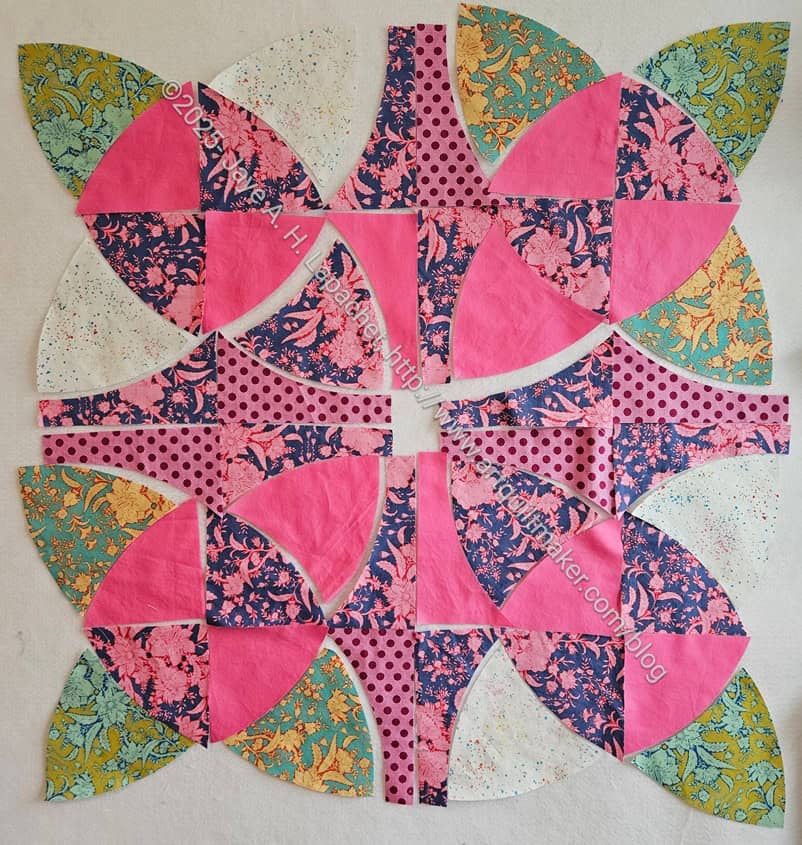
The other day I showed you the rest of the Flower #1 metamorphosis for the Country Revival/Sad Quilt. Here I am going to show you the entire process, though go back to the first post, then the second to read the explanation of whole process.
Country Revival/Sad Quilt flower motif
Country Revival/Sad Quilt flower motif with leaves v.2
Country Revival/Sad Quilt flower motif with leaves v.3
Country Revival/Sad Quilt flower motif with leaves v.4
Country Revival/Sad Quilt flower motif with leaves v.5
Country Revival/Sad Quilt flower motif with leaves v.6
Country Revival/Sad Quilt flower motif with leaves v.7
I am probably more fascinated by my own process than you are. As a result, I may publish another post later today. Stay tuned.
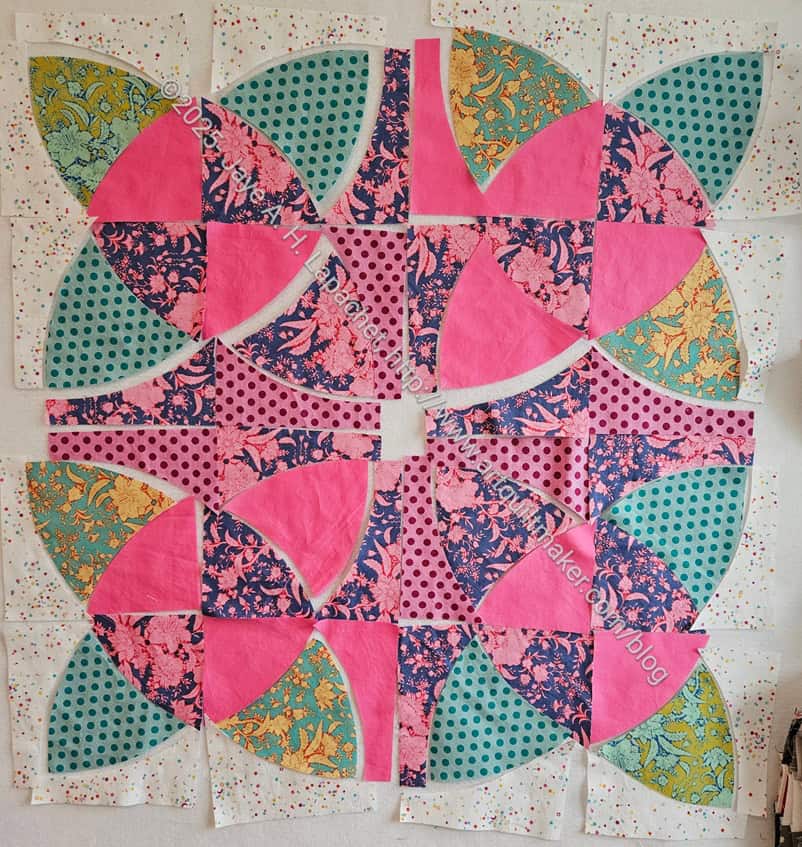
I received the stack of solids I ordered, so it was back to Flower #1 for more changes. you might remember how much I worked on making incremental, small changes the first time around. I have been looking at it as I sewed Flower #2 and still wasn’t 100% happy.
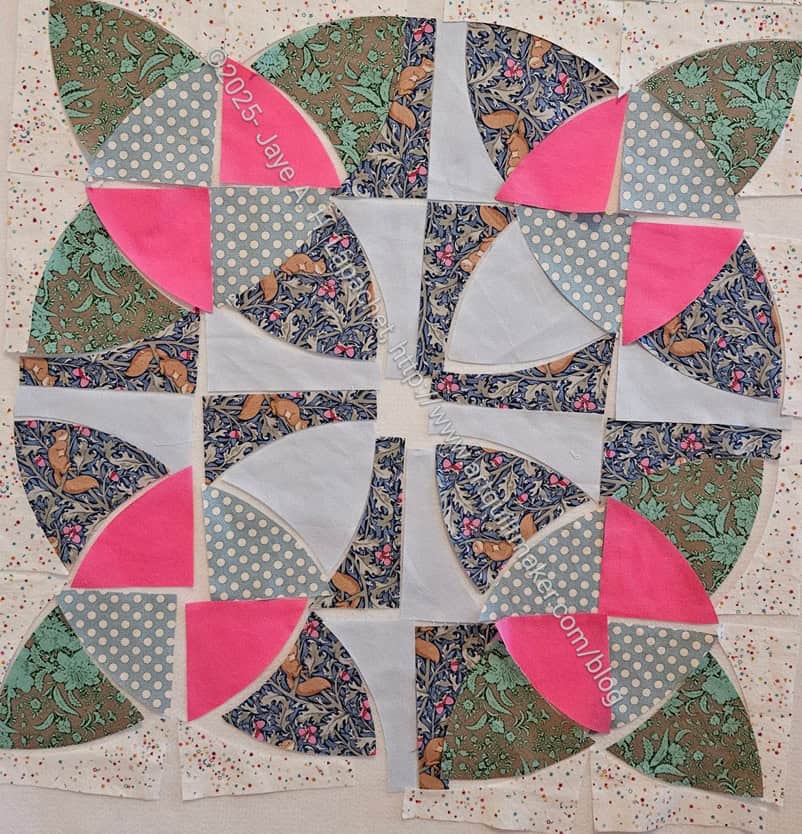
Country Revival/Sad Quilt flower motif with leaves v.3
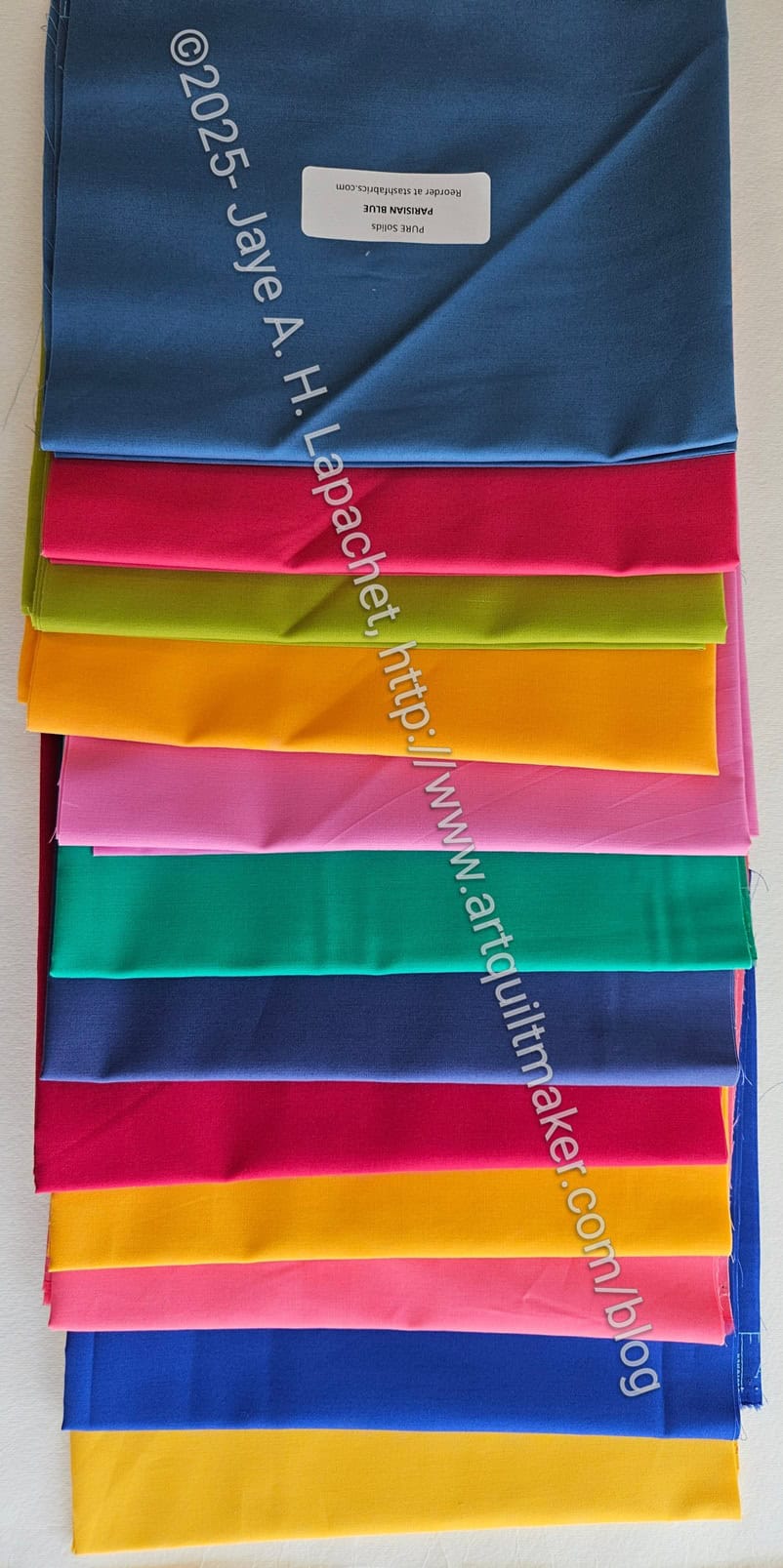
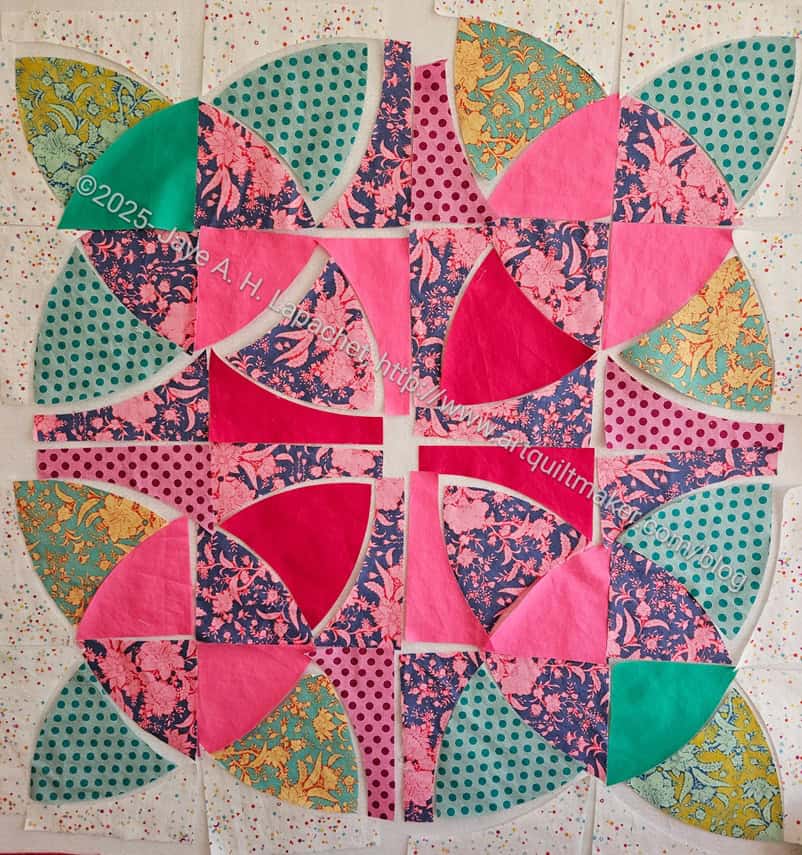
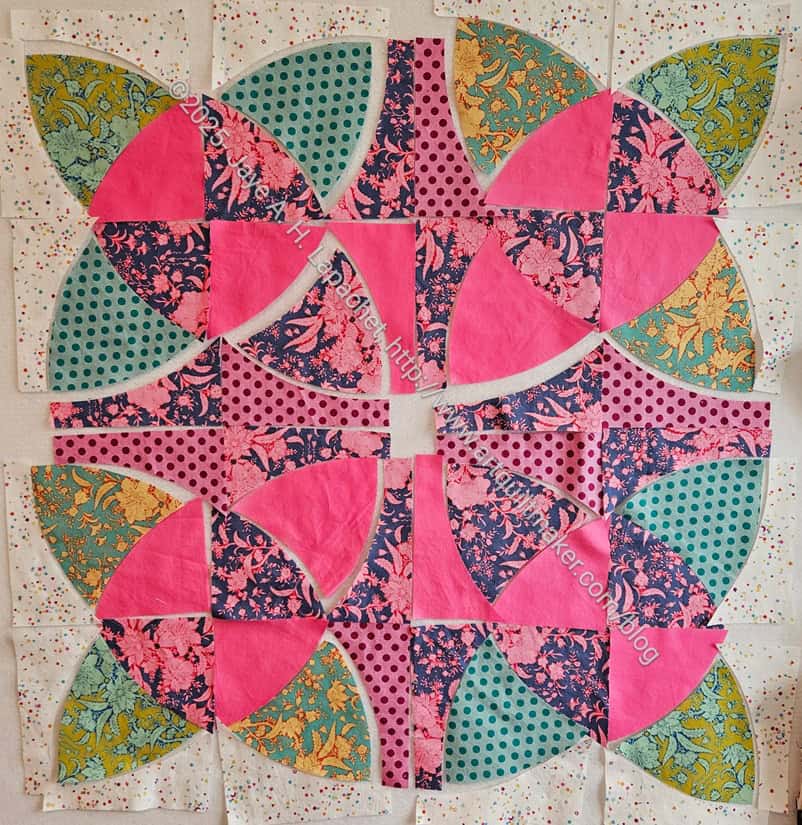
I decided to pick out some solids and see if I could make Flower #1 look better. I started off with a vast improvement over the original. Adding some more greens made the block much more interesting. I decided that there was too much solid pink, so I replaced some of the solid pink with some Emerald. The Emerald is about halfway down the stack in the photo above.
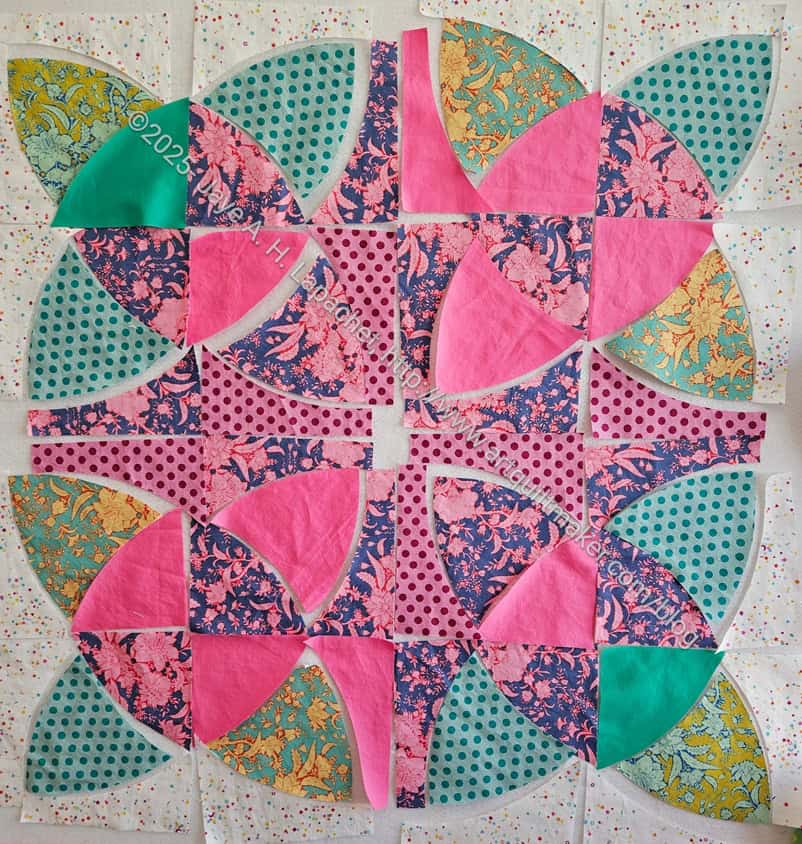
Country Revival/Sad Quilt flower motif with leaves v.4
I put the Emerald in the corners on the bottom right and top left. I want to make incremental changes to so I can see what it happening. It is amazing how the replacement of two little pieces makes a huge difference.
Country Revival/Sad Quilt flower motif with leaves v.5
The edges were looking better, so I decided to work on the center. I replaced some of the pink with Dragonfruit, a darker pink.
I liked the change, but it wasn’t quite enough. Each change I make highlights another area that needs attention!
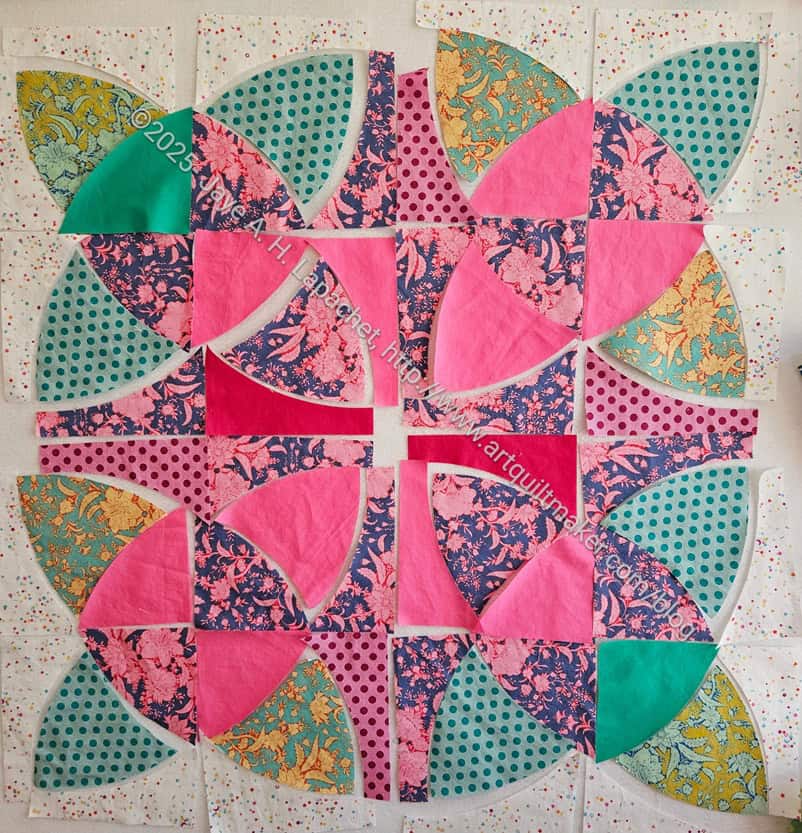
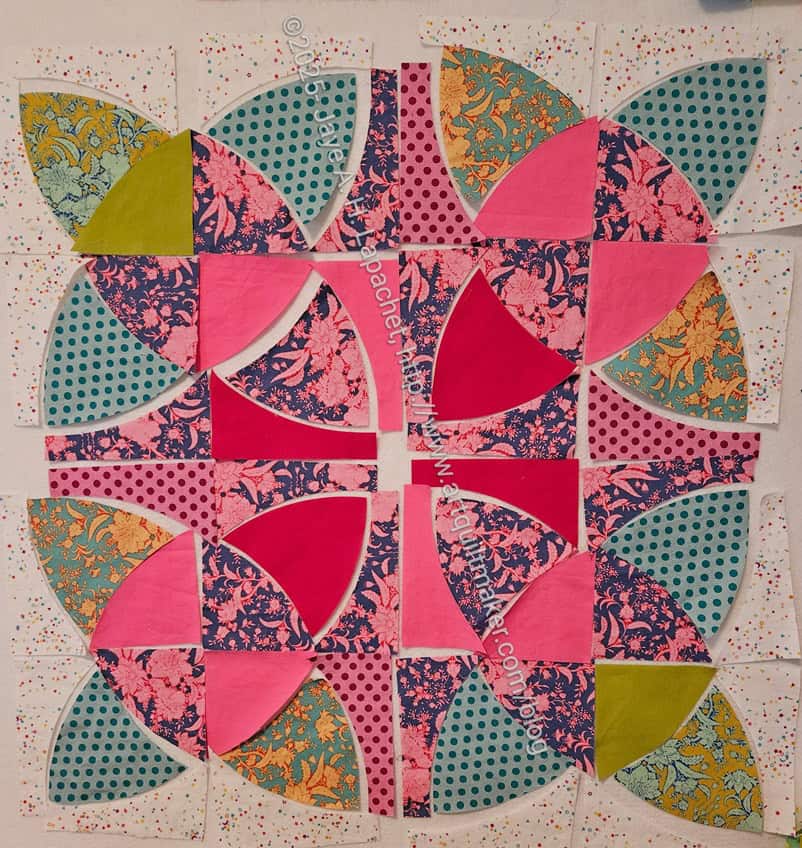
Country Revival/Sad Quilt flower motif with leaves v.6
Once I made the change by adding the Dragonfruit, I thought it needed more. I cut another couple of pieces to end up with more dark pink in the middle.
After looking at v.6 for awhile, I decided that this was the final version. Maybe it isn’t perfect. Maybe it could be better, but I like it. I think there isn’t anywhere that is too boring or too repetitive. Even the bottom left and top right corners light pink works.
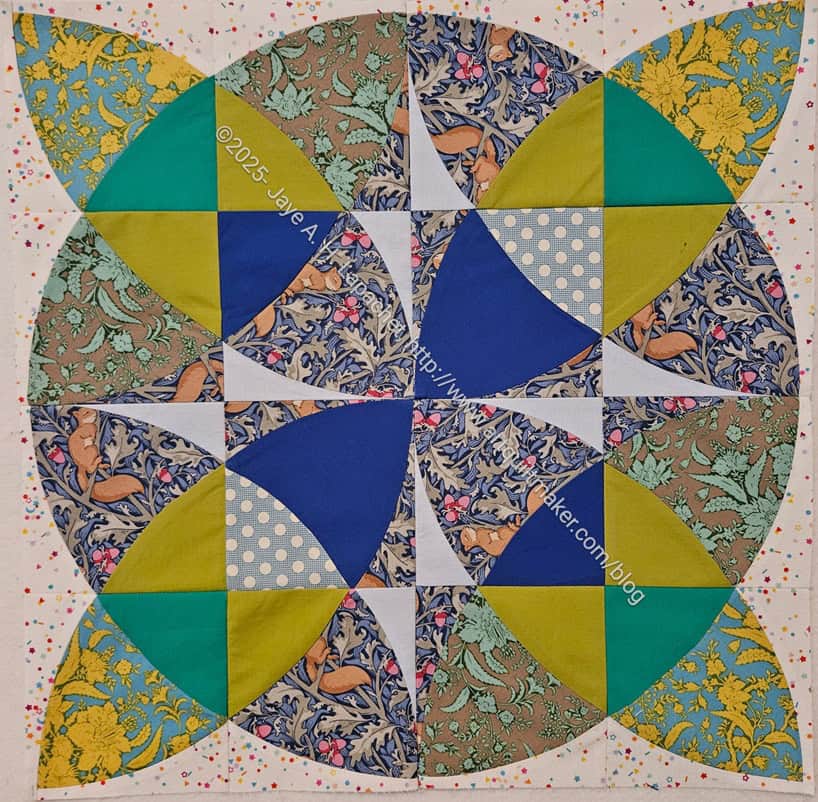
Country Revival/Sad Quilt flower motif with leaves v.7
Finally, I decided that the Emerald needed to be toned down a little. I like that fabric and the color, but for this block, I needed something a little more subtle. I decided to change the Emerald for Dark Citron.
Flower #1: upper left hand corner
I started sewing the block together and it is looking good.
The piecing on this quilt takes a lot of time. I think it is because of the curves. That doesn’t mean it is difficult, just time consuming.
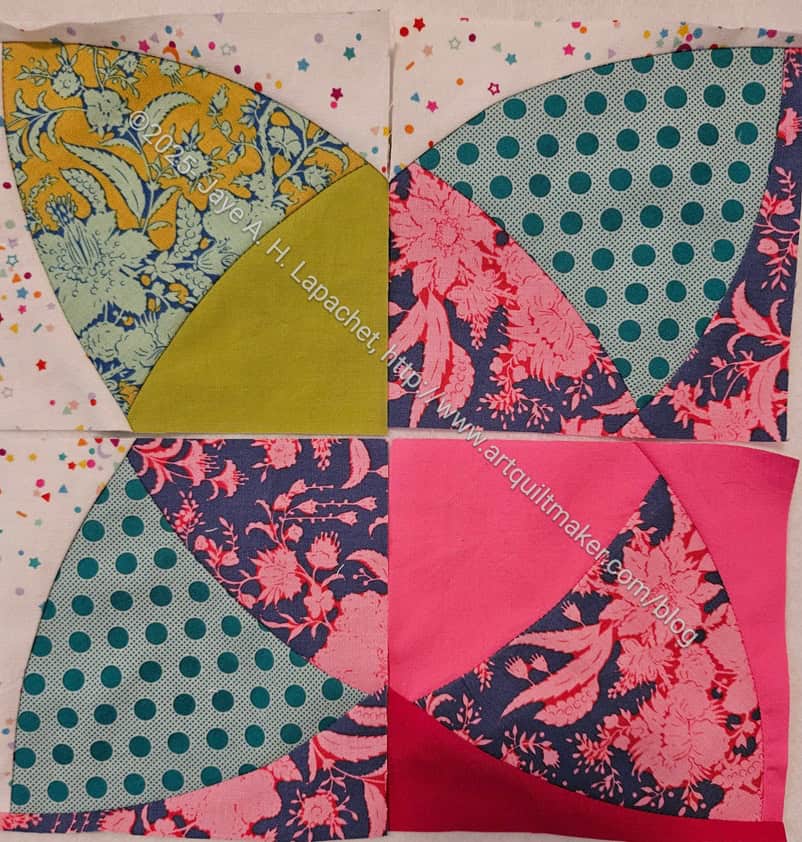
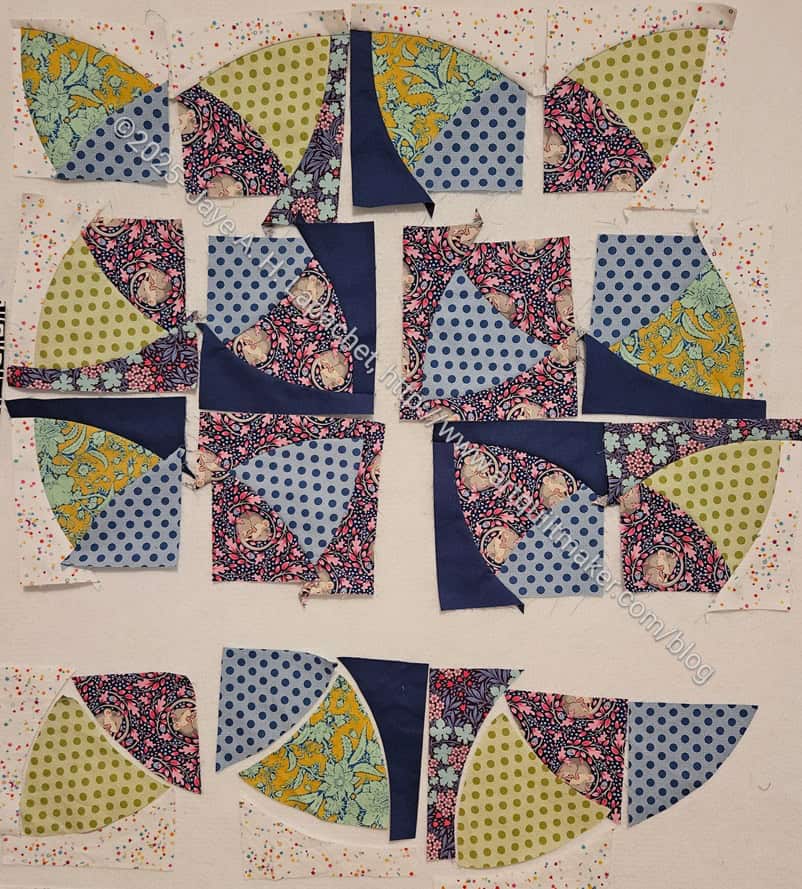
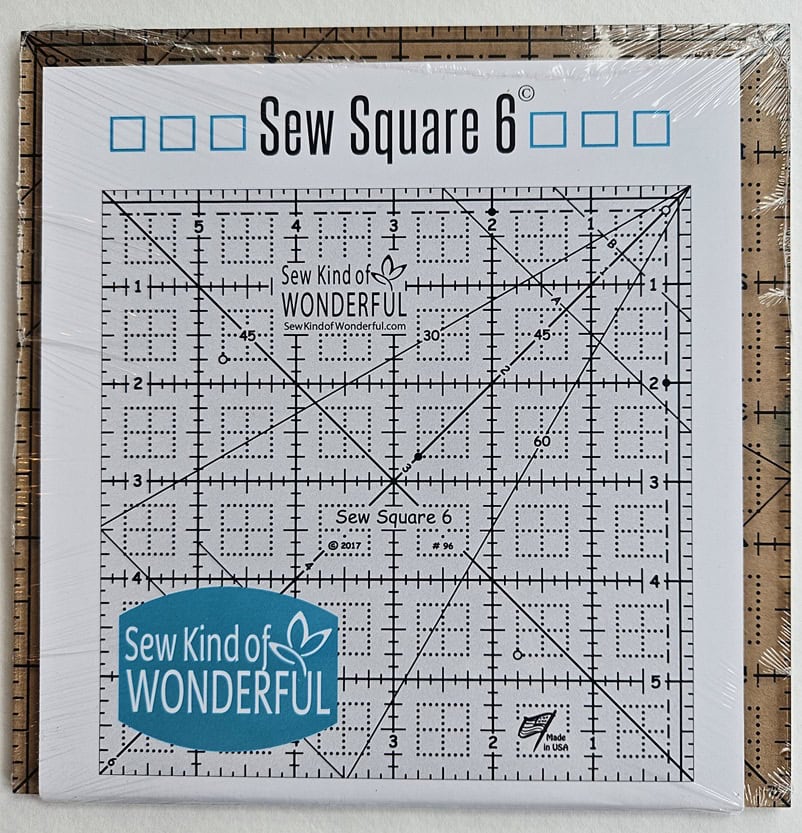
In the photo, the top left unit is pieced and trimmed. I wasn’t happy with the trimming. I ended up buying the SKOW recommended ruler, Sew Square 6**, though, despite my love for specialty rulers, I am fundamentally opposed to specialty square rulers. I would much rather the ruler I already have, the Quick Curve Ruler**, be marked well enough so I could trim with it. It isn’t impossible, but I found it to be very difficult. I haven’t decided if I need to make that upper left unit again. I don’t know if I trimmed too close to the green curved shape.
Sew Square 6
Except for the bottom row, the rest of the units have been sewn, but not trimmed. You can see how weird looking they are before they are trimmed. I bought the Sew Square 6** which I plan to use to trim the other units.
I didn’t buy the whole set; I just bought this one to see if I thought it was better than just using the Quick Curve Ruler.
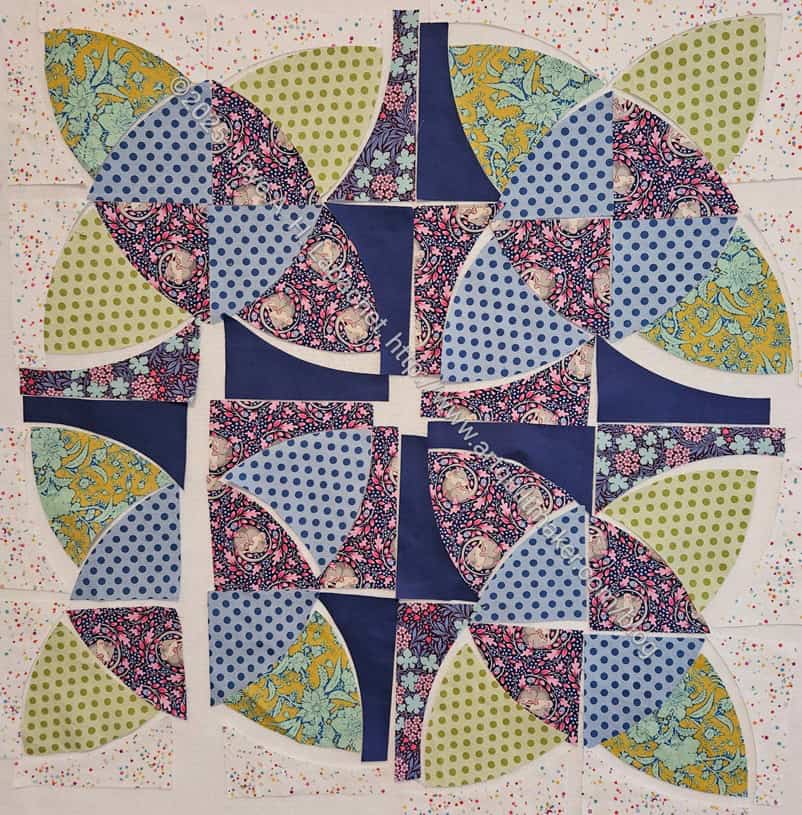
Country Revival/Sad Quilt flower motif with leaves v.4
Flower 1 is still unsewn. I am not 100% happy with the color selection. I bought a few solids, which I am hoping will help fix whatever the problem is.
**N. B. : Obviously, you should shop at local quilt shops and small businesses. However, if you are too busy or can’t find what you need there, I use Amazon affiliate links and may be paid for your purchase of an item when you click on an item’s link in my post. There is no additional cost to you for clicking or purchasing items I recommend. I appreciate your clicks and purchases as it helps support this website.
I had the Flower motif from the Country Revival pattern** on my design wall for a long time without sewing it together. It wasn’t quite right and looking at it was the only way to figure out how to improve it. I knew I couldn’t use white in the place I had put it originally-leaf area around the outside. I wanted to use white as a background and the white as shown would be lost and change the shape of the flower motif completely. I also didn’t know what to do.
I often find that if I just do something, then I can get started improving a piece.
Country Revival/Sad Quilt flower motif with leaves
The first thing I did was decide the white ‘petals’ needed to be replaced with green and become leaves. It was a good start.
I liked the addition of the green, but decided I needed more and different greens. In this photo there are two different Tilda fabrics. One reason is that I used some of the green on the tips of the flowers for a pillowcase for my friend. I didn’t have much left, but I wanted to include some so it would kind of match the pillowcase. I had just enough to make four leaves.
Country Revival/Sad Quilt flower motif with leaves v.3
I wasn’t 100% happy with the look and feel. I really wanted an emerald green solid. I didn’t have that so I tried some dots. They were close to an emerald green and looks like a great addition to the overall look.
I still felt like there was nowhere for the eye to rest, so I moved some of the tall, skinny pieces with the slightly curved tops around. Better, but not perfect.
I added in some of the Dovetail by Ghazal Razavi background I bought at Bay Quilts with Julie a few weeks ago. It is a bright white, which I like and the many colors go well. I know it is hard to see in the photo. You can enlarge the photo to see it better.
Country Revival/Sad Quilt flower motif with leaves v.4
I can’t get away from symmetry, so I cut more pieces and changed the fabrics around so there was more symmetry, e.g. the piece looked more symmetrical.
I know the changes are slight and hard to see. I changed the corner fabrics and moved some of the other greens around.
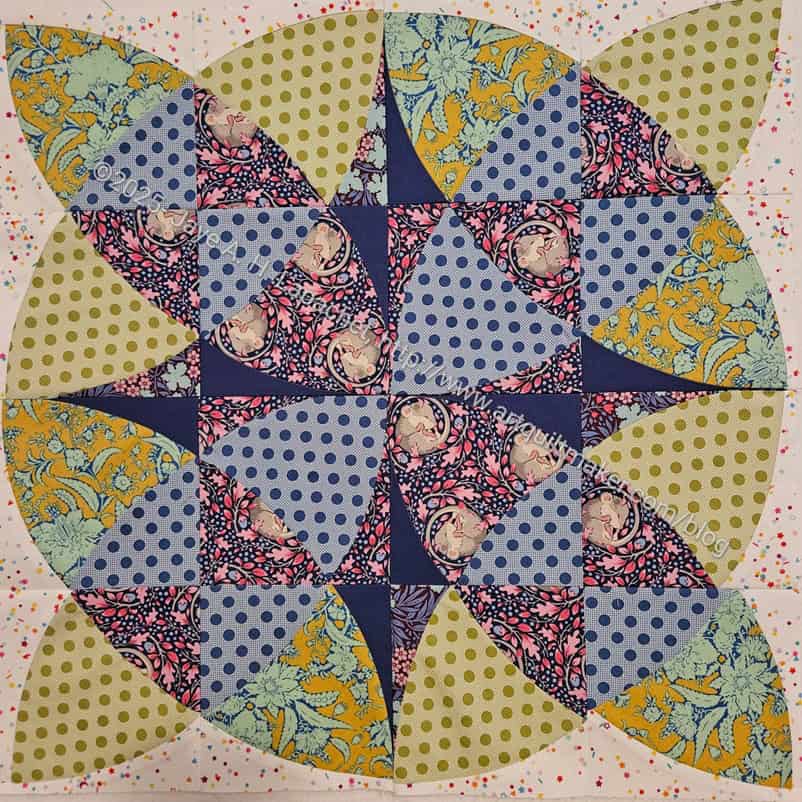
My eye was honing in on the pink dots. I wasn’t liking them, but I wasn’t sure what to do. I didn’t want to add more of the pink solid as I thought it would overwhelm the piece in general. For the moment, this is the final version of block 1. I may make some more changes, but I decided to work on a second block and give myself a rest from the pink.
I love that pink and blue Tilda fabric and it is now much less prominent. I’ll have to use it in another block.
**N. B. : Obviously, you should shop at local quilt shops and small businesses. However, if you are too busy or can’t find what you need there, I use Amazon affiliate links and may be paid for your purchase of an item when you click on an item’s link in my post. There is no additional cost to you for clicking or purchasing items I recommend. I appreciate your clicks and purchases as it helps support this website.
The Pearce is not going well. This curve is nearly impossible to sew on the machine. I have tried at least 4 times and ripped it out that many. Right now it is on timeout while I finish the Multi-Pocket Organizer.
Pearce in Progress
The bad part is that this was going SOOO well. I got to the point where there was one seam left to sew (photo left) really easily. I mean the pattern has been a bit of a challenge, but nothing like I am experiencing with that last curve.
I am afraid I should have sewed the curve first. If I make this again, I will do that. For now, I will think about what to do and get back to it in a few days.
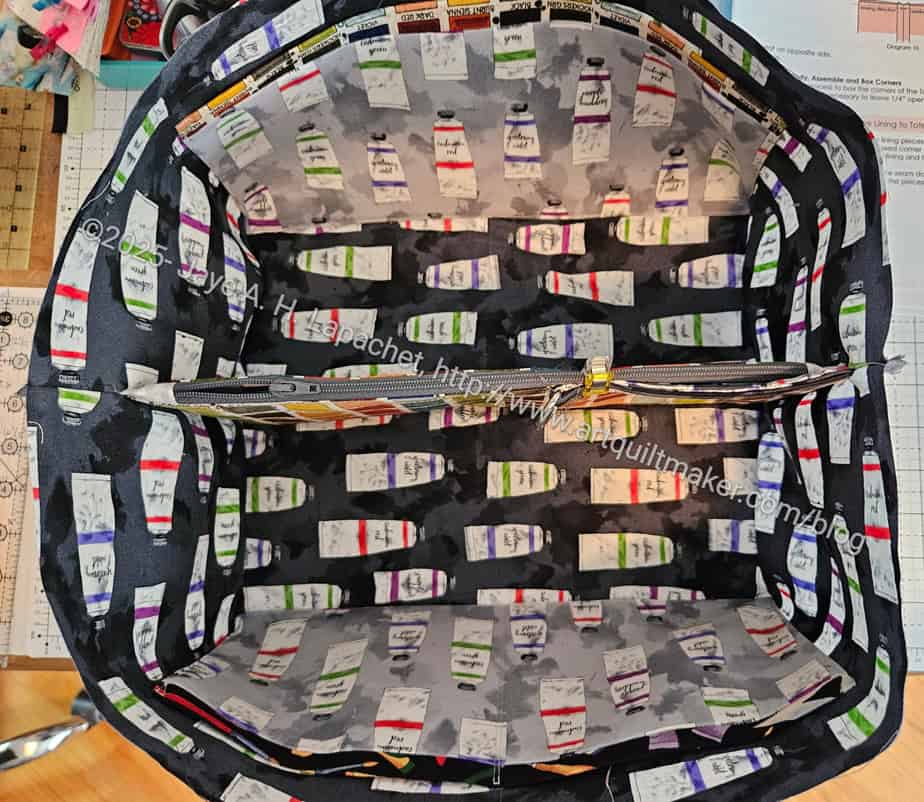
There have been a few bumps in the road to finishing this project. Due to the thick interfacing described in the previous post, this is taking additional time. I thought I would finish over the weekend, but am still working on this.
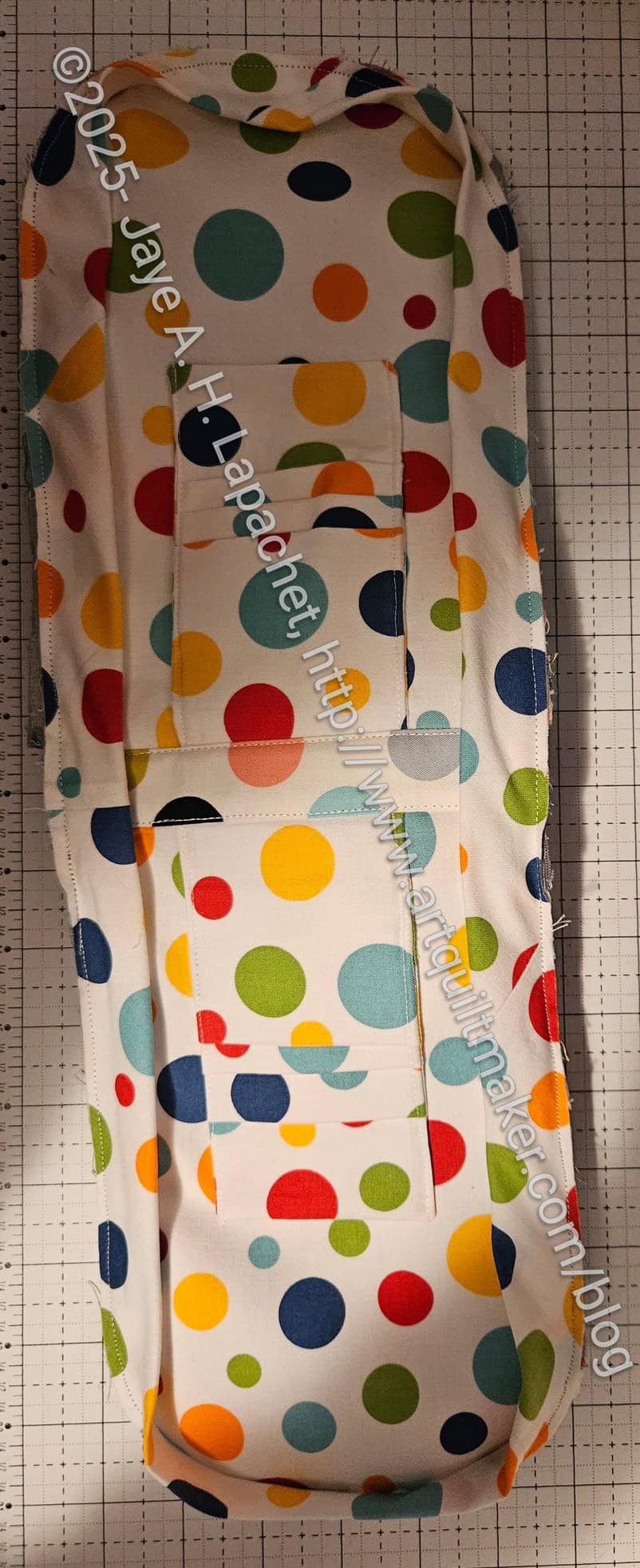
Sewing Date Traveler lining assembled
The lining is done and ready to be put together with the exterior.
I really should, as a rule, make bag linings smaller than exteriors. This designer didn’t note that in her directions and I didn’t do it. I’ll need to think about a measurement that would be good to use when cutting a smaller lining. For example, should I cut the pieces one half inch smaller or an inch smaller or what?
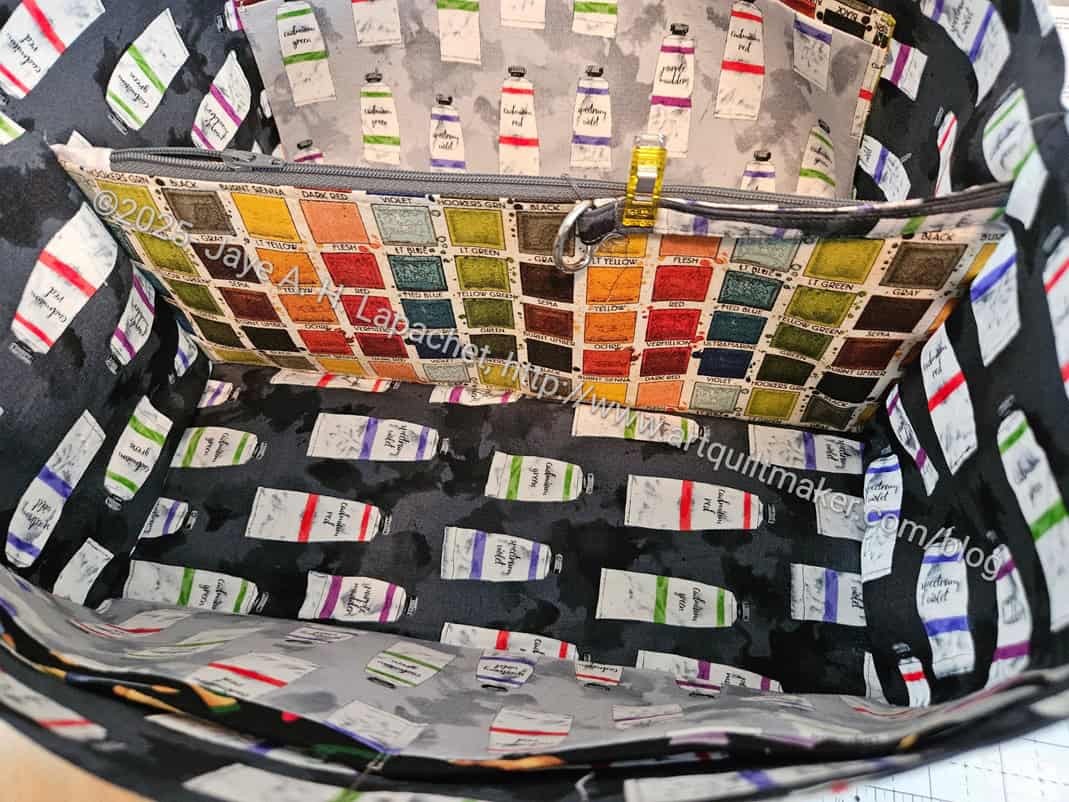
Sewing Date Traveler Lining with Leash
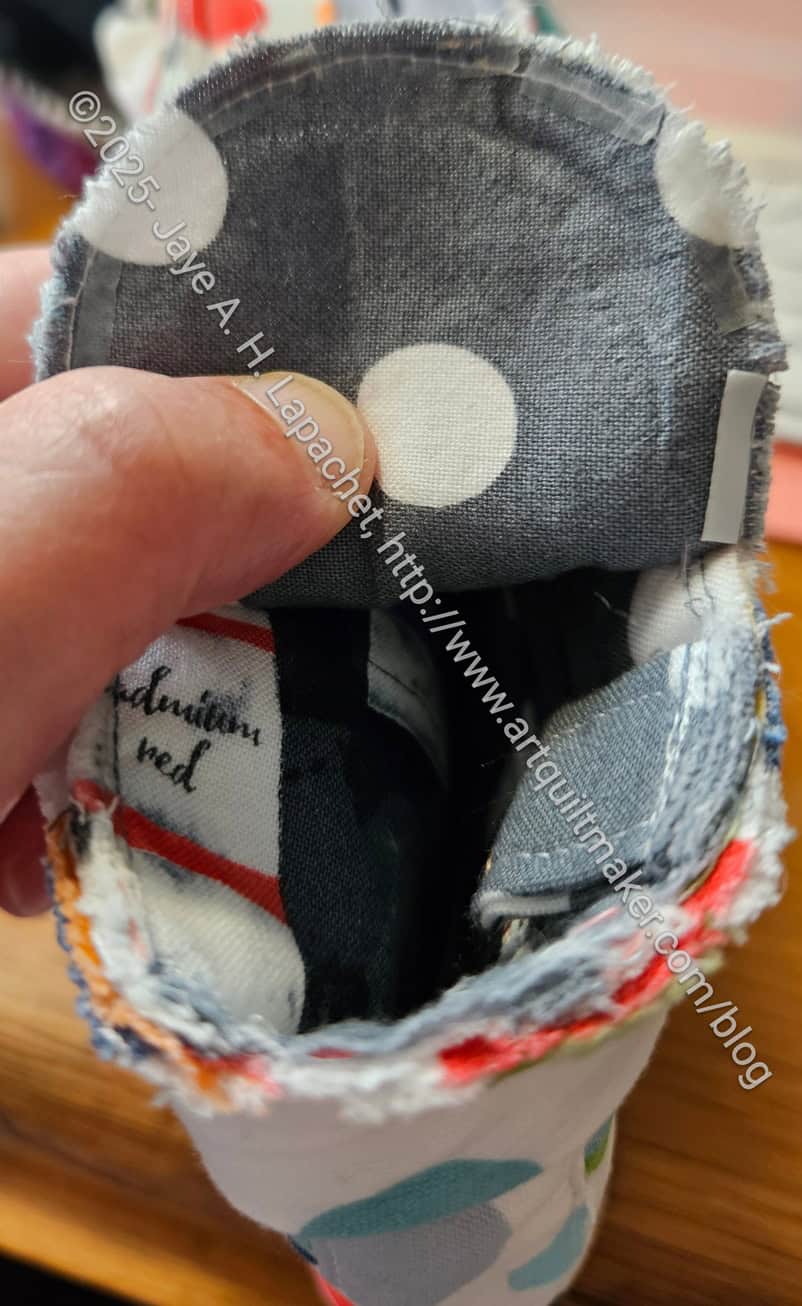
I added a leash to the inside. This isn’t part of the pattern, but they are easy enough to add. I may make a small Open Wide pouch with a lobster clip for added storage. The leash will also be useful for keys.
Putting everything together is proving to be a challenge. Despite my practice at anchoring linings to exteriors with Lynette, I can’t figure out how to do this one.
If I make this again, I will consult with Lynette about that. Neither of us could make the meeting and I need this done before the 26th.
I found the Sewing Date Traveler pattern a few months ago. It is a free pattern on the Robert Kaufman site. It was designed by Cynthia Frenette. I looked her up on IG, but didn’t see any other bag patterns. I wasn’t sure whether I would make it or not, but saved the pattern anyway.
Recently, I found out that my mom has to have another surgery. After looking at various examples on IG, I decided to make this to corral all the little things (phone, glasses, book, etc) that lay around a hospital room. She had a nice big ICU room before, but we hope she doesn’t get sent there and I don’t know how big the normal rooms are.
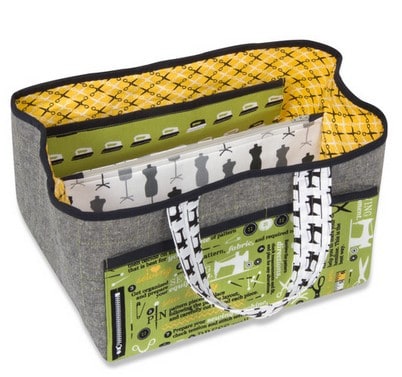
RK Sewing Date Traveler
The bag doesn’t have a closure, so it will be used more as an organizer than security. I keep thinking of it as a tray. The picture on the RK site is a little confusing until you read the directions (which I actually did for once). I thought this bag was more like the Sew Together Bag. I thought the green pocket on the inside back was another zipper pocket. In truth, that is a slip pocket on the back lining. The construction is a bit like the Sew Together Bag. If you have made one of those, you should be able to make this without much trouble.
Famous last words. LOL. The construction, for me, hasn’t been the problem. It is very straightforward, if different from the other bag designers whose patterns I normally use. The problem is the interfacing. Since this will be used for who knows how much stuff, I wanted it to stand up to some heavy use. I thought foam might be ok, but wanted something stiffer if I could find it. The pattern calls for Pellon 65. It is described as “… Extra Heavyweight is a sew-in interfacing for extra firm body and stiffening. It is great for printing, visor brims, backpacks, and drapery headers.” I have a chart for interfacing equivalents, but I couldn’t find an equivalent for Pellon 65 on any of them. The description told me a little about how stiff it was and I thought I wanted it stiffer. I used Pellon Peltex 71F, which I knew was thicker than how Pellon 65 was described. It is thick! I don’t use it that often, but once I started, I couldn’t backtrack.
Sewing Date Traveler lining assembled
At the moment, the exterior, which has the Peltex attached, is flat on my ironing board, but the lining is assembled. I thought the bag would be larger, but I think it is a good size. Also, it isn’t exactly small.
I thought I would get the whole thing finished over the weekend, but, as you can see, that didn’t happen.
Well, the Rose Petrillo sort of returned. I found the project bag in which I put all the pieces.
There are a couple of pieces missing like the strap. I’ll have to find some good fabric for that.
The fabric pieces are all interfaced with SF101, but no foam is cut out. It could be that I didn’t have foam at the time I cut out the pieces. I really don’t remember.
I visited Cyndi for a Sew Day last weekend and was able to get the Old Town sashing to a good place. I had a lot of 1.5 inch squares to cut and then a lot of trimming to make a house shaped rectangle. It was a lot better to do all of that work with a friend. We were able to chat while I did the tedious parts and that was great.
I got out the Simply Folded Ruler** again to create the flippy corners of those house shapes. That ruler is a gem. I always forget, but it really makes those flippy corners easy to sew. I didn’t have to draw diagonal lines on the squares, which would have made the process even more tedious. AND there was no trimming afterwards which meant no opportunity to cut off the wrong triangle. I haven’t tried one of the Simply Folded patterns (actually Antler Quilt Designs). I remember seeing one that was interesting at the Granary, but thought I was too busy to buy it. I was surprised at how many patterns the company has. I remember them being kind of country colors and having weird looking angles, but that isn’t true. There are a variety of patterns, some with brighter colors and fewer weird angles.
The good part about Bonnie Hunter Mystery quilts is that she suggests different methods of making the various units. I was reintroduced to the Simply Folded Ruler** through this project. It is good to be reminded of how I can use different tools.
Work has been very busy. It is stressful and I have been sewing a bit at lunch and after work. I haven’t had much time, but my effort at the Retreat at block making has gotten the process down to a science. I can make each block in about half an hour. Still, it has taken me several days to make this batch.
With this group, I only have four more left to make.
I didn’t have much time to sew on Sunday due to my caregiving duties. Between Sunday and Monday, however, I sewed two more Old Town blocks. I really like having my design wall on which to lay them out.
Old Town block #16
Old Town block #17
These two blocks were possible because, first, I sewed all the HSTs I would need to finish the block assembly. Now it is just laying them out and sewing the pieces together.