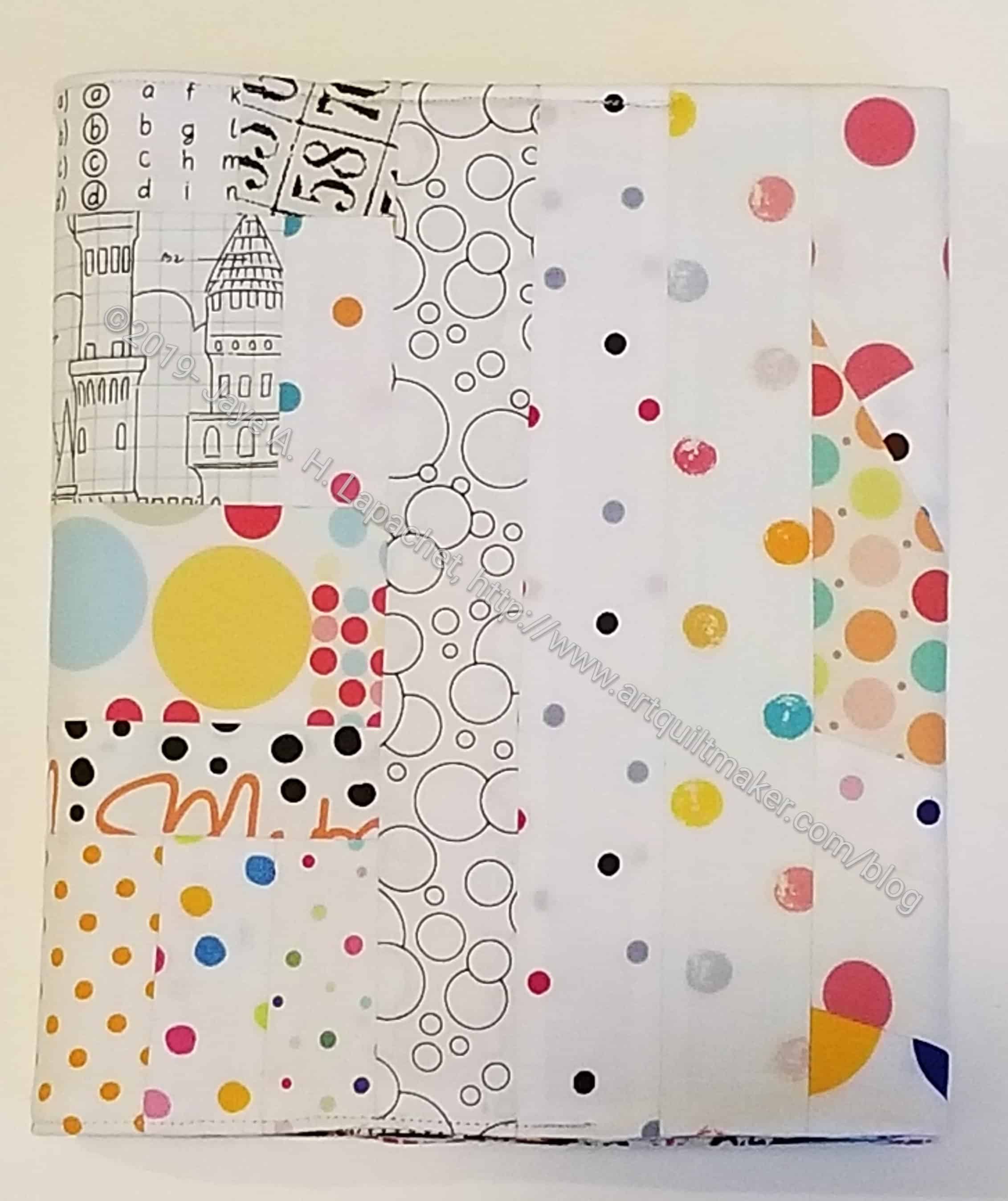
My friend had a birthday yesterday. I have been telling her – well strongly suggesting that writing in a journal would help her work out some issues. Thus, this is my “put your money where your mouth is” gift to her.
I rummaged through my white scrap bin to make this journal cover. I was going for cheerful and light to counteract the grey weather we have been having. I really tried hard to get that castle fabric (upper left) on the front, but didn’t quite make it.
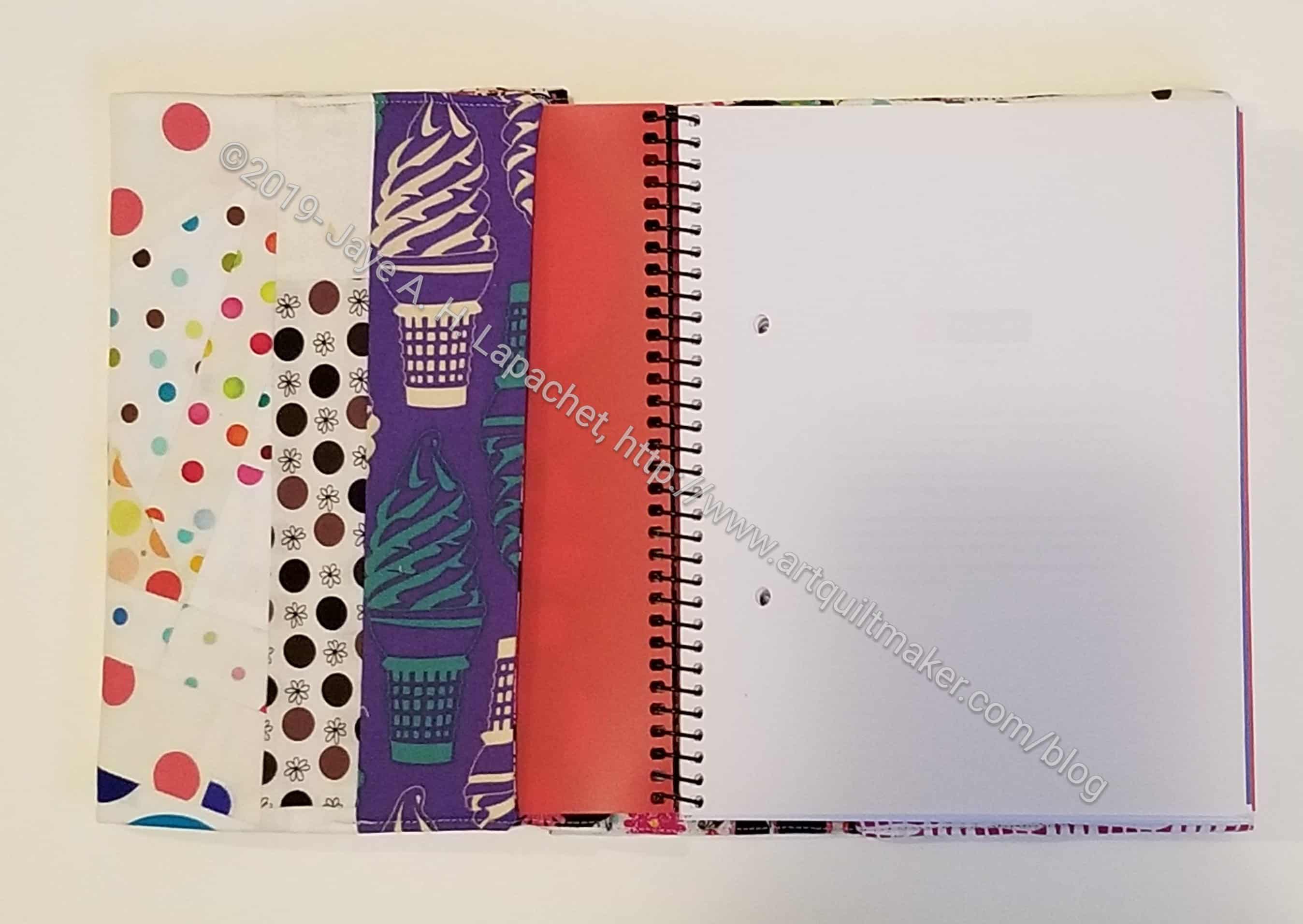
Gerre’s Journal Cover with front cover open
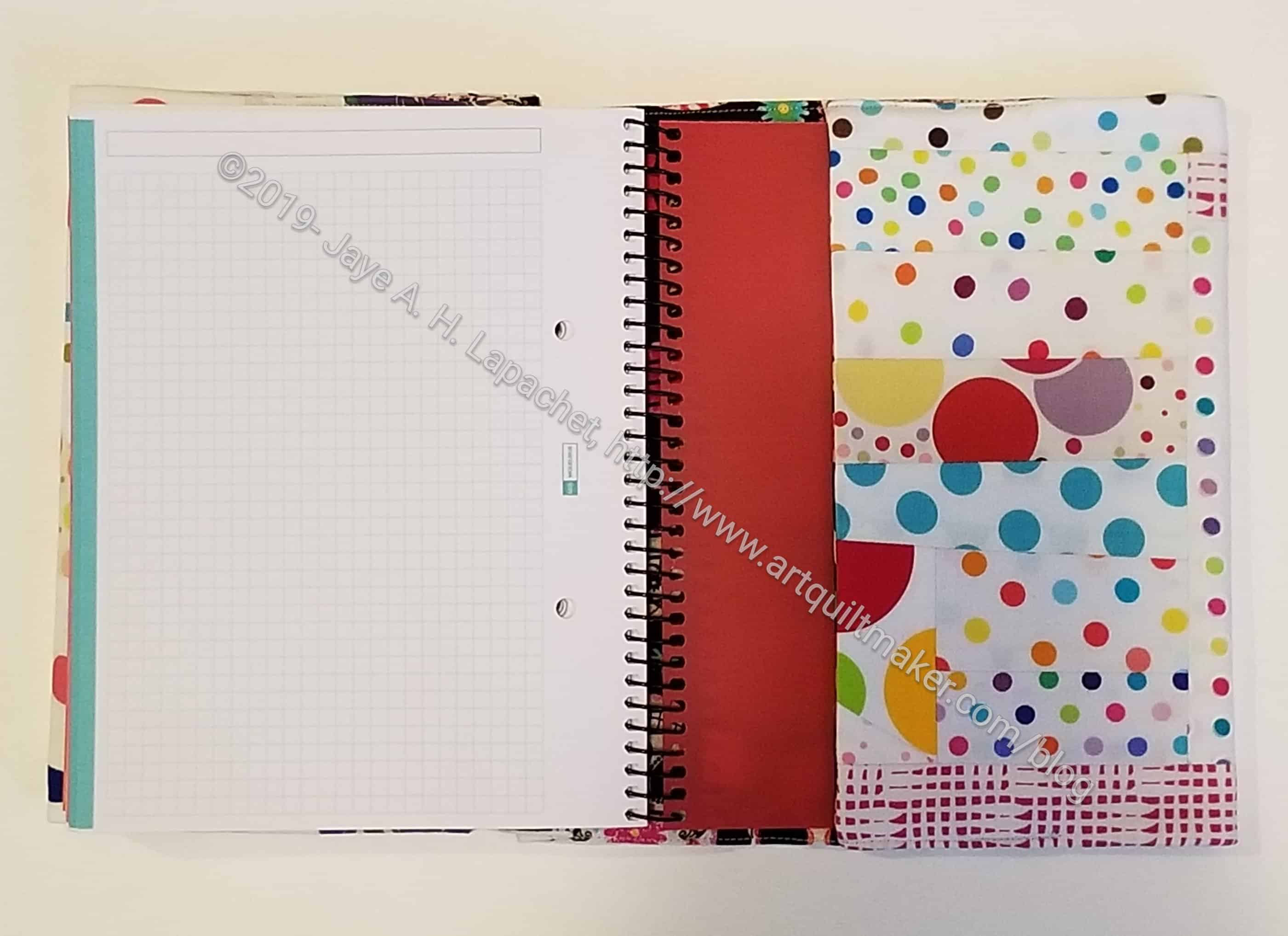
Since I have been making Gerre a few things recently with the ice cream fabric, I wanted to include some in this journal cover as well. I put it on the inside as it didn’t go very well with my light and cheerful look.
Gerre’s Journal Cover with back cover open
I haven’t made a journal cover in a while. The last one was dark blue and made in 2017. I have been sing a different kind of journal that doesn’t work with these covers, thus I haven’t needed a new one. I still like these Miquelrius journals. They have great paper and ink dries on it quickly. I am just more enamored with the Leuchtturm journals at the moment. I like hte rounded edges and the colors. The Leuchtturm journals also fit in my handbag, which is an added bonus.
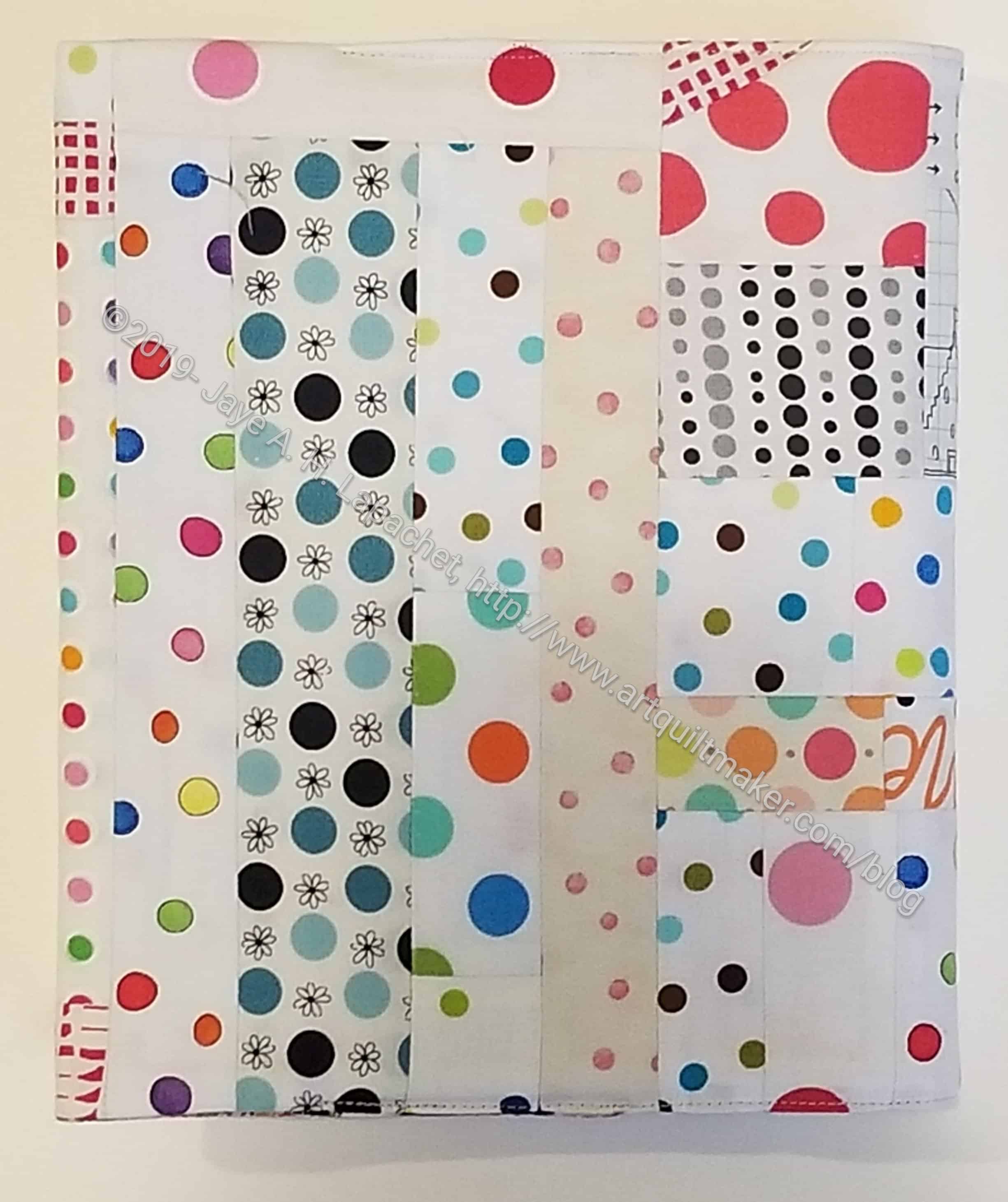
Gerre’s Journal Cover back cover
I had fun putting this cover together. I used a number of scraps from the EPP half hexie project and even some scraps from the City Sampler.
I had a hard time sewing it as there were so many seams along the edge, so I ripped the last seams out a couple of times. It isn’t perfect, but I hope she won’t notice. That edge is tricky.
I did get a nice compliment from Angela who has used the journal cover tutorial to make covers for other types of journals. She said it was her favorite journal cover tutorial. 🙂
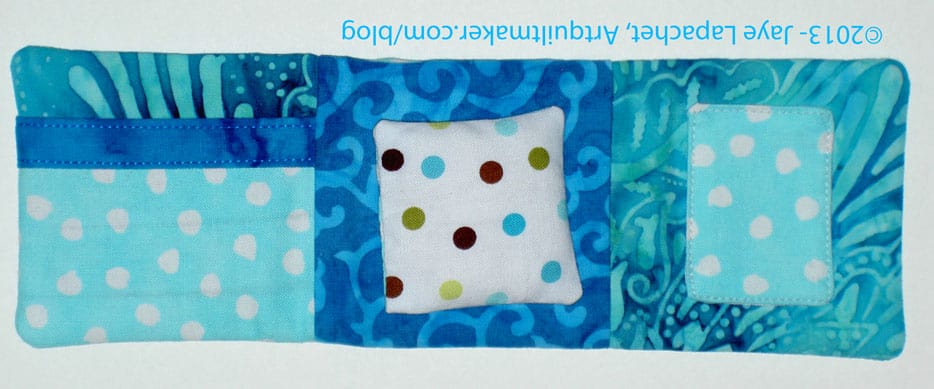
Gerre’s Journal Cover -whole cover, open and face down
I have to admit to using Leuchtturm journals lately instead of my favorite Miquelrius journals. The Leuchtturm journals are slim and fit in my handbag with all my other stuff. They don’t need covers. I couldn’t figure out why I was leaning away from the Miquelrius journals.
Finally, I realized, on Sunday when I needed a new journal because I had finished the old one what the problem was. I didn’t have any Miquelrius journals with the journal covers already made. As you may have guessed, I like to put journal covers on the Miquelrius journals, because the corners of the covers tend to poke me. I looked back and found that the last journal cover I made was the Orange Soda Journal Cover back in November (November seemed to be a good month for me). That was at least two journals ago.
I actually had a journal cover partially made. I hadn’t really worked on it in a few weeks. It occurred to me that it be an entry in the BAMQG scrap challenge. The donation blocks were giving me a bit of trouble (decision making not sewing), so it was an easy choice to switch projects. I used the journal cover pieces and parts as leaders and enders while I worked out my donation block issues.
Journal covers are not difficult (tutorial is posted -sizes are for the Miquelrius journals). The time consuming part is the mosaic piecing. Of course you can make the cover out of one piece of fabric for an even quicker and easier version. I rarely, if ever, do that, however.
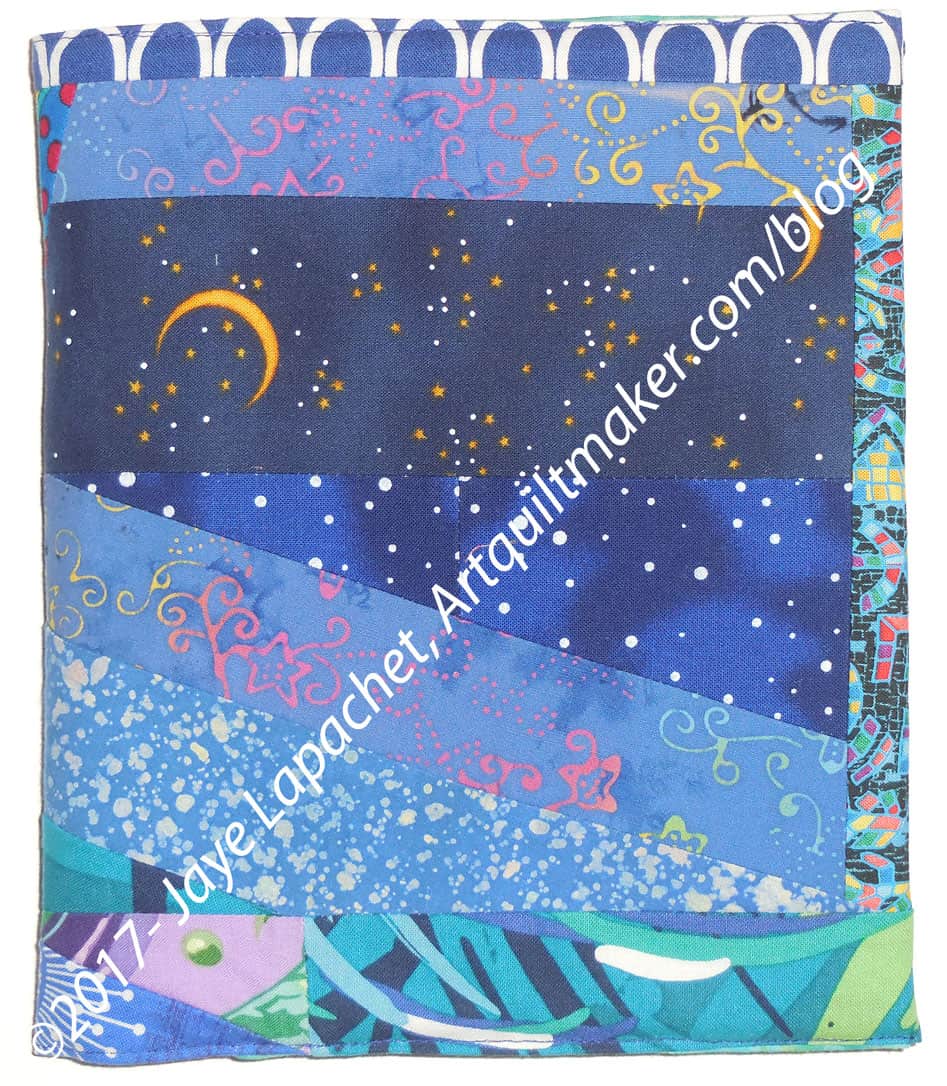
Dark Blue Journal Cover
Frequently, I start pulling out fabrics and stick to certain values in that one scrap drawer. I am not sure which fabric pieces I started with, but the first fabrics often set the tone for the entire piece. This one is a little darker than I usually like. I do like the monochromatic look, however, so I stuck with the darker blues.
Dark Blue Journal Cover – other side
I haven’t decided which side to use as the front. Since I don’t need it immediately, I don’t have to decide for at least three months.
I had some issues with the filling. I have been using flannel, but am just about out. I had some leftover bits of fusible fleece, so I stuck those to the back of the pieced front and filled the rest in with flannel scraps. Some parts are fluffier than I like, but it works and the project is done.
I started another journal cover with turquoise. Stay tuned.
I have been in desperate need of leaders & enders lately. The crisis has passed since I got my order of Northcott Colorworks charm squares, though before it did a lot of weird pieces were sewn.
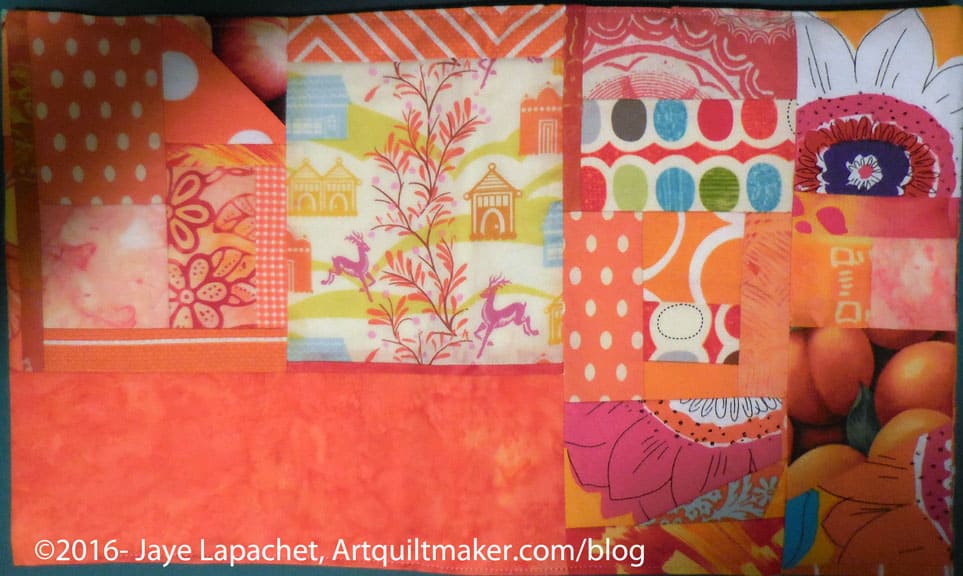
Orange Soda Journal Cover (closed)
I had some orange scraps that I had started to sew together, so I continued to sew and turned it into a journal cover. It is along the same lines as the Orange Crush journal cover and the scraps may have been from that piece.
I am really pleased with how this one came out. The front cover is really well placed. The scraps aren’t too small, which always causes finishing issues. It is also bright and cheerful. I need bright and cheerful right now.
I found a piece of pieced fabric when I was rummaging through stuff recently. The piece was about the right size for a journal cover. Over the weekend, last weekend, I did a bunch of small projects. Making this journal cover was one of them.
I am not sure for what this piece of made fabric was intended. I hope I don’t come across a note saying I needed it for X project or Y quilt. C’est la vie.
SIL #2 observed that the fabric combination looked like an adult coloring book. It does, but a mad version!
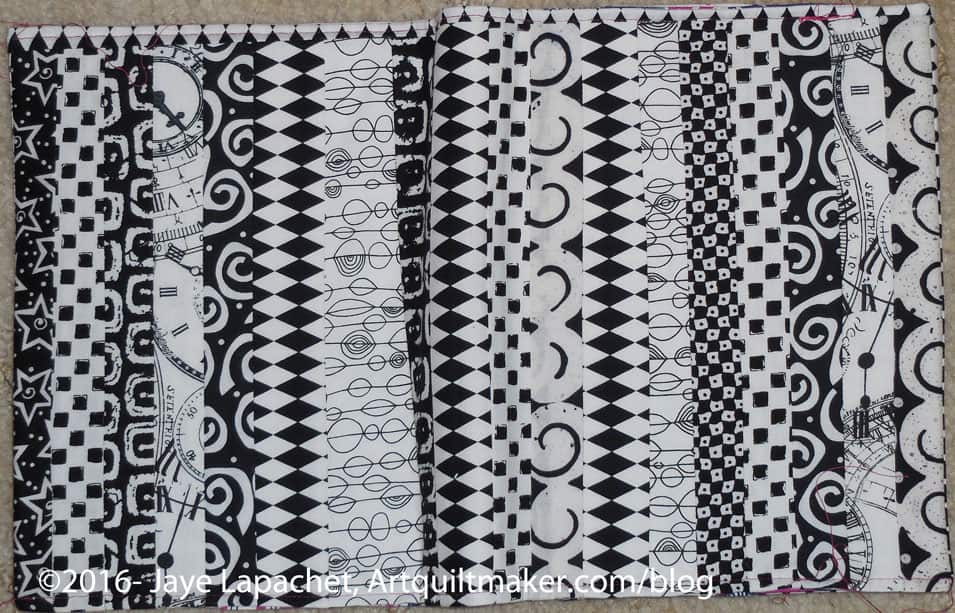
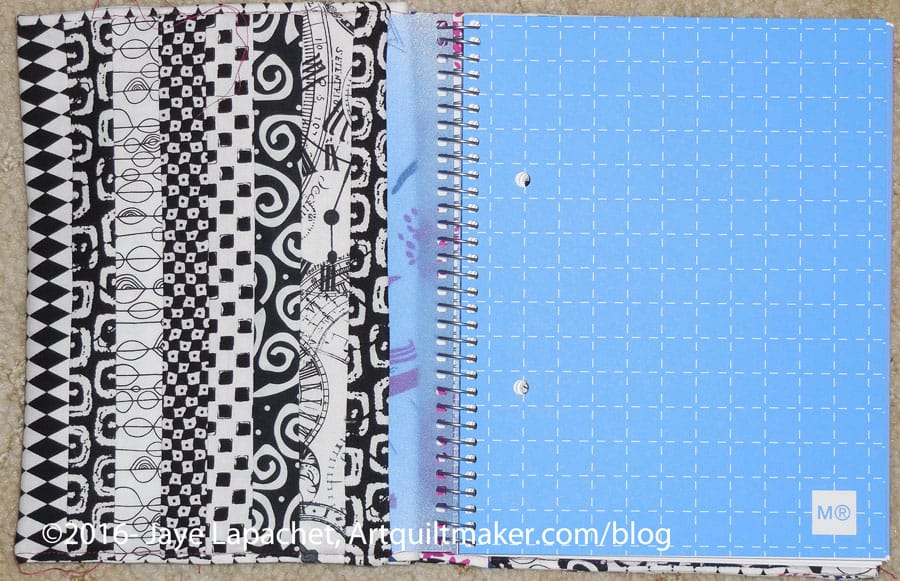
B/W Journal Cover Open
The strips were relatively even and bordered with the jester’s diamond check. I had to cut most of the diamond check off to make the journal fit. As it was I cut off a bit too much and the fit is snug. Fortunately, with cotton, it will stretch a bit.
I was working on something else at the same time and had magenta thread in the machine. I thought it would be great to use for this, because the piece is so stark. I thought a little color would enhance the whole project.
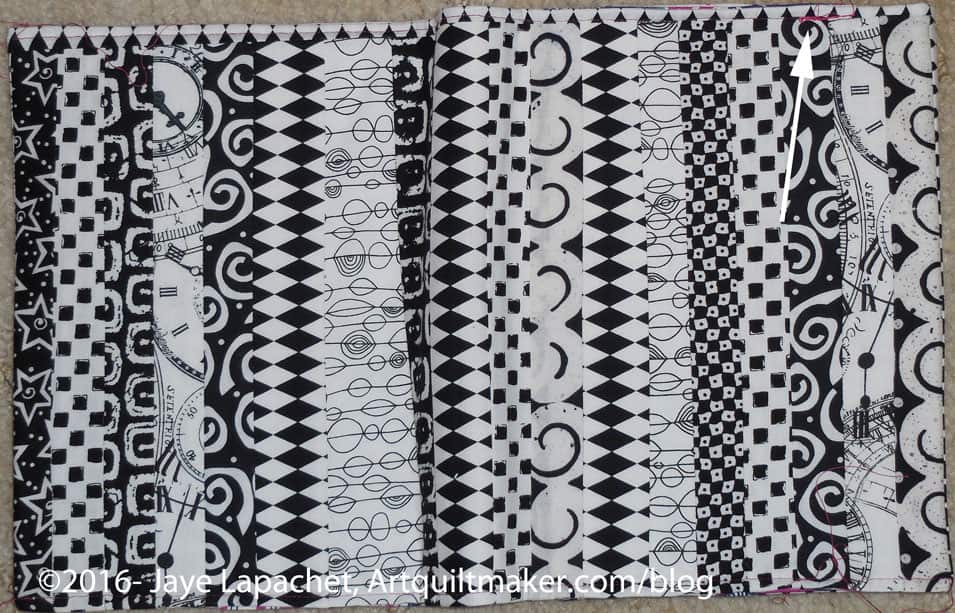
B/W Journal Cover Open – thread nest
What the bold color choice highlights is the big wad of thread that happened as I was trying to sew over several seams. Bleah. I unsnarled the thread nest at Craft Night. The journal cover is finished and will be ready when I finish the dot journal.
B/W Journal Cover – Open
You can see a little bit of the tightness on the inside cover. Still, this journal cover, even with its ridgy bump on the front will be an interesting change from my current journal.
I was working on another project that required a different foot than the quarter inch foot. This made my ability to sew donation patches together with any precision limited. I turned to an idea I had since I made my last journal cover. I had hoped that the CVZ/Paris Journal cover would be more of an exploration of low volume prints with just one bright spot. It didn’t quite work out as I intended. I kept thinking on how to do it differently.
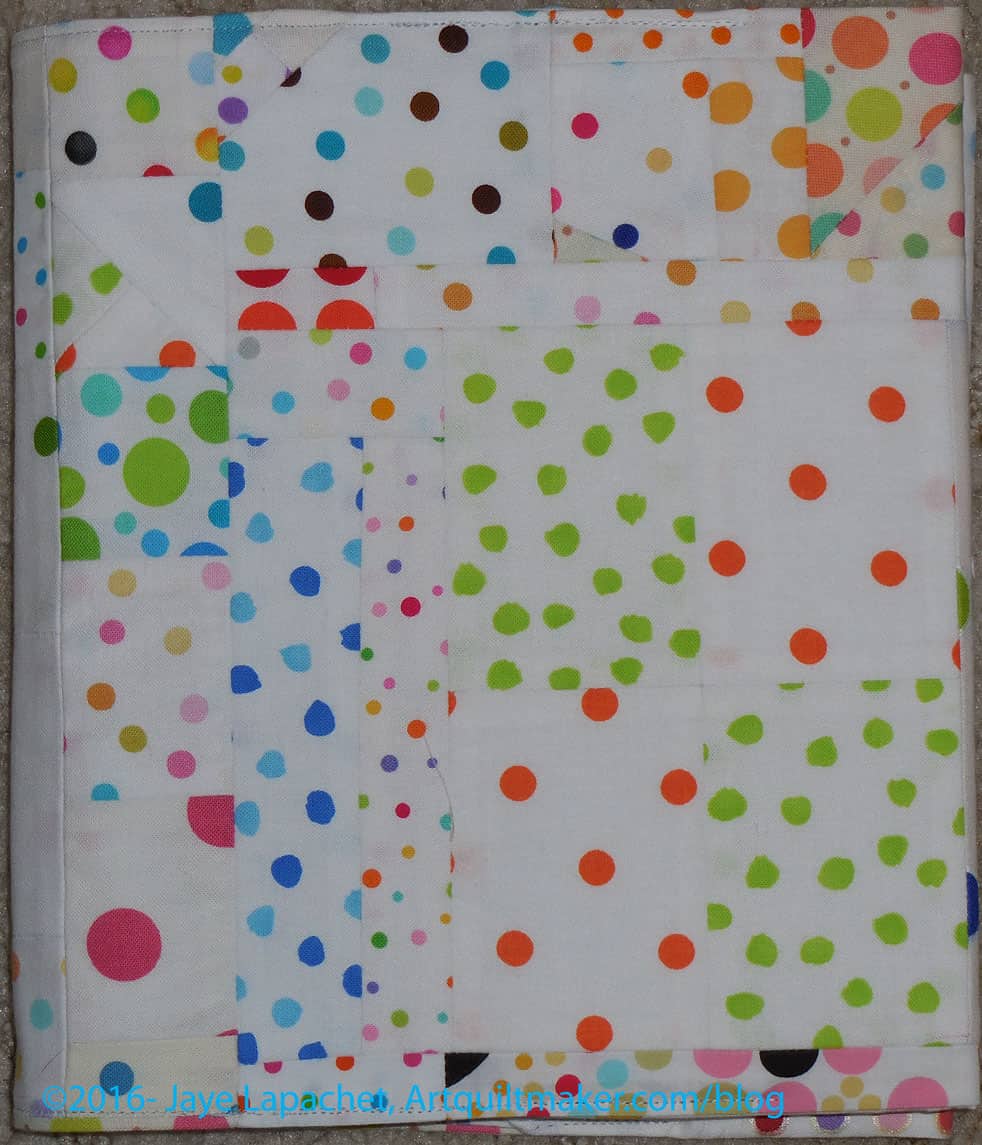
Dot Journal Cover
With these two constraints, I started sewing dot fabrics together. I was very strict with myself on the background and the fabric. I stuck to dots on bright white. I think I avoided any creams or ivory backgrounds.
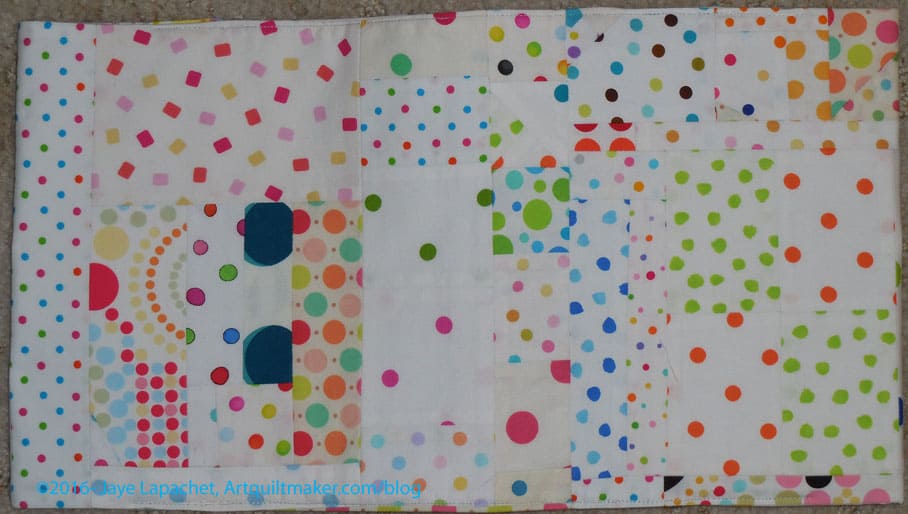
Dot Journal Cover and Back
I was also very strict with myself on getting to the right size (top to bottom)- remember I use the Miquelrius journal #4— and then not being sentimental about cutting off nice bits of piecing. There is always more fabric, right?
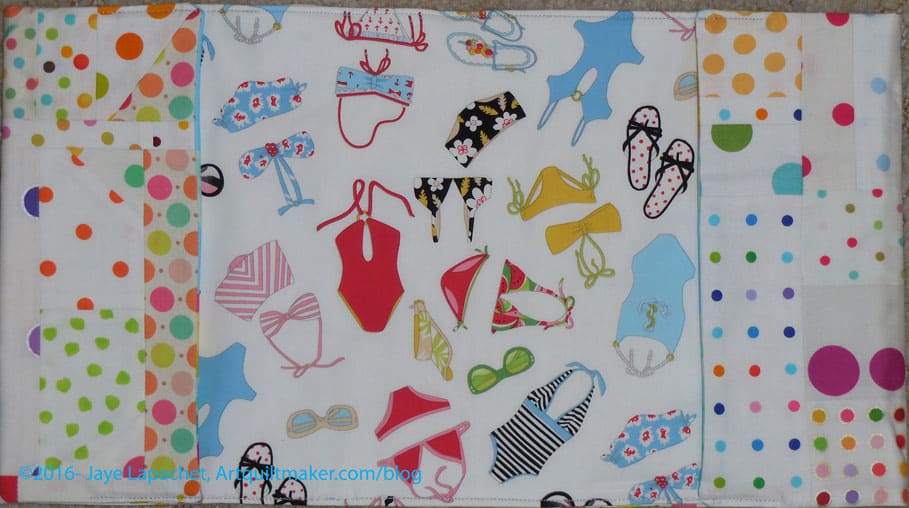
Dot Journal inside
Finally, I used a fun print, that I probably won’t use for anything else, for the inside.
I am pleased to have finished something after so much work on the Food Quilt. This project is also very cheerful and I will need a new journal soon, so I am looking forward to using it.
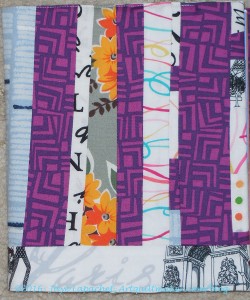
Karen issued a challenge to use a piece of Carol Van Zandt fabric a few months ago. She gave out the FQs at a meeting and there were so many that almost everyone got one, even those of us who had no intention of doing the challenge. Fortunately, I received a color that I liked. As the weeks wore on, I decided that the least I could do was make a journal cover. I needed a new one anyway. I wanted to explore the low volume concept some more so I decided to use low volume fabrics with the CVZ fabric to make a journal cover. I did it as part of the sewing frenzy over New Year’s weekend.
CVZ / Paris Journal Cover
I like the journal cover, but am not as happy with it as I am with the Carpenter’s Wheel effort in low volume. Somehow I got derailed and the journal cover looks like I am trying too hard. Or something. I think I should have stayed with black and white rather than straying into grey and colors.
I used some of the leftover strips from the Paris One Hour Baskets, most markedly to fill in the space at the bottom. What do you think of the addition?
Still, I am resolved to make a lot of work and just have a few good pieces come out. This will function quite well.
CVZ / Paris Journal Cover – front cover
I tried adding in some other purple, but should have stuck to the Carol Van Zandt fabric to highlight it. Fortunately, it is bold enough that it does stand out.
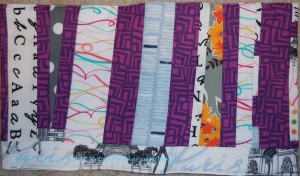
CVZ / Paris Journal Cover – back cover
I tried to add interest here by turning one of the strips sets sideways.
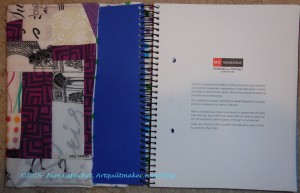
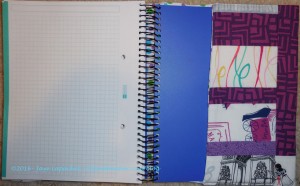
CVZ / Paris Journal Cover – open
You can see the whole cover. The colorful ribbon fabric really doesn’t go and I wish I hadn’t added it. I have some CVZ fabric left and will try again with that.
Tomorrow is my only day at work before Thanksgiving until December 2. I am cooking for Thanksgiving and ‘need’ the prep time. I also need to go to the dentist and clean up the house and sew and laze around. The whole Grama thing has been really hard and even though I was off for a week at the end of October/beginning of November, I need more time off.
None of that is either here nor there, except that you should watch for the Pie Day photos that I will tweet out. I don’t know if you like it, but I always have fun tweeting Pie Day photos. I plan to make a pie for my mom’s priest who was awesome while my grandmother was sick. He was a great support to her and is a super nice guy.
So, two paragraphs in and no discussion of sewing. Let’s get to it. I made a second needle case. I couldn’t help myself. I needed to get it right. It still isn’t exactly right, but is much better. I did it last Sunday and then worked on the hand stitching on Monday night.
The problem this time is that I put batting in and I think I just don’t like batting for small accessories like this. I think batting should be in quilts and something thinner (not sure what yet) should be in journal covers and needle cases.
The changes I made to the pattern are:
Put ShapeFlex on all the major pieces. This gave it more body, but not quite enough to forgo the batting.
Machine sewed the ribbon on to the main outside piece right after adding the ShapeFlex to the fabric and then pinned it carefully out of the way
No binding; sewed around and then turned the whole thing
Stitched the top and the bottom of the pocket accent (directions say bottom only)
Needle Case #2 Open
This pattern really doesn’t take very long. I am going to Joann to see about some ShapeFlex sometime this week and may look for fusible flannel as well. I don’t know if there is such a thing, but I will look. Flannel might be sticky enough without the fusible.
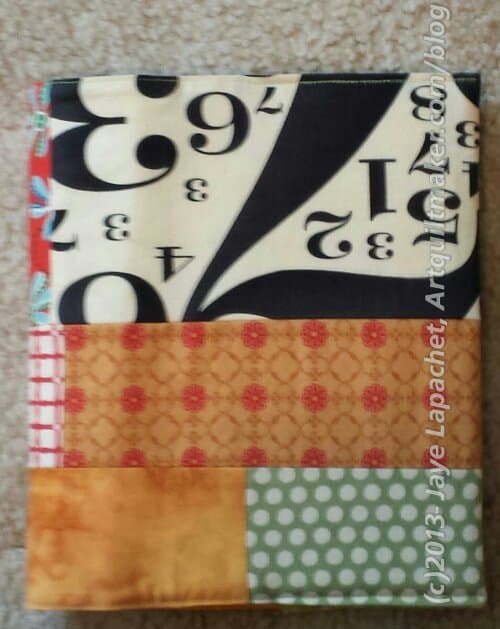
Last week I mentioned using the trimmings from the edges of journal covers. I even showed one that I had in process. Here it is finished. After getting the right size, I sewed it together in about 10 minutes.
Yes, the numbers are upside down. I wanted to see them as I carried the journal around so that is how they came out. I have to admit that I think I like the numbers the best out of all of these fabrics (the gold hand-dye is not part of the line). Perhaps that print is what attracted me to the line in the first place?
If you want to make a journal cover, check out my directions.
Sometimes, very occasionally, my personal creative world and my professional world meet.
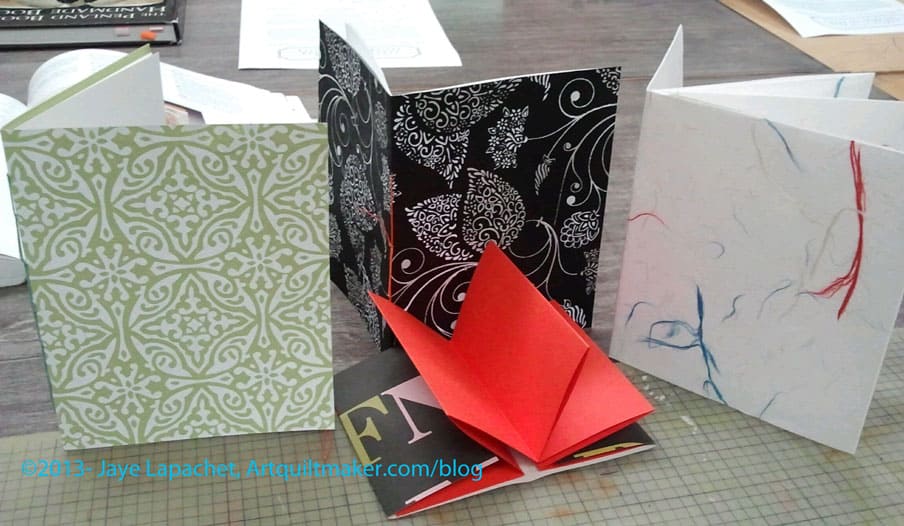
Books I Made 3/2013
This happened a few weeks ago when the social committee of one of the organizations to which I belong scheduled an outing to the San Francisco Center of the Book. Of course, it was a week where a thousand things were happening and I almost cancelled. I am glad I didn’t, though, because it was a great class and it got me moving in the direction of bookmaking, like the Red, Purple, Well Done and Good Job journals, again.
Until it is in Flame
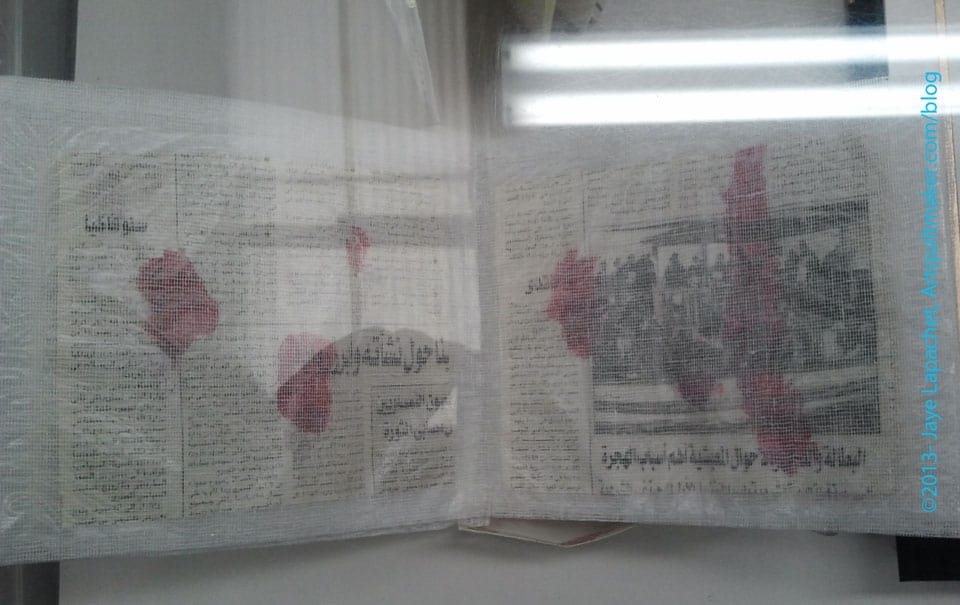
Not every participant had arrived, so I took some time to look at the exhibit on display. I don’t remember the name of the exhibit, but the books all looked like they had hidden messages.
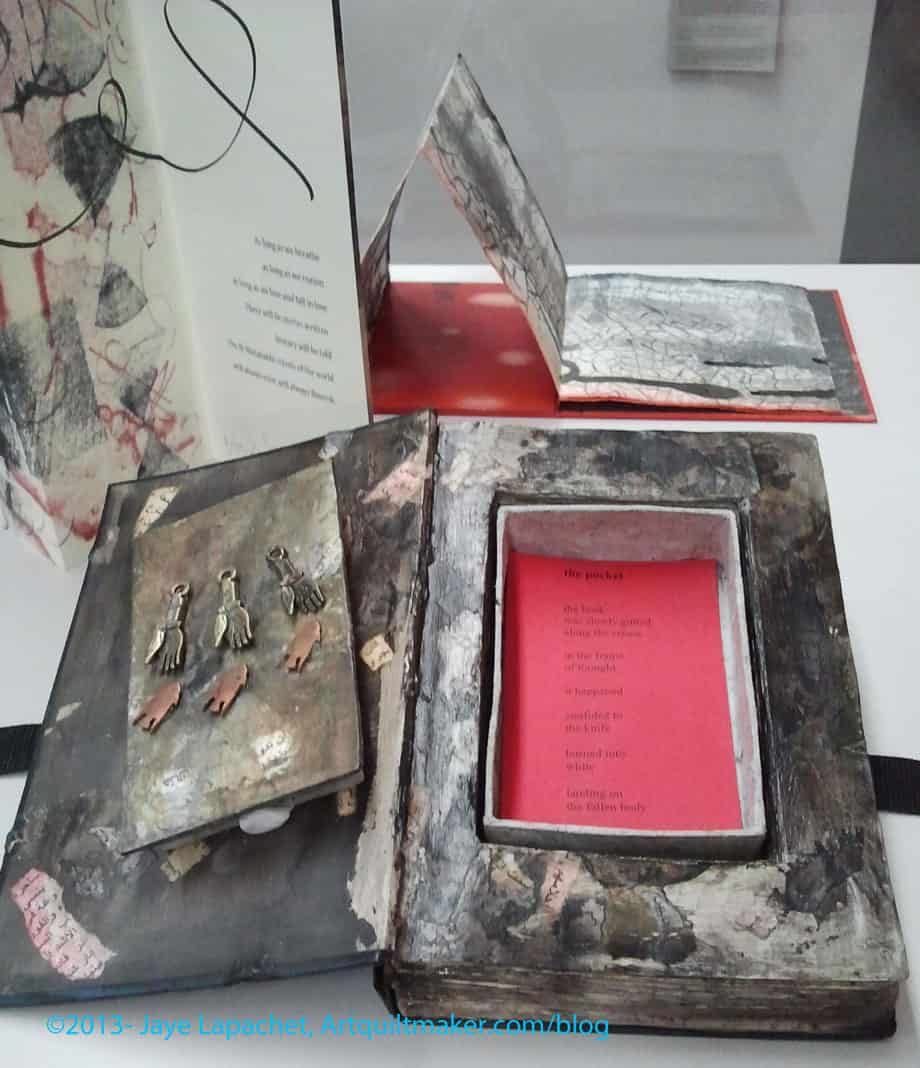
The piece, Until it is in Flame, is by Beau Beausoleil and Andrea Hassiba. While I do not like the burned and destroyed book, I do like the way a part of the book is hollowed out. The space could hold additional artworks, messages or other books. It makes me think of how to do this sort of idea in the structure of the books I make, but it also makes me wonder whether I should.
Healing Wounded Words
Healing Wounded Words is a piece about the power of words by Marina Salmaso, a Danish artist from KØbenhavn. I find this piece to be very light, but the words and the red are not boring. I also like the format.
You really have to click the photos to see them larger. The thumbnails don’t do them justice.
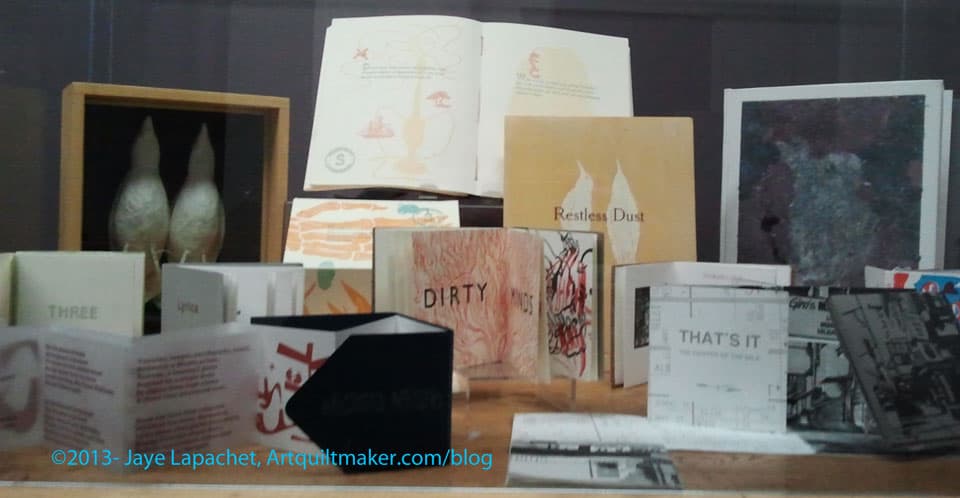
Exhibit
Another exhibit was in another room and it was equally as intriguing as the one in the main room.
I really like the variety of different bindings and different types of books. It was so fun to learn how make a few of them.
My Favorite Binding
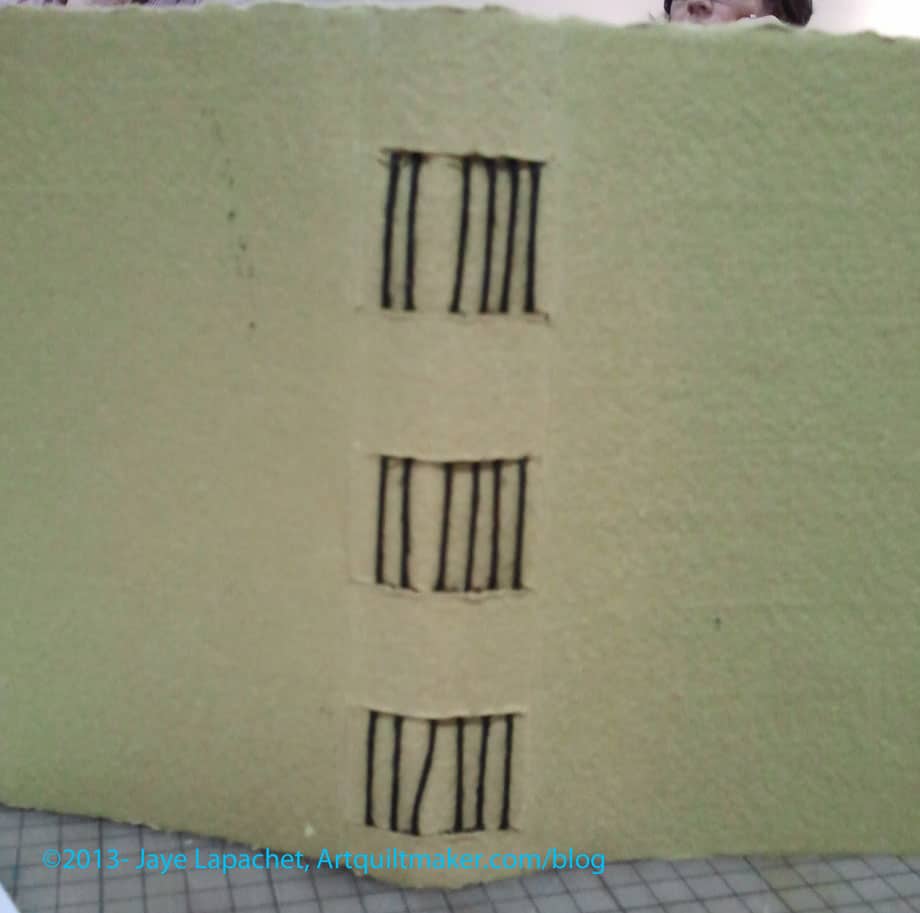
Rhianna, the instructor, passed around lots of different types of books with different bindings. We did 4-5 separate books and bindings. Of course when I saw the binding on the green book, I immediately thought it would make a fantastic journal binding.
Guess what?
This book was a teaser for another class! I really want to take that class so I can learn how to make the binding. If I made it I can decide whether I can translate the binding/bookmaking type into fabric.
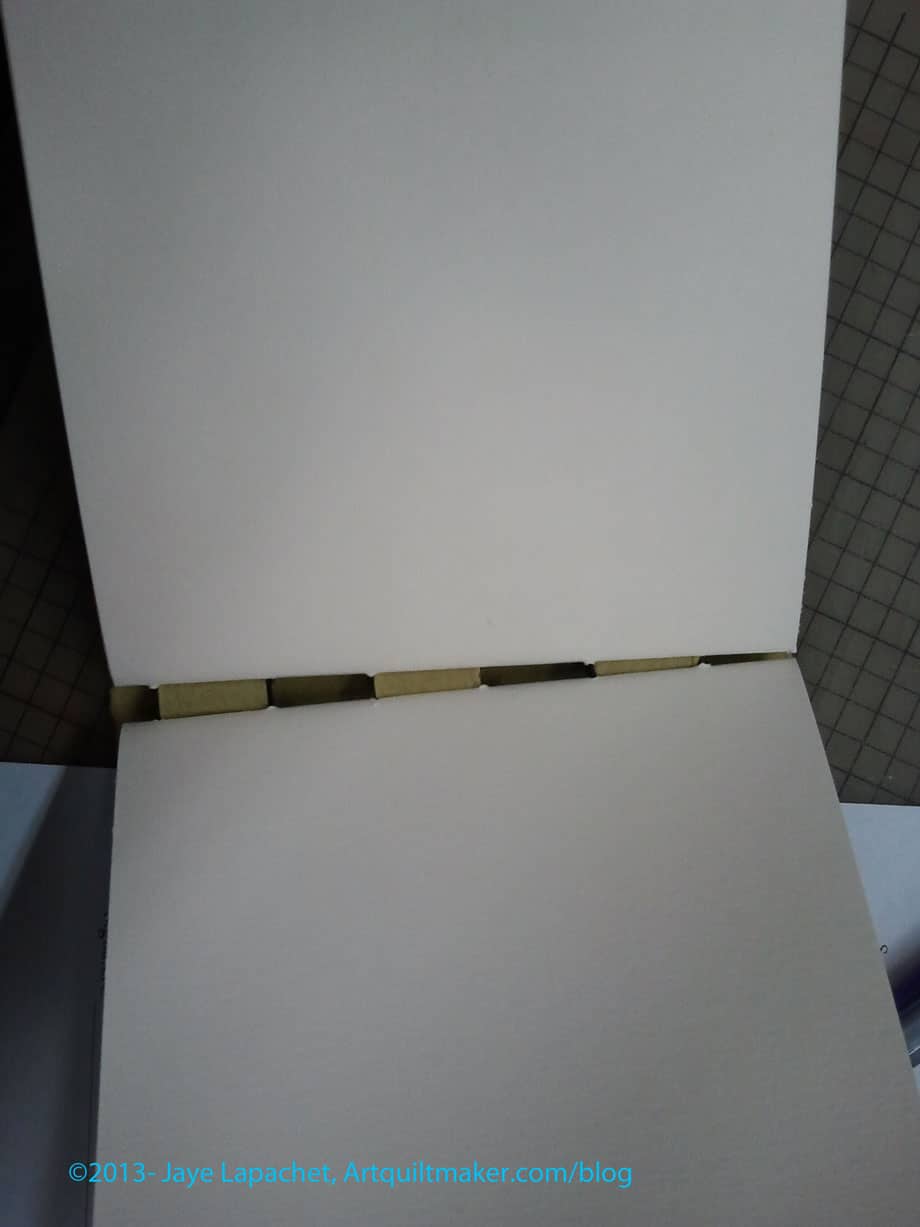
Inside of My Favorite Binding
From the inside, this binding looks like it would hold a lot more pages than the other types of bindings we learned.
It also looks like one could see some of the fabric through the binding.
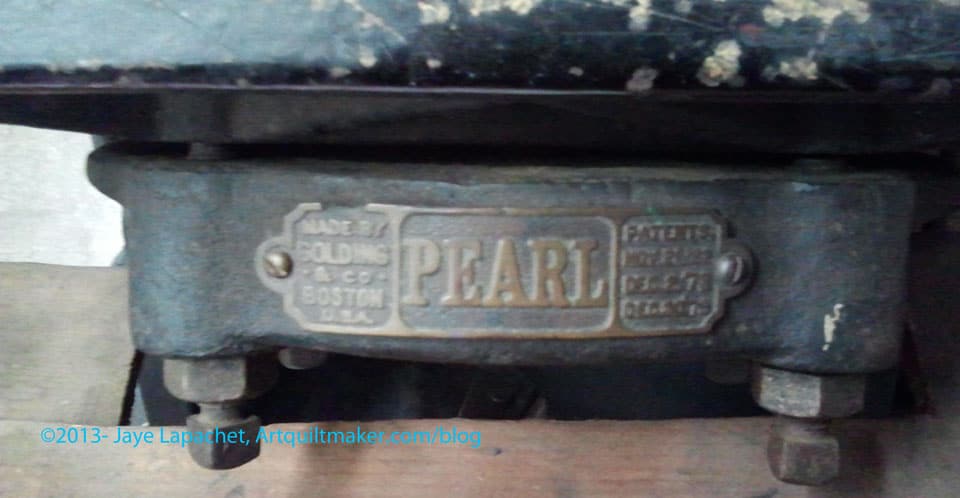
Type cases
The San Francisco Center for the Book is a great place. It is in a hip, up and coming neighborhood that still has a bit of grit with their Whole Foods.
Type case label
There are a lot of interesting things to look at in the facility and it is light and airy as well. The exhibits I looked at were two in a series of ongoing exhibits.
If you are making a trip to San Francisco and want to get off the Fisherman’s Wharf-Ghirardelli Square-Cable Car beaten path, you might want to check out the San Francisco Center for the Book.
I was tired on Memorial Day and think I needed a break from the Corner Store. We were out late the night before watching the Bridge fireworks, so I got a late start. My head was spinning from the work I accomplished on the Corner Store, so I worked on some smaller projects.
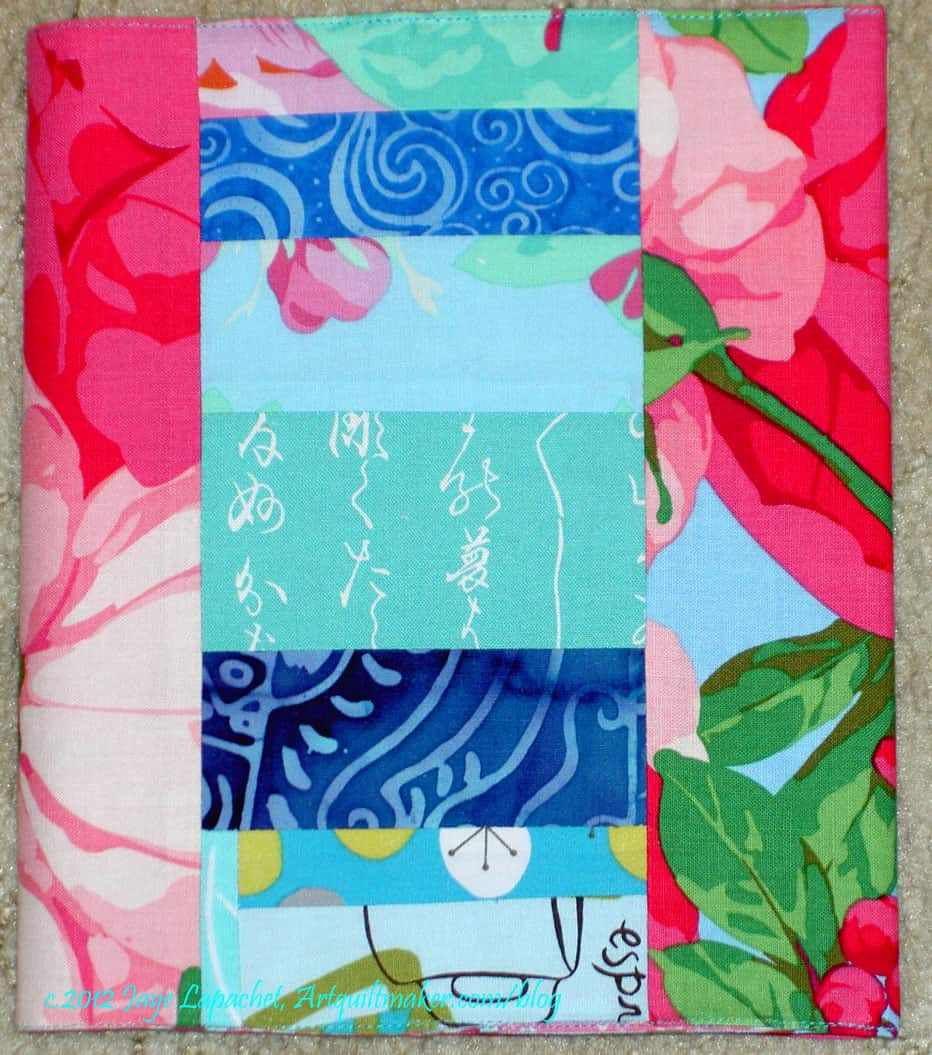
I finished my current journal, so I needed a new journal cover. I really like having a journal cover on my journal now. Need and desire convinced me to make a new for the fresh journal. I wanted to use one of the Philip Jacobs fabrics, but I also wanted to add interest, so I did a bit of piecing.
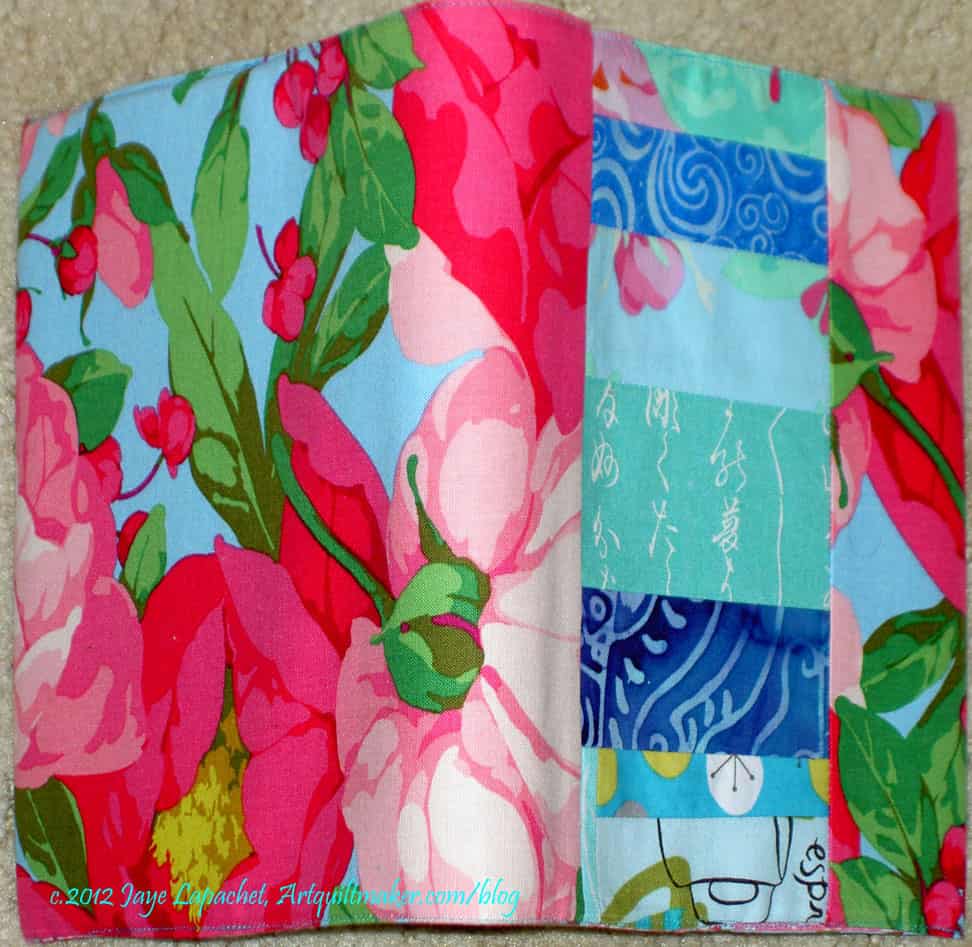
Journal cover open
The back is all Philip Jacob, which means I can look at it whenever I want. The bits of pink peeping on the front make me smile.
I sewed on a merit badge, fixed my pants and listened to a book. I also beefed up my supply of donation blocks. I think I am up to 6 of the pink one now.
I also worked on the next Swoon block. Stay tuned for more on the Swoon blocks.
For a long time, I had an idea in my mind that I would make two pencil rolls for some friends who worked with me on the Primal Green show. Somehow the pencil rolls never got made. Then, the idea morphed into journals as I worked on the Purple Journal and I got in the groove of making the pages. I ended up just kept making more and more pages until I had enough for the two additional journal.
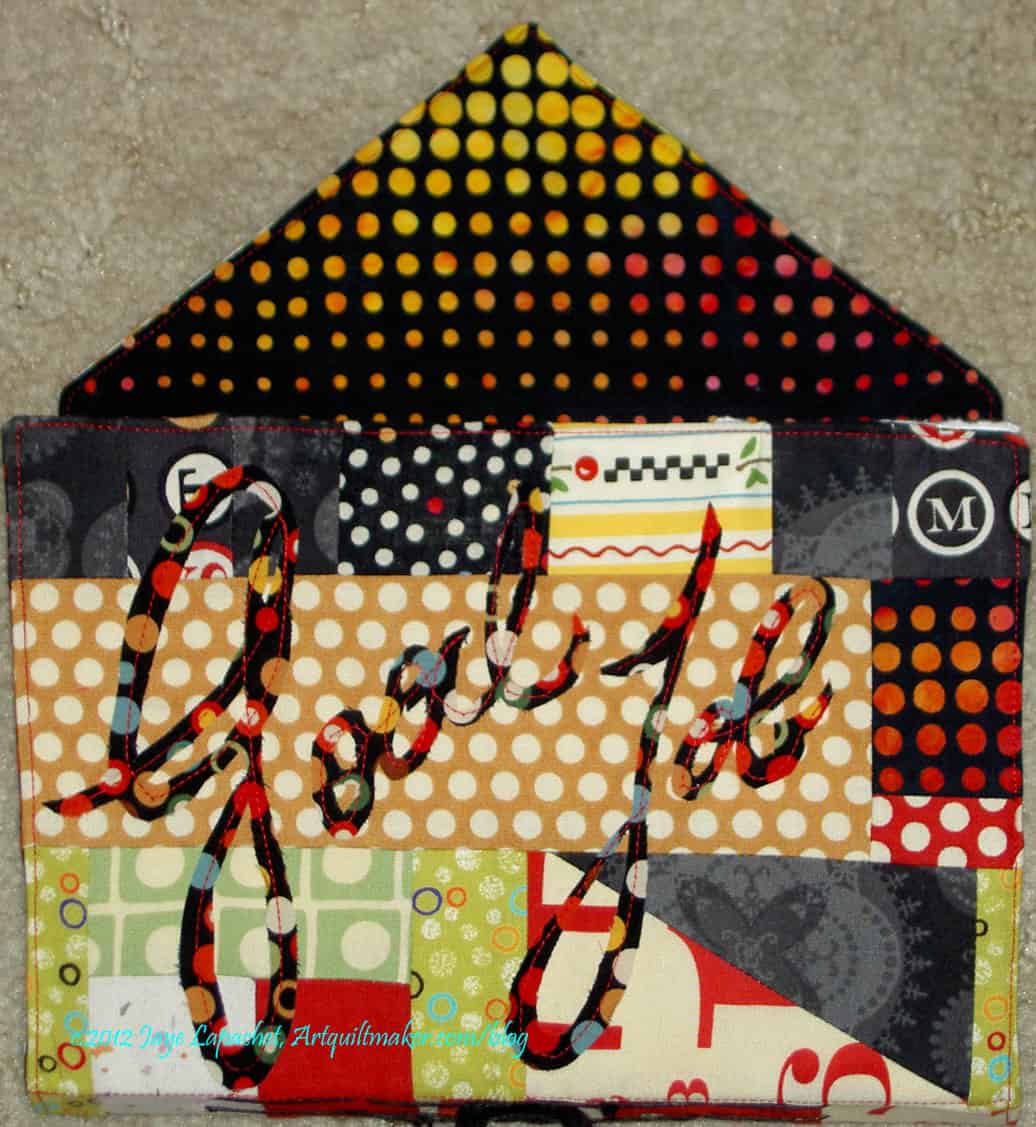
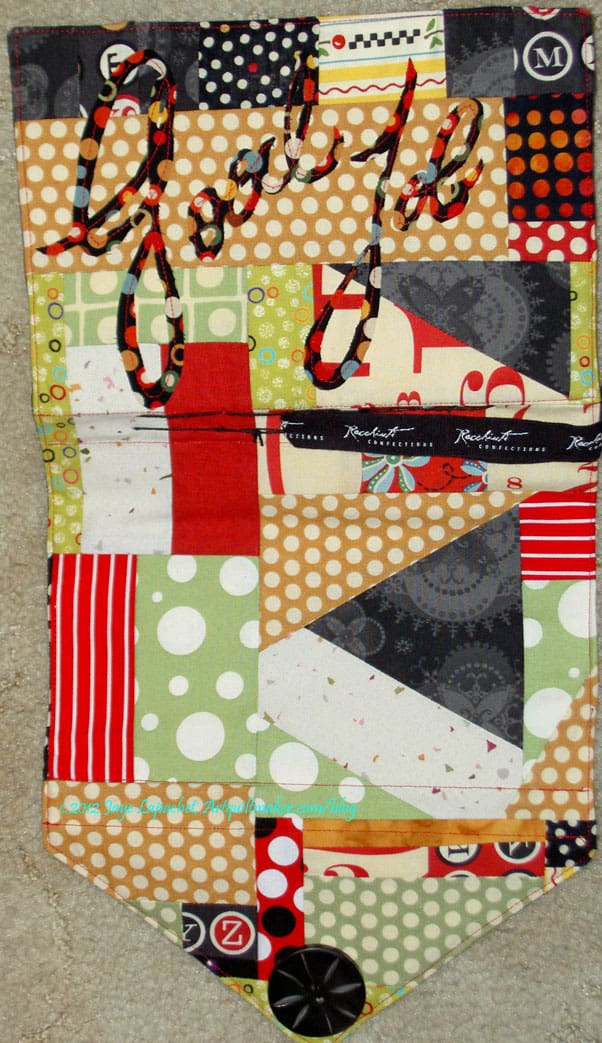
I used the Circa 1934 mosaic piecing pieces that I had started when I got off track for Julie. The words are appliqued on to the cover using raw edge applique’ (straight stitch down the center of the letters). I started out with a freezer paper template using my own, slightly stylized, handwriting. I am not much of a calligrapher, so I reworked the design of the letters until I was happy.
It took me a long time to cut out the freezer paper templates. The letters were thin and I didn’t want to rip them. It was meditative. I wanted the words to be subtle so I chose another fabric from the group I used in the Stepping Stones quilt.
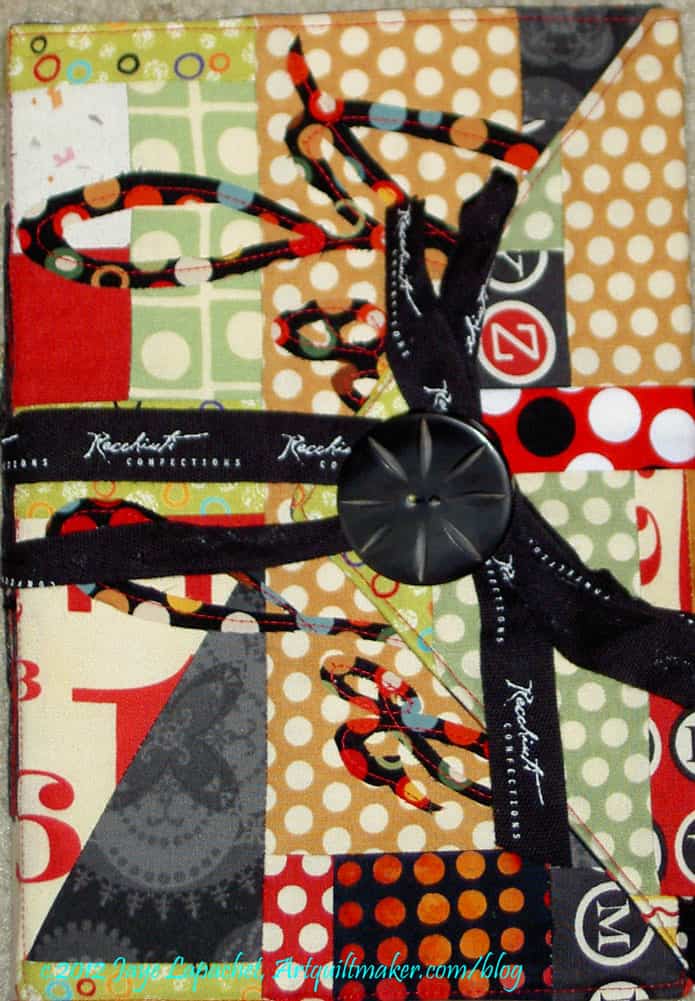
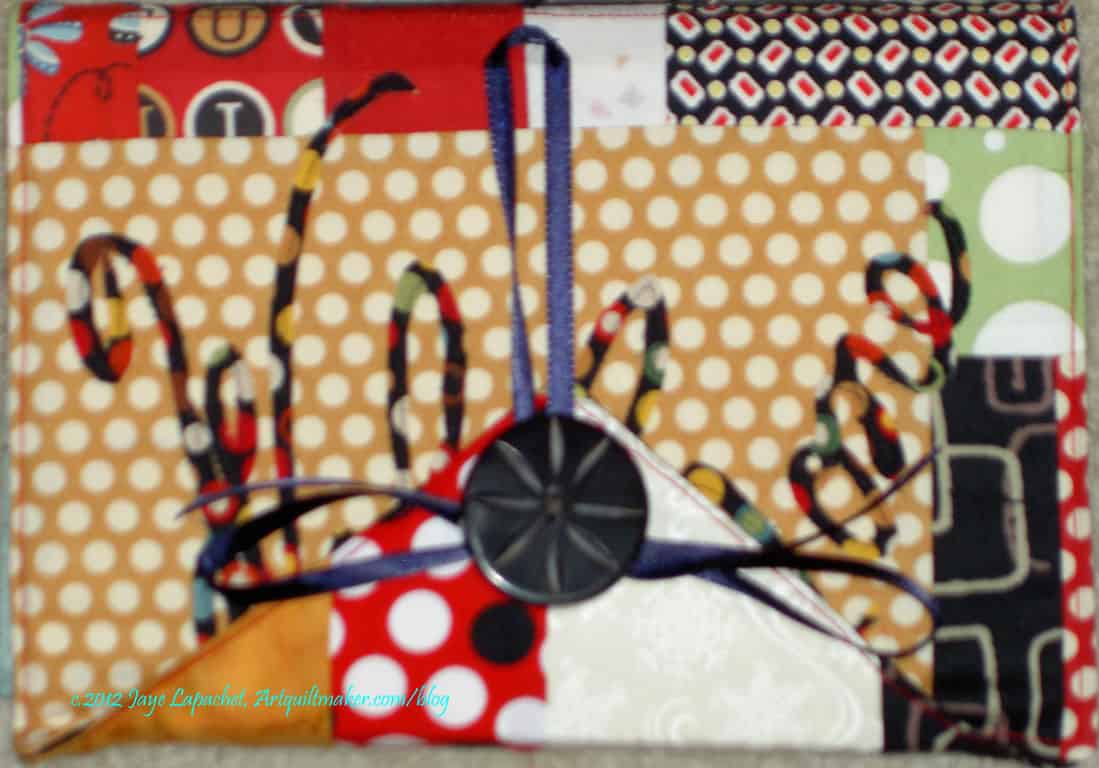
Good Job Journal - backGood Job Journal closed
I might have put the words on the back so that the closure wouldn’t cover them when closed, but I didn’t think of it. That is one reason why I like to work in a series (which sounds so much more arty than “make projects over and over”) – so I can learn and do better the next time.
On the other hand, it kind of looks like a surprise. You get a little peek of something else, then you open the closure and see the words.
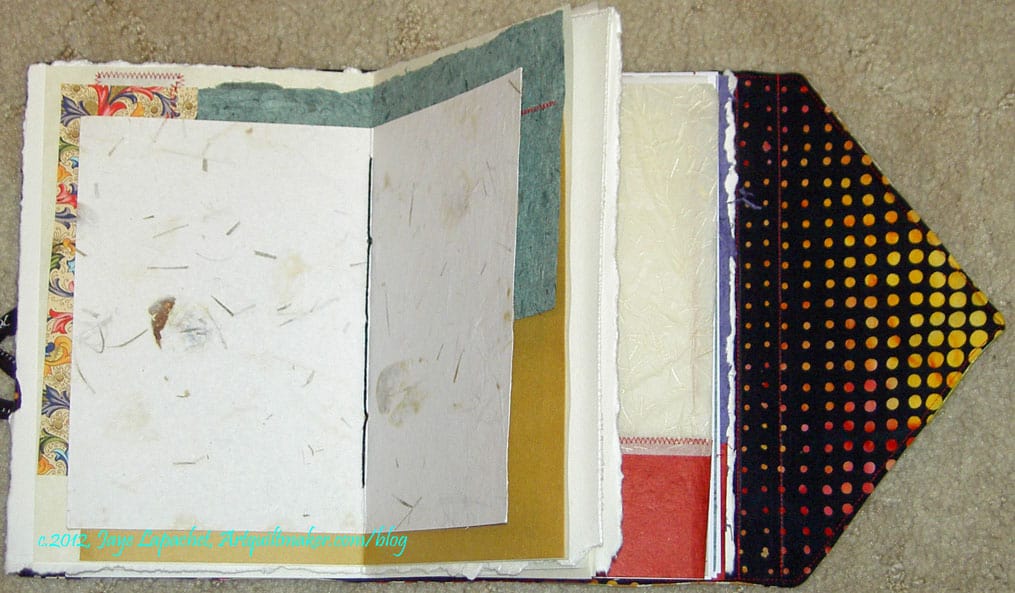
Good Job Journal - signatures
The signatures are the same or similar size to the signatures in the Purple Journal. I left a little more space to write and draw on these pages and thought about the Design Series Sandy and I have been working on while I embellished the pages. This project gave me the opportunity to get a little design practice in without starting a new quilt.
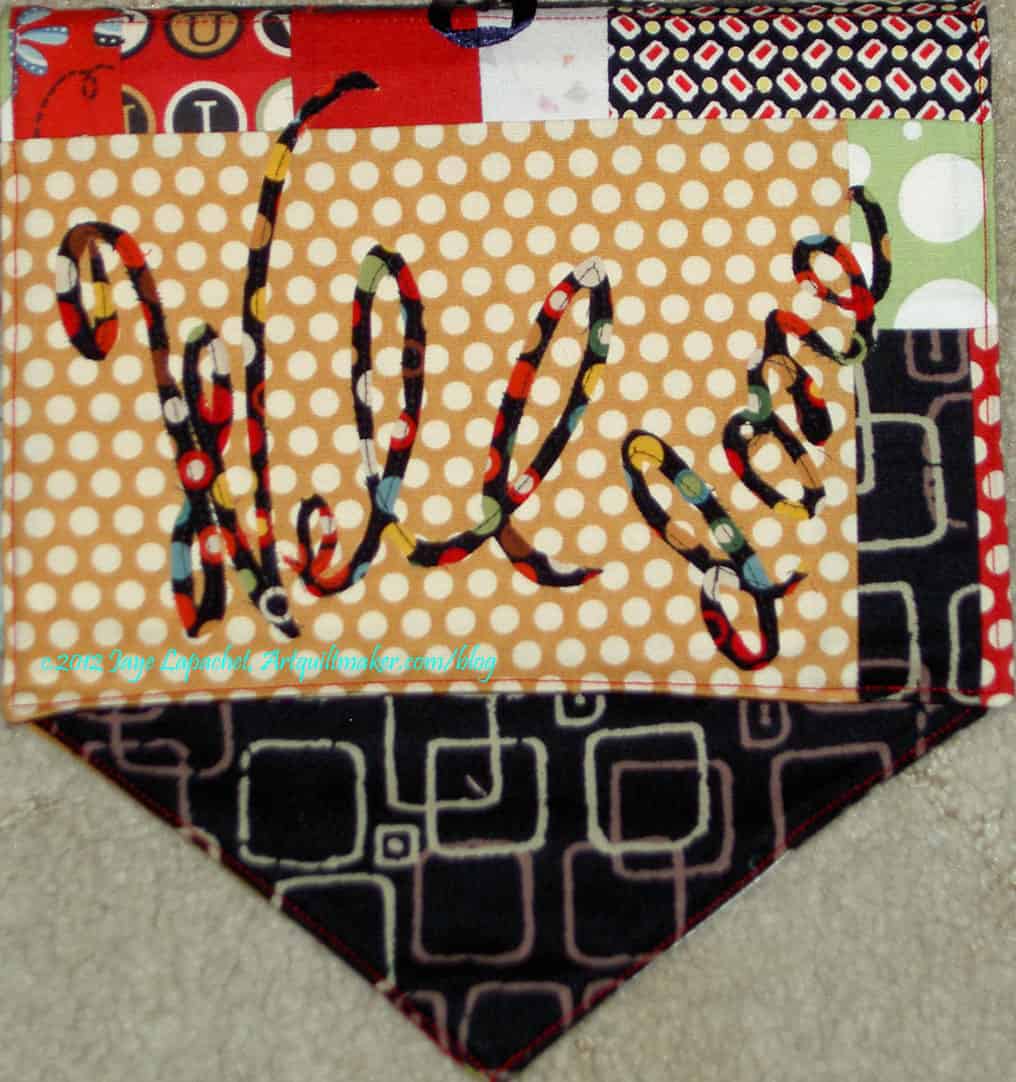
Well Done Journal - closed
These two journals are really twins: cut from the same cloth and made at the same time.
I didn’t pay a lot of attention to the design while I was piecing, because I knew it would be ok. One thing that encouraged me on to add the words was the large expanse of that mustardy dot that ended up on the front. It is really too big of a piece for the front. One large piece of fabric in this mosaic piecing technique does get the piece to the right size faster, but also looks boring. It is, however, a great background for words.
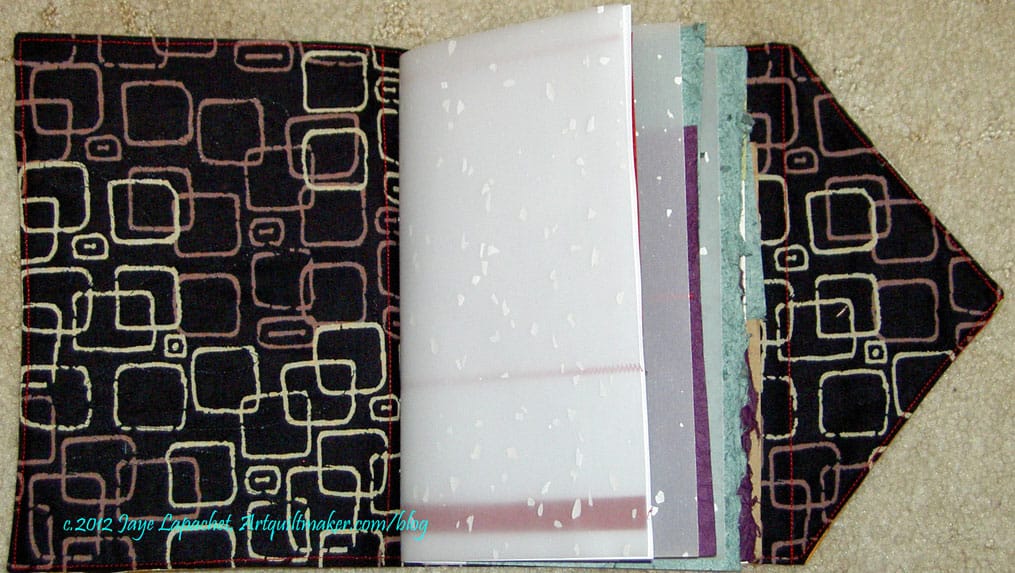
Well Done Journal - open
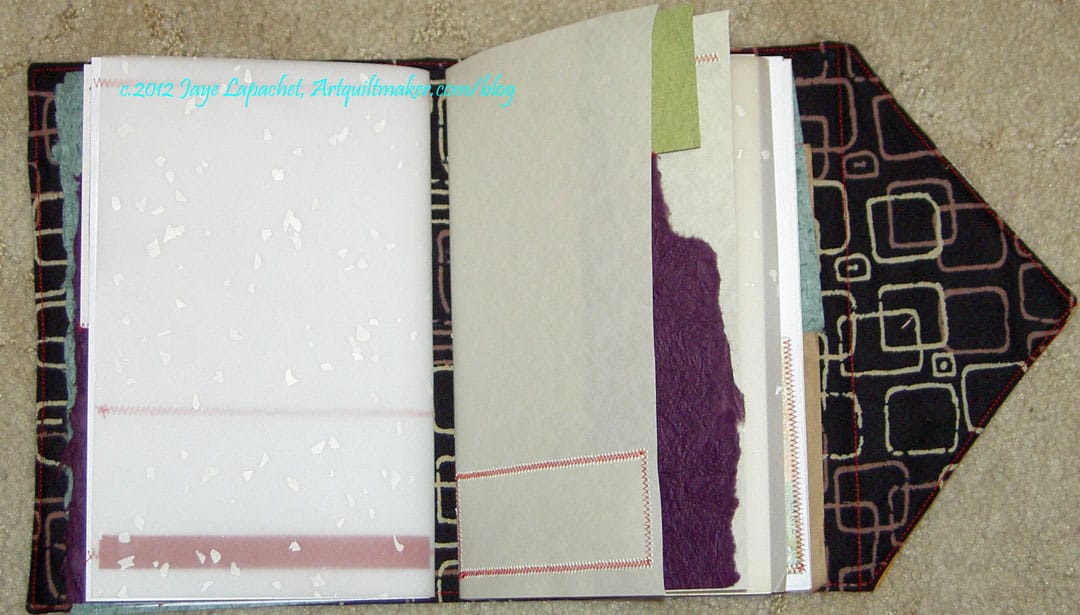
Shocking as it might seem, I stitched on the words AFTER I put the cover together. That means I stitched through the manilla folder which provides the base and gives the journal shape.
The ‘Well’ word was more tricky than the ‘Good’, ‘done’ or ‘Job’ words. I think the fact that they are taller and thinner were part of the issue. My second ‘l’ is leaning a bit more than I intended, but I think it looks ok. If I had thought of it I might have used a light fusible to keep the words in place while I sewed them.
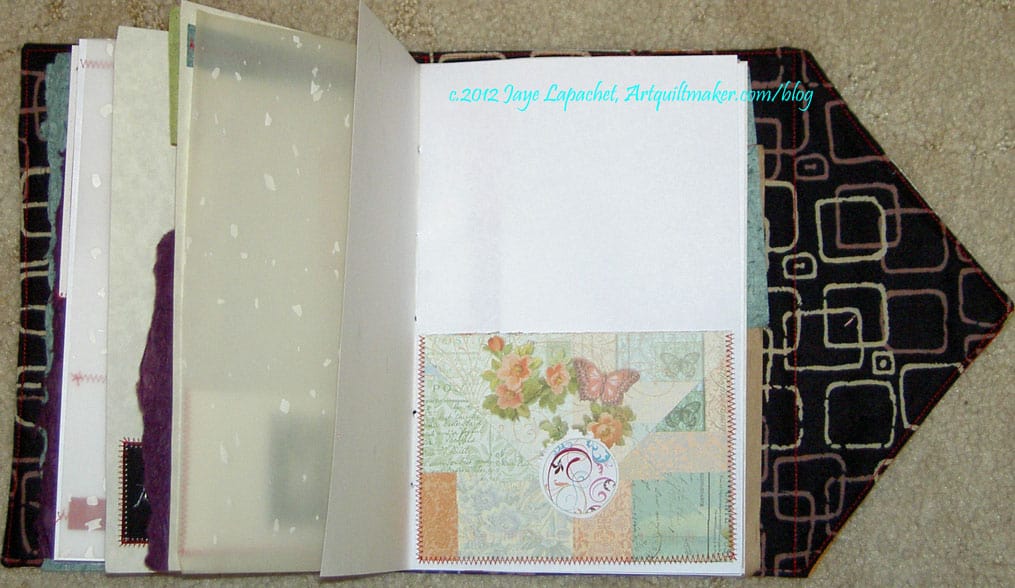
Well Done Journal - signature 1
I made a big effort in these two journals to vary the types of paper and put more blank pages in.
I didn’t realize until I started on the signatures for Good Job and Well Done that I was making mini art pieces as pages rather than embellishing pages to add interest and providing space for the recipient to write.
Well Done Journal - signature 1
Andrea, at A Work of Heart, where I took the original class, had a lot of great ideas about embellishing pages and adding interesting things to them. She also has a huge supply of all different types of items that could be used for pages, in addition to interesting paper.
I have a smallish bag of paper to use. I found an envelope in it, so I added that to one page so the owner could tuck bits into it. In some cases, I also sewed down only two sides of a piece of paper to embellish so that something could be tucked behind that embellishment as well. I like to tuck things into my journals and imagine that others might, too.
Well Done Journal - signature 2
On the left, which is the last part of signature 1, you can see that red strip of paper. That is the kind of embellishing that I was trying to do.
In signature 2, on the left, you can see how my stitching shows up on the first page of the signature, but embellishments are actually on the back of the page.
I also try to position the edges of the pages a bit unevenly. I wanted to highlight the handmade nature of the piece and also draw attention to some of the handmade paper I used.
Well Done Journal - inside back
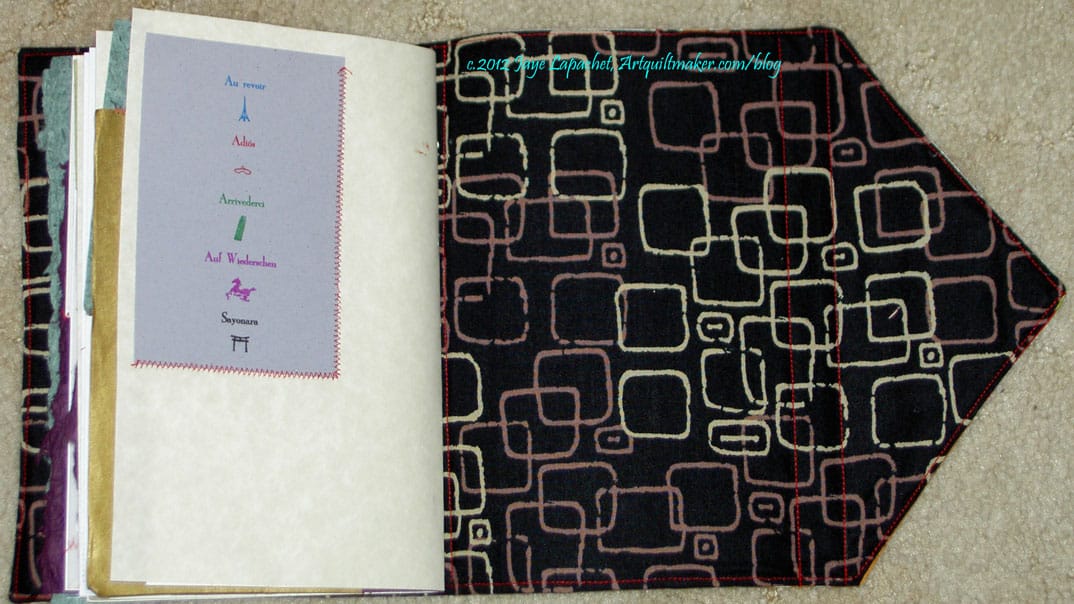
The inside back cover isn’t terribly interesting. I put a pocket on the Purple Journal, but forgot to do so on these two journals.
I thought the card with printed words saying good-bye in different languages was appropriate to put on the last page. I am sorry that I don’t remember where I got them, because I would like to get a few more. I had a few so I think each of these recent journals got one.
Well Done Journal - Good-bye detail
I also like the small images printed in between each of the words.
In this photo, you can also see that I used a zigzag stitch to adhere the paper to the other pieces of paper. I used the same color thread and the same stitch throughout both journals. I played around with the setting a little bit to get a width and length that I liked. I remembered to not make the stitch length too tight or close together (like a satin stitch) otherwise it would have torn the paper.
I think that little bits can be tucked behind the Good-bye card.
The bad thing about this project is that it makes me tempted to save much more paper than I really should save. I really don’t have any place to keep paper and A Work of Heart is too far away to depend on for a ready supply of paper. I guess that is another reason to use a lot of blank paper and embellish it slightly.
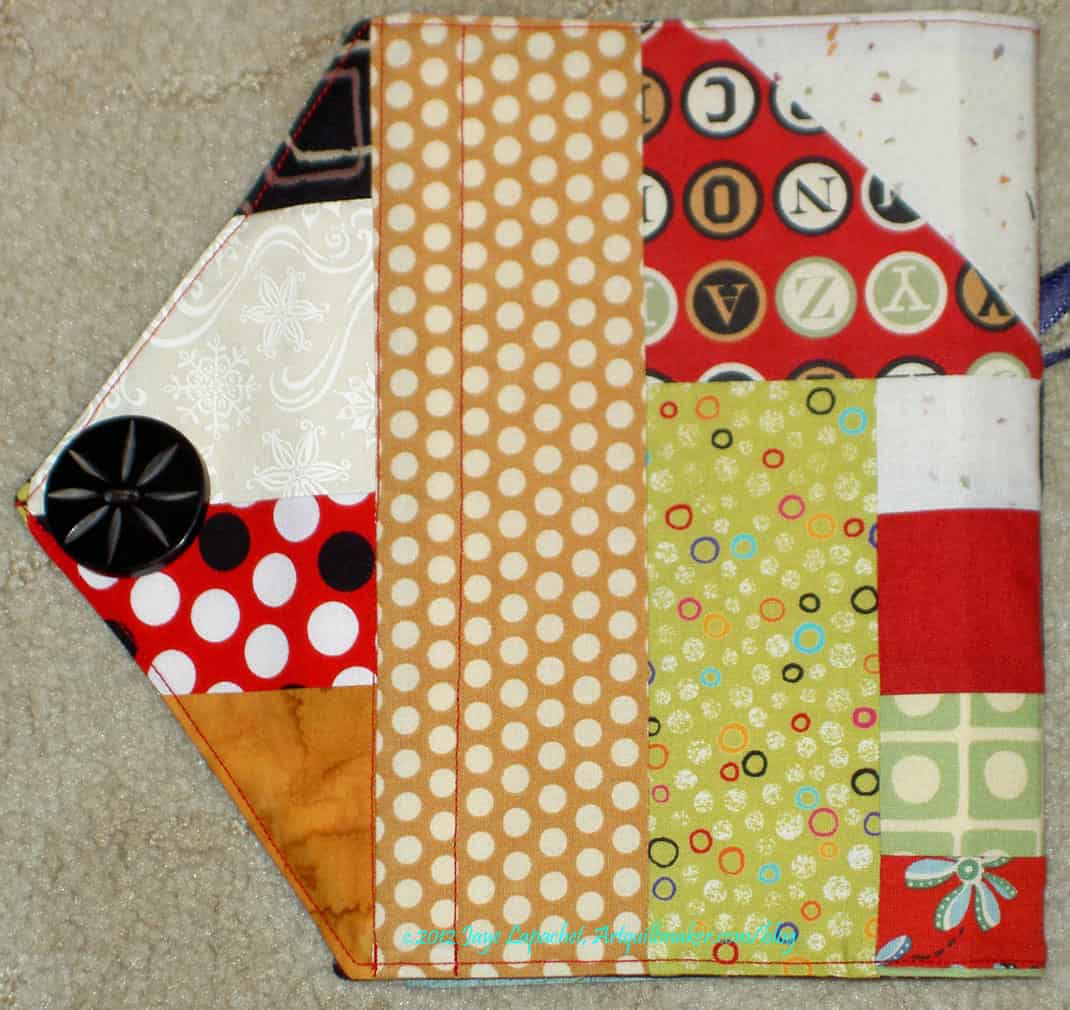
Well Done Journal - back
Mosaic piecing is not only good for journal covers, but it is a great way to get something done that you don’t have to think about too much while working on another project. Remember leaders and enders? Mostly, when using fabric, I sew like colors together, but in this case, I used a group of fabrics I had used for a quilt, the Circa 1934 + fabrics. You can see that my cover includes a half square triangle piece. I didn’t use it in the quilt, so why not give it additional life?
The Red Journal cover had a lot of super tiny pieces, but not all mosaic quilting needs to use super tiny pieces. Larger pieces become larger faster. In some way, Pieced Backs are a larger version of mosaic piecing. Of course, a cover can be made much more simply from two pieces of fabric. Piecing like I have done is not required.
Things I would like to try for next time (not that I know when next time will be):
use Timtex or similar for the base. I kind of want to see how that works and whether using a more fabric friendly base would be better.
use batting for the cover and see how a softer cover works.
push the limits on how many pages I can fit into a journal this size. One problem is that the sewing machine needle gets dull, so I have to make all the pages at once or keep track of a “for paper use only” needle and keep switching out the needle. It would be great to use the leaders and enders technique for making the pages.
try to put more blank (or nearly blank) pages in the journals. I want people to be able to use these as a journal, so more blanks would be one way to do that.
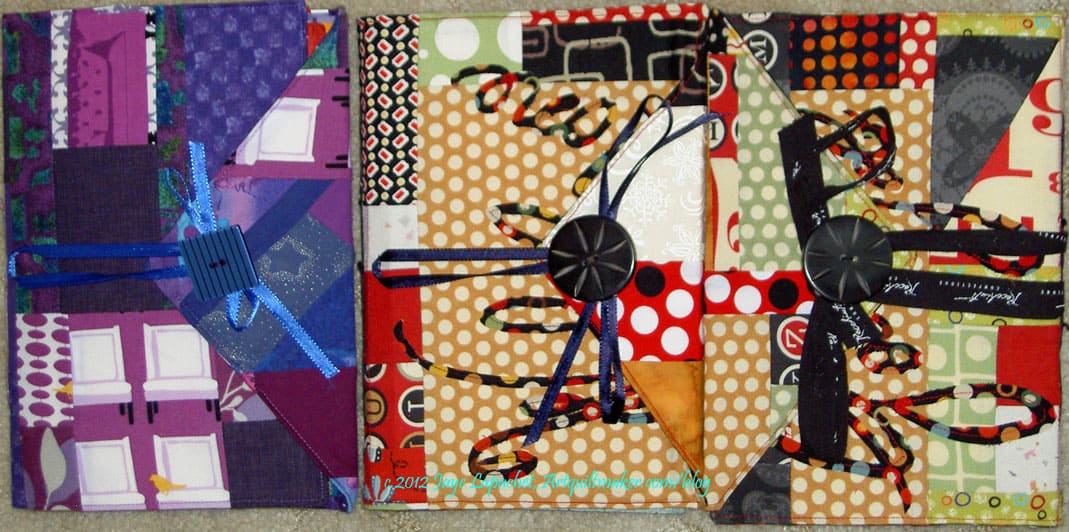
Three Journals, 2012
So, above are the three journals. I am really pleased.