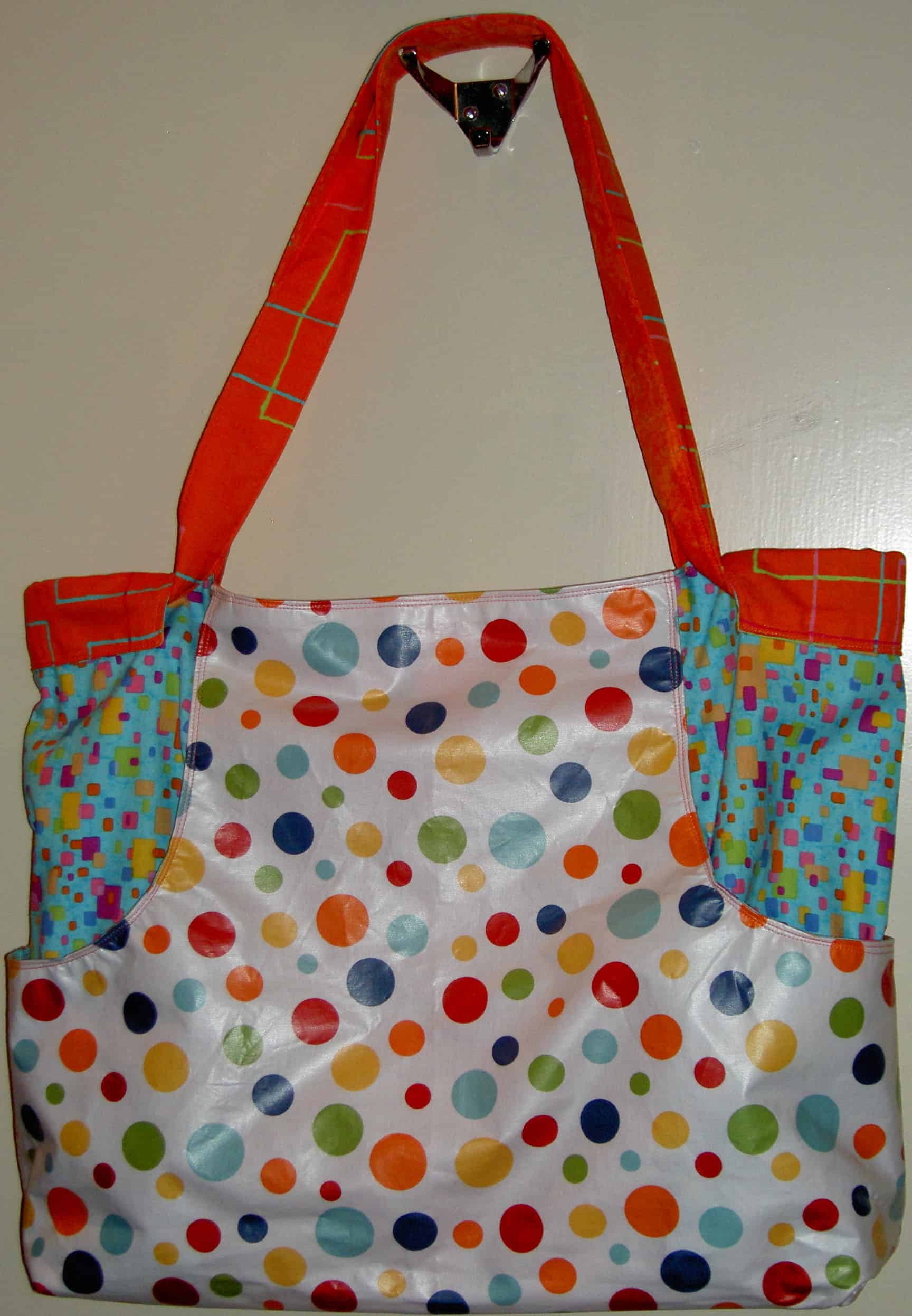
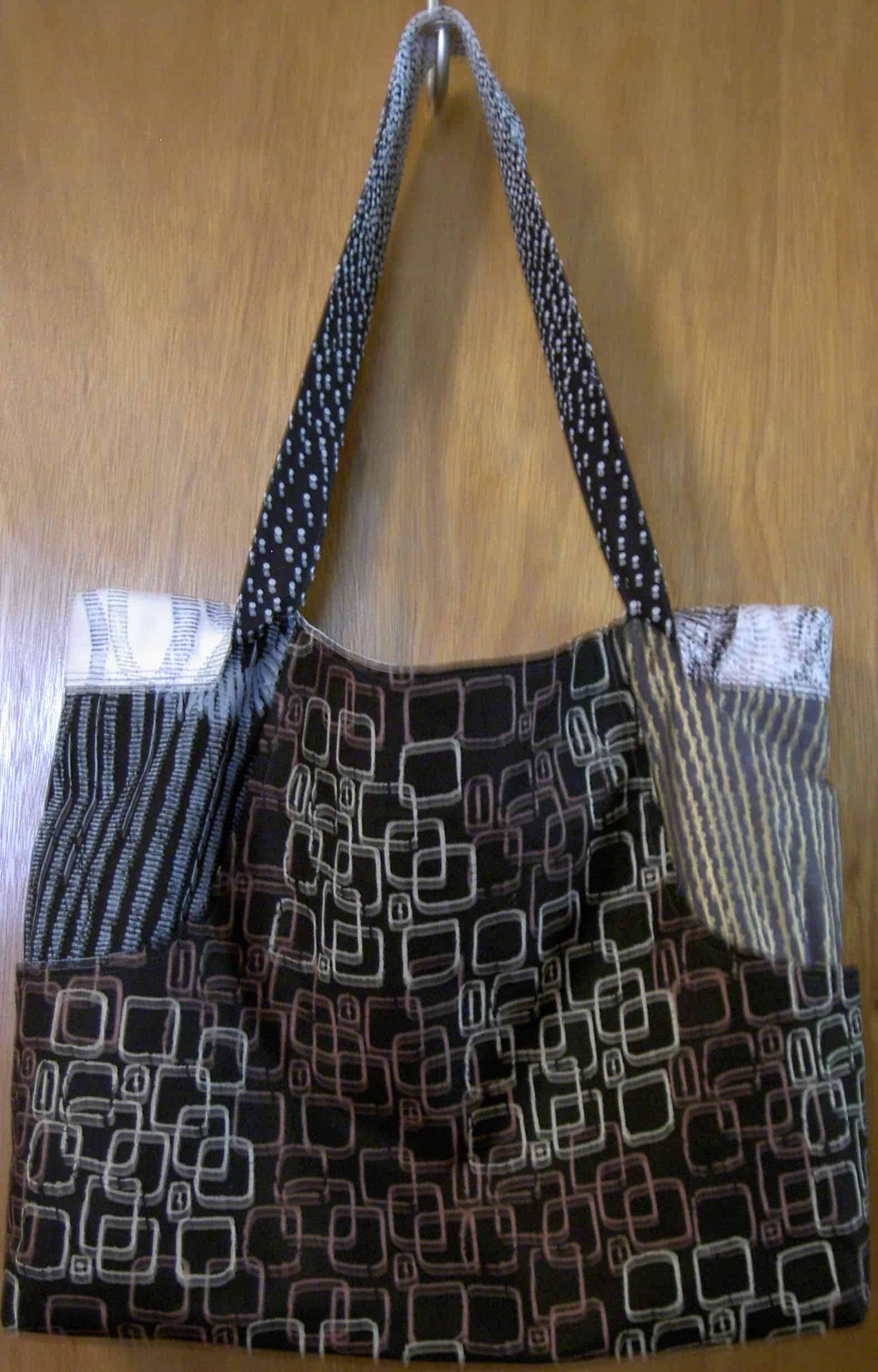
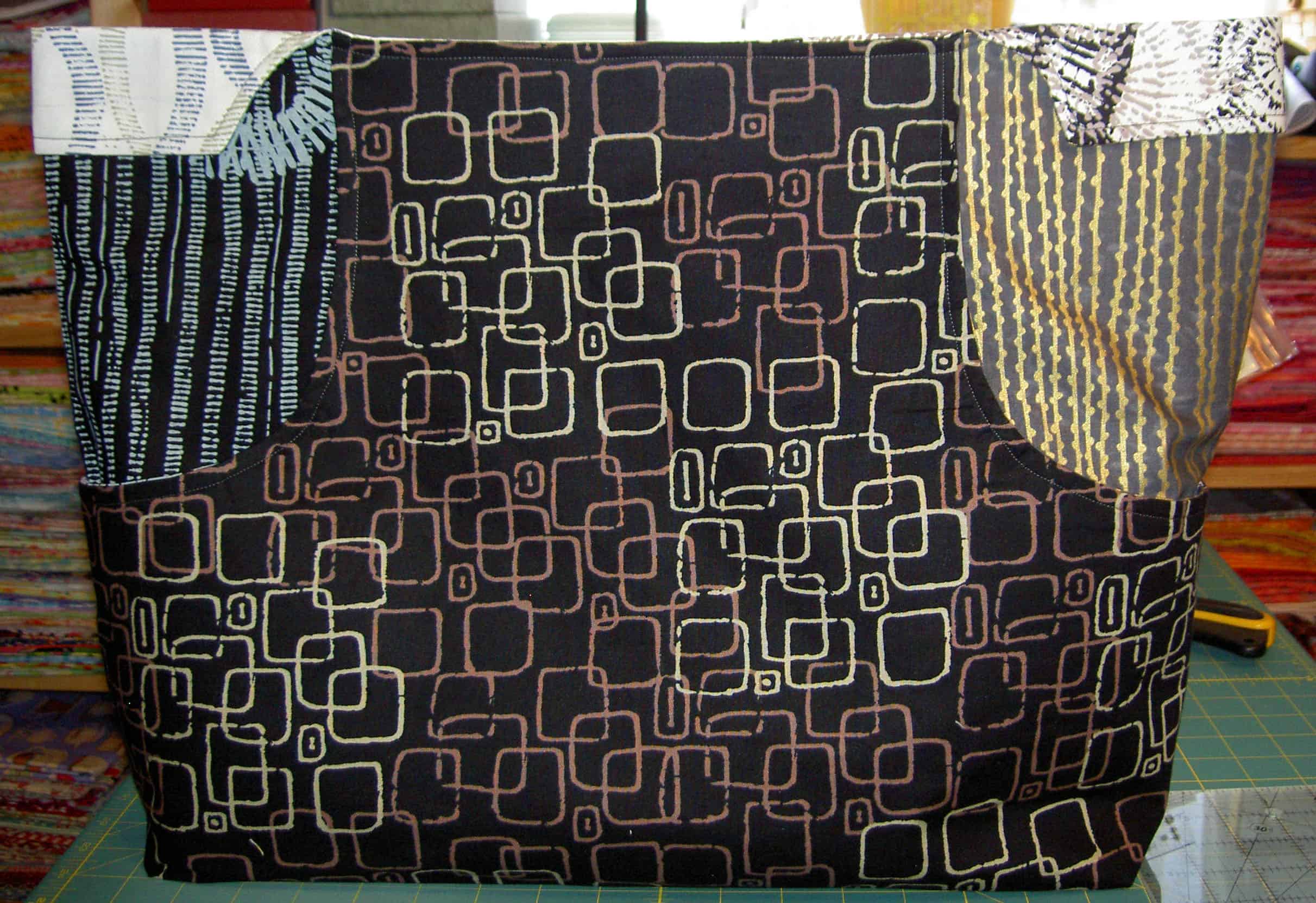
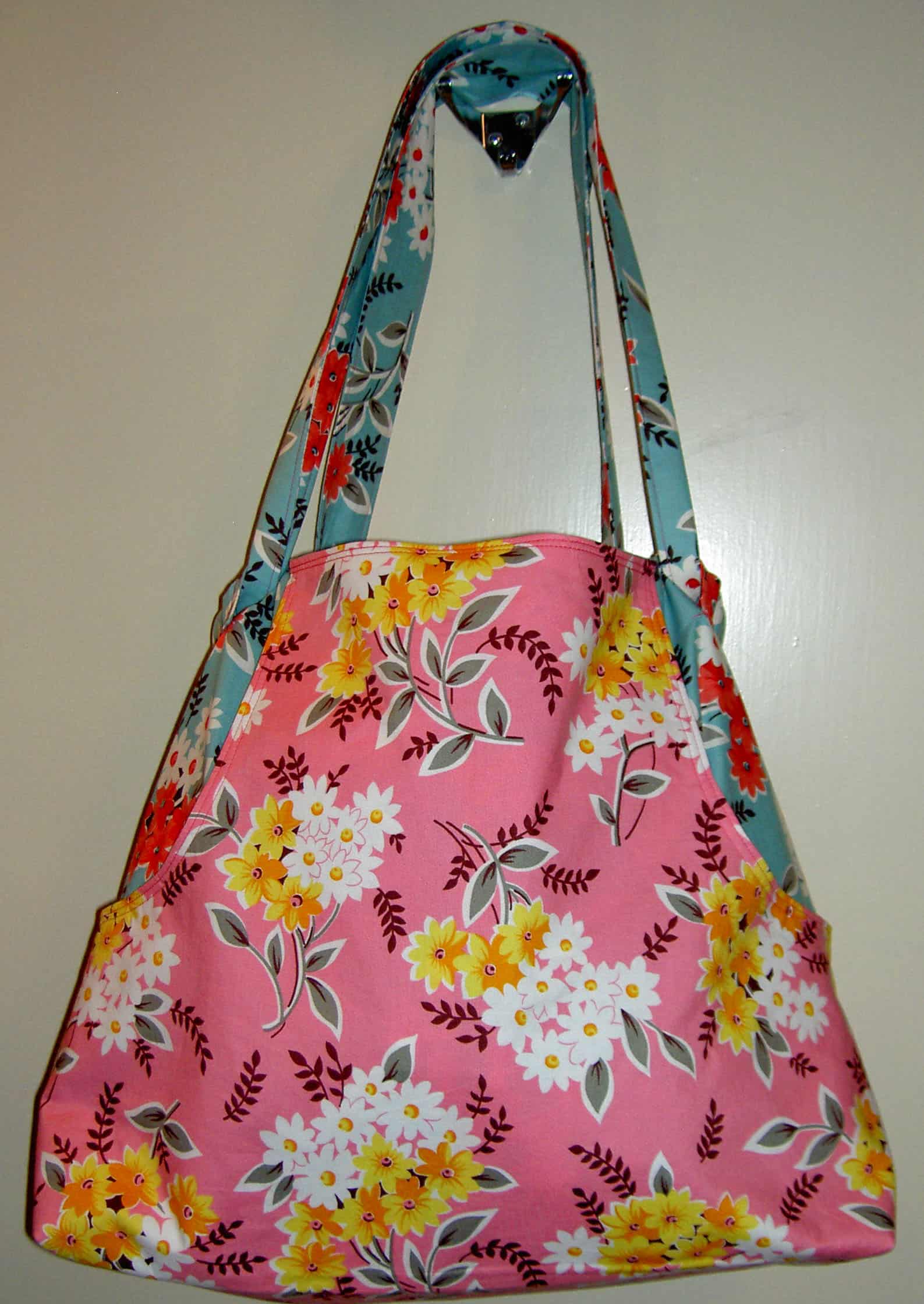
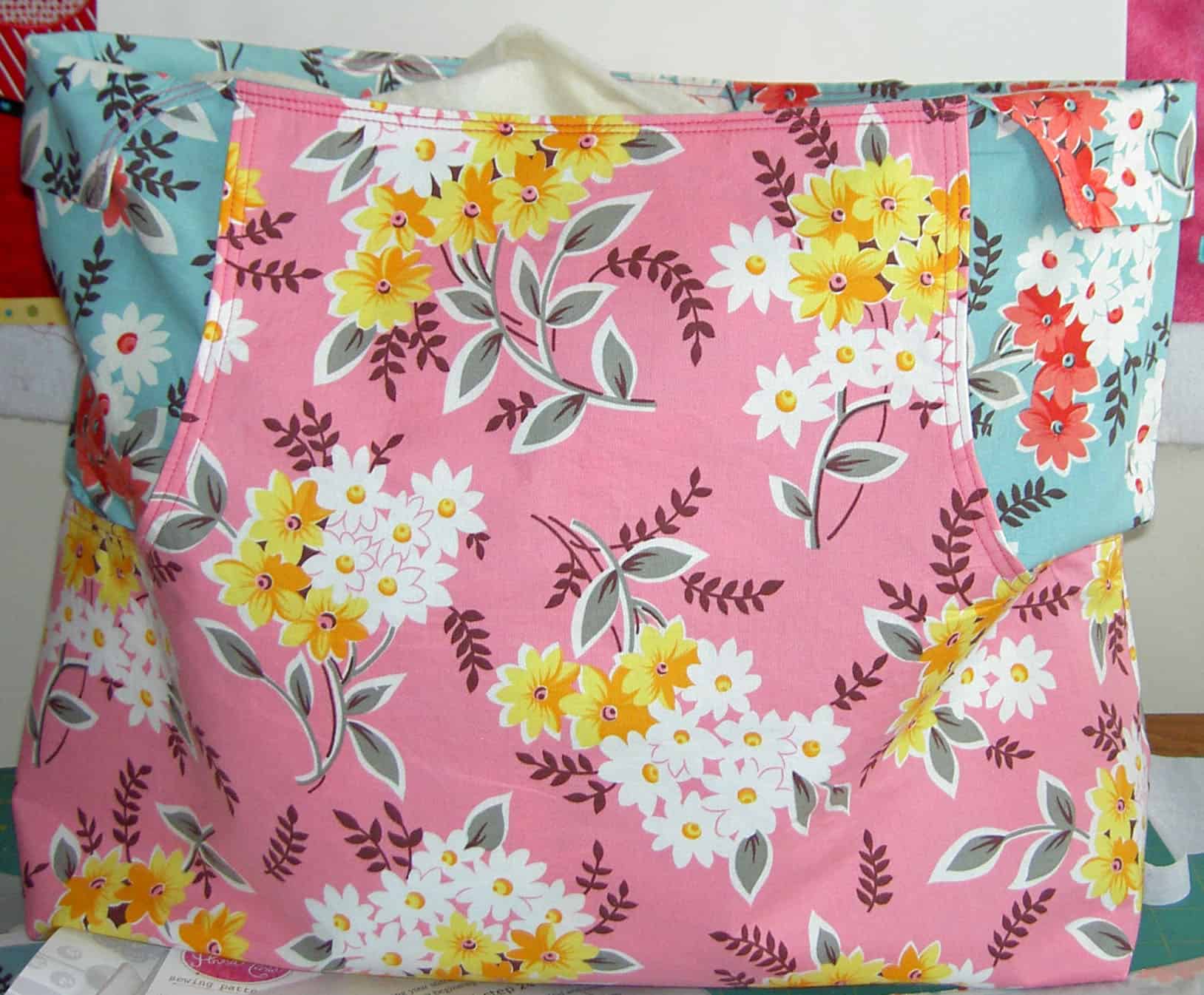
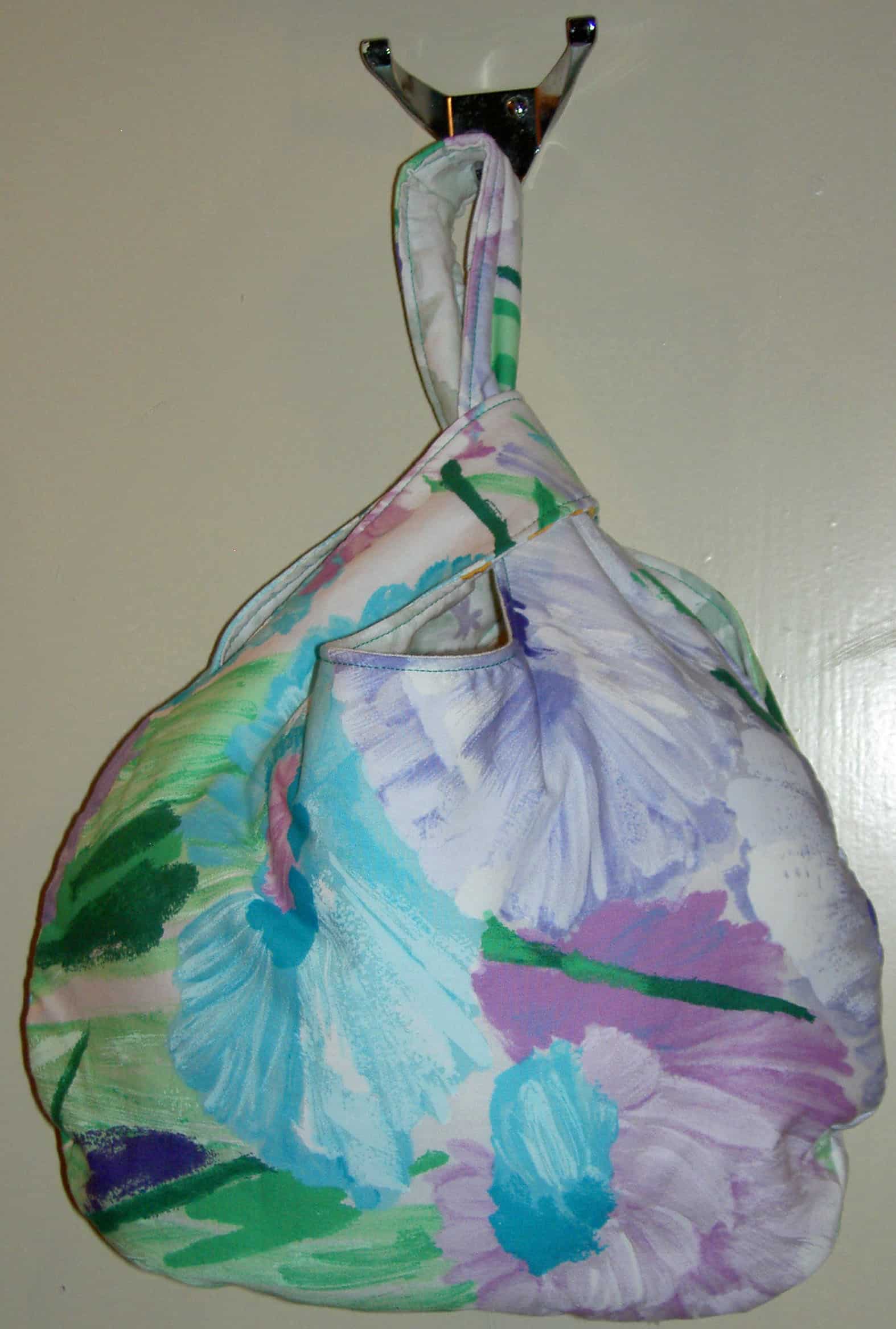
Here is my latest Multi-tasker tote. As usual, I made it from the Anna Maria Horner pattern. The more MTTs I make, the easier this pattern gets. Will this be my new tote bag pattern of choice?
I bought the laminated cotton (oilcloth) at the Quilting Loft in Seattle on my week away. As I mentioned, it poured rain part of the time I was there and the regular cotton Julie MTT got wet. When I saw the dotted laminated cotton, I thought it would be a great winter bag. I made it big, even though I still need to make the Mini Multi to see if it is a better size for my height and shape and the amount of space I usually have on public transport. I had a lot of stuff I was hauling around from cafe’ to cafe’ that week.
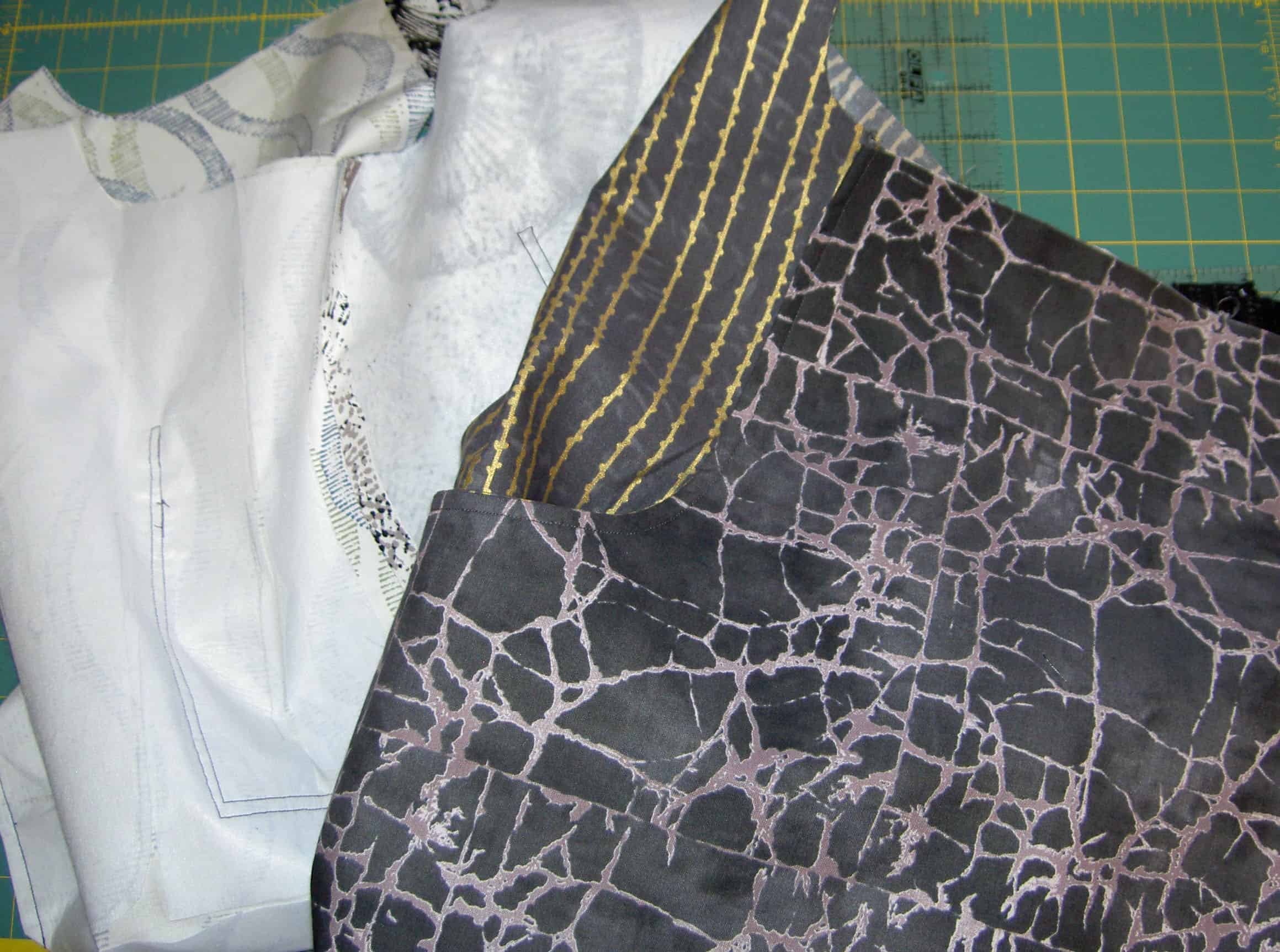
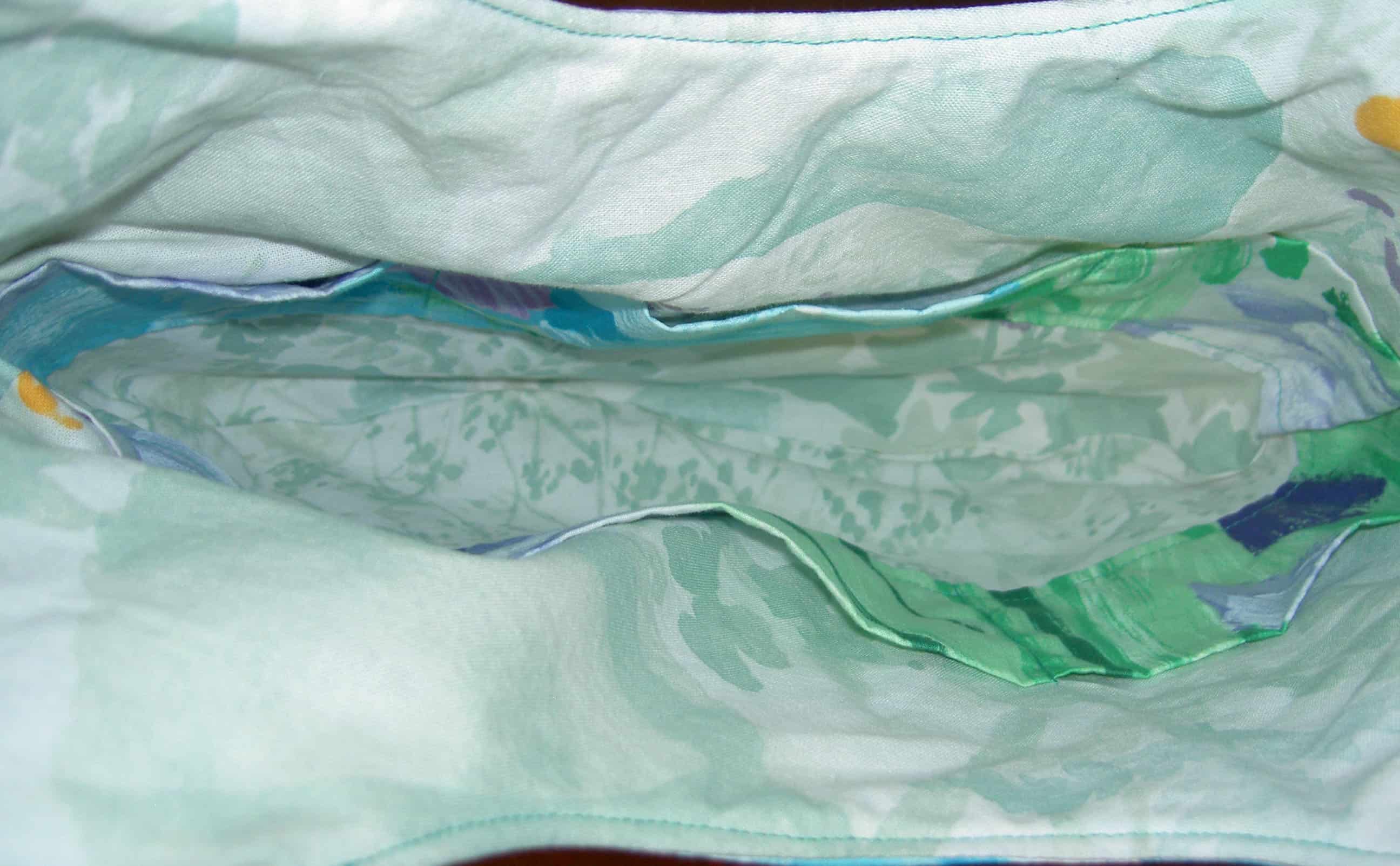
Dotty MTT, inside detail
Aside from the laminated cotton, the inside is an old, but still fun and fresh and bright Marimekko print, and the pocket panels are some random turquoise that I had. I am not happy with the outcome of this bag. I am not happy with the pocket panel fabric I chose (the turquoise). It goes well with the other fabrics, theoretically. Made up it just looks wrong. I wish I had used a stripe. I may make another one and use this one for a gift or something else. I have more of the dotted fabric.
One great thing about this project was that I was able to utilize a skill I learned during my week away to add a cell phone pocket to the inside. Apparently, cell phone pockets have a little pleat in them (do they all??). While I don’t know if I would put my cell phone in this bag, I might if my jacket pockets are full of other things. The pocket might also be useful for a Nano, or other small electronic devices. It is definitely a pocket I will use in other bags, mostly because it is cool to make and I feel proud of myself for learning to do it.
After I made this bag and looked at the seven (yes, SEVEN) hanging on my workroom door, I started to wonder if I was giving up quilts and moving on to other accessories? I don’t think so, but the speed with which I can churn out a bag is very attractive and very fulfilling. I will have to put some block making on my agenda for the rest of this long weekend.
Most of you have probably heard about oilcloth recently. Anna Maria Horner has some as does Michael Miller and many other designers. While on my week away, I bought some dotted oilcloth designed/produced by Michael Miller from the Quilting Loft.
I don’t have a very strong garment sewing background and part of my tote bag adventure is learning to construct 3D objects. As a result, I have never used anything like oilcloth before, except for the tablecloth vinyl. Some issues I ran into were:
What scissors to use: if used my good sewing scissors, would the oilcloth dull the blades?
What foot do I use? Will I need the roller foot?
The directions I found said press on low heat. What is low heat? Testing required, I suppose.
What thread should I use?
Will the oilcloth play nicely with the regular cotton?
As I may have mentioned I have wanted to try the oilcloth after carrying the Julie Bag around in the rain and trying to keep my stuff from getting soaked. The bag is complete, as you can see and here is what I found.
I used my medium scissors – not my good Ginghers, but not paper scissors either. They still seem sharp.
Using a regular foot was fine. The machine had no problems feeding the oilcloth.
Pressing the oilcloth was not an option. I used the very lowest setting on my iron and the oilcloth just curled up. After I found that out, I just finger pressed. Not as good as a nice crisp seam, but it worked. When I put the floor into the bag, I pressed from the lining side.
I used regular Aurifil thread and had no issues
The cotton and the oilcloth were nice to each other. The oilcloth was not too slippery. I think I sewed mostly with the flannel-ish side against the bed of the machine, which probably helped.
Vicki posted her Field Trips in Fiber post today and she linked to Geta’s blog. Geta is like me and does bags over and I over. I loved her fabric combinations. I am not sure if she created her own design or not. Very cool bags!
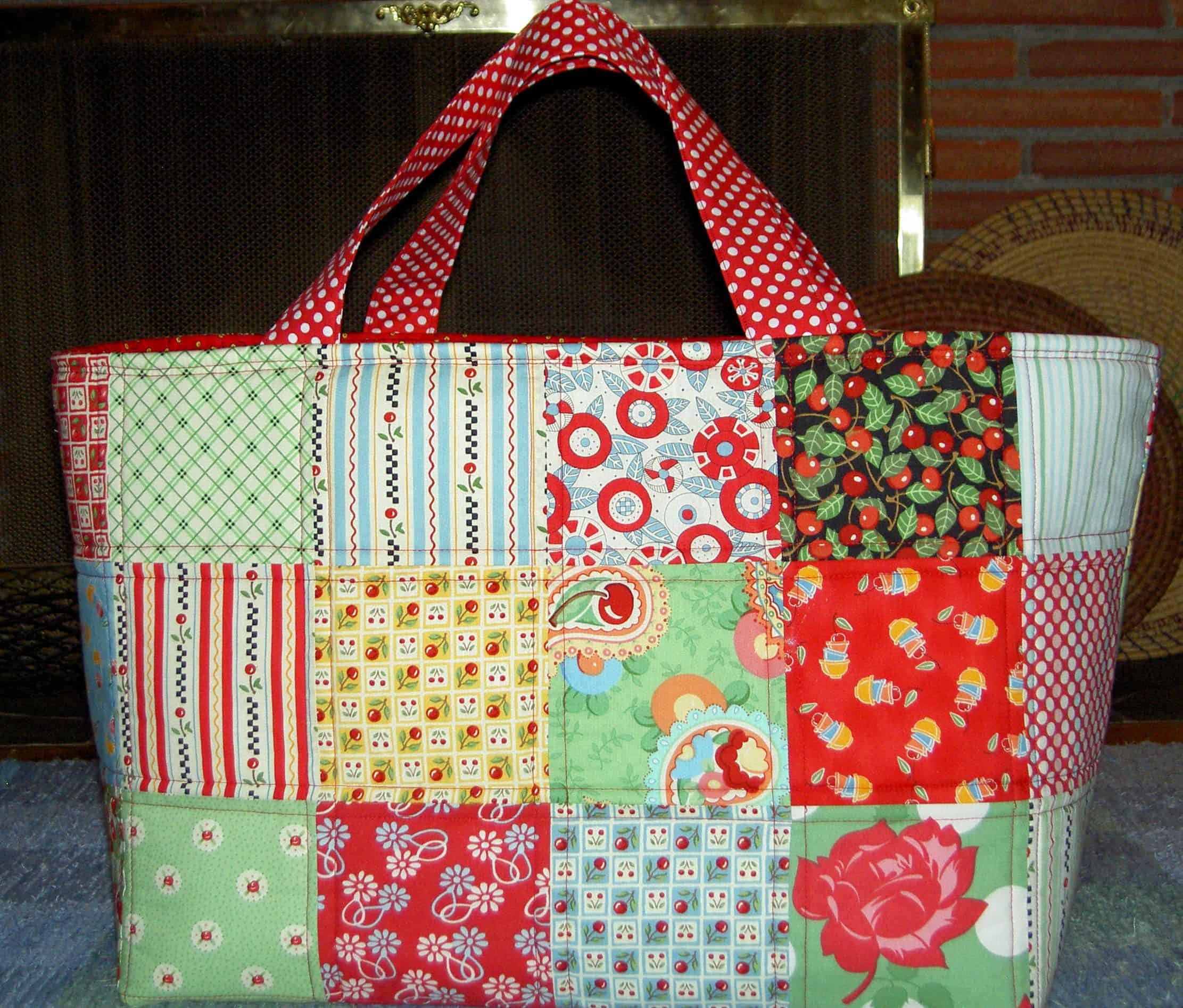
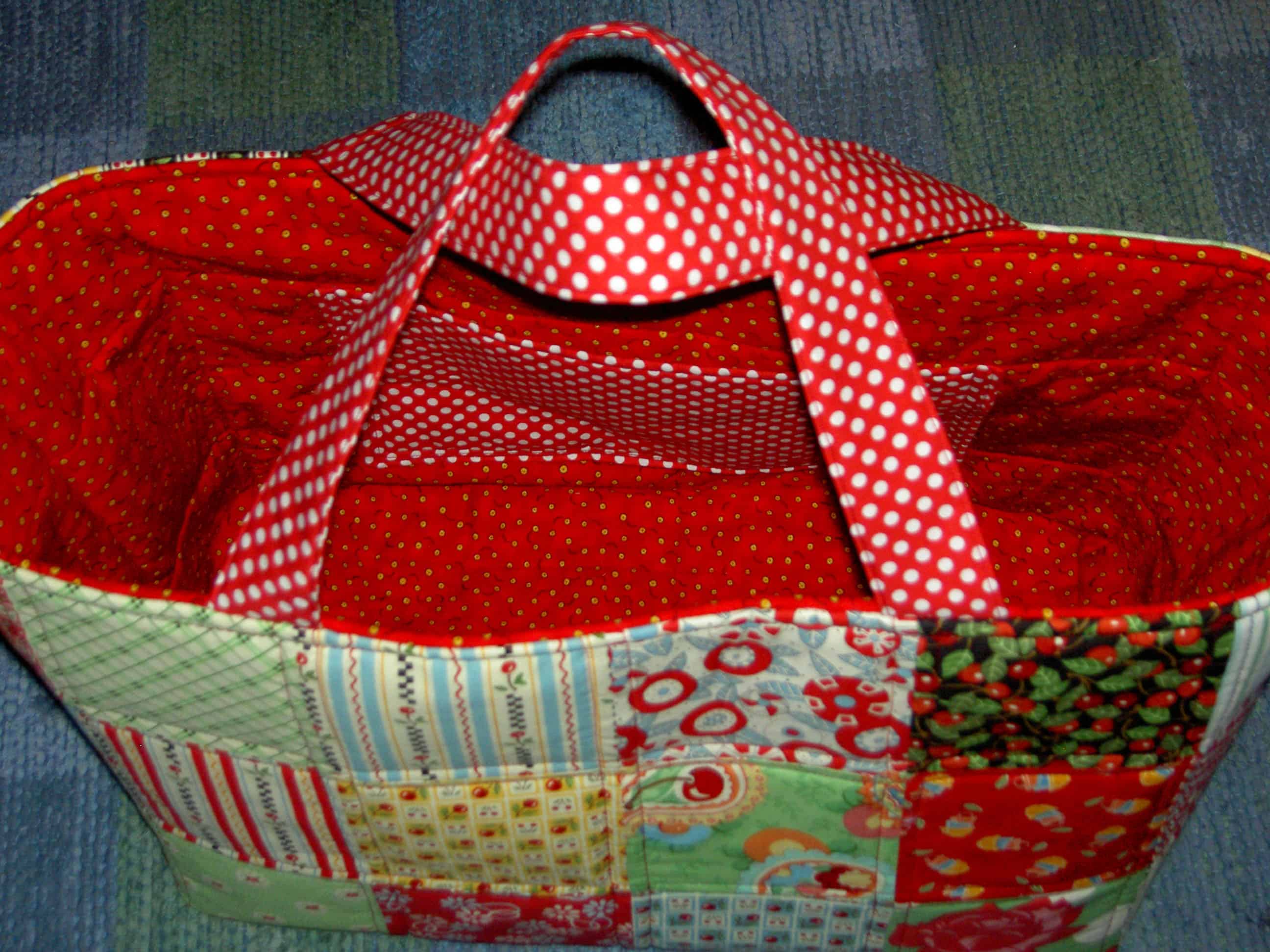
This is the Chubby Charmer. Two of my friends, Maureen and Terri both had bags made from this pattern and I admired their shape and size. On my week away, I made one.
This is a BIG bag. I could fit my 3YO nephew in this bag! I didn’t realize the size in relation to my size until it was finished. I like it and will probably use it to carry stuff up and down the stairs in the house, or perhaps out to the car. I can imagine it would be useful for carrying packages out to the car to take to the post office.
I don’t think it will be great for carrying around on a general basis, because it might get really dirty and I am not sure about the washability. I also think that I could easily fill it up with 30 pounds of stuff. I’ll have to make an effort not to fill it with 30 pounds of stuff.
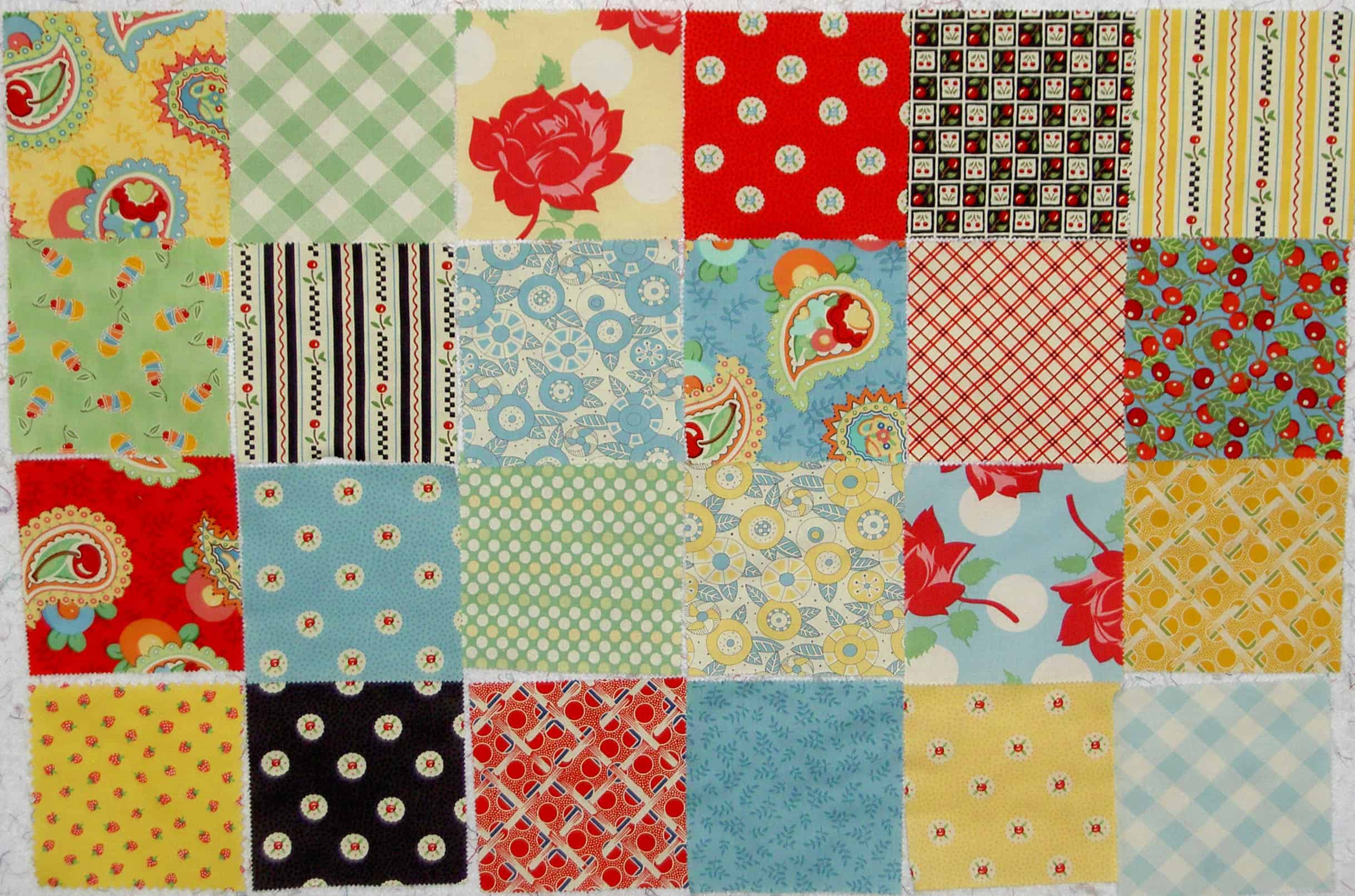
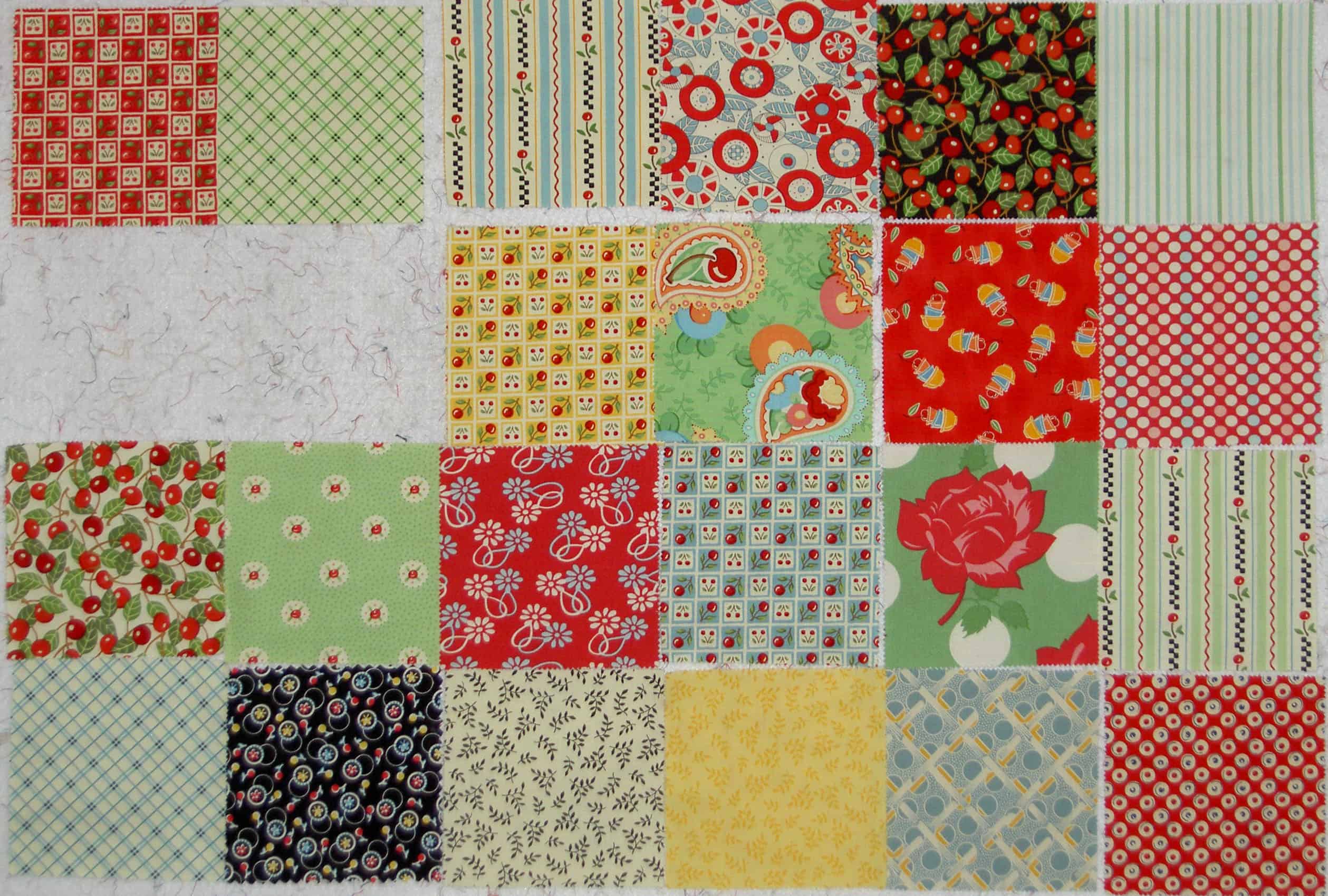
I used a Moda pack of charm squares from approximately 2007 called Recipe for Friendship by Mary Engelbreit to make the outside of the bag. There weren’t quite enough so TFQ threw in a few from the more recent Snippets collection. We agonized a bit, but not too much and then I began sewing them together.
Side oneSide two
One of the things I liked about this pattern is that it is specifically designed for the Moda Charm Packs. I don’t know if other companies make 5″ charm packs. I assume some do. It is very easy to cut your own 5″ squares out of your favorite fabrics. If I were going to use my own fabrics, I think I would collect 5″ squares as I cut fabrics for other projects.
I was putting away some other charm packs I have (Figgy Pudding and Pumpkins Gone Wild), I was thinking about what else I could make from these charm packs. I don’t need to have a specific charm pack pattern; I could just sew the squares together and then cut a pattern out of that new fabric.
I also used the red and white dotted fabric (by Susie Osborne, Emmalyne’s Day of the Week line) for the handles and TFQ gave me the red fabric (Mary Lou Weideman for In the Beginning Fabrics) for the inside.
I bought a pack of fusible fleece at the same time I bought the pattern at PIQF. I found, though, that that pack didn’t have enough of the fusible fleece and I had to get more. Both the inside walls and outside walls take two layers of fusible fleece. I didn’t find that it stuck together very well afer pressing. As a result I think I would just use my leftover batting if I made this pattern again.
The pattern designer has a really cool trick for making the box bottom. The maker traces a square template (provided in pattern) on to each bottom corner. After some sewing gymnastics, which are well explained in the pattern, you end up with a line to sew across that makes the box bottom. Very easy and no box bottom guessing. TFQ came across a similar trick in the Jane Market tote by Posie Gets Cosy. We tried to find the ratios of squares to front panels so we could try it ourselves on our own designs, but haven’t yet been successful.
I realized that one of the reasons I like making the same tote bag pattern over and over is that I am trying to understand it. I want to understand it so I can change the pattern to suit my needs and also incorporate the techniques into my own design bag of tricks.
Completed Bag, Nov. 2009
The Anna Maria Horner Multi-tasker tote is no exception. As I mentioned in a previous post, I love the way this tote goes together. Above is my completed Multi-tasker tote #2. This will be a gift for a friend of mine. I used Lonni Rossi’s new fabric line in the black and white colorway. You can buy them at Back Porch if you want some.
I used a FQ pack and had to piece some of the fabrics together to make them large enough to fit the pattern pieces. The pattern calls for more yardage than an FQ pack, however I only had a FQ pack of the fabrics and am always up for a challenge.
Nov. AMMTT in progressBernina Bliss
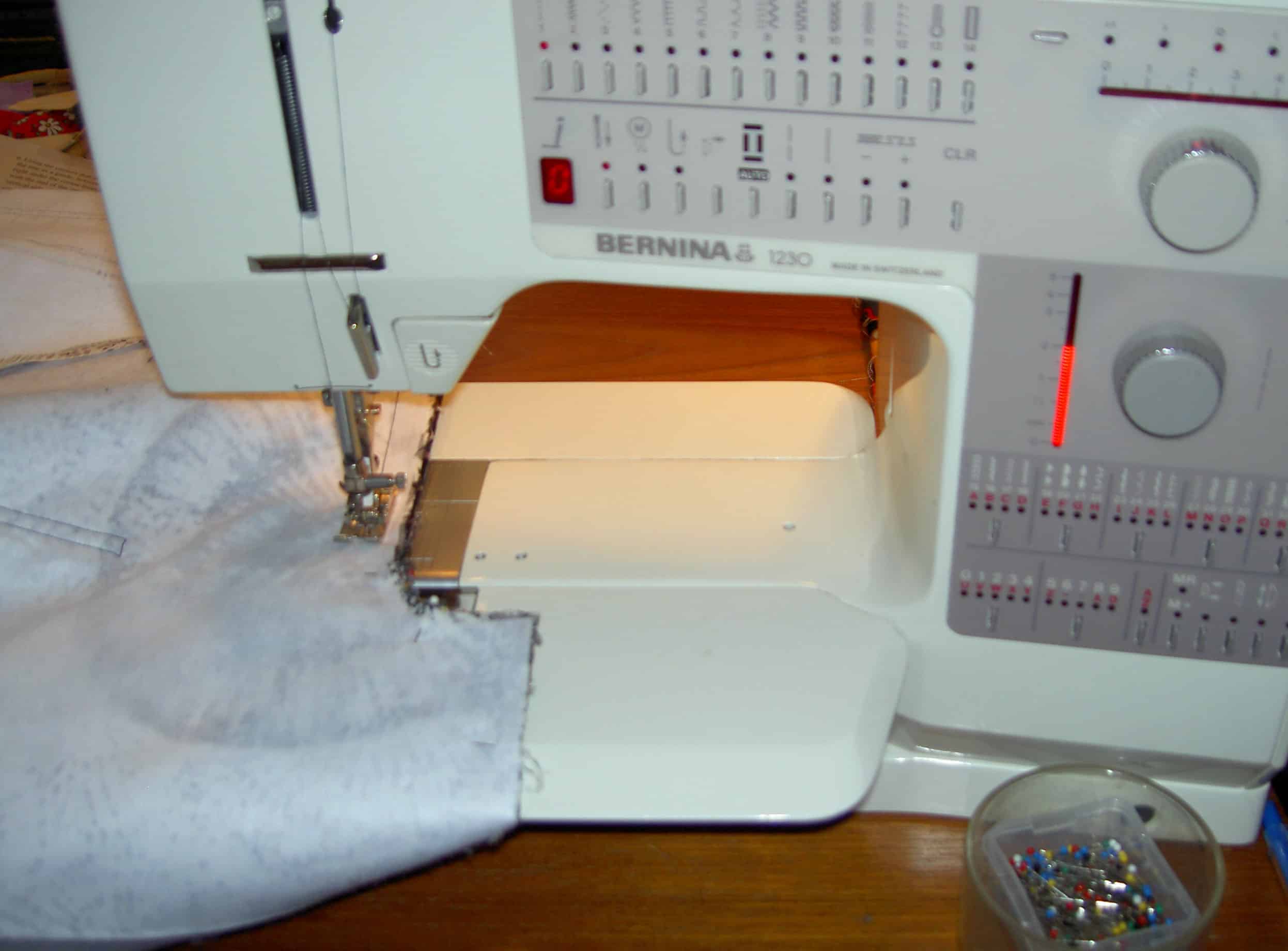
I always enjoy using TFQ’s Bernina 1230. It is a tough little machine that has never really given me any problems. Now I know how to wind the bobbin and rethread. TFQ better watch out or I’ll just take it over! 😉
It doesn’t have the bells and whistles that mine does (I miss the auto needle up button!), but it does bags very well. I also like the button holer.
I always have a tough time maneuvering the fabric through the sewing machine as the layers increase. Towards the end of the process I was sewing through about 8 layers of fabric or seams or interfacing. I found that TFQ’s machine was powered right through with no grunts, groans or complaints.
Nov. Tote, detail
The pattern doesn’t call for as much interfacing as I put in, but I like my bags to have some body, so I put interfacing on the exterior and lining pieces. I omitted it from the pocket panels.
I am pretty pleased with how it came out and hope my friend is as well. I am going to size this pattern down so it fits me better. If it doesn’t work, then I probably won’t make anymore of these totes, despite the great way they go together.
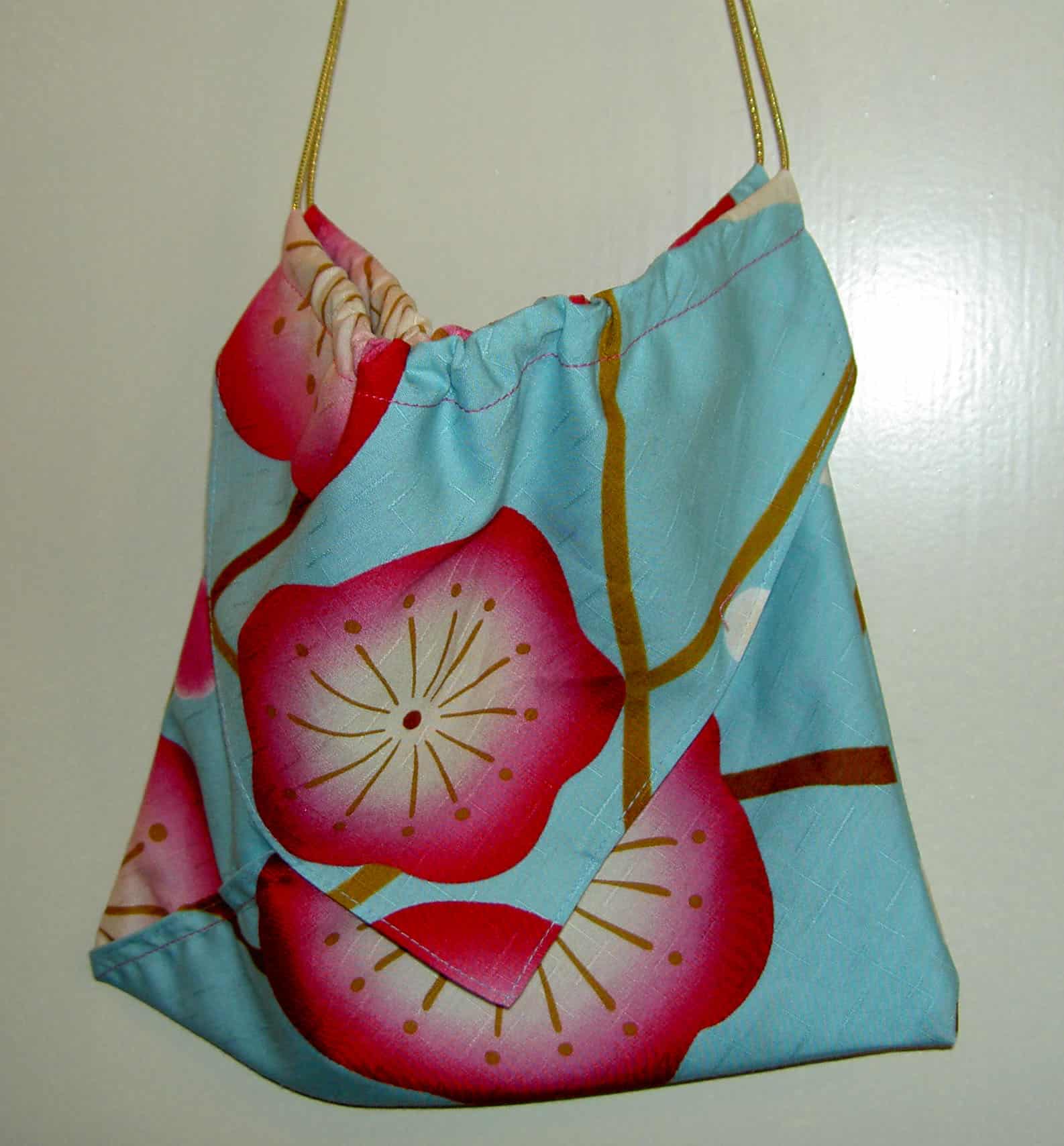
I got the directions for making this little bag, just with folding an sewing from Maeda Trading Company at PIQF 2009.
They sold squares of fabric so you could make this little bag right away. Of course, a person could also use their own fabric with no problem.
Mine looks a little weird, because I didn’t have enough of the right ribbon to make this work. I thought about using these types of bags as another kind fo gift bag.
Friday was a busy day, of which the crowning glory was a trip to buy wine as a gift. I bought the wine and laid the bags (small paper wine bags inside a doubled plastic grocery bag) in the trunk for the trip home. I don’t know why I didn’t bring my own bags into the store, especially since two of which were right there in the trunk. If I had, we may not be having this conversation right now.
Just before I closed the trunk I thought what a hideous wrapping that collection of bags was. Please note that I do not wrap gifts with paper. I avoid it at all costs. Once in a blue moon, if there is some good reason why I must, I will struggle through the process. Imagine a small person who has rumpled gift wrap all over the room, tape covering her hands, face and legs, a sore back and who is fuming with rage. That is me. I sincerely dislike wrapping gifts with paper. I remembered a pattern I had copied from the Bag Bazaar: 25 Stylish Bags to Sew in an Afternoon by Megan Avery for a wine bag and thought I would make a couple for the bottles.
I dutifully read through the directions, which made no sense, as per usual. I started in on following the directions. I find that if I go slowly, I will get through the pattern. Except for this one. There were two directions that were on pages that I had not made notes from. The first one was for the handle, which said ‘make handle according to directions on page 18.” I didn’t have notes from page 18 so I made the handle like I would for the Eco-Market Tote.
After I got to the instruction for the main body of the bag, which said, something like, trace pattern from next page on cardstock or a manila folder. Since I didn’t have that page either, I went online and found a pattern for gift and wine bags so I could just get the measurement. This was an okay tactic and I used some of the directions from the online pattern. I ended up, however, essentially taking my own measurements – 12″x15″ for the outside and 11.5″x14.5″ for the lining, if you are interested. I read and sort of followed the basic overall directions in both patterns, dealing with the details myself.
Wine Bag, test mode
One of the first issues was fabric. I have no shortage of fabric, but I wanted to use something that wouldn’t kill me with boredom and would fit the decor of my friends. They have a gorgeous house that uses lots of earth tones with some forest and tree kind of accents. I have been trying to think of ways to use my beiges and this seemed like a perfect opportunity. Still, I didn’t want to hate the project.
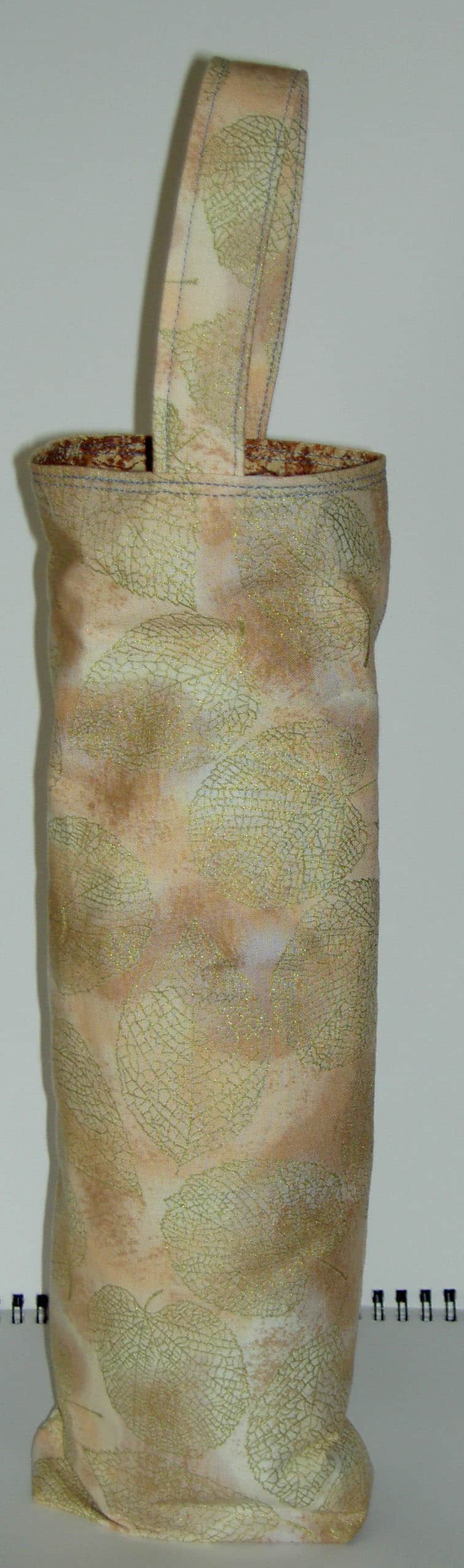
I found a great mottled pinky-beige with gold leaves, tastefully, screenprinted over the background. Perfect! I also had a lot of it. I picked out a marbled beige and brown for the lining.
Wine Bag, detail
The directions above say to cut a piece 6″x34″. These measurements did not make sense to me. I knew that wine bottles were neither 6″ around nor 34″ tall, thus there was no way I was cutting a piece with those measurements. I got the measurements, in the end, by measuring a bottle of wine.
NOTE to designers: please give some explanation up front when you want someone to cut a piece that seems way bigger, or more oddly shaped, than needed. I am sure you have a good reason, so please let me know.
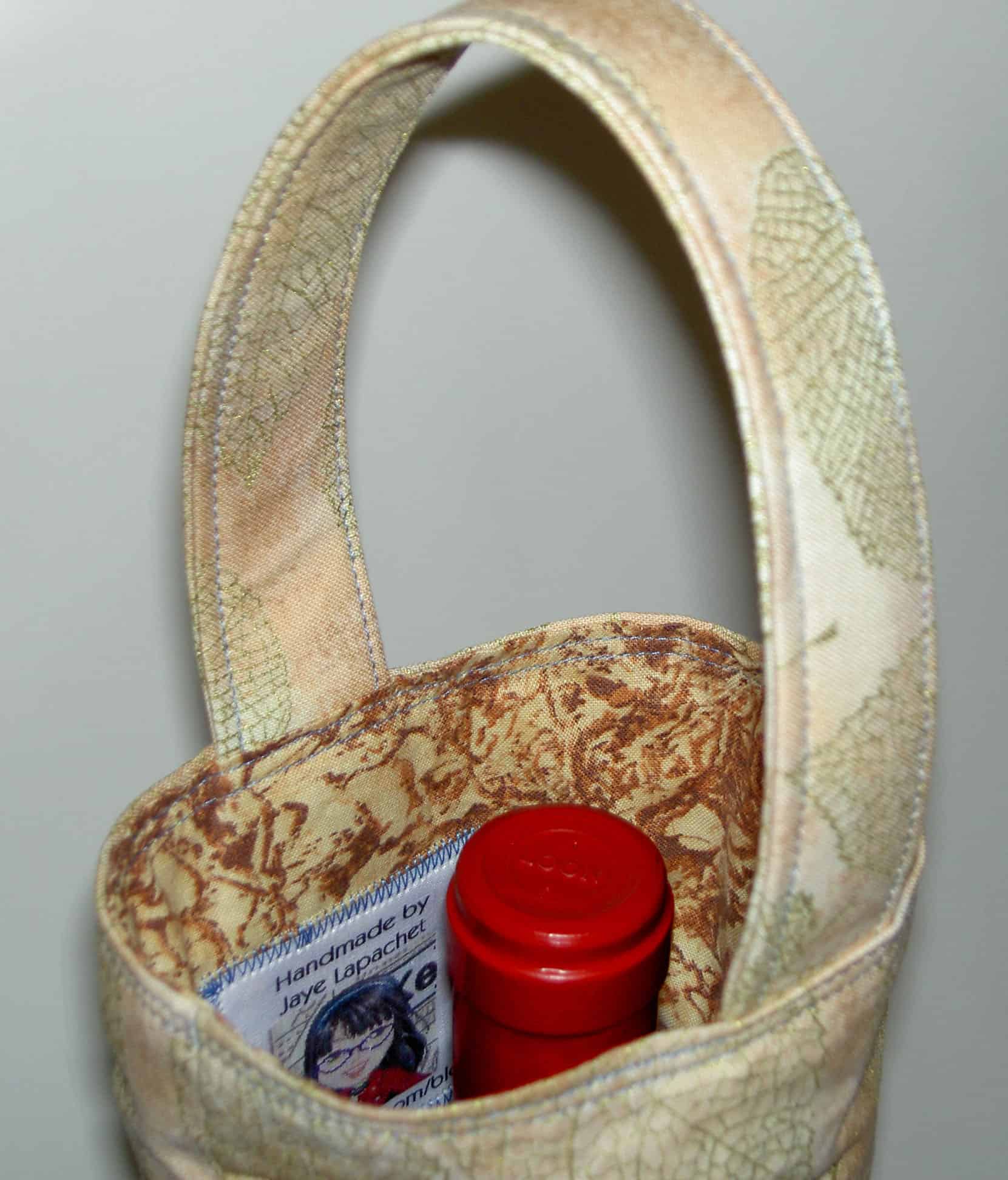
The red wine in the bag above was my test bottle. Yes, people will be mad at me for messing up their sediment process. Oh well. I was surprised to find that a wine bottle is about 11″ inches around.
I could have used the leave-a-hole-and-turn-the-bag-and-lining-right-side-out, but I didn’t feel like figuring out where the handles were supposed to go in that process. I put the whole thing together and folded the top hem down, inserted the straps and top-stitched around. It was a tight fit in my machine, but worked in the end.
I also neatly sank my knots and threads. 😉
Wine, wrapped and ready
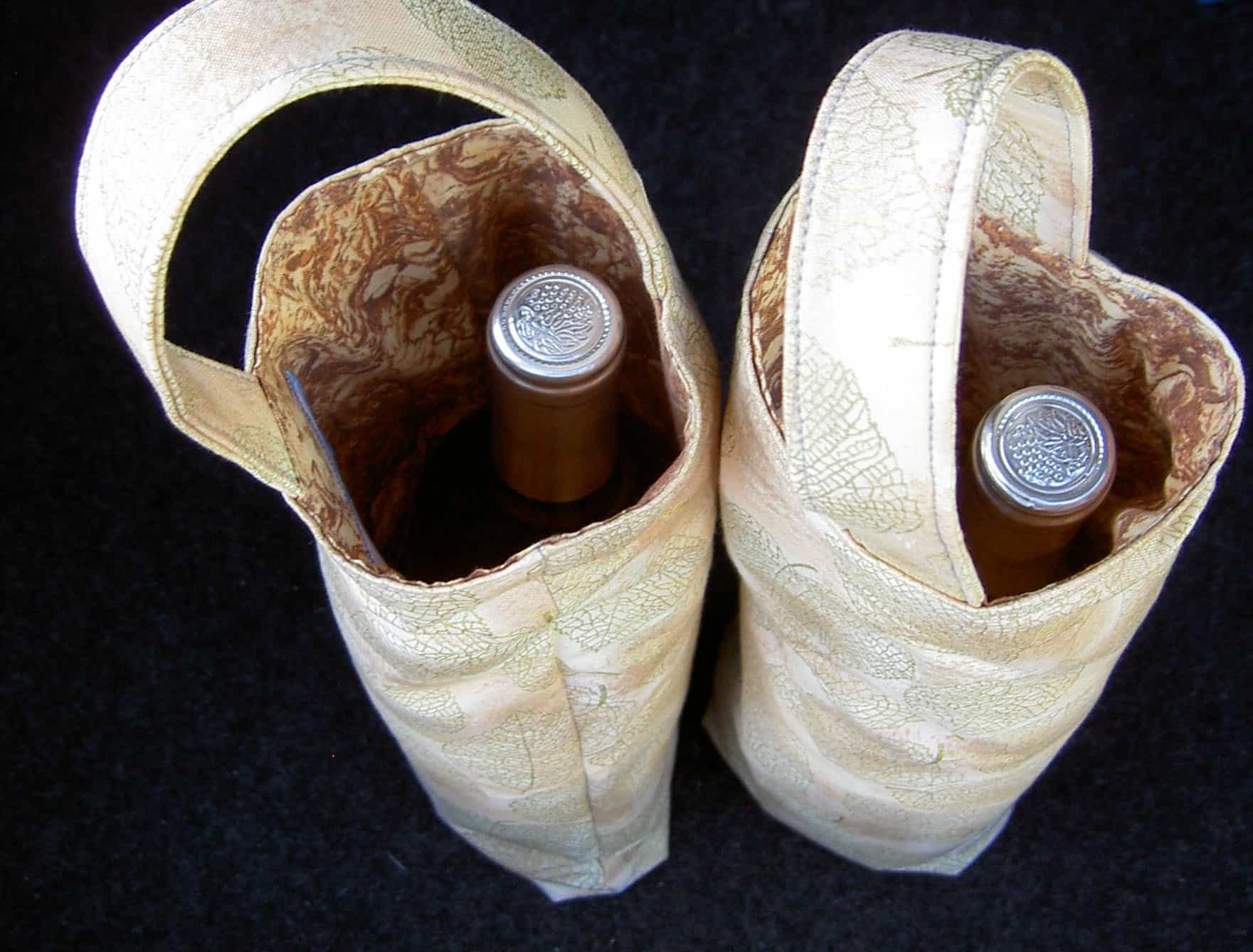
Above are my wine bags with the actual gift wines in them and ready to go. I have to admit that I thought about the height a bit. I wondered if I should make the bag shorter so the neck of the bottle was slightly visible. In the end, I decided the gift would be more of a surprise if the height covered the entire bottle. There would also be no interference between the neck and the handle.
I realize that some of you don’t drink wine. This pattern could be easily adapted to another gift drink such as Martinelli’s Sparkling Cider, or even a bottle of soda. It might be a nice way to wrap a gift bottle during the upcoming holidays.
I decided, when I was on a recent trip, that I wanted to write a review of this bag, because it is pretty different from the others I have made from fabric.
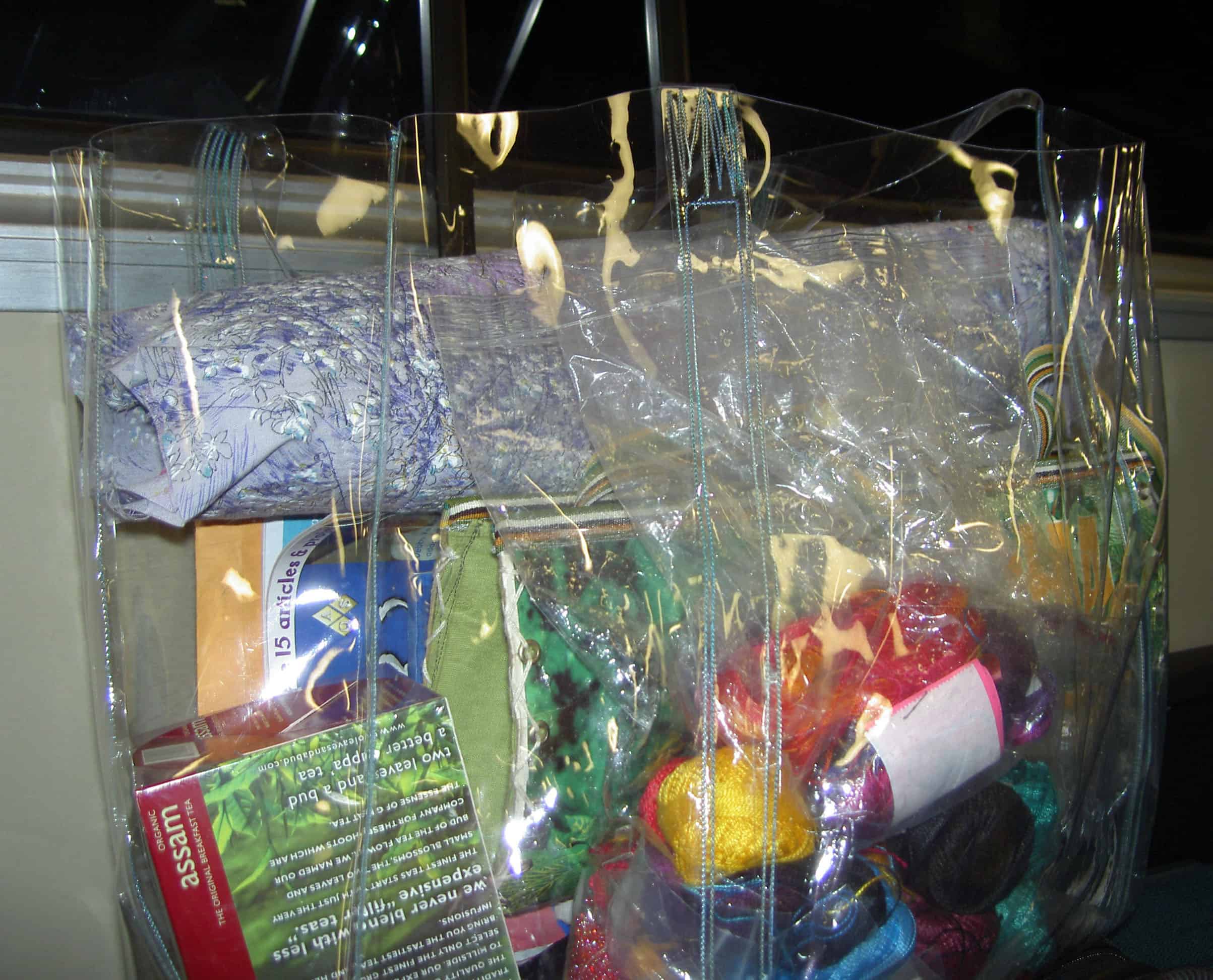
As you can see from the picture, I packed my tote with things to do plus some tea and chocolate to tide me over. I, at least, have the following in the bag: a zipper bag of Perl cotton, a box of tea, my handwork bag, Beach Town, a magazine, a library book and ….? Not sure what else, though I think there was more.
When I made this bag, I didn’t expect to like it as much as I do. I think I mostly like that I can see into it. I can see whether I have all of my stuff as I pack it. I can also admire the stuff that I have in there. This has led me to carrying around the pencil roll Julie made me. I can see it through the bag and admire it as I go on my merry way.
I made the handles a little shorter and they work for me at that length. They are long enough to put over my shoulder and are just the right length to carry in my hand at my side.
Pen leaks, water spills and other messes are easy to clean up with paper towel and some Simply Green or a cleaning wipe. Sometimes, I can’t avoid putting the bag down in something that someone else has spilled simply because I didn’t see the mess. It also protects my stuff quite well in the rain.
I find that the bag doesn’t look dirty either.
Some of the things that I like about this bag are also disadvantages. It is great for me to be able to see inside the bag, but I don’t want other people to see my iPod or my digital camera or my cell phone, etc. I definitely cannot use this bag to hold a table at a cafe’.
Using this bag in hot weather is not recommended. It becomes very soft and pliable. I think the handles stretch if the weather becomes hot enough.
I don’t find the pockets to be particularly useful either. The plastic sticks very well to itself, thus putting things in pockets means unsticking the pocket from the bag, which doesn’t work very well in a hurry.
I would like the tote to be stiffer so it would stand up better. As it is now, it kind of folds in on itself if I don’t have it full of the right sized and shaped stuff. I can’t think of a way to make it stiffer except to put two layers of plastic together, as I can’t line it with interfacing.
I also am more aware of how much I put in it. I think that the handles might break if I fill the main compartment with too many heavy items. This isn’t, necessarily a bad thing since I shouldn’t be hauling 30 pounds of stuff around with me. I realized that I have a sense of what fabric can take, in terms of weight, but I don’t have the same sense with this vinyl.
All in all, I really like this bag. I enjoy carrying it around and find it to be a very useful shape and size.
I had no idea I would ever need a book called the Illustrated Dictionary of Math. I now find that I actually might. I have mentioned Craft Nectar before and Weeks Ringle does not disappoint. She talks about the usefulness of this book in constructing oval tote bags. I might actually want to do that someday. You never know.
For example, did you know that the Illustrated Book of Math will give you the formula for the circumference of an oval if you’ve designing a totebag with an oval bottom?
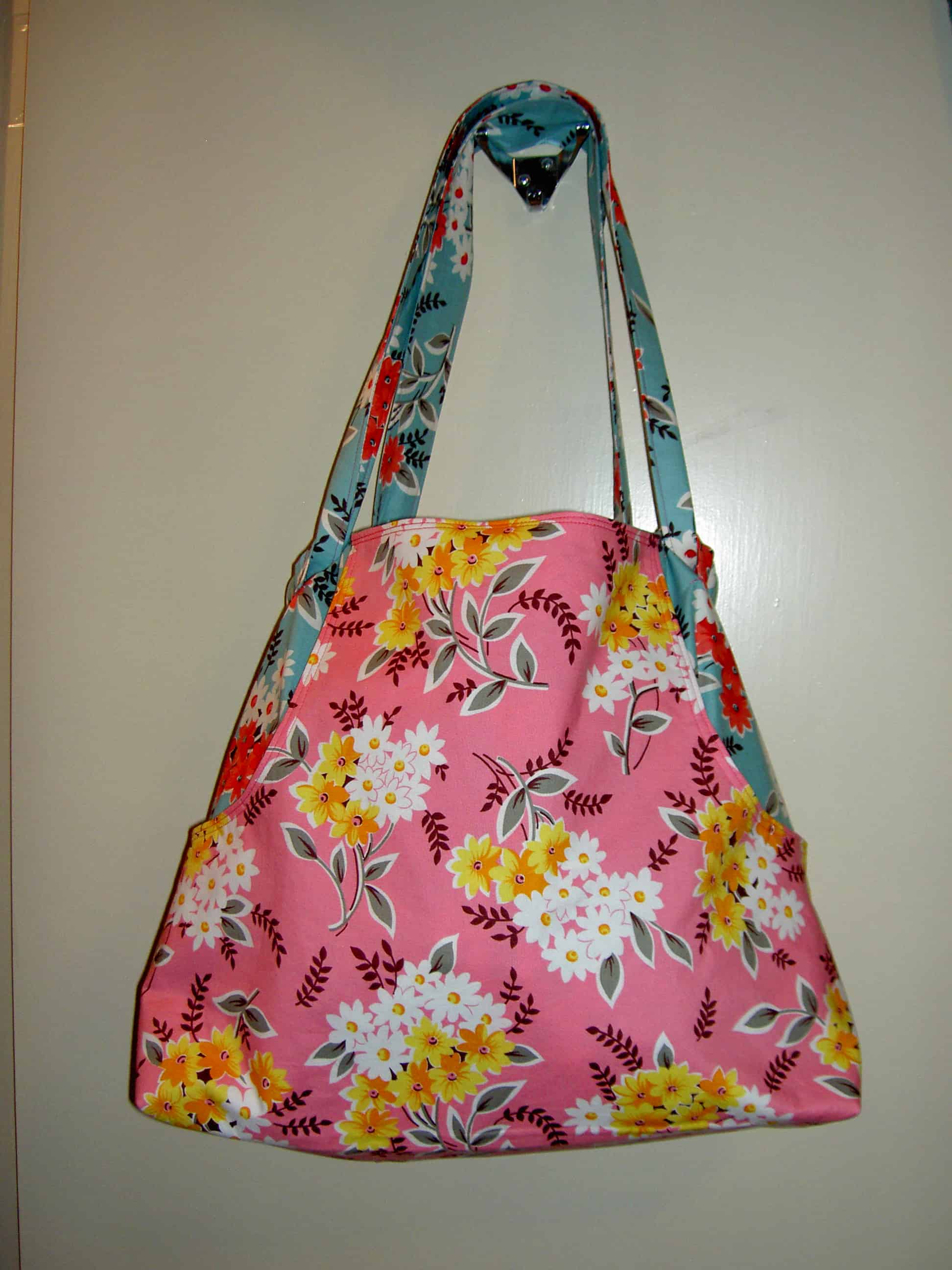
I spent some time sewing yesterday in between soccer and a movie. As a result, I finished the Anna Maria Horner Multi-tasker Tote. I keep thinking of it as the Julie tote, since Julie looked high and low and found the blue Denyse Schmidt fabric for me. She may get a gift. 😉
AMH MTT, finished!
As I mentioned in my review, the construction of this tote is amazingly elegant. Putting the straps on was no exception. There is a part where you fold over the top and that becomes the channel for the straps. I am still completely in awe of AMH and her ability to imagine the construction of this bag.
In the photo below, I tried to show you the channel. Aside from having to turn the straps inside out, which is a big pain in the patootie, I got the straps on and the bag ready to carry stuff in a couple of hours.
AMH MTT, detail
My only concern is that the way the straps are held on means that I won’t be able to carry heavy stuff in it. I don’t plan to use this for groceries, but I routinely carry:
I don’t think the above list is outrageous…. I do have to have my stuff with me.
I plan to make another one now that I know the drill. I have ideas for different ways of combining fabric. I ended up buying some of the Peltex 2 from SewThankful (I think), so I need to do something with it. This Multi-tasker tote bag is a nice change from the Eco Market tote.
If I didn’t think Anna Maria Horner was a goddess already, I do now. I spent the day on Sunday, minus a short chauffeuring task, with the Multi-tasker Tote (AMH MTT), a recent pattern from Ms. Horner. As I suspected, I did have trouble understanding the directions. It is the way I learn and not completely about the directions. I do think there were a few tiny parts that could have been clarified just a little bit more. I know they have a certain number of pages they can use to create a pattern and have to worry about font, enough photos, etc, so I really am not going to complain too much.
In all fairness, I think making 20 or 30 of the Eco Market Totes gave me a feel for what should be going on in the tote making process. Doing a multitude of those totes and making little changes in the pattern made me understand the bones of tote-making. The AMH MTT is much different than the EMT, but in the end they are totes and their goal is to carry things.
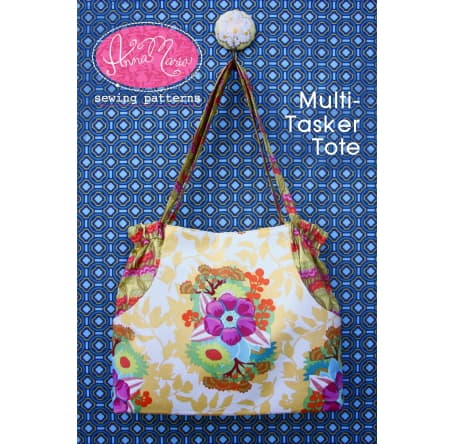
Multi Tasker Tote Pattern
In general, however, this is an amazing pattern. The way it goes together looks completely mysterious one minute and the next minute it is gorgeous and elegant. I was completely blown away, because it made me think about tote bags in a new way. I don’t think it is a beginner pattern, however I would say that any intermediate sewist who has a few tote bags under her belt could use this pattern to make a bag.
AMH MTT in progress, detail
In the above photo, you can see the bit that is folded over to accommodate the straps, including my lovely top stitching. 😉 I haven’t finished the straps yet, so there is another photo of this project to which you can look forward!
AMH MTT, Step #8
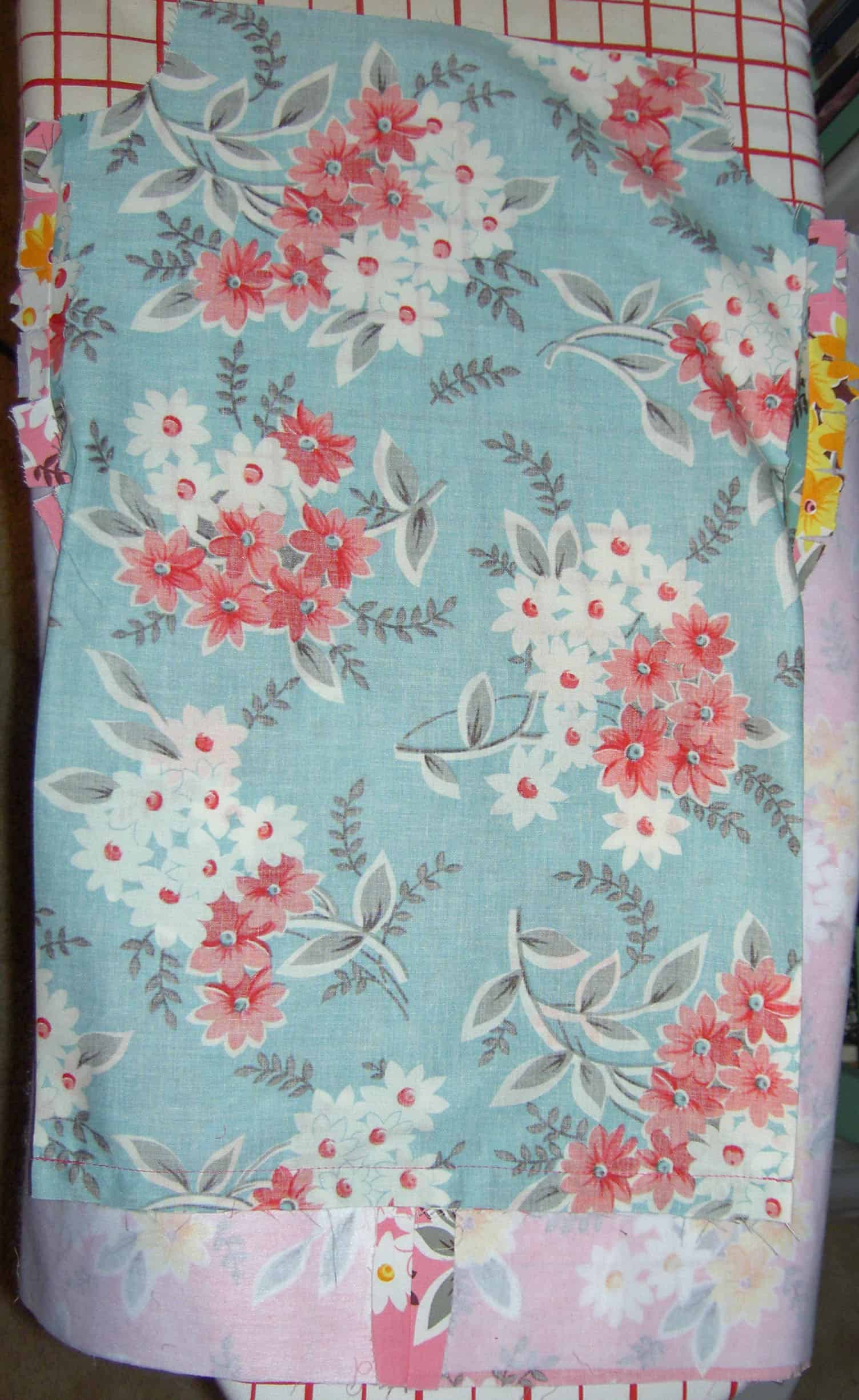
One of the steps I had trouble with was step #8. I really couldn’t figure out what the directions were trying to accomplish. Finally, I realized that she wanted me to sew the bottom of the pocket together! To accomplish that I had to pop the pocket (pattern piece is called pocket panel) out a certain way. When you do orient the section correctly, the whole thing looks like the section above.
Box corners
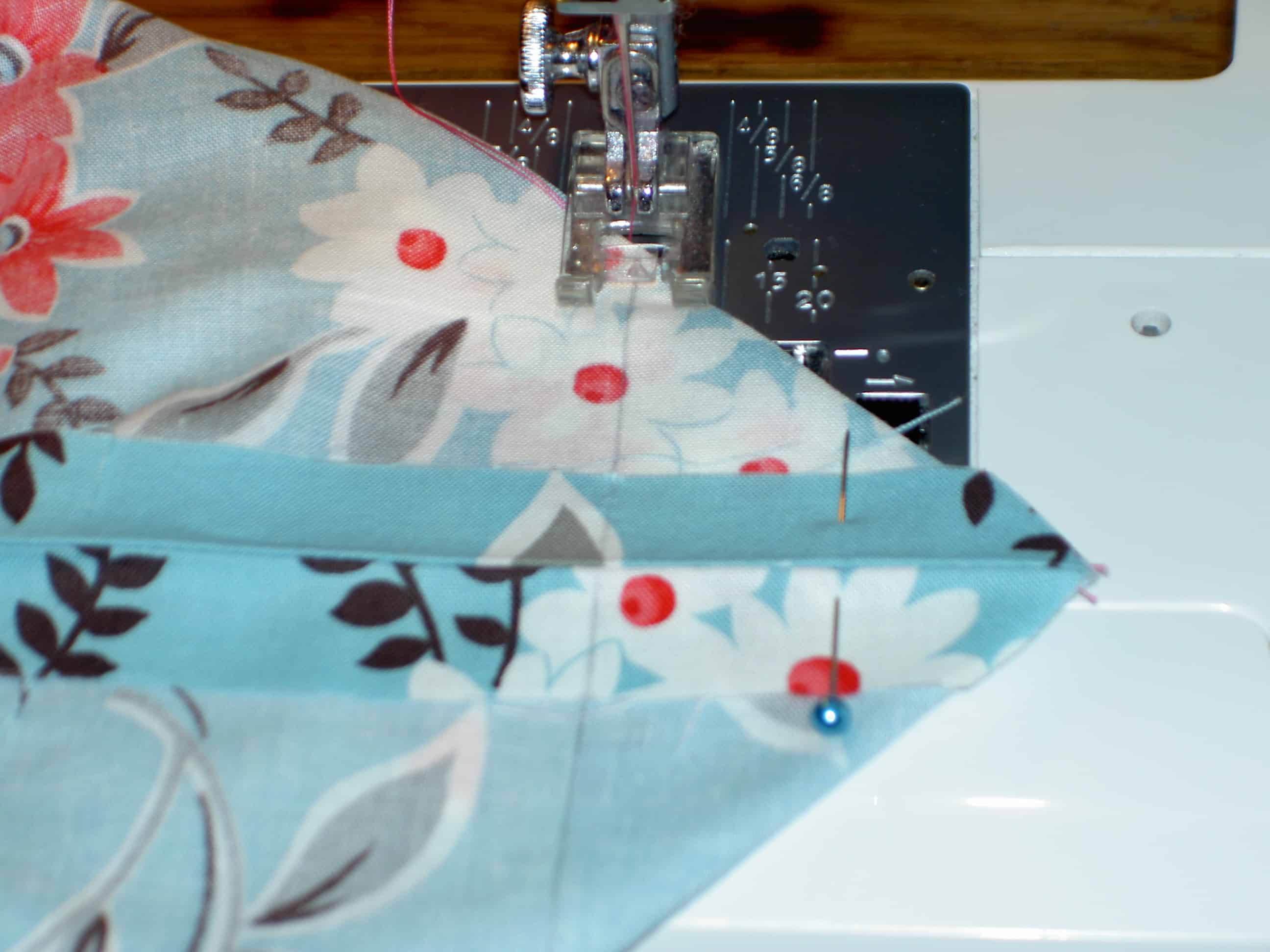
Remember I mentioned the gusset tutorial in the Bag Bazaar book? I didn’t have a chance to try it out. I found AMH’s directions to be stellar. You press a crease into the side of your bag, then you line up the bottom seam with that crease and you have a perfect triangle. I drew a line (not part of the directions), because of my A type personality. Perfect box bottom. I did it before I realized what was happening and was amazed at the results.
I love the fabrics that I chose for the current tote, individually. I am not happy with the two of them in combination in this project. Too many flowers, I think, which means that none of them stand out. Yes, I will be making another! As I mentioned in a previous post and as you can see from the photos, I used the Denyse Schmidt fabrics as a trial run.
MTT #2 Bag Fabric
My biggest challenge with this project is the requirement of Pellon Peltex Double-Sided Fusible Ultra Firm Stabilizer #72. I didn’t have any in my fabric closet, which didn’t worry me. I sewed and fused two pieces of Timtex together and the put Steam-a-Seam 2 on the outside and fused it to the bag. Having a stiff bottom is GREAT! It makes the thing stand up and much less floopy. Using my jerry-rigged method, I could easily see where something already stiff and fusible would be a lot easier. I searched the web and found it by the yard for $10+. I also found a bolt of it for $99+. Huh! I can’t make another of these using my jerry-rigged method, because I am out of SAS2. I have to decide whether to get a bolt (seems like overkill) or pay, what seems like, and exorbitant price for a yard. Anyone of you have any perspective on the price of Pellon Peltex Double-Sided Fusible Ultra Firm Stabilizer #72?
Kristin LaFlamme reviewed this pattern on her blog as well. It is a very complete review. She mentions a couple of the inconsequential typos I also saw and does some interesting things using recycled materials. Her rendition of the pattern makes me think about adding additional pockets to the outside. Adding a pocket to the outside would be especially successful when I don’t have a focus fabric (as shown on the pattern above) or fabric suitable for broderie perse.
My rating: 4 of 5 stars
I was sitting at a cafe’ when I started looking at this book. I glanced through it first and decided that I liked the format and the layout, but wasn’t enamored of the projects. I didn’t see any of the bags that I thought were useful looking.
“Listen to the Mustn’ts child, listen to the Don’ts.
Listen to the Shouldn’ts, the Impossibles, the Won’ts.
Listen to the Never Haves, then listen close to me.
Anything can happen, child, anything can be.”
-Shel Silverstein
That poem is how the text of the book started. It grabbed my attention and changed my idea about the book. I didn’t see it at first, because the color of the text was invisible in the glare of the cafe’ light. I looked through it a little more slowly and found that it is a book with really good bones. There are projects at the end that look useful and I would make, including a messenger bag and a wall organizer with pockets. I think the best part is that the author shows the reader how to think about bag making. The idea is not all about making her bags.
I, first, heard about this book on the Quilted Cupcake podcast. I wrote about in one of my summer catch up posts. I finally got it from the Library using Link+, a better, faster and more convenient way of getting interlibrary loans. It actually works for real people! Thank you, SFPL!!!
“A note on fear: It’s okay to be afraid to start a project. It’s okay to read the book for a while or just look at the pictures until you feel ready to jump in. The trick is that you have to jump in at some point. Like swimming or sky diving or picking up a pencil for the first time – like anything worth doing – you have to start somewhere. Start today. Start now. Don’t worry about getting it right or making the perfect bag. It’s likely that the first thing you make may not be perfect….but you will still treasure it. … the safety net will appear just when you need it. So jump.”
This note cemented my initial idea about the book. I thinkt he safety net comment is a good one to keep in mind. The tone of the book is really friendly and accessible and she has some great overarching ideas about making bags, such as “Build a bag from the inside out.” Another thing Lexie Barnes discusses is the length of the straps. I have been making the Eco Market tote with 54″ straps. 54″ fits me and works with the pattern. They go almost all the way around the bag and are sewn into the bottom of the bag seam. This reminder is good because I may want to make a bag where the straps do not go all the way around the bag. I also like the paragraph on designing pockets (pg.15), because it gives the maker practical ideas about making useful pockets. The section called “Graph, Paper, Scissors” discusses using graph paper (pg.14) to design a completely new bag to scale. I immediately drew a preliminary drawing (not to scale!) a for a saddle type bag.
I am going to spend some more time with this book.
This was another pattern from All People Quilt called Grab Bag. We were invited to a party on Sunday night. I whipped one up to bring to the guest of honor. I have wanted to test this pattern, so it seemed like a good opportunity.
I struggled a bit with some of the directions, especially the last few dealing with the handle finishing. Eventually I figured out what they were trying to tell me, but not without a fair amount of ripping. It was a good exercise in patience for me. I am sure companies like All People Quilt struggle with making the directions short AND easy to understand. For my part, I am glad for some of these free patterns.
I used an old large flower print for the outside and a Marimekko for the lining.
There are two major changes, and one minor change, that I would make on future Grab Bags:
I used regular batting like I use for quilts. I wouldn’t do that again. It makes it puffy, which is sort of cool, but I don’t like the fact that it doesn’t drape very well. I would like to try an interfacing to see how that drapes. I see experimentation with interfacing in my future. My other idea is to only put the batting on the bag part.
I would also make the inside just a bit smaller than the outside. The directions say to use the same pattern piece. It is fine (and much easier to write a pattern, I am guessing), but the bottom of the lining bunches up inside the bag. Not much, but enough to not look very professional.
The pockets are an odd size as well. I would make them a tiny bit larger, heightwise.
Grab bag detail
Above is a view of the inside. You can see a bit of the pockets and the Marimekko print.
I am pleased to have tried two new bag patterns. I think it has allowed me to feel sufficiently successful and warmed up to try the Anna Maria Horner Multi-tasker tote, I discussed in yesterday’s post.
As you know, I have been thinking of branching out from the Eco Market Tote bag pattern that I have a been using for the past 1.5 years. I saw the Over the Top bag in a recent issue of Quilts & More magazine. That mag is on Facebook, so I get more notifications about what they have going. I saw their promotion for Quarterly Challenges, which reminded me of this bag. A couple of things came together, including watching their little tips video, so I downloaded the pattern last Friday and made the bag, mostly, on Saturday.
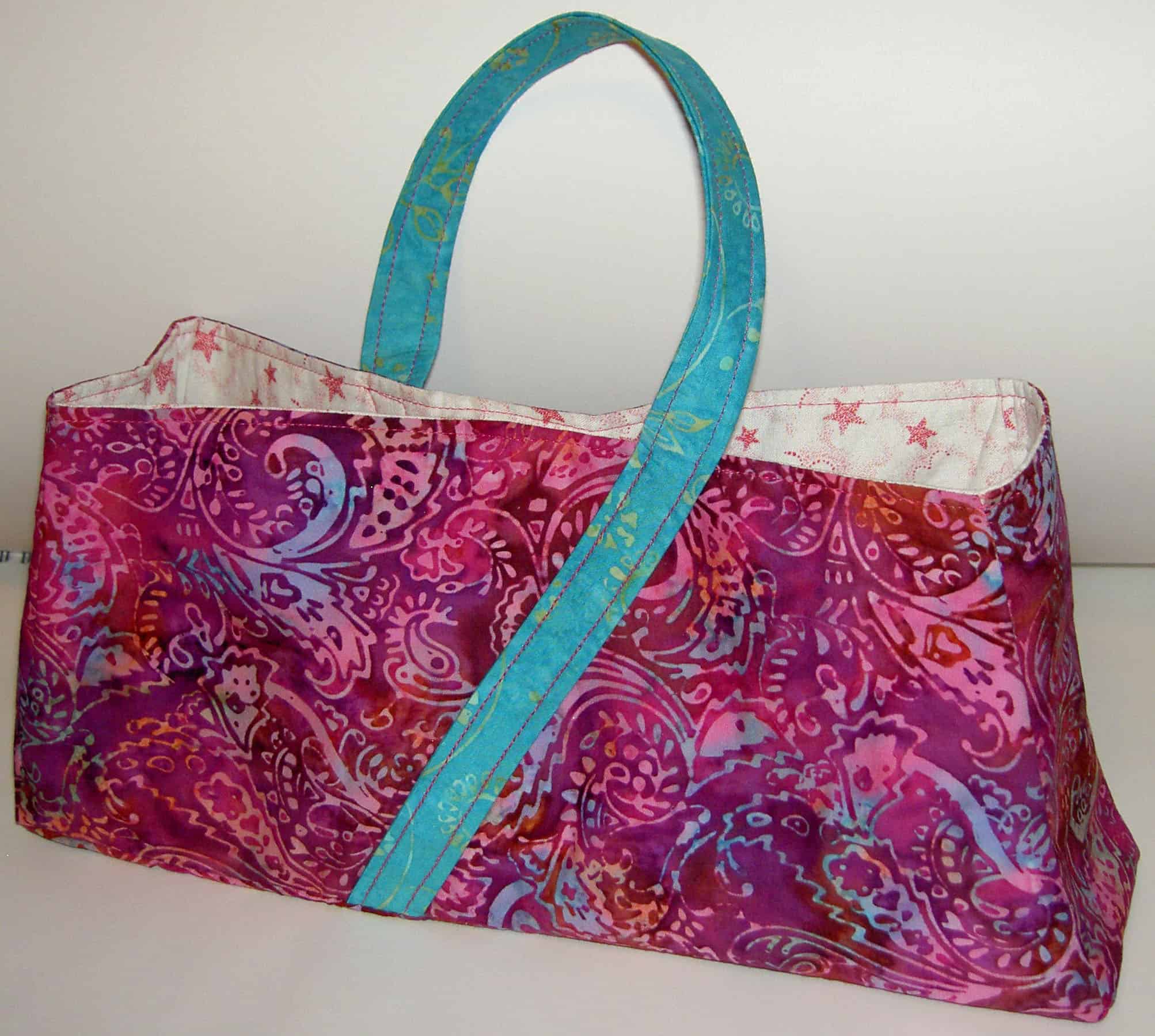
Batik Handbag
I am pleased with the way it came out. It is the perfect size for a small handwork project tote. As with all things I sew from a pattern, I found that the first piece is really a test piece. I rely heavily on TFQ and her garment sewing experience when it comes to 3D projects, so deciphering this one alone was a challenge.
There were a few things I didn’t really understand in the pattern and, thus, skipped. I don’t see that it made much difference in the long run. There were some things that the pattern said to do that I would do differently a second time. I would add more stiffness to the bottom, perhaps something like Timtex. The pattern says to sew only to the dots, which are about 1/4″ away from the edge. This makes sense for the bottom seams. It is necessary in order to put the Y seams together. It isn’t necessary on the top of the bag and actually turned out to be a pain. since the top seams weren’t crossed by another machine stitched seam, they started to come apart after I had the bag mostly together. I ended up hand stitching the tops of the seams.
I think that this pattern has a lot of opportunities for embellishment, which could be fun. I keep thinking of a picture I saw in either thr3fold journal or Quilting Arts, where Laura Kemshall did a beaded edging on one of her bags.
In anticipation of loving this pattern, I bought enough magnetic clasps to make 4 bags total. After making it, however, I am not sure whether or not I will make any more. In some ways I want to make the bag again, so I can perfectmy construction techniques. On the other hand, I don’t think they style and size would be that useful for me, so I am not sure I want to have a bunch of them hanging around the house. They may, however, make nice gifts.
I have bags on the mind again. I really am thinking about new bags to sew.I would like to have several in my repertoire. They make great quick projects. As such, I was reading Vicki Welsh’s most recent Field Trips in Fiber episode and found a really great laptop bag by Candy Glendening of Candied Fibers. I got the impression that this was her own design. I was really impressed with the attention to detail and the thoughtfulness of the design. I like the water bottle pocket and the cell phone pocket. The machine embroidery or quilting which Candy used to embellish the bag is very nice, too.