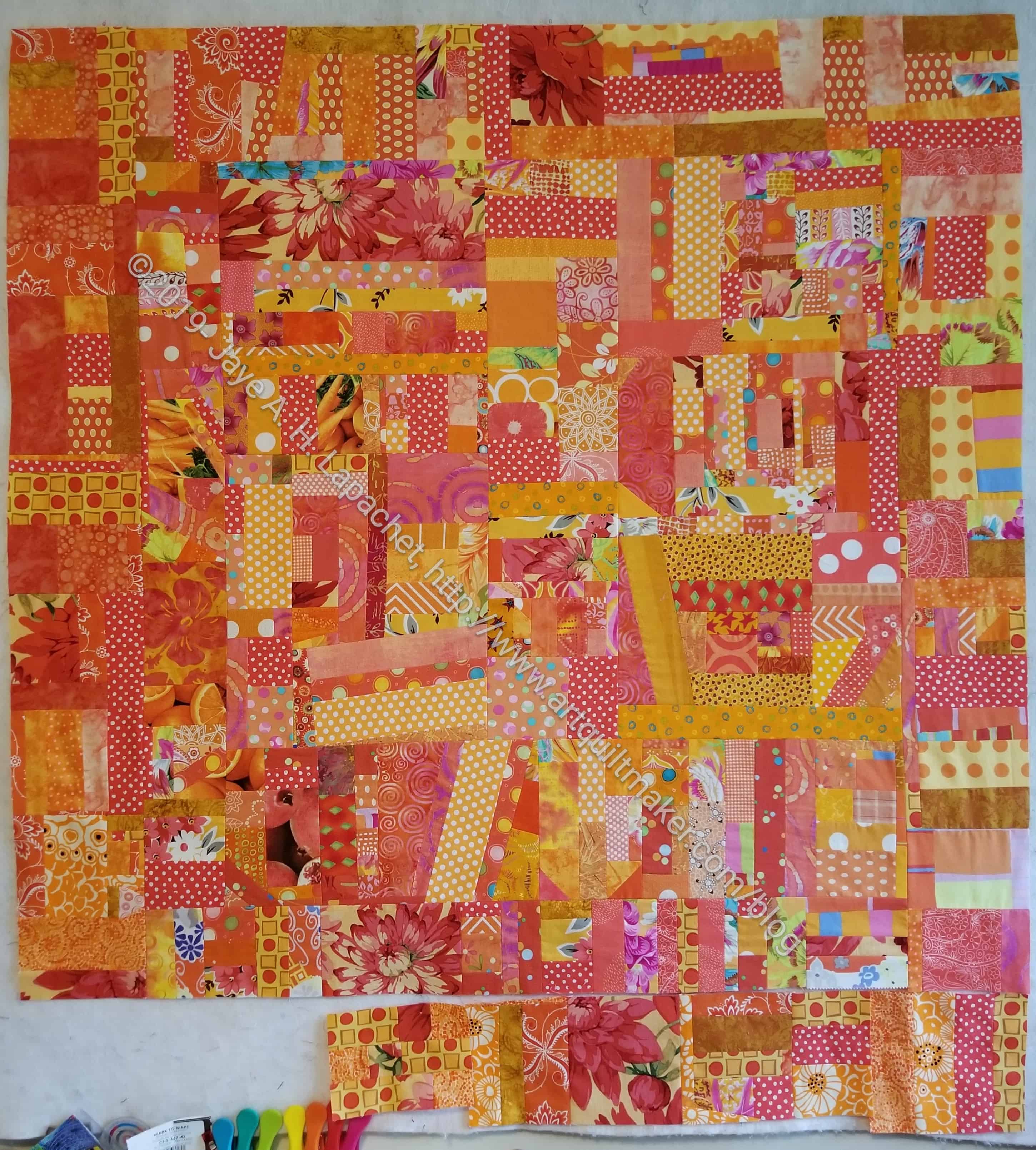
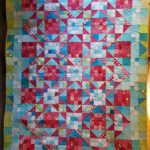
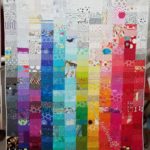
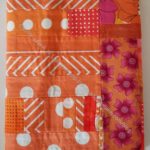
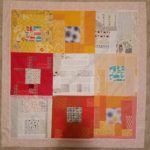
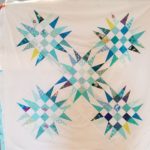
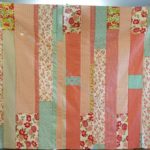
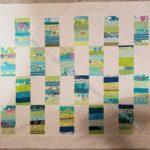
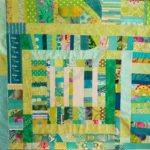
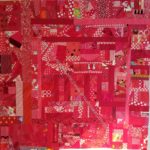
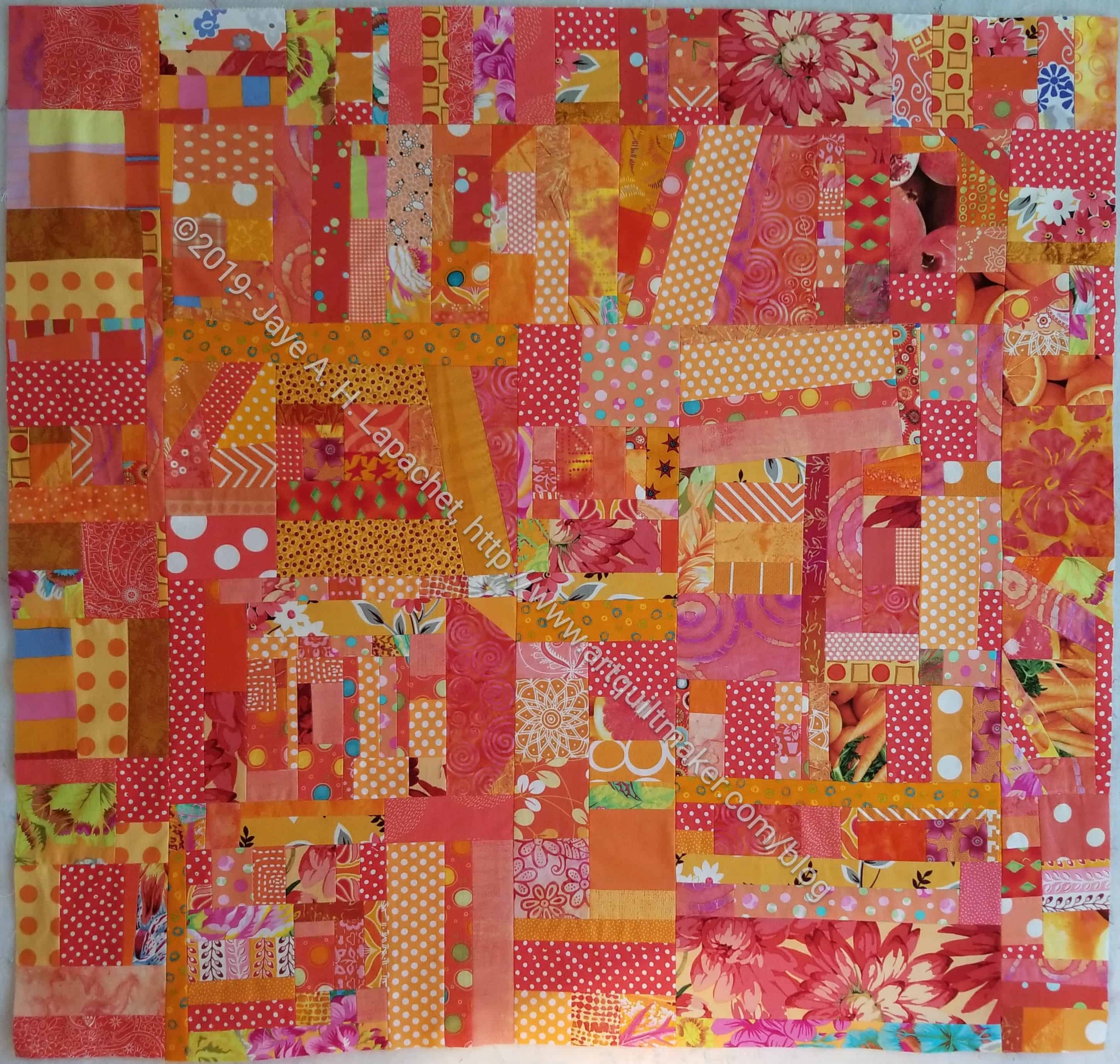
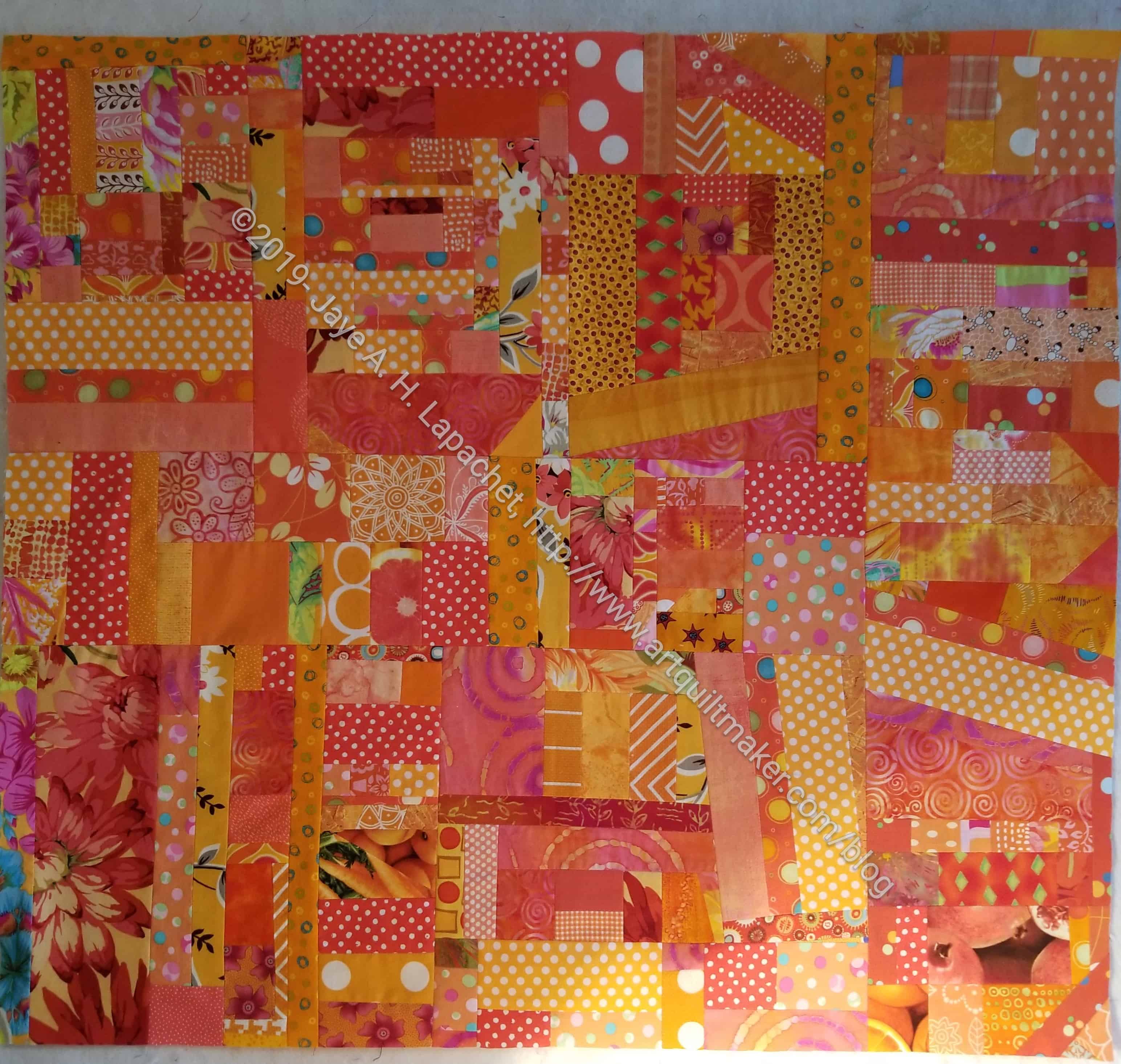
When I do a lot of work on Flying Around, a lot of work gets done on donation quilts or other projects. You already know that this Orange Improv quilt is currently on my small design wall as my leaders and enders project. I made a lot of progress over the weekend.
The size is about 34″x34″ right now. I like to make these quilts about 45×45, but I am really running out of orange scraps. I have 3 large, marginally orange at best, scraps left in my scrap drawer and a handful of scraps that SIL #2 gave me on Craft Night.
I have made a bit more progress. After my pillowcase frenzy from a few weeks ago, I have now used 117+ (gross) yards of fabric and close to 70 yards net. I am not 100% happy, however I can’t be anything but pleased with my progress.
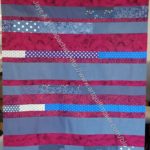
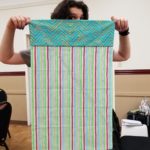
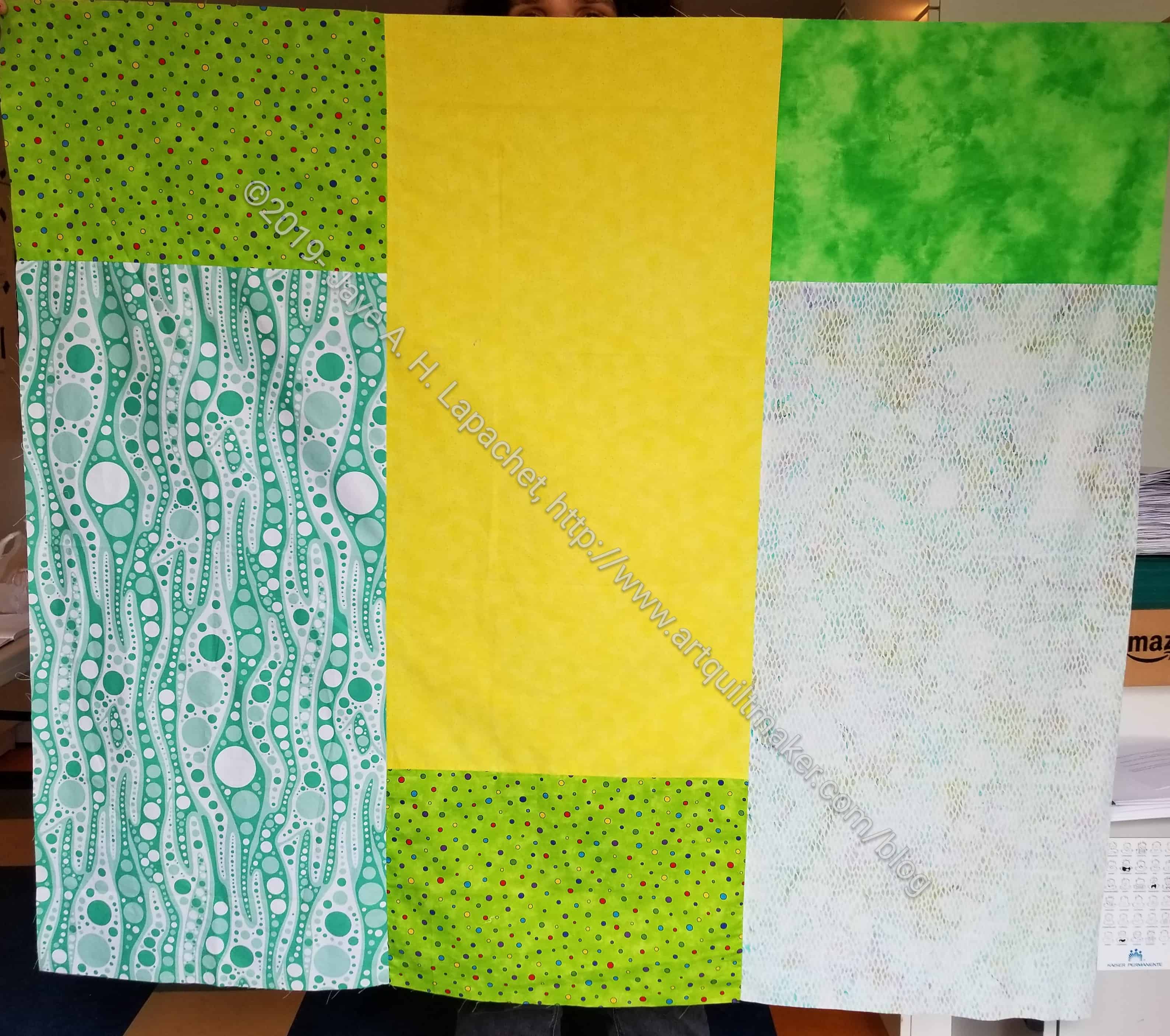
Green Strips quilt top and back – finished 1/16/2019
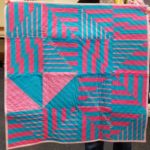
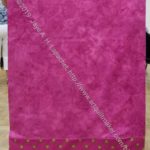
Green Thing donation top and back – finished 2/2019
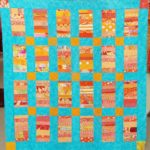
Libs Elliot donation top – finished 2/2019 – Cheryl actually did the quilting and the binding. She made me feel good by saying she really liked the quilt. I should try the technique using stripes instead of making stripes and see if I feel differently. I should do a lot of things.
In Process
The ‘In Process’ is used to denote projects on which I am actively working or are on the design wall waiting for me to stitch. I try not to put away projects, because that will ensure I never work on them
English Paper Piecing Project– half hexies – I have a big stack of stars ready to sew into the quilt. I am still thinking of my friend Faye whenever I work on it. She says that I have to think of this as my slow project.
Flying Around (was Flying Geese quilt) – just started, still cutting and some sewing
Serendipity Lady – thought I needed to rip out some stitching, but decided I didn’t. I need to decide how to finish it. I would like to frame this one.
Lobster – I finished the stitching. I plan to back it and overlock or satin stitch the edges. Even though I don’t need anymore cushions, I may turn this into a cushion.
Still WIPs
I still have WIPs. Who doesn’t, after all? A project in the ‘UFO’ category means I am stalled. A nicer way of saying UFO is a WIP. The list is a lot shorter and the projects are newer, for the most part.
FOTY 2018 – this has to be on the list now as I have cut a ton of squares and need to arrange and sew it together. This is next on my quilt list. I need to cut a bunch of back 2.5″ squares before I can get started.
Handbag Sampler – this is still the forgotten project. It should be on the UFO list. Too bad I don’t have one. The blocks were teaching samples when I taught a sampler class the time before I started writing the quilt class sampler tutorials. I found one block recently, but otherwise I actually don’t know exactly where the blocks are hiding. I have an idea and still have to crawl up in the far reaches of my fabric closet soon and see if I can find them. I haven’t even found a picture of all the blocks. Sad.
Pies and Points from 2016 Victoria Findlay Wolfe class. The last time I worked on it was when Julie and I had a playdate in April 2018. I brought this piece with me so I could cut more elements (Julie has a Sizzix). I lost my excitement about this piece shortly thereafter and still have to get it back. Thus, I had to move this to the WIPs area.
Pointillist Palette #4: Fourth is a series of 6 quilts; needs tiny square patches sewn together. No progress.
Black and Red quilt – This project is creeping into my mind, so it might be up for work soon. The project originally came about because of two other projects. I made a whole bunch of bias tape as part of my failed attempt at doing the Mighty Lucky Club a few years ago. Another part of the inspiration came from my class with Tina of Little Blue Cottage fame. This was going to be for a nephew, but I think it will be for one of my SILs and BILs. I have rectangles cut and some bias tape ready. My next step is to sew the bias tape to the rectangles like pickup sticks. I don’t have any photos of this, so you’ll have to use your imagination.
Who Am I? – This piece is off my design. I have lost momentum, but I think that just has to do with the amount of satin stitching I am facing.
Small Projects in Process
Most of my progress involves thinking or just cutting.
4-Zip Organizer – part of Crafty Gemini Organizer Club. I quilted the outside cover and need to figure out the next step so I can do the next step
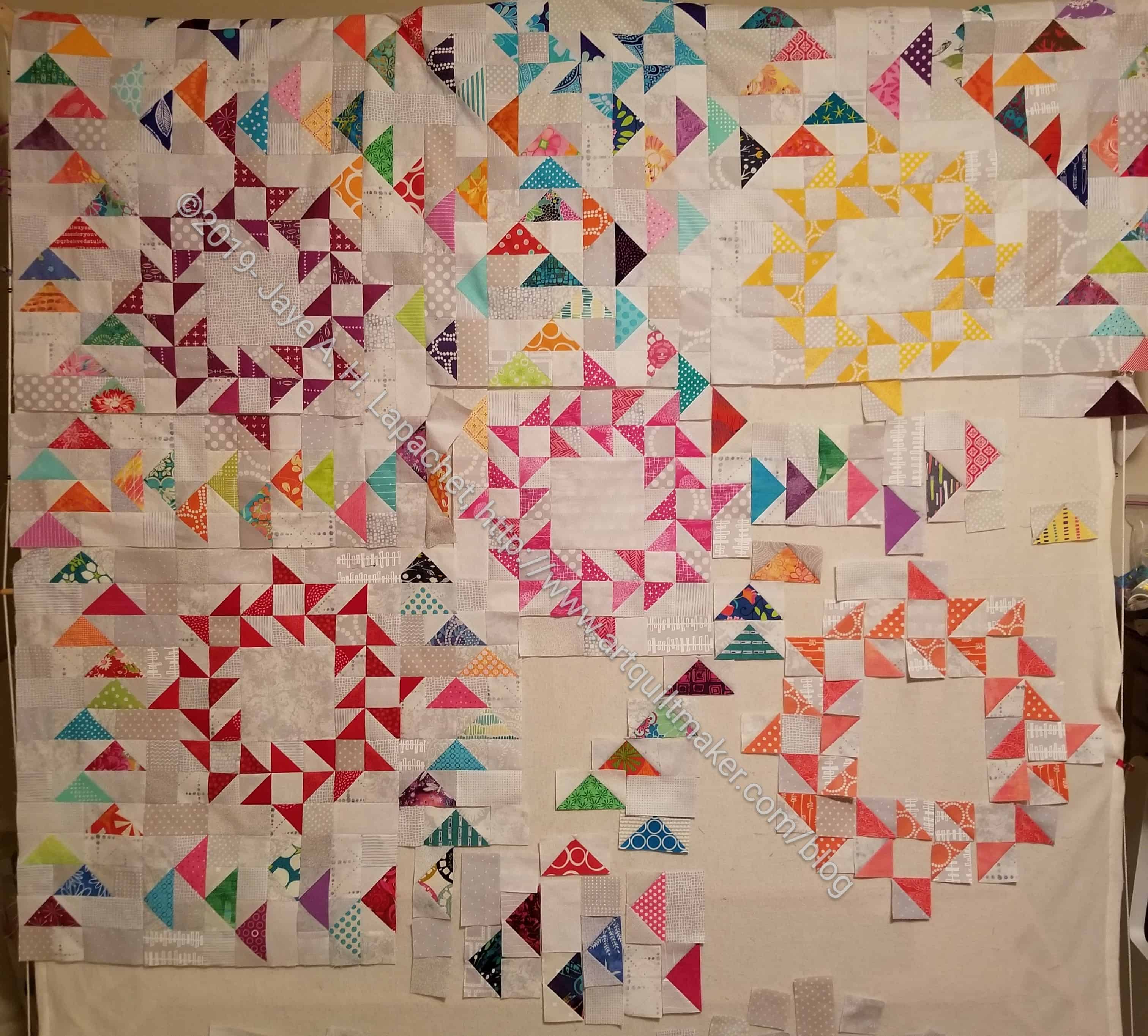
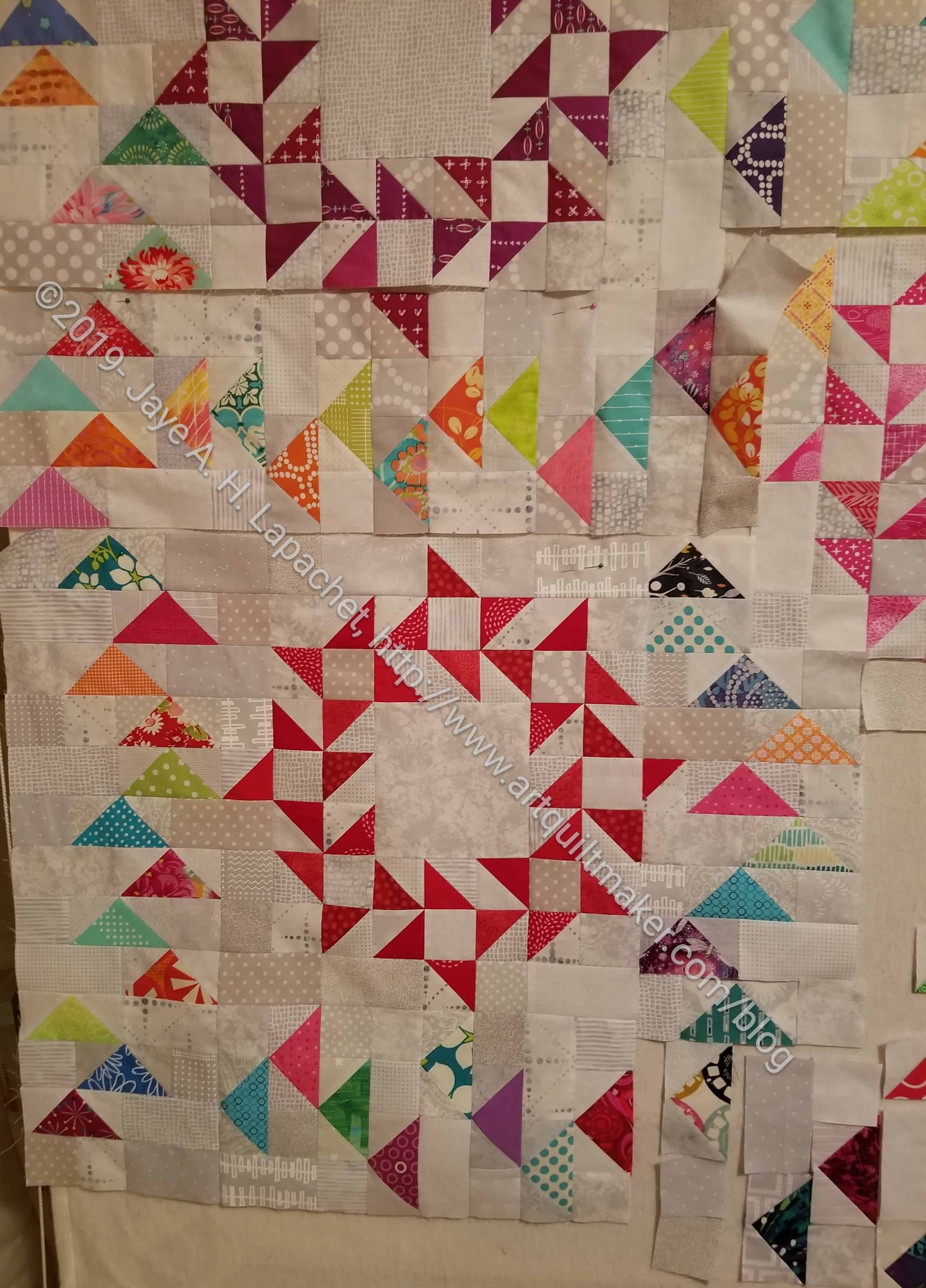
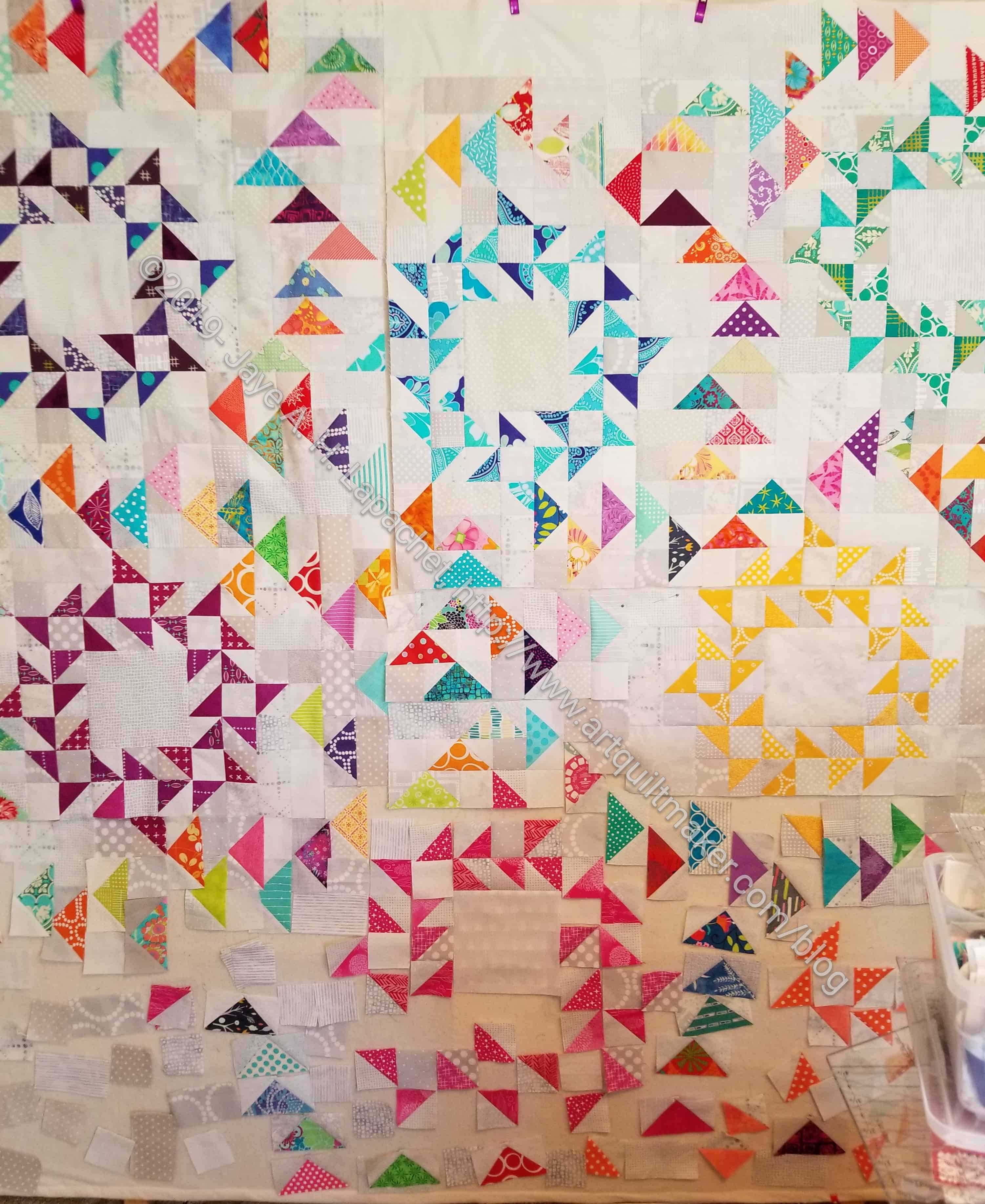
I made good progress on Flying Around over the weekend as well.
It is a lot of piecing, as I have said, so it may not look like much to you.
Flying Around- detail – early September 2019
I wanted to sew the bottom section to one large piece. I may, however, have to sew some of the sections to the upper piece before I do that. There is quite a bit of partial piecing I have to sew.
I worked hard during the past week to make this piece large enough to call it done. I am scraping the bottom of my orange drawer to have enough! I am still liking the way it looks.
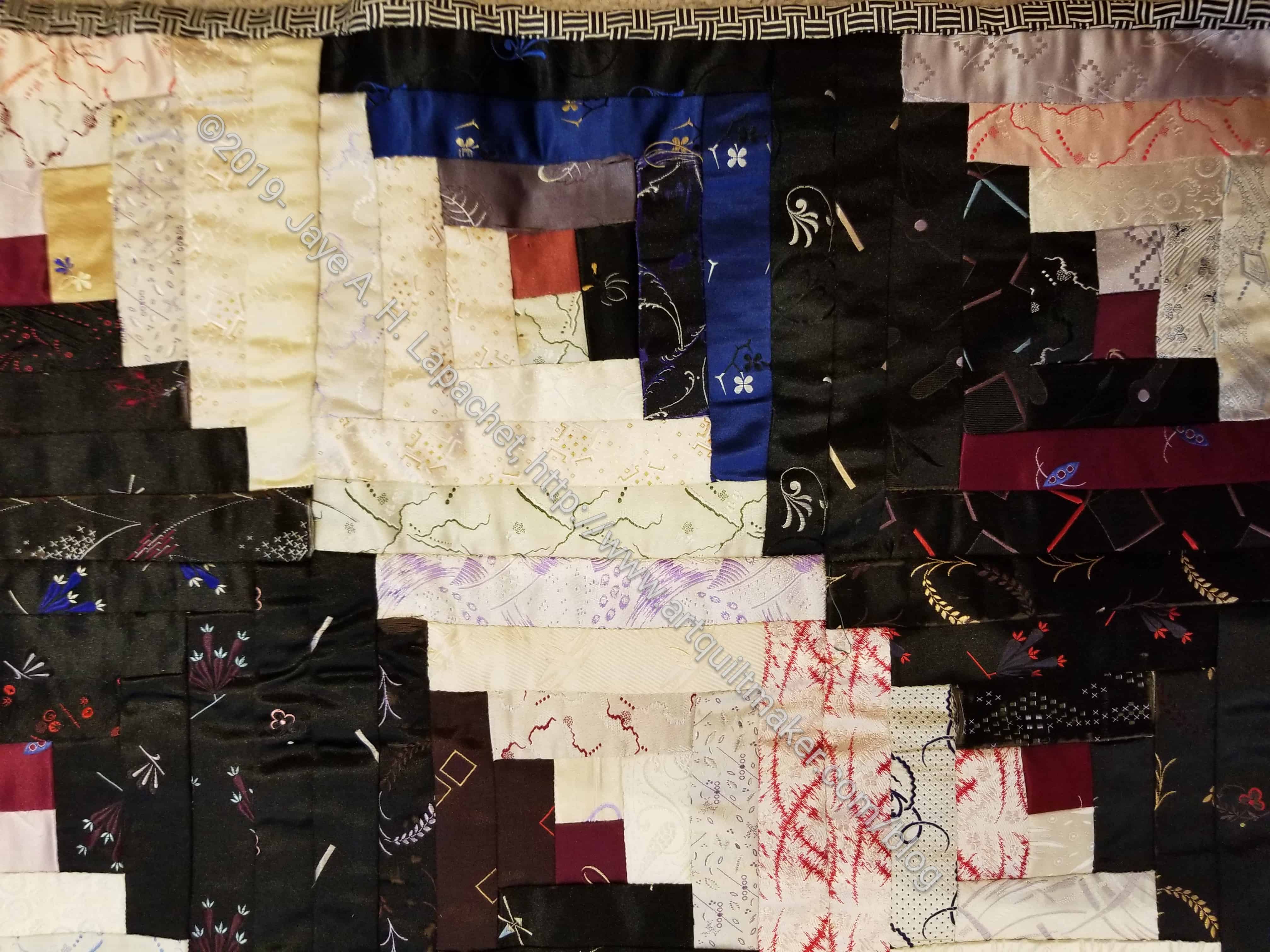
The other day I wrote about a friend’s vintage quilt. She had two and the second one was made from silk in a log cabin design.
I am not a huge fan of log cabin quilts, but this one is a beauty. The silk came from those sample cards. Apparently, whoever made this quilt pulled the silks off the cards, not realizing the cards with the samples had value as well. The remainder of the cards were donated to the LA Textile Museum.
Marguerite & Juliette’s silk quilt – detail
Note the low volume look for the background? Very modern, don’t you think?
I like it that there is some color to some of the background prints. It is actually very colorful, if you look at the background (whites/lights) up close.
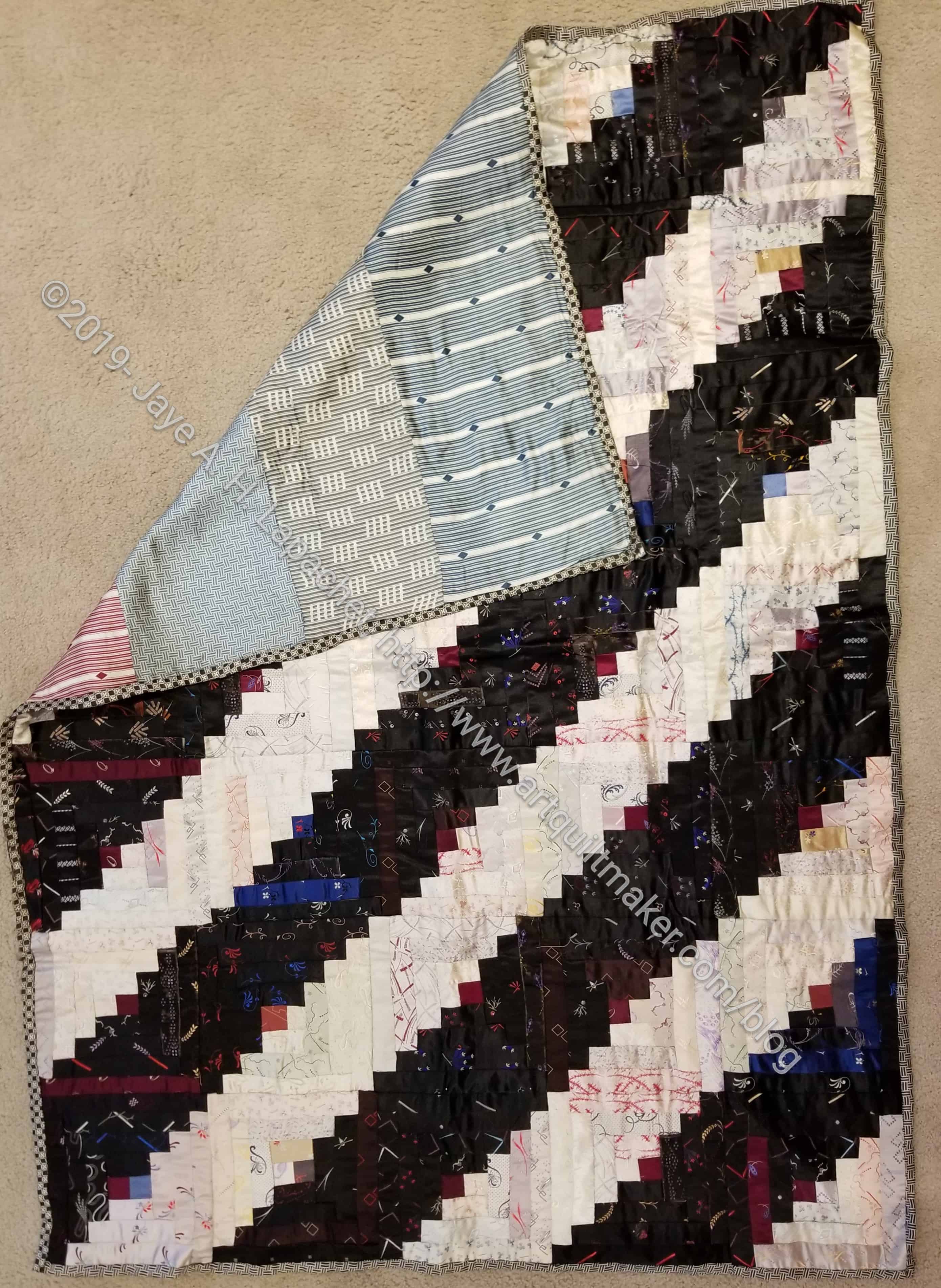
Marguerite & Juliette’s silk quilt – with back
The back is interesting as well, though I forgot to ask where the silk for the back came from. Another modern element: a pieced back.
I was so pleased that Marguerite brought these quilts to share. She did it specifically for Deena and I to see. So sweet!
Goodness! September already! It seems like yesterday when I was writing about my goals for the year.
As mentioned I went to a BBQ on Saturday and got to see a quilt extravaganza. The hostess is also a quiltmaker, but does art quilts and is preparing to sell a bunch of them.
Deena’s largest quilt
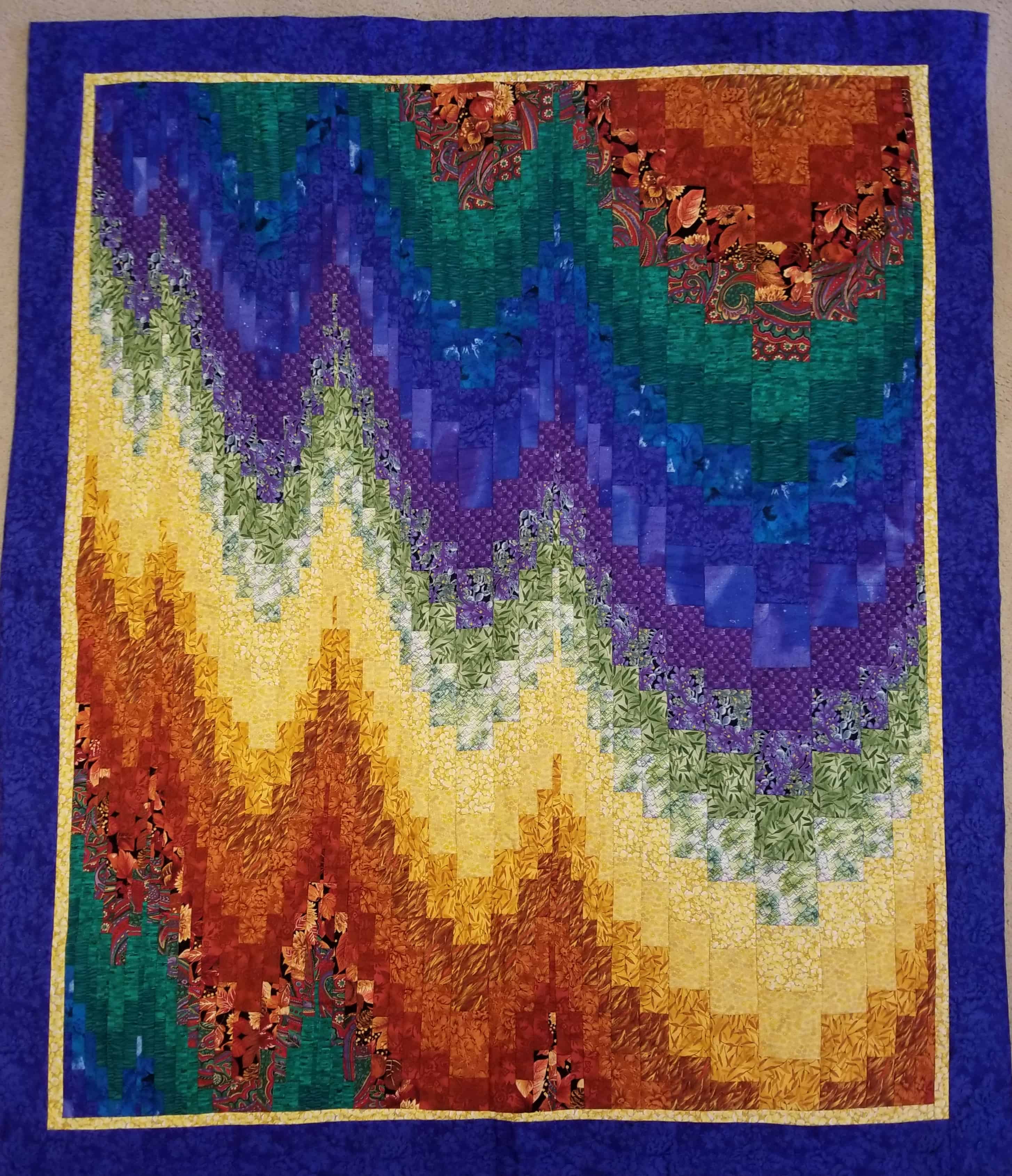
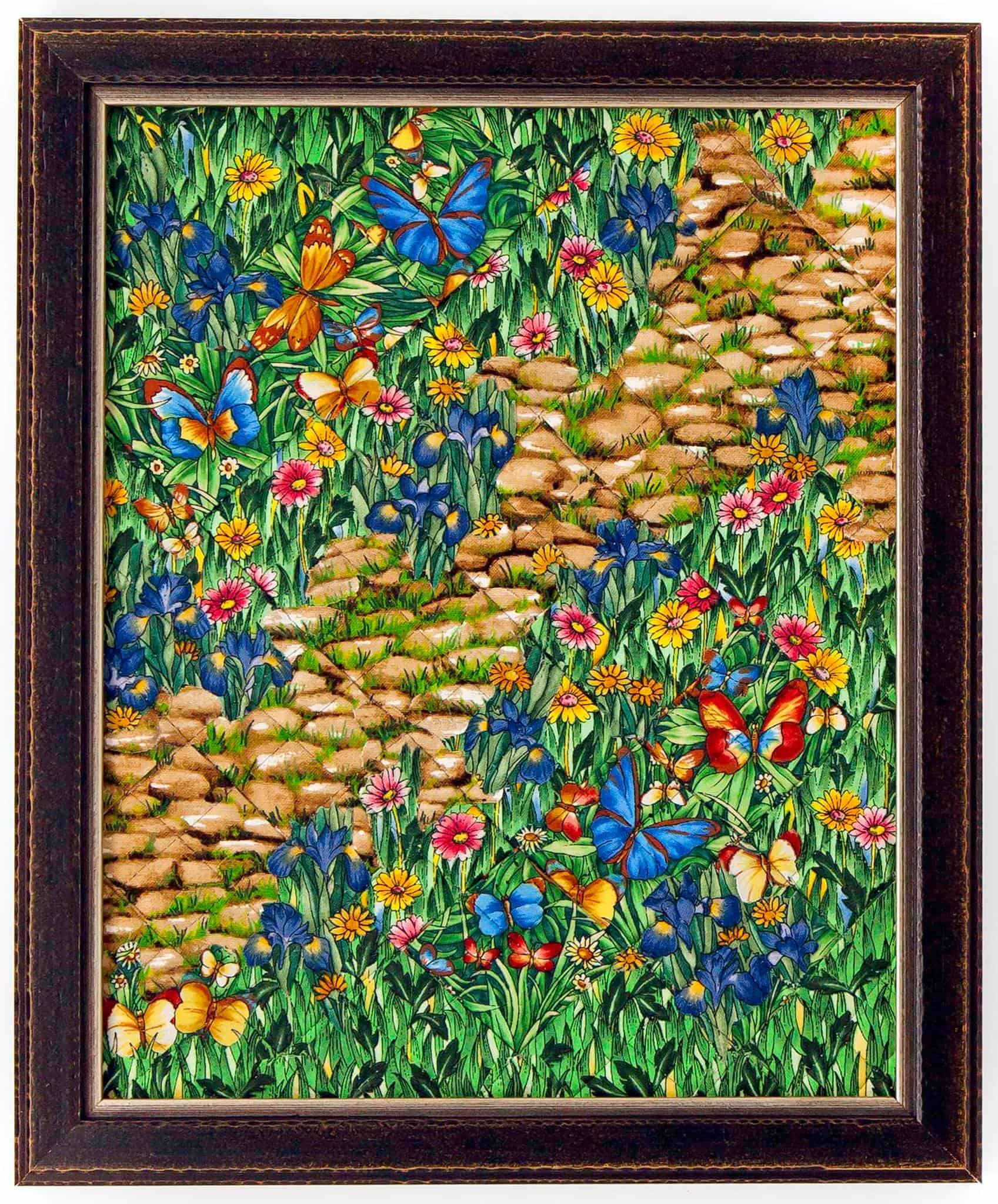
Deena’s quilts are all wall hangings. She starts out making a bargello background. After she is happy with the background, she fussy cuts motifs out of fabric and fuses them to the front.
The large quilt shown is one of the plainest of her quilts that I have seen. Most of them are beautifully embellished with a variety of motifs. Her newest collection is a Noel collection. Lots of cardinals are featured.
Deena Farrah Art Quilt: For Sale: Garden Path II Frame size: 8 x 10 Price: $135
I was at a BBQ with friends the other day when a friend tugged my sleeve and brought me to the living room, away from the festivities.
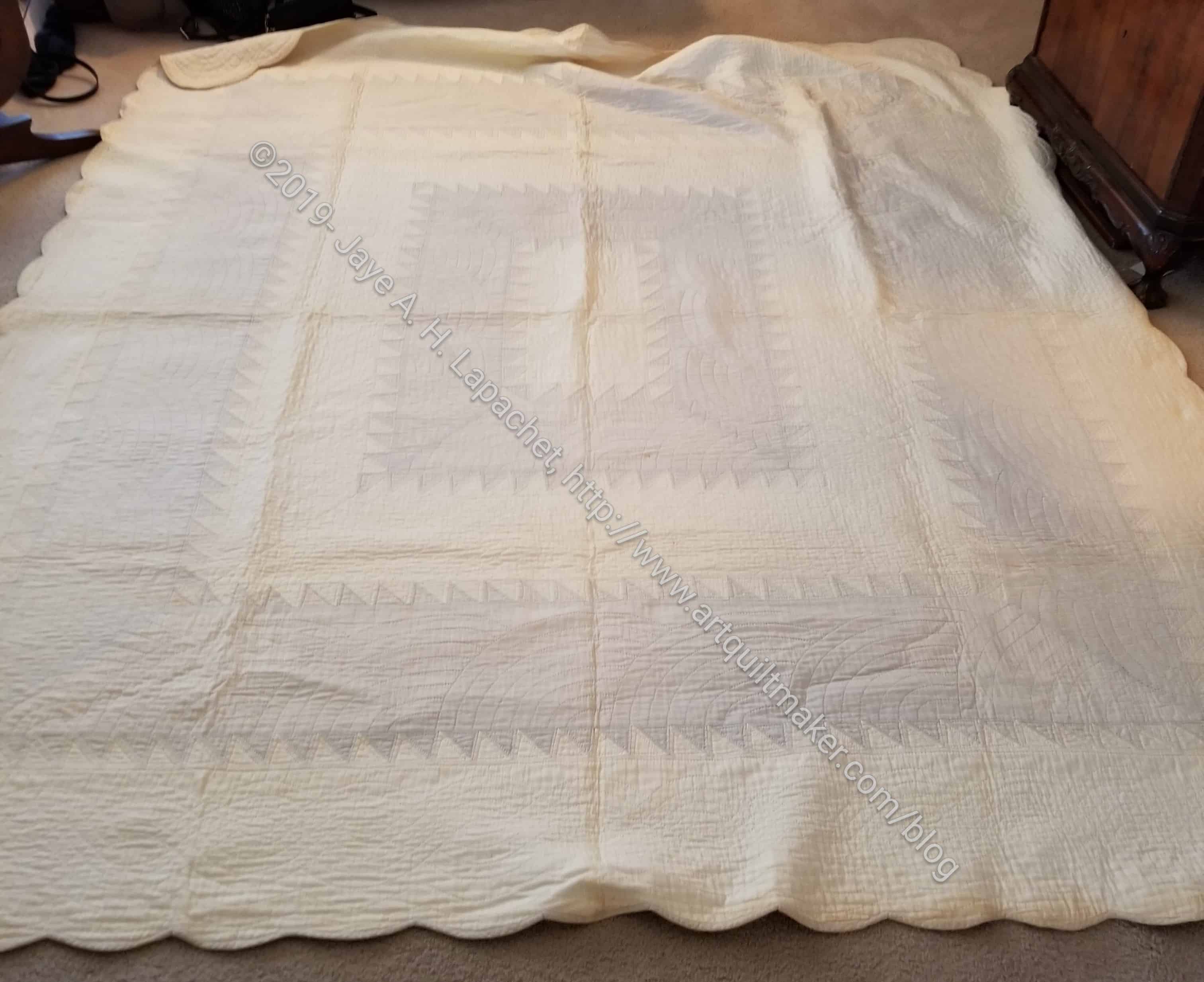
Marguerite & Juliette’s quilt
In the living room another friend was unpacking some old boxes – those my grandmother used to get for gifts at department stores. Out of them came two quilts.
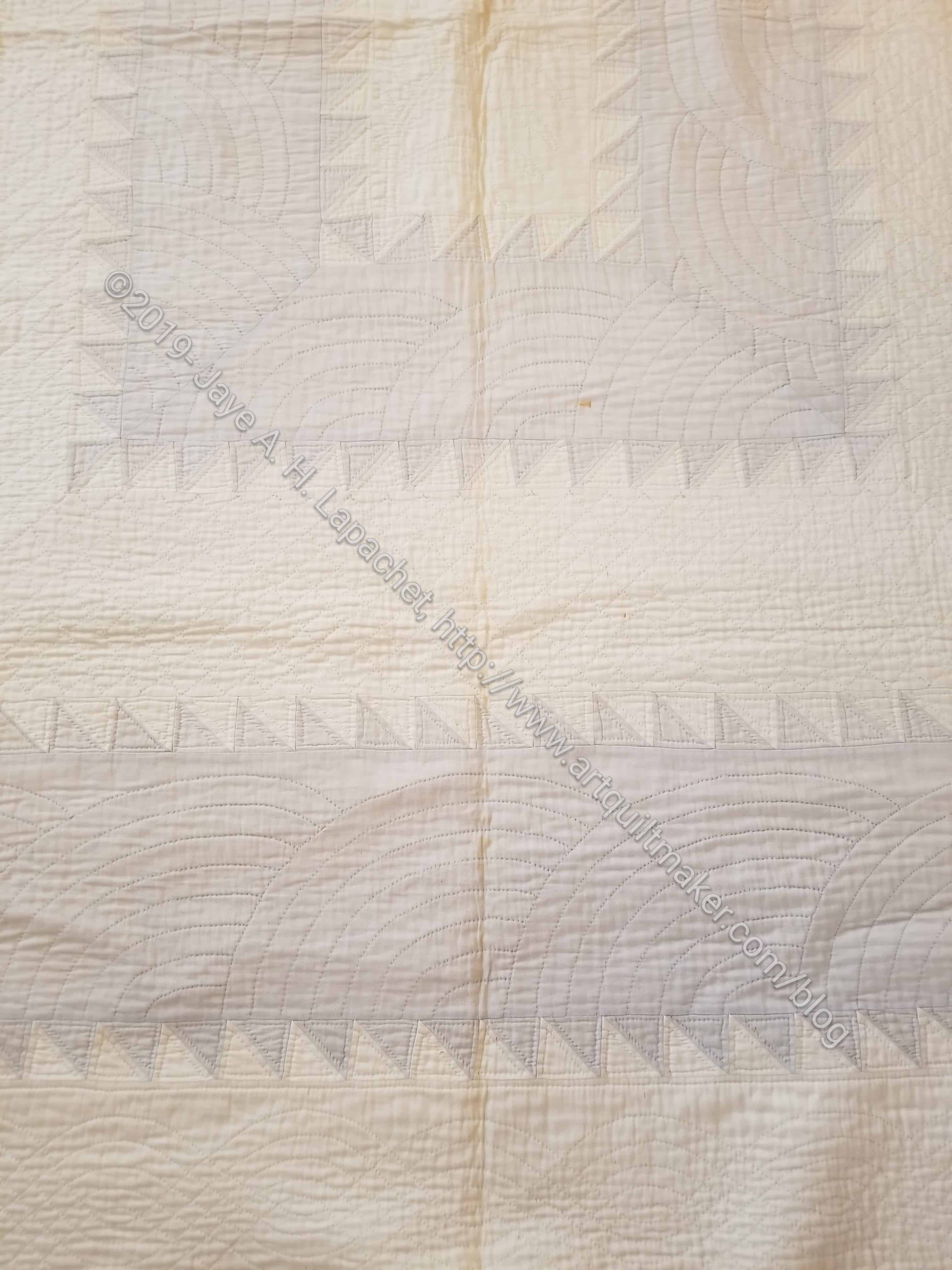
This one is a simple design and probably very faded, but is still beautiful. I love the grey to which the original color has faded.
Marguerite & Juliette’s quilt – detail
It is probably a double bed size. They found it when they were cleaning out the linen closet at their mother’s house.
This isn’t a complicated design, but would require a lot of HSTs to replicate it. I think it looks very modern.
It has been folded in the same place for years so there is some damage. There is also staining from … who knows what – non-acid free paper? Wood shelves?
Ellen Harding Baker made a quilt to illustrate her astronomy lectures in the 1800s. An article was recently published about this quilt.
Exhibits & Events
The Dear Jane quilt, officially called the 1863 Jane Stickle Quilt, is on display at the Bennington Museum in Vermont August 31 through October 14, 2019 in the Textile Gallery. Regular admission gets you a viewing. Let me know if you are able to go. You can find the information on their blog.
Local Sew Sweetness meetups are coming:
ALABAMA – August 24th at 9am-4pm. Location: The Sewing Machine Mart in Homewood, AL. Contact: Sheila Johnson, sheilakj99@msn.com
CALIFORNIA – August 31st at 11am-3pm. Location: Cotton Patch Quilt Shop, Lafayette, CA. Small fee to sew. Contact: Lisa Lien, l_lien@att.net
CALIFORNIA – August 31st at 11am-3pm. Location: Elk Grove Sewing and Vacuum Center in Elk Grove, CA. Call 916-714-0904 or go to the website to reserve a spot for the Sew Sweetness class. Contact: Lisa Lien, l_lien@att.net
DENMARK – August 31st from 10am-4:30pm. Location: Kvinsbjerg, Dalmose. Contact: Inge Hansen, ingeh64@gmail.com
MINNESOTA – September 28th at 9am-6pm. Location: Pearl & Myrtle’s Retreat Center in Anoka, MN. $11 fee to use the sewing space for the day. Contact: Amanda Badger, amandasoule1983@gmail.com
The Asheville Quilt Guild is having a show September 27-29. Check the website for times.
Doing Good
If you want to help AQSG raise money for their projects, send repro fabrics to them for their fundraiser.
Media
The Quilt Alliance blog has a story about connecting the community with quilts.
Fabric, Supplies, Tools & Notions
Have you seen the new state panels from Whistler Studios for Windham? The California panel is really cool! I saw them at Hawthorne Supply and my ideas are racing for another shirt for DH.
I think I will go on a bagmaking binge after finishing Flying Around. In preparation, I watched a Sara Lawson/Sew Sweetness video on applying Odicoat to make fabric water resistant. Sara talks about making bags, such as lunch bags or cosmetic bags wipe clean using Odicoat. As mentioned, I often use the iron-on vinyl to help protect the bottom of my bags. This is not ideal since the bottom of the bags needs to be completely enclosed by stitching to avoid peeling. The iron on vinyl that I have used has never peeled, but I don’t want to risk it. I think the Odicoat might work better since you paint it on the fabric, so you can put it where you want. The video doesn’t talk about sewing it (does the needle stick?), though it looks like it wouldn’t be a problem.
If you want to know what Pellon Products are used for or see a description, I found a chart. Sara of Sew Sweetness has a blog post that discusses how to use various products (smaller list, but what she uses for her bag patterns) and some of their qualities. I am searching for a massive chart that compares different interfacings from different manufacturers. Other articles about interfacing are:
I use vinyl on some of my bags. It is a little boring, so when I saw that Glitter Vinyl was available, I put it on my list to buy. You have to buy half a yard, which is a lot if you are just making a small pouch, though I could make another bag out of it.
Projects, Patterns & Tutorials
By the time you read this, there are probably a few other blocks posted for the Daredevils Block-a-Long. As I write this, the second block, Bessie’s Sunburst, the third block, Hazel’s Star, & the fourth block, Helene’s Star have been posted. I really like Helene’s Star!
PolkaDotChair has a list of “5 Foundation Paper Piecing Tips Perfect for Beginning Quilters.” You’ll have to tell me if they are helpful as I don’t like foundation piecing and probably won’t try them out.
MellySews has a tutorial for the zipper pouch we used for the recent Community Quilt Sew Day. There are tons of tutorials on the site. You’ll spent hours there. 😉
I was trolling hashtags on Instagram for new bags. Not that I need more bags, but you know. I can’t stay away. Anyway, I found a portfolio that is very interesting and would be great for someone getting a new job or being appointed to a committee. I don’t know if it would fit a composition book, but this would be an even greater pattern.
Sew Sweetness has a pattern and video bundle on sale until Sept.2. Yes, I bought it, but I haven’t made anything yet, but will. I was tempted by the Minikins Season 2 collection, because I like that Day Trip Cell Phone wallet. I held off, though.
Want to choose from a number of free tutorials to make wonderful small gifts? Take a look at the Sew Hungry Hippie Free Tutorials page. The page also includes a 1 hour basket tutorial made from vinyl.
Sara also has a free pouch pattern called the Persimmon Pouch available with a video! This looks similar to the Crafty Gemini pouch that Angela made for me. I am sure they are very different. The blog post has a link to download the pattern, an embedded video tutorial and a supply list. The pattern includes 3 sizes. She doesn’t, however, show the inside.
Need to know how to sew vinyl? Check out the guide from Sew Hungry Hippie.
Lynette recently flew to Zurich and then traveled to France and some other places. She was kind enough to take two quilts with her for the children of friends.
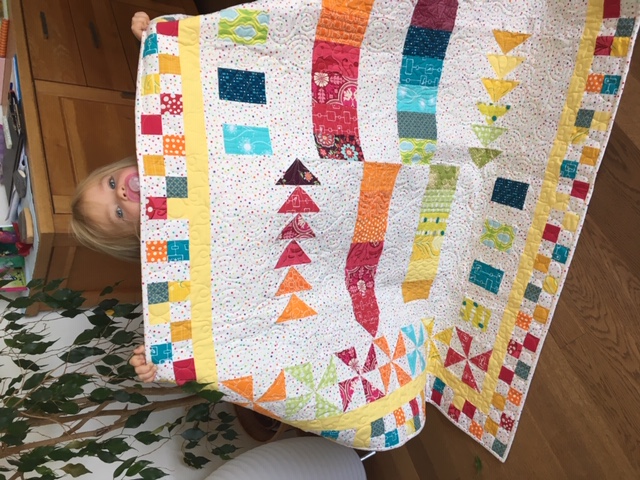
Anja with her BAMQG Color Round Robin
You might remember the BAMQG Color Round Robin? i started the piece in May of 2013.Kathleen and Rhonda both worked on, but I don’t know if anyone else worked on it.
This was one of the quilts I sent off to Austria. Anja is now the proud owner of this small piece. She is about 3.
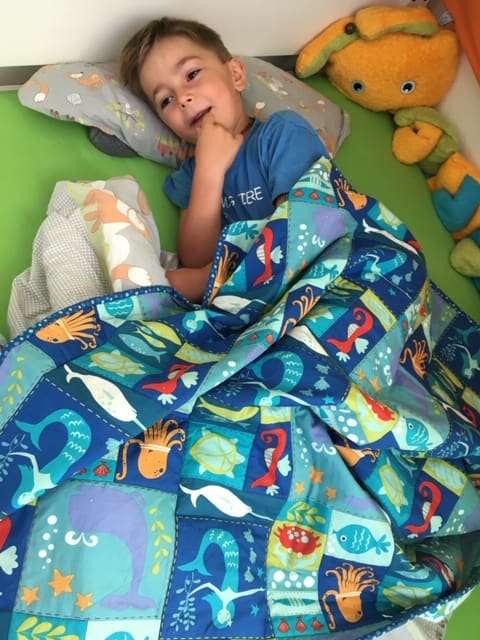
Lukas’ Sealife
Her brother, Lukas, received the Sealife quilt. I worked a lot on this one at the 2018 BAM Retreat.
It took awhile for me to get these quilts to Europe and it turned out to be the perfect time. Lukas and Anja also got a new baby sister a few weeks before, so these quilts ended up being their Baby Gifts.
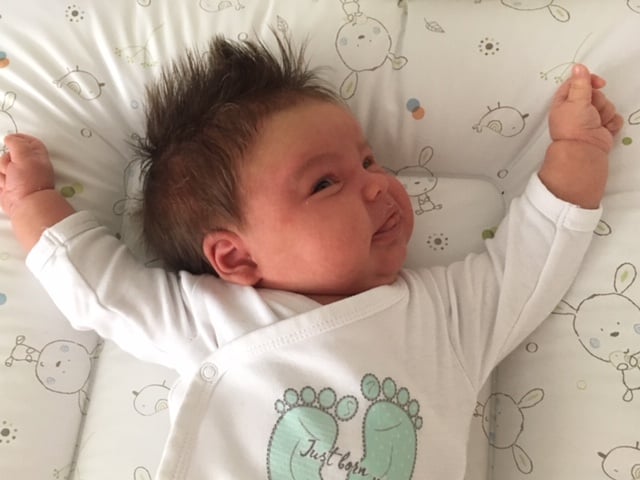
Baby Laura
Their new sister is called Laura (pronounced LOW -rah -with the OW being pronounced like an owie not like oh). Lukas is now outnumbered.
The way I send quilts to friends in Europe is I beg a traveling friend to stick a quilt (or 2) in their luggage and then visit a post office once they get to the EU. I put the quilts in one of those vacuum seal bags and suck as much air out of the bag as humanly possible. By doing this, I can usually save $70 on postage. I am pretty sure the post office wouldn’t like this if they knew, but I am not telling. 😉 I have another large quilt to send and I don’t know yet who will be the lucky courier.
The other day I talked about a new quilt top on which I was working. Over the weekend, I finished it and the back. It is now ready to take to the guild meeting for someone to quilt.
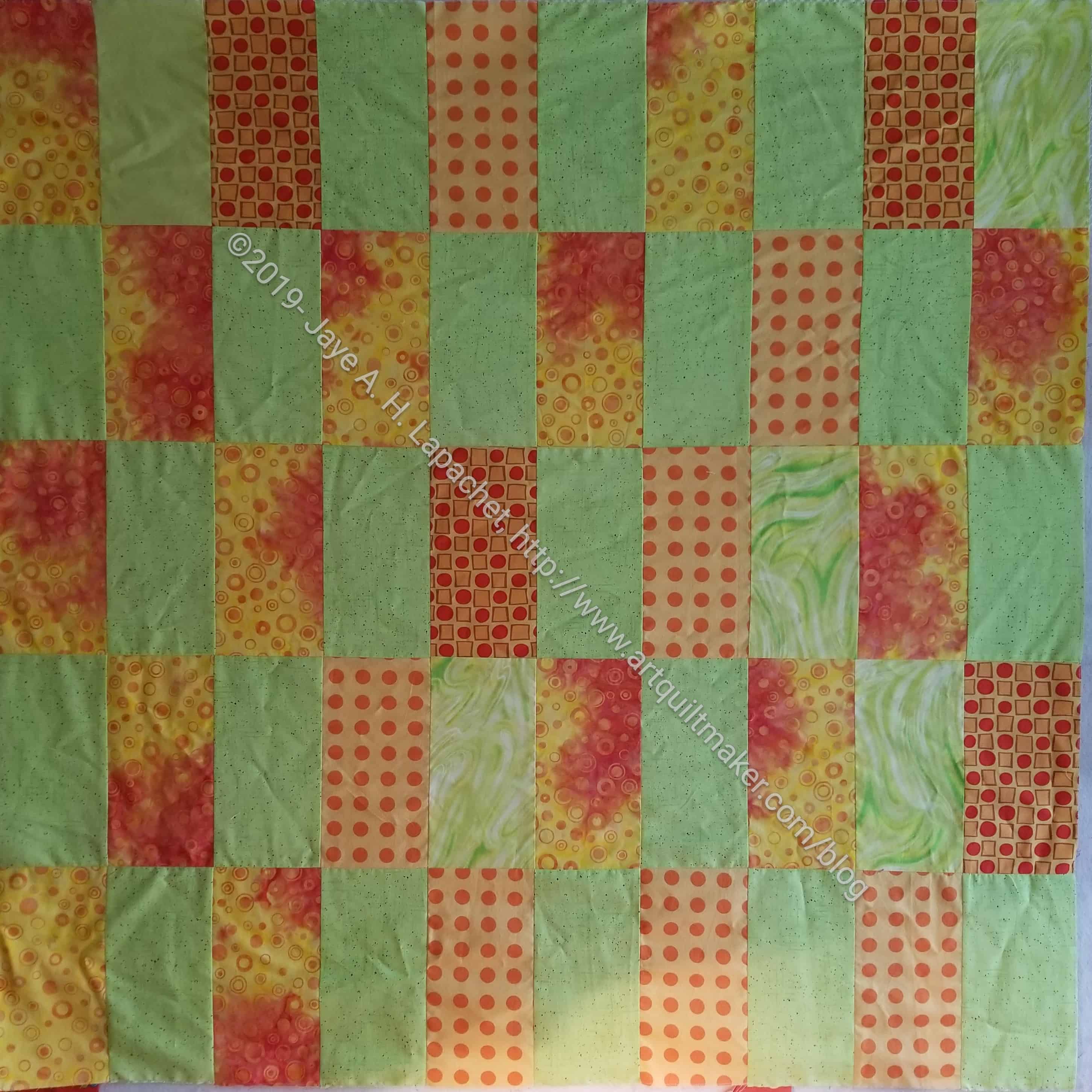
I can’t decide what I think about this color combination. It very much reminds me of eating sherbet at my grandparents’ house. I probably should have called this Lime Sherbet!
Orange & Green Donation Back
I did decide to make a back for this piece (more fabric used!). I pulled out several fabrics I didn’t think I would use and whipped one up. Amazingly, I didn’t have to fight to make the back for once. It went together really easily.
I am pleased that the green rectangles are off my sewing table and I get to add 3+ yards to my “Fabric Used” tally.
Periodically I like to updated and post this tutorial. Check out the previous tutorial.
I was taught this method of putting quilts together and have found it to be more accurate that putting rows together. I use it for block-based and similar quilts. Very occasionally I’ll sew on a long border after the center of the quilt is complete, but otherwise I try to avoid the long seams required to put quilts together in rows.
Using this method, usually I have only one really long seam to sew at the very end and 1-2 mid sized seams.
This technique improves accuracy when you have sashing and cornerstones, but also improves accuracy with sashing and blocks or just blocks. If you have no sashing, then the pieces are much easier to handle.
Occasionally you will have a quilt where chunking is not appropriate for one reason or another, which is why it is good to know many techniques. Knowing a variety of techniques enables you to choose the best method for achieving your creative vision.
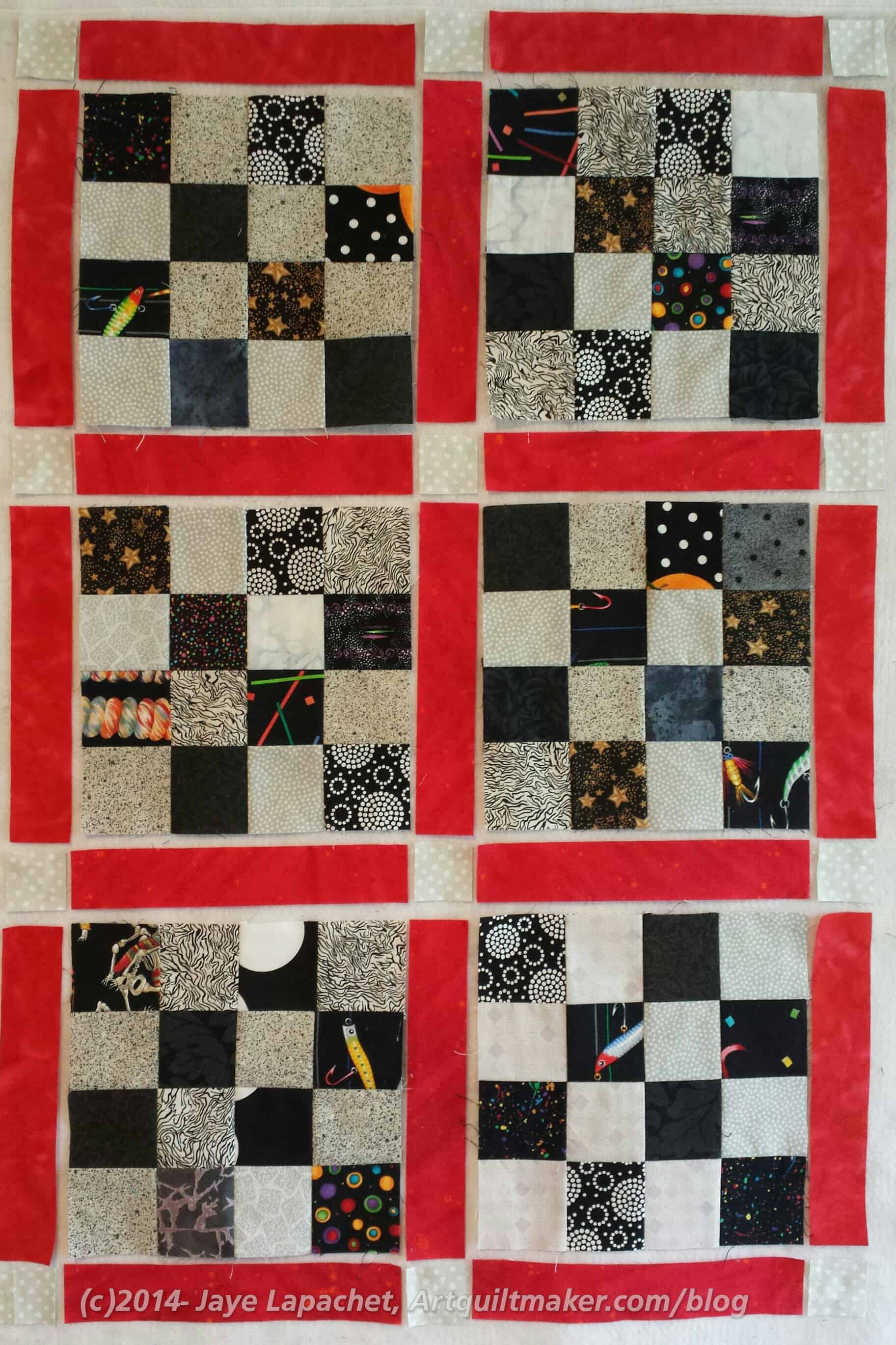
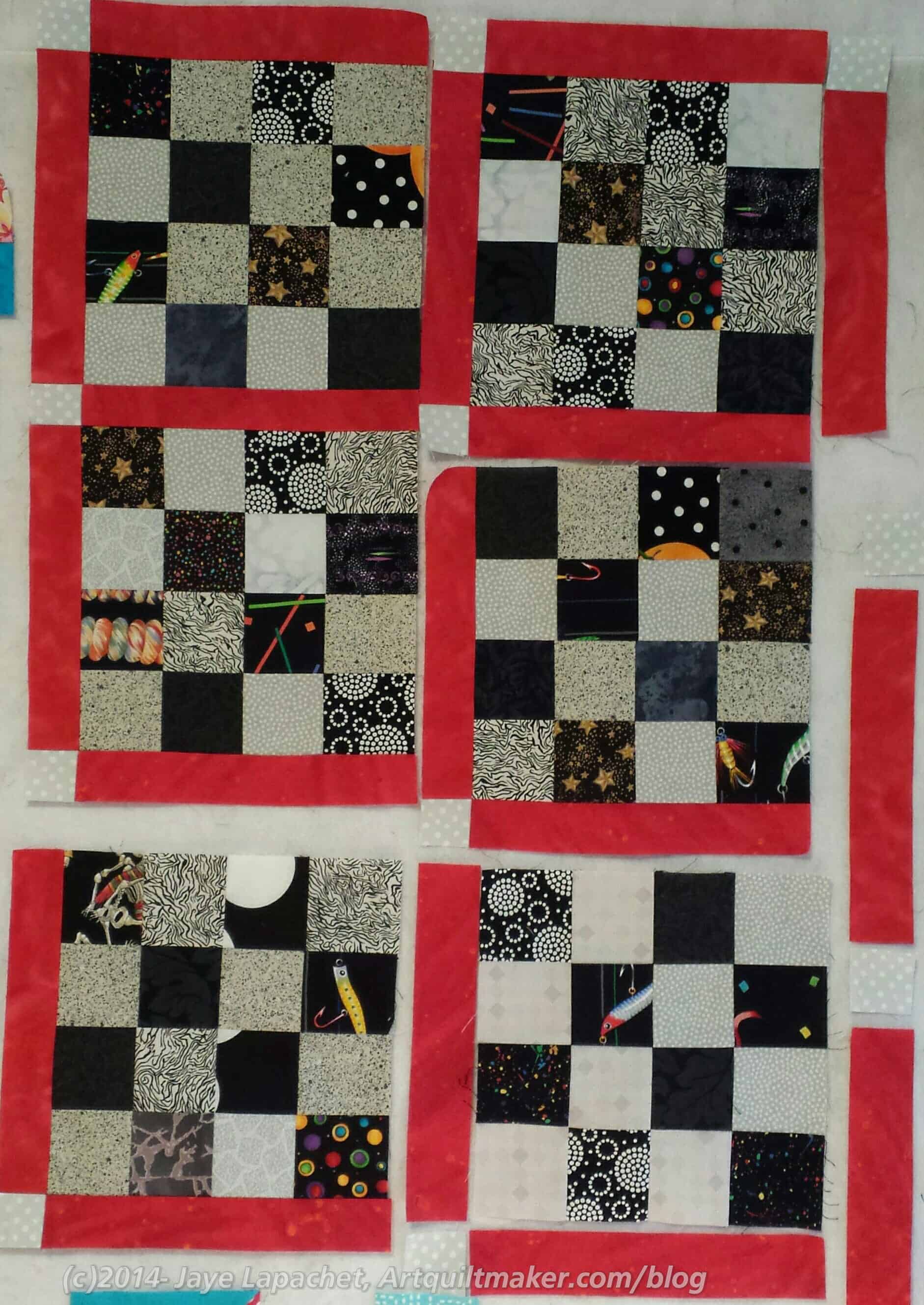
First, lay out your blocks and pieces on a design wall (or design floor) so you can see what you have to work with and the order in which you want them to end up.
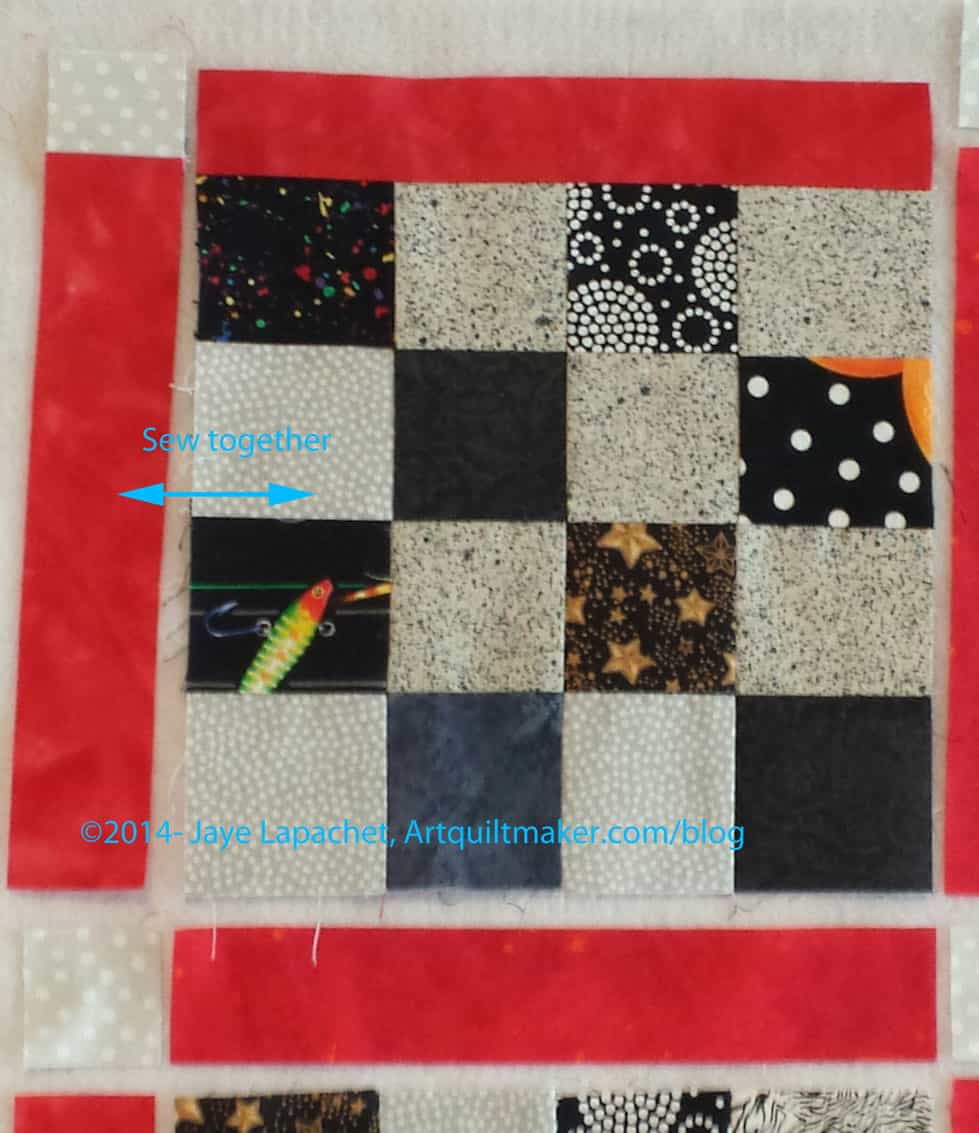
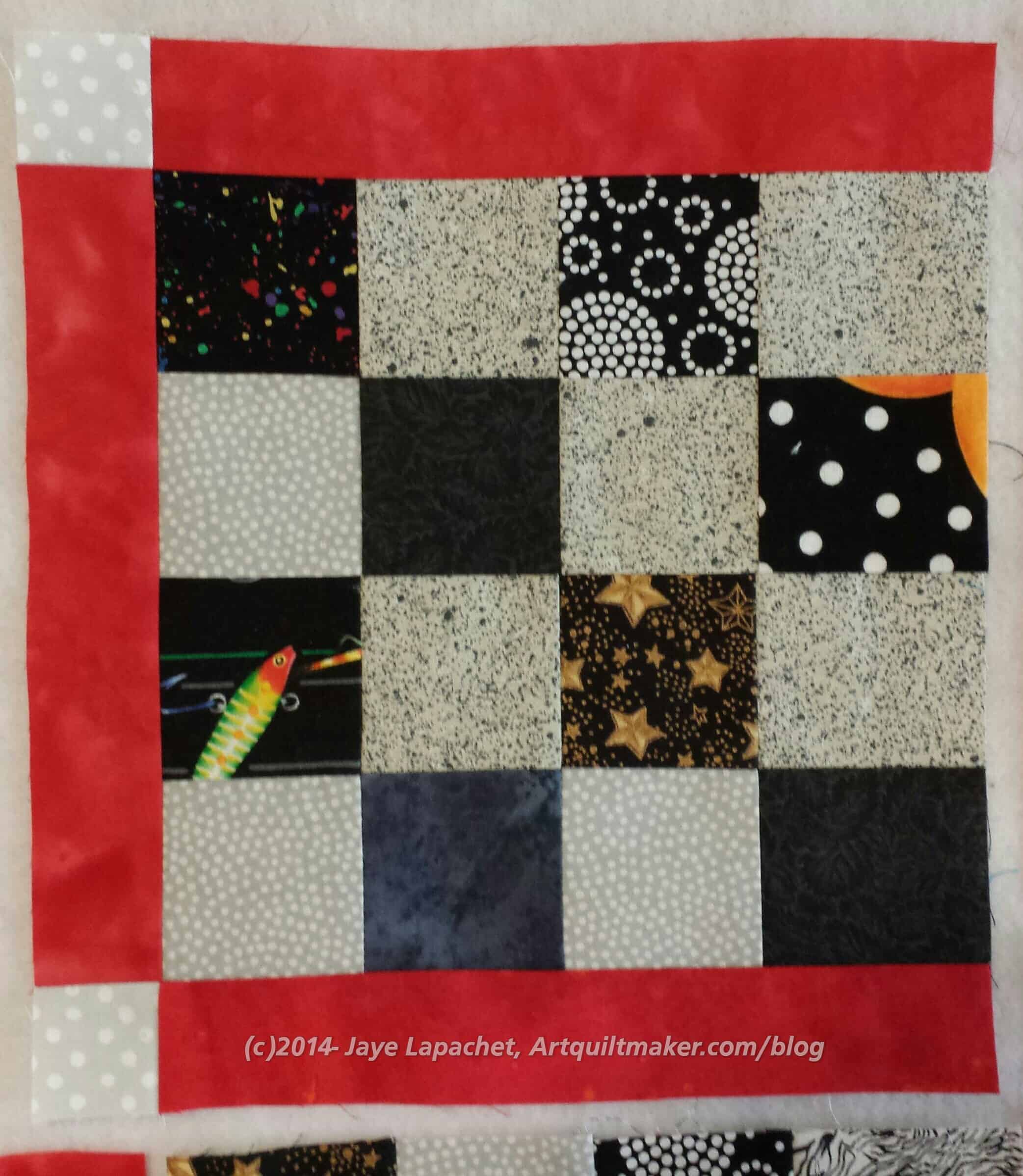
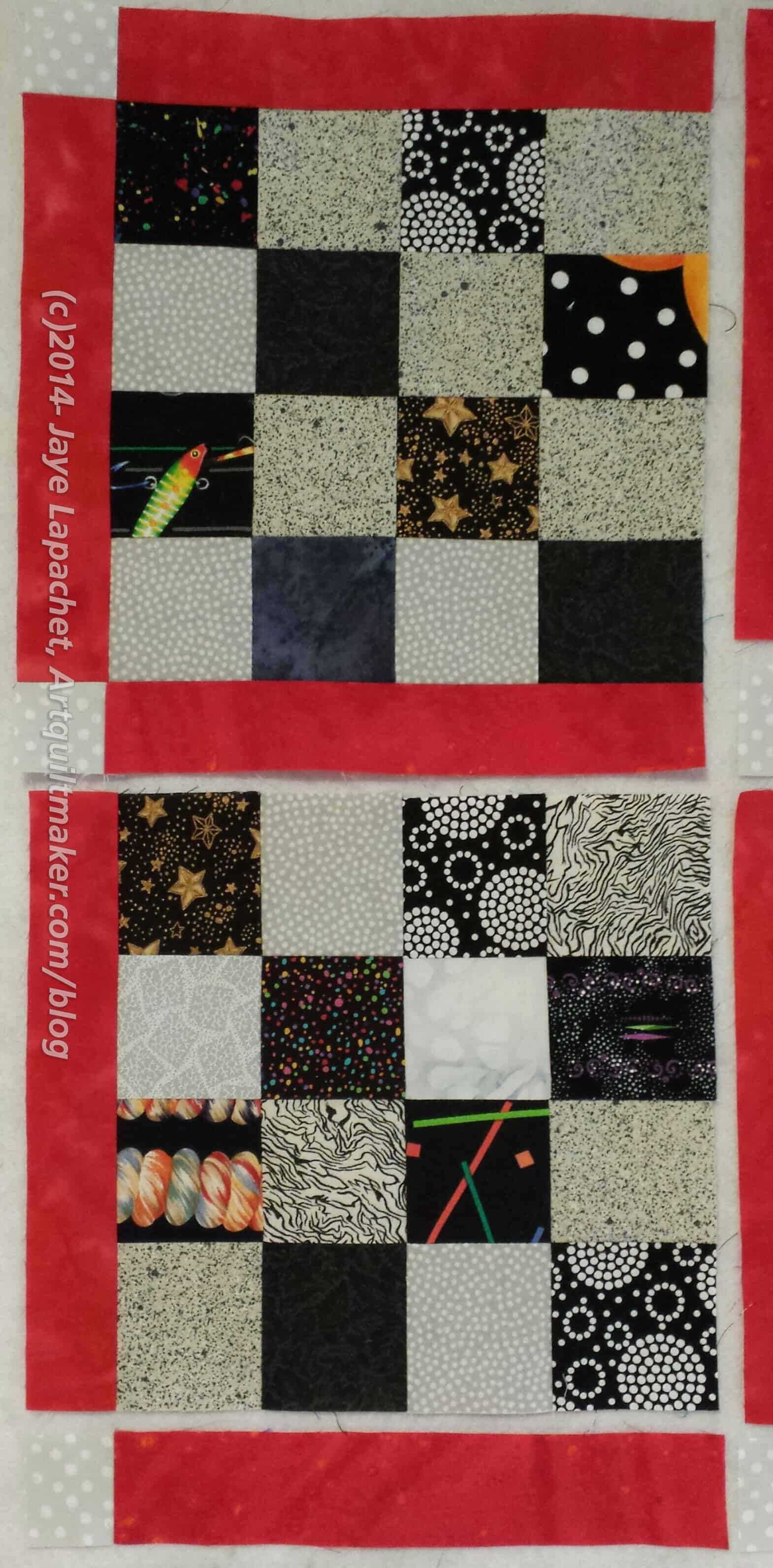
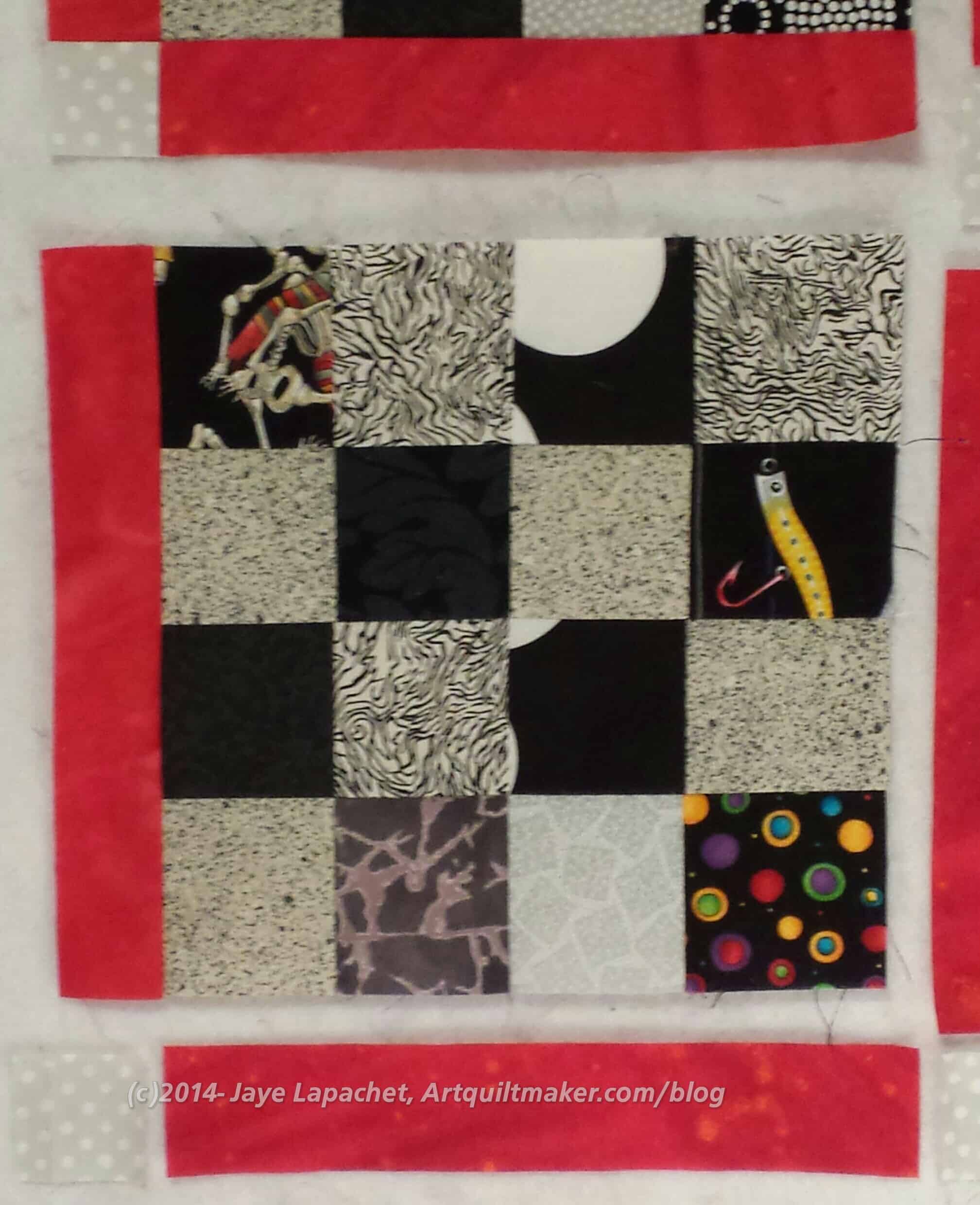
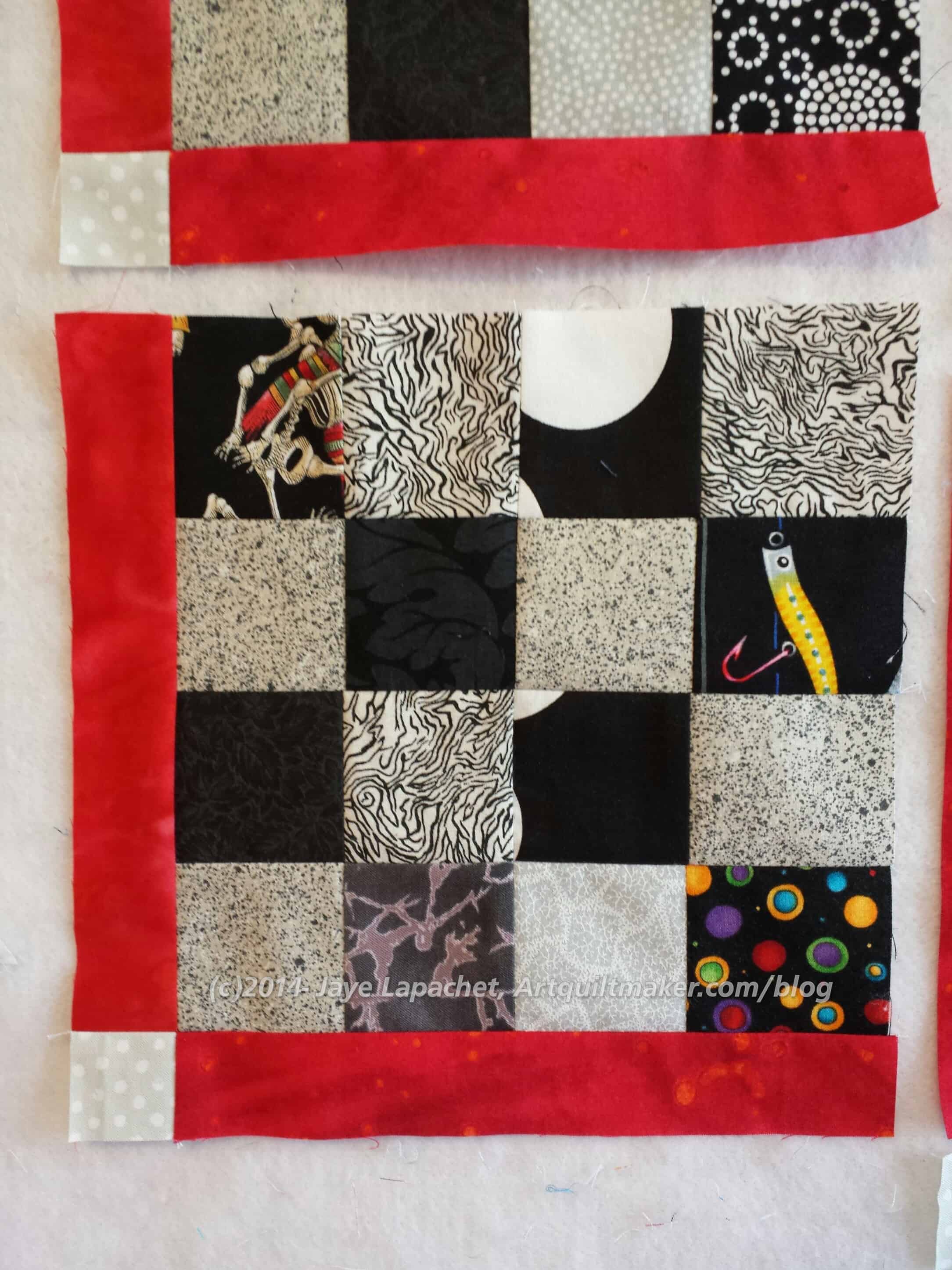
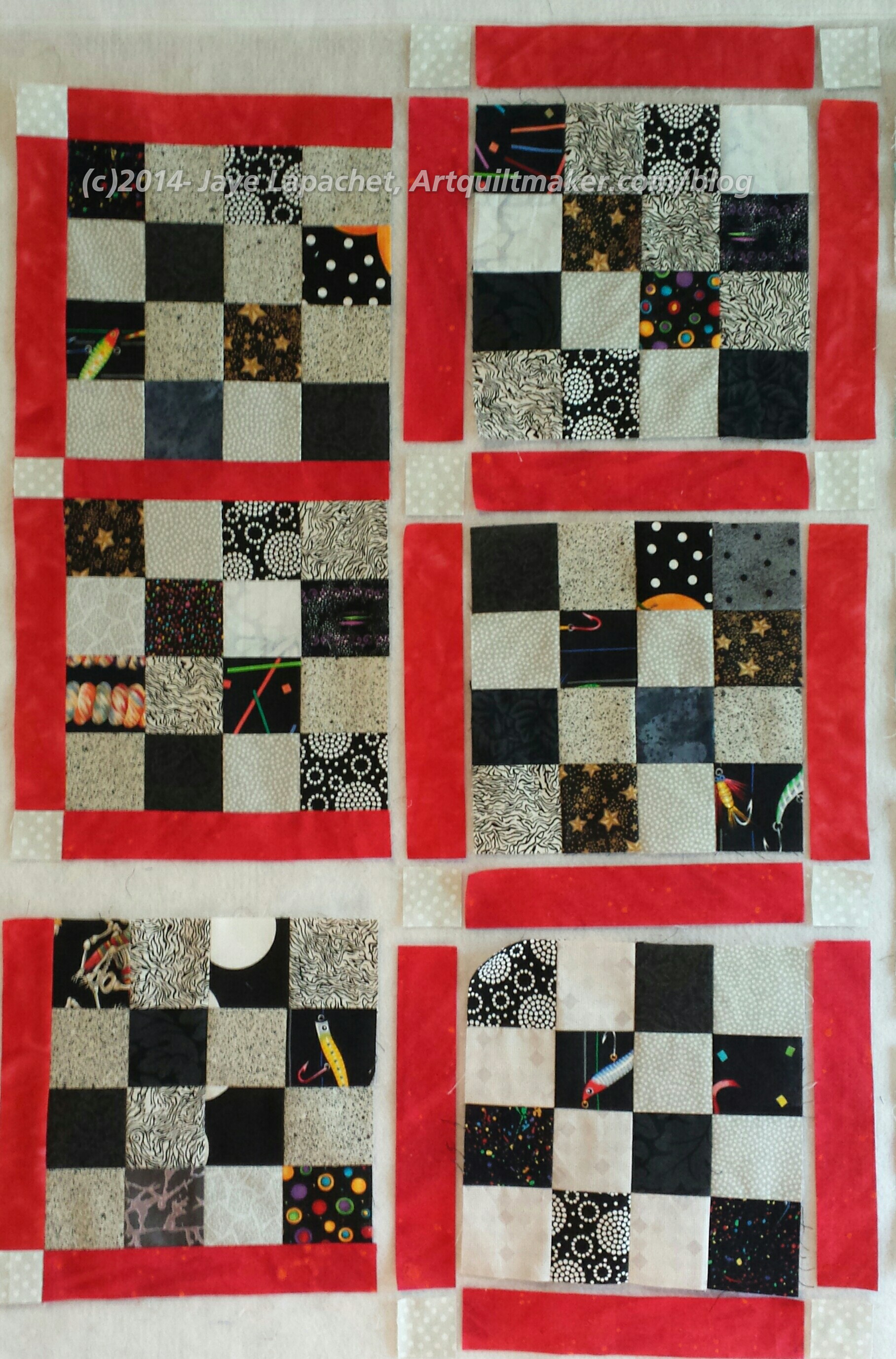
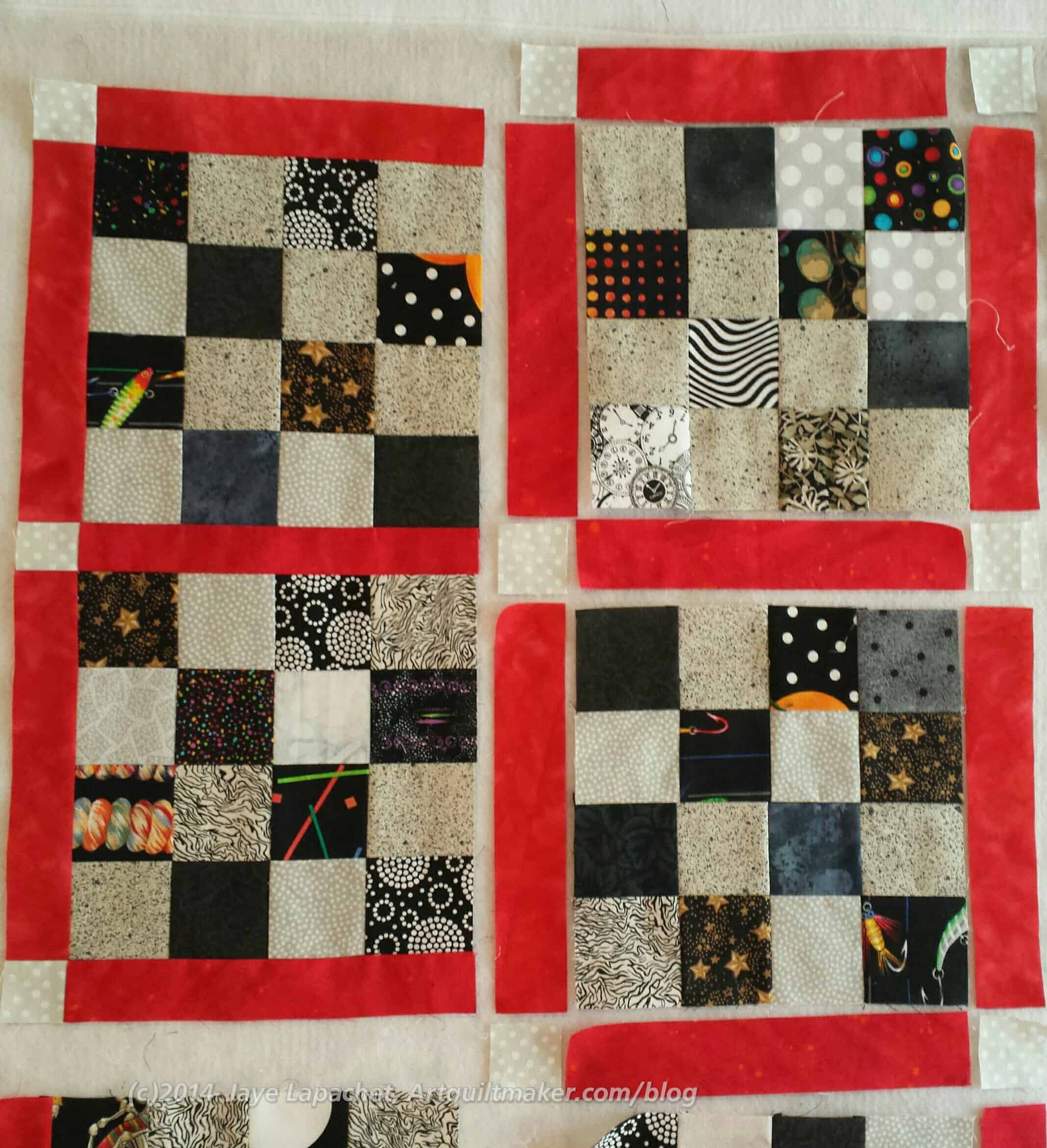
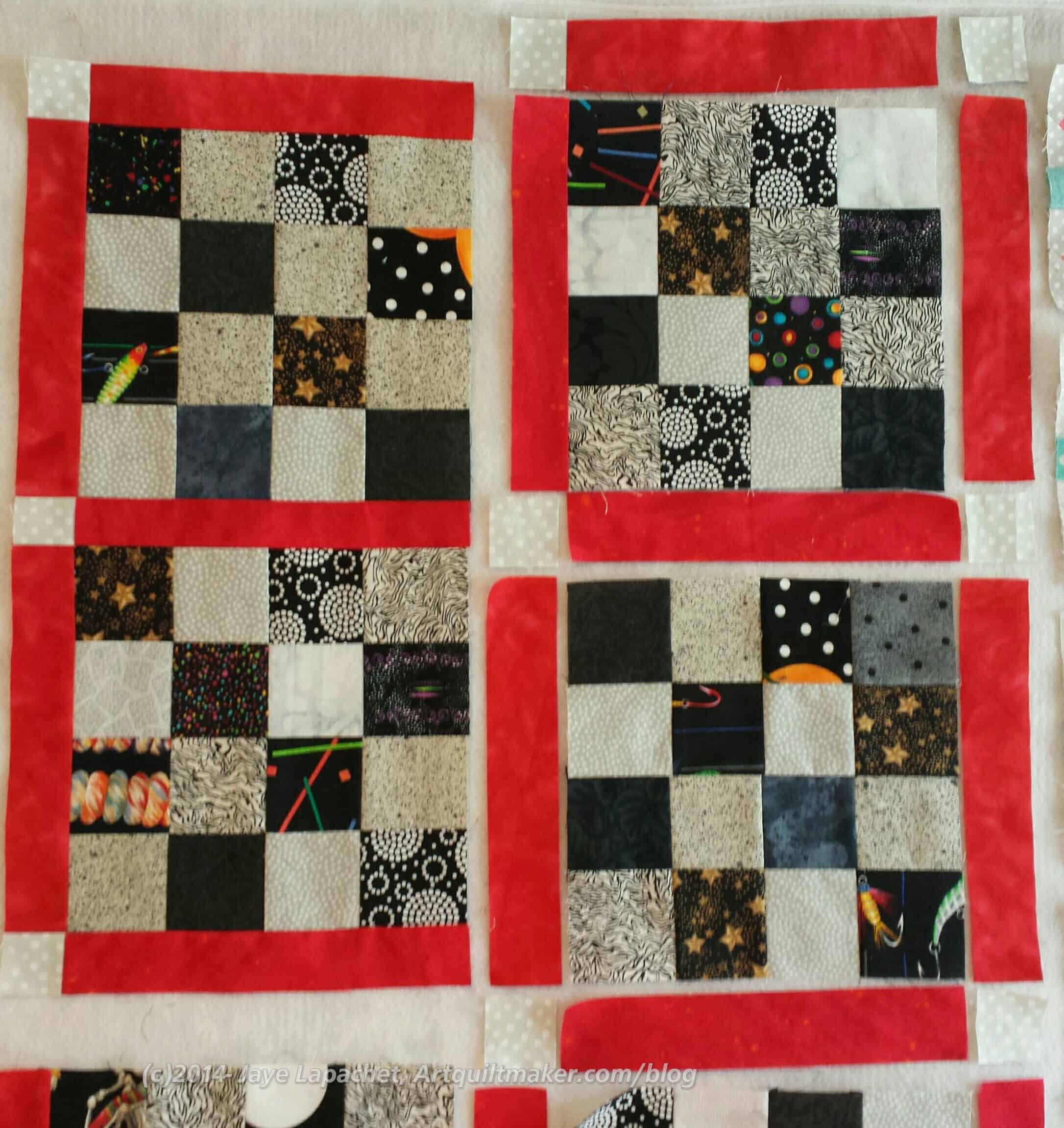
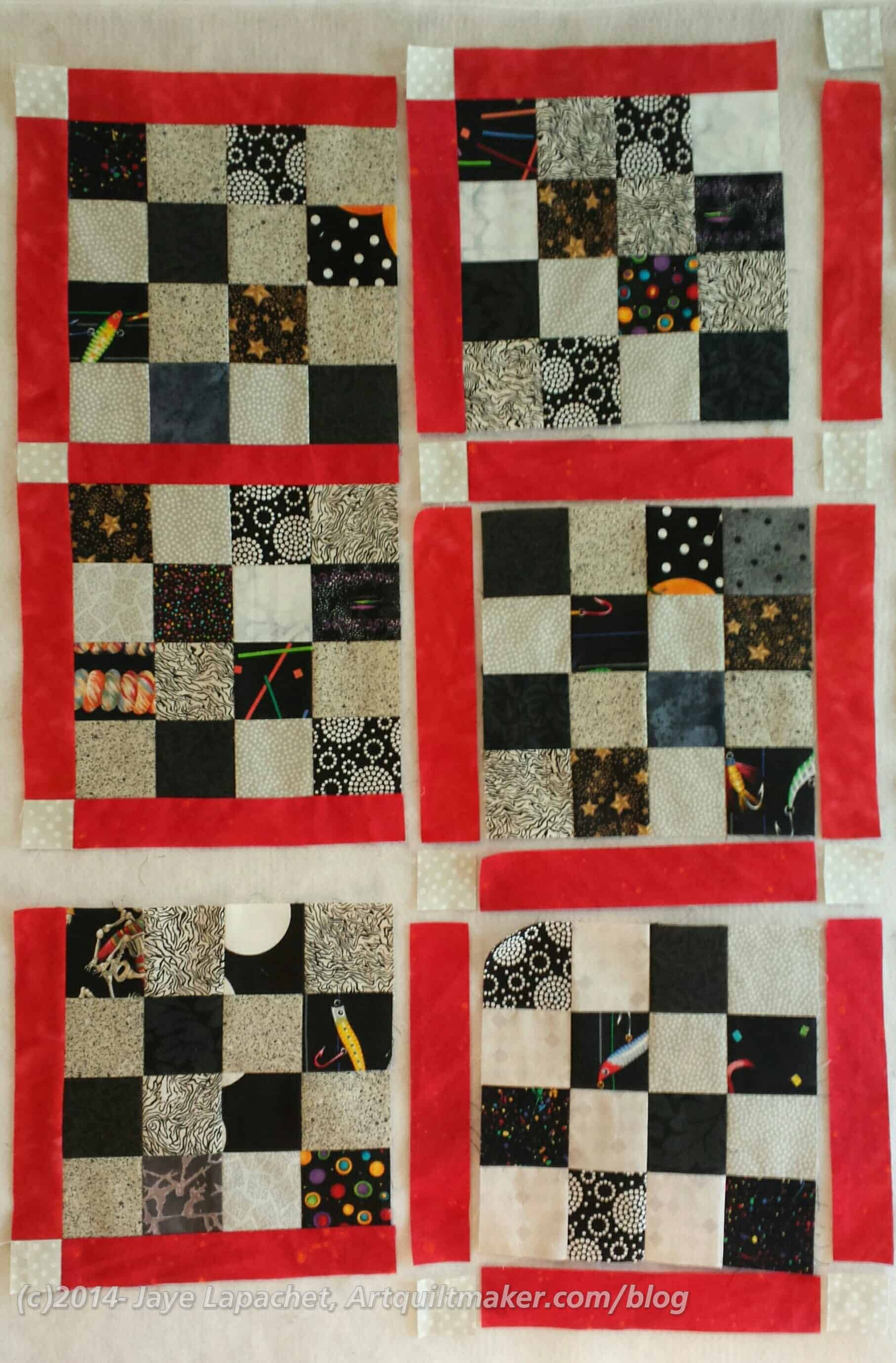
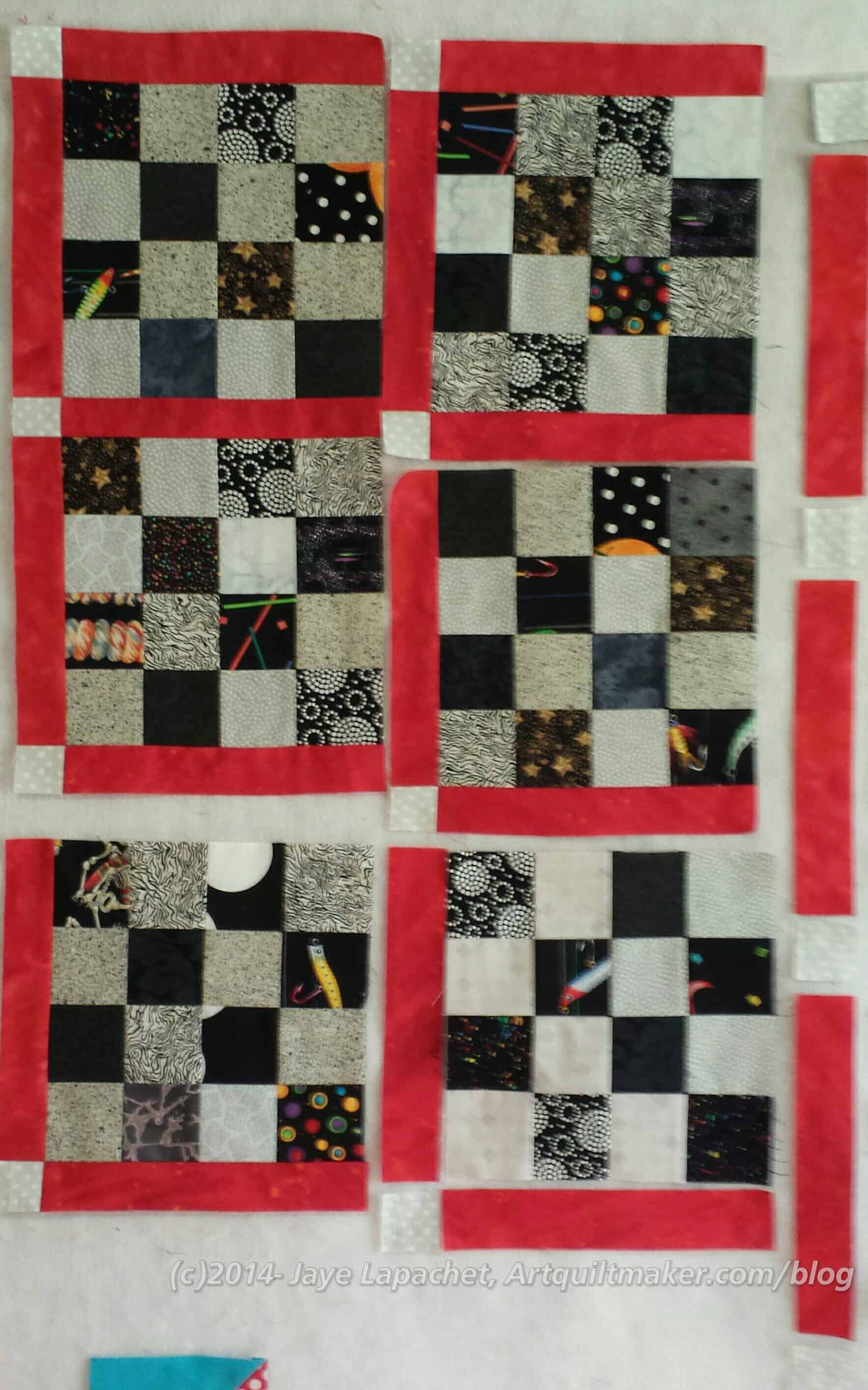
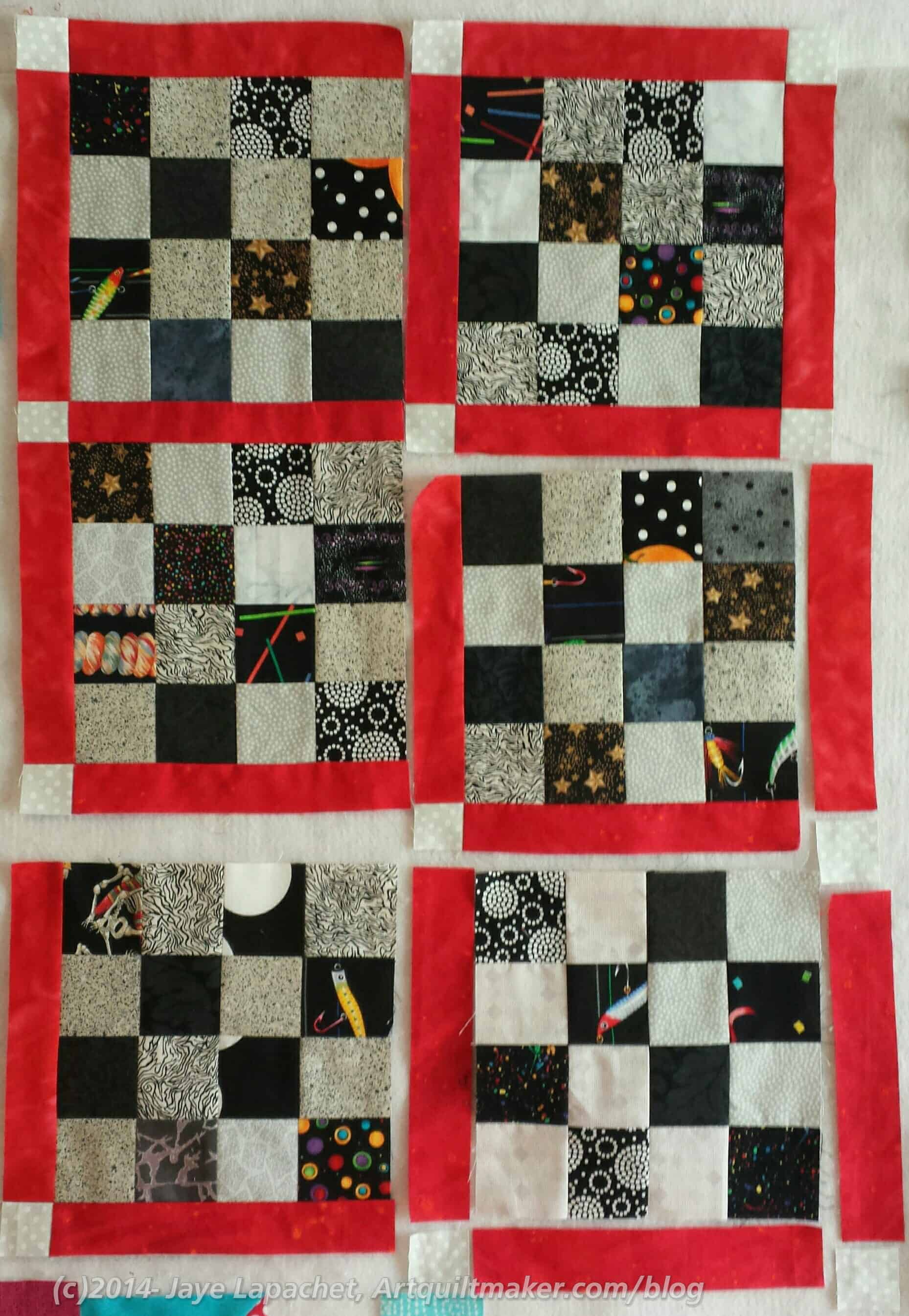
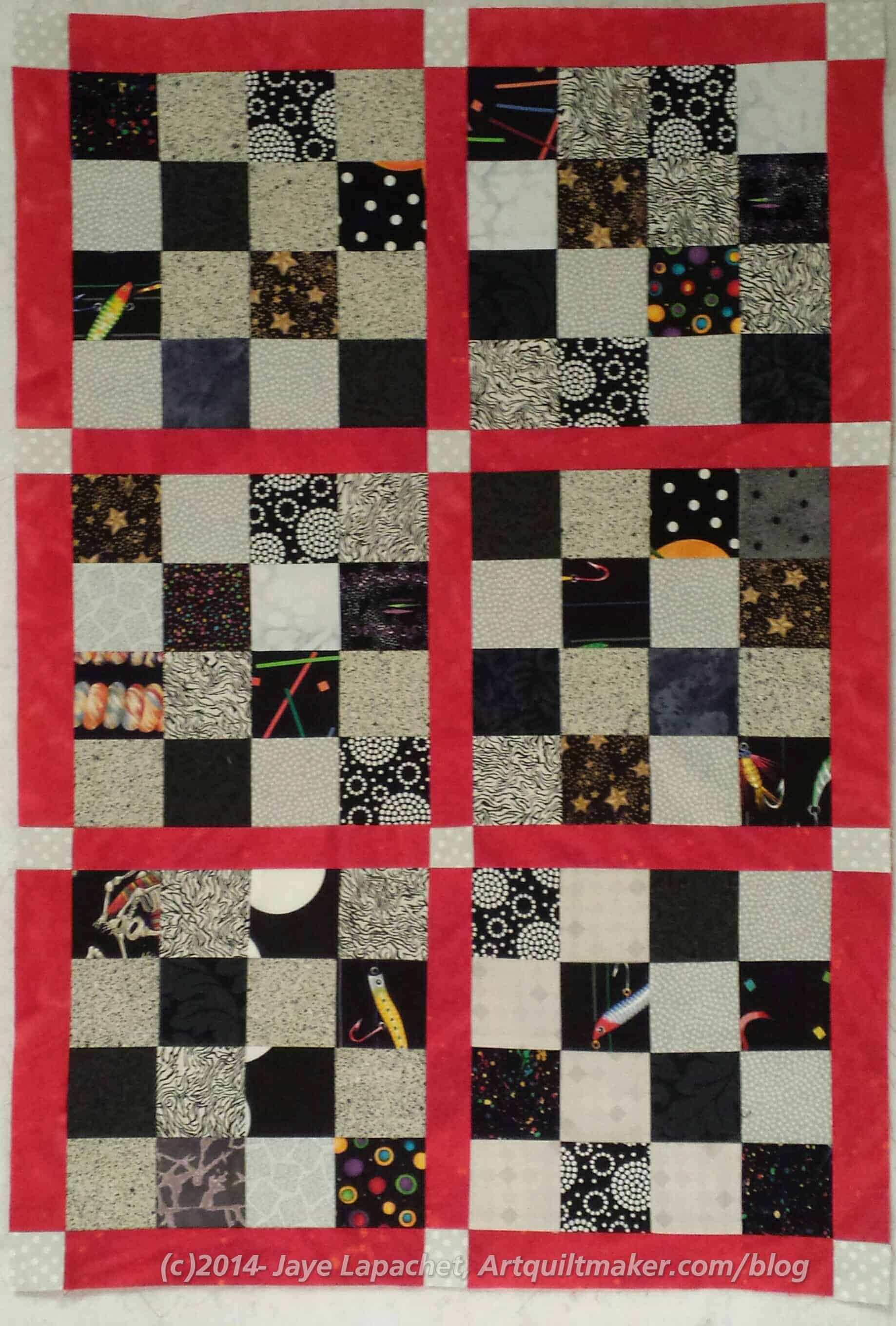
Blocks Laid Out Waiting to be Put Together
The quilt starts out as a bunch of pieces waiting to be put together. In the example above:
Blocks: grey and black Sashing: red Cornerstones: grey
The basic idea is to put the quilt top together as you would a block: sew smaller patches together to create larger sections. I avoid sewing the quilt together in rows as chunking keeps the quilt is more square. Also, my intersections line up much more accurately.
In the example above, the border is incorporated into the construction of the quilt top. If you sew it as you sew the rest of the top you won’t need to put it on at the end. Putting the border on as you put the whole top together will also help line up the cornerstones with the sashing more accurately.
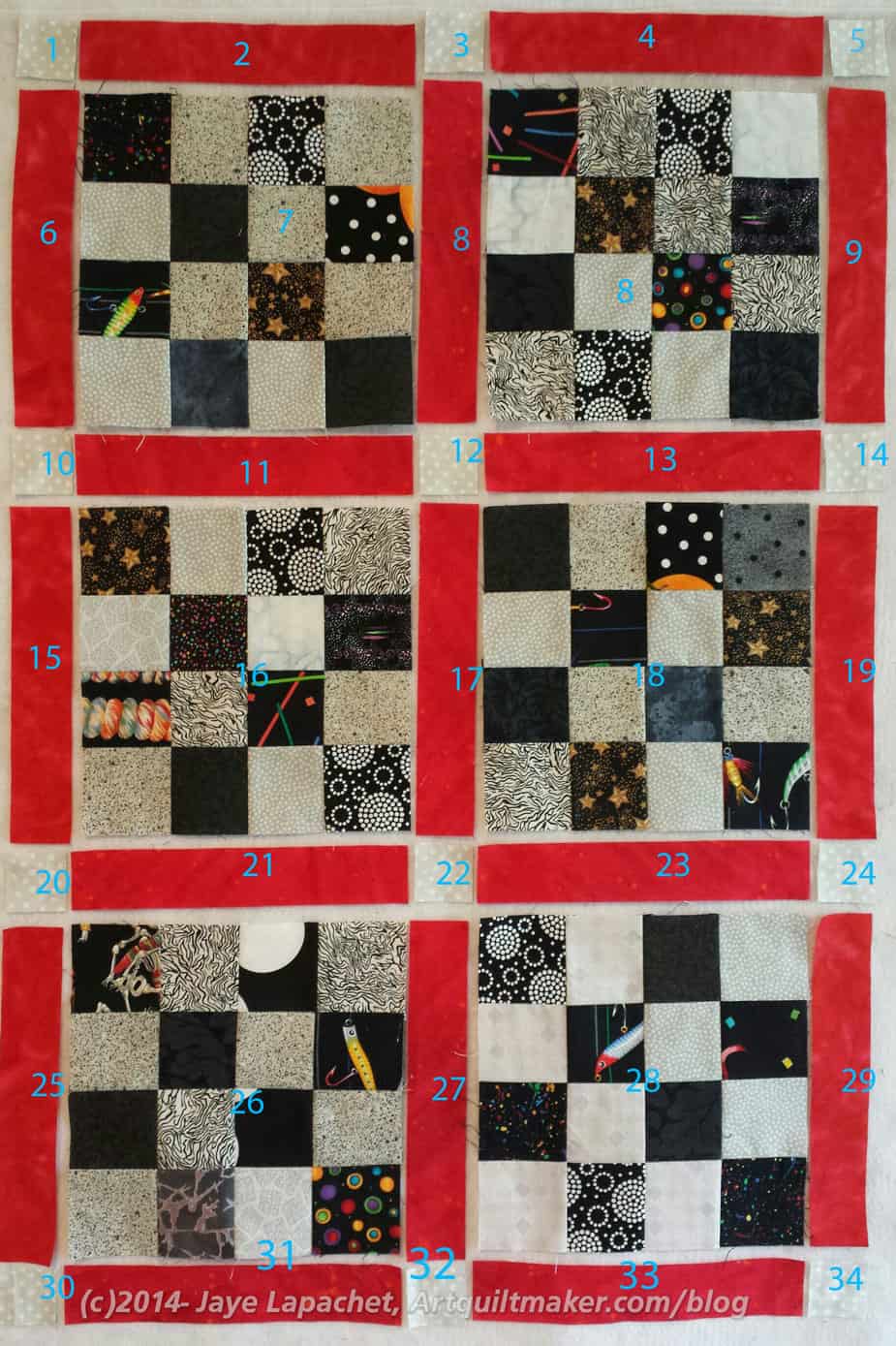
Nota bene: The picture below is numbered, so it will be easier for you to follow the tutorial. You may need to click on the image to enlarge the picture to see the numbers.
Numbered PhotoSew patch 2 to 7
First, sew #2 to #7, the top piece of sashing to the first left hand block. Press to the red piece of sashing. I press to the red, because there are fewer seams to get in the way.
Sew patch 1 to 6
Next, sew #1 to #6, the first grey cornerstone (upper left hand corner) to the first side piece of red sashing.
Sew first 2 sections together
Now you have two sections which you should sew together. This is how you sew the border on. If you had a second border, you could also incorporate that into the piece, but this technique works best when the border is broken up into pieces (e.g. sashing and cornerstone). You can always put additional long borders on later.
First two sections sewn together
You now have your first ‘chunk’! Hooray!
Sew bottom cornerstone and sashing to block chunk
Now sew patch #10 to #11, the bottom cornerstone to the bottom piece of sashing. Then sew that 10-11 cornerstone-sashing bottom pieces combination to the first chunk.
Almost fully bordered block
Voila! You have a chunk fully sashed!
Pin sashing piece #15 to block #16. Now sew the sashing to the block.
Side sashing sewn to 2d chunk
Generally, there will be a piece of sashing that needs to be sewn to a block alone before you can sew a sashing-cornerstone combo to a chunk. You make the ‘chunk’ by sewing a piece of sashing alone to the block.
Sew bottom cornerstone and sashing to 2d block chunk2d chunk
The center ‘chunks’ are just comprised of one cornerstone, 2 pieces of sashing, and a block. Sew the side sashing to the block. Sew the cornerstone to the bottom sashing, then sew the bottom cornerstone-sashing combo to the sashing-block combo for another chunk.
Sew two chunks together
At this point, you can sew your two chunks together.
Now that you have two chunks sewn into a larger chunk, the next step is to prepare your next chunk. You do it the same way you prepared the two chunks above.
Pin sashing piece #25 to block #26
Pin sashing piece #25 to block #26. Now sew the sashing to the block.
Patch #30 sewn to #31
Now sew patch #30 to #31, the bottom cornerstone to the bottom piece of sashing. Then sew that 10-11 cornerstone-sashing bottom pieces combination to the first chunk.
Third chunkTwo chunks
With two pieces of sashing and a cornerstone sewed to block #26, you have your third chunk. You could sew the #25-#26-#30-#31 combo to the chunk you sewed together before, but I suggest you wait until you have more pieces sewed together.
Sew piece #3 to piece #4
Refer to the drawing of your pieces in Step 1. Now we move up to the top of the section again and sew #3 to #4.
Sew sashing #8 to block #8
Sew piece #8 to block #8**. This puts a piece of red sashing on your block #8.
Next, sew cornerstone/sashing #3-4 to sashing/block #8.
Next, sew cornerstone/sashing #3-4 to sashing/block #8.
Sew cornerstone #12 to sashing #13 and then to the block
Sew cornerstone #12 to sashing #13 and then to the block. I don’t have a picture of the two pieces sewn together before I attached them to the block, but you do have to sew them together before you sew them on the block. Now, sew that combination to the block.
Follow the same steps for block #18.
Follow the same steps for block #18 as you did for block #8. Sew sashing #17 to block #18. Press. Next, sew cornerstone #22 to sashing #23 and then to the block.
You will have two new chunks, one with sashing on three sides and another chunk with sashing along two sides.
Sew cornerstone #5 to sashing #9
Sew cornerstone #5 to sashing #9 (upper right).
Sew cornerstone #14 to cornerstone/sashing piece #5-9
Sew cornerstone #14 to cornerstone/sashing piece #5-9. You will have a piece made from three patches.
When you press, press the cornerstone seams in the opposite direction as you have pressed the other sashing already applied to block #8. This will allow you to piece your seams more precisely.
Sew the long thin piece made up of three patches to block #8
Sew the long thin piece made up of three patches (2 cornerstones and a piece of sashing) to block #8, which already has sashing on three sides.
Sew sashing/cornerstone piece #19-24 to block #18
Sew cornerstone #24 to sashing #19. I don’t have a picture of the two pieces sewn together before I attached them to the block, but you do have to sew them together before you sew them on the block. Now, sew sashing/cornerstone piece #19-24 to block #18 (middle right).
Sew sashing #27 to block #28
Sew sashing #27 to block #28.
Sew cornerstone #32 to sashing #33. Now sew combined piece #32-33 to block #28.
Sew cornerstone #32 to sashing #33. Now sew combined piece #32-33 to block #28. This will give you a chunk that is sashed on two sides (left and bottom).
Sew sashing #29 to cornerstone #34, then sew that combined strip to block #28. Pay attention to seams so you can line them up.
You now have five chunks and are ready to sew them together.
Sew the two blocks on the upper right side together.
Sew the two blocks on the upper right side together.
Sew the two bottom blocks together.
Sew the two bottom blocks together. Now you have three chunks.
Sew the top two chunks together
Sew the top two chunks together, which is four blocks.
Sew the bottom chunk, made up of two blocks to the top chunk
Sew the bottom chunk, made up of two blocks to the top chunk, which is made up of four blocks.
I have used a small piece as an example, but the same principles apply to a larger piece. I start in the upper left hand corner and work my way to the lower right hand corner, making chunks and eventually sewing them together into larger chunks until the quilt is finished.
Let me know if you have questions.
You will have easy access to this tutorial via the link on the navigation bar to tutorials.
**Nota bene: I accidentally labeled two pieces of fabric with the number 8 in Step 1. Note that one is a piece of red sashing and the other is a block. Please look at the photos to assist you with the correct sequence of piecing.
This pamphlet could be considered an advertisement for Omnigrid. The reason I am including as a book review on my blog is that the book includes some basic quiltmaking information that is not covered in many other books. As I wrote this, it occured to me that I should cover the info in my sampler classes.
The pamphlet is 64 pages pages long with one of the last pages being an ad for other C&T pamphlets available, including the 3-in-1 Color Tool by Joen Wolfrom, which is a favorite of mine.
Continuing from back to front, the second to last page has a short bio of Nancy Johnson-Srebro with a list (possibly incomplete) of her other books. After the title page, dedication and acknowledgements (pg.4), the books starts with a detailed table of contents (pg.5-6). One thing I noticed is the clarity of the page design and font choice. These qualities make the table of contents very easy to read. Readers can get to the appropriate location quickly.
This is not a project book, though there is a link to free block designs, though the blocks designs weren’t immediately available at the main site link.. I can’t really call it a technique book either, though I suppose it is. The main point of the text is how to rotary cut. Many techniques are shown so the reader can cut almost any shape accurately. You may not have thought you could make certain blocks or quilts using just your rotary cutting kit, but this pamphlet will show you how. Non-square shapes are no problem. This pamphlet helps readers and cutters gain confidence.
The first part of the book (pg.6-8) covers rotary cutting equipment and how to cut. The bad part is that I do not use this model of rotary cutter. The good part is that the text is pretty general and, mostly, covers more than just the displayed rotary cutter model. If you do not use the model shown you will need to experiment with your own rotary cutter based on Johnson-Srebro’s suggestions.
One comment I found interesting was about accuracy. Th author writes “This piece of equipment has almost totally replaced…large dressmaking scissors in quiltmaking. The reason for this is accuracy. When you cut with scissors, the fabric is lifted slightly off the table…” (pg.6). This information makes complete sense, though I never really thought about it in these terms.
The helpful hints for successful rotary cutting “are useful for any brand or model of rotary cutter. Some of the tips are obvious, e.g “change the blade” (pg.9), but some are things about which I wouldn’t have thought such as “you are not holding the cutter at a 45 degree angle…” (pg.9).
The author prefers Omnigrid and Omnigrip rulers and explains why (pg.11). I use Creative Grids rulers because of the half inch with the 4.5 x 8.5 being my favorite. Any good quality ruler without nicks or breaks will work fine with this book. I always suggest that my students buy the highest quality tools they can afford. I still have rulers I bought when I first started quiltmaking. These are tools that last a long time, if you take care of them, and don’t need to be replaced very often. Many of the reasons Nancy likes the Omnigrid and Omnigrip rulers also applies to other brands.
The same treatment given to rulers is also given to Omnigrid mats, including how to clean them (pg.13).
After the introduction to tools, the book transitions to cutting with one of the reasons I chose to review this book: bias (pg.15-19). The author explains what bias is and the different types of bias. What other book does this? What other book even mentions bias?
One important note is included “to help keep your quilt blocks from out of square, try to cut your pieces so that the straight grain (not the bias) is on the outside of edges of the blocks or quilt” (pg.15). This is something critical to quiltmaking. It is a huge annoyance for me when patterns, especially free patterns and tutorials don’t mention bias. Modern quilt designers often do not mention (do not care??? do not know???) about the bias. This section will really improve your quiltmaking, especially your accuracy, if you think about it when you cut. The grainline diagrams (pg.16-19) could be displayed in your sewing room as a visual reminder.
Another reason I chose to review this book is the section on squaring up fabric (pg.20-23). The section covers the process in a very detailed manner, which is helpful if you have never had the whole process explained logically.
I have never heard anyone talk about the V cut. This is the result of cutting strips from fabric you haven’t squared up. Johnson-Srebro calls it “…the Dreaded V Cut” (pg.23). Keep in mind that while cutting you need to re-square the fabric periodically.
After the lesson on squaring fabric, the lessons on cutting start with a square (pg.24-25). In each of these cutting sections, right and left-handed instructions, detailed images illustrating the steps and example blocks are included.
The book includes basic cutting instructions for units as well as shapes. HSTs, QSTs and HRTs (pg.26-33) are covered. Method 1 uses a basic ruler for each of the shapes/techniques. Special rulers are used for HST method 2 (pg.31). The images accompanying the unit sections reinforce thinking about bias by showing where it is on each shape.
Cutting instructions for different shapes such as a 30 degree diamond (pg.34-35), a 45 degree diamond (pg.36-37), which is good for a LeMoyne Star or 8 Pointed Star and an equilateral triangle (pg.42-43). Unusual shapes such as trapezoids (pg.44-45) and parallelograms (pg.38-39) are also shown. For those who want to make lozenge quilts, the Double Prism shape is included(pg.48-49). There are a total of 17 units and shapes the reader learns to cut from this book. I recommend following along and cutting the shapes as an exercise so the techniques are more than theories.
Following a lesson on squaring up blocks (pg.55-56), the author includes several pages of “other Useful Omnigrid Products” (pg.57-59).
This is a good basic book that will improve your rotary cutting skills, if you take the lessons to heart.
The top finally got to be too much. I need to sew most of the top together in order to move the whole piece up (and hang some over the top of my design wall), so I can work on the bottom. I have been sitting on the floor, which is fine, but not so fine when the quilt doesn’t fit on the design wall. Pieces in order on the floor doesn’t work.
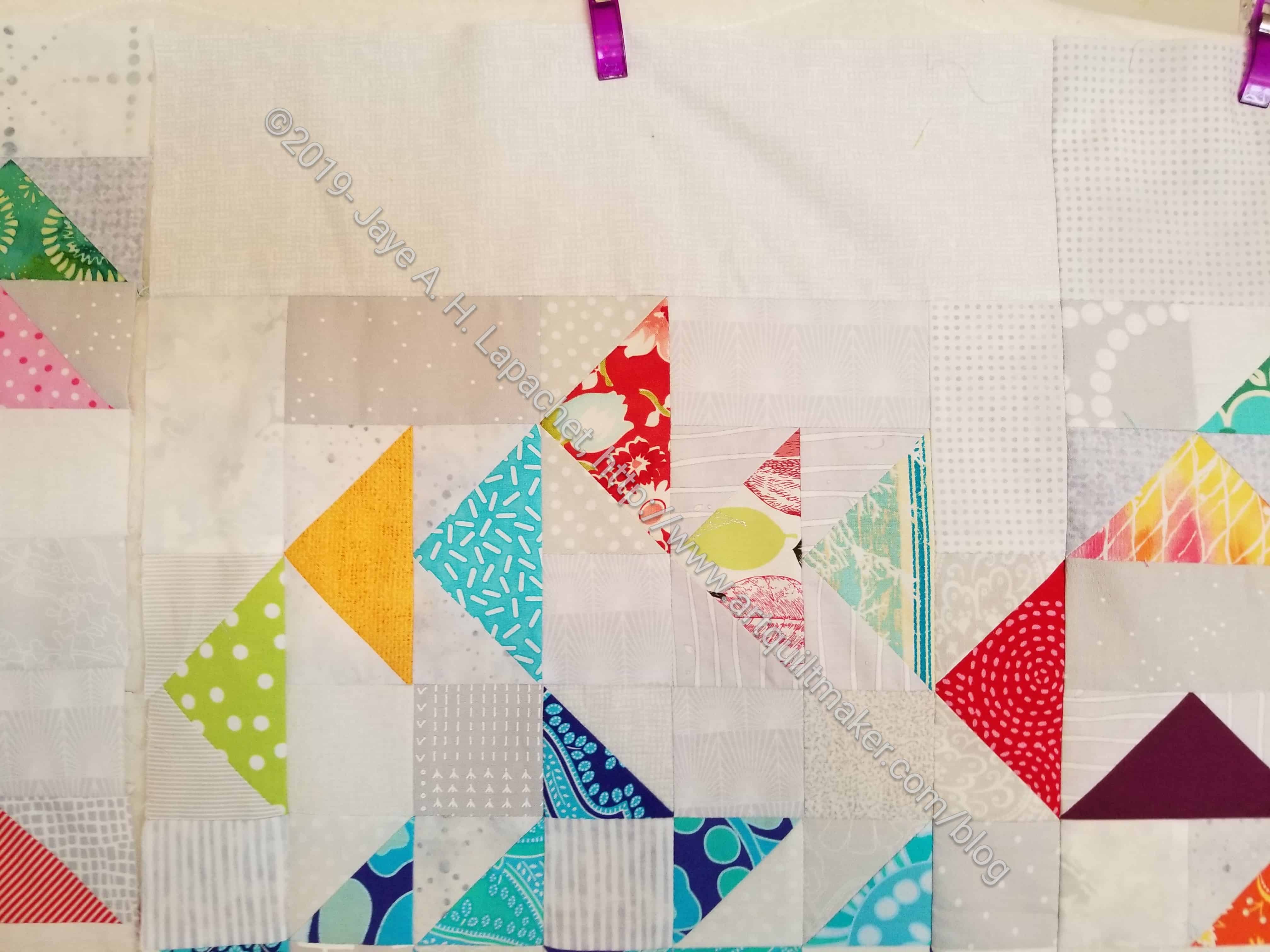
Background detail – Flying Around
In order to move the whole piece, I had to be certain of all the piecing on the top and sew the whole top section together, perhaps including the red-violet and yellow Friendship Circles. The top middle was bugging me, however.
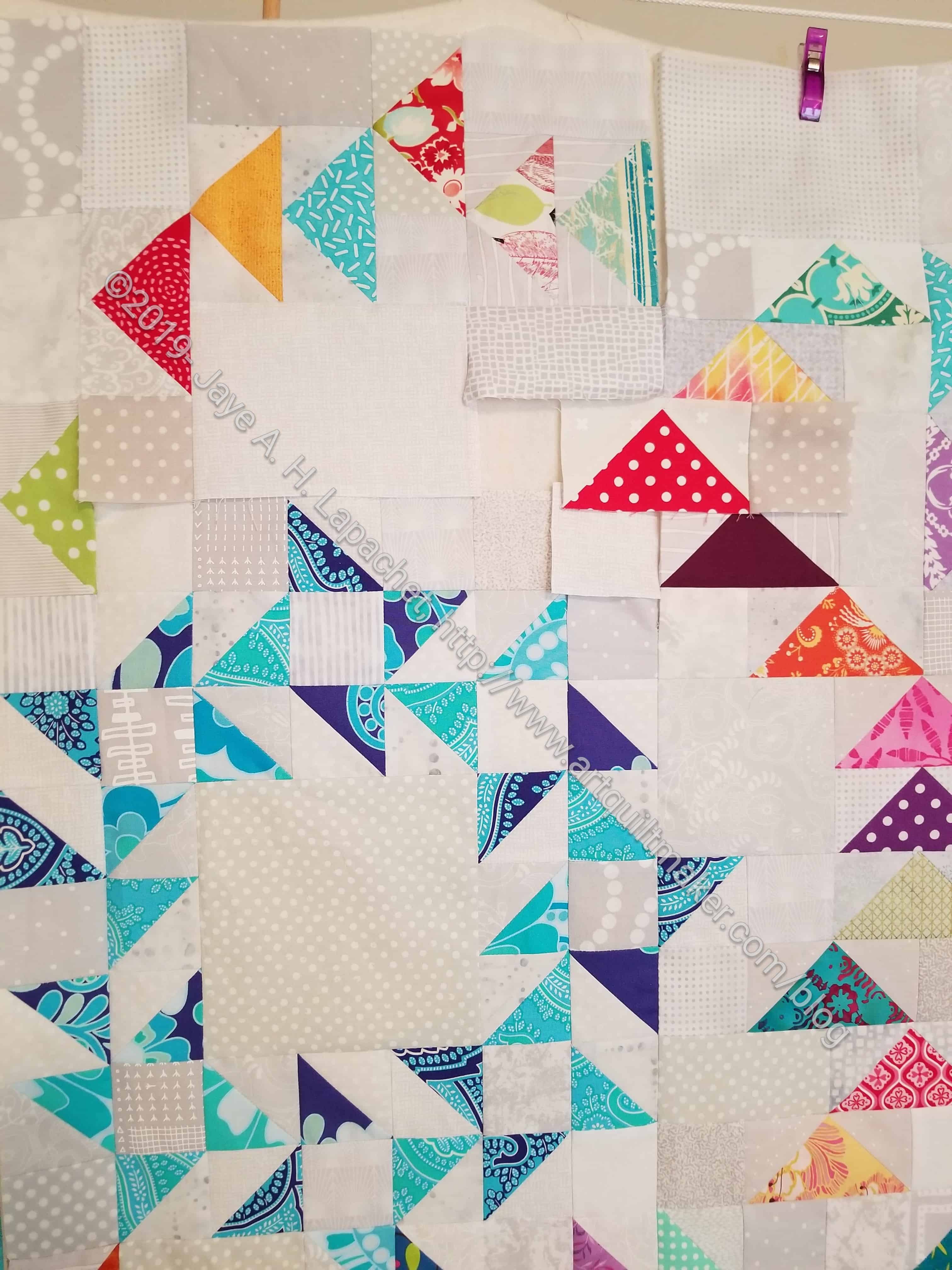
I finally decided that the Flying Geese were too low. They were supposed to add interest that low, but they just looked weird. Unpicking was in order. It was a hassle, but I did it. Anything for the sake of art, right?
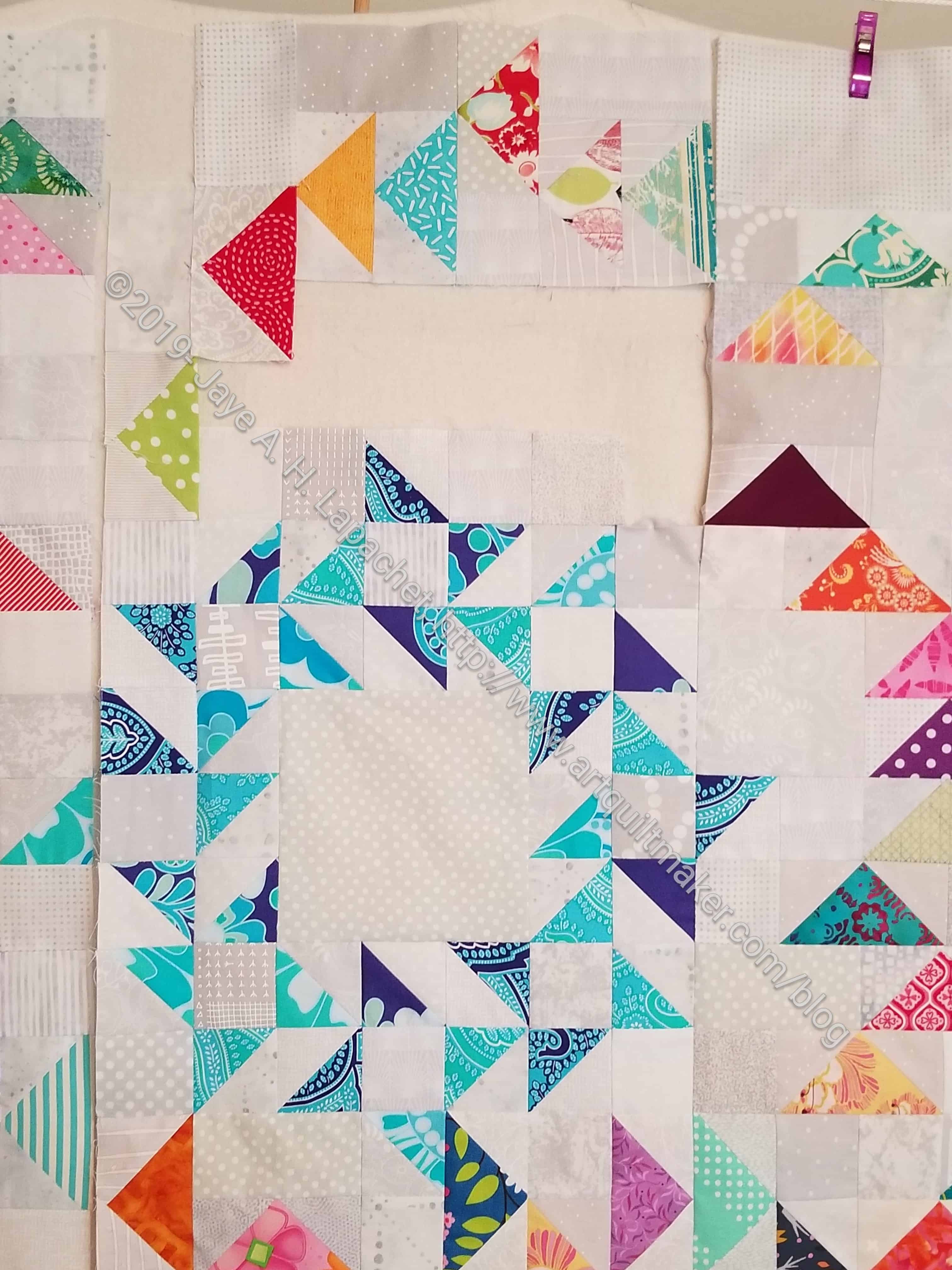
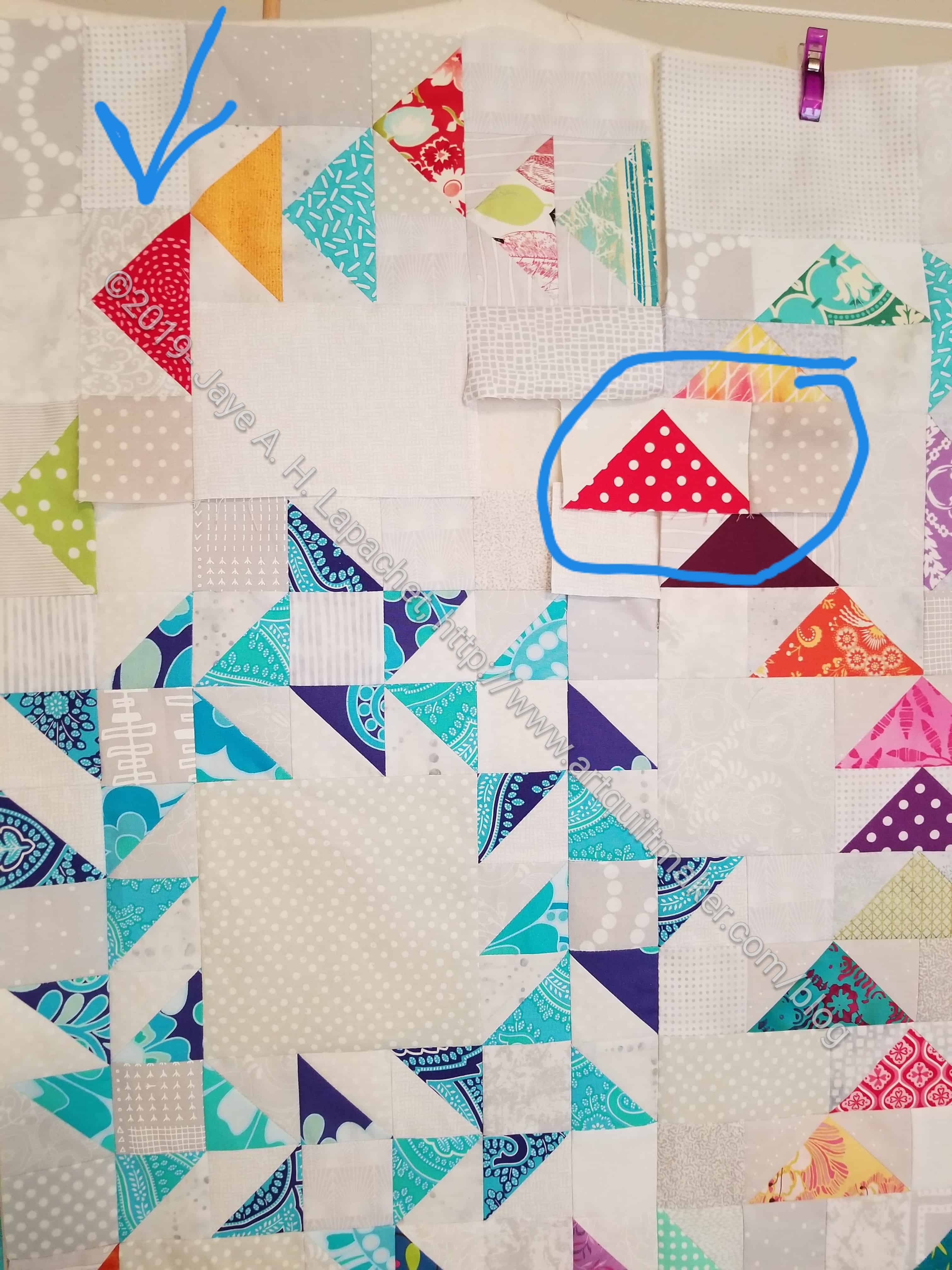
FGs moved up, red FG moved to left
The Flying Geese along edge are supposed to be a border. No, they are not a traditional border, but they are still a border because I say they are. Next, I moved the whole section of Flying Geese up higher. This move was intended to get it more in alignment with the Flying Geese border pieces above the purple and Green Friendship Circles. With this move, I had to move one of the red FGs to the other side of the group.
I don’t know why there is a missing FG between the deep purple and the yellow/pink FGs on the right. That space will have to go. It might have looked arty before. Now, it isn’t right.
That big white space under the new placement is still weird looking. I sewed a piece in. It didn’t look right. Another big space that was not the center of a Friendship Circle just looked wrong.
The answer? More FGs.
Add red FGAdded, moved Flying Geese
I found another red FG, which I thought would work. I think it is looking better. The red dot FG is not yet sewn in. I wanted to see if I could see how it would look before I committed myself. What I think looks strange is the two greens near each other on the right. I don’t know if I will change one of them, but it is a possibility.
I don’t think I will add more Flying Geese to the ‘white’ space. I think I will break it up with different greys and hope that helps.
I had some plain green blocks, which I showed during the process of working on the Purple Strip Donation Top. Obviously, I cut a bunch and didn’t use them. They have been sitting on my sewing table since then. Recently they started to bug me.
Green & Orange Donation Top
I decided that orange would look good with that shade of green. I cut some oranges and have started to put the top together. This is not interfering with Flying Around, but I put the Orange Improv top on a brief hiatus while I put this thing together.
It might just be quick and dirty with no back or batting since I know the Community Quilt stash has both of these. We will see since using fabric is high on my priority list.
I mentioned the Orange Improv donation top yesterday and realized it had been awhile since I showed it. I just finished adding a major piece, so it was time to post it again.
It is progressing. The orange scraps in my drawer are significantly fewer than before. I have some large-ish pieces and am wondering if I should add them as is or cut them up. I like the look of the piece now, which is mainly small pieces.