Here is the journal cover I made for Julie. It is a companion to the pencil roll I made for her birthday. This is actually the third journal cover I have made and this one went together the fastest and looks the best. My only problem was putting it together backwards, so the tree I wanted on the front ended up on the back.
Julie's Journal Cover - front
No matter. I tried to think of it as a design challenge after my initial disappointment. I fussy cut a tree out of the small piece of fabric I had and raw edge appliqued it to the front. I thought that Julie could handle the raw edge stitching.
Julie's Journal Cover - in process
The main green fabric is an old Marrimeko print, as I may have mentioned. The directions I used are a combination of the pattern from Allpeoplequilt.com, the directions on the Exuberent color site (they don’t print well) and my own trial and error and notes from previous journal covers. I use the Miquelrius journals, so those are the journals I bought and for which I made covers. Hope all of the recipients like them!
Yesterday I drove to Monterey to attend a Kaffe Fassett lecture. It was put on by Back Porch Fabrics, a local Pacific Grove/Monterey quilt shop. I have written about that shop a couple of times, most recently on November 4, 2009 after my late October visit.
During my last visit, I saw that they were selling tickets to a lecture by KF. I decided to buy 2 tickets and just go. I knew it would be after a 2 or 3 day holiday extravaganza, but I decided the opportunity was too good to pass up and that I would worry about who to take later.
Signed Books
I left in time to arrive before 2pm, which is when the book signing started. I got about 6 of his books signed and he didn’t mind. He said that I was supporting him and he was glad to sign. 😉 I don’t know why getting books signed thrills me so much, but it does.
Quilt Road Signed
My SIL went with me and she was pleased to see and shop at Back Porch Fabrics. She bought a few fabrics for another Infinity block project she is working on. I bought a few of the Lonni Rossi fabrics so I could make another bag. I bought some FQs there in October and used them all up on Marilyn’s Multi-tasker.
The lecture wasn’t until 7pm, so we had time to hang around Pacific Grove a little bit. We spent a fair amount of time in the shop, partially because it was REALLY crowded and the lines were long. One thing I love about my SIL is that she makes me slow down in quilt shops. She really looks at things, which is a good reminder for me to do the same. Not much else in PG was open, so we went out to eat and then to Home Depot to find some paint colors for MIL, and to Borders to look at books.
After some technical difficulties with the projector and the Powerpoint, the lecture got started at about 7:30. Things I didn’t know about Kaffe Fassett:
He found the name Kaffe in a children’s book about an Egyptian boy he thought looked like him. He took it to replace his boring given name, which he is trying to forget. He refused to tell us the boring given name. I imagine it is Joe or Rod.
He was born in San Francisco, grew up in Big Sur and is now living near the Camden and West Hampton (Hampshire??) sections of London in Kilburn.
He went to a museum studies program in Boston
He learned to knit and purl in 20 minutes on a train, which was followed, later, by another 20 minute lesson from his cleaning lady on weaving in the ends and casting off.
He feels that color is in instinctive, that people have to work hard at conquering their fear of color and to learn to listen to their instincts. He enjoys going to places where there is intense color such as South Africa, India and Guatemala. He feels that color is life enhancing; it can make something elegant. He finds color to be a gift that people can give to themselves every day for a very low cost.
He thinks that there is a lot of visual pollution in the US, such as concrete parking garages, and hideous buildings. He thinks that the buildings in the US are very drab. Every morning I go to a horrifyingly ugly concrete parking garage and wish that someone would add some color to it or embellish it with tiles or mosaics or something, so I have to agree with him. He finds developing countries o be filled with intense color, which he calls visual poetry. He showed a number of slides of buildings in various countries, which were painted and embellished in a different ways.
As you may know, Kaffe started as a knitter. He said that knitters are never bored, are happy in their own company and make things that are very personal. He also said that anyone who says they can’t do what he does hasn’t tried. This is the point where he said he learned to knit in 20 minutes on a train. His point was that people certainly cannot make what he makes if they sit and whine. People have to go to their knitting needles or sewing machine and try, then try again. He said that he makes simple things and spices them up with glorious color. I am not sure his needlepoints are simple, but I get his point, which echoes one that TFQ says:
Go to Your Studio and Make Stuff!
InKaffe’s career trajectory, he moved on to needlepoint after knitting. Some of the chair covers and cushions are just wonderful. I love his vegetable cushion and chair covers. He also create rugs and does quite a bit of needlepoint commission work.
He finds knitting and needlepoint to be slow, so was amazed when he discovered patchwork and saw how fast quiltmakers can cut up fabric and put a piece together. He loves teaching quiltmakers and commented several times on how he loves seeing how people put his fabrics together in new ways.
His adjectives of choice were ”thrilling and ‘exciting’. He uses those two terms a lot when he talked about fabric. He said that making books and fabric allowed him to give part of his creative mind to others and he commented again on how thrilling it is for him to see how people put his fabrics together.
For him, the different media are all about manipulating color and the knitting, needlepoint, fabric design and patchwork all are ways that he can work with color. He said that he painted white on white still lives for a long time, because he was also afraid of color. He continues to be fascinated by neutrals. He talked about how he enjoys putting colors and textures together so they almost merge (you can see what he is talking about in some of his vegetable needlepoint works, in the shading, especially the Lichen Auriculas at Ehrman Tapestry, which is part of the needlepoint slide show). He showed the Vegetable Rug Border Pack in the rug form and also made into cushions. He makes me want to take up needlepoint!
He got around to talking about stripes as well. He said that he is thrilled by stripes and finds that lots of ordinary stripes put together become extraordinary.
He talked about hanging an exhibit of his quilts in France, where he was thrilled to find that the quilt stands had shocking pink background drapes/curtains. He was thrilled and said that he would never find such an occurrence in the US. He finds mostly black and, the most ghastly color against which to hang quilts, white in the US. “Ghastly” was his description and I immediately thought of TFQ.
Philip Jacobs and Kaffe Fassett are now working together. Apparently, Philip Jacobs does large realistic paintings, which Kaffe then recolors in different colorways. One of the recent collections includes some very large sea shells.
Someone asked about creative waxing and waning. He said that life serves up the rhythm and since he travels quite a bit he gets quite hungry to get back to his studio and work, especially when he has been surrounded by inspiring views. He often will see something and go to his studio and make something from the inspiration. This is a piece of advice that I also like.
He hangs up projects which have gotten stale and works on something else. Leaving the stale project around so he can see it affords him the opportunity to be reinspired.
He doesn’t usually plan his projects from beginning to end, but makes the color combination up as he goes along. He also keeps looking at it from different views and angles to see what the piece needs.
Kaffe’s theory about fabric design is that he is working with a palette of color and continually works with those ranges so that newer fabrics work with some of his older fabrics. He is also working on keeping fabrics in print for longer by recoloring them and adding older designs to new collections. He doesn’t want to create a line that is in today and “so yesterday” tomorrow. I completely appreciate this and whish more fabric companies would take this advice. He seems to be going for more of a classic look/feel. I am not sure if that is the right description, because I am not sure I would characterize his fabrics as having a classic look. Perhaps they are the ‘new’ classic?
He said that he is basically a shallow person who likes pretty things. He claims not to have much depth. I think he was saying that we should make things that we like, things with which we want to surround ourselves and I think that is wonderful advice. He encouraged people to just start playing and put something into repeat to see how it looks. He also reminded us to work with simple shapes.
Kaffe finds inspiration everywhere and said that in England the gardens are where the passion is hidden. Aside from this, I think the best advice he gave was that ‘manifesting’ was vitally important and that having the confidence to make the statment [with your work] and enough energy to make the thing in the first place are the most important parts of the battle. Finally, he said it is important to surround myself with other positive people. This advice is stuck in my head and I think the confidence part is particularly pertinent.
His next book will be out in the spring of 2010 and will be called Simple Shapes, Spectacular Quilts.
It was 2 hours each way and I didn’t get home until 11:30 pm, but it was totally worth it and I am glad I went. I am now very interested in taking a class from him.
In the middle of the craziness last week, I just had to make myself a new napkin. We use cloth napkins in my house. Why not? There is a boatload of great conversatonal fabric and plenty of it is in my fabric closet. I don’t use many conversationals in my own work, but I seem to buy them anyway.
During the great Iron-Off that is ongoing I came across two conversationals that would go really well together, so I made a new napkin. Not four, not a set, just one.
Raspberry Cake Napkin
On the back is a luscious raspberry print. The motif is so good that the raspberries look good enough to eat.
The front has that funky cake print. There is a lot of pink, aqua and turquoise.
I use a full FQ for my napkins. I do not try to make them perfectly square and I like having my entire lap covered when I eat.
The bad part about this little project is that neither of these prints will end up in FOTY 2009. Oh well.
I love my sister dearly, but she is hard to shop for. She buys what she wants, so I always have to think early and creatively. I found this Basic Grey fabric and just knew I had to use it for a gift for sissy. She is an invertate scrapbooker and LOVES Basic Grey paper. It started the whole thought process, actually.
Sweet Harmony - Full
On my week away, TFQ tempted me with doing a joint Sweet Harmony Bag by Amy Butler. My idea was that we would each make one at the same time. However, it turned out that we worked together on one bag.
This is probably the last time I will make an Amy Butler pattern. I purposefully did not write the review right away, because I wanted to give the shock time to wear off and give the piece a fair hearing.
While the finished product turned out really well, the directions were overly complicated and the pattern promoted extreme wastefulness.
Here are some tips and things to be aware of when making this pattern:
Trace the pattern pieces on tracing paper and keep the originals all together on the pattern sheets.
Trace the pattern pieces again, but smaller (approximately 3/4″ will work) for the fusible fleece and interfacing pieces. If you don’t do this, the pattern will tell you to cut them full size and then trim them down. Thus, this direction promoted a lot of waste in the interfacing, Peltex and fusible fleece.
Make a separate pattern piece for the inside pocket as well. This is a combined piece and it is just too confusing not to have a separate pattern piece.
Make a chart (Excel or the Google Docs Spreadsheet feature would work) of the pattern pattern pieces you will need and which fibers you need to cut them out of. I didn’t know to do this and ended up laying all the cut pieces out and reading the list over and over while counting pieces.
The designers seem to have a problem with naming pattern pieces consistently. In Step 4G, they ask you to do something to a Lining Panel. This was the first time I had ever heard of this piece.
This pattern and the directions don’t always make it clear which layer (fleece & interfacing or interfacing only) the designer wants you to work with.
Sweet Harmony Org System
Directions should have included a rotary kit (cutter, mat, ruler). The instructions do not include these tools, but they make the process much easier. I understand that the pattern isn’t necessarily targeted at quiltmakers, however I think many sewists now have rotary cutting kits as part of their tool arsenal. If you only sew garments and accessories (e.g. no quilts) and do not have a rotary cutting kit, I think you should go and buy one. What do you think?
Use tailor tacks to mark dots.
Handbag pattern includes a 20″ zipper in the list of supplies needed. Then the designer wants you to modify this zipper to make it about 8″ shorter. I don’t know about you, but I don’t know how to modify a zipper. I also did not want to modify a zipper. I barely know how to put in a zipper. TFQ who has LOTS of garment sewing experience and she didn’t know how to modify a zipper with confidence either. This is another bit of waste. I ended up omitting the zipper (it’s for a an inside pocket), but I would recommend buying a 12″ zipper and not modifying anything. The pattern also gives the pattern pieces for a tote bag, which I did not make, and I believe that the 20″ zipper would work with the tote bag. I think they were trying to save space on the pattern by not listing two supplies.
The marks for the magnetic snaps are below and to the left of where they actually should go.
Sewing piping to outside pocket
The pattern asks you to make much more piping than you actually need. You will really only need about 25″.
Finally, there are not enough pictures, despite the price of the pattern, so I would recommend giving yourself plenty of time and using nice fabric. You may never make it again, so you want to like it!
I think that making all the tote bags I have made really helped in understanding the pattern and how to follow the directions. The final product is really nice and looks very professional. I als learned how to make a pocket that has a little tuck so larger things will fit and you can actually pull it out.
Remember this tote? I wrote about in a post way back in March. I ended up giving it to my mom so I get to visit with it periodically as she brings it over when she comes to visit with the Child.
The financial situation has not improved much, but my mom said in no uncertain terms that we were going to exchange gifts. We didn’t last year and she said it was really hard, so I decided to work on making some her, and a few others, some gifts.
I am not always a fan of giving homemade gifts, because I don’t want to give people things that have that homemade dorky look. I also like giving people things they will actually use and I don’t know yet know how to make iPhones or a Wii.
I have been working REALLY hard at making my fiber stuff look professional. It will never look like it was made in a factory, which I don’t want either. I press really well, poke the corners carefully and am careful about stitching, so I think they look good. In any case, I am not embarrassed to give things I make away.
Mom's Pencil Roll
I decided to make my mom a pencil roll since I thought she would use it and I had a lot of fun making Julie’s during my week away. Kathy‘s patterns (well, at least this one) are fabulous. As I mentioned in a previous post, they are very well written and easy to understand.
Mom's Pencil Roll Open
The most time consuming bit of this project was cutting the strips. I was kind of at a loss on fabric choices until I found the flowered fabric and the turquoise, both of which I used on the tote I made for her. Perfect! She’ll have a little set!
Stitching all the parts together after layering and turning them is also fairly time consuming. I do that topstitching very slowly after marking the lines on the pocket with a white pencil.
For the inside, Kathy says to use flannel, which I didn’t have, so I used batting and it was a little bit thick o sew through. I can’t say I would absolutely not use batting again, but it wouldn’t be my first choice. If I make another one, I’ll try a couple of layers of interfacng, though I suspect that would make the piece too stiff. We’ll see what I have in the fabric closet that might work.
Strips sewn for Pencil Roll #2
Above is a picture of how the strips look sewn together before the whole thing is layered together. One thing I needed to remind myself about was to turn the strips with a strong motif around so it would show after the pocket was applied. I didn’t choose fabrics that would lend themselves to arranging the strips in a colorwash design, as Julie did with mine. I am happy with the arrangement and the idea of making his pencil roll into part of a set.
And Peace and Joy to all of you who do not celebrate Christmas!
Tree 2009
For the past few years we have only put lights on our tree. Our Christmas decorations are still in storage after our kitchen remodel. They are closer to coming out, though. Just one more step and then we can unload the storage facility. Next year we will have all of our own decorations.
This year my mom went to her storage room and got her ornaments. She and The Child decorated our tree with her ornaments. It looks beautiful!
Decorated tree 2009
Below is a detail. The teapot ornament is really a chime. I decided to put it on the tree this year so I could admire it.
No rest for the wicked! Even on Christmas you get a prompt. ;-)I am doing it early so I can do a Christmas post for tomorrow and so you have time to get it done in a timely fashion. 😉
Please note that every single holiday in the universe is NOT listed. This is a small sampling.
Holiday preparations
New Year’s Day
Holiday packages
Three Kings Day
Holiday trip
Martin Luther King Day
I am going on holiday
Valentine’s Day
Golf Holiday
President’s Day
Definition: A holiday is, in the English-speaking world, a day designated as having special significance for which individuals, a government, or a religious group have deemed that observation is warranted.
The Holiday (2006) (movie), Directed by Nancy Meyers
Kwanzaa
Boxing Day
See the Creative Prompt page if you have questions about this project.
Post the direct URL where your drawing, doodle, artwork is posted (e.g. your blog, Flickr) in the comments area of this post. It will keep all the artwork together.
The Creative Prompt Project, also, now, has a Flickr group, which you can join and where you can post your responses.
I am slowly getting a bit of the FOTY blocks done in between the Christmas gifts. I am branching out a bit as well and not putting same color with same color all he time. For some of the color combinations it just didn’t look right. Not sure how I will handle that choice when I start putting together the whole quilt, but I am sure that it will work out one way or another.
Cutting FOTY strips and putting blocks together is my main project for next week
I mentioned that I am trying to make as many gifts as possible for the holidays. I am having fun doing it, but I wish that I had started earlier. I wasn’t sure what to make Grama since all she really likes to do is shop and play bingo. I decided to make her a ‘Grab Bag’ from the All People Quilt pattern.
She has started bringing bags back to the grocery, so I decided to make her this bag. I knew how to make it since I made it for a gift previously and could use a couple of FQs, if necessary.
Grama's Grab Bag in process
I found the older Jinny Beyer border print and a floral for the inside and think that it turned out well. I know she doesn’t read blogs, so I am not worried about ruining the surprise by posting this before Christmas.
My birthday isn’t until January, but during my week away, TFQ took me to Laura Bee Designs, a handbag maker in Seattle, and I was allowed to pick out the makings of a business card holder. It came last week.
I asked about whether she made saddlebag type handbags and she asked me what I liked about my handbag. I found out later that Laura asks many people that question.
Biz Card - inside
I love the bright cheeriness and I am waiting anxiously for someone to ask me for my card so I can whip it out and show it off.
We first heard about Laura Bee from a CraftSanity podcast. You can hear a lot of more about how Laura got started and her whole business.
McDowell’s information is always good. I have to say that, initially, I was disappointed in this book. It seemed to be, mostly, a rehash of the Piecing book, which is one of my bibles, so I know it very well.
After sticking with the book (rather than abandoning it) I found a few good sections. Around page 50, McDowell discusses thinking through a different way of piecing her Muir Woods quilt, which she had done a couple of times before. I really like it when quiltmakers discuss their process and I am also pleased to see that McDowell is working in a series.
One section is about using fabric. Ruth McDowell has a lot of little gems about, which could be considered good ideas and rules to live by, including using and choosing fabric. This section has some commonalities with Lorraine Torrence‘s advice to “make visual decisions visually.” I think this is an interesting section because McDowell gives insight, again, into her process.
McDowell makes a comment [on page 61] that making a quilt is not taking a photo. YAY!! Finally, an author has the guts to come out and just say it. She follows that up with more advice on using fabric in landscapes.
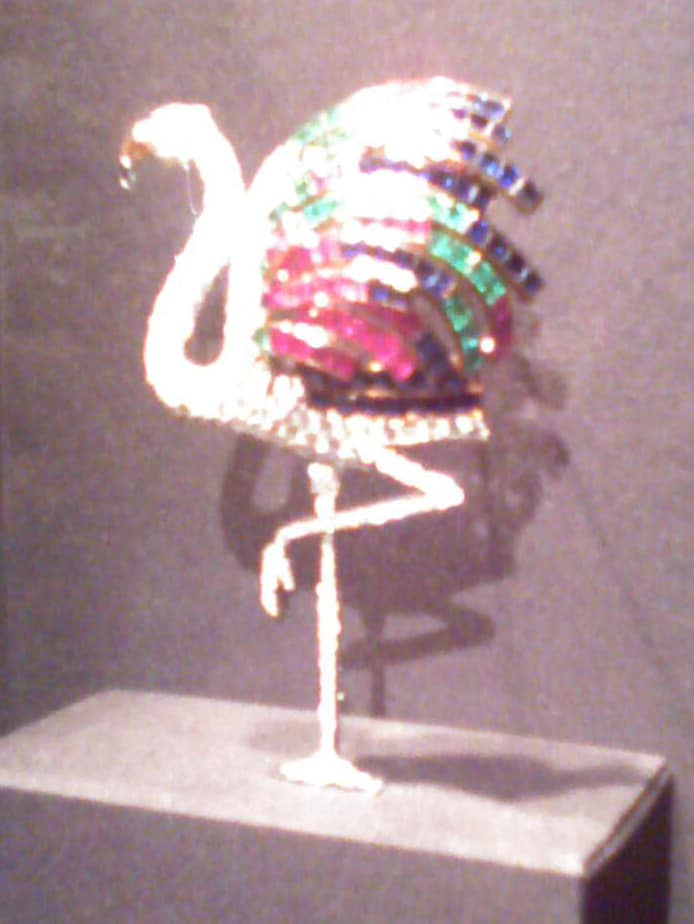
I particularly like the “Flamingo Demonstration”. She really makes a good point about how foreground pieces can blend in to the background if you don’t take care to separate the foreground (in this case flamingos) pieces from the background pieces. McDowell says “regardless of your intentions you must be honest with yourself about what you really see.” It is a reminder to me that if I think “oh, this choice will be ok”, it means that I have been lazy and it will probably NOT be ok.
Ruth McDowell has an excellent discussion of background fabrics and creating backgrounds, especially creating light backgrounds. She talks about including what different scales and motifs adds to and takes away from a background.
Another thought about backgrounds that Ms. McDowell discusses is about balancing colors in the overall quilt. The backgrounds can be unrealistic if the fabrics are the right colors. She says that it is more important to balance the colors in a quilt than make a realistic quilt.
Ruth McDowell is a thoughtful quiltmaker. She really thinks about all aspects of the quilt and their design. After thoroughly discussing the foreground and background, the main portion of the quilt, McDowell launches into an excellent discussion of borders. You might think that borders are easy – just slap on a long piece of fabric and you are done, but McDowell shows how borders can add to the entire piece. She shows what a border is and how the border are part of the piece.
I really like the buffalo quilt on page 82. I am not a big fan of buffalo, necessarily, but I like and respect the way Ruth McDowell completes the composition by using a non-border border. The border in this quilt is so subtle that you don’t even know it is a border. She skillfully integrates the border into the overall composition. I love the fact that the quilt has a border, but it doesn’t scream border at me.
The book has the obligatory section on quilting, batting and binding. Fortunately, Ruth McDowell doesn’t try to teach people how to quilt, choose batting and bind in 3 pages or less. She makes this section her own by telling the reader what she does rather than trying to teach everything there was to know about quilting, binding, and batting.
I was also pleased to see a disclaimer saying that the fabrics may not be available.
Finally, this book has an index. Indexes are fabulous in any book with sections to which you might want to refer later.
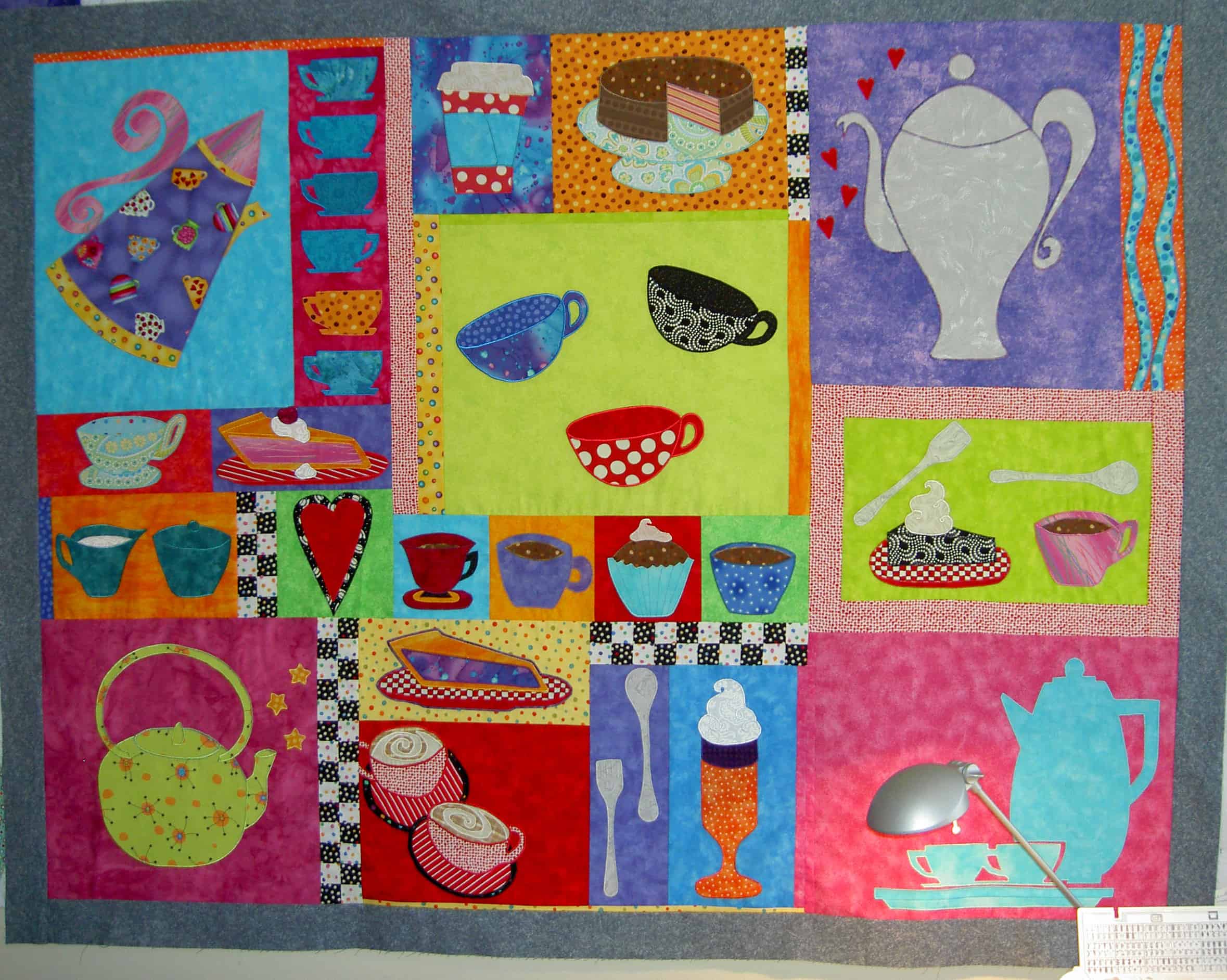
Have you seen the hot drink quilt, She had to have her Latte? I really need to take a better picture. This one was taken in the olden days before digital… No excuse, I know
Post the direct URL where your drawing, doodle, artwork is posted (e.g. your blog, Flickr) in the comments area of this post. It will keep all the artwork together.
See the Creative Prompt page if you have further questions about this project.
I was walking back from lunch the other day. I am always on the prowl for the perfect bag and saw a display of luggage I had never seen before. I looked closer and really couldn’t figure out the purpose of these suitcases. Finally, I stepped back and looked at the store’s sign and found it was a pet store and these carriers were for pets! I was amazed at the complexity.
The other day my sister sent me this picture of her dog, Cherry in the tote I made. I never thought of using the Eco-Market totes as dog carriers, but I am sure it was much cheaper than one of the pieces of luggage I saw downtown. Doesn’t Cherry look cute and sweet? She is sweet, but only intermittently. My Sis saved her from a bad home and she has to contend with 3 other dogs, the smallest of whom is 3x her size!
I hope her little claws don’t rip through. The bag has already been back and forth a time or two.
My life seems to be all about piles lately. I am racing at top speed trying to get everything done and keep house and heart and work and school and everything from bursting at the seams. It is really frustrating.
Desk pile
This is one of the piles on my desk. It is the pile next to my computer; the working pile, often. It is a combination of project notes, book reviews (took this photo while I was writing the review of Taking Flight), bills, reimbursement requests from healthcare, etc.
Book pile
This is the pile hat spurred on this post. It is a pile of books on the floor next to my desk, which are waiting for my attention. One day, I was leaning over to change the radio station and the fell all over the place.
I put all of my craft and quilt books into a database to which I refer before I go to buy a book. My rule is that I only buy quilt and craft books, mostly quilt, though, unless I think I am going to read some fiction book again. I try to check every book out of the library and review it before I buy it. I, frankly, don’t have the space to create a library in my house, no matter how much I would like to do so.
Another Desk Pile
Periodically, I will rip inspirational pages out of magazines and then file them. This pile, towards the bottom, is a big group of those ripped out pages. Somehow I got sidetracked or ran out of space in the middle of filing and it never got done.