Random Quilt Stuff

I went out the other day and encountered some random quilt stuff. I wanted to share some things with you.

On-the-go-snack-case

First, at the Granary, I saw some interesting patterns. I have Organizational items on the mind as that might be the theme of the guild’s next swap. (N.B. Click the ‘join here‘ button so you can participate, too!). I saw a couple of interesting ideas. I thought they would be a little different than the Desktop Cube type project I made recently.  One was a pouch for reusable silverware. I saw the larger one made up and it is a little on the large size, but the small size might be really useful.

Pockets to Go
Pockets to Go

Next, was the Atkinson Designs Pockets to Go** pattern. As you can see in the pattern, there are two sizes. The larger size looks like it would be great for a car trip or to corral personal items in a hotel room. Obviously, this would work very well for Sew Day. It is a little like a purse organizer for things other than purses.

The smaller size would fit very well on desks and next to sewing machines.

This is more like the Desktop Cube type project I made recently, but the handles and pockets make them a little more useful .

The larger size reminds me of the Oslo Tote I made for a swap several years ago.

Madelyn Bag panel
Madelyn Bag panel

Second, also at the Granary, Julie pointed out a tote bag kit where the fabric is a printed panel. The various pieces of the bag are printed on the panel and labeled. For example the long strips at the top are labeled ‘straps’. Sadly, there was no picture of the finished bag on this package. Still, this is a great idea for new bag makers or if you want to make a quick bag as a gift.

I had to go out and do some research to see if I could find out more about this product. I found the Quilt Trends site. On it was the following description “a 36” panel featuring Lazy Girl’s popular Runaround Bag pattern, you’ll be able to make two bags with this versatile panel. The pieces are printed, just cut them out. Basic directions are printed on this panel. If you would like a more complete pattern, the LGD Runaround Bag Pattern is available on this site.”

I also found out that the panel is part of the ‘Madelyn’ line of fabric from Joan Hawley. The site describes this fabric as “Madelyn is Joan’s latest collection for QT Fabrics. The Madelyn Collection is anchored by a Jacobean print in Joan’s 11 piece collection done in her signature colors of aqua and purple. Supporting fabrics contain florals, scallops, tossed leaves, geometrics and a stripe.”

Well, I am impressed that Joan or QT Fabrics thought a great panel to include would be a bag. Good work!

Axe Yamazaki sewing machine

Third, from the MOMA is a fun little sewing machine called the Axe Yamazaki. I don’t think it is really that useful, but it is cute and I would love to take it for a test drive.

Again, I wandered around the Web and found the Axe Yamazaki website, which has better pictures of the machine. “This lightweight, only 4.6 Pounds,
cordless machine can be used anywhere.”  The machine’s size is given as 4.5″D x 11.5″W x 10.4″H. Cost is $168 and the machine comes with a cell phone stand.


**N. B. : Obviously, you should shop at local quilt shops and small businesses. However, if you are too busy or can’t find what you need there, I use Amazon affiliate links and may be paid for your purchase of an item when you click on an item’s link in my post. There is no additional cost to you for clicking or purchasing items I recommend. I appreciate your clicks and purchases as it helps support this blog.

Tim’s Donation Quilt

Tim's donation quilt
Tim’s donation quilt

Tim is getting his longarm back in order. In order to test it, he quilted this quilt, then handed it over to me to bind. I didn’t know he would do that, but I don’t mind.

He has had this quilt in his pile for a long time and doesn’t remember who made it. I think it is an interesting design.

I plan to cut off the excess back and use that for the binding. It’s small and shouldn’t take me that long. No fabric usage for me from this quilt.

Sew Day Pouch Swap

There were 34 people at the Sew Day/Meeting the other day, which is some kind of record. I am not sure what generated the interest, but I am glad so many people came. We have four new members and they came, too.

BAM Pouch swap 2024
BAM Pouch swap 2024

The swap was really successful. I was amazed that almost 20 people participated!

Some were wrapped and some weren’t. Mine was very popular and got stolen twice. It finally ended up with the guild president.

People did nice work, too.

Swap pouch 2024
Swap pouch 2024

I chose a pouch made by SueG. It matches the Poolside tote I was gifted by Angela a few years ago.

I worked hard at posting different patterns on our member forum and trying to generate interest. I guess it worked!

Ends n.20 Top Finished

Ends n.20 top finished

I did finish the Ends n.20 top and back in time to take it to the guild sew day to hand in.

I cut the piece in half and rearranged the strips as I described the other day. I think it looks a little better, but it isn’t perfect. I know someone will like it and it is certainly improv!

I used a large piece of a sea green solid with some added white strips to make the back.

I have only one more set of strips to use up, though I should be getting some quilts back soon.

Getting Started on Old Town

Old Town is the latest Bonnie Hunter Winter Mystery Quilt. In case you don’t know, you need to grab the directions while you can, because she takes them down sometime in February. You aren’t out of luck as Bonnie, later, makes the patterns available for sale.

I have done Frolic! and En Provence. I have the directions for many more, but haven’t quite gotten around to them. Bonnie’s directions are amazing and both of my quilts have come out very well.

Old Town clue #1 - cut
Old Town clue #1 – cut

Right now, the group is in week three or four. I did not get started until after the second clue had been posted. Instead of my usual practice of saving all the clues and deciding whether to start sewing later, I just started on Old Town. I didn’t have a quilt going, though I needed and wanted to start on the Sad Quilt. Also, I had posted the information about the mystery quilt on the guild site and thought I might need to sew a long as well. The colors Bonnie posted appealed even though I know I can choose whatever colors I want. It is easier when I like the colors she chooses.

I did make a small change in the colors. I am using pink instead of red. Why not? I like pink and I am acknowledging that I do.

Friend Julie had a good idea to try out all the different techniques Bonnie Hunter provides in the directions. She shows at least two methods of construction of the units in each clue. These Mystery Quilts are a great way to practice different techniques, try out different tools and get practice on accuracy in the process.

Anyway, I thought I would try out the different techniques as well. Then I panicked when the second clue was posted and I was lounging around in the sun on vacation. I cut up a bunch of squares to make Flying Geese using the Wing Clipper** and just went with it.


**N. B. : Obviously, you should shop at local quilt shops and small businesses. However, if you are too busy or can’t find what you need there, I use Amazon affiliate links and may be paid for your purchase of an item when you click on an item’s link in my post. There is no additional cost to you for clicking or purchasing items I recommend. I appreciate your clicks and purchases as it helps support this blog.

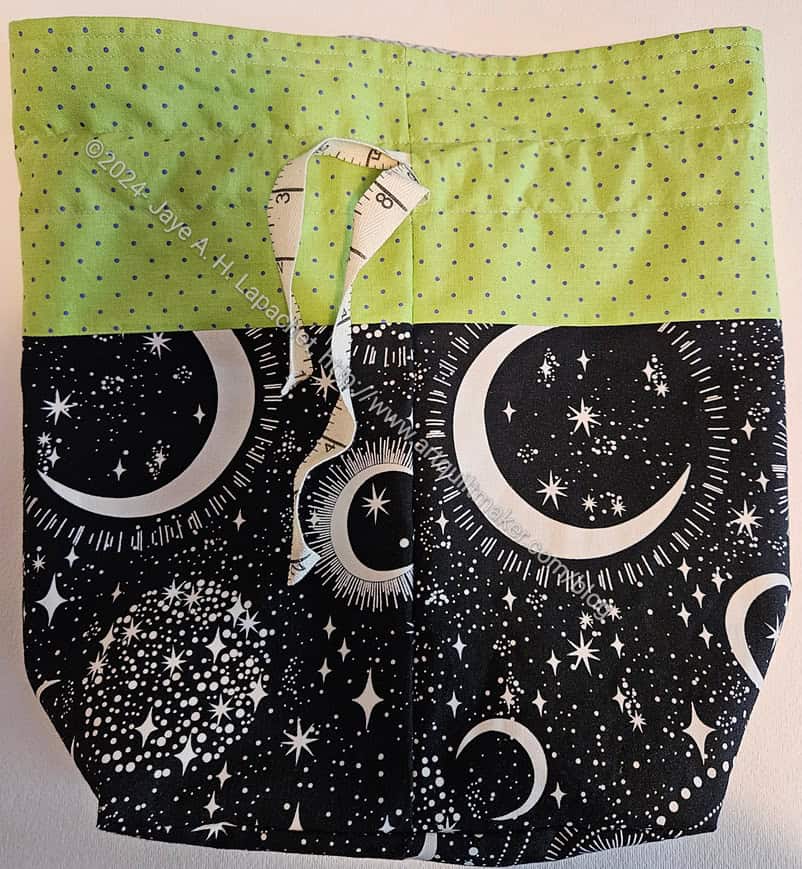
Gift Post: Lined Drawstring Moon Bag

Lined Drawstring Bag for Julie

I made a Lined drawstring bag for Friend Julie for her birthday. It is a different look to all the other gifts I have made her.

She likes moon and stars themes, so when I saw this fabric at Kruusn, I knew I had to buy it and make for a gift for her.

She likes that green paired with orange, too, but I didn’t want to go crazy.

Progress on Ends n.20

Ends n.20 nearly finished

I finished Ends n.20 the other day, but I am not sure the top is really finished.

I don’t like the distribution of the strips. It looks unbalanced to me.

I know it is a donation quilt and I shouldn’t care that much, but I don’t like sending ugly quilts out into the world. It isn’t ugly, but it isn’t right either. It also isn’t good for me to not do my best. I use these quilts as a design exercise and need to do my best.

Ends n.20 where to cut

I am thinking of cutting the quilt as shown and sewing the right edge to the center. That is flipping the cut off piece 180 degrees. The dark and the grey ‘L’ will be in the middle if I do this.

Time to Make Gift Bags

It is once again time to make gift bags. Obviously, Christmas is coming and these types of gift bags make wrapping a breeze. I know many of you don’t celebrate Christmas. These bags are great for any holiday including birthdays, anniversaries, saints days, Hannukah and any other you can think up. I use them for most birthdays. There is always more fabric, after all.

The great thing about these bags is that they are reusable. The other great thing is that you can use ANY fabric; it doesn’t have to be quilting cotton. I have made some gorgeous bags from upholstery fabric I got from FabMo.

Supplies:

  • Fabric – I use either a half yard, a yard or a fat quarter. If you use a yard you can make 4 smallish bags, two medium bags or one large bag. You can make bags with any size piece of fabric and you can make a specially sized bag for a special gift. I once made a gift bag for a weed whacker!
  • thread
  • ribbon- I often save ribbon from packages and other gifts and reuse it for gift bags.
  • Sewing machine
  • basic sewing kit

For this tutorial, we will use a fat quarter of fabric

1. If your fat quarter does not have a selvedge, create a hem using two folds so there are no raw edges. If your fat quarter has a selvedge, use the selvedge for the top. It won’t unravel.

2. Press hem in place.

3. Sew hem with a decorative stitch, if you have it, a zigzag or straight stitch work fine as well.

Optional: you can use embroidery to liven up or personalize the front of the bag.

Optional: If you have stitch letters on your sewing machine, stitch your name and the year so you know when you made the bag.

4. Fold hemmed bag in half WRONG SIDES TOGETHER so that half of the hem is underneath itself towards the top and the fold is on the left. You will be making a French seam.

5. Fold a piece of ribbon about 1.5 feet long in half. You can adjust the size of ribbon you use depending on how much ribbon you need to make a nice bow when you tie.

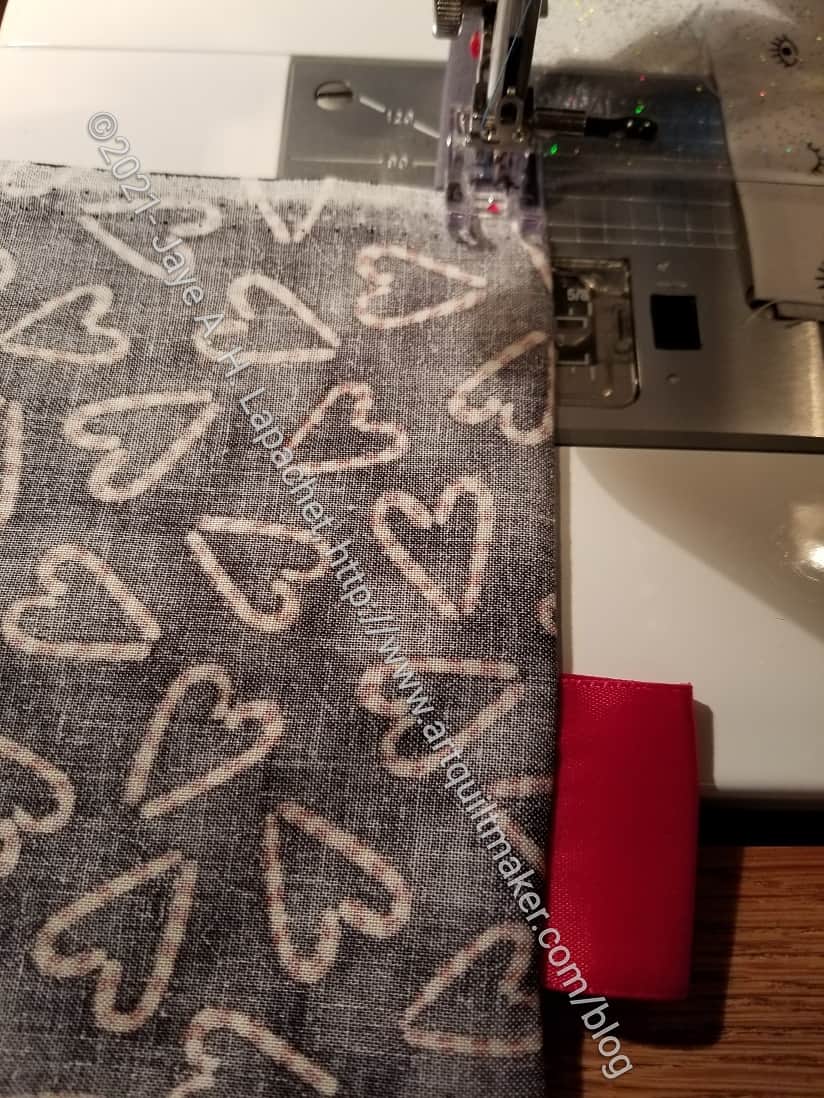
6. Place the folded ribbon in the open side of the bag about 4″ from the top edge/hem.

7. Pin ribbon in place.

8. Pin rest of the right side and bottom closed.

Use an 1/8″ seam allowance.

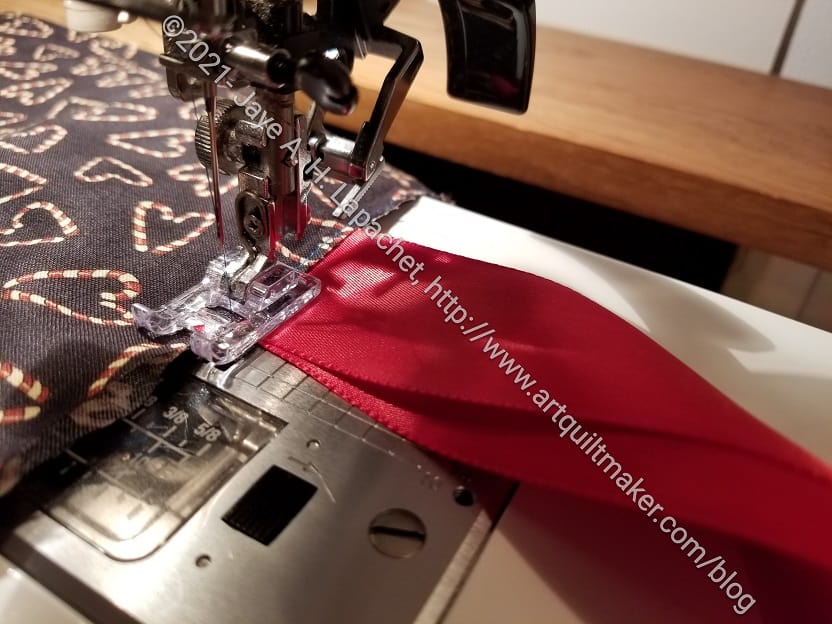
Sew first seam on gift bag

9. Starting from the top, sew down the right side, backstitching at the beginning and over the ribbon, 2-3 times. You want to backstitch at stress points to keep the bag from ripping apart.

10. Turn at the corner and continue across the bottom, backstitching at the end.

Optional: round the corner. It makes sewing and turning easier.

11. Turn the bag inside out, so the right sides are together and the ribbon is out of the way of the seam (It will be inside the bag, but I put mine as straight as possible towards the opposite side of the bag.

12. Press seams, taking care to push them as far out as possible so there is no extra fabric folded near the seams.

Use a 1/2″ or 5/8″ seam allowance.

Finish French Seam
Finish French Seam

13. Starting at the top, sew down the side and across the bottom again to finish the seam.

14. Open bag to make sure the raw edge is completely hidden inside the seam.

15. Turn bag inside out and press.

Voila! Your bag is really to use!

Many people ask about labels. I punch a hole in a gift tag and thread the ribbon through it. You can also buy basic tags with strings** or gift tags** and use those or stick a sticker onto the bag. I would recommend reusing gift tags. We do that, too.

Benefits:

  • reusable
  • reduces garbage
  • good way to use fabric you might not use for quilts
    • Novelty fabrics
    • fabric you don’t love anymore
    • Use fabric you already own
    • orphan blocks
    • vintage sheets
    • Any fabric is suitable including velvet, brocade, knits, etc
  • provides you with the opportunity to buy holiday fabric without committing to making a holiday (or birthday) quilt
  • quick method for wrapping
  • If you track fabric usage, this a good way to use fabric quickly
  • no need to rush out to buy gift wrap
  • no tape or scissors needed
  • small children can help wrap, or wrap their own gifts
  • Fabric costs can be amortized over the years of the gift bag use 😉
  • bags are made quickly
  • hems provide a good opportunity to try out decorative stitches
  • can quickly make a gift bag for an oddly shaped gift, such as the weed whacker I mentioned
  • odd sized bags can be cut up later and used for different sized gifts
  • I reuse ribbon I get from other places for the ties
  • Easy to open and close the gift bag up again if the gift tag falls off
  • Embellishment possibilities are endless, if you want to take the time. Gift bags are a great way to try out different techniques, stitches, embroidery. embellishments or use orphan blocks
Blue Flower gift bag

Drawbacks:

  • takes time to develop a stockpile
  • reusable gift bags have to be stored
  • fabric costs are not insignificant
  • You don’t get beautiful mounds of boxed gifts under your tree

Any gift bags you make will add to your stockpile. You can use leaders and enders to make them, which means that your regular sewing isn’t interrupted much .

Resources:


**N. B. : Obviously, you should shop at local quilt shops and small businesses. However, if you are too busy or can’t find what you need there, I use Amazon affiliate links and may be paid for your purchase of an item when you click on an item’s link in my post. There is no additional cost to you for clicking or purchasing items I recommend. I appreciate your clicks and purchases as it helps support this blog.

Stella Swap Pouch

Yesterday was the guild’s Holiday Extravaganza. SIL#2 organized a pouch swap. I didn’t participate in the last swap, which featured potholders.  I am not a fan of potholders, so I didn’t want to bother. There were plenty without me.  However, I want to encourage people to make bags, and I like making pouches, so I planned from the beginning to participate in this latest swap.

Swap Stella pouch
Swap Stella pouch

After seeing the Center Street Quilts video on IG showing the making of a half vinyl pouch, I decided to try and make one for the swap. I thought I could probably make the pouch after watching the video, but decided to buy the pattern, the Stella Pouch from Center Street Quilts just to make the process a bit easier.

I looked for more specific directions on the Flying Geese and the vinyl, but didn’t find any. Even with the pattern, I still had plenty of figuring out to do. It wasn’t a problem. I knew I could figure it all out. That is one reason I enjoy making bags. There is always something to figure out.

I think I forgot to trim the height, so the pouch is bigger than the pattern states. Still, I think it will be useful. Small project bag?

Swap Stella pouch - back/vinyl
Swap Stella pouch – back/vinyl

I am pretty happy with the way the pouch came out. I am getting more practice with binding the inside edges and I was thrilled to get more practice on the zipper tab technique I talked about a week or so ago. I have big plans to make a bunch of these, but we will see.

Book Review: The New Quick & Easy Block Tool

The New Quick & Easy Block Tool!: 110 Quilt Blocks in 5 Sizes with Project Ideas—Packed with Hints, Tips & TricksThe New Quick & Easy Block Tool!: 110 Quilt Blocks in 5 Sizes with Project Ideas—Packed with Hints, Tips & Tricks by Liz Aneloski

This book is the same format and style as the book I reviewed a few weeks ago, The New Ladies’ Art Company Quick & Easy Block Tool: 110 Quilt Blocks in 5 Sizes with Project Ideas.

This book starts off, after the table of contents, with directions on how to use the Block Charts (pg.4). The page includes a chart key giving readers tips on reading and using the various included charts, especially those that tell makers how sew each block. Quiltmakers are able to use this book in a similar manner to Around the Block, a favorite block book, which is now out of print.

Block Index by Name (pg.5-7) shows all the blocks included in this book. It is arranged by name. While the blocks in the other book weren’t unknown, the blocks in this book are more familiar. There are a lot of basket blocks as well as quiltmaking standards like Dutchman’s Puzzle, Flying Geese, Friendship Star, 9 Patch, Ohio Star, Pinwheel, Shoofly and many others. The authors include a Snowball block, which is a great alternate block to create secondary designs.

The author or editors have colored the block examples so readers can get an idea of how they will look. Remember to try placing colors in different places for a variety of looks. This allows makers to perfect their piecing by using the same pattern over and over to achieve different looks.

The Grid Number Index (pg.8-10) shows blocks together when they are based on the same grid, such as 2 Grid (Four Patch), 3 Grid (9 Patch), etc. This list helps quiltmakers combine different blocks to create interesting secondary designs. Block grids help with construction and also putting blocks together in your own design. This section includes 2,3,4, 6 and 8 grid blocks. 6 and 8 grid blocks are great to blow up into really large elements. They often have more pieces so the design look good enlarged. The large size also makes them easier to piece. Grids are also shown on each block page.

The concept of grids isn’t explained very well, though there is space on the first page of the section, so the authors could add it. I refer you to Jinny Beyer’s The Quilter’s Album of Patchwork Patterns. Ms. Beyer provides detailed explanations about girds in quiltmaking and lists of blocks and the grids to which they belong. It’s a good start to learning about grids as it helps with understanding some of the math of quilt blocks. We don’t always get that information when we just use patterns.

To help readers who use and enjoy pre-cuts, a “Precut Friendly Index” (pg.11) is provided. This information provides a baseline to terms and sizes used in the book. Great idea! The terms and sizes are followed by lists of blocks suitable for the various pre-cut sizes. For example, charm squares (5 in. x 5 in.) can be used for Dutch Rose and Maple Leaf blocks while fat quarters can be used for Starshine and Union Square B. Remember: yardage can be used for all blocks. You don’t need pre-cuts to be successful. You can also make your own pre-cuts by cutting the relevant size off the yardage.

Block making instructions start on page 13 with Air Castle. Included on each block’s page is a wealth of information. Not only do readers find the name and a list of cutting instructions, but the grid, design options, a piecing chart, yardage for a quilt and written instructions. Note that yardage for only one size quilt is given. That varies depending on the block pattern. Some sizes given enable you to make baby quilts, while other blocks have lap quilt sizes included. Readers can extrapolate out for larger sizes.

The Design Options are the best part of this book. The options provided are a great way to use the blocks or a great jumping off point for your own designs. It is also a great way to see how blocks work together. Readers can also see how a block, when combined with others can look more complex. It is a good way to get an understanding of how relatively simple blocks look different and more complex when put together.

Aztec Jewel (pg.17) would be a great block if readers want to show off a variety of fabrics. Further fussy cutting motifs from some of your special fabrics would work well with this block. The example shows two different fabric placement methods.

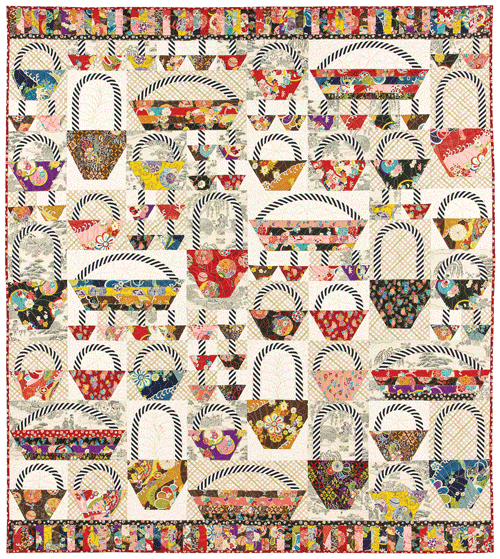
I am a sucker for basket blocks and, as mentioned, there are several in this book, starting with Baby Bunting (pg.18). I would have liked the design options better if they had showed some designs with different basket blocks, like in a sampler. I know, however, that the authors had to focus and that is beyond the scope of the book.

Readers could combine the different basket blocks to make their own scrappy basket quilt. Baskets included in this volume are Basket A (pg.20), Basket B/Cake Stand (pg.21), Basket C (pg.22), Basket D (pg.23), Basket E (pg.24), Basket F/ Flower Basket (pg.25), Basket G (pg.26) and H/Cherry Basket (pg.27).

The design options given for these baskets are not that interesting, but they can start off your design inspiration. For some reason, this group of basket blocks reminds me of Laura Nownes’ Going to Market pattern. The Going to Market pattern does not look like these baskets at all, but you can get some inspiration from it.

Cats & Mice (pg.32) reminds me of a tile floor. In looking at the design option, I am tempted to reduce the amount of piecing to enhance the star motif. I can see, when just looking at the block, that it might be difficult, but the edge triangles could be cut from a QST.

Despite the name, I am interested in the Country Farm block (pg.37). I am not sure I have seen it before, but I don’t pay much attention to frame blocks as a general rule. I think it looks like the background is in the center. It might be a difficult block to use with such a large open space in the center, but it would be another block to use for showcasing large motifs you fussy to size. I think it would be worth playing with the block. It reminds me of Ocean Waves (pg.76) and could possibly be put together in a similar manner with some thought.

Millstone (pg.68) shows a quilt that looks really cool because the blocks are combined. I think the background gives a little visual space so that the individual blocks can shine.

Old Maid’s Puzzle (pg.78) is very traditional. It is often seen in sampler quilts as it uses a variety of QSTs and HSTs. They way they have put 4 blocks together in the design options really makes the block really interesting. I have never been excited in this block until I saw the design in this book. Granted, I have never played with it either.

The design for Paradox (pg.81) looks like a continuous design. by that I mean one block flows into the other. Readers could make a lovely braided design by coloring multiple blocks carefully. For example, using ombre fabrics or carefully placing pieces from carefully gradated fabrics. Using the color wheel and placing the fabrics in ROYGBIV order would be gorgeous. A light to dark arrangement would be striking as well.

This book does not leave beginners out. There are easy blocks in multiple of sizes such as Rail Fence (pg.84). Readers could use a layer cake with this block design very easily, though the pre-cut friendly note says to use Jelly Roll strips.

I am enamored with Jacob’s Ladder type blocks at the moment. There are several different versions in this volume, such as Road to Heaven (pg.90) and Road to Oklahoma (pg.91)

Rolling Stone (pg.92) and Single Wedding Ring (pg. 97) are, essentially, the same block. They are colored differently and the design options look different. This is something that interests me about quilt blocks. People seem to think that putting fabric or contrast in a different place means the block can be renamed. I don’t really agree, though I can see the reasoning in that opinion. In this book, I am a little disappointed in the authors, because they could have added a completely different block and given readers another, completely different block with which to play.

I am sure you have seen the 16 patch donation blocks I make for my guild. I have tried, in different ways, to show guild members different design options with this block. When I saw the Star of Sedona (pg.104) I saw the 16 patch in the middle of the block right away. I immediately thought of adding a border of squares and HSTs to some blocks I haven’t yet handed in. This would throw the community giving team for a loop, but would make the blocks more interesting and larger. The color/ fabric placement we use in the donation blocks are incorrect for the Star of Sedona, but might work. Definitely something to try.

After the block section is finished, the author has included a section called Tips & Helpful charts (pg.123-128). As the title indicates, this is a useful section. I recommend you mark and keep it in mind for later. It will be useful to know that there are tips on cutting different shapes (pg.123) and also information on how to sew various shapes (pg.124).

The ‘Grids’ paragraph (pg.123) is too short, but useful. It is a good start, or additional information, on being able to look at a block or quilt and figure out the block or the piecing.

The authors say, in the ‘Create New Blocks’ paragraph, “Create more complex blocks by repeating and rearranging simpler blocks in groups of four or nine.” (pg.123). Keep in mind that if you choose blocks with the same grid, your quilt will look more cohesive. Of course, that needs to be the look you want. There is value in trying a variety of blocks together.

The ‘Corner Alignment for Piecing Shapes’ (pg. 125) is from Alex Anderson’s Simply Stars book and is one of the most useful charts around. Use this chart to ensure you are lining up your triangles the correct way for the best piecing outcome.

Find information on yardage (pg.126), sizes for on point designs (pg.126) and a chart for changing block sizes (pg.127).

Piecing blocks is a great way to hone your sewing skills. This book can support that as well as a desire to step away from patterns and create your own quilt designs. Piecing blocks is also a great way to get your sewjo back. Blocks can always be donated to a community giving project after you have moved on.


Finished: Green Strips n.2

Finished: Green Strips #2

Friend Julie posted about binding Green Strips n.2. Someone else quilted it, possibly Laura, and Julie bound it.

I am glad to see it is done, especially since I only finished the top and back in about October.

The green drawer is still relatively empty, though I have a huge pile of unprocessed scraps on my cutting table, so I am sure that won’t last. I need to find some time to deal with them. Maybe Sew Day?

Started Ends n.20 Donation Top

Ends n.20 start
Ends n.20 start

I am trying to use up all the ends from various quilts. This is another group of fabrics from the BAMaQG IRR quilt with a few from Pointillist Palette n.4 thrown in. The pieces seem to be a random assortment of sizes, so I am doing a bit more fiddly piecing than I normally would.

The PP fabrics on the right are a little heavy, so I may move one of the pieces to the left. It will kind of ruin what I have going with the grey strips, but maybe I can create something better.

I hope to get this done before Saturday’s meeting, so I can hand it in. We’ll see.

Brimfield Tablerunner Plans

Brimfield Block
Brimfield Block

I got a sample of the Brimfield Block at QuiltCon a million years ago. I might have bought the templates for one block. I can’t remember. It is from a company called Brimfield Awakening. I am a little put off by the name. Somehow it reminds me of brimstone.

Anyway, I finally dragged out this block to have some handwork to take on vacation. I have no knitting going, the needlepoint project is too large and La Pass is also too large. I came across this block and decided to work on it.

The table runner will be for our buffet and will comprise 3 blocks.

I spent the Sunday before we left cutting out small pieces of fabric, organizing templates and making sure I had everything. I was sure I would be glad when I could just pull a piece out and start sewing, but it felt like a waste of a day. I didn’t get to sew much at all.

One struggle was  that the illustration on the pattern cover was very distracting. I looked up some samples on IG and found a sort of layout I liked, then I rummaged through my fabrics to find my favorites.

I hope to show you some progress soon.

Gift Post: Holland Pouch

Black Cat Holland Pouch

I finished the Holland Pouch while I was in Portland in October. It was a pretty quick sew – ~6 hours from start to finish. I  wasn’t feeling my best, so I knew I could make it faster.

Center Street Quilts directional fabric chart

I bought this pattern at Stitch during the July trip home from Portland.  The fabric was also purchased during that trip at Sewlarium. It was a great choice for this bag.

The directions show how to position fabric if it is directional, which is the first time I have seen such a feature in a pattern, that I can remember. I’d love to see this type of chart in all bag patterns. I know most say something like “all cutting directions are width x height”, but having the visual makes a huge difference for me. Even before I saw this chart, I drew little pictures of how directional fabric should be cut in my various patterns.

Black Cat Holland Pouch - interior
Black Cat Holland Pouch – interior

I used some hippo fabric and hope he remembers visiting the hippo at the zoo when he was young.

This is the first bag I have made for the YM. I hope it is one he likes and will use it. I sent it off to him for his birthday, which was on the 30th.