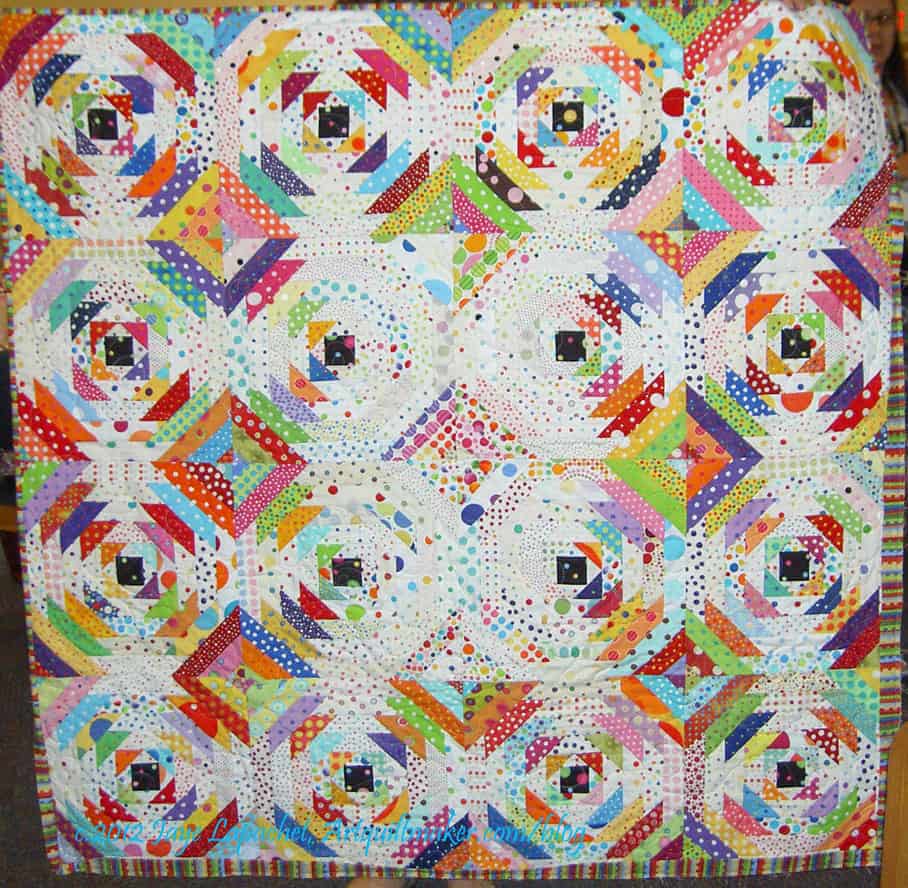
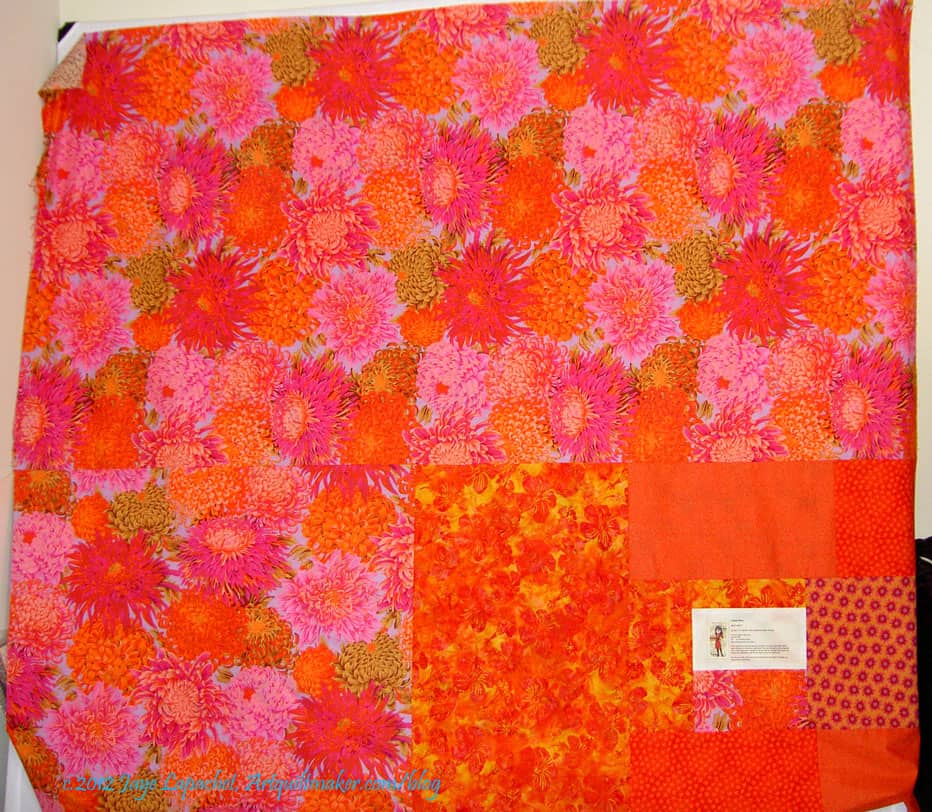
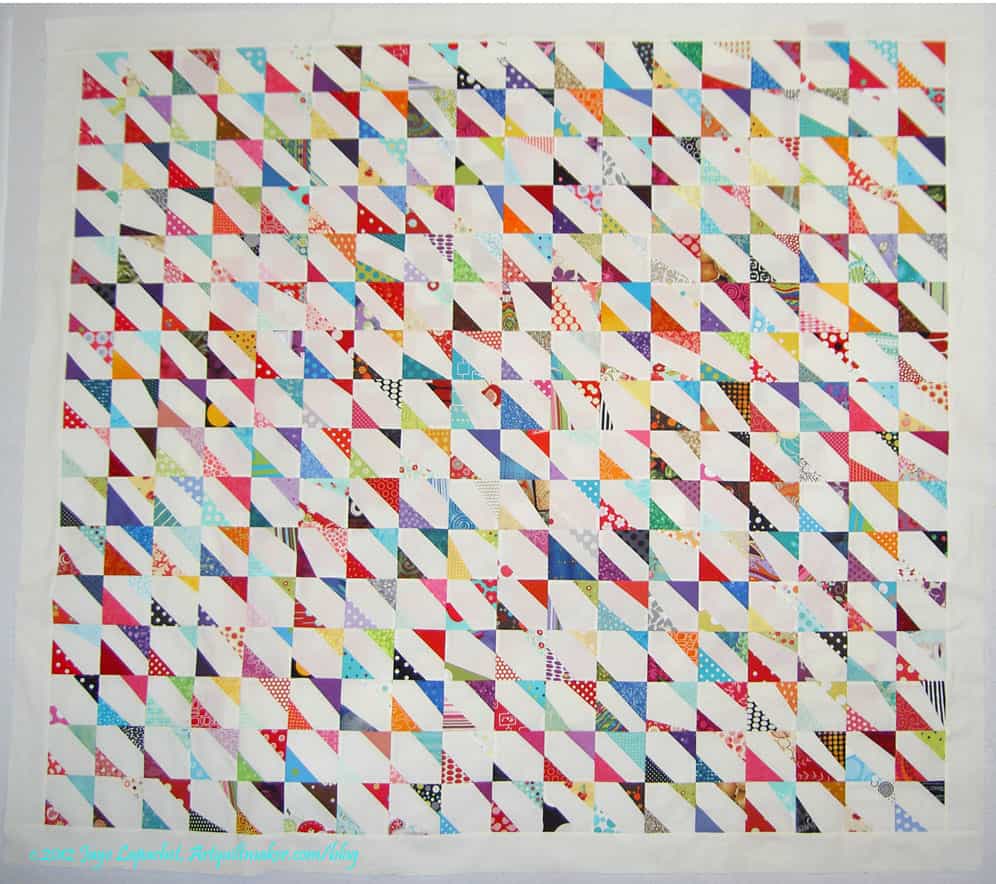
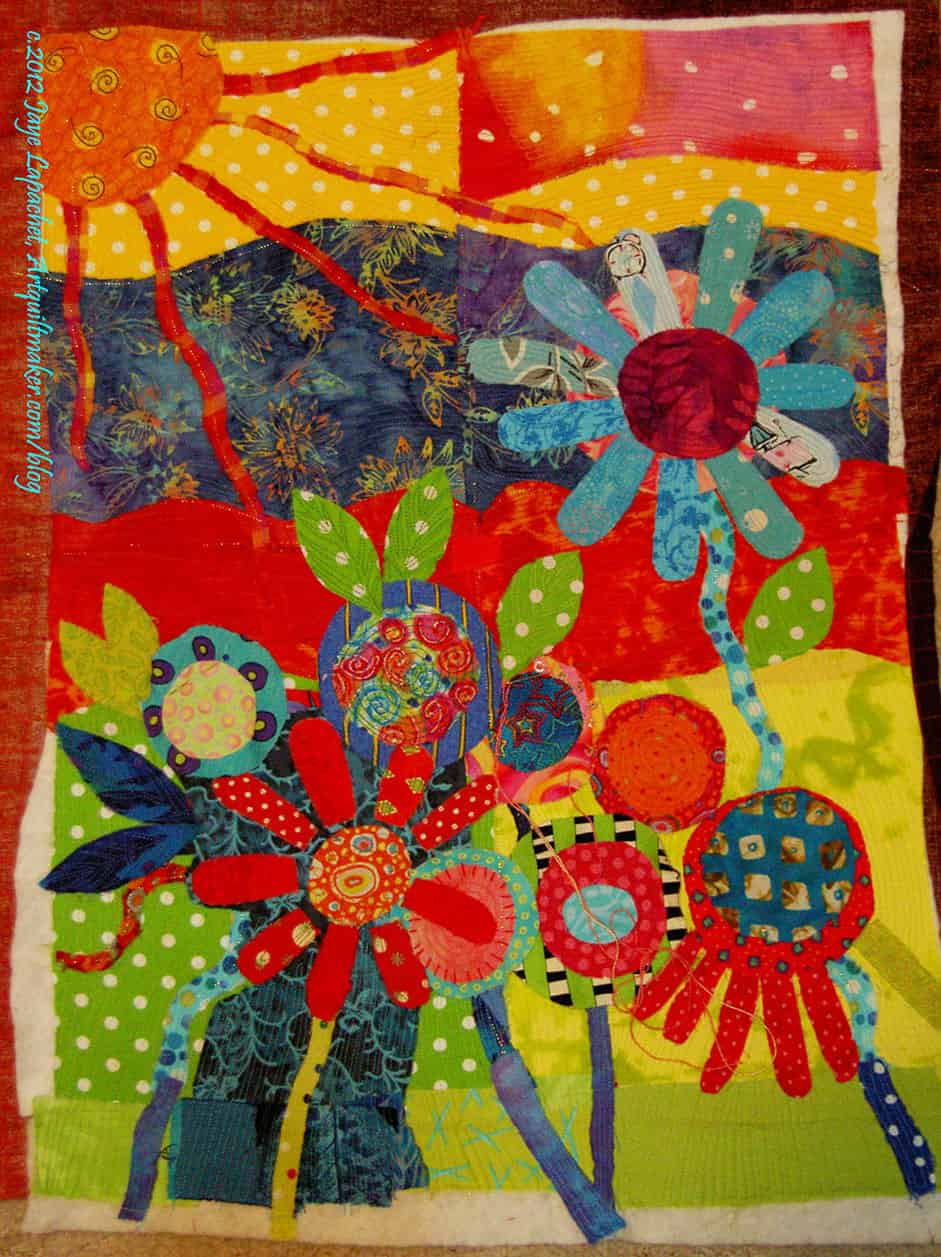
FOTY 2011 Update

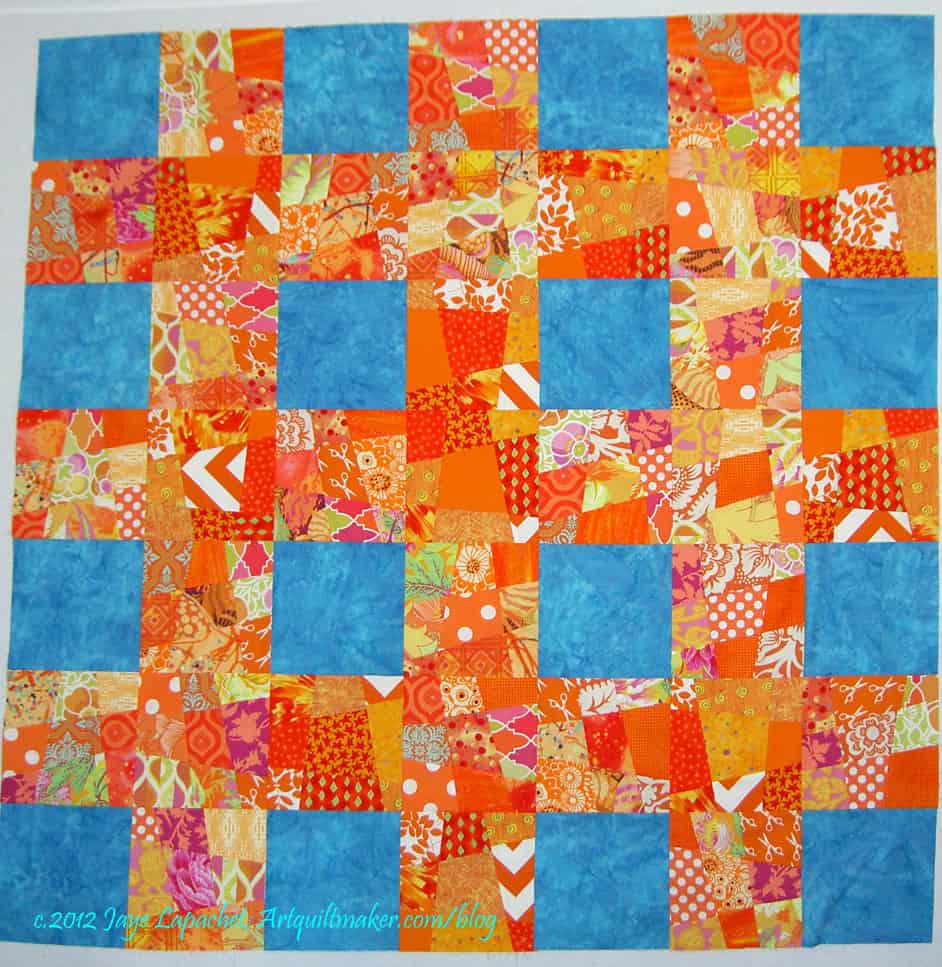
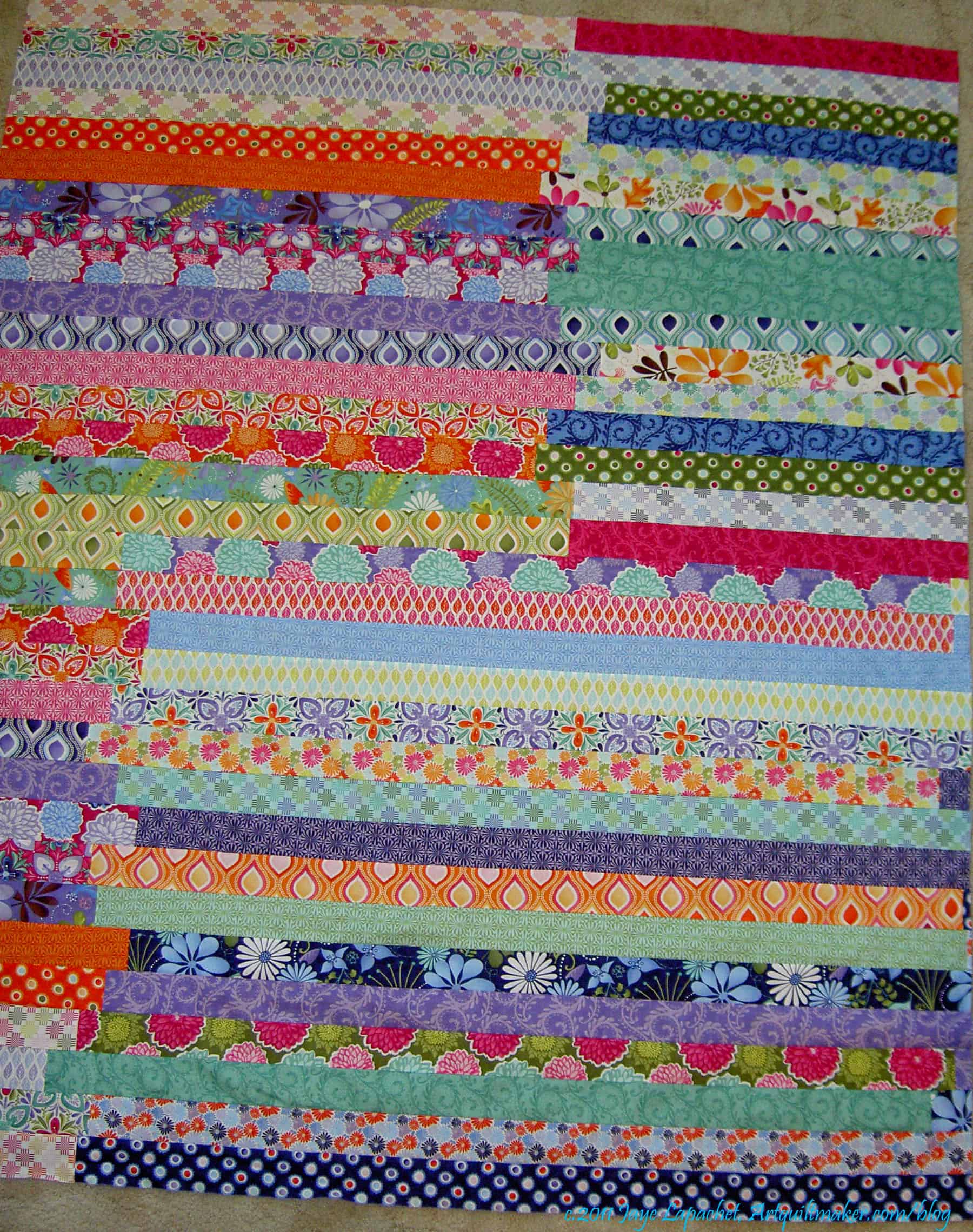
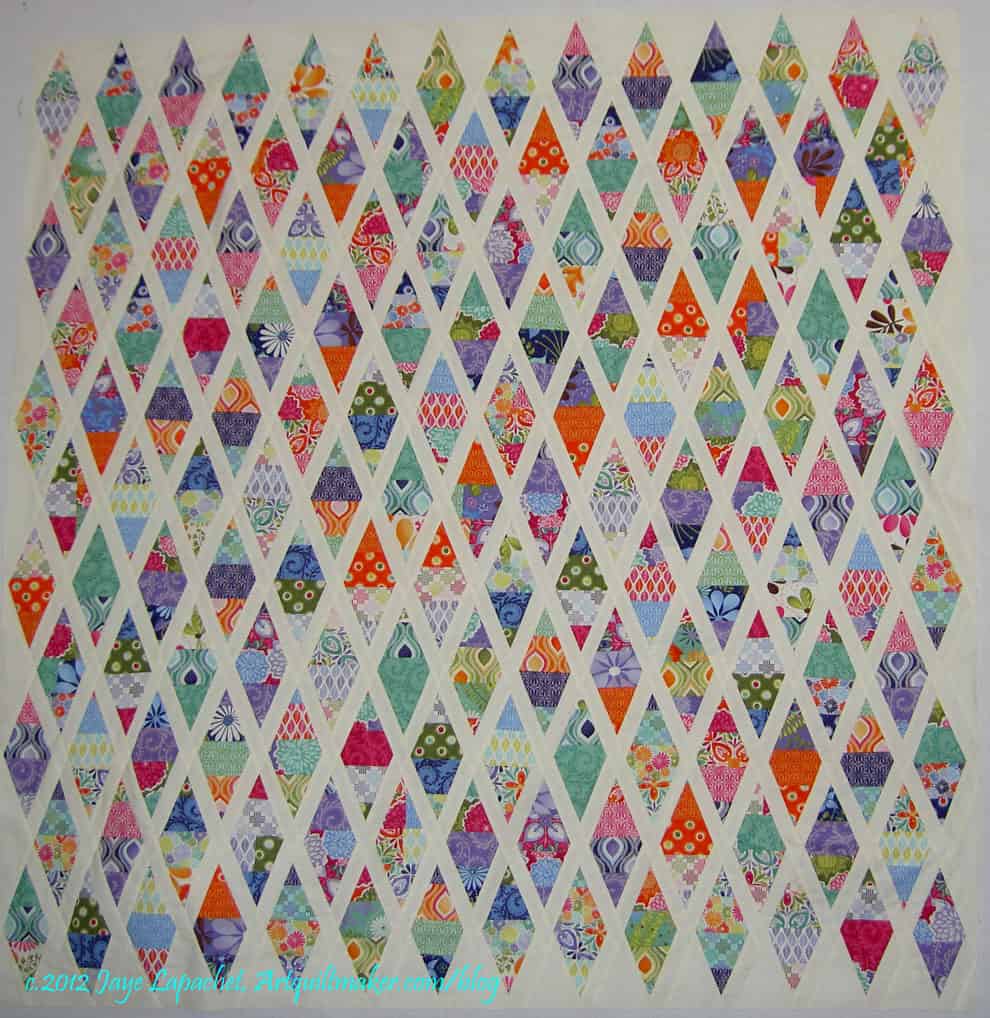
FOTY 2011 before ripping

I was going to say “HOORAY!!! I finished the FOTY 2011 top!”, jump up and down and encourage us all to dance together.

But.

No dice. I starting ripping out the border on Monday, because it screamed at me. The diamond black and white didn’t work. Two people that I asked didn’t even notice, but I can’t even look at the top without my eyes going straight to that black and white border. And that means I have to rip.

Still, I spent all day Sunday sewing and that is a bonus. It was such a pleasure to spend time with my sewing machine listening to audiobooks (yes, I finished one book and started another). Still, the pleasure did not create a great border.

If fabric were wider than 42"

If fabric were wider than 42″the quilt top would have looked like the photo right. In this photo, you can’t see the way the fabric was printed off grain or the way my joins did not line up properly when I tried to make the borders longer. The border didn’t work for *me* and the sooner I faced that reality the sooner I could really get to finishing the top.

I got to this place, because I couldn’t find the fabric I originally wanted to use and I was too lazy to shift stacks of fabric around to find it.


New Border Option
New Border Option
New Border #2
New Border #2
New Border Option #3

Laziness is my downfall and I deserve what I get. In fairness, I did move some fabric AND I may have used all of the fabric I was considering, but I did not look all of the blacks to make sure.

I retrieved some other fabrics and found the stars. Right now it is my favorite. I’ll see how I feel and how the joins look later in the week. I am so glad to have some time this week to  work on this project in little bits.

FOTY 2011 Update

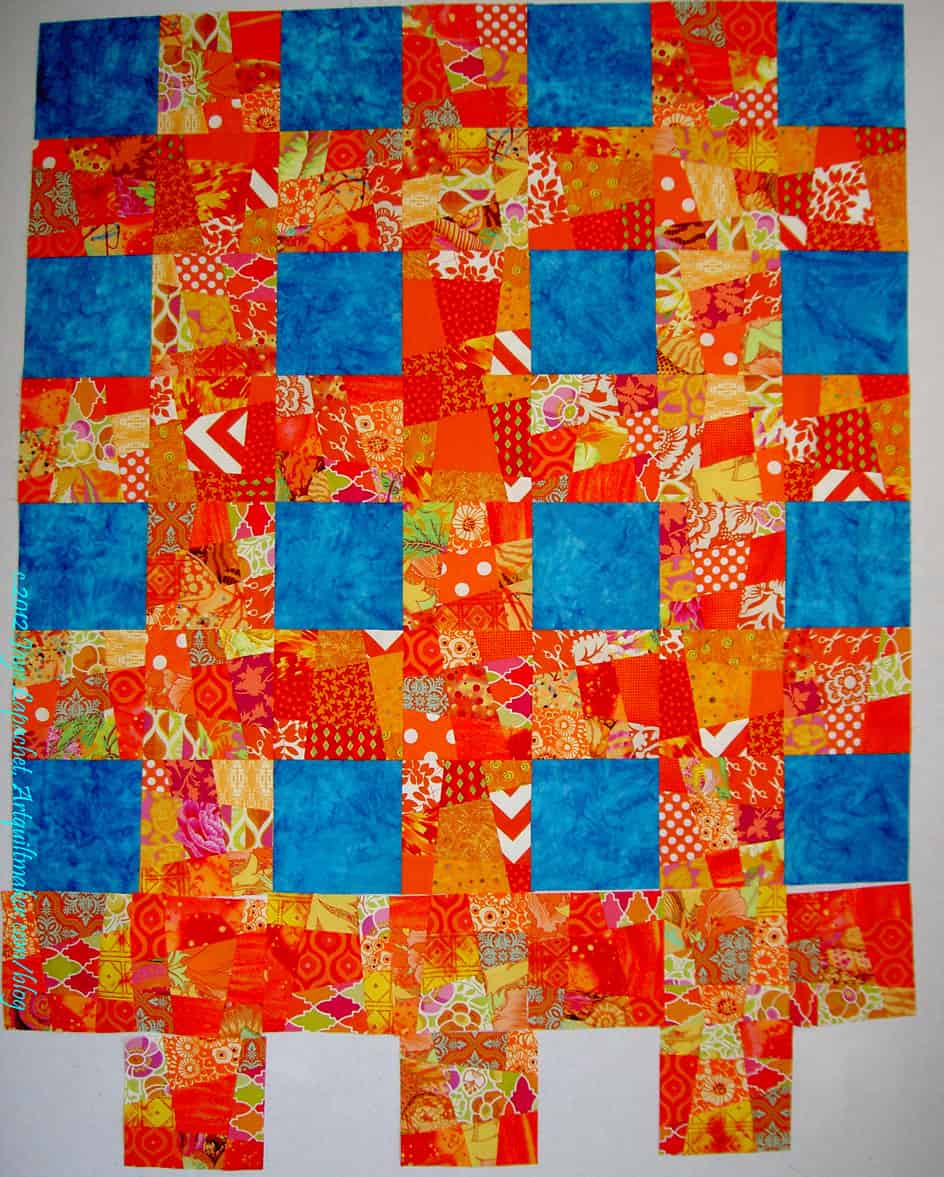
FOTY 2011 in progress 2/5/2012

I made really good headway on FOTY 2011 over the weekend. If I had not gone to  BAMQG, I would have finished the top, but socialization is a good thing. 😉

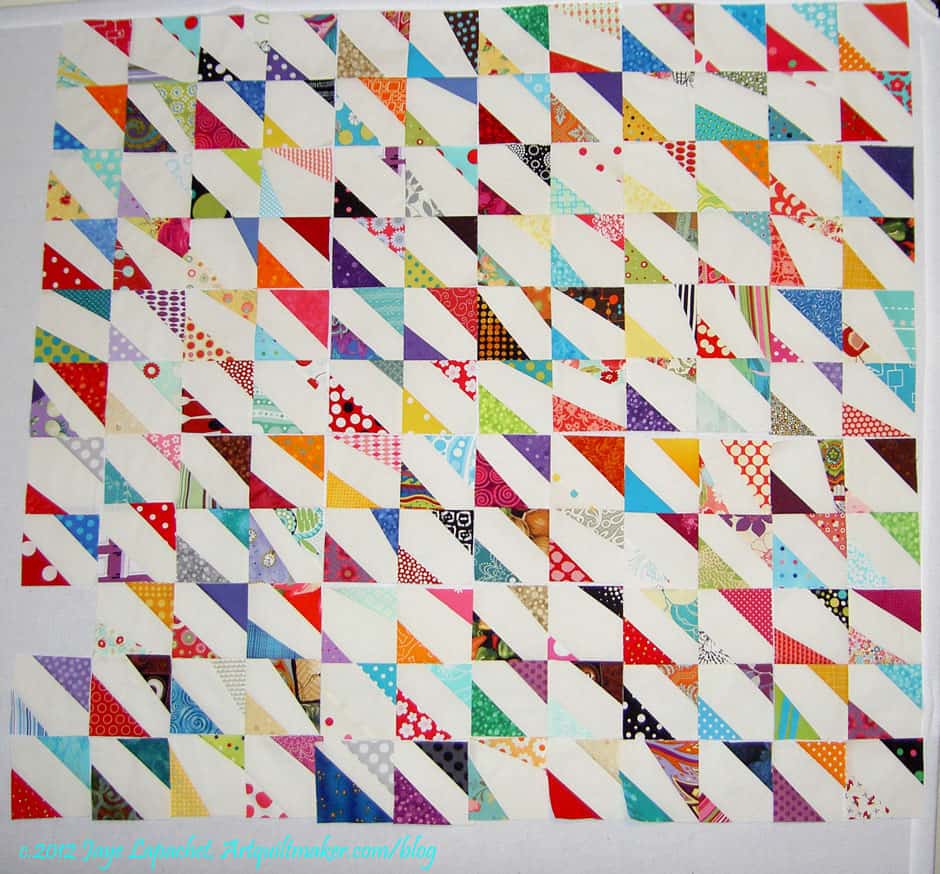
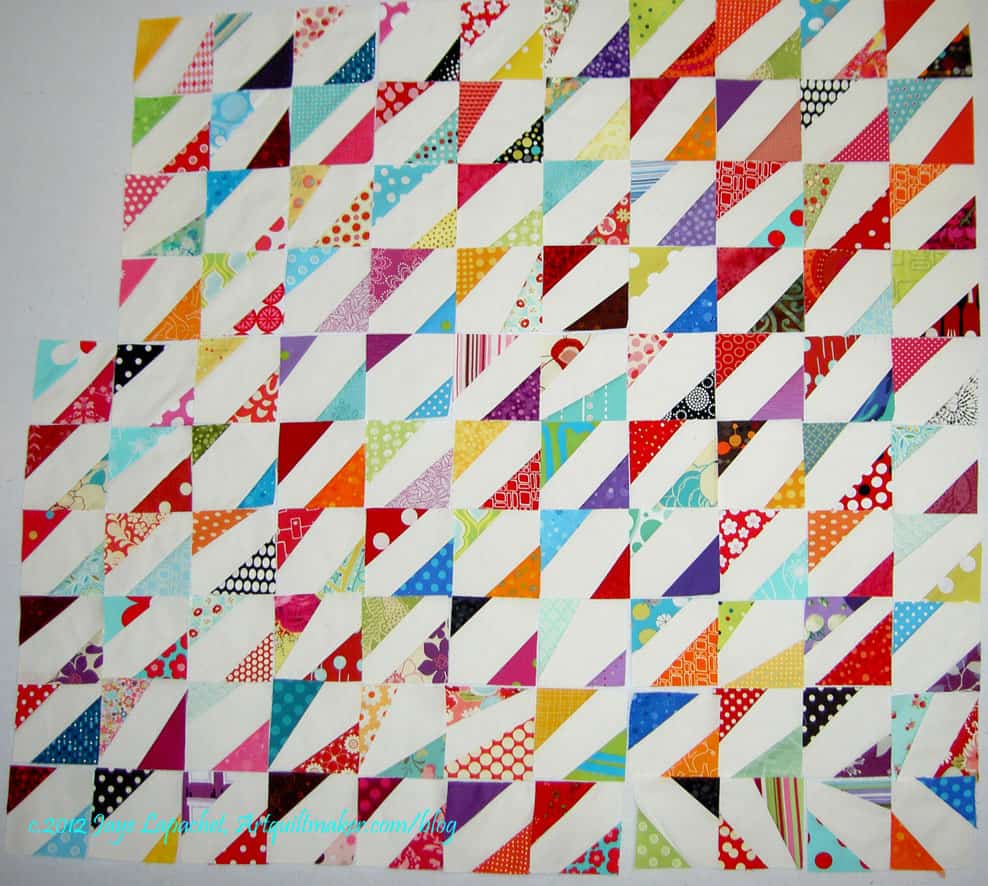
The photo on the left shows where I left it on Sunday night when my family finally managed to drag me away from the sewing machine. I start the piece by laying out the patches in the bottom left hand corner. I, first, concentrate on arranging the pieces in that area and move towards the upper right hand corner. The patches, before sewing, take up enough space to cover the entire design wall. As I sew, I move the sections (chunks) away from that beginning corner towards the upper right. It helps me know how much I have left to sew.

It turns out that I had a fair amount of unsewing to do. When I started, I just sewed one triangle to another without really thinking of how I was going to put the chunks together. As you can see in the light blue section, I now have all of the chunks angling to the left. To get them to line up, I had to rip some pairs out and sew those patches to other pieces.

I also needed to rip out and recut the smaller triangles. I am not sure what happened, but when I sewed the three prints and one background triangles together, they were at least a 1/2″ too big. I tried to work with them that way, but, in the end, I ripped them out and recut them, then sewed them back together. I have a few more to do in the last couple of rows, but am almost done. I am much happier with them now.

I may finish the top this weekend, but we will see. DH and I have to try and fix our printer and I have an event on Saturday to attend. I hope to have a bit of time to sew.

Design Series: Unity/Harmony

Look for Sandy‘s podcast, which was posted on 1/12/2012. This post is a companion to the podcast and we discuss many examples and I provide a lot of explanations about the information below.

The Design Definition we are using in this series is:  Design is a problem solving activity within all the arts, placing or creating subject matter so it is of visual significance and interesting to the artist. (from The Quilter’s Book of Design, 2d ed)

Unity/Harmony are Principles of Design. Unity and Harmony are often combined as one principle. Harmony is used here as another word for Unity.

Definition:

  1. the presentation of an integrated image (Pentak & Lauer, 5th ed. pg.20)
  2. a design in which “congruity or agreement exists among the elements in a design; they look as though they belong together” (Pentak & Lauer, 5th ed. pg.20)
  3. some visual connection beyond mere chance has caused elements to come together. (Pentak & Lauer, 5th ed. pg.20)

According to Adventures in Design by Joen Wolfrom, “the backbone of any design is unity,” because it provides stability and control in a design as well as visual comfort. It also clarifies the design (Wolfrom, Adventures in Design, pg.97)

“The strength of the composition is that the parts are not there by chance, but that they appear to belong together… The parts don’t have to be the same or have to touch each other; rather, they must make sense together.” (The Quilter’s Book of Design, 2d ed, pg.13)

Creating Unity (aka Unity with Variety  (Pentak & Lauer, 5th ed. pg.19) )

Unity cannot exist without other closely related elements and principles (Wolfrom, Adventures in Design, pg.97), which means that this is probably the principle where we will discuss the most other elements and principles.

“Unity of design is achieved by the arrangement of the lines, shapes, colors, values textures and patterns that are used.” (The Quilter’s Book of Design, 2d ed, pg.13)

Methods of creating Unity are below:

  • The Grid
    • a checkerboard pattern using only black and white fabrics has complete unity. There is a “constant repetition of shape and obvious continuation of lined-up edges.” This design, however, can be a bit boring. (Pentak & Lauer, 5th ed. pg.34)
    • Many, many quilts have an underlying checkerboard pattern (blocks)
    • a checkerboard pattern using black, white and two kinds of grey adds in some variety to the basic checkerboard theme
    • a checkerboard pattern using black, white and two kinds of grey where rectangles are added to,” OR replace some of, “the squares creates even more variety while still using a basic grid. There is an “obvious, underlying feeling of unity, yet variations enliven the pattern.” (Pentak & Lauer, 5th ed. pg.34)
    • “shapes may repeat, but perhaps in different sizes; colors may repeat, but perhaps in different values.” (Pentak & Lauer, 5th ed. pg.34)
  • Unity through Repetition
    • “Repetition is another way to create unity in a quilt design. The repetition of an element in a composition can tie the whole together, creating a relationship among the elements.” (The Quilter’s Book of Design, 2d ed, pg.15)
      • “…repetition of an element creates visual rhythm.” (The Quilter’s Book of Design, 2d ed, pg.15) Static rhythm, alternating rhythm and progressive rhythm have an effect on unity through repetition, but we will cover that when we cover the Principle of Rhythm.
      • Examples:
        • http://www.flickr.com/photos/68806166@N05/6632122205/
        • http://www.flickr.com/photos/baileygirl5/5179971933/
        • http://www.flickr.com/photos/ericacrafts/4542434534/
        • http://www.flickr.com/photos/14922562@N05/6153186561/
        • http://www.flickr.com/photos/redpepperquilts/3361801067/
        • http://www.flickr.com/photos/goingsewcrazy/5102965576/ (also shows pattern interruption)
        • http://www.flickr.com/photos/daarrr/6609341817/
  • Varied Repetition
    • Variety is achieved by  position (straight set or on point), size and difference in proportion (e.g. all star blocks, but not the same size star blocks) of the features. (Pentak & Lauer, 5th ed. pg.36)
    • “Variation or contrast with unity creates a stronger design than unity alone.” (Wolfrom, Adventures in Design, pg.99)
    • “Variety creates increased interest in a design.” (Wolfrom, Adventures in Design, pg.99)
    • porch posts or stair rails are another example. Certain standard measurements repeat while a variety of carving vary the sections of each column. (Pentak & Lauer, 5th ed. pg.36)
    • “Repetition in design is simply repeating one or more elements. Every element does not need to be repeated. If too many elements are repeated, predictability, visual monotony, and disinterest can result.” (Wolfrom, Adventures in Design, pg.97)
    • “When elements of a design have a similar shape, we automatically create a visual relationship among them.” (The Quilter’s Book of Design, 2d ed, pg.14)
    • “Variation is added through the shifting of motif shapes;” “our eyes are most interested in the place where the pattern is interrupted.” (Wolfrom, Adventures in Design, pg.99)
      • Example: http://www.flickr.com/photos/goingsewcrazy/5102965576/
  • Emphasis on Unity
    • “To say a design must contain both the ordered quality of unity and the lively quality of variety does not limit or inhibit the artist. The principle can encompass a wide variety of extremely different visual images and can even be contradicted for expressive purposes.” (Pentak & Lauer, 5th ed. pg.38)
    • Subtle repetition can enhance the unity of composition. By using subtle repetition, the artist draws the viewer in to look more carefully for differences. (Pentak & Lauer, 5th ed. pg.38)
      • consider identical twins. When looking at a photo of identical twins, the eye seeks out the differences. The same can be said for a one block quilt. If the quiltmaker chooses subtle variations in color, the viewer will seek out the differences even if the block is the same.
    • “Unity without variety can evoke our worst feelings about assembly lines and institutions.” (Pentak & Lauer, 5th ed. pg.38)
  • Emphasis on Variety (difficult to explain in words, because it is easier to see a visual example!)
    • Star quilt where none of the star patterns are the same.
    • Quilt where none of the blocks are the same, but the colors unify the piece
  • Chaos & Control
    • “without some aspect of unity, an image or design becomes chaotic and quickly ‘unreadable’. (Pentak & Lauer, 5th ed. pg.42)
    • design can also become lifeless or dull (Pentak & Lauer, 5th ed. pg.42)
    • “neither utter confusion nor utter regularity are satisfying” (Pentak & Lauer, 5th ed. pg.42)
    • housing subdivisions often start out boringly the same, but as years pass elements of personal variations crop up (landscaping, paint color, fence style, etc) (Pentak & Lauer, 5th ed. pg.42)
  • Bridging
    • Bridging is used to gently move the eye from one extreme to another. (Wolfrom, Adventures in Design, pg.103)
    • considered a ‘principle’ by Joen Wolfrom, but is more of an element under unity for our purposes.
      • Color is often used for bridging. (Wolfrom, Adventures in Design, pg.103) Color gradation often shows up in quilts (consider my Fabric of the Year series).  Moving from light to dark can add great drama to a design. (Wolfrom, Adventures in Design, pg.103)
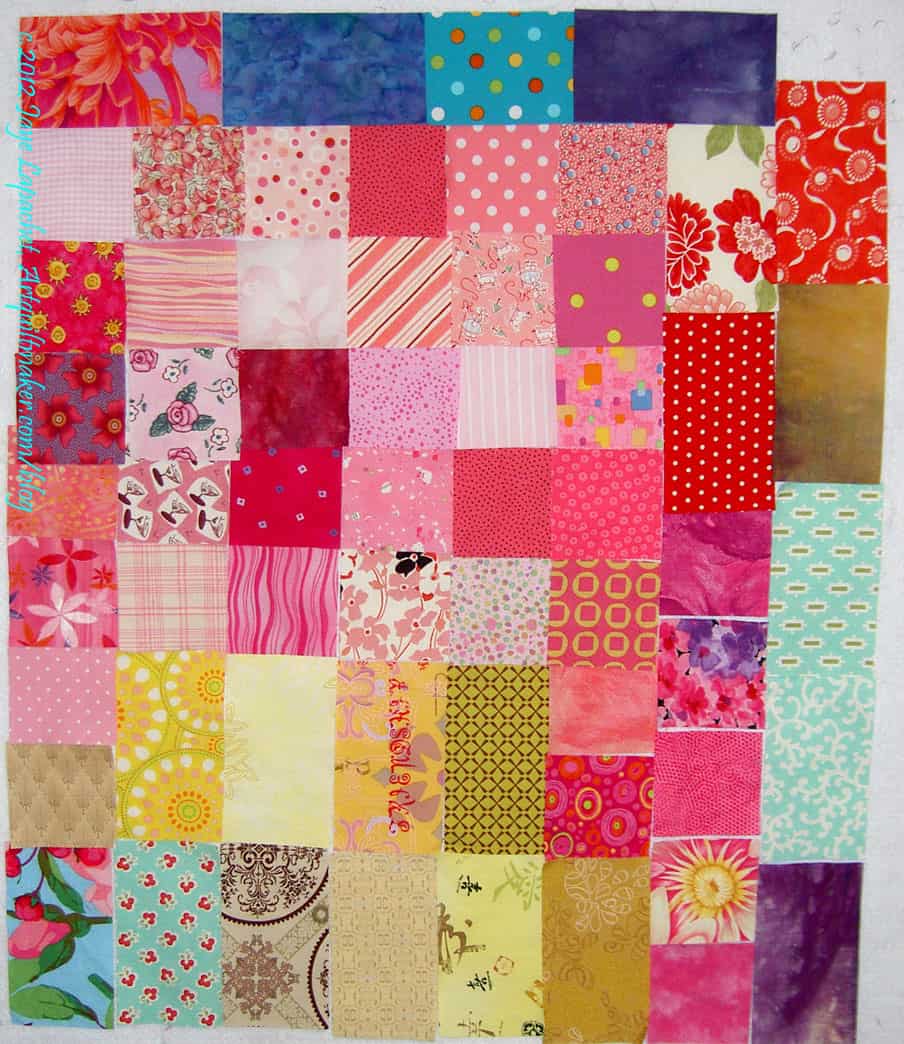
      • Size gradation is also compelling. Moving across your quilt from a large shape to a small shape can create variety and interest. (Wolfrom, Adventures in Design, pg.104). It kinds of looks like this series of rectangles
      • A quiltmaker can also change the configuration of shapes such as going from a vertical thin rectangle through a square to a thin, horizontal rectangle. (Wolfrom, Adventures in Design, pg.105)
  • Unity through Proximity
    • “One of the easiest ways to tie elements of a design together is to place them close to each other.” (The Quilter’s Book of Design, 2d ed, pg.13)
    • “Make sure the objects in your design are close enough that they have a visual bond – a visual relationship. Objects need to be in close proximity for unity” (Wolfrom, Adventures in Design, pg.105)
    • Different shapes can be placed in such a way that they have no unity, but shapes can also be placed in such a way that suggests a meaning. (The Quilter’s Book of Design, 2d ed, pg.14)
    • Tidal Flat by Inge Mardal and Steen Hougs uses proximity well.
    • Bagpipes by Judy Simmons
    • “Our eyes also organize the empty spaces in a design. The foreground or positive shapes are surrounded by the background, also called negative space.” (The Quilter’s Book of Design, 2d ed, pg.15)
      • “…the artist has to be aware that the shapes in the foreground create shapes in the background that can confuse the viewer, or dominate the positive shapes. Traditional pieced quilts often use this principle to add complexity to a design.” (The Quilter’s Book of Design, 2d ed, pg.15)
  • Movement
    • Repeating an object’s shape across the design creates movement when the repetition gives the eye the opportunity to move across the design. (Wolfrom, Adventures in Design, pg.106)
  • Unity  through Continuation
    • “…the arrangement of various elements in the composition so that their edges create a visual line. (The Quilter’s Book of Design, 2d ed, pg.18)
    • “Quilts often employ a grid as an underlying structure that gives the blocks unity through the principle of continuation.” (The Quilter’s Book of Design, 2d ed, pg.18)

Achieving Unity

  • “One way to tie the foreground and background together is to repeat a color in both the positive and negative spaces.”  (The Quilter’s Book of Design, 2d ed, pg.20)
    • This means that perhaps you have a batik with gold running through the predominantly black fabric. By appliqueing gold leaves to the background fabric, you have moved in the direction of creating unity. (The Quilter’s Book of Design, 2d ed, pg.20)
    • If your quilt has large yellow areas, you can quilt with yellow Perl cotton to help achieve unity. In this example, there must be contrast as well.  (The Quilter’s Book of Design, 2d ed, pg.20)
  • The balance of positive and negative space can also work to your advantage in creating unity. (The Quilter’s Book of Design, 2d ed, pg.21-22)

 Un-unified or Un-harmonious Designs

  • the whole design or the group elements appear separate or unrelated.
  • A viewer will ignore a chaotic design (Pentak & Lauer, 5th ed. pg.24)
  • “lack of unity is one of the major reasons a design is unsuccessful. Too much variety creates visual chaos. If not repetition exists, there is nothing to hold the design together.” (Wolfrom, Adventures in Design, pg.98)
    • this quote brings orphan block quilts to mind. These are difficult quilts to design, because of the variety included. The artist must create something to hold the group together such as unified sashing, a color that flows throughout the piece, etc.

 Notes:

  • “in the application of any art principle, wide flexibility is possible within the general framework of the guideline” (Pentak & Lauer, 5th ed. pg.38)
  • “To say a design must contain both the ordered quality of unity and the lively quality of variety does not limit or inhibit the artist. The principle can encompass a wide variety of extremely different visual images and can even be contradicted for expressive purposes.” (Pentak & Lauer, 5th ed. pg.38)
Stars for San Bruno #1

A kind of Star Sampler is my Stars for San Bruno #1 quilt.

Unity/Harmony Resources:

Art Institute of Chicago’s Art Explorer (the Millinery Shop): http://www.artic.edu/artexplorer/search.php?tab=1&resource=14572
Design Basics, 5th ed. by David A. Lauer and Stephen Pentak, pg. 19-43
NPR blog post on Unity: http://www.npr.org/blogs/13.7/2011/09/07/140211660/what-is-unity?sc=fb&cc=fp
Setting Solutions by Sharyn Craig

You can see the last Design class, which was on Balance on the November 29 post.

Pieced Backs

Not too long ago, Frances asked, in one of her podcast episodes, about making pieced backs and whether there was a tutorial.

I didn’t look for one, but I knew I had a back to make soon (for the Stepping Stones), so I thought about taking the opportunity to make a tutorial.

As I have mentioned in the past, once the top is finished, I am done with the project and want to move on. I love piecing. The other parts, such as making the back, making the binding and label, quilting are all dull for me. However, I have found that the Finishing Fairy does not visit my house and I have to do my own finishing or finish by checkbook.

My first step was figuring out how I make the pieced back. The basic premise is easy: sew pieces of fabric together until you have a piece large enough to accommodate the quilt.

What I realized is that it isn’t quite as easy as a step 1, step 2, etc tutorial. I sew bits and pieces together as I am making the quilt that end up larger when I am ready to sew the back together. You aren’t going to have the same size pieces as I have. So, this will be more like a guide rather than a tutorial.

I am a firm believer in not buying new fabric just for the back. Yes, it would be easier, but I have a lot of fabric and I might as well use it. I try to use the largest pieces possible as well as the pieces I have sewn together while making the quilt.

The first thing I do is make a label. I make my labels using a word processing program (Google Docs would work just fine) and then I print the piece out on paper backed fabric. I have also used the stitch letters on my sewing machine to write out a label.

The label will be sewn into the back, so as soon as I peel the fabric off the paper I start sewing. Know your paper backed fabric  and ink so that you know whether the ink will wash out immediately, over time, or not at all. I use fabric backed paper from Dharma Trading Company and my regular ink jet printer.

Tip #1: larger pieces make the back go together faster

When I made the back for FOTY 2010, I purposefully used really large pieces. That was the best back experience of my life, because it went together really fast. I suggest you start out this way with pieced backs so you don’t lose your mind. This is your fair warning!

Tip #2: As with blocks, sew from smallest to largest.

I start with the label and surround it with fabric until I have about 1.5′ from the right hand side of the back and about the same from the bottom.

I sew the label into the back so if a quilt is stolen, the label cannot be ripped off without ripping out the quilting.

Tip #3: Plan to leave extra fabric around the edge if you want to longarm. 4″ on all sides is usually sufficient.

Once I have one corner completed, I sew across the bottom of the quilt back until I have a piece the desired width. I make the width generous as I don’t want to go back when I think I am finished and have to sew on a strip to a long edge.

Tip #4: Coordinate your backing fabric with the fabric pieced into the front.

I use fabric that will coordinate with the front, though it isn’t necessarily the same fabric. If I have a lot of leftovers that I don’t think I will use in another quilt, such as in Stepping Stones, then I will use the leftovers for the back.

Tip #5: Leaders and enders techniques make the process of sewing the back go faster.

Where possible I will sew smaller pieces/shards (not schnibbles! I am not advocating doing something that will send you to an insane asylum) of fabric together using Bonnie Hunter’s leaders and enders technique. Now, I have not taken a class from her, so visit Quiltville, Bonnie’s blog or buy her books to learn her methods. My idea is that I put pieces/shards through the machine after the regular pieces for my top so I can get those to ironing board for pressing faster (discussed previously in this post). Also, this alleviates the need to put a scrap piece of fabric through the machine to keep your feed dogs from eating your triangle corners. Finally, it minimizes scraps added to the scrap pile.

Red Journal - Closed
Red Journal – Closed

As I have discussed on different occasions, I call the end result of sewing bunches of scraps together randomly mosaic quilting. I use the leaders and enders method to facilitate the mosaic quilting result. I made the entire cover of the red journal by using the leaders and enders method to get a mosaic quilting piece. I enjoy sewing like colors together to make new fabric. If I have nothing else to do or I can’t think or I am stressed out, it is a good activity.

How does this relate to pieced backs?

Mosaic Quilting for Pieced Backs

I do the same thing, but on a larger scale. When I am finished piecing the top and am definitely working on the back, I find pieces that fit together and sew them. When I am piecing the top, I sew the smaller pieces into larger pieces and then use the larger pieces for the back.

Mosaic Quilting for Pieced Backs

Tip #6: Skip sewing small pieces together if you have not done so prior to finishing the top.

I just want to finish, so if I have not sewed smaller pieces into larger chunks prior to starting the back, I skip it. It drives me crazy to have to stitch little bits together for no other reason than making a back. Why this doesn’t bother me when I am using them as leaders and enders, I don’t know.

Tip #7: Backstitch

Any seam that will be on the outside of the quilt or not crossed by another seams gets a few back stitches. All of my handling rips out those stitches and then I have to go over them before giving them to my longarmer. To alleviate the process I backstitch. I backstitch more than just the outside seams as sometimes I don’t know what will become an outside seam.

Finally, I sew chunks the same width as the first chunk (with the label) until I have a piece the same size as the top with an additional 4″ on each side. Depending how how small the pieces are, the back can take me 4-6 hours. I am slow, and get cranky when I do this.

Alternatively, you can just buy a big piece of fabric and put it on the back. 😉

Preparing for Quilting

If you, mostly, do not quilt your quilts yourself, then part of your quiltmaking process should be preparing your quilt for your longarm professional. You can read my longarm rant which implies things to think about when choosing a longarm quilter, but regardless of who you choose, you will still have to prepare your quilt.

To be honest, when I get to the “YAY! I have finished my top” stage, I am done with the quilt. However, I also don’t want a bunch of tops laying around, so I am working on finding the Zen or meditative qualities of finishing my quilts.

For the top, don’t worry much about pattern or block design when thinking about the longarmer. I am more interested in what I want for the top.

Back

However, when I get to the back, I do try to be nice. Part of the process or creating the Zen or meditative space in my head of finishing my quilts deals with the back. I no longer piece tiny squares together to create a coordinated back. I try to use very large pieces of fabric, which not only enables me to finish the back quickly, but also lessens the number of seams on the back for the longarmer.

My personal, fabulous longarmer has never complained about seams, but I also don’t want her to become frustrated with me. I make pieced backs. That is just what I do. I see no good reason to buy additional fabric for the back when I have perfectly good fabric in my fabric closet that is not being used.

Lately, I have started to try to remember to piece the seams open on the back. It doesn’t really matter in terms of construction, IMO, but it lessens the number of layers that the longarm needle has to punch through. My personal, fabulous longarmer has never said one way or the other, but I figure that it can’t hurt.

If I know that the end of the seam will be on the outside of the quilt or NOT crossed by another seam I will also backstitch. I do this on the front also, so that the threads don’t pull apart as the quilt is being stretched on the longarm machine. Of course, I don’t always know, but I do my best.

I try to make the back at least 8″ larger (4″ on each side and 4″ on top and bottom) all the way around than the size of the top. To do this, I lay the top on my design floor and build the back on top of it.

Post-it Notes are your Friend

I measure the top and the back and pin a post-it note to the quilt saying what the sizes are. I use hot pink post-it notes. My quilts are generally square, but usually not perfectly square. They are often off by an 1/8″, but not much more. If I put the post-it note on, the longarmer clearly knows what s/he is dealing with and can’t blame me later for lousy piecing (Well, s/he can, but I can just look at him or her sarcastically and not feel bad).

Top and Bottom

You might think that any idiot could tell which is the top and bottom of your quilt, but that is not always the case. I had a quilt where the back was really large – much larger than the 4″ all around that I normally make it – and my personal, fabulous longarmer put it on sideways, because I didn’t mark the top and the bottom. She is not in my head, though she is in my fantasy life, so now I put a post-it note with the word ‘top’ on both the top and the back. Top on the post-it note means “dude, this is the top of the quilt.”

Pins

I take them out as I piece. There is no later. If my personal, fabulous longarmer runs over a pin I left on the quilt, I pay to have her machine repaired. My fault, my problem.

Embellishments

I embellish with anything 3D AFTER the quilting is done. If there is some reason that I put a button or beads in a section of the quilt, then I pin a very bright post-it note to that area. I also point it out to her when I bring the quilt to her. If my personal, fabulous longarmer runs over an embellishment on the quilt, because I didn’t warn her, I pay to have her machine repaired. My fault, my problem.

Press, Press, Press

As much as I despise pressing the top and the back I do it just before I take the quilt to the longarmer. Then I hang the top and the back on a pants hanger. The pants hangers have to be tough and have really strong clips, because those quilts are heavy. If I don’t press the wrinkles will not ‘quilt’ out.

This is the last step. Once the quilt is on the hanger, it is ready to be taken to the longarmer.

Keep in mind that your personal longarmer might have different requirements for how you prepare your quilts. Make sure that you know what those are before you take your quilt to be quilted.

26 Projects

For some reason I felt the need to count up the projects I have in process. In process, to me, means that some sewing has taken place

26.

Yes, I have 26 projects in process. Too many. I was kind of appalled, actually, but when I thought about it, I realized that many of them are more than 3 years old. Some are half class projects. I used to stop, put a project away and go on to something new. I thought that was what quiltmakers did.

At some point I decided that I did not want to do that anymore. I have changed my process so that I gear up, gather, test and then focus like crazy on one project and finish it. I might be working on more than one project at a time, because they are in different stages, but at some point in the process each of them gets my full attention and gets finished. Once I focus on a project, I can finish pretty quickly.

I don’t enjoy making the back or the binding, but I get it done and THEN, only then, move on to the next project. Projects frustrating me now stay on the design wall so I don’t forget about them.

This post is not about finishing for finishings sake. I need brain space. I need closure on some of these projects. I need to work on them, learn what I need to learn, finish, or abandon them. They are cluttering up my brain and my fabric closet. They don’t allow room for me to start new things. And I have plenty of new things I want to start, fabric to buy, blocks to test.

Now I am on a mission to work through some of these projects. Stay tuned.

Stars for San Bruno #2 Off to Finishing

Stars for San Bruno #2

As I mentioned I took the Stars for San Bruno #2 quilt to my quilter last Friday. I am so pleased that I finished the top and that I am really moving along on this project. I probably won’t get it back until the beginning of September.

I was stupid about how I put this top together and ended up needing to sew a lot of partial seams. I decided to put on two borders (yellow and blue) on the top. I thought about putting two yellow borders, but couldn’t face the scrap piecing so I compromised by putting a slightly wider yellow border on.

I have a large piece of solid fabric left that I want to use for #3,  but other than that, I don’t have much dark blue fabric left. Tons of turquoise, but none of that deep blue. I am trying not to buy any more for #3.

I am not that fond of working with really dark colors anymore, but have been trying hard not to infuse the quilt with resentful or bad feelings since I want these quilts to be a comfort to their new owners. It is working very well and I don’t even have to try that hard. I do know that I need to take a short break and do some other projects before starting on #3.

Thanks to everyone who has contributed blocks.

Everything a Masterpiece?

I was listening to Mark Lipinski’s Creative Mojo episode from 6/29/2011 the other day. He was interviewing Lesley Riley, who I thought was really good. She is the creative force behind TAP and a creative mentor/coach. She said that people often don’t do anything creative, because they have forgotten how (we are all born with the ability to be creative, according to Leslie), or we feel like we don’t have time or we feel like everything we do has to be a masterpiece, because we don’t have time to screw up.

Fabric of the Year 2010 Professional

The masterpiece comment really struck a chord with me.

It made me think about the quilts I have made where I feel like I have really struck gold. I have had Fabric of the Year 2010 on my mind lately, because I really feel like I struck gold with this quilt. This conversation, further, made me think that there is no predicting whether a quilt that will have the it factor.

Spiky Stars
Spiky Stars

I feel like I have two or three quilts that are truly excellent quilts. This is many fewer than the number of quilts that I have made. I asked myself if I was ok with that and I am. I am because the other quilts are not horrible, ugly or hideous. Most of them are good work and make me happy. They are nice quilts, but just don’t have the “it” factor.

I am going to keep making quilts and I’ll nail another one sometime. I don’t know when, but if I stop working, because each quilt isn’t a masterpiece I will never find that quilt with the ‘it’ factor, but more importantly, I won’t progress. I believe that my truly great quilts are great, because I keep making quilts.

I make blocks to try out color schemes before I commit to a whole quilt, sometimes. I make bags and other small objects to try fabrics and techniques that may not be suitable for quilts. I go to A Work of Heart and play with paint and ink, paper and gesso under the watchful eye of Andrea, a creative genius if there ever was one. It feels good not to be making all the decisions all the time.

I also look at my quilts, once finished, and think about what I could have done better. I worked hard on FOTY 2010 based on what I had seen in FOTY 2008 and FOTY 2009.

And I just keep making.

Pavers

Pavers is ready to quilt. I am not sure the name suits, but that is what it is. It will be a gift.

Pavers - top
Pavers - top

This pattern is based on a photo I saw on Flickr from Green Couch Designs and related to the Purple quilt I finished a few weeks ago. Both on the Purple Quilt and this quilt I wanted to work with asymmetrical borders. I wasn’t happy with the border on the purple quilt, so I tried again on this one. I think I want to work with the border a little bit more and will make one more quilt in this pattern.

This is an easy quilt to make and I basically finished all of the blocks by using them as leaders and enders.

The photo above has that lovely pink post-it on the top as a direction to the quilter. It just says what I have designated as the top. I do that for the back, too.

Pavers - no borders
Pavers - no borders

Above is a picture of it laying on my ‘design floor’ before I put the borders on. I was amazed at how much better the piece looked sewn together. The duplicate fabrics near each other didn’t seem to matter and the whole thing just came together.

This quilt was made from a group of fabrics I bought from the Fabricworm.


Hexagons Tutorial-Preparing to Sew

Hexagon piece
Hexagon piece

Did you follow the directions for cutting your hexagons? Did you watch the video? If so, you are ready to prepare to piece. If not, you can find the directions and information on my previous post.

Note: my hexagons are 7″ unfinished. We are preparing to machine sew the hexagons using Y seams. Leave your fear of Y seams at the door, please. This is a relatively quick method after you do the step outlined below. However, you won’t be able to chain piece.

Supplies needed:

  • Sewing machine
  • Quarter inch foot
  • Thread
  • Ironing board
  • Iron
  • rotary ruler a bit longer than one side of your hexagon (I like the Creative Grids 4.5″x8.5″ rectangular ruler)
  • thin sharp black pen like a Pigma Micron or a Pilot Scuf or a Sewline pencil
  • your hexagons

You will be working on the wrong side of your hexagons at first.

The photo of my piece (above) is similar to what your goal should be. Note that the piece I show is not the final product. I don’t know how large my final quilt will be. That is just how I roll on certain projects. You should check Sandy’s blog and podcast as she has provided some information about sizes and amounts of fabric.

I don’t think in rows, so I don’t always sew in rows (remember the Chunking it tutorial?). This project lends itself to sewing in a circle, which I find very calming.

Face Down
Face Down

Take your cut hexagons and turn them right side down (wrong side up) on a surface you can draw on. I do this step right next to my sewing machine just before I sew. Take your rotary ruler and position the edge a quarter inch from one edge.

Ruler on Hexagon
Ruler on Hexagon

For example, pretend you were going to slice off a quarter inch and position your ruler that way. Note there is no rotary cutter on the supply list so no cutting, please. The goal is to end up with an X at the 60 degree angle spot on the patch.

Hexagon Marked-detail

On the wrong side of your fabric, take your pen and draw a light line where a quarter of an inch should be.

Draw a Light Line
Draw a Light Line

You won’t see it on the front if you are careful, so using one of the pens mentioned above is ok. You will be doing this at the 60 degree angle/where the corner of the patch is, if the patch had a corner.

Draw Line on Next Side

When you mark the second side, you will have one X and 2 lines.

One X and 2 Lines
One X and 2 Lines

Do the same thing at each of the other angles.

Hexagon Angles Marked

If you draw lines all the way around so you have little X-es at every angle of your hexagon. No groaning. I didn’t promise this would be a fast project, but it also doesn’t take that much time. If you are rolling your eyes, go buy the American Patchwork and Quilting magazine, because they have a method of doing this piecing in rows. Seems everyone is on the Hexagon bandwagon these days.

If the above process is just too horrendous for you to contemplate, consider the Perfect Piecer by Jinny Beyer.

Perfect Piecer
Perfect Piecer

The 60 degree angle on the right side is perfect for making dots (not X-es) which you can use to sew between. Those circles are actual holes through which you can mark. I bought this to use for my Flowering Snowball and realized it would work with this project as well. I pushed the Sewline pencil lead way out of the pencil and was able to use it with this ruler.

Once you have done the marking, go to your sewing machine.

Do all the normal thread and needle checking stuff necessary for your machine.

Put your machine on the setting for stopping with the needle down. If you don’t have a needle down setting, adjust your sewing so you can stop with the needle down. This isn’t an absolute must, but really helps.

Position the needle right above the intersection of the x. Sew into the intersection of the X and sew all the way across using your quarter inch foot. STOP at the intersection of the second X. Do NOT sew into the seam allowance. Backstitch a couple of times.

I backstitch, because there are no seams crossing one another.

Remedy for sewing into the seam allowance: rip out the number of stitches into the seam allowance. Don’t rip out the whole seam, just rip out the stitch or two that went over.

Take the piece out of the machine and reposition the next unsewn side.Same deal: Position the needle right above the intersection of the x. Sew into the intersection of the X and sew all the way across using your quarter inch foot. STOP at the intersection of the second X. Do NOT sew into the seam allowance. Backstitch a couple of times.

Hexagons Unpressed
Hexagons Unpressed

Take your piece over to the ironing board and lay it face down. Yes, I know everyone says to press right sides up. Not this time, sweetie. Face down. On the ironing board. You are going to make a swirl with the seams near each other. Look for how the other seams connected to the new ones you just sewed are pressed and press the new ones in the same direction.

Hexagon Flower
Hexagon Flower

If you follow these directions, you will get a little flower at the intersections of the seams. That is why you don’t sew into the seam allowance. The quilt will lay flatter and the seams will be in order.

You see a slightly different method at the Blue Chair blog.

Hexagons Follow-up

Recently, I talked about my adventures with hexagons. The adventures continue and a few people are joining in, something I didn’t know, or think, would happen. There seems to be something about hexagons that intrigues people.

Small Hexagon Test
Small Hexagon Test

The above photo shows what I did to test out my hexagon theories.

Much larger hexagon test piece

The test kind of grew.

Hexagon-not a test
Hexagon-not a test

Now I have to admit that this hexagon piece is no longer a test. This will be a real quilt at some point. At this point, I am just sewing hexagons to each other as a kind of treat for myself in between other ‘must finish’ projects. The hexagon piece really helped me get through the pillows. The colors are cheerful and fun. I am trying to keep it even on all sides, but the edges keep creeping out into long lines of hexagons. I don’t know how big it will be – perhaps as big as the amount of fabric I have?

It is good to look at the piece in a photo format, because it helps me see where I need to put the next colors.

Clearview Ruler
Clearview Ruler

The ruler I used is a Clearview Ruler from Alicia’s Attic. They are a bit hard to find, but you can find them at the Granary. I am pretty sure that if you call them they will send you one. Why do you need this one? Because you need the tip. Any 60 degree ruler will work as long as the tip is not blunted.

Pyramid Ruler
Pyramid Ruler

I started out using my beloved Pyramid ruler from Fons & Porter and my hexagons came out kind of squashed looking. I love this ruler, but it doesn’t work for this quick cutting hexagon method. You MUST have the tip to use the quick cutting method described in the video by Kaye Wood, which is on Little Bluebell’s blog.

You can, of course, use a hexagon ruler. You don’t need to make hexagons using the quick cutting method described by Kaye Wood.

Hexagon Ruler
Hexagon Ruler

I bought the Fons & Porter hexagon ruler for the Spin Wheels project. I didn’t start out using it for the hexagon project, so I am not using it for that project. If you plan to do a scrappy hexagon, this ruler (or one like it) is the way to go. The Kaye Wood quick hexagon cutting method uses strips and if you aren’t using strips, there is no reason to use that method. I have an Easy Hexagon ruler by Sharon Hultgren, but it is too big for me and  I am getting rid of it. Check Quilt Trader’s Newsletter.

I have 150 or so hexagons cut. I am sure I could figure out how big that would be, but where would be the fun in that? I just want to make sure it doesn’t get too big. 😉

Flying Geese Tutorial

This is a thinking girl’s tutorial to making flying geese. Knowing how to make Flying Geese allows you to make Sawtooth Star blocks, Dutchman’s Puzzle blocks, borders and other parts needed for your quilts.

You are going to have to use the technique with your own measurements to make the geese that fit your project. There are many other ways to make flying geese.

Cut 2 Squares for each Flying Geese Element

This fabric will be used for the ‘wings’.

Draw diagonal line from corner to corner

Turn the squares over and draw a diagonal line from corner to corner. You will need to do this on all of the squares for your Flying Geese.

Cut background
Cut background

Cut background, or goose, fabric.

Lay wing 1 on goose
Lay wing 1 on goose

Lay first square that will be a wing on the goose (background) fabric and pin. Make sure the pin is out of the way. You will be sewing on that drawn line, so you will need to pin far enough away so the pin doesn’t interfere with the operation of the machine.

Sew along line
Sew along line

Sew along line and trim threads. I use a foot that has an arrow on it. I can line that arrow up with the drawn line and sew away.

Trim
Trim

Trim 1/4″ through the wing and the goose away from the sewn line as shown above. Press the wing so the front of the wing fabric is showing.

Lay 2d square on goose.

Place the second wing on the other side of the background fabric.

Trim 2d sewn wing
Trim 2d sewn wing
Sew and trim second wing

Sew and trim as above. Sew so that you cross the previous sewing line.

Press back 2d wing
Press back 2d wing

Press back the 2d wing and, voila’, you have a Flying Geese element.

You need four of these to make a Sawtooth Star or eight of them to make a Dutchman’s Puzzle.


Three Quilts Return

3 Quilts
3 Quilts

These quilts returned to me by mail last week. I just couldn’t open them, because I haven’t finished the hand stitching on the others that I got back last month. Too much piecing and not enough TV watching, I guess. I need to finish the binding on the Frosted Stars and decide if it is getting a sleeve. I may give it away, thus it wouldn’t necessarily need a sleeve, but I have nobody in mind at the moment. We’ll see.

I also need to make and put the sleeve on the FOTY 2010. I am not sure if I will use the Ta Dot in Stone (may not have enough) to match the binding or some blues like the back. I think either would be fine, but am agonizing a bit.Making the sleeve should be a task for this weekend so at least I can have the hand stitching available if I have time. That baby has to be ready by July 11.

Anyway, the three quilts (above) are back.

Zig Zaggy detail
Zig Zaggy detail

Frankly, I never thought the Zig Zaggy would get done. I really like the freshness of the colors and the piecing was just challenging enough not to be boring. That was fun. It is, however, a weird shape , which doesn’t exactly encourage me to work on it, but there it is, binding on and ready to have the binding sewn down. Colleen is a master, though, and it is due to her that the quilt is done. I didn’t expect this quilt back until the Fall. She did a great job on the quilting and really took the design to the next level.

Her quilting reminds me that the quilting aspect of making a quilt is really a design element. Kerr and Ringle discuss this in Quilts Made Modern, which I read and took notes on, but haven’t finished writing the review. In a quilt like the Zig Zaggy quilt, this concept really stands out.

SfSB Quilted, detail

Yes, that is the Stars for San Bruno #1 quilt. All of you who contributed should be proud! In the detail, you can see the quilting. It is a kind of wind blowing pattern. I asked her to do something that would last for a quilt that would be used by a non-quilter household. I don’t usually go for all over patterns, but this one looks good for the style of quilt, I think. I am really pleased that I am keeping up my end of the bargain. I am a little bit excited about giving the quilt to DH’s cousin. I know getting something out of it isn’t the point, but I can’t help being a little excited. I’ll dial it down a bit until I get the binding on. Of course, SfSB #2 is calling my name more and more insistently. 😉

JDJ Quilt
JDJ Quilt

Finally, the bottom quilt is a food quilt that my mom made for my cousin. I may never see this quilt again, so here is a full photo of it minus the border.

Mom made this quilt for my cousin (her nephew) after the first quilt she made for him mysteriously disappeared. This is about the 3rd incarnation of this quilt as she kept rearranging and remaking blocks and pieces. I am sure she will write about it on her blog, so look out for that post.

Various & Sundry 2011 #9

Cafe Press Store

I am getting ready to change out all of the designs on the items in the store. If you want any of the Seeing Red items, now is the time to get them. You know you need that iPad cover. 😉

Supplies & Patterns

I never think to look at Nancy’s Notions for quilting supplies. Not sure why. I saw an update from her on FB and checked a new product she rolled out at Quilt Market. I also looked around at her rulers and such. She has a nice selection of what looks like innovative tools and rulers.

I am sort of interested in needle felting – not actually doing it, but knowing about it and seeing other people do it. I thought this project for a felted iPad cover was a good idea. Useful as well appropriate pattern for the materials.

Fabric

Michael Miller has posted all of their new lines of fabric. They also have an Aqua Red line that includes the Little Plain Jane flower print that I am using on my latest sampler.  I may also buy more of the aqua with the red dots. I love the cheerfulness of that fabric design.

Rouge et Noir looks like it also has some nice prints. I see some of them becoming bags.

Aqua Queen Street
Aqua Queen Street

In both of the lines I have mentioned, I see Michael Miller reusing designs, which I think it is a good idea. I still would like Windham to reissue Botanical Pop in the turquoise colorway. They might have missed their chance, because I am really liking the aqua/turquoise with white dot print in the Queen Street line (above or bottom row, 3rd from left in this photo). I also like the red, which is from the Moda Bliss line.

Michael Miller has spread dots all over their new lines. They have included some of the ‘dumb dots’ (dumb name, IMO) and the Ta Dots in their various new lines. I consider those dots to be staples and am glad to see them reappearing. I will have to search hard in the new lines to ‘replenish’ my supply. 😉

I keep hearing that grey is in for the new season of fabric. I don’t think I am buying into it. I live in the fog. Weeks can go by when I don’t see the sun and the last thing I need is more fog in my workroom.

Did anyone see anything new from Martha Negley at Quilt Market?

Quilt World News

Quilt Market has come and gone. Again I did not attend. I followed along via Twitter, which was ok. The Fat Quarter Shop posted tons of candid shots and that was fun. Stop Staring and Start Sewing has a great blog post recap about it-one of the best I have seen. Camille Roskelly also posted a nutshell recap. There is a great picture of her booth and I just love the colors. I can’t get enough of them. Front and center is a tray of Ruby charm packs. I think I have to get one. Lots of fabulous aqua and red photos in Camille’s post. Kathy at Pink Chalk Studio has a wonderful recap. She posts pictures, but also talks about the trends. Her post feeds my intellectual curiosity about the quilt industry.

C&T publishing, and their Stash imprint, was featured in an article about their phenomenal growth in a difficult industry. YAY C&T/Stash!

I have to admit that I was disappointed in the recent blog list in Quilter’s Home magazine. I like the idea of the 50 best blogs or whatever, but was disappointed (a) because mine wasn’t in there and (b) because most of the blogs were the same old, same old. I have to be honest. I work hard on my blog and it would be nice to see it show up in one of these lists sometime. Still, that isn’t the reason I write this blog, so fine, I am moving on. The other thing, though, is that the blogs they featured are great blogs: good info, gorgeous photos. There isn’t anything wrong with the blogs, but they are the popular blogs. The writers/editors didn’t have to work to make a new and innovative list.

Getting the Word Out

I am excited that another one of my posts, Hooked on Hexagons, was featured on Creating the Hive. This is my fourth post to be featured on Creating the Hive. Creating the Hive is another space for people to talk about their art. Lisa of LisaLizaLou invited me to join. If you want an invitation, let me know.

The other great news is that FOTY 2010 will be hung at the San Jose Museum of Quilts & Textiles. How did I do it? I just sent in a picture for one of their shows. I am pretty excited. I finished putting the binding on, but have to get the sleeve on that baby and then I can consider it done and will show it here.