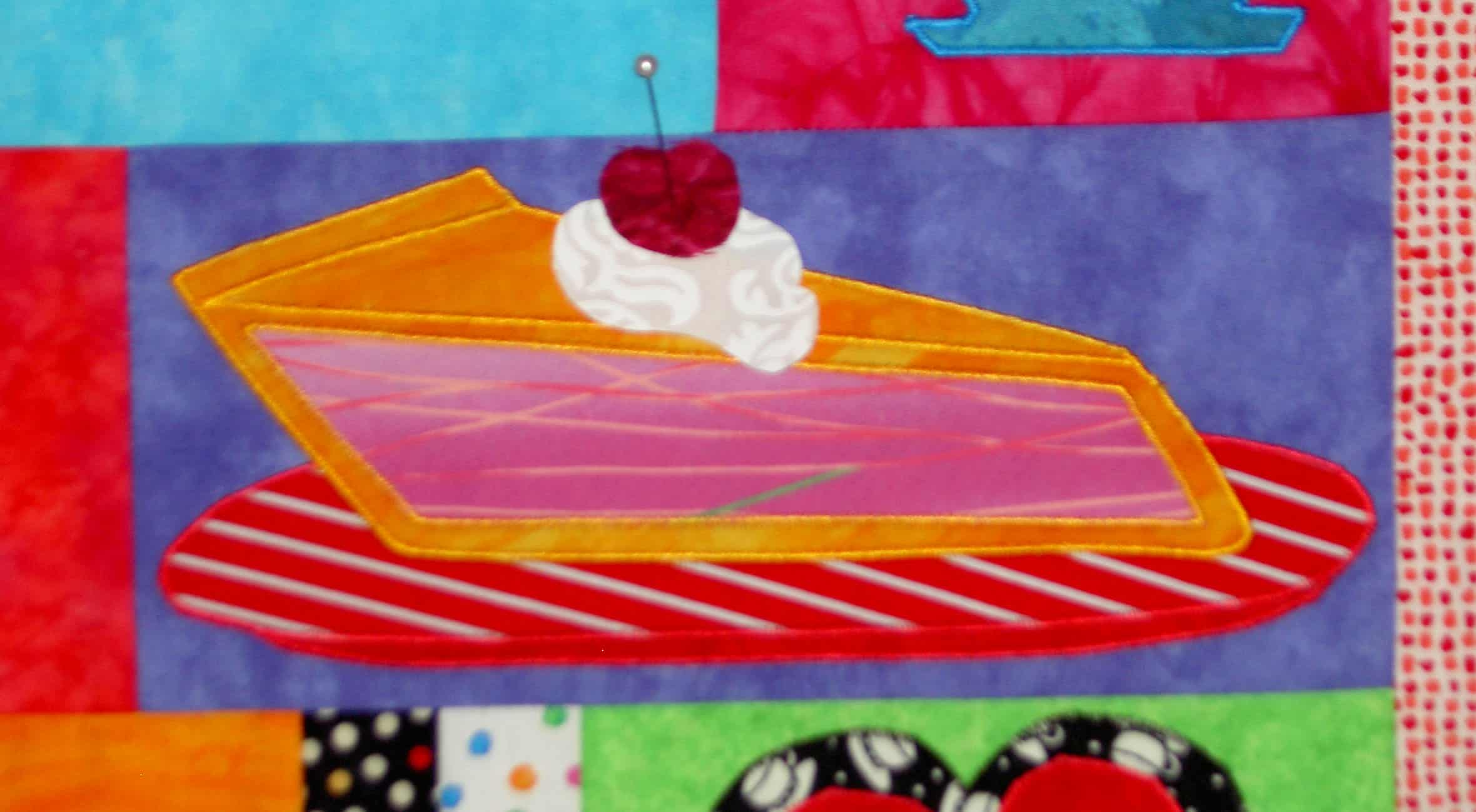
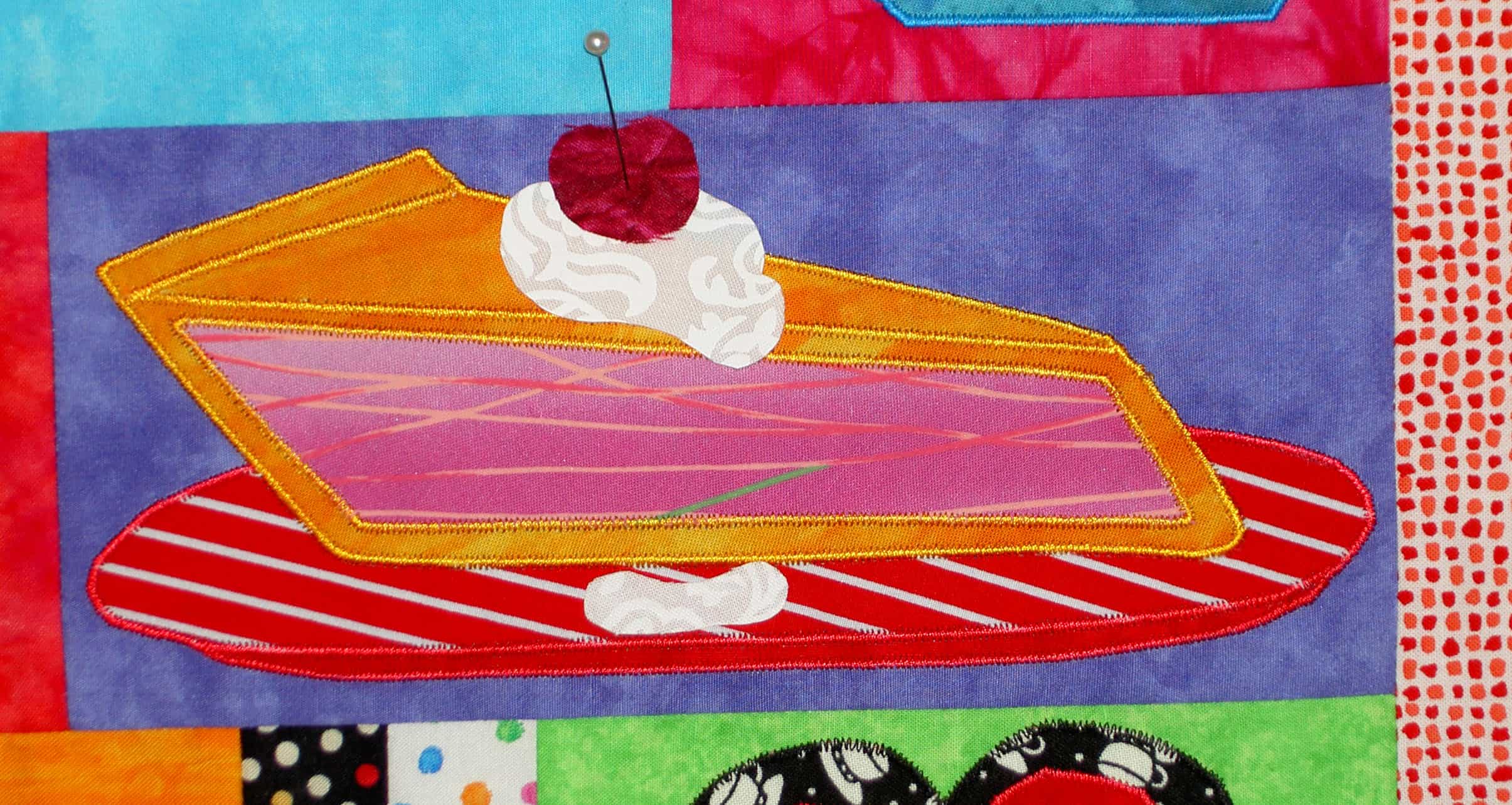
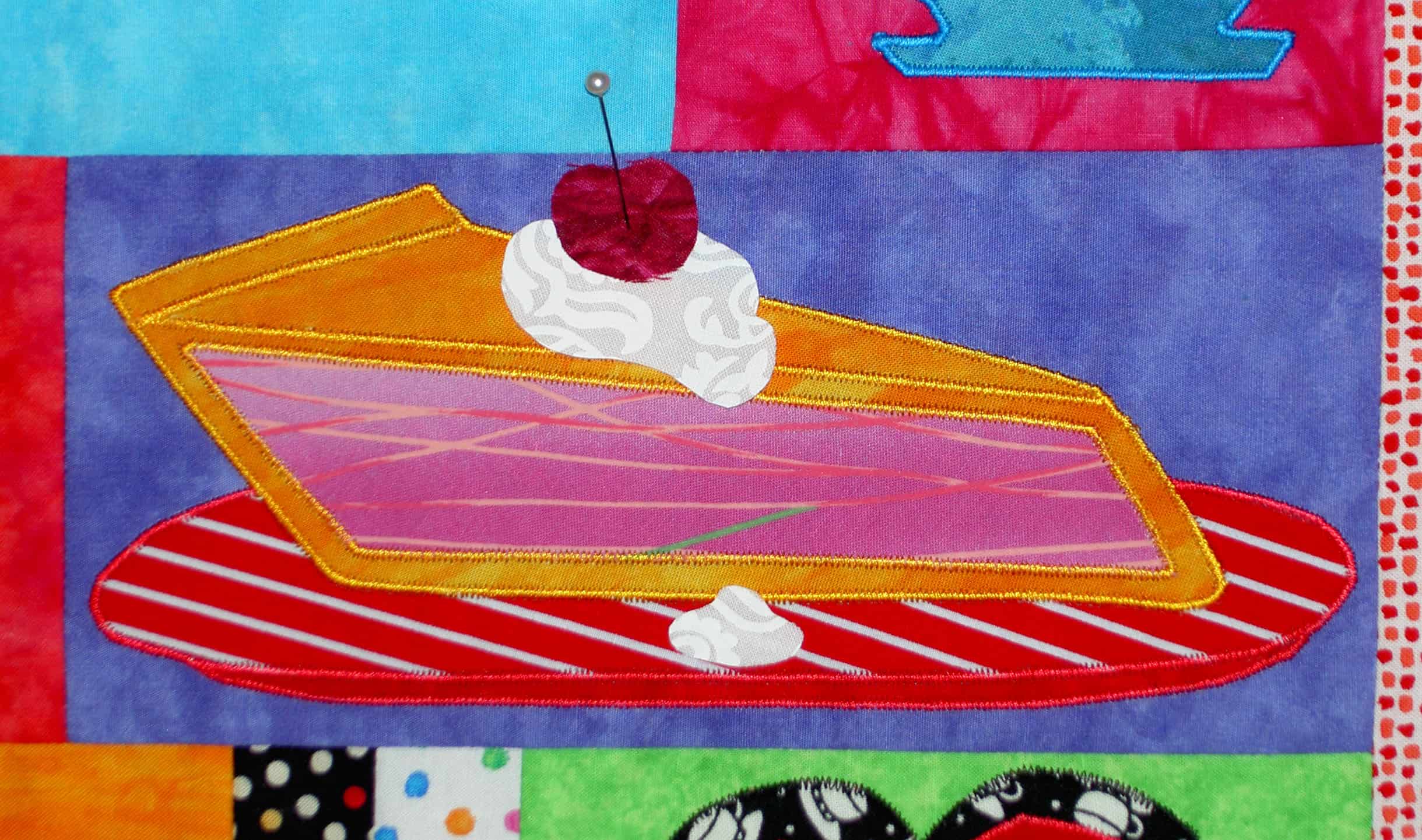
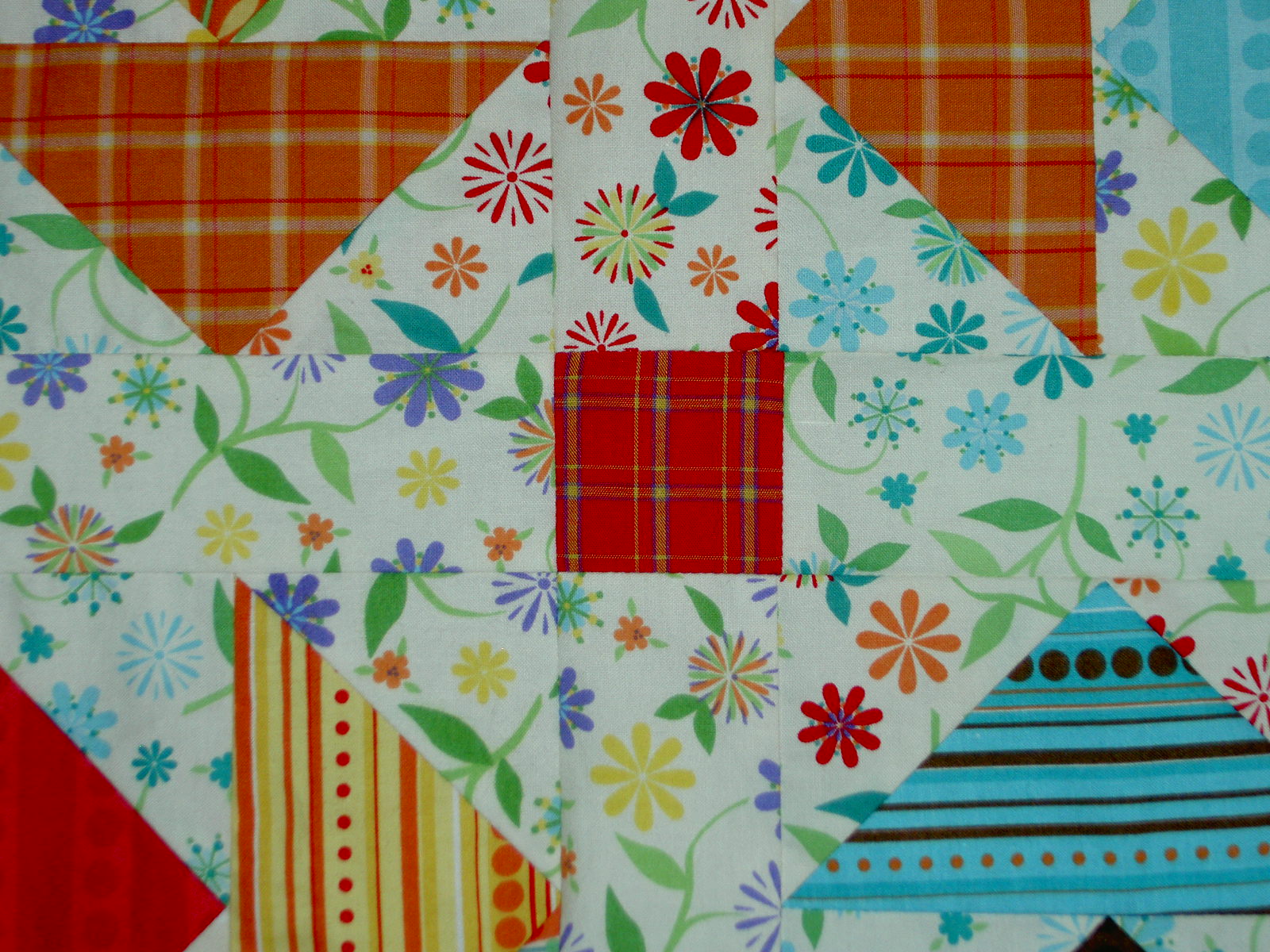
Yes, I am obsessing. This is the last time I will force you to read my obsessive, compulsive rantings on, what I am now calling, The Big Drip. The reason? The Big Drip is done. It is glued and appliqued down for eternity. Or at least until the glue from the fusible rots away and the fabric underneath is no longer viable.
I am pretty pleased with how it came out and will be even more pleased when I am at the point where I can embroider a stem on the cherry. Stay tuned for that drama! 😉
Fluttering Hearts
After successfully appliqueing The Big Drip to the piece, I had the idea that, perhaps, I should add some other little, appliqued embellishments to some of the other blocks.
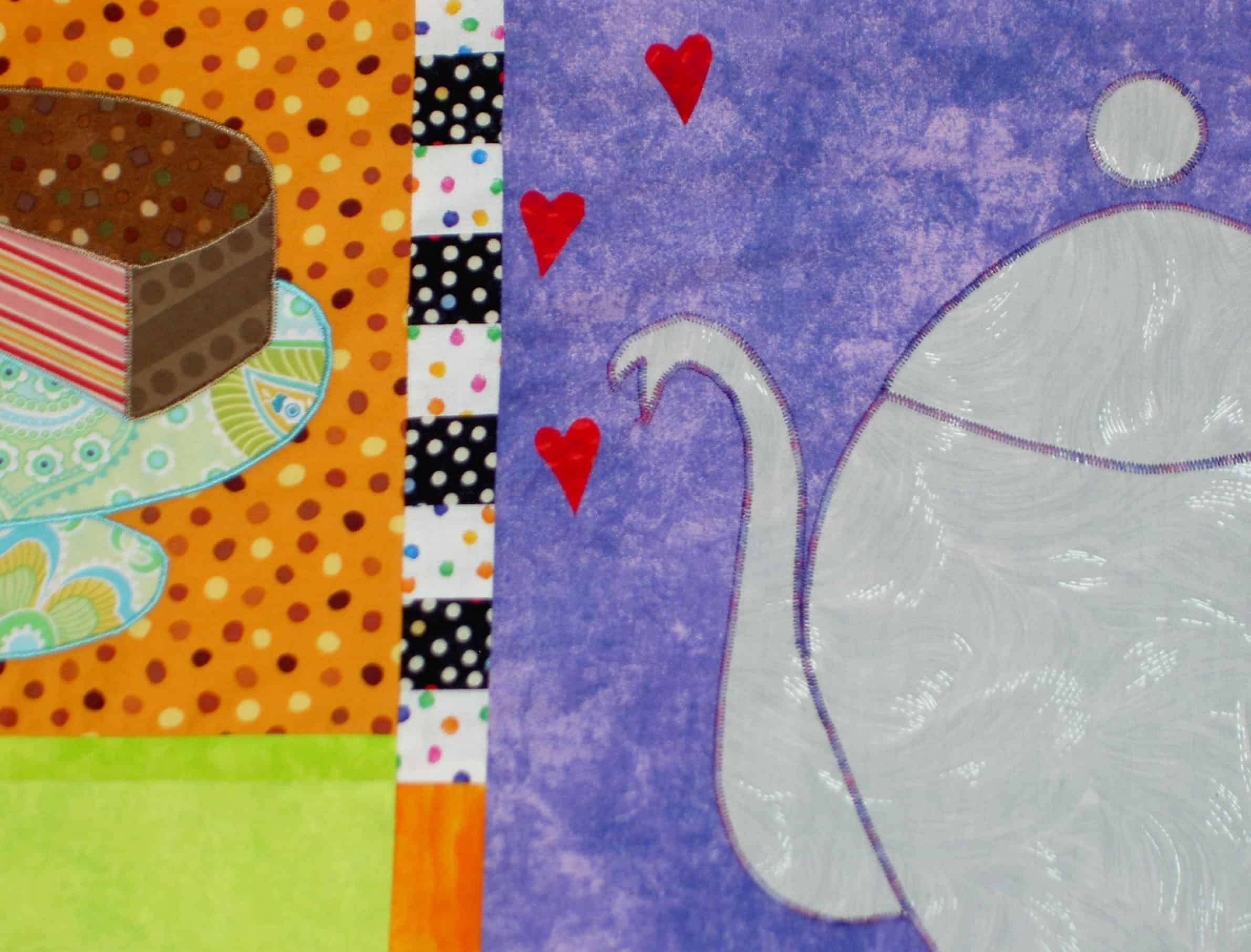
I have to admit that the big grey teapot needs some spicing up. I cut out, and am trying, these little hearts. They do add a bit of a spark and draw the eye up towards that corner of the quilt, which is good. I don’t want the piece to look like I copied Mary Engelbreit. I also want it to be fun and not cutesy. Let me know what you think.
I latched on to the idea of Mind Sorbet or Quilt Sorbet) after I heard about it in Judy Martin’s newsletter in February of 2008. I mentioned it in a post around that time. Today, I got a new view of finishing, process, starting and resting as I listened to an old CraftyPod podcast.
I am a bit obsessive about thinking about process. I can get stuck in a mindset, though, as I think I did with mind/quilt sorbet. Fortunately, I can also be easily influenced by a reasonable argument. It is probably a good thing that I leave politics mostly to Julie! 😉
Sister Diane interviewed (CraftyPod episode #66) Kirsty Hall, a UK artist who, in 2007, did one drawing every day and mailed it to herself in a project she called the Diary Project. This interview was done towards the end of 2007 as the project was winding down and Kirsty was anticipating ceasing her daily envelopes drawing practice. As I listened I thought “how can she just give up something that has been a habit?”, but I listened further and found what she said to make sense. Personally, it also defined and named something I didn’t even know I was experiencing.
I started the Quilt Sorbet project soon after finishing (mostly!) the Tarts top. I was excited to do something, uncomplicated, easy and fun in different colors. Then the 9K went back to the shop and I have wandered around not working on that project for a number of weeks.
As Ms. Hall talked about her Diary Project and the ending, she talked about resting after a big project. She made a good point in saying that we makers love to dive in and start something new. She subtly suggested, and included herself in this suggestion, that we should consider refraining from diving into a new, big project right away. Her words and thoughts resonated with me, because diving into any quilt project is a big commitment. No matter how enjoyable a project is, quilts take a lot of time and energy. Other people may be able to make a quilt in a day. That isn’t me; I spend a lot of time thinking and looking and trying. Looking at the time I have spent on Beach Town is a good illustration. I spent at least 10 hours quilting that thing and it is a small quilt! A quilt is a big project.
Listening to this podcast suggested to me that I might need to think about the project that I undertake after finishing a large project, especially a large quilt project. Ms. Hall mentioned resting after a project and I think it is a good idea. Perhaps making tote bags or pencil rolls or journal covers would be better than starting a new project. Perhaps sewing scraps together to make new fabric for fuure projects would work better than starting a quilt. I am wondering if even sewing on sleeves and bindings or facings would be good mindless resting projects?
I have had to expand my idea of finishing since I started doing the UFO reports at the end of each year. I was getting down looking at my massive quantities of UFOs. I had to start thinking about completing steps/sections as accomplishments. Really finished does mean the piece is ready to hang or put on a bed. Quilts, however, are big projects and there are multiple steps in the process. I have found that completing one of the steps, like the top can be a good place to stop in order to work on another piece for awhile. Completing a group of blocks, then sewing a tote bag together can be a kind of finishing. Working on different projects one after another can give me some breathing space to mull over a project subconsciously.
I have to say that there is a definitely a limit to the number of projects that be happening at the same time, especially if one of them takes a lot of design wall space. I may have reached that limit at various points this year.
What I have taken away from this podcast is to rest between projects. I don’t think that means stop making. I think it means making something smaller and easier.
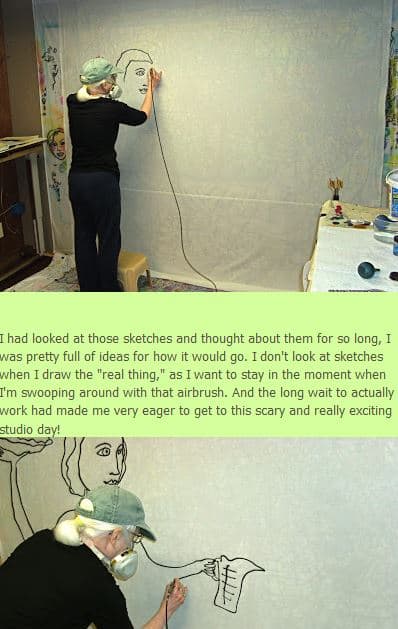
Deirdre sent me the link to this entry in Susan Shie’s blog. The post is all about the process of making one of her pieces. I was riveted reading the detail which she includes in her post. Read the post!
Susan Shie’s Savannah
Process is something that has been on my mind as I have worked on the Tarts. I used to be only focused on the end product. I found it to be very unsatisfying, because the end product had a short-lived shelf life. What do you do with a finished product? Put in the bed, hang it on the wall and …. There is nothing after that. I would be finished with the piece. There isn’t much more interaction with a finished piece.
It occurred to me at some point that the process was what was important. I have, since then, tried to focus on the process. I wrote about it in blog post on March 14, 2009 and also mentioned process on January 1, 2009 in the 2008 UFO Report.
In focusing on the process, I try to work on what I am working on right at that moment fully and completely. I try not to think ahead to the next step or the next project. This was brought home to me in a big way as I worked on the Tarts. That project required my absolute full and undivided attention. Any time I thought “oh this will be fine” meant trouble and I would end up ripping something out. The lesson was, however, that Lorraine Torrence’s advice about making visual decisions visually was correct. I knew it was, but the Tarts hammered the mantra into my mind.
One of the other things I realized about process is that while I work on something, I am completely engaged with it. I feel the fabric in my hand. I feed the thread into the machine or hand sewing needle, feeling it with my fingers. I am close to the fabric and the project supplies.
Susan Shie’s post goes through her process in minute detail. It would bore me if I had heard it before, but I haven’t. I find everyone’s process to be different and, often, fascinating.
The other thing about process is that a process does not necessarily stay within the bounds of a specific project. A process can continue to another project once I have finished with a piece. Susan talks about making her Kitchen Tarot deck, which is a multi piece project. She is making a quilt for each of the many Tarot cards in a deck. I really admire someone who can commit to such a large project. Her pieces aren’t small either. She has committed to the process.
The Word of the Day for Labor Day, September 7, 2009 was Reverence. My immediate reaction was a sinking heart and steeling myself for a lecture. The reverence that the author talked about was multi-faceted and had nothing to do with a harangue about organized religion. The passage talked about reverence for a process and reverence for materials.
“Everything that we do should be imbued with reverence and so one would think that we should begin with this concept. But no. Reverence only comes with experience and care.”
and
“In our own small way, we must create and bring order to our lives each day. We must be responsible, and at the same time express the wonder of all we know as human.”
and
“The stately determination to make something worthy of the materials and the moment is reverence.”
I think that by engaging in a process, we gain experience. The more time I spend working on pieces the more experience I gain. I also think that being appreciative of the materials and what they are contributing to the process helps me work better.
It seems to me that reverence is part of a process.
In the process of writing this post, I became much more interested in Susan’s work, classes, blog etc. Perhaps there is a class with her in my future?
I know you thought I forgot about the Tarts. Or, perhaps, you thought I abandoned the piece for another 3 years?
Oh ye of little faith!
Non quilt parts of my life have been busier than usual. I have still taken the time to diligently test your ideas for the whipped cream on the second piece of pie after I posted some thoughts in a previous blog post. I thought it would be easy and fast. HA! When will I ever learn?
Another issue is that the 9K is back in the shop. It is fixed now, but I won’t be able to pick it up (80+ mile round trip) until Friday since I am going out of town on Tuesday and the shop is closed on Monday. I tested an approximation of a satin stitch on the Jem. The Jem is a great machine, but the satin stitch it makes doesn’t compare to the 9K’s satin stitch. I need to wait until the 9K returns from his/her vacation. I’ll get everything ready, however.
Below are the candidates:
Whipped Cream #3
I liked this one, but didn’t think it was enough. I thought it needed more of something. Someone mentioned a drip in a comment, so I started working on that.
Whipped Cream #4
The drip above is too small. I want it to stand out a bit more against the plate.
Whipped Cream Test #5
The one above is pretty good in terms of having more than just an element on the top. However, the indentation in the top of the dripped whipped cream on the plate looks strange. It may be realistic, but it doesn’t look fun or interesting.
Whipped Cream #6
The one above is the option I have decided to use. I like the more engaged shape of the drip. I don’t think that is how drips really look, but this quilt isn’t reality.
As you can see, I take Lorraine Torrence’s admonishment to “make visual decisions visually” to heart.
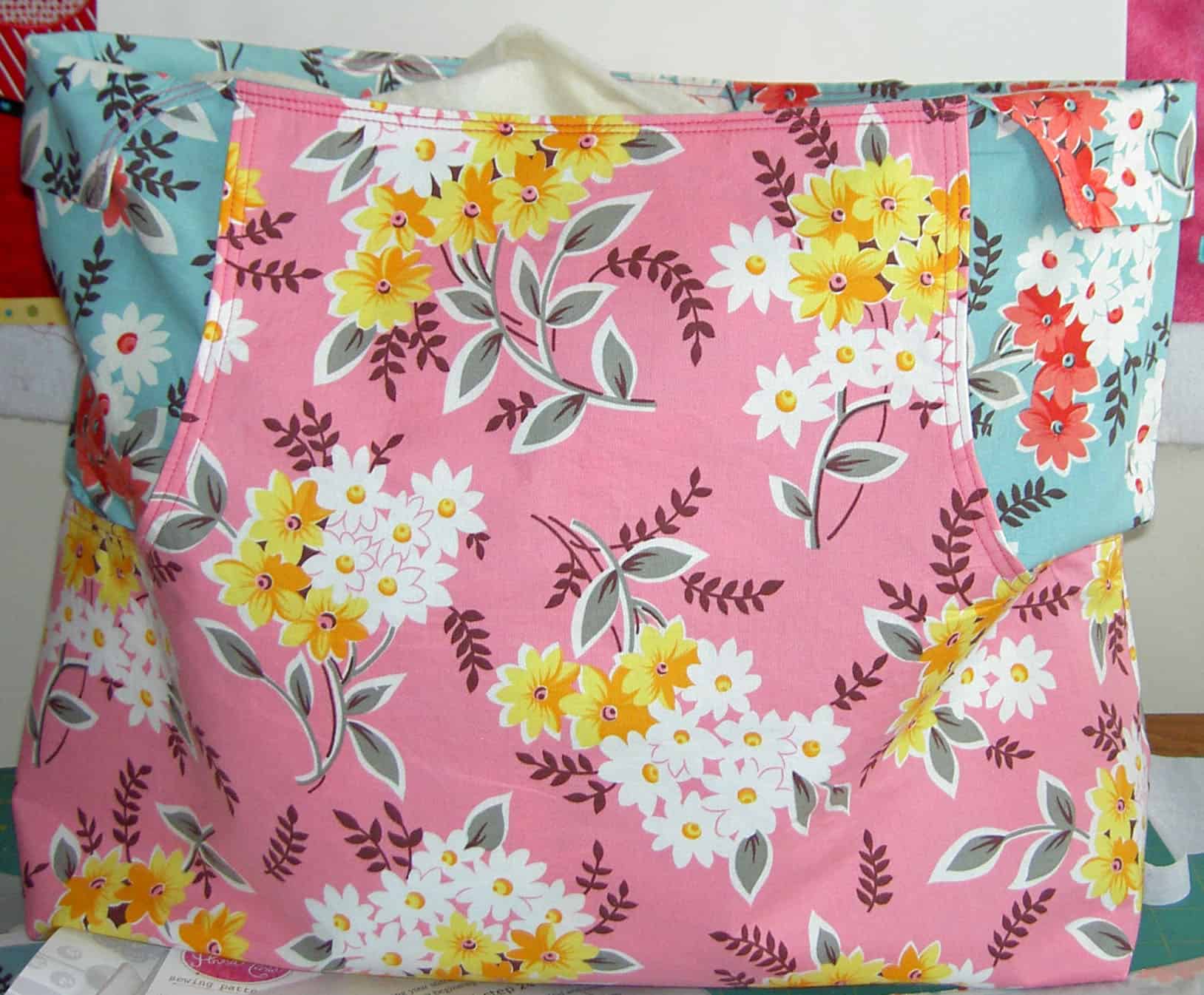
If I didn’t think Anna Maria Horner was a goddess already, I do now. I spent the day on Sunday, minus a short chauffeuring task, with the Multi-tasker Tote (AMH MTT), a recent pattern from Ms. Horner. As I suspected, I did have trouble understanding the directions. It is the way I learn and not completely about the directions. I do think there were a few tiny parts that could have been clarified just a little bit more. I know they have a certain number of pages they can use to create a pattern and have to worry about font, enough photos, etc, so I really am not going to complain too much.
In all fairness, I think making 20 or 30 of the Eco Market Totes gave me a feel for what should be going on in the tote making process. Doing a multitude of those totes and making little changes in the pattern made me understand the bones of tote-making. The AMH MTT is much different than the EMT, but in the end they are totes and their goal is to carry things.
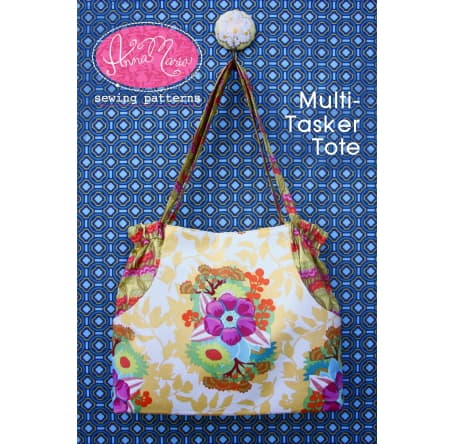
Multi Tasker Tote Pattern
In general, however, this is an amazing pattern. The way it goes together looks completely mysterious one minute and the next minute it is gorgeous and elegant. I was completely blown away, because it made me think about tote bags in a new way. I don’t think it is a beginner pattern, however I would say that any intermediate sewist who has a few tote bags under her belt could use this pattern to make a bag.
AMH MTT in progress, detail
In the above photo, you can see the bit that is folded over to accommodate the straps, including my lovely top stitching. 😉 I haven’t finished the straps yet, so there is another photo of this project to which you can look forward!
AMH MTT, Step #8
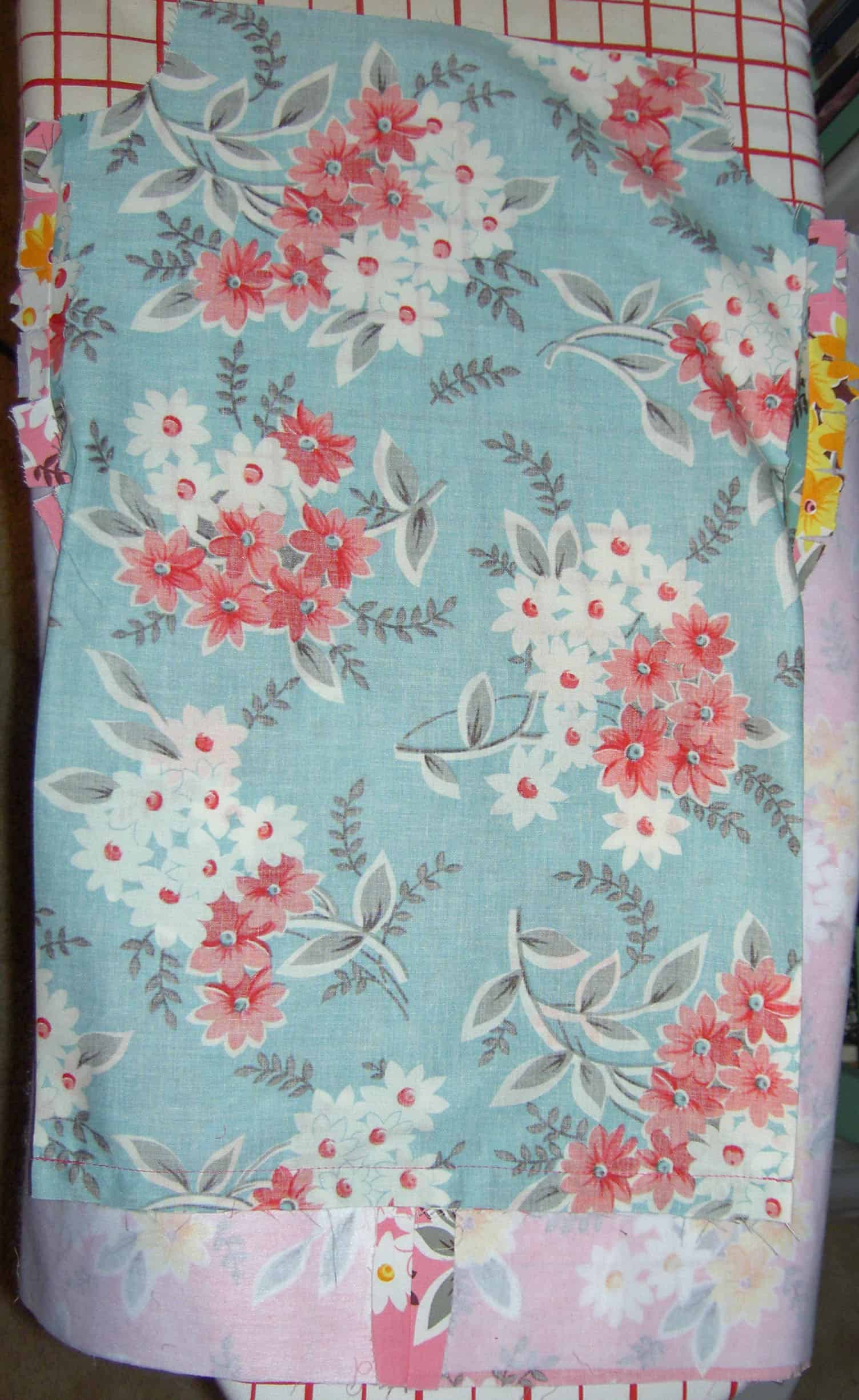
One of the steps I had trouble with was step #8. I really couldn’t figure out what the directions were trying to accomplish. Finally, I realized that she wanted me to sew the bottom of the pocket together! To accomplish that I had to pop the pocket (pattern piece is called pocket panel) out a certain way. When you do orient the section correctly, the whole thing looks like the section above.
Box corners
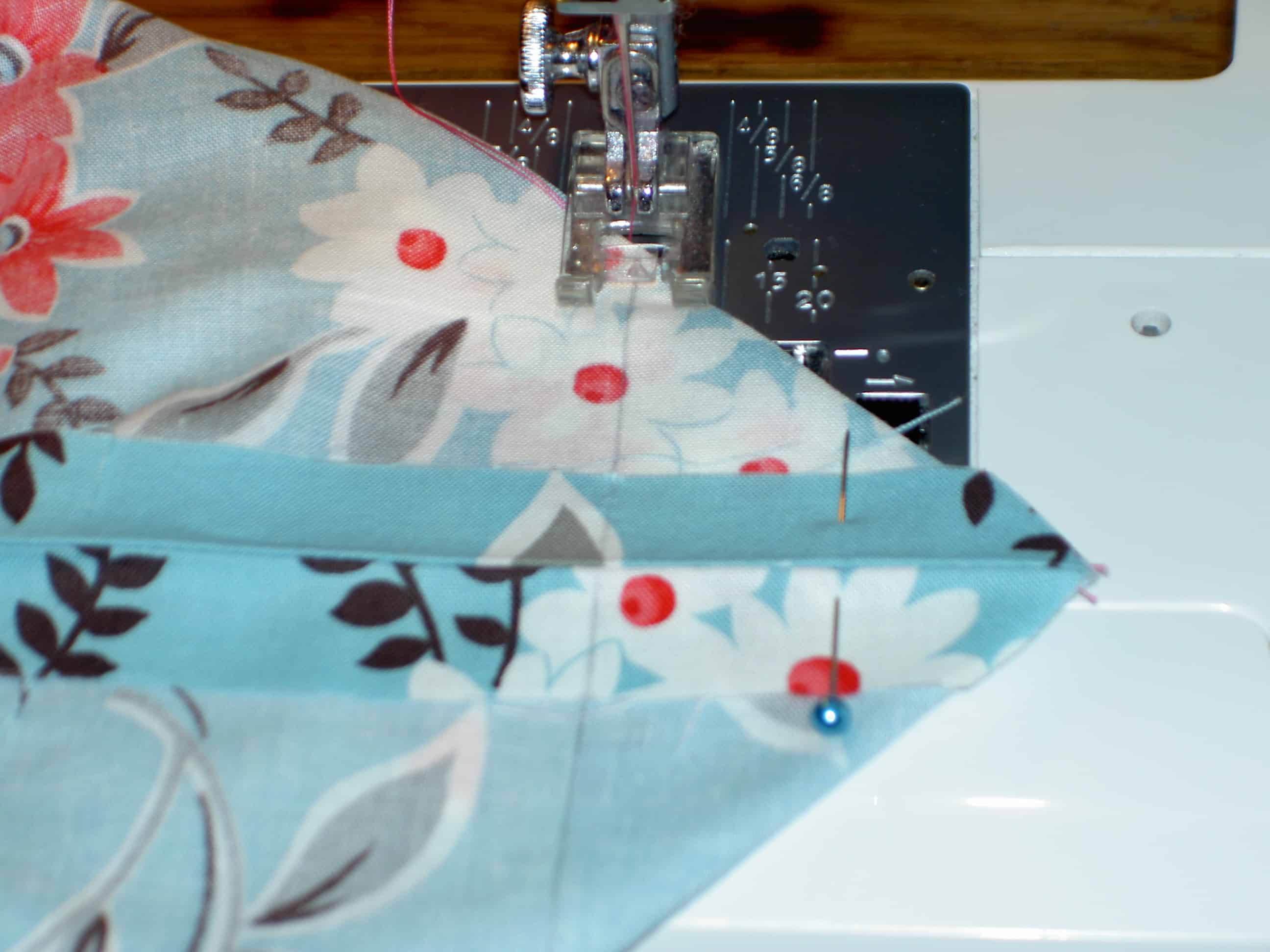
Remember I mentioned the gusset tutorial in the Bag Bazaar book? I didn’t have a chance to try it out. I found AMH’s directions to be stellar. You press a crease into the side of your bag, then you line up the bottom seam with that crease and you have a perfect triangle. I drew a line (not part of the directions), because of my A type personality. Perfect box bottom. I did it before I realized what was happening and was amazed at the results.
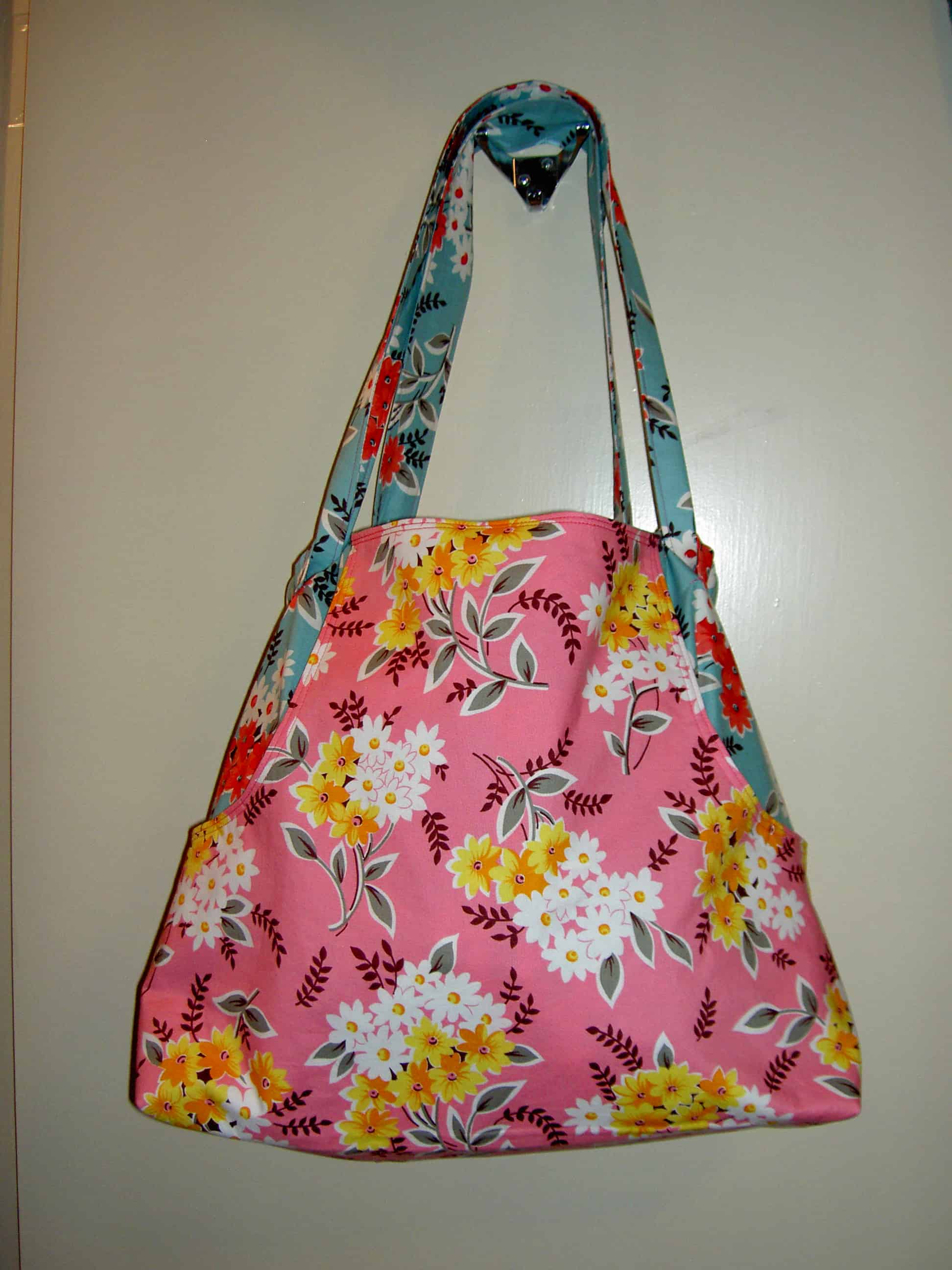
I love the fabrics that I chose for the current tote, individually. I am not happy with the two of them in combination in this project. Too many flowers, I think, which means that none of them stand out. Yes, I will be making another! As I mentioned in a previous post and as you can see from the photos, I used the Denyse Schmidt fabrics as a trial run.
MTT #2 Bag Fabric
My biggest challenge with this project is the requirement of Pellon Peltex Double-Sided Fusible Ultra Firm Stabilizer #72. I didn’t have any in my fabric closet, which didn’t worry me. I sewed and fused two pieces of Timtex together and the put Steam-a-Seam 2 on the outside and fused it to the bag. Having a stiff bottom is GREAT! It makes the thing stand up and much less floopy. Using my jerry-rigged method, I could easily see where something already stiff and fusible would be a lot easier. I searched the web and found it by the yard for $10+. I also found a bolt of it for $99+. Huh! I can’t make another of these using my jerry-rigged method, because I am out of SAS2. I have to decide whether to get a bolt (seems like overkill) or pay, what seems like, and exorbitant price for a yard. Anyone of you have any perspective on the price of Pellon Peltex Double-Sided Fusible Ultra Firm Stabilizer #72?
Kristin LaFlamme reviewed this pattern on her blog as well. It is a very complete review. She mentions a couple of the inconsequential typos I also saw and does some interesting things using recycled materials. Her rendition of the pattern makes me think about adding additional pockets to the outside. Adding a pocket to the outside would be especially successful when I don’t have a focus fabric (as shown on the pattern above) or fabric suitable for broderie perse.
I hang my quilts from a system that uses a shelving standard screwed to the ceiling, and S hooks and fishing line looped over the ends of the rod. Or in this case, actual picture hangers.I have to have a way to hang many sizes of quilts, and I change them out often. This system is hardly noticeable since the eye usually sees the quilt first.
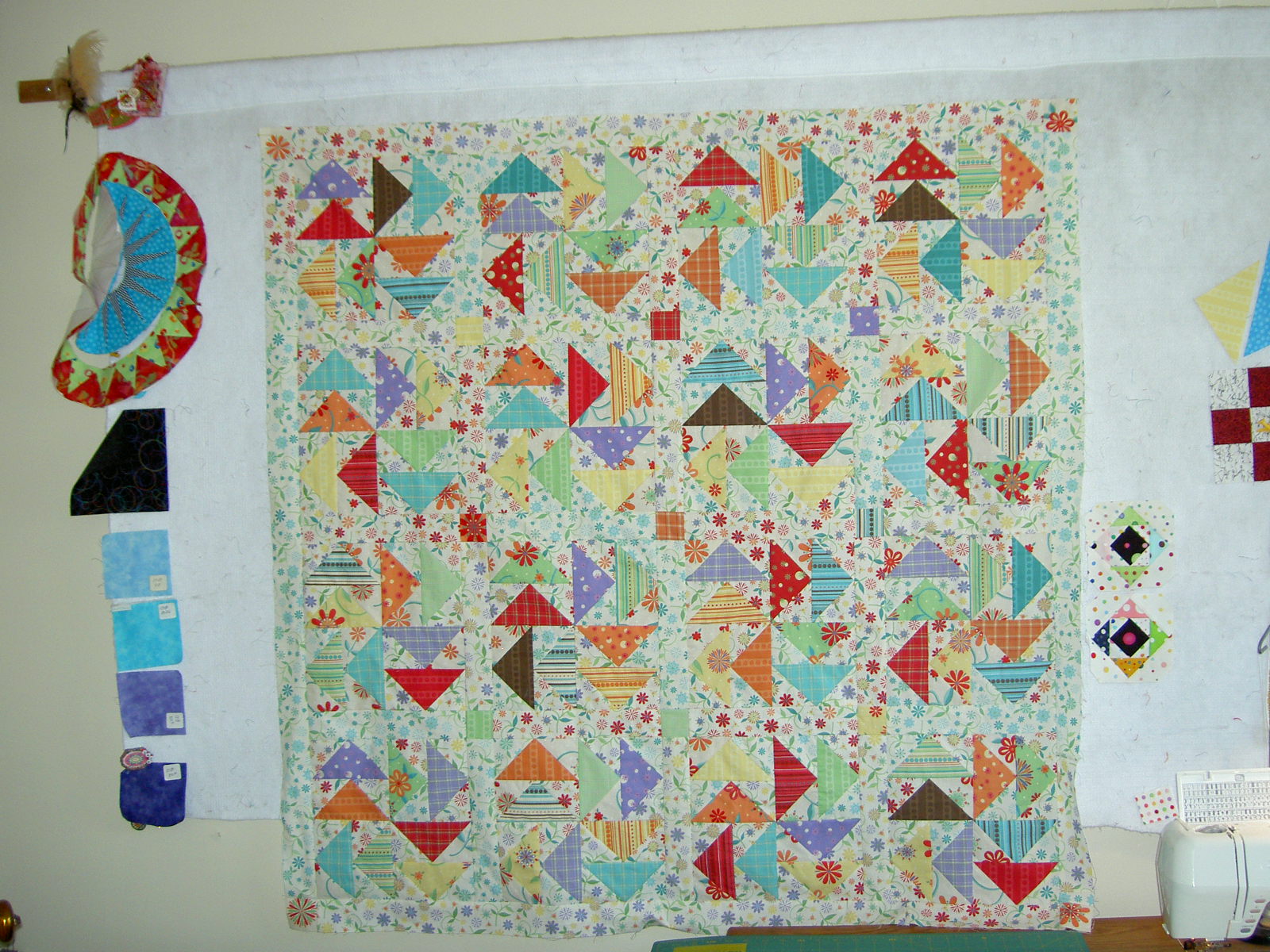
I put the first white/background border and the cornerstones on the piece last night and this morning. Intermittently, I have been working on the back. I may have mentioned that I am using some of the leftover fat quarters. I am mostly not using the stripes, because they will be good for the Stars in Stripes quilt that started out as a test that I will probably make into a quilt. It is pretty far down on the list.
This is a secondary pattern that I saw after I put the first border on this morning.
Afer looking at this hand last night and this morning, I am not so happy with it. The quilting looks off and weird. I think it was the batting that I used. My plan now is to make another one – same design, etc, but better batting and quilting.
I really had trouble with the quilting, because there was nothing to grab on to. I really wanted to use the Glitter, but, as I mentioned, couldn’t get the tension right. My machine better behave or I am junking it and getting a new one! I will try again with straight lines and the Glitter.
The good thing about doing something over is that the second time goes faster. I don’t feel it is a waste; I feel that I am improving the process.
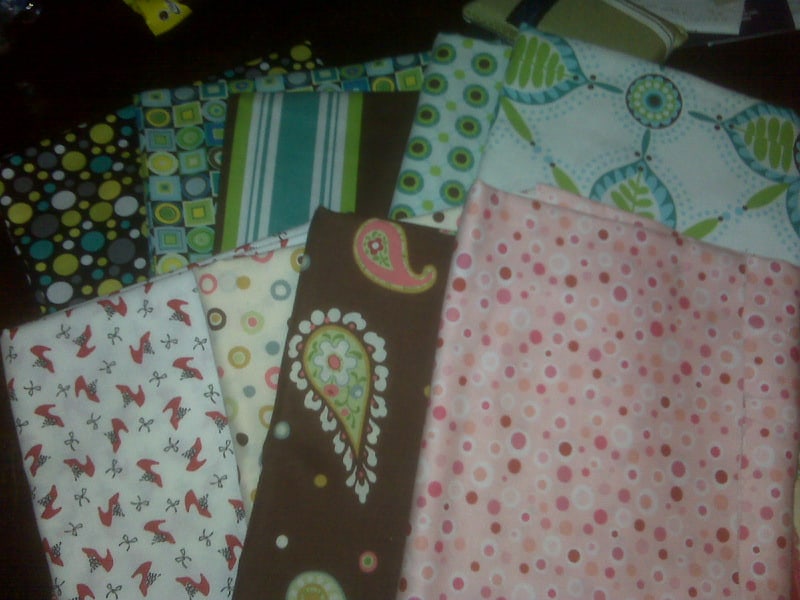
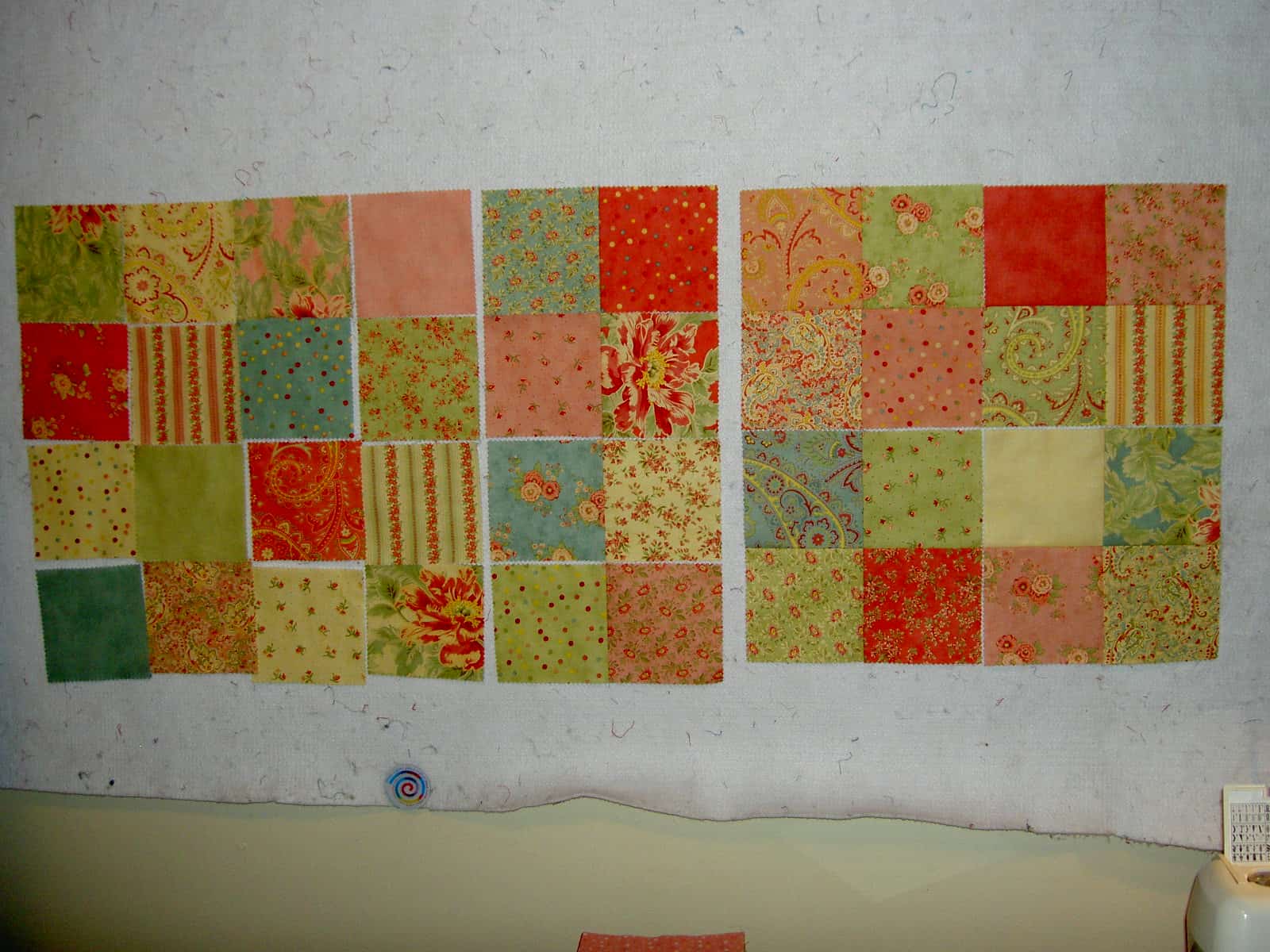
Also, during TFQ’s visit, I worked on the Moda squares I got from Hancock’s. I decided on the final arrangement and started sewing them together. More than 20 days later, they are still in the same state. I will get back to it in another month or so.
I decided to get more of the squares, after St.JCN suggested it, and make the piece a little bigger. I was thinking about how I would arrange the new batch of squares. My idea now is to arrange them the same way, but turn the whole arrangement upside down and then sew it to the original group. Since I have not made this decision visually yet, we will have to see once the squares arrive.
I was listening to Morning Edition this morning (April 7, 2006) and heard a bit of the last segment with Seu Jorge, a Brazillian musician. He said [paraphrased] that Bob Dylan could write a very simple song that was sophisticated in its simplicity.
When I heard this I realized that this is a goal that I strive to achieve in my quiltmaking. This comment coalesced some of my thinking about my quiltmaking. In making blocks to form a quilt design, I strive for a look that is sophisticated in its simplicity. It is not that simple, however, because you have to taking the fabrics, the thread, the quilting all into account. With fabric, and I realized this with the Thoughts on Dots squares, you have to think about the “weight” of the look of the fabric. Does the fabric look or feel heavy or light, sherbety or cake-like?
I would love to hear what this means to you. Please make a comment in the comments field or e-mail me via Artquiltmaker.com.
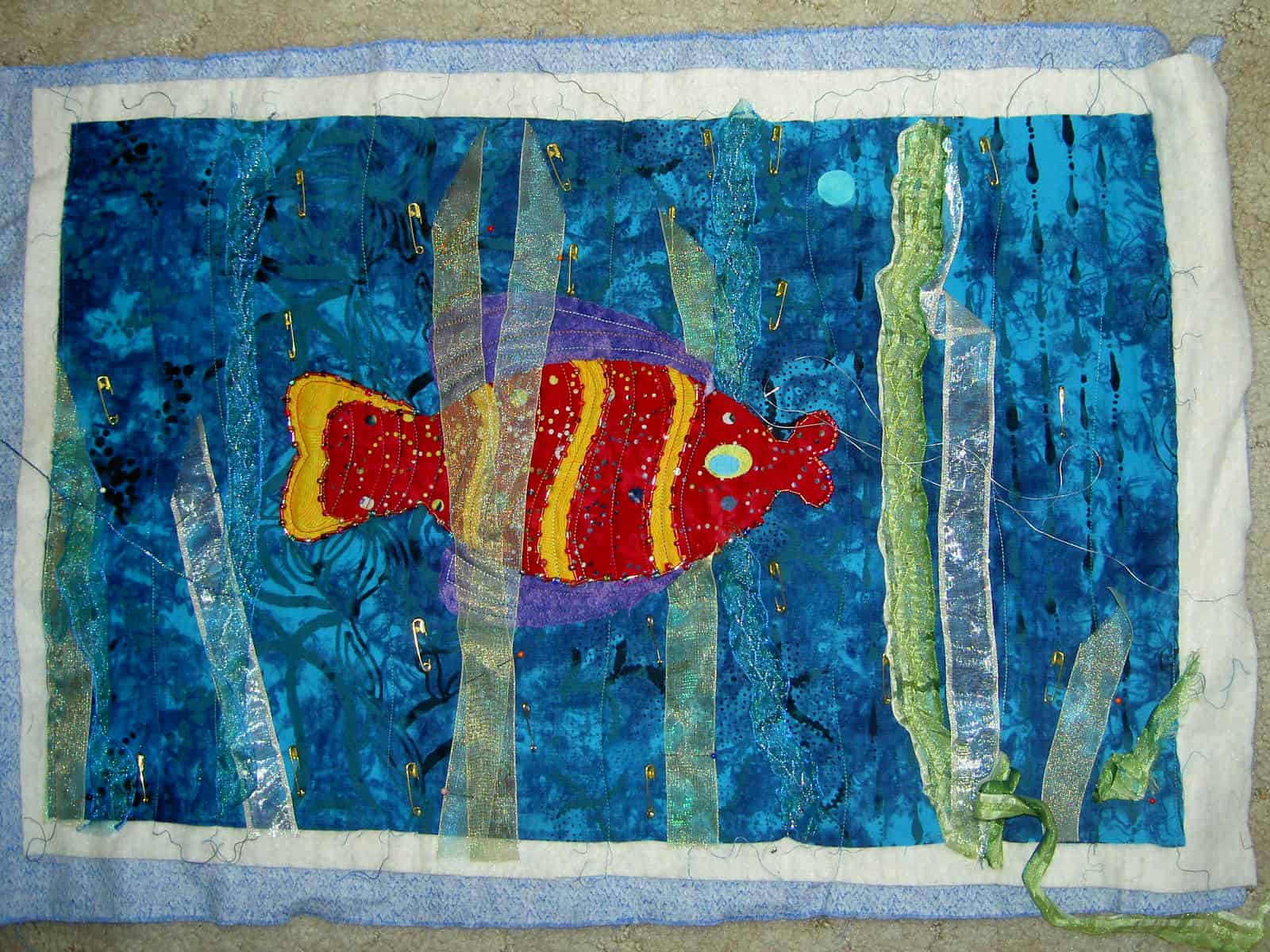
Kissy Fish is a small piece that I created so I would have some handwork and be able to try a few things. I haven’t worked on it lately due to time, and didn’t for a long time, because of an injury. In a continuing effort to sew and make progress on my quiltmaking, I pulled out the project and brought it with me to DS’ appointment today.
Every Friday I have about an hour to do something portable and not computer related. I have been bringing blank paper and writing letters. Over Christmas, I brought Christmas cards and wrote those. It occurred to me today that I could bring a portable sewing/quiltmaking project and make some small progress.
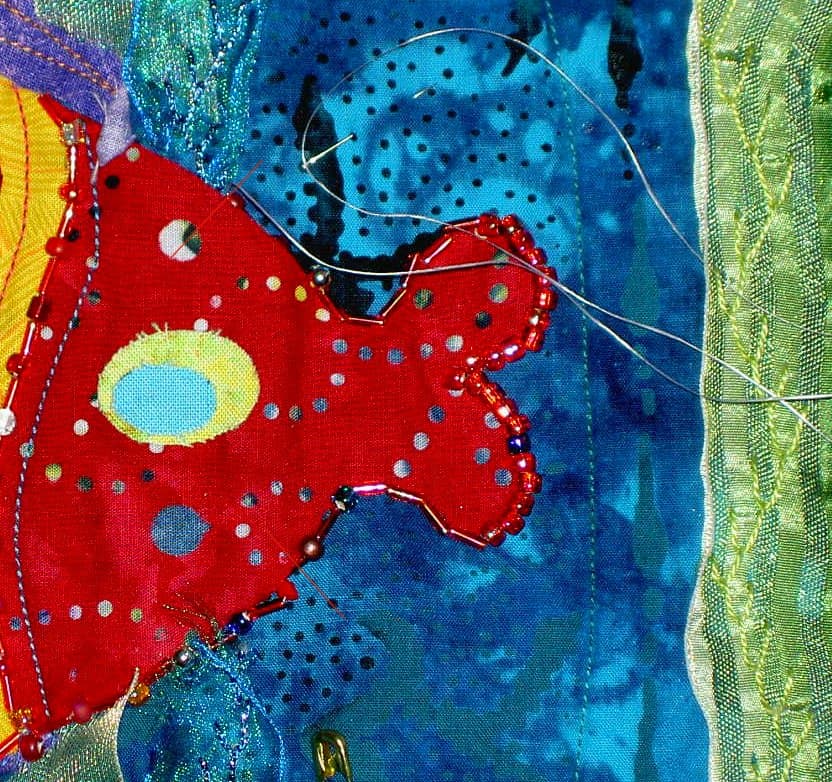
In the detail above I have placed slash marks in the area I was able to accomplish in the hour I had to work on it.
One reason I started this project was because of the embroidery articles in Quilting Arts magazine. I thought I would like to try some of the stitches, but am not interested at all in Redwork or an entire project based on embroidery such as a crazy quilt. I also had a lot of beads and thought it would be good to try beading out. Around that time I saw the work of quilt artist, Susan Carlson, on Simply Quilts and was inspired to try both beading and embroidery in a free form sort of way on Kissy Fish.
It is not meant to be a great work of ART. It is meant to be a test piece for me. I hope that it comes out well, but I am giving myself permission to do what I can and screw up if I need to. It is quite liberating to think this way.