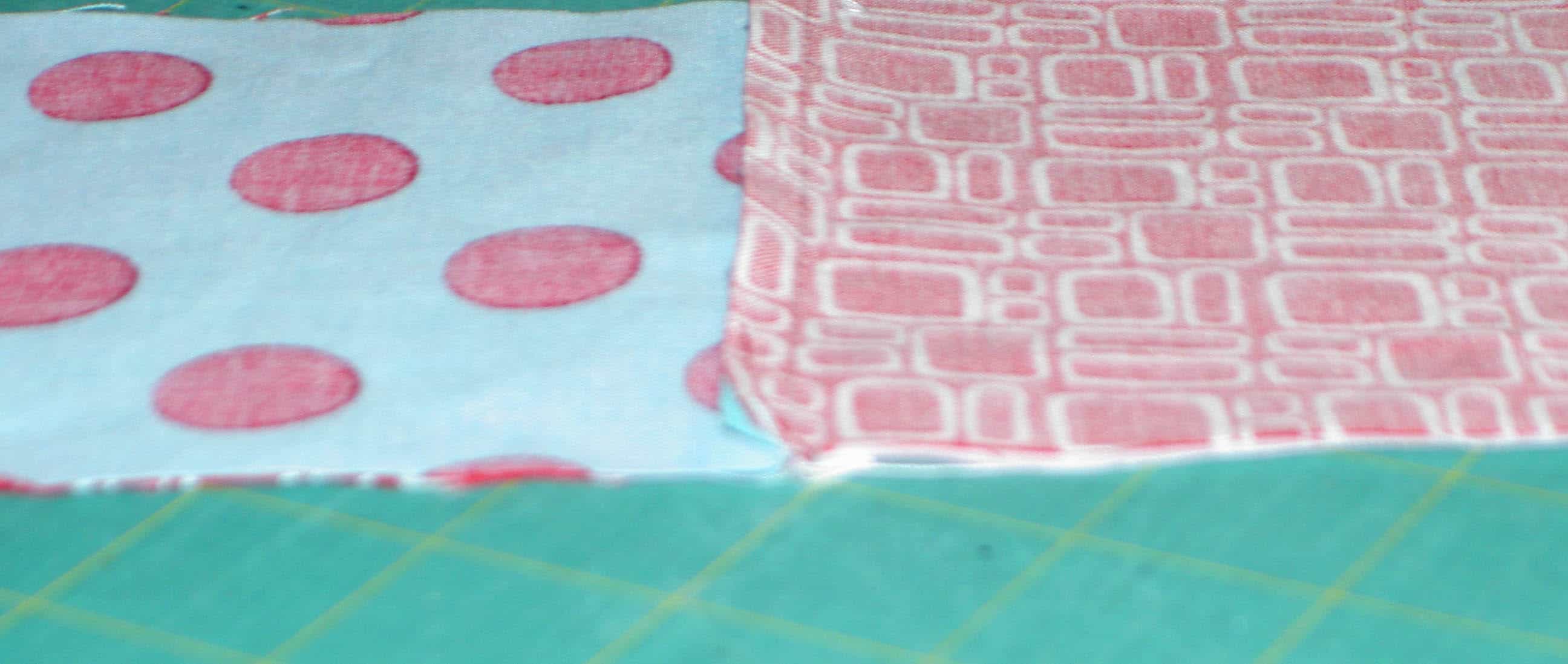
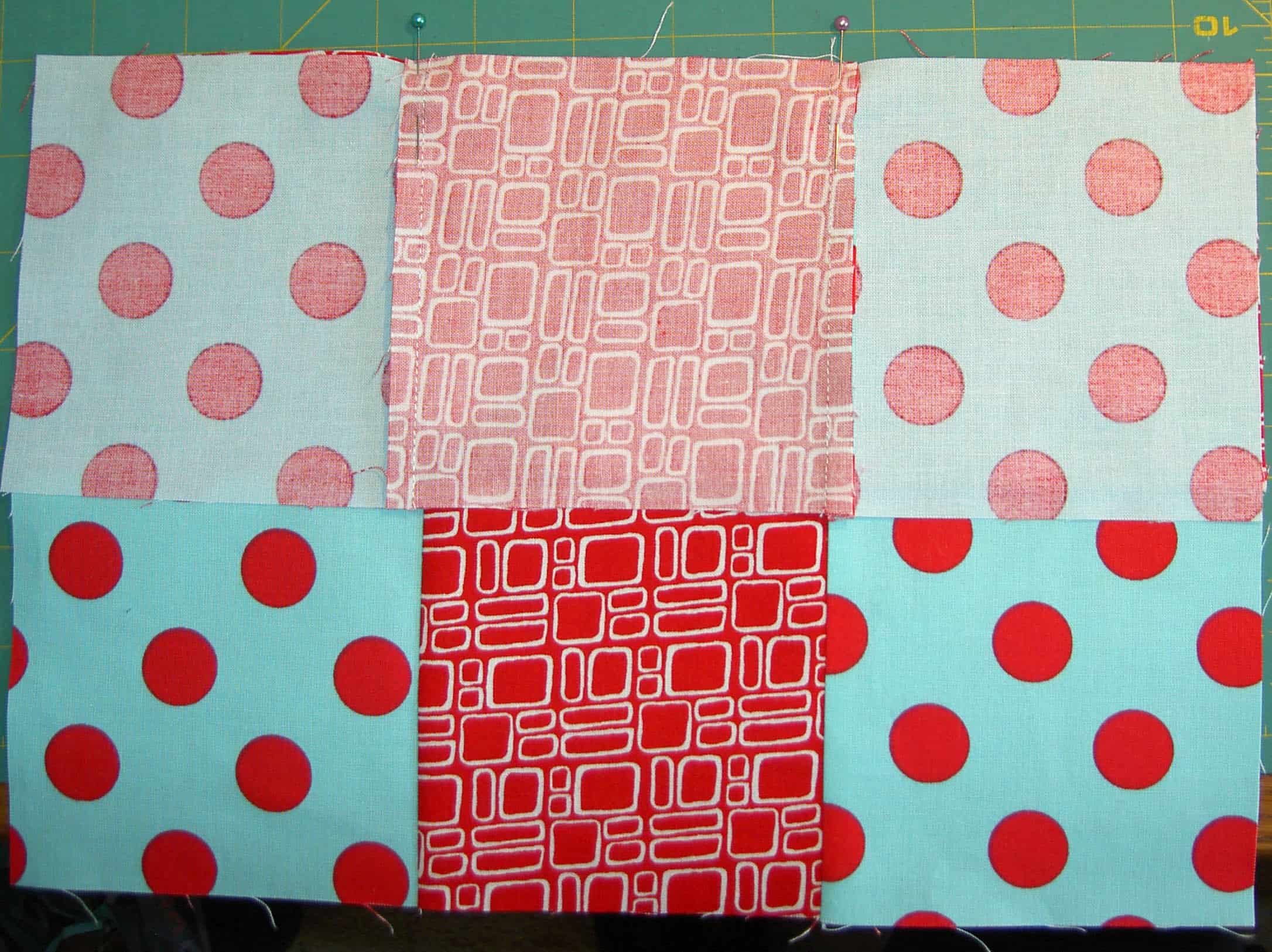
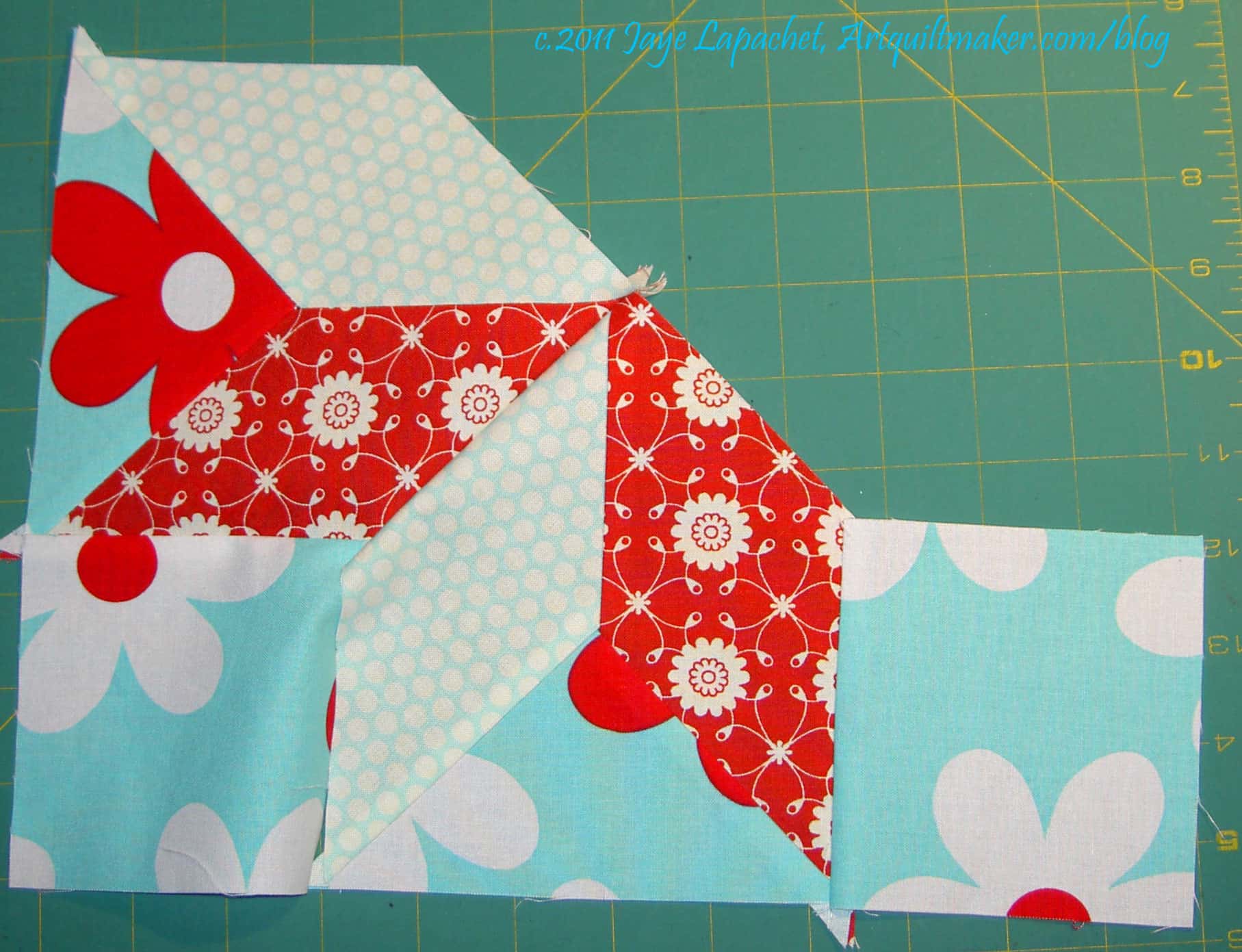
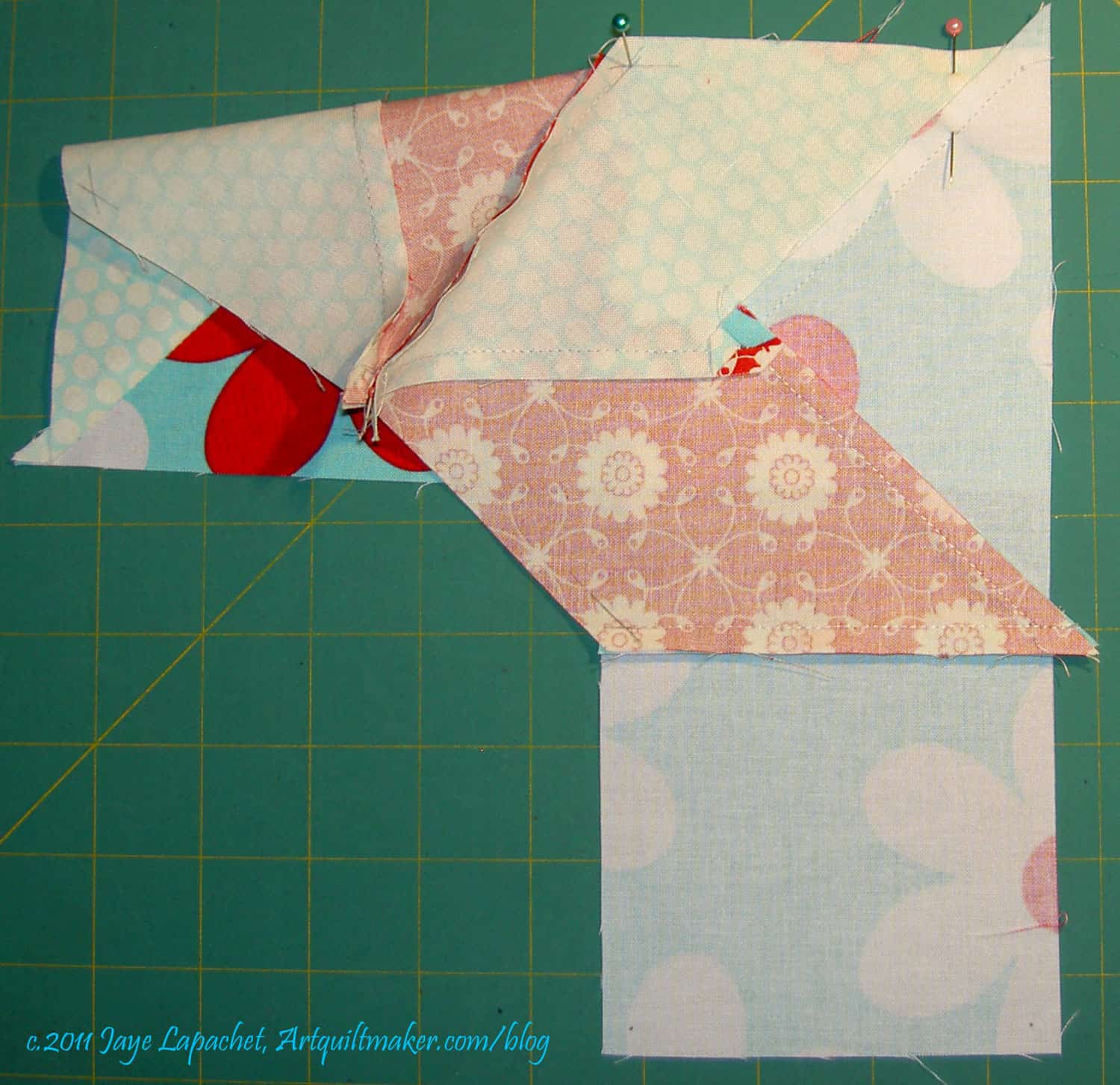
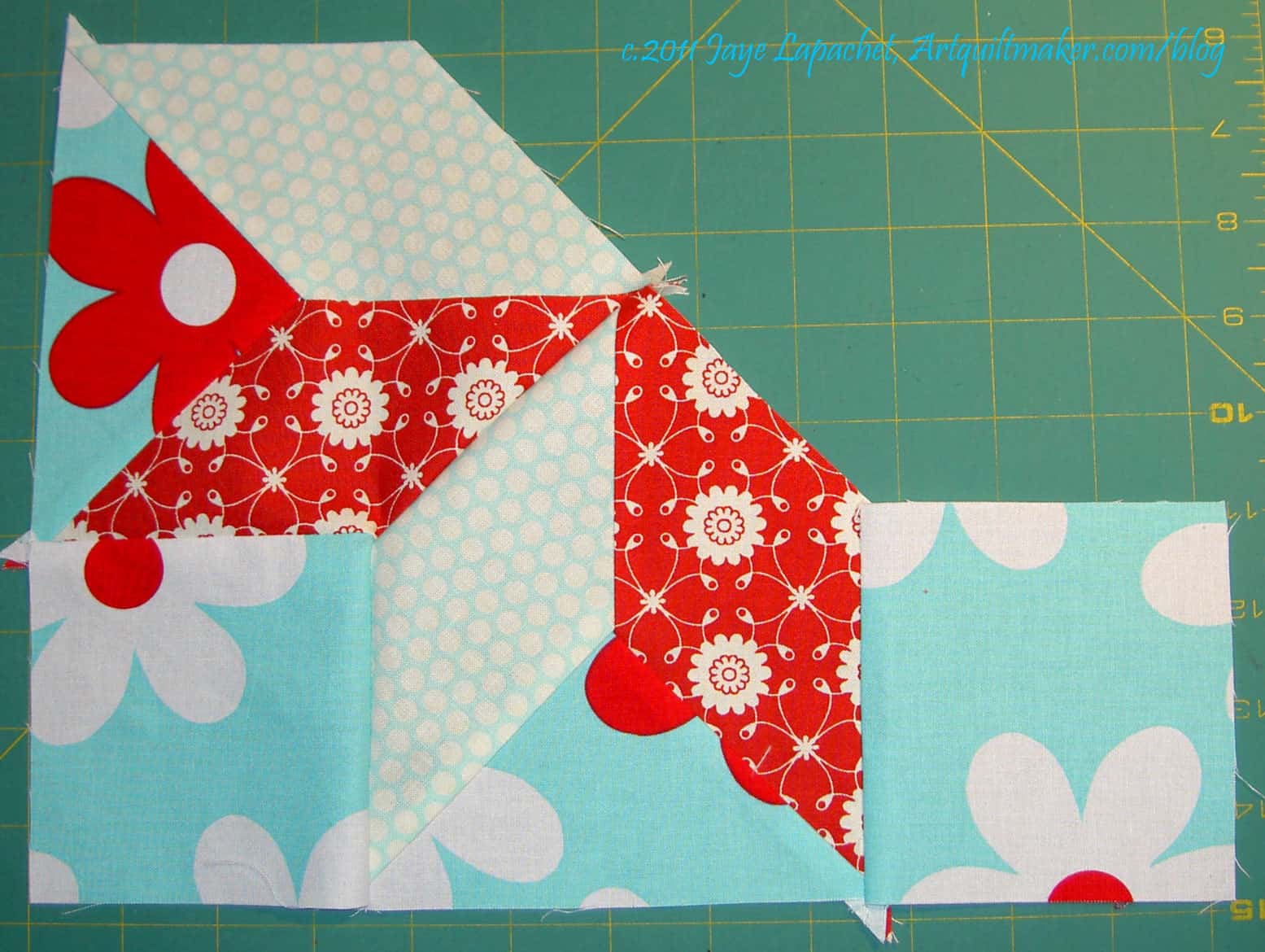
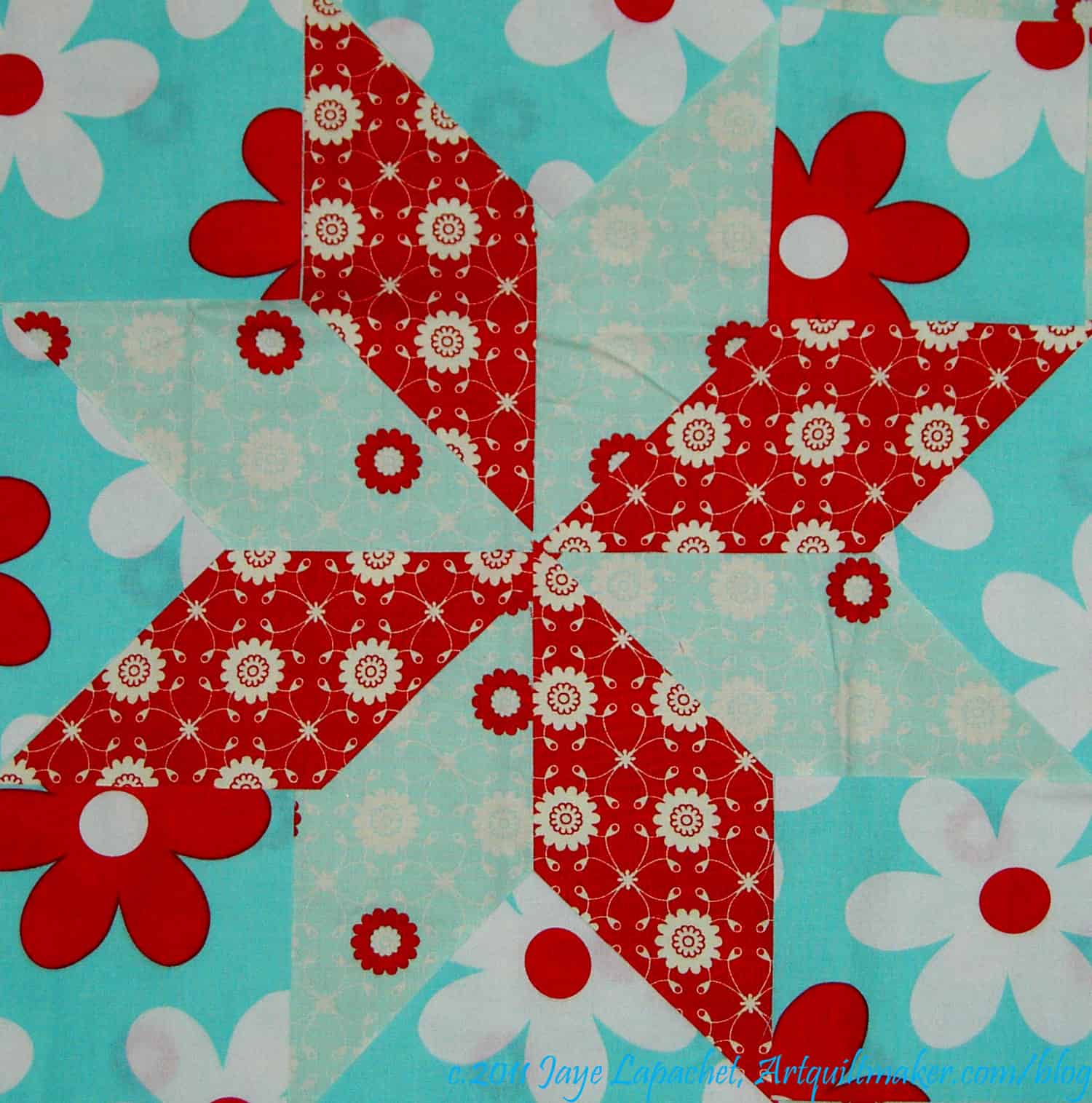
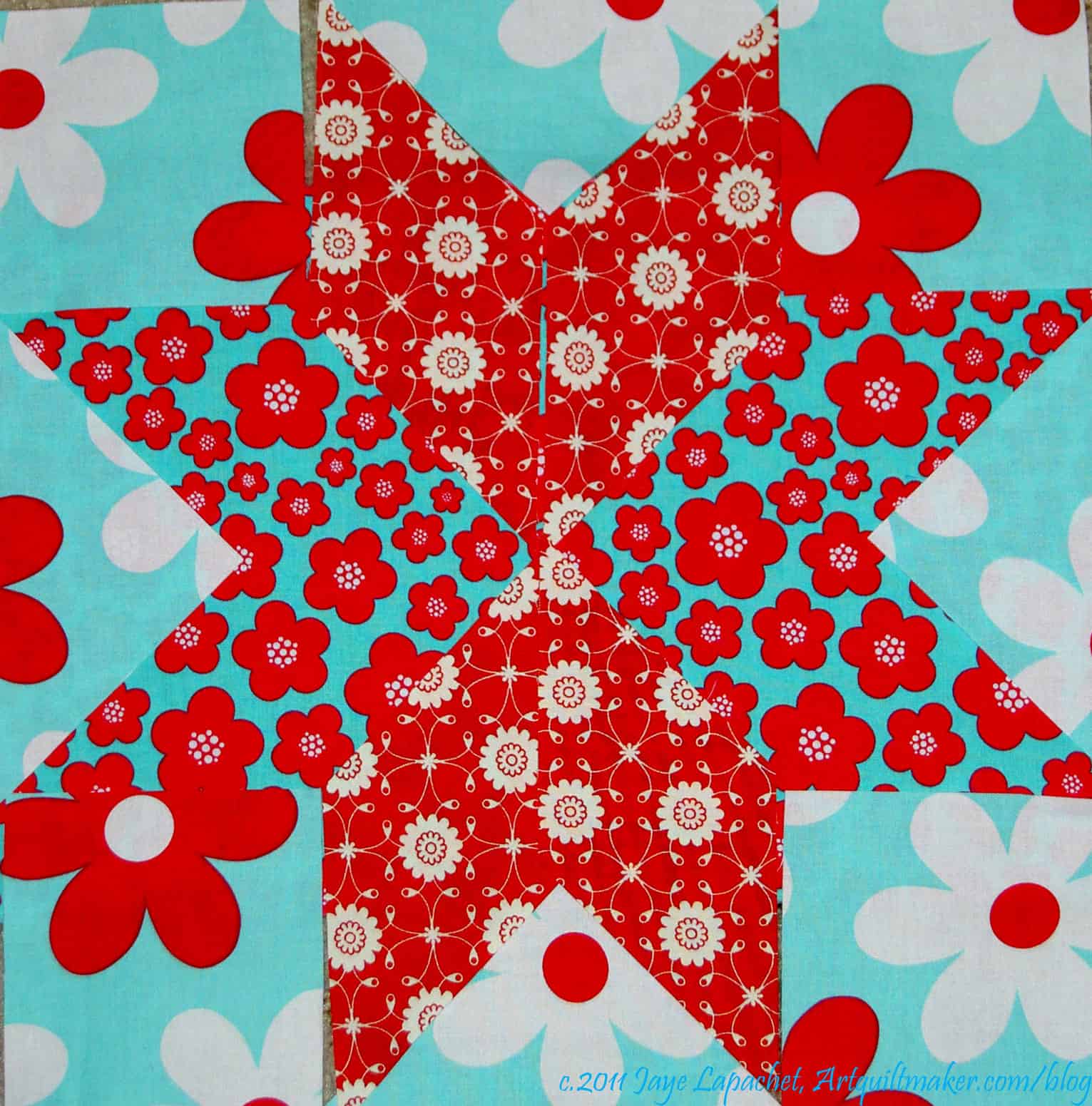
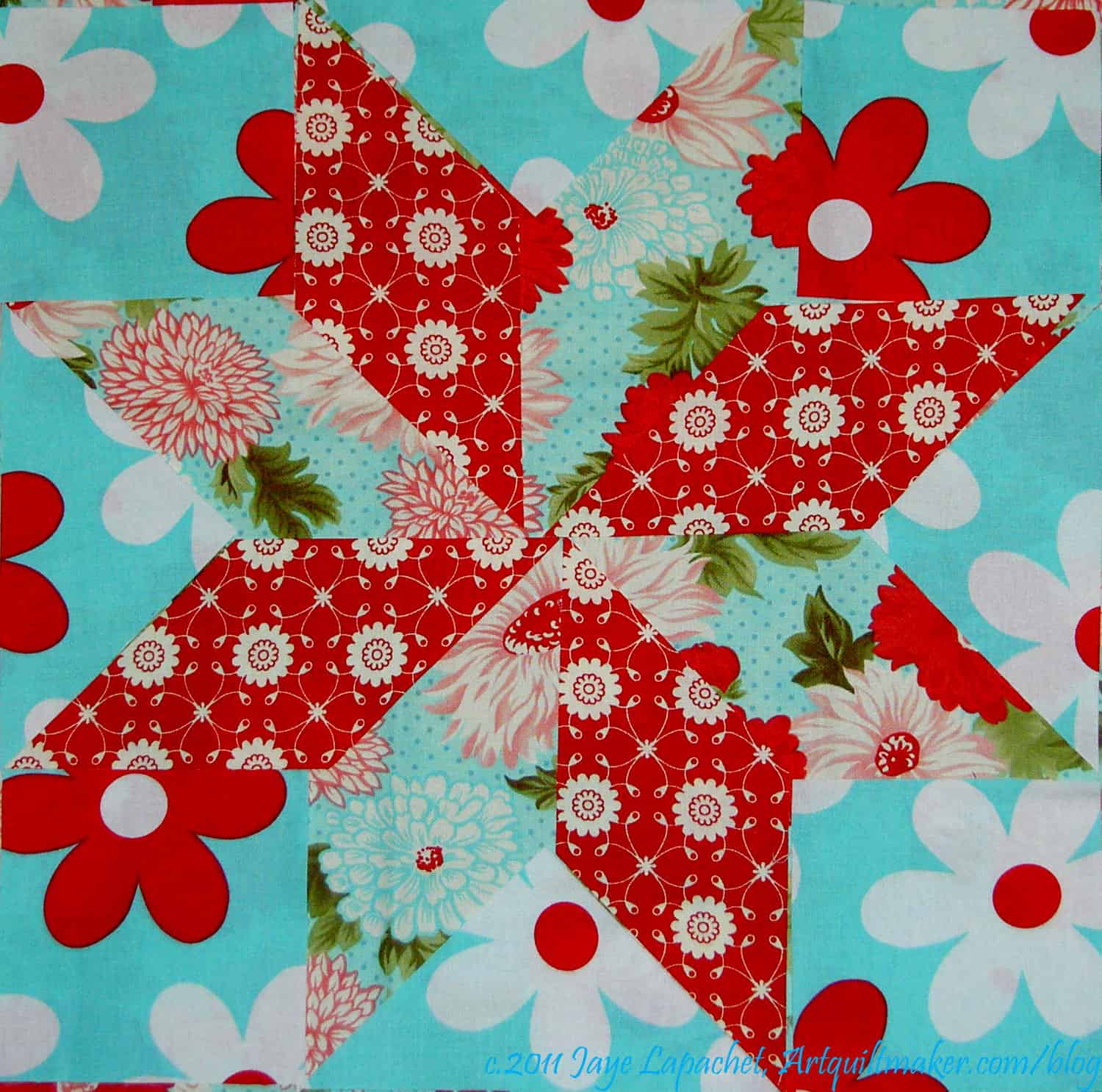
We are midway through the foundation piecing class. This is a long tutorial, but there are a lot of steps and I want all of the parts to be clear. This would be a great tutorial for a video, but A) I don’t have a crew and B) I don’t do video.
This segment discusses more foundation piecing. In order to get to this point, you should have completed parts 1 and 2. All of the supplies are listed in Part 1
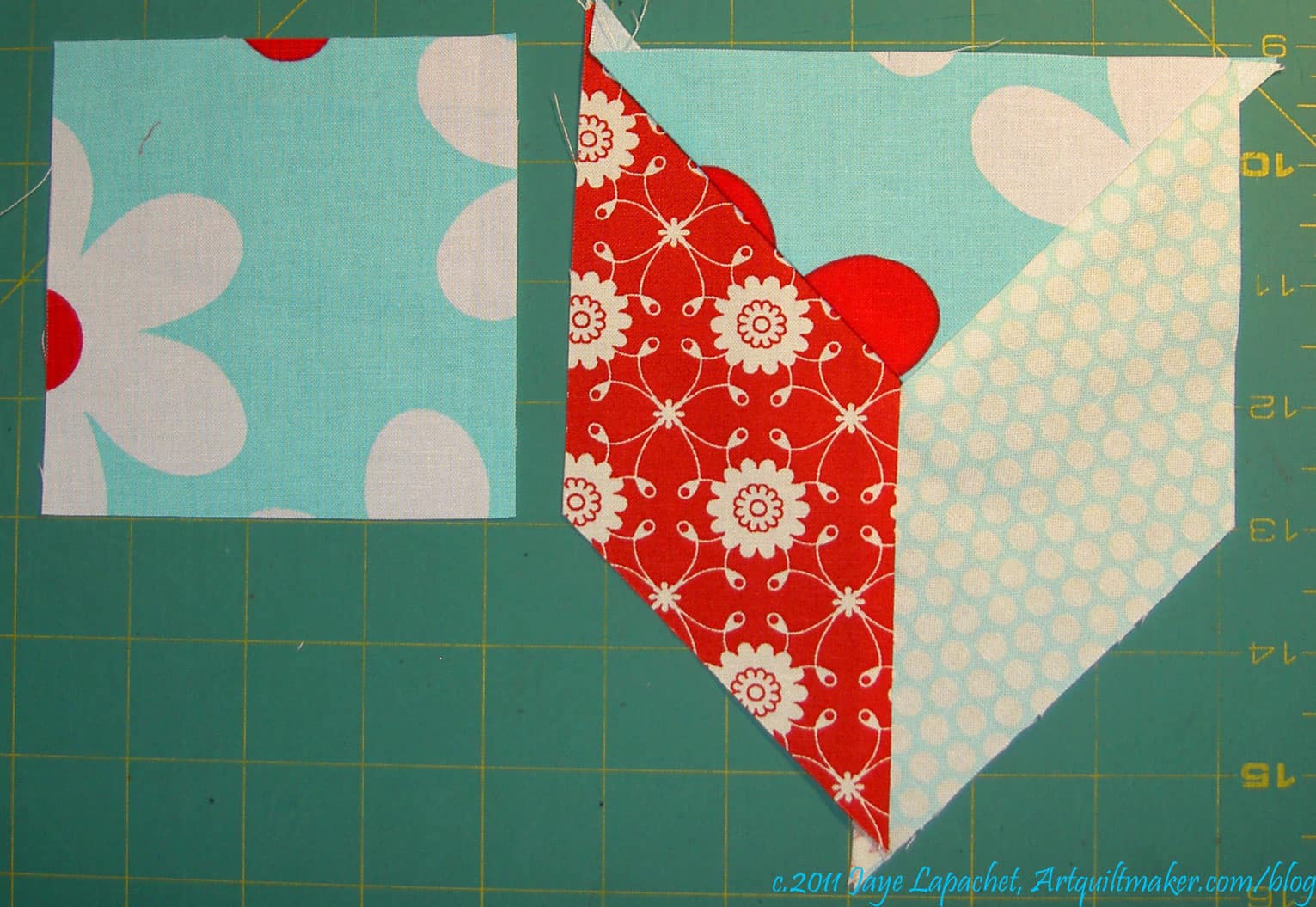
Remember our goal:
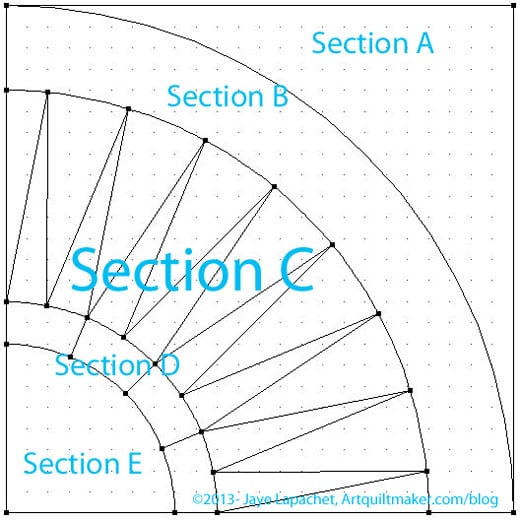
NY Compass Outline
Next, we need to foundation piece the small strip called Section D.
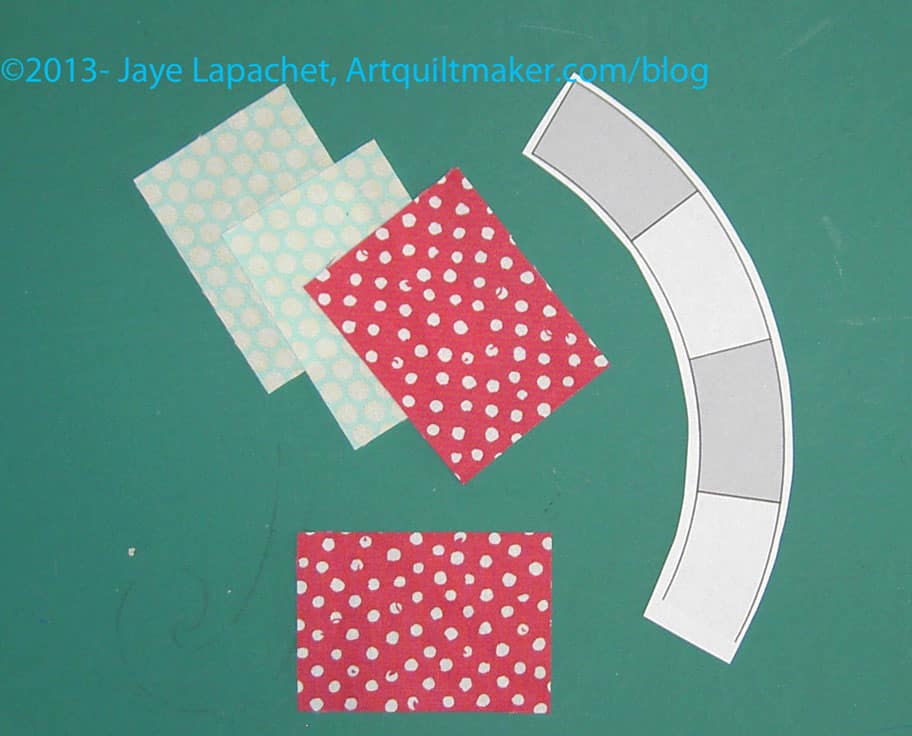
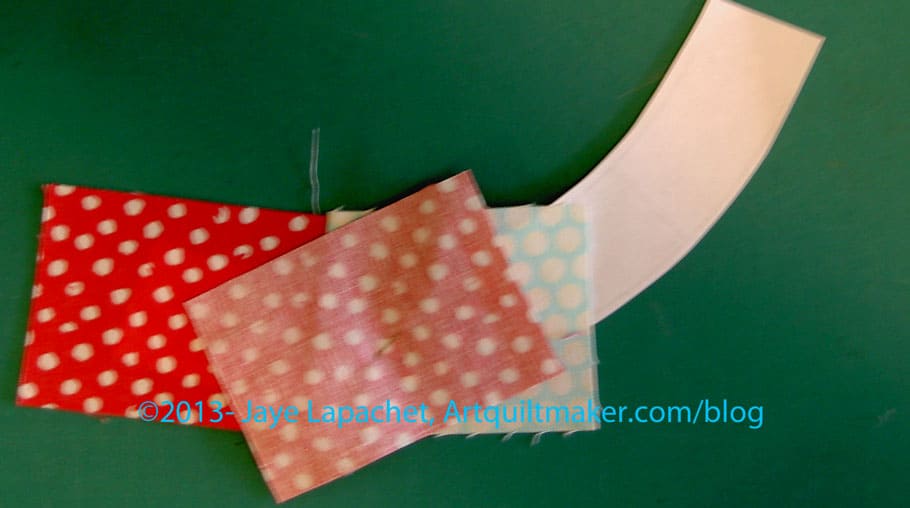
Cut fabric4 Pieces of fabric
Cut 4 pieces of fabric that coordinate with the fabrics of your block. The pieces should be about 2.5″x 1.75″, which is generous. You may be able to use scraps for these pieces. (Please ignore the messy cutting table)
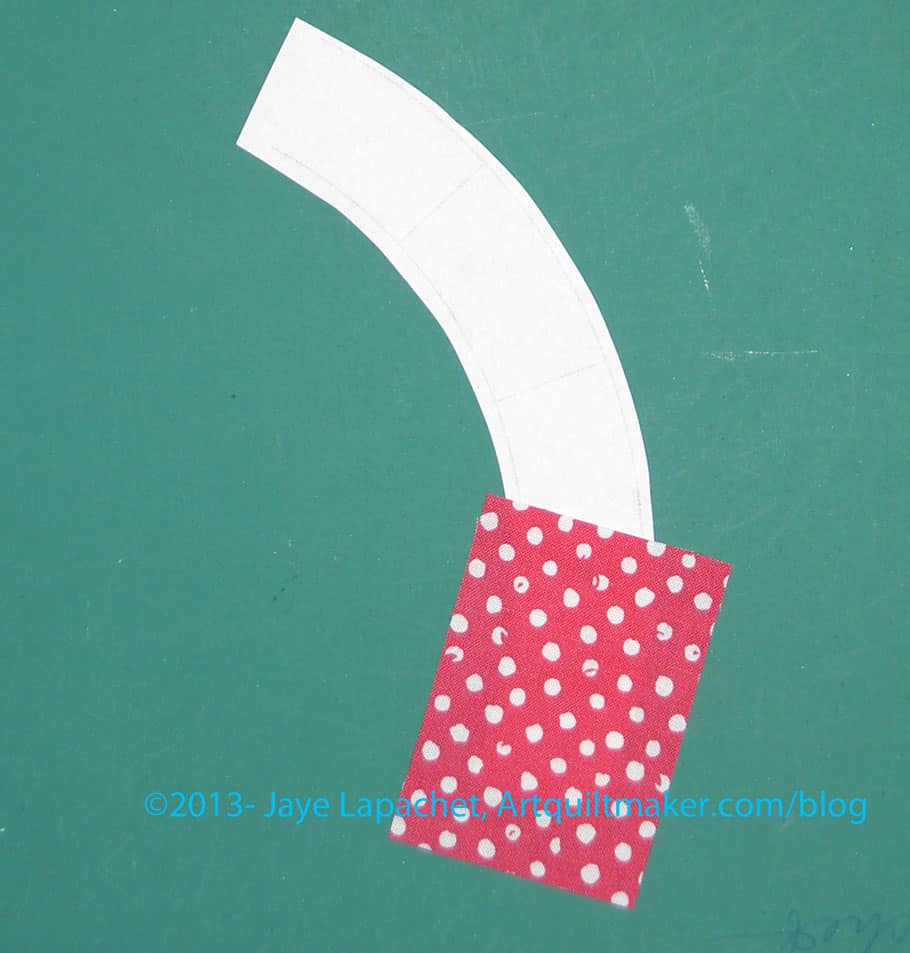
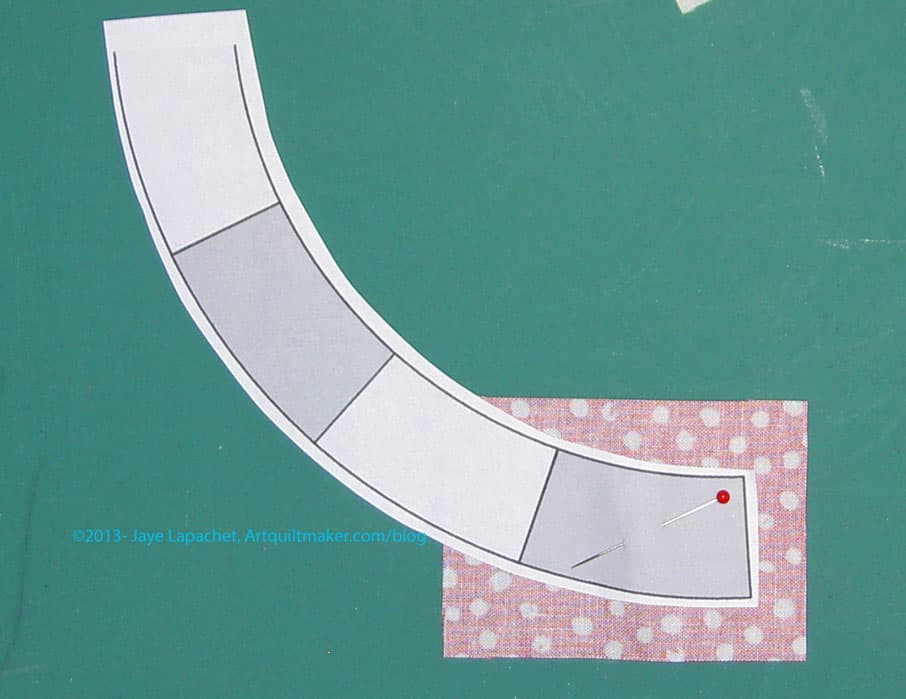
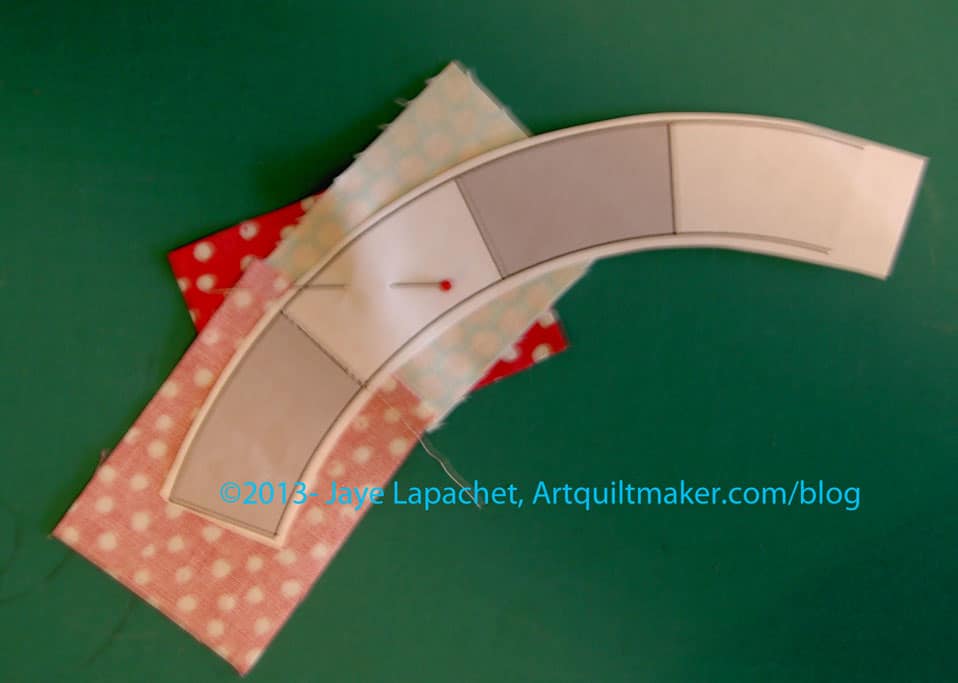
Place fabric on pattern
As you did in Part 2, you will work on placing 2 fabrics on the line between D1 & D2 with about a quarter inch hanging over into D2 as a seam allowance. Note the printed part of the pattern (the lines on which you sew) are face down for this step.
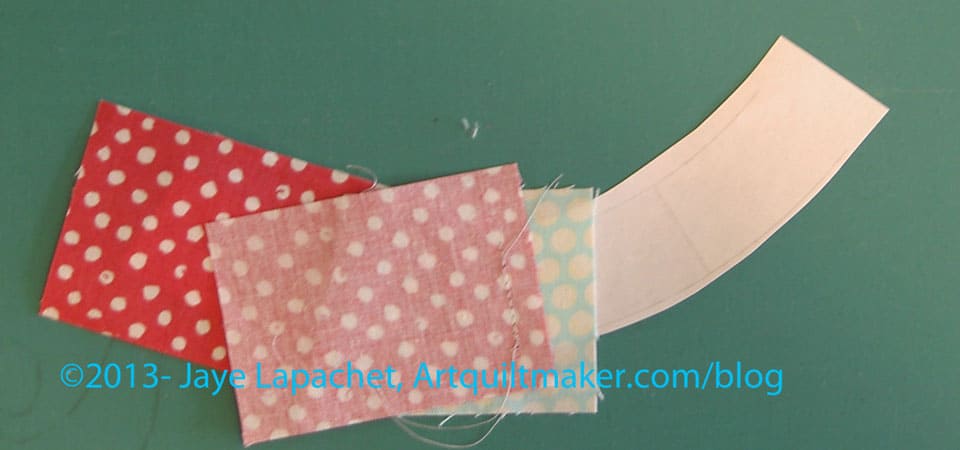
Pin fabric
I like to pin the first piece of fabric to my pattern. It helps keep the fabric from shifting as I work on the second piece of fabric. Note the printed part of the pattern (the lines on which you sew) are face up for this step.
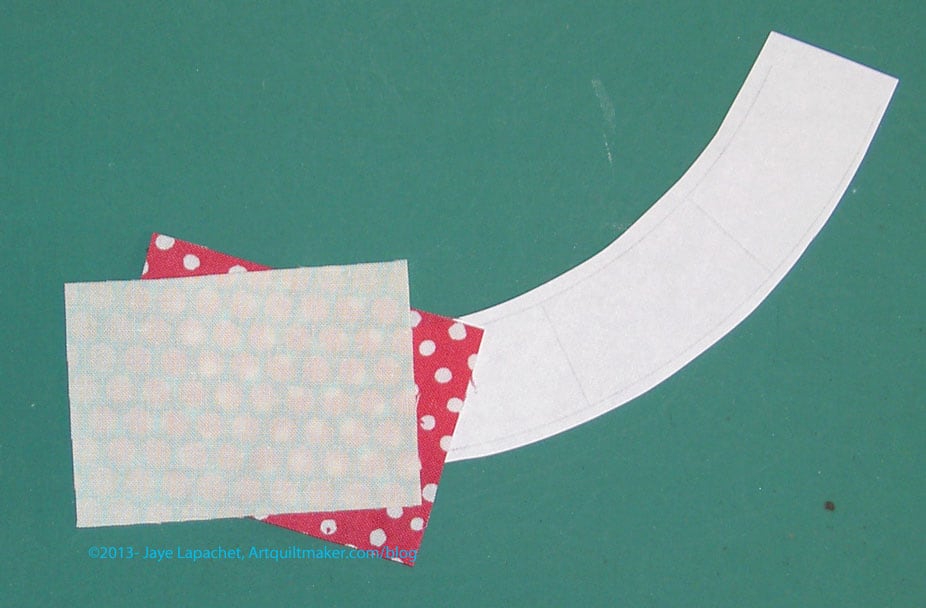
Position 2d piece of fabric
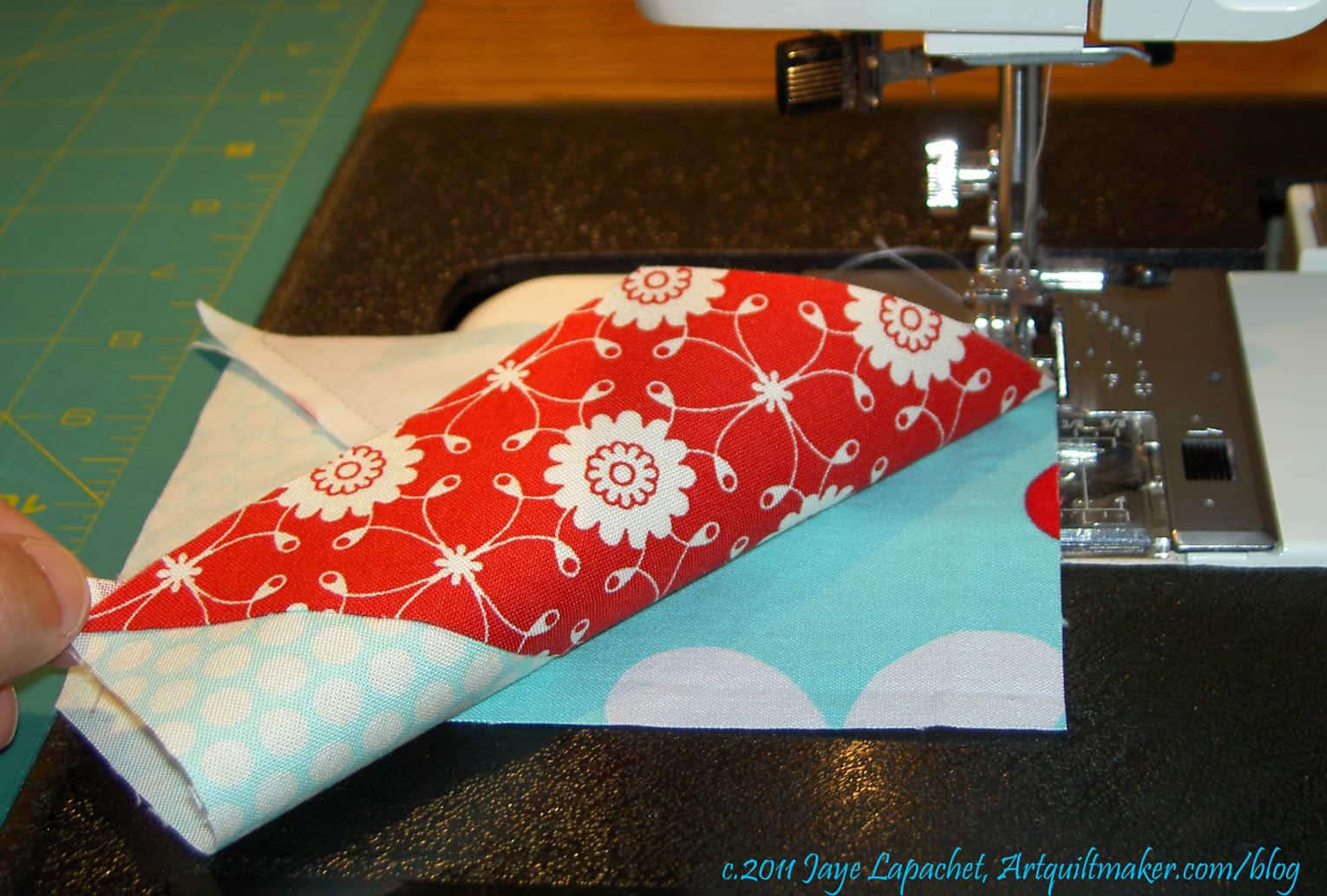
Flip Section D back over and position the second piece of fabric over the first.
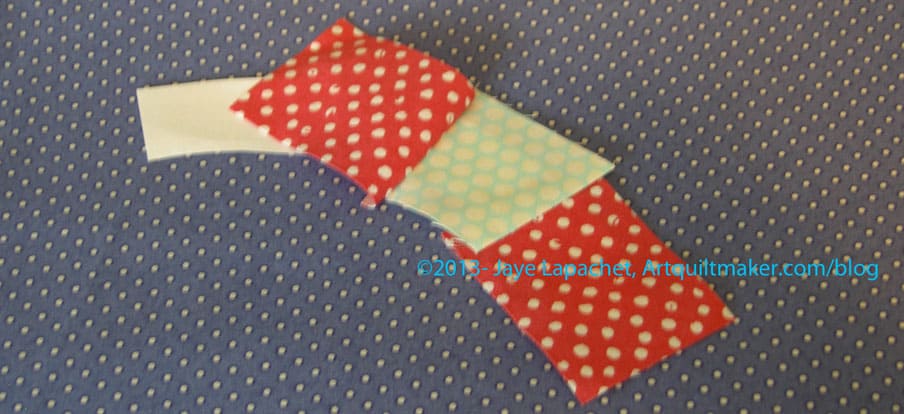
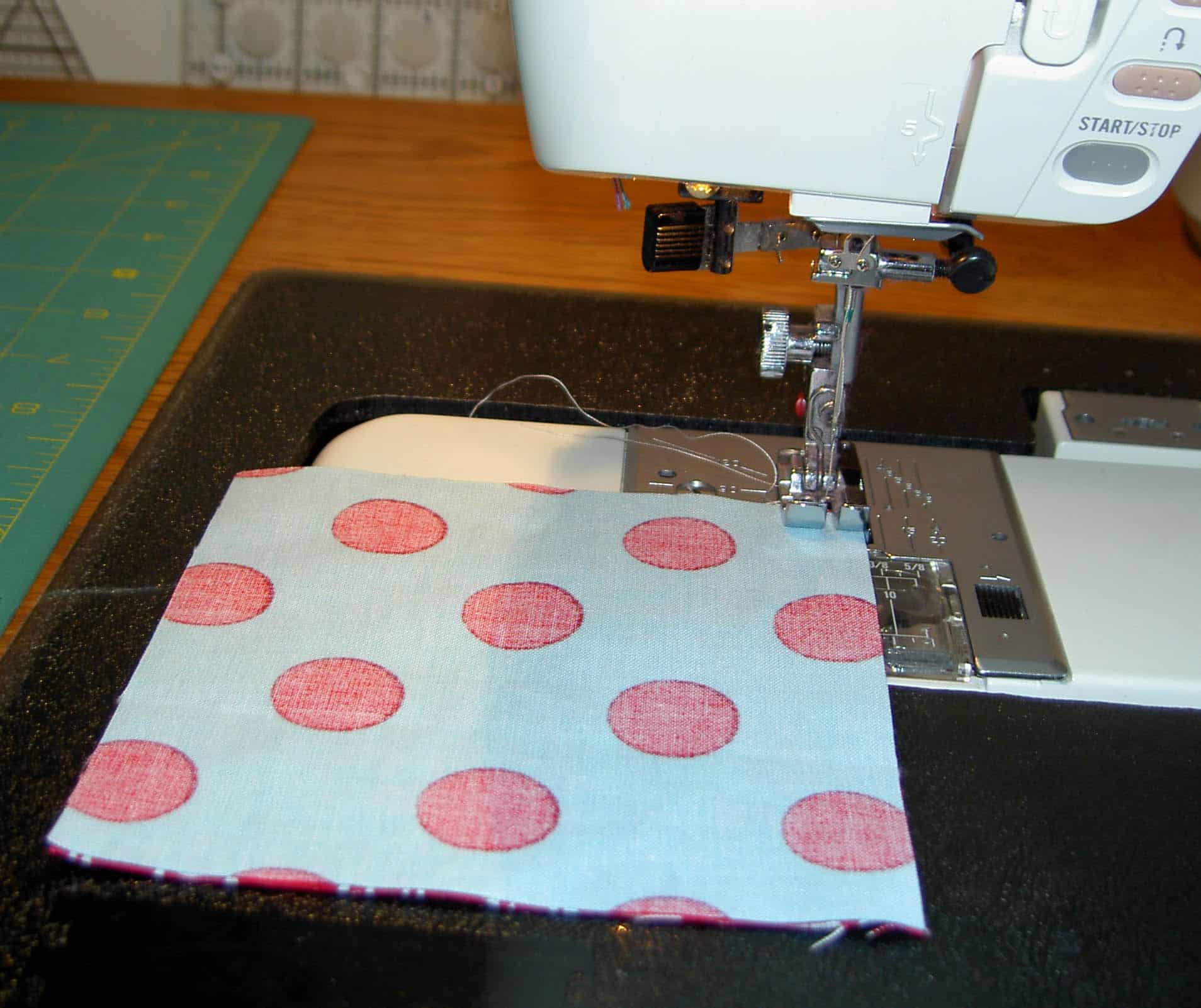
Ready to Sew
When you have both of your pieces placed like you like them, pin in place. I like to use thin pins. Your piece should now look like the above photo.
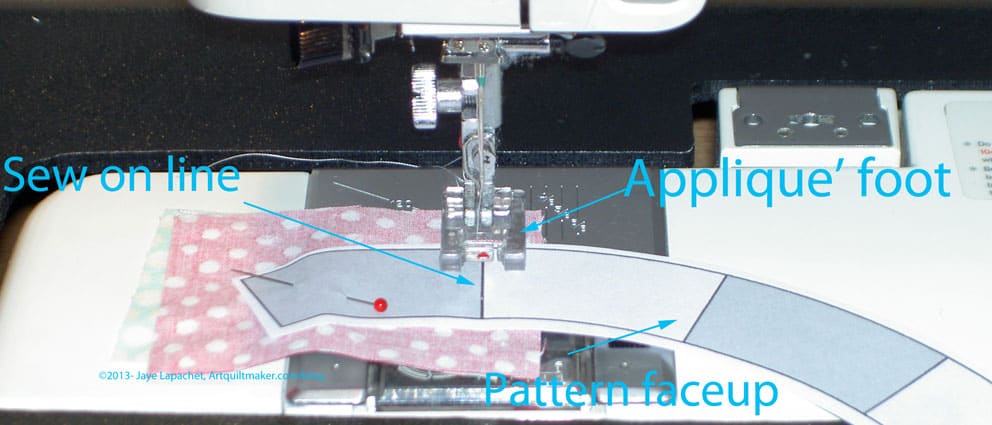
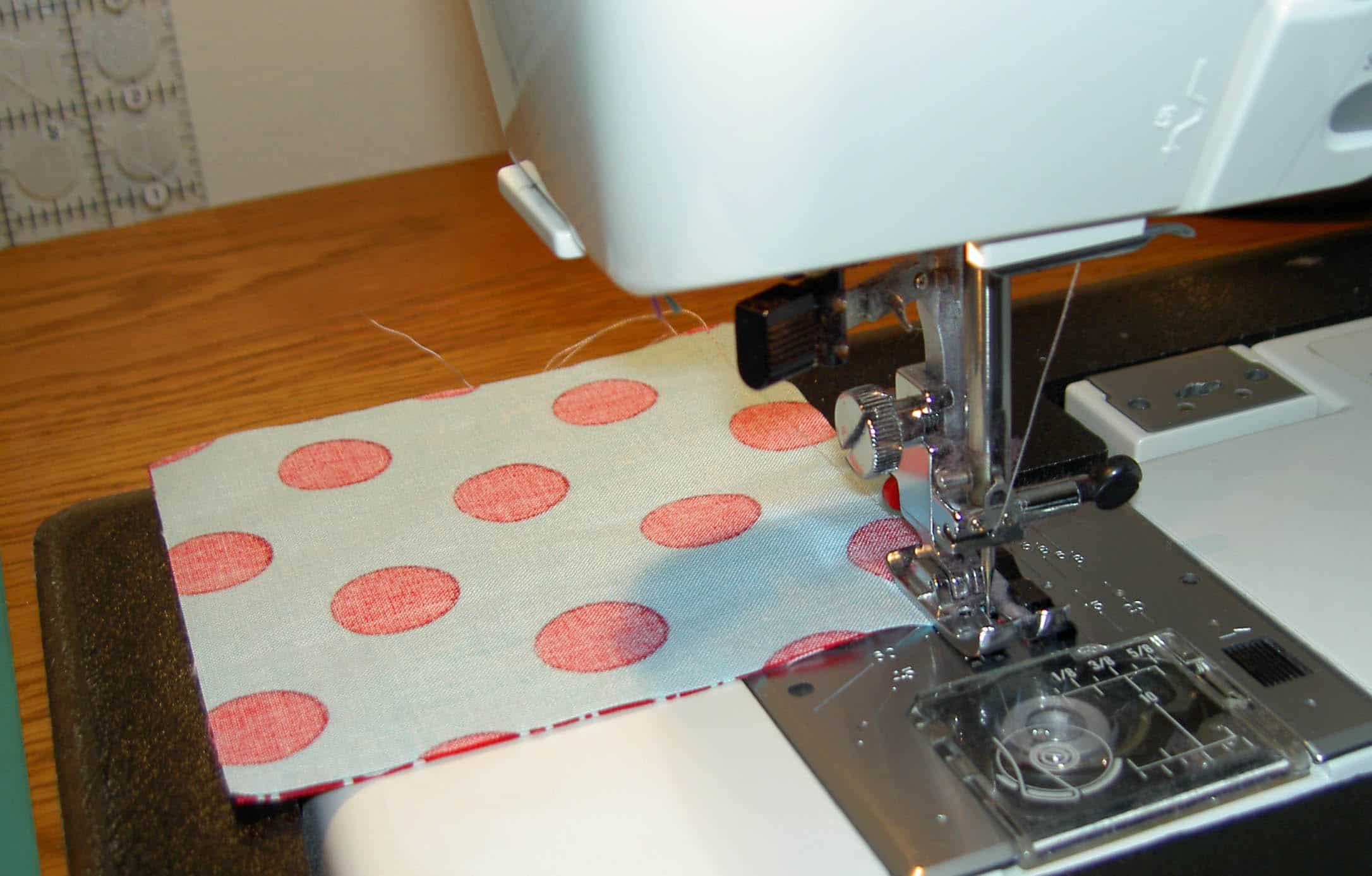
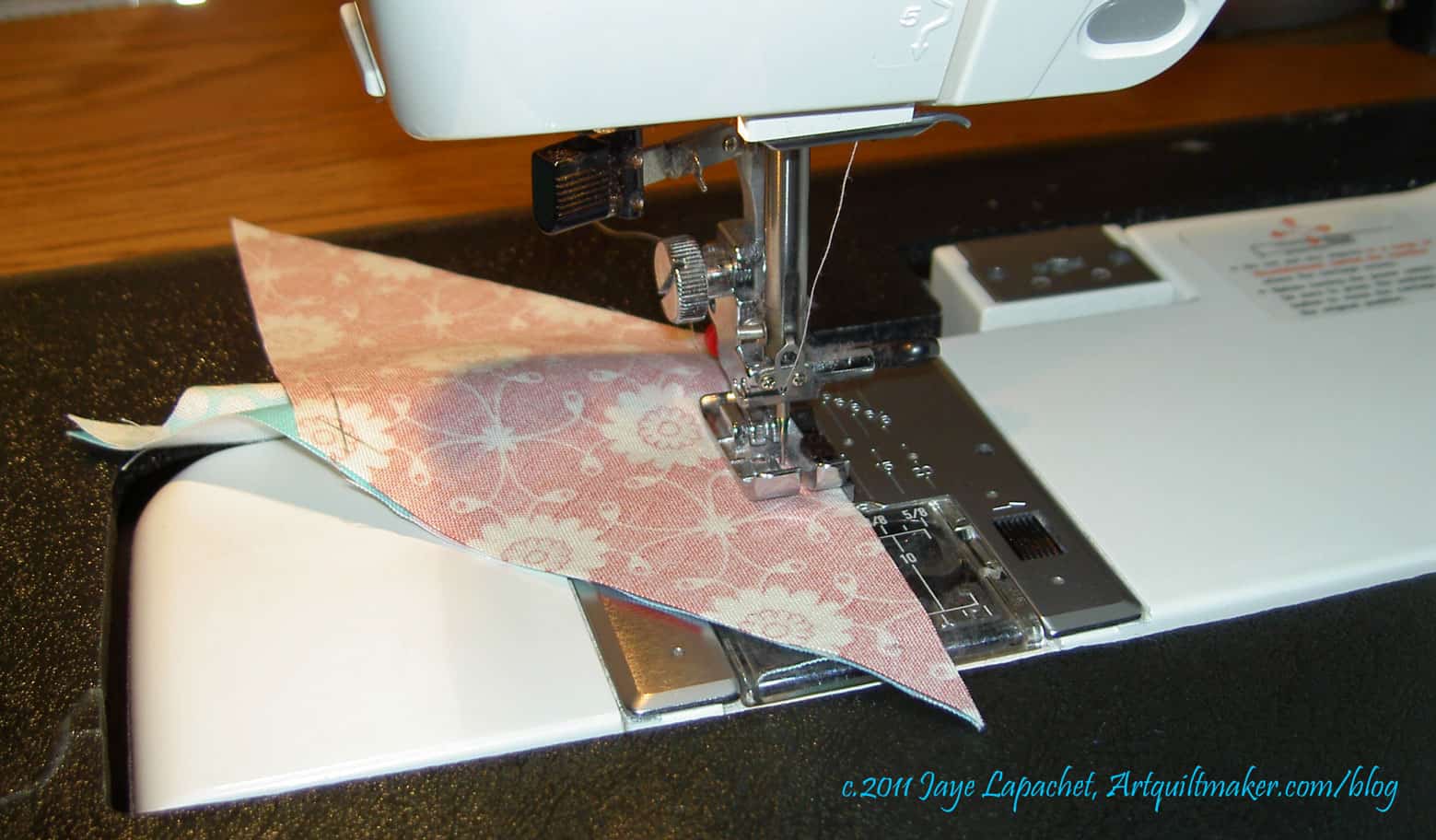
Sew on lineSew on the line (#2)
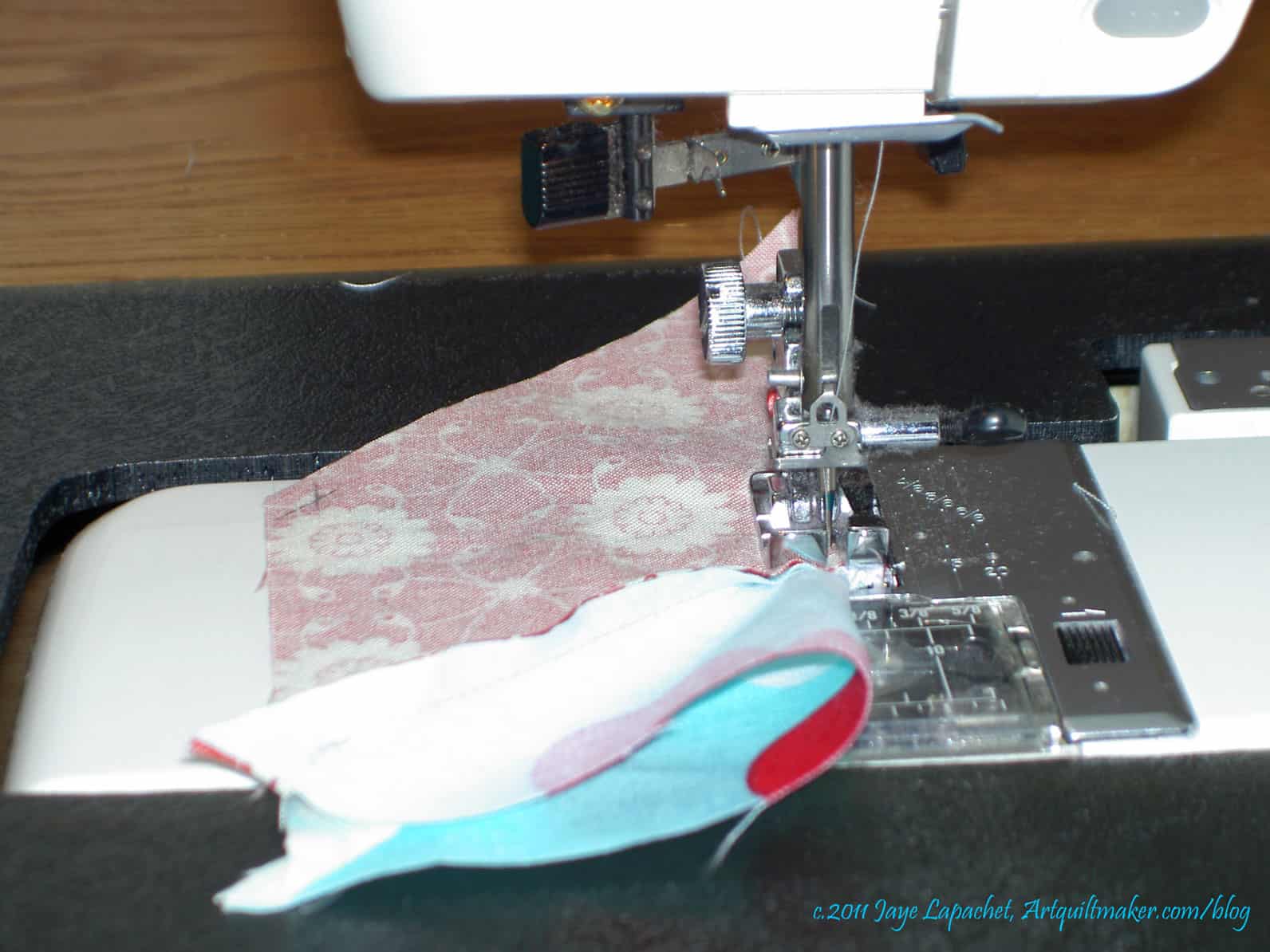
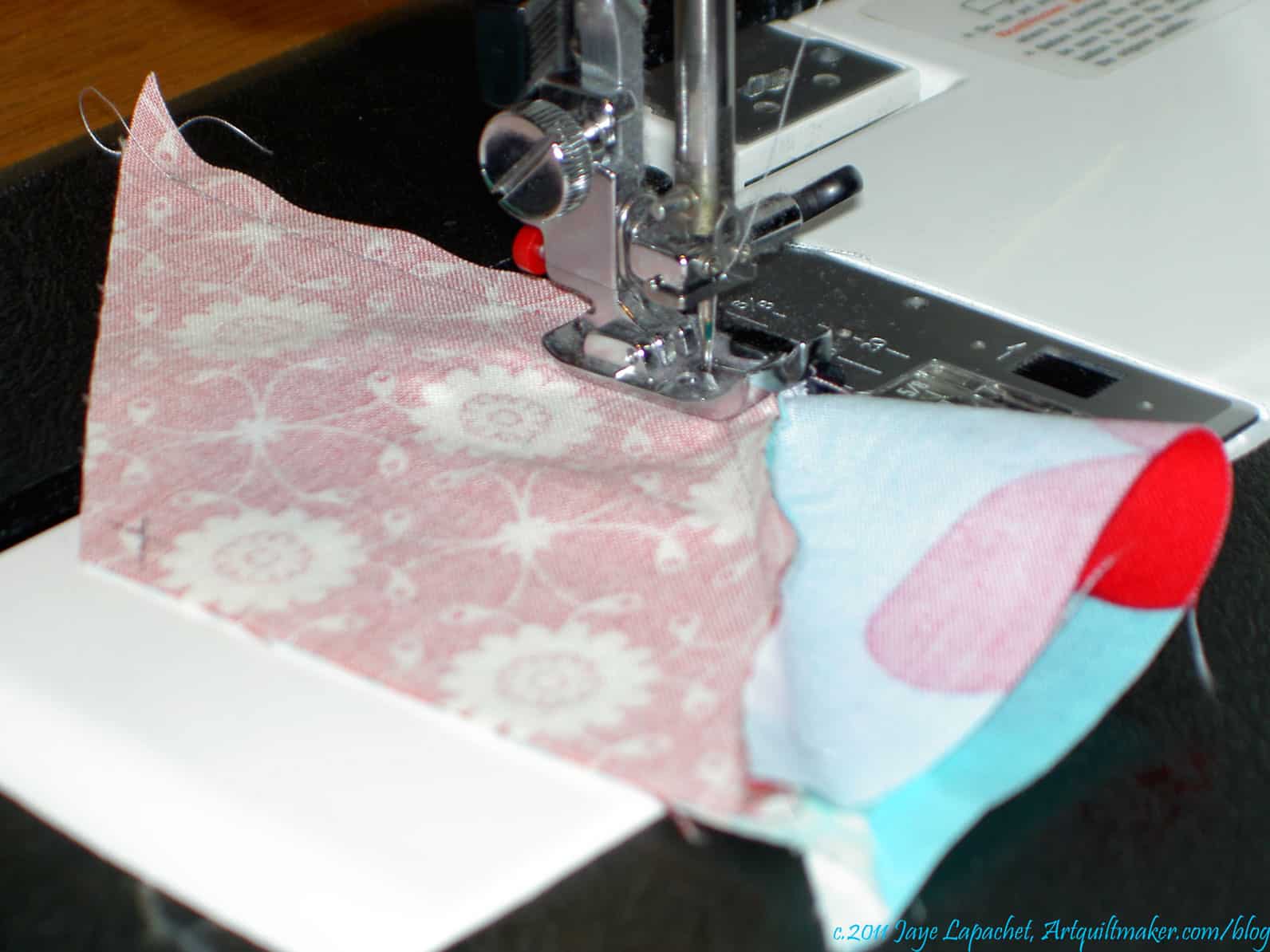
With the applique’ foot on your machine. Sew on the line between D1 & D2. Do not cross the perpendicular line at the top or bottom. Back stitch one stitch at the beginning and the end.
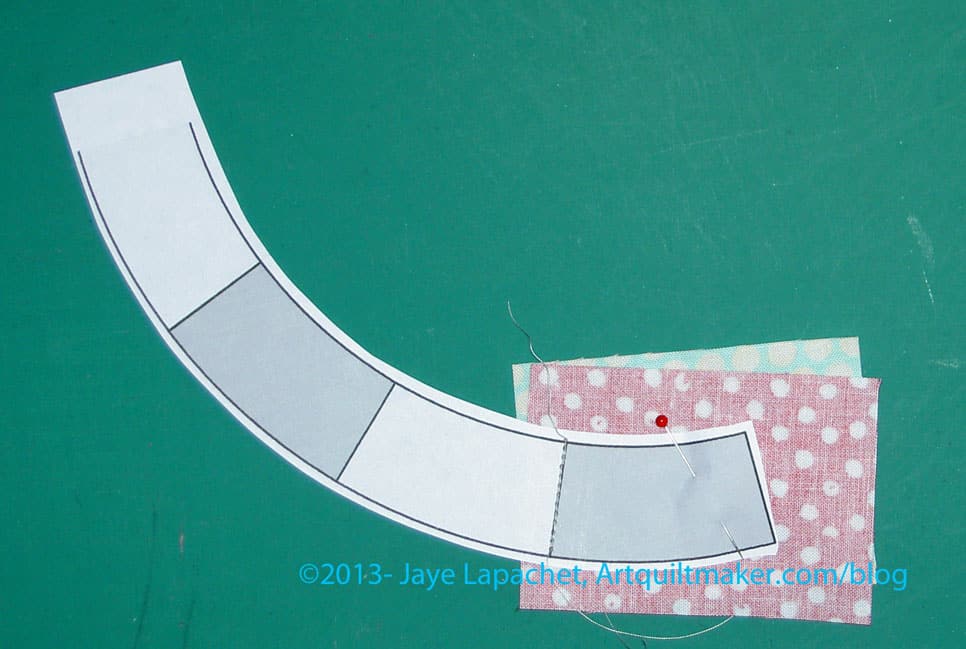
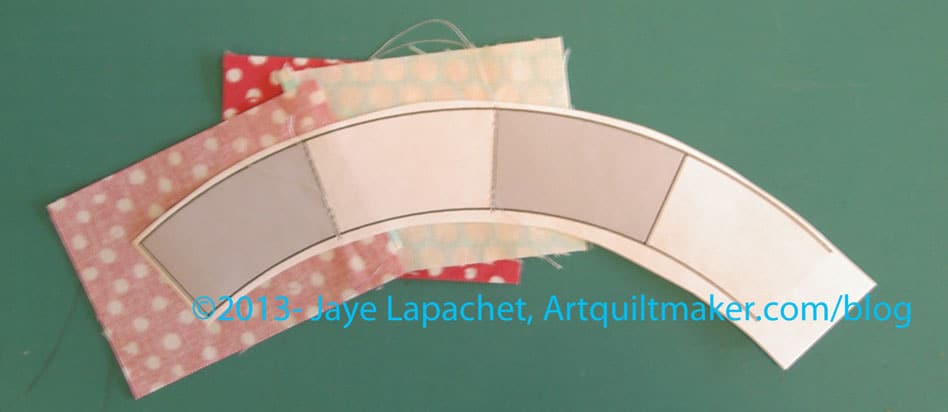
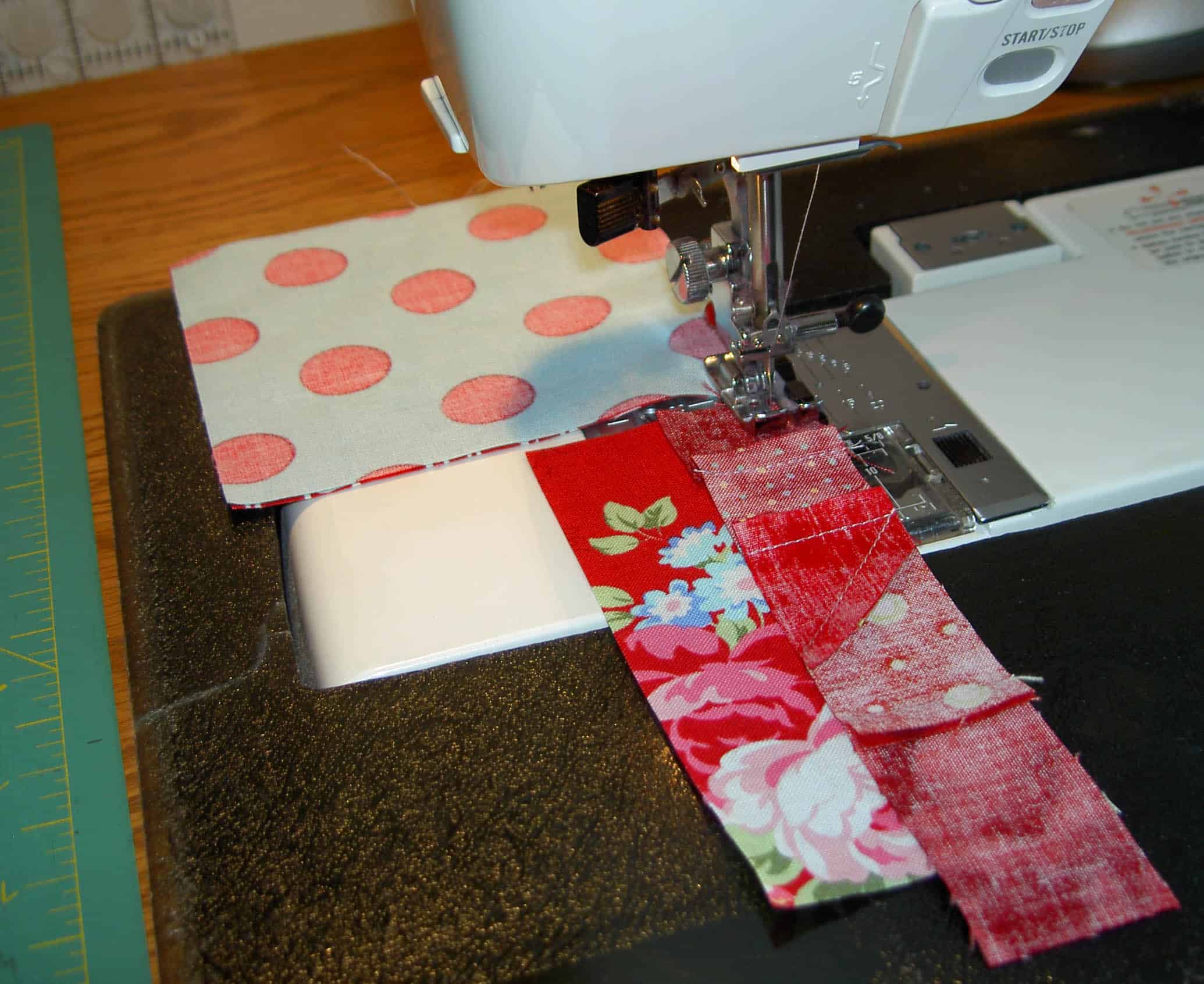
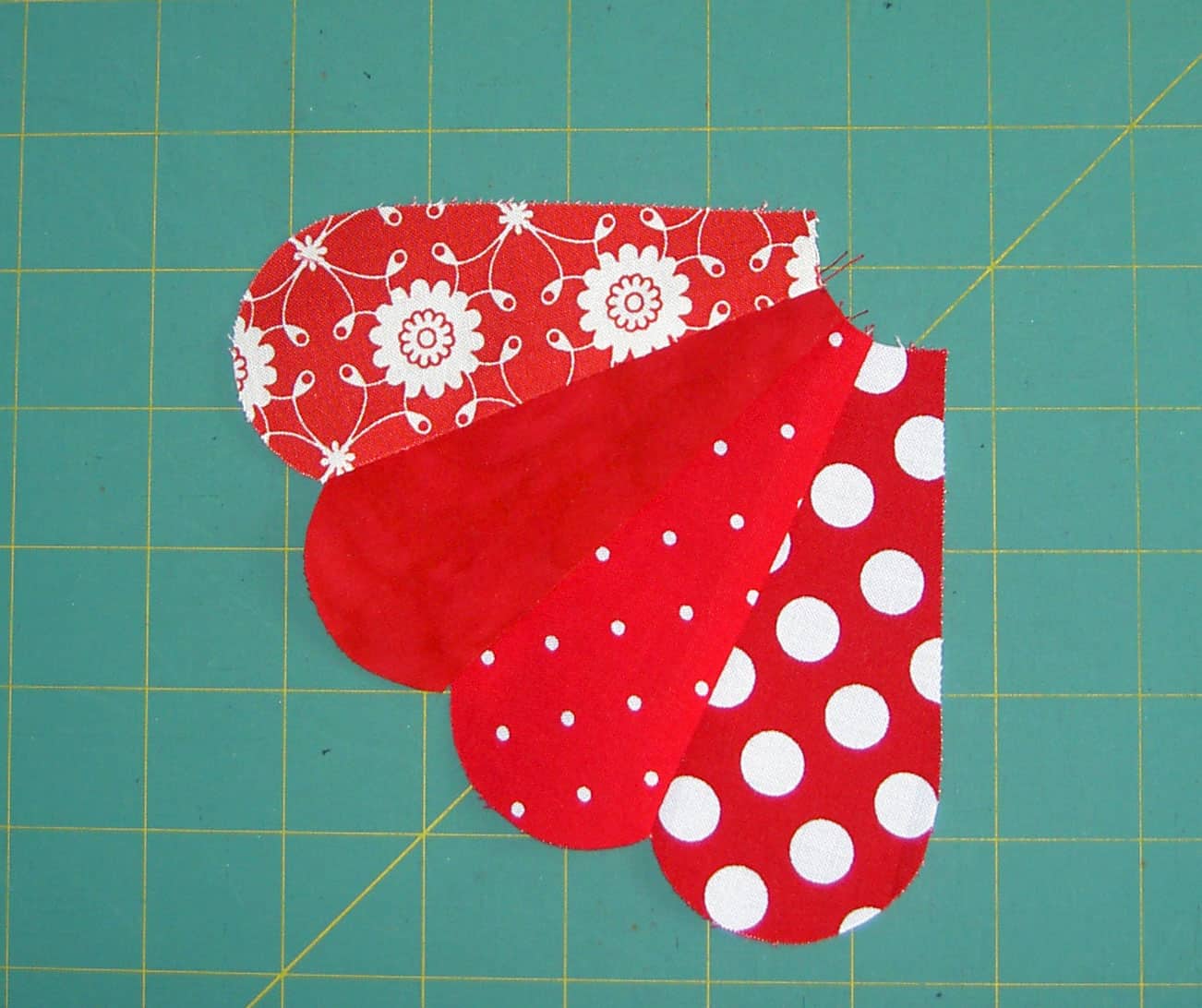
Section D sewn
Once you have sewn on the line, your piece should look like the above photo.
Press first sewn pieces
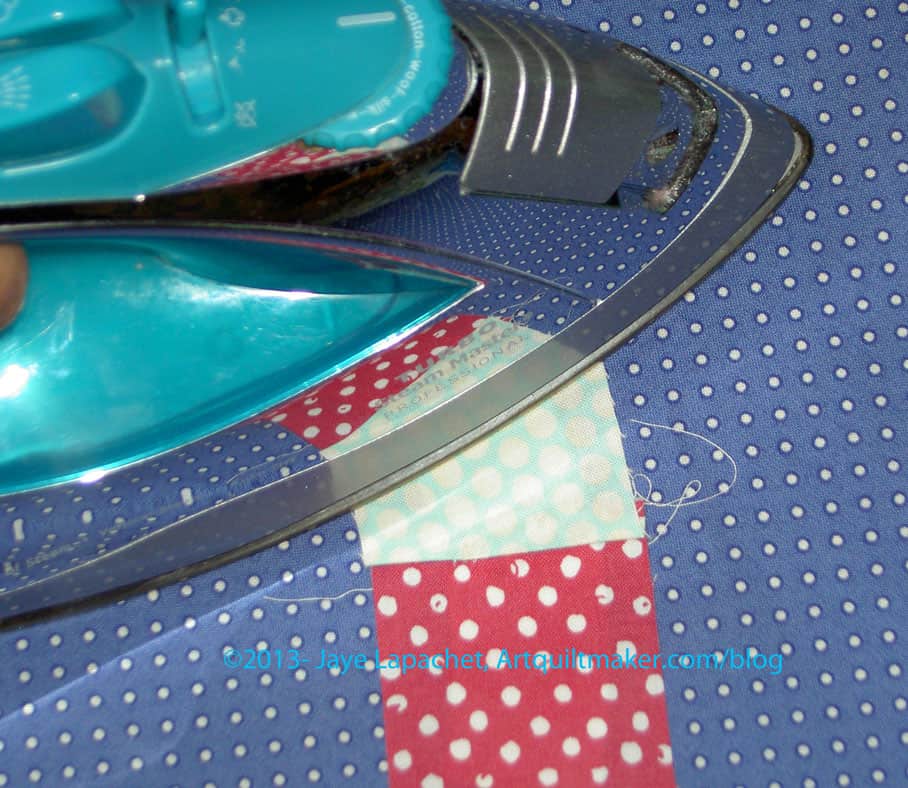
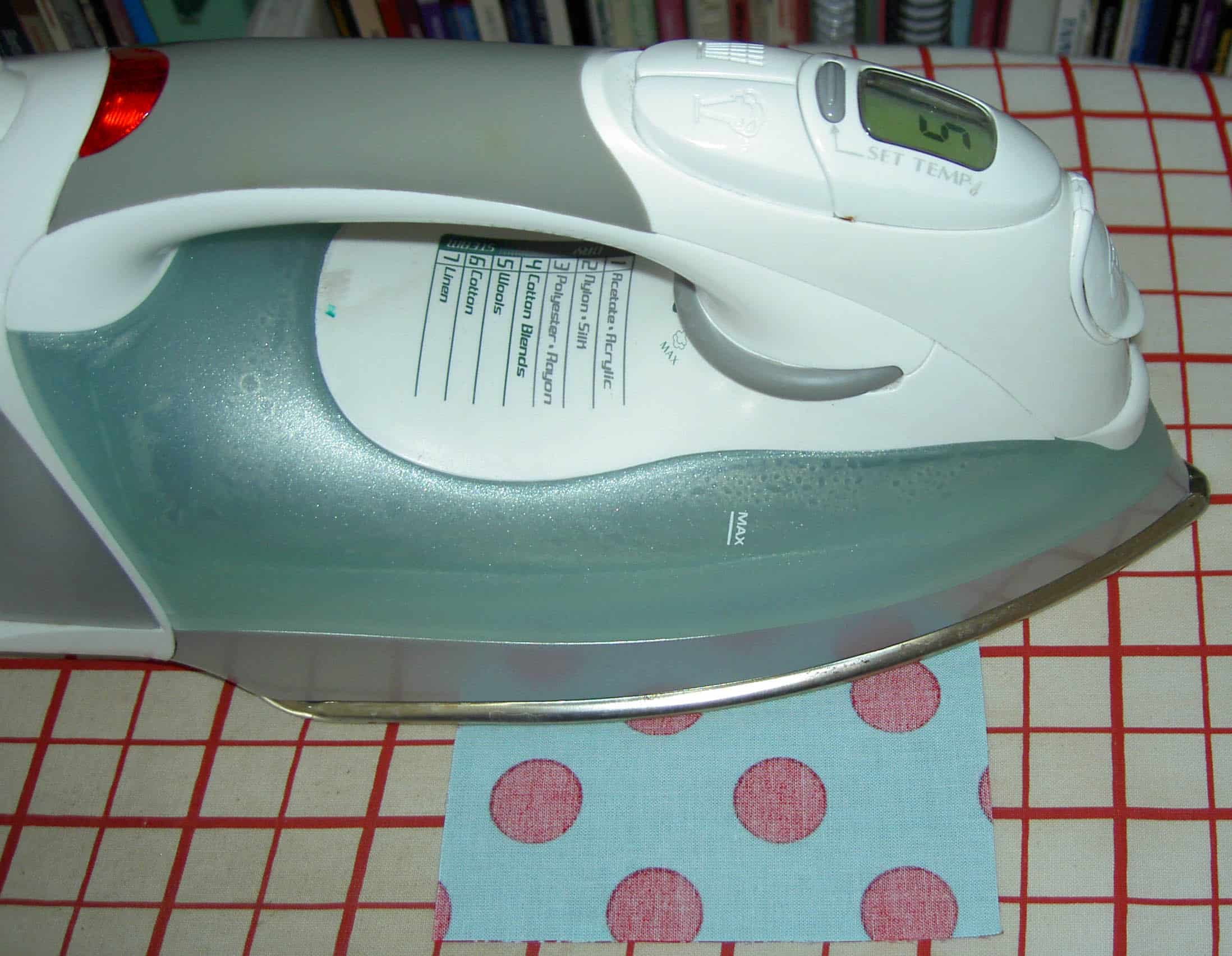
Open up both pieces and make sure they cover D1 & D2. Once you are convinced that you have covered both D1 & D2 with your fabric and there is a 1/4″ seam allowance, press your piece. Press with the pattern on top. Note the pattern is face up and you can see the sewing lines. (Nota bene: if you have taped your pattern, use a press cloth so that you do not get melted tape on your iron)
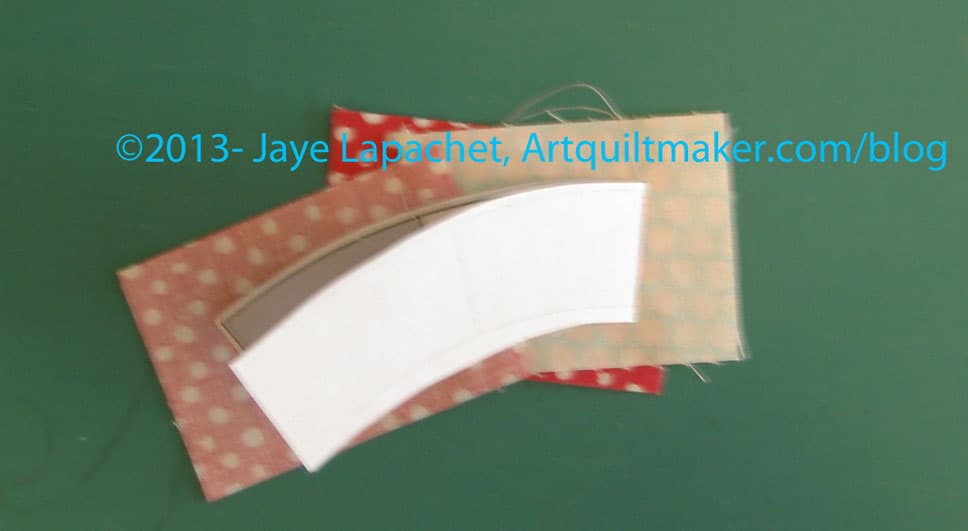
Sewn, pressed Section D back
Flip your Section D over again, so you are ready to trim.
Ready to trim
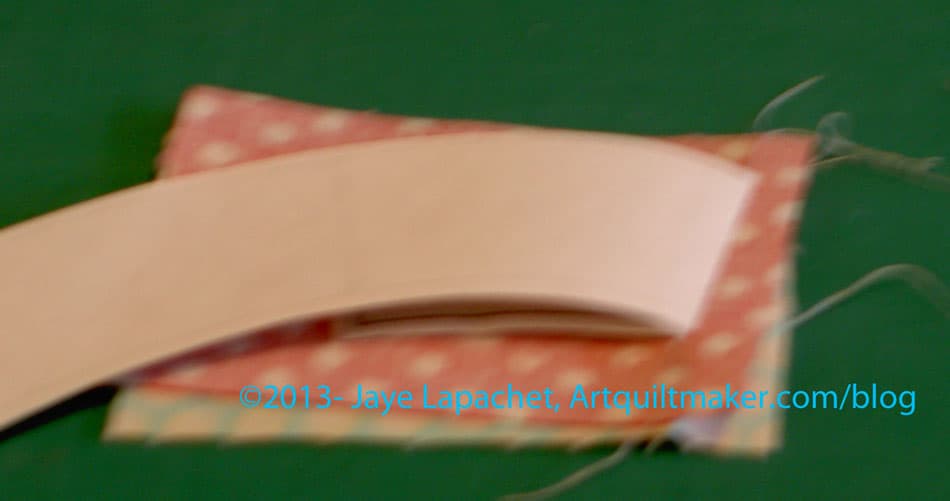
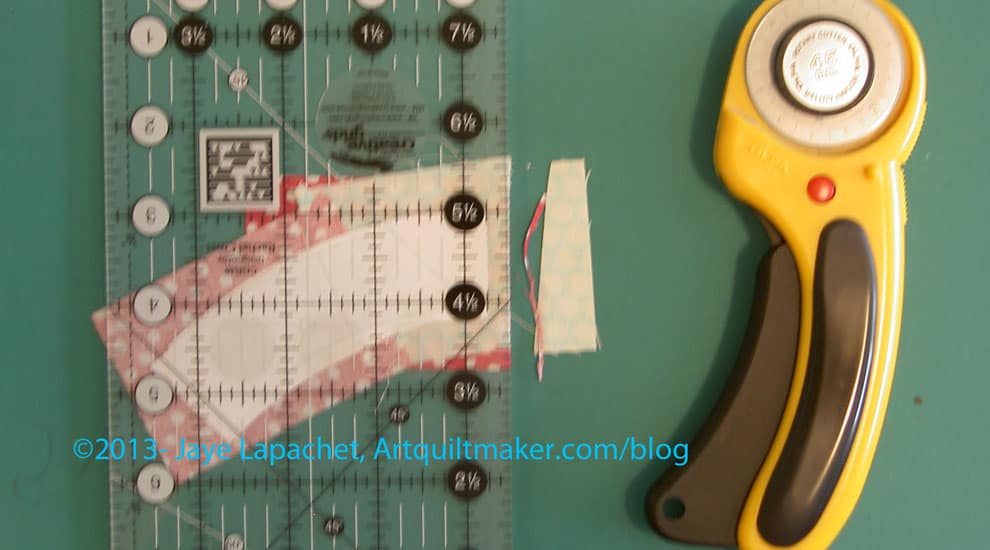
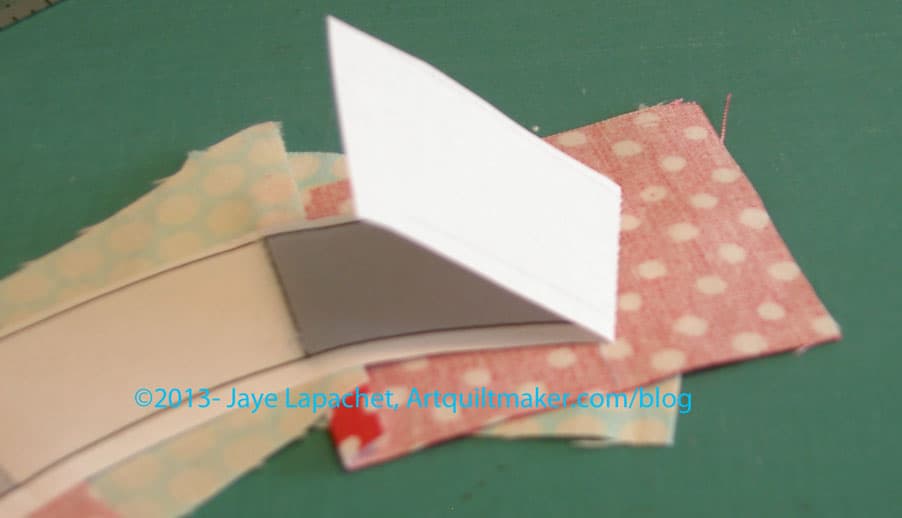
Lay your pattern, with sewn fabric, pattern side up (fabric down) on your cutting mat. The inside part of the curve will be facing your body. You may want to flip Section D around if you are left handed.
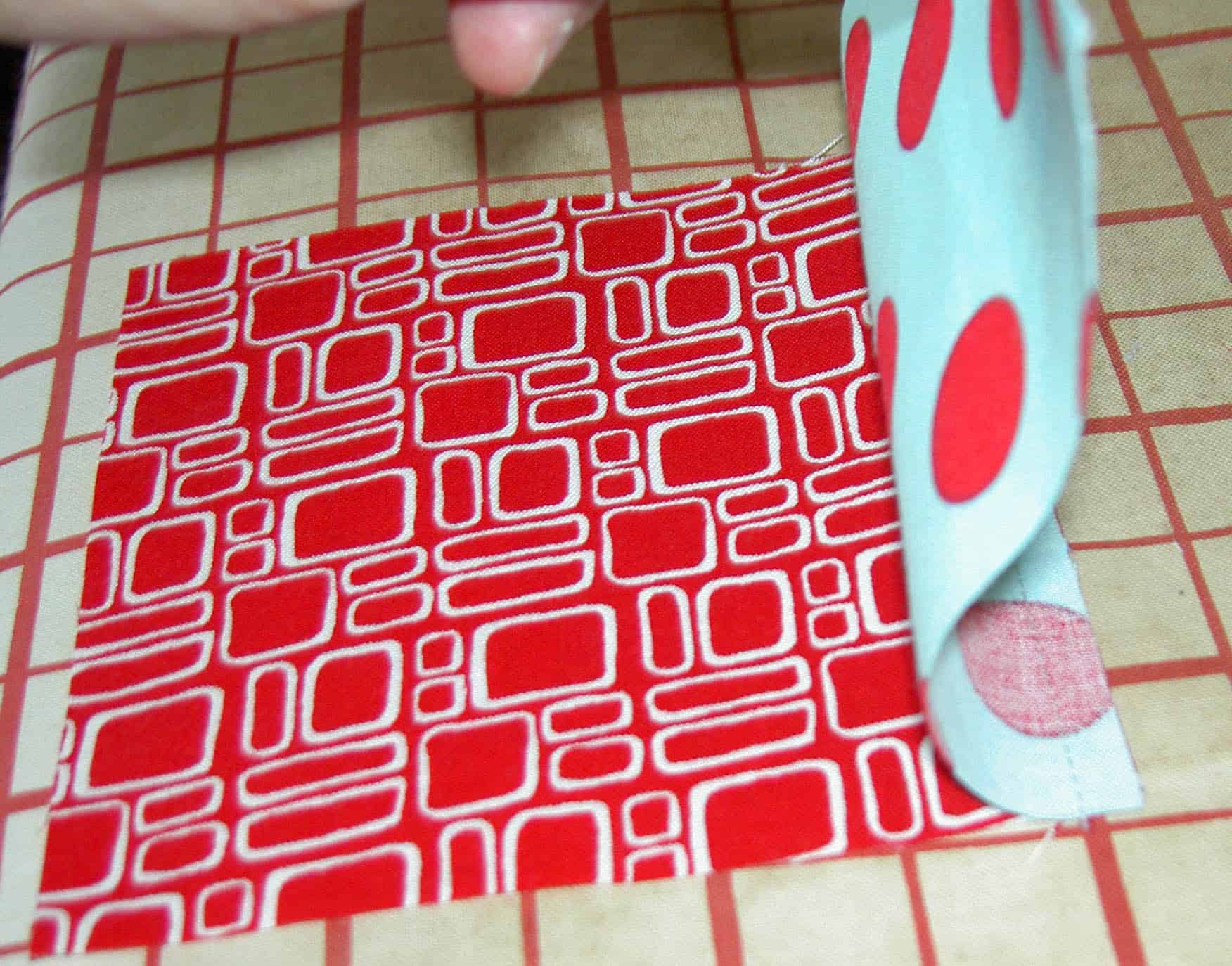
Fold the longer piece of the pattern over to the left using the seam line as the fold line. This will expose the fabric that will be your seam allowance.
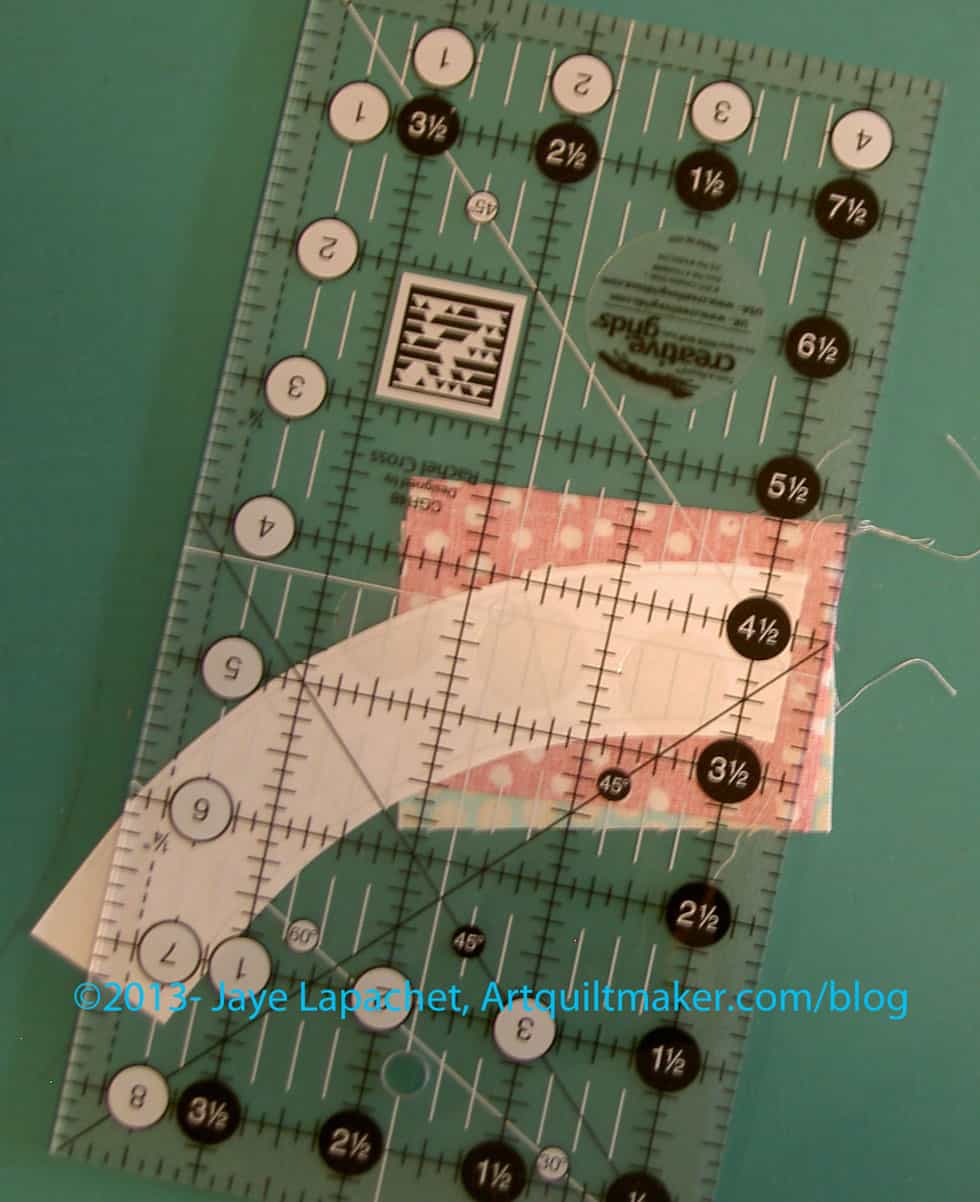
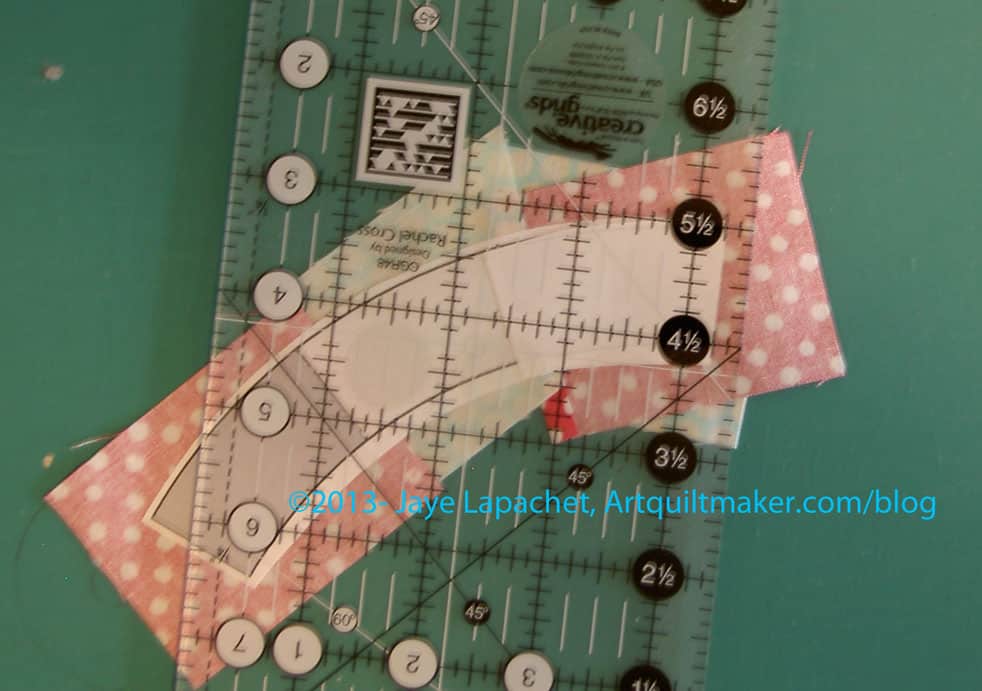
Place ruler on sewn line
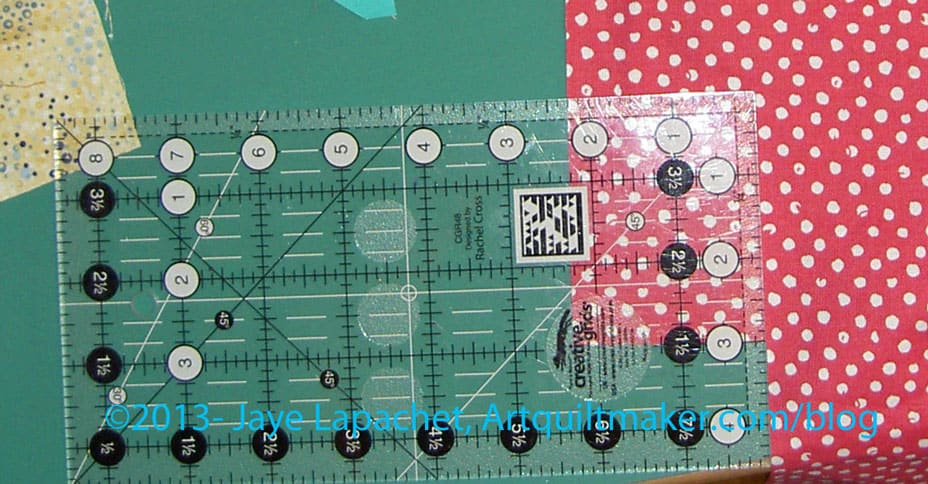
Line up your ruler’s 1/4″ mark on the seam/fold line and trim your seam allowance to 1/4″.
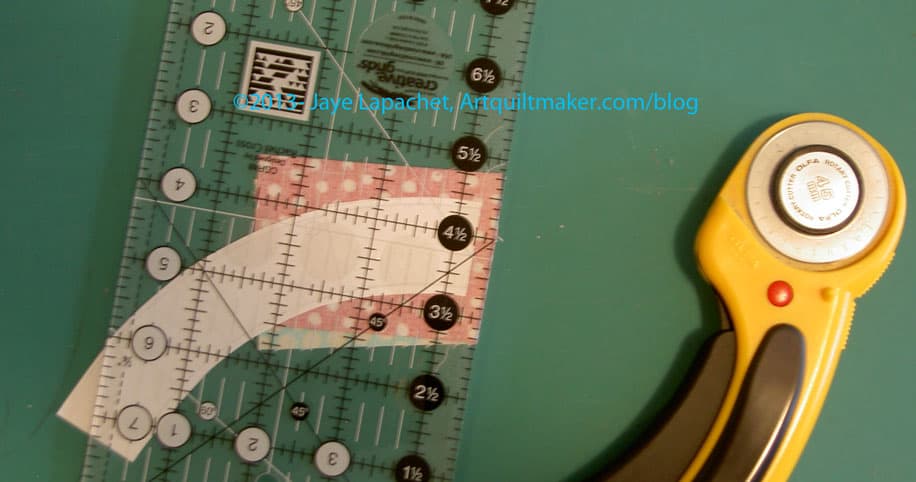
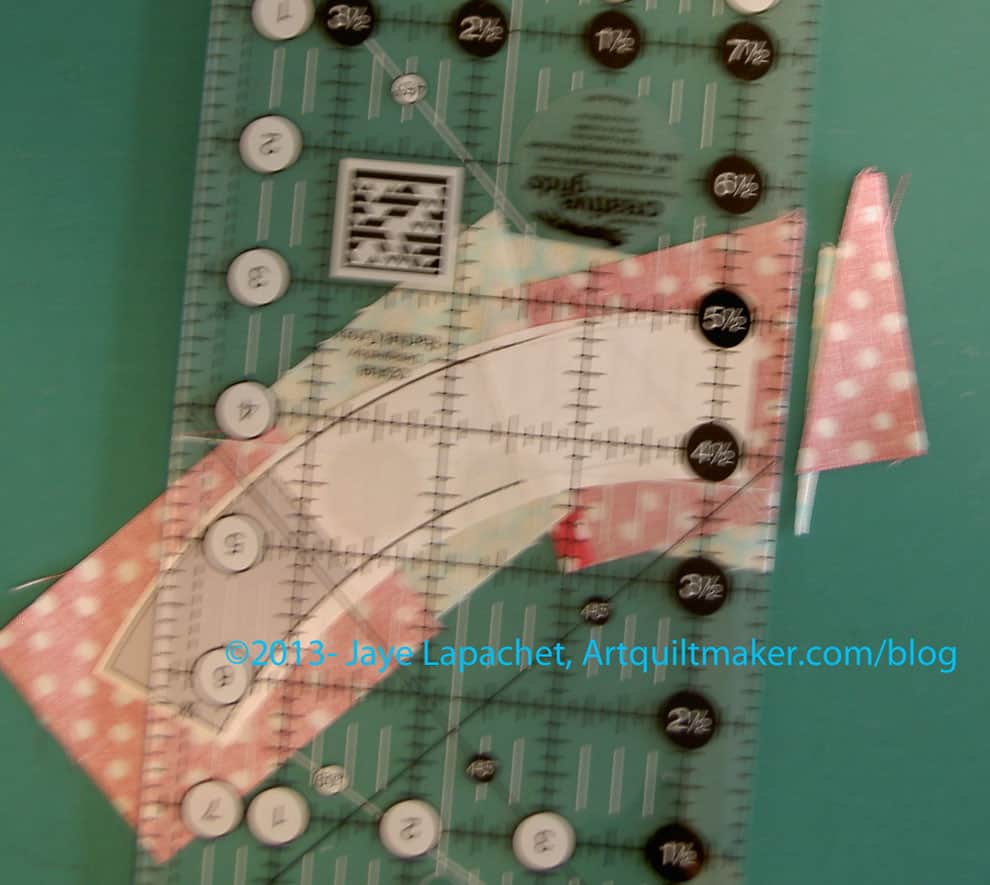
TrimTrimmed
Trim seam allowance to 1/4″.
Ready to press pieces into place
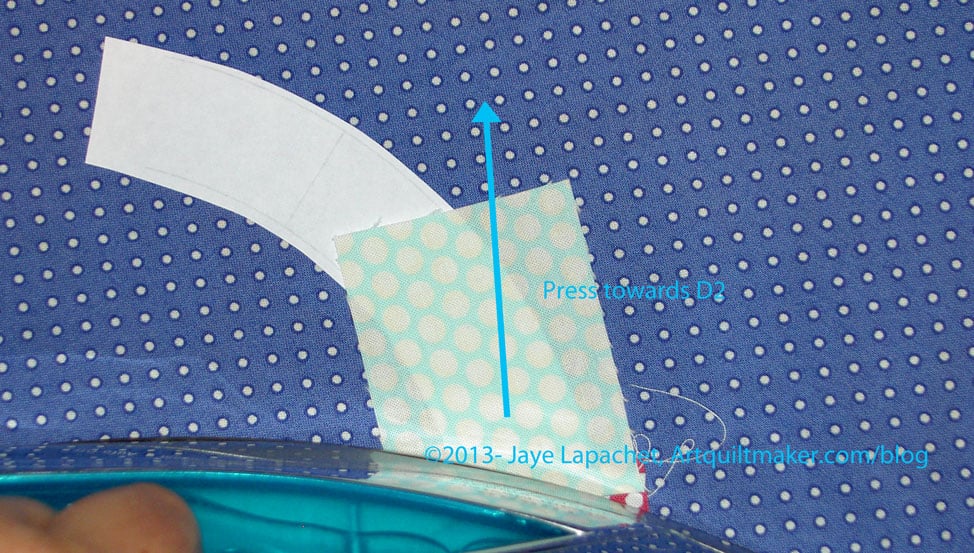
Go back to the ironing board and position your piece so the fabric is up, pattern side down and smooth the fabric towards D2, lightly finger pressing.
Press towards D2Press towards D2
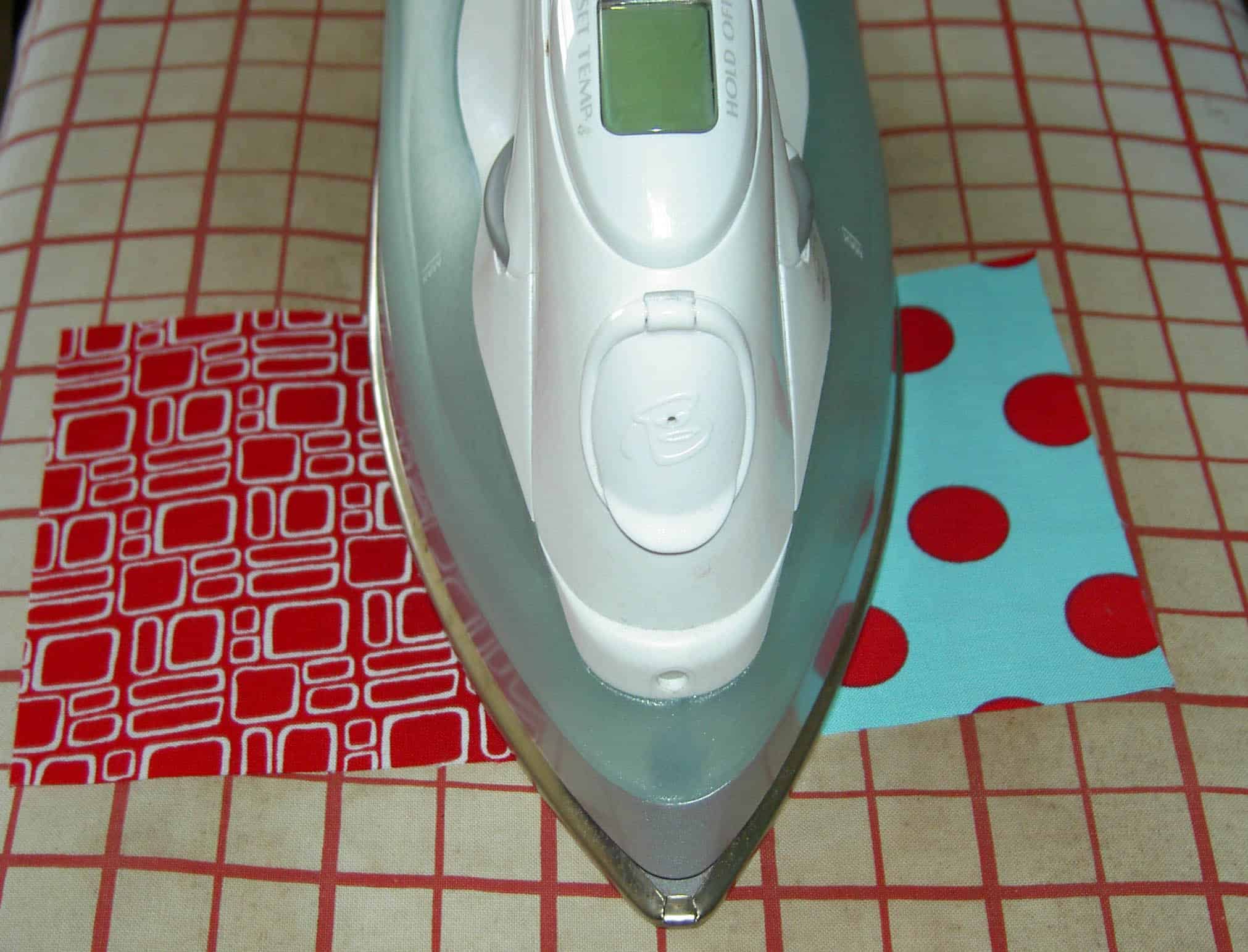
Take the piece to the iron and press carefully towards D2.
Place D3 fabric
Place your next fabric with the longer part towards D2 and the future seam allowance closer to D3. Hold the whole piece up to the light to make sure your placement is correct.
Place D3 fabric in place
Pin in place.
Get ready to sew on the line between D2 & D3.
Sewn D3
Once sewn, your piece should look like the photo above.
Check to make sure fabric covers D3
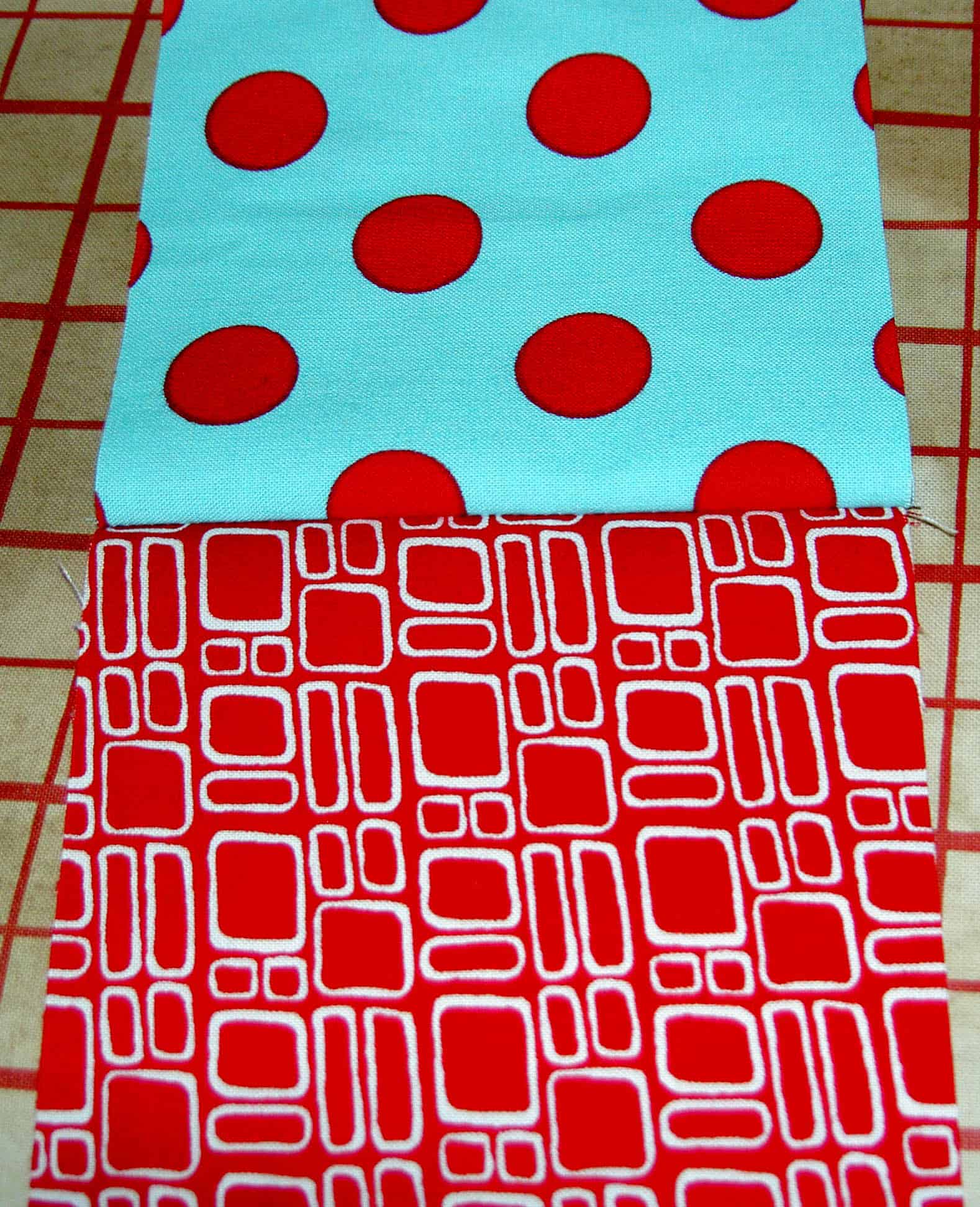
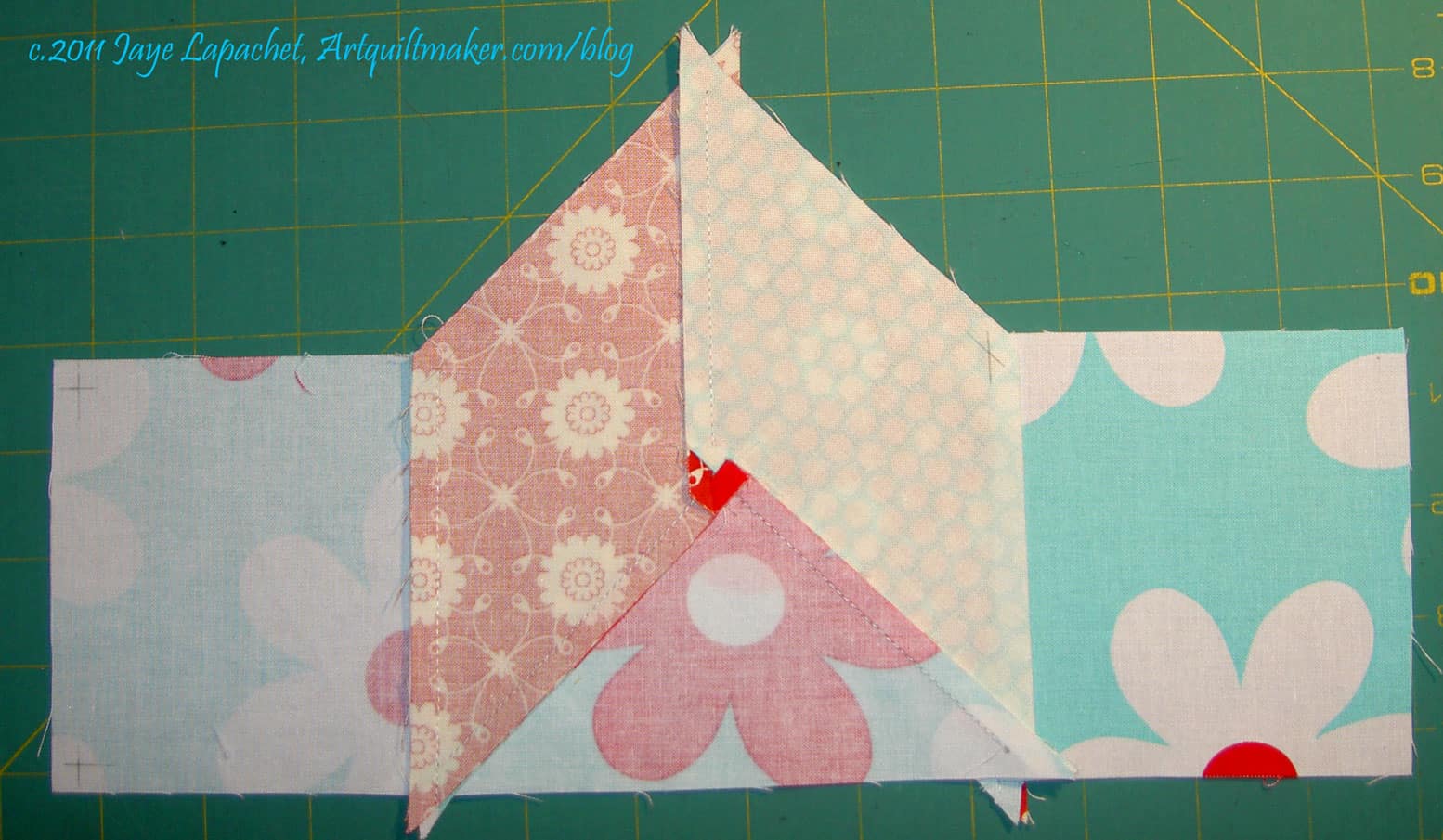
Check to make sure your fabric covers pattern section D3. You do this by folding the fabric over and looking to see that you have about 1/4″ on all sides.
Pattern side up
Now, get ready to trim. Put your piece on the cutting mat pattern side up.
Folder pattern back
Fold your pattern to the left again, like you did before.
Ready to trimTrimmed
Line up your ruler’s 1/4″ mark on the seam/fold line and trim your seam allowance to 1/4″.
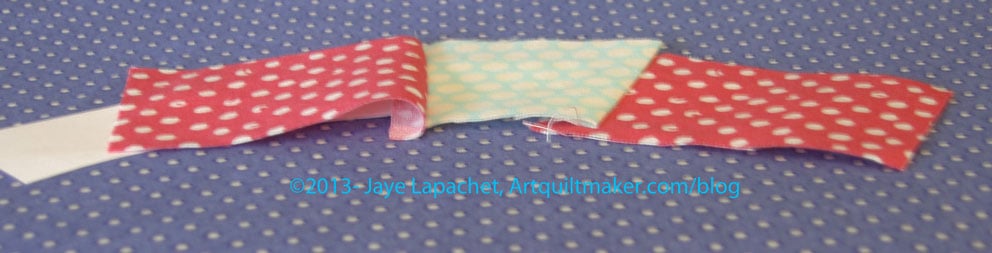
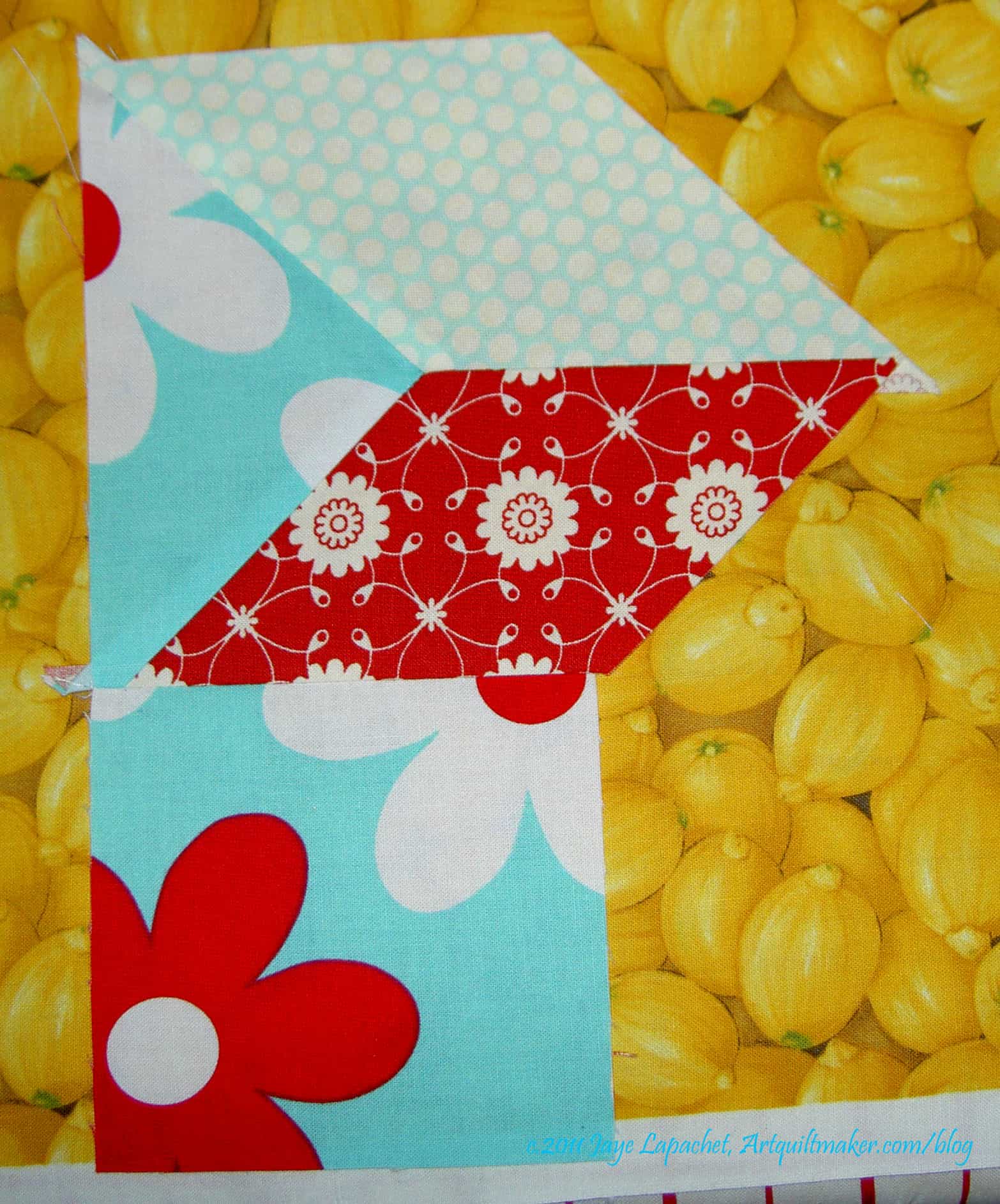
Avoid the bump
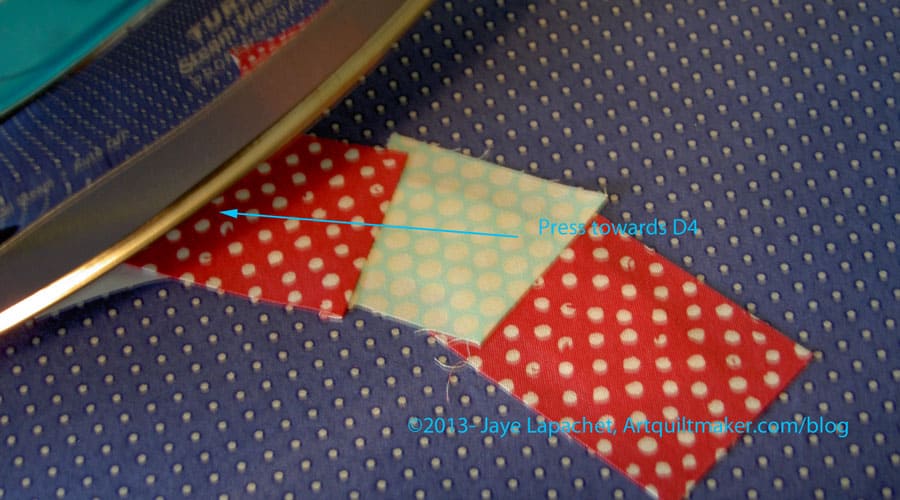
See that bump in the photo above? You do not want that bump to show once you have pieced D4 on to the parts of Section D you have already pieced. Press again, this time towards D4. Avoid the bump by pressing!
Press towards D4
Press towards D4. No ironing!
We are heading to the home stretch!
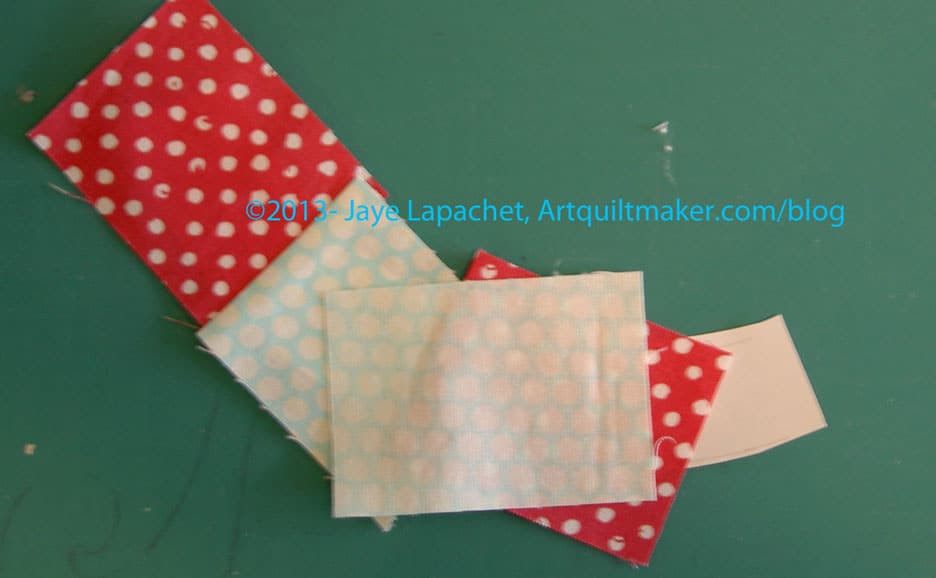
Position D5
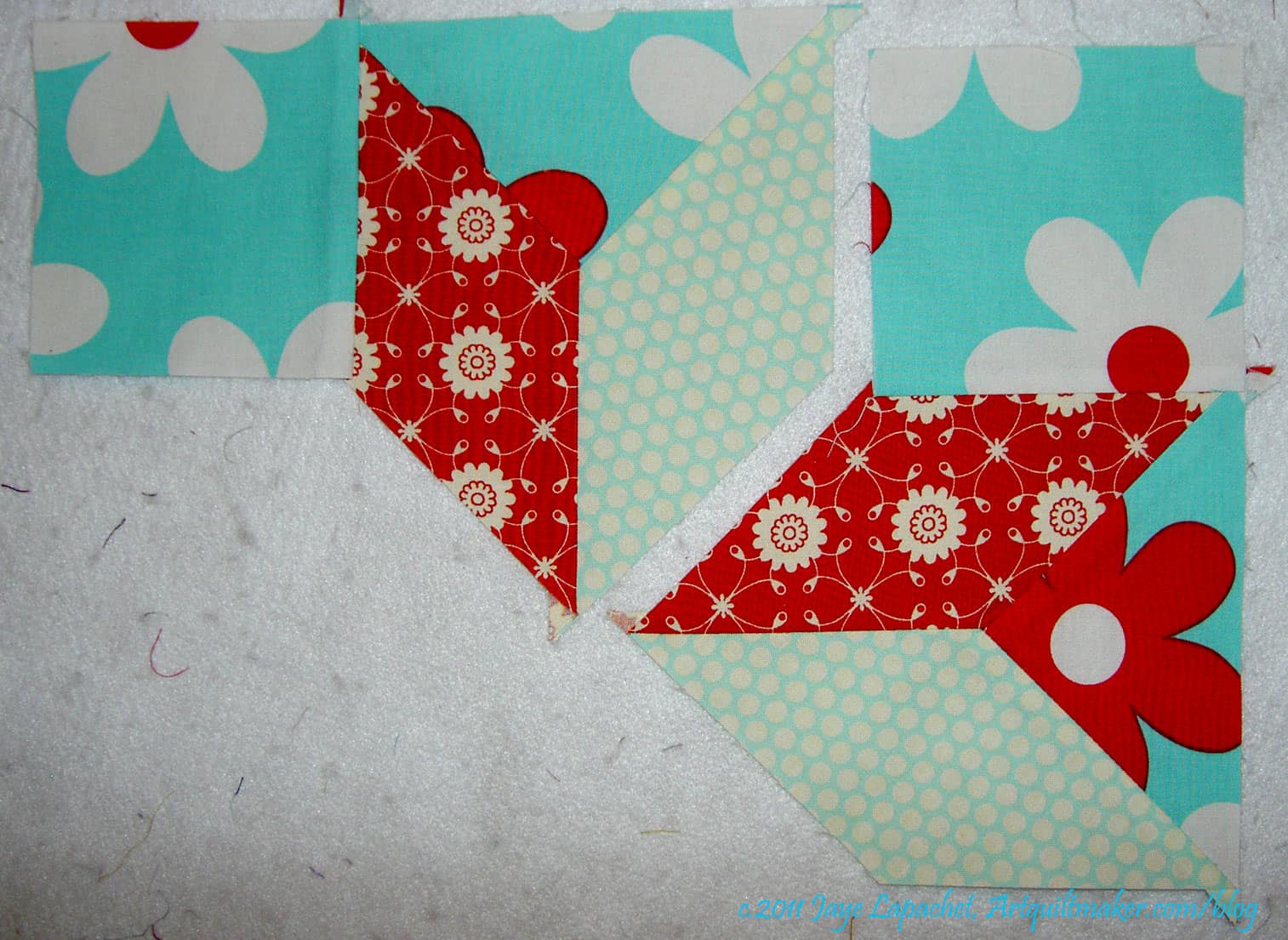
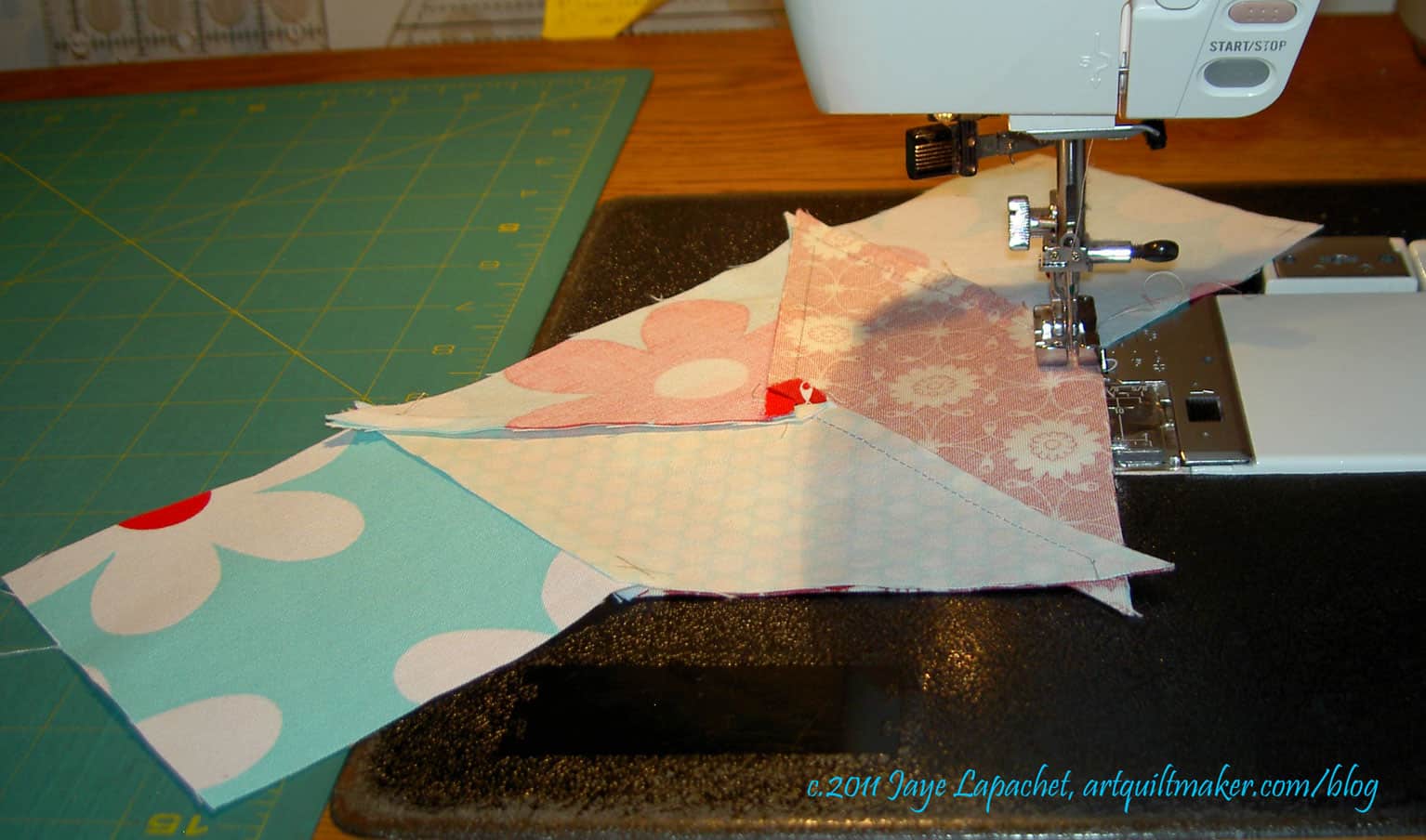
Position your last piece as you have done before. It is going to look at little weird and out of alignment, because you are working with a curve. Remember to position the fabric so it covers D5 plus 1/4″ seam allowance. Pay no attention to the edges of the other pieces, such as D4, that you have already sewn.
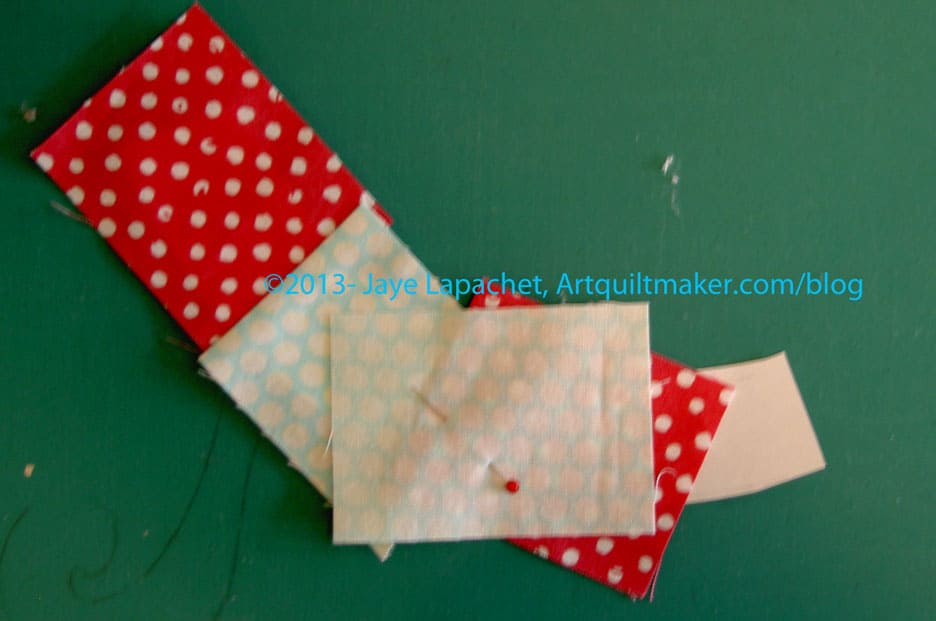
Check placement
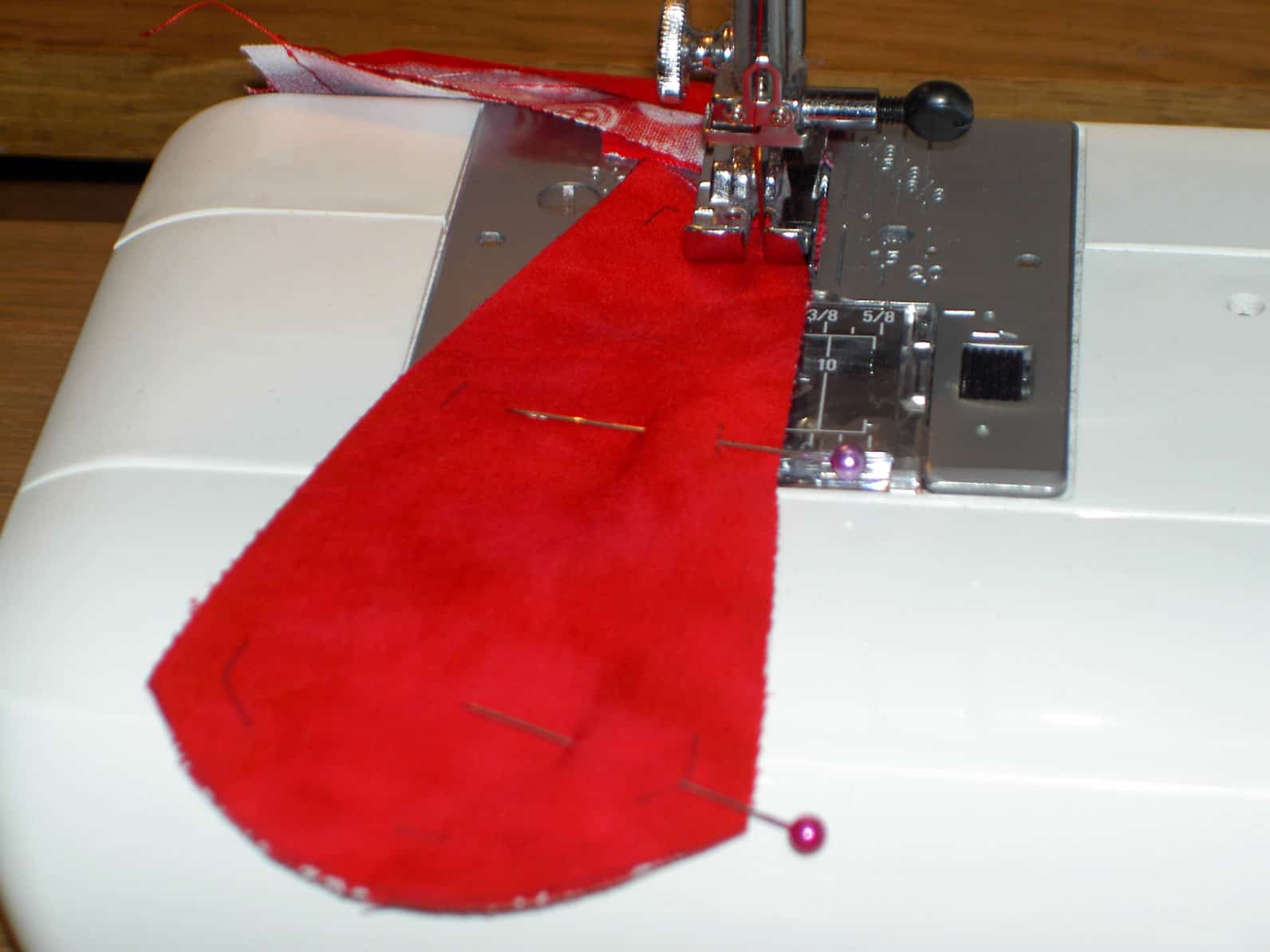
It is easier for me to see whether or not piece D5 was in the right position by pinning it. Note, I would pin it on the pattern side to sew, because then I can see where the pin is in relation to where my sewing machine foot and needle are. the pin in the photo is temporary.
Sewn D5
Once you have the placement finalized, go ahead and sew.
Fold back pattern and prepare to trim seam allowanceAlign ruler for 1/4″ seam allowance
Now you have to fold back the pattern one last time and prepare to trim the seam allowance.
D5 trimmed!
Trim!
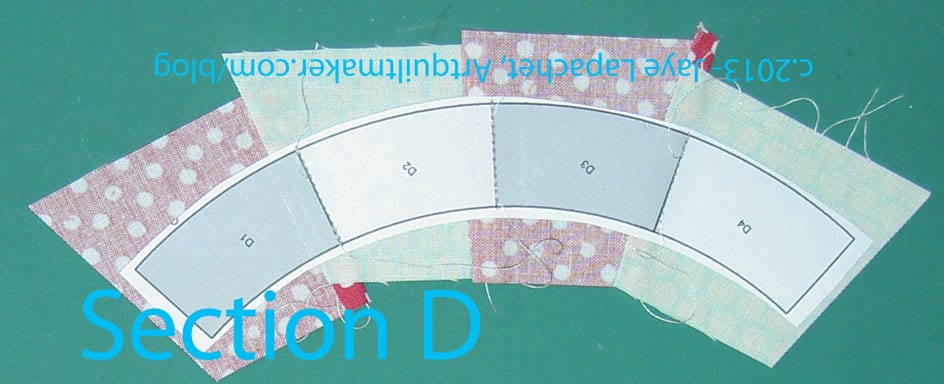
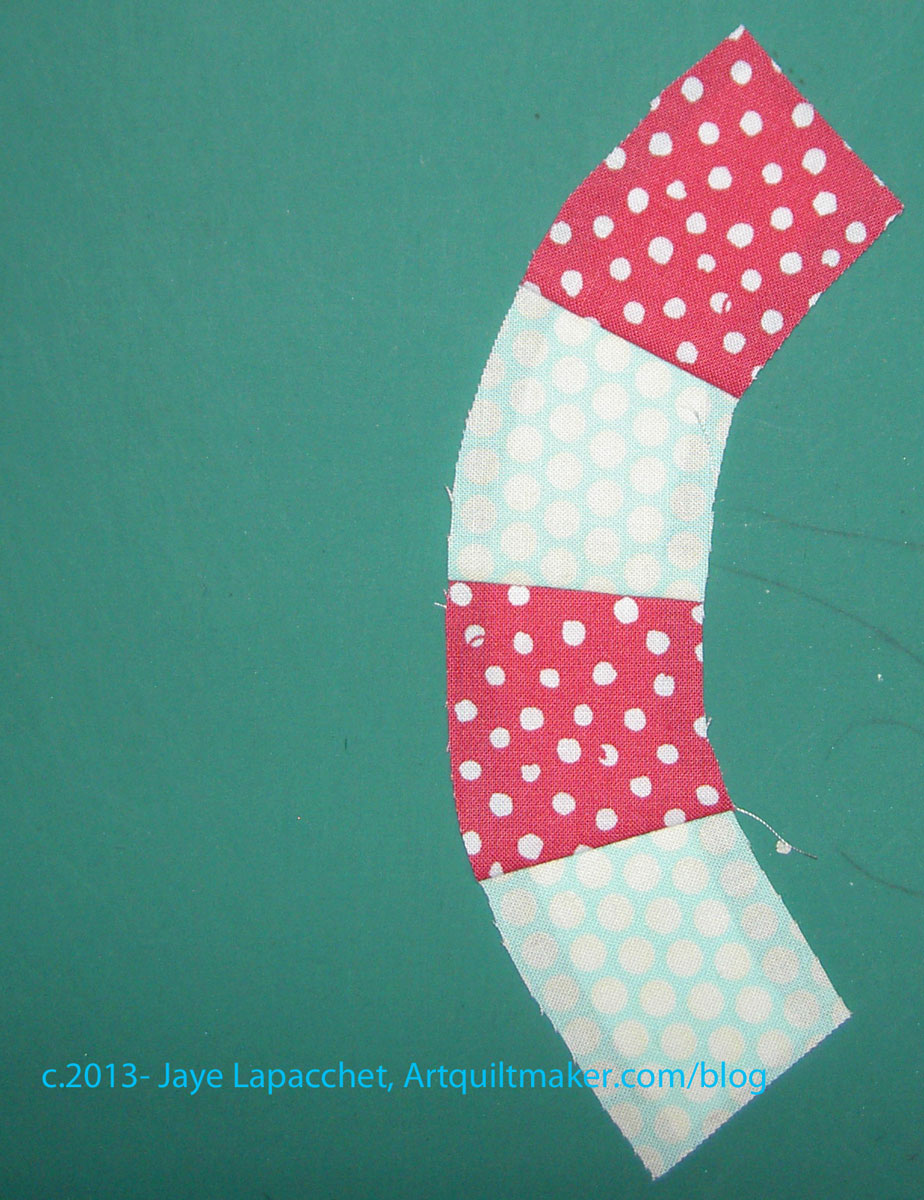
Section D Complete!
Now your piece is done. Fold back the D5 fabric and press. Place your ruler on the lines at the end of the pattern and trim a 1/4″ seam allowance. I know you can do this without photos.
Now you have to trim the curved parts of Section D
Untrimmed Section D
It is too difficult to sew the untrimmed Section D, so you will have to trim.
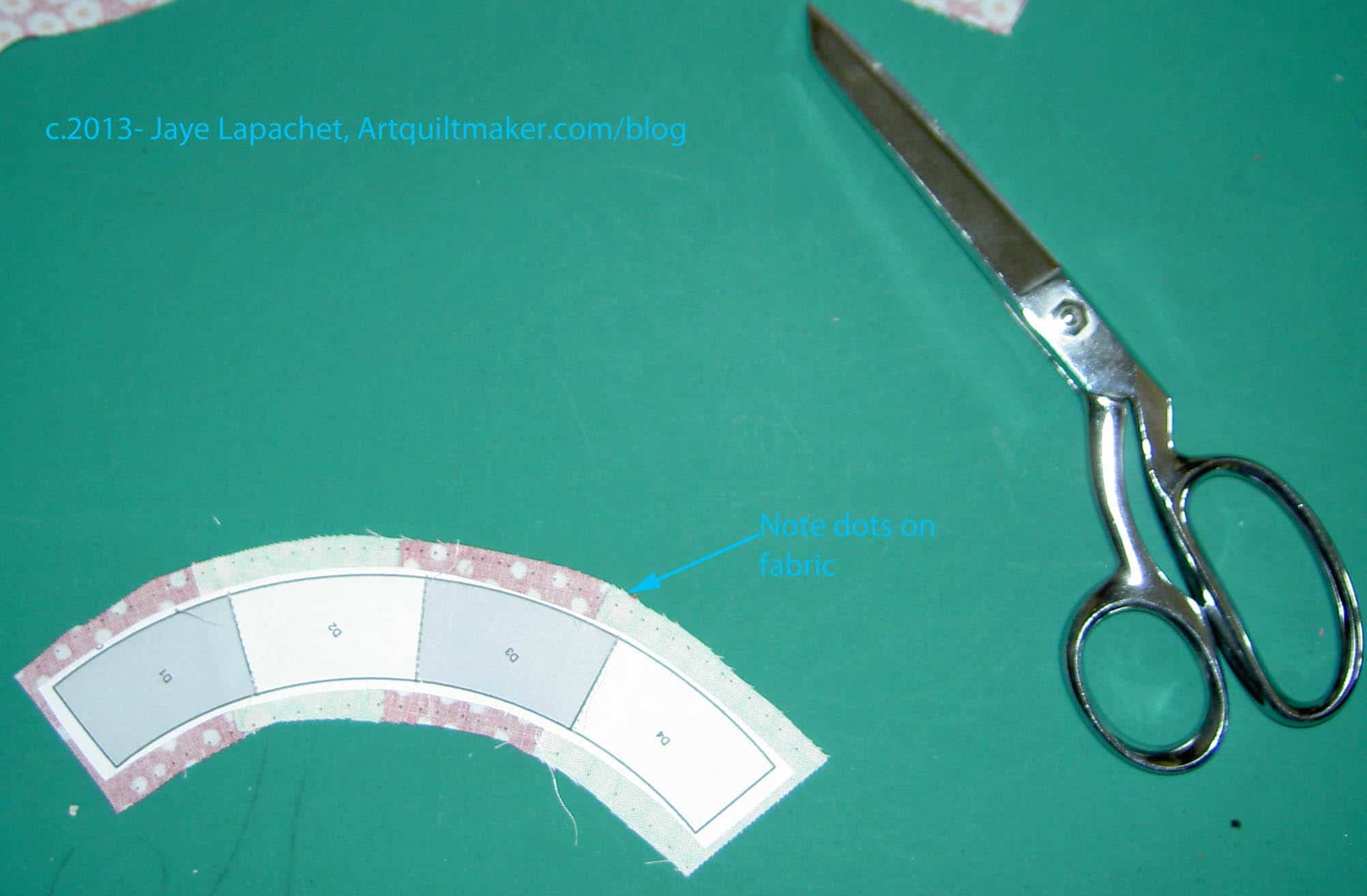
Dots mark 1/4″
To trim, mark 1/4″ away from the dark line. The dots in the photo above mark 1/4″. I have trimmed the straight ends with a rotary cutter and I am ready to play “dot to dot” with my scissors. I am going to cut from dot to dot to create a 1/4″ seam allowance.
We are working on learning foundation piecing (also called paper piecing) using a pattern called New York Compass. If you are just finding this tutorial, go to part 1 to see the supply list and learn how to prepare your pieces.
I am using an aqua with white dots for my background and a red with white dots for my foreground. You should have already cut your rectangles for both foreground and background at 2.5″x6″. If not, do it now, as you will need them almost immediately.
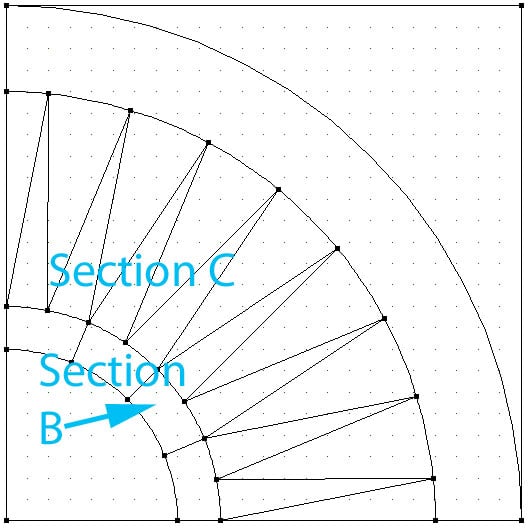
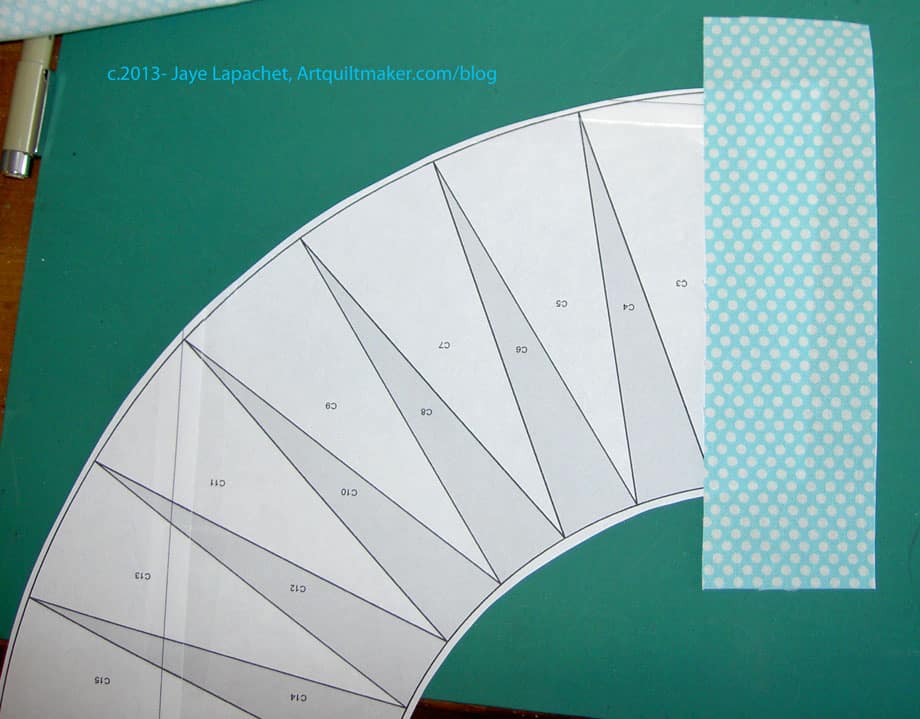
The sections of Section C are marked in the order in which you should piece them. Start with C1. Odd numbers are the background and even numbers indicate you should use the foreground fabric.
You will be piecing from one side (C1) towards the middle to the other side (C17).
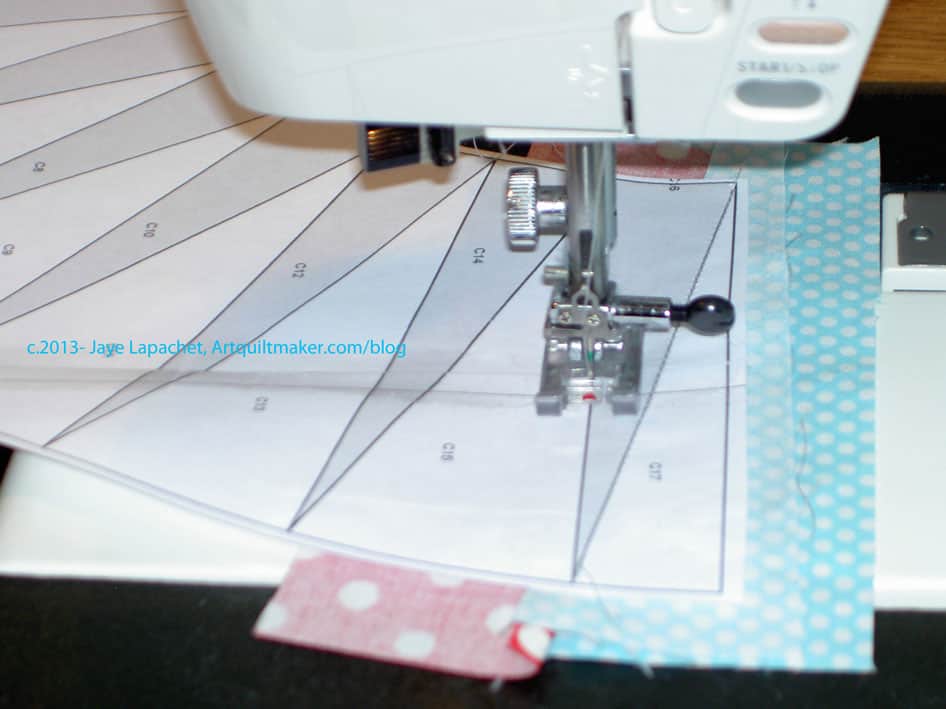
Set up your sewing machine with an applique’ foot or similar. You will not need your quarter inch foot for the foundation piecing part of the process.
Shorten the stitch length. If you can’t shorten the stitch length, remember to backstitch at the beginning and end of each line of stitching.
If you are a speed demon, and the option is available on your machine, slow down your machine a little bit. You will need to control the speed at the beginning and the end of the stitching lines.
Place your Section C pattern face down on a flat surface.
Lay Section C Face Down
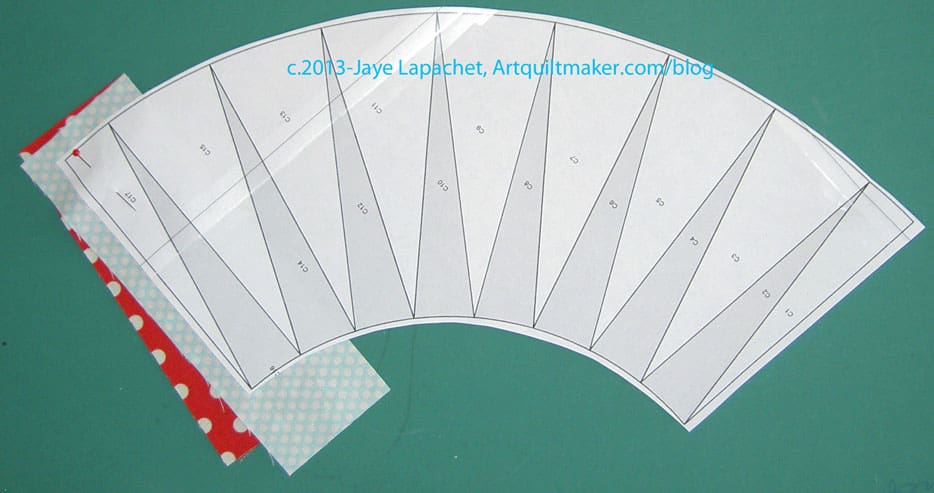
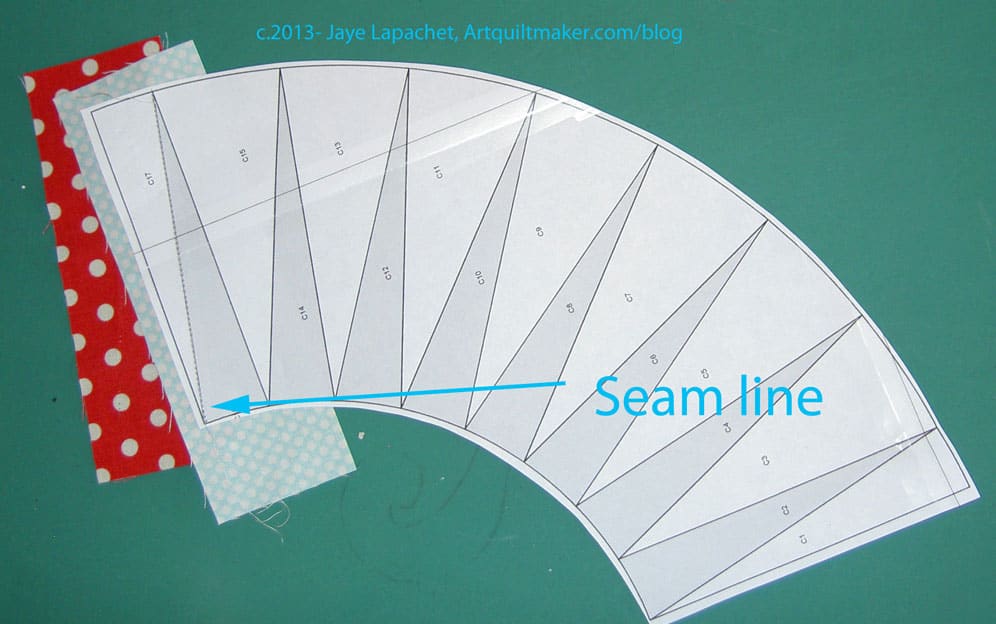
Cover piece C1 with one of the background rectangles you cut in Part 1. Place the fabric so there is at least 1/4″ of fabric around each piece. You get extra bonus points if you line one long straight edge with the straight line at the end of the pattern.
Now, hold these two pieces in one hand (optionally you can clip them together with a WonderClip) and hold the whole piece up to the light (facing a window or a lamp or on a light box). Take note of where the line is between C1 and C2.
Add second fabric
Still holding your pieces up to the light, take one of your foreground rectangles and place one of its edges 1/4″ from the line between C1 and C2. This will be the seam allowance and that quarter inch should hang over the line into C2.
Put all the pieces carefully back down on your table.
Pin the two fabrics to the paper, keeping the pin away from the line between C1 and C2. You want enough space so the pin doesn’t interfere with the foot on your sewing machine. I like to pin on my cutting mat so I don’t damage the furniture.
Fold the foreground piece back to make sure that it covers C2. You will fold it on the line between C1 and C2. That will be your sewing line. You can move the pins to the front if you want to make for easier sewing.
Flip the whole thing over
Flip the whole thing over and take a look.
Once pinned, check again to make sure that you have at least 1/4″ all around C1 (background) and C2 (foreground).
Take your piece to the sewing machine and sew on the line between C1 and C2. Do not go over. Only sew on that line.
Stitched on line
Back stitch at the beginning and the end. One backstitch is fine.
Fold over to check coverage
Remove the piece from under the presser foot and fold your foreground over to check and make sure it covered C2.
Why you need to trim
You can see the foreground fabric through the background, which is why you need to trim. Depending on the colors you use, this may not be the case, but you don’t want to build up so many layers that you cannot quilt through the piece.
Take Section C back to your cutting mat and place it so the paper part of the pattern is on top.
Fold the paper back
Fold the paper back on the seam line so the excess seam allowance is exposed. You are going to cut this off, so it is worthwhile to take a minute and make sure you are not cutting off the wrong part (the part you need to cover your background and spikes).
Trim Excess Seam Allowance
Line up your ruler with the 1/4″ line on the seam line and trim the excess seam allowance.
Press
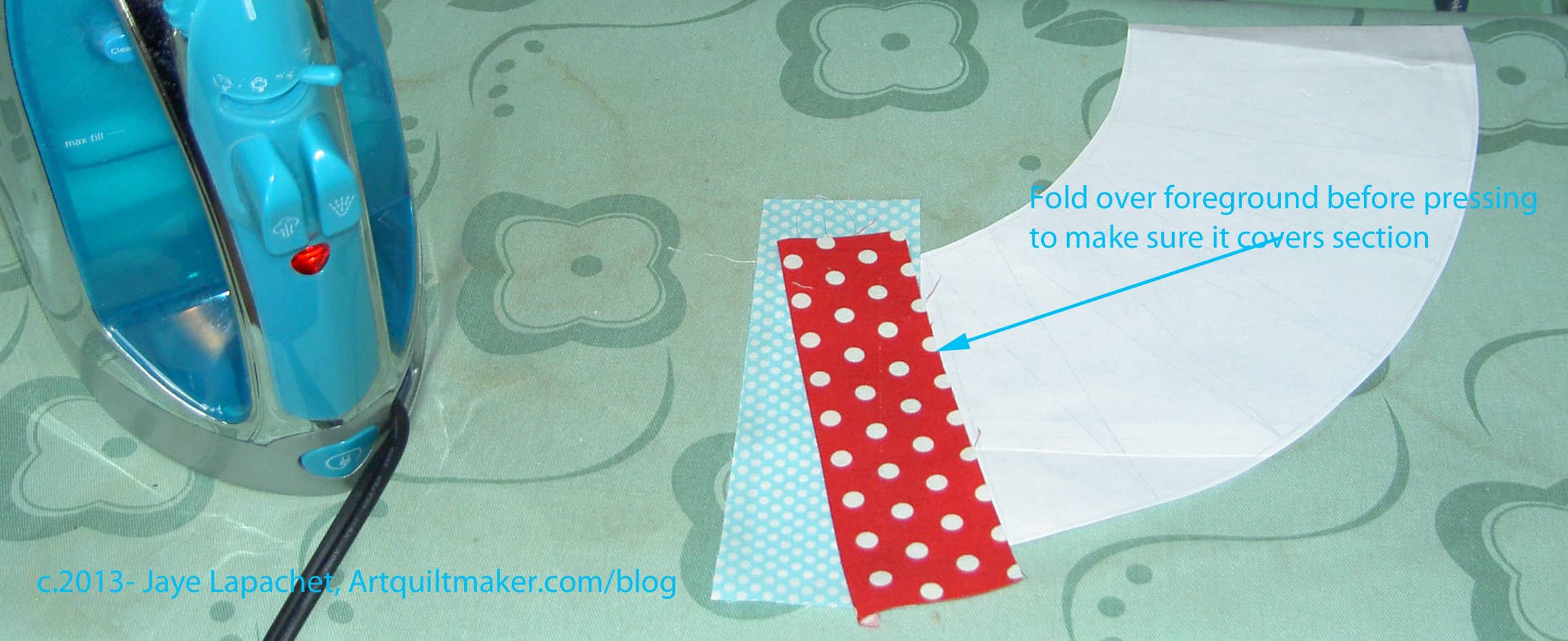
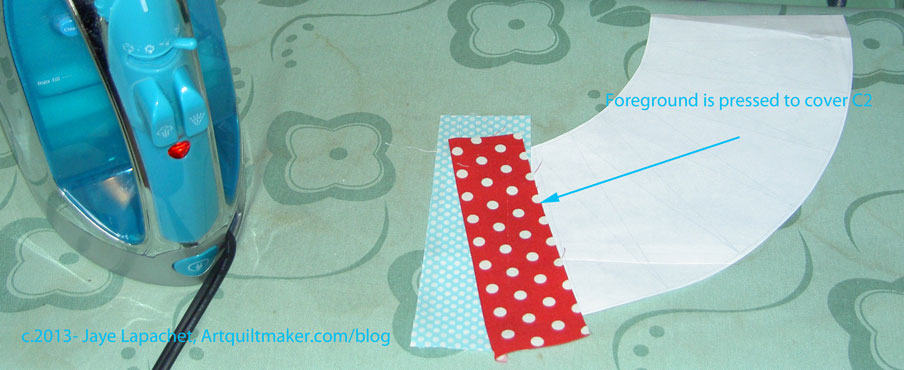
Take your piece to your ironing surface and place it with the paper down. Press towards the foreground, so you get rid of as much of the “bump'” from the seam as you can. Press towards the middle of your pattern. You want the foreground fabric to be as flat as you can get it. Pressing is very important. It is possible that there will be a bump when you put the next piece over the previous one, if you don’t press well.
Your foreground piece should cover the line between C2 and C3 and give you a 1/4″ seam allowance.
Once you have pressed the foreground flat, you are ready to put on the next background piece.
Take one of your background rectangles and place one of its edges 1/4″ from the line between C2 and C3, smoothing (without stretching) the foreground piece you sewed, so it is as flat as possible. Again, this will be the seam allowance and that quarter inch should hang over the line into section C3. You may need to hold it up to the light again to position the piece correctly.
Once you have the correct placement, pin in place.
Once pinned, check again to make sure that you have at least 1/4″ all around C2 (background) .
Sew on black line
Take your piece to the sewing machine and sew on the line between C2 and C3. Do not sew beyond the end of that line. Only sew on that line.
Repeat
Repeat this process, alternating between foreground and background until you reach the other end of Section C. As you move down the pattern, your Section C will start to look like something you could put into a block.
Trim Straight Edges
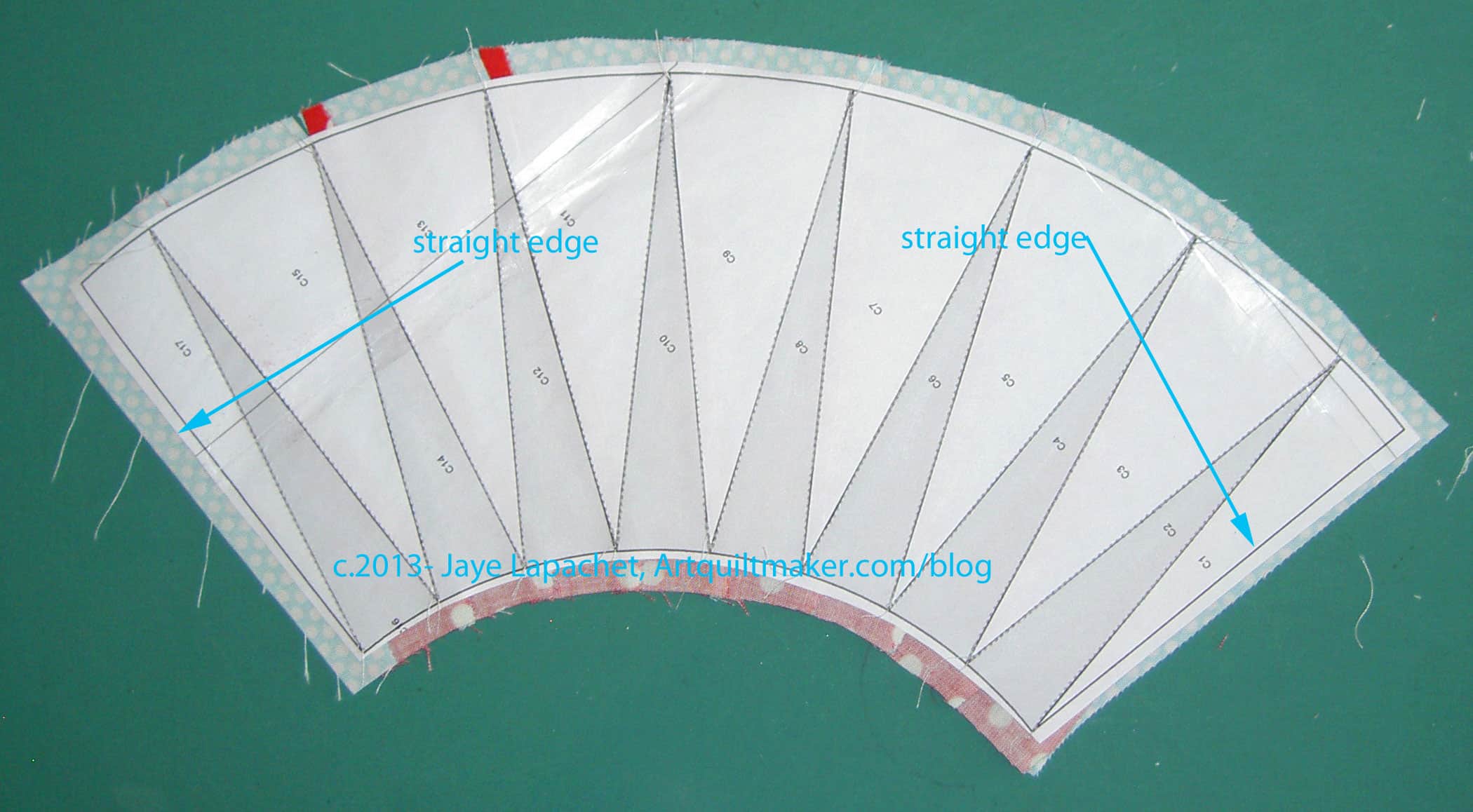
Use your rotary cutting kit to trim the straight edges of Section C.
Trim with Sharp Scissors
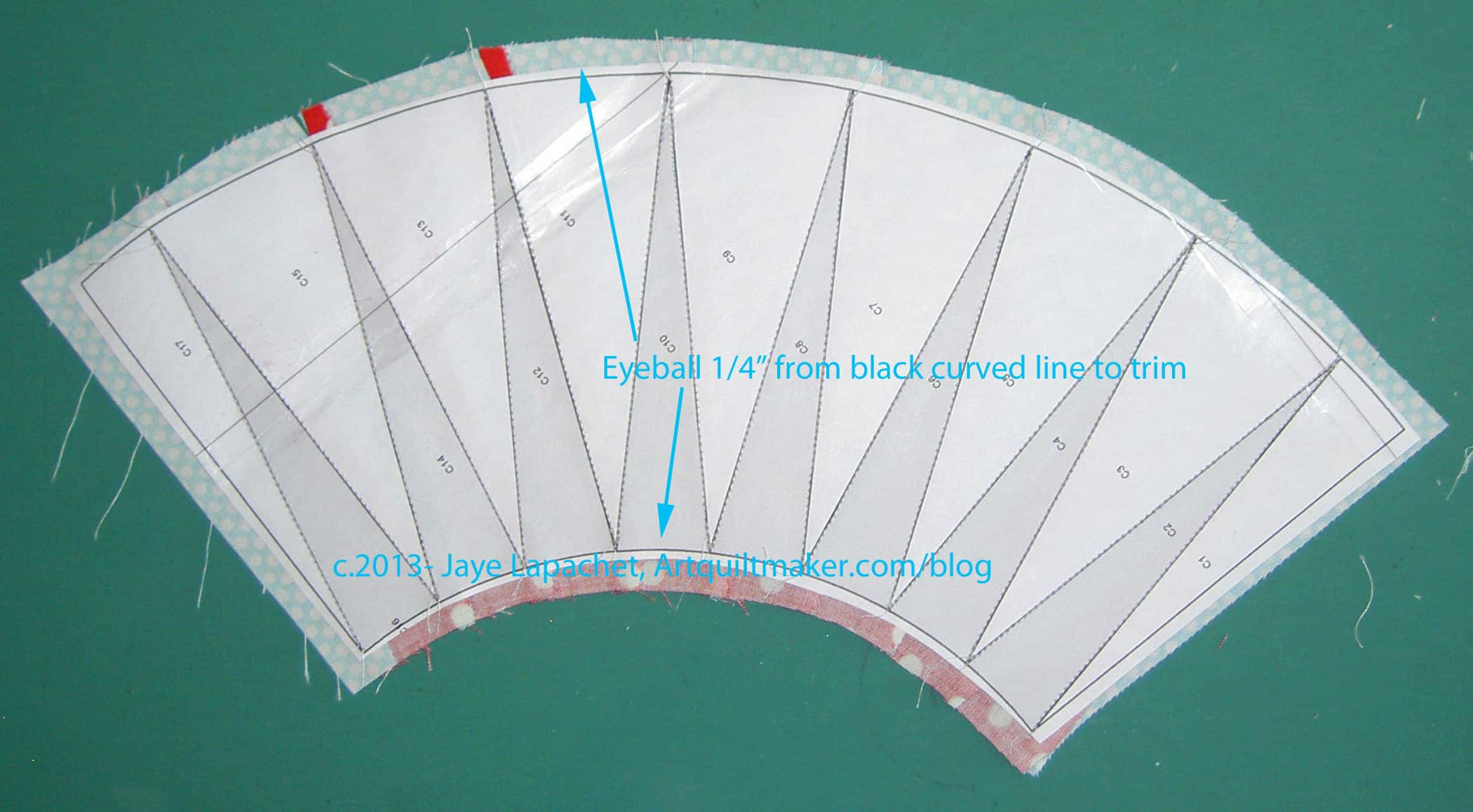
From the paper pattern side of Section C, I eyeball a 1/4″ and trim the curves with very sharp scissors. There are some serious layers here, so I am not fooling when I say sharp.
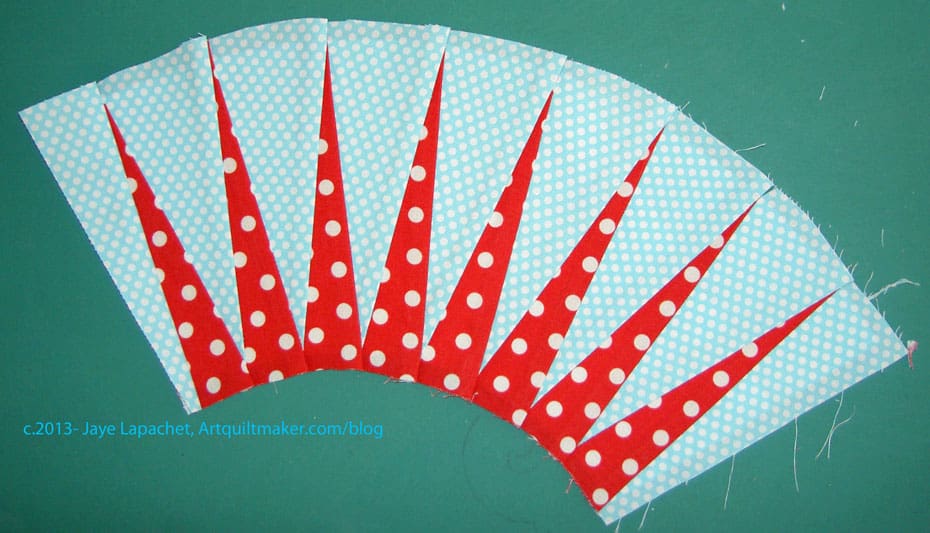
Finished Section C
The finished Section C is a sight to behold. Even after making several of these sections, I amazed each time it comes out relatively normal.
Tips:
If you have to rip out stitches, rip them out from the fabric side, not the paper side.
Pay attention to putting the next piece on the foundation.
Frances talked about foundation piecing in one of her recent podcasts. I am nothing if not an accommodating 😉 teacher, so I thought we would tackle a foundation piecing pattern next. This is called New York Compass, a variation of the New York Beauty pattern. It is a little more complex than the patterns we have been working on, but I decided to throw caution to the wind and nudge Frances to step up. She has done curves, so I am confident she can do this one.
New York Compass
In part 1, we will prep everything.
Supplies:
Notebook for notes
Pen to take notes 😉
Sewing Machine
applique’ foot (preferably one with a mark showing where the needle will stitch)
1/4″ foot
thread
fabric
fabric scissors
paper scissors
foundation piecing paper like Toni’s Disappearing Paper or Carol Doak’s Foundation Paper
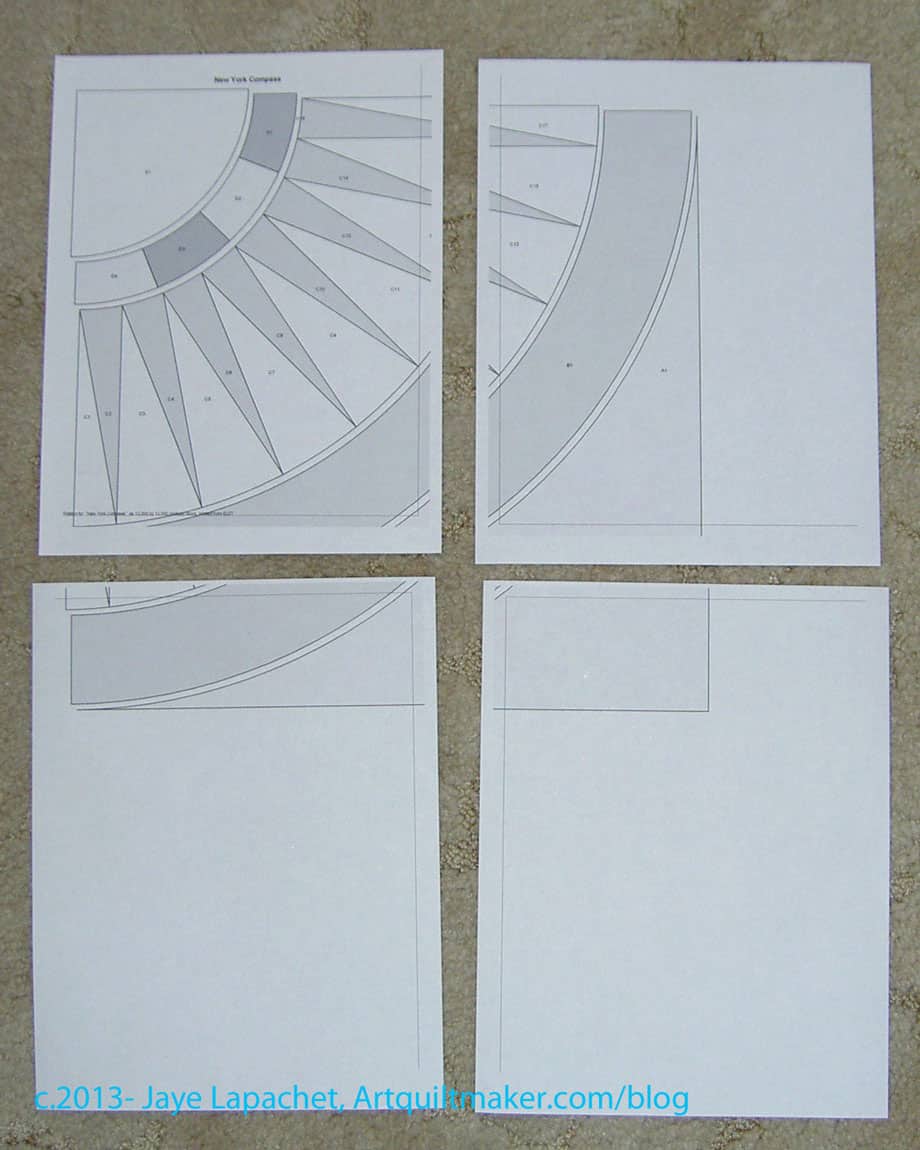
Print the pattern sheets (all 4). I only have 8.5″x11″ paper so the pattern comes out on 4 sheets. Use some kind of foundation piecing paper to print the pattern. Nota Bene: I keep a folder for all of my projects, so I like to print at least 2, if not 3 copies of the pattern. One I use to make the templates, one I will tape together and keep whole (you can use regular copy paper for this one) and one I will use for the foundations.
Tape pattern together
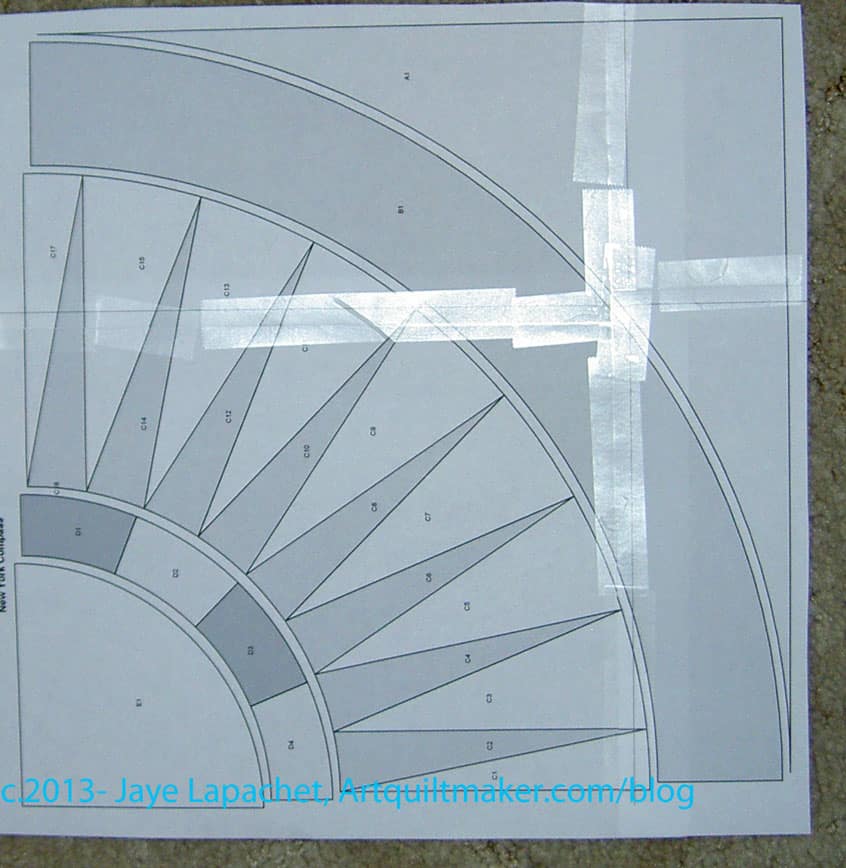
Trim off the margins and tape the parts together. Note, the tape will not play nicely with your iron when you press the foundation pieced parts so USE A PRESSING CLOTH. A scrap of fabric or ugly fabric work great. Guess how I found out?
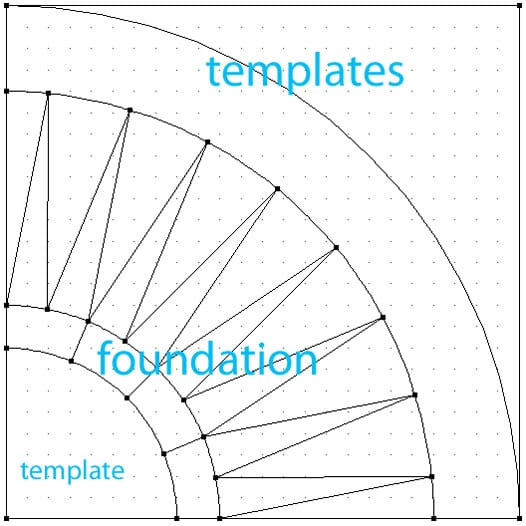
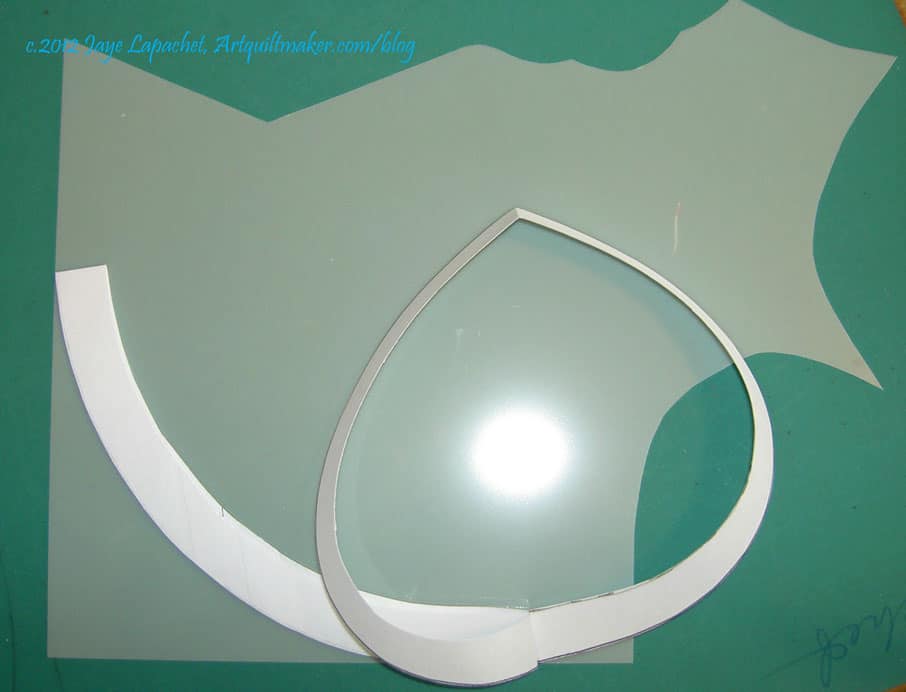
NY Compass Templates
Above is how the templates shake out: 3 regular plastic backed templates and two foundation templates.
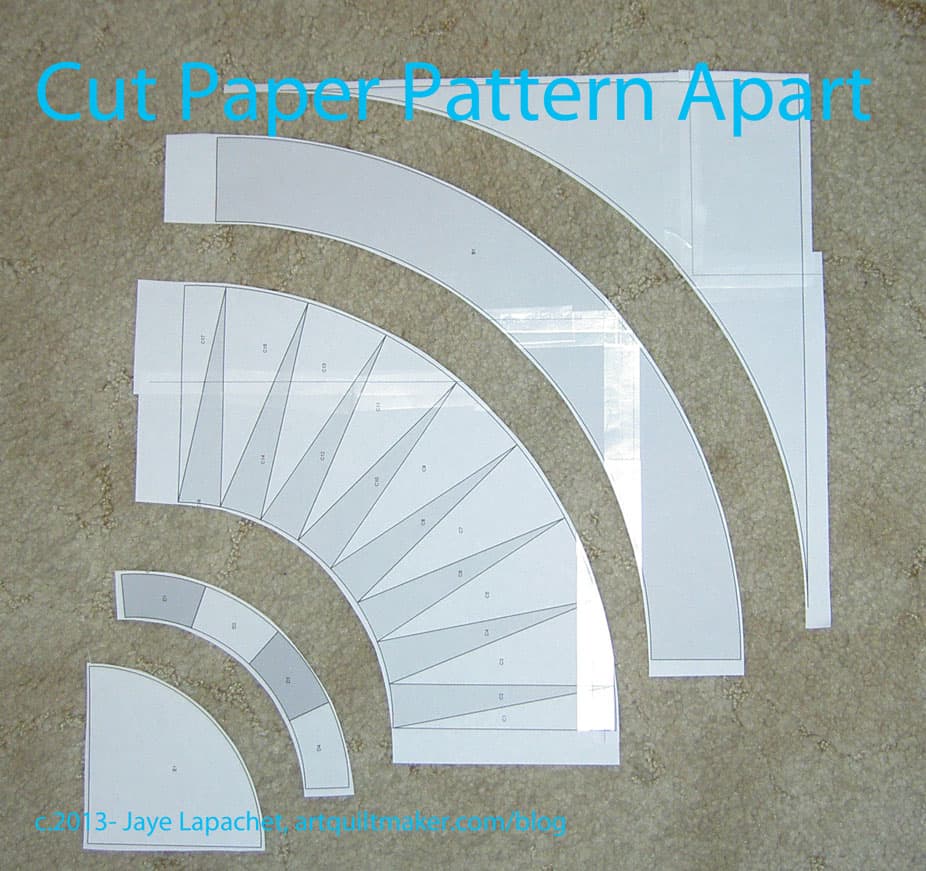
Cut Paper Pattern Apart
Rough cut the parts of the pattern apart. You will have 5 parts. Two of them will be foundation piecing patterns and 3 of will need to be made into regular templates with template plastic.
NY Compass SectionsNY Compass Outline
I am going to refer to the skinny spikes piece as Section C. Section C is in the middle.
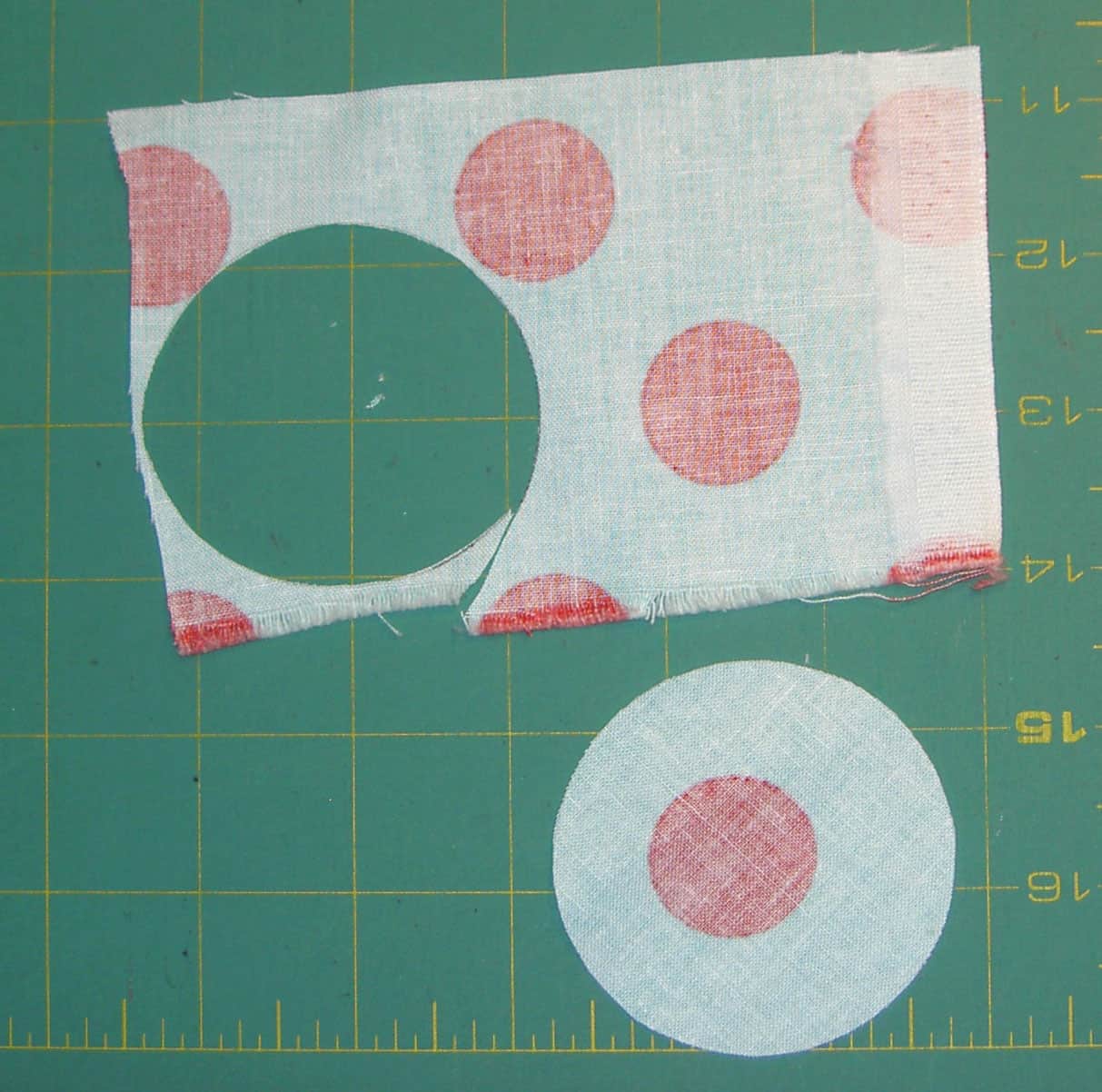
Make your templates. You must add a quarter of inch to your paper templates (not the ones that will be foundation pieced. If you don’t know how to make templates with template plastic, refer to my tutorial on Machine Applique’ Part 1. Make sure you put the plastic on the correct side (wrong side of fabric).
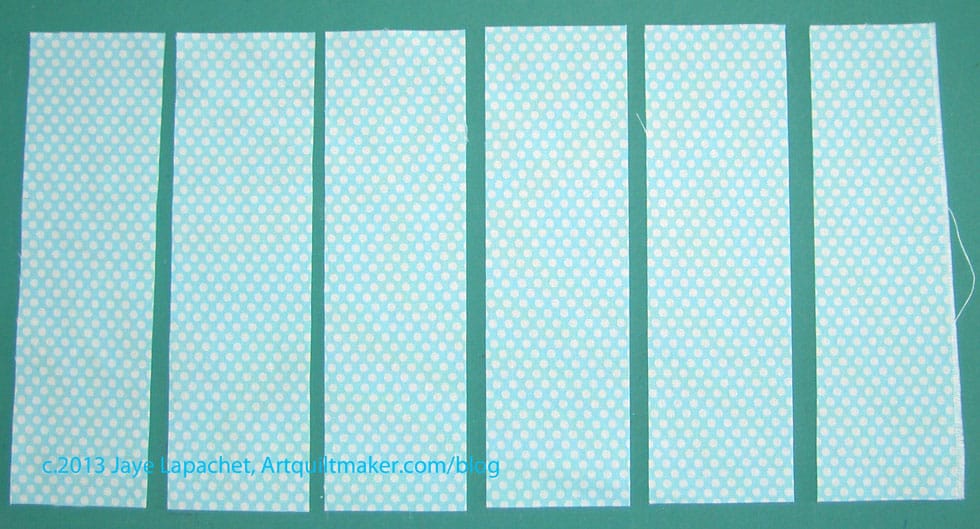
Cut rectangles for foundation piecing 2.5″
Cut rectangles for foundation piecing 2.5″x 6.5″. This is a generous rectangle. You aren’t going to save any fabric with this technique and you should worry more about coming up short, because ripping out stitches is a real pain.
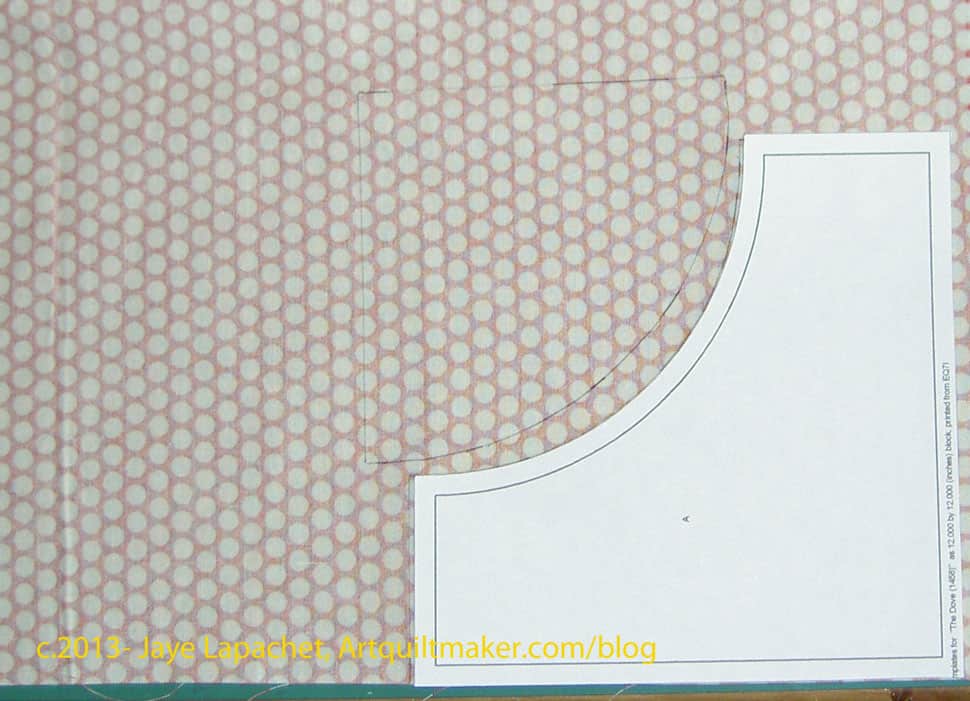
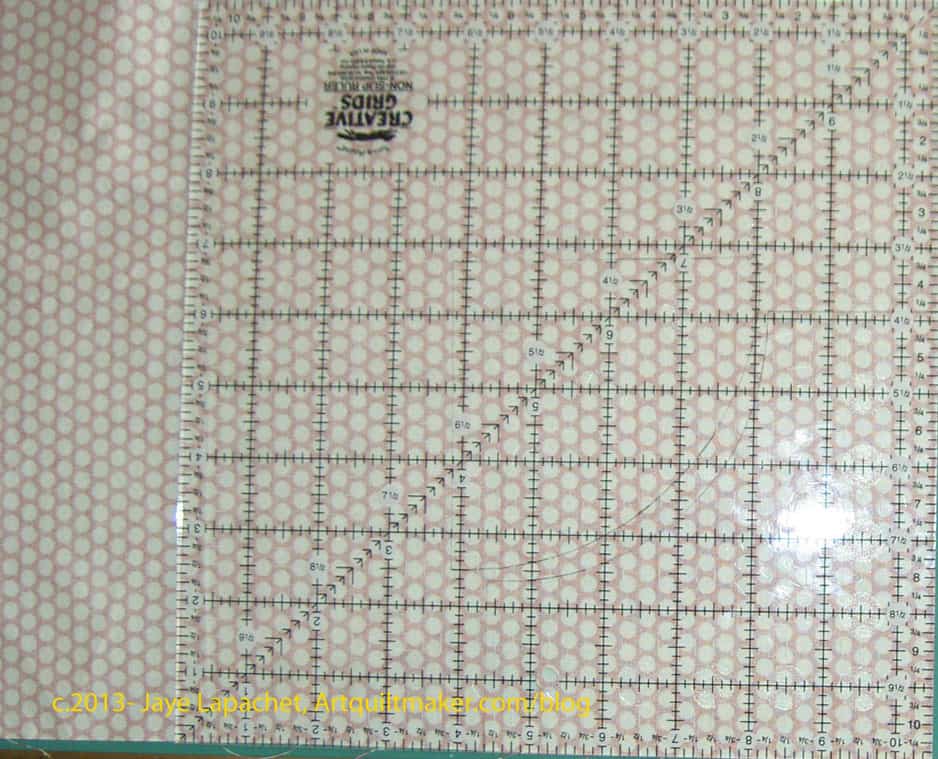
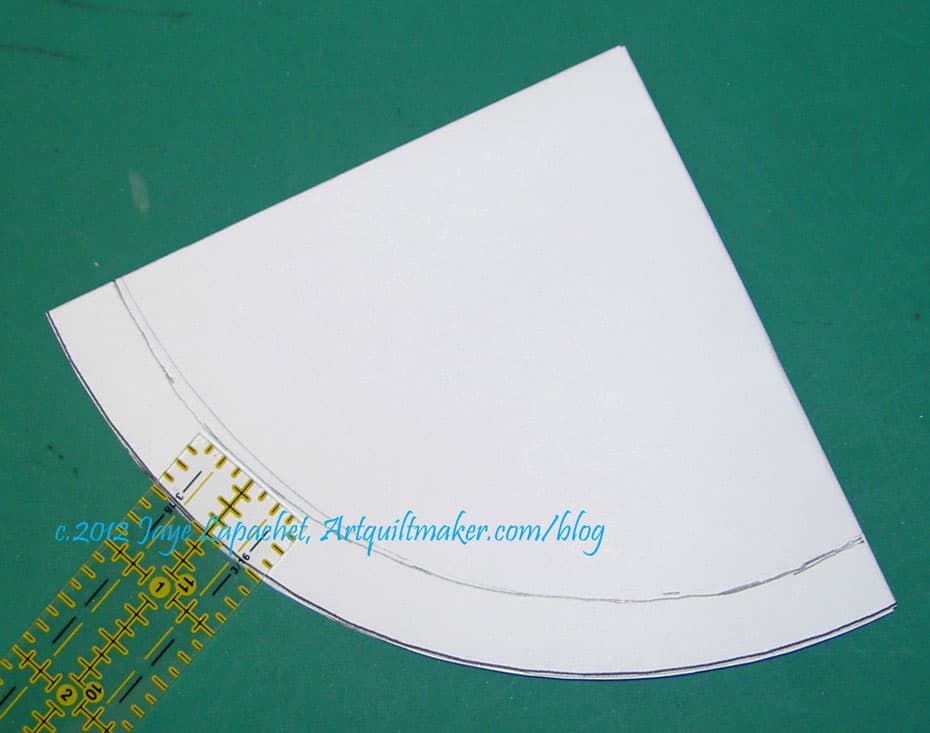
There is one tricky part about these templates. You will need to add a 1/4″ to the curve. The way you do that is to: A) glue the paper template to the largest piece of template plastic you have (you may have to piece the template plastic). B) Take your ruler and start at the left end of the paper template. Line the ruler’s 1/4″ mark up with the dark outline on the paper template (you should still have a rough cut paper template before you glue the paper to template plastic). C) Make a mark with a template plastic friendly pen at the 1/4″. D) Move your ruler slightly to the right and make another mark at the 1/4″ point. E) Follow the curved line of the paper part of the template with your ruler until you reach the far right side of the ruler. F) Cut along the dots you have made in as smooth a motion as you can using your paper scissors. You should now have a quarter inch seam allowance along your template. Repeat for all curved templates.
Cut your fabrics. Nota Bene: When you cut the fabrics for Section C, cut rectangles for these spikes at 2.5″.
Check fabric strips
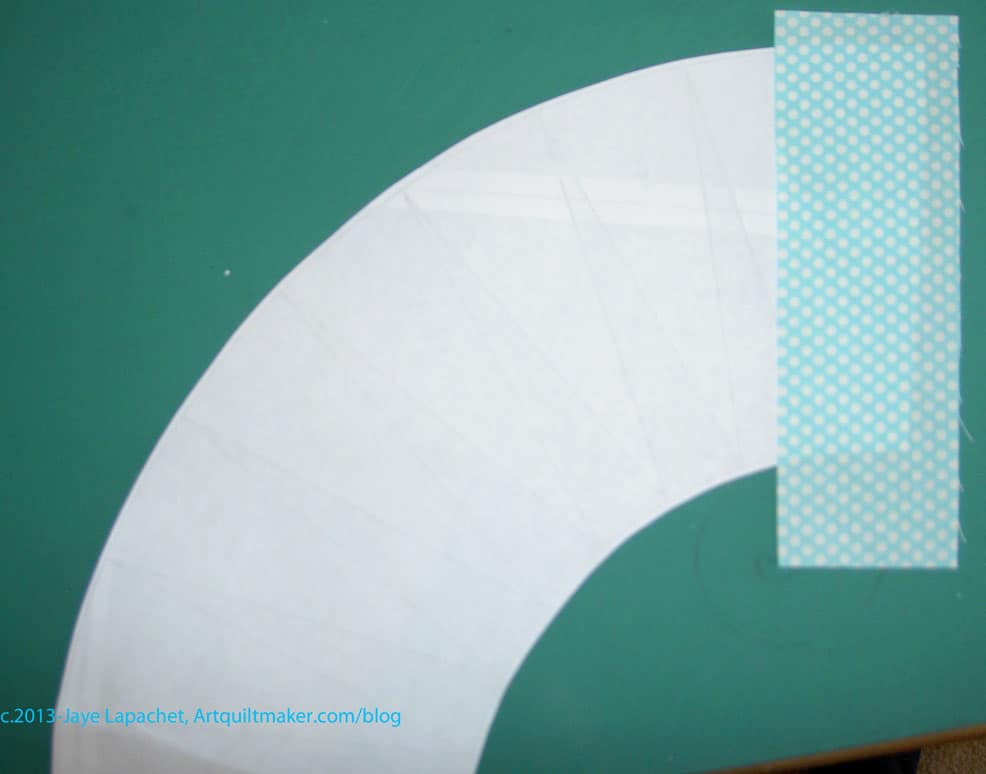
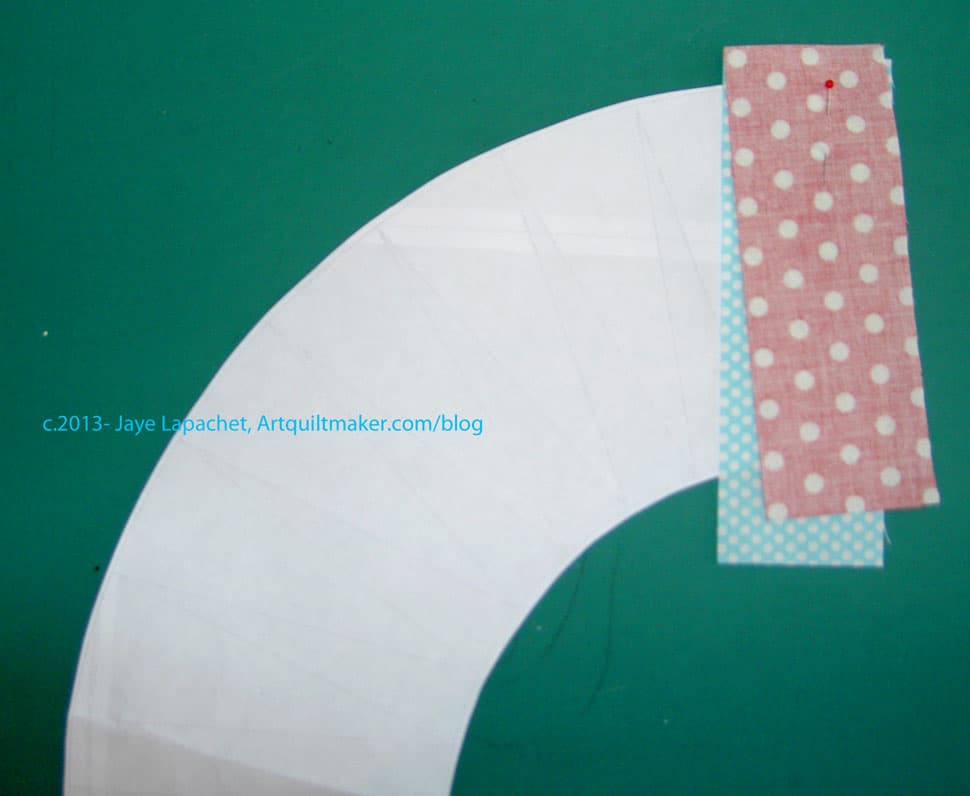
Check to make sure you have cut your rectangles large enough. Take your Section C and lay it face up. Cover the first section (labeled C1 on my pattern) to make sure your rectangle covers the entire section C1 plus 1/4″ seam allowance around all sides.
Now go to Part 2 to learn the actual foundation piecing.
Tips:
If you have to rip out stitches, rip them out from the fabric side, not the paper side.
I started a series of tutorials on sewing curves during my last Sampler Class, but I never finished the last two parts. The first part is about fabric and arrangement of pieces.
Curves-The Dove
Supplies:
The Dove pattern
paper scissors
template plastic
glue stick
fabric (at least 2 different)
pen ( I like the Pigma Micron & the Pilot Ultra Fine Point)
Fabric scissors
pins
Sewing machine
quarter inch foot or other marking system
thread
Iron and ironing board
We will be using a quarter inch seam allowance. You will need to adjust the pattern if you are using a different seam allowance.
The Dove pattern is a baby version of the Drunkard’s Path. If you make this piece, the next logical curved piece would be a Drunkard’s path block.
Key to Pieces
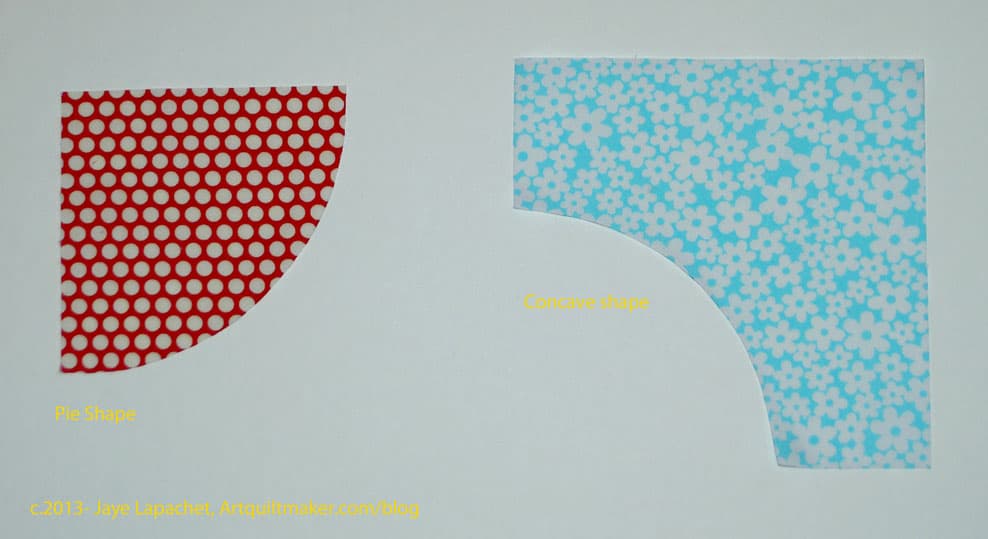
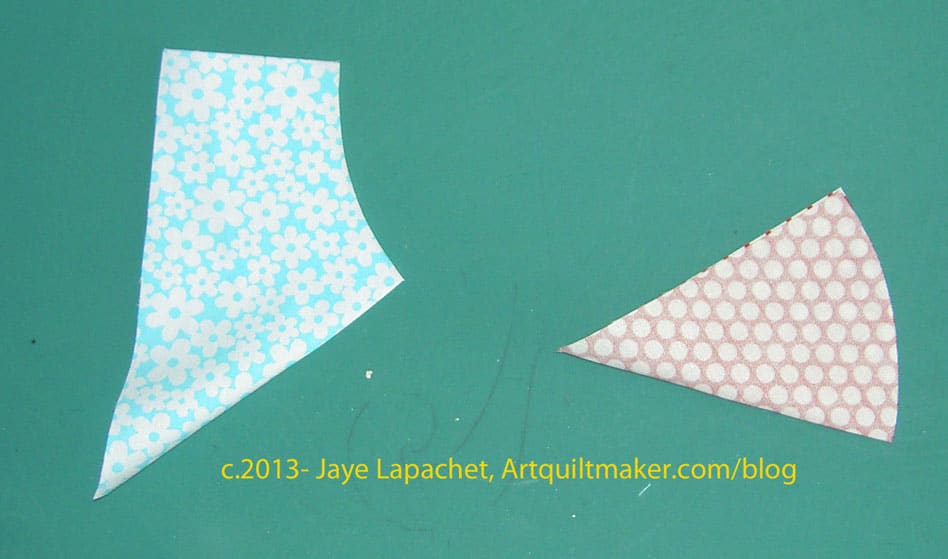
This block, as well as the Drunkard’s Path block is made from two types of pieces: a concave ‘L’ and a pie shape. The pie shape forms the circle in the center and the concave ‘L’ can be considered the background. In this block, the pieces are somewhat larger than in the 12″ Drunkard’s Path I used in my previous class. This design also has a very strong focal point.
Take the The Dove pattern and rough cut the templates.
Use the glue stick to stick the paper templates to the template plastic. You won’t need heat resistant template plastic as we won’t be ironing over the templates. It is fine to use, though, if that is the only kind you have.
Rough cut out the templates you have glued to the plastic.
Carefully cut out the template on the seam allowance line, cutting off the rough cut paper and plastic.
Place your fabric wrong side up on a hard surface.
Draw Around Templates
Place the templates wrong side up on your chosen fabric. Nota bene: If you are using symmetrical templates, then it doesn’t matter whether they are right side or wrong side up, but it is good to get in the habit of doing it the right way in case you use non-symmetrical templates in a future project.
Draw around the template with your marking implement of choice. You will need to hold your template firmly so it doesn’t shift. You can also rough cut out the fabric pieces if trying to cut precisely or carefully with a long length of fabric draped over the cutting table is too difficult.
Rotary Cut 90 degree angles
Cut the fabric out carefully using your fabric scissors, especially the curves. Cut the drawn line off the fabric. I used a rotary cutter for the 90 degree angles.
Check to make sure that the fabric you just cut out is the same size and shape as your templates. You can lay the template over your fabric to check.
Fold Pieces in Half
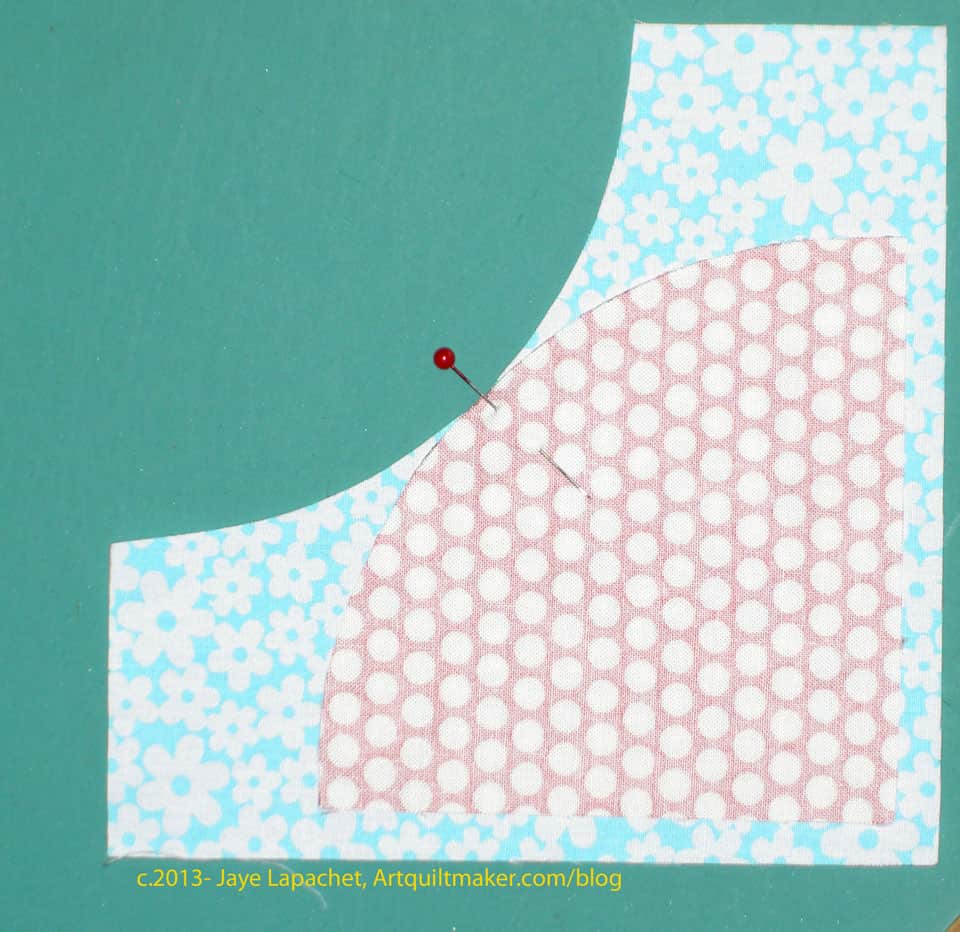
Take a pie shape and a concave shape and fold them in half. Line up the edges carefully. The halfway point that you create will be used to make sure the pieces are sewn together evenly. You will want to make the marks so the patches nest. That means you fold the concave piece in half with right sides together and the pie shaped piece in half with the wrong sides together. Mark the halfway point with a pin or through finger pressing.
Nestle the pieces right sides together.
Pin in Middle
To do this, line up the middle mark where you have finger pressed to align the blocks accurately.
Pinned 3 times
Line up the outside edges and place a pin close to the two outside edges.
Fill in the area between the middle pin and each outside pin with pins. Ease the area between the outside and middle pins into smoothness with your fingers, lining up the edges of the fabric as you do so. Place as many pins as you need between the middle pin and the outside pin. Make sure the fabric is flat and there are no pooches. You may have to ease a bit, but do it very gently so as not to stretch the pieces. If you have to stretch and tug and pull, there is something wrong and you should check to see if your templates match your fabric pieces.
Completed Pinning
Do the same with the second section between the middle and the other outside edge until you have used a lot of pins.
Sew Pie to Concave Piece
Sew Pie to Concave piece, removing pins before you sew over them. You may want to use the point of a pin to keep the edges of the fabric lined up until you sew over the area where the pin was. I also use a seam ripper as a stiletto to keep the two pieces in place after I remove the pins.
Dove Block in Process
Press carefully.
Repeat for all of the quarter blocks.
Dove Block in Process
Sew 2 quarter blocks together to make a half, then sew the other 2 quarter blocks together so you have two halves.
Press so that the center seams nest
Pin the two halves together, paying careful attention to the center.
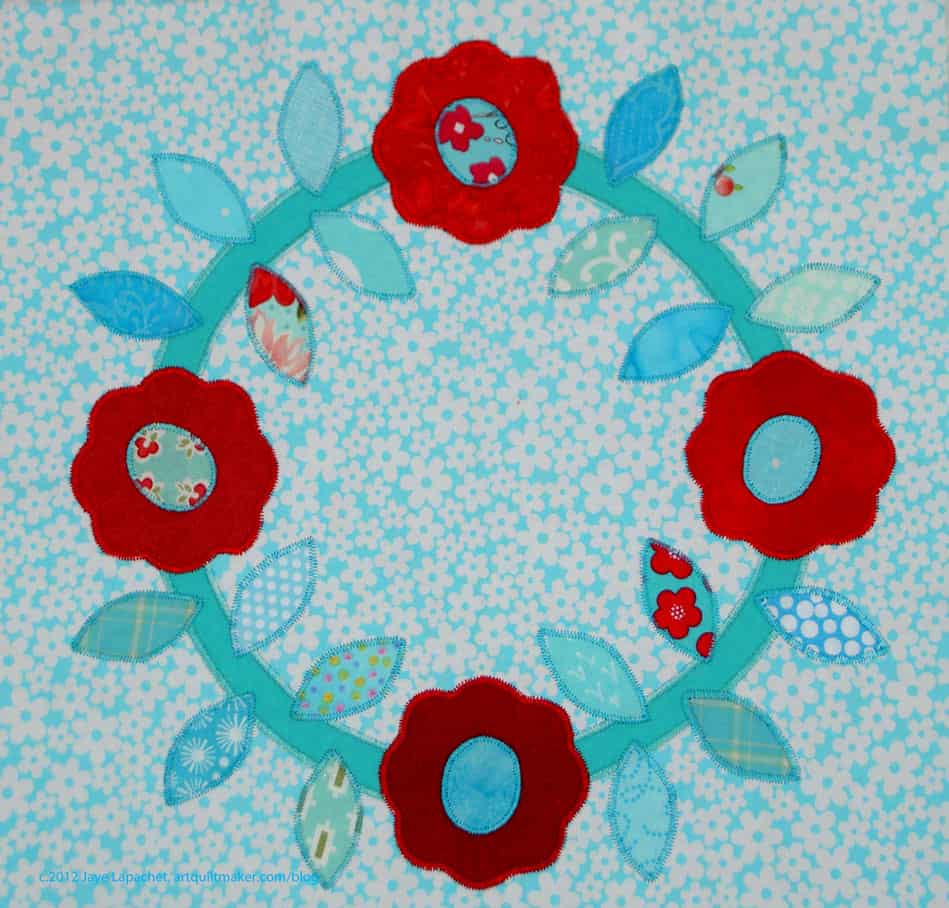
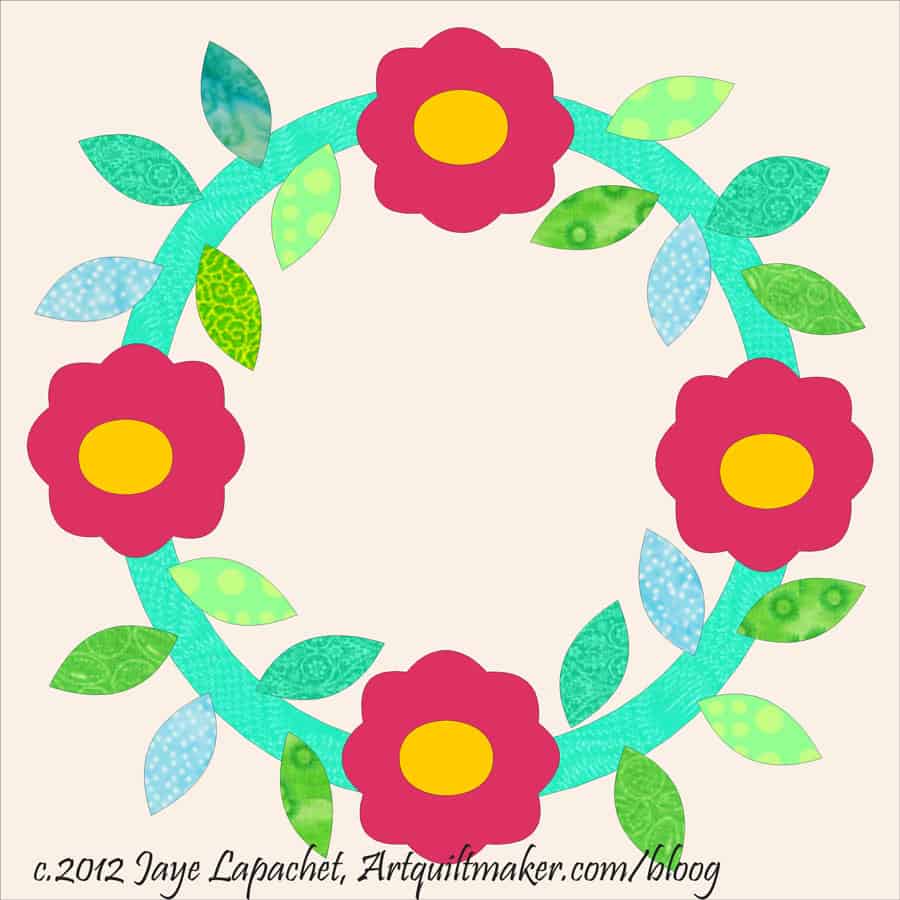
We are making the Flower Wreath block. To find out how to make templates, including the ring, see Part 1 for making templates and Part 2 for making the ring and positioning the ring on the background.
Flower Wreath
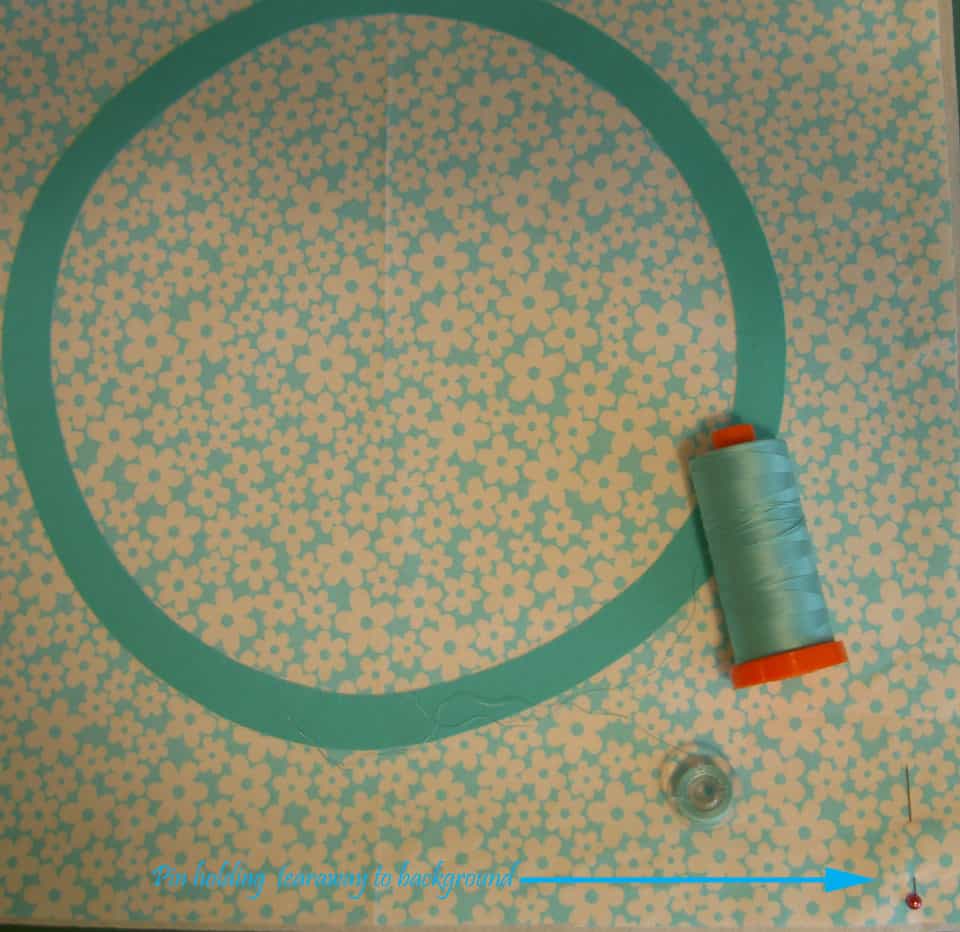
Now we are going to stitch the ring. If you haven’t started, check the Supply List in part 1 and grab your 3″x5″ tearaway backed fabric. Your ring should be applied to the background and ready to stitch. If your ring is not fused and ready to stitch, go back to part 2.
I stitch in layers, so that the stitching is easier, there are fewer starts and stops and the piece looks more finished. Now that you are ready to stitch, it is time to choose your thread.
Choose thread
Whenever you choose thread, you must consider the stitch. If the stitch will be dense like a satin stitch, you should choose the color by looking at the thread wrapped around the whole spool. That will give you a better sense of the color the satin stitch will end up.
It you will be using a straight stitch, you should unreel a bit of the thread and look at one strand on your fabric. You may need to pool a little of the thread together – less dense than the whole spool and more dense than one strand.
Now set up your machine for zig zag stitching. You will need to choose a stitch density. I like a semi-open zig zag that is not too wide, because it uses less thread and looks more interesting. Dense satin stitching, however, can really highlight and outline each piece. I use the following settings on my machine:
Ring: width: 3.0, density: 0.45
Flowers: width: 3.0, density: 0.45
Leaves: width: 2.0, density: 0.5
Flower centers: width: 2.0, density: 0.5
Even if you haven’t chosen all the fabric, I like to get the ring stitched down first, so I can audition the other fabric without worrying about the ring. Yes, it is fused and shouldn’t go anywhere, but I still like it to be stitched down.
In order to choose the stitch density, you will need to test. Get the tearaway backed sample piece you have prepared and start testing with the width and densities I have provided above. Stitch lines of zig zag stitching 2-3″ long using a contrasting thread similar to the thread you will be using to stitch the ring. Adjust the width and density on your machine until you are pleased with the look.
Stitch ring
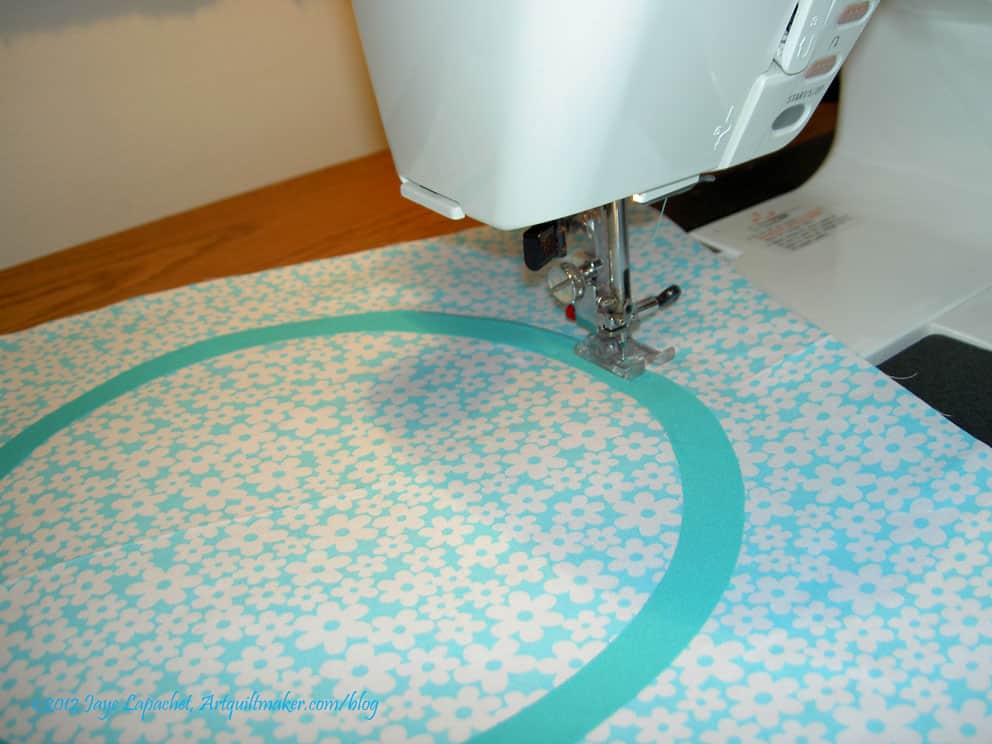
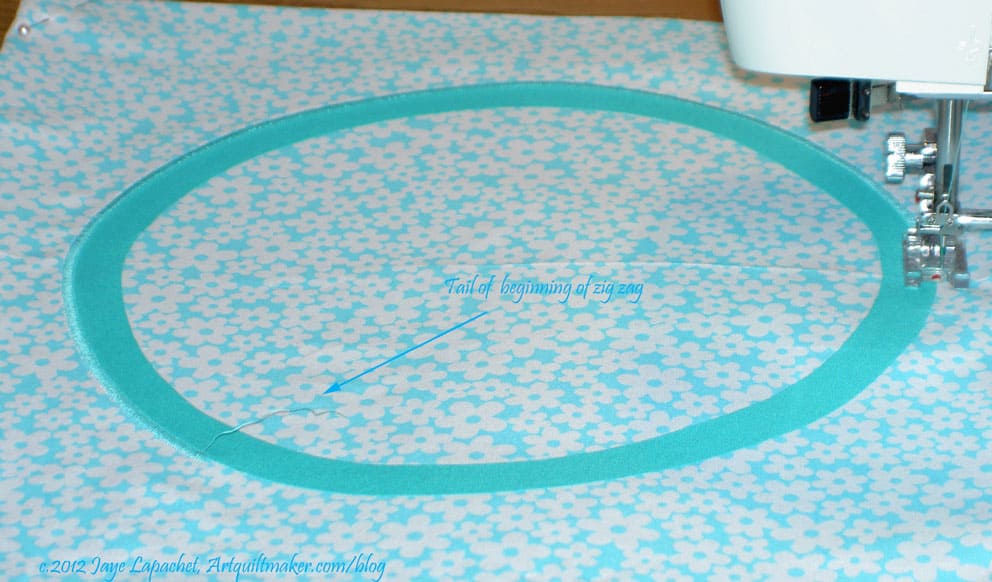
Put the ring on the machine and start stitching. I always leave a long tail that I can pull to the back and tie shut later. My zig zag does not automatically tie the ends. If your machine is more advanced you may not have to tie a knot on the back. I don’t want my zig zag to come out if it gets snagged while being used, which is why I tie the ends.
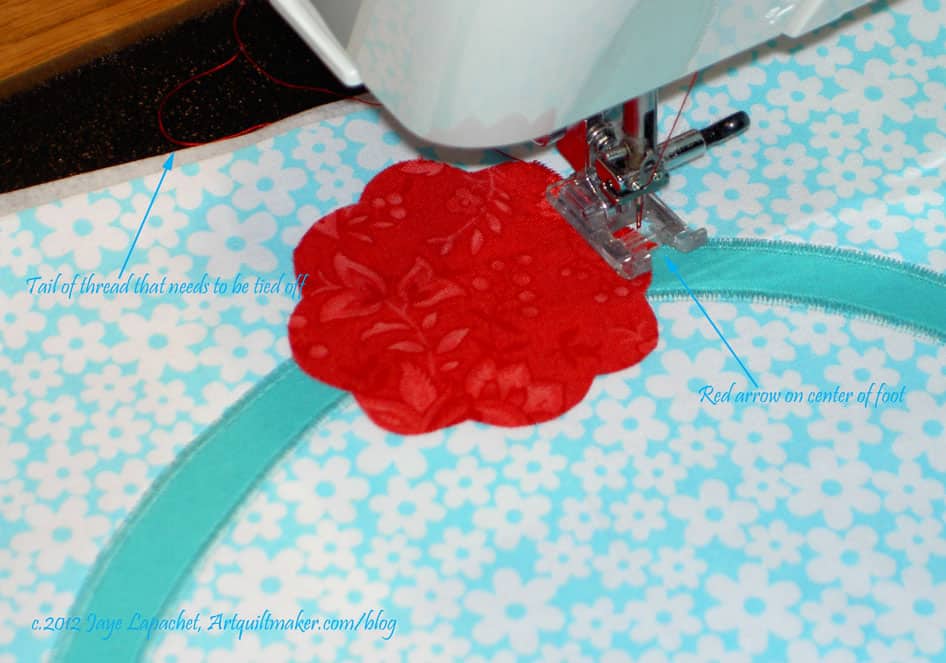
I use my applique’ foot, which has a red arrow in the center to stitch out the zig zag. I place the tip of the red arrow on the raw edge of the ring and follow it around. You should stitch with needle down or use the hand wheel to put the needle down when you stop. If the center point on your foot gets off the raw edge of your ring, stop and readjust. Stop with the needle down on the outside of the ring’s curve whenever you need to readjust the needle to accommodate the curve. Turn the fabric to the left to get the center point of the foot back on the raw edge of your ring. The stitching will be slightly closer together on the inside of the shape, when the needle punches the fabric to the left, and more open on the outside of the shape or when the needle hits the background.
Tail of thread
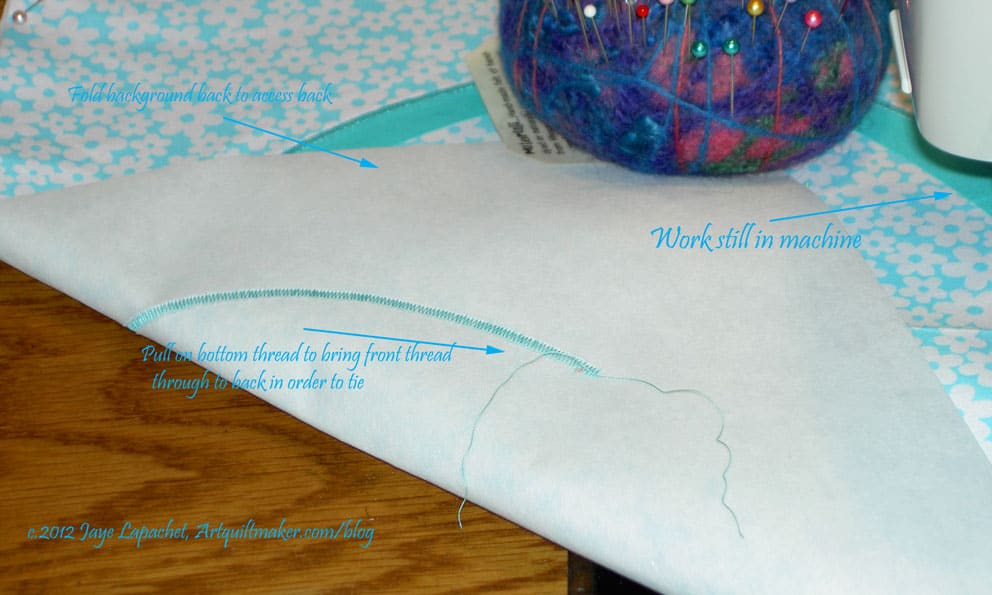
When you have done about half – 3/4s of the stitching on the ring, stop and pull the beginning thread to the back and tie it off, if you need to.
I tie the beginning off before I get to the end, because the beginning and ending threads can get tangled up and make it impossible to make small, neat knots. I have tied all four ends together in a pinch, but prefer to make the knots as small as possible.
Fold work back to tie
I also use this technique also if I have to stop and pull the work out of the machine because of thread breakage or necessary bobbin refill.
I fold the work back (I only used my pincushion so I could photograph what I was doing. Normally, I just hold it with my wrist as pull the front through to the back and tie the ends together. I don’t take the work out of the machine unless there is a good reason – like a big knot, or thread breakage, etc.
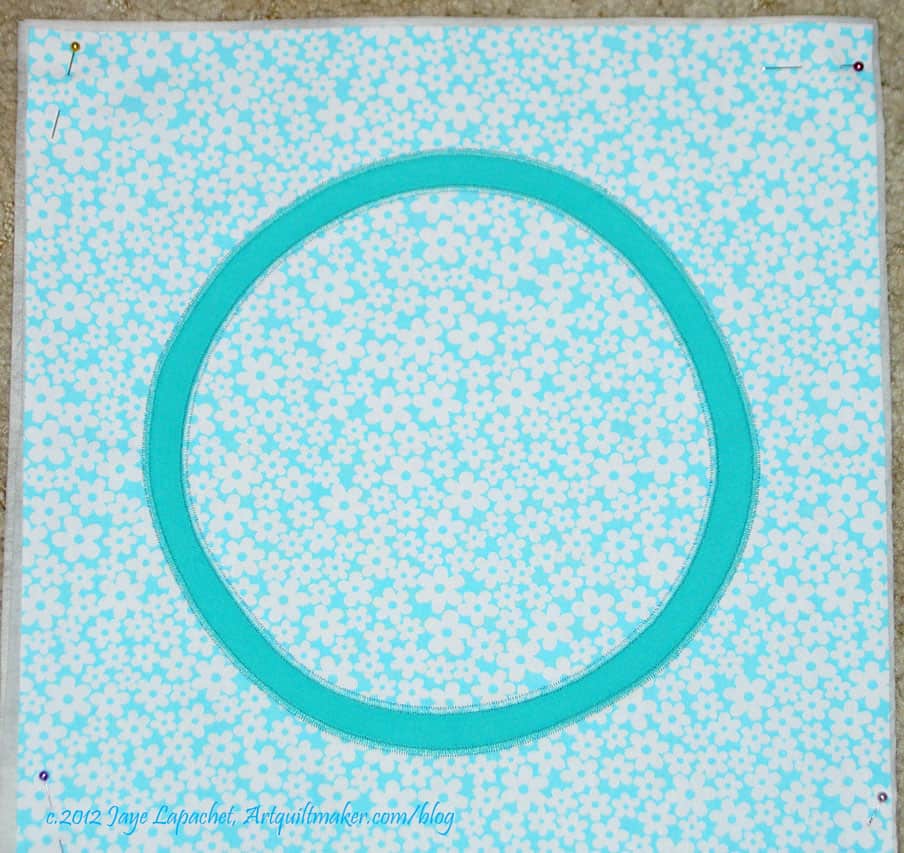
Completely stitched ring
Once your knot is tied, continue stitching to where you started. I don’t overlap much once I get to the beginning, perhaps only a stitch or two, because I don’t want the look to be too different.
I pull the work out of the machine and tie off the ending threads. You may not need to do this if your machine does it for you.
Now do the same thing, but on the inside to finish stitching down the ring. Once you have stitched both the inside and outside of the rings, your ring will be complete and you will be ready to place the leaves and flowers on the ring.
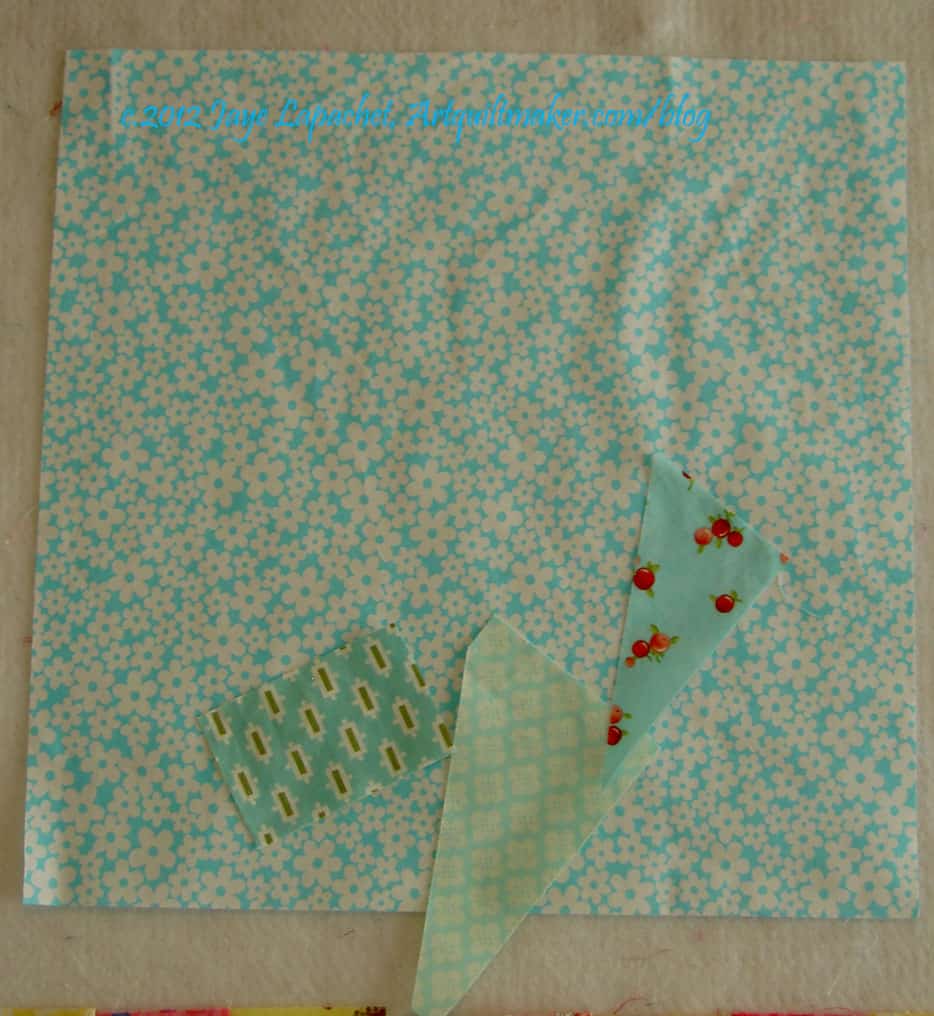
If you have not already done so, choose the rest of your fabrics. You will need fabric for the flowers (1-4 fabrics) and leaves (1-20 fabrics). If you have not cut out and fused the wreath to the background, please go back to part 2. The leaves can be the traditional green or you can use something else. If you use one color, you might want to mix up the prints to increase interest. You can also use different colors. Make the block your own.
Make visual decisions visually
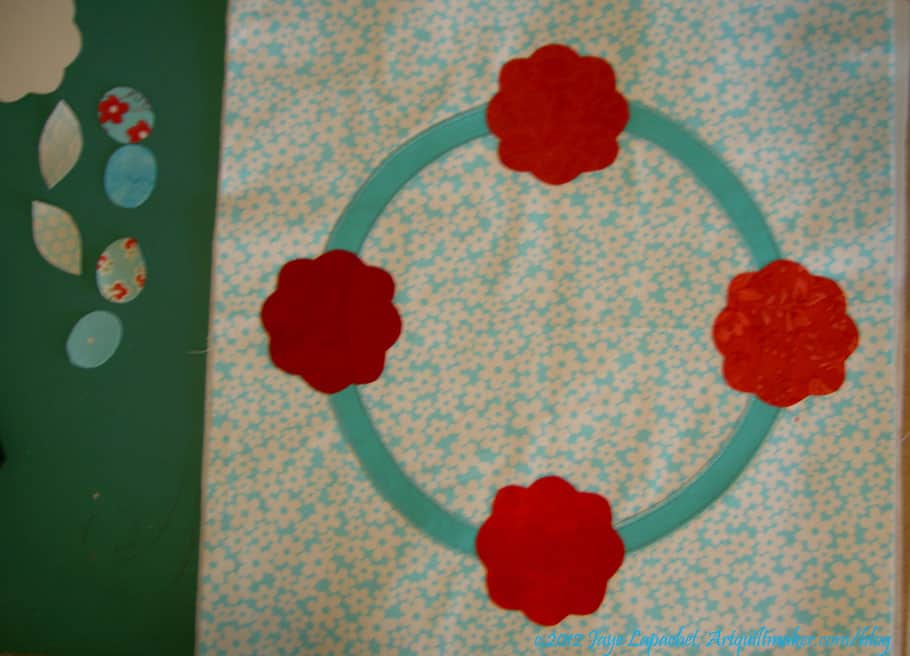
I thought about making the leaves green to make them more realistic, but decided I was still of a mind to use a variety of turquoises and aquas and keep my quilt’s color scheme of aqua/turquoise with red consistent. I found more leaf fabrics in my scrap basket. It is important, with my limited color scheme, to make sure the viewer can see the individual leaves. For that, I will need to have enough contrast between the various aquas and turquoises. Remember, when choosing your fabrics, to make visual decisions visually. Put your potential fabrics on the background and step back to look at them. From my test piece (right) you can see that there are a variety of tones of aqua and turquoise. Some of them blend a bit into the background. I want movement and interest.
Cover fusible with fabric
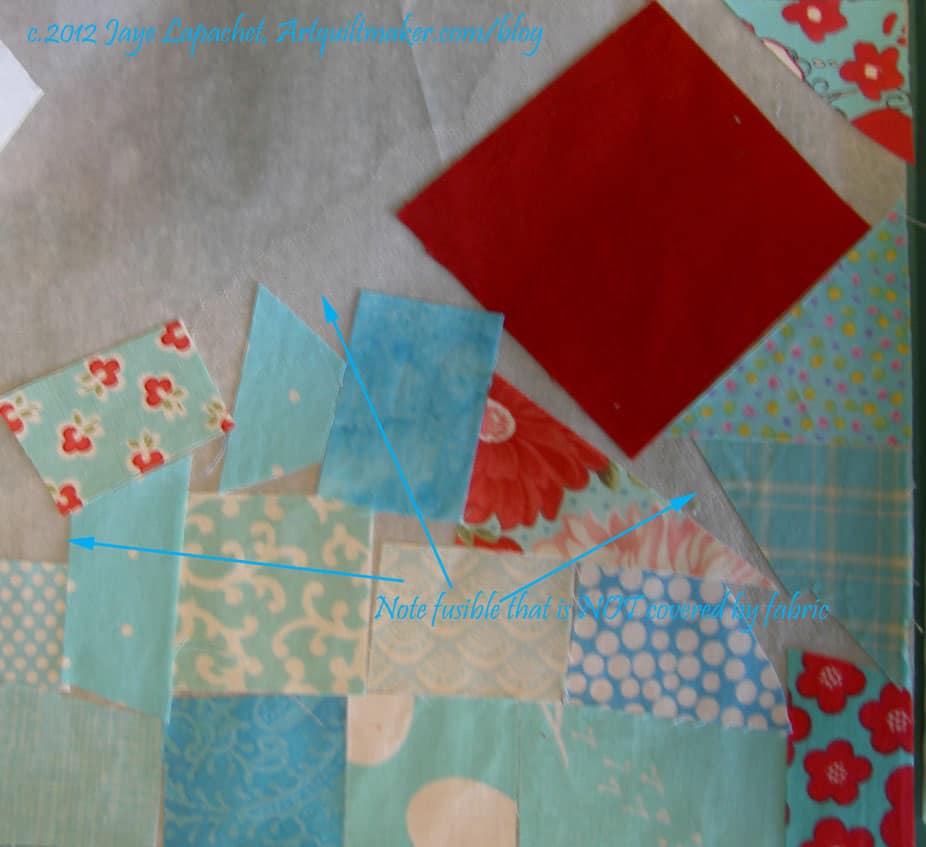
Once you have chosen all of your fabrics press the wrong sides, cheek to jowl, to one side of the fusible.
You are not going to be able to cover every inch of the fusible, which is why you have a pressing cloth or applique’ pressing sheet. If you press directly, the fusible that is not covered by fabric will end up on the bottom of your iron.
Cover this piece with a press cloth and press the fusible to the fabric following the directions on your fusible’s packaging.
Trace leaves & Flowers
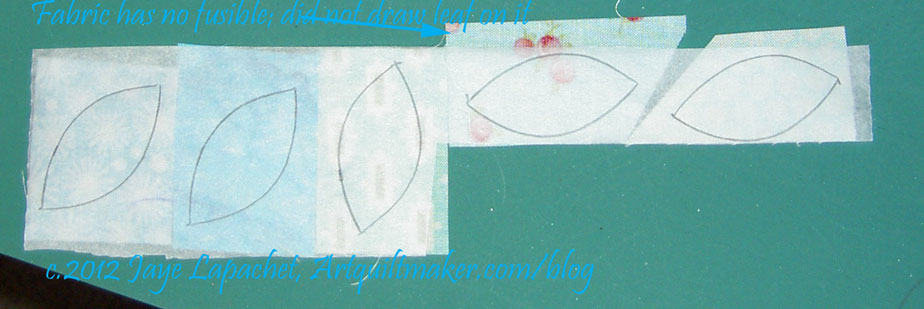
Make all of your leaves and flowers. Flip the fusible so that paper side is up. You will be able to see your different fabrics through the paper. Place a template face DOWN on the appropriate fabric and trace with a writing implement. I use a Sewline pencil, but you can also use a pen, regular pencil or anything. I wouldn’t use a Sharpie even though I don’t think the paper will allow the marking to bleed through to the fabric.
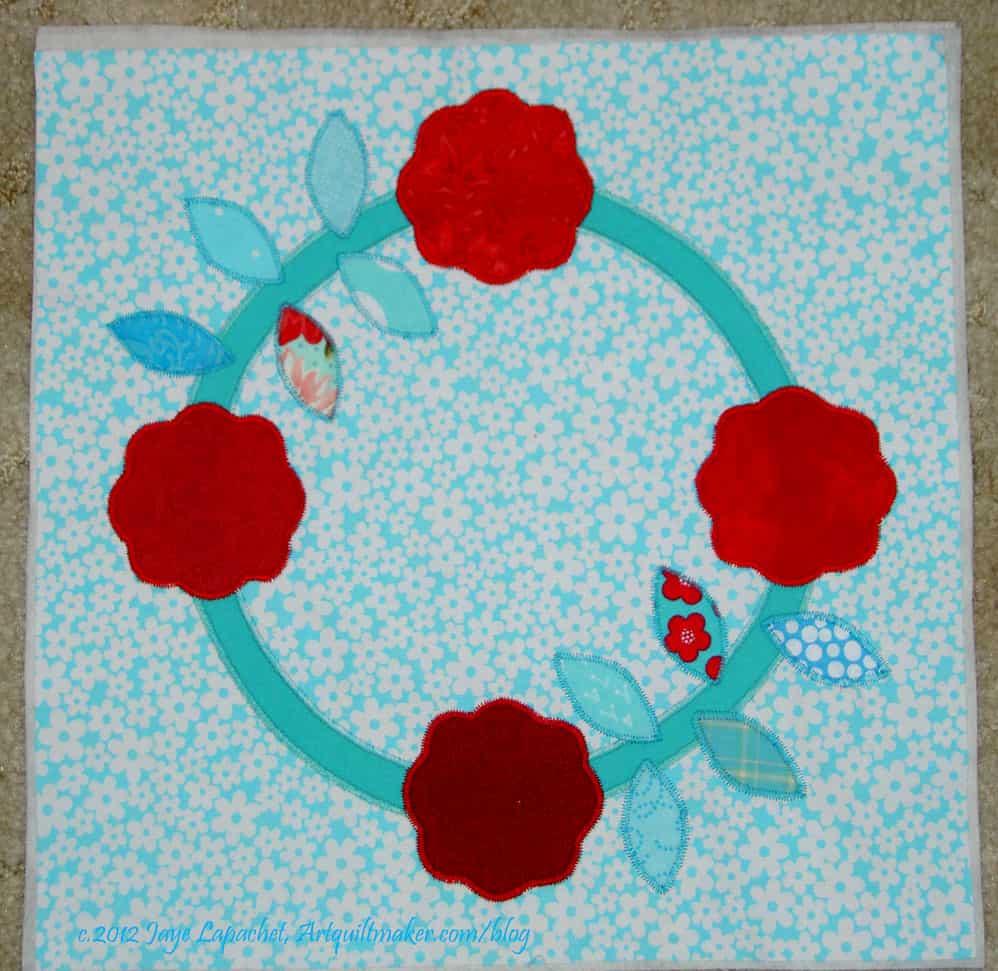
Once you have traced all pieces**, cut them out right inside the drawn line. You should have 20 leaves, 4 flowers and 4 center flowers.
Take all of your pieces and arrange them the pleasing way. Arrange them into the position you want them to end up once they are fused. You are doing this to look at the effect. Once you are pleased with the arrangement, take a photo or sketch out placement.
Fuse & Stitch Flowers
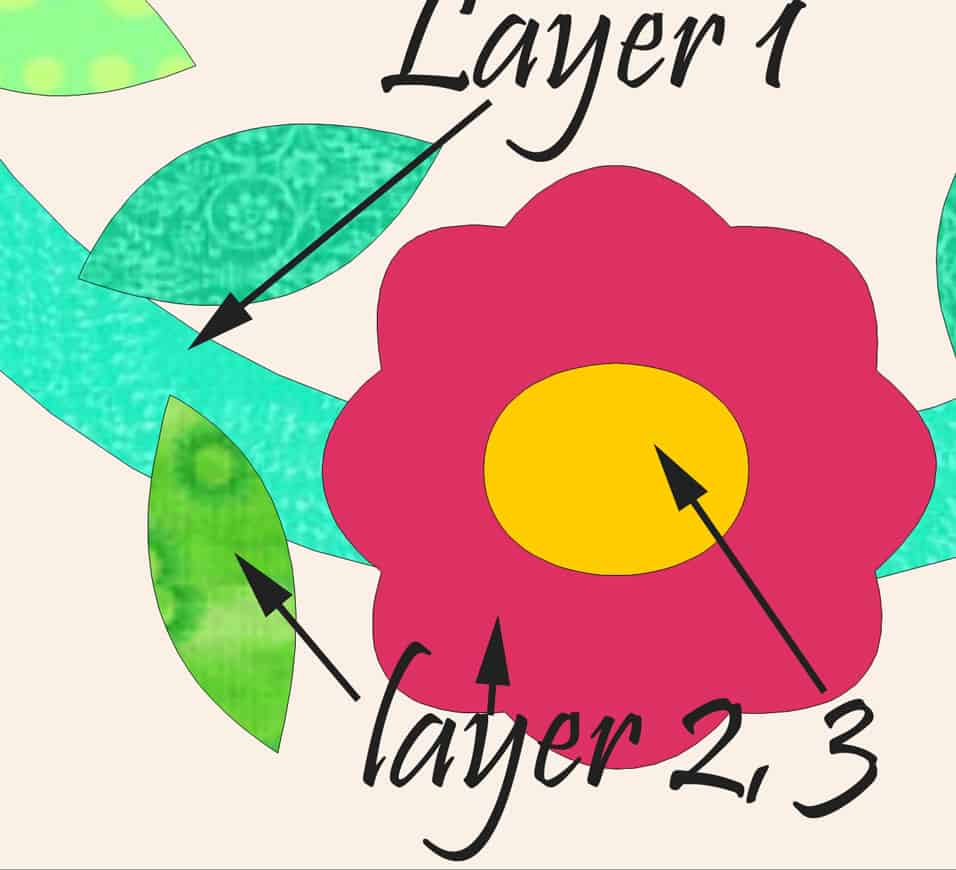
You will need to stitch the flowers first, then the leaves and finally the flower centers. The flowers and leaves are on the same layer, so you can stitch them in any order. Anything that will be covered by another piece will need to be stitched before you fuse the covering piece.
Place the flowers on the ring using the press marks you used to place the ring on the background (or fold the background in quarters and finger press again). Place them symmetrically along the ring, or in a pleasing way to your eye.
Fuse them into place and get ready to stitch. You can also reference the machine applique’ tutorial for more information. Again, pay attention to where the layers of the design are placed. If there are leaves that you want to place under the wreath, you will need to satin stitch them before you fuse the wreath down entirely. For the flowers, you will need to satin stitch down any parts of the design that will be covered by another piece of fused fabric, such as the centers. The design will look better if you satin stitch a layer and then fuse the next piece down.
Place the interfacing under the background. You could use a machine basting stitch to stitch the interfacing temporarily to the background, but pinning works fine, too. You will need to zig zag with the interfacing under the background.
Stitching flowers
Satin stitch all the other pieces down using the thread you chose. When you stitch, the middle of the stitch will cover the outside raw edge of each piece. I line up the red arrow on my foot (see photo) with the sharp edge of that raw edge. The pieces you will satin stitch have curves, thus you will need to manipulate the stitch so it is smooth. This means that you will need to stitch with needle down.
Stop stitching to create smooth curves
Stop with the needle down on the outside of the curve for the leaves and flower petals. For the inside point between the flower petals stop above that point on the inside. If you do not have a machine that automatically stops with the needle down, then you can use the hand wheel to move the needle into the downward position when you stop. Do this carefully without moving the fabric. Once the needle is down you will need to assess the way to turn the fabric. Always turn the fabric very slightly to ensure a smooth curve. You may only need to take one stitch before adjusting the fabric again in order to get around the curve smoothly. For the outside curves, generally, you need to turn the fabric to the left to make a smooth curve. (Updated 10/30/2012: My engineer SIL says: You turn it clockwise for outside curves and counter clockwise for inside curves.) The stitching will be closer together on the inside of the shape and more open on the outside of the shape when you move in this direction. For the inside point of the flower, between the petals, you will need to take a slight adjustment of the background to the right. For the pointy ends of the leaves, stop the needle on the outside of the leaf near the point and adjust the fabric to the right very, very slightly. Take one stitch, stop on the outside of the point again. Adjust very slightly to the right. Your goal should be to get the needle into the same hole on the inside of the leaf until the arrow or line on your machine’s foot is in line with the raw edge of the other side of the leaf. When you move the fabric always keep the needle down. Before starting, take a few of the shapes, e.g. a leaf and a flower, make some test pieces and do a test on junk fabric so you get the feel of the procedure. This is not something you should work on when you are pressed for time.
Arrange leaves
Once you are finished with the flowers, change your thread and adjust the width and density of your stitch, if desired.
Arrange the leaves in a pleasing manner. I placed 5 at a time on the background and stitched them down.
Stitch leaves
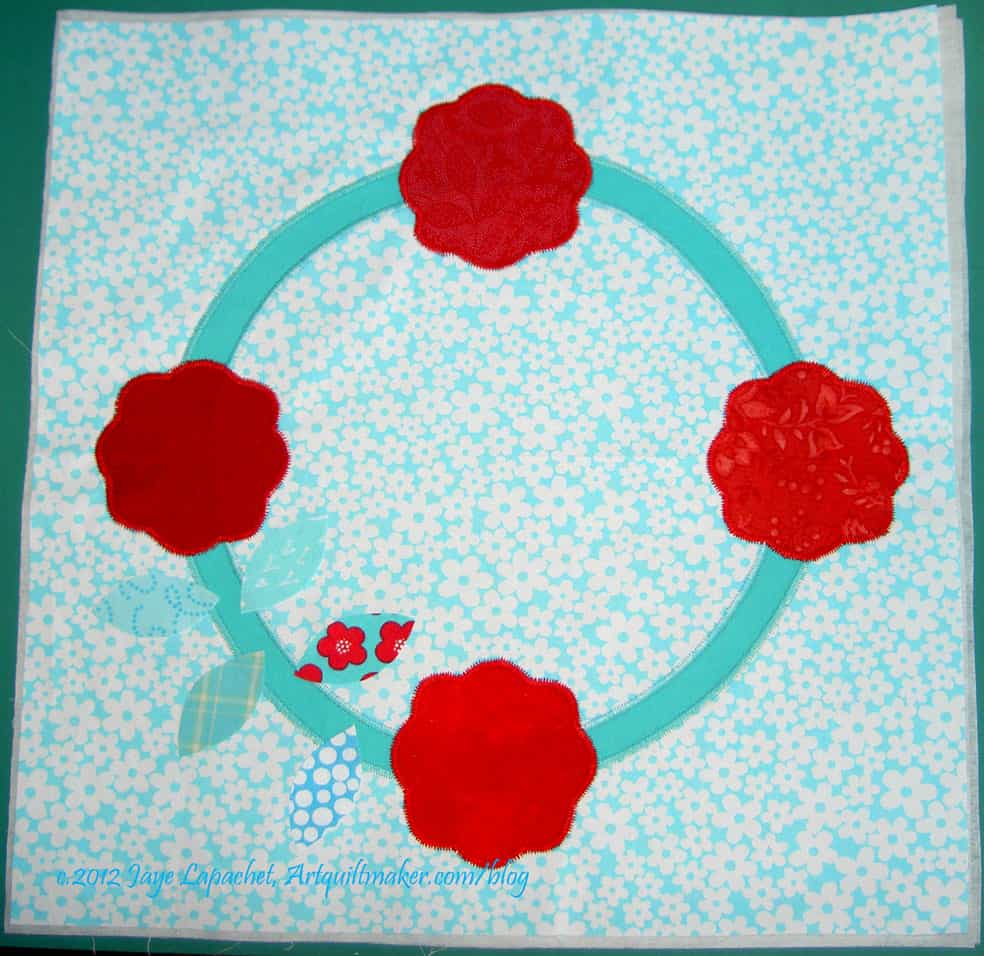
Arrange and stitch all of the leaves. My photo shows only 10 sewn leaves.
Place the centers on the flowers and stitch them down. Follow all the directions above for tying off and moving the needle to create a smooth curve.
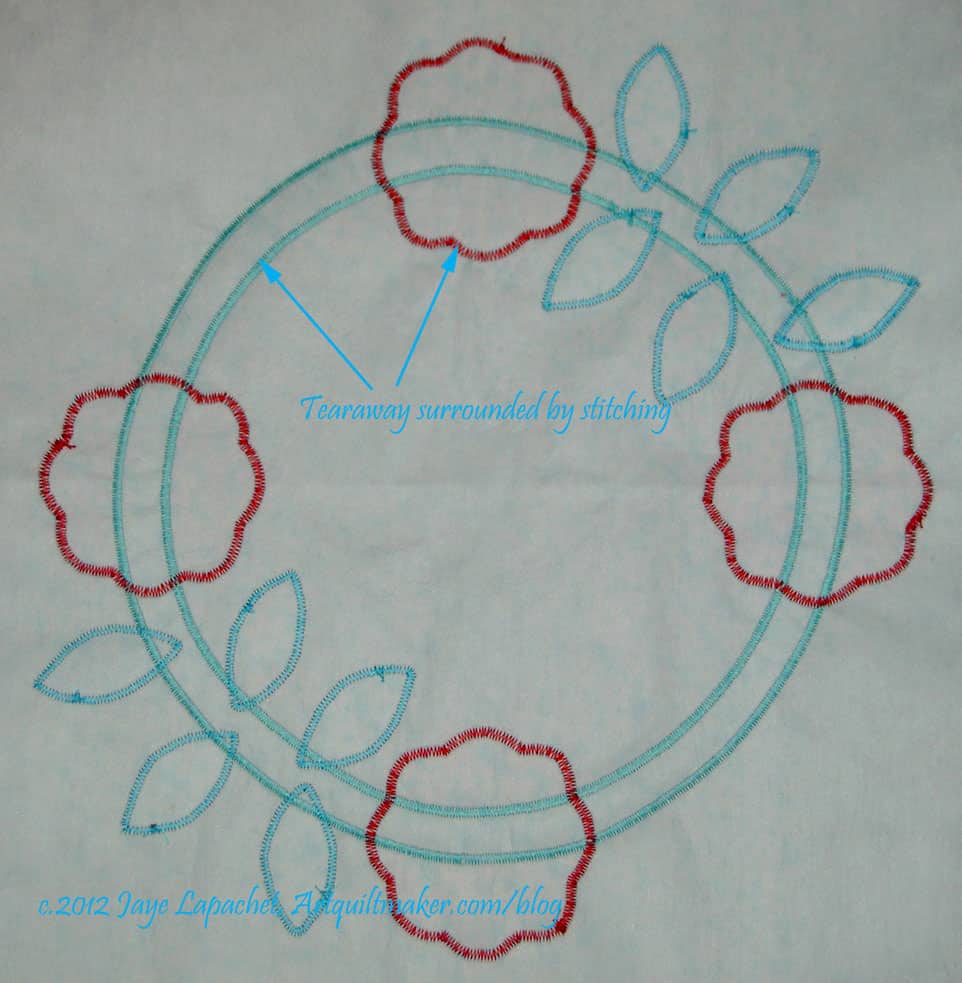
Back of block
Once you have stitched all the pieces, rip off the tearaway. I use a seam ripper to get the ripping started on pieces that are surrounded by stitching.
Once you are finished with the entire stitching and tearaway ripping, trim the background down to 12.5″
**Nota bene: These pieces have no right direction. You can trace them any way and apply them anyway and they will look fine. Pay attention if you are cutting out letters or another motif that has a special direction. Put the right side down on the paper backed fusible and trace the motif backwards.
We are making the Flower Wreath block. To find out how to make templates, including the ring see Part 1.
Flower Wreath
Choose your fabrics. You will need fabric for the flowers (1-4 fabrics), leaves (1-20 fabrics) and the wreath (1 fabric). The leaves can be the traditional green or you can use something else. If you use one color, you might want to mix up the prints to increase interest. You can also use different colors. Make the block your own.
I am going to try and use a variety of turquoises and aquas to keep my color scheme in the aqua/turquoise with red range. I have a few of the leaf fabrics picked out from my scrap basket, but need to find more. It is important, with my limited color scheme to make sure the viewer can see the individual leaves.
Cut piece large enough for ring
The ring is the biggest pain to deal with so I deal with it first before I even really think much about fabrics for the other parts. I decided to use one of the Pat Bravo Pure Elements solids in the turquoise range, but more on the green side. I haven’t used it in this quilt before. I picked it to highlight the leaves a little more.
Cover fabric with fusible
Now you need to make sure that your fusible will cover your fabric.
I used a package of Steam-a-Seam 2 Lite, but there are many fusibles that will work just fine for this project. Use what you know how to use or what you have on hand.
Tear the paper carefully off of one side of the fusible (or follow directions for your fusible) and stick it to the fabric, smoothing it carefully so there are no puckers or bubbles. The fusible is sticky so you can stick to the fabric and reposition it until you are happy.
Back of fusible backed fabric
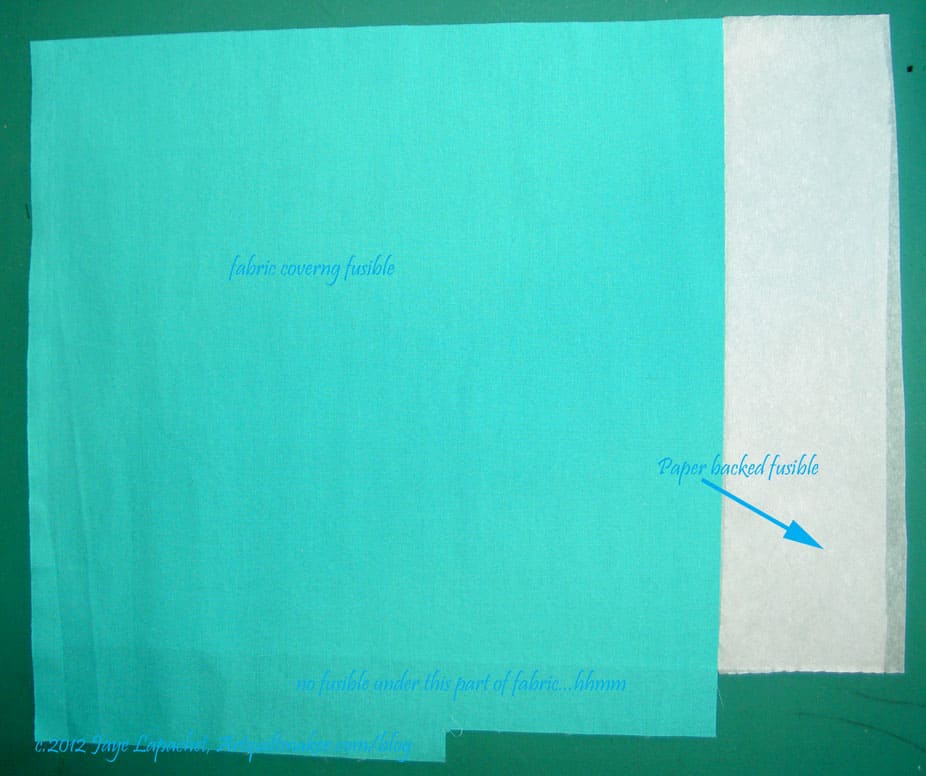
Since the pieces I had were 8.5″x11″, I needed to cover an extra piece (bottom of the photo above) that was wider than the 8.5″ width of the fusible. I cut a piece from the fusible (white part in photo above) and re-positioned it to cover the part of the fabric I need for the size of the template.
Once you are happy, fuse the 2 sided fusible (should have the paper left on one side) to your ring fabric. Follow the directions on the package or website. You may want to cover your ironing board and the piece with junk fabric or an applique’ pressing sheet to keep your iron and ironing surface clean.
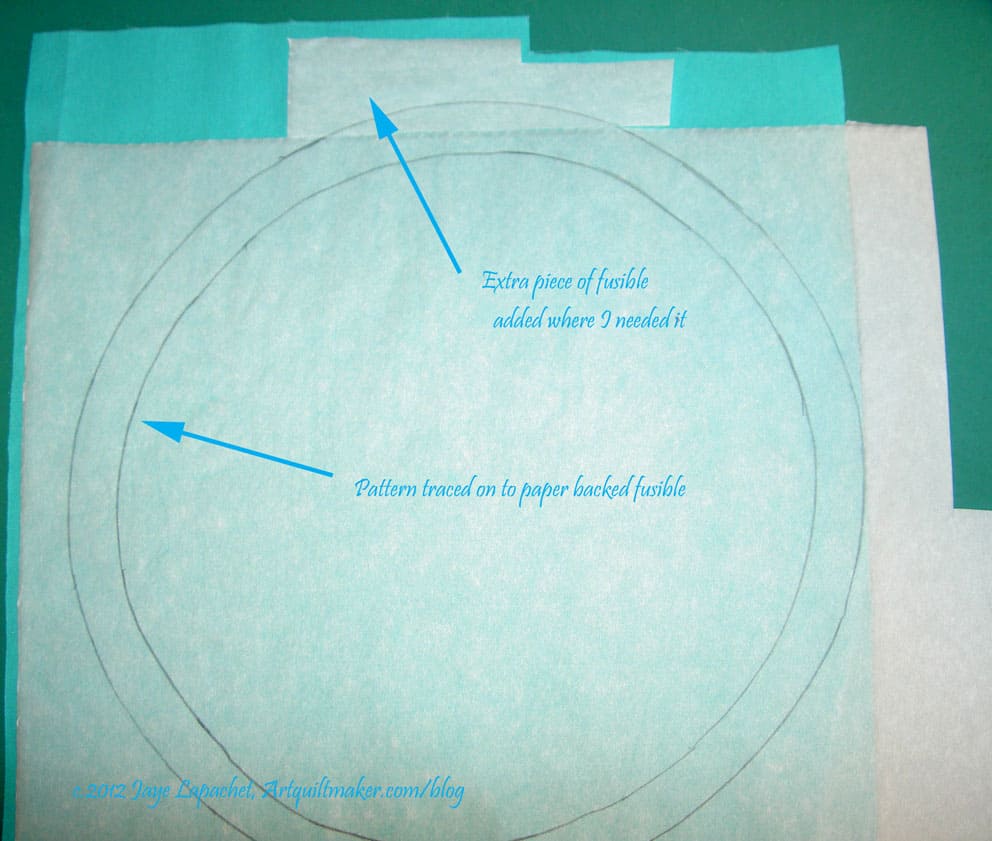
Turn your fusible backed fabric so that the paper left on the fabric is face up, as in the photo above. Place your ring template face down on the paper and trace around it with a pencil.
Ring cut out
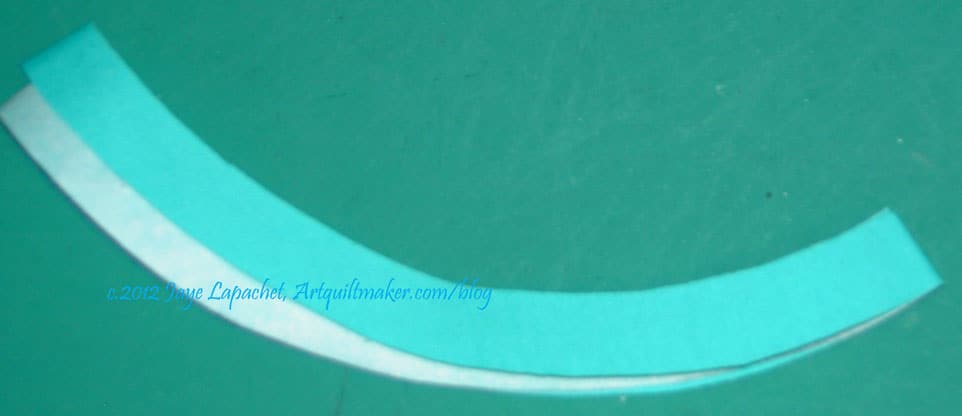
Cut out the ring carefully on the line. I used an X-acto knife to start the center. I did use a pair of fabric scissors, but not my Gingher scissors. It is kind of hard to know what to do, because you are cutting both fabric and paper and you need a nice sharp edge. I use a pair of my mid-range scissors and hope for the best. They still seem sharp even after a bit of this type of cutting.
Fold the ring into quarters and finger press lightly. Again you will be lining up the folds to center the ring.
Retrieve your background. Fold the background into quarters and finger press, so you can see the folds.
Line up ring on background
Remove paper from the ring.
Line up the folds of the ring on the folds of the background. If they are all in alignment, there should be a ring fold snuggled with a background fold evenly. If you want to check, measure from the edge to the ring. You do need an absolutely square block for this to work.
Press the ring onto the background so it sticks.
Carefully bring background with the ring stuck to it to the iron. Check to see that your ring is still in place. According to your fusible directions, press the ring into place.
Your ring should now be firmly ironed on to the center of the background.
Leave this piece on the ironing board temporarily.
Get the tearaway you purchased (or had) and cut two pieces of tearaway stabilizer a little bit larger than your background. Place your background on top of the tearaway and pin it to the background. This will provide stability and prevent the piece from puckering when you zig zag stitch the pieces.
You are now ready to machine applique’ your first part of the block. See part 3 for machine stitching the block.
Frances and I are back in action with the Sampler class. I am excited, but nervous because I haven’t done this in awhile. The next class is about fusible machine applique’.
Flower Wreath
Supply List:
Notebook for notes
Pen to take notes 😉
Mechanical Pencil
Fabric (at least 4 different, preferably more greens to create variety in the leaves; scraps work well)
Fabric Scissors
Paper scissors
Small ruler
Glue stick
Template plastic
Dinner plate or compass
Fusible web, such as Misty Fuse or Steam-a-Seam 2 or Steam-a-Seam Lite
Applique’ pressing sheet
Tear away stabilizer (the size of your background)
Iron
Ironing surface
3″x5″ piece of fabric backed with 2 layers of tearaway stabilizer
Cut a piece of fabric for the background .5″ to 1″ bigger than the finished size of the block. If you have a regular background fabric, use that, if not use a coordinating fabric. I took a look at my current blocks to help me decide what background I wanted to choose. This is a coordinated scrappy quilt, but I also wanted to find a background that would work well with the applique pieces that I was planning to put on top of it.
After cutting out a background, you need to put it aside for the time being. You will need it after you make the templates and the ring.
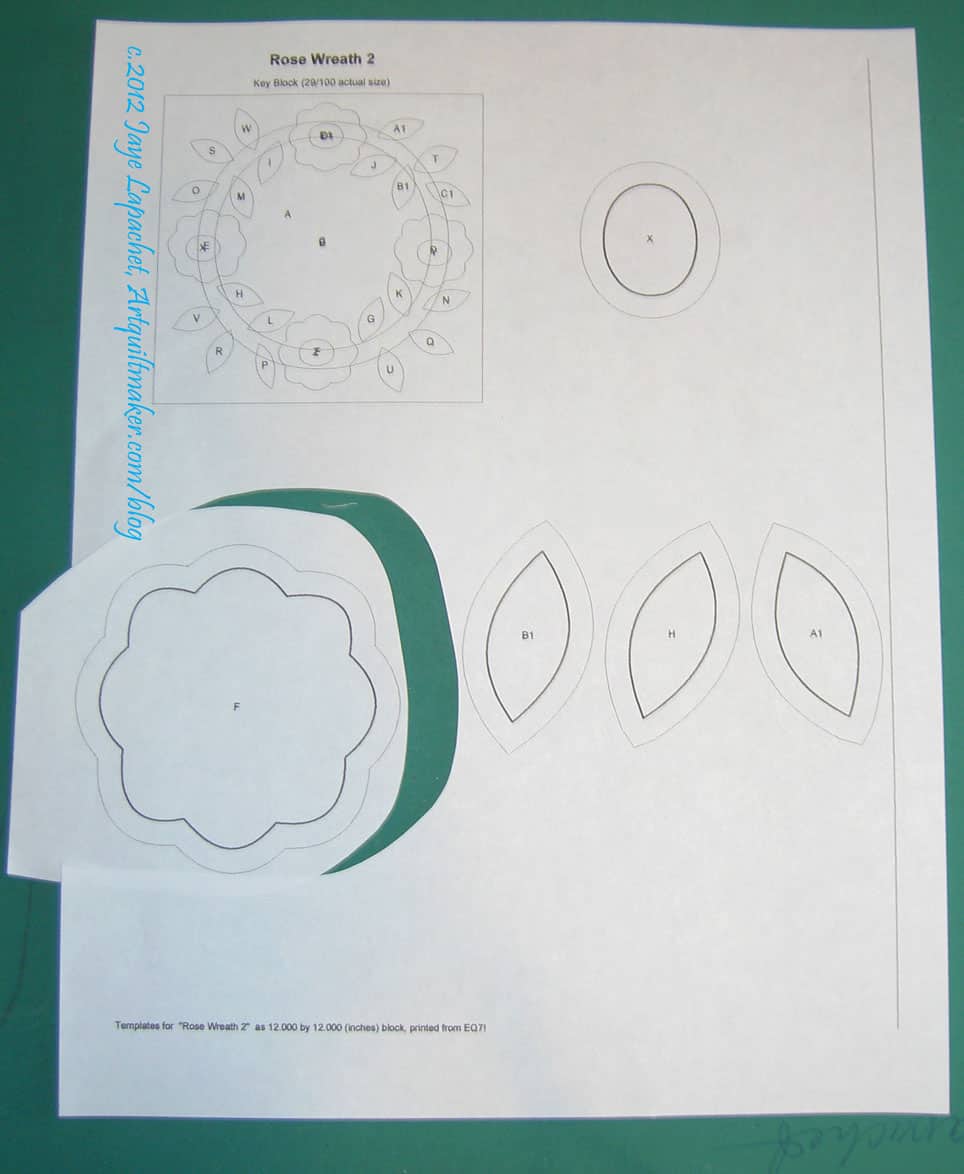
Rough cut pattern out for templates
Cut out all the templates from the paper. Leave a little of the paper around the edges. Feel free to adjust the design of the flowers or leaves, if you want the shapes to be a little different.
All patterns rough cut
In the photo above, you can see all of them templates rough cut out, except the circles. The circles print from EQ7 on two sheets of paper. You will need to rough cut the two pieces for each circle and then tape them together. In order to tape the pieces together, hold each piece for one circle in a hand up to the light and match them up you. Before you hold them up, have the tape ready just to tack the pieces together. You can use a light box for this procedure also.
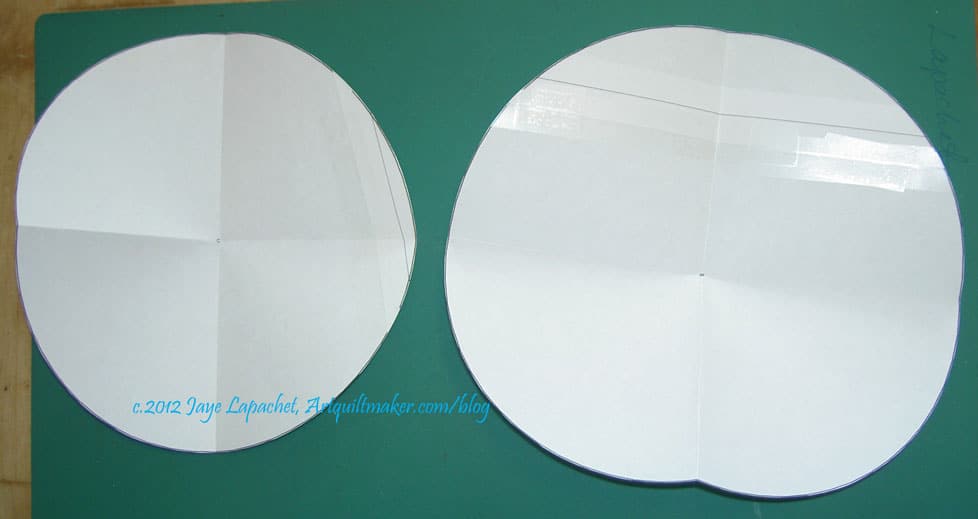
Fold circles in quarters
Fold circles in quarters to make a line down the centers. This will help you line them up to make the ring for the wreath.
I never did this before and had to figure it out, but it works pretty well.
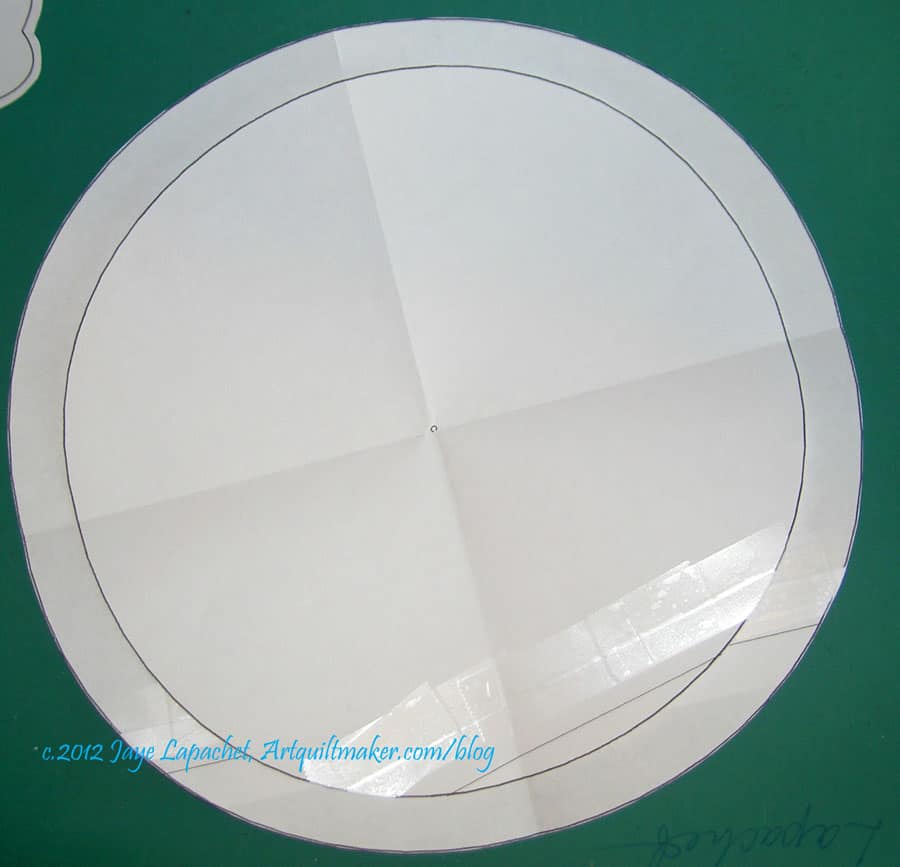
Layer Circles
Using the folds, layer the circles together so you can see the black line of the upper circle. Draw a line around the smaller circle using the smaller circle as a template. You will be drawing on the larger circle. Use a soft implement (pencil or roller ball pen) that doesn’t skip to draw the circle. Once you have drawn the circle, you can put the smaller circle away with your other templates. I use a zipper bag for all of the pieces and parts.
Check width
Fold up the larger circle. Check the width of the ring of the wreath using a small ruler to make sure it is even. Once you are happy with the line. Cut along the line without opening the circle.
Complete Ring Pattern
Once you have cut out the ring, open up the ring.
Now you are ready to make the templates. Grab all of your patterns, your template plastic and your glue stick.
Glue the paper templates to the template plastic.
No template plastic on folds
The only tricky part is for the ring. I avoid the folds in the pattern and only put the template plastic on the parts of the ring where the fold isn’t. Why? Because I want to be able to fold this piece and put it in a zipper bag. Also, by adding the template plastic in quarters you save template plastic and you can use smaller pieces. Finally, you don’t end up with a circle of leftover template plastic.
Trim the templates to the line on the pattern.
Front & back of templates
Depending on the kind of template plastic you have, your templates will look something like the photo above.
Part 2 will talk about choosing fabrics etc.
You can find more detail about machine appliqueing directional motifs, such as letters in a separate tutorial.
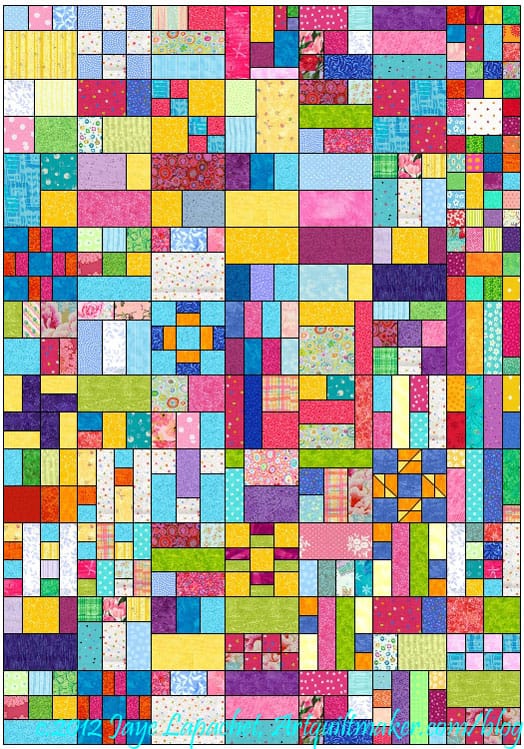
I thought I would make up an example of one way you could put the Block-a-Long blocks together in a sampler format. This layout looks a lot more complicated than it really is. Remember each block is relatively easy.
Of course, there are a multitude of ways you could put together a sampler quilt. I was thinking that these blocks would lend themselves to a scrap quilt. As you get scraps large enough to make one of the blocks, make one, then eventually you would have enough for a quilt. It would be a nice memory of projects you did in a year or over a period of time.
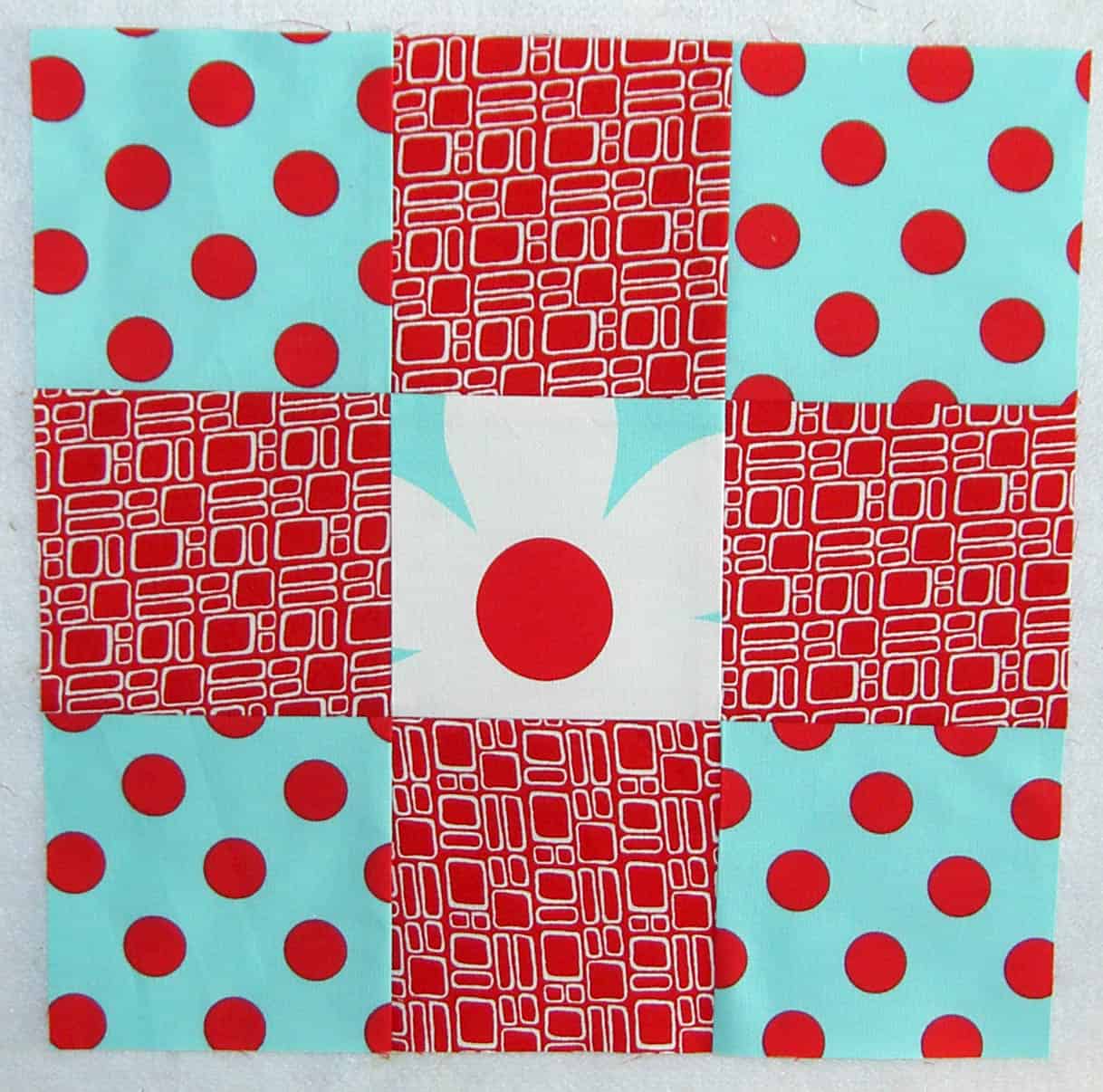
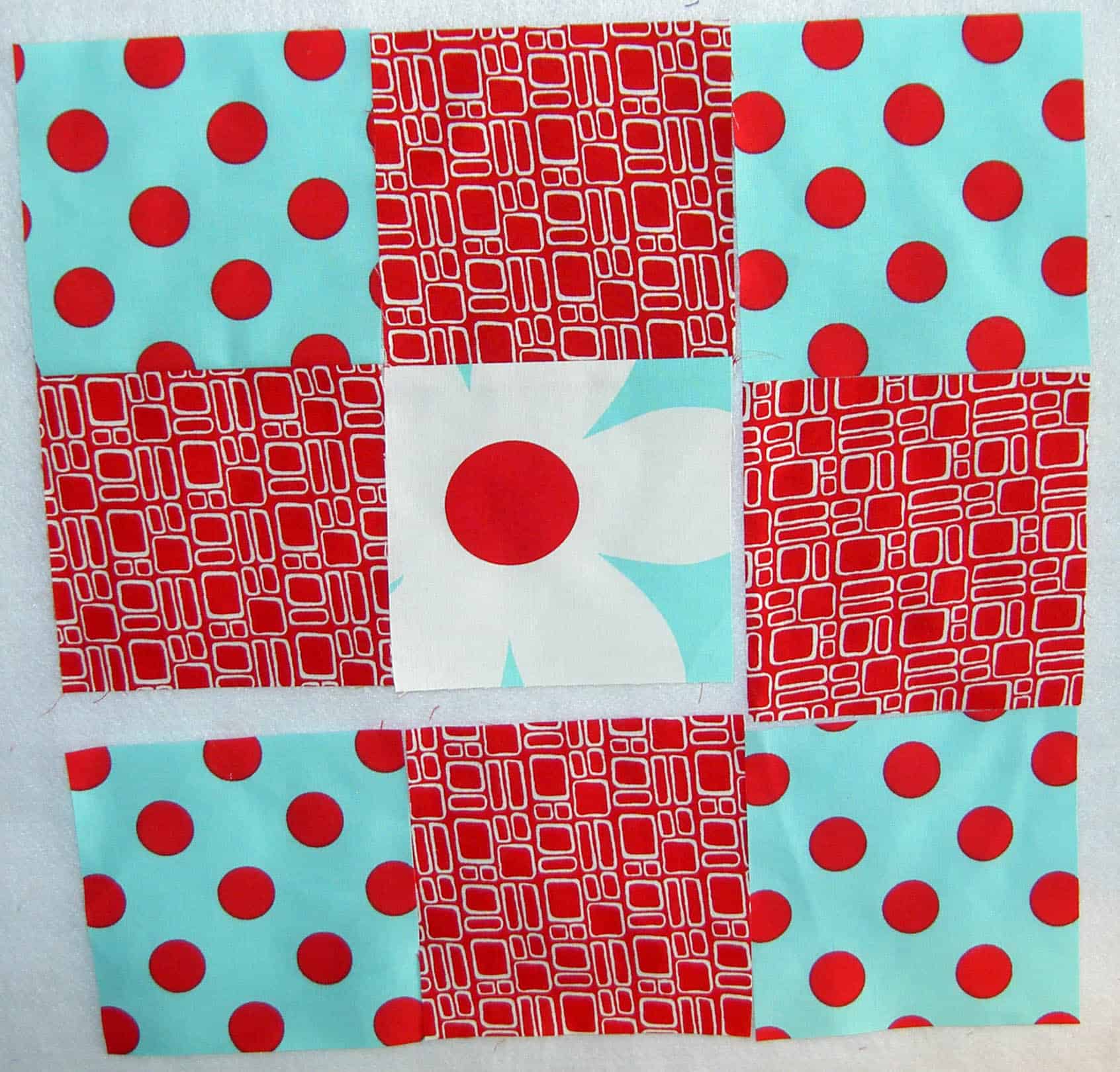
Today we are making a Nine Patch. This is usually the first block I teach when I teach beginning quiltmakers in a Sampler Class context. You will need:
Supply list:
rotary cutter
rotary cutting ruler large enough to cut 4.5″ squares
rotary cutting ruler
fabric (2-3 different)
Optional: Mary Ellen’s Best Press (or similar)
Optional: pins
sharp trimmers or scissors
thread for piecing
sewing machine
Iron
ironing surface
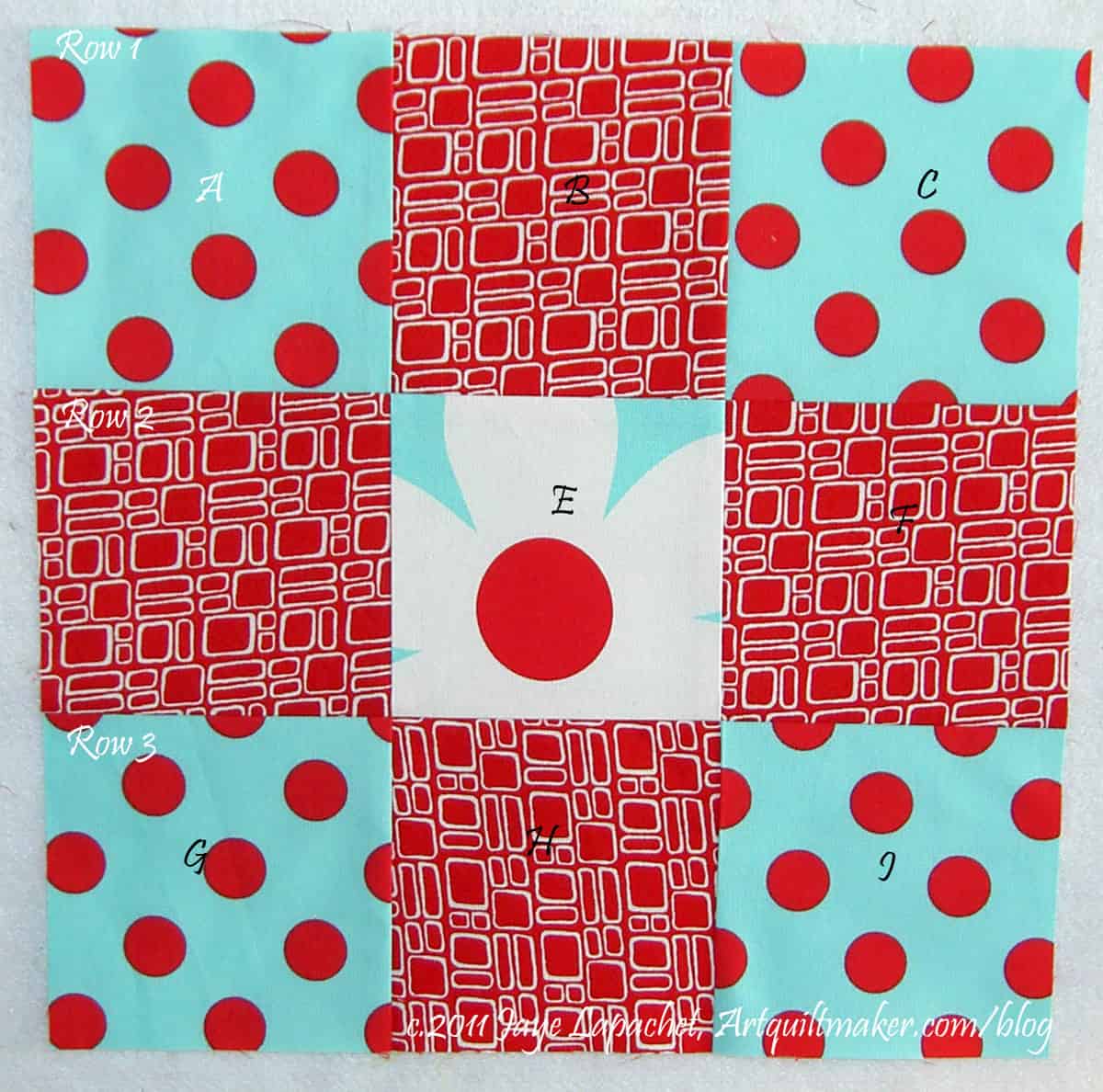
Key Block
I have marked the rows and patch with letters and numbers so I can more easily refer to them for you.
Nine Patch: Center
Step 1: Cut fabric. You need 9 squares 4.5″x4.5″ each. I like to use a different fabric in the center of the nine patch block. It adds interest, especially to a 12″ finished size.
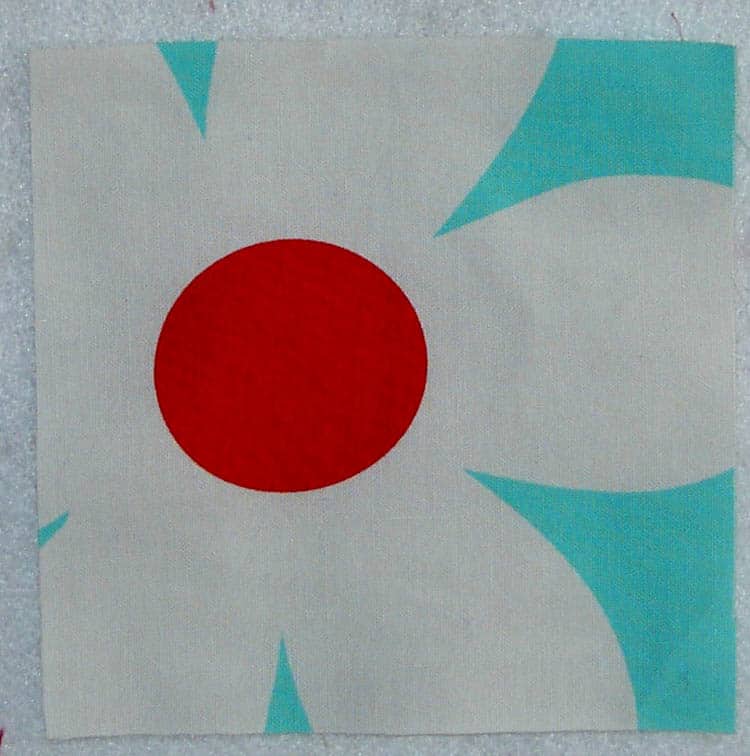
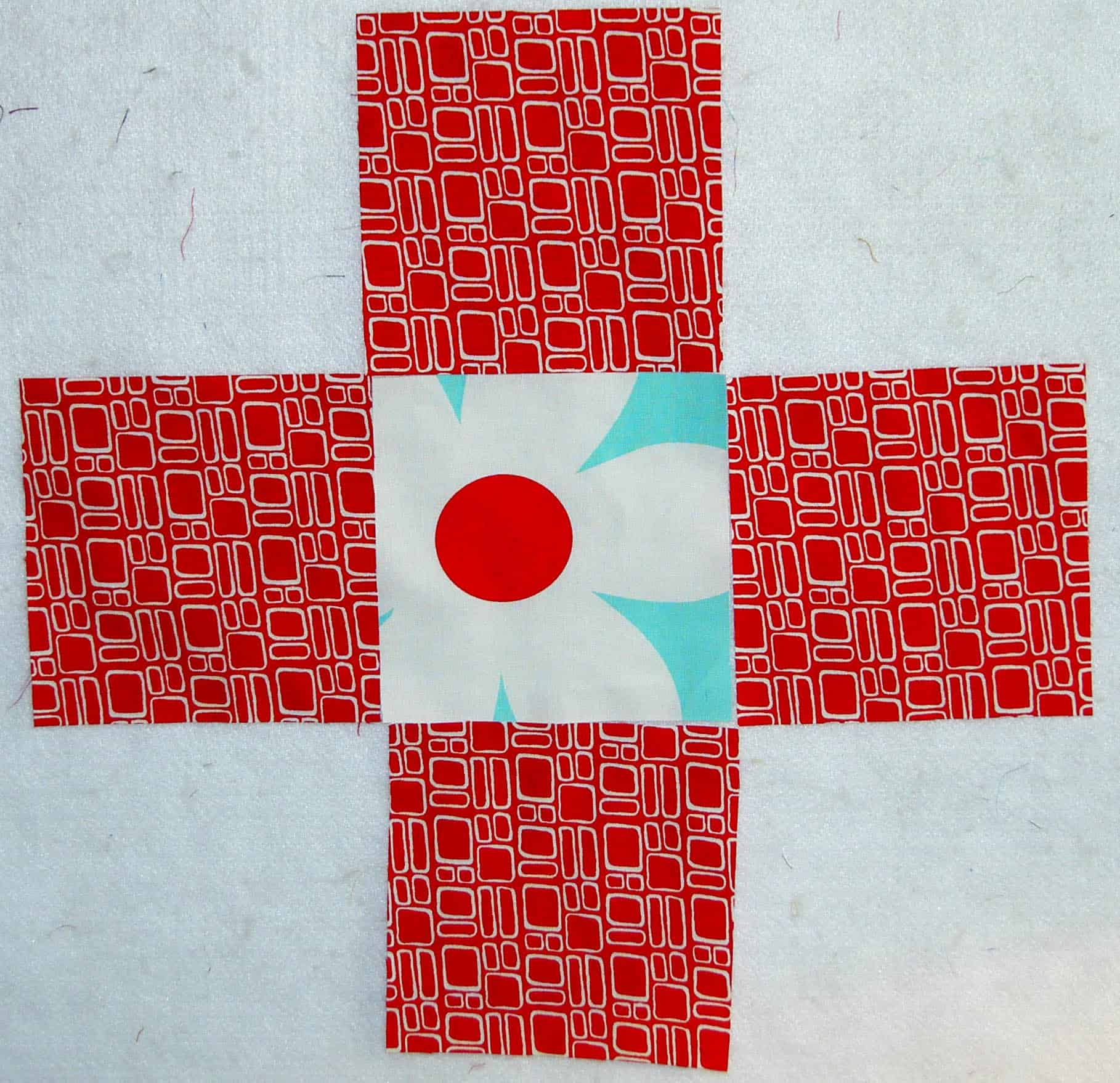
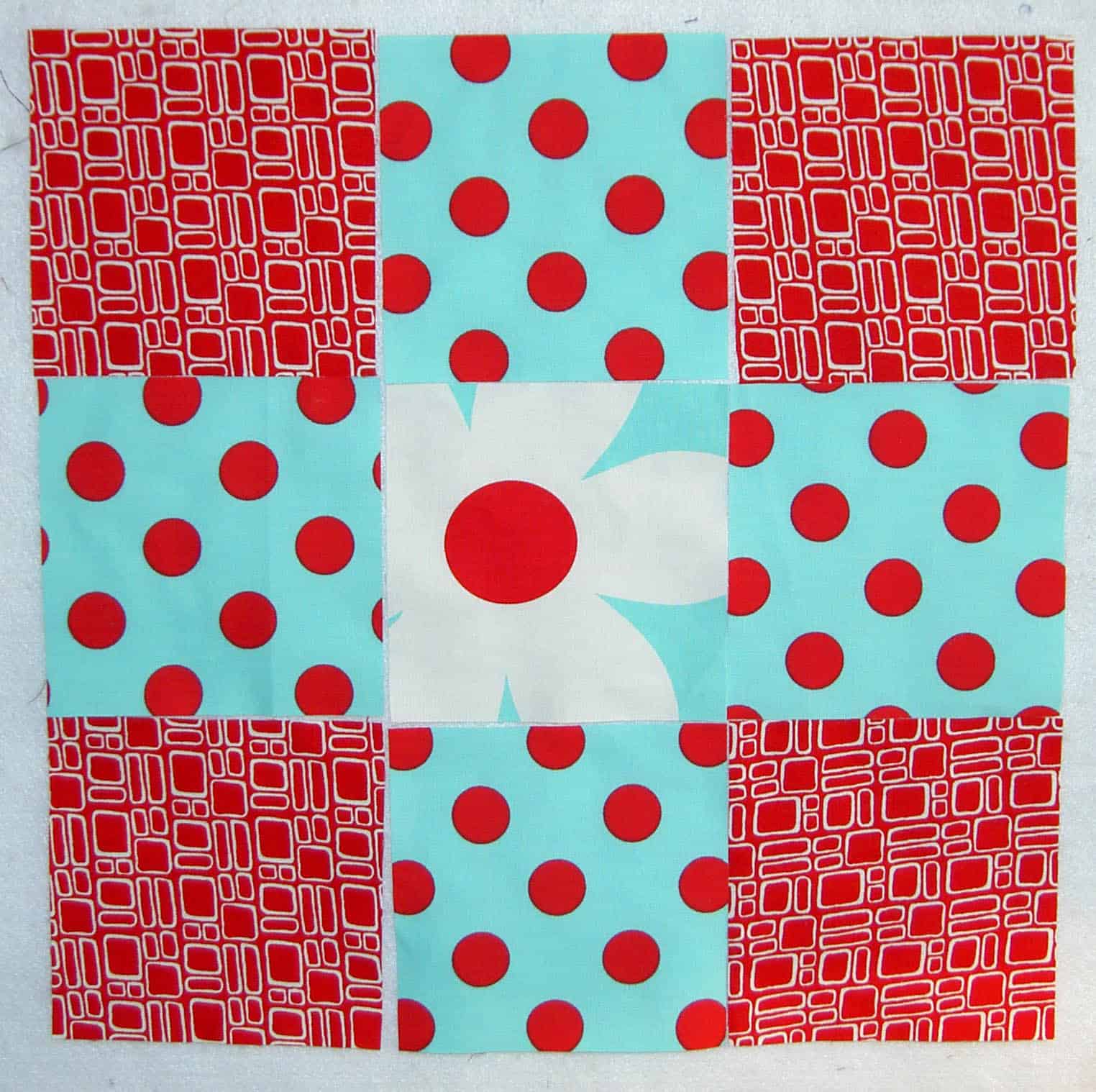
Adding RedsAdding Blues
This block is actually the first block I teach in the sampler series. This particular Nine patch will be in the quilt I am making with Frances. You have seen it in different photos on the blog.
Move Fabrics Around
Step 2 (above): After you cut the squares, move them around to make sure you have the placement of the fabrics in the right place.
Start Sewing
Step 3: Prepare to start sewing.
start, usually in the upper left hand corner 9row 1 patch A and row 2 patch D), everything else being equal. In general, if I don’t start in the upper left hand corner for other blocks, I start by sewing smaller units/patches into larger patches.
Sew patches together in groups of 2
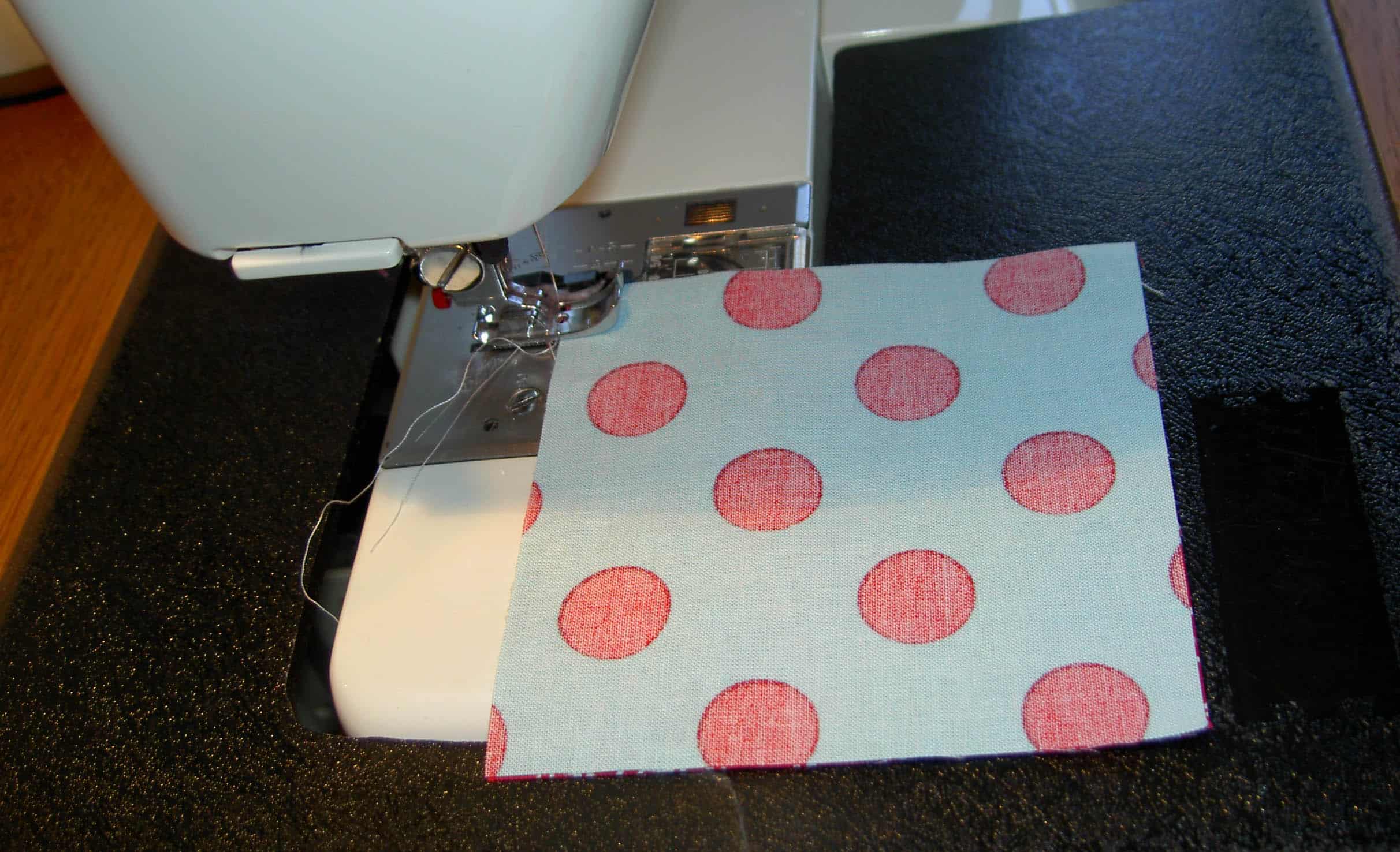
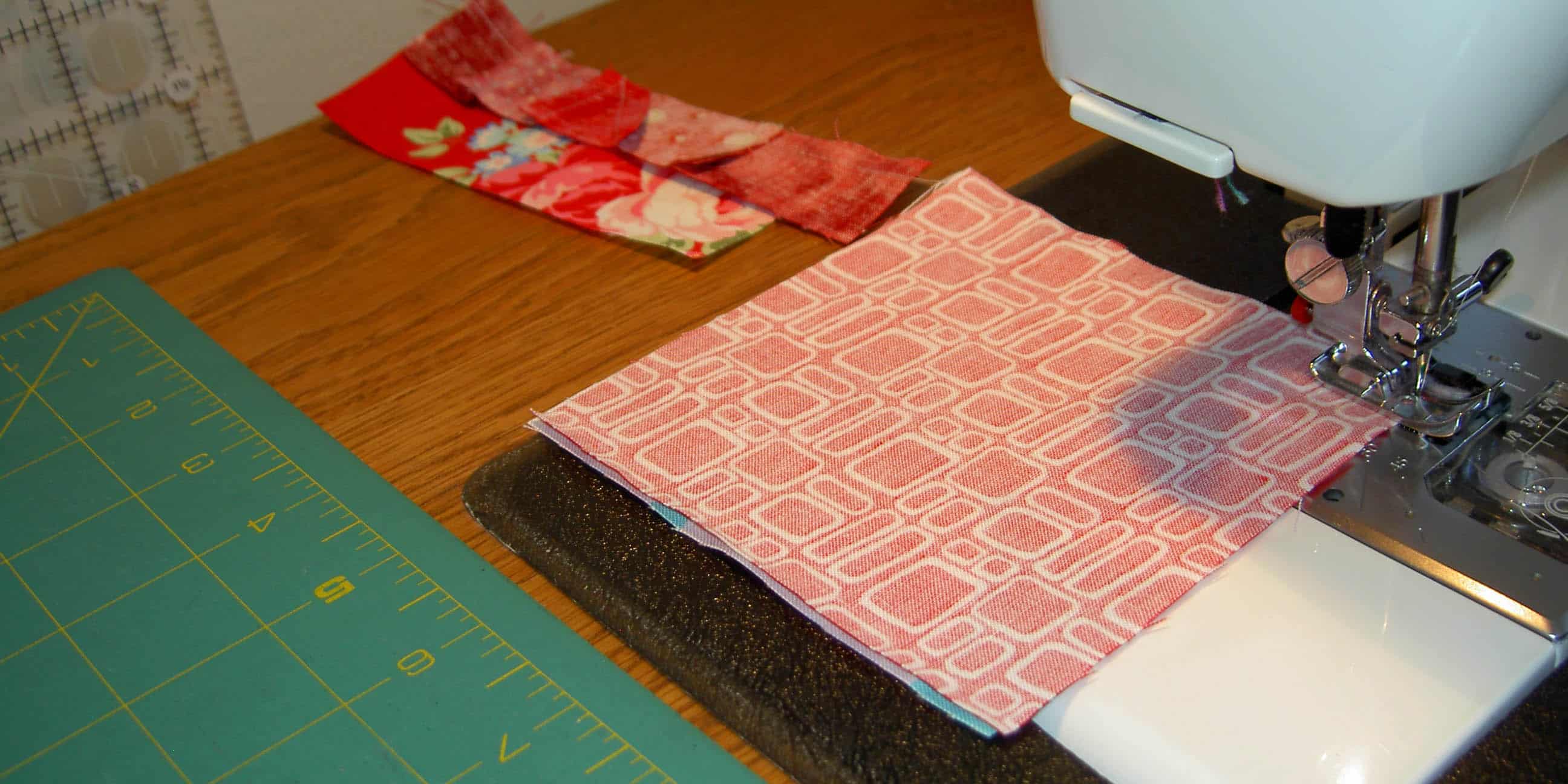
Step 4: Place fabrics right sides together and place into machine. I have my quarter inch foot on my machine and I sew 2 patches together to make a unit that will fit into the upper left hand corner of the block.
Sew patches together in groups of 2 (front view)
The edges of the patches are lines up so that the bottom fabric is not showing when I sew. Fabrics are right sides together.
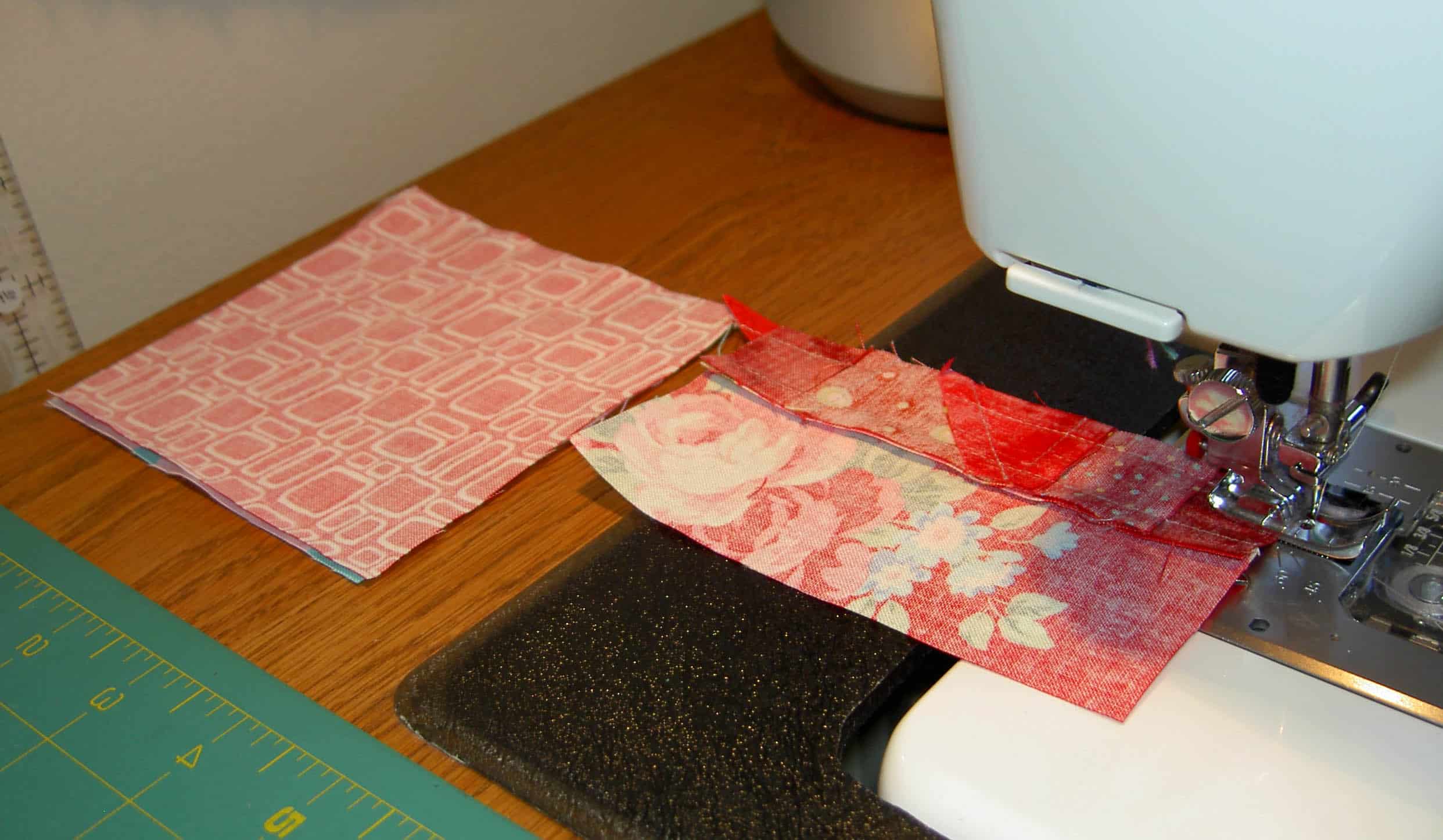
Patches SewnChain Piecing
You can certainly take the sewn patches out of the machine, but this is a good time to talk about chain piecing. I have other bits and pieces handy so that I can keep sewing, so I will put them through the machine after the patches for the block on which I am working. In the above photo, you can see scrap pieces for a journal cover. I find it is much easier to work on sewing scraps together rather than another block. For my journal covers, I sew pieces together any which way. I don’t have to worry about putting the right patch in the right place or not cutting off triangle corners. This method gives my brain space to concentrate on the block at hand.
Once you have done some blocks and know how you work, you can certainly put the next group of pieces for your current block through the machine after the first set. Also, if you feel confident, then go ahead and put the next set through the machine.
Cut off Chain Piecing
Step 5: After you have put your second group of patches, or your scraps, through the machine, cut off the sewn patches apart from your second group of sewn pieces. I usually just put one set of chain piecing through my machine after my set of patches for my current block, especially if I have a lot of fiddly placement. I would rather unsew one set of patchwork if I make a mistake than many.
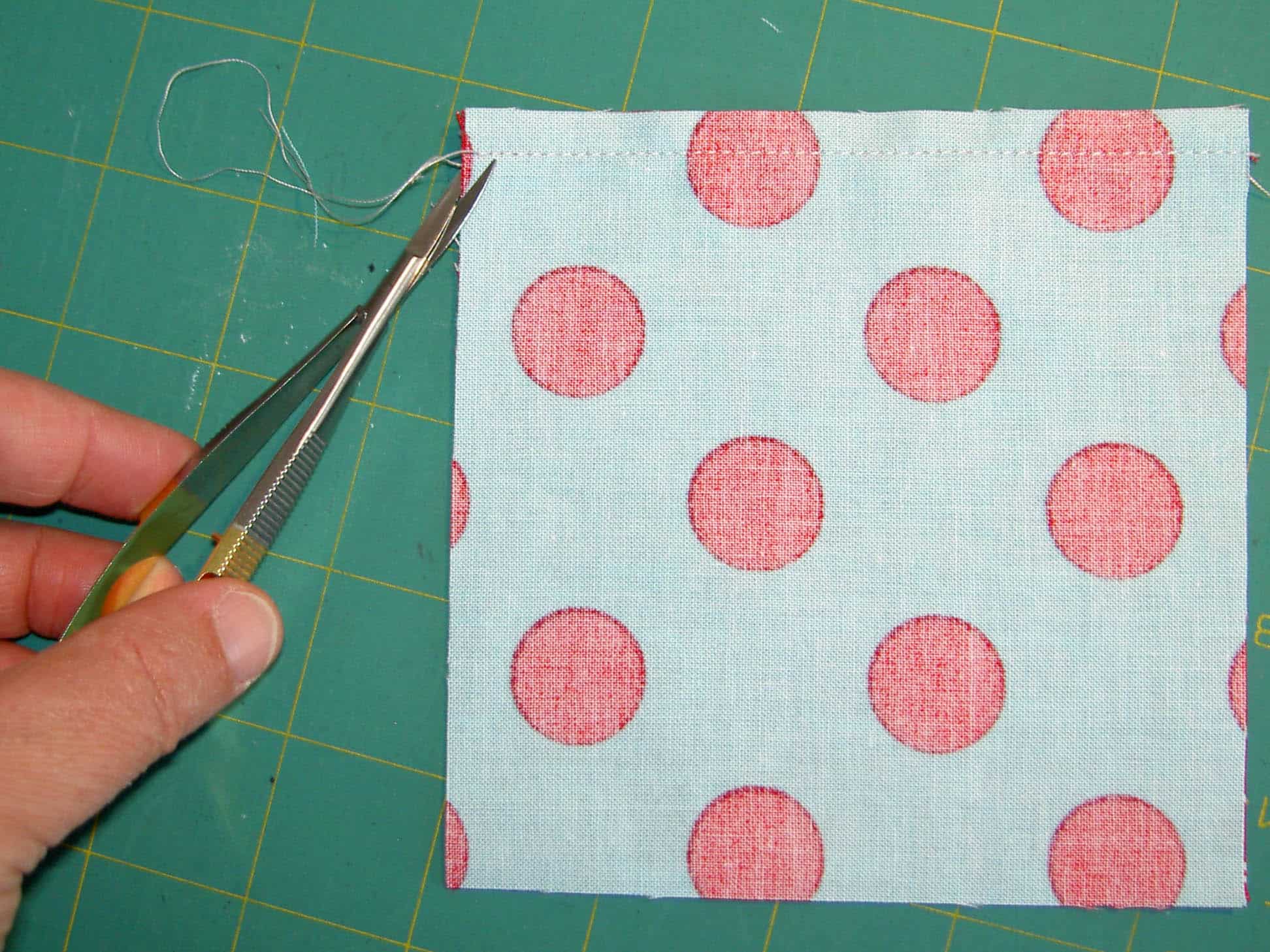
Trim threads
Step 6: Trim threads.
I dislike a bunch of long threads hanging off the back of my finished blocks. The best way I have found to deal with that is to trim as I go along. Trimming threads is a personal preference. I find it makes my blocks look a bit better and there is less of a chance of anything getting caught in my machine as I sew further along in the project.
Set Seams
Step 7: Bring your 2 sewn squares over to your ironing board and press the threads on the seam allowance from the back with the patchwork closed. You have not yet opened your piecing to look at it from the front.
I have no idea if this step really sets the seams. Fons & Porter do this and since there doesn’t seem to be any harm in it, I started to do it as well. If you skip this step, your patchwork will not fall apart.
Open Patches
Step 8: Open your patchwork so that the seam allowance is pointing towards the patch that will be in the very upper left hand corner.
Seam Allowance Points Away
Step 9: Point the seam allowance, referenced above, away from you.
You could also point it to the side (either right or left depending on which is comfortable based on the hand with which you press). Above is the way I do it, which probably depends on the size of my ironing board and habit.
Press
Step 10: Swoop your iron carefully from the patch without the seam allowance to the patch which is laying on top of the seam allowance. In my case I am swooping carefully from the red towards the aqua dot.
Place Sewn Patches on Design Wall
Step 11: Place sewn patches on in their spot on the design wall (or design floor or design table).
Place Sewn Patches on Design Wall (detail)
You will notice that they are quite a bit smaller (1/2″ to be exact) than your other cut pieces. No panicking is necessary. The patches are smaller because you have used 1/2″ of fabric for the seam allowance. You are on track, if your block looks like the two pictures above.
Sew Next Patches
Step 12: Take the center patches (from row 1 patch B and row 2 patch E) and sew them together. Again, you will place your right sides together before you sew.
Use Chain Piecing Techniques
Step 13: Follow steps 3-11 for these patches and the right hand patches (row 1 patch C and row 2 patch F).
Press Opposite
Step 14: Above we pressed towards row 1. After sewing row 1&2, patches B&E, you will press the seam allowance towards row 2. Patch E will be on top of your seam allowance.
Used Another 1/2"
Step 15: Place your pressed patch on the Design Wall. You have used up another 1/2″ of fabric.
After you have sewed all the patches for rows 1&2 together, you will need to sew the patches for row 3.
Step 16: Sew row 3 patch G to patch D. Yes, patch D is already sewn to patch A. Don’t press yet.
Step 17: Follow the directions in Step 16 for patch H and patch I. Wait to press.
Step 18: Press patch G towards patch G.
Step 19: Press H towards patch E
Step 20: Press patch I towards patch I
Nesting Rows
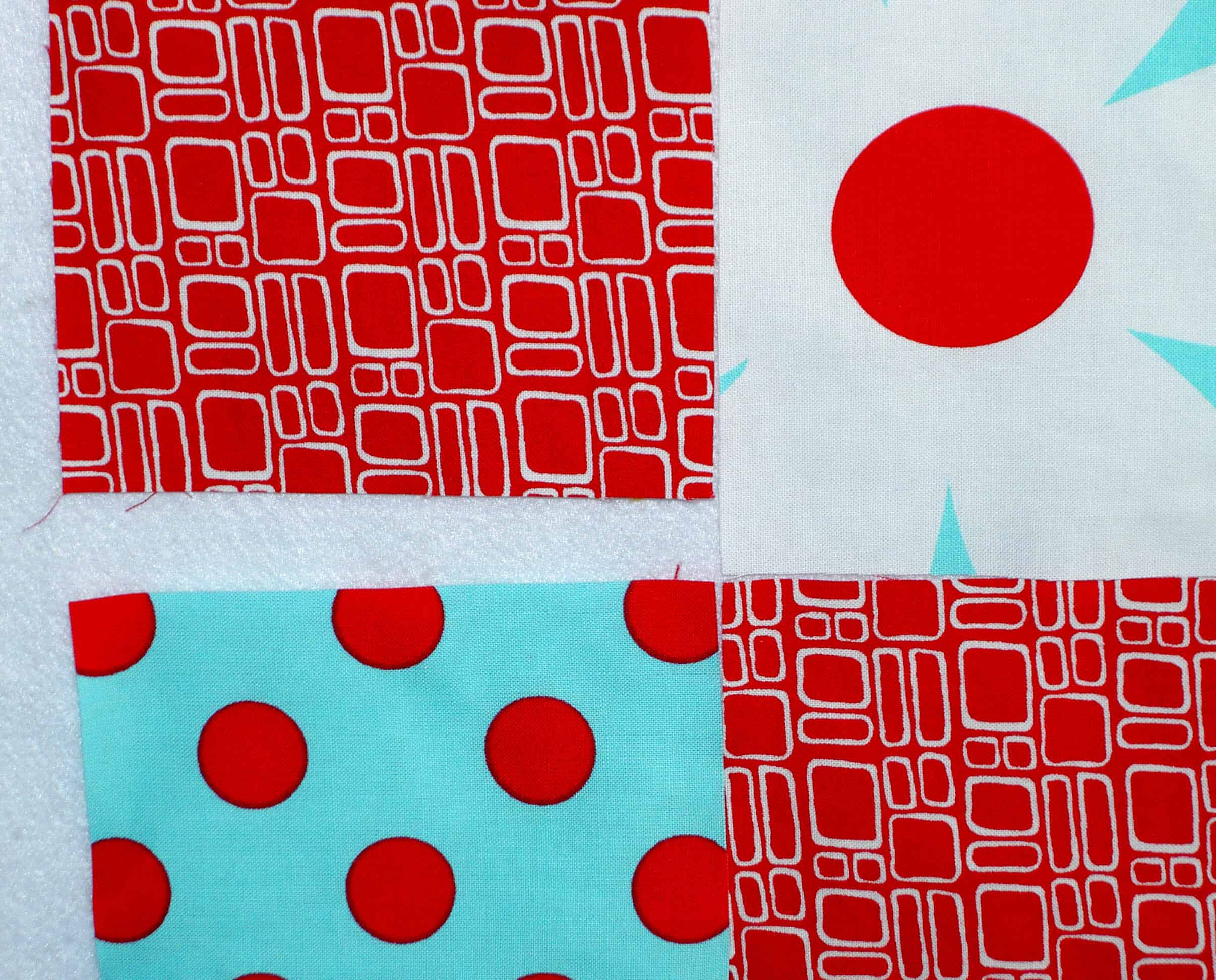
Step 21: Lay the column with patches B, E and H on top of the column with A, D, and G. Make sure that your seams look like the photo above – nested into each other, not resting on top of each other.
The reason to pay attention to pressing is that you can ‘nest’ the seams when you go to start sewing the rows. Nesting seams is when the seam allowances are pressed in opposite directions so that they rest against each other.
Sew Left Column to Middle Column
Step 22: With the column with patches B, E and H on the bottom, sew the column with A, D, and G to the column with patches B, E and H on the right side.
I did use some pins at the seam allowances.
Step 23: Set seam between the left and middle columns.
Step 24: Press seam allowance between the left and middle columns in whatever direction suits you.
Lay Left Column on Middle Column
Step 25: Lay left column (with patches C, F and I) on top of the middle column.
It looks like the top row, but really is the right column. I just have it turned so the right column is on top.
Step 26: Pin at seam allowances, if desired.
Step 27: Sew left column (with patches C, F and I) to the middle column.
Step 28: Set seam between right and middle column.
Step 29: Press seam between right and middle column.
Finished: Nine Patch
Step 30: Congratulate yourself! You have successfully completed your Nine Patch!!!
Nota bene: I may update this tutorial or make clarifications, changes as necessary
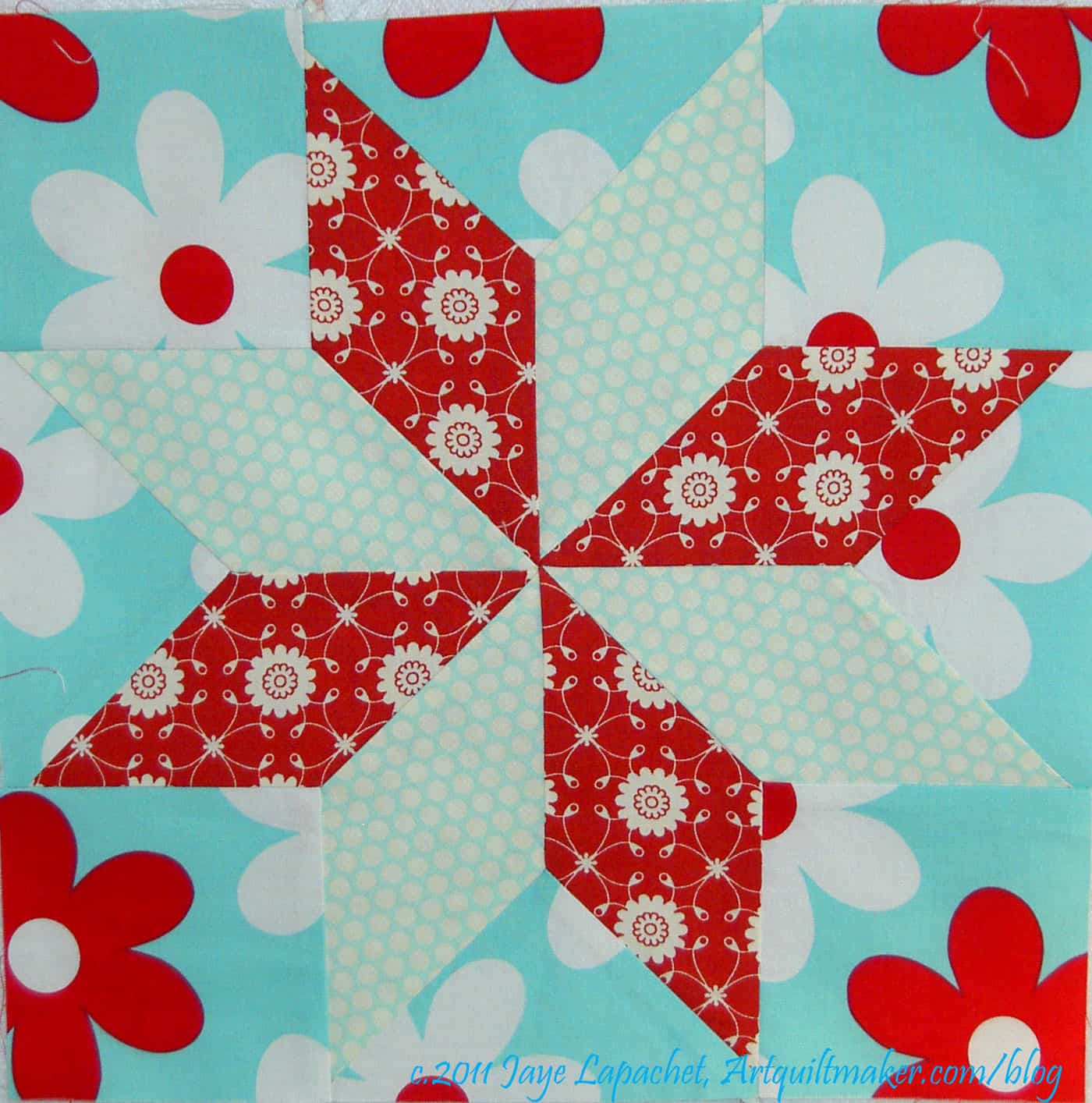
This is a tutorial on making a LeMoyne Star. This block is also called an Eight Pointed Star. This is one of the ways that I make it. There are many methods and I encourage you to try different techniques.
Alex Anderson has a great tutorial on one of the Quilt Show episodes on making a Split LeMoyne Star.
Before you do anything else, print the rotary cutting instructions below (first item under supplies). All the sizes, etc are there.
These directions use a quarter inch seam allowance.
You will be creating Y seams.
Chain piecing is not part of this tutorial.
Respect the bias.
Do not sew into the seam allowance.
Cutting
Line Up Ruler to Cut 1 Side of Diamond
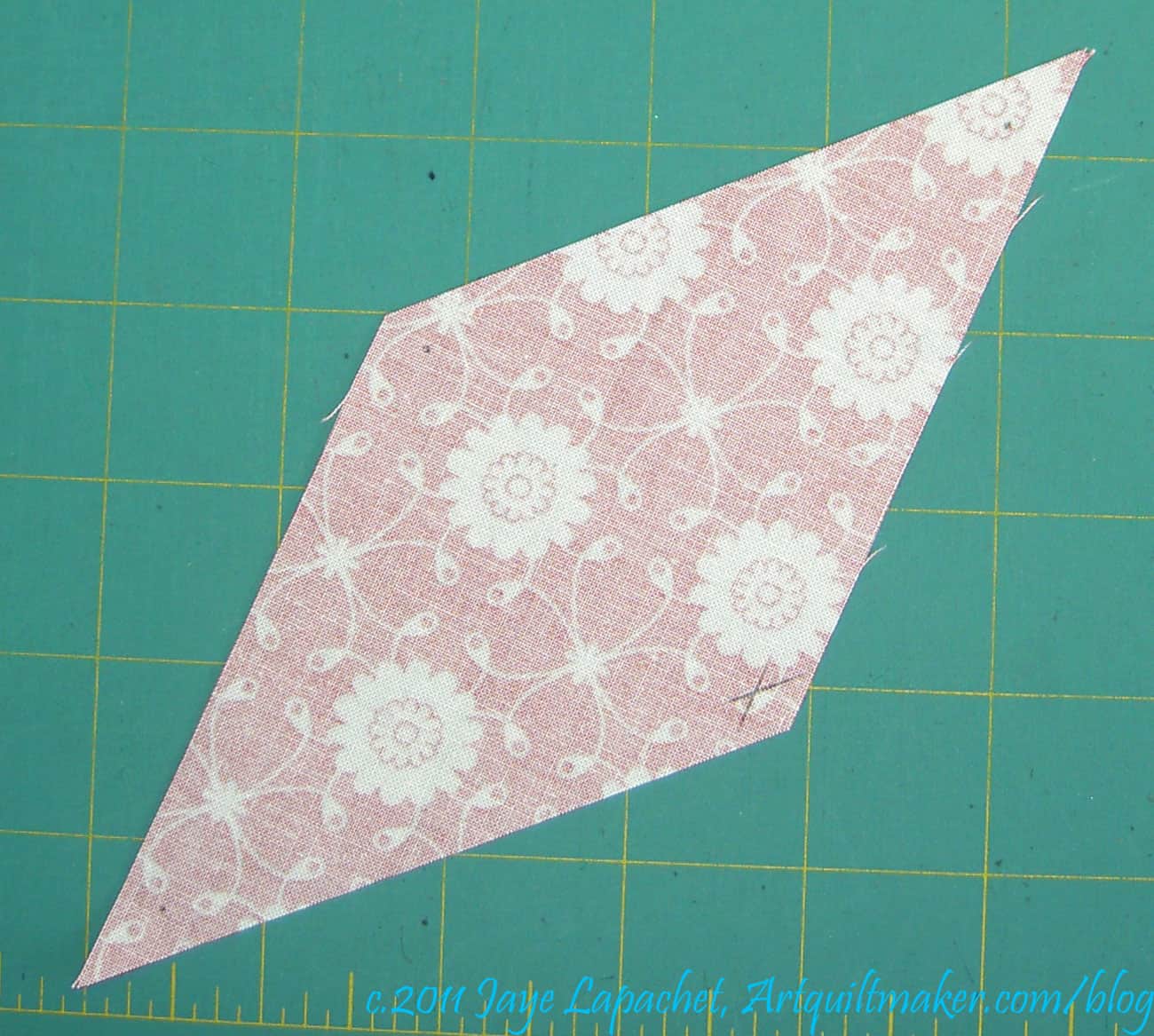
Cut a 3″x23″ strips. That should be long enough for 4 diamonds (parallelograms). Cutting a 3″ strip across the width of a half yard of fabric will generate a strip that is long enough. You will need two and using 2 different fabrics looks good.
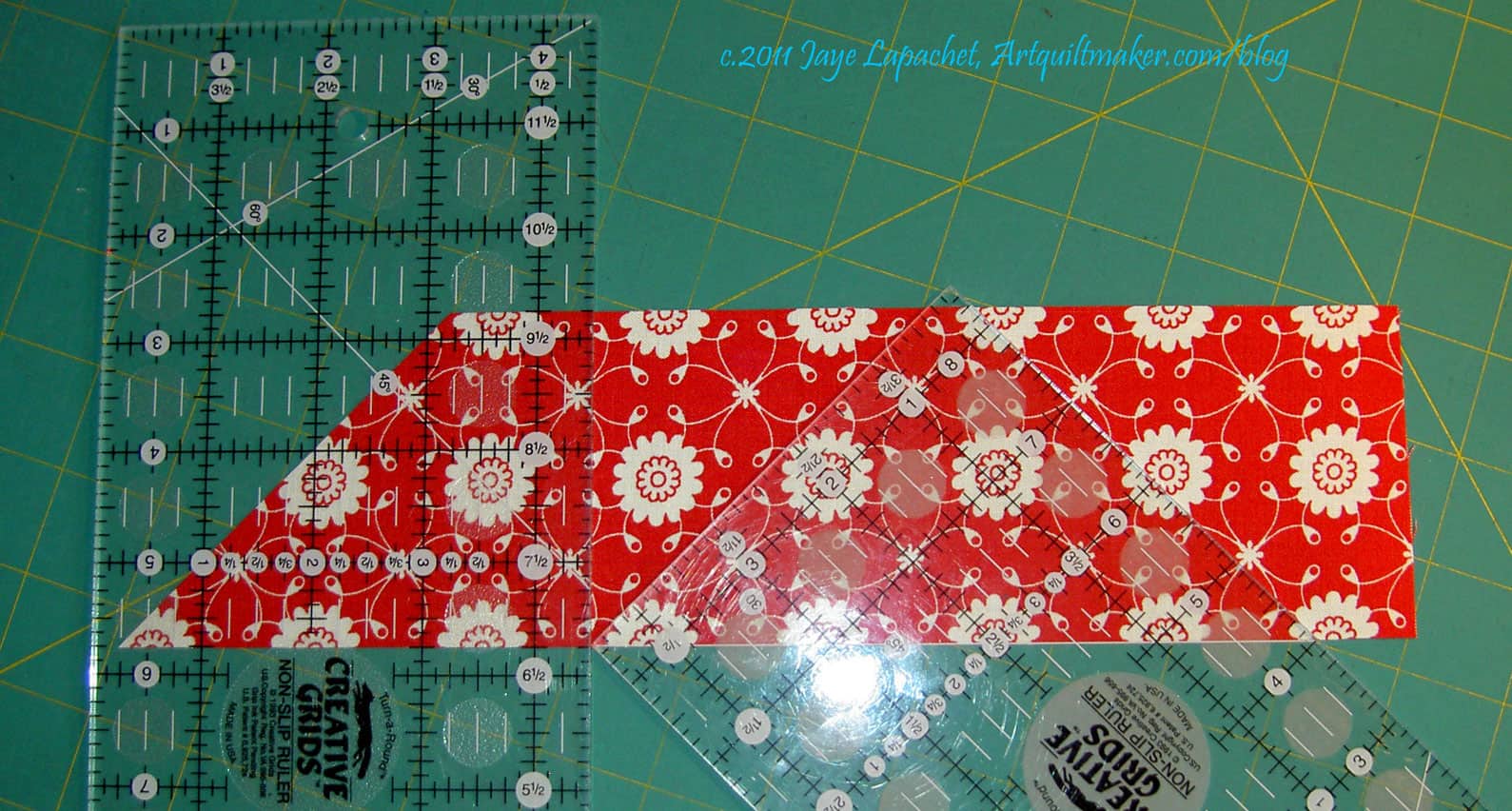
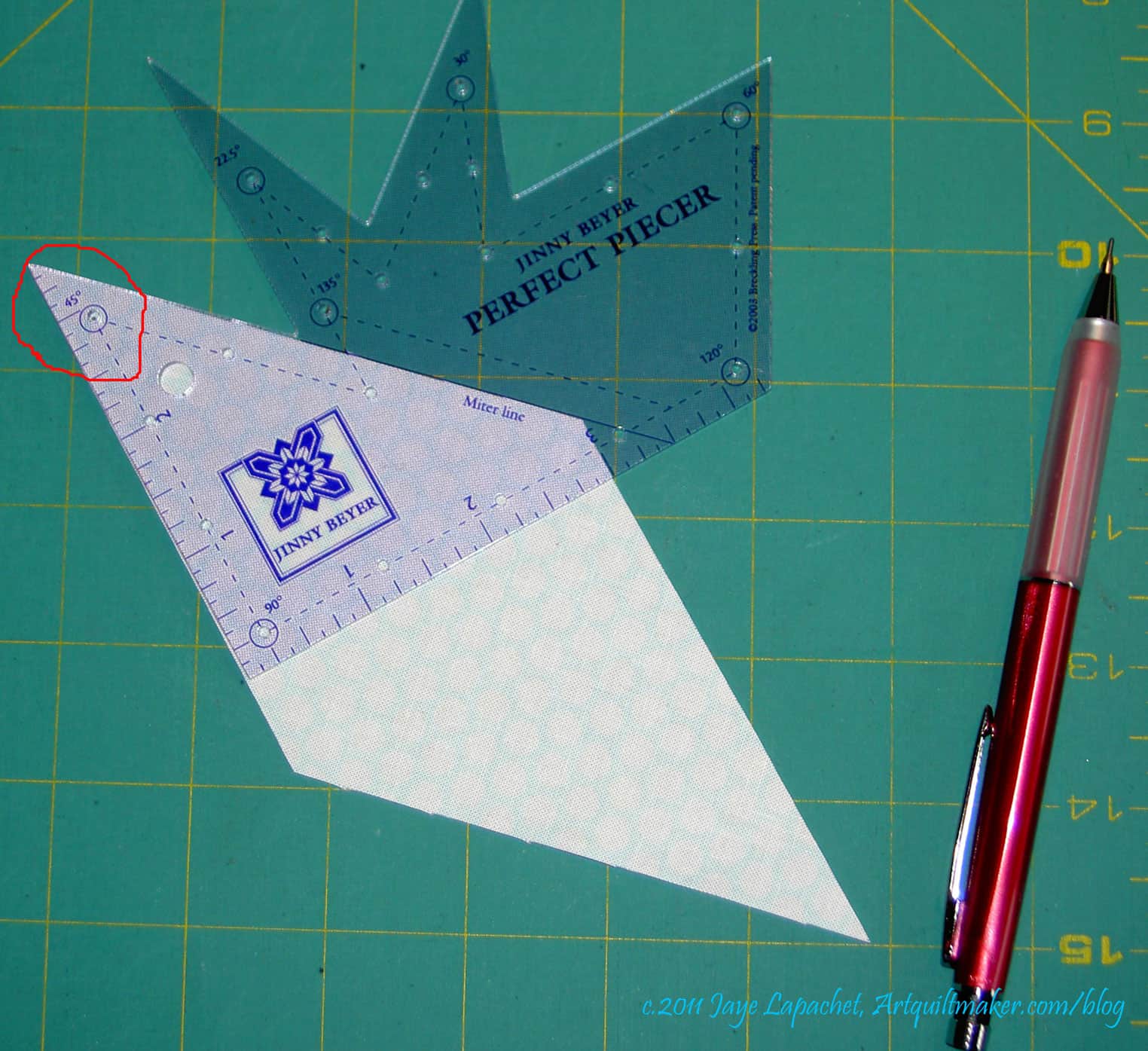
As shown (left), line your ruler up so the 45 degree angle on your ruler is along the bottom of the strip.The side of the ruler should be lined up right in the corner of your strip.
The idea is to cut off the end of the strip, so you have the correct angle of one pointy end of the diamond. I did try my diamond ruler, but none of the lines were quite the right size, so I couldn’t use it for this particular block.
Line Up Rulers to Cut the Second End
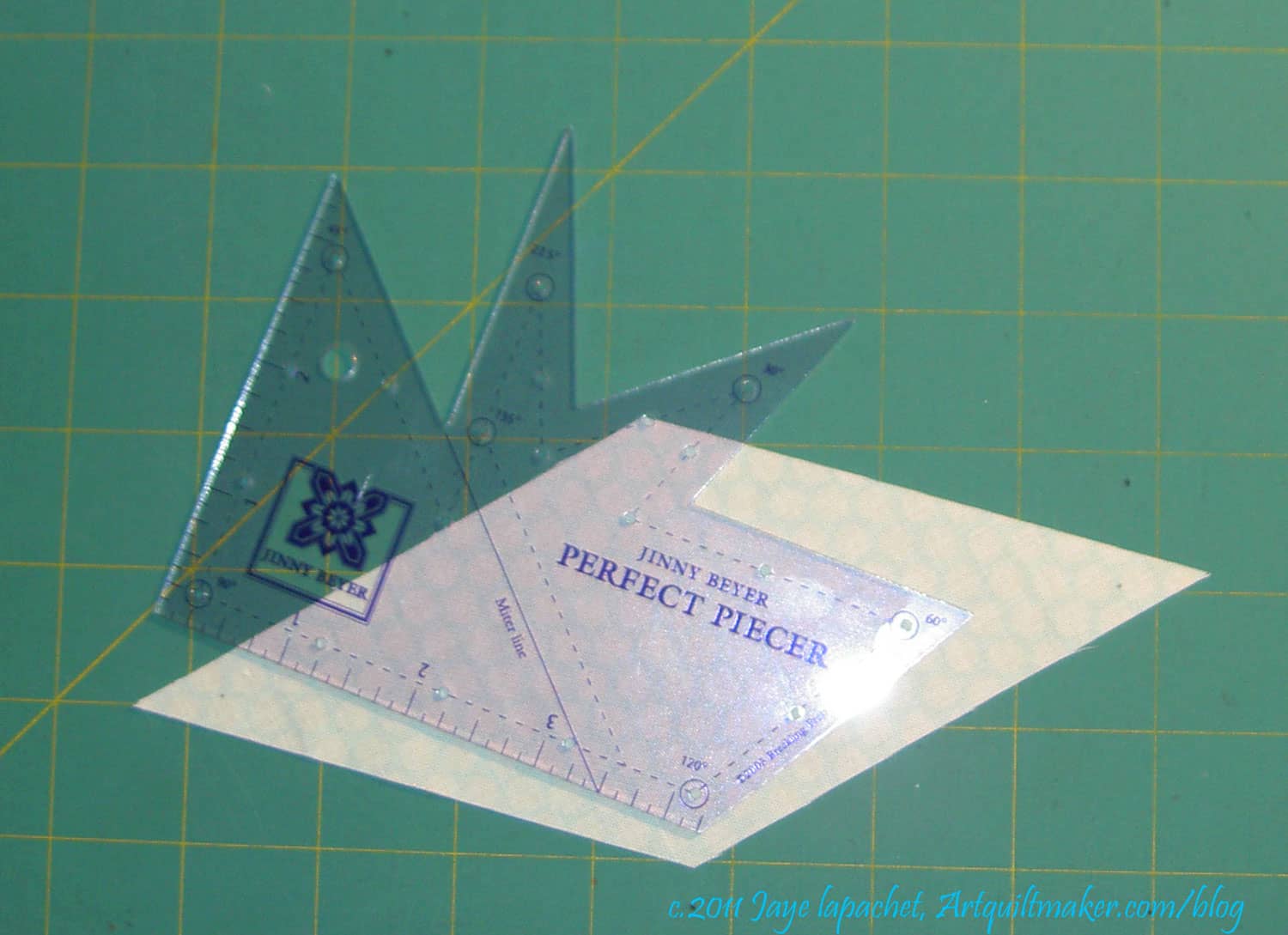
I used the two rulers to make sure that the diamond were accurate. The first ruler, on the left, should be even with the far left [soon to be] diamond point so that it would measure 4.25″ along the bottom edge. I used that measurement to line up the 45 degree angle of the second ruler so I could cut the angle in the right place. I butted the second ruler up against the first ruler (carefully) so everything was in alignment. The second ruler (on the right) must have a 45 degree angle that intersects with a corner or this trick won’t work.
I removed the left ruler before I started cutting, as it was easier to cut with just one ruler on the mat. I was careful not to jostle the ruler in the 45 degree angle position. Line your ruler up exactly as shown in the photo. You don’t have to have exactly the rulers I have. You can use any rulers with the correct lines.
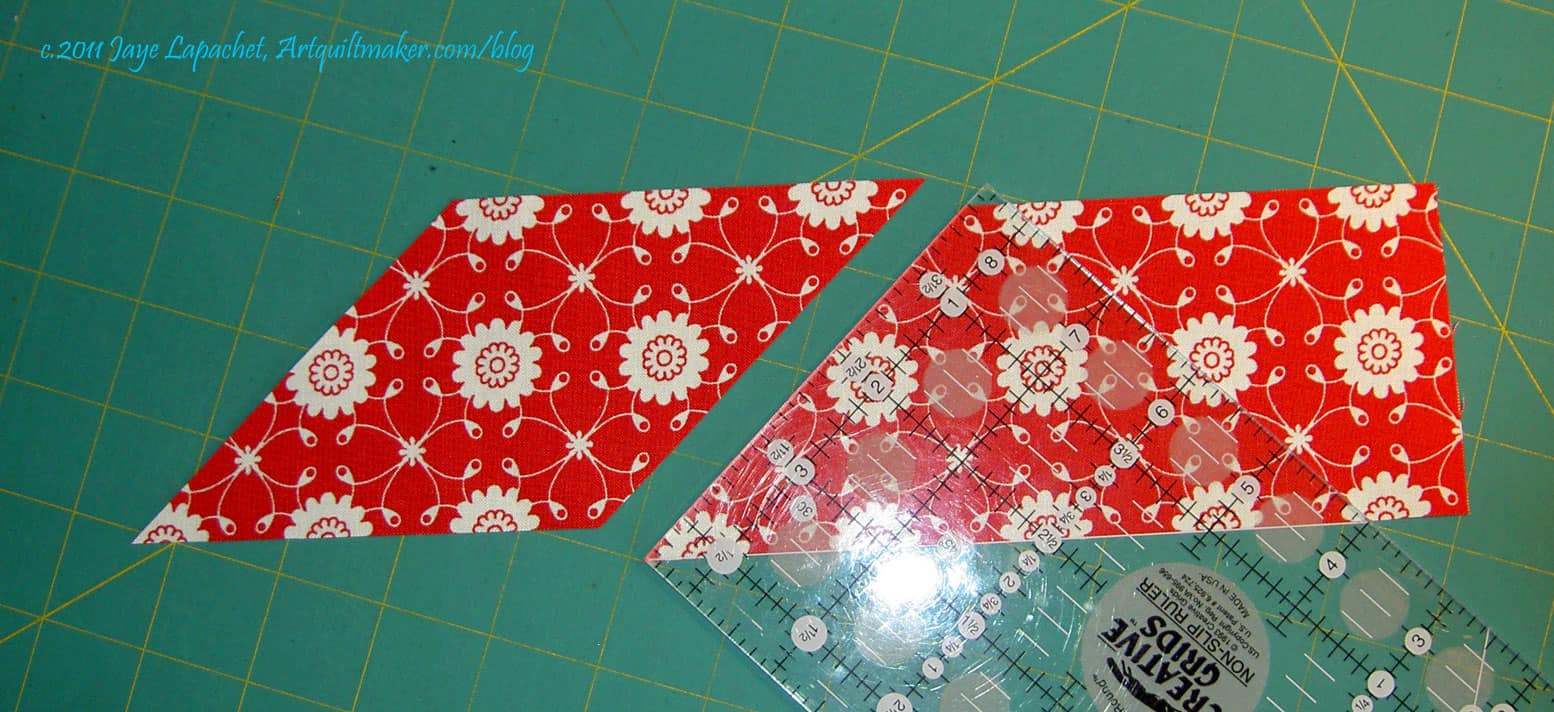
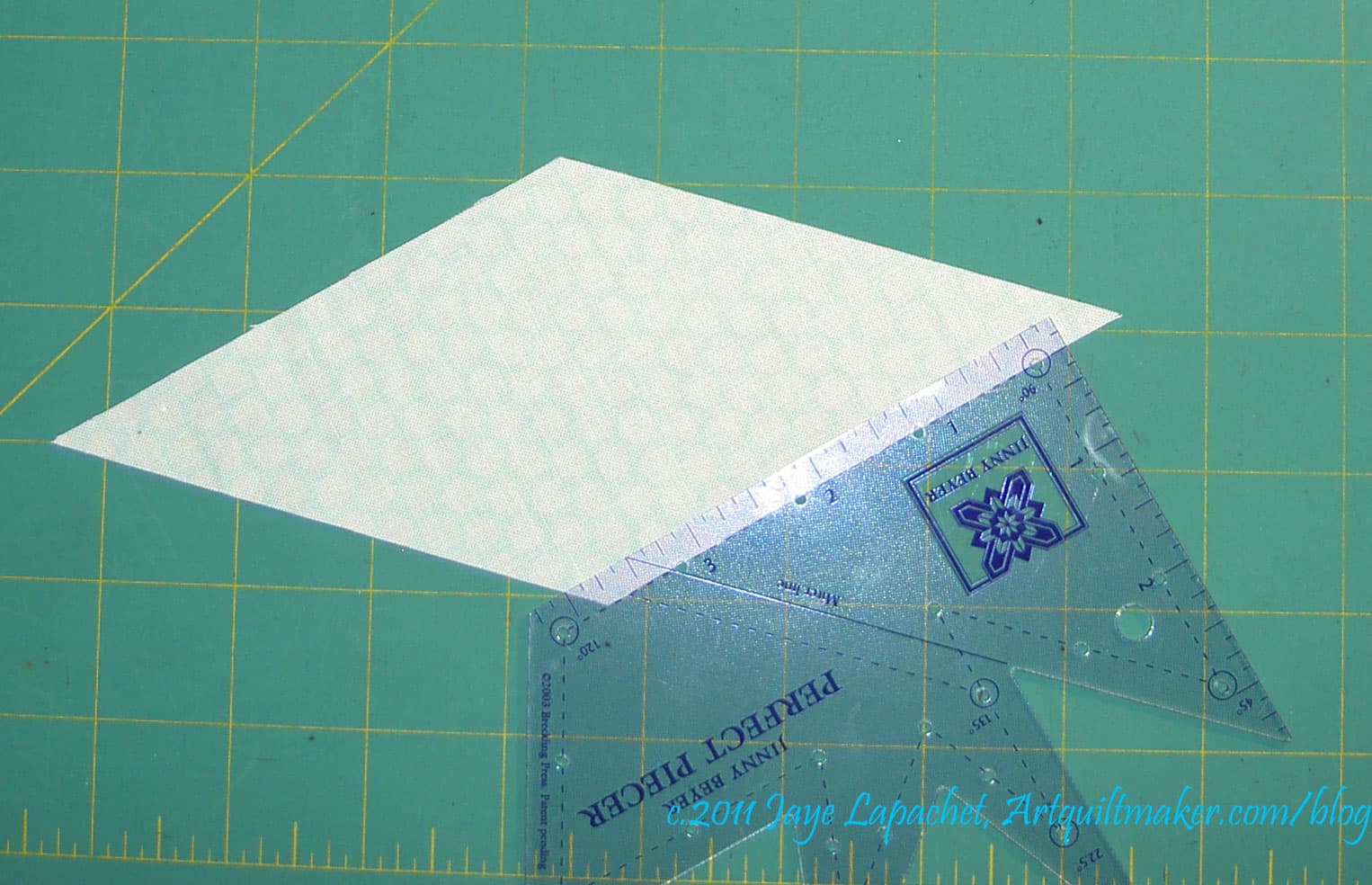
Cut 2d End of Diamond
I found that the method really does work. You will need to repeat the step above 8 times to get 8 diamonds. After the first diamond, it will be easier, since you can use the 2d cut for each diamond as the first cut for the next diamond.
Aside from having to watch out for ruler jostling, I was really pleased with how easy this was and well these diamonds came out. Don’t get me wrong, I wouldn’t have wanted to cut the 300+ diamonds for FOTY 2010 using this method, but for a LeMoyne Star, it works very well.
I cut all the diamonds at once from two strips of two different fabrics. My fabrics are:
background: Lil Plain Jane
red diamonds: Moda Bliss #55021
aqua dot diamonds: Moda Bliss #55023
Side Triangles
Cut the squares and triangles according to the cutting directions on the PDF in the supply list. The triangles are quarter square triangles, which means that you cut the triangles so the straight of the grain will be along the hypotenuse (the long side of the traingle).
If you have some reason for not being able to cut the side triangles as shown, be careful sewing the block together and then stay stitch the outside of the block once you are finished.
Pieces cut
Once your pieces are cut, lay them out or adhere them to your design wall, so you know what you have.
Cut Diamond, Face down
I like to keep them where I can see them because it helps me know where I am. As I sew, I put the sewn elements of the block back up on the design wall.
Once you have cut all the diamonds, you will need to mark them. You need to mark 1/4″ away from the seam line, because if you want this block to come out right, you cannot sew into the seam allowance. The biggest rule I have for making the LeMoyne/8 pointed star block is NOT to sew into the seam allowance. There are exceptions, but I am not going into those now.
Put your diamonds face down on a writing surface and prepare to mark. As you can see from the photo, I used my cutting mat as the hard surface. You can use a table or whatever else works for your work area. I used the Sewline pencil to make the marks. Pilot SCUF pens, a mechanical pencil, etc also work.
Get ready to mark the seam allowance on all of your pieces (squares, triangles, diamonds).
Mark with Perfect Piecer
I like using the Perfect Piecer ruler by Jinny Beyer for marking weird angles, because I only have to move the ruler once to mark the ‘corner.’
With the Perfect Piecer (they aren’t giving me free stuff, BTW!), you put the ruler in the ‘corner’ as shown in the photo. Where I have placed the circle is a hole. Note it is a small hole, so a regular No.2 pencil usually won’t work. Stick your Sewline (or other fabric marking implement with a very thin point) in there and make a dot. Voilà!
You will need to use two different parts of
Ruler Angle Does Not Fit Side
the Perfect Piecer ruler to make the marks on all four ‘corners’. There is no angle for the sides of the diamonds, so just use the straight edge (as I describe below). You don’t need to know the angles, if angles make you crazy. Just match up the shape of the ruler with your cut piece.
Use Straight Edge for Marking
You can certainly use any kind of ruler. Take your regular ruler and line up the 1/4″ line with the cut edge. Make a line around where you think the quarter inch would be. Make it longer, so you don’t have to go back and do it over. Move the ruler to the opposite cut edge of the diamond and cross your first line with a new line. It makes an X. I have done this numerous time and there is no problem using an X instead of the Perfect Piecer dot.
Beautiful marks!
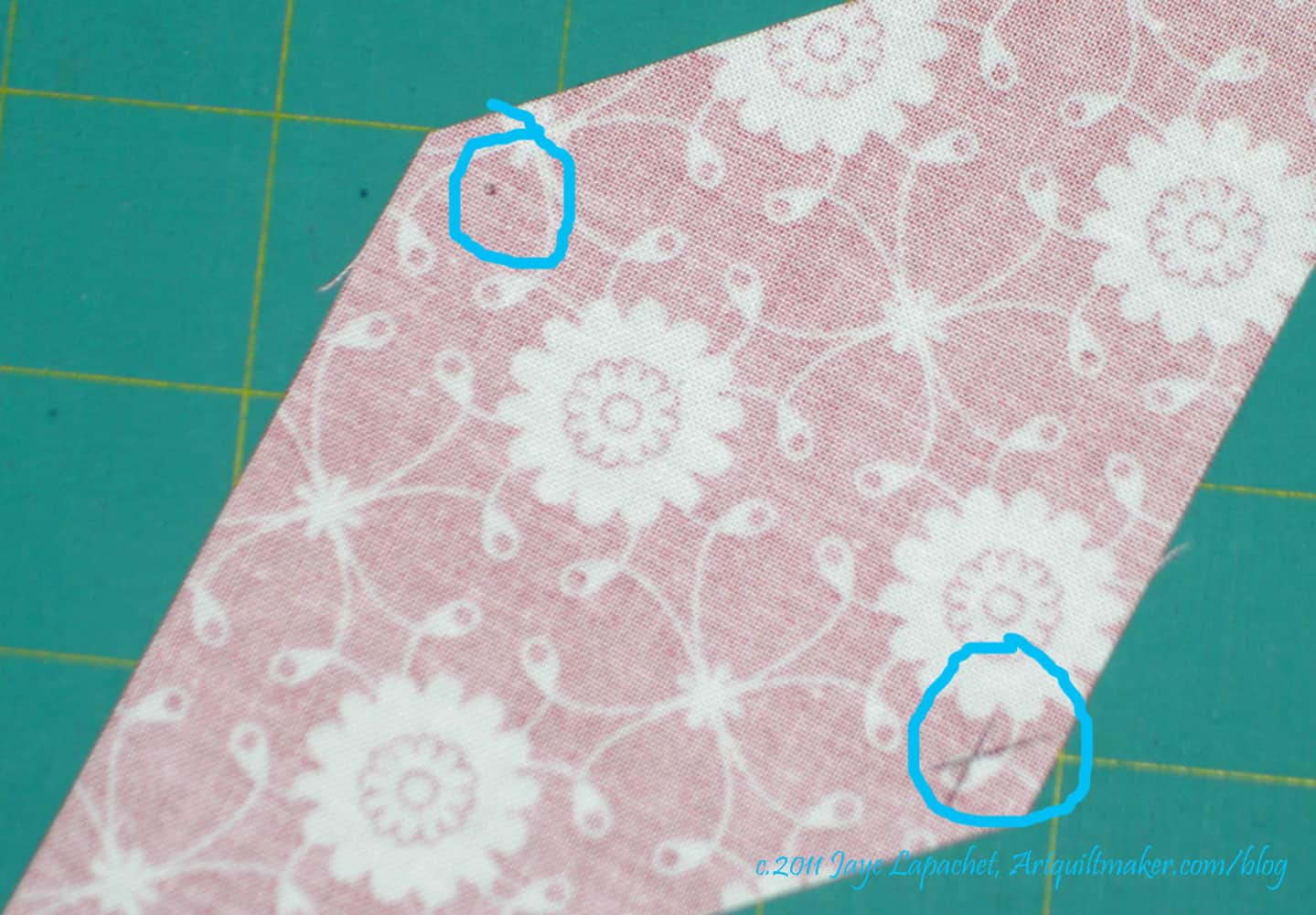
In case you were wondering what the marks look like, the photo (red diamond with blue circles, left) shows examples.
The upper left hand mark inside the blue circle is the mark made with a Perfect Piecer and the Sewline pencil.
The lower right hand mark is made using a regular rotary cutting ruler and the Sewline pencil. Either mark works, as I said. You will use these marks to stop and start your seam lines. NO sewing into the seam allowance!
You will need to mark the squares and the triangles, too. You can use the Perfect Piecer to mark those pieces as well.
At this point, you might want to use some Mary Ellen’s Best Press to stiffen your pieces since you will be sewing along a lot of bias edges. You can either spray it on all of your pieces all at once, or as you are getting ready to sew. If you don’t want to use Mary Ellen’s Best Press or spray starch, no problem. Just keep in mind that you are working with bias edges, so work with them carefully. You don’t need to be afraid of bias edges. Just work slowly and carefully. Respect the Bias! 😉
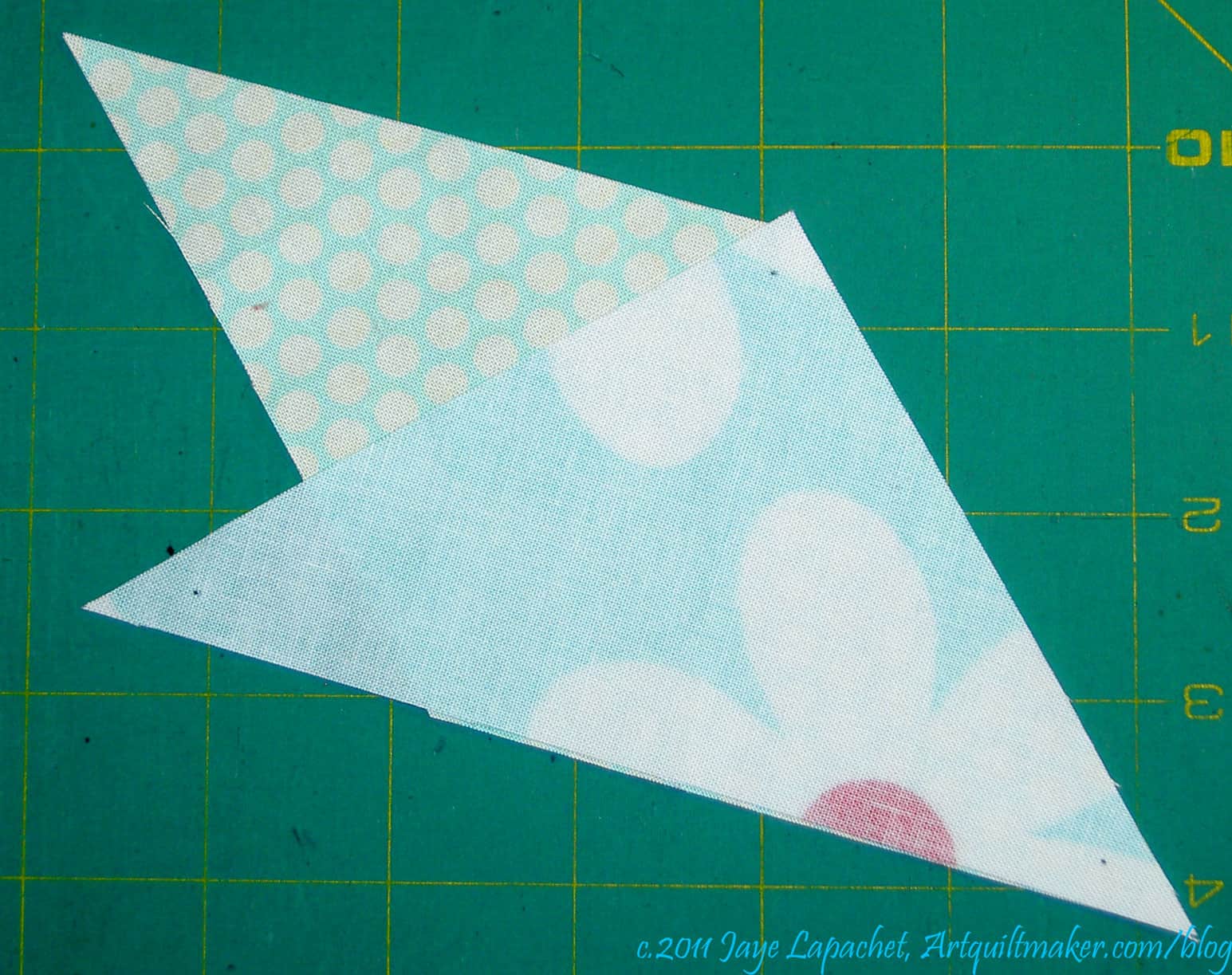
Position Triangle over Diamond
Sew Segments Together
Now you are ready to sew!
First, position one of your side triangles over the diamond as shown, right sides together. You are lining up the diamond with the left non-hypotenuse side of the side triangle.
Line up the marks you have made on the diamond with the marks you made on the triangles.
I used pins, but only stuck them through vertically one time to keep them in place until I got to the sewing machine.
You can give the pieces a little press to stick them together, too, if you want.
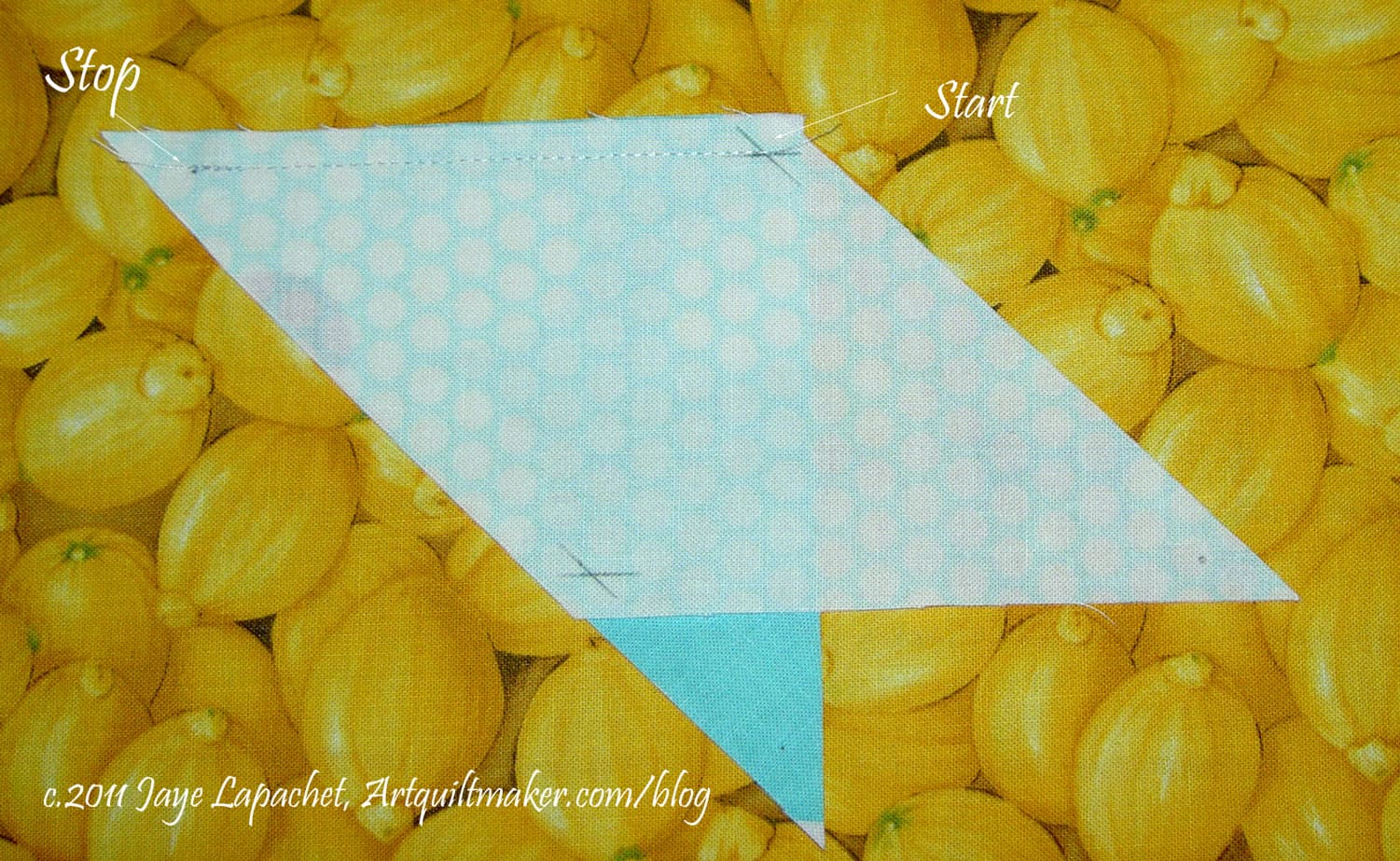
Sew from Mark to Mark
Next you sew from mark to mark. Stay out of the seam allowance! You can back stitch, if you want, but stay out of the seam allowance. Start sewing at one mark and stop at the second mark. Easy!
An Aside: You are probably wondering about the lemon fabric. I press fabric on my ironing board and if I am pressing a lot of pieces, then I will put a larger piece of fabric so that I can get more bang for my buck. As I press the smaller pieces the larger piece gets pressed as well.
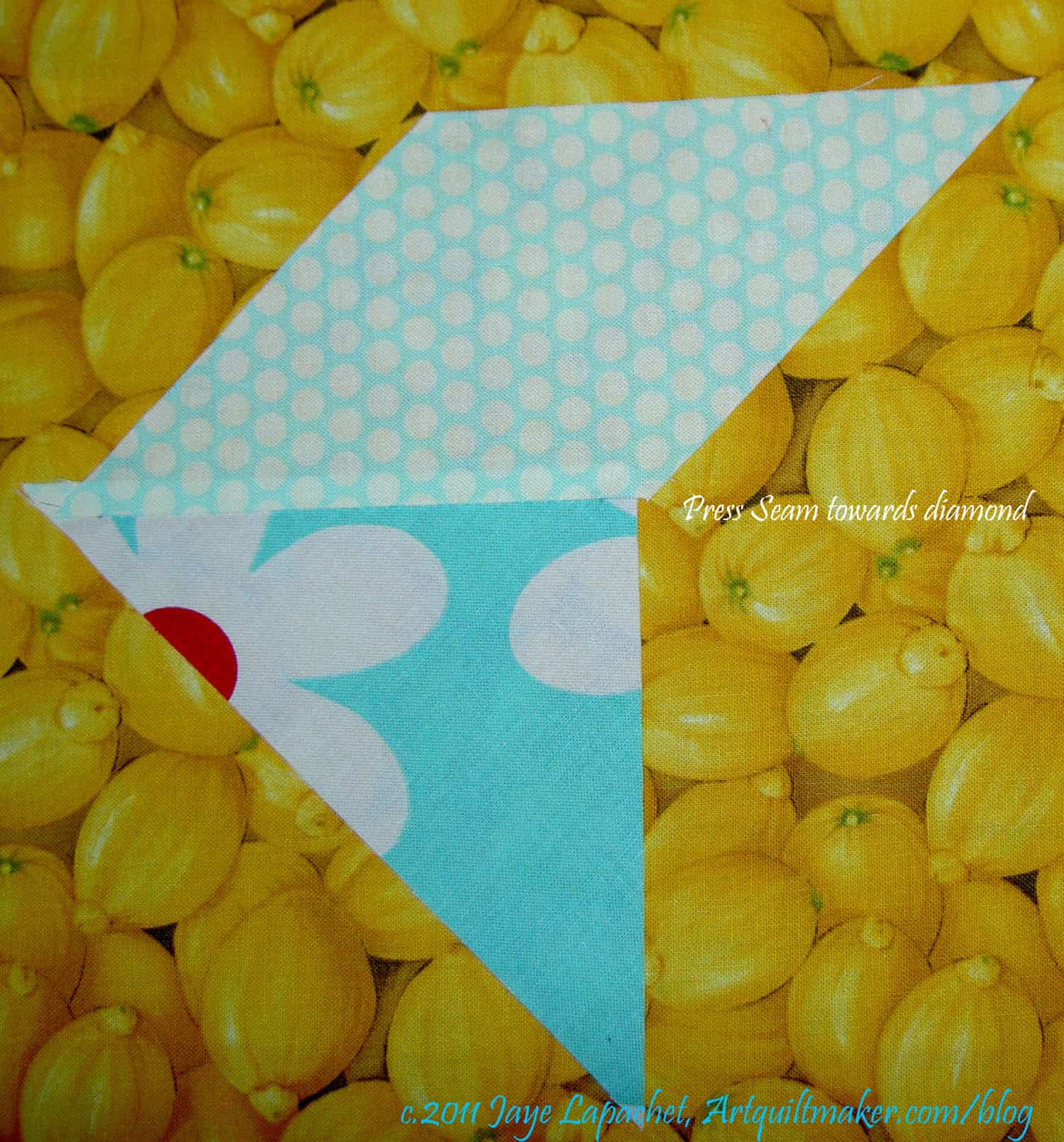
Press Carefully
You can press now. If you do, press carefully (remember the bias, respect the bias) towards the diamond. If you don’t want to press until later, that is ok, too. I usually create the entire segment (2 diamonds, one triangle) before I press.
Now you have your first piece. YAY!
Not hard or scary, right?
Repeat this step for all of the diamonds that will be in the same position as my aqua with white dot diamonds.
2d Diamond with Pieced
The next step is to sew the second diamond on to the segment (above: aqua with white dot & Lil Plain Jane fabrics) you have just made. You will be doing an inset seam. An inset seam is also called a Y seam. A lot of people hear this and panic. It isn’t difficult, but you can’t chain piece them and you have to pay attention. This method is similar to sewing hexagons together. Y seams really expand your quilt block piecing repertoire.
As you can see I have lined the red diamond up with the segment I sewed and am ready to line up the pieces, pin and sew.
Line Up 2d Diamond & Pin
First, line up the marks on the triangle and the diamond.
I just used vertical pins to make sure that everything was lined up before I sewed. I put a pin in the middle of seam line right before I sewed just to hold everything together.
You will be sewing in two stages. I like to sew the triangle to the second diamond before I sew the two diamonds together.
Sew 2d Diamond
Next, place the group of 3 patches (2 diamonds and a triangle) under the needle, lining up the marks so that the needle misses the seam allowance and goes straight into the first mark.
Sew from mark to mark. The triangle and the second diamond will now be sewed together.
Sew from Top to Middle
Second, line up the new diamond with the diamond you have already sewed to the triangle.
Line Up 2d Diamond & Pin
Match up the marks on the top and sides of the diamond. Right sides should be together.
Put the top of the 2 diamonds into the machine. You will start sewing at the mark, which is 1/4″ in from the top of the diamond. Sew between the two marks, avoiding the seam allowance.
Top View of Sewing Mark to Mark
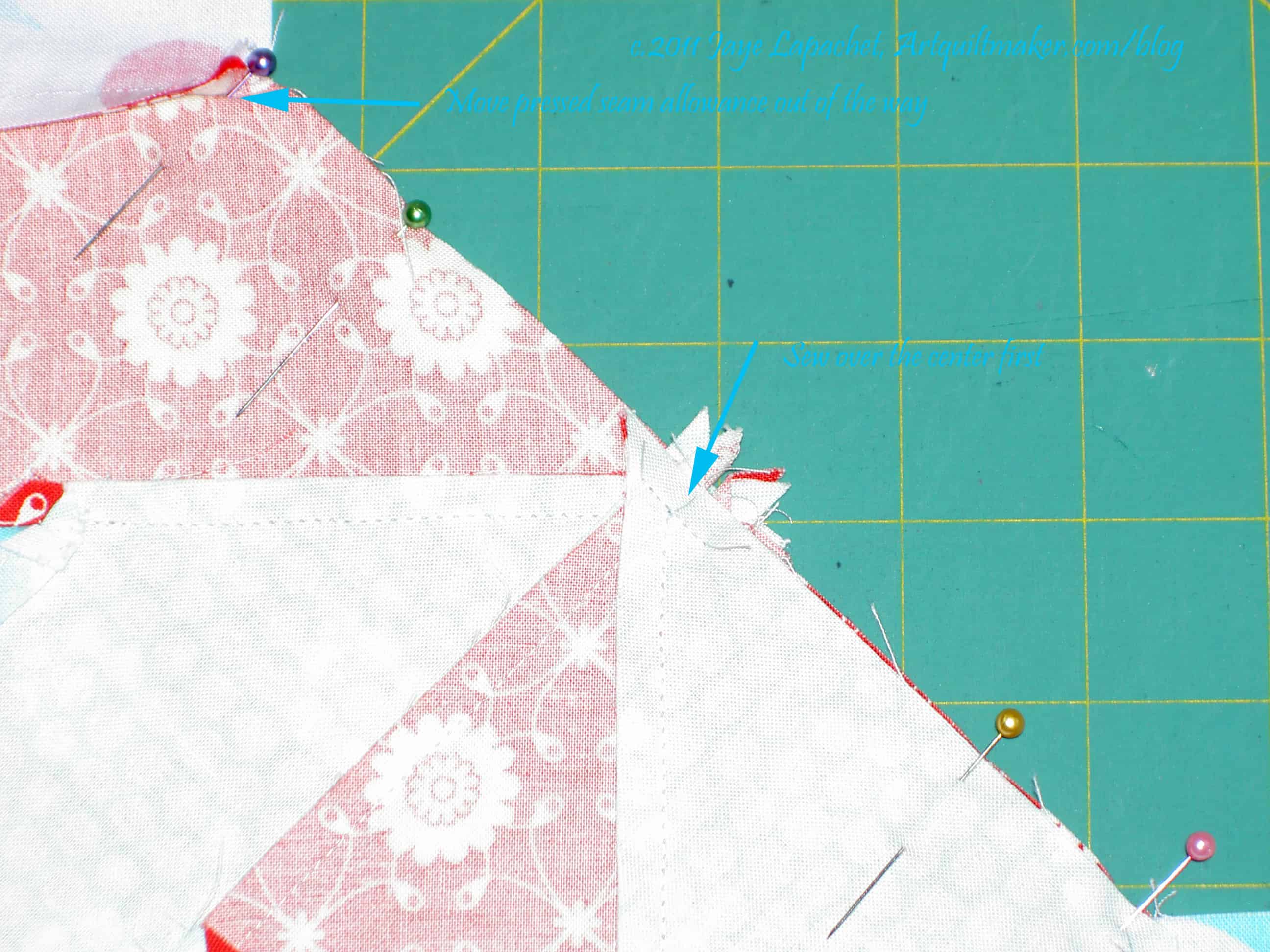
Sew down to the mark at the bottom of the diamond. If the pressed seam allowance looks like it will go under the needle, move it out of the way with your finger, the tip of some sharp scissors or a stiletto.
Stop at the second mark.
Remove the piece from the machine.
Segment 1 Complete
Once you have sewed the the three patches together, you will have one full segment completed.
Next, press the 3 seam allowances into a swirl. This is similar to what you do with hexagons. As a guide, use the first seam that you pressed after sewing the first diamond to your triangle.
The reason I suggest the ‘Swirl’ is that it reduces bulk later. This particular pressing point isn’t as important in terms of bulk as the center, which has a crazy number of layers, once finished. Consistency is good, though.
Repeat to make four of the above segments.
Sew Quarters into Halves
Segment and SquareSew Square to Segment
Line up the square to the [red] diamond, matching the marks.
Arrange your pieces like I have done.
Line up the marks in the square with the marks on the outside side of the bottom (in the picture it is red) diamond.
Press, if you like. Pin, if you like. Go back to the sewing machine and sew from mark to mark.
Repeat this step for all four segments.
Sew Square to Segment 1
If you just look at the next photo, you might have a heart attack. Please don’t. Add the square is not hard. The key is to NOT sew into the seam allowance.
Two Quarters of the Block
Once you have two segments sewn to two squares, prepare to sew the two quarters together.
An Aside: You can actually sew into the seam allowance on any seam that will end up on the outside of the block. If this thought is going to make your head explode, then just remember my mantra: don’t sew into the seam allowance and you will be fine.
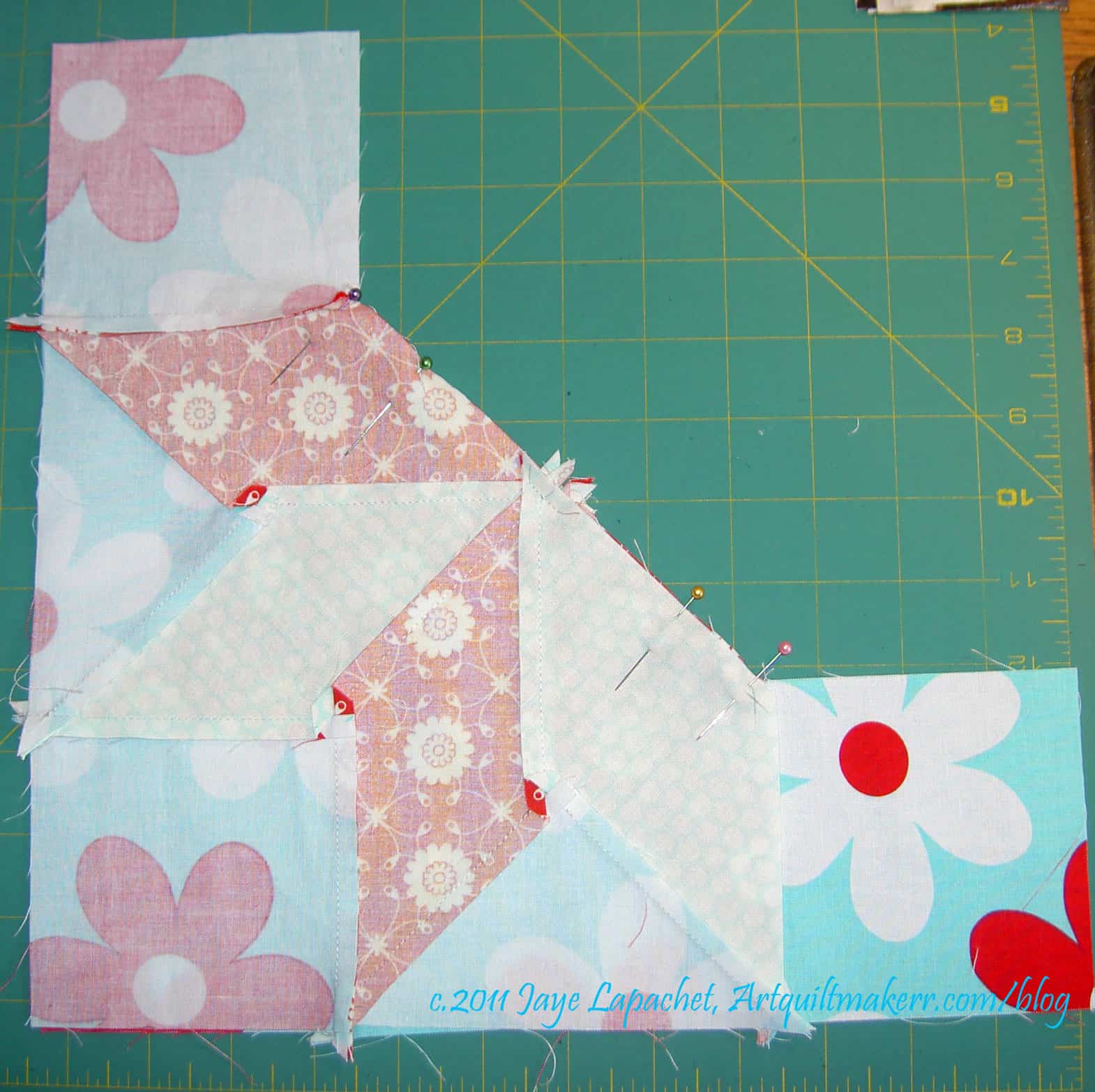
Line up 2 Halves along the Center Diamond
Sew Diamond Only
Sew the [red] diamond to the aqua diamond on the bottom. Stay out of the seam allowance and sew mark to mark.
Seam Line After Sewing Diamonds
After Diamonds are Sewn
It looks weird once you have sewn the diamonds together, but it will work out.
Line up Square
Line up the square with the [aqua] diamond and sew from mark to mark.
You Finished Half of Your LeMoyne Star
Two Halves of Block
Center detail
Finally, we are ready to sew the two halves together. You should have pressed in such a way that you can nestle the diamonds together using your pressed opposing seams.
Match up the marks with pins. I used really thin ones this time. I normally use the kind shown in the center detail photo, but switched to thinner ones as I worked on this step, because my normal pins weren’t giving me the results I needed for this tricky piecing. Note that I don’t pin right in the center. I pin well where I am not going to sew and may put another vertical pin in the center temporarily. There are so many layers in the center that it doesn’t always make sense to pin there. Do what works for you.
Sew Halves Together
Line up your piece carefully.
Hold on to your pinned halves tightly.
Sew over the center only. Start about an inch from one side of the center and stop about an inch after the center.
Sewing only a couple of inches makes it much easier to rip out, which I had to do. You might think that this will be a piece of cake, which it might be for you. It can be tricky also, because of the many layers of fabric that you are sewing through. My sewing machine did not want to go straight over that center section, which is why I had to rip out the first time.
Take the piece out of your machine, open it and see if you were able to match the center.
Once you have the center matched to your satisfaction, sew from the edge of one diamond across the entire center to the edge of the opposite diamond. Remember the mantra? Refrain from sewing into the seam allowance.
Finished and Pressed (full)
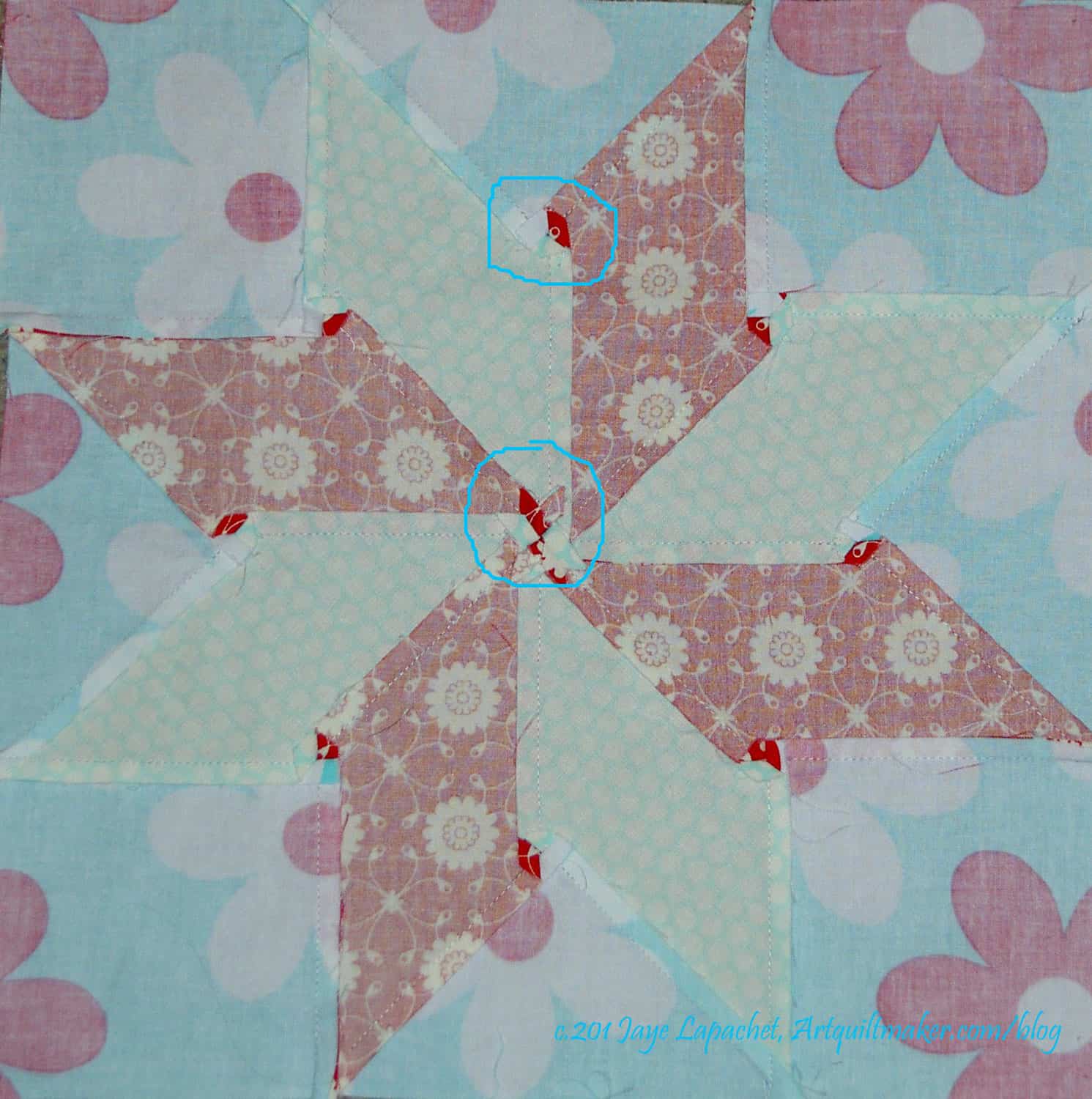
Once you have sewn the squares to the last sides of the last diamonds, pressing becomes very important. I have indicated with the circles how your pressing should look. If you need to re-press, spray the piece with water and that will make it easier.
By creating a swirl during the pressing of the center, you will reduce bulk for your quilting step. You will thank yourself if you quilt your own quilts. Your quilter will thank you, if you have someone quilt your quilts.
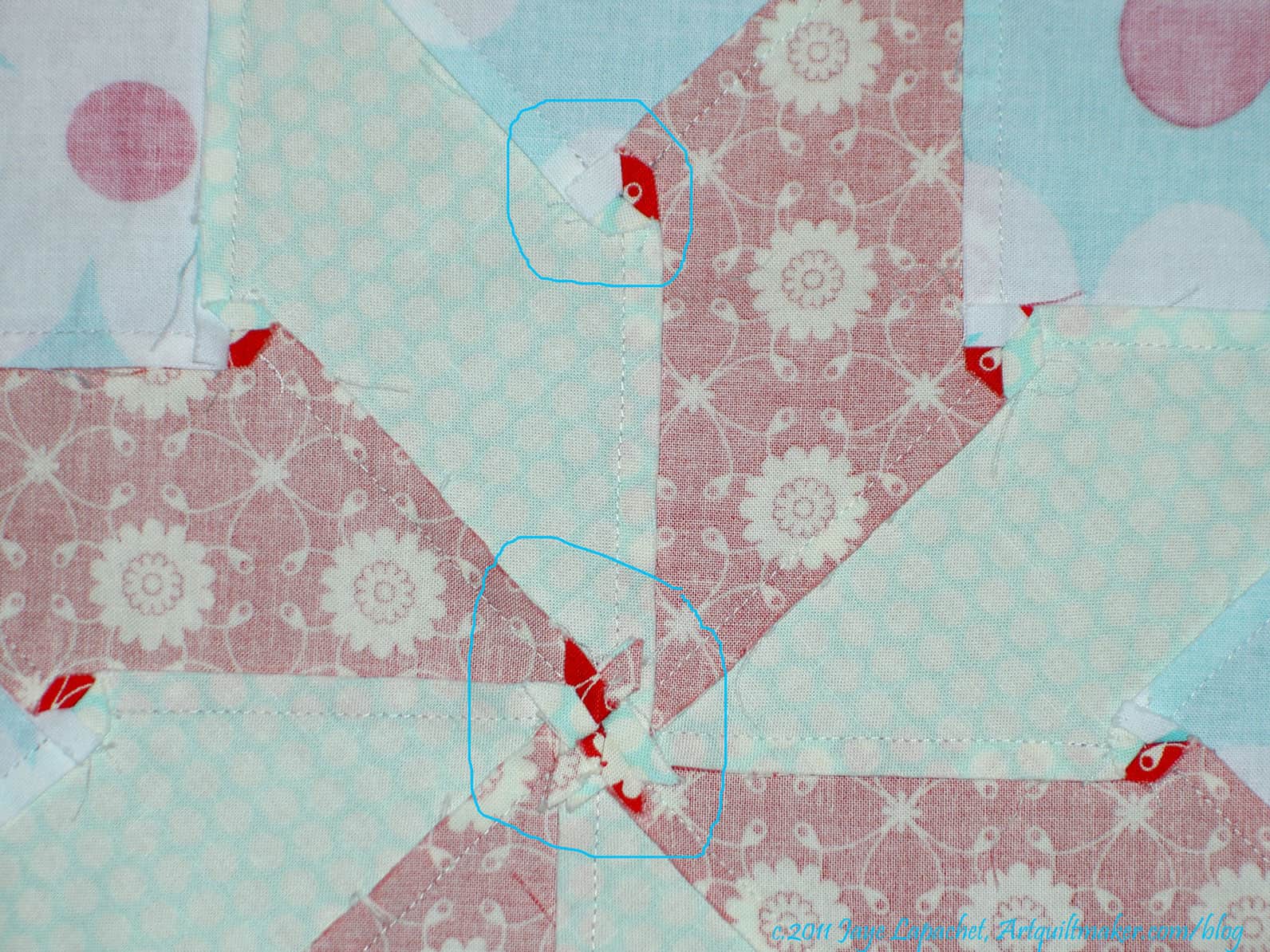
Finished and Pressed (detail)
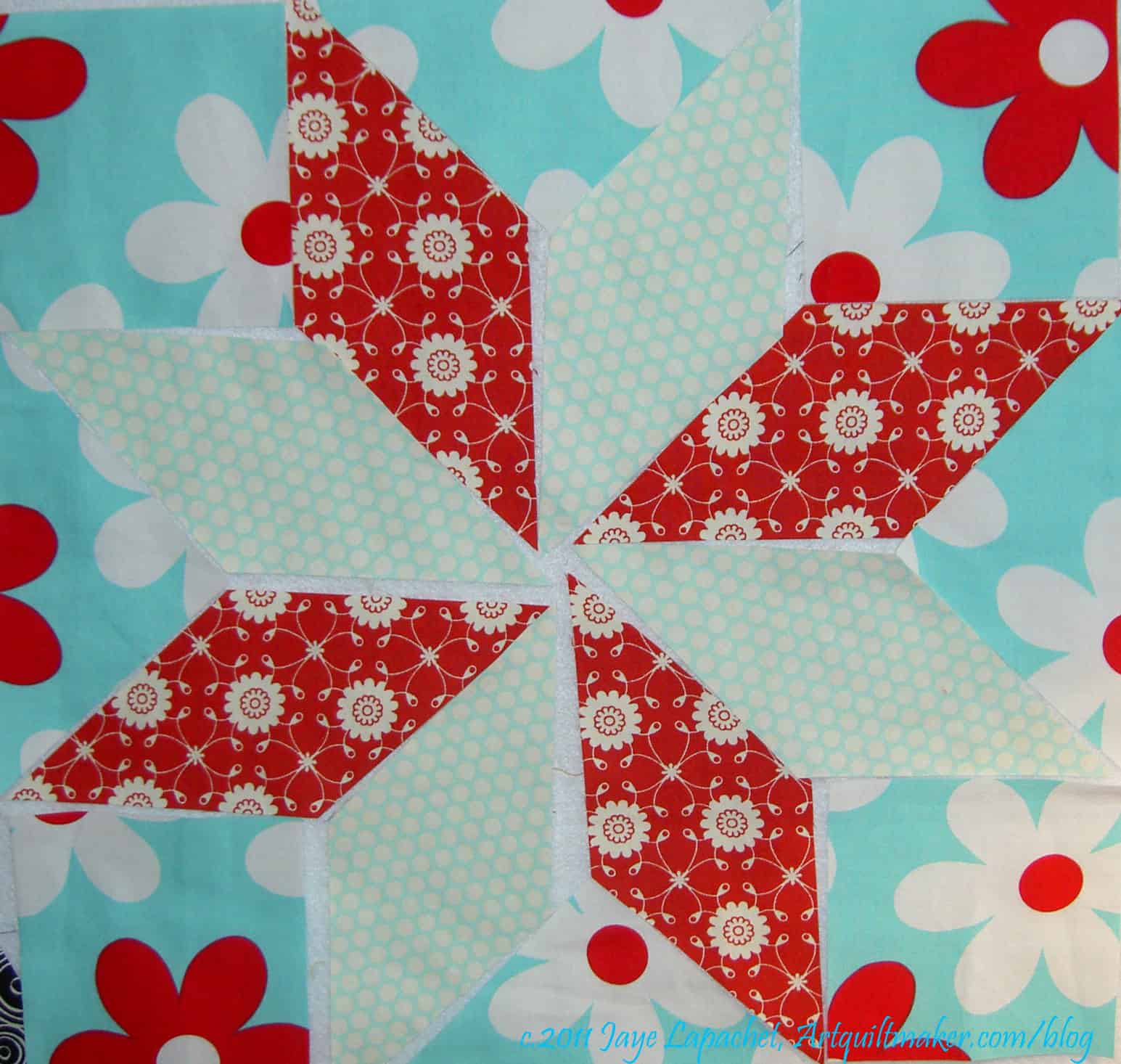
Once you have sewn the squares to the last sides of the last diamonds and pressed the piece, you should have a gorgeous block and feel very proud of yourself.
I worked on the LeMoyne Star today. I had some work, which languished while I was out of town,so I had to do that as well, but it was great to get back to sewing a bit.
The LeMoyne Star has some tricks, but is not very difficult to piece. I took pictures as I pieced it and will work on a tutorial for a future post. The key trick is to NEVER sew into the seam allowances. I did sew into the seam allowances along the outside edge towards the end of the process, but otherwise, I stopped shy of the seam allowance, or moved it out of the way as I was sewing. My stilletto came in handy. Choosing fabrics was a key piece of the process and took longer than I expected. The ‘make visual decisions visually’ adage worked well, though, because what I thought would look good didn’t look good at all. Below are some of the choices I considered:
Alternate colorway from the Moda Bliss lineDots from Quilted FishBright FlowersAnother Bliss FabricAqua-Red Sampler Quilt Blocks -September 2011
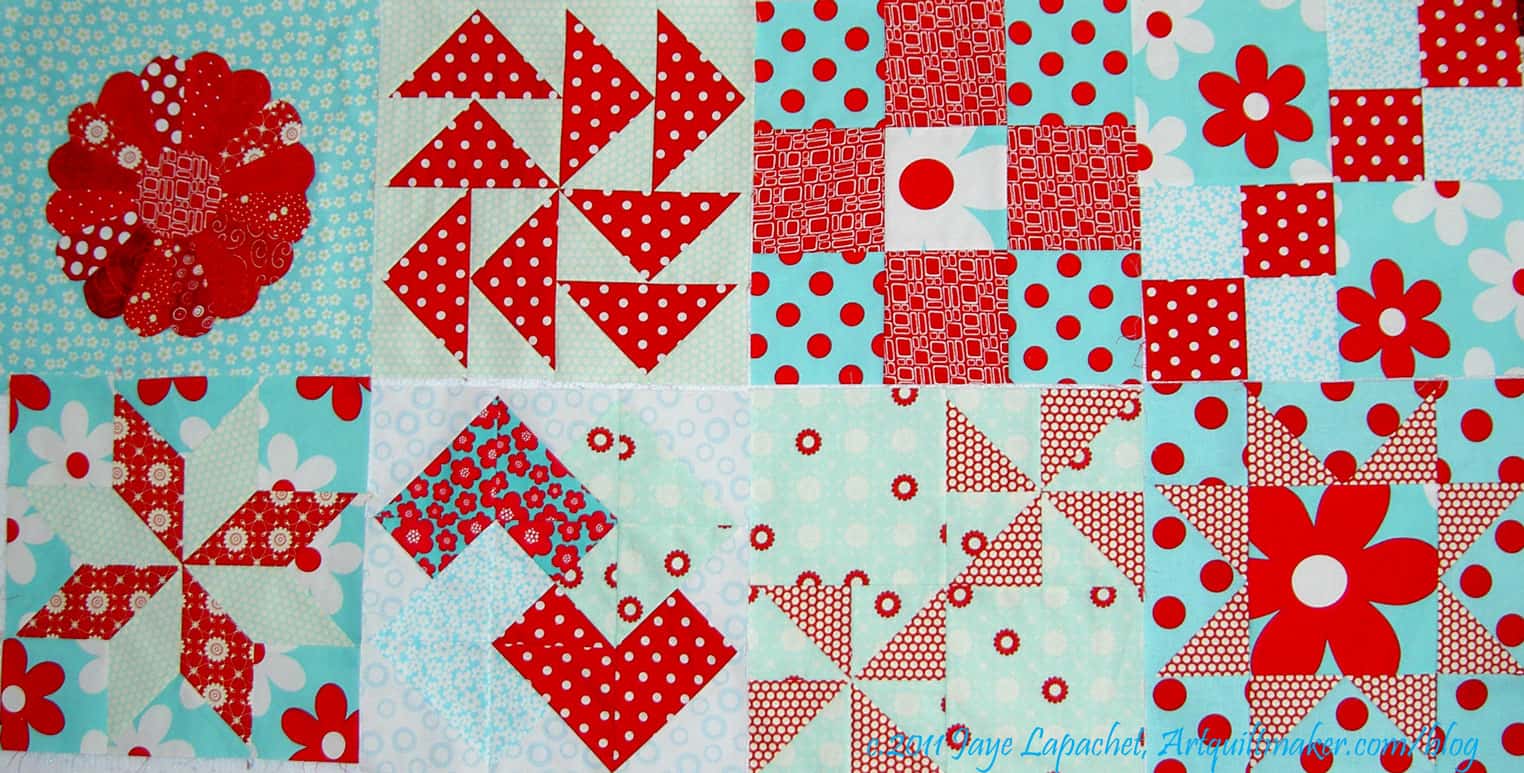
Above are all of the blocks I have made for the class so far. Don’t they look nice? They are hogging up space on my design wall, so I will need to take them down, but I am pleased with how they are coming out.
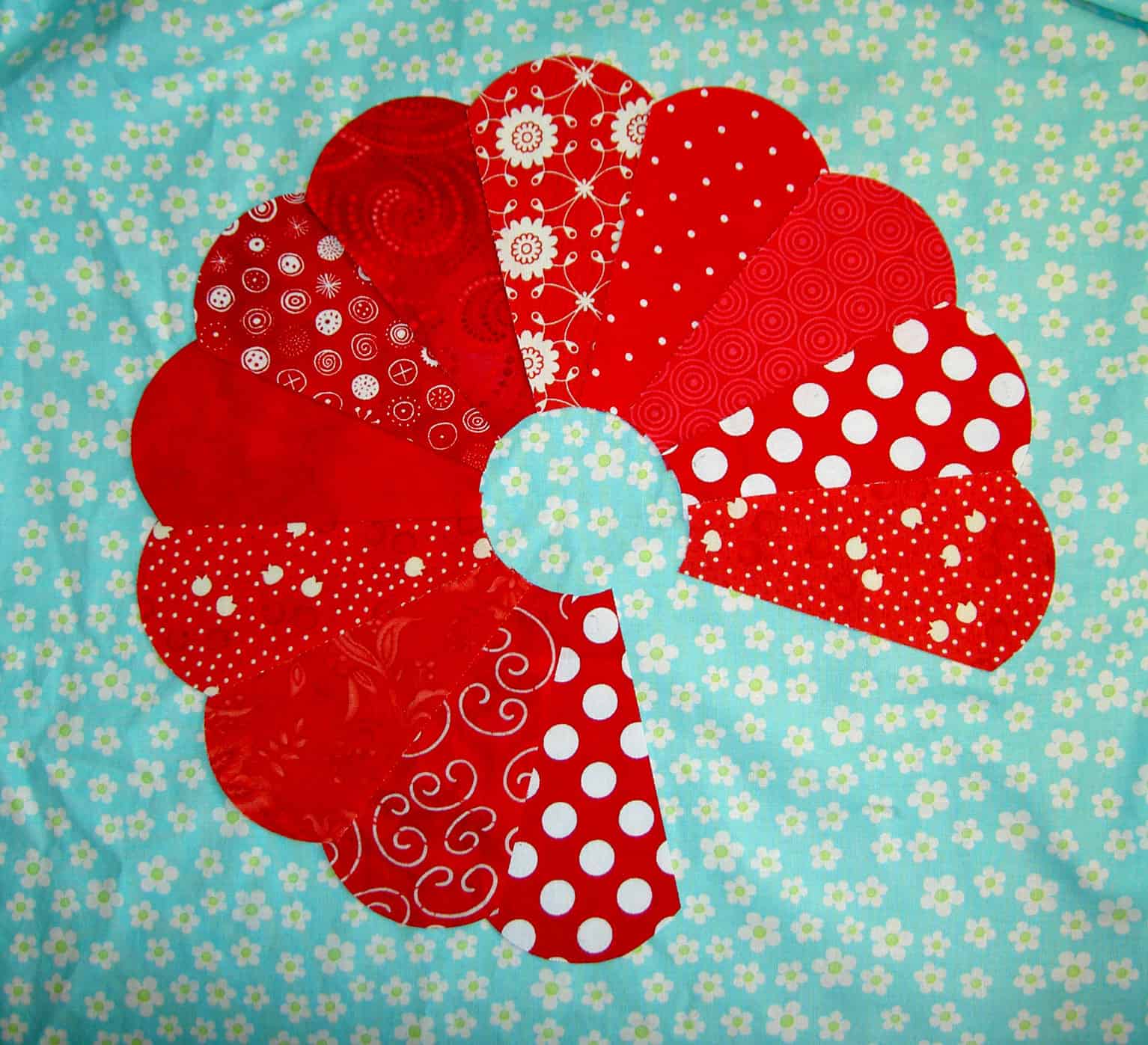
The next block is the Dresden Plate, which we are making using templates. If you would like to see a wide variety of Dresden Plates, you can do a Flickr search to see what others are doing.
Supply list:
pen
heat resistant template plastic
Glue stick
paper scissors
Pilot SCUF black thin point pen or Pigma Micron or Sewline pencil
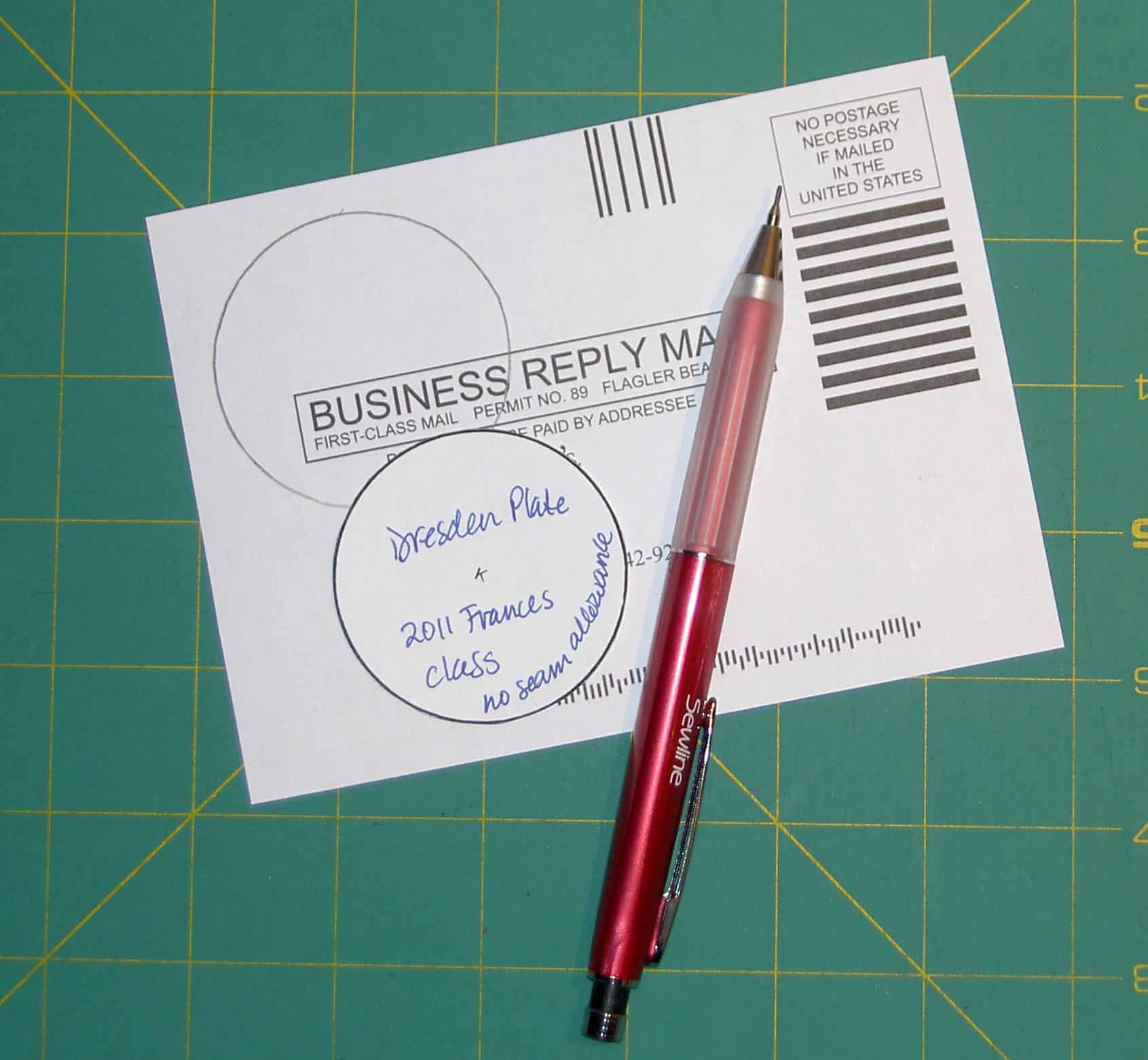
magazine subscription postcard or small piece of scrap card stock
pins
12.5″x12.5″ or larger square rotary cutting ruler
fabric
Mary Ellen’s Best Press (or similar)
stiletto or similar (popsicle stick might work)
sharp fabric scissors
thread for piecing
sewing machine
basic sewing kit
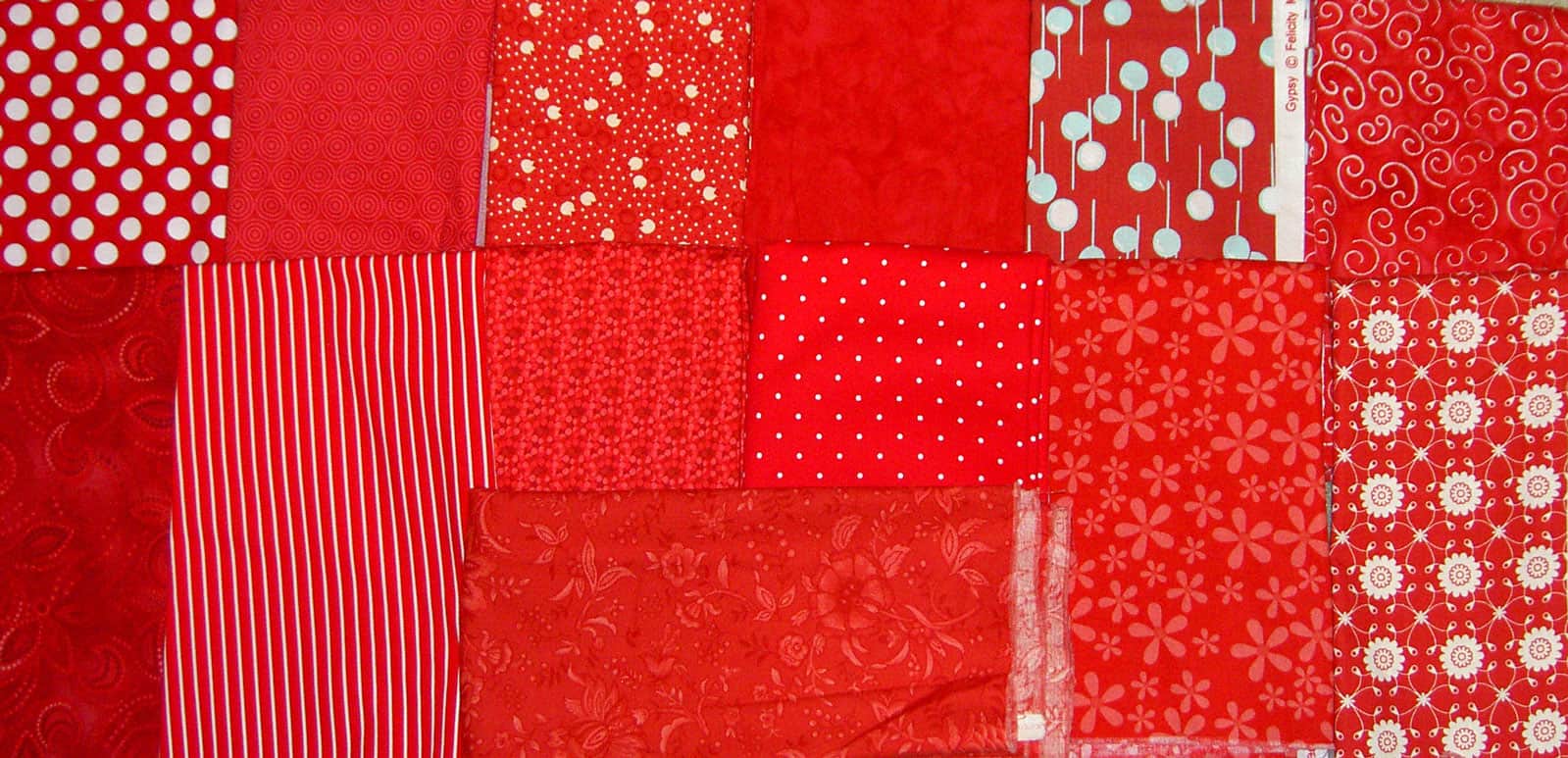
Auditioning Fabric
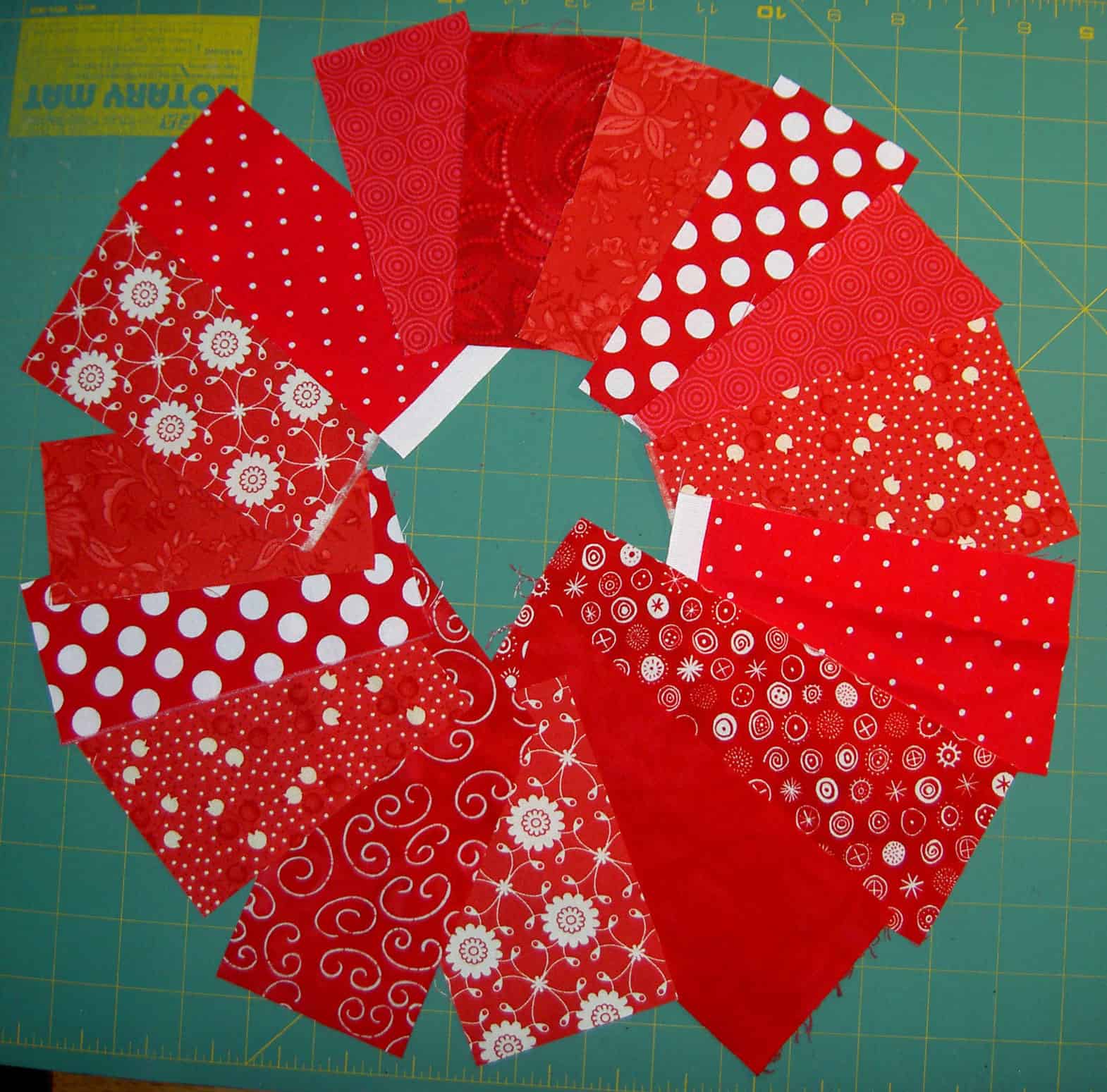
1. Select your petal fabrics. You can use 2 or many. You want to be able to see the work you have put into this block. Above are all of my options. I didn’t end up using all of them.
2. Print 3 copies of Dresden Plate Templates pattern. Two you will cut out and one you will keep for future reference.
Rough cut templates out of pattern sheet
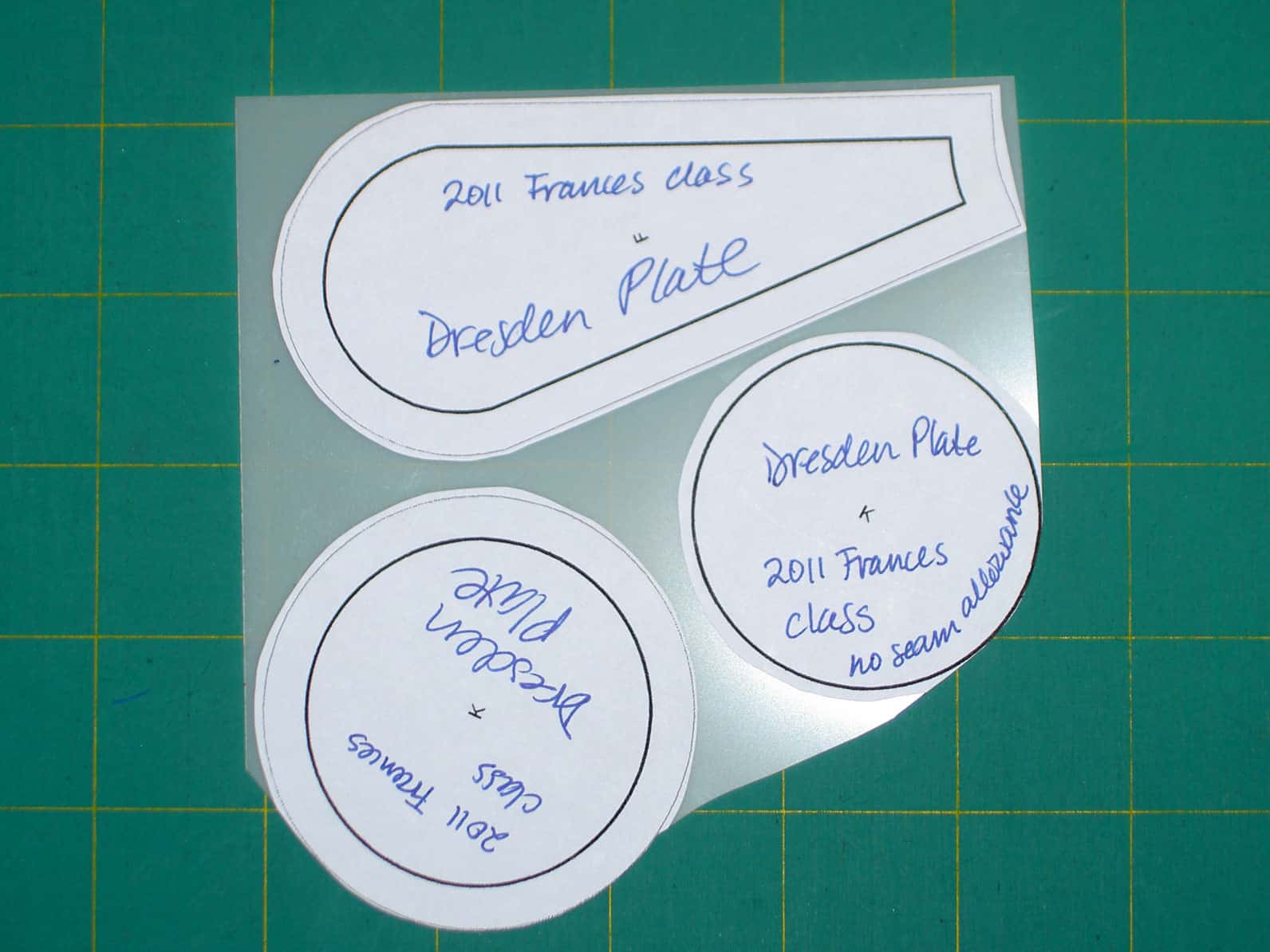
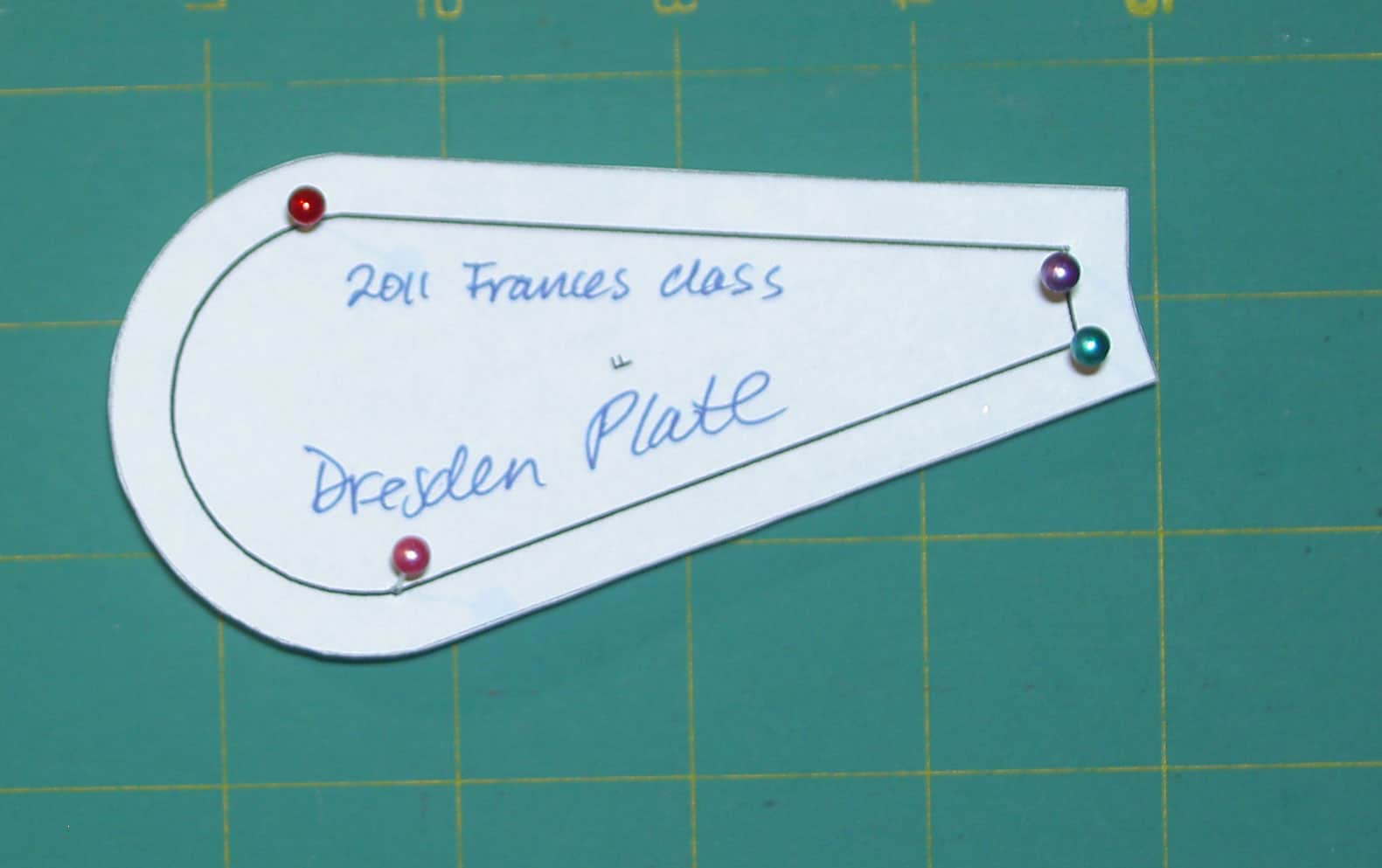
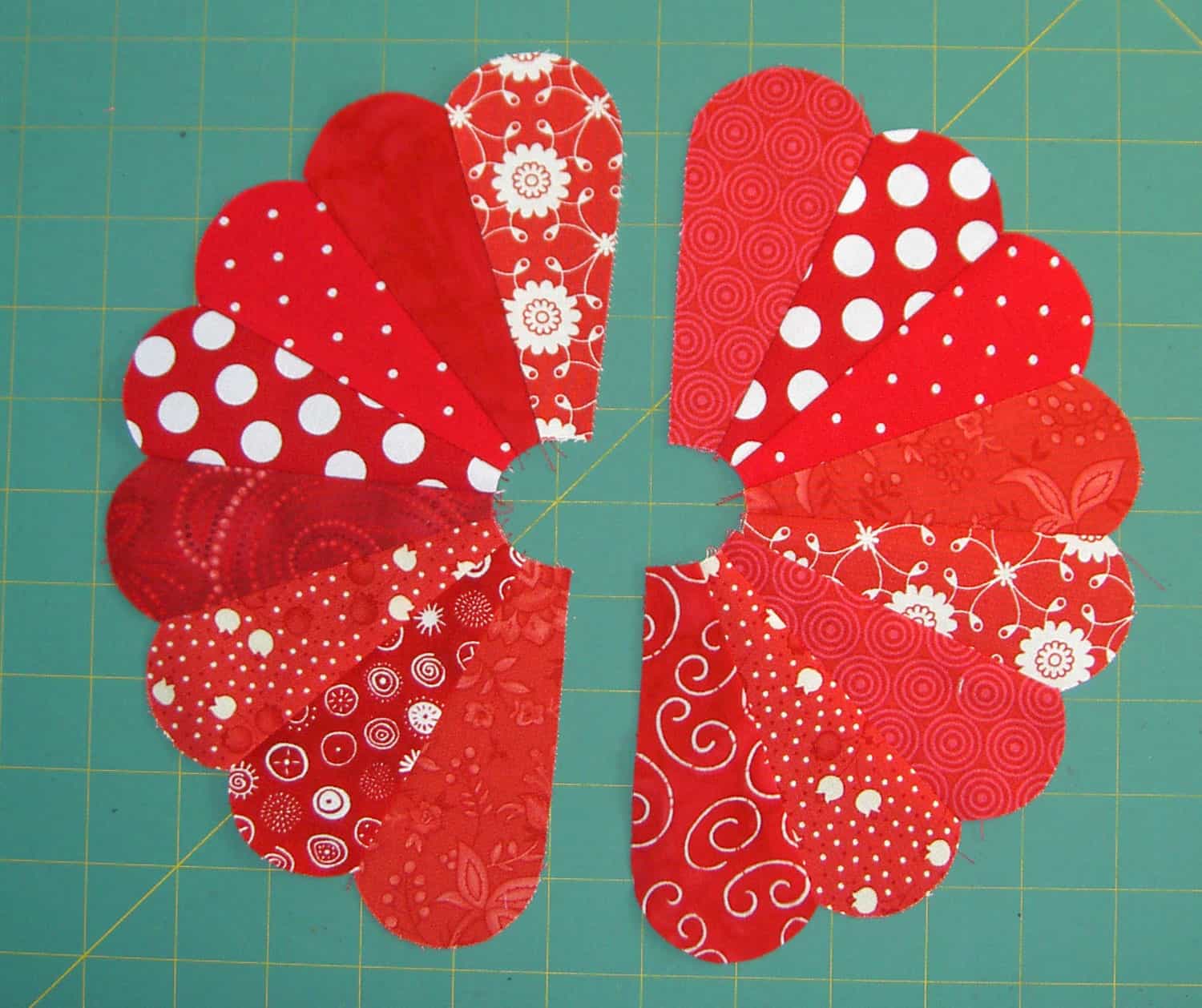
3. From one pattern sheet rough cut around the petal and the circle including the seam allowance.
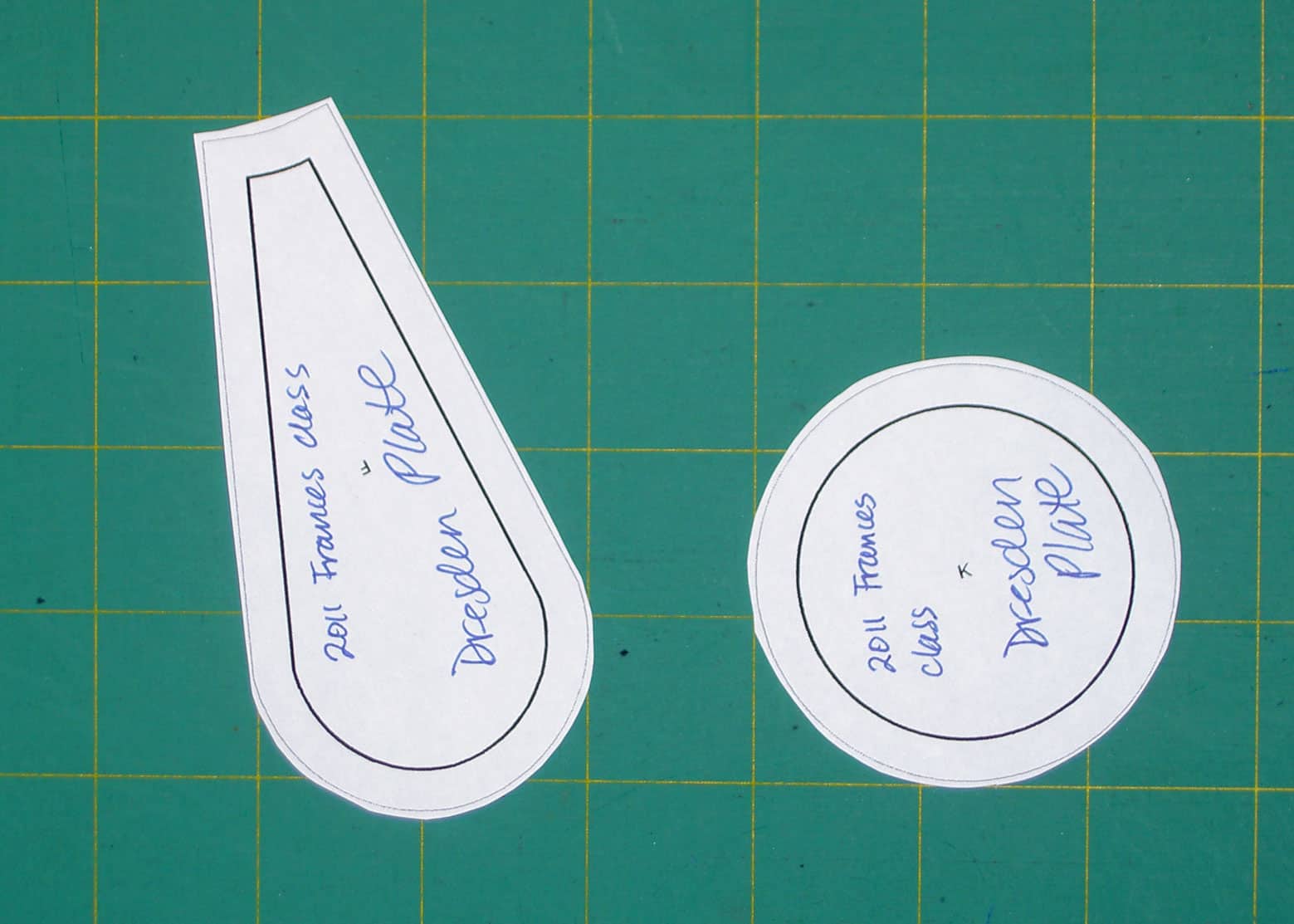
4. From one pattern sheet rough cut around the circle template and the petal template excluding the seam allowance. On the petal, cut off the thick black line. For the circle, leave the thick black line on the template.
Optional: Write ‘Dresden Plate” on each piece (or some way of identifying why you made these templates for later). Make a notation on the circle with no seam allowance so you don’t it mixed up with the other circle.
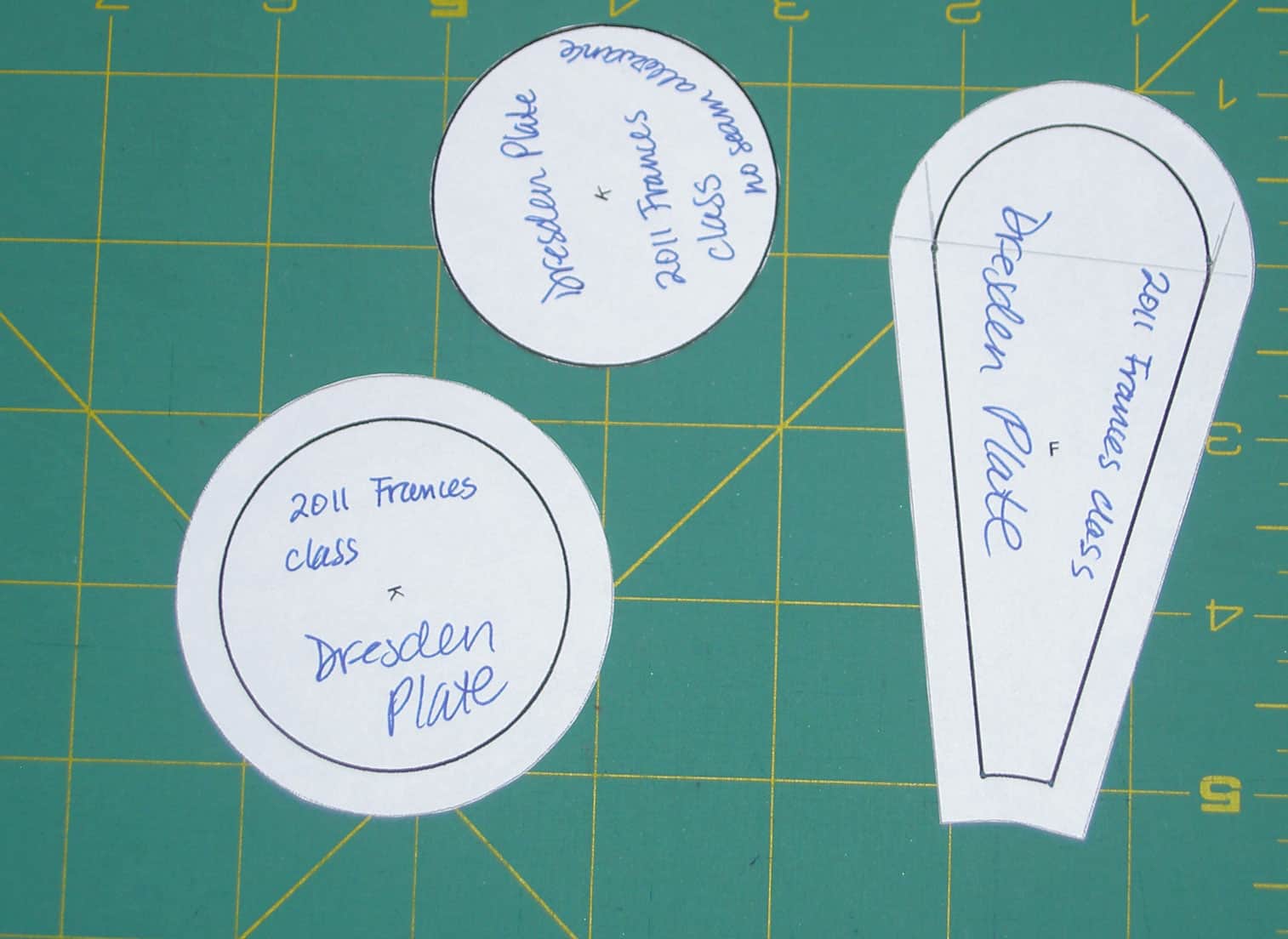
Glue paper patterns to template plastic
5. Glue circle and petal templates to template plastic
Templates Cut Out
6. Carefully cut templates out of template plastic just outside of thin outside line.
Extend Lines
7. Extend the straight line into the seam allowance with a ruler and a very sharp pencil or pen.
8. Right where the curve starts to move away from the straight line of the template, draw a line between those two points.
Poke Corners
9. At the intersection, poke the corner of the petals to mark sewing start and stop points. I used a pin and then enlarged the holes with a seam ripper.
Optional: Spray rectangles of petal fabric with Mary Ellen’s Best Press to control the bias.
Trace Around Petal Templates
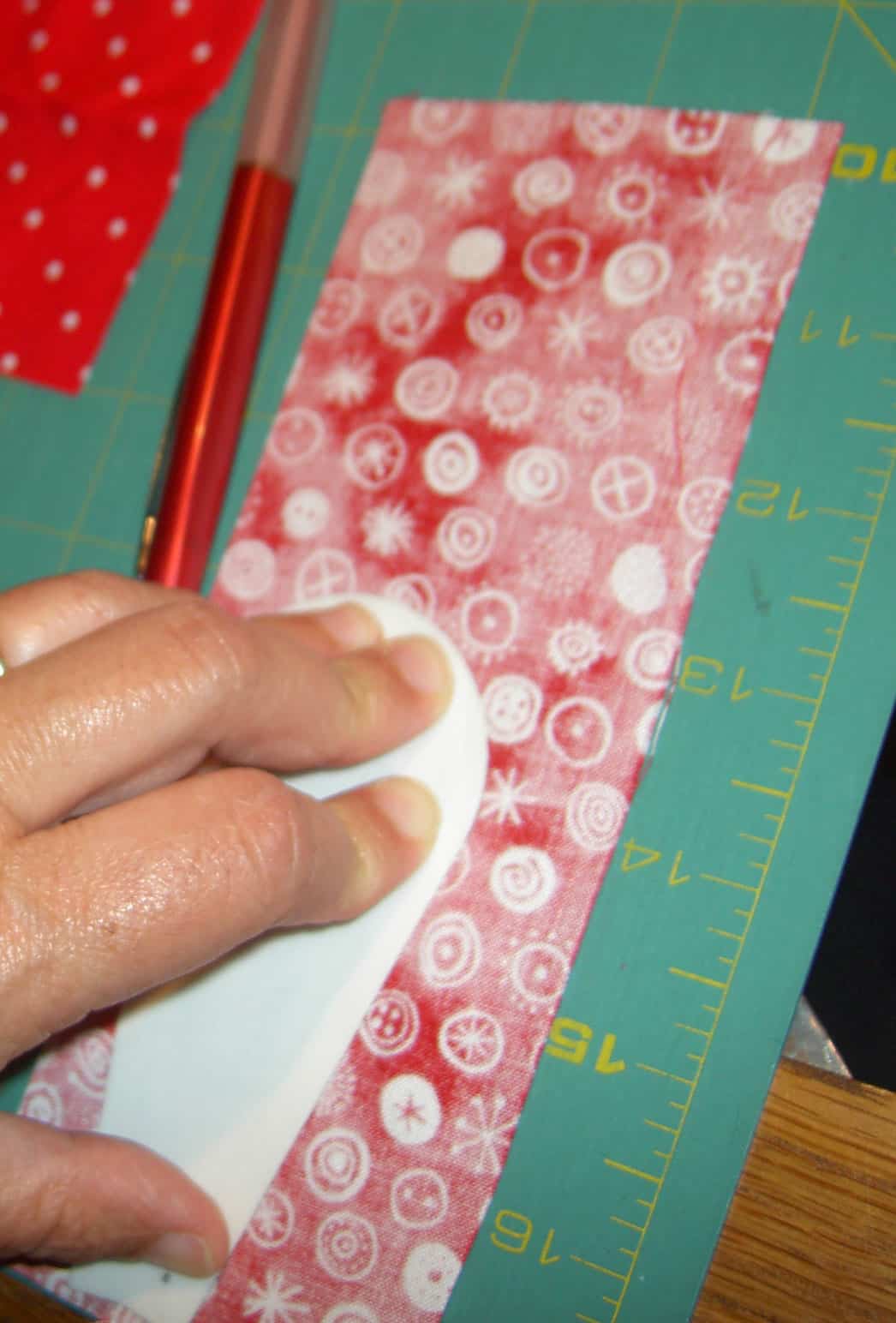
10. Trace around the petal template face down on the wrong side of the fabric. Hold the template tight down on the fabric with your fingers near where your pencil or pen is moving around the template.
Note: test to make sure that your quarter inch seam line covers the mark you made. If it doesn’t use a pencil.
Fabrics Ready to Trace
11. Use at least 2 different fabrics to trace 16 petals. You can use many more. You want to be able to see the work you have put into this block. If you use two, alternate them.
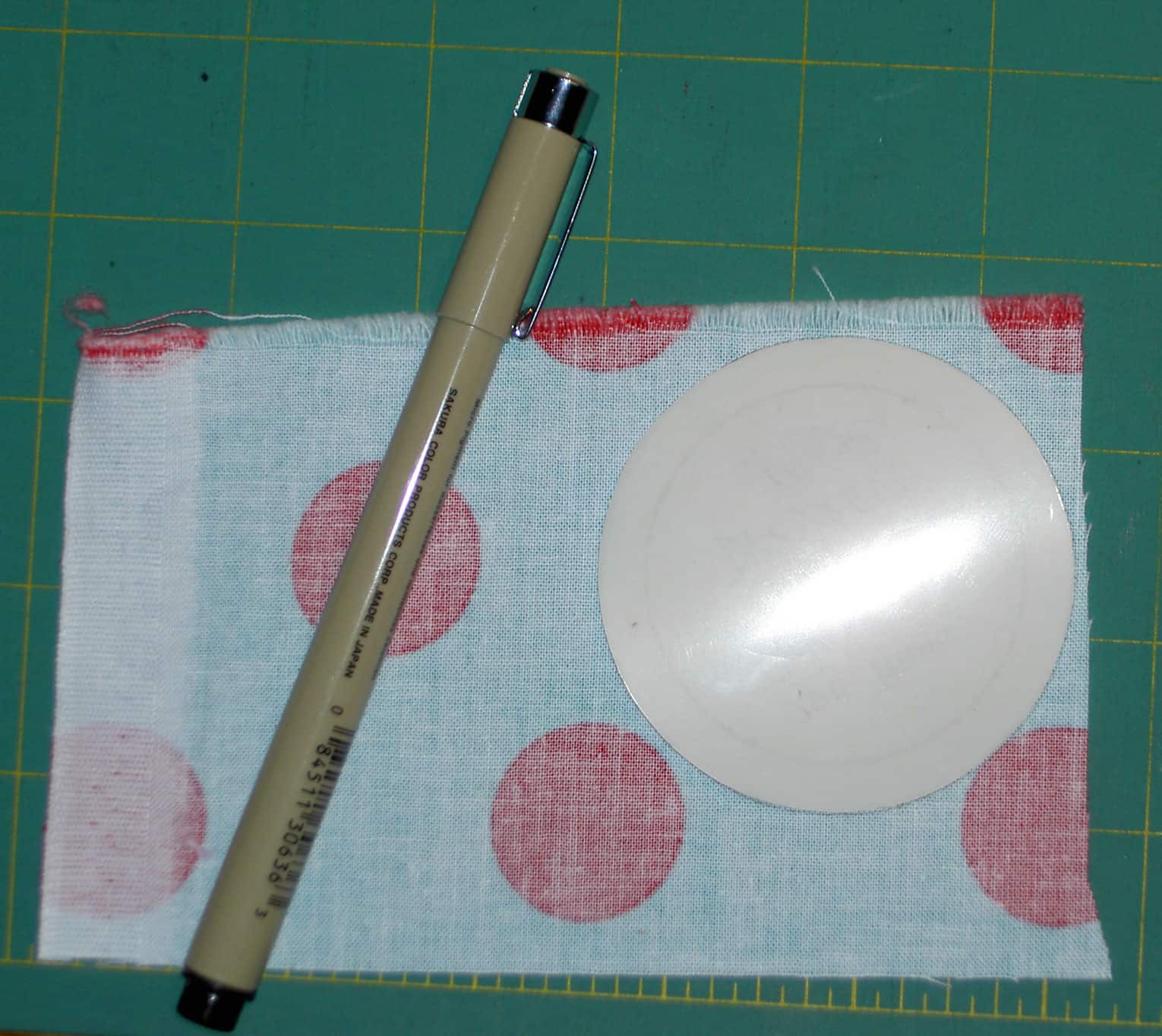
Trace Circle on Fabric for CenterCut out Center Circle
12. Trace a circle using the template with the seam allowance. Cut out the fabric circle with a generous seam allowance (more than 1/4″).
13. Cut fabrics using very sharp fabric scissors OR cut straight lines with rotary cutter and curved seams with fabric scissors.
Petals on DotsPetals on Flowers
14. Choose your background fabric by laying the petals on the possible background fabrics, approximating the shape of the Dresden plate.
15. Cut a 13.5″x13.5″ background piece. Your Dresden Plate will be appliqued to this piece. Make sure it is square by using a 15″x15″or larger square ruler. You want to cut a larger block, because the sewing of the block may make it shrink up. You will trim the background piece once your block has been completed. Set this aside for now.
16. Line up two petals, right sides together.
17. Pin pieces together by lining up the holes you made when you traced around the template.
Sew from Point to Point
18. Sew from point to point, back stitching at each end. DO NOT sew into the seam allowance.
19. Press seams open.
Group of 44 Groups of 4
20. Sew petals together in groups of 2, then sew the groups of twos to each other to make groups of 4, etc.
21. Sew between points, back stitching at each end. DO NOT sew into the seam allowance.
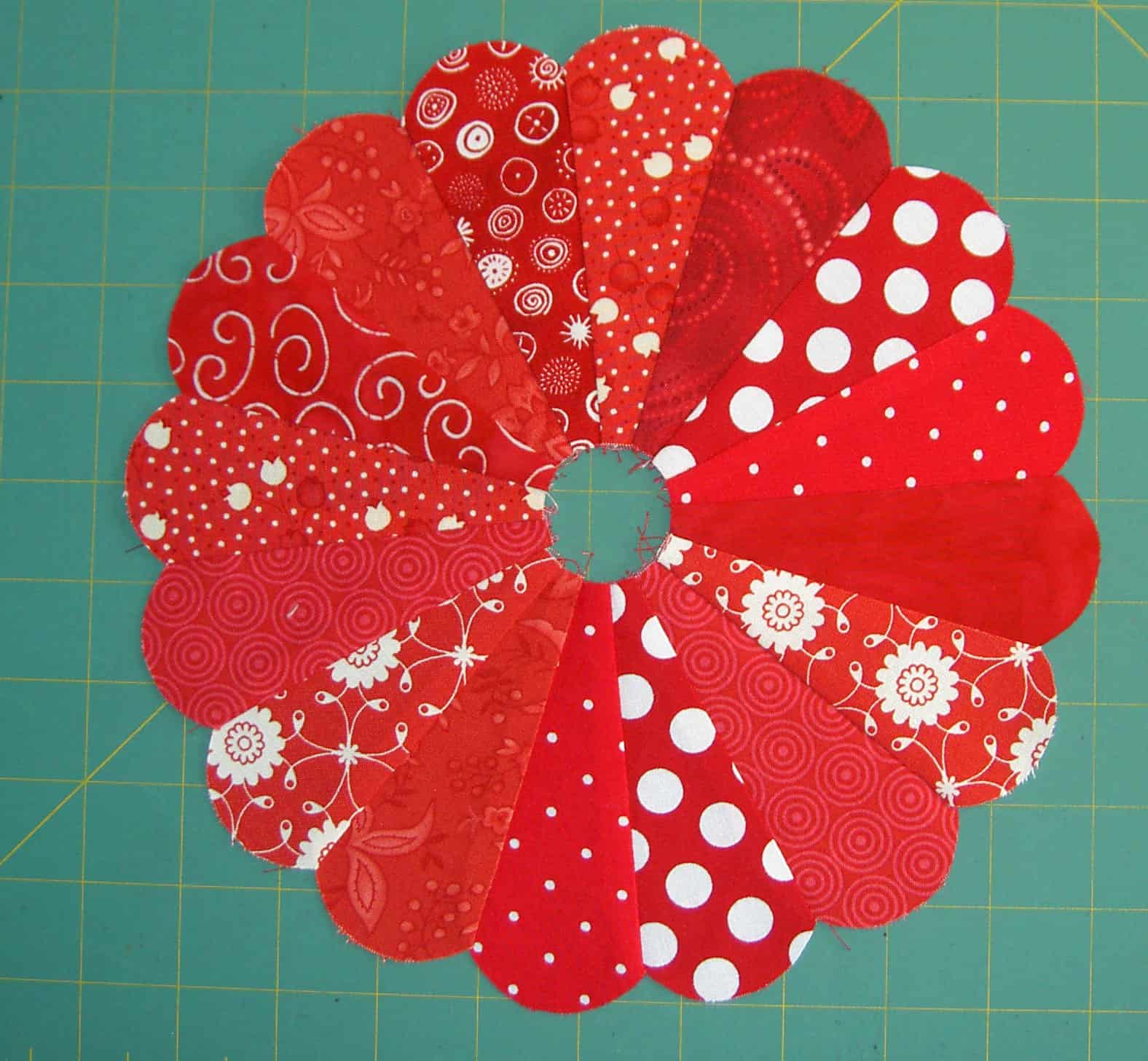
Completed Plate
22. Sew all petals to each other, back stitching at each end, making a ring.
23. Press all seams open.
24. Trim threads.
25. Lay petal ring face down on your ironing board.
Plate face down
26. Lay the petal template without the seam allowance (which must be made from heat resistant template plastic or cardboard. Don’t use something that will melt) on the back face up.
Press Curve
You probably won’t be able to get the seam allowances flat, but press enough so the fabric knows where the curve is. It will help you when you go to stitch it down.
Press CurveFinished Pressing all Curves
27. Press the curve into the outer edge of each petal. Use the stiletto to hold down the edge and iron right over the stiletto tip and the template. This is the miserable step, so intersperse some chocolate or some other sewing. Lay aside.
28. Take your cut piece of background fabric. Fold it in half and press lightly.
Fold Background in 1/2, then 1/4s
29. Fold your background fabric in half again (in quarters) and press lightly.
30. Open and you should be able to see the cross you have pressed into your background piece.
Center Plate on Background
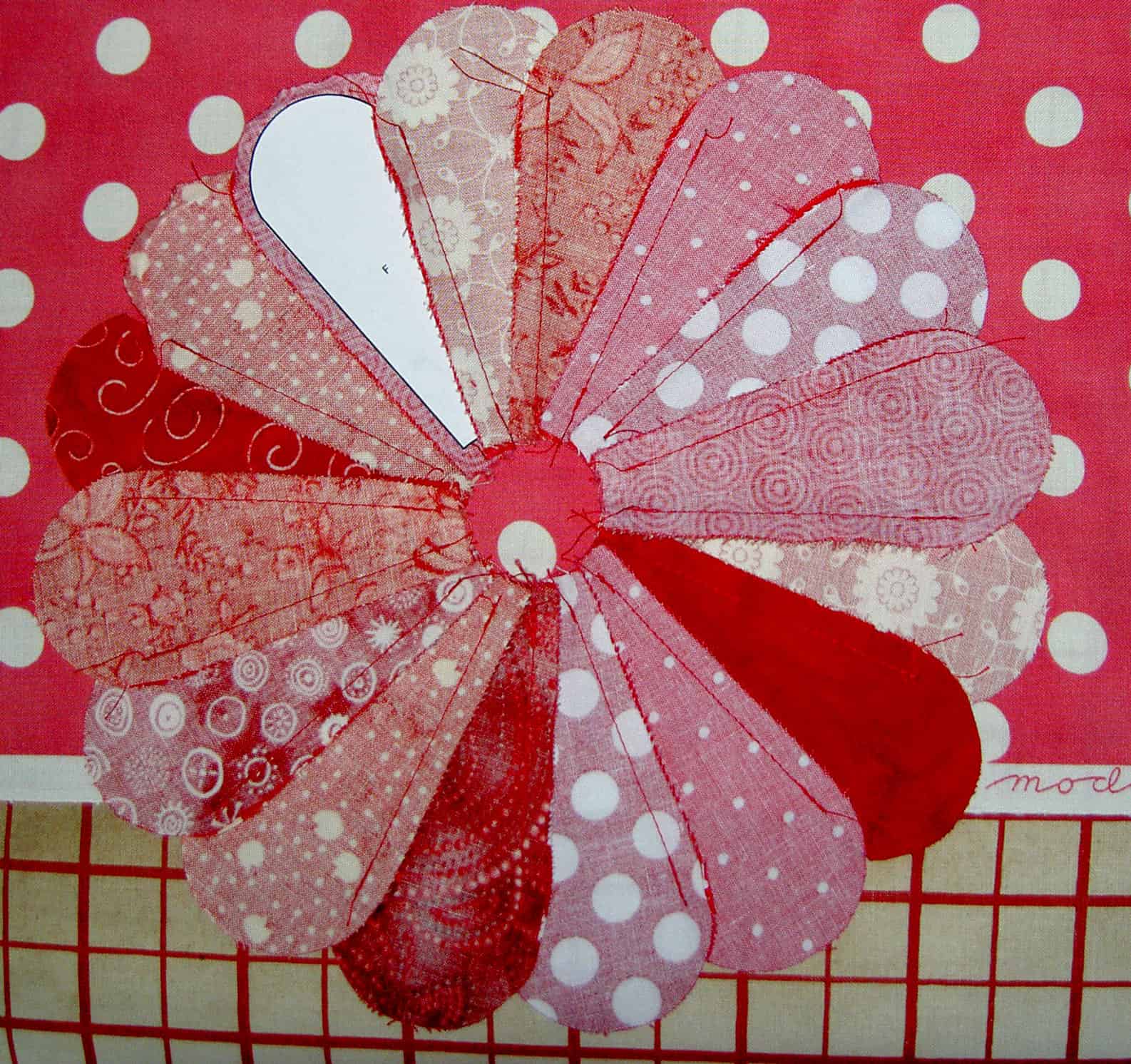
31. Take your plate of petals and line up 4 of the seam allowances with the pressed cross on your background fabric. This will center the plate on the background. Make sure you pay attention to the vertical as well as the horizontal.
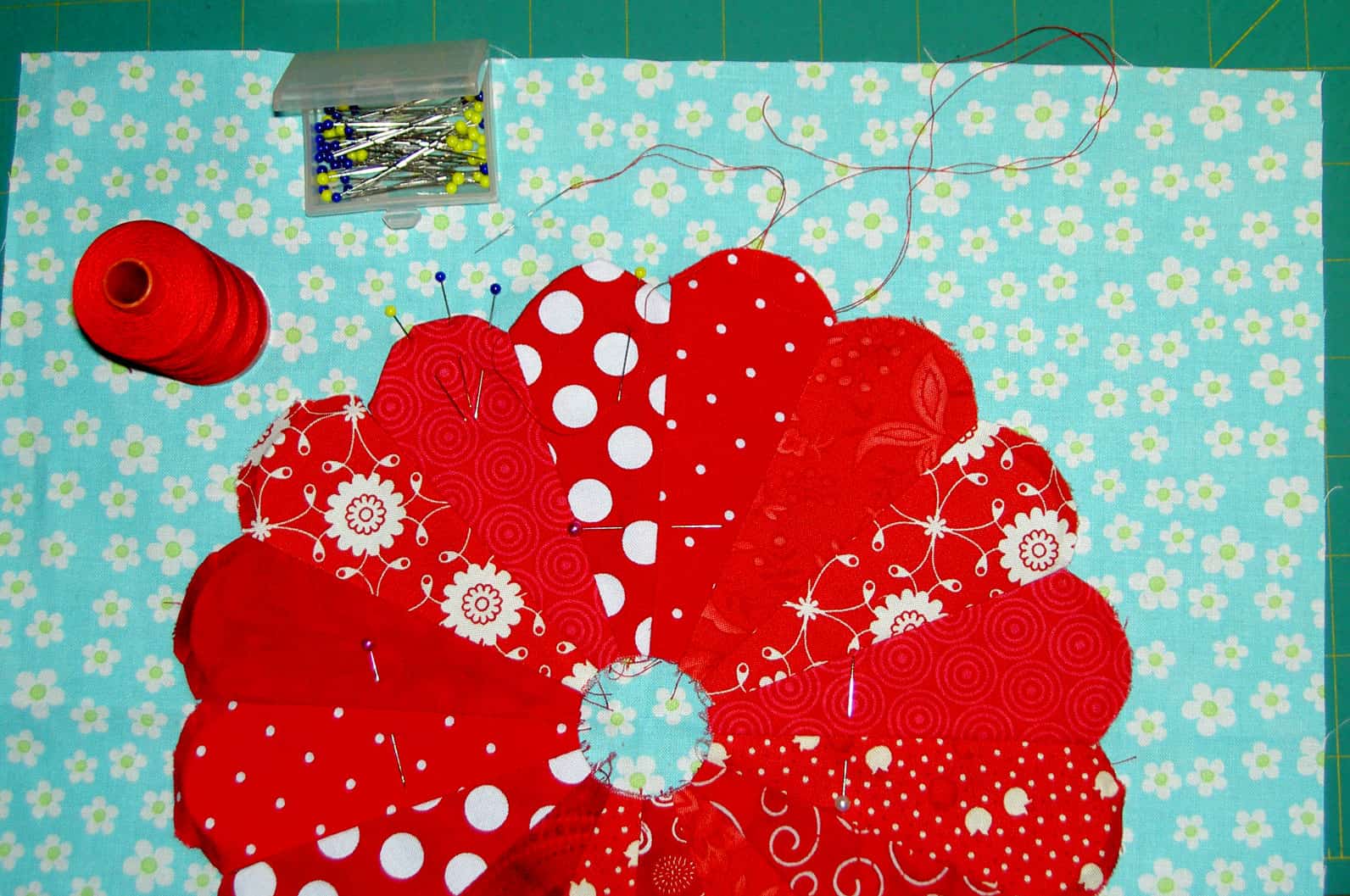
32. Pin in place
33. Use thread that matches the plate or is neutral for hand applique’ or a blanket stitch to sew plate to background. You can also machine applique’ the plate to the background. We will cover that technique in another lesson, but there are many other tutorials available.
Move Pins as you Stitch
34. Pin curved edges of plate as you move around the plate to applique’.
35.Know the thread so the knot does not pop through the background.
36. Bring the thread up from the back through the fold of the plate (where you pressed the seam allowance).
37. Tug gently and put the needle into the background, just catching it, and pull the needle tight through the fold of the plate again.
38. Go around the entire plate in this manner, using the needle to tuck in the seam allowance so it has a smooth round shape.
Trace
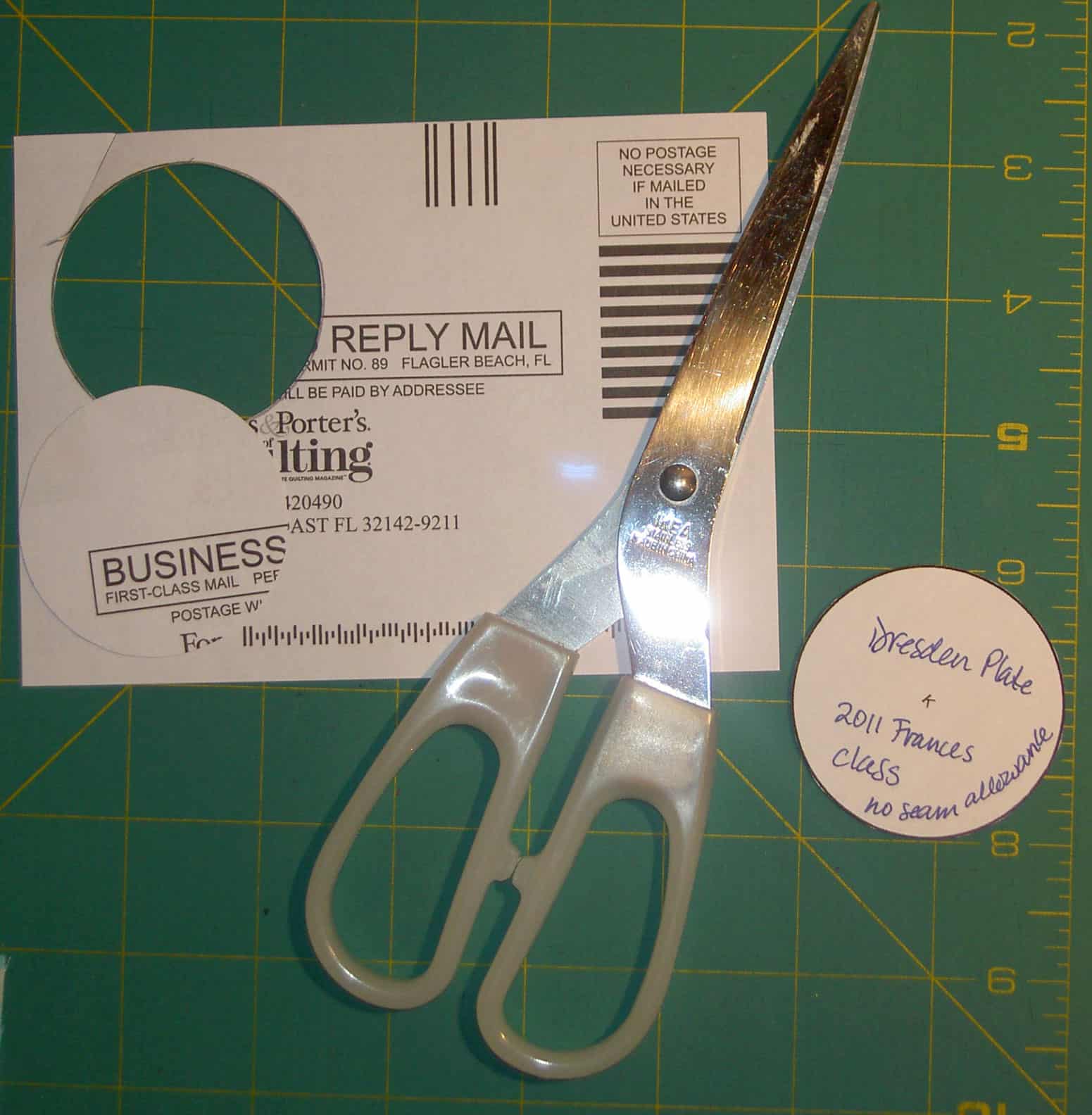
39. Trace the circle template without the seam allowance onto the magazine subscription card.
Cut out Circle
40. Cut out the magazine subscription card circle, being sure to cut off the pencil/pen line.
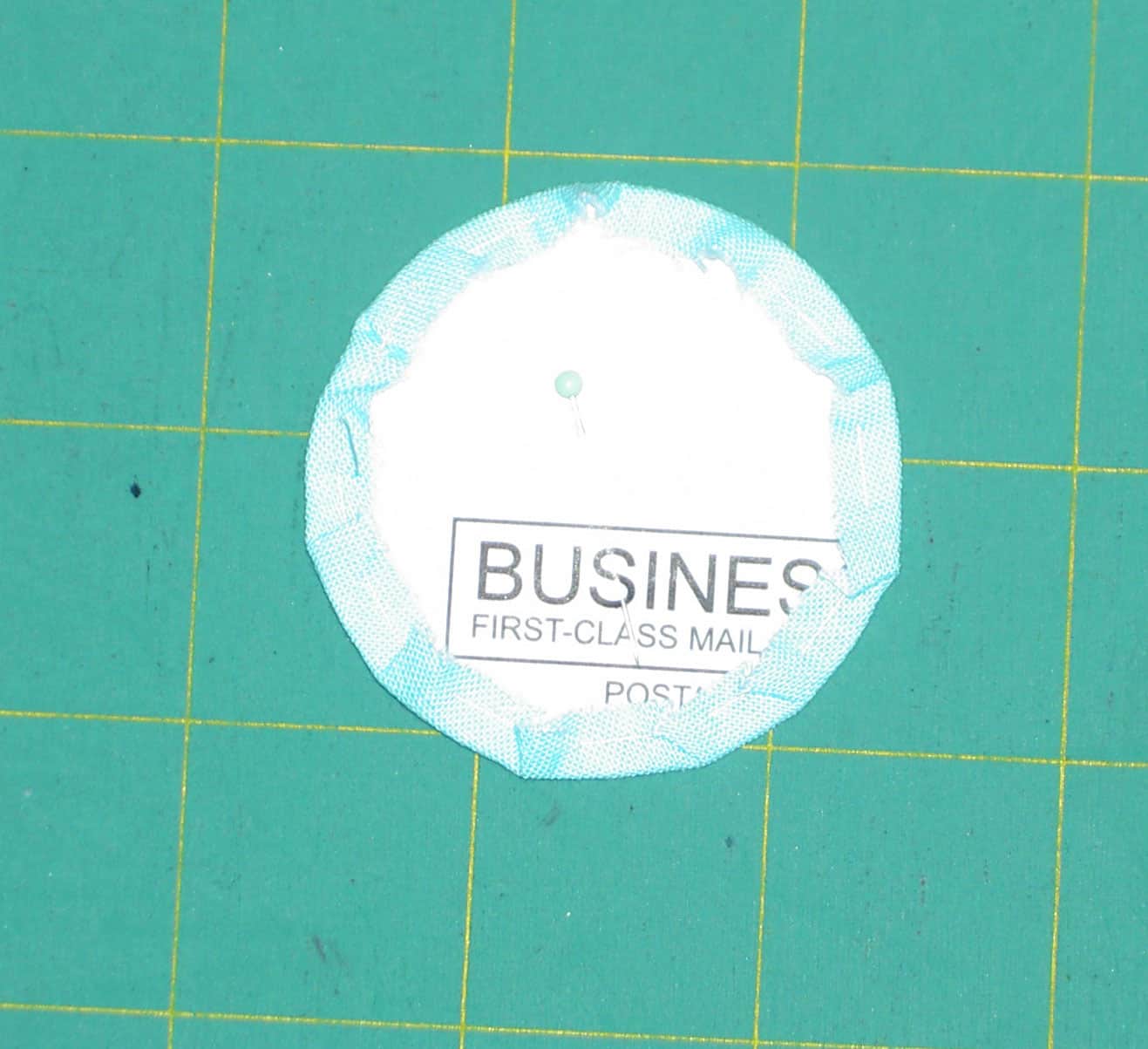
41. Take the circle fabric you have cut and wrap it around the magazine subscription card circle.
Use a Running Stitch to Draw up the Circle
42. Using any thread, take a running stitch in the seam allowance of the circle fabric and tighten it, keeping the magazine subscription card circle flat. If the magazine subscription card does not have enough body, you can also use the circle template without the seam allowance.
Pressed, Drawn up Circle
43. Press the drawn up circle well, so it is flat and a perfect circle. You will need to tug on the thread to draw the circle up as you press the first time. Once the fabric knows it needs be pressed you can pull the thread tight and make a knot.
Center Circle Ready to Applique'
44. Pin the circle to the center of the block, covering the raw edges of the center petals.
45. Applique’ using the same directions you used to applique’ the plate.
46. Trim block to 12.5″x12.5″. You might want to wait until you start assembling the quilt.
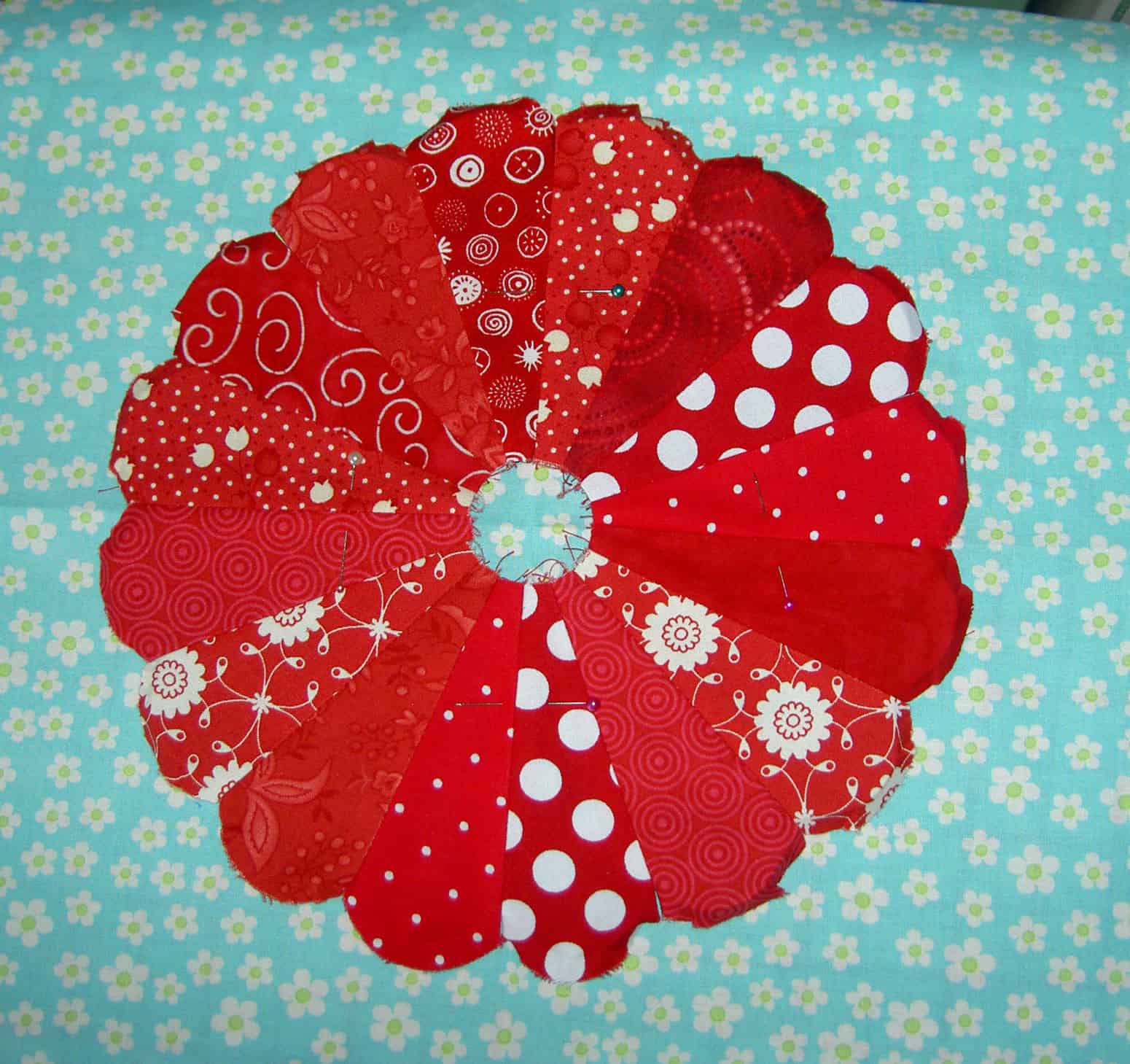
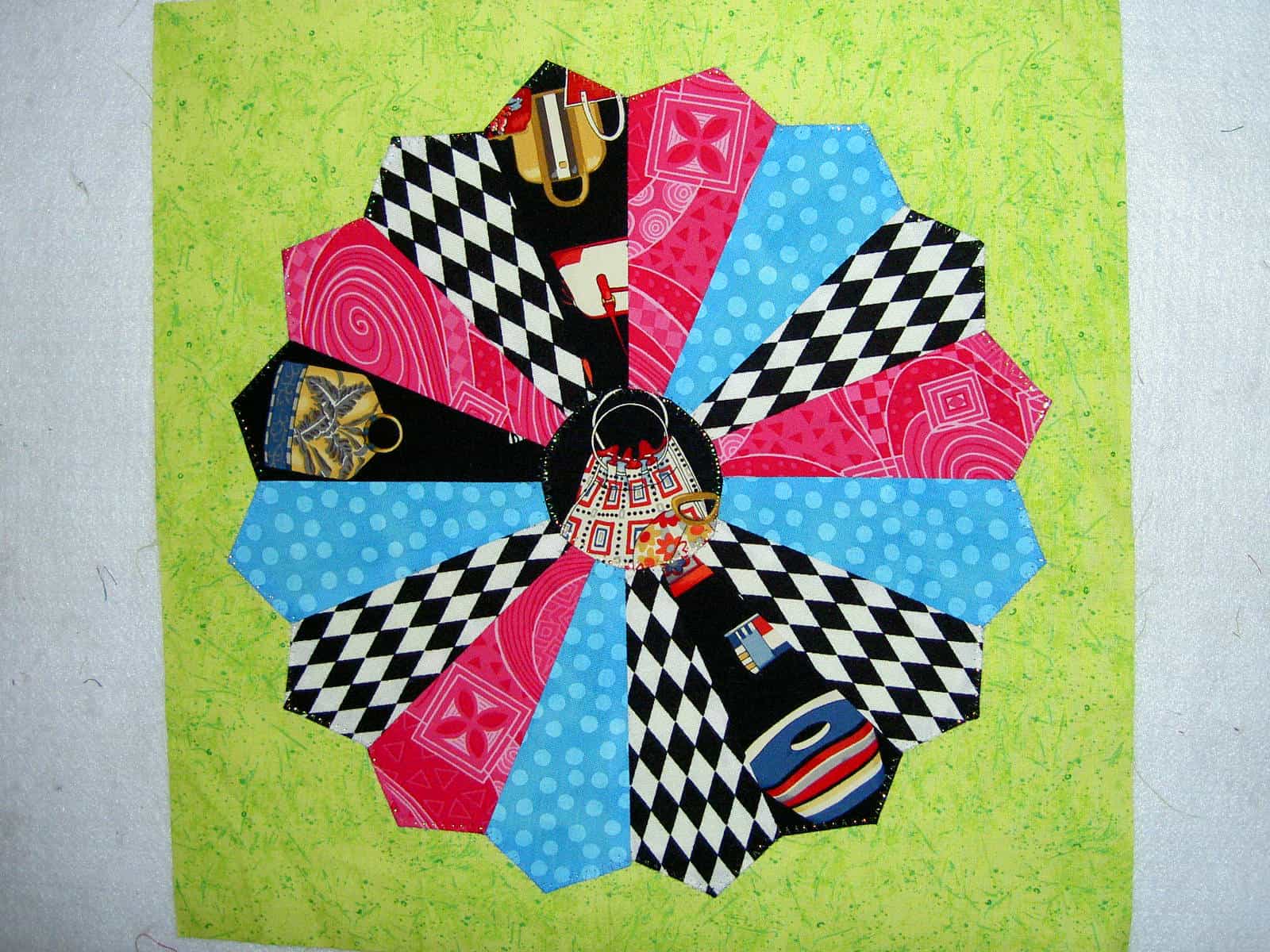
Dresden Plate Sample
The green, turquoise, black and pink sample Dresden Plate was made for the class I taught in 2006/2007. I did this one a little differently. I machine stitched the plate to the background and the circle to the center.
As you can see, I also fussy cut fabrics to take advantage of larger spaces in the quilt block.
Dresden Plate detail
In the solid Dresden Plate, I placed like fabrics into groups of two for a slightly different look. The center circle was a good showcase for a bit of hand quilting.
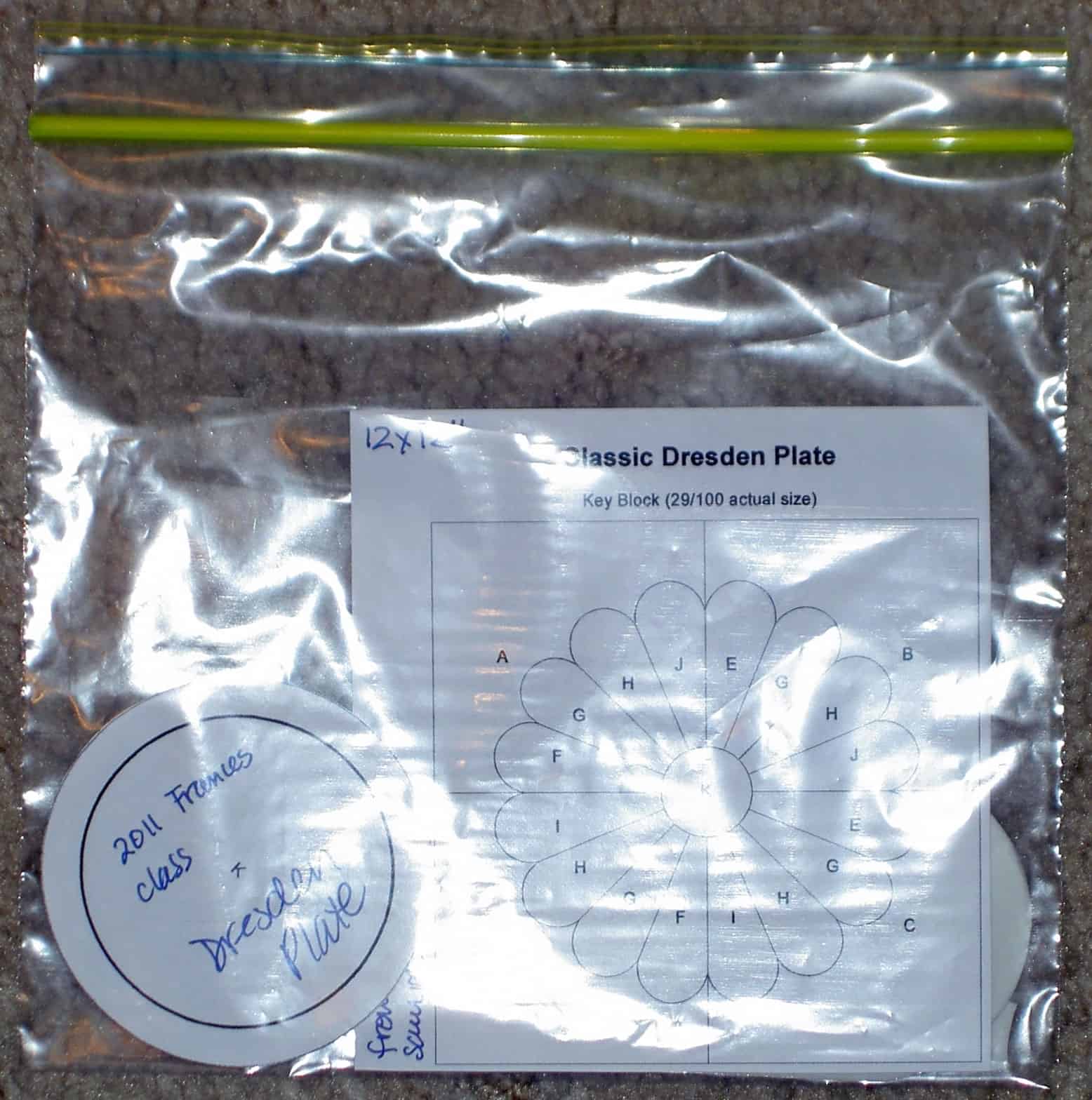
Store Templates in a Ziploc Bag
I may add some more photos to illustrate steps better and will link to this tutorial from the Artquiltmaker Info–>AQ Tutorials link under the header (see above).
I store my templates in a ziploc bag with a picture of the block or a label with the name and size of the block on it.
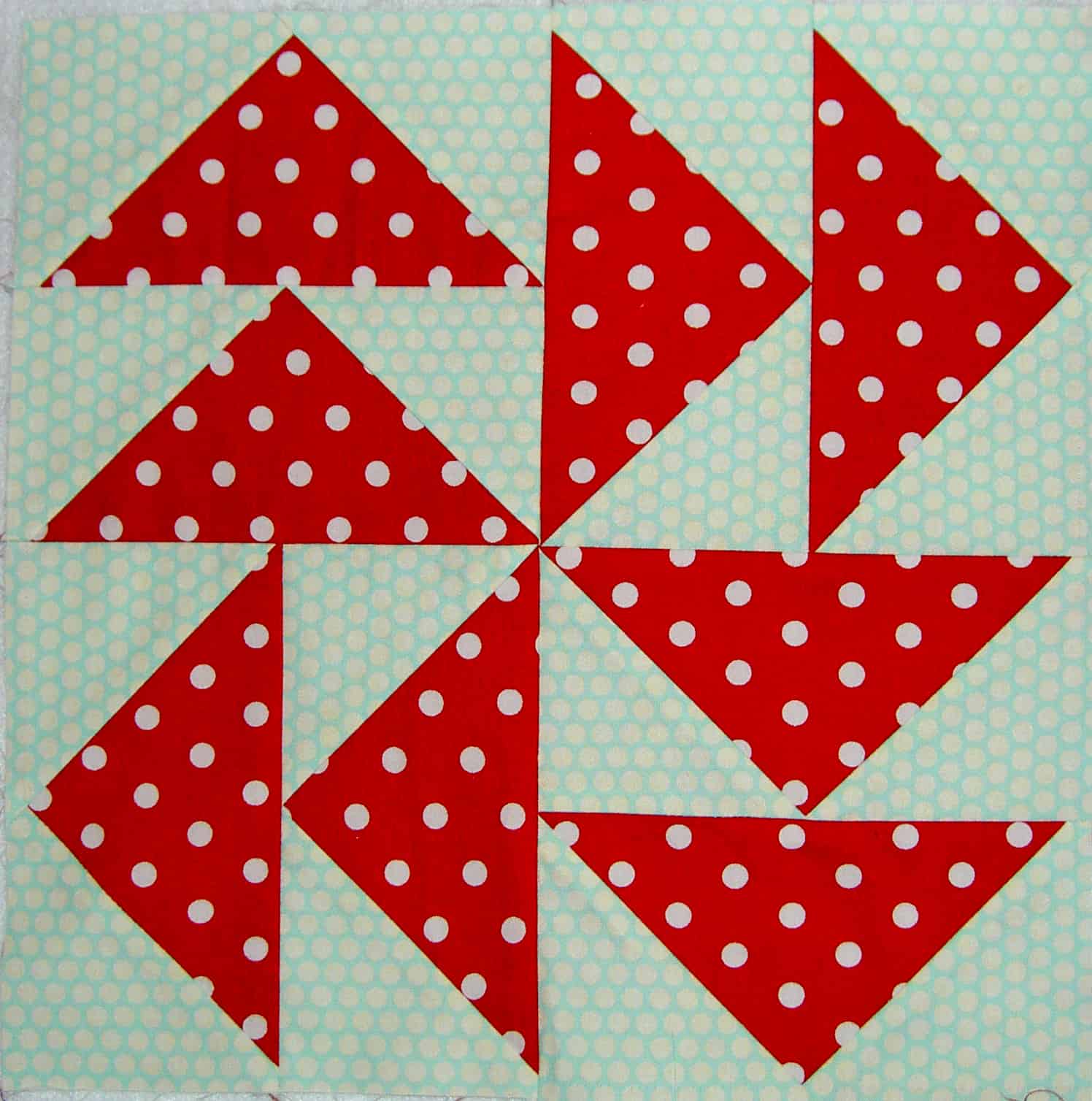
We have been on a bit of an unintentional hiatus, because I was out of town for 10 days, she had some things to take care of and went to the beach, the Young Man graduated and, generally, life got in the way of quiltmaking. I needed to get in gear for as much sewing as humanly possible this weekend, so I started in on the Dutchman’s Puzzle on Thursday night.
Doing one block doesn’t take very long. I thought I would just getting the cutting done, but I was able to piece the whole block together. I had enough time even after I sewed the four major sections together wrong and had to rip them out! Being more of a morning person, I don’t sew well at night (make lots of mistakes) and usually just hand sew bindings or something. I am glad I didn’t do worse damage!
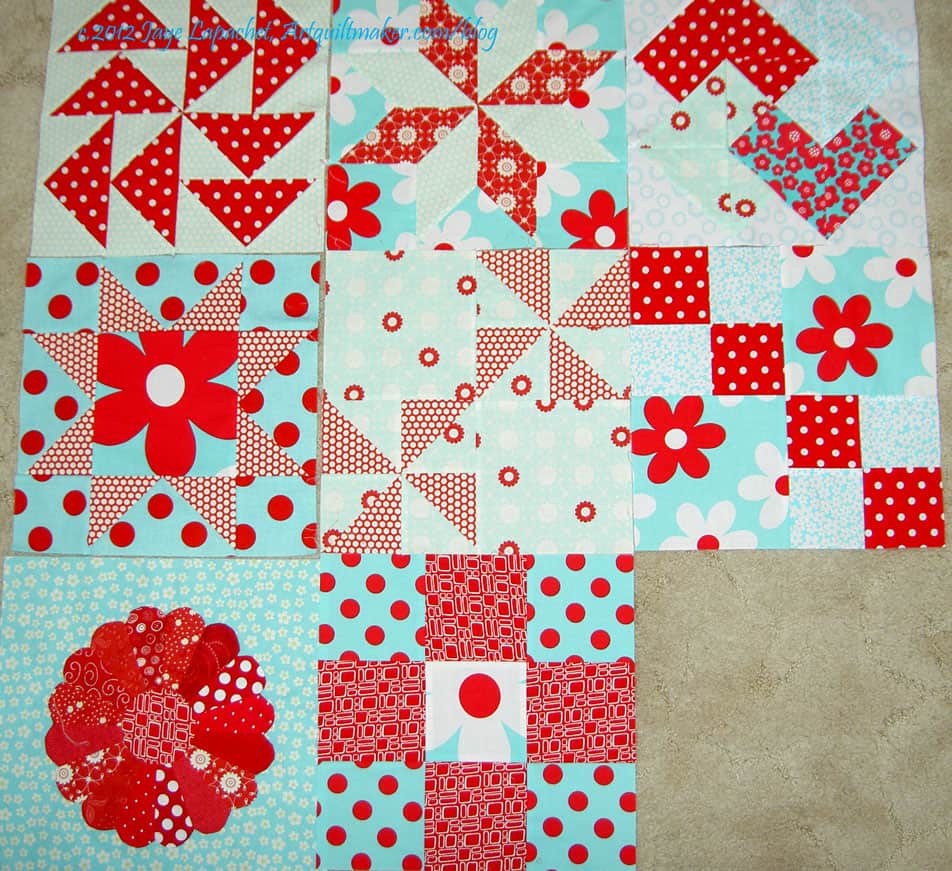
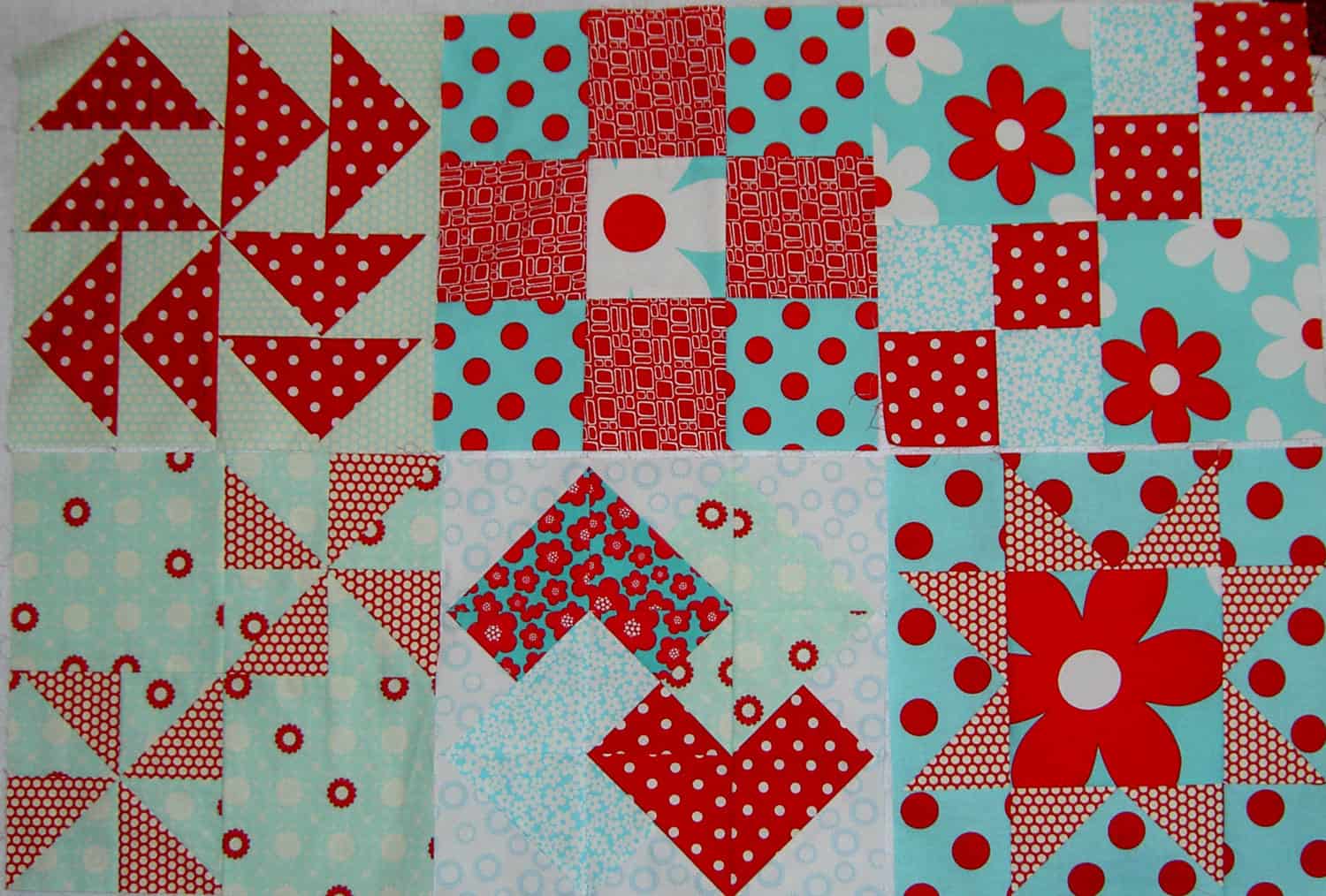
Sampler Blocks, early July 2011
Now I have a nice round 6 blocks. This reminds of the goals of the first ever quilt class I took. The goal was to make a 6 block sampler. The blocks are different, but this group of blocks provides me with some fond memories.
I also was able to look at the piece from a color and fabric stand point. I am not liking the Card Trick. I need to decide if I will make a new one or include the light background fabric in a couple of other blocks.
I can also see that I need to include the Big Plain Jane fabric, and a few other fabrics, in at least one more block. I am pondering whether or not there is a block scheduled that will showcase it.
All in all, I really like the way this is coming out.
This post is kind of a roundup of the good and the bad. No ugly today, as I use GREAT fabric. 😉
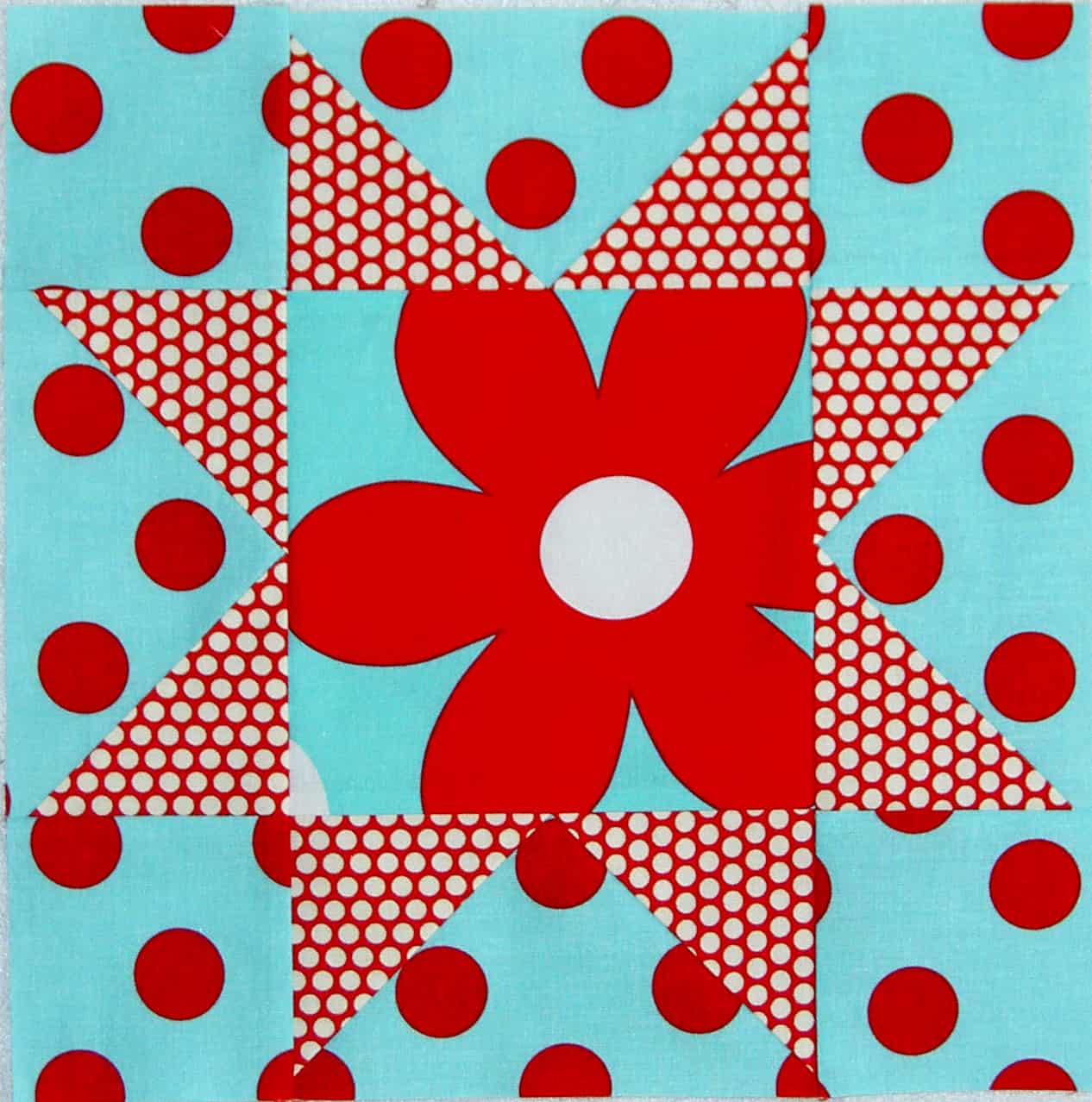
This Sawtooth Star block is one I use to teach Flying Geese. I love the Dutchman’s Puzzle block, but think starting students out with 4 Flying Geese as opposed to 8+ is much kinder.
The larger blocks are weird for me to make, because I like to make 6″ or 8″ blocks mostly. The good thing about making these giant blocks is that there is a lot of potential for fussy cutting and the Big Plain Jane print worked really well in this block. I tried to position the flower a little off center to add a bit of interest while not showcasing the white flower that is near the red flower on the print. I am really pleased with how cheerful this blocks looks. I am glad I am working in a turquoise/aqua and red palette.
Card Trick
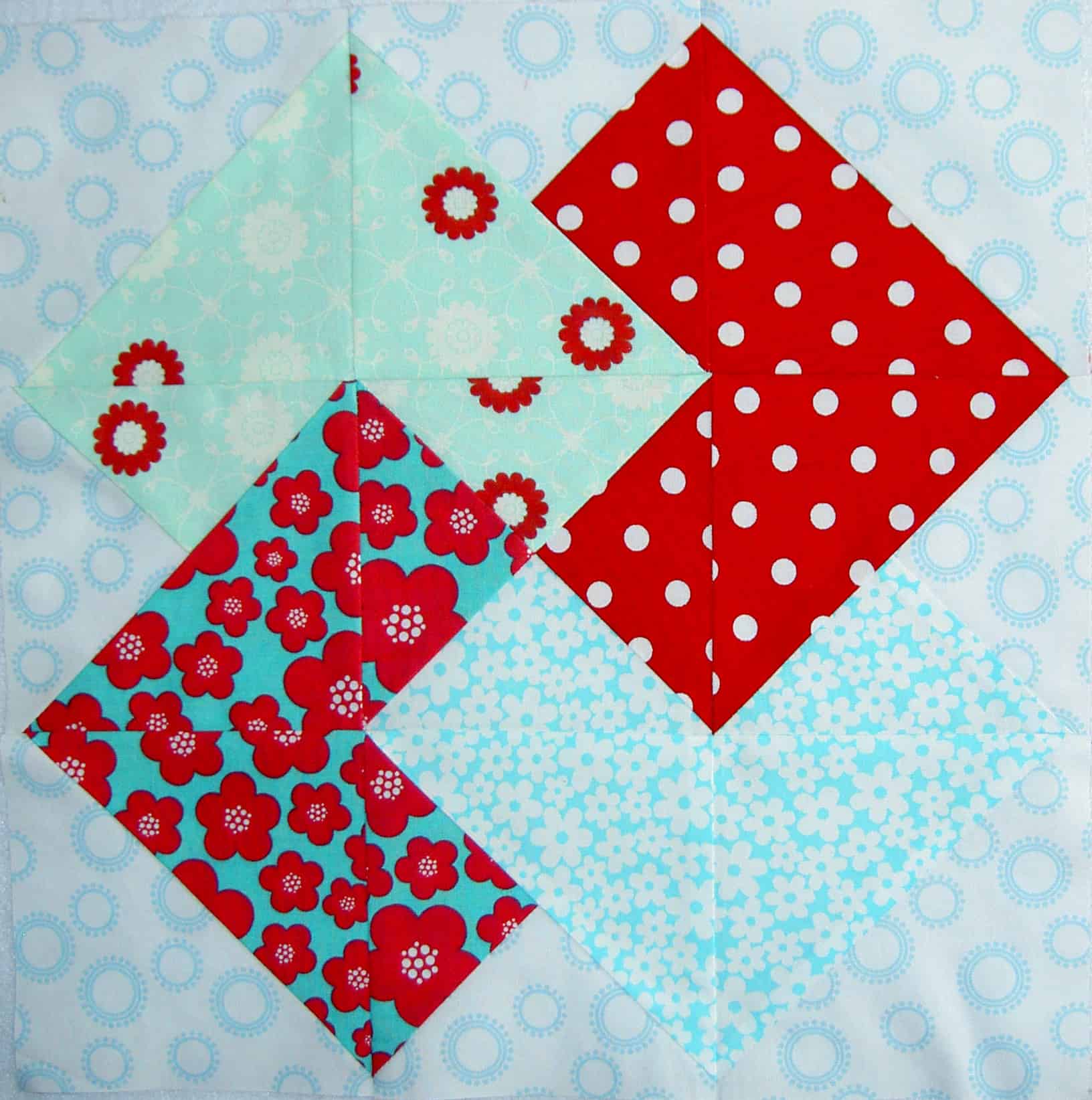
The Card Trick block is a great block for practicing triangles. It includes both half and quarter square triangles. If you haven’t tried the Card Trick, it is a great block as long as you pick the right fabrics. I, as you can see, did not build in enough contrast between the background and the light fabrics. There are a lot of seams and triangles in this block and you have to lay it out and piece carefully, because it is easy to get mixed up.
As I work on this project I see these blocks set on point with red cornerstones. We’ll see as the time gets closer.