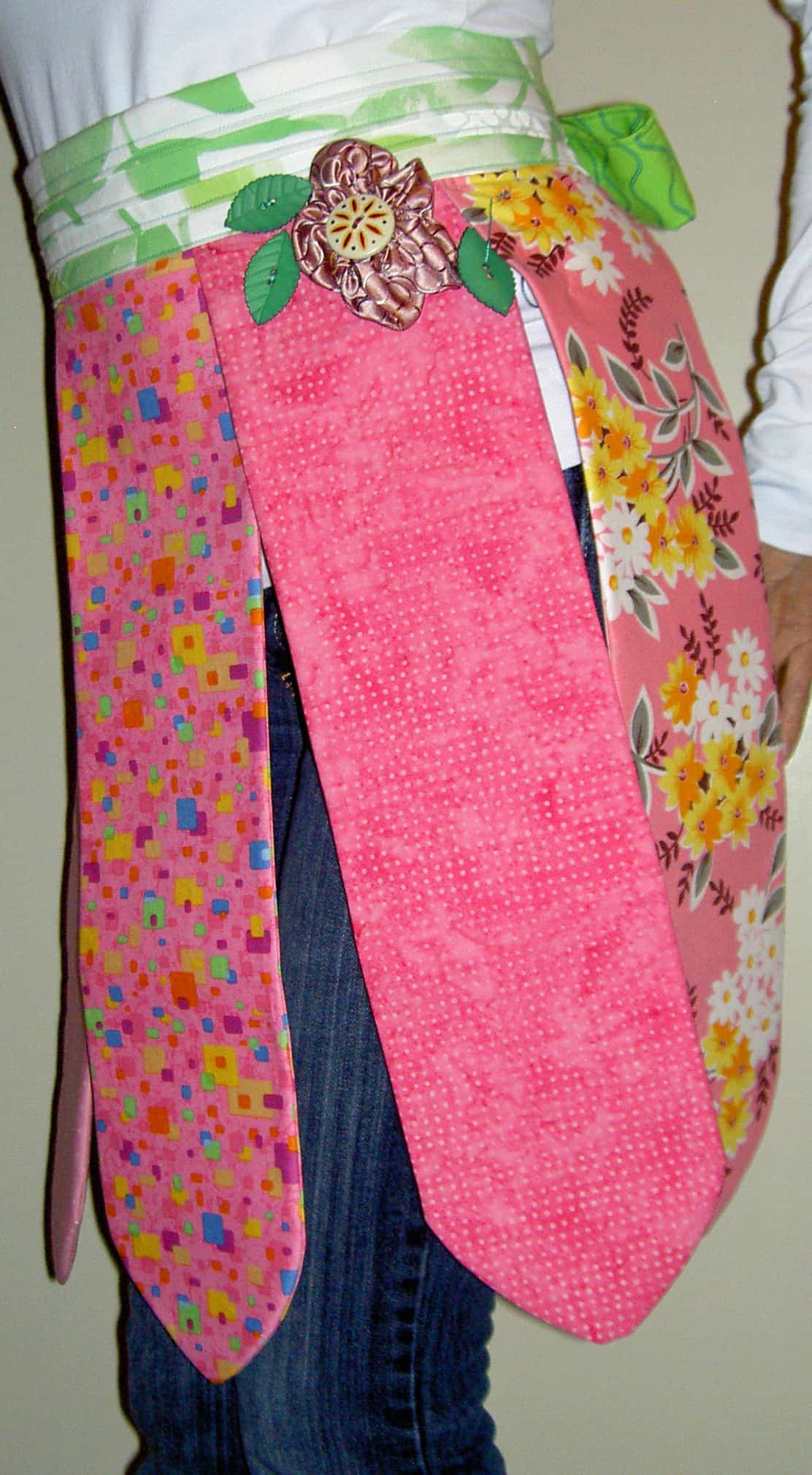
Jennifer at CraftSanity is running in a race for charity in May. She is part of a special training group called the Road Warriors. The Road Warrior team members get training mentors, have a blog and train together. She has been paired with a domestic violence shelter. In order to be part of the Road Warrior team, she needs to raise a certain amount of money for a charity. Instead of going door to door to gather donations, Jenifer is organizing an apron exhibit. To do that she needs aprons. I decided to make and send her one.
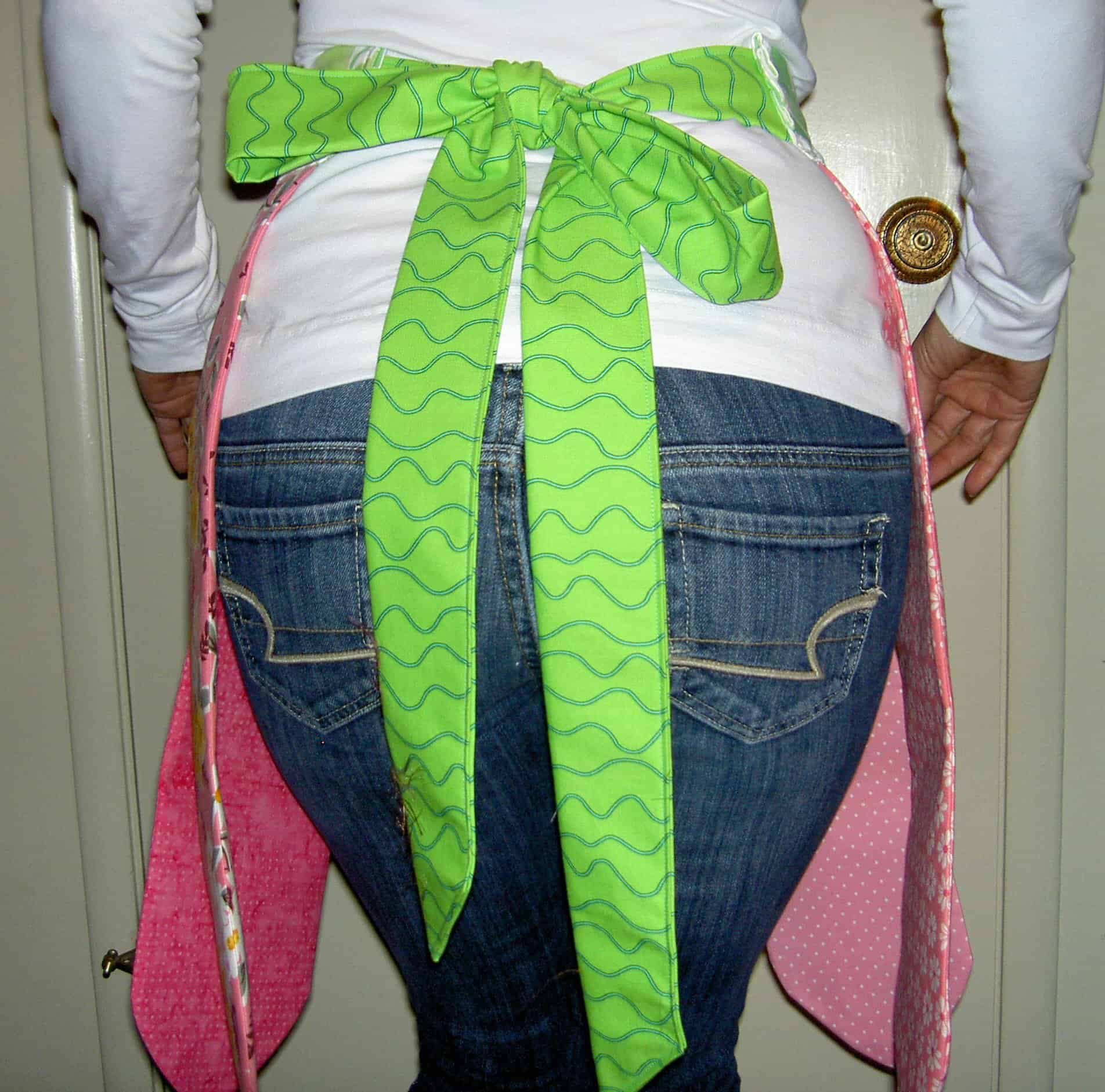
Apron Right (Tarty view)
I had listened to the Patchwork and Pacifiers podcast just before listening to Jennifer’s newest CraftSanity podcast that mentioned the apron contest. The P&P podcast is one to which I just started to listen. On that day, I heard Jennifer Ruvalcaba (P&: host) briefly mention a petal skirt her daughter had. Then, when Jennifer Ackerman-Haywood (too many Jennifers doing podcasts??) mentioned the apron contest an image formed in my mind. Then, I was looking the One Yard Wonders book. That combined with the various other sensory inputs and I was off and running.
The Kitschy Kitchen Apron from One Yard Wonders was a big help with sizing and length of the straps. I had a good time working on it as well, though I found it to be quite a solitary endeavor.
Apron Front (Supermodel view)
One of the requirements of the exhibit is to add a piece of tie fabric to the apron. I wanted to put a flower made from the tie fabric on the apron, so I had to go and find a pattern, which, through the power of the ‘craft’ web, I was able to do quite easily. I found a site, Tip Junkie, which had a number of different patterns. I ended up using Pink Paper Peppermints Rounded Petal Fabric Flower pattern to make my flower. The tie fabric frayed quite a bit, so it wasn’t a particularly fun process, but I learned how to make fabric flowers. I could have used Fray Check, but I was afraid it would stain the fabric.
Apron Side
I spent most of the weekend working on the apron. I had actually been thinking about making one for awhile for no particular reason.. This was the perfect opportunity. It isn’t a quilt, but it may have gotten that particular wish out of my system.
I didn’t take pictures of all the steps. It just didn’t seem right. I feel good making the things I have for charity lately. I feel like I am doing some good in some small way. I hope you will join in and send an apron to Jennifer at CraftSanity as well. If you can’t make an apron read the post to find out other ways to help.
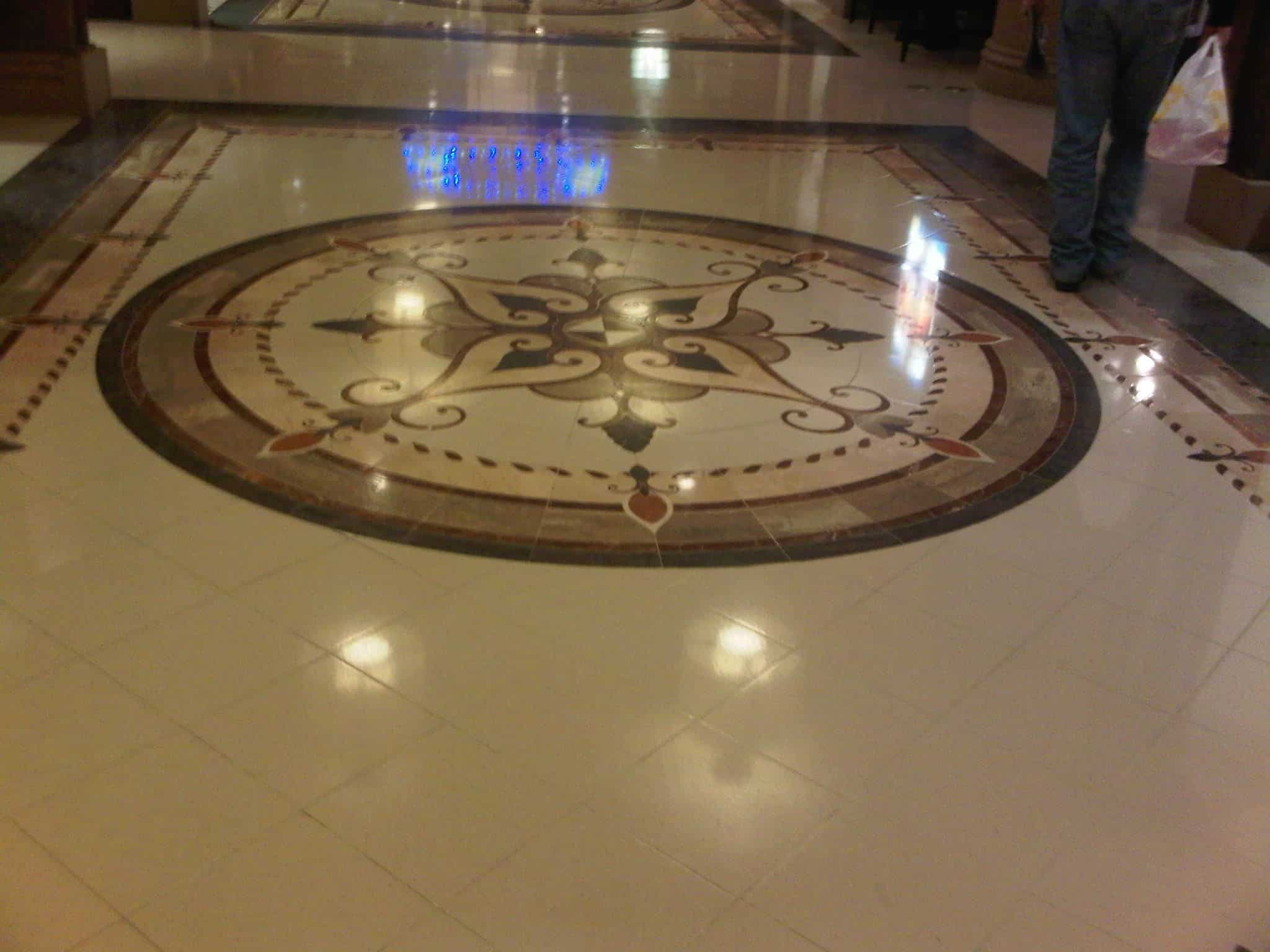
My sister’s sweetie took her to Vegas last weekend. Here is a photo she sent me. These photos were taken of a floor at The Palace Station. This is not your typical Mariner’s Compass as we quiltmakers think of it, however, it would be a wonderful applique’ project. It makes me think of Jinny Beyer’s Soft Edge Piecing book.
The curves of this motif are really lovely. They also look like stylized hearts.
Vegas Floor Corner
My family is well trained. They know I always want to see the corner. If tile layers figured out how to get the two borders to meet, I don’t need to do the math, right? I love that rope like piece acting as an inner border.
The Open Toe Walking Foot offers precise control of fabric, and is especially helpful when working with layers of fabric, or those that may shift or pucker. Feed dogs are incorporated into the foot itself which work in conjunction with the machine feed dogs to feed fabric layers evenly. The open toe configuration allows for a clear view of your work. Use it for quilting, matching plaids, leatherwork, and any task that requires superior fabric control.
I have done several projects lately where I wished that I liked using my walking foot. It came with my machine and I tried it and I really couldn’t see where I was stitching and that was pretty much the end of my walking foot use.
Making Deirdre’s pencil roll last week, which actually calls for a walking foot in the directions, rekindled my wish for a Janome ‘F’ Foot with clamp-on functionality like a walking foot. The Janome ‘F’ foot is clear and I can see exactly what is going on under the presser foot.
I am friends with Janome Sewing Machines on FB and those people are responsive (another reason to love my Janome). Periodically they talk about a new foot or provide a project to fans on their fan page. Something they said last week reminded me of my wish. I made a comment and they got back to me, also in a comment, and then they posted information about this new-to-me open toed walking foot. I called my dealer to find out the cost and if it works with my machine. It was just under $30 and does work with my machine. Because I think I am at a point in my quilting where this foot would add to my technique when I quilt the Tarts, I bought one. They will mail it to me and I plant to quilt a table runner first. I’d like to try it out and practice before I ruin the Tarts.
I am curious to know if any of you have a similar foot and what you think about it. Do you use it? Is it as great as it sounds?
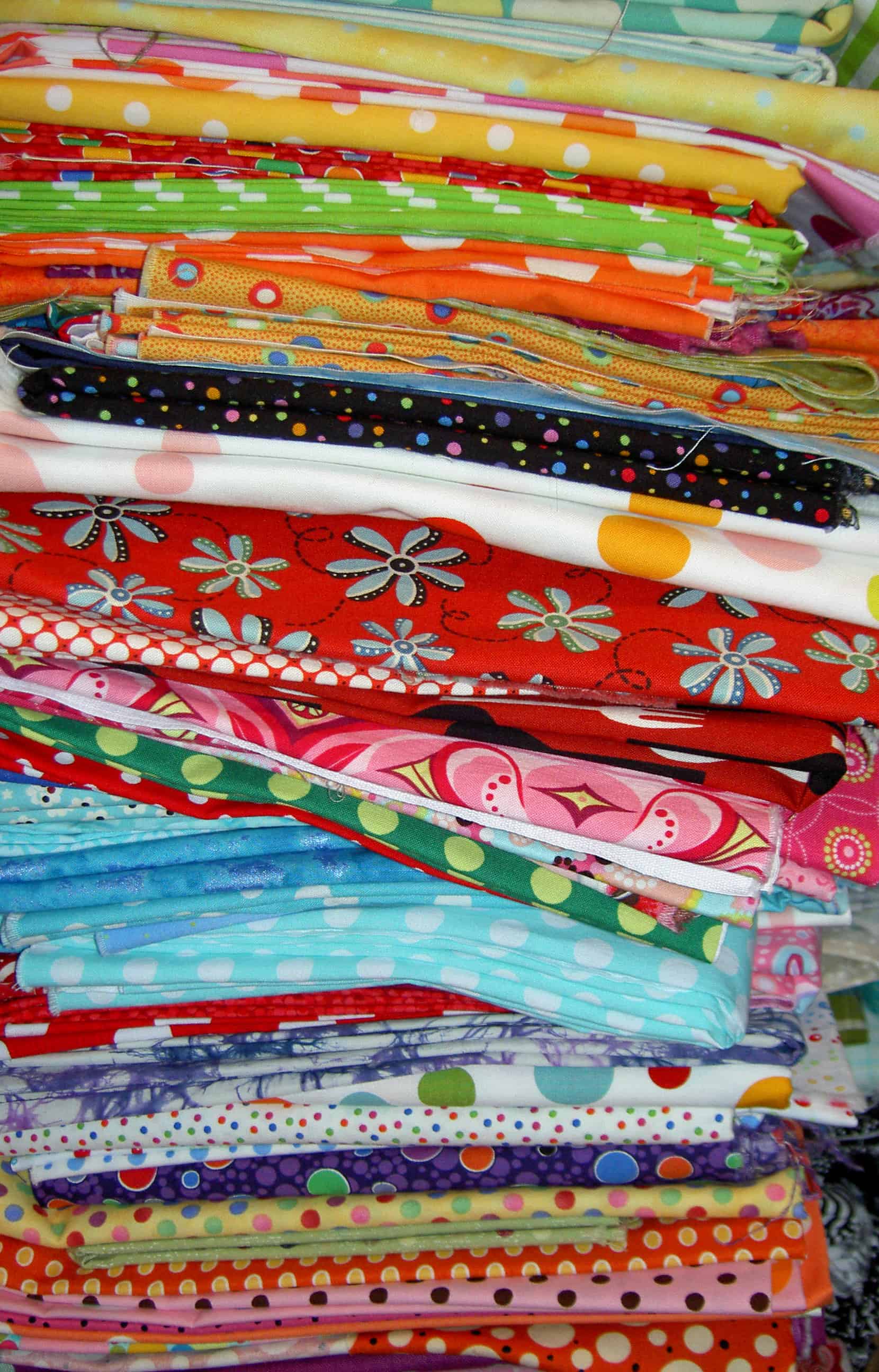
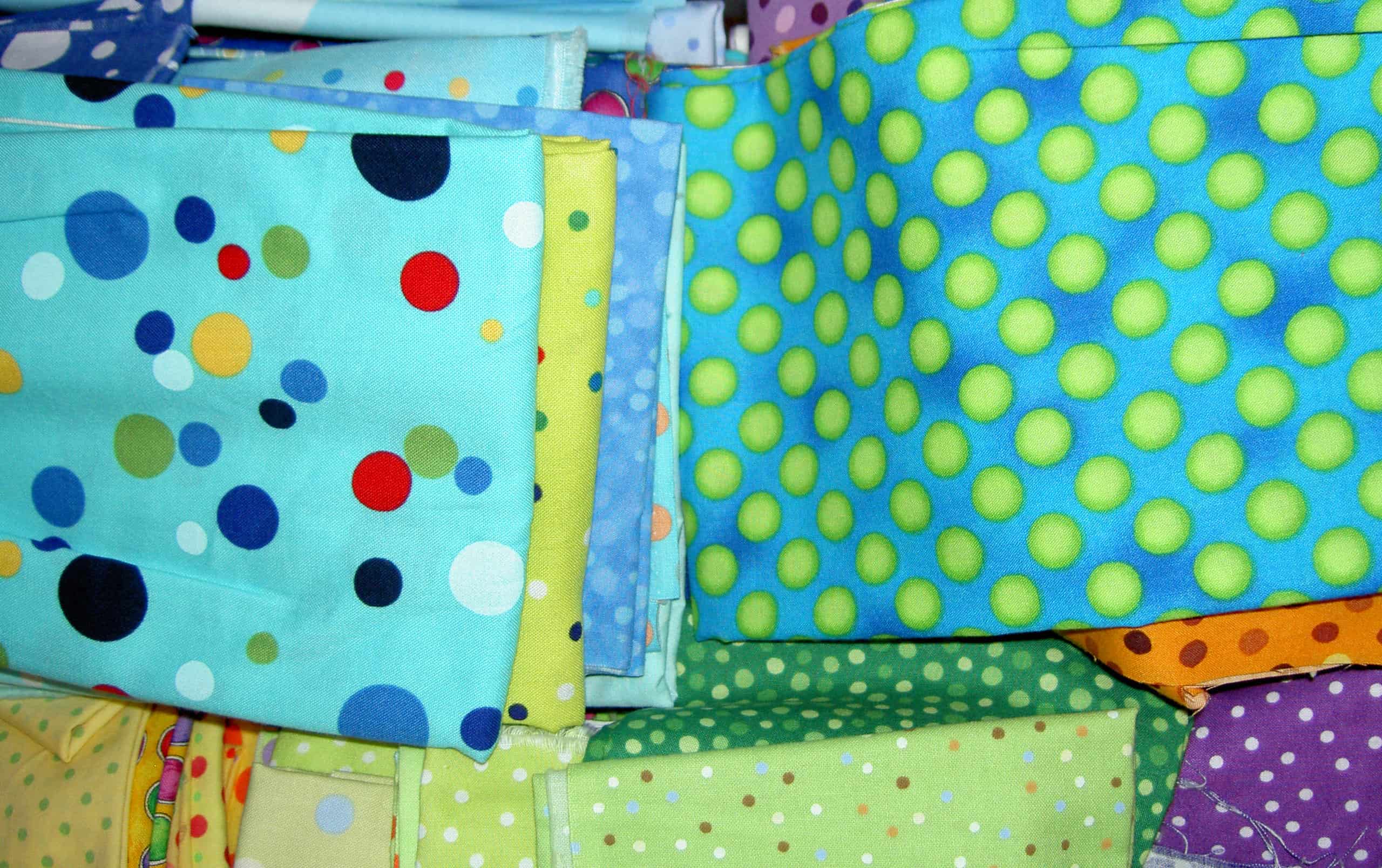
I have been thinking about my fabric lately. It is hard not to think about my fabric. First of all, I love it and second of all, it is where I can see, at least some of, it all the time.
Fabric
I have been thinking about fabric over the last year, in general, on a lot of different levels:
terminology
how much yardage should I buy?
do I have enough fabric?
do I need to add to what I have in order to have a wide range of colors?
do I need to add to what I have in case the manufacturers stop making that perfect shade of turquoise?
do I need to add to what I have in order to keep my inspiration high?
do I still like the fabric that I have bought in the past and haven’t used yet?
what happens if I can’t add to what I have?
is shopping for fabric a stress relieving mechanism?
Terminology
Fabric
Stash – this is the most common way quiltmakers refer to their supplies of fabric. I wonder why? I wonder who first called their fabric a stash? I wonder if calling it a stash was a joke that got out of hand? When I think of a stash, it has a negative connotation. I don’t hide my fabric in a baggie in the toilet so my parents won’t find it. I also have a stash of emergency cash on me, which isn’t really negative, but does imply poor planning or organizational skills.
None of those things really suggest that fabric buying or, by association, quiltmaking are positive activities.
Finally, buying fabric, as many others have pointed out, is not illegal and it doesn’t hurt anyone. For myself, touching, pressing, playing with fabric really reduces my stress level.
Palette – for a long time, I tried to call my fabric supplies ‘my palette’. I was diligent, but eventually gave up because people had no idea what I was talking about. A lot of them thought I was talking about a wooden thing with paint on it. Painters have it made. They have their palette, they put paint on it and everyone knows what they are talking about.
Fabric Collection – TFQ has a fabric collection. She buys fabric as a collection. We have discussions about the subject often. She may buy a fabric that she just wants to for her collection while I really try to buy fabric if it is something I think I will use. I have to admit that some conversationals are so fun-hilarious-cheerful etc that I can’t not buy them.
Fabric vs. Material – when I was a kid my mom would take us to House of Fabric which was in a mall called the Laurel Plaza (I liked a fast food-ish, but not a chain, restaurant there with great blue tropical shakes as well as dried puffer fish hanging from the ceiling) and we would buy some material to make a dress or outfit or something.
Now I only buy fabric.
I don’t know why I don’t call it material anymore. I think ‘material’ isn’t specific enough. If I say “I need some material for my project” someone could think that I wanted to buy some paper for a scrapbook project or metal for my most recent welding project. Perhaps material is a regional term and people don’t use it where I now live?
Size and Shape
I was listening to Brye Lynn’s podcast (still catching up) recently. One of her podcasts talked about the quiltmakers’ Fabric Stash (episode 8). It got me thinking about how much fabric I buy. Up until I started making tote bags at an alarming rate, I always bought half yards and FQs nad that was plenty.
Cutting up a FQ
Now, when I buy fabric specifically destined to be a tote bag, I buy at least 2 yards and sometimes 3. That is more than I need for most tote bag projects, but I like to have enough for the straps and a FOTY piece and to screw up. Brye Lynn said that the minimum that she has seen recommended to buy is a yard and then if you REALLY like it you should buy two yards. Hhhmmm.
Well, if I buy a yard as a basic rule, then I would only have half or quarter the variety of fabric I have now.
What's Left of a FQ
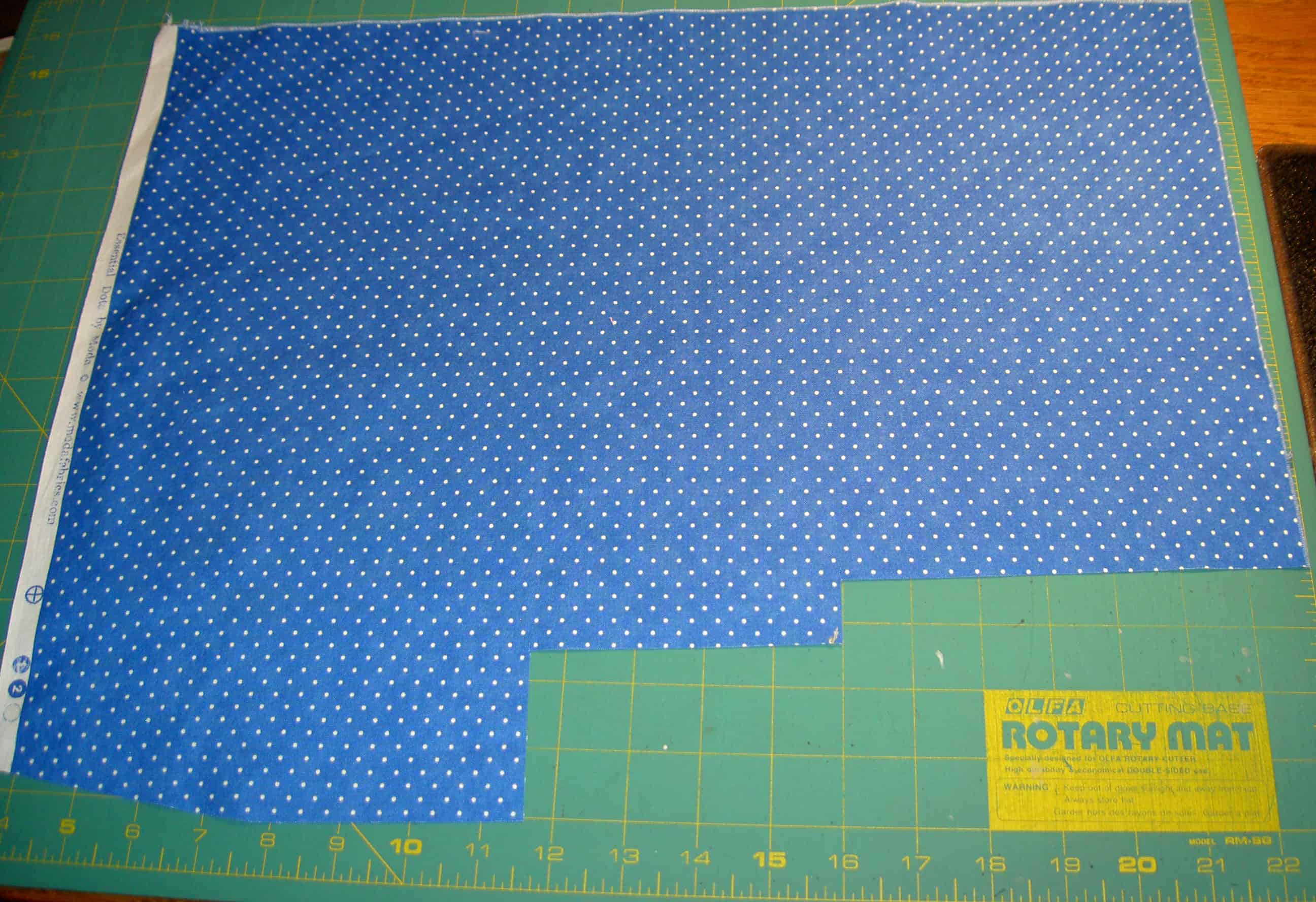
Half yards are starting not to be enough. I have a whole list of pieces I have to cut before a piece of fabric is filed into my fabric closet. For blue FQs, they rarely even make it to the fabric closet. I have so many blue pieces to cut (a 6.5″ square, a 2.5″x4.5″ rectangle, a diamond, a Tumbler, etc) that a FQ is just not enough. The above FQ may be a little bit misleading because it was larger than a normal FQ. Not much bigger, but enough.
Part of the Palette
Half yards are not enough for most bags, but they are enough for straps for a bag. I have adapted half yards for a bag, but it makes me wonder if I need to purchase fabric with bags in mind and not just quilts? Buying a yard of fabric regularly is a lot more of financial investment as well.
The Whys of it All
do I have enough?
do I need to add to what I have in order to have a wide range of colors?
do I need to add to what I have in case the manufacturers stop making that perfect shade of turquoise?
do I need to add to what I have in order to keep my inspiration high?
Well, if I don’t have enough fabric, then there is no such thing as enough. I have less fabric than others. Still, you saw all the things I made last year. I did not make a dent in what I have.
Adding to my fabric selection choices is interesting, because I have enough, in terms of physical quantity. However, I often seem not to have the right colors. No matter how many colors I buy, I often don’t have the right color. I am coming to the conclusion that buying more colors is futile. I am not going to stop buying fabric, but I am going to buy without the goal of having ALL the colors.
I have also been caught with my quilt pants down and not had enough fabric (remember the Windham fabric?), so perhaps I need to buy larger quantities of fabric? The FOTY project has helped in learning which fabrics really work in the projects I make. Perhaps I will start a project to convince fabric manufacturers it would be to their benefit to upload their out of print fabrics to Spoonflower.
New fabric does get me excited about quiltmaking. I do think that I need to shift my inspiration from cash outlay to books, as in read books and don’t use my credit cards. I will probably never be able to stop buying fabric, nor do I want to stop buying fabric, but I need to be aware of what I am trying to accomplish when looking for inspiration.
Is Shopping for Fabric a Stress Relieving Mechanism?
Definitely. That reality is good and bad. On the positive side, I have a legal way of relieving stress that also, as an added bonus, keeps small businesses open and helps the economy. If the stress is bad, it can be really expensive and if I don’t have money my stress just continues. I have to admit that I do have other methods of stress relief.
I don’t think I have any answers for anyone but myself. I am curious what you think about fabric.
My rating: 4 of 5 stars
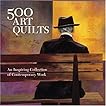
Thanks to Lark Books for sending me this book to review. I love getting cool books for free. And this is a really cool book. It is part of Lark Books’ 500 Series, which they appear to have been working on for about 6 years. Taking a quick look a their webpage, it looks like this series would be wonderful if you are stumped for inspiration. They have a variety of titles in this series covering different types of art. Included are glass beads, rings, wooden boxes, polymer clay designs and beaded objects. The only one I have seen is the 500 Art Quilts book.
First off: NO patterns. I have nothing against patterns. They definitely serve their purpose, but I don’t need patterns and basic directions on how to make a quilt in every quilt book published. This book is pure inspiration. There is page after page of contemporary quilt eye candy, which, in certain circumstances, is just what the doctor ordered.
I was nervous that the book would be filled with the same old quilts that are always shown when books and articles are written about art quilts. There were one or two I had seen before, and a few quilts from the 1990s, but for the most part included were quilts that were new to me. I was also pleased to see that the quilts were relatively recent. I was also pleased to see that some new names had their quilts included.
Second, Karey Bresenhan was the juror. Whatever you think about her style, the woman has seen a few quilts in her day and knows good quilts. She has taken the opportunity to select a wide variety of contemporary quilts. There is something for every quiltmaker’s taste in this book. If you like contemporary quilts that jump off from classic patterns, take a look at Kathy York’s piece, Little Cities (pg.15) or Carol Taylor’s Dispersion on pg.366. If you like thread painting, one of the best pieces I have ever seen is Nancy Murty’s Greens for Dinner (pg. 351). For applique’ Kathy Nida’s Lost (pg.217) and Nancy S. Brown’s The Usual Suspects (pg.329) are excellent examples. There are also photo realistic quilts, dispersed dye quilts and everything in between.
Additionally, Bresenhan is a talented writer. Her introduction is wonderful. There is a lot of history, opinion and experience in the two pages allotted to this section. She puts to rest the art vs. craft debate very skillfully, easily links quiltmaking to the broader concepts of art that many trained artists learn in school and made me not want to wait to finish reading because I was so excited about the quilts. It is well written, interesting ans well worth the time to read it.
When I first started to look at this book, I began categorizing the quilt by “like” and “do not like”. Then I stopped, started over and began looking at the quilts purely for inspiration. Every quilt, with a few exceptions, have something I found to inspire me or gave me something to think about. I don’t mean that the quilts sent me a literal message. I was able to look at each page and find something I could look at and wonder how the artist accomplished that particular element. This is definitely a book where a website of further information on each quilt would be welcome.
Third, Lark includes an index of quiltmakers with their city and the page(s) on which their quilts are shown. I love indexes and this makes it much easier to see which artists were included and which ones have more than one quilt. I love seeing names I recognize and there are several acquaintances and one or two friends in the lists of artists. This index would have been improved by include each artists’ blog or website, but I understand the space constraints as well.
Fourth, having so many quilts gives the reader a wide variety from which to be inspired. Some of the quiltmakers have more than one piece in the book. Yvonne Porcella’s Paris View, Lou & Who, Two & Two jumped out at me, because it is so different that the style with which I normally associate her work: the bright colors and black and white checkerboards. The reader can flip between the above and her Dick and Jane (pg.61) to see her evolution as a quiltmaker. There are enough quilts in the book to see progress in people’s work without one person dominating the book.
Fifth, the detail shots the authors have included are well placed and thoughtfully selected. Philippa Naylor’s piece, Star Sign (pg.60) shows a detail of her quilting. The detail is so good, albeit small, that the reader can see the evenness of her stitching, the way she fills in areas and the color changes.
One of the oldest quilts I saw in the book was from 1995. It is Natasha Kempers-Cullen’s piece, Heart of Lightness (pg.43). The quilts are not chronological and, though, I specifically tried to find the oldest pieces so I could try to judge how many times I may have seen the quilts in the book, I don’t know that this piece is the oldest. My impression: most of them I had not seen. A few I have seen once.
While I am a visual person, I am often drawn to the text about a quilt. As a result, I often forget to look at the quilt. Initially I struggled with wanting to know more about the artists’ thoughts on the quilt. Finally, I reminded myself that these quilts are probably on the web somewhere and if I really wanted to find out more, I probably could. Bresenhan speaks to this when she says in her introduction “The goal with this type of work is to remove all distractions, so that the energy and spirit of the art can speak clearly to the viewer.” If she thought about this when selecting the quilts, then I feel I should just look at each page and let the pieces speak to me without interference from words.
There is a strong visual context in the quilts selected. That may sound strange, but since the pieces are reproduced in a book, pieces where the medium or a certain technique are preeminent would not be successful. These types of pieces seemed to be left for a different book or another method of presentation. The one piece in this genre that was included was Hooked on Caffeine by Penelope E. Mace. I love the shape of the fish. I couldn’t figure out why it looked so dirty until I read the materials and techniques list and saw that it was made from coffee filters. I have no doubt that this piece would have much more of an impact in person.
I was also glad to see that the authors did not feel obligated to include some prominent quiltmakers just because of their names. In addition to my own work, I enjoy seeing as much of other quiltmakers’ work as possible. There are tons of quiltmakers in this book whose work is new to me. What a pleasure to be exposed new pieces! Works from renowned quiltmakers were also included, but, again, they did not dominate the book. I was glad to see two of Susan Shie’s tarot deck quilts, one of Jane Sassaman’s pieces and a piece by Judy Coates Perez.
There is a lot of wonderful colorwork shown in this book, such as Faye Timmerman-Traudt’s Desert Blooms and Jan Elliott’s Shot in the Dark.
By now I have glanced through this book at least 10 times. Twice I went through it page by page and consciously looked at each image. Each time, I was able to find something new to look at. I am sure that I will have the same experience next time I look through it.
I think this book is well worth having in your library. I am really glad Lark sent it to me, because I would not have been able to buy it right away otherwise. I hope you will rush out and buy this book and encourage Lark to put together volume 2 in a few years!
Peter Gabriel’s “Steam” – “Steam” won a Grammy-Award in 1993 for “Best Short Video”. The song was also nominated in the category “Best Rock Vocal Performance”.
Post the direct URL (link) where your drawing, doodle, artwork is posted (e.g. your blog, Flickr) in the comments area of this post. I would really like to keep all the artwork together and provide a way for others to see your work and/or your blog.
The Creative Prompt Project, also, has a Flickr group, which you can join to post your responses. I created this spot so those of you without blogs and websites would have a place to post your responses.
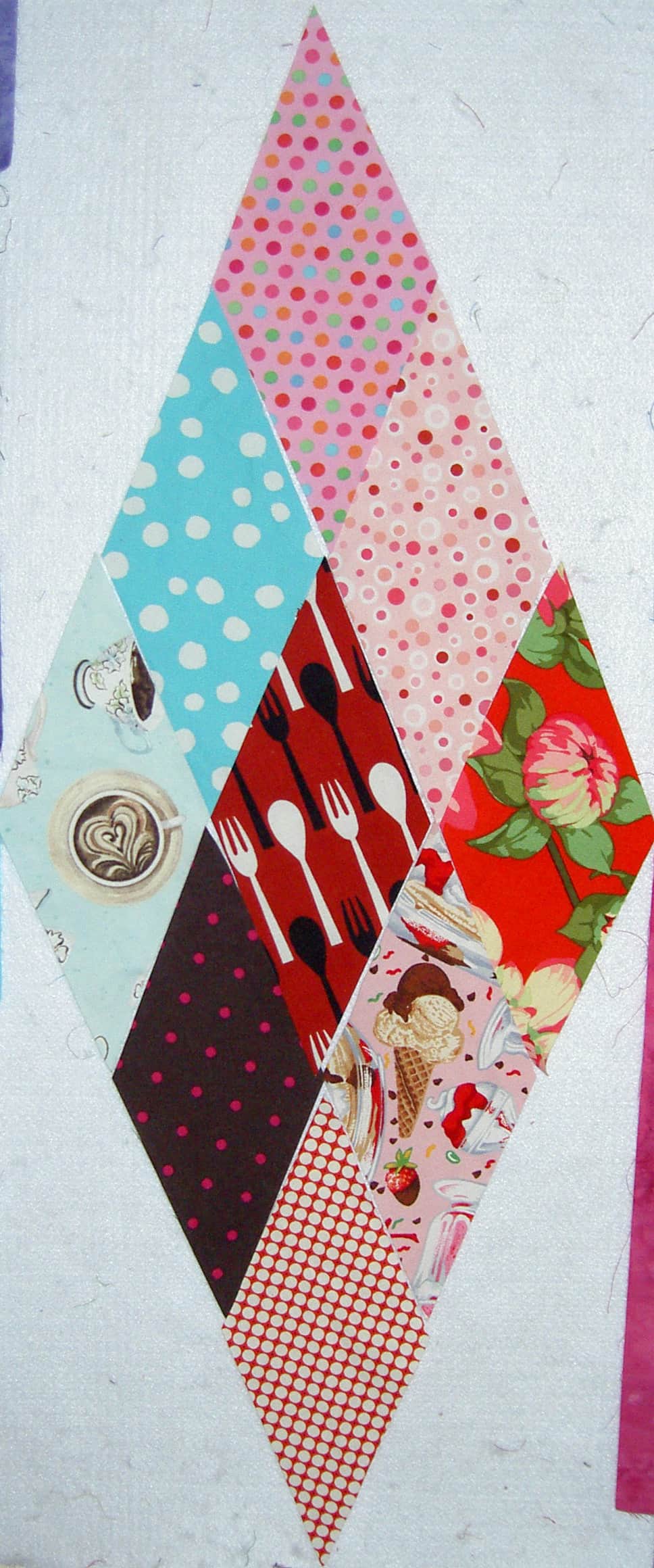
Here is your first glimpse of the FOTY 2010 patches. I have pressed a lot of fabric, but haven’t cut it yet. Many of the patches in this photo have been on my design wall for awhile. I have been moving them around so I can see how they look in different arrangements. It is definitely different.
Not different as in “I wish I had chosen something different,” but different in the way I have to think about cutting the patches.
This patch takes a lot of fabric to cut. I like the diamond ruler I bought to help. Once I got the hang of using it, I found it to be quite useful. I am ending up with a lot of triangles and may pick a background and sew them on to squares to make the Corner Store design I discussed in the Pretty Little Mini Quilts review. It would make an interesting sort of scrap quilt. We’ll see.
Starting this cutting process is also making me think about how I will arrange them and set these diamonds. I am thinking of picking something for the border and cutting half diamonds to make a straight edge out of a uniform color. I need to decide if I want to use something I already have or if the “rules” say I have to buy something. Stay tuned.
Caroline, another CQFAer, has started her own blog. Her first post tells a little about what she wants to accomplish and what she plans to write about. It is actually a great post and much better than I did on my first foray into the blogosphere. Stop by and say hi.
This is my first experience with blogging. I have seen a few, but have wondered who reads them, and why?
Mostly I will be writing about fiber art, in particular the quilted kind, or that fabricated from pieces of cloth and sewn, painted, embroidered or otherwise embellished. I haven’t done weaving for years and have no current interest in the scrapbook and paper art projects done by many of my contemporaries. There are too many things higher up on my “To Do” list.
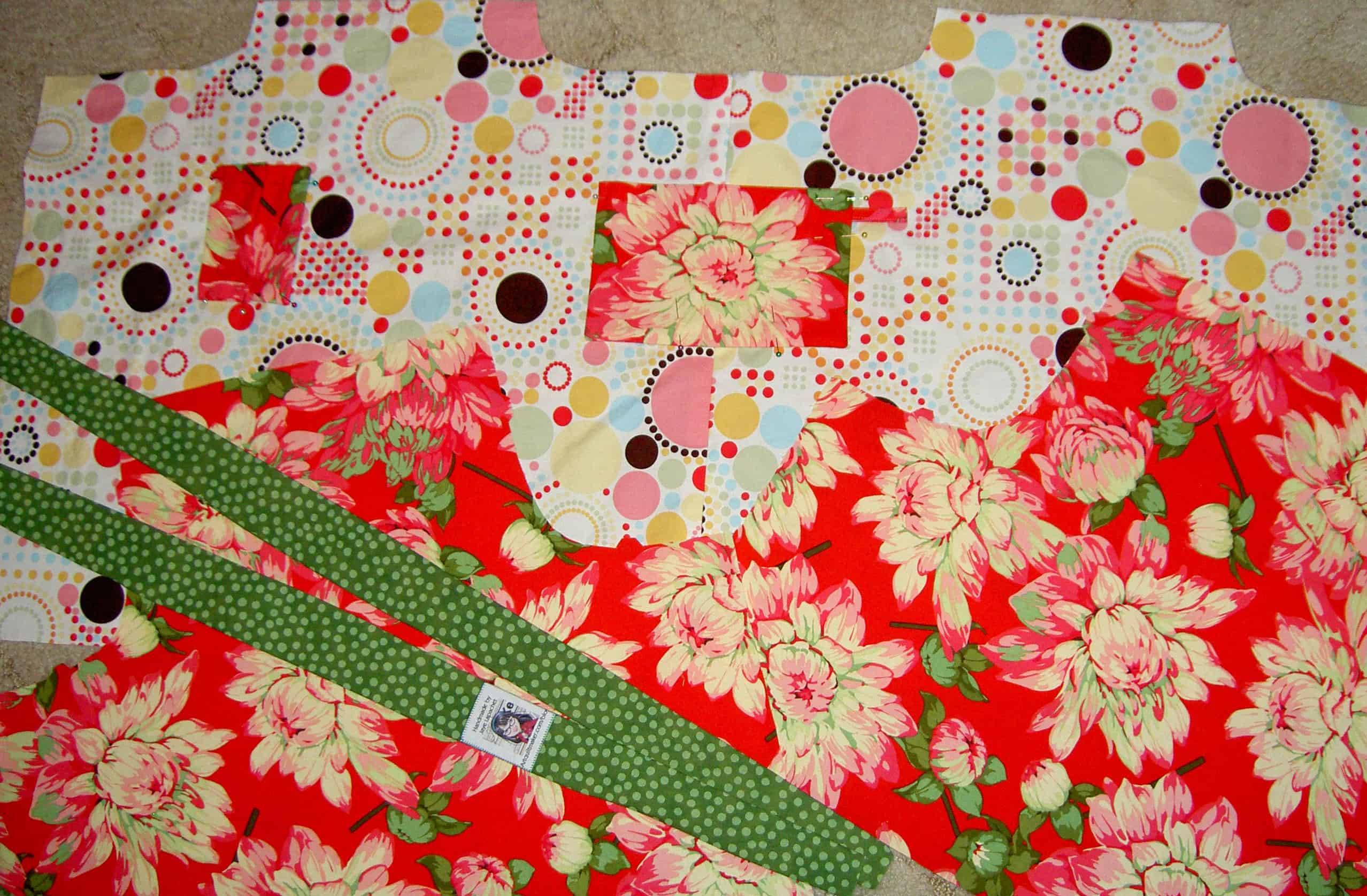
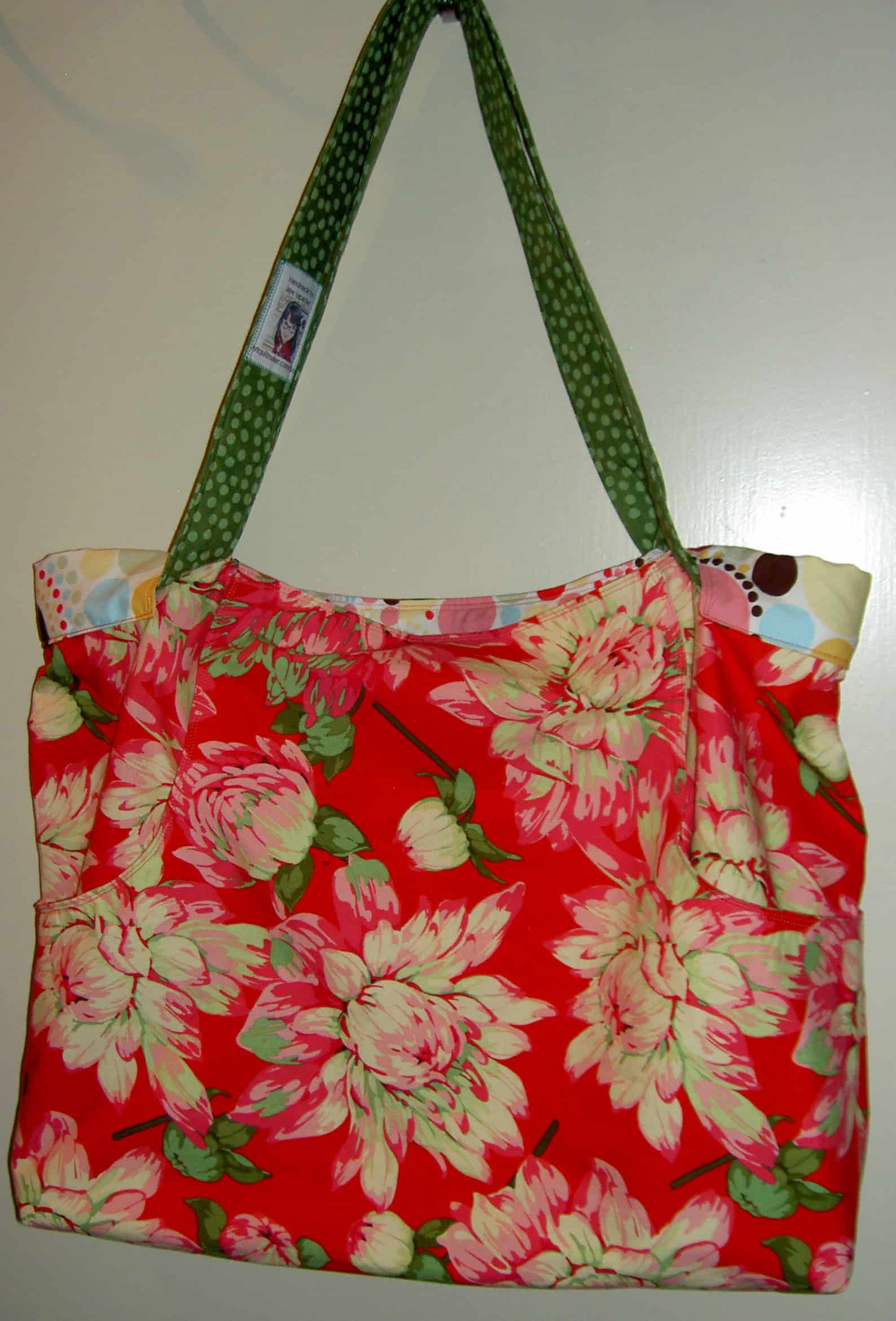
You might remember about a week ago I talked about selecting bag fabrics. I just couldn’t decide so, instead, I started on a different bag, the Anna Maria Multi-tasker Tote, where the selections were already firm in my mind.
AMH MTT in Progress
I really enjoyed working with these fabrics. I loved the colors and the feel. I finished the bag on Saturday and took it out with me on Sunday. I have to admit that even if I give bags away, I try most of them out. I intend to keep this one, but tote bags flow through my life so quickly that who knows?
These are fabrics that I bought in Ferndale and the large flower print is by Martha Negley. I do love that color, a reddish pink tending towards salmon. It is a cheerful color.
This is the first time I have made the pocket panels the same color as the exterior of the bag. They are the pieces right under the dot fabric you can see peeking out of top left and right.
It made the fabric selection process a lot easier. The pocket panels aren’t highlighted at all; they look like part of the exterior. I don’t know yet if that bothers me. I did a lot of work on the bag and wonder if I need people to see the pocket panels? I’ll have to think about it and let you know.
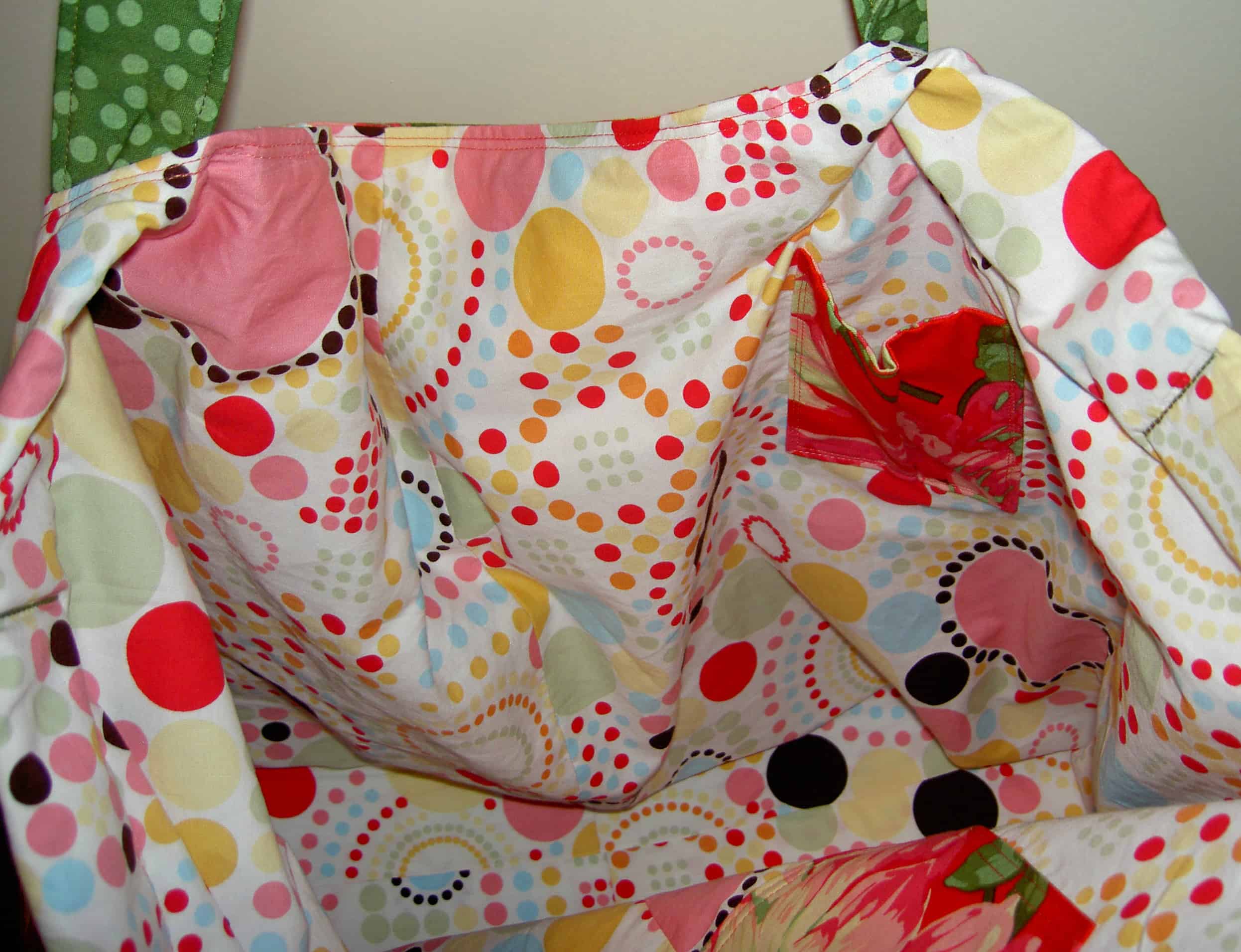
I like to make the inside of the bag a light color, so I can see what is hiding inside the bag. I really like that dot fabric! I got some a long time ago with a chartreuse-y / olive background. This colorway works very well for the inside of a bag.
I realize that this is another non-quilt project. Yes, I have quilt projects; I just don’t seem to be working on them. Two quilts, Chocolate Box and Passionate Purple are ready at the quilter and I haven’t gone to get them yet. I also finally called for a longarming date. I could have had March 26, but have to work that day, so FOTY 2009 will be quilted on April 23. Don’t give up! Some quilts are coming.
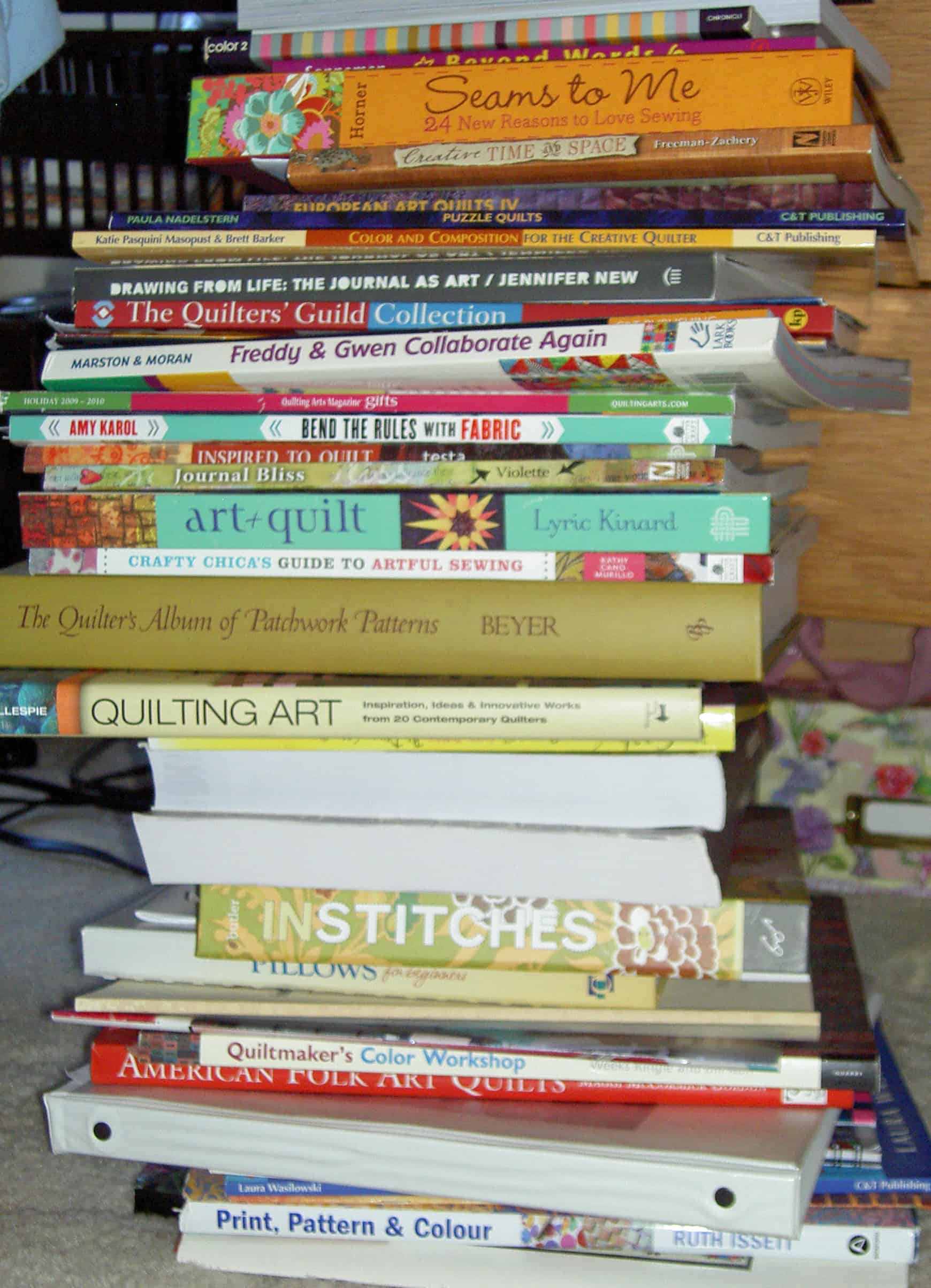
These are the books that I MUST finish reading soon. Four of them (top 3 and bottom middle) are due back at the library. In fact, by the time you read this I will have already taken back the Design It Yourself Clothes book. I like the tone of the first part of this book even though I haven’t done anything about the actual making of clothes. I may buy this book so I can work through at my own pace.
Fortunately, I did write the review for Pretty Little Mini Quilts. that was on my mind since Lark Books sent me the book for free. Did you read it? I found the review hard to write. It is different writing reviews when I get the books free from a publisher than when I get them out of the Library.
Yes, this is the Leaning Tower of Book Pisa, as I like to call it. The Leaning Tower of Book Pisa books not only need to be shelved, but they also need to be cataloged and read. I have officially over reached my current shelf space for any kind of books. This pile makes me anxious. I want it to be neatly shelved, cataloged and have every book easy to find. I very rarely buy non-quilt books. My rule is that I have to get it from the Library and think I will read it again before I buy a copy of my own. I am only allowed to buy non-quilt books if it is hard to get from the Library.
Quilt books are a different story. I used to buy all the quilt books that came out, but there are simply too many now. Also, many of them are just pattern books and I have plenty of patterns. This past year or so, however, has been a great time for quilt books. I like to buy quilt books, because I make notes on the patterns or in the margins. I make notes about what I like or I underline (in pencil, don’t worry) bits that I want to come back and review again. I have only been, pretty much, putting quilt books on my wish list this year. As I mentioned, I have been fortunate in the past year to have received almost all of these books as gifts.
I still try to borrow them from the Library first to make sure I like the book. My local Library doesn’t have many fiber books, but it is in a network and one of the sister libraries has a lot of the titles I want. If I can’t find a quilt or fiber book in my library system, I go to The City system and can usually find it there.
I want to read all of the books in the Leaning Tower of Book Pisa. I am currently reading Design Explorations for the Creative Quilter by Katie Pasquini-Masopust. I read about a chapter of it a week. It is short, but is still taking me awhile to get through it, probably because, also, I am reading 3 other books at the same time. I am almost finished and will put up a review soon.
Linda, a big supporter of the CPP, has a new fabric line out. It is from Avlyn Fabrics and the theme is seahorses. What I love about her lines are that they are different. She is not creating the same thing that all the other designers are creating. Nice work, Linda! Keep it up.
I also like the background fabric. I like the swirly-ness of it. I would like to see it come in many more colorways. I would also like to see Linda add to it so that all the colors I could ever want were included.
My rating: 3 of 5 stars
This book was sent to me for free by Lark Books unsolicited. I was pretty excited to receive it! It is part of the Pretty Little Series, which also includes another book about pillows. The ‘mini’ part of the title is defined, in the Introduction, as projects that are less than 36″ square. This size is appealing to people with small spaces to display their works and those that want to try a lot of different techniques.
This is obviously an inspiration book. The colors, shapes in the projects, and design of the book all make my mind swirl. The book has a high level of eye candy from the beginning. The photography is very well done. The layout and graphics were noticeable right away. What drew me in, immediately, was the hexagon piece, called Spanish Flowers (directions on pg.102-105) on the inside front flap. The colors are really vibrant and the piece has an interesting shape. It is different from the other hexagon pieces I have seen. Another element I really liked were the different colors on the page edges. The color for each chapter is different, adding interest and giving the reader an additional visual cue as to where they are in the book. The images of spools and stacks of fabric seen before page 7 are appealing as well.
This is another project book which tries to go it alone. It devotes the first quarter of the book to basics including information about different types of fabric and tools, what a fat quarter is and how to make a quilt. For the size of the section, it is a relatively comprehensive section. The paragraphs on tools are entertaining. For example, under the section entitled needle threader, “Folks with perfect eyesight and rock-steady hands can skip this tool. Otherwise, save yourself some frustration by using a needle threader.” The section continues and I like the tone. It isn’t dull and a bit Mark Lipinski-esque. I wonder if that is a new style of writing?
I didn’t like the references to “…thoughts of a quilting bee near that little house on the prairie” or “Unless you’re stitching up petticoats, nothing you’re sewing has stronger ties to the past than quilts” in the Introduction. Once I read the second paragraph I got joke, but the first couple of sentences put me off. I think clothes were probably made before quilts and I prefer not to read assumptions like the above without references to the source. This isn’t a historical tome, so I shouldn’t demand it, but such statements can perpetuate untruths and questionable “facts” and there are enough of those going around the quilting world.
I do think this book is one that can open the minds of readers to the possibilities of quiltmaking. the different stitching, both hand and machine as well as the colors and variety of techniques all show that quiltmaking is not boring. The book does show a 9patch (pg.45-47), but it also introduces the idea of scanning a photo and turning it into a quilt (pg.77-79). I am not that interested in photo realistic quilts, but I do think the photo of the “Portrait of Velma” piece shows a quilt that is pretty well done.
I really wish that major publishers would each write a basic sewing/quiltmaking book and refer back to it rather than recounting the same basic quiltmaking information over and over in every book they write. The idea of a book like this teaching a new sewist to quilt from a list of supplies and 12 steps in a project is crazy as well as potentially frustrating. I know little to nothing about the costs of producing a book, but I do know that publishers are under fire and want to appeal to as many readers as possible, which is why they use this kind of tactic. I would keep the layout the same, but refer back to a book with much more detail on how to make a quilt. A direction such as “Quilt the quilt using diagonal lines that run through all the large white squares and diagonal lines that run through all the checked squares” seems so easy. After all, whole books are written about machine quilting, such as those by Diane Gaudynski, Harriet Hargrave and Sue Nickels. The beginning section, as noted above, does have more information about the mechanics of quiltmaking, which are a big help. I think it would be a service to add a comprehenisve beginning quiltmaking book to a publisher’s line that they could keep in print over a long period of time and revise as needed. Such a book would also have an appeal to new quiltmakers over time.
There are a number of appealing projects in the book. My favorite is the Corner Store pattern (pg.51-53). This is the first pattern, which I noticed, that acknowledged that there is a quiltmaking community outside of this book. The designer refers the method of piecing as Gwen Marston‘s ‘liberated piecing’ technique. I think the book would have benefited from other references to the quiltmaking community. I like this project because of the red background. I also like the line drawing that was included to show what the designer meant about adding triangles to a squares. I have a lot of triangles which work for this project from cutting the FOTY 2010 diamonds and seeing that line drawing inspired me.
I liked the ‘Have a Cup’ project as well. The style of it gets ideas related to my various House and Garden quilts flowing. One thing I would have liked to see, in this quilt in particular, is a couple of versions of the quilt made in different colorways. My mom and I had a discussion about several of the projects and the discussion centered around the colors. I kept reminding her that she didn’t have to make the project in those colors, while she insisted that colors drew her in or repelled her. Again, I know the cost of the book is a factor, but that would have been a nice addition.
“Give me a Hand” (pg.114-117) is a good reminder that we can make our own patterns and redwork is especially conducive to family type quilts.
One project “Star & Cross” (pg.126-129) includes paper piecing, which is interesting. This book really tries hard to give the reader a full quiltmaking experience.
The other inspirational part of this book is the “about the designers” section. There are two pages worth of designers in this book and the editors have included a brief bio as well as links to their websites or blog. Really nice to be able to look up more of their work. I have heard of a number of the designers and am actually Internet acquaintances with two of them.
I was sorry to see that I would need to take the book to a copy store and enlarge the patterns. I prefer to have full sized patterns in a pocket in the back or download them from the publisher website.
The book also gets high marks for including an index and a comprehensive table of contents.
All in all I like this book for its inspirational qualities. I think it has the potential to help quiltmakers think outside the box.