Do you know that feeling when you step into a hole and everything tilts. That happened to me, without the sprained ankle, when I asked DH a simple question.
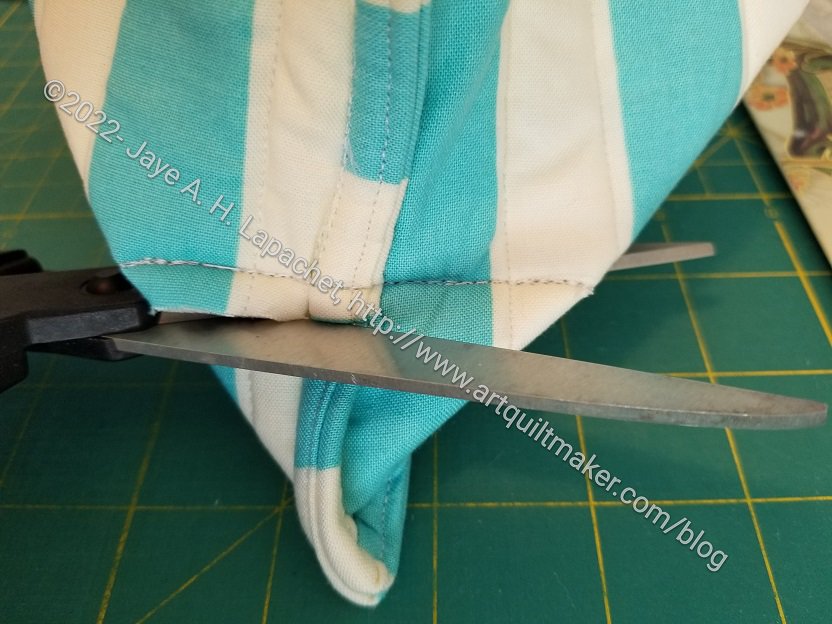
I asked him how to find the number to cut out the box from the “lining up the seams and cutting off a bit” number.
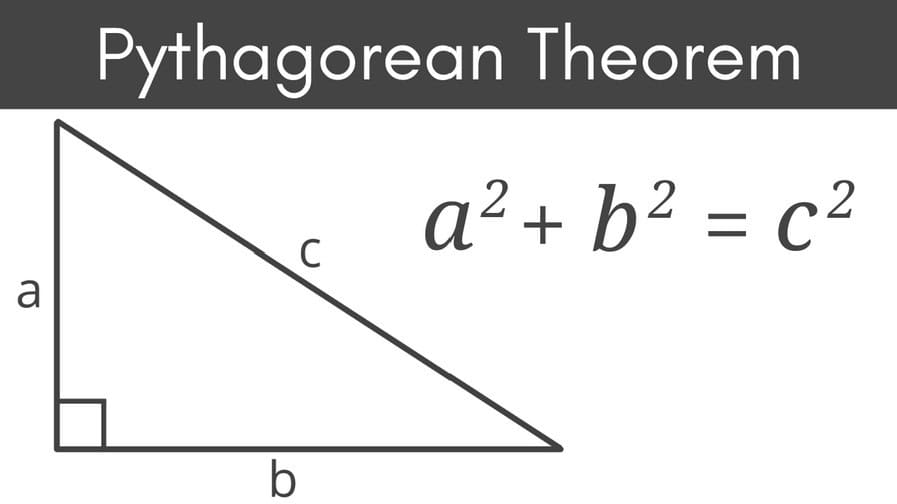
DH said “Pythagorean theorem”.
Holy smokes!
That &*^%$ math! He showed me the theorem. We talked through it and I understood a bit more about how it worked. Am I an expert? No. No, I am not.
I am really annoyed, though. If I had been shown how to make a pouch, then given this problem I would have understood the concept. Instead math teachers throughout my education wrote lines of numbers and letters on a chalkboard that all looked like gobbledy gook to me. Now I get it. Years too late to do more than squeak by in every math class I ever took after 3rd grade. Sigh.
Thanks to www.inchcalculator.com
OK, so here it is. Remember, I am not an expert, so your mileage my vary.
The key number is the number Anna said to cut off after lining up the points. It was 4.5 inches.
The triangle has to be a right triangle, which means that one corner is 90 degrees. Your formula works like this:
a² + b² = c²
a=b
a² + a² = c²
2a² = c²
c=4.5 inches
In numbers this formula looks like:
4.5² =2a²
some math using the calculator
20.25 =2a²
10 1/8 =2a²
3.28=a
I looked at the number given in the small and medium sized Open Wide pouches and did the match. I came up with 4 (medium) and 3.5 (small). 3.28 isn’t a great number for quiltmaking or bagmaking, so I rounded. I found the Open Wides came out a bit of a weird shape. Still useful, but a little odd. I’ll have to play with the formula bit and I think rounding down might be the way to go.
I went to the San Mateo County Fair on Thursday with SIL#4.
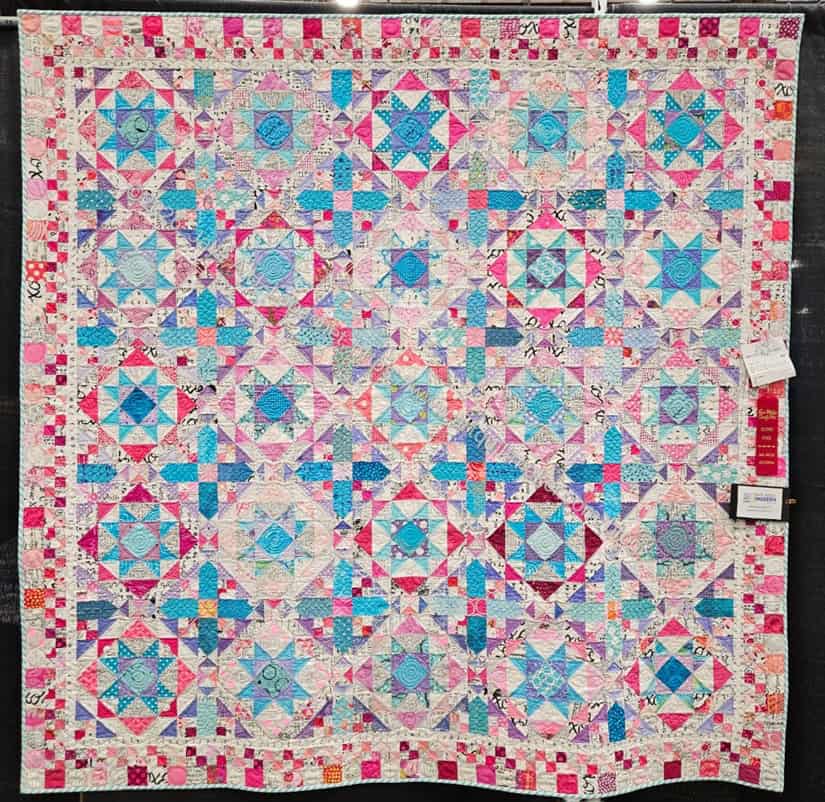
Winner 2026: Pandora Charisma
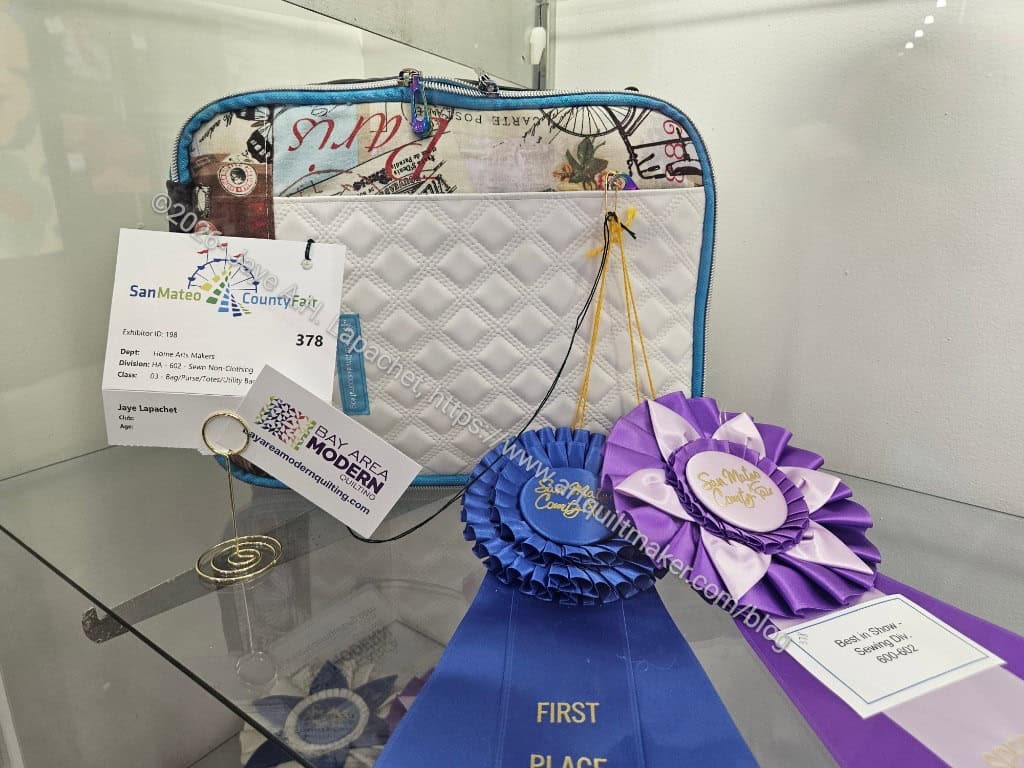
I was shocked and amazed that the Pandora Charisma won at the County Fair. Lee Ann shared the news with me at Sew Day, so it wasn’t a surprise. I was, however, so excited to see the evidence in person. I am in wonder at the size of those ribbons!
Old Town with Ribbon
I was also pleased that one of my quilts, Old Town, won a second prize. While second place can seem like nothing special, this quilt was entered into a category where a lot of quilts are entered (quilted by someone else). After thinking about it, I was very pleased even with a second place in this category.
BAM members in general did really well! I was thrilled to see so many BAM cards on prize winning exhibits.
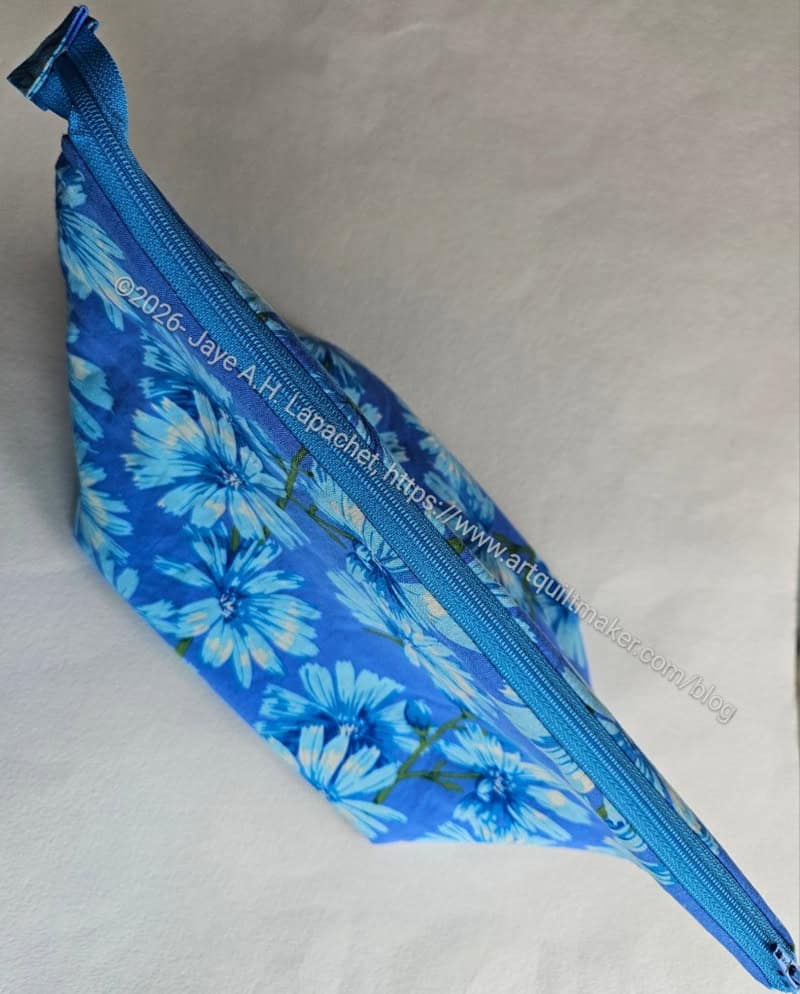
I spent some time making some Open Wide pouches for the wife of a friend of my Mom’s. He drove Mom and stepdad to an appointment on his wife’s birthday. I thought a couple of pouches would show appreciation.
I used the new Martha Negley fabric I bought at Picking Daisies a few weeks ago.
Large Open Wide for Mom’s friend
The one thing I did was delve into math again. The pattern tells you to line up the corners, sew and then cut off the excess. I get better results by cutting out a box and then lining up the edges. DH reminded me of the Pythagorean theorem (!!!!). It is one of those with a lot of letters that made me crazy as an eighth grader. More detail on that later.
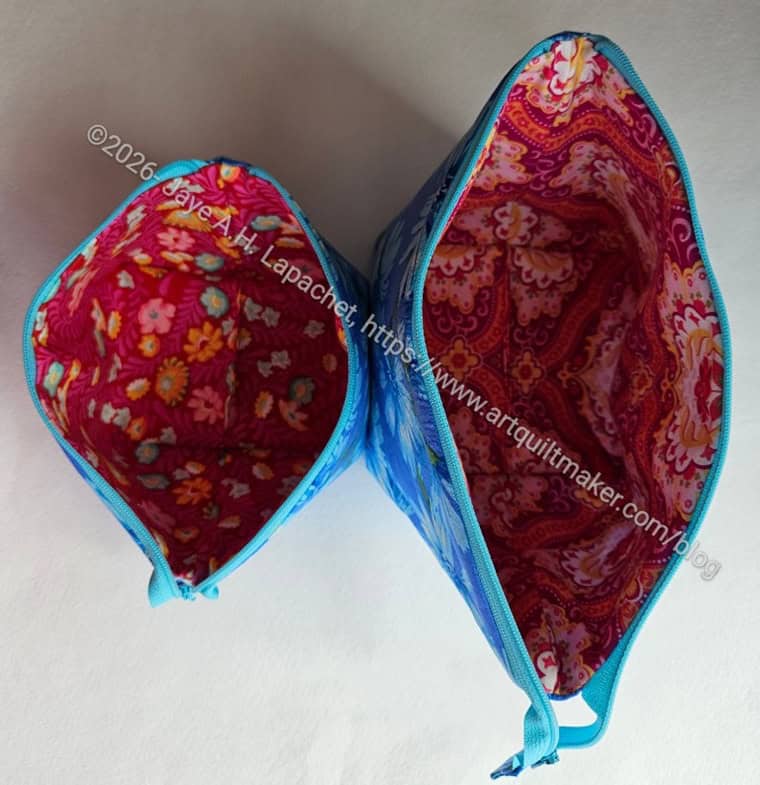
Small, medium Open Wide pouches-open
Needless to say, I used this theorem and my calculator to figure out a box size for these pouches. Closed they look a little weird, but open they look ok. The open wide aspect is so useful.
I’ll have to work on figuring out the best size to make these look ok.
Large Open Wide- open
I have to say that exercise was interesting. I showed DH how a pouch goes together every step during the process and he was really interested. I think he thought the practical use of the Pythagorean theorem was fascinating. I have to say that learning the practical use of one of those stupid math concepts was a revelation.
The other thing I noticed was a lot of similarities in the construction of this pouch and the Retreat Pouch, also free, from Emmaline.
In a way this post is an adjunct to my regular Various & Sundry posts. I did NOT buy these patterns. I just took pictures because there was something interesting about them. I have a record when/if I need the type of bag.
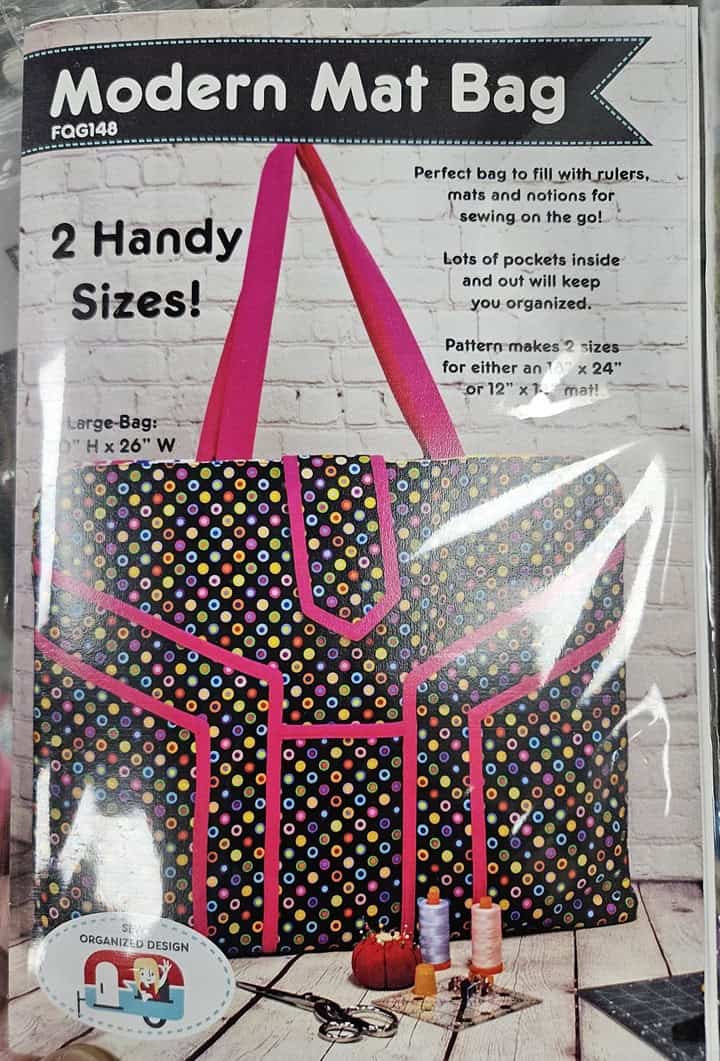
Modern Mat Bag
First was a Mat bag. It is called the Modern Mat Bag by Sew Organized Design. This is the most likely pattern I will buy. I have wanted to find a good Mat bag pattern to make as gifts for people I want to encourage to go to Sew Day.
Sew Organized Design is a company I have never heard of before. I went and looked them up and found they only have a few patterns listed on their website. All of them are on-the-go sewing related.
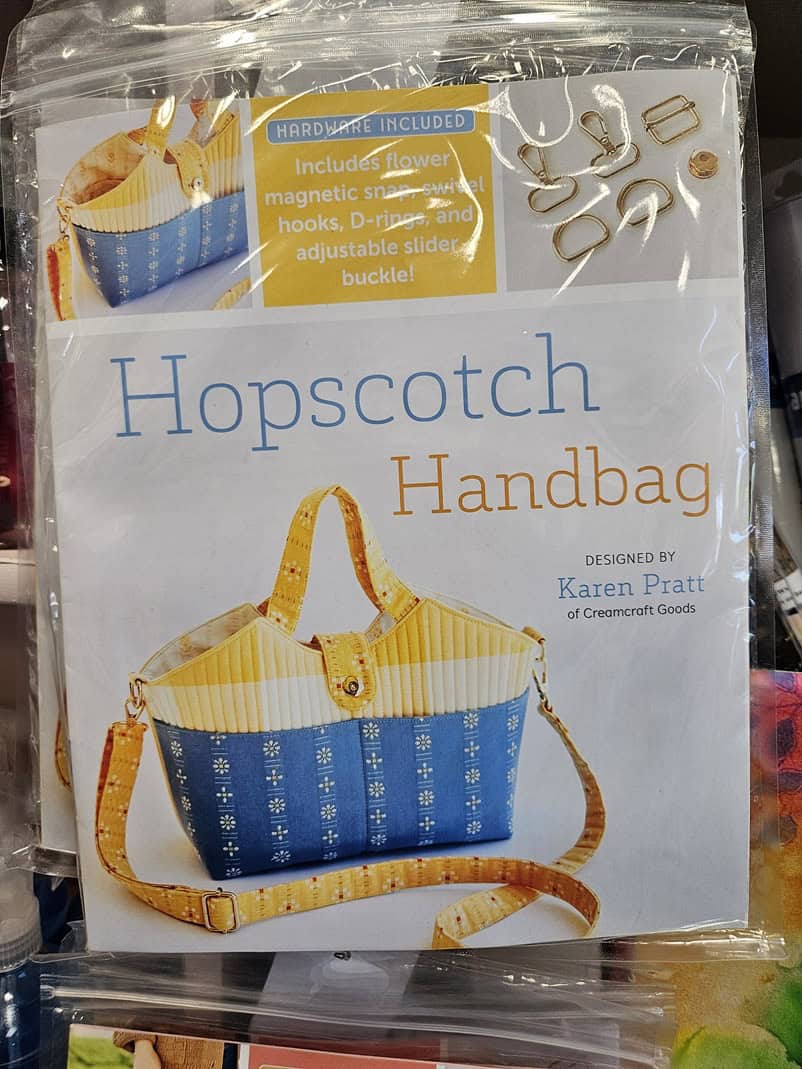
Hopscotch Handbag pattern
Next is the Hopscotch Handbag. It is designed by Karen Pratt of Creamcraft Goods. This another company which is new to me.
I liked the shape and design of this bag. I have to admit that the quilting on the top really adds to the look of the bag. I saw one site that sells this bag that had photos of the inside as well.
Karen has a nice blog post on another project called the Tri-Fold Journal Folio and Journaling tote.
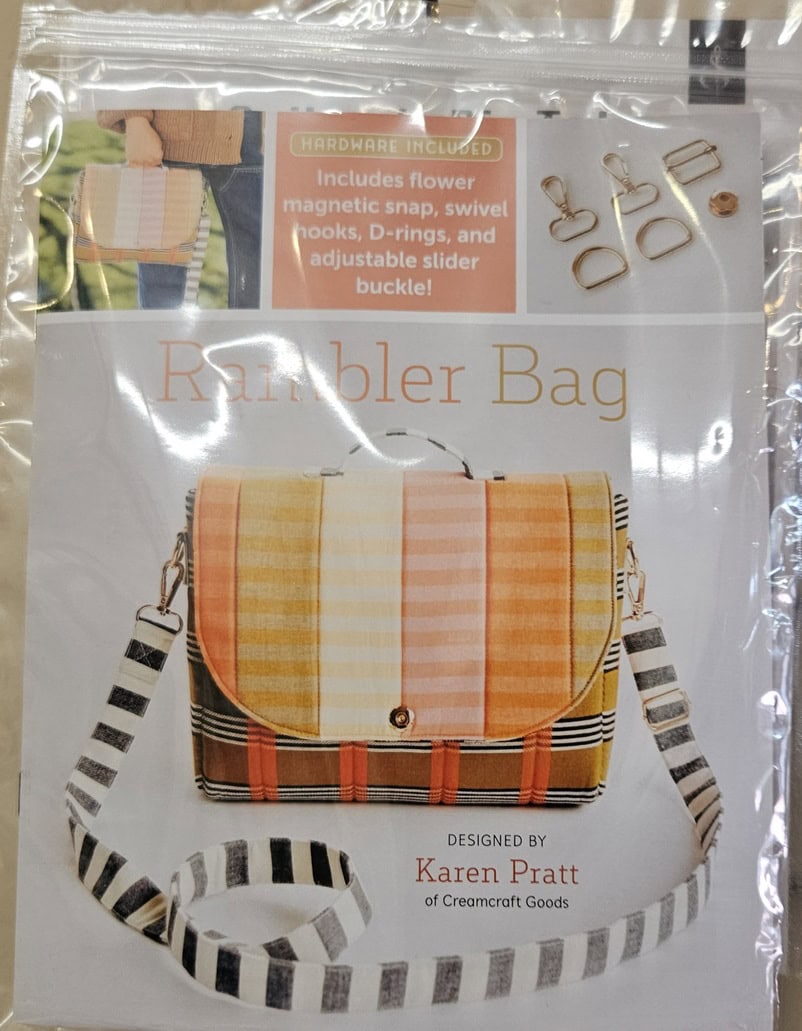
Rambler by Karen Pratt
As mentioned in the Picking Daisies post, I saw more Karen Pratt patterns at that shop. Don’t worry, I am not going to tell you about all of the Karen Pratt patterns. I just wonder about how her bags came out of nowhere for me. I also liked the look of the Rambler pattern. It is a small messenger type bag with inside pockets for your phone and other small items.
I think including the hardware is a good idea, especially for new bag makers, however it means you are stuck with the chosen color rather than selecting the hardware finish you like.
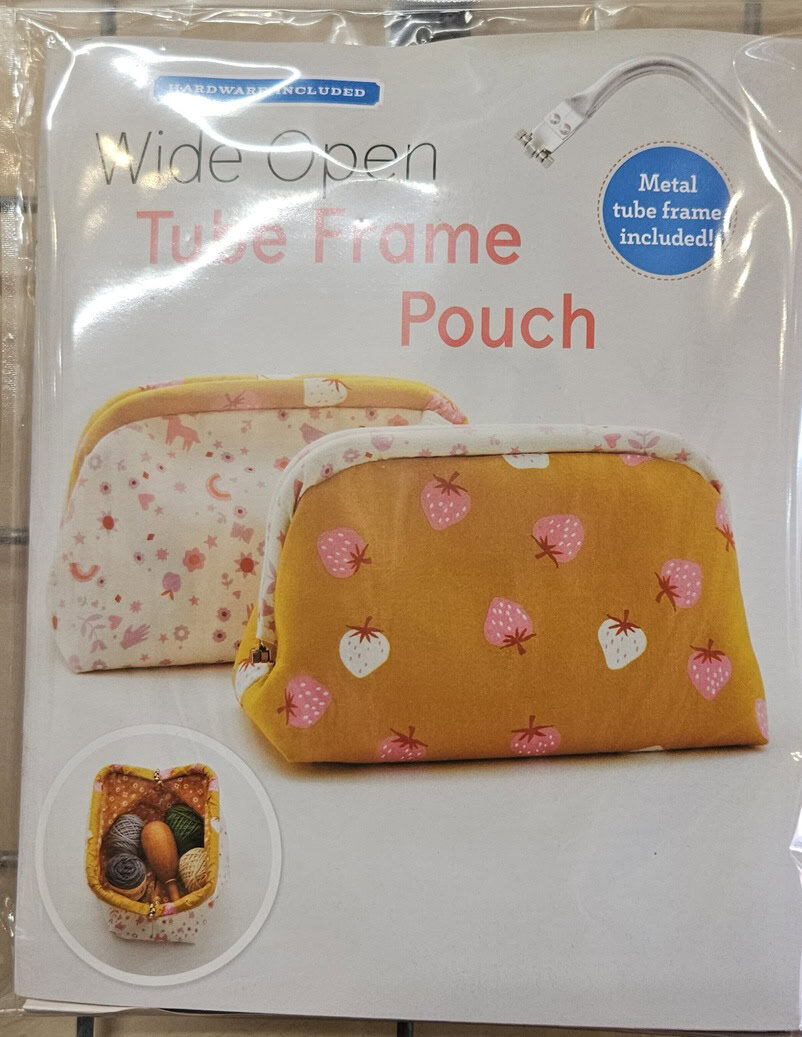
Tube Frame Pouch by Karen Pratt
The other pattern I saw at Picking Daisies was the Wide Open Tube Frame Pouch. Since I am enamored with open wide bags at the moment, this one caught my attention. This open-wide bag is in pouch form. As shown and described the bag opens fully so you can see everything inside. It would be great for a knitting project bag.
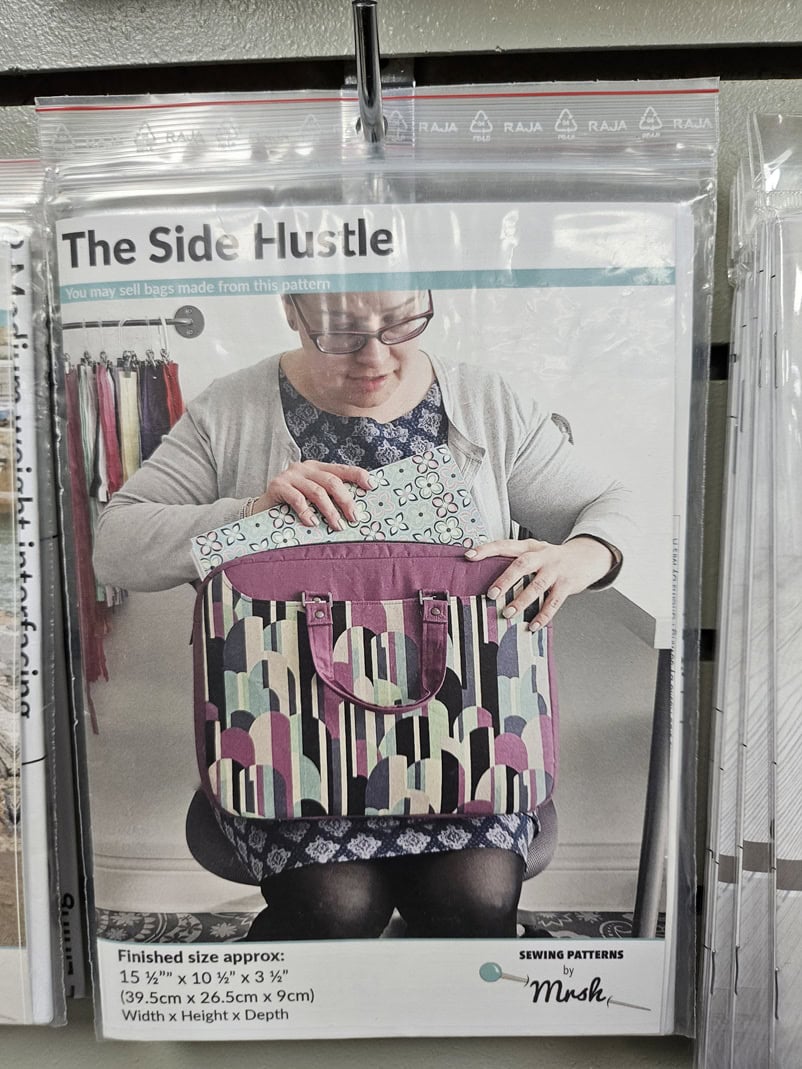
The Side Hustle by Mrs. H.
The Side Hustle is a Mrs. H pattern. Mrs. H has a lot of patterns, a bag club, a book and bag retreats. The Side Hustle is a messenger-style bag that is designed for carrying a laptop and files. I really like the name of this bag, but also that rounded slip pocket on the front in the photo.
These bags have really widened my horizons in terms of bag designers. I know there are only a few. This is another reason I like to visit quilt shops when I travel.
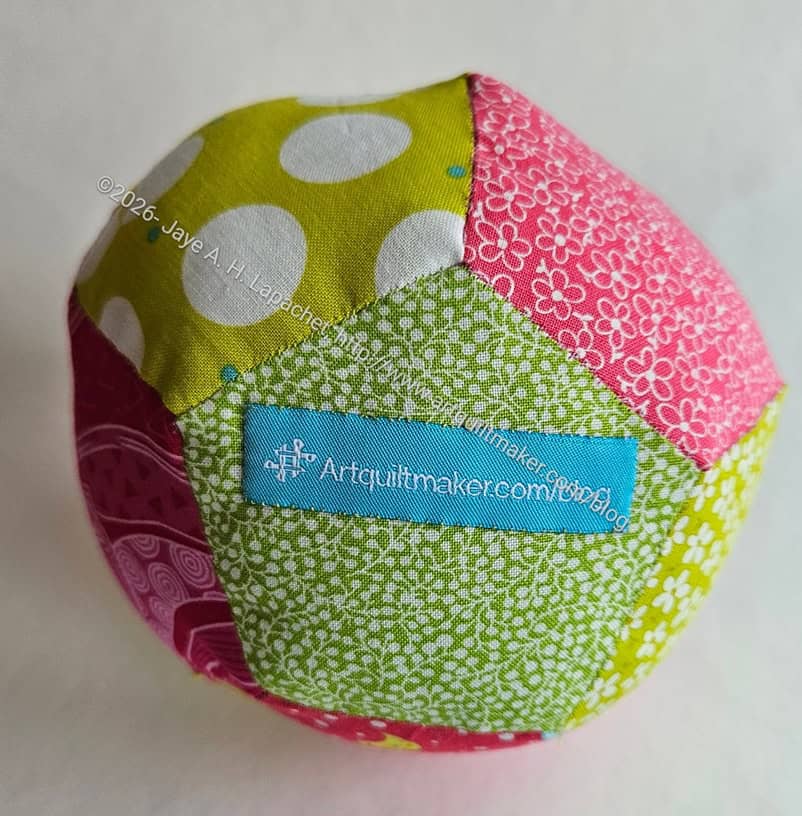
I finished another EPP ball. It wasn’t black and white, but the next one will be. 😉
I had fun using chartreuse and pinks. Some of the pinks are pinky-reds, which I like. I think the chartreuse and pink go together very well. The combination isn’t designed for a boy or a girl and could be used for both.
EPP Ball #13
EPP Ball #13
Do you see a lot of pink in my work lately? I am leaning into pink lately. I am not fighting against the urge; I am just going with it. I don’t know what it means or how long it will last, so buckle up.
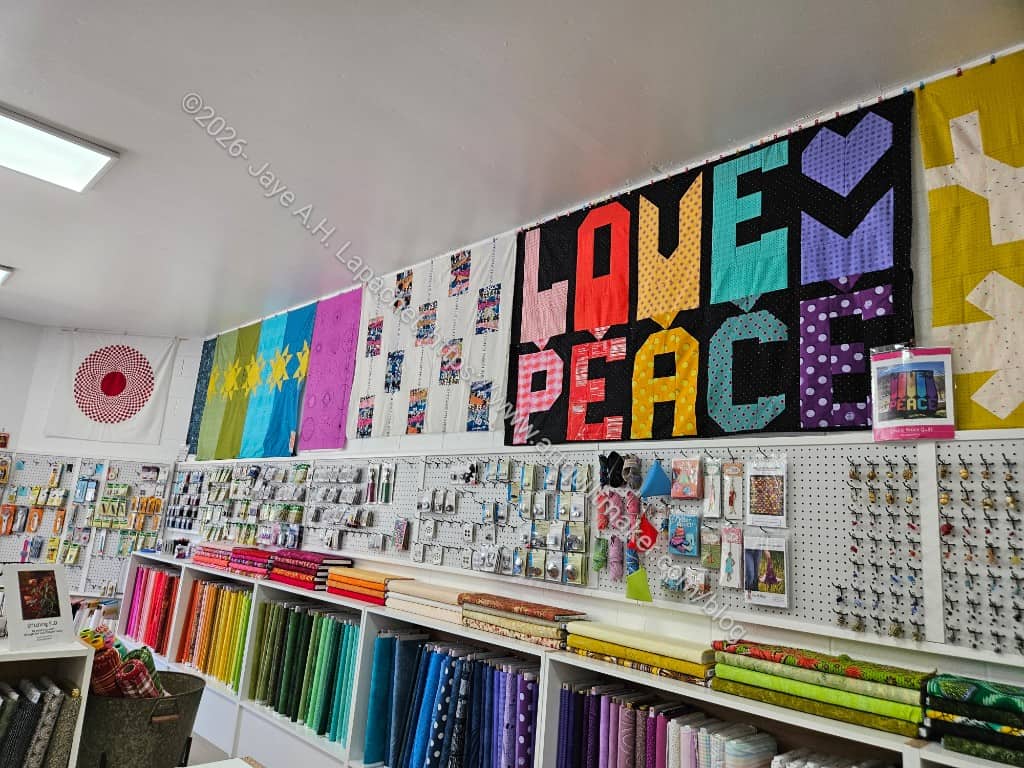
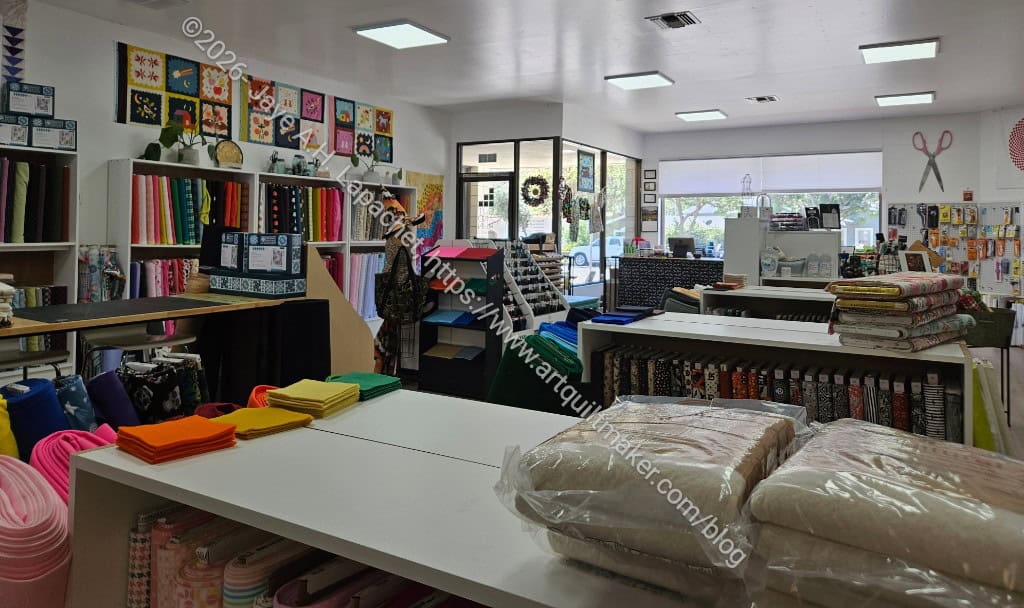
Picking Daisies is an amazing quilt shop in downtown San Luis Obispo. I loved it.
Picking Daisies is located in The Creamery. Described as “Tucked back behind the intersection of Higuera and Nipomo Streets, The Creamery Marketplace might just be downtown San Luis Obispo’s best-kept local secret. The open-air public market merges the Central Coast’s storied dairy history with its modern, flavorful present.” Inside the gates is a courtyard with seating surrounded by various shops, including Picking Daisies.
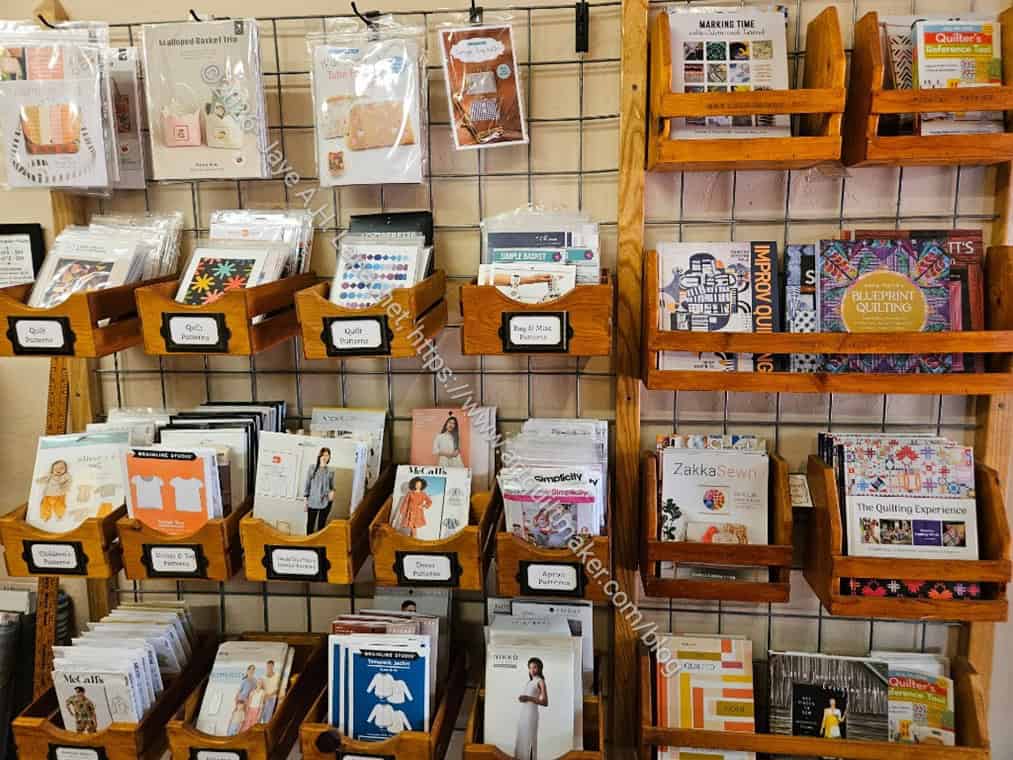
Picking Daisies – books, patterns
Right inside the door of this petite shop are bag and garment patterns. I also saw a small, but nice selection of books, though I didn’t take the time to look at them.
I was surprised to see more Karen Pratt patterns! I went from never seeing her before to seeing her patterns all over! This is why I like to go to quilt shops: I always see items I haven’t seen before.
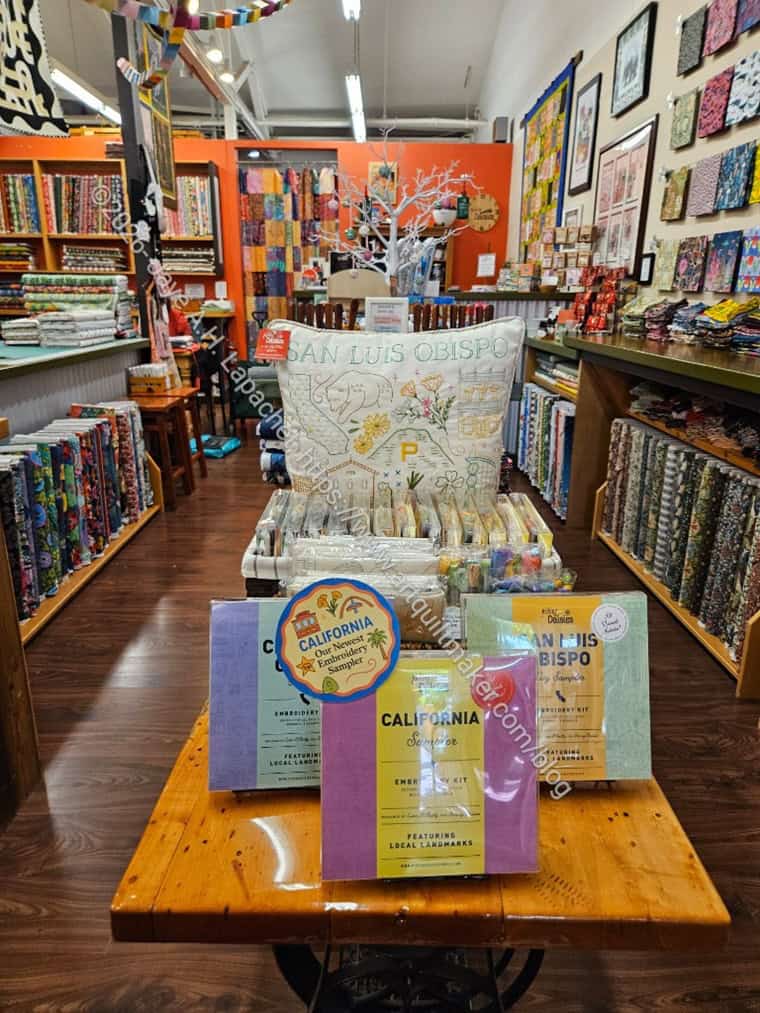
California embroidery
The first thing I saw when I walked in were California tea towels and a California themed embroidery kit. Some of the tea towels were the same fabric that I used for the shirt I made for DH. I didn’t buy the kit, but I did buy the embroidery cloth with the design printed on it. I’ll see about making it after I finish the needlepoint. The cool thing was that they had a completed example, which looked modern not fusty. One motif was the iconic building at Los Angeles International Airport. The designer is Cedar O’Reilly. There are three different designs and are only available at Picking Daisies.
Picking Daisies – kits and projects
Both Cut and Run and Picking Daisies were great. It would be hard to choose a favorite, but the merchandising at Picking Daisies was really amazing. Everywhere I looked I saw bundles of napkins, kits for projects, but not just the normal kits shops can buy from fabric companies. They had clever and carefully put together kits from their stock. The photo above shows a project bag using some Tula cat food cans as the background. This is a similar idea to my I Spy pouches. In the middle of the photo is the Divided Basket pattern by Noodlehead. There were about six kits available for this pattern in all different fabrics. I have resisted buying this pattern, but when I saw it here for a good price, I succumbed. I didn’t buy a kit as I am sure I can make one up at home. 😉
Picking Daisies – color
I also noticed the color. The walls were all different colors, not necessarily colors I would choose, but great colors for the space. It felt small, but also cozy and warm, not claustrophobic. I know I said I really like the bright white walls and light filled rooms of Stitched, but I also liked the warmth and coziness this shop.
The shop owners were working with a fabric rep to select new fabrics from upcoming offerings. They were occupied and I was able to wander around the small space seeing what I could see. I also earwigged a bit and saw some new and upcoming fabrics from Cloud 9 and Northcott.
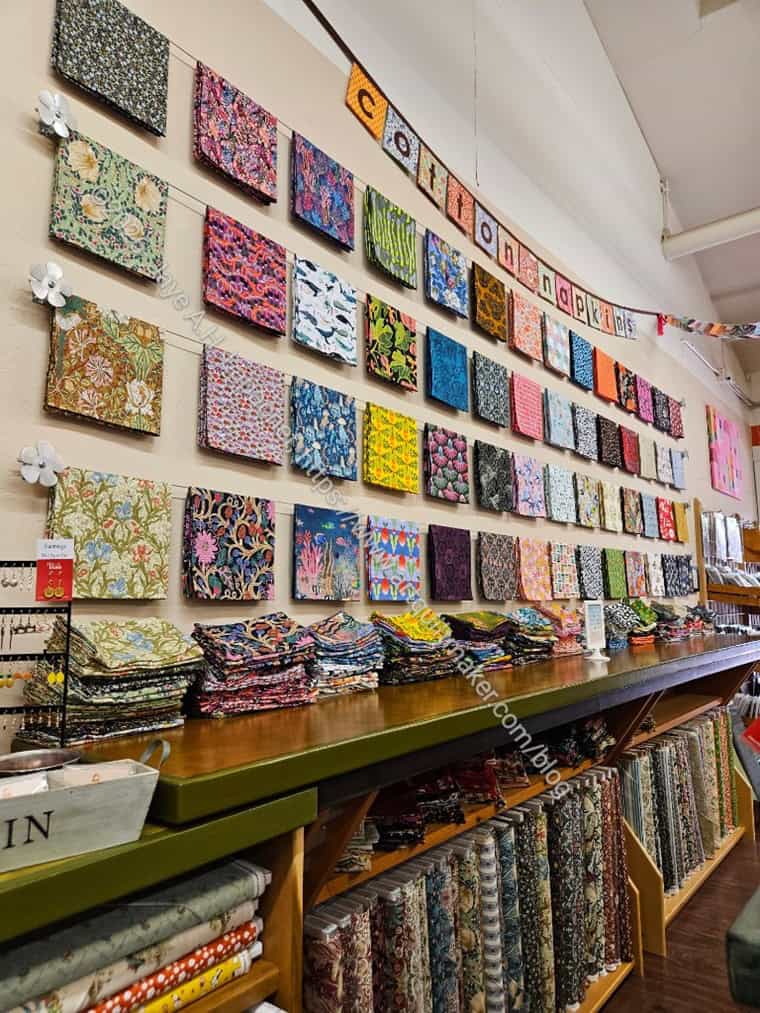
Napkin Wall
While this was definitely a quilt shop, they also had some gift items, which is a great idea for tourists and kids who might wander in. Earrings, some cards, a couple of puzzles, the tea towels, were some of the items I saw. The gift items did not take away from the fact that this was a quilt shop.
One thing I noticed is that they make cloth napkins and have them for sale. They had a whole wall of napkins. Napkins make great gifts, they are made from fabric and can be made from bolt ends. Not your usual tourist gift, they are a clever choice for someone who wants a souvenir, but a useful one.
I love the way these napkins are displayed. Hanging them on the wall makes a lovely art piece. Napkins were sold individually (need one for your lunchbox?) and in packs of four, maybe more.
Picking Daisies – fabric
The shop was absolutely STUFFED with fabric. Everywhere I looked had bolts displayed. Even though it was a small shop, I didn’t feel like visiting was a waste of my time. In addition to everything mentioned above, there were plenty of great prints from which to choose, including a new line by Martha Negley!!! Apparently, she has been picked up by Free Spirit again and Picking Daisies had a flower collection plus fabrics from a new mushroom themed collection. They are also expecting another collection called Golden Harvest from her, shipping in July. I saw some of the Golden Harvest prints online, but need to take a look in person. There is one with grapes and pears and an eggplant and I loved it!
Picking Daisies – notions
They had a small, but well thought out collection of notions. I was pleased to see Karen Kay Buckley scissors displayed, which are the best. I added some True Grips to my pile just because they had them.
They had the basics and few unique items like one of those glow rulers we saw at Kruusn a few years ago. I haven’t seen those very many places (another thing to make sure stays charged?), so I thought it was interesting.
Picking Daisies – Embroidery & Notions
Picking Daisies – Fabric & Notions
Picking Daisies -side wall to back
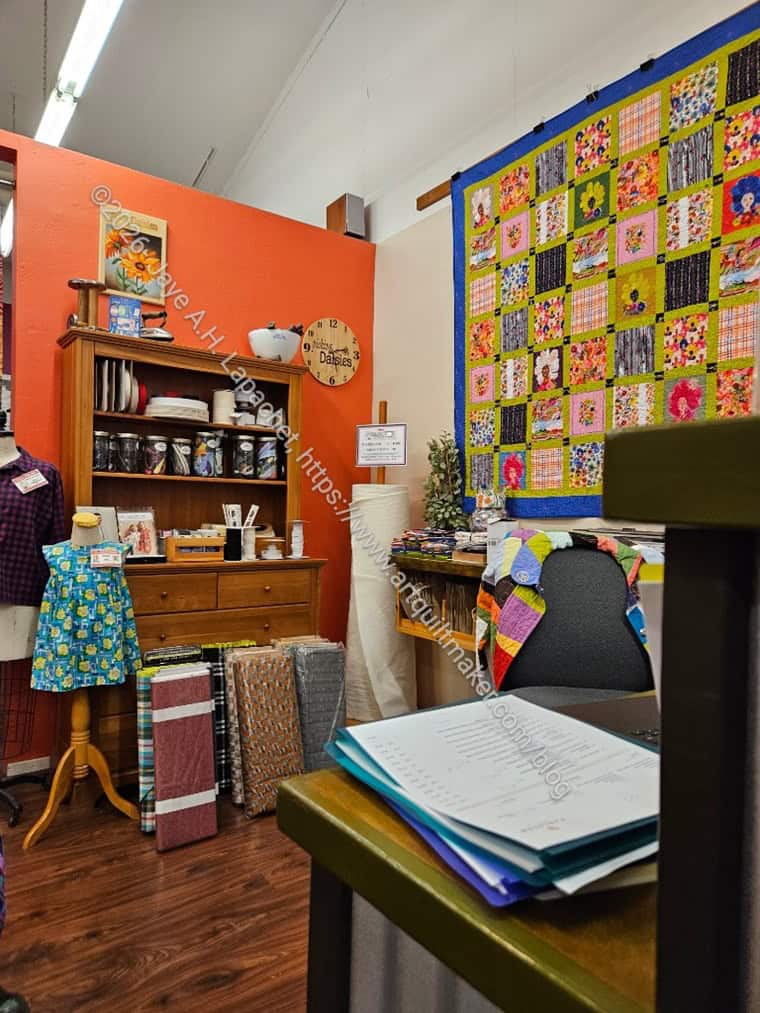
The Notions are in the front corner of the shop. Next to them is a cabinet with more fabric and notions and then along the side wall are quilts and their cutting area. Behind the cutting area is a small area,possibly for classes where the owners were meeting with the fabric company salesperson.
Picking Daisies -more kits
In between the embroidery and the kits section was another shelf with more kits for napkins and other small projects. This is what I mean by great merchandising. They had things so you could make your own projects, but everything you need to grab and go as well. In looking at the photos, I saw things that I didn’t see while in the shop.
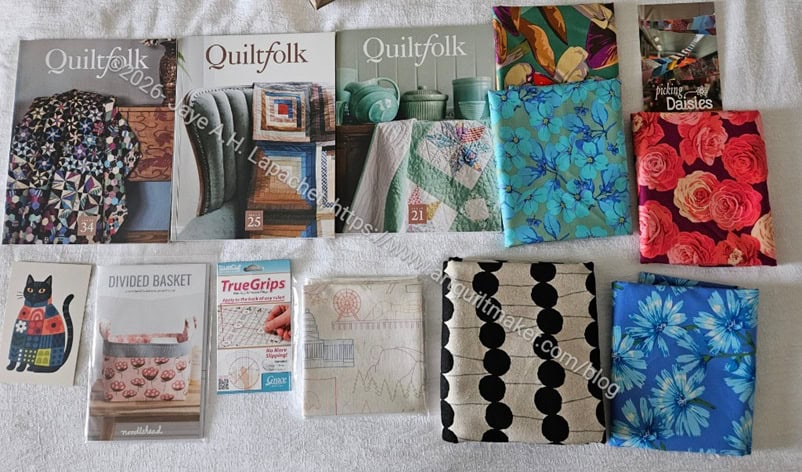
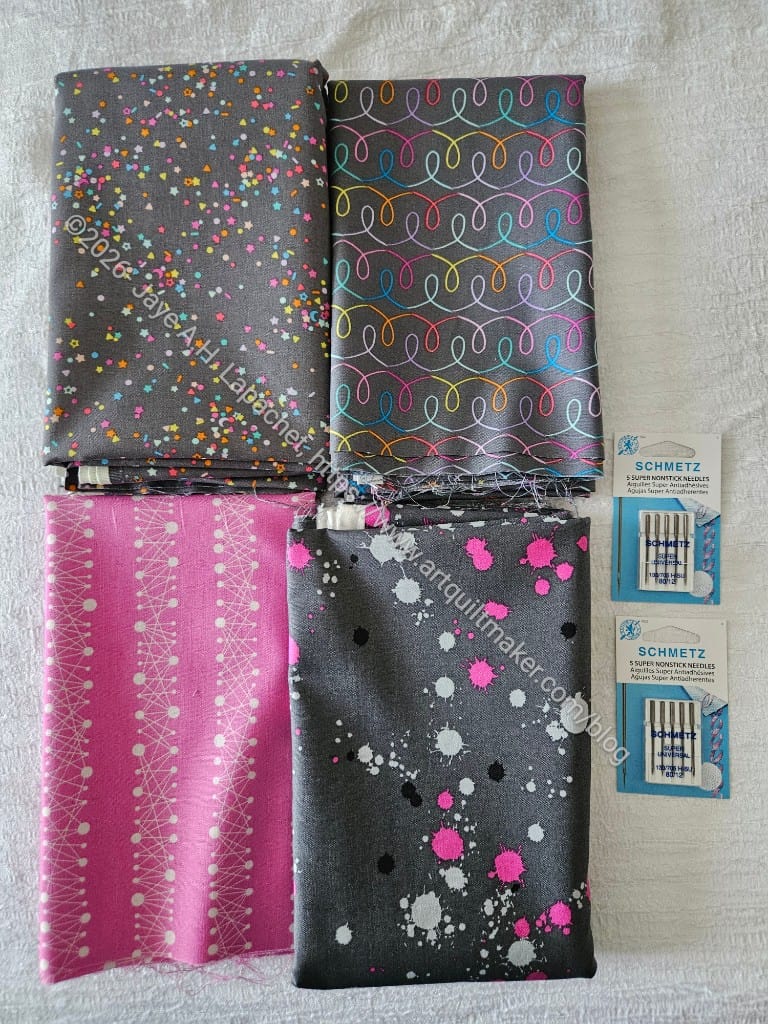
Picking Daisies purchases
I did buy some of the Martha Negleys they had. I didn’t LOVE any of them. Everyone does flowers, but her vegetables were unique and I wish she had scattered some veggies in among her flowers. Don’t get me wrong, the flowers were nice. I even have an idea for a couple of them. I also want her to continue designing, thus the purchase.
Finishing the Sheffield took longer than I expected. I thought I was done, then I had to make the false bottom, and add a label and…
No problem. I really enjoyed finishing it. REALLY! I realized that I have been anxious to get through the final assembly of recent bags, because that was the time when I fought with my machine. I didn’t even realize I was fighting with my machine until I used the new machine to put this bag together.
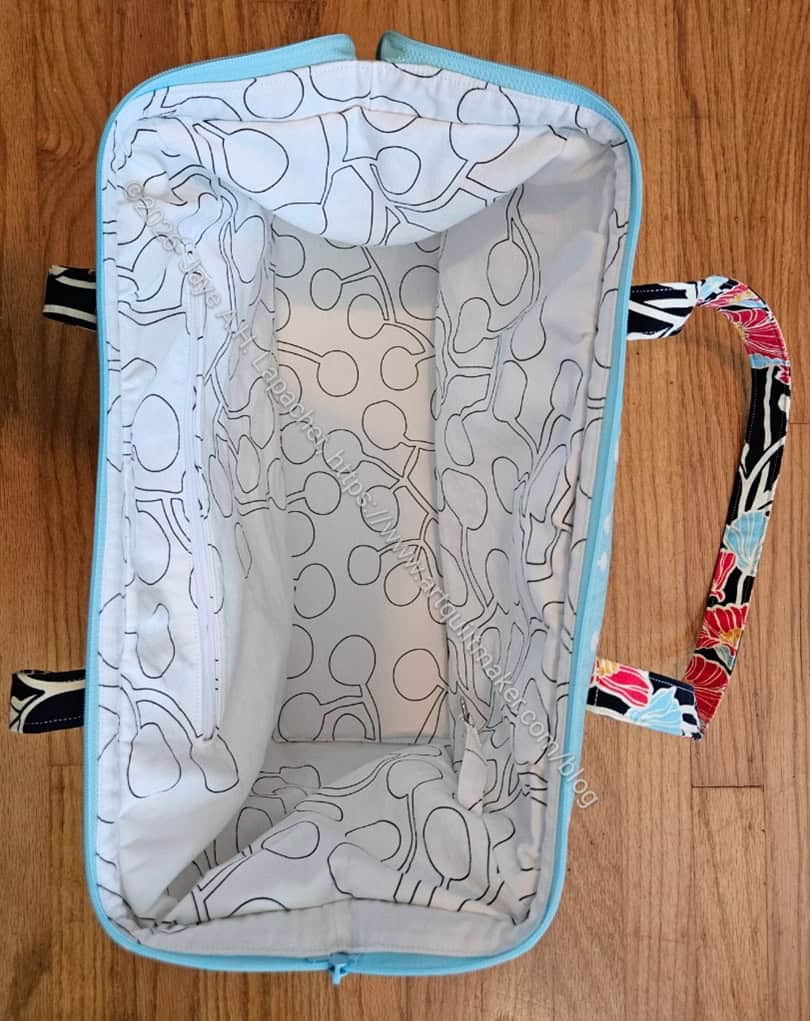
Sheffield: open wide design
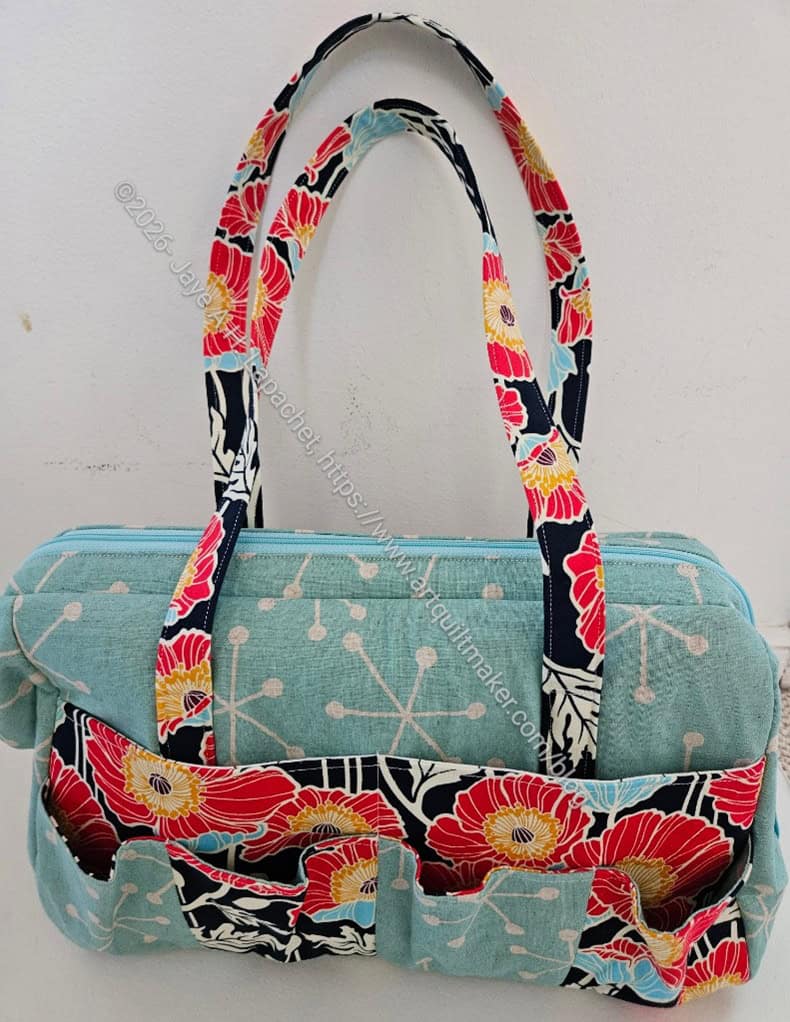
The Sheffield has been on my list to make for a long time. Since I made Gerre hers, I wanted to make one for myself. The open wide design of this bag is very appealing.
The interior is made from an IKEA lightweight canvas I picked up from the free table. My lining is a little saggy baggy, despite the larger seam allowance. The lining will not fly out since I used my hard won knowledge (thanks, Lynette) of anchoring the lining to the exterior. One issue I had is that the pattern pieces for this bag are not square. They are trapezoids. I think something might have happened, because the pieces are trapezoids, when I was sewing the lining together that made them larger than I would have liked. I don’t know.
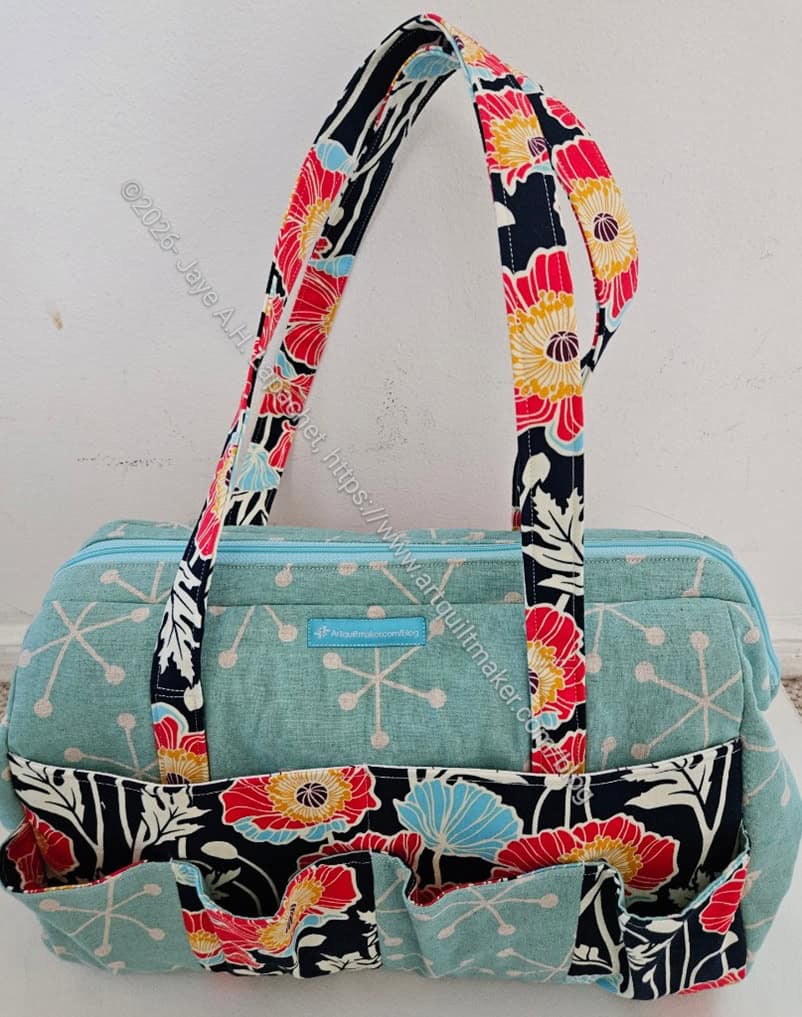
Finished: Sheffield back
I finished most of the exterior pieces while visiting MaryM.
I did the final assembly at home after adding a leash and an interior zipper pocket. I wanted to add a slip pocket,but forgot in my excitement.
The handles on this bag are larger than the those indicated in the pattern. Sara has makers position the handles a half inch up from the bottom. This is so the handles clear the seam allowance. Beyond reducing bulk, I am not sure why. I would like to say I will try putting the handles in the bottom seam on my next one, but I am not sure I will make another one.
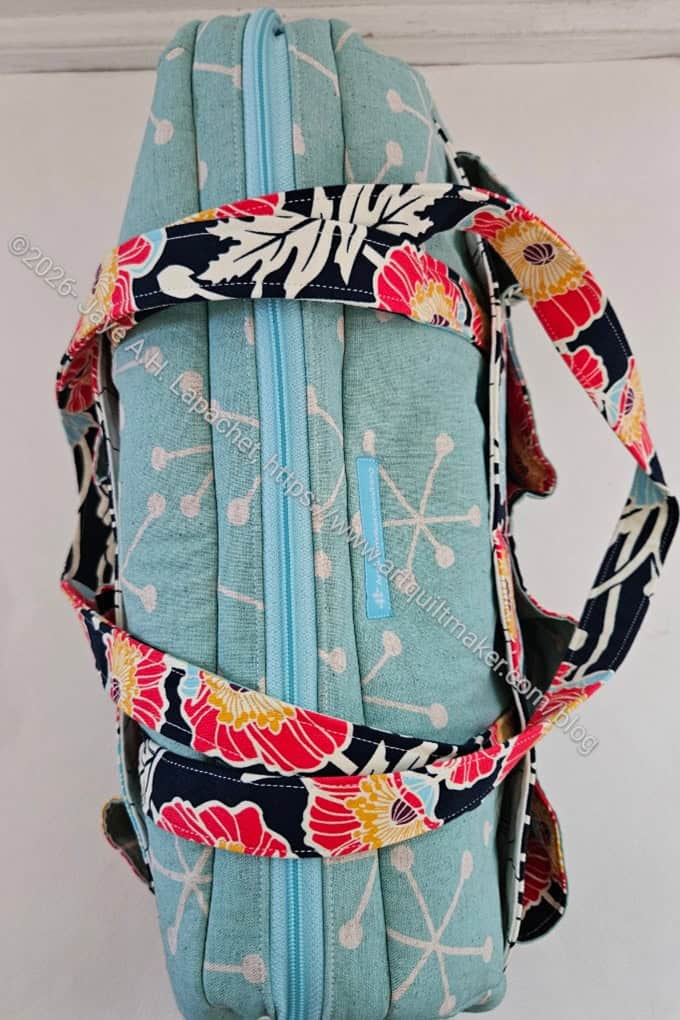
Finished: Sheffield top
I think I could have put the poppy fabric on the frame casing. I think it would have added a finish or border to the top of the bag.
Cutting for the frame pocket was confusing. I have to look at the directions again to see where the cutting went wrong. I wanted to have the exterior match the exterior and same for the interior. I ended up with extra lining pieces.
For now I am just excited about the bag. I don’t know for sure how I iwll use it. I am thinking about putting all of my metal tools in in: KAMsnaps, Snap Setter, awl, hammer, etc. If there is space, I could add in webbing as well.
We were away last week on the Central Coast so DH could attend Grand Parlor. I didn’t do nearly the prep that I had done in the past for his events and had decided to do some quiltmaking side trips of my own. I planned to drive to Carpinteria while we were in SLO to visit Roxanne’s. It was about a two hour drive and after finding a few quilt shops much closer I put off the Roxanne’s visit (and the SBPL visit) for another time.
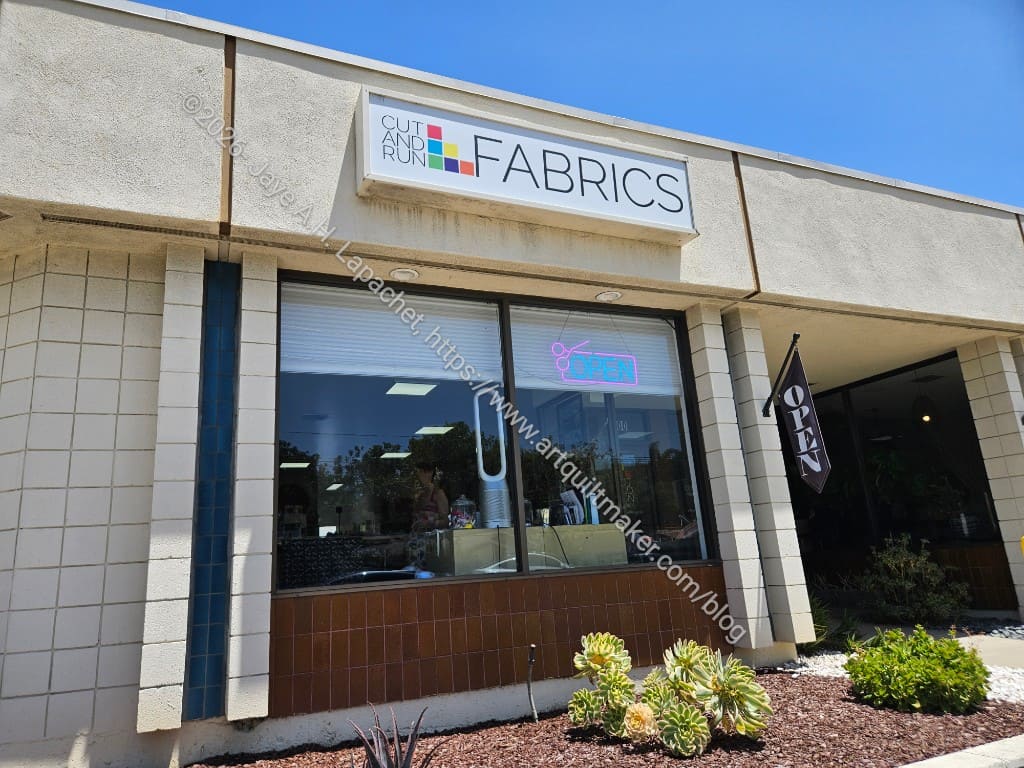
Cut and Run Quilt Shop, SLO
Cut and Run Fabrics was the first quilt shop I visited. I stopped on my way back to the hotel after the Ladies Luncheon.
I had a little trouble finding it, but I was in the neighborhood and eventually arrived. It turns out that the shop is within walking distance of my aunt’s house.
Cut & Run interesting notions
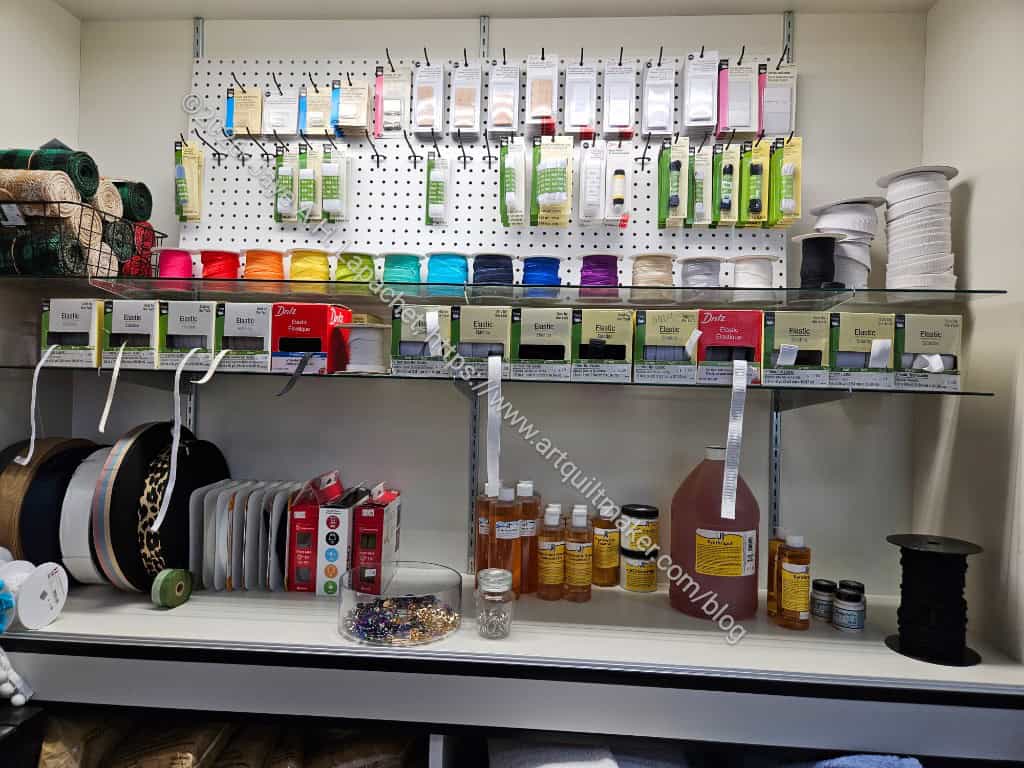
Cut and Run has quiltmaking fabrics as well as garment fabrics and supplies for making garments. I saw some lingerie straps and closures that I recognized from when my grandmother took a lingerie class.
Cut & Run fabrics
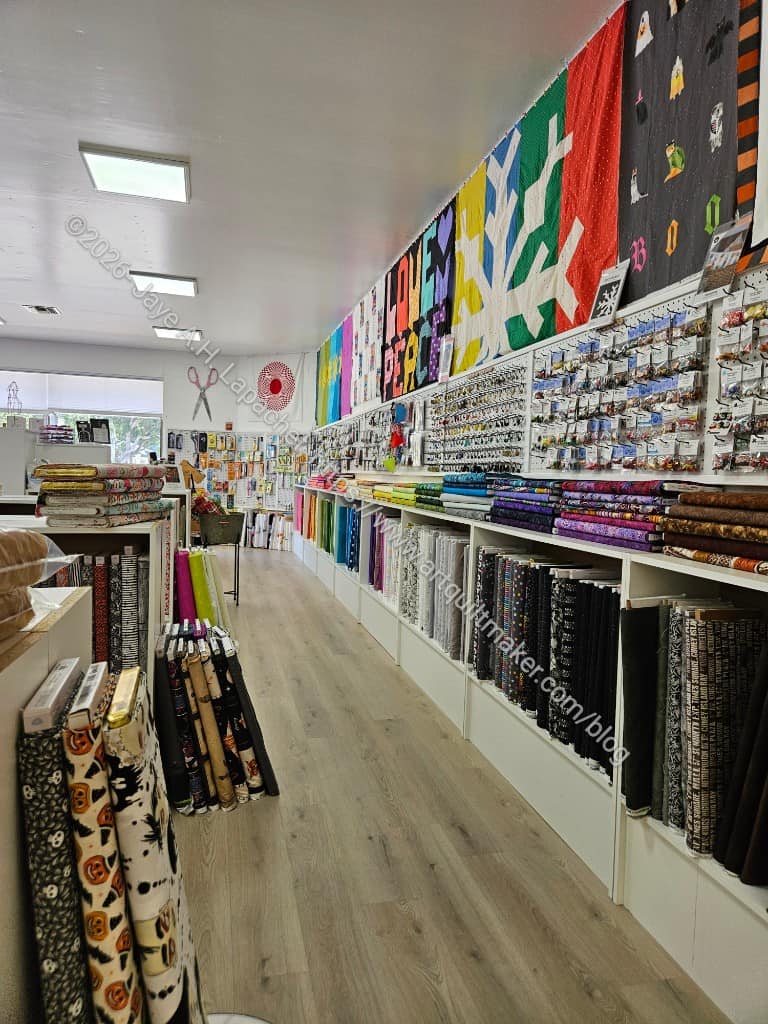
The shop had a great selection of fabrics with a distinctly modern vibe that appealed to me.
I chatted with the owner for awhile after she gave me a bookmark with all of the shops on the Central Coast listed. This is definitely a great effort by all of the shops to work together.
The bookmark definitely makes for a temptation to go on a road trip specifically to visit all of these quilt shops. Of course I wanted to head out right away, but I had to fulfill promises to DH and attend events for which I had signed up.
Cut & Run vintage buttons
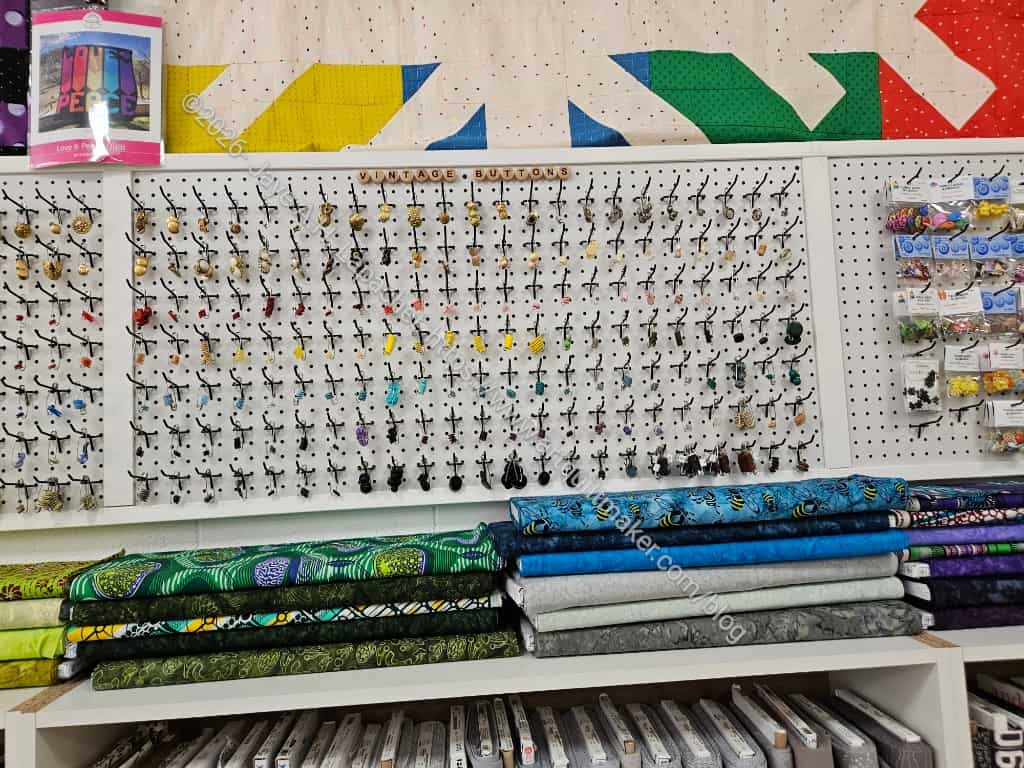
There was a wide variety of notions including quite a large display of vintage buttons.
Cut & Run, Dozer and front of shop
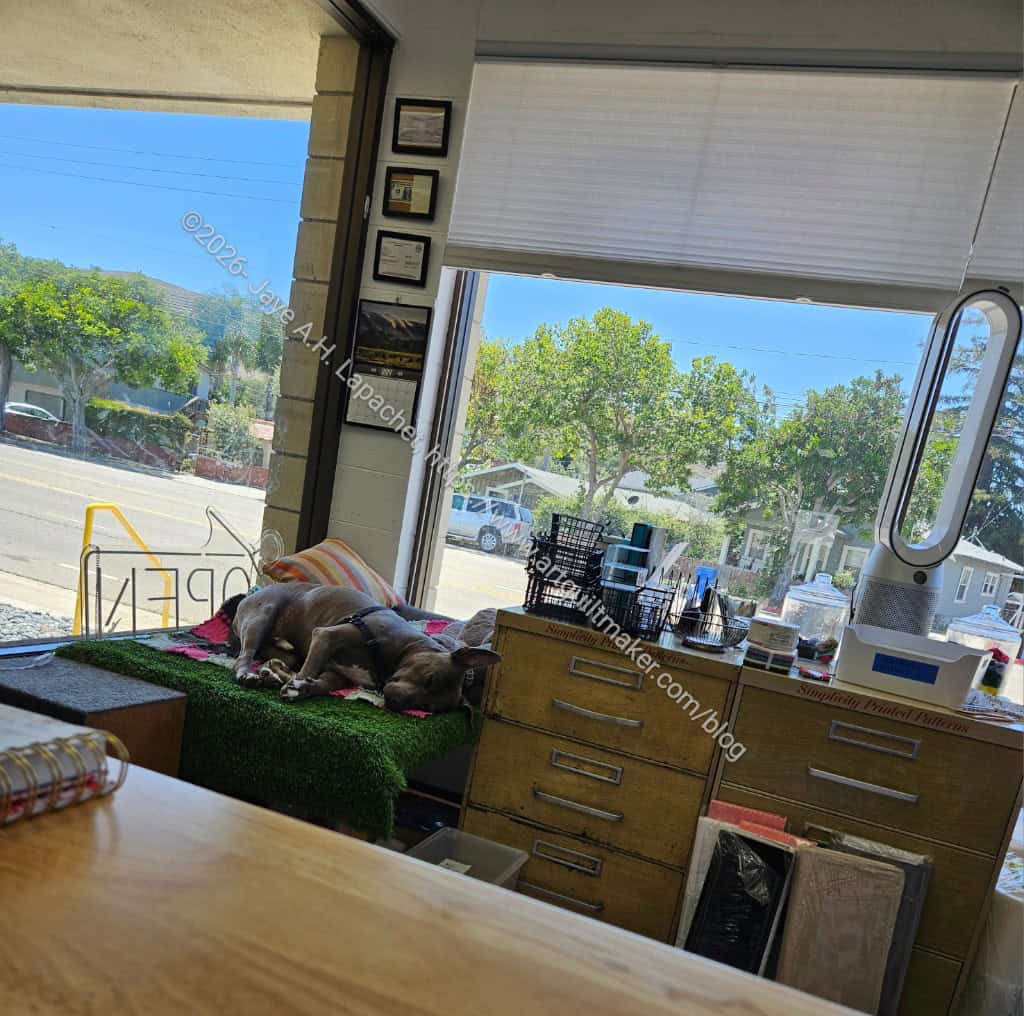
Dozer, a very large dog, was snoozing away behind the cutting counter.
I meant to ask whether the shop actually stocked garment patterns, but was distracted by the excellent marketing. It is possible she rescued the cabinets from a Joann that was going out of business.
Cut & Run samples
I like the samples of quilt patterns that were displayed. They are big and bold. I like the colors, too.
The variety of colors of the samples and the fabrics made me happy to be in the shop.
Cut & Run back to front
I thought the shop was a good size, too. Not too small, plenty of fabric and notions, fresh everything.
One thing I saw was great flannels! The shop had wonderful colors for flannel. I can’t remember seeing such a good variety since I was at Joann’s looking for flannel for the YM.
I think we will make another trip south later this year and I will put this shop on my list as one to visit again.
Cut & Run fabric purchases
Address: 2300 Broad St, San Luis Obispo, CA 93401
Phone:+1 805 519 1908
The Sheffield is a joy to work on! I can’t tell you how much easier it is to work on a bag when I don’t have to fight with my machine. I didn’t even realize, really, that I was fighting with my machine.
To make this bag, I changed feet and needle plates pretty frequently, but it really helps use different feet.
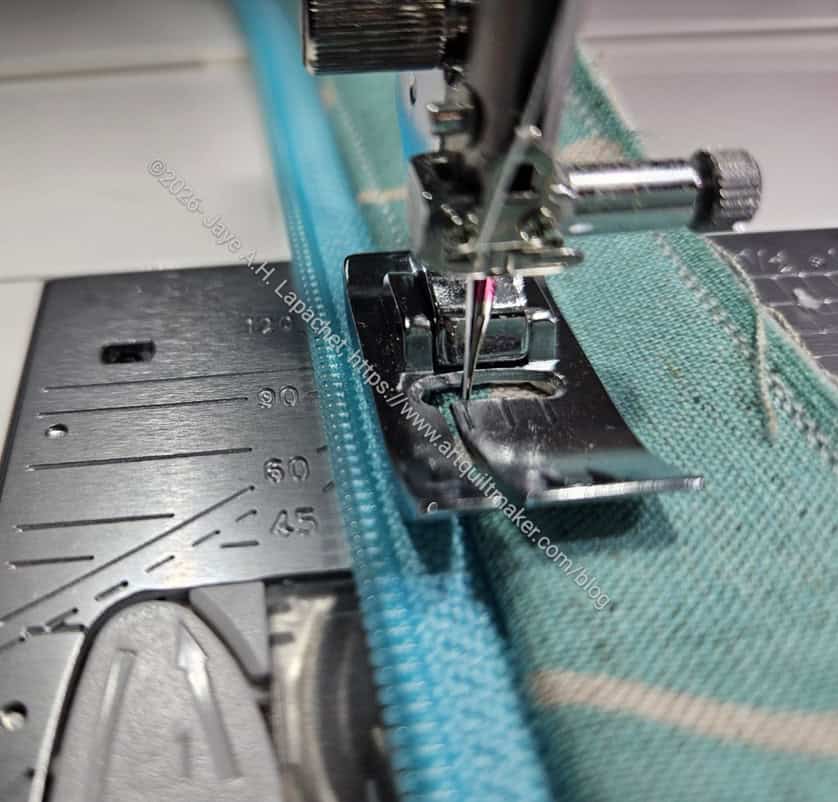
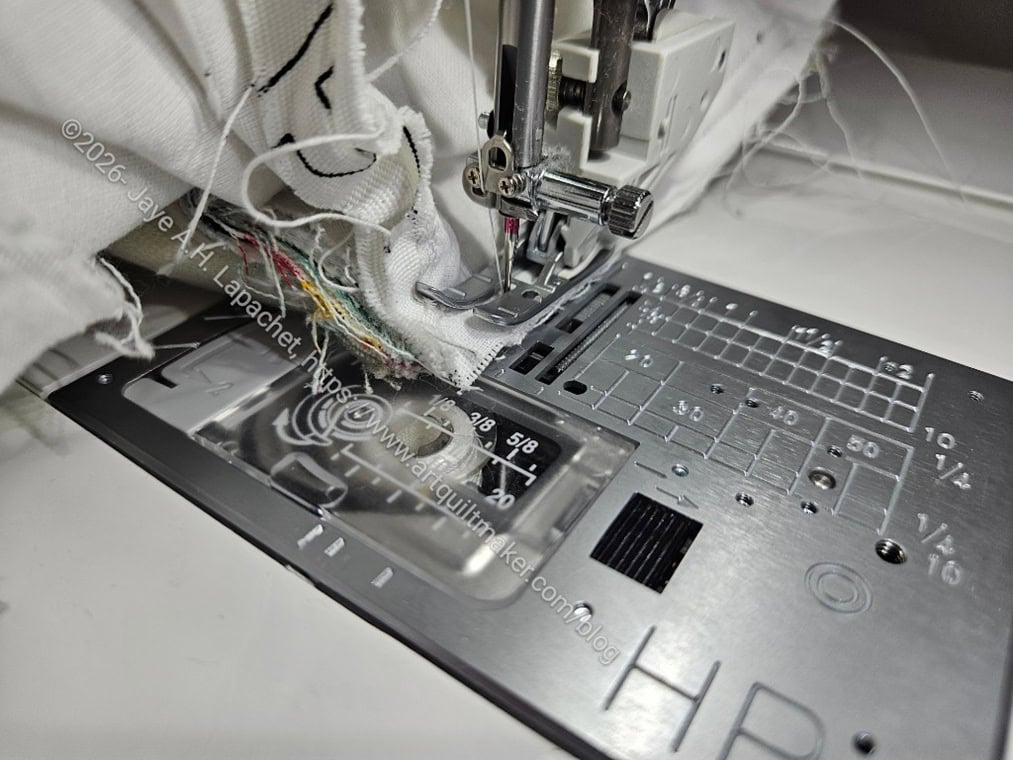
Top stitching thick layers
I used the Bi-level foot to stitch the top stitching on the frame case and that was a breeze. I never used the Bi-level foot before, but now it is one that seems to be coming out of the box often. I am not sure why I didn’t use one before. Maybe I didn’t have one?
Anyway, I was amazed and pleased with how straight the stitching was using this foot. There are a lot of layers the machine is punching through in the photo above and I got good stitch quality, no broken needles or stuttering. Of course, I wasn’t being the demon speed sewist either. I sewed pretty slowly on this section.
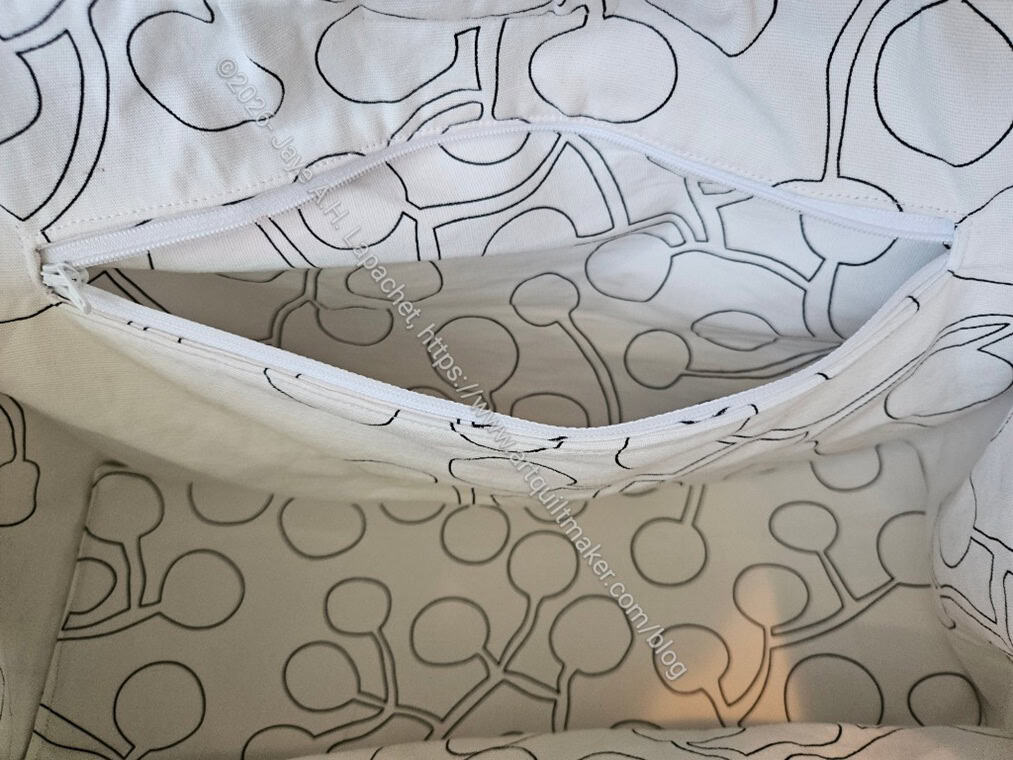
Sheffield internal zipper pocket
I decided to add an internal zipper pocket, which is not part of the pattern.I didn’t have any trouble making it. I learned a bit from the second interior zipper pocket on the Pandora Charisma and that experience helped.
I also wanted to turn the bag through that zipper pocket, which is a technique that Tim taught me. I had to think about it for awhile, because I wasn’t sure if any bag could be turned that way. I didn’t come to any conclusion, so I just went for it. It worked out fine. I like this method, because it means that nobody can see where the bag was turned unless someone digs into the pocket.
I am not sure why I wanted a zipper pocket, but I did. I also added a leash, which I do for all of my bags.
Anchoring the lining
Finally, my next step is anchoring the lining to the exterior. I have started but need to finish.
My new machine does not have a name, but it might need one. I haven’t ever felt the need to name a machine, so this is an odd feeling for me.
As I worked on the two bags I talked about recently at home, the Zip It Up and the Sheffield, I was determined that my machine should work hard. Part of the reason was to test it out, to see what it could do. As I started to write this, my first machine class was coming up. Throughout my testing on the Sheffield I feel like I was able to make good choices and not do anything fatal to the machine.
Top stitching thick layers
I am thrilled with the Bi-level foot. It helped me do an amazing job on top stitching around the zipper. The top stitching on my bag looks professional.
Top stitching is something that needs to be done on most bags. It is also something I have struggled with. I am so pleased that this foot helps improve the look of my top stitching.
Anchoring the lining
I have used this foot quite a bit, but learned at the class that I have to turn the dual feed aspect on. Even without that aspect, the foot was fabulous. It is even better with the dual feed activated. I used this HP2 foot to anchor the lining of the Sheffield to the exterior. I had to turn the bag back inside out as I forgot to sew the anchor stitches before I turned it right side out, but that was no problem. The corners were pretty thick so I avoided those, but I was able to avoid them and sew a long way down the bottom seams. That HP2 foot is a total champ in this task. The width of the foot is a quarter inch. The dual feed aspect of the foot means that despite several layers of foam and canvas, nothing shifted. One seam each on two bottom seams and I was done.
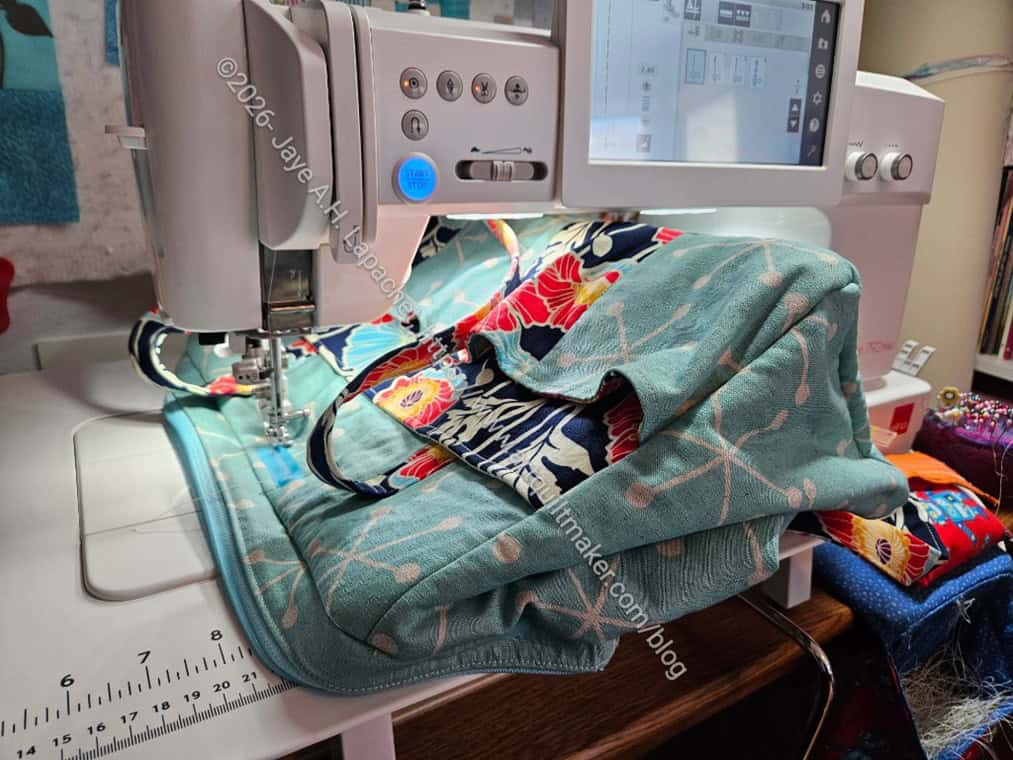
Sheffield under the needle
Yes, I really should have put my label on when I finished each side, but I forgot. I also think I didn’t have any labels with me at Mary’s. After I finished the entire bag I remembered to sew on a label. I found a spot where I would have to go through layers, but none that would impede the smooth operation of the interior zipper pocket. I was super careful when I performed this operation, but it worked perfectly.There was enough throat space to fit the whole bag without the bag being scrunched up and catching on something. I knew that having a throat space that was taller was good for bagmaking. It came as a surprise that this new machine had it. I didn’t measure. A++ to taller throat space.
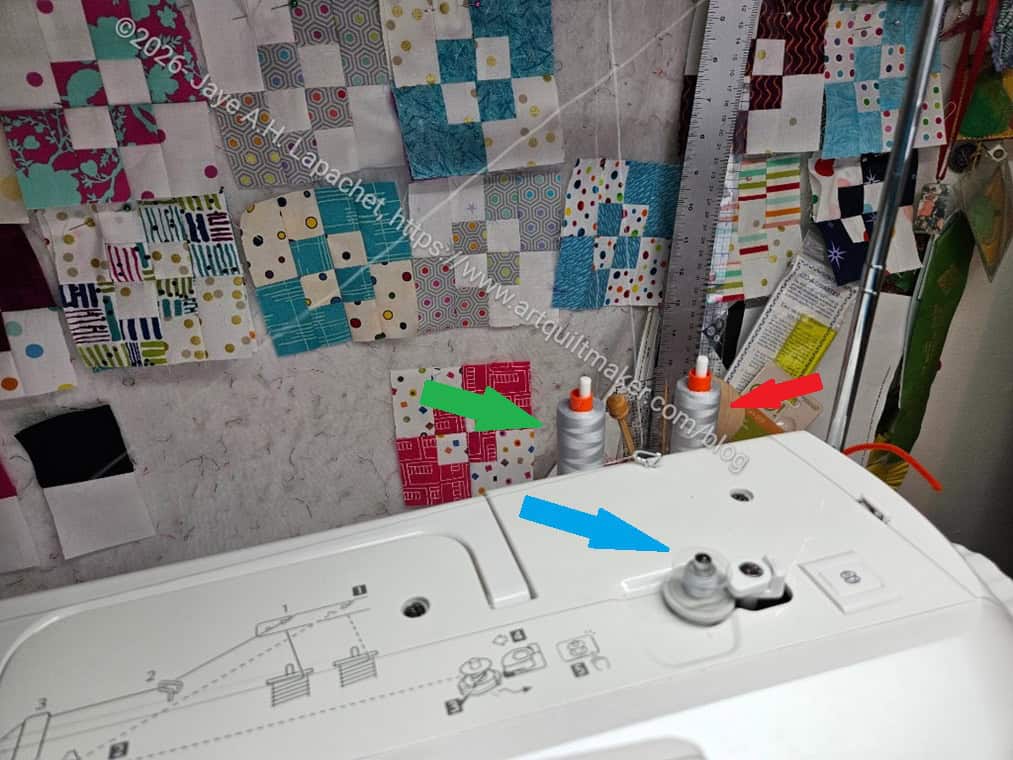
Elna – bobbin winding
Finally, the bobbin winder has a separate motor. I found this out at the class I attended. I had wound a bobbin before the class. With my 6600, I was in the habit of winding multiple bobbins at one time with my go-to Aurifil 2600. Then I could plow through multiple bobbins before stopping my sewing and repeating the whole exercise. It made sense with my old machine, because I had to stop sewing in order to wind bobbins.
In the photo above, I am winding a bobbin. The blue arrow points to the bobbin winder. Next to it, on the right, is a button that engages the bobbin winder motor. The red arrow shows the thread I was using to wind the bottom. There have to be two spools of thread to wind the bobbin and sew at the same time. The green arrow shows the thread I was using to sew, which I was doing at the same time. In this case, I was using the same color thread to sew and wind bobbins.
I am exploring a lot of things at the moment with this machine. Different feet, different capabilities. I am really happy with how the machine handles lumps in my sewing, such as where multiple seams meet in piecing (like an 8 pointed star) or thicknesses in bagmaking.
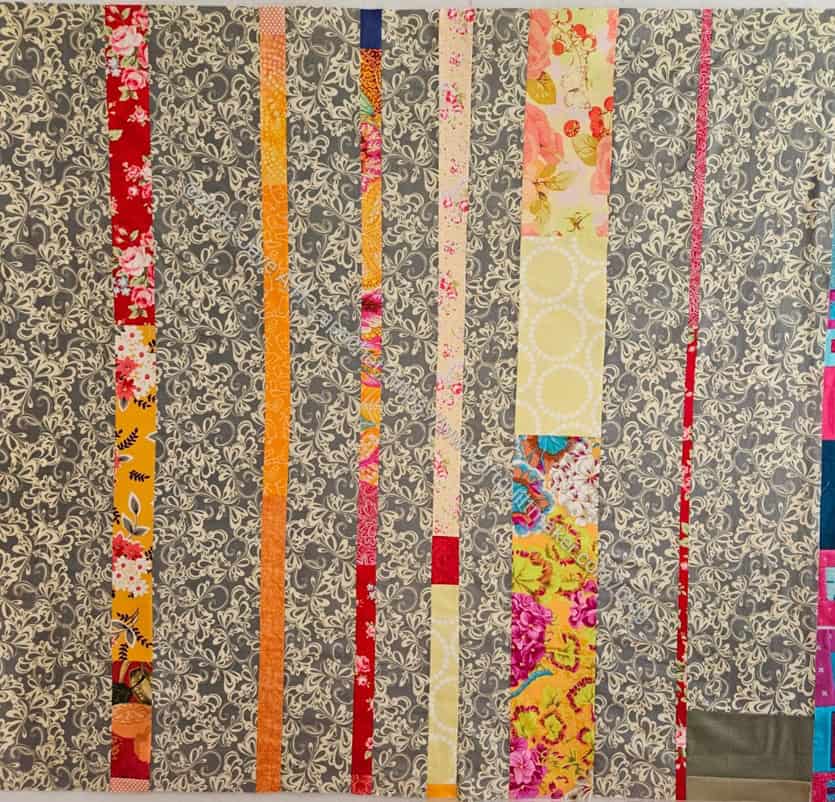
I finished Ends n.25 a few weeks ago. I just handed it in and made time to post about it.
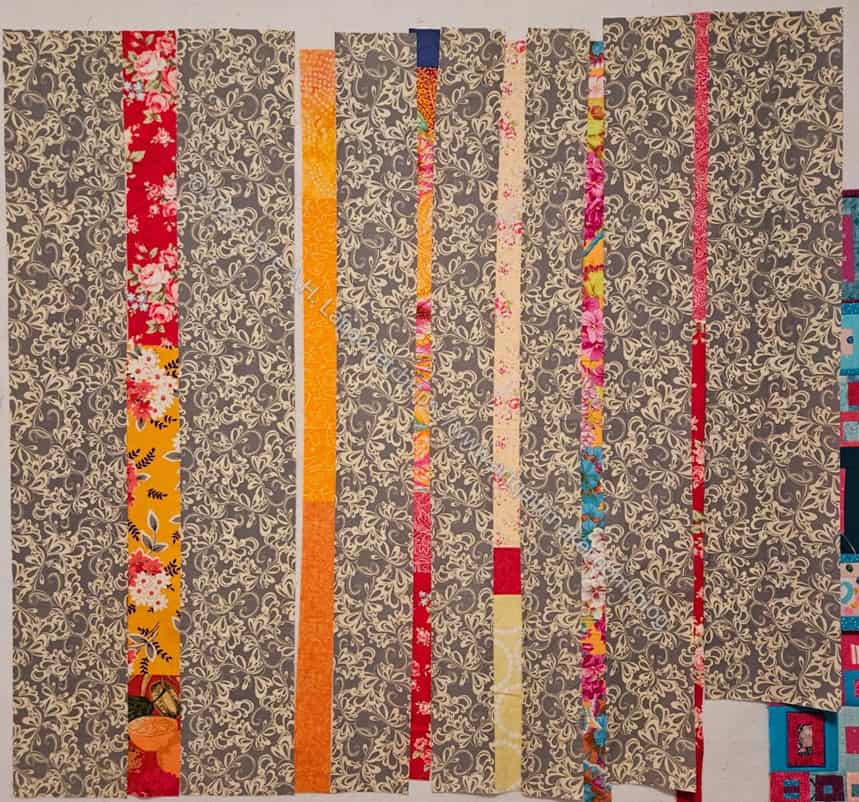
The background doesn’t provide the required contrast to make the oranges and yellows stand out. They don’t, however, blend together either.
This is a great example of what is fun about making donation quilts. I can play around with fabric combinations that I wouldn’t otherwise consider for my own work. I guess making backing is a little of the same.
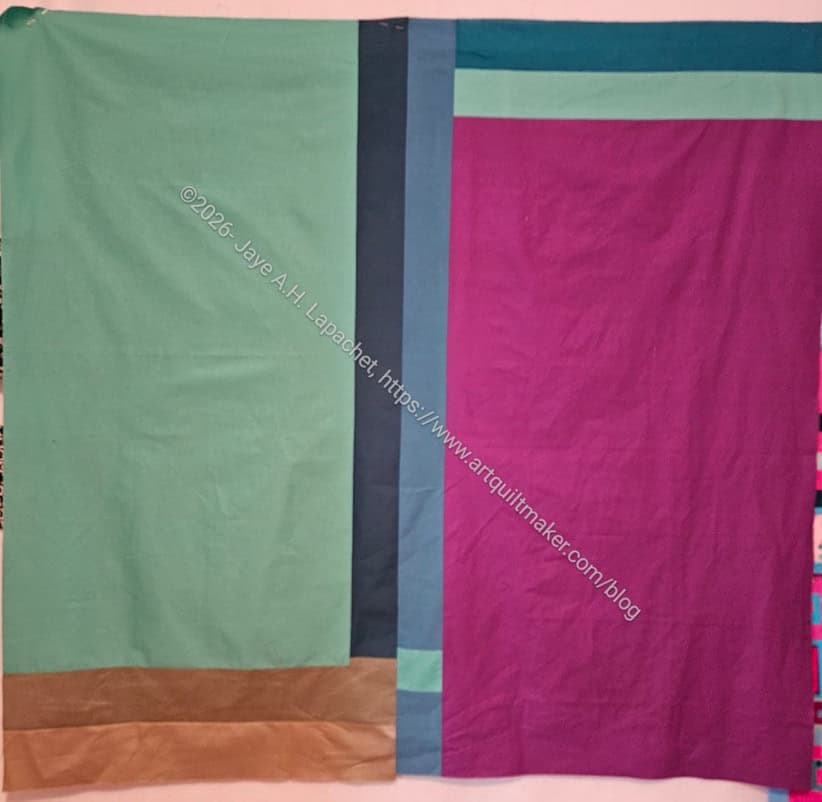
Ends n.25 Back
The back, like the back for Ends n.24, uses some old solids that have been around since the dark ages.
I promise not to show every single one of these that I make. I am just so tickled that the directions from an IG video actually work!
The aspect I worked on in this version was making sure the lining wasn’t saggy baggy.
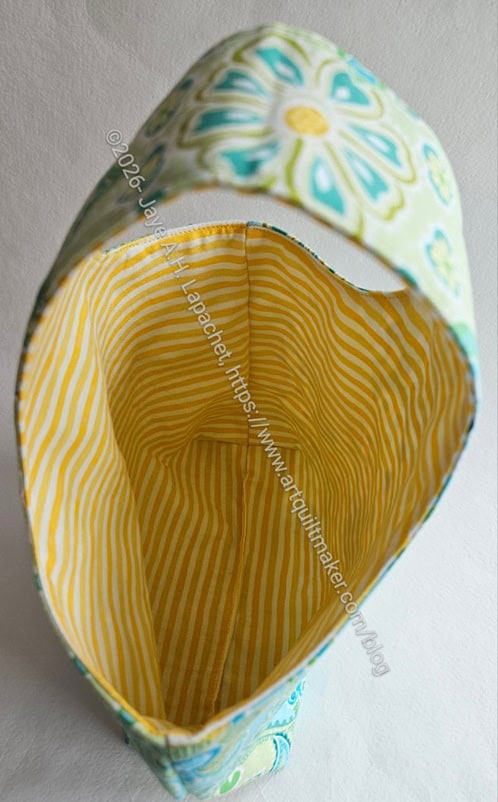
Bag sewn
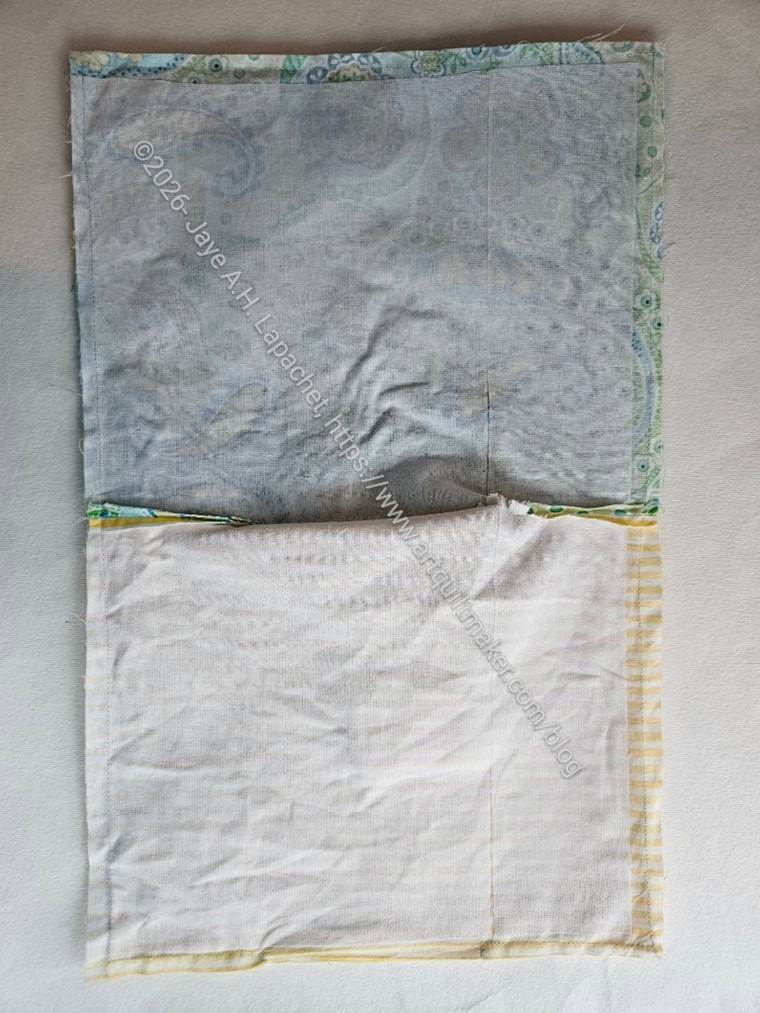
I am pretty pleased with the way it came out. I veered to a 3/8 inch seam allowance when I sewed the lining part of the bag together and used a 1/4 inch seam allowance for the exterior. This all happens before the bag is turned right side out. The picture of the inside of the bag shows the different seam allowances! (enlarge the photo). The trick is to veer smoothly. Don’t abruptly change the seam allowance, though it might not matter if one stopped, then restarted. I think veering is better, though. I may have to try the stopping and starting.
I am thinking about adding a pocket. I’ll have to think about how that would work.
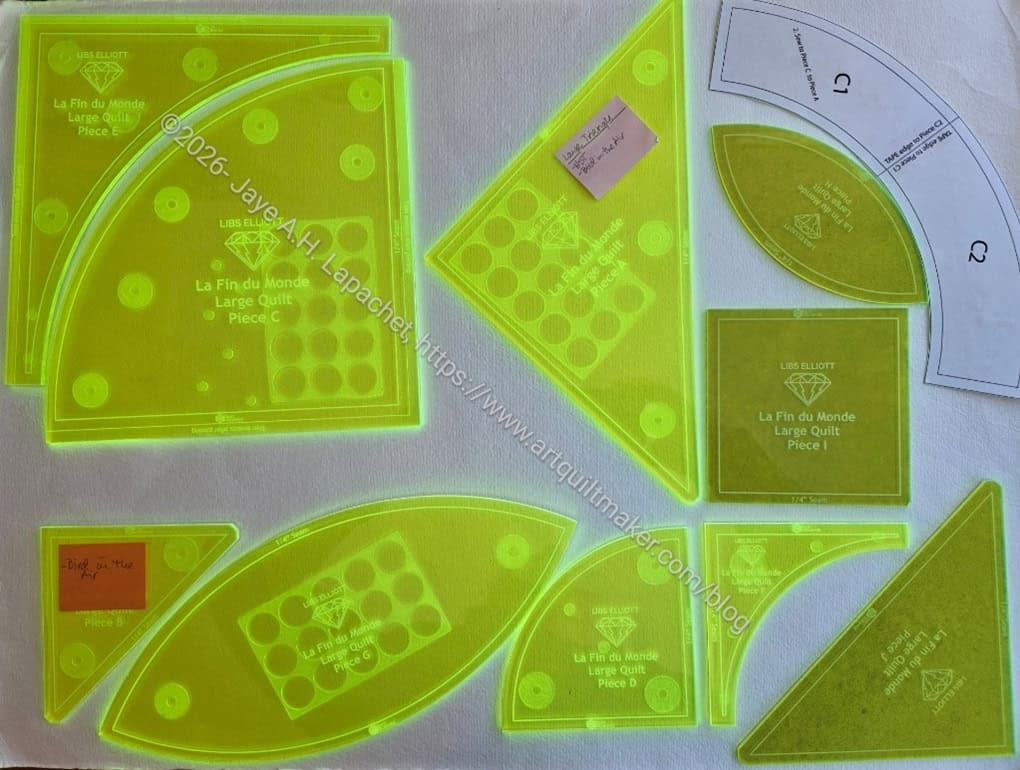
There is no acrylic template for the rainbow block included in the Chaos with a Twist template set. Libs has repurposed these templates from other patterns, Bloem and La Fin Du Monde. It is great that the same templates can be used for all patterns, but I would really like that rainbow block template.
I have placed True Grips** on the back of my templates as it keeps them from sliding around. You can see them through the bright green. My paper Rainbow template is in the upper right hand corner. I made using the tried and true paper and template plastic** method. Not ideal, but it will work.
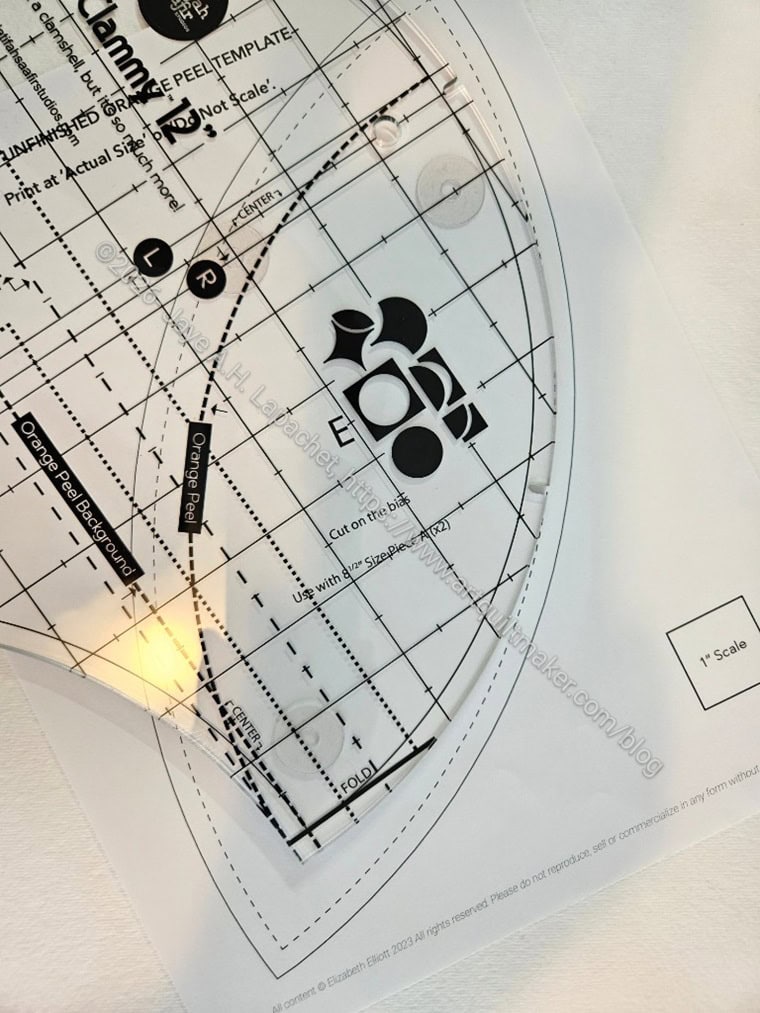
Testing the Clammy for Chaos
Before I put the Rainbow arch template together, I tried different specialty rulers to see if one of them would work.
The Clammy (left) is the wrong shape for this quilt. I tried to use it for the Orange Peel block and it is just too small. As a result, it won’t work for the Rainbow block, either.
JCB Options
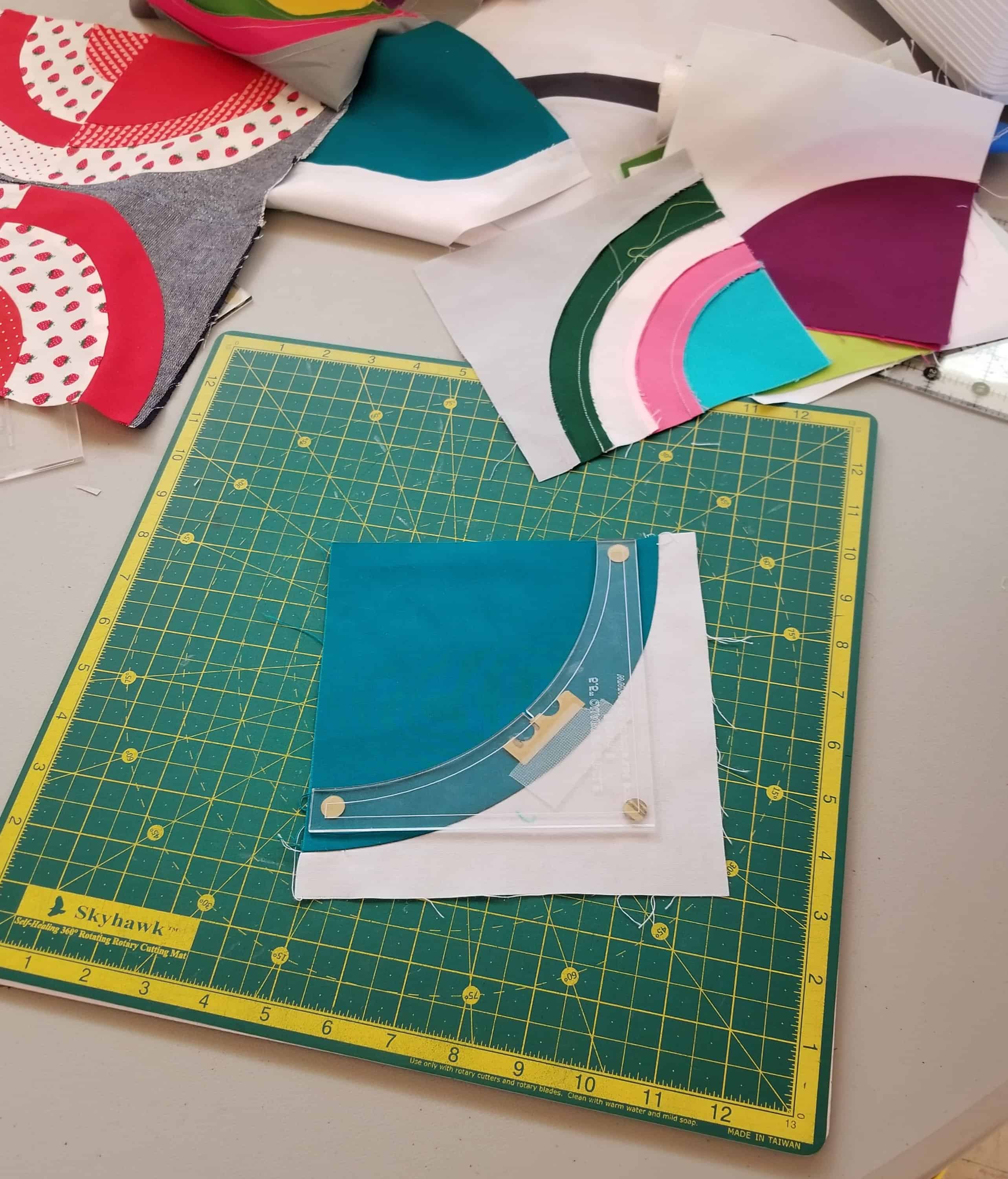
I also pulled out my Jen Carlton Bailly templates from the class in 2019. One of the blocks she shows was a Rainbow block. It might not be the exact right shape, but if I do them all the same, it should work.
Looking at the photo I took, it may also work to make a regular quarter circle then use the background template to make the Rainbow. I am going to try this and see what happens.
Almost as soon as I finished Ends n.24, I started Ends n.25 using the same background fabric. I got the background fabric for free somewhere and never used it, so here we are.
You can see that there is a shortage on the bottom right so I’ll have to add something in there.
I am still working through the edges of the back of Orange You Glad, which make up the color in this quilt. I have a few other red and orange edges that I added in, some still hanging around from the back of the Lobster table runner.