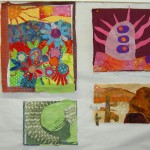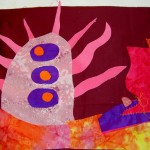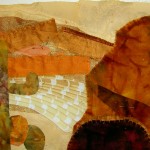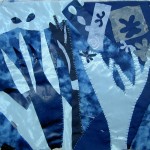
The AHA Moment

I have been in class for the past two days with Pamela Allen. Pamela is much more than a quilt teacher. She is truly an art teacher who works and encourages work in fabric. I had THE Aha moment in her class today and it really thrilled me. I could feel the difference in my work after that moment.

As you may have read, or noticed, I felt crappy all week. Barely any blogging got done even though I have a pile of sticky notes with reminders of things to tell you. My house is a wreck and my to-do list is still long. A cold was really beating me down and I was doing everything I could to conserve energy so I could go to class. A good move on my part was to take Thursday off of work rather than working straight through and then going directly to class.

I have taken several classes with Pamela. The first one I took was in Richmond, Virginia at Quilting Adventures. I actually took two different classes in one weekend. The first was a self portrait class and the second was on composition. I started one piece in each class.

Self Portrait
Self Portrait
Garden (before)
Garden

Pamela also came to California in 2008 to teach at EBHQ. I took her class there as well. I don’t think I ever wrote a blog post about that one, but Julie wrote one, which is probably what I would have written anyway. 😉

The quiltlet, House and Garden, that I did at EBHQ has been worked on more since the class and I am almost finished with it.  Maureen sent me a link to facing directions from Jeri Riggs site and I plan to use them to make a faced edging as soon as I finish the beading.

House and Garden
House and Garden

I brought all three of these pieces to the workshop with the intention of working on them and not starting anything new.

The first exercise was a monochromatic exercise. I didn’t do it. Don’t worry! I warned Pamela that I was planning to bring projects from previous classes. I did enjoy the pieces that others in the class made.

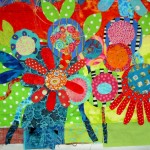
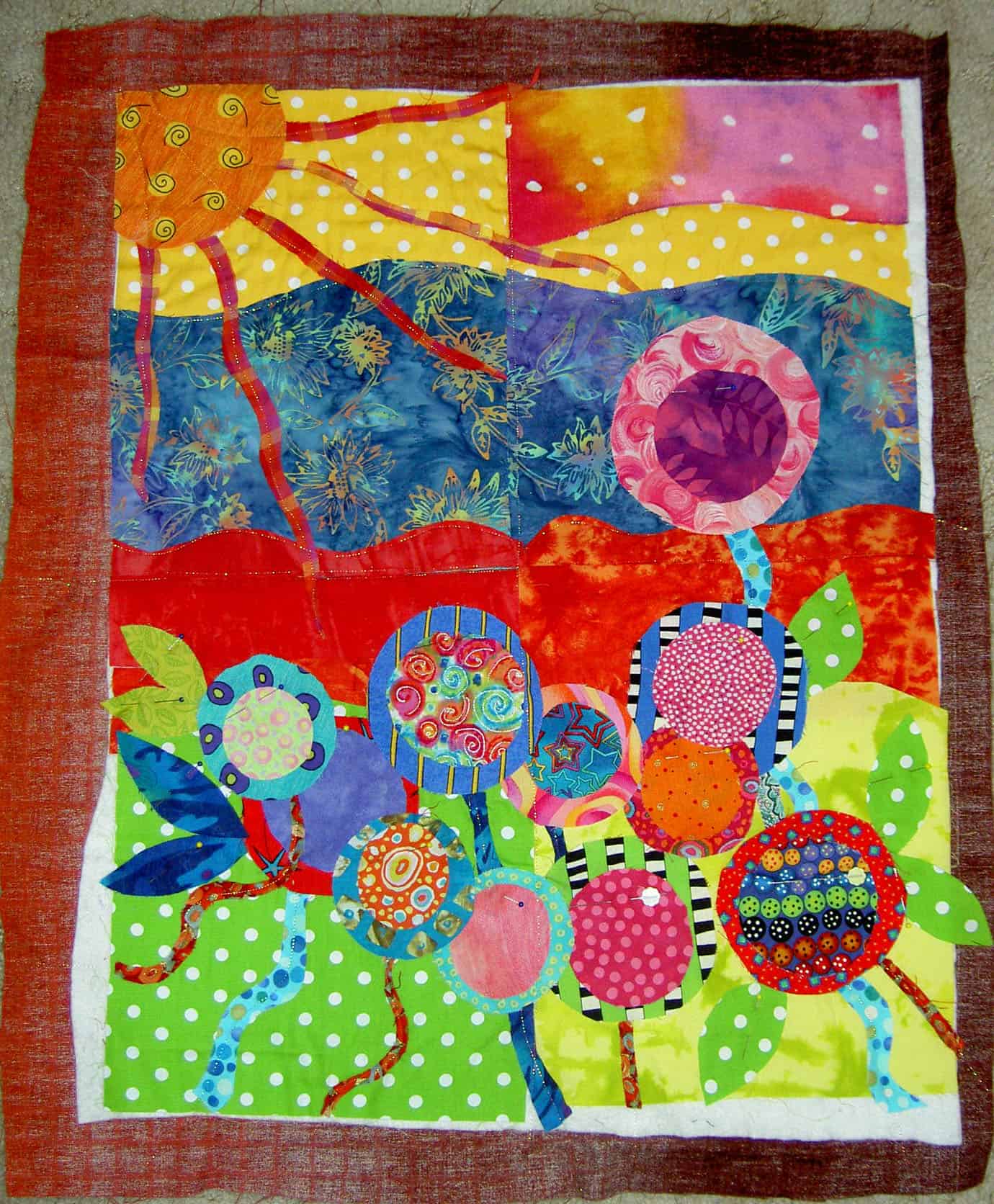
I worked and made progress on the Garden. I am actually ready to handstitch on it, though I do still have a bit of piecing to add. I am really pleased with the work I did on the Garden. I think it looks very different from what it was when I started.  I also think it looks a lot better.

Garden (after)
Garden (after)

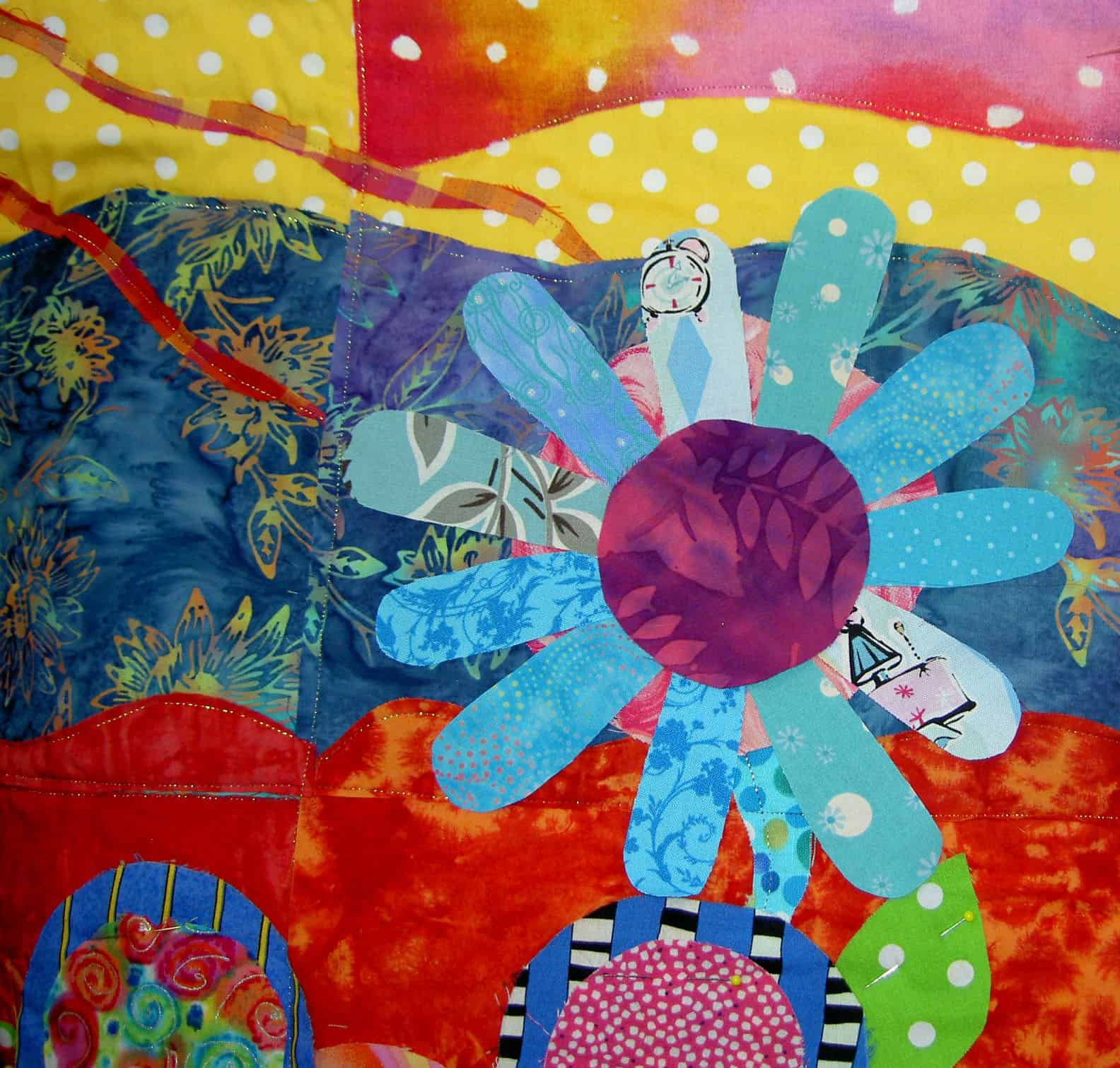
I am really pleased with the petals that I added. I wanted to create a little more interest in the space where the blue petals are now.

Garden (detail 1)
Garden (detail 1)
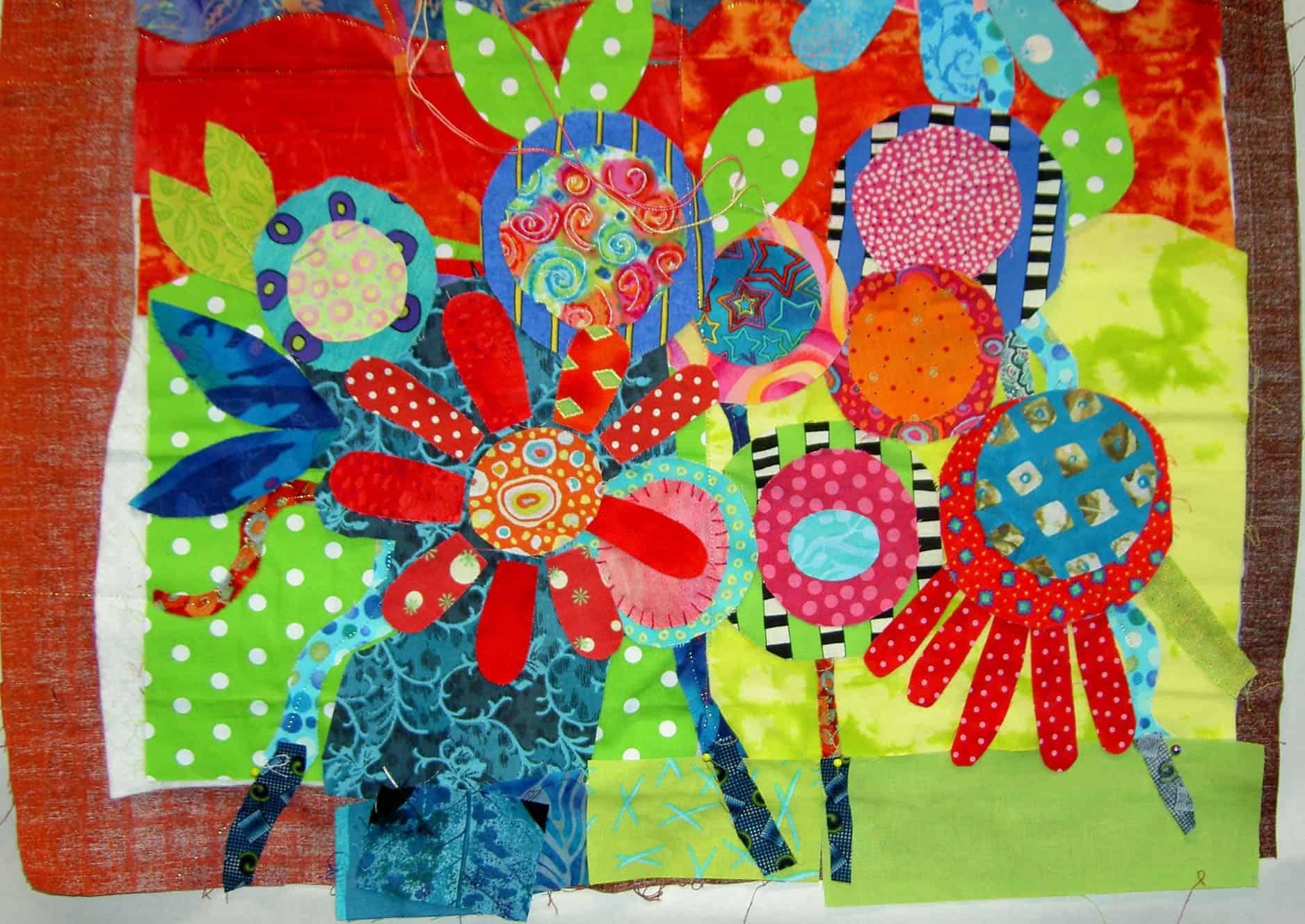
Garden (detail 2)
Garden (detail 2)

In the bottom part of the piece, the flowers were all middle ground. Pamela helped me create a foreground by putting some darker blue behind the red flower with the petals. I also created a little bit of a different foreground with the flower in the bottom right hand corner. I was thinking of it as kind of a coneflower, but some people said that it also looked like the petals had dropped off. I have a little work to do on the bottom. During the critique, Pamela and the other students suggested that I extend some of the stems to the bottom of the piece and make the bottom of the piece longer as well. They also like the brown border. That brown is currently the back, but I will cut it off and add it to the new front, but only on a couple of sides.

I didn’t succeed in doing my own thing. Pamela is such an engaging teacher that it just wasn’t possible for me to ignore her completely. She did help me with the projects I was trying to work on, though.

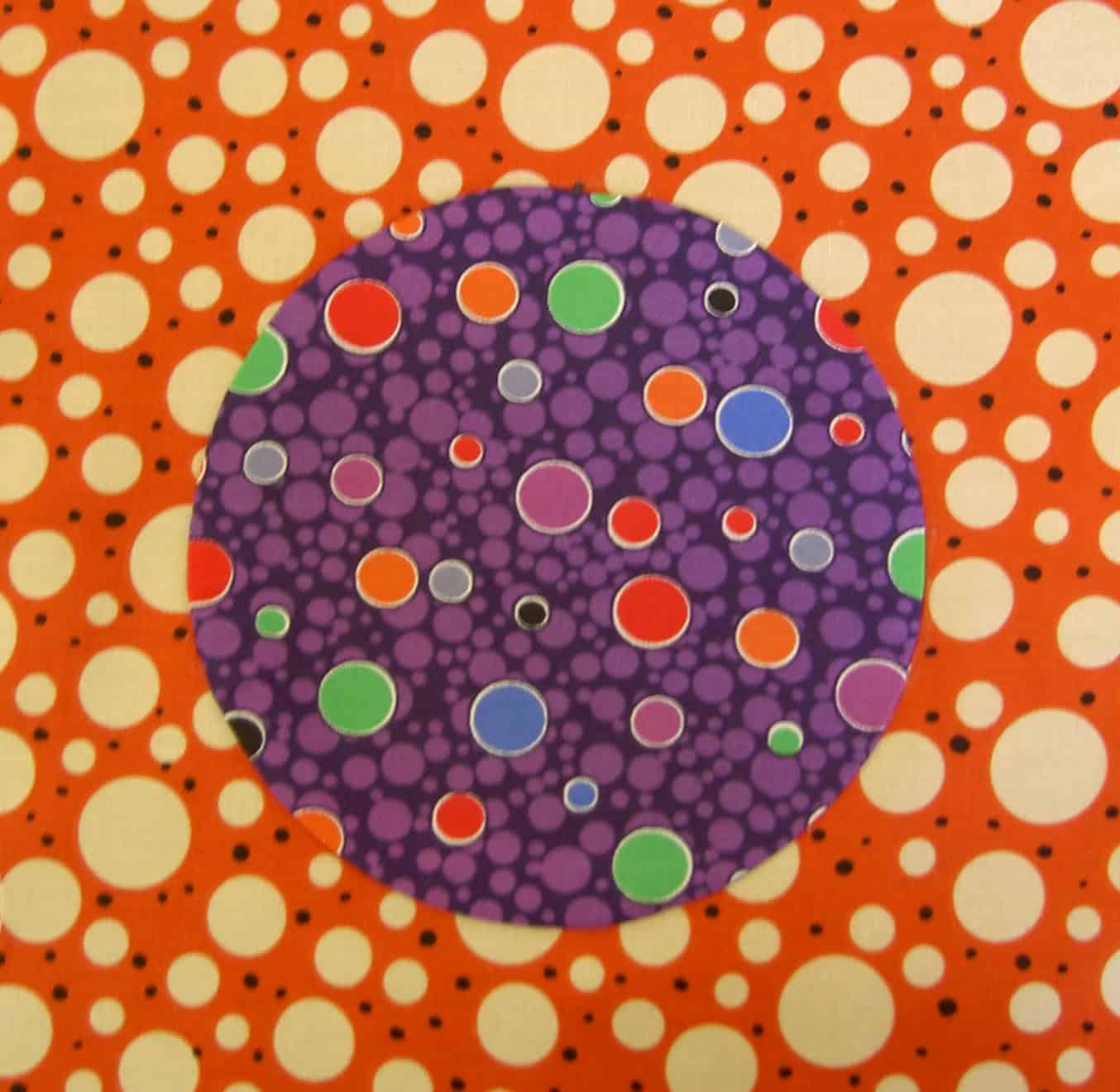
After a quick litle quiltlet exercise (15 min), she gave  us a piece of fabric and we had to make something with it. My piece was brown. No other colors. None of my colors. Bleah!

The exercise was about accentuating or extending existing lines in the fabric she gave us. I liked the idea of the exercise.

Line Exercise
Line Exercise

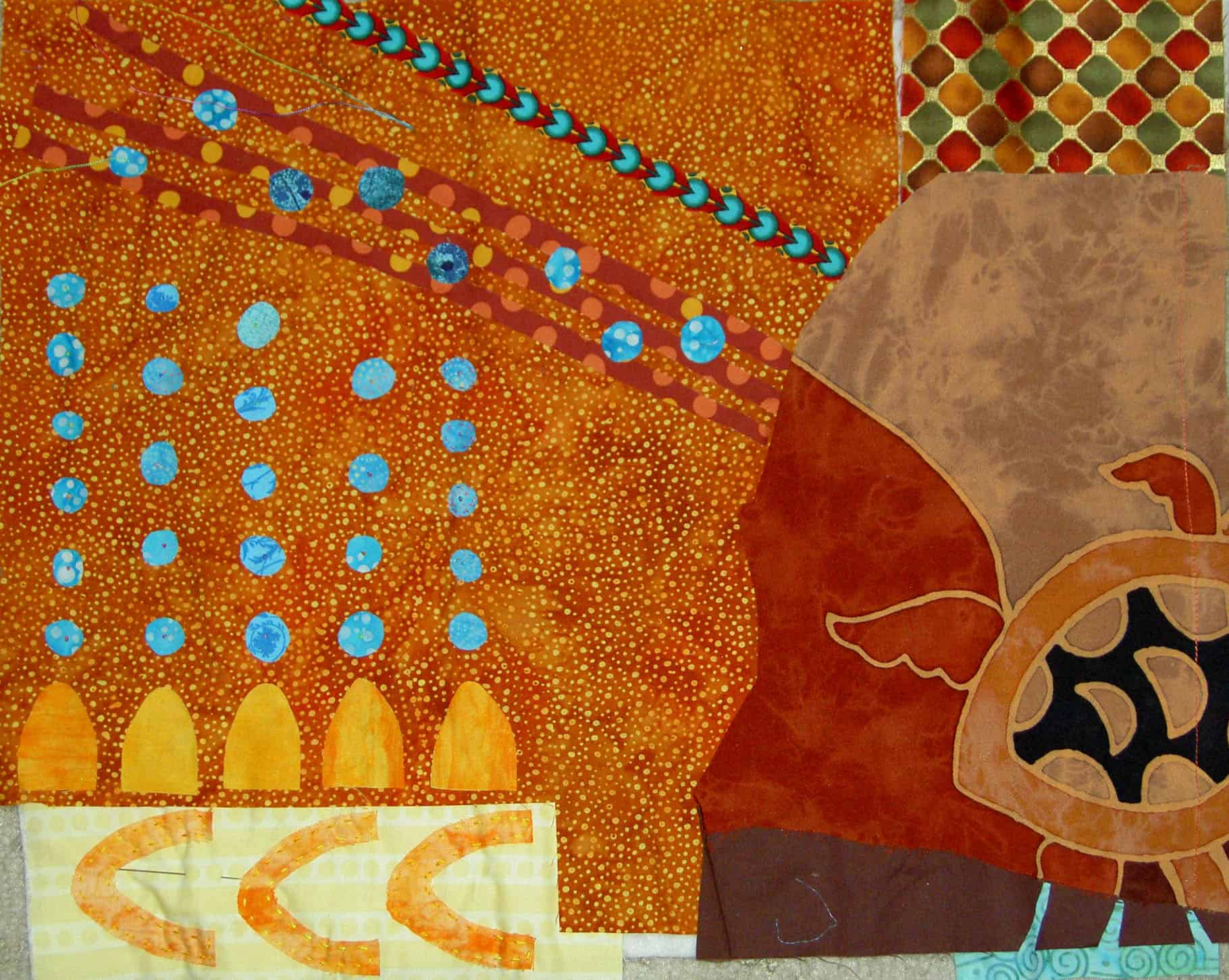
This is the piece that came out of it. The colors aren’t me, and you can see that I injected quite a lot of blue into the surface.

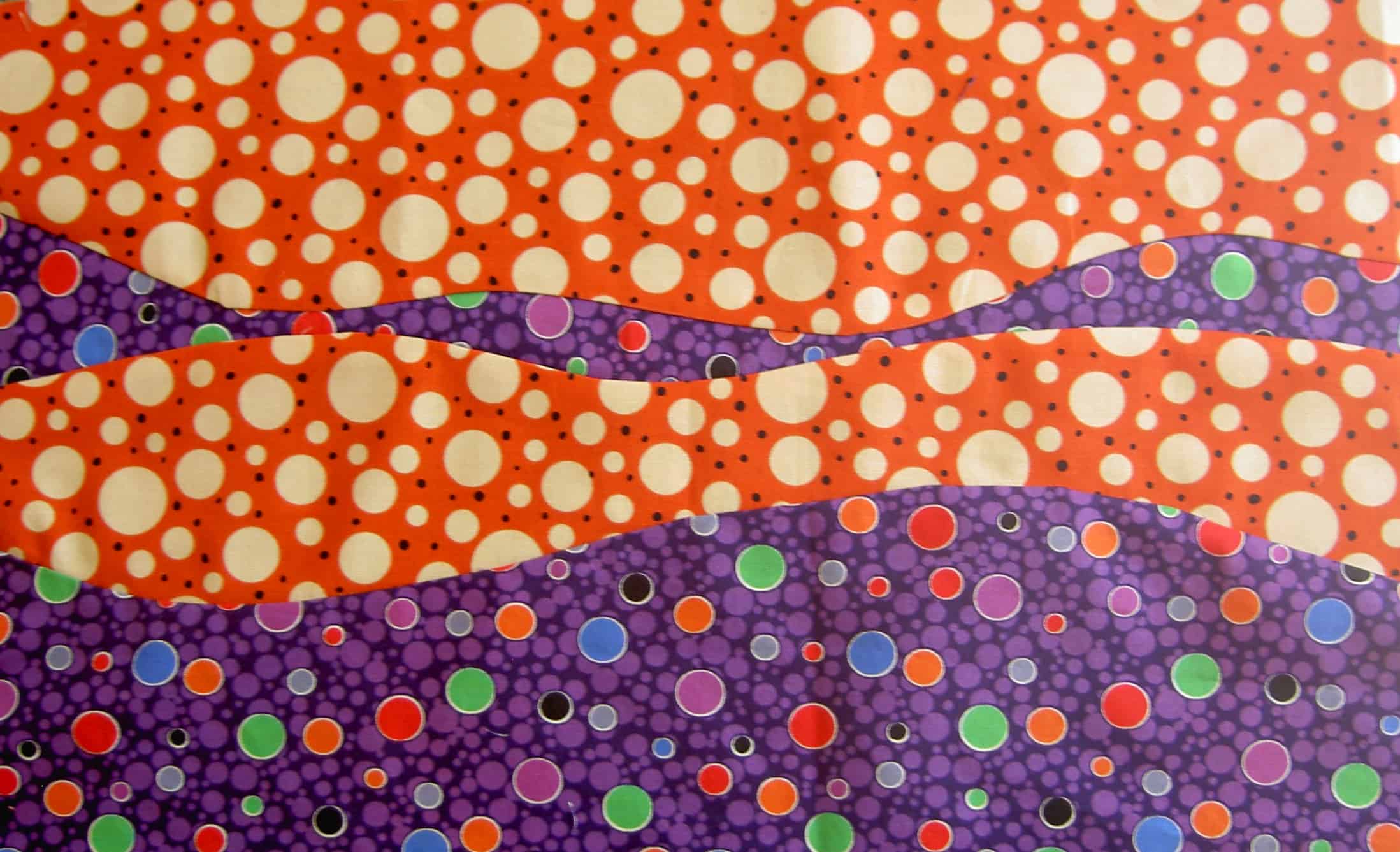
Today, we worked on critiques and one piece using stripes and prints to create movement.

Final piece, stripes and prints

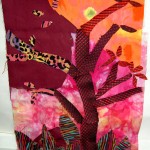
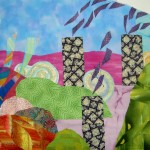
This piece brought the AHA moment for me. The AHA moment was a point where I finally got all that I have been learning from Pamela. I finally understood about the background and how to put stripes and prints on the piece in different ways in order to achieve movement and the illusion of something. I am really pleased with this piece and think it is very strong.

I can see how some of what I learned today will help me with the Tarts. I am going to use some of the techniques and thoughts to get that piece finished.

Thanks, Pamela!

Longarm Class 1/9/2009

I want this to be a year of creativity. I can’t say that this is on my to do list, but it is in the back of my mind. One way to do that is to sew as much as possible.

To that end, I took the longarm certification course at Always Quilting on January 9, 2009. As a result, I am now a certified longarmer at Always Quilting. Don’t be too impressed as this certification only gives me the privilege of renting their longarm to quilt my quilts. Still: YAY!

After seeing the demo in November with the CQFA team, I signed up for the class. I was curious about the whole longarm process and because I wanted to see how I could incorporate the longarm as a tool into my repertoire.

That being said, I learned a few things about longarming:

  1. Using the machine takes practice and people who machine quilt well should be admired greatly
  2. There is much more to learn
  3. I will never be Colleen. I also don’t want to be her and will still use her fabulous services for some of my quilts
  4. I am not going to quilt all of my quilts myself
  5. Using a pantograph is hard
  6. Taking the class will improve the quilts I prepare for someone else to quilt

I really enjoyed the class. It was an expanded version of what we learned at the demo. It was great to hear some of the same information again as it helps to cement it into my mind. Some of the information she gave about preparing quilts, especially, applies to the computerized machine they use to quilt quilts for customers. It is a large computerized machine.

One thing I learned was that the longarm professionals vary, but if you understand some of the background and the way the process works, you can work with your longarm professional of choice much more effectively.

Always Quilting wants you to have square corners. No lopped off edges or strangely shaped corners, because you use the corners to pin the quilt to the machine. Oh! Now I get it. Better fix that I Spy quilt.

Kit also suggested practicing good pressing habits in order to reduce bulk where seams meet. The centers of pinwheels and 8 pointed stars can be a challenge for the machine. I was surprised to learn that the machines have a hard time going through selvedges! I’ll have to look at some of the quilts that Colleen has quilted for me to see what she does in this circumstance.

  • The Always Quilting staff wants the backs 6″ wider than the quilt and had several suggestions for the back. The back needs to be longer than the top, but they don’t care how long.
  • It is ok to piece the back, but they don’t encourage it and the same rules about bulk and bulky seams apply.
  • Kit suggested using large pieces of fabric rather than piecing a second top for the back.
  • She also said to consider pressing seams open on the back and using a larger seam allowance to help reduce bulk.
  • Both top and back should be square and FLAT. Kit reiterated that quilting does not cure all evils. She gave some tips about measuring the top before one cuts and attaches borders that were really interesting, especially to make sure that there isn’t more fabric in your border than in the quilt top.

Always Quilting prefers batting such as Hobbs Natural and Warm & Natural, both of which they carry. A quiltmaker can bring her own batting but they reserve the right to not allow you to use it. Apparently, batting with scrim works best. As you know, Colleen has quilted my quilts using Hobbs Organic for awhile with no problem, so I am not sure what I am going to do about that.

Kit said that they want a quiltmaker to use the shop thread, because of the way it interacts with the machine. Again, you can bring your own, but they reserve the right to not let you use it. They use Signature, King Tut by Superior and Permacore, which is their preference. The Permacore is polyester wrapped in cotton. Bad thread can incapacitate the machine, which is why they encourage quiltmakers to use the shop thread. They have hundreds of colors.

To put the quilt on the machine:

  1. Put the back on first, right side DOWN. You could put a quilt on the machine sideways. This orientation works well for row quilts because it is easier to quilt different things in rows.
  2. Find the center of the back by folding it in half.
  3. Pin the back to the leader about 1/4″ down from the edge of the leader. There are notes in Sharpie on what attaches to what leader. There is a black mark in the center. Pin from the center out.
  4. Ask your helper if the machine has been oiled
  5. Brush the lint out of the bobbin area. There is a very important disk in the bobbin. Hold on to it when changing or cleaning the bobbin.
  6. Line up batting on backing right below the pins on the leader.
  7. Use a single stitch to baste the batting to the backing.
  8. Baste top to batting, lining it up just under the batting.


I have found it important to doodle a bit before going to class. It seems to train your brain to sew a continuous line. It helps with practicing for achieving a smooth, continuous line. I assume this would be rule for going to quilt as well. It gears up your muscles for the quilting motion. Above are doodles I made during class. They are my own variations inspired by designs from the various books the shop had. I wasn’t able to try them all out on the machine.

One of the books we were able to look at was one by Trillium House Designs. They have a set of three books called Pocket Guides to Freehanding containing a multitude of quilting designs. Kit said Always Quilting didn’t carry them, because books 2&3 were too advanced and the company did not sell book 1 separately. The price for the set is also $55, which is a bit steep.

I think that there are a lot of continuous quilting designs out there you can use as a guide for your own quilting. It would pay off to start collecting some of those designs and practicing them with pencil and paper before renting the longarm.


My section of free motion quilting loops. This is the pattern they encourage their students to use for most quilting project. They also encourage people to use this size of pattern when quilting.


My attempts at using the pantograph (above). It was very hard to get the shapes smooth and I thought I would have an easier time posting the design on the wall and following it with my eyes, rather than trying to trace it using the laser.

I am scheduled to quilt one of my own quilts on February 6. I am planning to quilt the Crazy Test. I was planning to quilt the hexagon/I Spy quilt, but decided to do something I didn’t care about much before quilting something I did care about. I do have to make the back before I can quilt it. The longarm doesn’t work very well without a back!

I was really pleased with this class. I thought it was well run and thorough.

Saturday Project

I brought two projects to the CQFA meeting yesterday and didn’t even finish one. Better safe than sorry, I say!

The first was the Pamela project that I started at EBHQ in a class with Pamela. I want to get this done before she comes out for the next class in April. If I can also finish the flower garden, that would be great.

I had worked on it, as you know, during the summer. I did mostly handwork. I came to a point where I decided I needed to machine quilt it and that sent the project to a screeching halt. This sewing time with CQFA seemed like a good time to get that machine quilting out of the way. I got about 2/3s of the way done yesterday and finished up the quilting today.

I always have a couple of issues when I am contemplating machine quilting something. Getting started is primary and the biggest problem. I never want to do it, don’t think I will be good enough, haven’t practiced in a long time blah blah blah. On this project’s machine quilting, I just went for it. I used a simple design and my regular open toe foot and just pretended I was sewing. The second problem comes up after I get going on the quilting. I start to see the quilting add to the design and some of the motifs not being quilted pop out. This makes me want to do more and more quilting.

I can never envision how the quilting will look while I am piecing and I always think of it as interfering with my great piecing design. It usually turns out just fine.

Here is some of the detail of the quilting part way done.

Gabrielle Swain Class Day 2

The second day of the Gabrielle Swain class was about the technical steps of putting the blocks together. Swain does all of her applique’ by hand and all of her piecing by machine. She wanted us to follow her through her process, but didn’t care, ultimately, whether we used her process to put the leaves together.

I thought this was an important lesson for me. I often go to class skeptical and with preconceived notions, mostly because I have had teachers who put stupid useless supplies on their list or don’t know how to teach. I am not saying that I am better than them; I am saying that you can’t be a teacher just because you say you are. I have high expectations for teachers. Anyway, when I heard that we were going to do needleturn applique, I groaned inwardly. I was too exhausted to fight and just went with the flow. As the class unfolded, I could see why she makes her quilts the way she does. She has a point and, while I may never make a whole quilt the way she taught us, I am glad I know about it so I have another technique in my arsenal and can choose it among others in the future.
In the first part of the class, GS talked about placing the fabric in such a way take advantage of the shifts in color of the hand dyed fabric. She was basically talking about fussy cutting. You end up with Swiss chees fabric, but she wanted us to understand that by paying attention to the color you could expose light and shadow to make a more interesting quilt. She also wanted us to ensure that we didn’t have big breaks in the colors, that the colors flowed together in a way that looked natural.

Swain also talked about the properties of color. She said:

  • Value: light, medium and dark
  • Temperature: warm (reds and oranges), cool (blues and greens)
  • Intensity: how true or saturated the color is; how much grey is in the mix of the color
  • Hue: more color you get in a quilt the less value

I need to do more research on intensity and hue. I have never really taken a serious color class and cannot vouch for what she said about color and hue.

The other color tip GS provided was not to use equal amounts of opposite colors. I think the ratio she mentioned was 60/40, but it could have been 80/20. Another thing for me to look up. You comments on the color theory aspect are most welcome.

Before we started the applique’, I was thinking that hand applique’ would be too much work. I took an Elly Sienkiewicz class a long time ago and really hand a hard time with the needleturn applique’. I made two blocks in the ES class. One was some kind of flower block and the other was a folded snowflake. I did finish them, but decided that my dream of a full, needleturn applique’ BAQ would never happen in my lifetime. Those two blocks will eventually go into my miscellaneous blocks quilt – a quilt I intend to make from trial, test and class blocks… someday. If I find the ES class blocks, I will post them here.

In order to transfer our pattern to the fabric, we had to ink over the lines of the pattern. I used a Sharpie, which worked very well. I taped the pattern to the lightbox and traced over the pattern straight on to the fabric with a Pilot Scuf pen. GS recommended a Pigma Micron pen, but somehow, I didn’t have the right one with me. The Pilot Scuf worked fine, but you have to make sure that the point is not squished otherwise you will get a very thick line. You have to turn the black line under, so you want it to be as fine as possible.

Before you actually start the applique’, you need to decide which way the seam lines will go once you applique’ them. You start with the piece that will be on the very bottom and build on top of the pieces on the bottom. For the applique’, the supplies recommended are:

  • Mettler 50w thread
  • Thread Heaven thread conditioner (instead of wax)
  • #11 sharp needles (I used a between and it worked fine. I bought some sharps later and will try them outthe next time I work on this quilt)

GS cuts her thread at an angle and threads the cut, angled piece through the eye of the needle. I have never understood this tip and am thrilled that I do now.


She also showed us a much easier way of doing needleturn applique’. After basting the pieces together with junk thread (who really has junk thread???), you hold the pieces in your left hand and scrape the needle above the raw edge you want to hide, towards the unsewn part of the seam, with your right hand. You hold the piece below where you have already sewn with your left thumb. This allows the appliqued edge to be smoother. It also sends the give towards the unsewn area, which prevents ripples, I think. I found it to be much easier and much faster than the way ES taught. I am not saying that the Queen of Applique’ is wrong. There are many ways of doing things and not every way works for every person. It is important to find the way that works for you and if your results are good, then you should continue to work in the method that suits you.

It was readily apparent how you have much more control when you do this work by hand. However, I can also see how, with care, this work could be done by machine.

Gabrielle Swain does a lot of colored pencil and ink work on her quilts. She showed us that as well. You can see my colored pencil work in the purple accent above.

Great class. Take her class if you have the opportunity. This post is a good description, but the real thing is well worth the money.

Gabrielle Swain Class Day 1


Another teacher to add to your ‘must take’ list. This woman knows how to teach! She knows her stuff, has confidence in her teaching and has an opinion, which I like. I don’t have to agree with the opinion, but wishy-washy “well, what do you think, dear?” kind of comments from a teacher, make me crazy.

Above are the fabrics that I brought to class. Not being a hand-dyed girl, I chose batiks in a palette that I like. Her suggestion of 3 yards was a wild shot in the dark, IMO. I would improve the supply list by asking for 20-30 FQs evenly divided among all the colors. In this case, I was able to find some fabrics out of my small batch to work with, but other people were having a really hard time. Even people who had brought a lot of fabric with them.

The first part of the class was all about design. No sewing. Some people were completely mortified. I was thrilled. I actually got to spend time on my design and try out a couple of different things. One thing that Swain said, which resonated with me, was that people find their materials first and then try to find a design to fit the fabrics. I Think it is true in a lot of cases, but I don’t think it is true, mostly, for me. It is definitely something to consider and keep in mind.


The theme of the class was leaves. Mom went through my inspiration file and pulled out many of the pictures containing leaves. Talk about a hero! I went through the pictures a few times before I started the design and whittled down the group. I finally settled on a Georgia O’Keeffe postcard of a painting called Yellow Leaves (bottom left). Apparently the real painting is at the Brooklyn Museum of Art. In surfing the web, I found an image of another of her leaf works that has to be in the same series called Pattern of Leaves.
Swain gave us large format patterns, which we could have also used, but I don’t think anyone did.


This was my first attempt and , frankly, it is pretty much a copy of the O’Keeffe work. Swain said to add another leaf (rule of odds) and turn the leaves so they were going in different directions. I had a hard time understanding what she was suggesting. She ended up explaining it by saying to align the leaves so they hit various points on the letter C. Finally, I got it and set to work.

This was my second attempt. After finishing the draft, I was concerned that not enough of the two upper leaves were showing.
I traced my second attempt, but shifted the paper slightly to modify the spacing. It ended up with too much spacing.


Above is my fourth attempt, which I liked. Again, I modified the spacing.

This is the final design for my project. It is the third drawing, which Swain thought was better than the fourth.

I think the above process is a good example of why spending the time on the design is worthwhile.

My first thought was hat I would make each of the leaves out of a variety of different fabrics. Above is my first pass at fabric selection. I was thinking that more fabrics would add interest.

Here are my choices with the background.

This group is good, but Swain was concerned about the strong print on the middle fabric. She thought, when cut up, the petals of the sunflower would draw the viewer’s eye in an unintended direction. She is very much about careful choices in both fabric and seam lines. There were a lot of things she said that reminded me of Ruth McDowell’s work with seam allowances.

Here is my final selection. I guess it is ok. I may work on it a bit more later just to make sure I am happy with it. I like the fabrics, but the combination as leaves is a bit of a stretch. I am, however, willing to work with the colors to see how Swain’s advice works. Here is one example Swain had for a design principle. Think of a tic-tac-toe board. Put an x in the middle, because you don’t want to put anything exactly in the middle. The Os at the intersection of the squares are where she suggested we place our images, if doing this kind of a design.

Julie’s fabric selections and pattern. Julie is Swain’s star student as Julie took her 6 month creativity class earlier this year. Sadly, none of the glow is rubbing off on me. 😉

Supply List Suggestions

I am taking a class with Gabrielle Swain tomorrow. I hadn’t ever really heard of her until Friend Julie took a 6 month long one-on-one class with her. I decided to take the class because Julie really got her creativity juiced. She did a lot of work during the first few months of the year.

Lo and behold, I am completely prepared for the class. I have all the stuff sorted, piled up and ready to go. I am thrilled. No running around like a chicken with its head cut off at the last second. I’ll even bring the bags down to the car tonight so I just have to walk out with my handbag tomorrow morning.

While I was getting ready, obviously, I had to look at the supply list. One thing I realized was that teachers don’t always explain why they want you to bring something to class. It would be very helpful if the teacher put the name of the class along with a brief description of the class at the top of the page. This should be followed up with the normal supplies such as pencil, notebook, basic sewing kit, scissors, etc.

While ‘normal’ is relative, I think that there are some standard supplies. It would be great to explain anything beyond the standards. I realize that teachers are busy and that they have a lot to prepare. However, a little explanation can make the students feel more secure in the supplies they choose and help the students bring better supplies.

Ms. Swain’s supply list was relatively straightforward. I often wait until the last minute to get the supplies together, thus I am really resentful when there is something strange and unexplained on the list. Of course, my procrastination is not the fault of the teacher. I have a lot of supplies. I even have a lot of strange rulers and materials, so it doesn’t seem to much to ask for someone to explain why they need a certain brand of this or that.

I really am not complaining about Ms. Swain’s supply list. Reading over her supply list just made me think about supply lists in general. The only thing on it that I couldn’t supply out of what I have at home was hand-dyed fabric. I am not a hand-dyed fabric person; I just don’t have very much of it. If she had explained why she wanted hand-dyed fabric, I might have gone out and bought some. Instead, I chose some lovely batiks that I think will make great leaves.

Stay tuned!

Another One Night Stand, Part 2

At the end of the Nance O’Banion class today, we had to talk about what set us off in the direction we went and the themes we saw emerging our work. Both of my pieces were driven by the beginning of the class when Nance said to be open to serendipity and surprise. Because of the “personal pieces” I chose, the themes that emerged were themes that I had worked with in the past: One Night Stand and the Goddesses.

Nance’s class was full of different types of supplies and things to inspire us.

Rubber stamps lined up and ready to use in the books.

The book on the bottom is full of wonderful bits of embroidery and quilted books.

I was intrigued by the way she lined up everything.

This was waxed linen thread that she offered for our use. I used my own hand dyed thread.

We were supposed to bring three meaningful things with us. I wasn’t quite sure if she meant things we could use in our work or just things in general. I chose the former definition and these are the items I came up with.

Dots, of course.

The little woman figure is very like Desiree and I like her shape.

I am really into taking time for tea right now, thus the cup.


Cover: Here is the cover of the finished piece. I made this one MUCH smaller. We had less time for this second book and I wanted to accomplish a lot, if not finish the piece.
Page 1 and Page 2: First I went through and drew all of the figures. I alternated between the shape from the bead and the Desiree shape. The little figure on page 1 said that her name was Paulina. Not sure why or what her goddess responsibilities are, but there you have it.

After I was done drawing the figures, I went back and modified colors, sewed a bit, added beads. I think I want to stiffen the pages on this book as well.

Page 3 and Page 4: I merged the two shapes in the figure on page 3.

Page 5 and Page 6: Page 5 may be Referencia, but may be someone else. She did not reveal herself. The wings are a flash of brilliance, I think. The house in the Little Mother’s tummy is supposed to be a Gwen Marston house.

This is the end. I used a rubber stamp that I bought from Karenlee (finally!). You can also see the binding very well. It is called a stab binding. I still need to sign and date it.

Another One Night Stand

Today I made fast art again, which, on this blog, is called a One Night Stand. Start to finish is all one session. A One Night Stand here has nothing to do with sex.

EBHQ, the East Bay Heritage Quilters, had a workshop with with Nance O’Banion. She is the head of the printmaking department at CCA (formerly the California College of Arts & Crafts) and teaches, among other classes, book making. I mentioned, earlier in the week, that I thought this class would be interesting in the visual journaling department. I was correct.

Nance O’ Banion doesn’t teach many workshops, as she is a full time faculty member at CCA and doesn’t really have the time. She taught this workshop for EBHQ as a special favor and it was fantastic!!! First, of all, we worked quickly. I finished two books today.

Second, we worked with a limited “palette.” It wasn’t a palette in the sense of colors, but a palette in the sense of materials. She gave a us a group of materials and our job was to make something out of the materials she gave us and what we brought. Since I couldn’t bring my entire sewing room, this limited what I had to work with, but it was fine. It was actually great. I think working with rules, even if they are self imposed, makes for more interesting projects/pieces.

Third, Nance was a very nurturing instructor. Not in a gooby, “I want to be your best friend forever” kind of way, but in a “you can do great work and I will support you” kind of way. I would love to take a semester long class with her. She normally teaches bookmaking with paper and I don’t think I would mind taking that with her.

Fourth, she was really organized. She had a packet of stuff that she had prepared for us (magazine pictures, pages ripped from books, blank paper, etc. She also had a schedule, let us k now what it was and stuck to it. I really enjoy working in that kind of environment. I am good with deadlines. I am not bothered by deadlines unless I don’t know what they are.

Cover. My book came out a little big for the first exercise, but I used it anyway. I wanted to play a bit with the double meaning of One Night Stand. Remember, I didn’t have much time, so I did what I could. I could always add more to the piece. I think I will shore up the pages with some interfacing as they are very floopy.

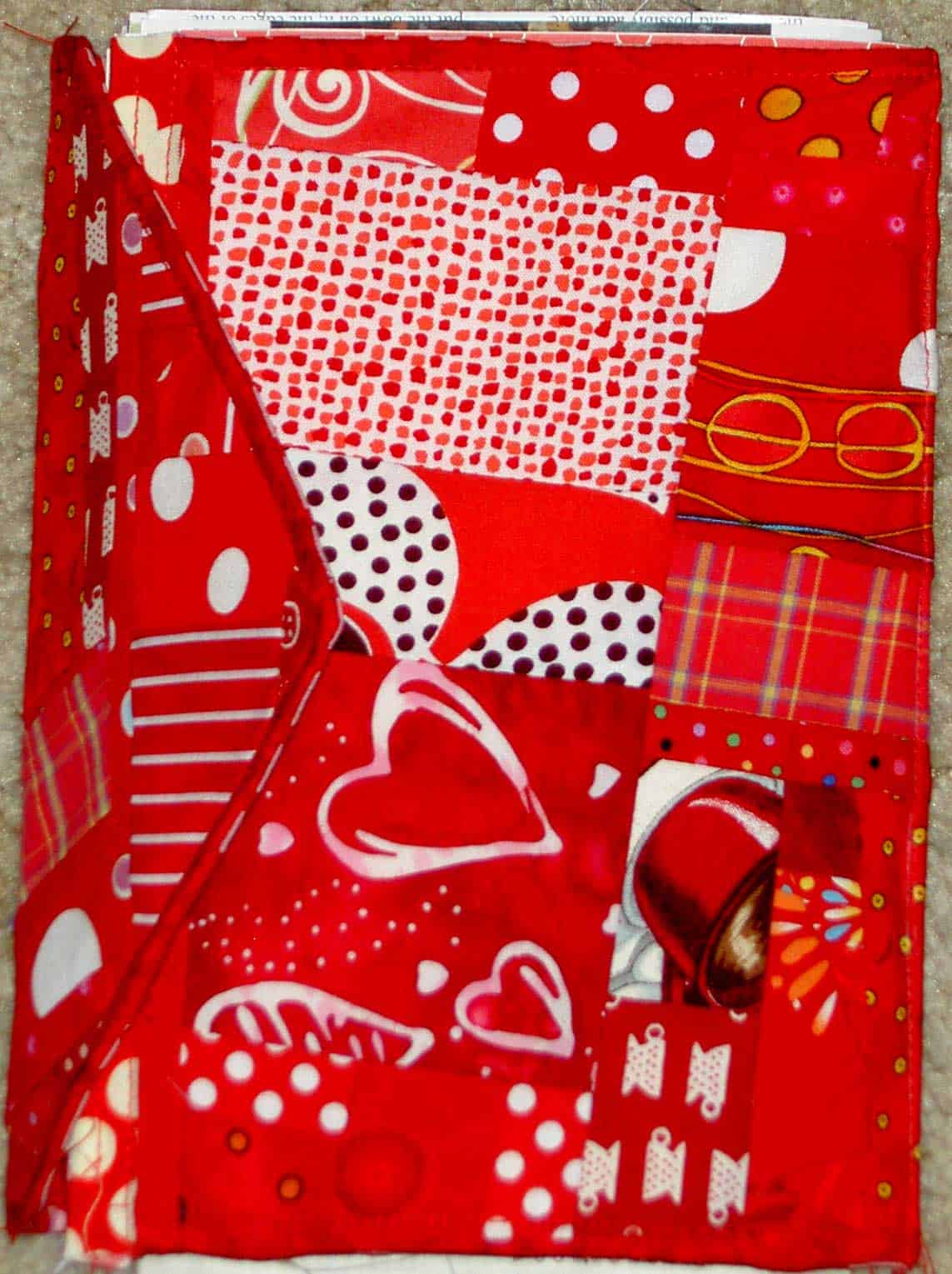
Page 1 (left) and page 2 (right): The red and white motifs on page 1 are on the back of the fortune card (Nance’s words) that was in my prepared packet. I didn’t want to lose them by gluing the card onto the page, so I sewed it on with Laura Wasilowski hand-dyed Perl cotton and cut the back out so the motfs would show through. Page 2 just plays more with the meaning of One Night Stand.

Page 3: Here I wanted to get the reader’s mind out of the gutter and tell them that a One Night Stand is about creating quickly. It allows things to happen with my work that wouldn’t happen if I thought too much about it. I also tried to incorporate a piece of the motif of the iron grille with the shadows I saw in Seattle. I was a also trying to reintroduce the woman shape I used for Desiree. This was the first attempt of the day and she looks a bit wonky. This page had a bit of a problem, because I had cut a piece out of the yardage and didn’t realize it was in the middle of my book until I was well into. I had planned to have the camera peek through, but I didn’t line it up properly. I may leave it but I may fix it somehow (door? sewed on ‘patch’?) . We’ll see.

Page 4: At this point, things started to pop into my head and I would write them down. I was feeling like the piece was a bit word heavy, but just went with the flow. The pink card with the compass came in my prepared packet.

Page 5: Here I am back to a little bit of wordplay with the double meaning.

Page 6: The ‘think,’ ‘try,’ ‘do’ are relevant to creativity, I think, but they are also a take off on something that Yoda says to Luke in Star Wars, Episode 6: Return of the Jedi.

Page 7: While you see this page in the same orientation as the other pages it is actually oriented 90 degrees to the right, so you have to turn the book. This is one of my favorite pages, because it just told me what to put on it and I like the layering of the leaves.

Page 8: I wanted to have a closing credit, so I started on a “The End” page. They I thought of the phoenix rising from the ashes and new beginnings came to mind.

I’ll write about the second book later.

I stopped at New Pieces to see if they had interfacing for the bags and bought, in addition to the interfacing, the following:


The turquoise dots on the bottom will be a bag outside and the pink flowers with the black will be a bag inside for the white dots that I bought from fabric.com.

Nance O’Banion Workshop

I will be taking the Nance O’Banion workshop on Saturday with EBHQ. It is a little different than the normal quilt workshops, but I thought it would help with the visual journaling theme that I have been dipping into of late. I also hope that it will give me some ideas (and freedom???) to do more of the visual work. We’ll see!

clipped from www.ebhq.org
  • Nance O’Banion
  • Saturday, April 26, — Cloth Books and the Creative Process

    (Supply List)
    Combining found materials and cloth in an experimental setting;
    we will work to discover a meaningful narrative in the book format.
    Two sewn book structures utilizing cloth as a basis,
    a simple transfer technique, collage, rubber stamps, and
    more will all be a part of the game. Come ready to play.
    < /br>
      blog it

    New Inspirations (and A New Danger to You)

    As you may remember from a previous post that I am teaching a class at work (other life). Above is the gorgeous quilt from one of my students. The photo is not so gorgeous, unfortunately. Alice has used all batiks and the quilt just glows.

    I got a new phone for work and it has a camera. Danger! Now I have a camera with me AT ALL TIMES. WOW! This is great for me, because every time I see something I can snap a picture. The color isn’t as good as my other camera, but at least I have it with me all the time.

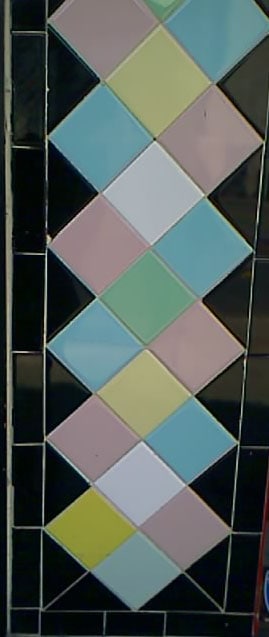
    These are tiles I have been walking past for years. Finally, I was able to take a photo. This is a simple tile pattern, but I love the contrast between black and the pastels.

    I stopped by Stone Mountain and Daughter to buy some fabric for pants. While, I was there I saw this quilt (yes, I asked and received permission to photograph). It reminds me of the Piece O’Cake pattern (below-pic from APNQ 2006). I like the subtlety of the fabrics that the maker chose.

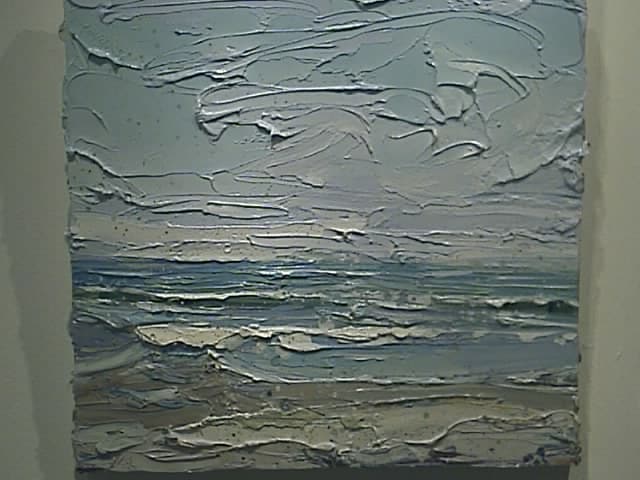
    This is painting by Carolyn Meyer. Ms. Meyer is the Assistant Director of Fine Art at the Academy of Art. The Academy of Art gallery was one that I went to visit a few weeks ago. I went back, because I love this painting. It has some qualities of Wayne Thiebaud’s work, but this painting is very restful to me. It is called Summer and I would love to have this piece to hang in my house. Unfortunately, it is $1900 and I don’t have it to spent on a painting right now.

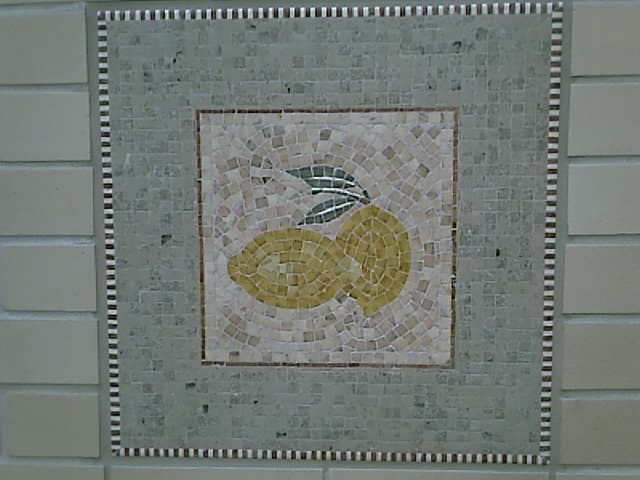
    One of the mosaics in the building where I work.


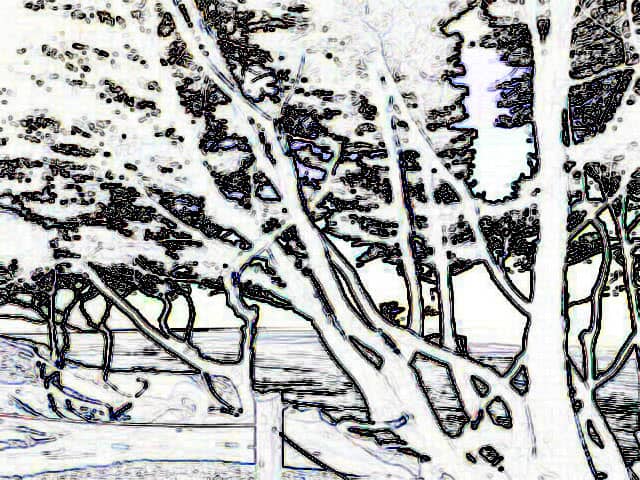
    September and October provide some of the best weather in my area. One day, after work, I couldn’t shake the need to go and sit by the ocean for a few minutes. Despite the weird looks that Darling Boy gave me and the several questions about what exactly this action meant for his future, we went. We went to a place where they have recently remodeled a few benches and a parking lot at the top of one of the cliffs. While there I saw this tree. I couldn’t shake the idea that the trunks would make a wonderful quilting pattern.
    I applied some filters to the photo to try and outline the pattern of the trunks.

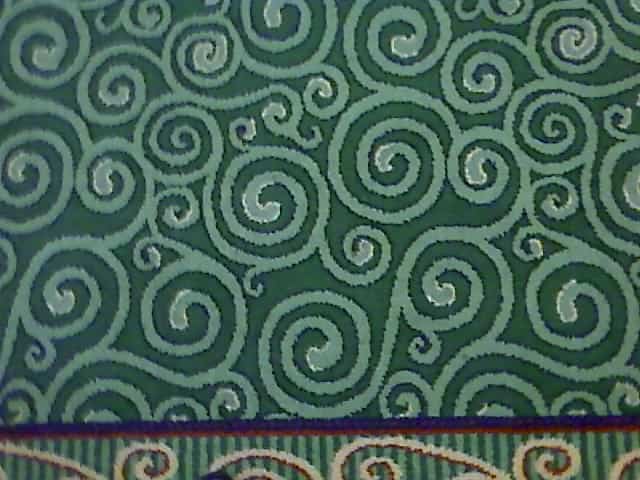
    Rugs – good quilt patterns?
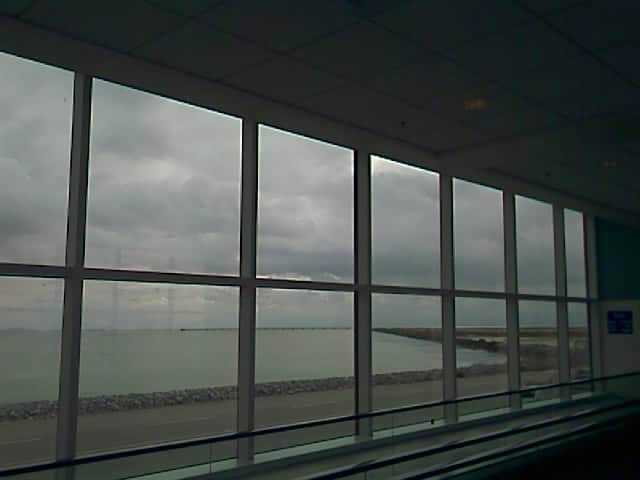
    I like the repetition of the windows with the estuary in the background. The color didn’t come through very well, though.

    Some New Work & Some Finished Work

    Thanks for continuing to read!


    This is the piece I made in the Laura Wasilowski class through CQFA. This piece looks like the pieces I have worked on in Pamela Allen’s classes (May 2007 and June 2006). I seem to have a thing going for flowers in my small quilts at the moment. I think it is good to have a theme for classes, so you can try the teacher’s technique out without trying to think up interesting subject matter as well.

    I would recommend a class with Laura. She is teaching at PIQF this year, so you may have a chance if you attend that show. She is a calm teacher (though we had none of those people who demand a lot of attend from the teacher – you know who they are), explains things very well and doesn’t try to cram too much into a class. There was lots of fusing going on and she gave everyone plenty of time to complete the various steps. She also sings various Chicago School of Fusing songs, which are quite entertaining.

    I finally had a space large enough in my living room to get a full picture of Thoughts on Dots. Not the best picture, but at least you can see the entire thing. This quilt went to the County Fair today to be exhibited through mid-August. I can’t wait to see it hanging up. Hopefully, it will be a location I can use to get a good photo.

    As you may be able to see I chose the green fabric for the binding. I was tempted by the red, but went with the green in the end. The green fit in with my theme of cheerfulness better for this quilt. Thanks to everyone who gave me their ideas and opinions. Your time and energy were greatly appreciated.
    Block #20: complete! This completes all the center Pineapple blocks.

    Corner block #1. Most of it is made of fabric with white backgrounds. The fabrics with the colored backgrounds aren’t quite dark enough. I will try to make the contrast between the back- and foregrounds more prominent.
    Corner block #2.
    This is, essentially, how the corner blocks will work with the center blocks.

    Inspiration and Some Work

    I have spent a lot of time working lately and no time on the Pineapple. Bleah! Still, I am trying to keep up and keep you all entertained.

    First the inspiration:


    This sun can be found in the sidewalk on 30th near Church and I have been admiring it for years. I was finally carrying my camera around this week trying to get a photo of a really stupid bus ad (not successful), so I took the opportunity to snap a pic of this sun. One thing I like about it is the detail in the rays.


    I saw this flower on 2nd Ave near Cabrillo, which looks much better in the photo than in person. I like the way the composition came out. I also thing those little lines (stamen???) are cool. This flower looked flat, but was very 3D when I looked at it.

    Now on to the work. Just to warn you the following work is only indirectly mine.

    As some of you may remember, I have been teaching a beginning quilt class for the past ~2+ years. We had been on extended hiatus and I finally forced the class to meet in order to see where they were in the process so we could either move forward or agree to give up on the class. Fortunately, they agreed to go on, because I would have been a bit depressed if they just wanted to bag it.

    We looked at each of the sets of blocks and agreed to work on machine quilting next. I had another type of machine applique’ on the agenda, but I think the students are done with making blocks.
    Above are the blocks that Beth has done. She started out making two color blocks, which posed different issues during class. It was good, because we had to discuss issues of contrast and placement of color in the blocks. That is the kind of look that she wanted and her blocks turned out very well. She needs to make one more block and we had a long discussion about the color of sashing. The problem is that a number of the patches in each block will drop out if she uses the fabric she has used. We discussed muslin, navy and black. My advice was to go to the quilt store and lay the blocks on top of a lot of different colors to see what look was best for her.

    All of the blocks are supposed to be 12″ finished. One problem both students reported is that their blocks are wildly different sizes, ranging from 10 1/2″ – 13″. I gave them all of the templates, so something happened between then and the sewing. There is a lot of margin for error, but I didn’t have a pat answer for them. I’ll need to refer them to Sally Collins’ book. I’ll have to think about that problem, though, so I can address it in my next class, if I ever teach again. The solution for this class is that they will have to add frames to their blocks to make them a uniform size.


    These are Alice’s blocks. Alice is Indonesian and does beading and Indonesian dancing. These blocks really reflect her personality: friendly, bubbly and very creative.

    The two photos above are details.

    Alice had a lot of fabric with her so we were able to discuss how to pick out the fabric for the sashing.

    For various reasons, only some of which are related to quiltmaking, I have been thinking about commitment lately. I know that people are busy, but it seems odd to me that people give up on activities they enjoy so easily. I have not been able to sew a lot lately, but I have been reading magazines and working a little bit on my hand piecing (photos to follow). I understand that people are busy; I am the queen of juggling. I understand that people have to prioritize and that life intervenes. Still, it is annoying that people will just give up on something and not care if another has spent a lot of time organizing. I wonder if people really value time.

    Reflections on Pamela’s Class

    I know I overloaded myself with photos posted to Artquiltmaker blog on Saturday after the class with Pamela, so I must have overloaded you all as well. This post is about focus and reflection on the class.


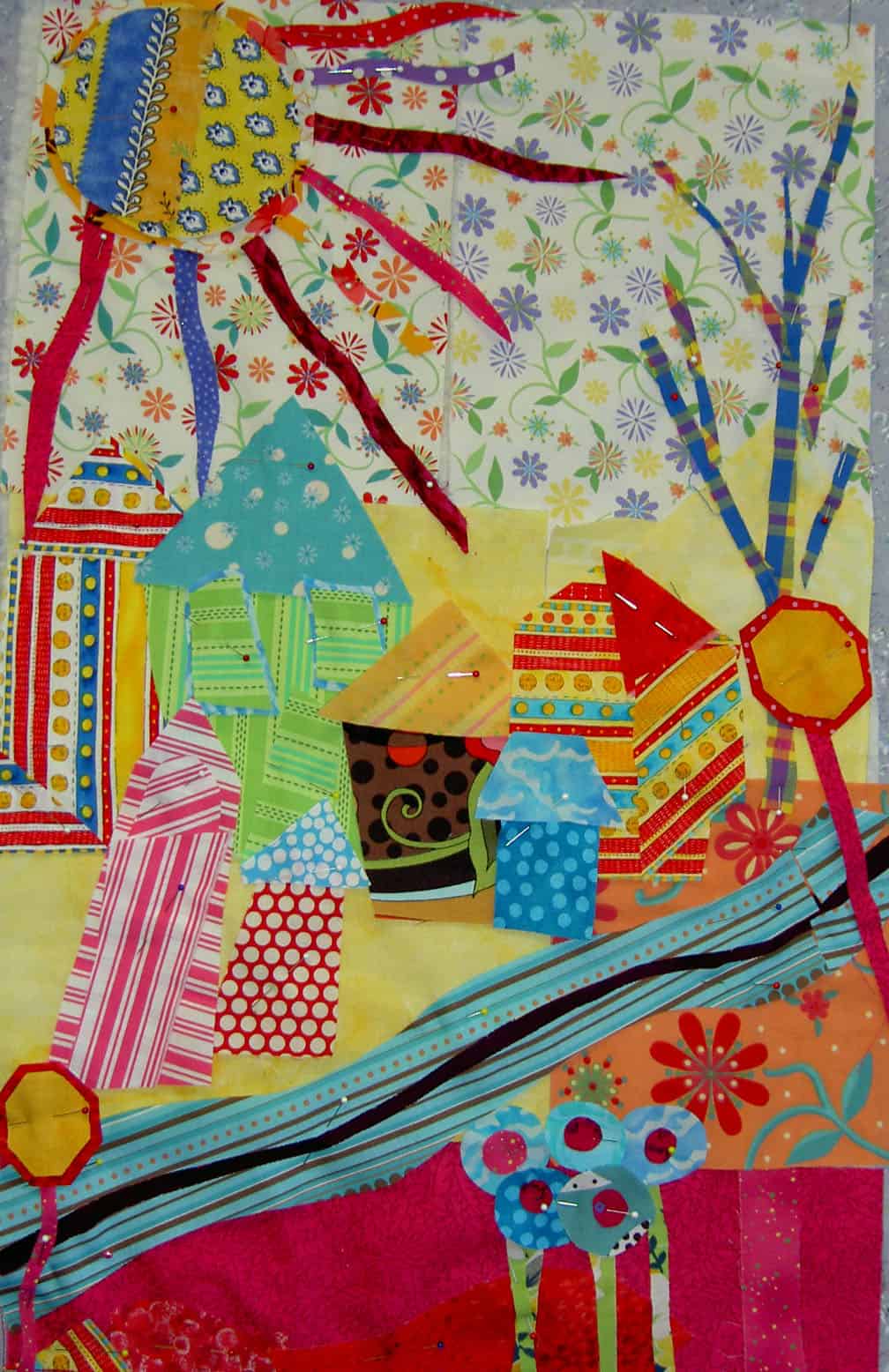
    Here is my first draft, so to speak. I had looked at my previous effort, from the first class with Pamela, before this class and had an idea that doing a related quilt would be a good idea. I was also looking at Collaborative Quilting by Freddy Moran and Gwen Marston last week, which made me think about houses. The sun and the flowers are in common, I think.

    One thing I realized is that I have not been working with scale much lately. The Pineapple, the various square pieces including Thoughts on Dots did not require me to work with scale in any meaningful way. I did pay attention to dots were in the various prints I used for Thoughts on Dots. I didn’t have to worry about scale overall in terms of the elements of the quilt. So, this piece made me stretch. When Pamela came around to help me the first time, scale was what we focused on. I needed larger flowers and larger rays of the sun.

    Final piece (sans quilting)

    It wasn’t quite so easy as making some elements a little bigger, though, because I had the previous garden quilt (below) on my mind as well. Some of the intermediate “drafts” of this piece had many more flowers. You can see the various drafts in Saturday’s post.

    I brought scraps per the directions, so I didn’t have a lot of choice of background. I had a lot of variety in fabrics, but not a lot of variety in size. My scraps are relatively small in general, so I put some darks in (per Pamela’s instructions) and really had trouble working with them, as I also mentioned. I have not been working with black and the checkerboard is interesting, but it doesn’t read as a cheerful fabric to me. I have gotten some feedback that it isn’t too dark, so I am considering it stretching and moving on.

    Pamela’s technique of cutting directly into the fabric is a very freeing way to quilt, however, and I think it is good for me. Now that I have two of these garden type quilts, I might try to make two more and have a quartet. We’ll see.


    I enjoyed her handstitching techniques with Perl Cotton as well. One of the things about this is that it doesn’t have to be perfect. The stitching adds to the charm, but I don’t think it looks like the fake folk art kind of look. I could be wrong, of course!

    My 2006 Pamela piece. I am more excited about getting back to it now. I machine stitched some of it down, but plan to go back and work some more with the Perl Cotton on the flowers, especially.

    I highly recommend Pamela’s classes. She is a quilt teacher, but she has been trained in art and knows about design principles. That is the focus of her class with fabric as the medium. She seems to truly want people to do good work. I am glad she directed me, in her gentle but firm way, to scale, because that is what I needed to work on.

    A Day with Pamela

    I made it to the Pamela Allen class at EBHQ.

    This is all the stuff I took to class, except my sewing machine is not in the picture. (above). The pieces you see are pieces that I made in a previous class with her at Quilting Adventures.

    Pamela’s work (below)


    Tooth Fairy


    Tooth Fairy (detail)


    more Tooth Fairy detail


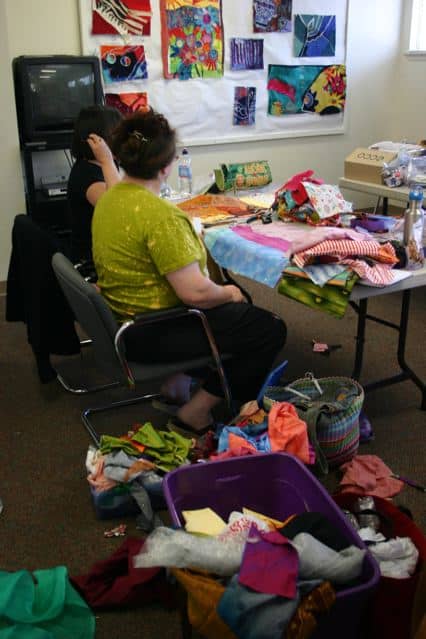
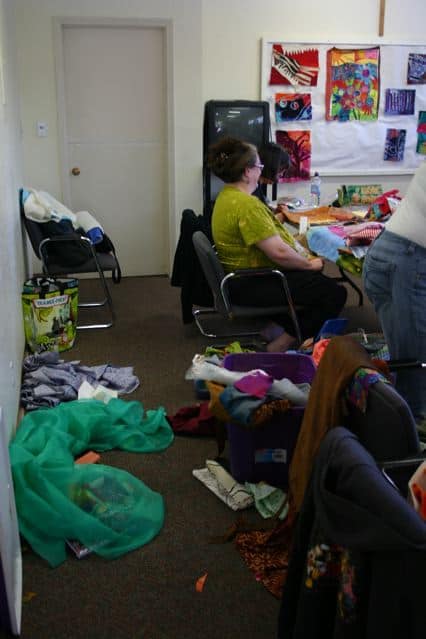
    This is what it looks like when I work in a class. (above) What a mess!


    My background for the House & Garden quilt. I really can’t help starting new projects in her class.


    First draft


    Pamela working on my piece


    Lots of flowers and flying dots.


    Not so many flowers and flying dots.


    Not so many flowers and no flying dots.


    Final composition. I like it, but I have to admit that I had a very hard time working with the darker colors (the black around the flowers and the blue/black checkerboard. All I could think of was that I wasn’t used to it. I haven’t been using much black lately and, as you know, have been trying to make cheerful quilts. This quilt-let seems a little dark to me.


    Pamela working with Julie


    Julie’s piece. I love the line up the left hand side.


    Group Sampler project. We had 15 minutes to make our part of this piece.


    Julie’s two fish. Can you find the second one?


    My fish – with dots, of course!

    I am tired and about to sign off, but I thought I would put up some photos for all of you to drool over while I go recover from a FAB day. More tomorrow.