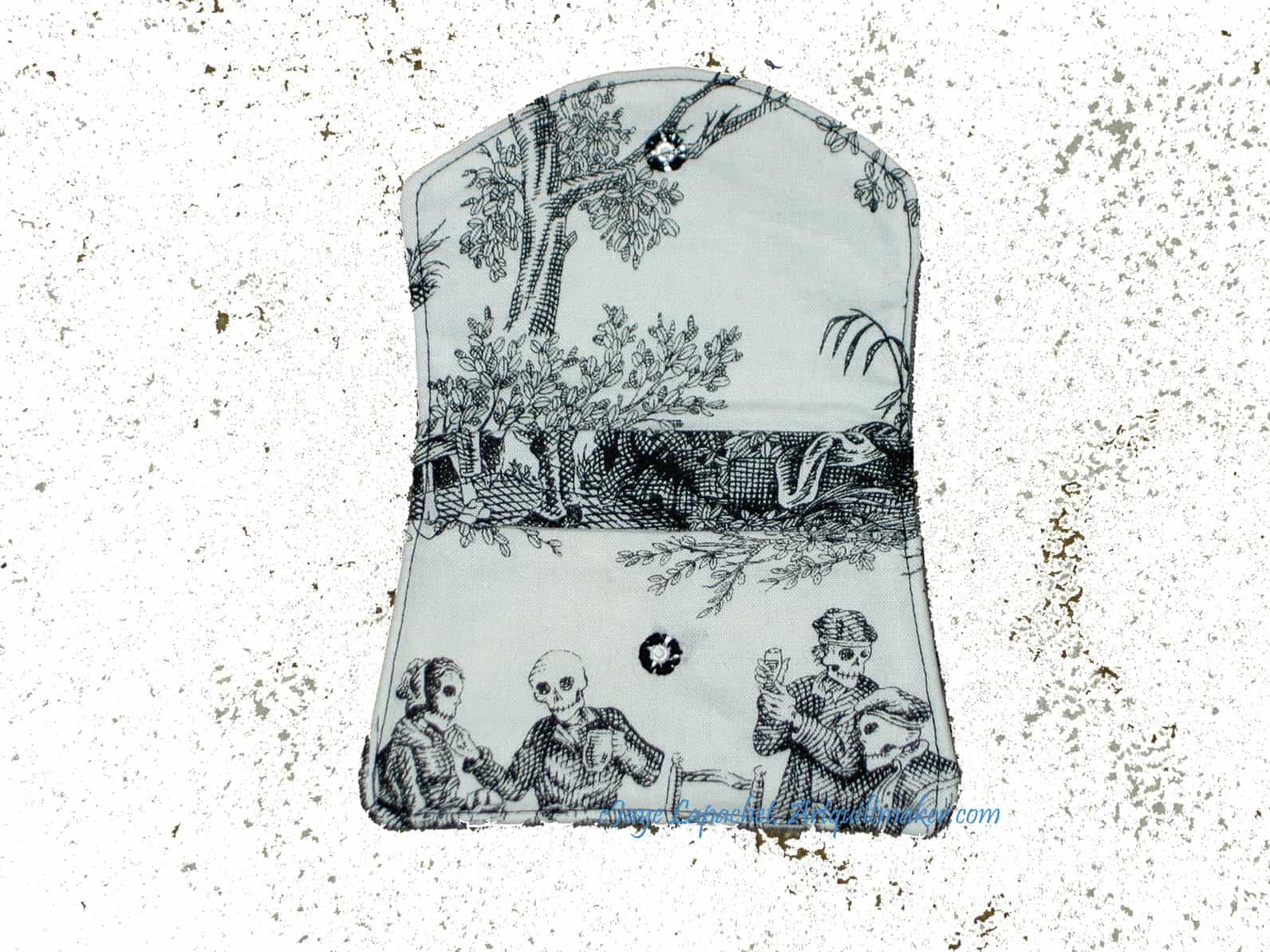
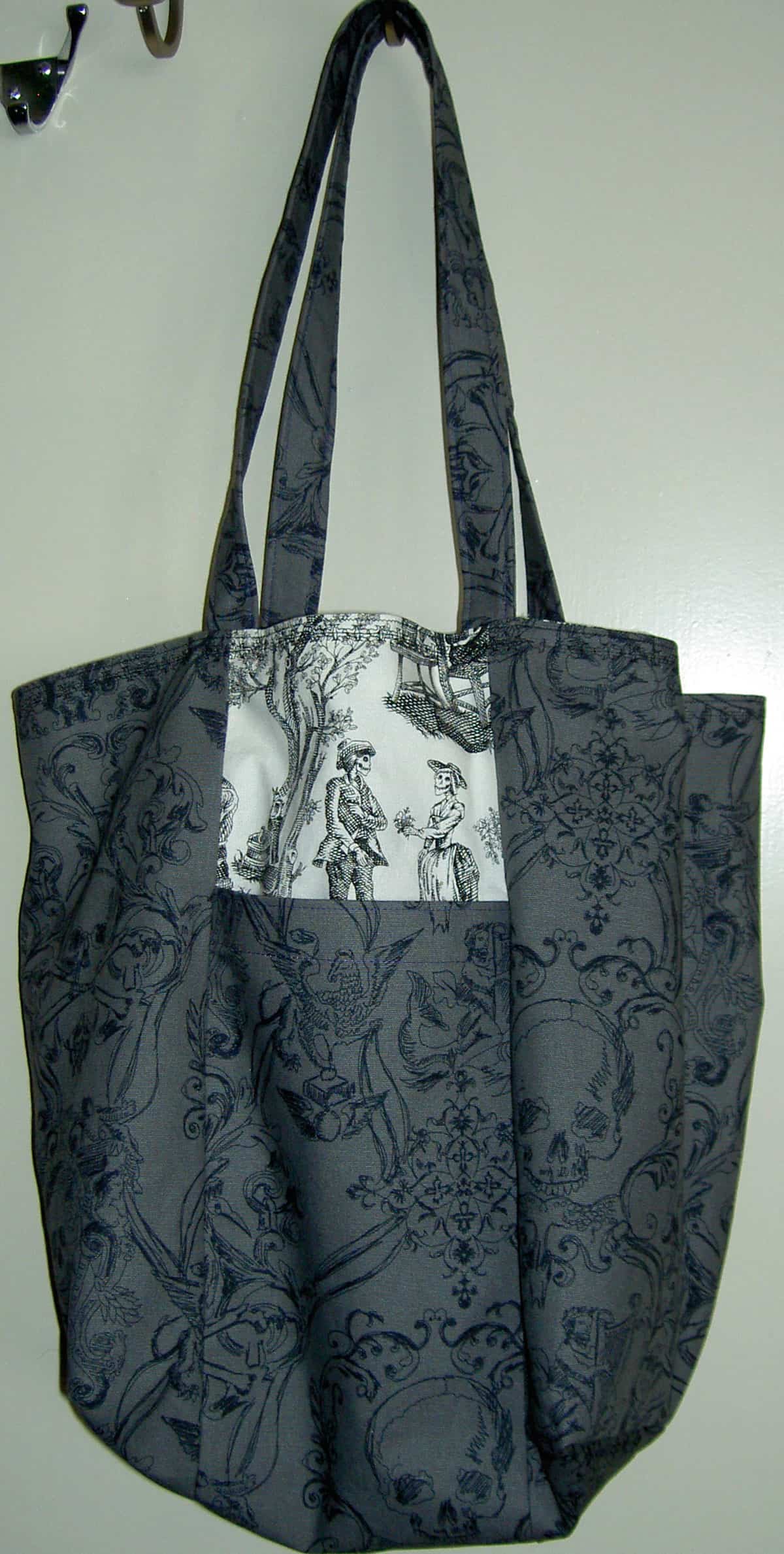
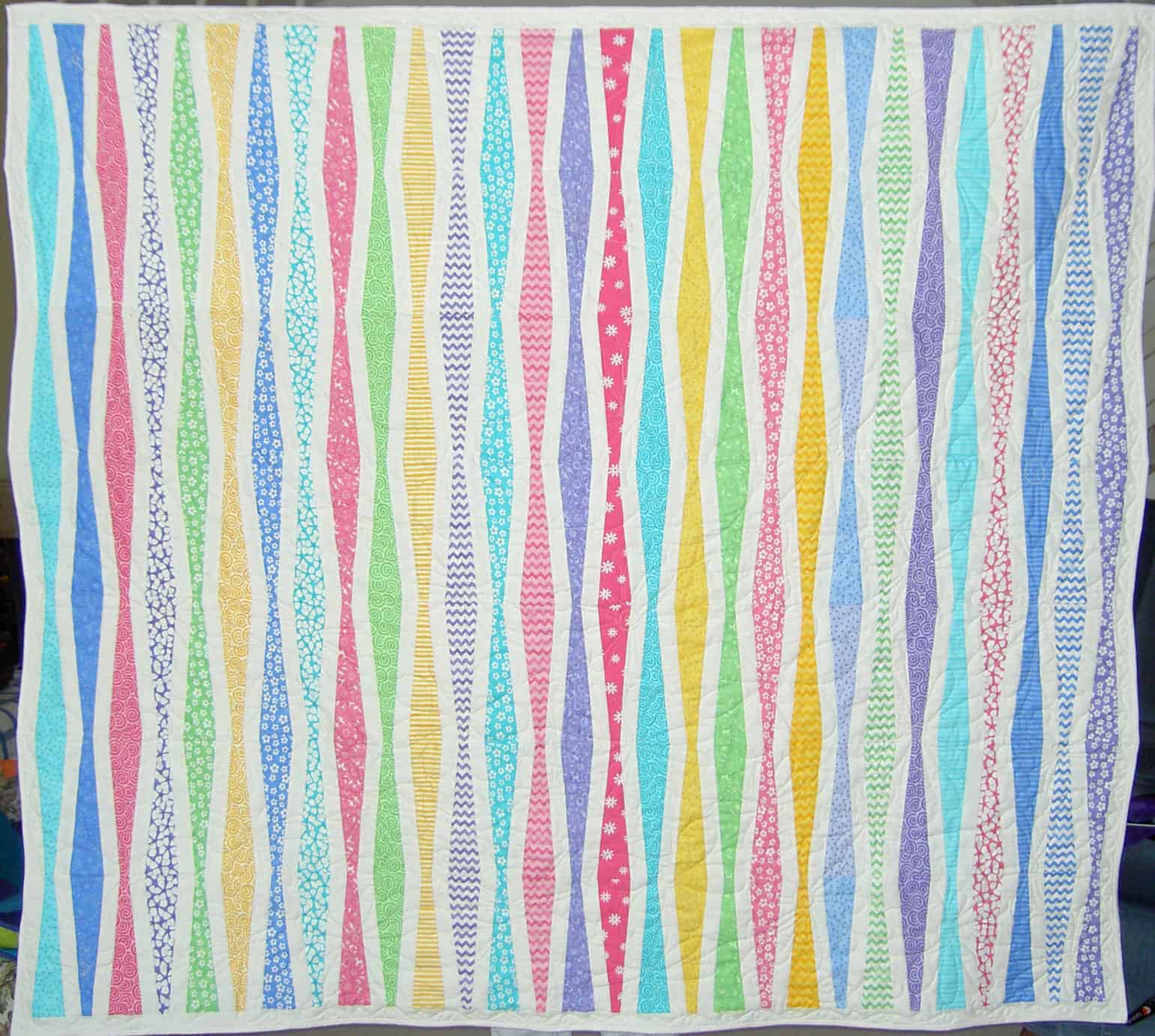
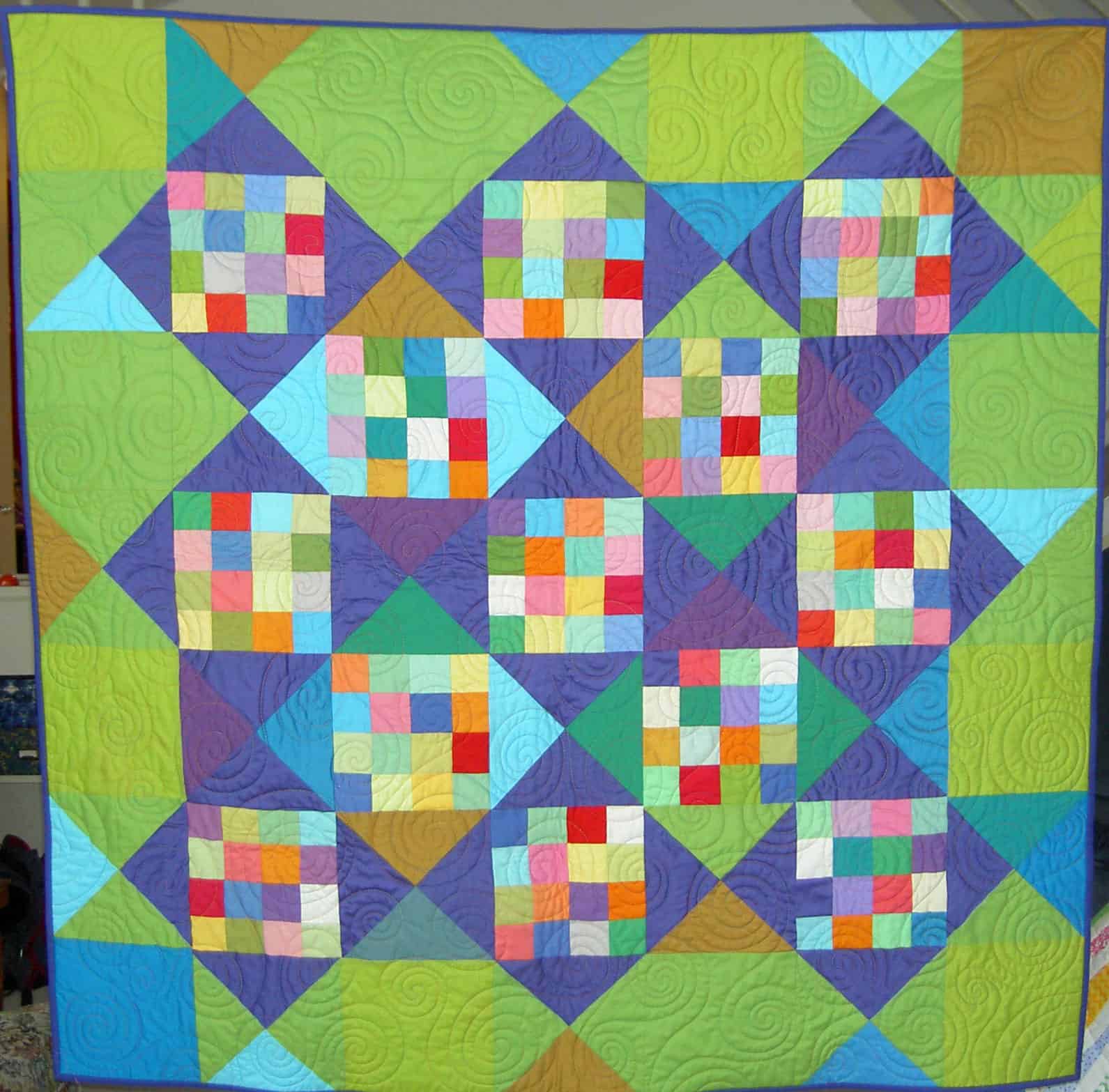
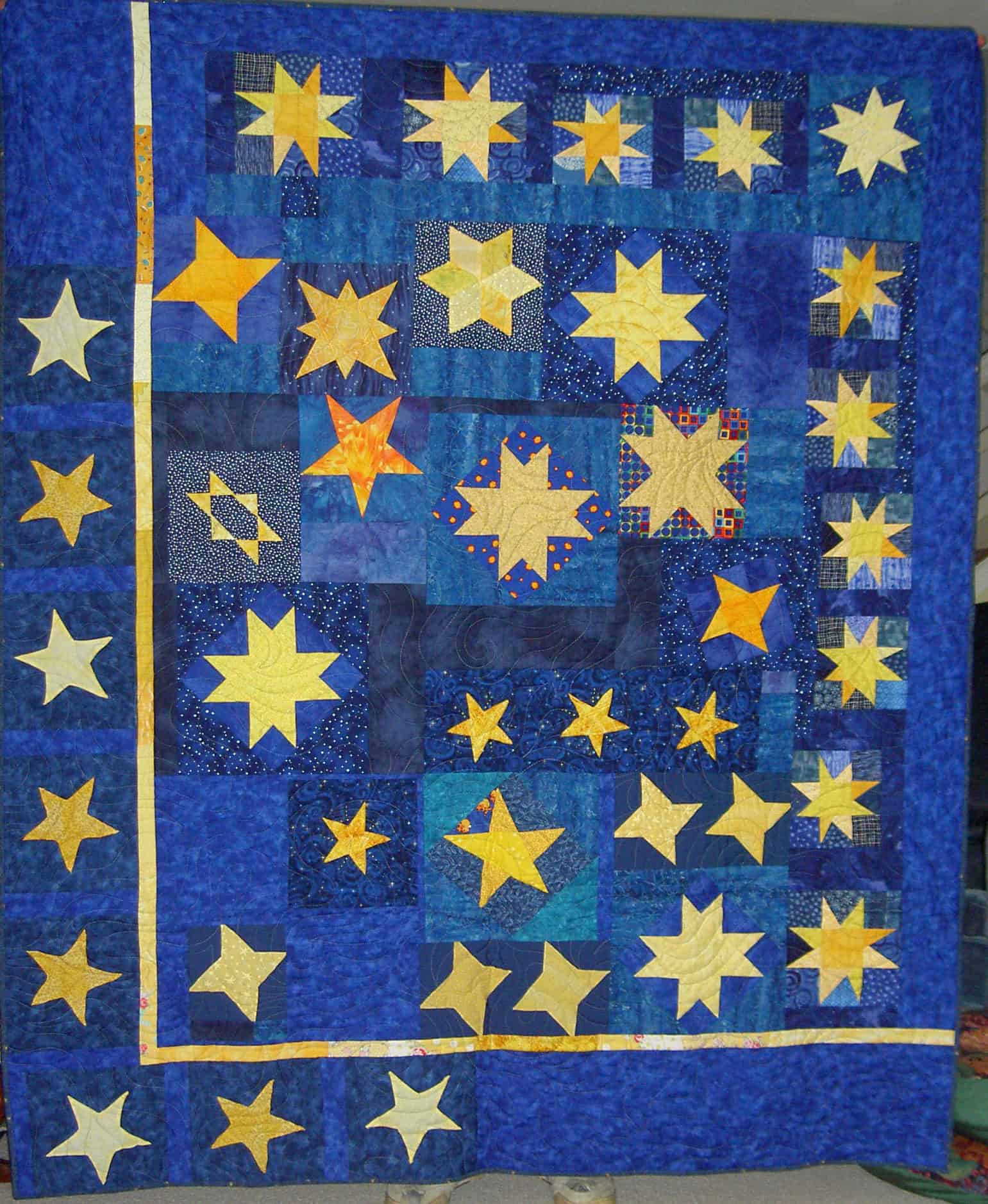
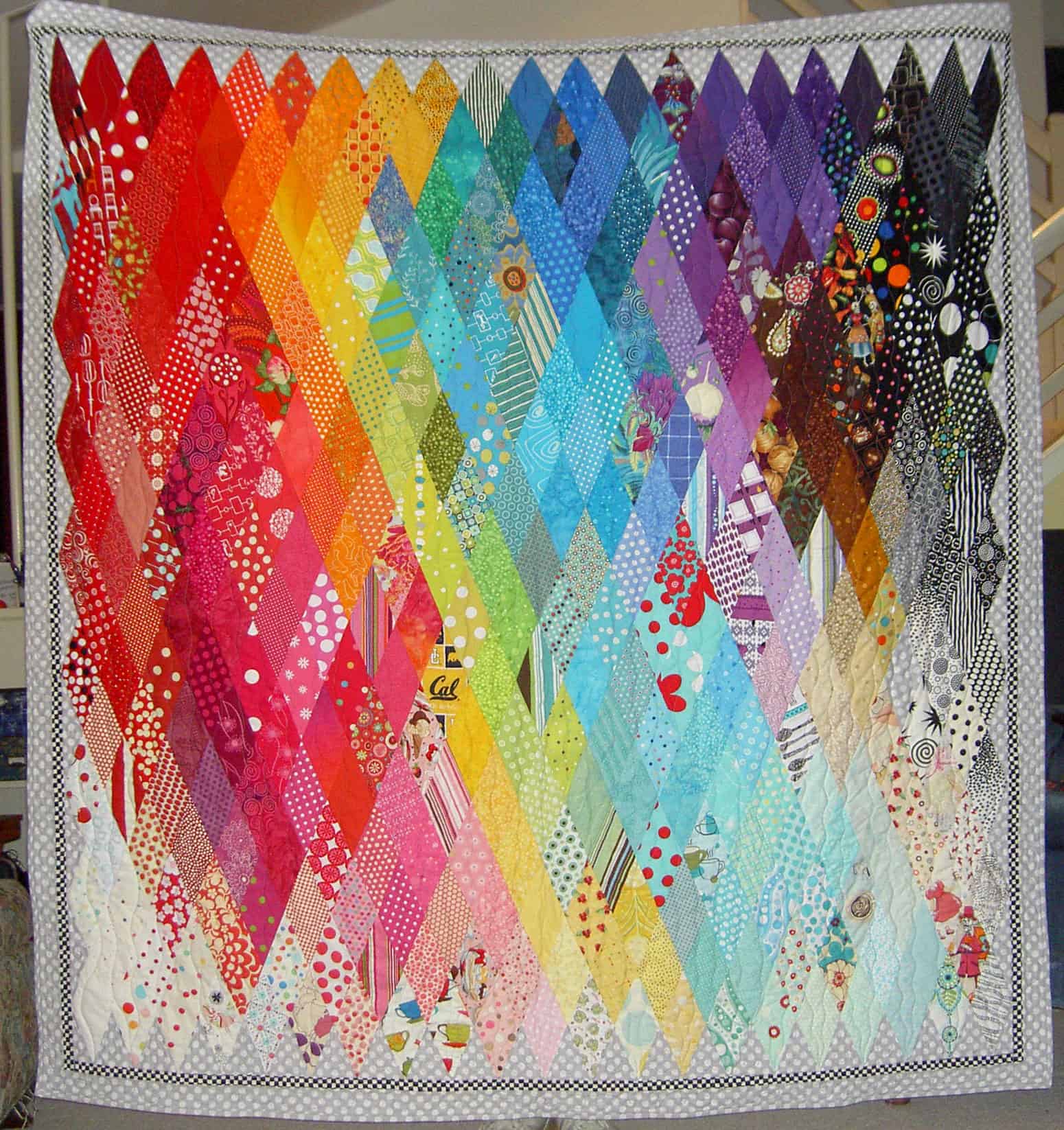
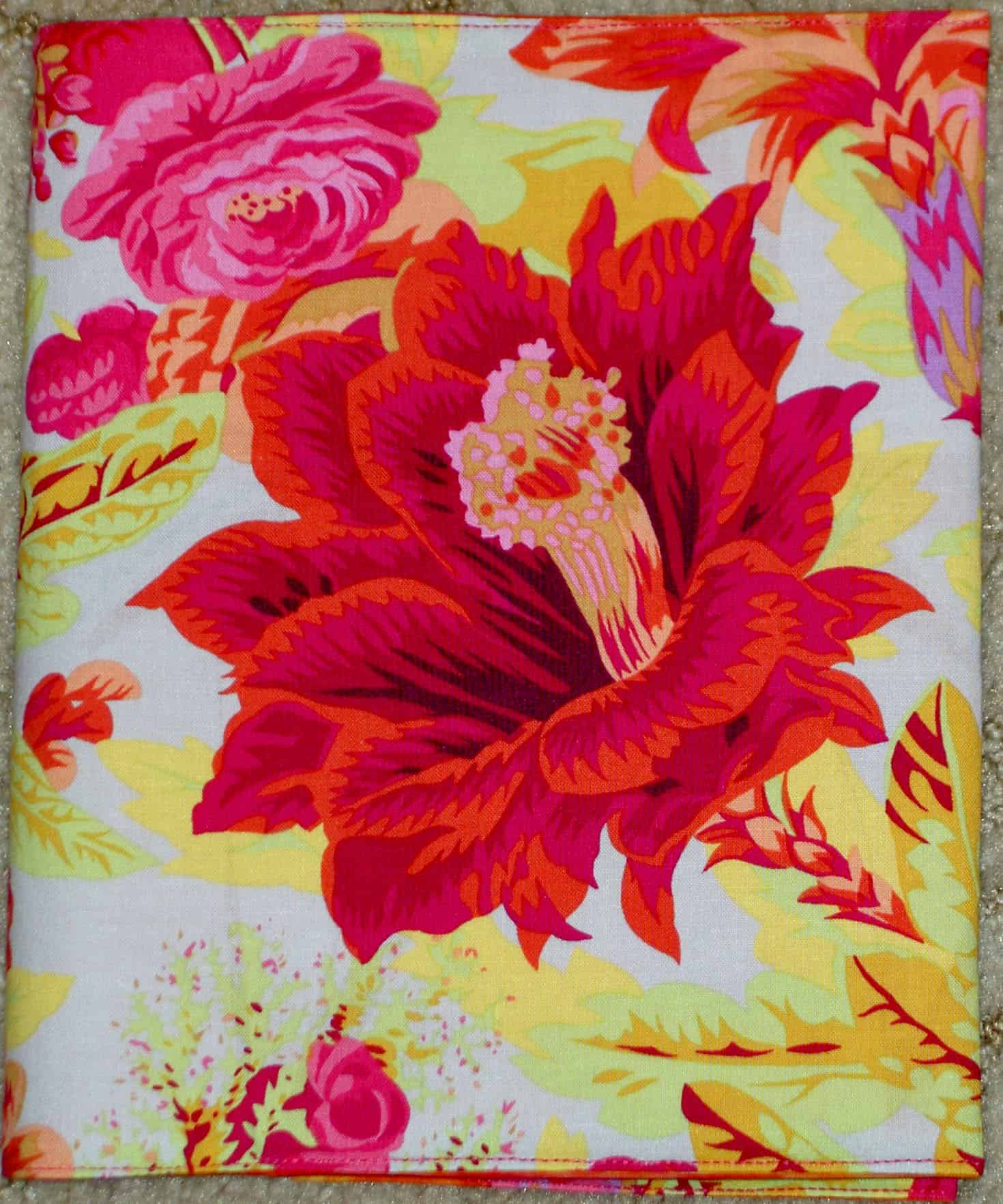
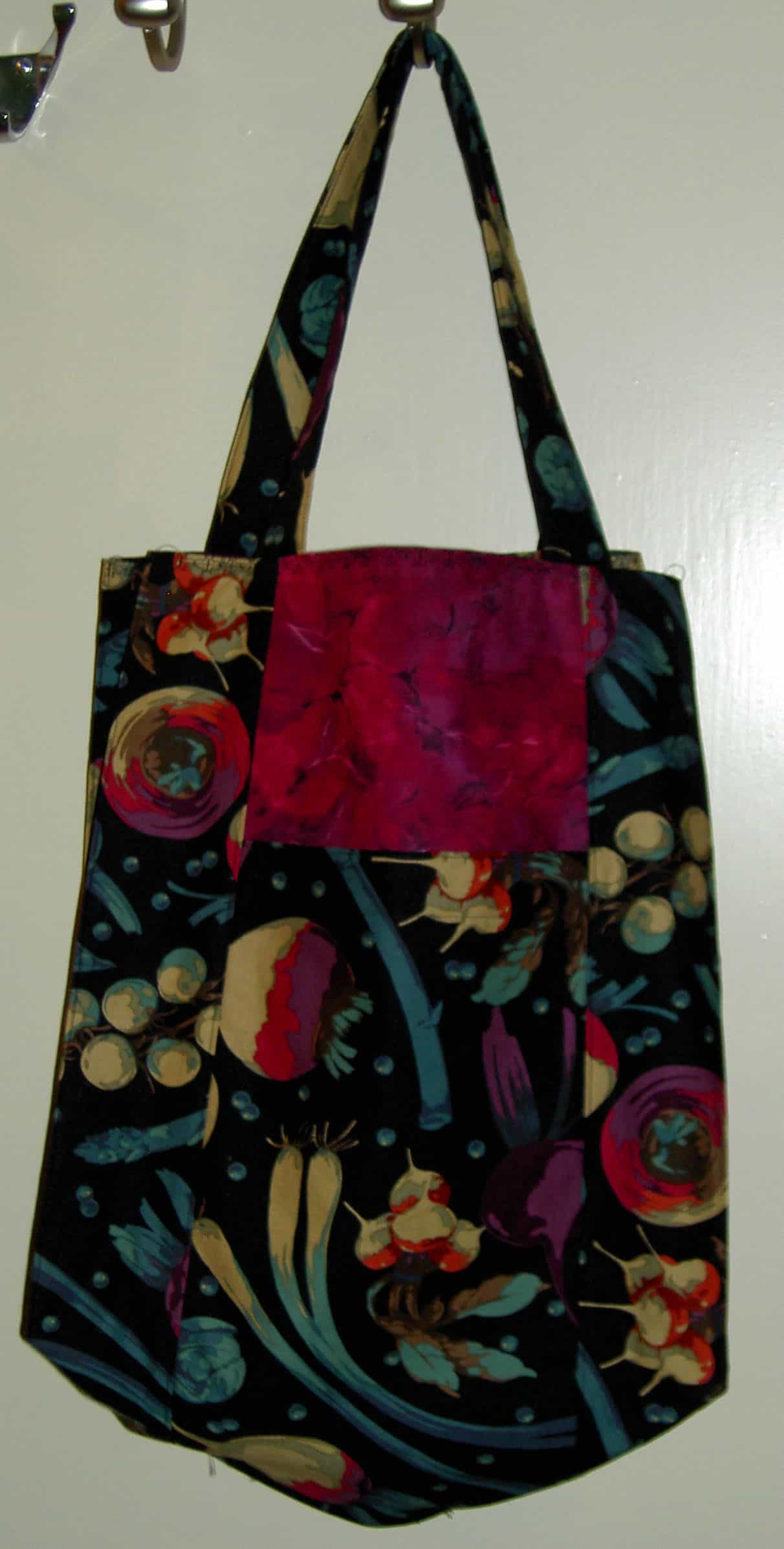
Yes, the Knitting Box, which seemed like such a failure, is finished. It took me much longer than I thought it would. Even though I should be done with this project, I am tempted to make another just because I would like to perfect the process as well as make a few modifications.
Knitting Box Open
SIL likes it and I hope she will find it useful. I was nearly finished when she dropped off her child and requested a wrist band instead of the belt loop she originally requested.
Knitting Box One Flap Open
No dice. I did not want to rip out the seam and insert a longer loop. I didn’t have it in me. Fortunately, SIL is very thin and the belt loop was generous enough to fit over her hand. It is tight enough not to slip off as she is in transit.
The above photo shows that I added some snaps. I had some large black snaps on hand, which SIL said would be fine to use. I decided I wanted something to match the piece. I looked for pink snaps in several local shops with no success. I am sure I have seen colored snaps before, but I couldn’t find any. I must have seen them online. I finally bought clear snaps and they work well to keep the box closed. I was able to finish it while she was out.
Corner Detail
Part of what I wanted to do was secure the corners into a small box shape. I did that with beads and Laura Wasilowski hand dyed Perl Cotton. I hope it holds up. If not, I can fix it.
Snaps in Action/Corner Detail
Above you can see the snaps and unfolding action as well as a bit of the corner detail.
Open View from the Side
I put two snaps on the edge covering the section where the yarn will come out. I thought that SIL could only snap one in order to allow the yarn to flow out more smoothly.
Another View - Closed
You can see how the yarn would come out with one snap open.
Another View - Closed
I will be really interested in how this project actually works in practice and if SIL uses it. I like the way the box looks in this picture and wonder if it will stay like that while she is on the go and knitting.
One of the things I really ended up liking about this project is how it became a group effort. I appreciate my SIL and my niece helping me figure out the solution to my challenges and to all of my readers who gave me resources. I also appreciate the opportunity to do something a little different and to Ruthann Logsdon Zarroff of Mirkwood Designs for posting the original Truffle Box pattern.
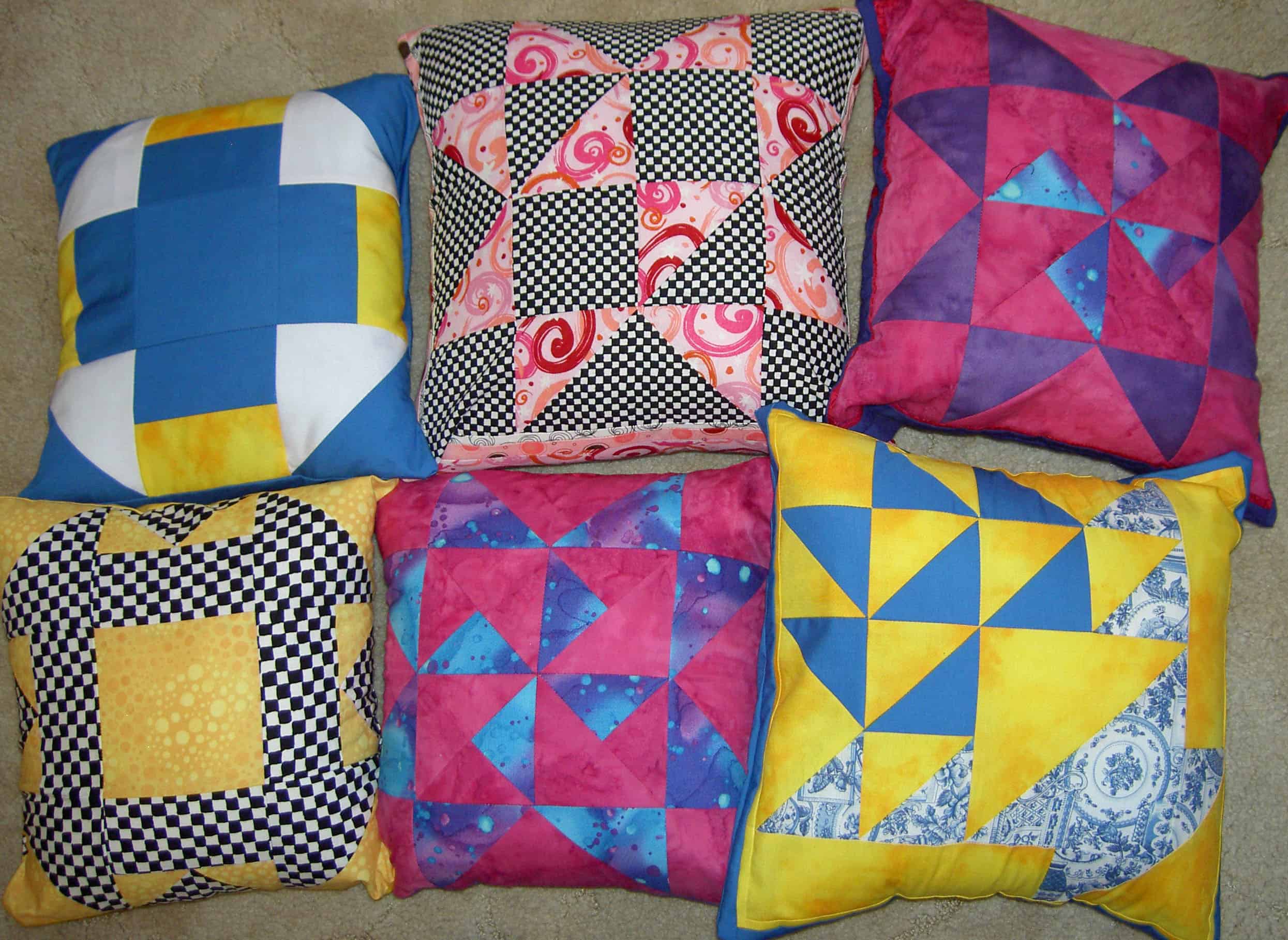
Yes, it is Teacher Pillow time of year. I had resolved to not leave it until the last minute, but being in bed with a nasty virus for over week did not assist me in my resolve.
I made one pillow last weekend after I was feeling a little better. I also made a block during the week for one of the pillow tops, but spent the better part of Friday finishing them up. School is out on Friday, so I had to get it done.
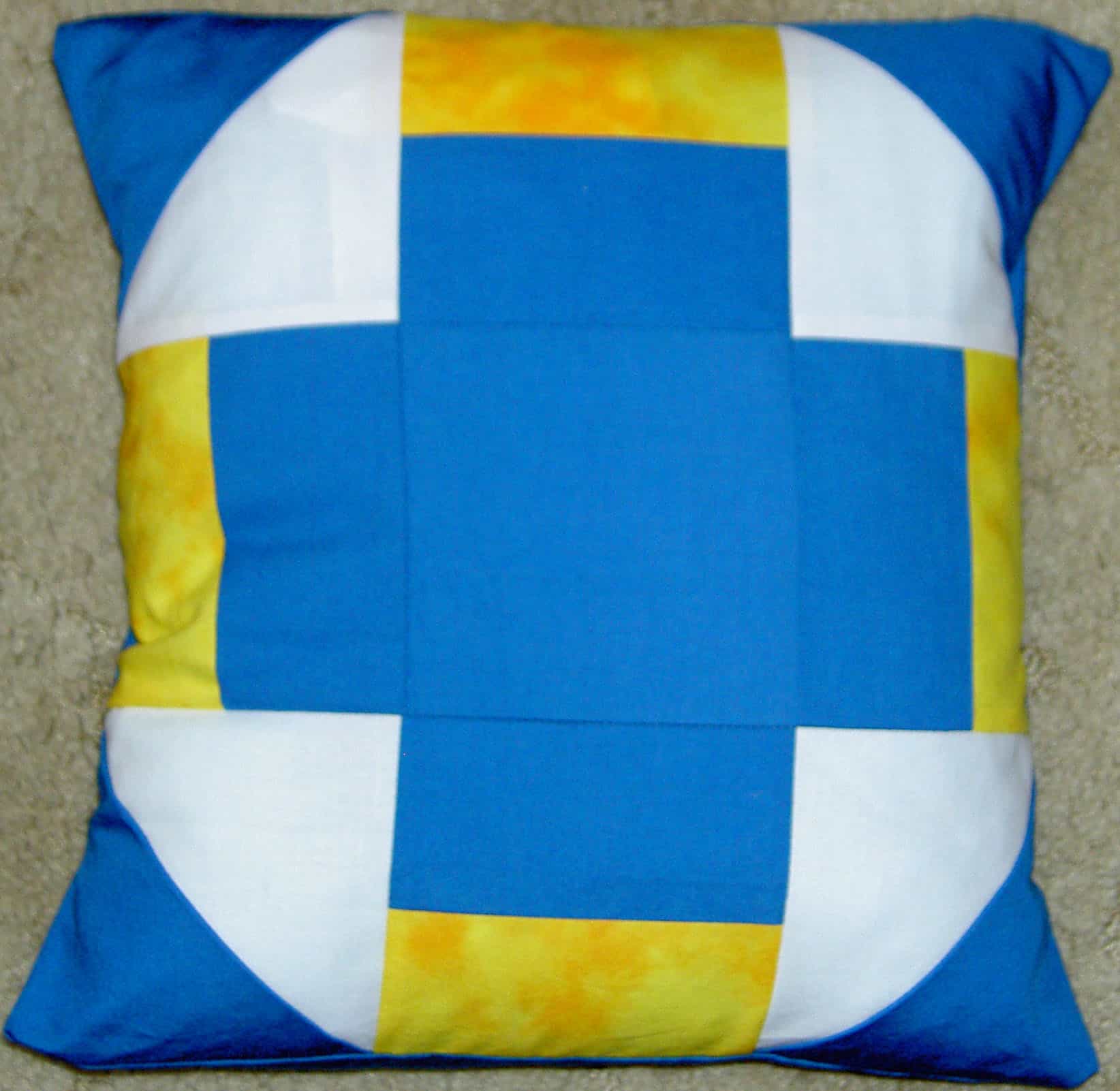
Resource Teacher Pillow
Above is the pillow for the Resource Teacher. She has been working with The Child for the past four years. She has made my life a lot better, because she gets The Child. She has provided support that I wasn’t getting from the lower school resource teacher (through no fault of his own). I will be VERY sad not work with her anymore.
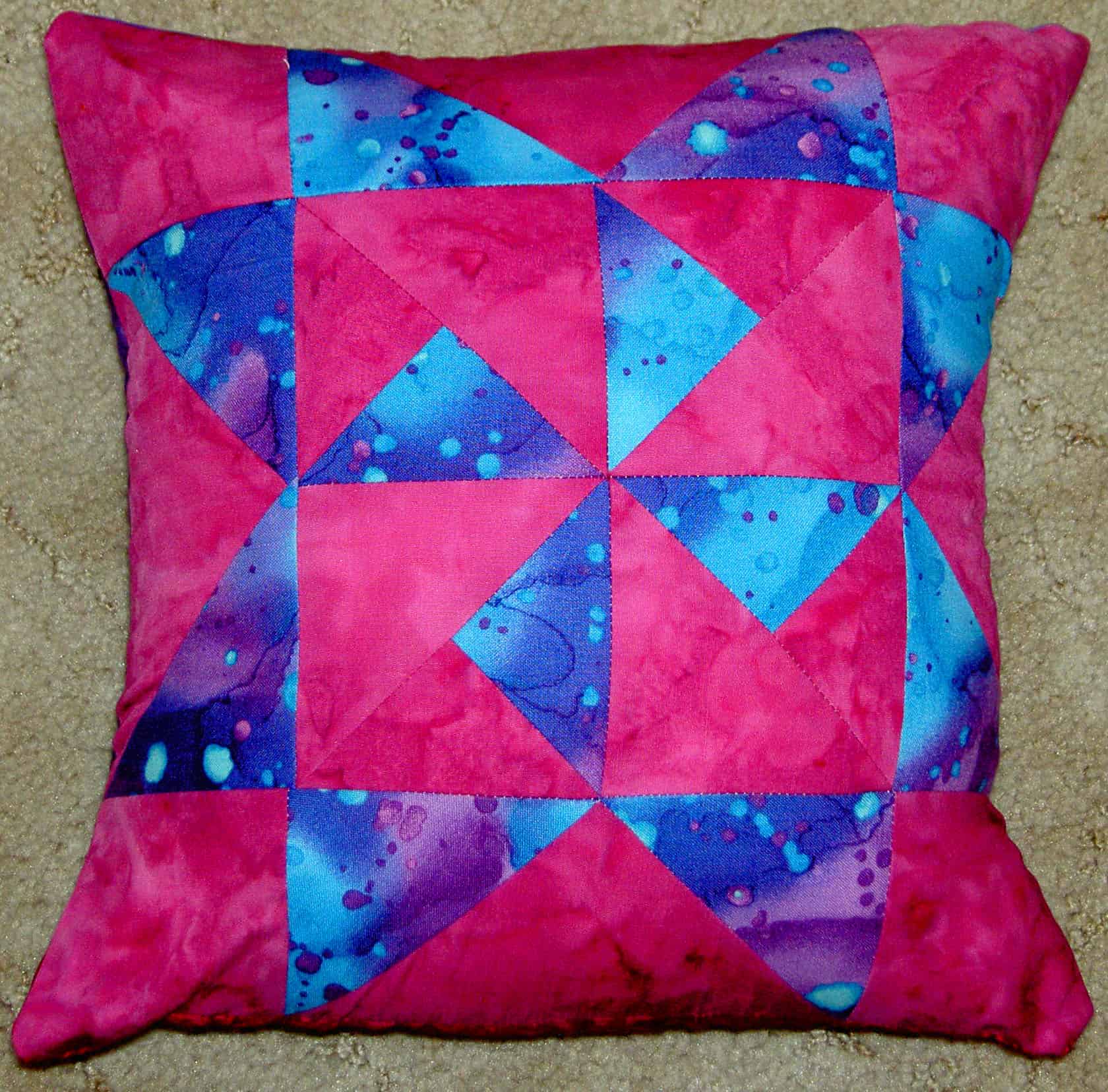
Every year I pull out the same fabrics and make a different block. Now she has a set. I am thinking of making a quillow next year. I have never done that, but my SIL is an expert and I can draw on her expertise.
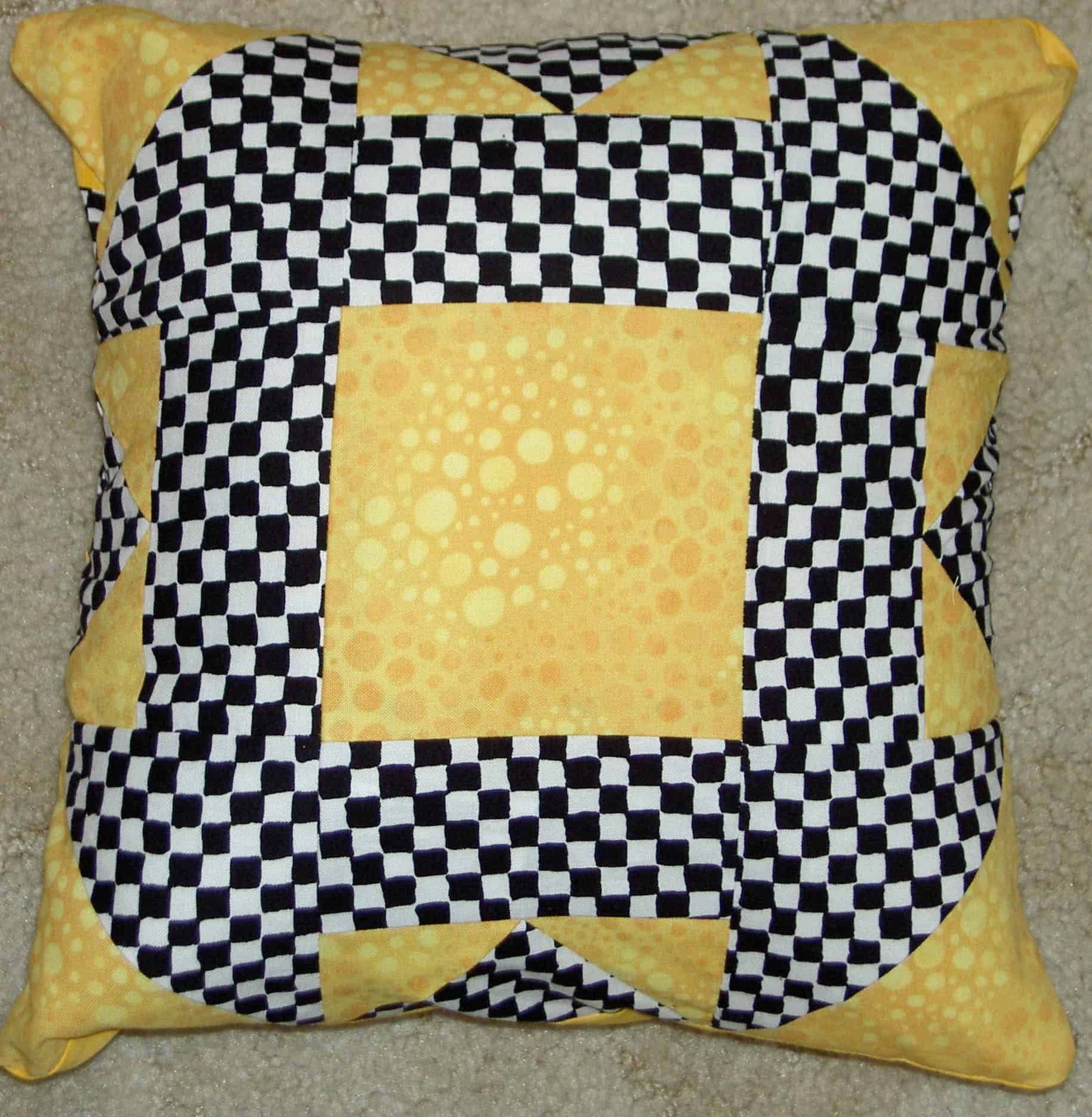
I was surprised to see that lozenge design show up in the middle of the block. I amy have miscolored the blocks when I sewed the pieces together. The block is called Crockett’s Cabin in Around the Block. That lozenge shape is very appealing and I am wondering if it would work for a FOTY piece?
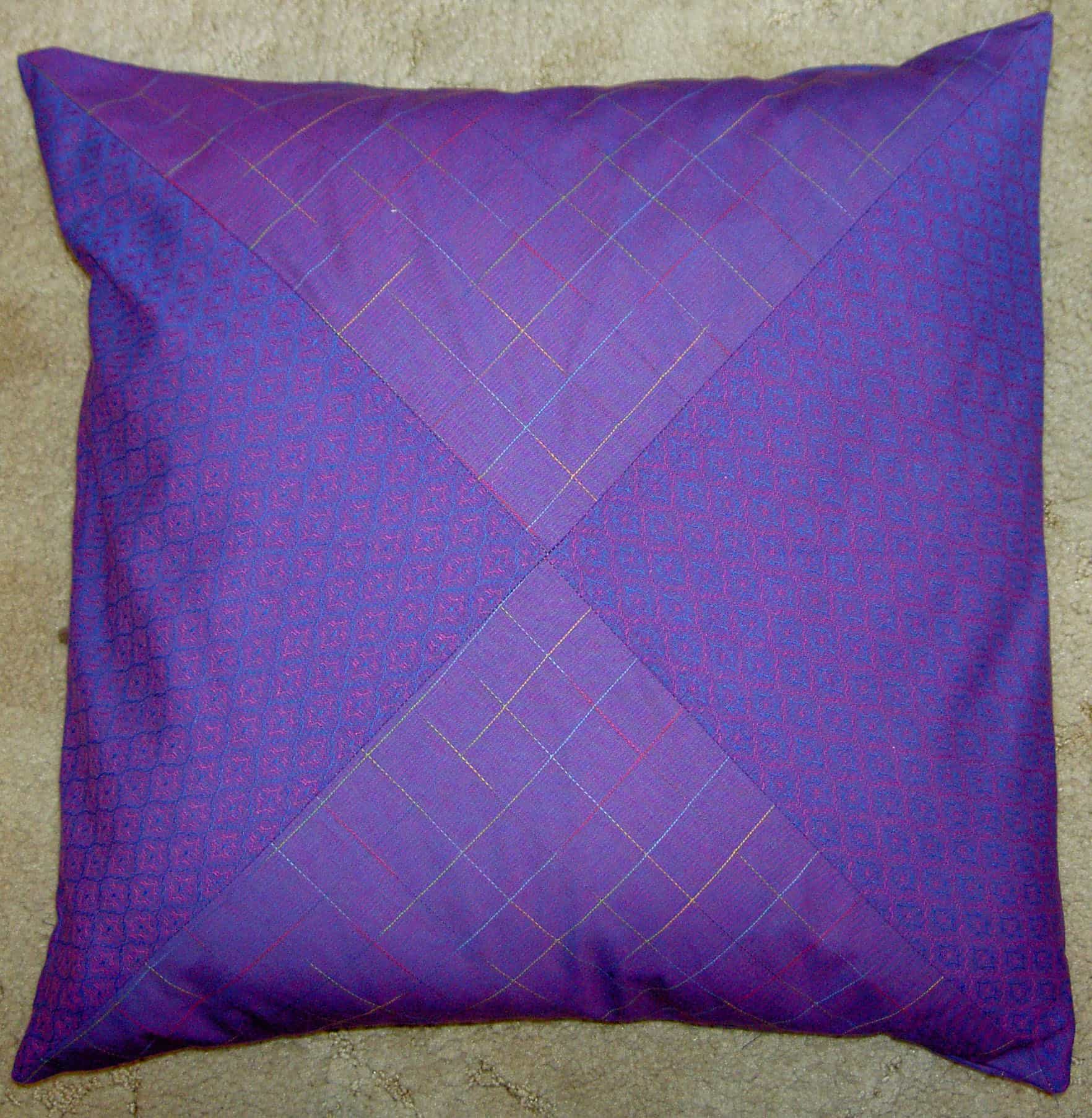
Literature Teacher Pillow
As The Child has moved up in the grades, I spend less time in the classroom, thus I know the teachers less and less. I try to get a sense of the colors of the teachers and it is very difficult when I have only spoken to them 3-4 times. The literature teacher, who also happened to be The Child’s homeroom teacher had a hard year this year. She was out for four months at the beginning of the year, because of the death in her family. I thought The Child would have a hard transition when she came back to school, but he took to her like a duck to water. He liked her because “she doesn’t think she knows everything” and I found her to be a very intuitive teacher. I don’t know if the above colors or design are her style, but they are what immediately came to mind when I thought of her. I hope she likes it.
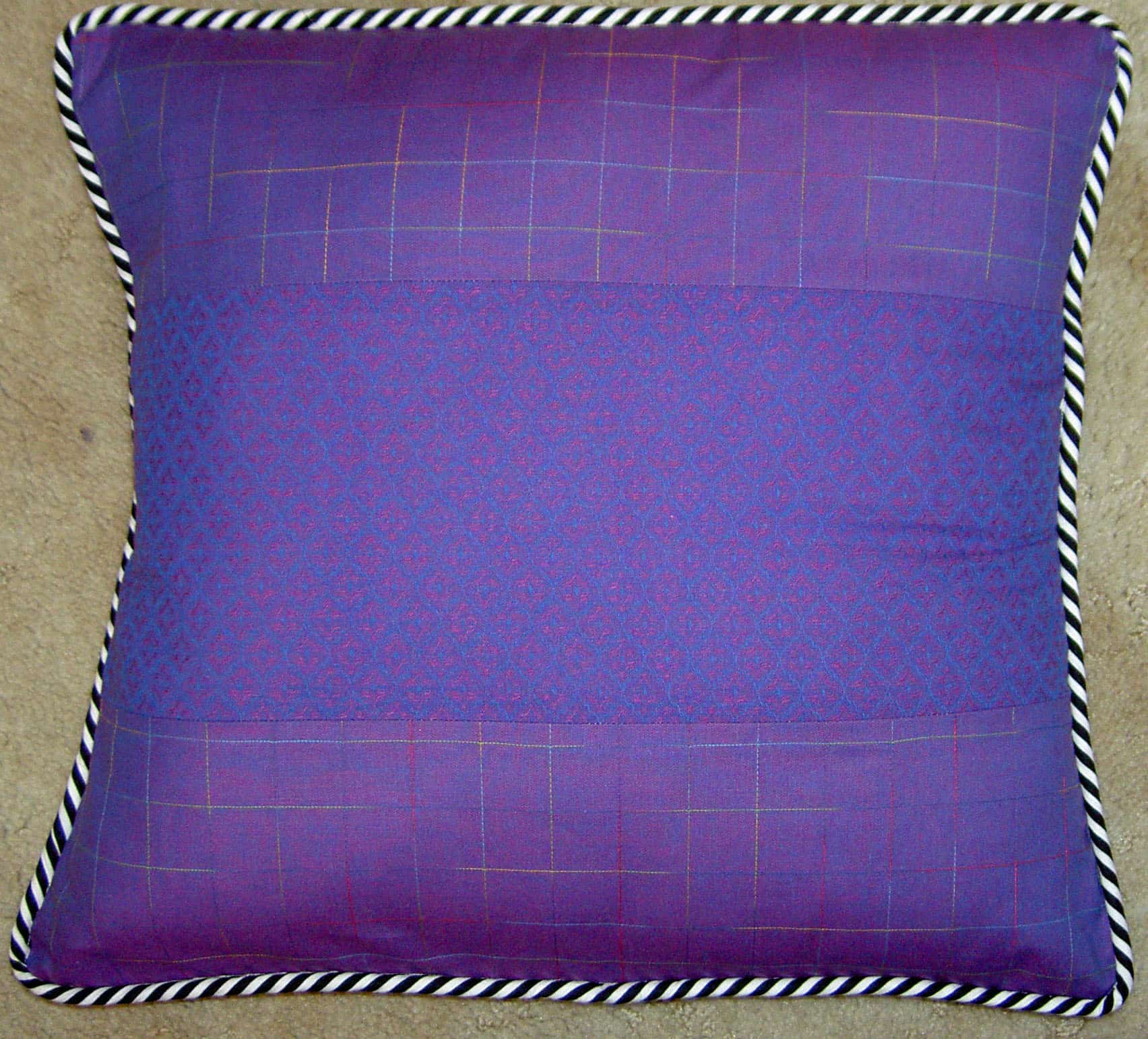
Literature Teacher Pillow-back
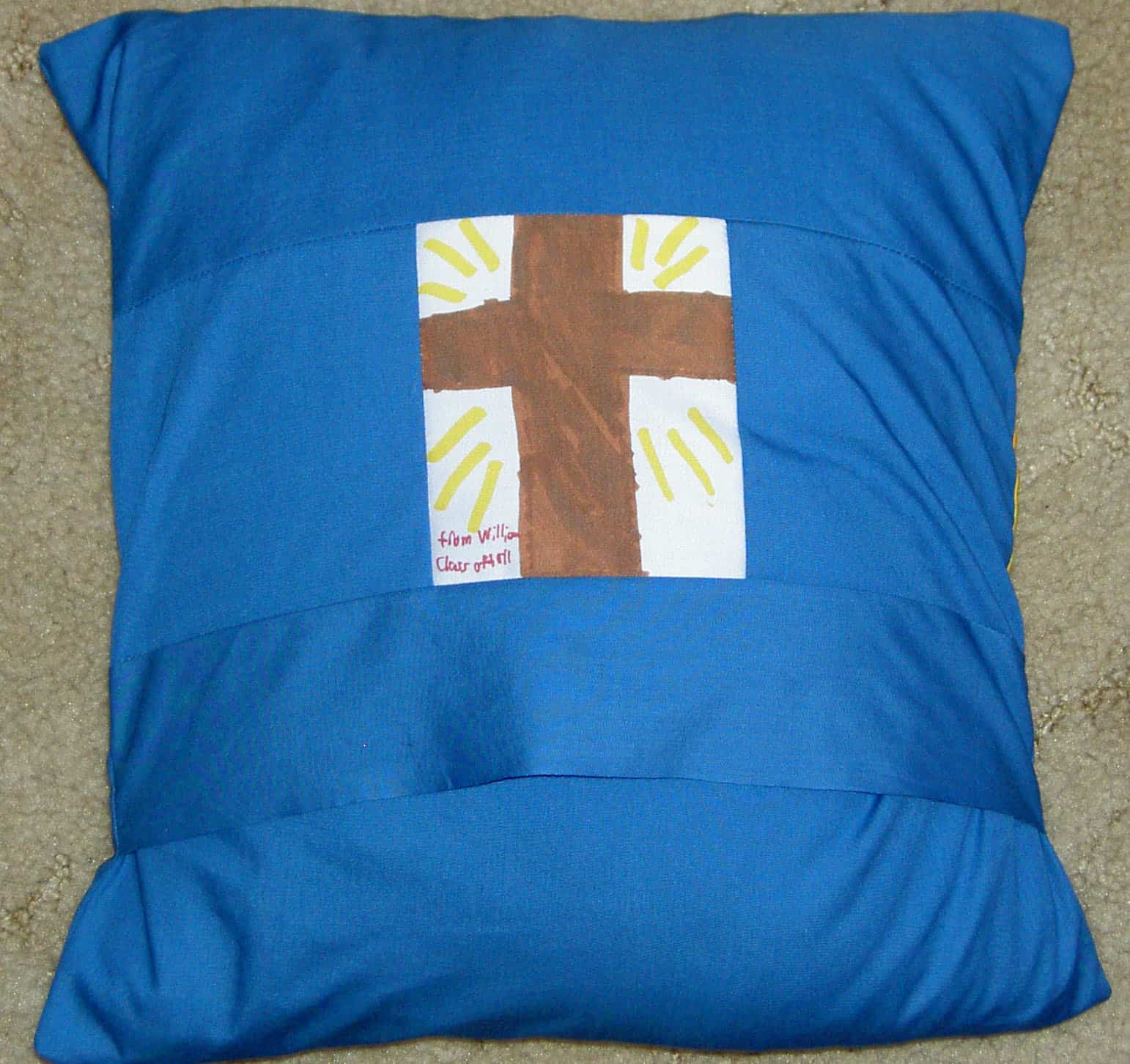
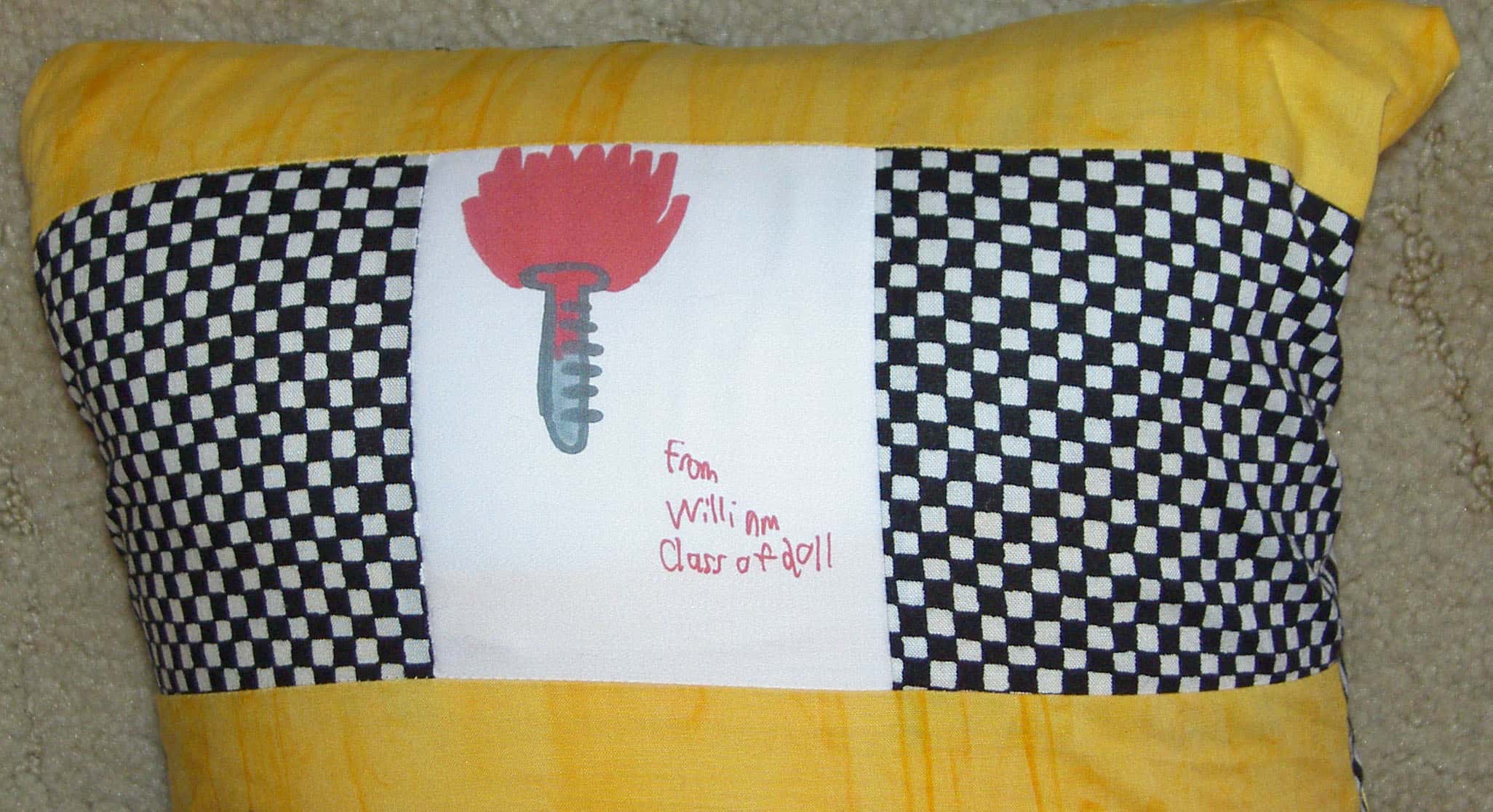
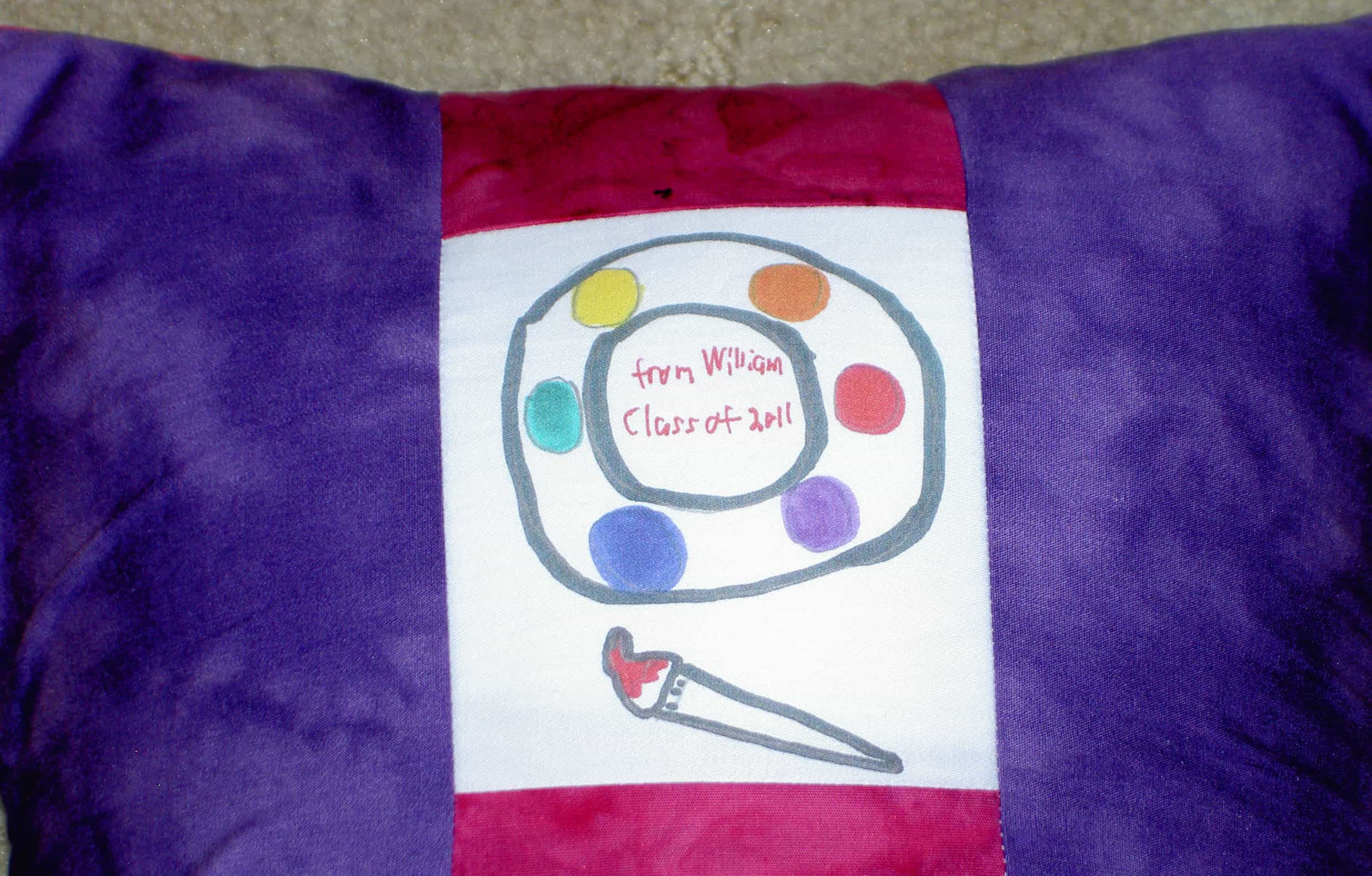
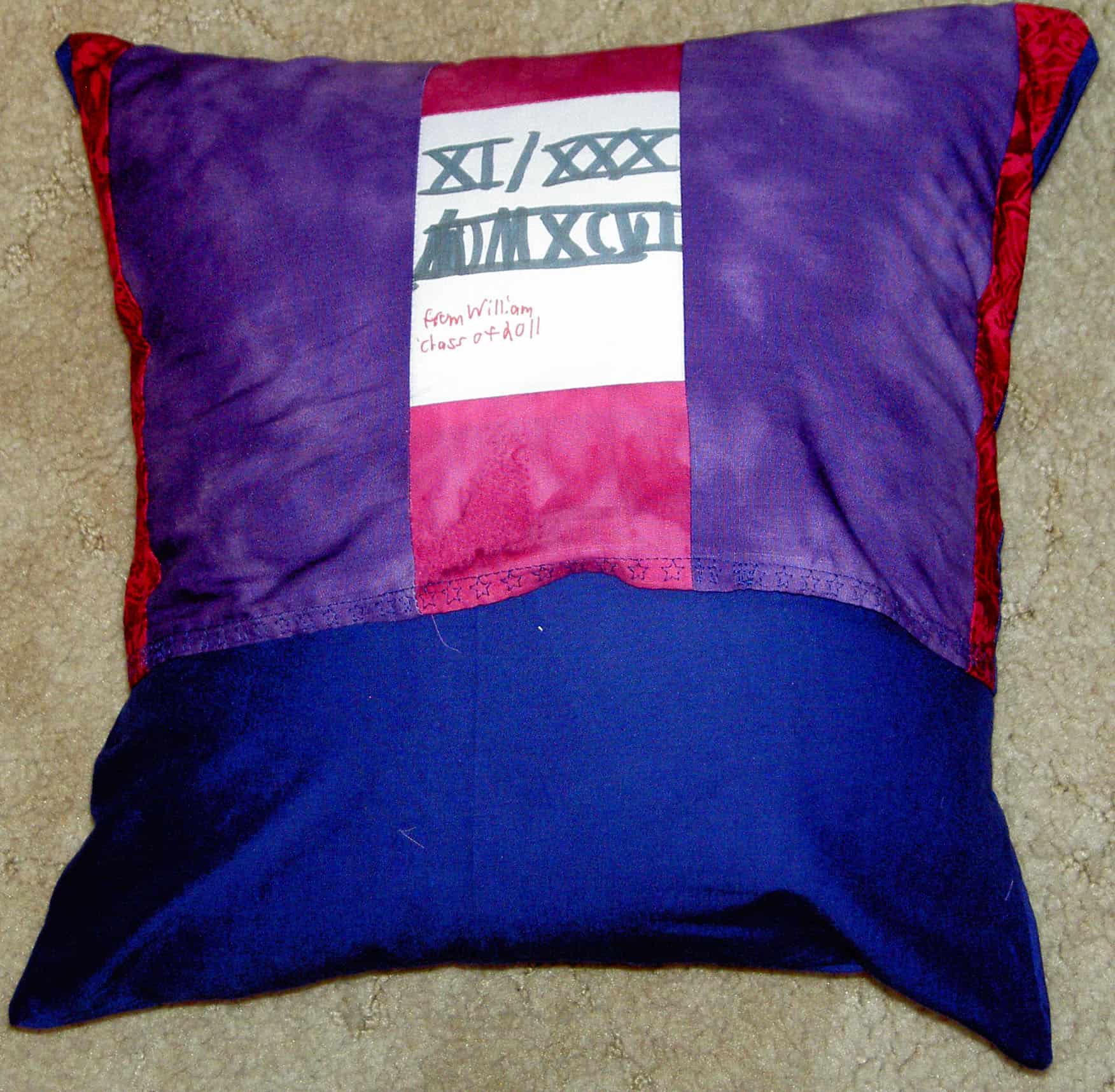
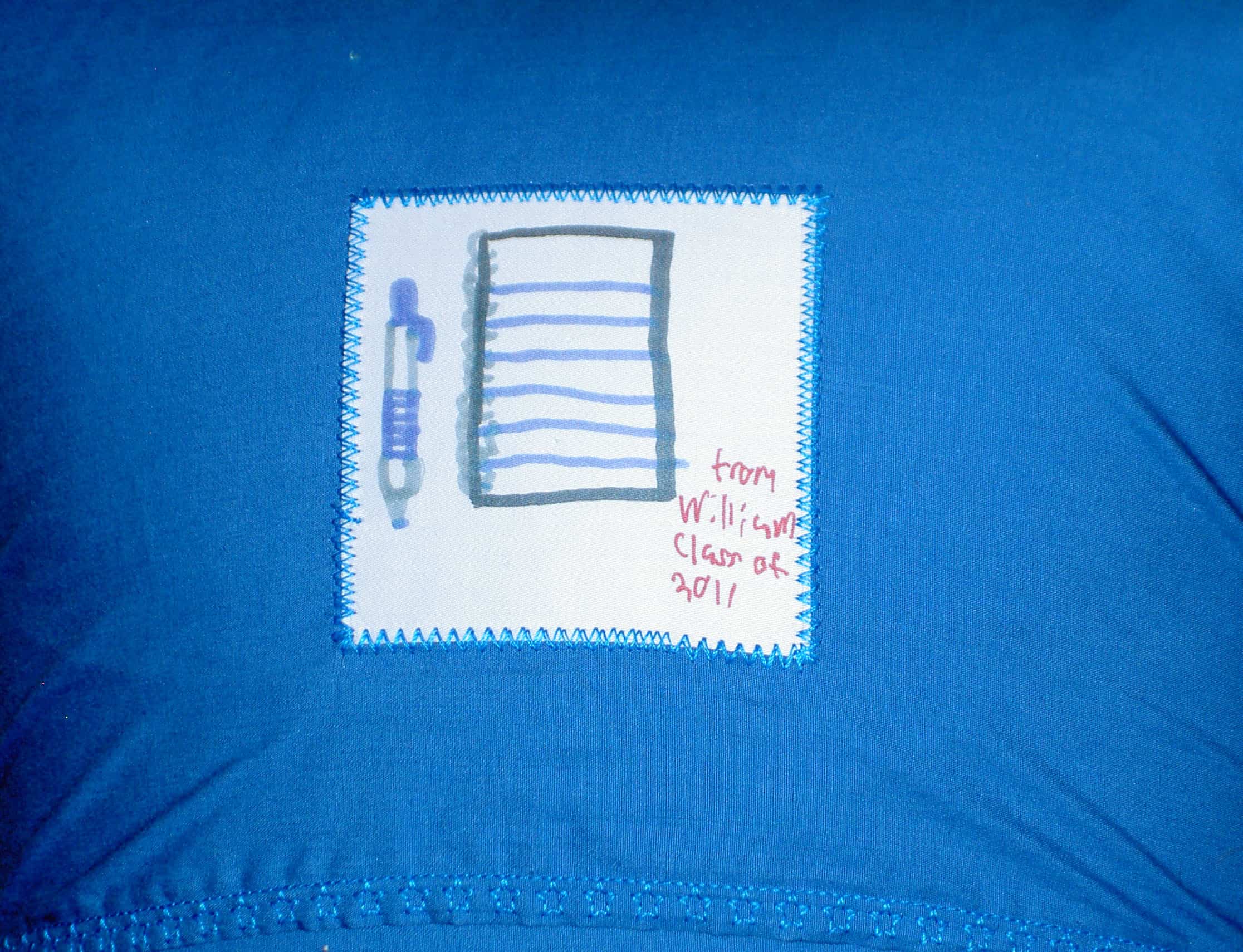
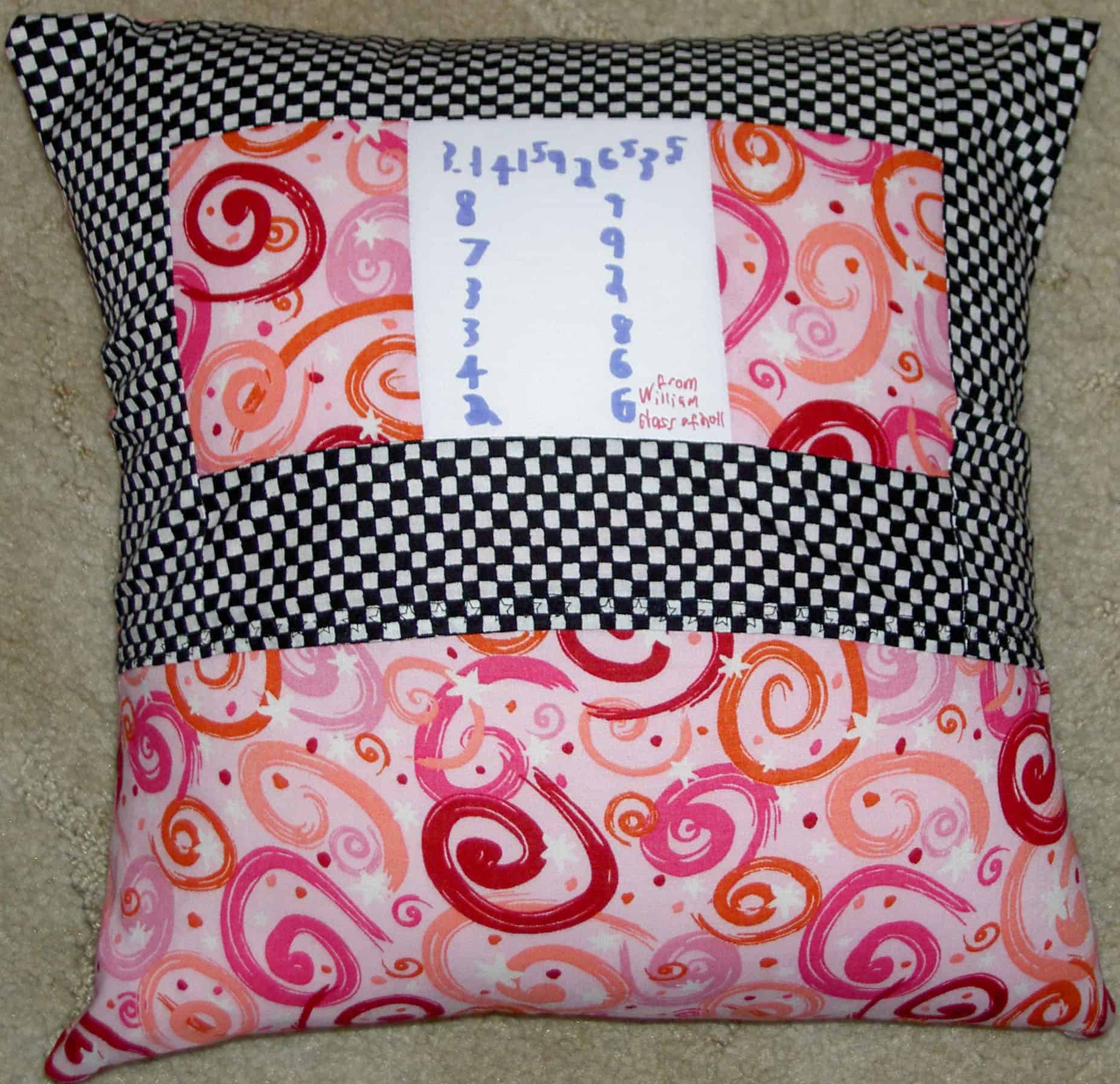
I force The Child to do a little drawing for each of his teachers. He had a hard time this year. He is getting out of creative practice and I have to get on him about that. (N.B. I blacked the names to protect the innocent!)
Making the backs fit is the most time consuming part. I couldn’t seem to get it right on any of them. This one is actually sideways on the pillow. I figured that nobody would care, if they even noticed.
Social Studies Teacher
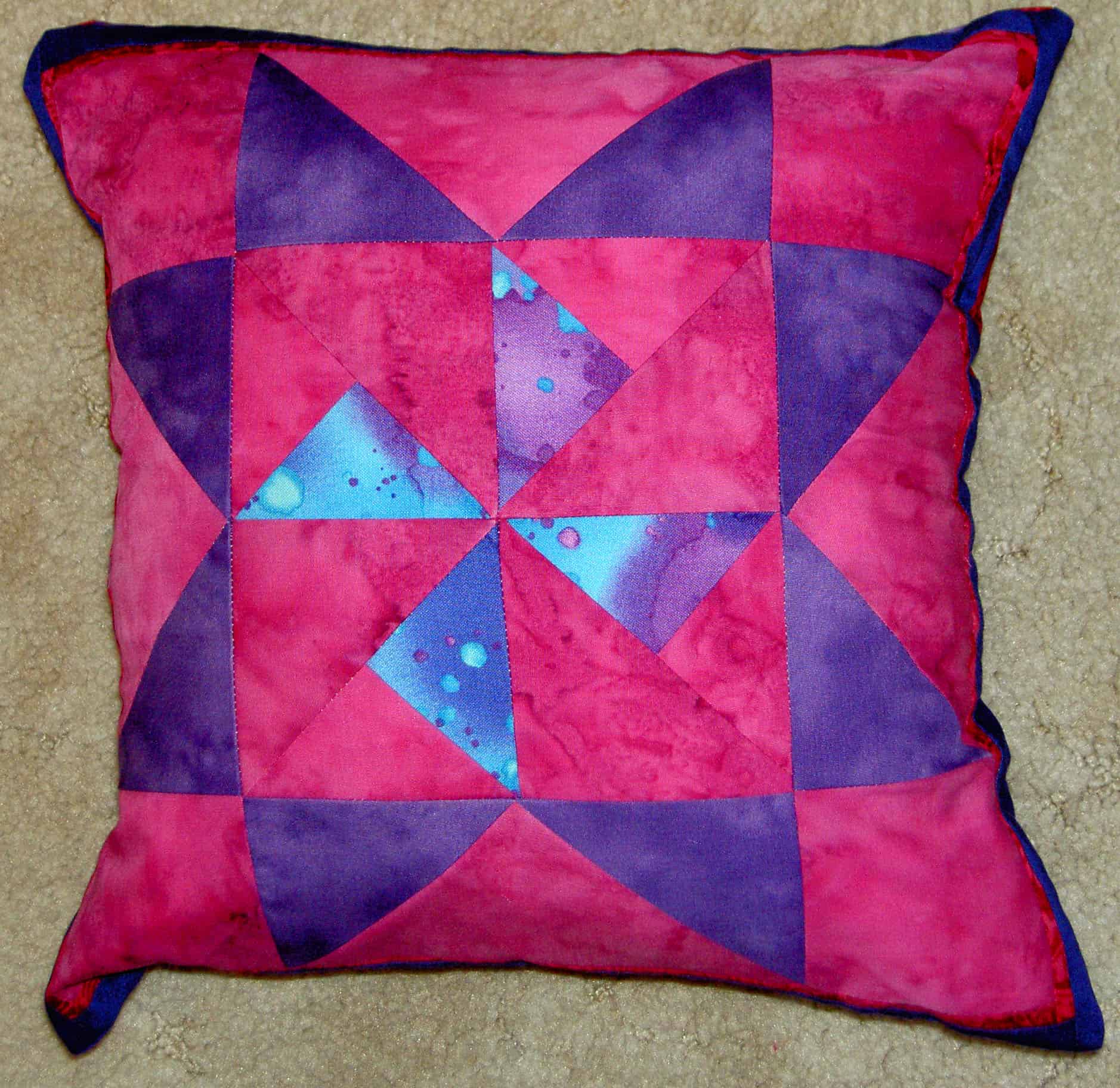
I really hope she doesn’t sincerely dislike purple. This block, in Around the Block, is called Star of Hope. It looks to me like a basic Ohio Star. I don’t really believe that blocks should have different names just because they have been recolored. I haven’t taken the time to look this up in the Jinny Beyer’s new book, The Quilter’s Album of Patchwork Patterns.
Social Studies Teacher - back
The Child kind of got into his drawing after a bit. He has a subtle sense of humor. I thought this drawing was very funny. Do you get it?
Science Teacher
I mentioned on Tuesday that I found some fabrics I didn’t really like while I was cutting FOTY pieces. A couple of the above fabrics are those fabrics. However, the Science Teacher is male and I have not had the opportunity to make pillows for many male teachers. I found these fabrics to be great for a science man. I think they look a bit like rocks. I only had a fat quarter of each, so I had to add some others and I don’t have any to match next year, but may continue with the rock theme.
Science Teacher-back
You can see that The Child got on to a roll with his drawings as he progressed through them.
The drawings are done on an 8.5×11″ piece of paper. First I fold the paper into quarters and then I draw pencil lines to mark the seam allowances. I also make a note as to which rectangle on the paper goes to which teacher. This year I also put in the name and the year. The Child knows now to keep within the seam allowance
Math Teacher
In the past, The Child has chose the blocks for each teacher. This year he didn’t really care that much, so I mostly chose them. He was adamant about what he wanted for the math teacher. He saw the piece of pie I appliqued on the Tarts Come to Tea piece. He was adamant that he wanted that on the math teacher’s pillow. This is the first time I have done applique’ for a teacher.
Math Teacher-back
The Child kept with the Pie/Pi theme for the back. Again with the sense of humor!
So done for another! YAY! I am going to a party today, but am going to find a fun project to work on tomorrow. I am glad I soldiered through and don’t have this project hanging around for tomorrow, except for the wrapping and the card writing.
I have to admit that I am sick of this project. There is only one year left and I am finished. I am not doing them for high school. I don’t think it is really appropriate and would embarrass The Child, but there are also too many teachers.
It is funny how you think something is a good idea and then a tradition and expectations start, which turns the fun into a chore.
I do enjoy looking through Around the Block and picking out the blocks to use. I am tempted to make blocks for next year’s pillows while I have the fabric out and just tuck them away until April or May so I have less to do next year. We’ll see.
You might remember about a week ago I talked about selecting bag fabrics. I just couldn’t decide so, instead, I started on a different bag, the Anna Maria Multi-tasker Tote, where the selections were already firm in my mind.
AMH MTT in Progress
I really enjoyed working with these fabrics. I loved the colors and the feel. I finished the bag on Saturday and took it out with me on Sunday. I have to admit that even if I give bags away, I try most of them out. I intend to keep this one, but tote bags flow through my life so quickly that who knows?
These are fabrics that I bought in Ferndale and the large flower print is by Martha Negley. I do love that color, a reddish pink tending towards salmon. It is a cheerful color.
This is the first time I have made the pocket panels the same color as the exterior of the bag. They are the pieces right under the dot fabric you can see peeking out of top left and right.
It made the fabric selection process a lot easier. The pocket panels aren’t highlighted at all; they look like part of the exterior. I don’t know yet if that bothers me. I did a lot of work on the bag and wonder if I need people to see the pocket panels? I’ll have to think about it and let you know.
I like to make the inside of the bag a light color, so I can see what is hiding inside the bag. I really like that dot fabric! I got some a long time ago with a chartreuse-y / olive background. This colorway works very well for the inside of a bag.
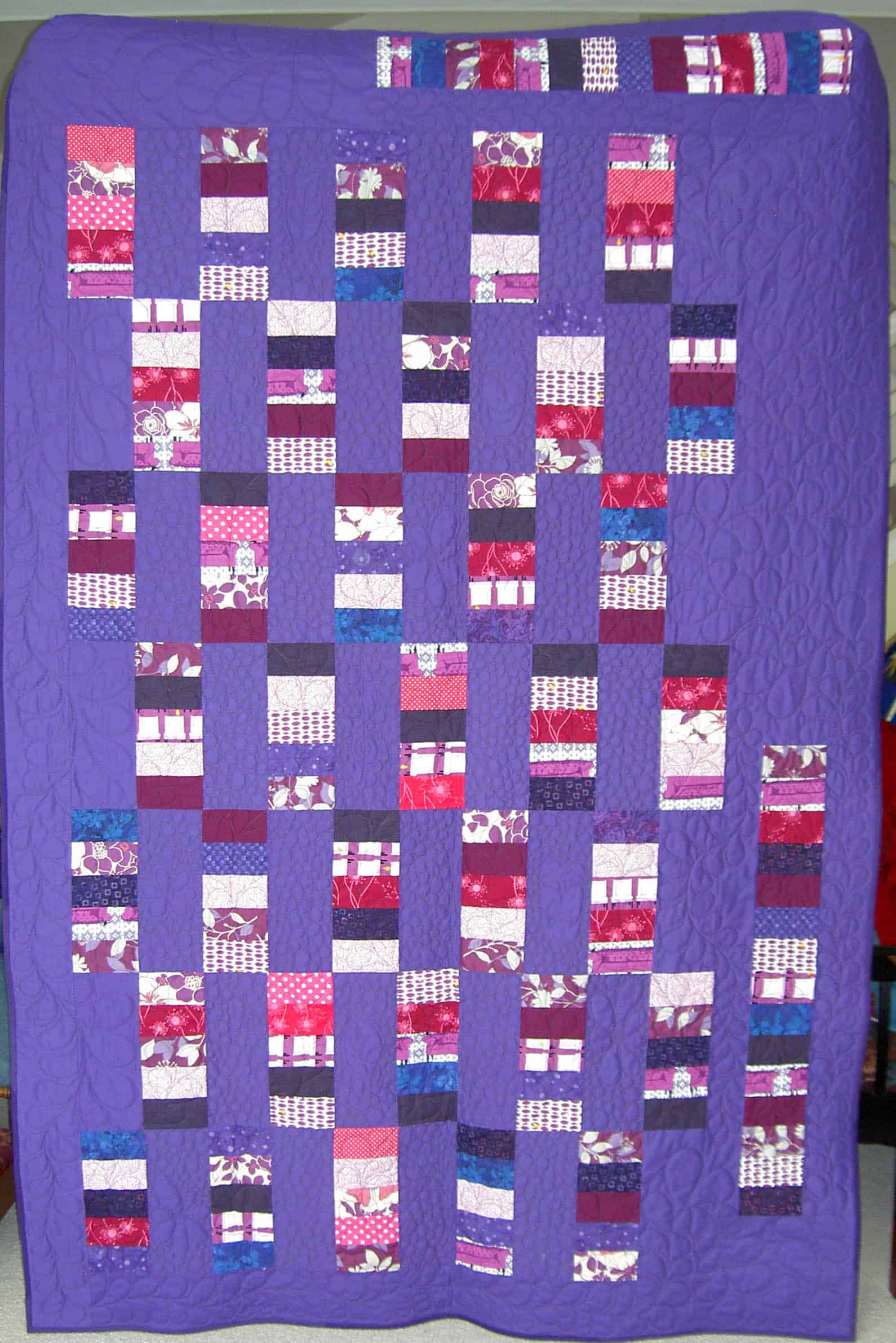
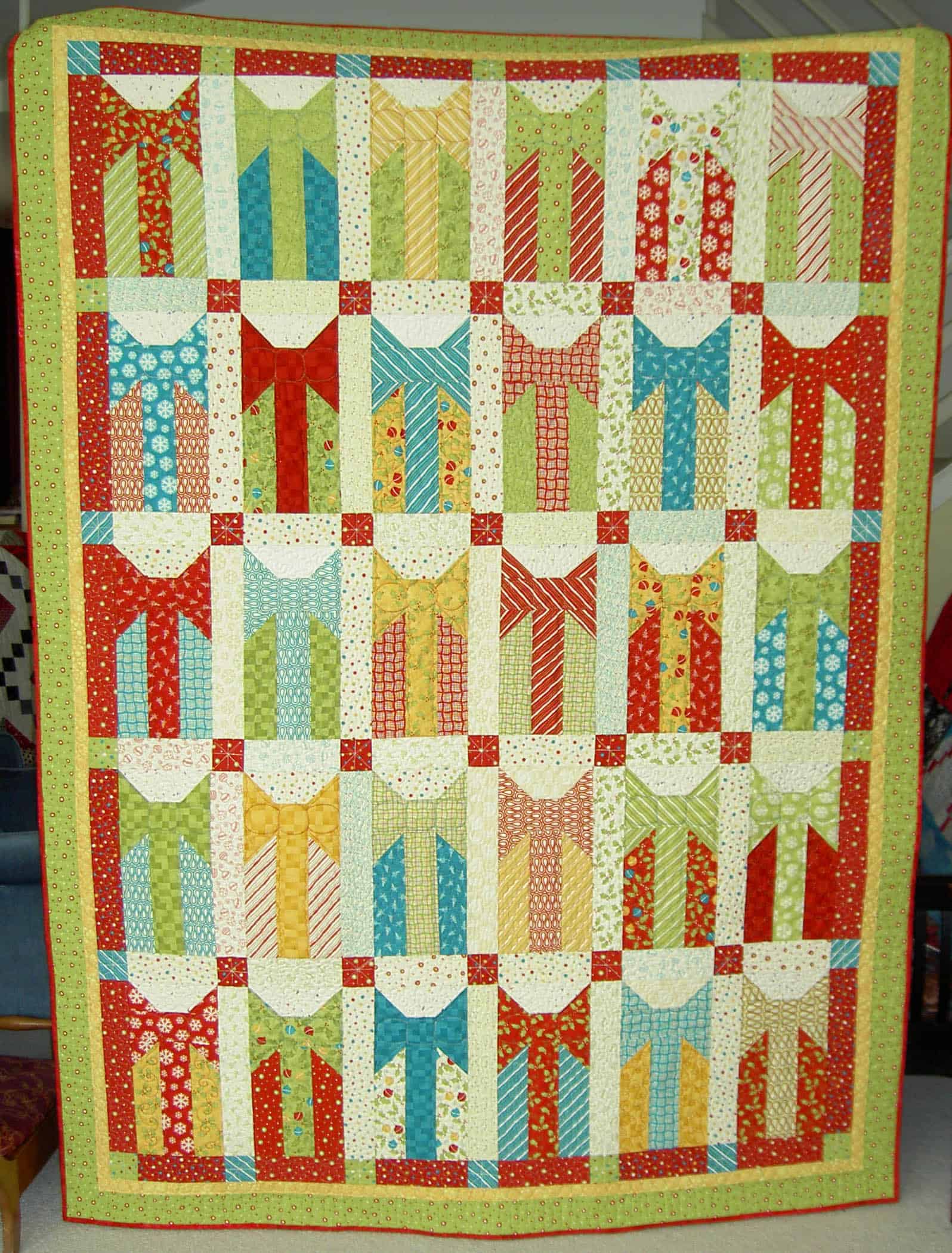
I realize that this is another non-quilt project. Yes, I have quilt projects; I just don’t seem to be working on them. Two quilts, Chocolate Box and Passionate Purple are ready at the quilter and I haven’t gone to get them yet. I also finally called for a longarming date. I could have had March 26, but have to work that day, so FOTY 2009 will be quilted on April 23. Don’t give up! Some quilts are coming.
Yes, boys and girls, I finally finished Beach Town. You can read about starting it in the post about the Pamela Allen class from last year. I liked looking at the piece in that post (one of the things I LOVE about blogging!), because I could see the differences including all of the handwork I have added.
Beach Town Back
I made a smaller version of the Robbi Joy Eklow sleeve (from her book Free Expression) for this piece. I don’t know if it will ever be hung using a rod, but it is ready if someone wants to hang it that way.
One of the things I need to think through when I use this technique in the future is the back and the label. I like to include the label as a part of the back. As you may have noticed, I often piece the back and include the label in that piecing. This allows me (or my quilter) to quilt over the label so that it cannot be removed if the quilt is stolen. Jill, one of the creative prompt participants, talks about this in her recent blog post.
Another reason I piece the back is that I have the fabric, so I might as well use it.
Smaller quilts, and particularly this Pamelala technique are free form and quick. The maker usually lays down the back and batting first with no opportunity to piece the back or make a label. When I take a Pamela Allen class again, perhaps I should just put down the batting and work on the back later?
I am pleased [with myself] to say that 2010 started out with a sewing bang. I finished the bag for my aunt (she never reads this blog as far as I know, so I don’t feel bad about posting it even though I haven’t sent it off yet).
Jeri’s Bag
I started this bag way back in December 2009, but with one thing and another wasn’t able to finish it until Friday. I feel bad, because it was intended to be a Christmas gift. My aunt really loves purple, so I made this bag in purple for her. In terms of fabric selection I had a couple of things I wanted to accomplish and some limitations to deal with. First, I was limited in my fabric choices because of the size of the pieces of fabrics I had available. For a long time I have purchased half yards and FQs. These are fine for quilting, but I am finding that they are barely adequate for bag making. I intend to try the Mini-Multi (AMH’s pattern for the Multi-tasker tote that I resized)This limitation directed me to more plummy colored purples.
Also, I wanted to try a bag where I didn’t use fabrics with a ton of contrast. I think Marilyn’s Multi-tasker was pretty successful. That one wasn’t boring to make. Thus, I wanted to try another interesting combination of fabrics that were also not wacky looking and my aunt wouldn’t feel bad about carrying around.
I am pretty happy with the way this bag turned out. It looks nice and does not look wacky. I made the pockets and straps at the beginning of the process even though AMH says to make the straps at the end of the process, right before I am supposed to attach them. I think my process worked better for me, because once I got past the tedious, fiddly parts, I was able to put the bag together relatively quickly. I like to get all the fiddly parts done, so I can move through the process quickly as I tend to get bored if I have to keep going back to the fiddly bits periodically throughout the process.
Jeri’s Bag – detail 1
I think the combination of fabrics is a good one. The colors work well together and there is some interest in the combination. They are all older fabrics, so an added bonus is that I delved into the fabric closet and used some stuff that has been hanging around. I think Auntie would have preferred less plummy and more purply colors, but the bag is what it is.
Jeri’s Bag – detail 2
AMH does not make her pockets fully lined. Another change that I have made is that I make them fully lined [by cutting a piece of fabric, folding it in half (right sides together), sewing around, turning] before sewing them on to the bag. I think this method makes a nicer finished product and doesn’t take much longer. I want to remember next time to add a label to the pocket. It seems like a good place to include a label.
Jeri’s Bag – detail 3
I am still liking the cell phone pocket, which I learned to make from the Sweet Harmony bag, so I added one to this bag as well.
Cloth Napkins
I have bought some of the fruit and vegetable fabrics, that seem to be popular, recently. I had a joint project with my mom in mind, but decided I liked certain ones too much to give away, thus I made napkins. Perhaps I am making a series after taking a look at the raspberry napkin I made in 2009? The cake fabric and the pots and pans fabric is from my collection of fabric for backs. Those pieces are large, so I can make FQ napkins with no problem and no piecing. In general, I don’t really like making napkins. Turning the pieces and getting the seam crisp are really frustrating and I am generally not successful at it. I tried a couple of different methods this time and am progressing. I do enjoy using the new napkins! I also enjoy looking at the cake fabric. My sister wants a set, but I don’t know if I have it in me to make a SET. Perhaps I can make one a month for her, then give her a set of 12 for Christmas? We’ll see.
In a way I wanted to set a trend for 2010 of major league sewing. In 2010 I want to make major progress in the sewing-quiltmaking-bag making department. I think I did well last year. Still, I want to do better. Not necessarily in terms of numbers of projects completed, but improvement in my processes. Oh, and I would like to see major improvement in my organizational systems. I am not committing to anything on that front, but would like to see it. We’ll see about that.
I love my sister dearly, but she is hard to shop for. She buys what she wants, so I always have to think early and creatively. I found this Basic Grey fabric and just knew I had to use it for a gift for sissy. She is an invertate scrapbooker and LOVES Basic Grey paper. It started the whole thought process, actually.
Sweet Harmony - Full
On my week away, TFQ tempted me with doing a joint Sweet Harmony Bag by Amy Butler. My idea was that we would each make one at the same time. However, it turned out that we worked together on one bag.
This is probably the last time I will make an Amy Butler pattern. I purposefully did not write the review right away, because I wanted to give the shock time to wear off and give the piece a fair hearing.
While the finished product turned out really well, the directions were overly complicated and the pattern promoted extreme wastefulness.
Here are some tips and things to be aware of when making this pattern:
Trace the pattern pieces on tracing paper and keep the originals all together on the pattern sheets.
Trace the pattern pieces again, but smaller (approximately 3/4″ will work) for the fusible fleece and interfacing pieces. If you don’t do this, the pattern will tell you to cut them full size and then trim them down. Thus, this direction promoted a lot of waste in the interfacing, Peltex and fusible fleece.
Make a separate pattern piece for the inside pocket as well. This is a combined piece and it is just too confusing not to have a separate pattern piece.
Make a chart (Excel or the Google Docs Spreadsheet feature would work) of the pattern pattern pieces you will need and which fibers you need to cut them out of. I didn’t know to do this and ended up laying all the cut pieces out and reading the list over and over while counting pieces.
The designers seem to have a problem with naming pattern pieces consistently. In Step 4G, they ask you to do something to a Lining Panel. This was the first time I had ever heard of this piece.
This pattern and the directions don’t always make it clear which layer (fleece & interfacing or interfacing only) the designer wants you to work with.
Sweet Harmony Org System
Directions should have included a rotary kit (cutter, mat, ruler). The instructions do not include these tools, but they make the process much easier. I understand that the pattern isn’t necessarily targeted at quiltmakers, however I think many sewists now have rotary cutting kits as part of their tool arsenal. If you only sew garments and accessories (e.g. no quilts) and do not have a rotary cutting kit, I think you should go and buy one. What do you think?
Use tailor tacks to mark dots.
Handbag pattern includes a 20″ zipper in the list of supplies needed. Then the designer wants you to modify this zipper to make it about 8″ shorter. I don’t know about you, but I don’t know how to modify a zipper. I also did not want to modify a zipper. I barely know how to put in a zipper. TFQ who has LOTS of garment sewing experience and she didn’t know how to modify a zipper with confidence either. This is another bit of waste. I ended up omitting the zipper (it’s for a an inside pocket), but I would recommend buying a 12″ zipper and not modifying anything. The pattern also gives the pattern pieces for a tote bag, which I did not make, and I believe that the 20″ zipper would work with the tote bag. I think they were trying to save space on the pattern by not listing two supplies.
The marks for the magnetic snaps are below and to the left of where they actually should go.
Sewing piping to outside pocket
The pattern asks you to make much more piping than you actually need. You will really only need about 25″.
Finally, there are not enough pictures, despite the price of the pattern, so I would recommend giving yourself plenty of time and using nice fabric. You may never make it again, so you want to like it!
I think that making all the tote bags I have made really helped in understanding the pattern and how to follow the directions. The final product is really nice and looks very professional. I als learned how to make a pocket that has a little tuck so larger things will fit and you can actually pull it out.
Babies and wedding some in waves and I am in a baby wave right now. I am not having my own baby, just to be very clear. Friends are in baby producing mode, however. I have made a few quilts for friends, but am, frankly, too lazy for the most part.
I do make receiving blankets quite frequently. They are much more useful than quilts and people seem less reluctant to use them or save them for a special day. I thought I had written about them before, but I guess not. I searched and only saw mentions
Lily Blankets
Mostly I made receiving blankets, which can be used for all sorts of useful baby things such as:
Superman (or girl) cape
sunshade
nursing cover
layer for warmth
tent
playmat
wings
changing pad
burp cover
etc
Ayden Blankets
I fold over a double hem and stitch with fun thread and a decorative stitch. Often I will leave the selvedge on so as not to have to hem yet another side. The decorative stitch takes awhile, so it is better for me to do as little hemming as possible. If these were going to another sewist or quiltmaker, I might rethink that strategy, but mostly they go to people who are not crafty.
Baby Gift Bags
Finally, I don’t usually give gift bags to people who don’t give them back or re-use them. This time, I really didn’t feel like dealing with any paper or tape or anything. I sincerely dislike wrapping gifts with paper, so I pulled some fabric off the ‘back art’ shelf and made two bags. I don’t really like the background color of the fabric. Don’t ask me why I bought it – the cherries, probably. I like the bags, though and perhaps it will encourage more people to make fabric gift bags they can re-use.
This is the Chubby Charmer. Two of my friends, Maureen and Terri both had bags made from this pattern and I admired their shape and size. On my week away, I made one.
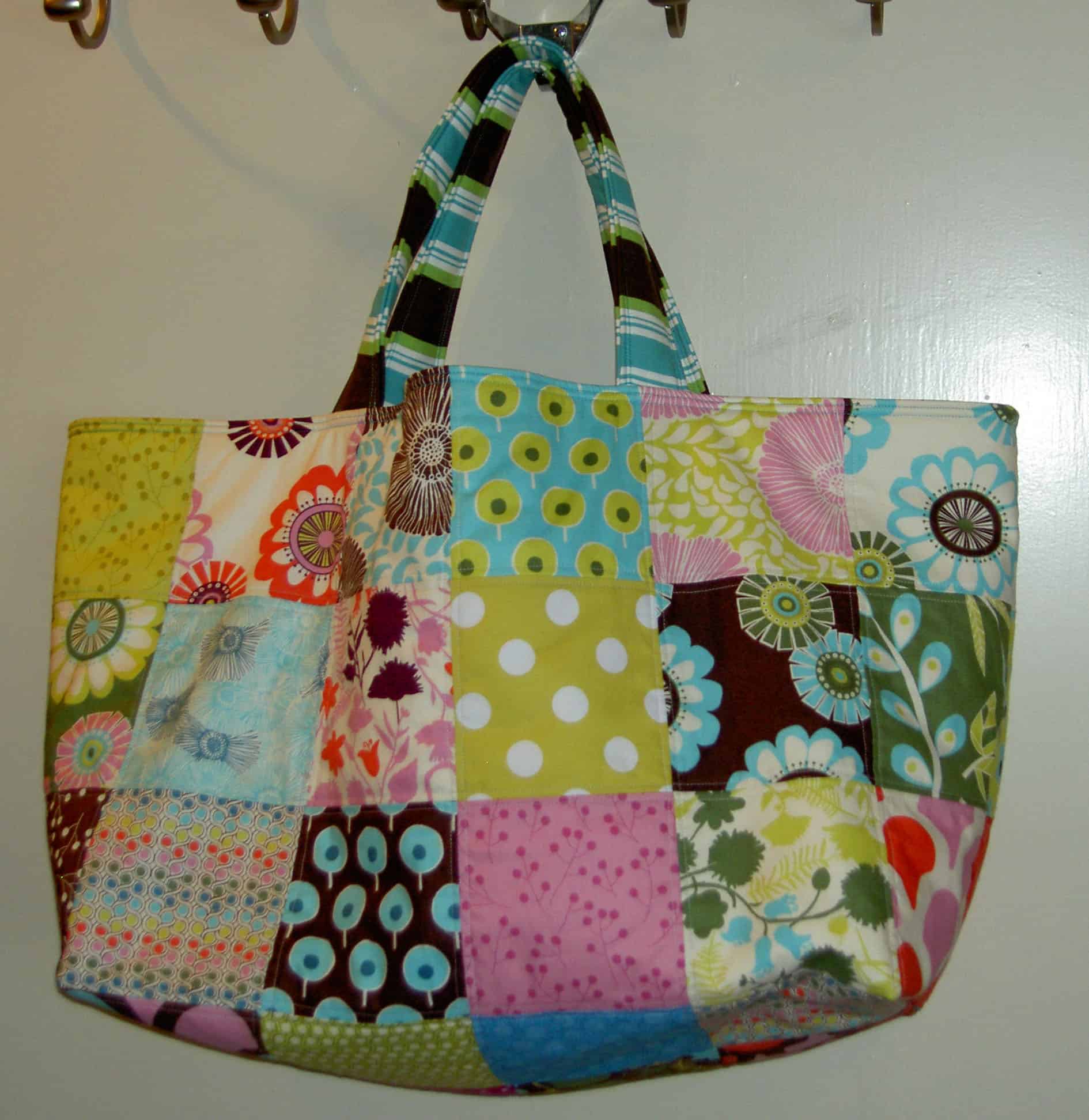
This is a BIG bag. I could fit my 3YO nephew in this bag! I didn’t realize the size in relation to my size until it was finished. I like it and will probably use it to carry stuff up and down the stairs in the house, or perhaps out to the car. I can imagine it would be useful for carrying packages out to the car to take to the post office.
I don’t think it will be great for carrying around on a general basis, because it might get really dirty and I am not sure about the washability. I also think that I could easily fill it up with 30 pounds of stuff. I’ll have to make an effort not to fill it with 30 pounds of stuff.
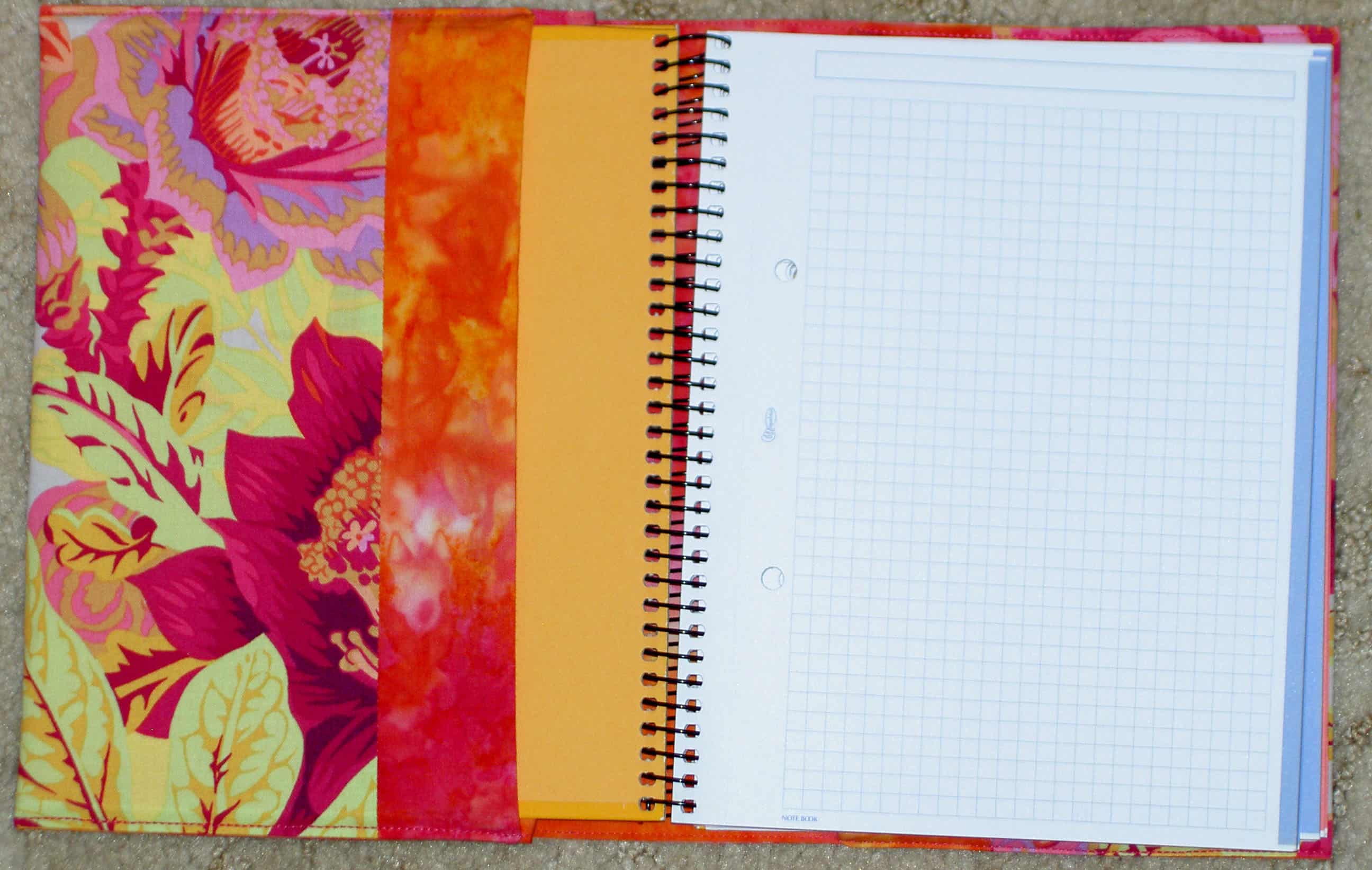
I used a Moda pack of charm squares from approximately 2007 called Recipe for Friendship by Mary Engelbreit to make the outside of the bag. There weren’t quite enough so TFQ threw in a few from the more recent Snippets collection. We agonized a bit, but not too much and then I began sewing them together.
Side oneSide two
One of the things I liked about this pattern is that it is specifically designed for the Moda Charm Packs. I don’t know if other companies make 5″ charm packs. I assume some do. It is very easy to cut your own 5″ squares out of your favorite fabrics. If I were going to use my own fabrics, I think I would collect 5″ squares as I cut fabrics for other projects.
I was putting away some other charm packs I have (Figgy Pudding and Pumpkins Gone Wild), I was thinking about what else I could make from these charm packs. I don’t need to have a specific charm pack pattern; I could just sew the squares together and then cut a pattern out of that new fabric.
I also used the red and white dotted fabric (by Susie Osborne, Emmalyne’s Day of the Week line) for the handles and TFQ gave me the red fabric (Mary Lou Weideman for In the Beginning Fabrics) for the inside.
I bought a pack of fusible fleece at the same time I bought the pattern at PIQF. I found, though, that that pack didn’t have enough of the fusible fleece and I had to get more. Both the inside walls and outside walls take two layers of fusible fleece. I didn’t find that it stuck together very well afer pressing. As a result I think I would just use my leftover batting if I made this pattern again.
The pattern designer has a really cool trick for making the box bottom. The maker traces a square template (provided in pattern) on to each bottom corner. After some sewing gymnastics, which are well explained in the pattern, you end up with a line to sew across that makes the box bottom. Very easy and no box bottom guessing. TFQ came across a similar trick in the Jane Market tote by Posie Gets Cosy. We tried to find the ratios of squares to front panels so we could try it ourselves on our own designs, but haven’t yet been successful.
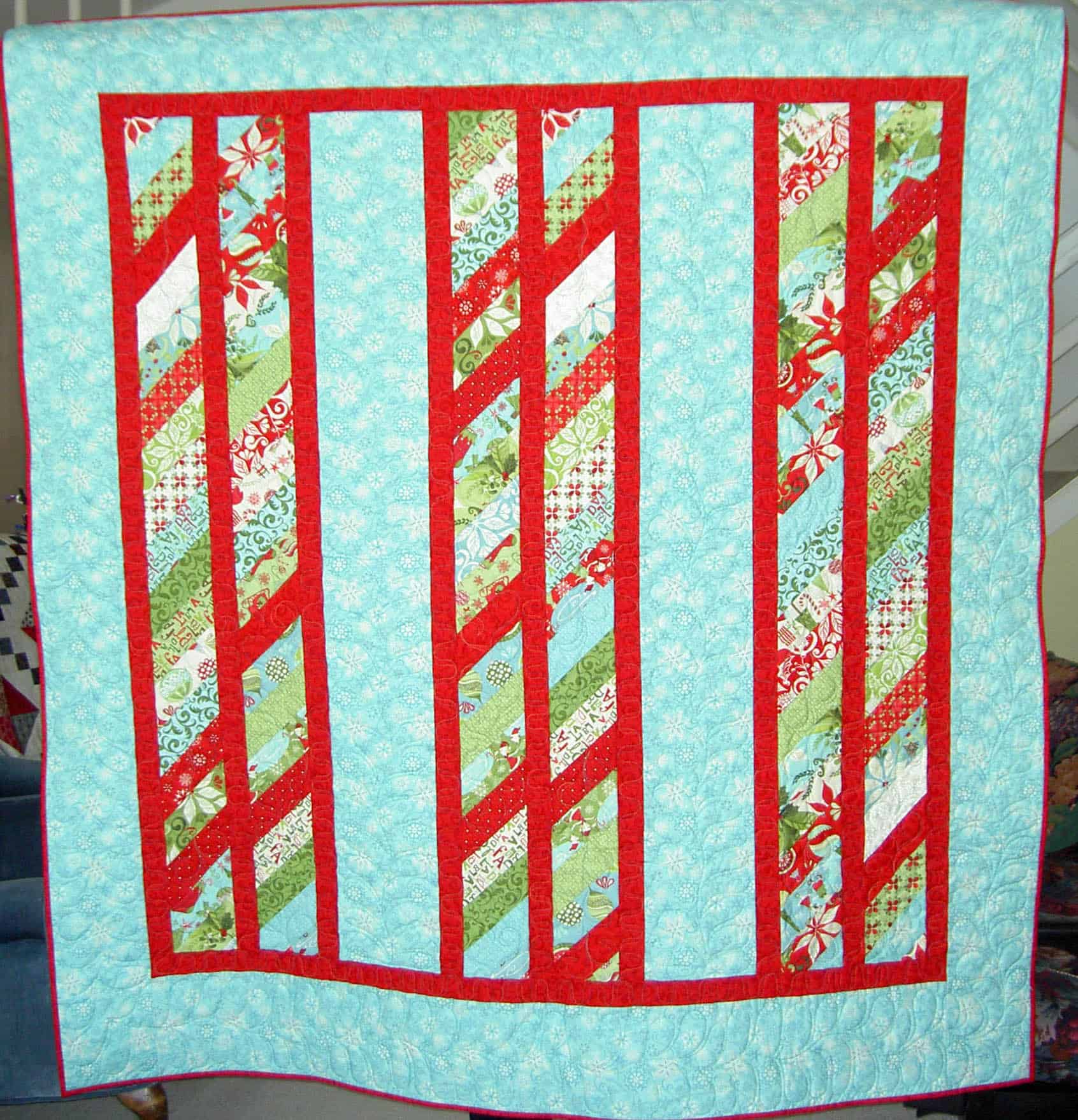
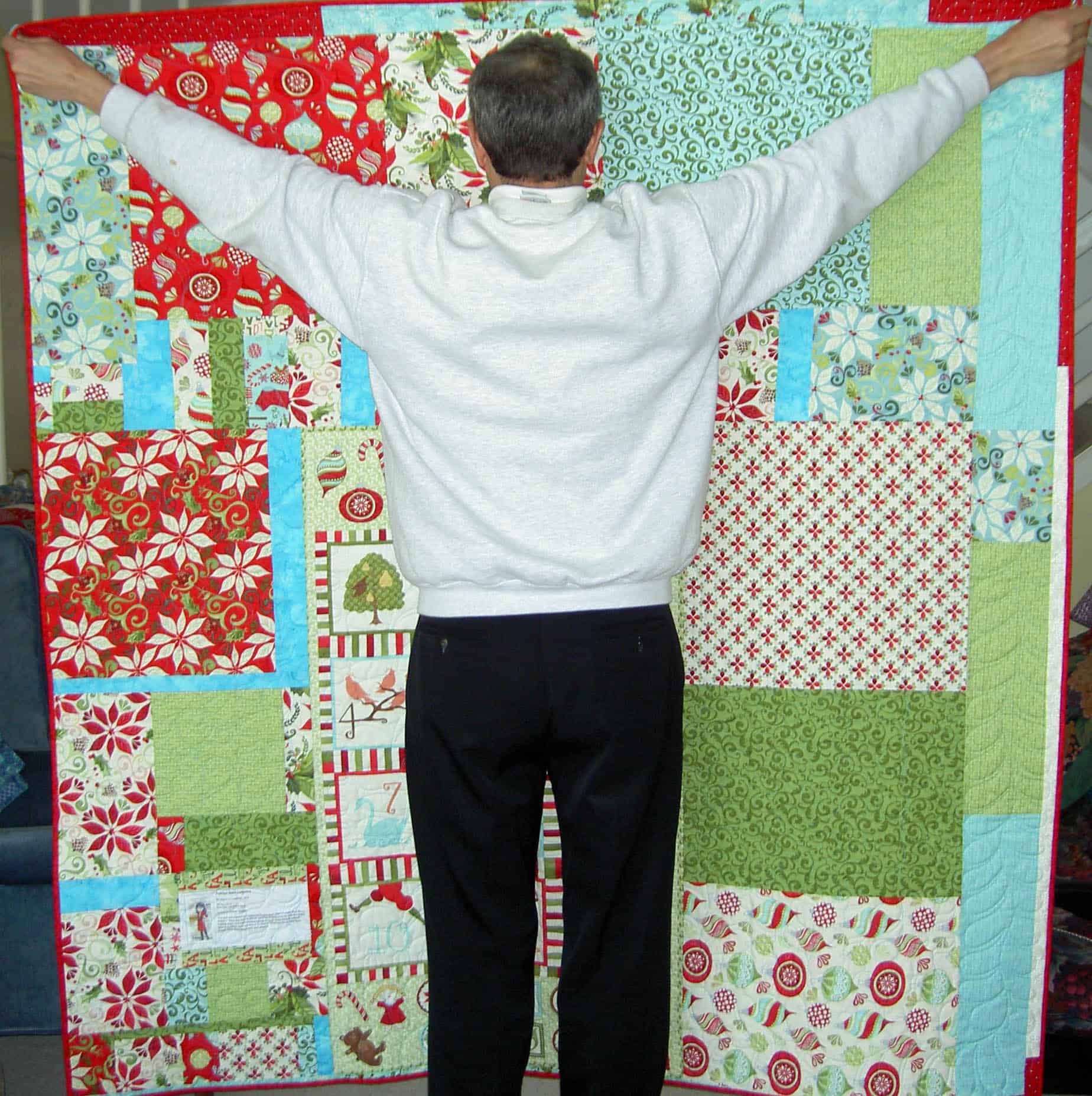
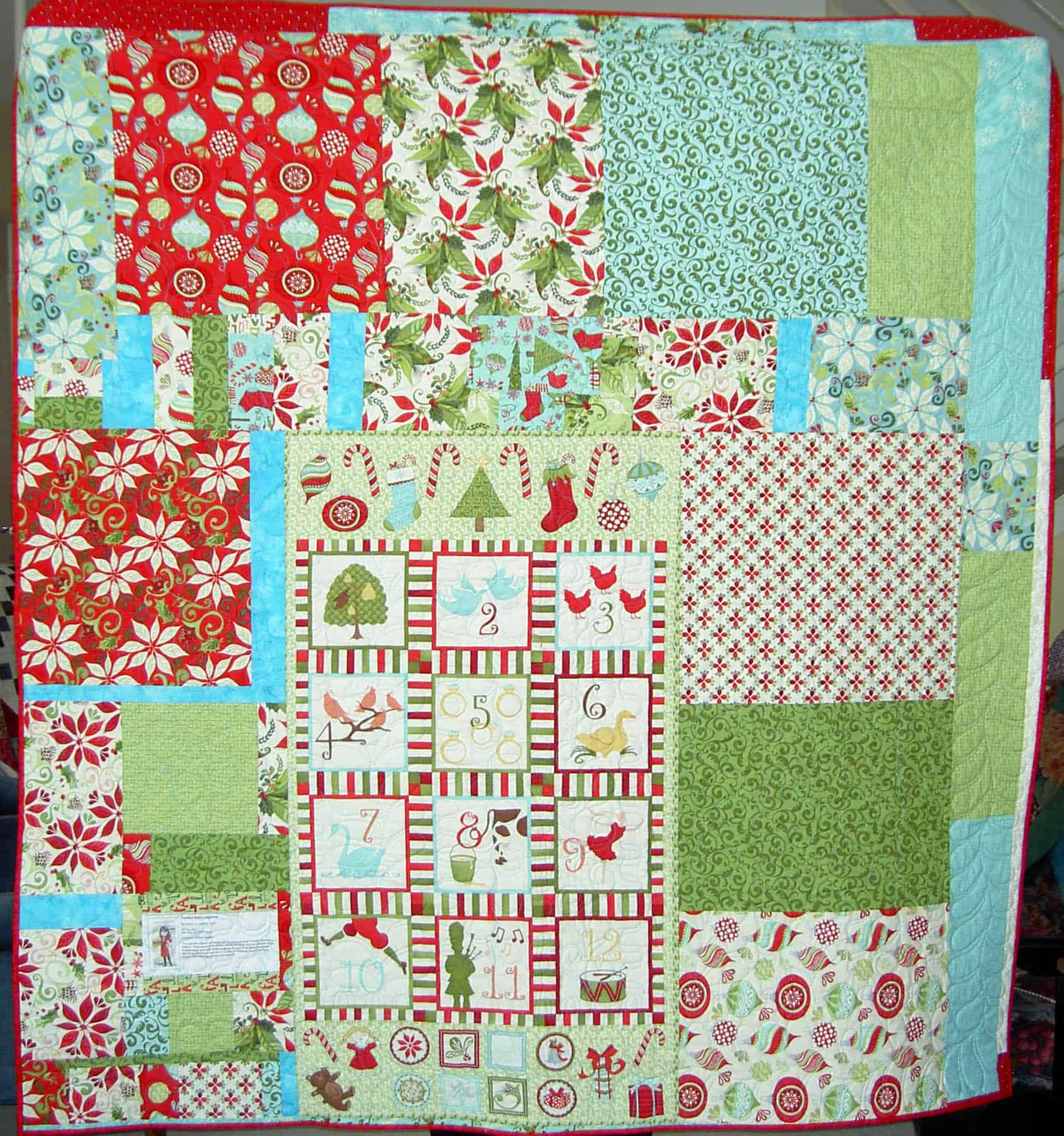
Yes, this baby is complete. I can chalk another finished project up on the list. I quilted it a long time ago and only had to do the facing and the sleeve. I really don’t know why I waited until the last minute. I did and ended up with some unsewing that needed to be done. When I sewed the facing on, I kept sewing through all three layers quilt. Duh! I don’t know what that was about. I ended up clipping the threads from the front and sewing the back, very carefully the second time, shut again. It was sent off with the Nosegay on Wednesday and should have arrived today. We’ll see.
I know I showed this earlier this week, but I wanted it to have its own celebratory post.
House & Garden Finished!!!
This quilt was started in Pamela Allen’s class at EBHQ in May 2007. Two years, almost to the day later. Hopefully, the ones I started last month at CQFA won’t take that long
The binding is on. The piecing is finished. The sleeve has been handstitched on to the back. It is a large quilt, so I will have to post it again after I get a professional photo taken.
I finished sewing the sleeve on to the back while watching The Queen last Saturday night while the boys were gone. I had to watch some of the bonus features (sadly, no deleted scenes) in order to get the last bit done.
So many “hands” have touched this work. By that I mean I have received so much help with this project: TFQ, quiltmakers from CQFA, Doreen Speckman, the teacher of the class in which I started the project, Colleen.
I am thrilled to have a finished project – a quilt project.
I had resolved to look at all of the Pineapple blocks yesterday in order to see how many I need to remake in order make progress on the Pineapples. It has been kind of a Pineapple disaster couple of weeks and I wanted to get back to it.
But, I didn’t.
Instead I worked on the easy project and finished a bag and made another whole bag. Yes, start to finish. I am going to use it today.
This is the bag that I had been working on. It is kind of part of a small series of bags made from fabric that I bought from Fabric.com. I was going to keep this one for myself, thus the dots, but I don’t think I will. I like it and find it to be well made, but the colors aren’t me. I need a another bag for a gift and will probably use this one as the gift. I also decided that I don’t really like the paisley fabric that much. I was happy with the way I centered that one paisley on the pocket.
The white dots had been languishing in my sewing room for awhile and I wanted to get them into a bag. I, originally, wanted to make an entire bag out of them, but didn’t have enough of the dot fabric. One of the fabrics I bought on Saturday was destined for the inside of this bag. I also used the webbing straps I bought at Britex for this bag. They made the sewing go REALLY fast. However, I melted one part of a strap and got goo all over my iron, so I may not use them again. I also don’t like the limited color selection. Anyone know of a good source for these straps? How about nice colors and NOT made from plastic?
This is the inside of the bag. Isn’t it fun!?! It is a very sedate bag until you open it and then it gives you a little punch. I love this fabric, because it makes me feel cheerful when I look at it. I was shocked to find that it is a Judy Rothermel Aunt Grace fabric!
I cut out the pieces for another bag and will use this cheerful flower fabric for the outside of a bag as well. Yes, I am going bag crazy.
Below is the last iteration of the corner I was working on. It was amazing that when I woke up and looked at it on Sunday morning I REALLY liked the piece. I was lukewarm (and somewhat worried) about it on Saturday, but kept working through it and feel like the work paid off.
I realize that the changes are subtle and those of you in blogland will have to study them to see the differences, but here IRL, there were differences that mattered.
The piece is a monster, so, without help, this is the best photo I could take. I’ll get a better one up.
Some time has gone by since I last wrote and I hope my faithful readers have not given up on this blog. Since I last wrote, I haven’t been doing much of anything creative. However, the top for the Nosegay is finished! St. JCN’s visit was the first weekend in May and extremely productive in a lot of ways. Although we did not get to do everything we wanted (we never do!), we did get to do a number of fun things on the list, one of which was finishing the Nosegay.
The Nosegay was started in a class with Doreen Speckman at Black Cat Quilts. It was the last class she taught at Black Cat before she died. This class was held in about 1997 or 1998. I worked on it on and off, but fairly steadily until I came to the border. The quilt is huge and, thus, unwieldy to work on alone. St. JCN has helped me on and off but other quilts took precendence since the 90s and the Nosegay was relegated to the closet. At some point a few years ago, in an attempt to move the project along, we made border blocks. St. JCN is very good at helping me work through problems. She is also generous with her time and excellent at keeping me on track. We (I?) decided that the time had come to deal with Nosegay. First we looked over all the notes I had from the past efforts (I keep a file on each quilt and stuff everything related to it in the file). One note had been on my bulletin board so long that the ink had faded to a point where we could no longer read it! We also measured the border blocks and the quilt itself. We discussed how to get the border blocks to fit and tried a couple of different options.
I did like the black, in theory, as it echoed the cone in each of the Nosegay blocks, but it really looked like a big blob of black in each corner. The other colors are very pastel-y, thus we thought it was important to watch how the black fit in. I also liked the idea of a different shape in each corner to take the viewers mind off of the fact that the border blocks didn’t fit perfectly.
The yellow looked nice in the corner and was pastel so it worked with the other colors. It also fit with my concept of the different shape to draw attention away from the spacing issue, but again we had the big blob problem. A big blob of fabric in the corner drew too much attention to the area we wanted to mask.
Finally, we selected the above arrangement of border blocks as the best option. Even though the spacing isn’t even when you get to the corners, the blocks being similar draws less attention to the problem area.
Lorraine Torrence is one of my favorite teachers. She is organized, not sentimental, friendly in a professional way and provides useful information. One of her precepts, which has proven very useful to me, is “make visual decisions visually.” This means that a quiltmaker needs to make design decisions by looking at how the design will look IRL before starting to sew and cut. I did this with the black and yellow options above. In the case of the black, I actually sewed a few blocks and we tried them out. In the case of the yellow, St. JCN and I folded the fabric in some semblance of how the block would look. This is a much better method than just thinking it would look good. If I hadn’t looked at the design visually, I would have probably gone with the black and ended up with blocks that drew attentio to an area, I really didn’t want anyone to notice.