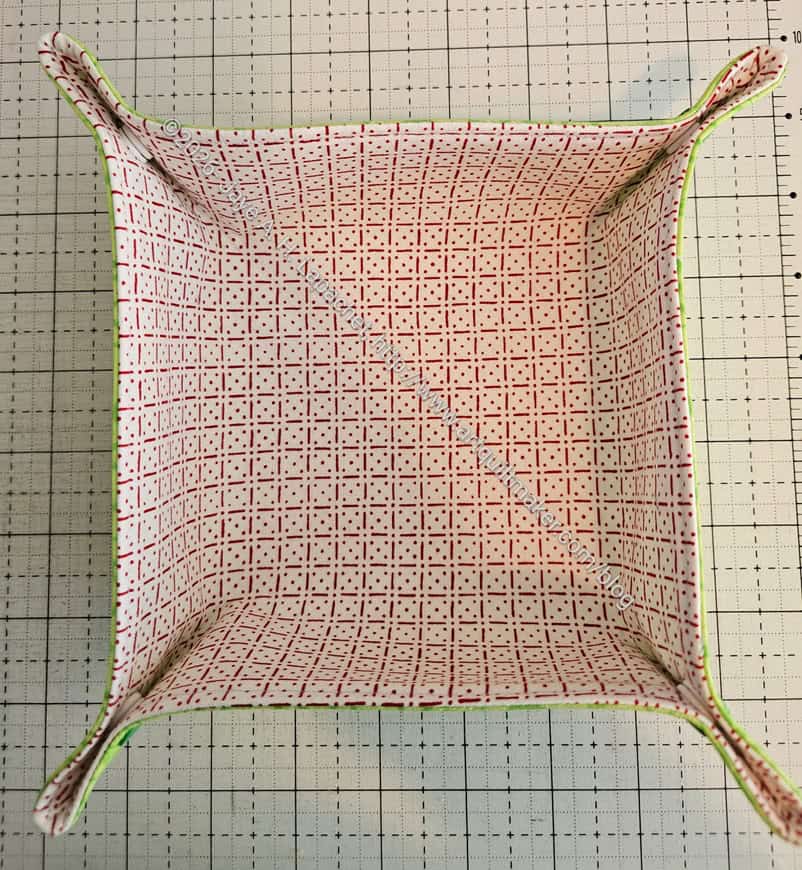
Tutorial: Snap Tray

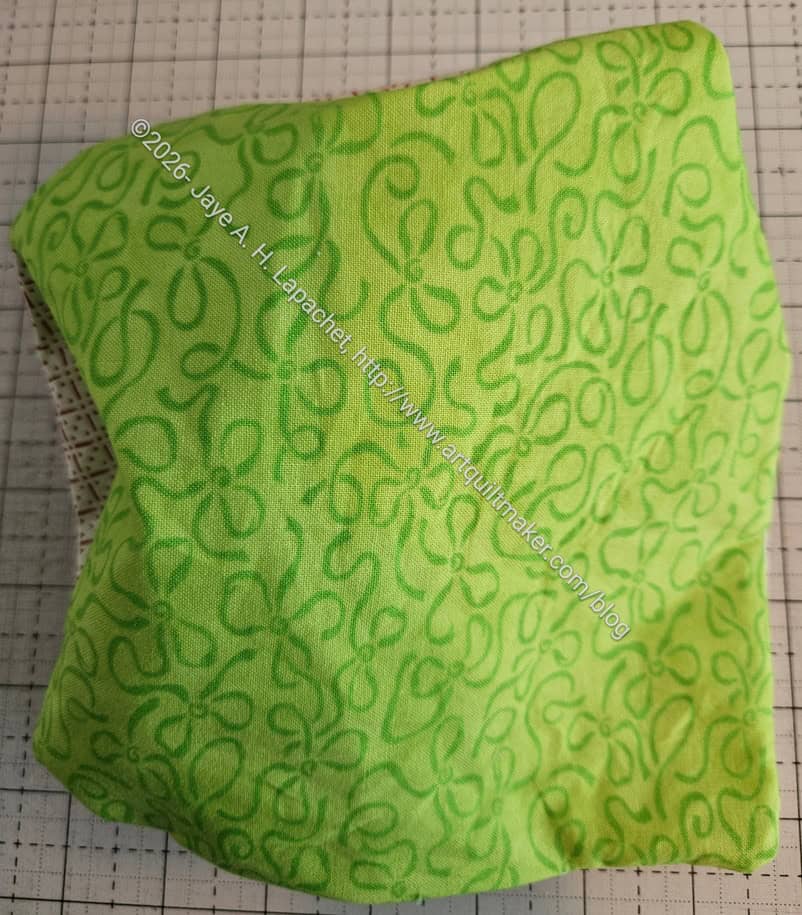
Snap Tray finished - interior
Snap Tray finished – interior

After Sew Day, I decided to make one of the trays that Lynette showed in her Heavy Metals demo. I am thinking about making them for people attending the Flash Retreat in April.

The project also inspired me to get out my KamSnaps tool.

This is not a project that I invented. I know there are probably many tutorials out there. You can do searches to find others. This tutorial shows the way I made mine.

Supplies
      • Sewing machine
      • BSK
      • 2 Squares of fabric the same size. 
      • DecorBond (Pellon 809) OR
        • ShapeFlex / SF 101 or ProFuse
      • Thread
      • Turning/poking tool
      • Sewline pencil
      • Ruler(s)
        • Creative Grids 4.5 x 8.5 inch
        • Creative Grids 9.5 inch square
      • Leather hole punch** or awl**
      • KamSnaps tool and snaps or SnapSetter or Rivet Press with appropriate snaps.

Optional Tools and Supplies:

These are easy enough to make several at a time. I used a Layer Cake that I had washed and divided into pairs, but hadn’t yet used.  I have no idea what I was going to do with the squares.

Any squares will work. Use a larger square for your first one. I would not use a smaller square than a 5 inch square, but try it out. I think you could also use rectangles.

Since I don’t use DecorBond much I used that for my first tray. It made the first tray really stiff, which has its advantages. I found it hard to turn. For my second one, I used ShapeFlex. The tray was a little more floopy, but still usable.  ProFuse would also work. The takeaway is that many different kinds of interfacing will work. Try what you have at home and see what you think. There is always more fabric, right? 🙂


Directions

Gather supplies and materials.

      • You can use whatever color thread you like. Use a matching thread to make your stitches disappear when you topstitch. 
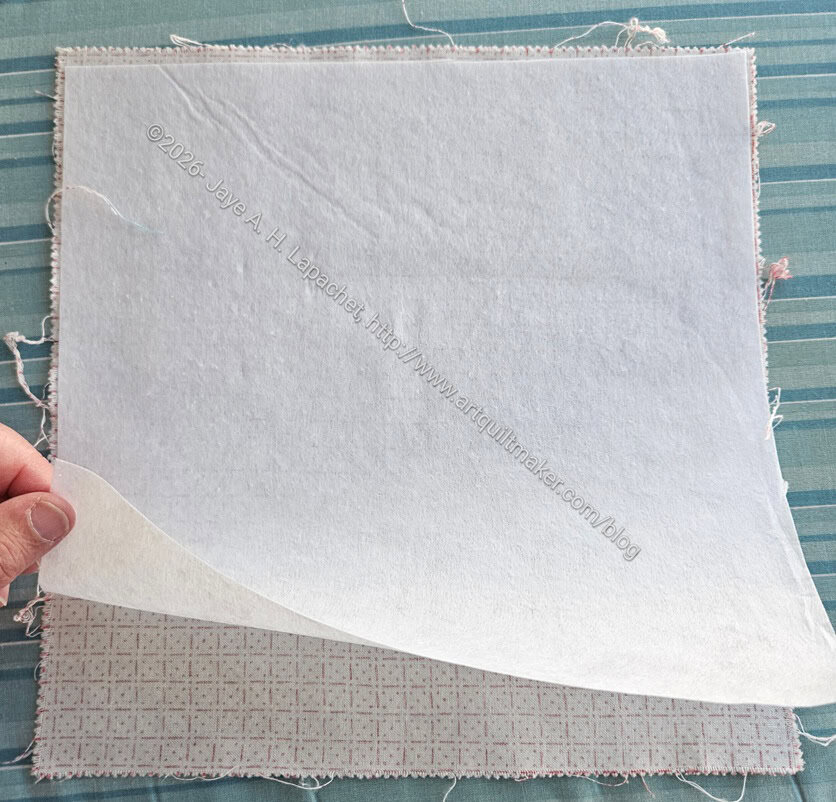
Cut interfacing smaller than your square

Cut interfacing 1/2 inch smaller than your squares to lessen bulk in the seams.

Note: in the photo above, I cut my interfacing 1/2 inch smaller, but it turned out that my layer cake squares had shrunk when I washed them and were more like 9.5 inches instead of 10, thus the interfacing is not as small as I normally like. I like to keep it out of the seam allowance if I can just to lessen the bulk.

Apply interfacing of choice to the squares according to the manufacturer’s directions. Since I don’t use DecorBond much I used that for my first tray. It made the first tray really stiff. It will still be usable. For my second one, I used ShapeFlex. Since I was making 14 or so of these, I took the opportunity to try some Featherweight Fusible (Pellon 811FF) I had on hand to see how that would work and how it would feel. 

Place squares RST
Place squares RST

Place the interfaced squares right sides together. 

Trim so the edges are square and all the threads are removed.
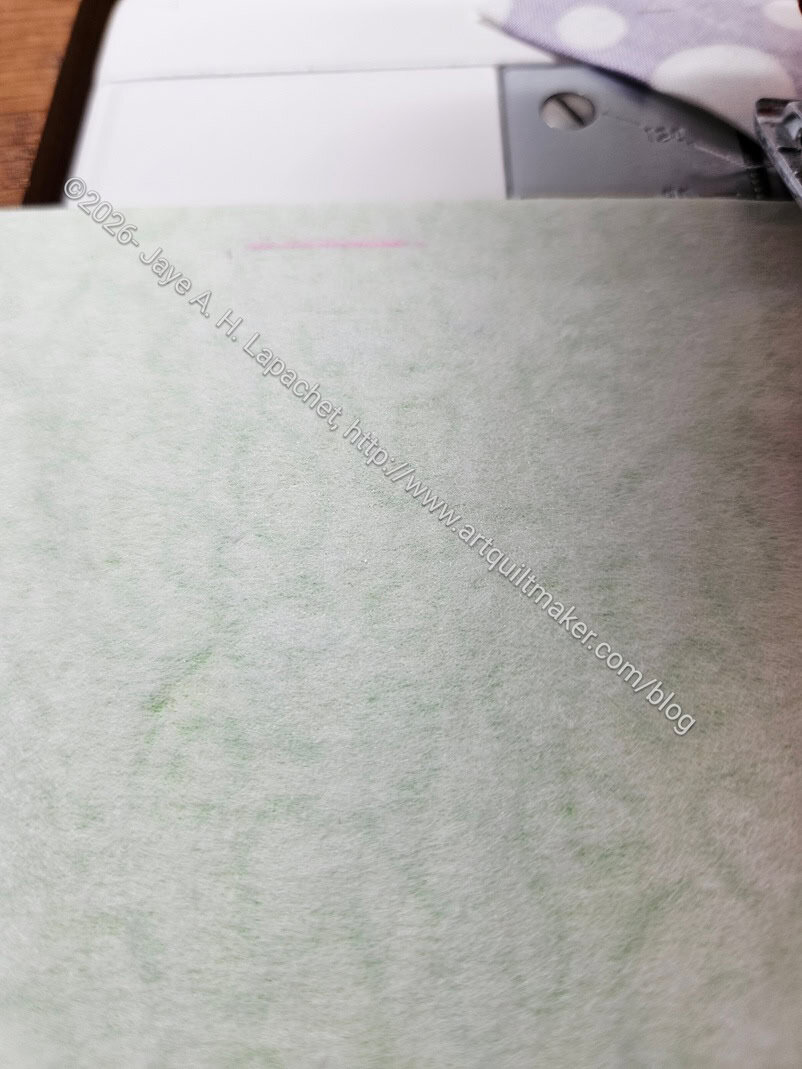
Draw a line to note 1/4 inch

Draw a line 1/4 inch away from the edge of the fabric where you plan to have your opening for turning.
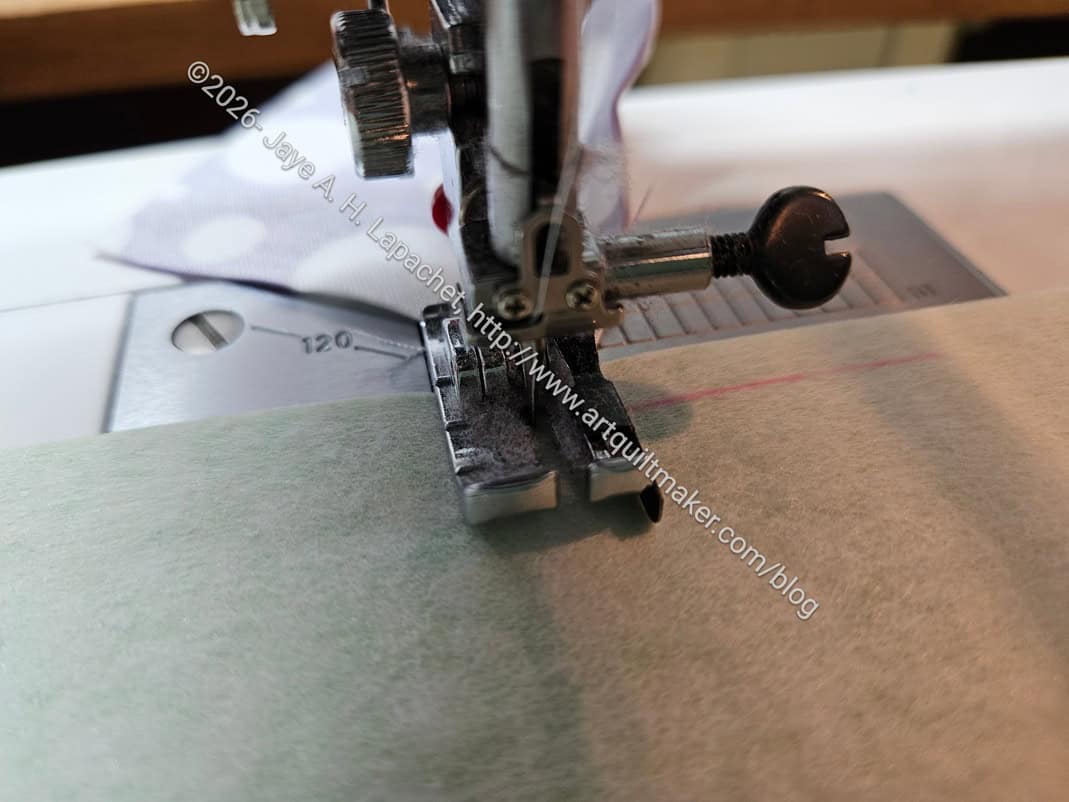
Use the line you drew or your foot to note 1/4 inch

Start sewing perpendicular to the edge of your fabric for about 3 stitches or 1/4 inch.

Stop with the needle down.

Turn the fabric so you are sewing parallel to the edge of the fabric. Remember that you are going to leave an opening.

Sew around the edge using a 1/4 inch seam allowance, leaving a 4-6 inch opening

Sew a 90 degree angle to edge

Tips for Success:

      • At the beginning and the edge of the opening, sew up to the 1/4 inch line from the edge of the fabric to stabilize the opening for turning
      • About 3 stitches before each corner, backstitch, go forward again and then turn the corner. After you turn the corner, backstitch again. this will reinforce the corner and make it less likely that you poke through the fabric or stitches when poking out the corners.

Leave a 4-6 inch or so opening for turning
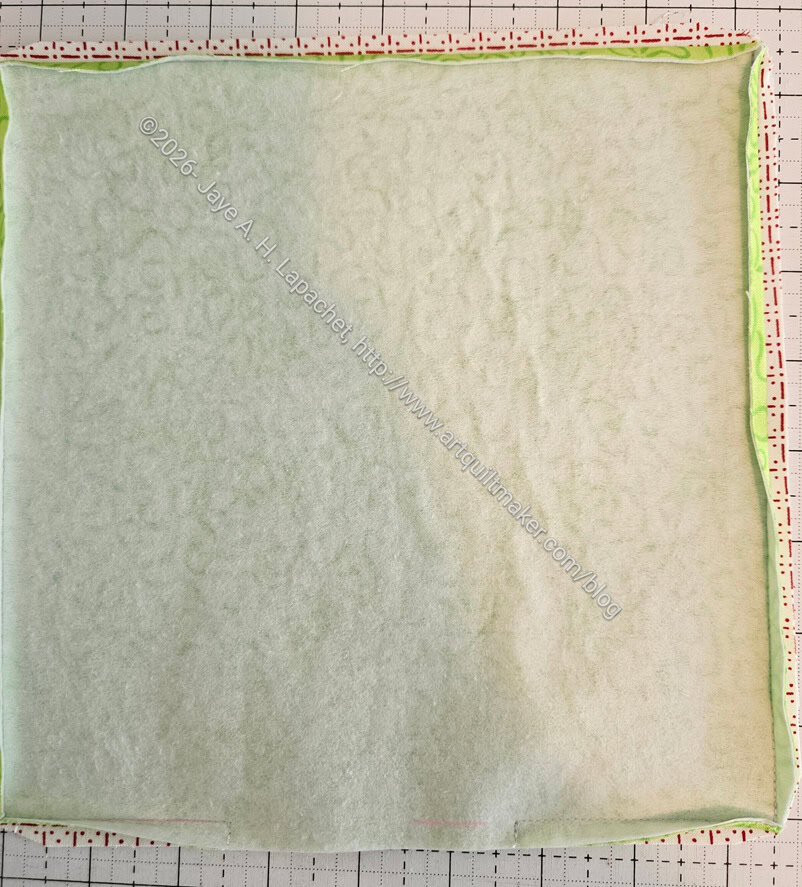
Press the seams open

Press seams open

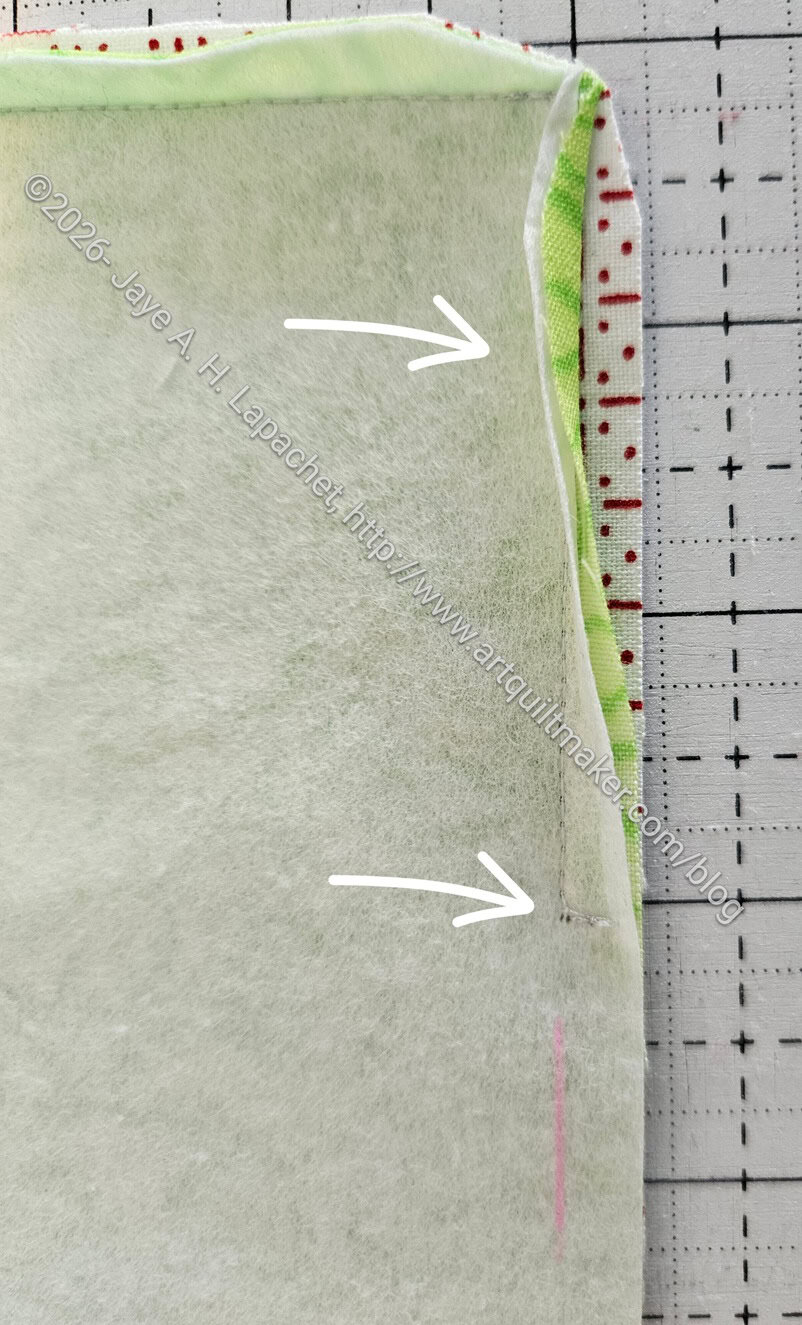
Pressing won't be completely smooth
Pressing won’t be completely smooth
      • You won’t be able to press the seam on the side with the opening all the way flat, but do the best you can (enlarge the photo above to see more detail)
Turn the piece
Turn the piece

Turn the piece right sides out. Poke out the corners carefully. I use my Modern American Vintage Point Turner/Hera Marker. If you backstitched at each corner, it will help keep your tool from poking through.
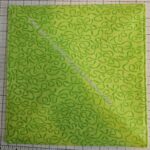
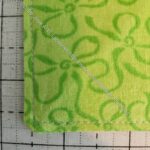
Topstitch using 1/8 inch seam allowance

      • sew over the starting point and backstitch.

Fold tray in half on the diagonal in both directions.

Make holes
Make holes

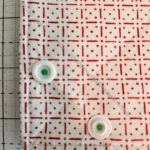
Make holes for Kam Snaps using your awl or leather punch.
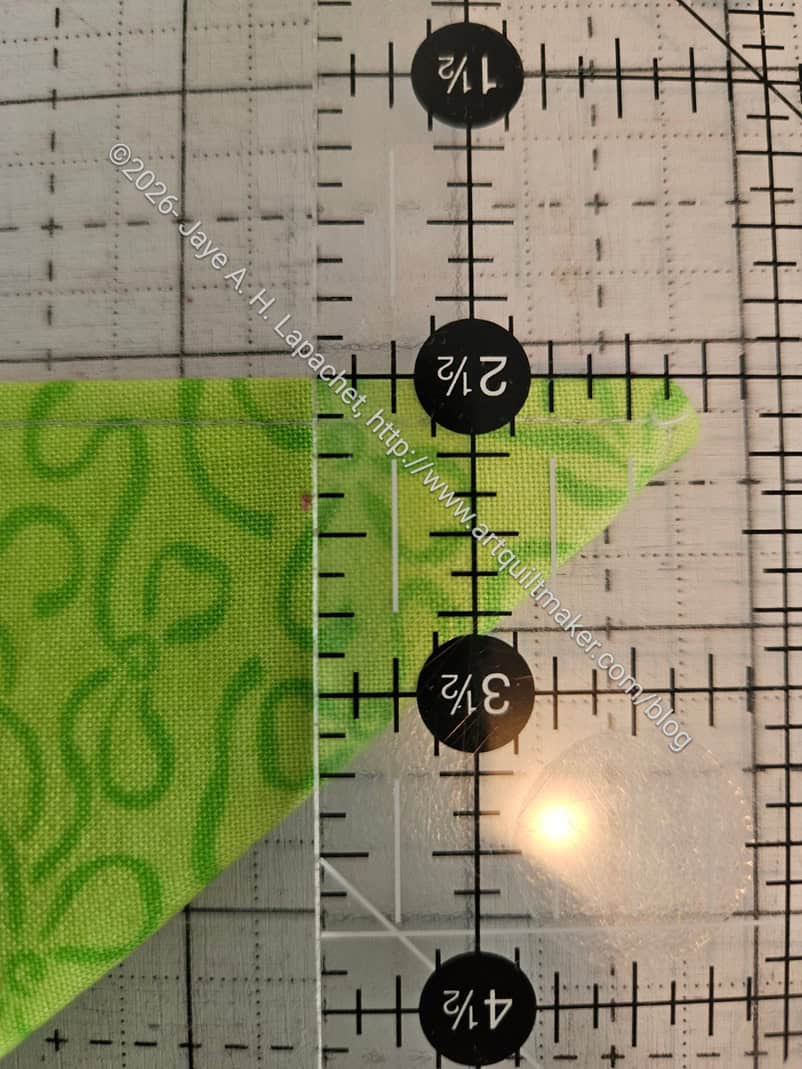
Measure and make a dot
      • Measure 1.25 inches from the very tip of the folded square in towards the center
        • My friend, Lynette, uses a 1.5 inch measurement, so try both (on different trays) and see what happens.
      • Keeping the ruler in place, measure 3/8 inch down from the edge of the tray
        • My friend, Lynette, uses a .5 inch measurement. Again, try both measurements, on different trays, and see what works for you.
      • Using your Sewline pencil, make a dot.
      • Do this on all sides near each corner.

Follow the directions on your tool of choice (KamSnaps, SnapSetter or Rivet Press). You will need 4 caps, one Innie and one Outie for each corner.


This is a good project for your Quiltmaking Go Bag. You can store it flat and then use it at the side of your sewing machine while you are in class or on retreat for small tools and supplies, like snips and a seam ripper, or for trimmed threads. It helps with a little organization in unfamiliar spaces.


**Obviously, you should shop at local quilt shops and small businesses. However, if you are too busy or can’t find what you need there, I use Amazon affiliate links and may be paid for your purchase of an item when you click on an item’s link in my post. There is no additional cost to you for clicking or purchasing items I recommend. I appreciate your clicks and purchases as it helps support this website.
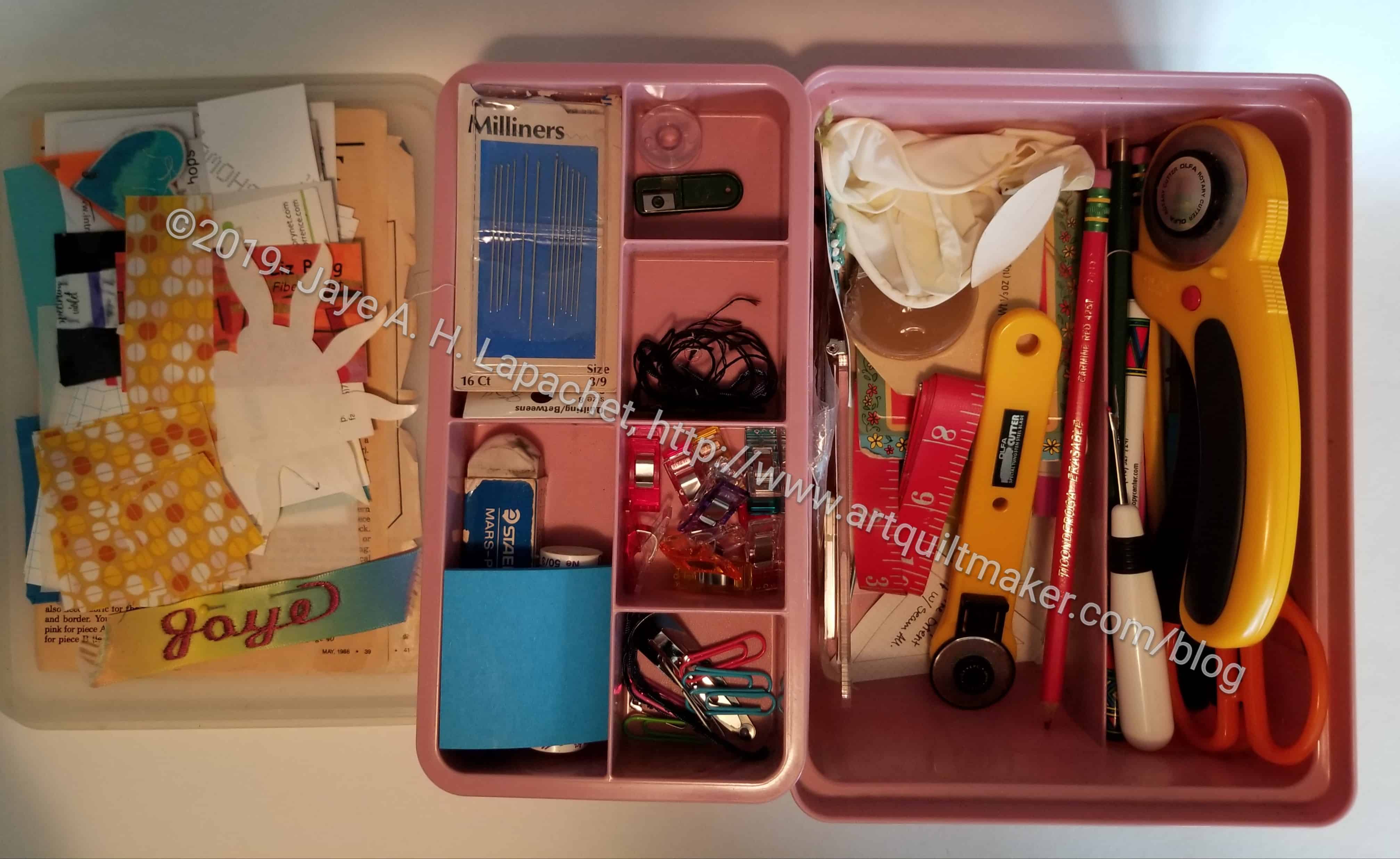
What is a BSK?

Small Go bag supplies

I often refer to BSK in my tutorials and when I teach. When I teach I can show a BSK, but that doesn’t really work in tutorials.

BSK is basic sewing kit. I know I have referred to what it is in passing. It is also in the glossary, but I thought I would write about my BSK and give you some visuals. I don’t usually include fabric as part of a BSK, so it is not included here.

A BSK is a basic sewing kit, which includes all the tools you need to make a quilt.

I choose to have a basic sewing kit I keep at home and another one I use exclusively for travel. This way I don’t forget anything when I go on retreat and I have what I need when I am sewing at home. I did not go out and buy second items for my travel kit. I have collected the duplicate items over the years. I suggest you do the same as outfitting yourself or quiltmaking can be daunting. 

A basic sewing kit for quiltmaking includes the following:

Sewing

Sewing machine

    • Sewing machines come in all price ranges and lists of features. It is important to buy a reliable machine. A new machine is not required. A used machine from a reliable dealer is a great option. I use Janome machines. I have friends with Berninas, Jukis, Pfaffs and Brother machines.
Janome quarter inch foot

1/4 inch foot – find the one that fits your machine. I like one that has a flange. 

Bobbins – I like to have plenty of bobbins. I don’t know what ‘plenty’ is. I wind about 10 bobbins at a time for my basic sewing color (Aurifil Dove, 2600) and maybe a half a bobbin for other colors. It depends on what I am doing. I try to walk the line between having thread sit on the bobbin for years unused and having a bobbin available so I can continue sewing.

Thread – I use Aurifil, but find a high quality thread that your machine likes. My go to all around sewing thread color is Aurifil Dove #2600. This color blends into a lot of fabrics. I don’t generally change my thread color when I change fabric, but might depending on how the thread looks. I do change the color of thread when I am top stitching, for the most part. 

Machine needles – I like sharp needles. I don’t use universal needles.

Hand sewing needles – I like chenille needles in size 24 because they have a big eye, so are easier to thread, but the eye isn’t too big

Needle threader – I have lots of different ones and they all break at some point. I just keep trying different ones. 

Pins – my favorite are Dritz 64 Pearlized Pins, Long, 1-1/2-Inch**. they are long and don’t bend as quickly as others.

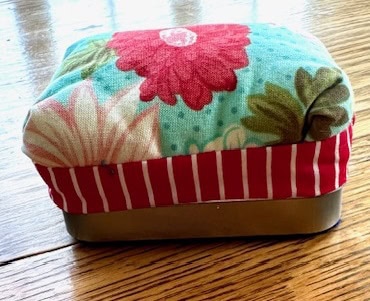
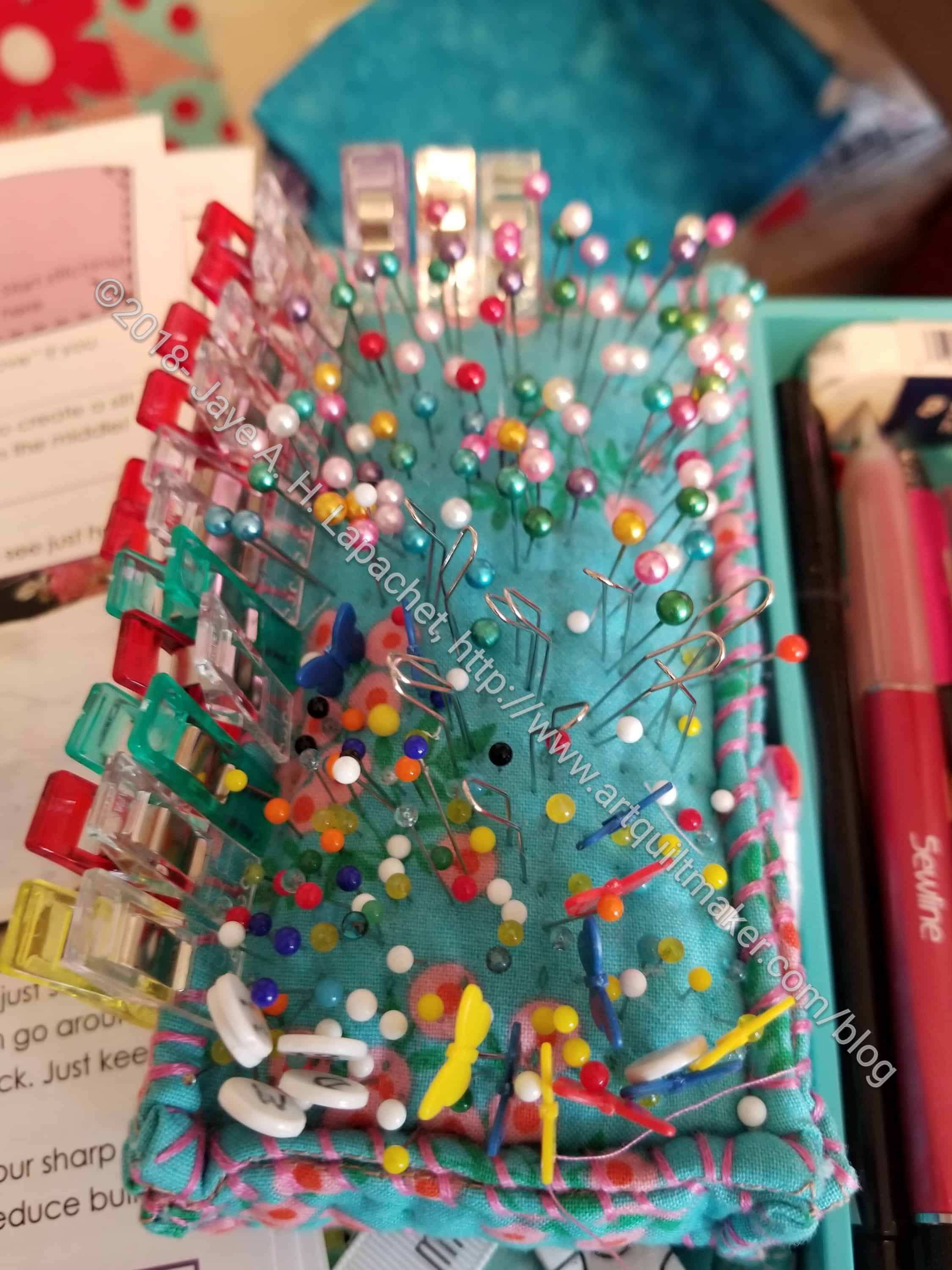
Gerre's special rectangular pincushion
Gerre’s special rectangular pincushion

Pincushion 

Wonder Clips (especially if you are making bags) – I like both sizes, but use the small clips more often than the large clips. I buy only the Clover brand version as I go through the off brand versions like water. They break very easily with the smallest amount of stress.

Pressing

Iron – I have had good luck with inexpensive irons from stores like Target, Costco, etc. I had several

Ironing surface 

    • I have a Polder ironing board which I received when I got married. It works fine and I have had no problems with it. I have had to buy new ironing board covers, which I have found at the Container Store.
    • I also have a June Tailor Quilter’s Cut ‘n Press** for travel, Sew Days and retreats. It was very convenient when we were in Portland. It also fits in my ruler/mat bag along with my mat

Cutting

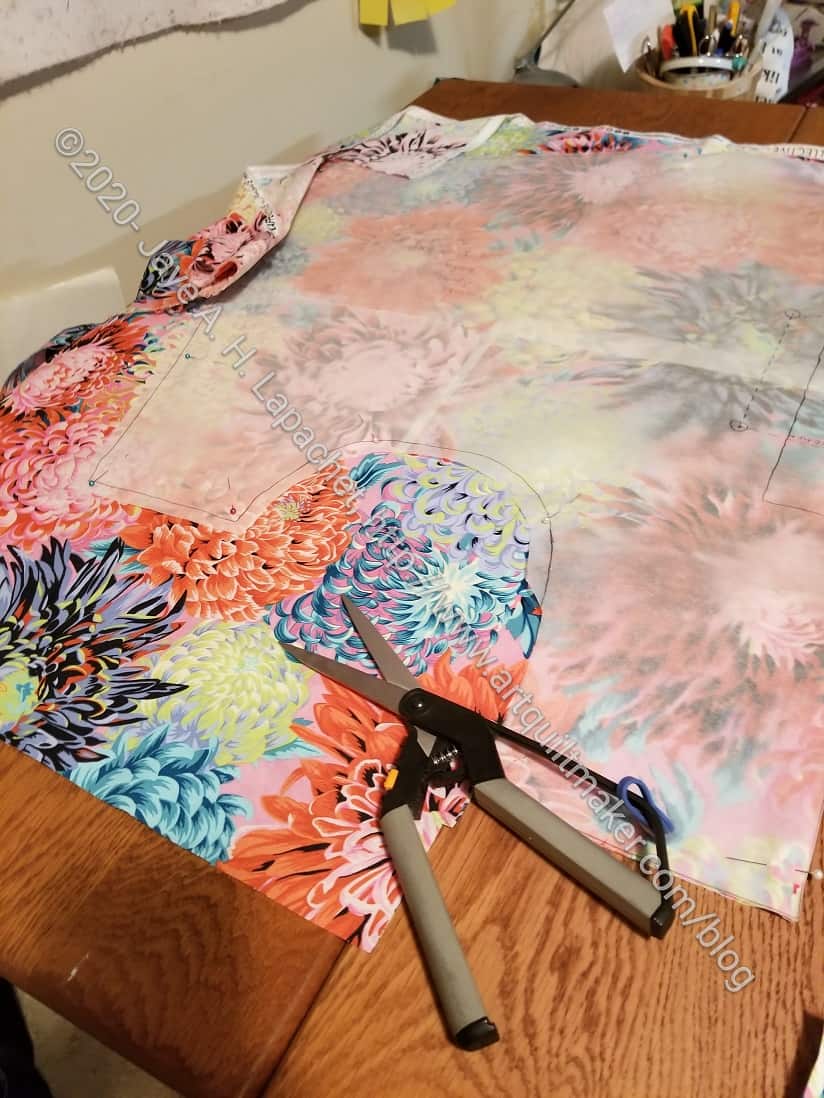
Cutting out Japanese Apron

Scissors

Snips

Rotary cutter – I like the OLFA 45mm Ergonomic Rotary Cutter (RTY-2/DX) – Rotary Fabric Cutter w/Blade Cover & Squeeze Trigger** because the blade is protected unless you are squeezing it. It is not possible to leave it open. I have other types of rotary cutters as well, but this is the style I use the most. I use a 60mm rotary cutter when I am cutting foam, which means less re-cutting. I use the small size occasionally when cutting curves.

Acrylic ruler(s) – I have a quite the collection after so many years, but the following are what I consider the basics.

Self healing rotary cutting mat

Unsewing

Seam ripper – I have a lot of seam rippers. I have them everywhere as I don’t want to go hunting for them. I like the Clover ergonomic seam ripper**, because it has a fat white handle. I received a Clover Grip Fit seam ripper** as a gift. Even though the handle isn’t as fat, it fits in my hand pretty well. I also have a couple of Kaffe Fassett seam rippers which have a super fat handle, so far very comfortable. the blade isn’t as thin and I can’t always get it under the stitches.

Marking and Measuring

See also: Cutting

120 inch measuring tape

Marking tools

      • Sewline Pencils
      • Chalkoner

Extension cord (good for quilt retreats/travel)

Quilting

Machine quilting gloves

Walking foot

Basting pins

Painter’s tape

Masking tape

Optional

Pen

Notepad – I like graph paper notepads or journals so I can draw quilt blocks, if I need to

Bobbin boat/bobbin holder (something to keep your bobbins from rolling away)

Tweezers – I like the ones called Swiss Precision Angled Tweezers 4 1/2″ 507SP on the GEQuilts website. I use them for bagmaking and also sometimes for removing threads

Pinking shears

Applique’ scissors

Stiletto

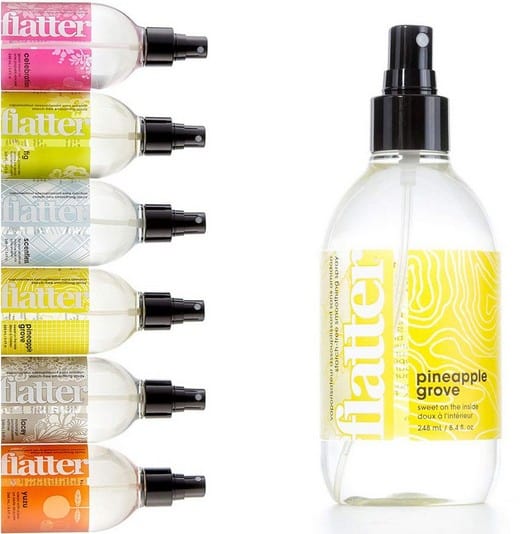
Flatter
Flatter

Flatter

Free motion quilting foot

Travel iron


This is my first effort at describing a BSK so I may make updates.


**Obviously, you should shop at local quilt shops and small businesses. However, if you are too busy or can’t find what you need there, I use Amazon affiliate links and may be paid for your purchase of an item when you click on an item’s link in my post. There is no additional cost to you for clicking or purchasing items I recommend. I appreciate your clicks and purchases as it helps support this website.
Quilt Class: Fabric Selection

The following is a lesson on different methods of selecting fabric. This is a lesson I give as one of the first classes when I teach beginning quiltmaking.

Color Choice Basics

      • Use what you love
      • Use the good fabric
      • Don’t be boring
      • Splash Out – be bold
      • There’s always more fabric

Using fabric you love or your really good fabric means that you will enjoy working on the quilt as well as using it or looking at it once it is finished. Since there is always more fabric, be bold in your choices. Take chances and try new color combinations. Yes, quilts take a long time, but you can always make another.

Fabric Selection

      • Fabric selection is personal. Think about what you like not what is trendy. Don’t copy the fabric choices of your friends. Quilts take a long time to make so don’t make a quilt that has already been made.
      • Colors should bring you joy. Don’t use colors because you think you should, such a ‘on trend’ colors or fabrics.
      • Your opinion matters. Like your fabrics
      • What you choose at the start is not the final selection.
          • Add and delete throughout the process
          • You will gain insight as you work with the fabrics

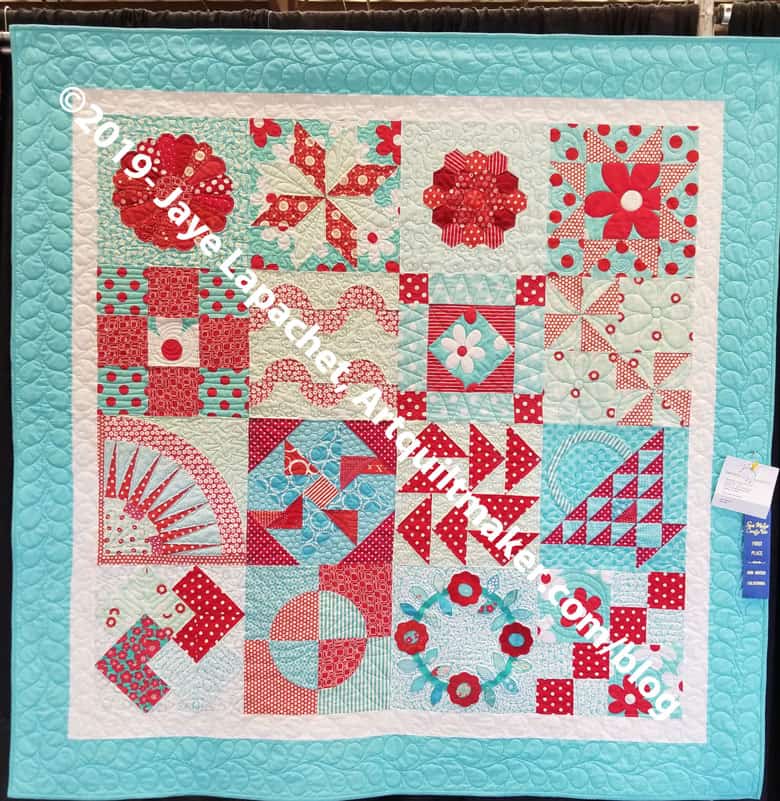
        Aqua-Red Sampler with prize
        Aqua-Red Sampler with prize
      • Start with ¼-1/2 yard of 8-10 foreground fabrics
      • Select background fabric as well
      • Often background fabrics are neutrals (grey, white or beige)
        • Splash out! Use yellow, blue, green, pink, or black as backgrounds. They can be effective, exciting and wonderful choices. Also, they can be unusual when the fashion is to use neutrals
      • Revise (add or delete) fabric choices after you have made a few blocks

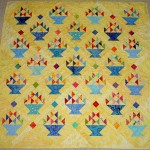
Cheerful Baskets still has a light background, but looks nice and warm with yellow instead of white. Also, yellow is across from blue on the color wheel so the baskets play nicely with the background.

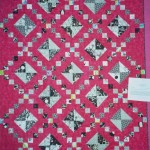
I turned background and foregrounds on their head in the Punk Rock Quilt, using pink for the background and black and white prints for the foreground.

Design Wall, Labor Day 2017
      • Stand back and squint
      • If some of the fabrics blend together, you will not be able to distinguish between them in the quilt.
            • If you like or want a blendy effect GREAT!
      • If you want to see each of your fabrics very clearly, then remove some of the fabrics that blend together.
      • If you love each of the fabrics you have chosen, move the fabrics around so the ones that blend are not next to each other.

8 Methods for Fabric Selection

Method #1: Selecting by Value
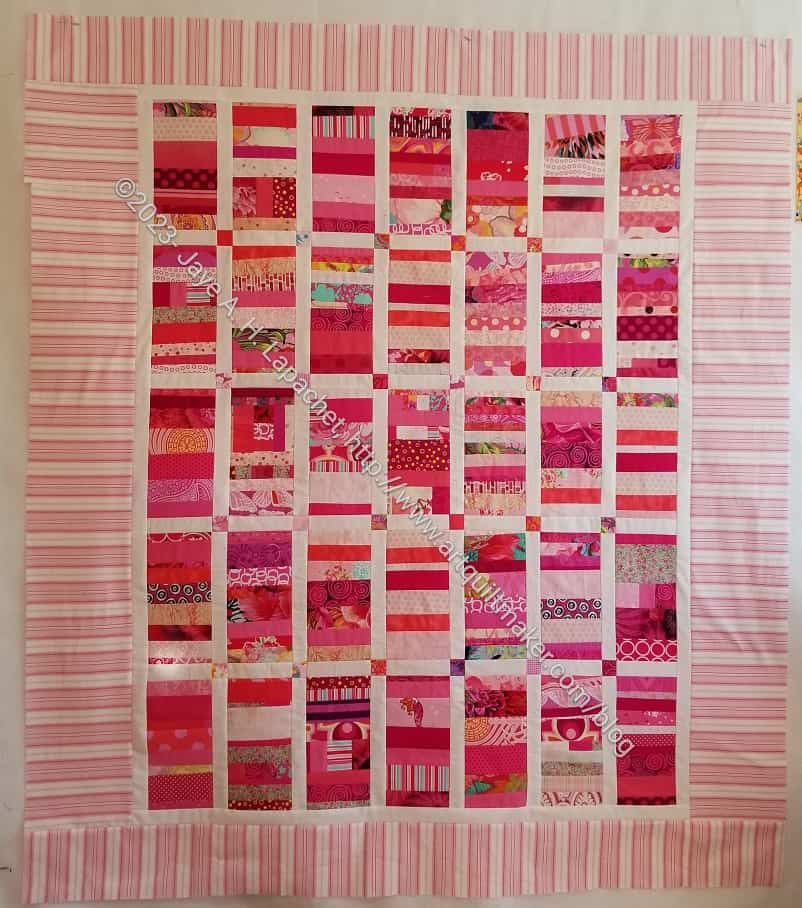
Pink Strip donation top - finished
Pink Strip donation top – finished
  • Select one color to be your main color
  • Tone-on-tone or solid colored fabrics work well for your main color, but don’t limit yourself if you love a, for example, red and white print. After you have selected your color, then you will choose a light, medium and dark of that color, e.g. light blue, medium blue, dark blue.

Value is important. There are lots of quilt fabrics that have a medium value. Choose enough lights and some darks, so that the piecing of your blocks shows up and the eye of the viewer moves around the quilt.

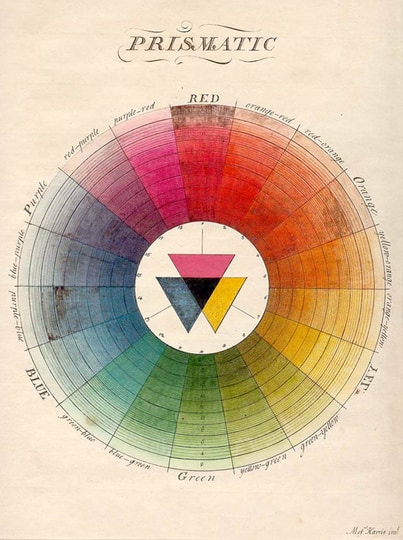
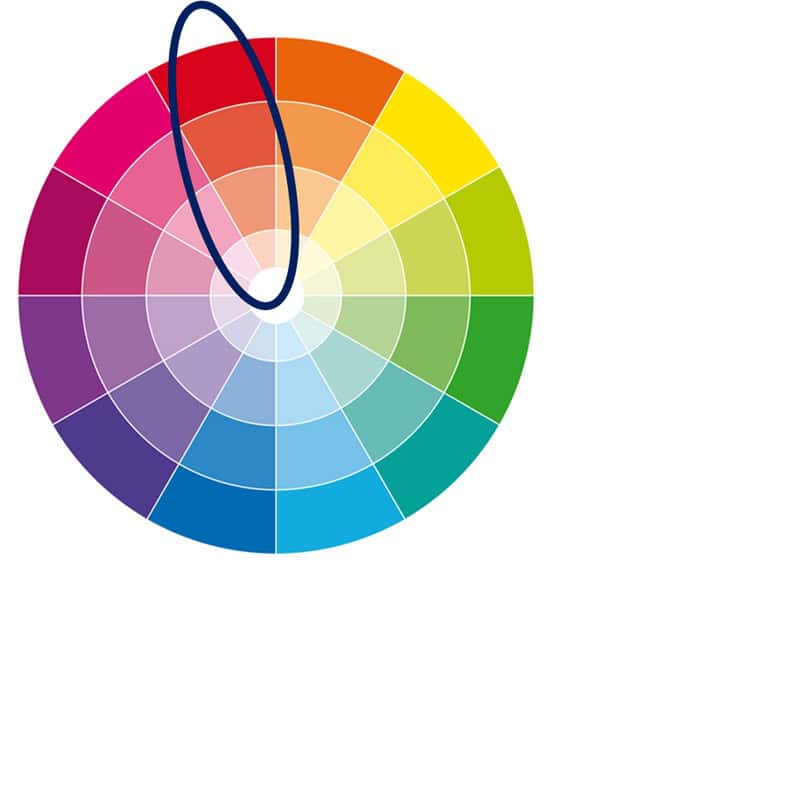
Use a color wheel to help you.

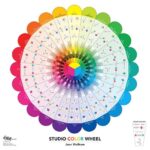
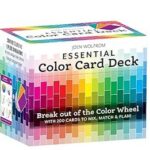
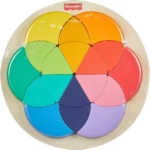
Apartment Therapy Color Wheel


Color Wheel selection


All of the hues in one of these groups will be your palette


Method #2: Heroine or Focus Fabric
        • Select a lovely, busy print with more than 2 colors. 
        • Large scale prints work well
        • Lots of colors gives you a lot of colors from which to choose. All of the colors, or a selection can be used to make a successful quilt.

Note: Many large scale prints are the main fabric in a line of fabric.

Once you have your focus fabric:

    • Handbag Sampler - ready for binding
      Handbag Sampler – ready for binding
      • Choose fabrics that have the colors you find in the focus fabric
      • Select some solids or tone-on-tone fabrics to give the eye of the viewer a resting place
      • Vary the size and scale of prints.
      • Try not to match up the colors exactly. It will add interest if the colors are slightly off the color in your main fabric.
      • Include the complementary color to the focus fabric’s main color to pop that main color
      • If you want each of your fabrics to shine, make sure you have lots of contrast
Method #3: Monochromatic / Two Color
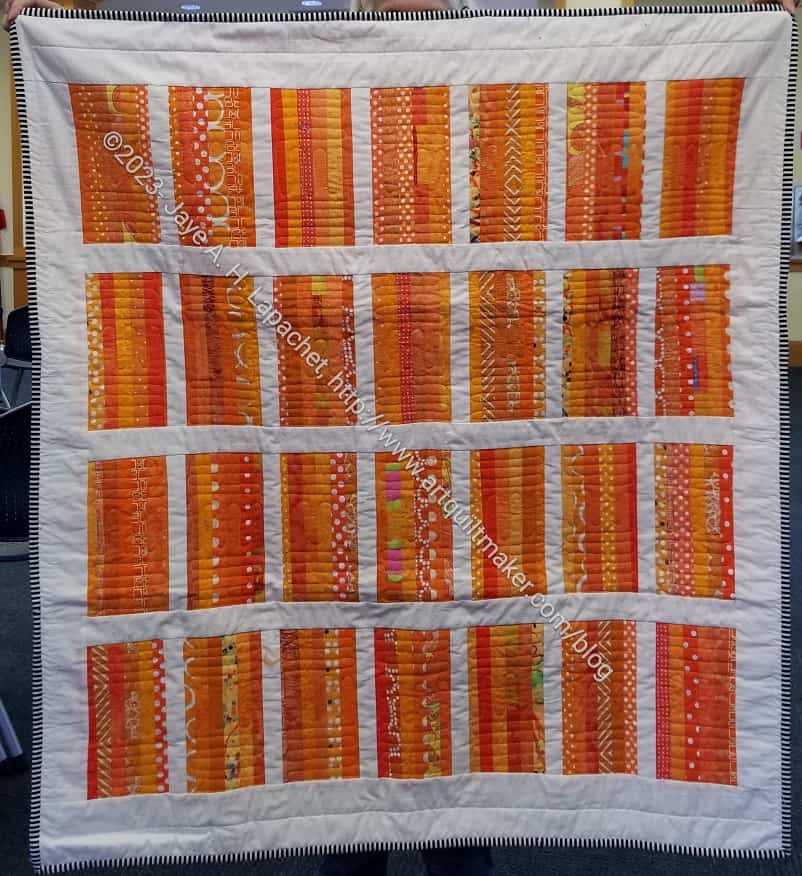
Finished: Orange Vertical Strip

Monochromatic is a method where you choose one color and include many different fabrics in that color.

      • You can also choose a variety of different fabrics in the same color family and one background.
      • Monochromatic and two color quilts have a long history in quiltmaking. Think of red and white quilts.

If you pull from your stash, usually these quilts come out well since most quiltmakers buy tones and shades of colors. For example, clear orange versus dusky orange. I am a clear orange girl.

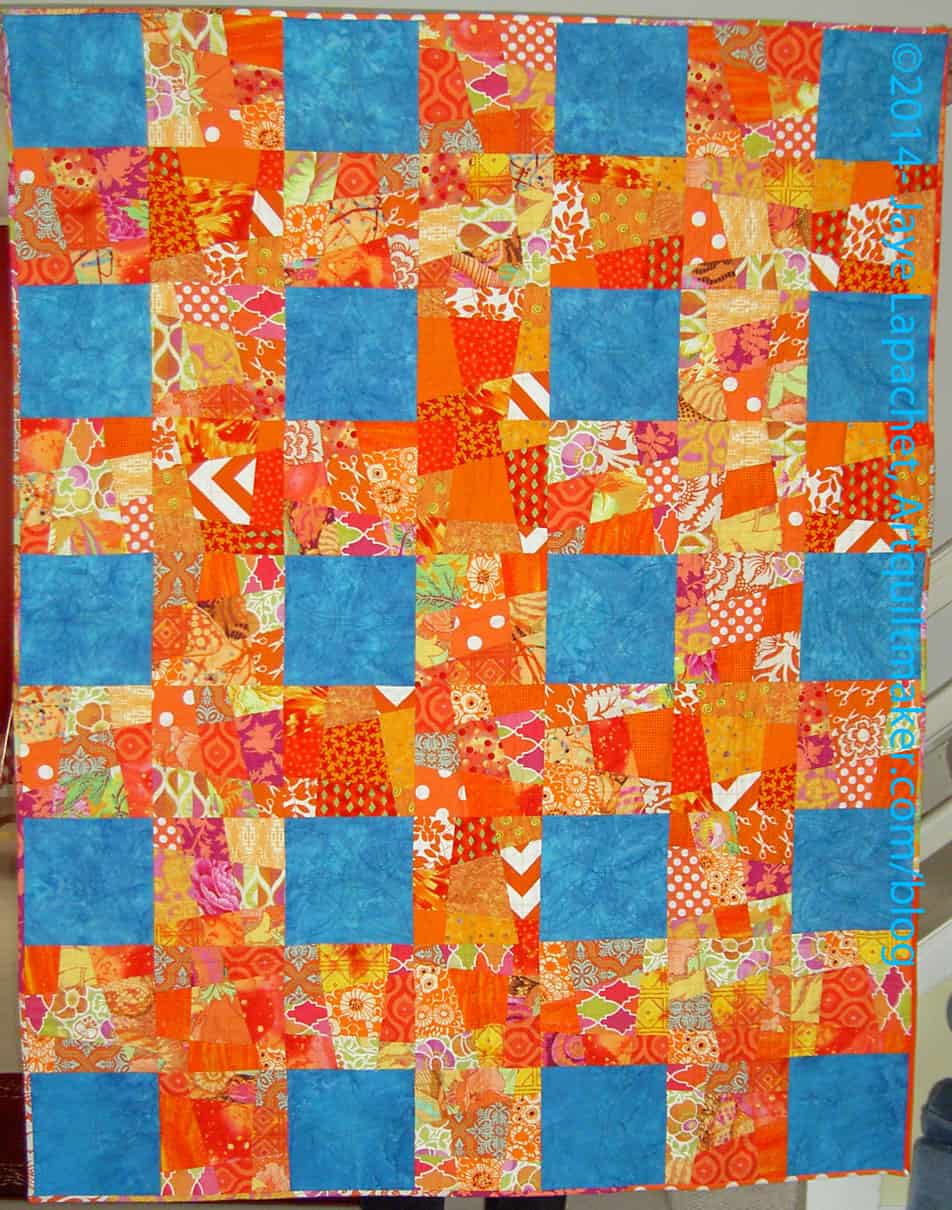
Finished: Wonky 9 Patch

The two color method is a slight variation of the monochromatic method

  • Choose one color and a background fabric (red+white or blue+white are popular examples).
  • Using the complement of your main fabric can be super striking. This orange and blue quilt is one of my most successful quilts.


Method #4: Dealer’s Choice
A-B-C Challenge with 1st Place Ribbon

Dealer’s Choice is the method by which you choose whatever fabrics you like.

      • These could be the newest or the most recent you have bought.
      • Put all the colors you like together
      • You can control the look by choosing a type of fabric like solids or all dotted fabrics.


Method #5: Scrappy
Scrapitude Carnivale Finished

This is similar to Dealer’s Choice. The difference is using scraps. There are often more fabrics and fewer duplicates using the scrappy method.

      • This can be a very serendipitous method
      • Use a lot of fabrics.
      • Use a variety of colors
      • Make sure there is a variety of contrast
      • Use a variety of motif scales – big prints, small ditsy prints, etc
      • Use fabrics, colors and prints you like
      • Curate your fabrics so the overall quilt appeals to you
      • Have a good mix without too many of one color or value
        • Scale means that you think about having different size motifs
        • Solids and tone-on-tone fabrics to provide resting spots
      • Distribute similar colors across the quilt; try not to concentrate one color in one area unless you are trying to gradate the colors
Flowering Snowball Finished

Using a similar background (dots on white in the example above and black on white in the example, left) creates success through lack of confusion. Not having a defined background can make the quilt look confusing to the viewer.

I also curate my scraps. If I think a patch will look ugly in the quilt, I don’t use it. I don’t use the ‘paper bag’ method, because I am a grownup and can choose fabrics without a gimmick.

Method #6: Whole Line of Fabric

Using a whole line of fabric can be a stress free way of starting your fabric selection process. A whole line provides a starting place.

      • Choose a line that has a lot of fabrics in it. Some current lines don’t have enough different fabrics for an interesting quilt. For example, the Parisville Deja Vu line by Tula Pink has only 8 fabrics. One thing that can help you overcome such a problem is that many fabric designers use similar colors in their lines. In Tula’s case, you can use several lines to make up the fabric selection for your quilt, because all of her fabrics coordinate. 
      • Remove between 10-25% of the included fabrics. Collections tend to have a lot of medium colored fabrics as well as a lot of fabrics with a similar scale in the motifs. You need variety
      • Replace the removed fabrics with lights and darks

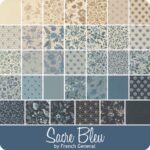
These lines are an example of mostly medium fabrics, which would make a beautiful blendy quilt. However, if you want contrast, you need to add fabrics.

I think that one dark dark on the bottom right of the Sacre Bleu photo would stick out like a sore thumb, though, which is why I like 10-25% lights and darks.

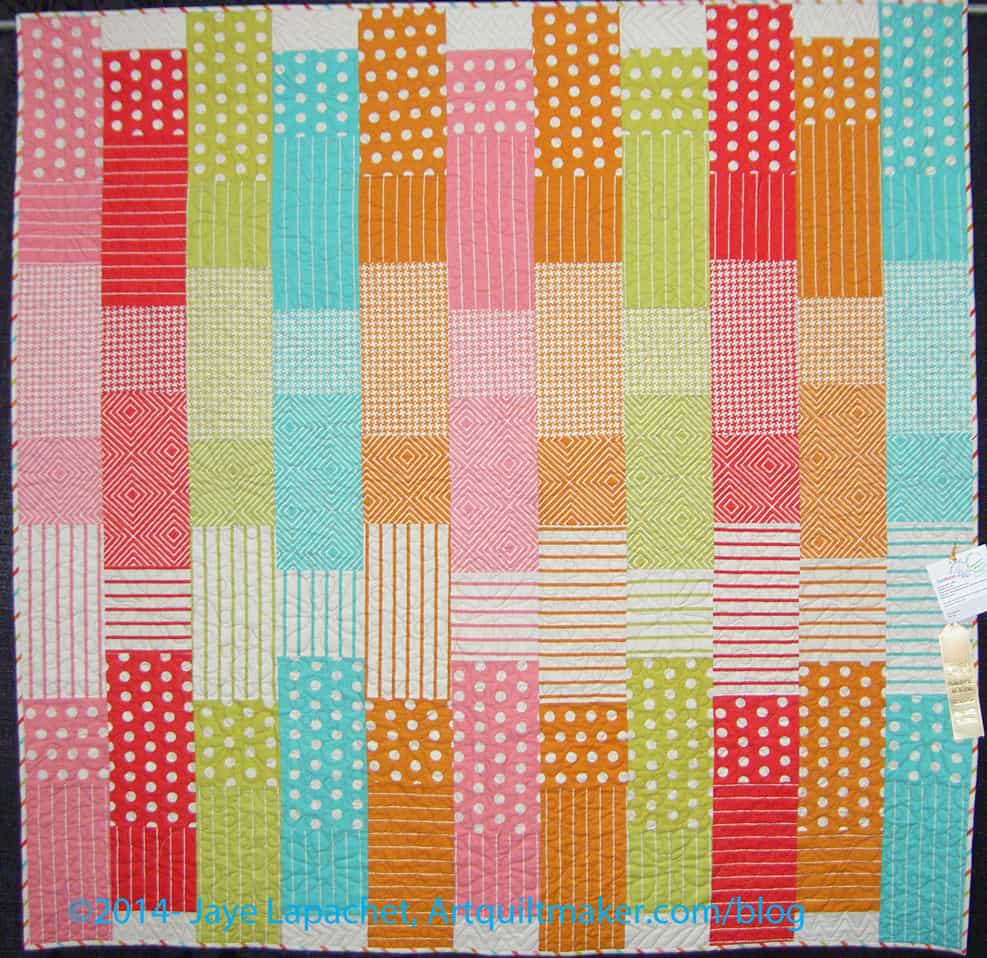
Fresh Fruit: San Mateo County Fair 2014
      • Shops also create curated packs of fabrics.
      • Using someone else’s color choices can be a good way of learning about color.
      • It is also a good way of learning what you like and what you don’t like.
      • Adding a background that isn’t included in the line can make the quilt more interesting.

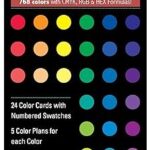
It is a good learning experience to use someone else’s fabric selection so that you can learn. This is where a tool can come in handy. You can compare the designer’s color choices to palettes in the tool to get an idea of what they were thinking.

Method #7: Inspirational Image
Kirkham & La Playa house - color inspiration
Kirkham & La Playa house – color inspiration

Magazines, blogs, websites, Instagram all pay a lot of money for great photos. If you find one you like, you can use it to select colors for a quilt.

Use a photo you snap as you move through the world to create a color palette. It can be an exercise even if you never make the quilt. Choose a photo, choose fabrics similar to the colors you find in the photo. Decide if the exercise is successful. Learn from the exercise.

Nature can help out, especially with monochromatic quilts. Next time you drive through the mountains, check out all the different greens you find on the hills where there are forests.

Method #8: Use a Tool

Tools are a great way to learn, though try not to rely on them long term. Tools are great for solving a problem. When you have a quilt on the design, but feel something is missing, pull out your color wheel, or other tool and see what you can add or delete. 

Important things to think about when picking fabric:

      • Do I like these fabrics?
      • Do these fabrics appeal to me?
      • Will I enjoy looking at and working with these fabrics?
      • Do they feel good in my hand?
      • Do I like these colors?
      • Is the value correct?
      • Is there enough contrast?
      • Do I have a variety of large and small prints? (Scale of prints)

Amounts of the fabrics is not as high priority, because there is always more fabric.

If you are trying to add or remove fabrics, check out the post I did when I was working with Frances.

The Bottom Line

The bottom line? Make visual decisions visually.

This means hang your fabrics on the design wall (or lay them on your design floor or pin them up on your clothesline) and then stand back and look at your choices. Leave them up for a few days so you can see them as you walk around.

If anything bugs you, make the piece smaller. If it still bugs you remove it. Add new fabrics in and remove fabrics until you have a palette you like.


____________________________________________
____________________________________________

Resources

Here are a selection of resources. I have only included resources I have read and don’t dislike. Everyone has a perspective and they are all valid.

Reviewing a Zipper Tab Technique

The other day, I talked about making some Open Wide Zipper pouches for my mom to give to friends who have been helping her. I also talked about using the Sweet Cinnamon Roses technique to make the Zipper tabs. After my chores and stuff were done, I set about the pouch task. One of the steps was making Zipper tabs.

Zipper tab finished
Zipper tab finished

I followed the Sweet Cinnamon Roses IG “tutorial” and had mixed results.  I was making 4 at once. Two were ok and I could use them. The other two needed unsewing. I sewed too close to the zipper tape and couldn’t turn them right side out. After unsewing and sewing the two again, everything was fine. Once I gave the zipper tape some space, the technique worked pretty well. 

What I learned is that you don’t need to sew right next to the zipper tape. It is actually better to sew farther away so there is less bulk to sew over when inserting the zipper into the pouch later.

I suspect that I don’t even need to sew up the sides next to the zipper. I suspect that is just for convenience, or because it looks better/ easier on the video. I haven’t tried that, so stay tuned for further results.

Definitely watch the Sweet Cinnamon Roses IG “tutorial”. Below are the steps I took:

1. Find and lay out the zippers you want to use

2. Cut some squares or rectangles of fabric about 2.5 in. by 3.5 in. I made sure I had at least .75 in. on each side of the zipper tape. This is not exact and you’ll be cutting off much of it anyway, so use scraps. These will be your zipper tabs. The longer you make your zipper tabs the more options you will have for positioning the head of the zipper. I found that a solid would have worked better for the pizza print. Having part of the print show just looked a bit weird to me. YMMV.

3. Lay two zipper tab squares / rectangles on top of and under your zipper. You will be able to see the end of the zipper and the stop after you lay them out. The squares will have the zipper sandwiched in between. The zipper stop and  1- 1.5 ish in. of zipper tape will be sticking out. You are going to cut off the zipper stop, so make sure you have enough space so your needle does not hit the stops. 

Sew in a U shape
Sew in a U shape

4. Move the zipper pull out of the way

5. Sew in a U shape from the side where the zipper pull lives towards the zipper stops and back towards the pull. Make sure the top of the zipper tab fabric, by the zipper stops, is sewn a quarter inch away from the top. Sew far enough away from the zipper tape (on the uprights of the U) so you don’t catch it in the stitches

6. Make sure you haven’t caught any zipper tape in your stitching

7. Cut off the stops at the top. Use the edge of the fabric as a guide

Zipper tab finished
Zipper tab finished

8. Turn the zipper tab right side out. 

9. Press

Zipper with zipper tab inserted into pouch pieces

10. Insert your zipper into your pouch or bag. In the photo of the stingray view of the pouch, you can see that I have at least 1.5 inches of extra zipper tab. I could have lined the end of the zipper tab up with the edge of the exterior pouch pieces in order to lengthen the zipper. This is a good way to eek out a little more space if your zipper is not quite long enough. 

In my case, I positioned the zipper head where I wanted it and sewed it into the pouch pieces. 

Zipper tab finished
Zipper tab finished

Once I turned the zip pouches  right side out, I was happy and unhappy with the results. 

I think the technique looks good. It is a useful finish for a zipper end. It came out as expected.

What I don’t like about it is that it isn’t great for an Open Wide pouch like the Noodlehead Open Wide Pouch. It doesn’t allow the part by the zipper to open wide. 

Lynette gave me some tips for finishing the zipper ends, so I’ll try those and see what happens. For certain types of pouches, like the Triple Zipper pouch I sewed awhile ago.

Sidewalk Tutorial

Sidewalk top: done
Sidewalk top: done

I am well into my second Sidewalk quilt. I got such good feedback on it at the guild meeting last month that I decided to write a tutorial for it. I want to encourage people to make donation quilts using the 16 patch blocks the guild makes tons of. This tutorial will enable you to make one of your own.

I saw the original quilt at the Sonoma County Fair. There was no attribution. If I find that someone has written a pattern for the quilt, I will add a link here.

Supplies

    • Sewing machine
    • Background fabric
    • Random scraps
    • Basic sewing kit
    • Thread
    • Iron 
    • Pressing surface
    • Graph paper 
    • Pencil
    • Optional: Colored pencils

Draw

1. Draw out the design on graph paper

2 Mark the pieces that will be background. You could do this with colored pencils

3. Mark, or color in, the pieces that will be your foreground

4. Count up the pieces on your design and confirm my math is correct.

This gives you a map to work from.

Cut

Nota bene: Cutting directions are duplicated below. I have included cutting here in case you want to cut the background in advance.

Cut 25 4.5 in. x 4.5 in. background patches (B blocks)

Cut 16 8.5 in. x 8.5 in. background patches (C blocks)

      • I used one full yard to cut these 8.5 inch blocks out.

Sew

1. Create 40 8.5 in. x 4.5 in. patchwork blocks, unfinished. (A blocks) There are several ways to do this:

      • half 16 patch using 2.5 in. squares
      • scraps, e.g. blue strip blocks
      • improv piecing similar to my improv donation quilts / made fabric
      • one solid piece of fabric cut at 4.5 in. by 8.5 in.

2. Cut 25 4.5 in. x 4.5 in. background patches (B blocks)

3. Sew 24 4.5 in. x 4.5 in. background squares (B blocks) to 24 patchwork pieces (A blocks). This creates an A+B block.

3A. Keep back 8 A+B blocks for the ‘border’ or outside edge

4. Press to the background squares (B blocks), because there is less bulk. If you are using white, there might be a shadow. 

5. Cut 16 8.5 in. x 8.5 in. background squares (C blocks)

6. Sew 16 8.5 in. x 8.5 in. background squares (C blocks) to 16 patchwork pieces (A blocks). This creates an A+C block

7. Press to the background squares (C blocks)

Sidewalk #2, block 1

8. Sew 1 4.5 in. background + patchwork combination block (A+B block) to 1 A+C block )8.5 in. background + patchwork combination block).

You will end up with a block like the one shown on the left.

You need a total of 16 of these blocks, so go ahead and sew them.

Blue Strip Sidewalk blocks

9. Put all of your blocks on the design wall. 

10. Rearrange them until you like the design.

As I was looking at these blocks on the design wall, I realized that I had focused on putting like blues together rather than mixing them up, so in this arrangement there are big blobs of dark blues that I will need to mix up before I sew the blocks together. 

11. Find the 8 A+B blocks for the ‘border’ or outside edge that you set aside in step 3A. Position them along the right side and the top. 

12. Add your last B block to the corner.

13. Chunk your blocks together.

14. Make a back

15. Make a binding

16. Take to your longarmer or quilt as desired. 

I am having a fun time trying different things with this pattern and I hope you will as well. 

Pattern for improv version.

I’ll make updates if needed. Remember: this is a free tutorial that I created in my spare time. Thank you!

Helpful Tutorials and Guidelines

Tutorials
Tutorials

I have a lot of tutorials available for FREE for you.

Click on the link indicated above. Note: if you click you get a longer list. If you hover you see a submenu of my favorite tutorials.

All of these tutorials are available for your perusal at your convenience. You can find them on the tutorials page. I, also, am not perfect, so I constantly update and rewrite them.

I have made a list of the tutorials here so you can easily take a look.

Altoids Tins Sewing Kit

Altoids Tin Sewing Kit – how to make a small sewing kit using an Altoids tin

Bullseye blocks guide:

Corner Store Blocks: guidelines (a tutorial) on making the Corner Store blocks

Disappearing Pinwheel: tutorial on my way of making the Disappearing Pinwheel block

English Paper Piecing

Facing: I started with Jeri Riggs directions and some help from Maureen over at Flies in the Cathedral. I have modified it a bit more to use strips double the size folded in half so I don’t have to stitch a hem.

Flowering Snowball (Cross Block)

Flowering Snowball blocks: these blocks have curves and inset seams. Fun, but not for the faint of heart. How to make the traditional pattern, Flowering Snowball. This block is #3081 in the numbering system of Barbara Brackman’s book.

Folded Corners Ruler: I taught myself the basics of using this ruler. Very helpful to avoid drawing diagonal lines for ‘flippy corners’.

Gift Bags: these bags are great to use instead of wrapping paper. You can see and admire your fabrics and use them year after year. Vary the fabric to make bags suitable for all occasions.

Gift Card Holder: this is a quick tutorial using felt.

Half Rectangle Triangles (Bias Rectangles): links to various methods of making these blocks.

Half Square Triangles (Triangle Technique/ HSTs): tutorial and size chart on making 8 half square triangles (triangle squares) using the X method at one time.

Handles: this tutorial makes up very sturdy bag handles with flair. It shows you how to cover webbing with fabric to make straps that match your bag. It was written to supplement the handle section of the Noodlehead Cargo Duffle 2 pattern. You can, however, use it for different bags. Vary the length of the handles according to your needs. Some tutorials from other designers may help you find the right type of strap:

Journal Cover: how to make a journal cover. This builds off of the patterns over at Exuberant Color and All People Quilt.

Kelly’s Bag– make this after you have practiced some free motion quilting. Makes a great gift.

Lanyard Tutorial – includes a ring so that your nametag is near your face and people don’t have to look at your belly button to see your nametag. Includes hardware where you can clip things to the hook.

Orange Peel Circle
Orange Peel Circle

Orange Peel Circle tutorial: This is a tutorial using the Clammy ruler to insert an Orange Peel into a circle.

Paper Wreath (Origami Starburst) – step-by-step tutorial for making a paper wreath. Directions are the same for making the wreath from fabric with a few added supplies that I have noted.

Pet Bed / Cat Bed Tutorial – simplified tutorial on making a pet bed

Pillowcases Guide – guide for making pillowcases.

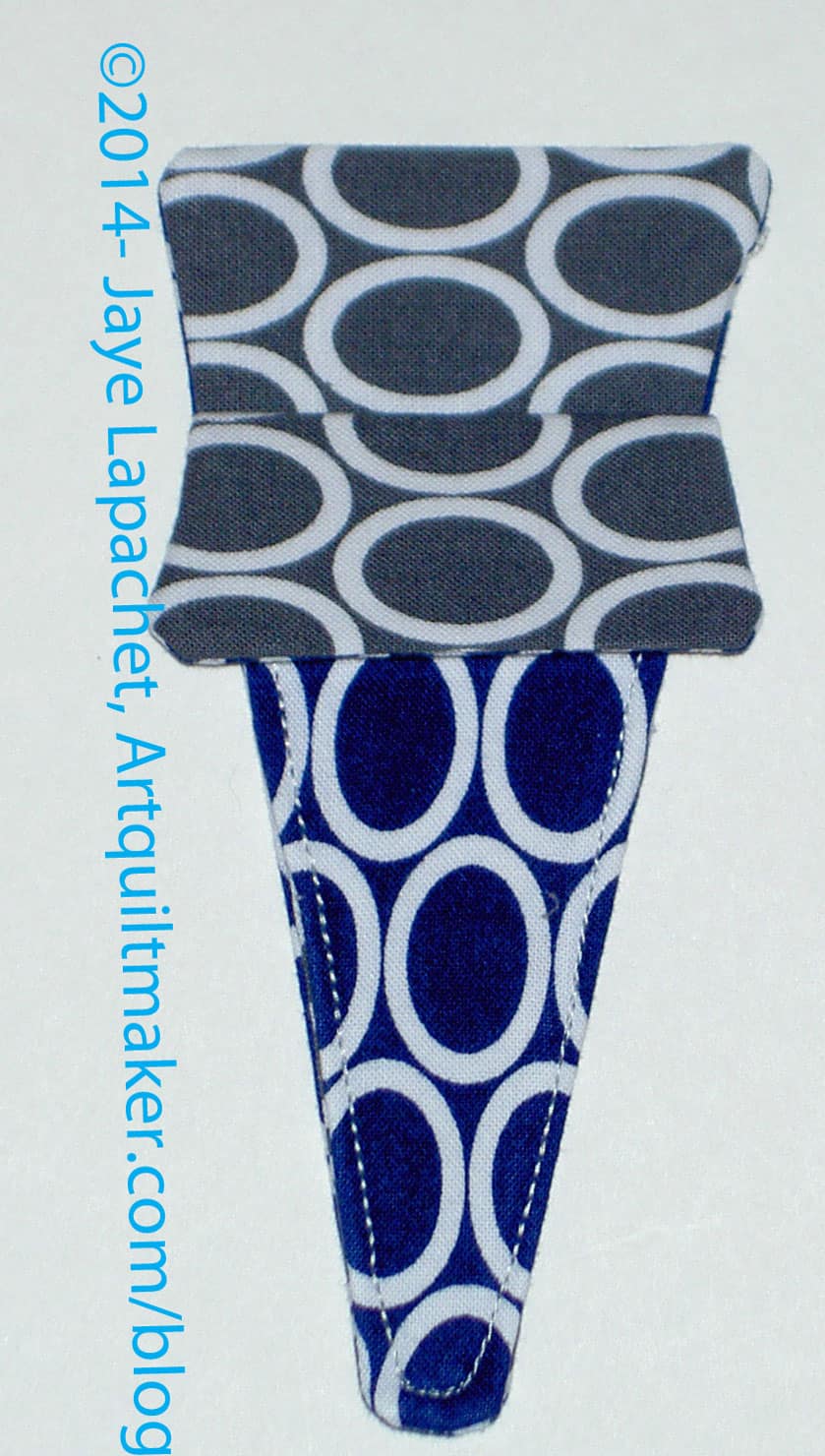
Scissor Sheath, finished

Scissor Sheath – guide for making a protector for your small scissors

Sew Together Bag – Hiding the zipper tab tutorial

Spiky Star block – guide for making one block using the Studio180 Split Recs ruler

Triangle Technique (Half Square triangles/ HSTs): tutorial and size chart on making 8 half square triangles (triangle squares) using the X method at one time.

Vinyl Tips & Tricks: tutorial on working with vinyl

Wine Bottle Gift Bags: this is more of a list of guidelines and process information, but you can make these awesome looking bags from the guidelines.

Zig Zaggy Quilt: how to make my version of Elizabeth Hartman’s New Wave quilt.

Installing Zipper Heads to zipper tape

Zipper Tab Technique – I first saw this technique on the Stella Pouch pattern from Center Street Quilts. Check out one of the CSQ patterns for more information, sizes and step by step instructions.

Paper Wreath for Beth

Paper Tutorials


I’ll add more tutorials as the mood strikes.


Gift Card Holder Tutorial

This started out after I searched my various small project books and the web for an easy gift card Holder. I found one on the web, but there were so many ads that I couldn’t use it. I also saw some YouTube tutorials, but just wanted a paper template and maybe some instructions. 

Gift card holder drawing

DH and I talked about it at dinner and came up with a viable pattern. We talk a lot about the mechanics of quiltmaking at dinner. Usually, I am trying to work out a problem. He doesn’t want to make quilts, but has a mind that can help me work out a pattern and mad math skills. It’s a good thing we had a lot of holiday and New Years cards on the table. Their backs made for great drawings.

N.B. while it is Christmas now, it will also be Hannukah in a few days. You can use this pattern for any holiday or gift giving event. Just choose the right fabric.

Supplies (If you have taken my quilt class, you should have all of the supplies, except maybe felt)


Gift card holder Pattern with sizes

I have not tested this ‘pattern’ extensively, so YMMV. Adapt the sizes as you see fit.

These sizes are slightly larger than my test version to make it easier for you to sew.

Take your graph paper and measure out the lines as shown. It helps to have a gift card or credit card handy.

There is no size or angle for the diagonal line. Create the rest of your pattern first, then connect the two lines to make the diagonal.

Gift card holder pattern traced

Trace your pattern on the felt.

If you plan to make a lot of these, I would recommend pasting the pattern onto template plastic as it makes it a lot easier to trace. That is why I added template plastic and a glue stick to the supply list as optional.

Gift card holder -cut out

Cut out your felt along the lines of the outline.

If you have time, you can embellish your felt. Some embroidery along the diagonal line would look nice as would an applique’ around the area of the diagonal line. If you do an applique’, remember that that part of the piece will be folded to the left, so you need to put the applique’ on the back of the piece as shown above. See below.

Of course, you can also embellish the edges using various decorative stitches on your machine or bits of leftover ribbon and rickrack.

Gift card holder - testing size
Gift card holder – testing size

Test your pattern piecing using a gift card or credit card.

On my first try at this ‘pattern’, my piece was very tight. I only had a little space for sewing. That’s why I made the sizes a little larger for you. Depending on your machine, you may be able to use a decorative stitch.

You only need to sew from the bottom of the diagonal line on the left vertical to the corner and then along the bottom. If you want to sew all the way around, check your size to make sure you have enough space for the stitching and that the card will still fit.

Gift card holder finished

I also cut the top corners so they were curved. I did it freehand and you can, too. 

This is a super basic gift card holder, but it is free and fast, especially once you have made the pattern.

Since I am not making you plow through ads or watch a 30 minute video to make this, I appreciate you clicking on the Amazon links and buying things from my Associate account. As it says below, it helps support the costs of this blog.


If you send me a photo of a gift card holder you make, I will post it, with due credit, here in the new year.


**N. B. : Obviously, you should shop at local quilt shops and small businesses. However, if you are too busy or can’t find what you need there, I use Amazon affiliate links and may be paid for your purchase of an item when you click on an item’s link in my post. There is no additional cost to you for clicking or purchasing items I recommend. I appreciate your clicks and purchases as it helps support this blog.

Time to Make Gift Bags

It is once again time to make gift bags. Obviously, Christmas is coming and these types of gift bags make wrapping a breeze. I know many of you don’t celebrate Christmas. These bags are great for any holiday including birthdays, anniversaries, saints days, Hannukah and any other you can think up. I use them for most birthdays. There is always more fabric, after all.

The great thing about these bags is that they are reusable. The other great thing is that you can use ANY fabric; it doesn’t have to be quilting cotton. I have made some gorgeous bags from upholstery fabric I got from FabMo.

Supplies:

  • Fabric – I use either a half yard, a yard or a fat quarter. If you use a yard you can make 4 smallish bags, two medium bags or one large bag. You can make bags with any size piece of fabric and you can make a specially sized bag for a special gift. I once made a gift bag for a weed whacker!
  • thread
  • ribbon- I often save ribbon from packages and other gifts and reuse it for gift bags.
  • Sewing machine
  • basic sewing kit

For this tutorial, we will use a fat quarter of fabric

1. If your fat quarter does not have a selvedge, create a hem using two folds so there are no raw edges. If your fat quarter has a selvedge, use the selvedge for the top. It won’t unravel.

2. Press hem in place.

3. Sew hem with a decorative stitch, if you have it, a zigzag or straight stitch work fine as well.

Optional: you can use embroidery to liven up or personalize the front of the bag.

Optional: If you have stitch letters on your sewing machine, stitch your name and the year so you know when you made the bag.

4. Fold hemmed bag in half WRONG SIDES TOGETHER so that half of the hem is underneath itself towards the top and the fold is on the left. You will be making a French seam.

5. Fold a piece of ribbon about 1.5 feet long in half. You can adjust the size of ribbon you use depending on how much ribbon you need to make a nice bow when you tie.

6. Place the folded ribbon in the open side of the bag about 4″ from the top edge/hem.

7. Pin ribbon in place.

8. Pin rest of the right side and bottom closed.

Use an 1/8″ seam allowance.

Sew first seam on gift bag

9. Starting from the top, sew down the right side, backstitching at the beginning and over the ribbon, 2-3 times. You want to backstitch at stress points to keep the bag from ripping apart.

10. Turn at the corner and continue across the bottom, backstitching at the end.

Optional: round the corner. It makes sewing and turning easier.

11. Turn the bag inside out, so the right sides are together and the ribbon is out of the way of the seam (It will be inside the bag, but I put mine as straight as possible towards the opposite side of the bag.

12. Press seams, taking care to push them as far out as possible so there is no extra fabric folded near the seams.

Use a 1/2″ or 5/8″ seam allowance.

Finish French Seam
Finish French Seam

13. Starting at the top, sew down the side and across the bottom again to finish the seam.

14. Open bag to make sure the raw edge is completely hidden inside the seam.

15. Turn bag inside out and press.

Voila! Your bag is really to use!

Many people ask about labels. I punch a hole in a gift tag and thread the ribbon through it. You can also buy basic tags with strings** or gift tags** and use those or stick a sticker onto the bag. I would recommend reusing gift tags. We do that, too.

Benefits:

  • reusable
  • reduces garbage
  • good way to use fabric you might not use for quilts
    • Novelty fabrics
    • fabric you don’t love anymore
    • Use fabric you already own
    • orphan blocks
    • vintage sheets
    • Any fabric is suitable including velvet, brocade, knits, etc
  • provides you with the opportunity to buy holiday fabric without committing to making a holiday (or birthday) quilt
  • quick method for wrapping
  • If you track fabric usage, this a good way to use fabric quickly
  • no need to rush out to buy gift wrap
  • no tape or scissors needed
  • small children can help wrap, or wrap their own gifts
  • Fabric costs can be amortized over the years of the gift bag use 😉
  • bags are made quickly
  • hems provide a good opportunity to try out decorative stitches
  • can quickly make a gift bag for an oddly shaped gift, such as the weed whacker I mentioned
  • odd sized bags can be cut up later and used for different sized gifts
  • I reuse ribbon I get from other places for the ties
  • Easy to open and close the gift bag up again if the gift tag falls off
  • Embellishment possibilities are endless, if you want to take the time. Gift bags are a great way to try out different techniques, stitches, embroidery. embellishments or use orphan blocks
Blue Flower gift bag

Drawbacks:

  • takes time to develop a stockpile
  • reusable gift bags have to be stored
  • fabric costs are not insignificant
  • You don’t get beautiful mounds of boxed gifts under your tree

Any gift bags you make will add to your stockpile. You can use leaders and enders to make them, which means that your regular sewing isn’t interrupted much .

Resources:


**N. B. : Obviously, you should shop at local quilt shops and small businesses. However, if you are too busy or can’t find what you need there, I use Amazon affiliate links and may be paid for your purchase of an item when you click on an item’s link in my post. There is no additional cost to you for clicking or purchasing items I recommend. I appreciate your clicks and purchases as it helps support this blog.

Tutorial: Orange Peel Circle Method 2

This is the second tutorial for the Orange Peel circle.

Orange Peel Circle
Orange Peel Circle

I don’t know how this shape came into my mind, but I was driven to learn to make it when I took the Latifah Saafir class in 2021. I have the start of an idea for a quilt using this shape, though I am still finalizing the details. The closest I have come to drawing it out or designing it is the Bubble (circle) donation quilt I made with Gerre a few years ago.

Ever since I learned to make these Orange Peel Circles, I have wanted to write a tutorial. I wanted to remember how to make these shapes whenever the desire arose and the best way is to post something here. I also wanted to share the knowledge with you so YOU would have another use for your Clammy** rulers. In a lull in the class, Latifah showed me two ways to make this shape. I broke up the tutorials so you could focus on one method at a time.

Supply List: (same as for the first method)

  • Clammy ruler – the 12 inch** or the 8 inch** or the 6 inch** (any size works)
  • Optional: 45 mm rotary cutter**
  • 28mm Rotary Cutter**
  • Rotary Cutting Mat**
  • Optional, but very helpful: rotating cutting mat** (The 10″ rotating cutting mat** is also useful for smaller spaces)
  • fabric (at least 2 different) – I used large-ish scraps for this tutorial
  • pins
  • Sewing machine
    • quarter inch foot
  • thread
  • Iron and ironing board

Notes:

  • You need the directions for using the Clammy for this tutorial
  • The tutorial for the first method was posted a few weeks ago. This second method yields the same results, but gives you construction options so you can figure out what works best for you.

6" Clammy and packaging
6″ Clammy and packaging

For this tutorial, I am using the 6 inch** Clammy. Adjust if you use other sizes.

The directions for cutting the Orange Peel shape are on the front of the Clammy ruler. The directions are in a different context, but you can extrapolate.

Steps:

Gather your two pieces of fabric.

Orange Peel Circle tutorial 2: cut a square


Orange Peel Circle tutorial 2: cut a square

Cut a 1/4 circle out of the square. I cut my square slightly larger than the square indicated on the Clammy.

Orange Peel Circle tutorial 2: Cut inside circle

Cut the inside circle to make a quarter circle. This is one step where I use the 28mm rotary cutter**.

Orange Peel Circle tutorial: cut 1st 1/2 of Orange Peel

You will have a quarter circle. Throw the extra background into your scrap bin.

Do the same again with a different fabric. This will be the whole circle in which you will insert the Orange Peel piece.

Orange Peel Circle tutorial 2: Cut a square

Cut a square-ish shaped piece.

Orange Peel Circle tutorial 2: cut quarter circle

Align your ruler and cut a quarter circle.

Note: For most of the cutting in this tutorial, I used my regular 45 mm rotary cutter**. For this step, however, I switched to a 28mm rotary cutter**. It is easier for me to cut the inside circle with a smaller rotary cutter. If you are using the larger Clammy, then the 45mm will work. Use the tools that feel best to you.

Orange Peel Circle tutorial 2: cut quarter circle

Cut a quarter circle out of the larger piece of fabric.

Orange Peel Circle tutorial 2: make registration marks

Fold the circle and the Orange Peel in half to create registration marks. I do this to allow me to line up the two pieces more precisely.

Tip: If you fold one piece RST and one piece WST, you will be able to nest them in the next step.

Orange Peel Circle tutorial 2: line-up registration marks

Line up the registration marks. The fabrics should be right sides together.

Pin at the registration marks to keep the pieces in place.

Orange Peel Circle tutorial 2: pin at the ends

I anchor the ends of the Orange Peel with pins.

Orange Peel Circle tutorial 2: pin the rest

Pin the rest of the Orange Peel to the circle using 2-3 pins between each end and the center. You may not be able to line the piece up exactly end to end. The ends may extend beyond the ends of the circle fabric.

Orange Peel Circle tutorial 2: sew the seam

Piece the quarter circle into the square with the quarter circle cut out. I put the piece that will be the Orange Peel on top to sew.

Orange Peel Circle tutorial 2: sewn

The piece looks odd and not circular at all when you are finished sewing.

Orange Peel Circle tutorial 2: press

Press the seam towards the piece that will be the Orange Peel. In this case, that piece is the green.

Now, follow the directions for cutting out a circle using the Clammy. Review the directions on the packaging.

Fold the sewn piece in half with the fold towards you.

Orange Peel Circle tutorial 2: line up the ruler

Line up the ruler as shown in the photo. Remember: the fold needs to be closest to your body.

Orange Peel Circle tutorial 2: cut the circle

Cut out your circle. Again, the directions on the packaging will help you.

Troubleshooting:  If your circle is not whole (cut in half) when you open it, then you need to realign your fabric and make sure the fold of your folded square is close to your body before you cut. If this is the case, you will need to start over, because your circle is ruined.

If you have cut the circle with the fold towards you, then you have done it correctly and have a fabulous Orange Peel circle.

Orange Peel Circle tutorial 2: Orange Peel circle

Toss the background excess into your scrap pile. Cut the background for a circle and piece your Orange Peel Circle into the background. Stay tuned for that tutorial or check Latifah’s site.

–>Alternatively –> applique your Orange Peel Circle onto the background using hand or machine applique’

See the other method for making these Orange Peel circles.

If you make one of these circles, send me a photo and I will post your work here! I’d love to see your efforts.

Notes:

*I prefer the smaller versions. The Orange Peel circle I made with the 12 inch** (first photo above ) just looks too big to me. If I made a bunch of them, it might be fine.

*If you have tossed the packaging or can’t find it,  download the information from Latifah’s site. I downloaded one and the information is laid out very well. You can also check Latifah’s videos on YouTube. One video shows how to cut different shapes, though it focuses on the half circle. You can get some good tips even if you don’t get the full instructions. Take a look at all of her videos.


**N.B. I use affiliate links and may be paid for your purchase of an item when you click on an item link in my post. There is no additional cost to you for clicking or purchasing items I recommend. I appreciate your clicks and purchases as it helps support this blog.


**N. B. : Obviously, you should shop at local quilt shops and small businesses. However, if you are too busy or can’t find what you need there, I use Amazon affiliate links and may be paid for your purchase of an item when you click on an item’s link in my post. There is no additional cost to you for clicking or purchasing items I recommend. I appreciate your clicks and purchases as it helps support this blog.

Tutorial: Orange Peel Circle

Orange Peel Circle
Orange Peel Circle

I don’t know how this shape came into my mind, but I was driven to learn to make this combination of shapes when I took the Latifah Saafir class in 2021. I have a sort of idea for a quilt using this shape, but it hasn’t come to fruition yet. The closest I have come to drawing it out or designing it is the Bubble (circle) donation quilt I made with Gerre a few years ago.

Ever since I learned to make these Orange Peel Circles, I have wanted to write a tutorial. I wanted to remember how to make them whenever I wanted.  I also wanted to share the knowledge with you so YOU would have another use for your Clammy rulers.

Supply List:

  • Clammy ruler – the 12 inch** or the 8 inch** or the 6 inch** (any size works)
  • Optional: 45 mm rotary cutter**
  • 28mm Rotary Cutter**
  • Rotary Cutting Mat**
  • Optional: rotating cutting mat** (very helpful)
  • fabric (at least 2 different) – I used large-ish scraps for this tutorial
  • pins
  • Sewing machine
    • quarter inch foot
  • thread
  • Iron and ironing board

Notes:

  • You need the directions for using the Clammy for this tutorial. They are included on the packaging. If you have tossed your packaging, download the information from Latifah’s site. I downloaded one and the information is laid out very well.

For this tutorial, I am using the 8 inch** Clammy. Adjust if you use other sizes.

Steps:

8" Clammy ruler and packaging
8″ Clammy ruler and packaging

The directions for cutting an Orange Peel are on the front of the Clammy ruler.

Orange Peel Circle tutorial: cut a square

Start with a square. If necessary, give yourself some wiggle room by cutting the square a bit larger than called for in the directions.

My Orange Peel Circle came out perfectly using the sizes on the ruler packaging. Try out some test circles to gauge whether you need to start larger or not.

Orange Peel Circle tutorial: line up Clammy


Cut your Orange Peel from this square. Line up your ruler as shown. You can see the lines of the Orange Peel shape clearly on the ruler. You want the straight dividing lines to be on the edge of the fabric and the Orange Peel shape to be completely in the square. Review the directions on the front of the Clammy packaging* to line everything up.

If you have cut a larger square, you will trim more.

Orange Peel Circle tutorial: cut 1st 1/2 of Orange Peel

Cut the first part of the Orange Peel. This will yield a shape like you would use for Drunkard’s Path.

This is where your rotating cutting mat** comes in handy.

Orange Peel Circle tutorial: realign the ruler

Turn your fabric and re-align the ruler. You can see how your Orange Peel piece will look through the ruler.

Orange Peel Circle tutorial: cut the 2d part

Cut the second side of your Orange Peel. Set this part aside. Toss the leftover background fabric into your scrap bin.

Now you are ready to cut your full circle

Orange Peel Circle tutorial: cut square

Based on the 8 inch Clammy, cut a 8.5 inch square of fabric. Adjust if you are using a different Clammy.

This will be the main part of the circle.


Orange Peel Circle tutorial: fold square

Orange Peel Circle tutorial: fold square

Fold your square in half and place the fold closest to you.

Orange Peel Circle tutorial: align your ruler

Place your ruler on the fabric. This is a good time to review the instructions or one of Latifah’s videos.

Orange Peel Circle tutorial: cut the circle

Cut the full circle.

Orange Peel Circle tutorial: open the circle

Open the full circle and admire your work! I always feel excited when I see that circle opened up.

Troubleshooting:  If your circle is  not whole (cut in half) when you open it, then you need to realign your fabric and make sure the fold of your folded square is close to your body before you cut.

Orange Peel Circle tutorial: align your ruler

Line up your ruler to prepare to cut the Orange Peel out of the full circle.

Note: For most of the cutting in this tutorial, I used my regular 45 mm rotary cutter**. For this step, however, I switched to a 28mm rotary cutter**. It is easier to cut the inside circle with a smaller rotary cutter.

Orange Peel Circle tutorial: cut the Orange Peel

The photo above shows the Clammy lined up and the Orange Peel cut out.

Orange Peel Circle tutorial: cut the Orange Peel

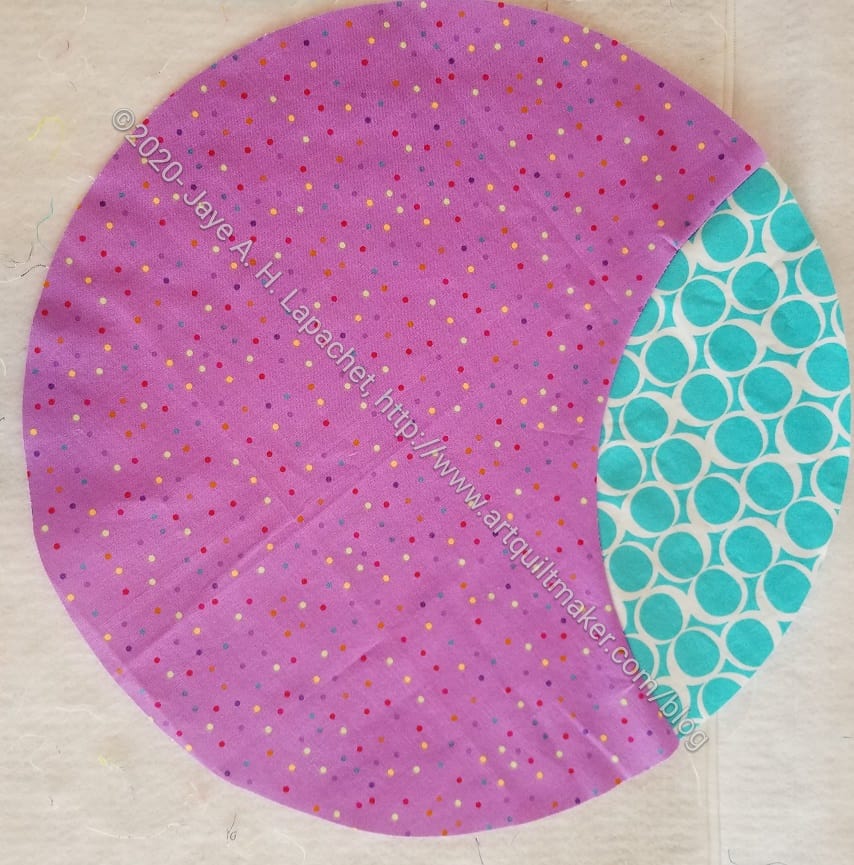
Cut an Orange Peel out of the full circle. Turn the circle if you want to avoid cutting into certain fabric motifs. In this case, I wanted to leave the full crescent moon on the fabric, so I avoided cutting the Orange Peel out of that part of the circle.

Throw the Orange Peel from the full circle into your scrap bin

Orange Peel Circle tutorial: create registration marks

Fold the circle and the Orange Peel in half to create registration marks. I do this to allow me to line up the two pieces more precisely.

Tip: If you fold one piece RST and one piece WST, you will be able to nest them in the next step.

Orange Peel Circle tutorial: Line up the pieces

Line up the two pieces using the registration marks. The fabrics should be right sides together.

Orange Peel Circle tutorial: pin at the registration marks

Pin at the registration marks to keep the pieces in place.

Orange Peel Circle tutorial: pin at the ends

I anchor the ends of the Orange Peel with pins as well.

Orange Peel Circle tutorial: pin the rest

Pin the rest of the Orange Peel to the circle using 2-3 pins between each end and the center.

Orange Peel Circle tutorial: sew

Sew the Orange Peel to the circle. I sew with the Orange Peel on top. Take out pins before your needle gets to them.

I keep the two pieces of fabric as flat as possible while sewing the curve. If necessary, make little clips in the curve.

Orange Peel Circle tutorial: sewn

Your Orange Peel is now sewn to your circle.

Press the seam allowance towards the Orange Peel.

Orange Peel Circle tutorial: sewn & pressed

You now have an Orange Peel circle!!

Your finished circle is ready to be pieced into a background. Stay tuned for that tutorial or check Latifah’s site.

If you make one of these circles, send me a photo and I will post your work here! I’d love to see your efforts.

Notes: I prefer the smaller versions. The Orange Peel circle I made with the 12 inch** (above photo) just looks too big to me. If I made a bunch of them, it might be fine.


*If you have tossed the packaging or can’t find it,  download the information from Latifah’s site. I downloaded one and the information is laid out very well. You can also check Latifah’s videos on YouTube. One video shows how to cut different shapes, though it focuses on the half circle. You can get some good tips even if you don’t get the full instructions. Take a look at all of her videos.


**I use affiliate links and may be paid for your purchase of an item when you click on an item link in my post. There is no additional cost to you for clicking or purchasing items I recommend. I appreciate your clicks and purchases as it helps support this blog.

Gift Bag Reminder

I saw an article about Christmas coming up fast. That article and the gift bags I made for birthdays recently reminded me that it was time to encourage all of you to make gift bags! I updated the tutorial and am reposting it here.

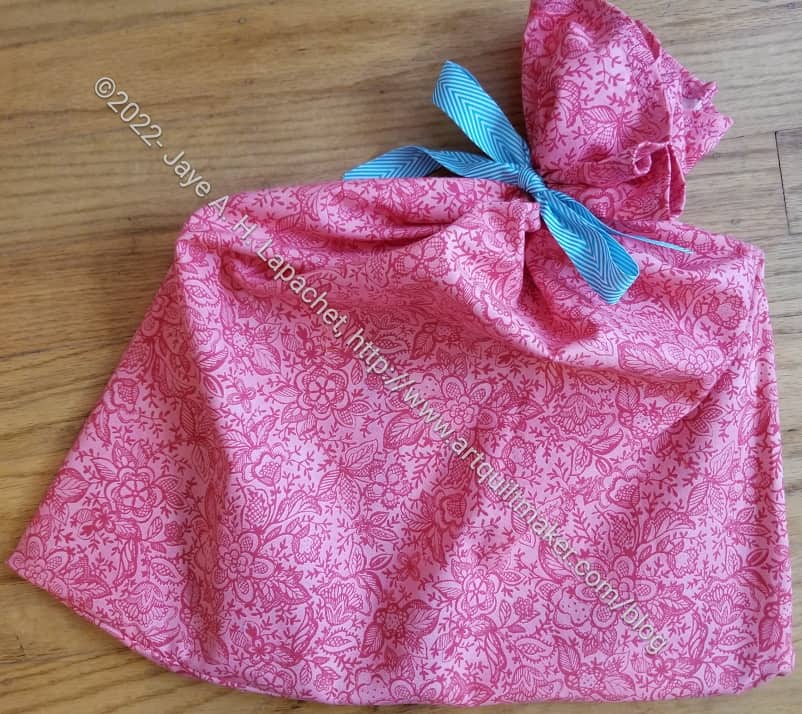
Pink Gift Bag for Mom

I love using fabric gift bags for all types of gifts – birthdays, Christmas, graduations, weddings. Besides the fact that I intensely dislike wrapping gifts with paper, the fabric feels so much nicer in my hands. For Christmas, or other specialty holidays, I also get to sew with the new and beautiful fabrics each year with out committing to a holiday quilt.

Gift bags are a great way to use up scrap fabric that would otherwise hang around unused. If a fabric is no longer to your taste, it will make a great gift bag.

You don’t need super high quality fabric for gift bags either. If stored properly gift bags can be reused year after year.

Supplies:

  • Basic Sewing Kit
  • Sewing machine
  • Thread
  • Fabric
  • Ribbon

Supply Notes:

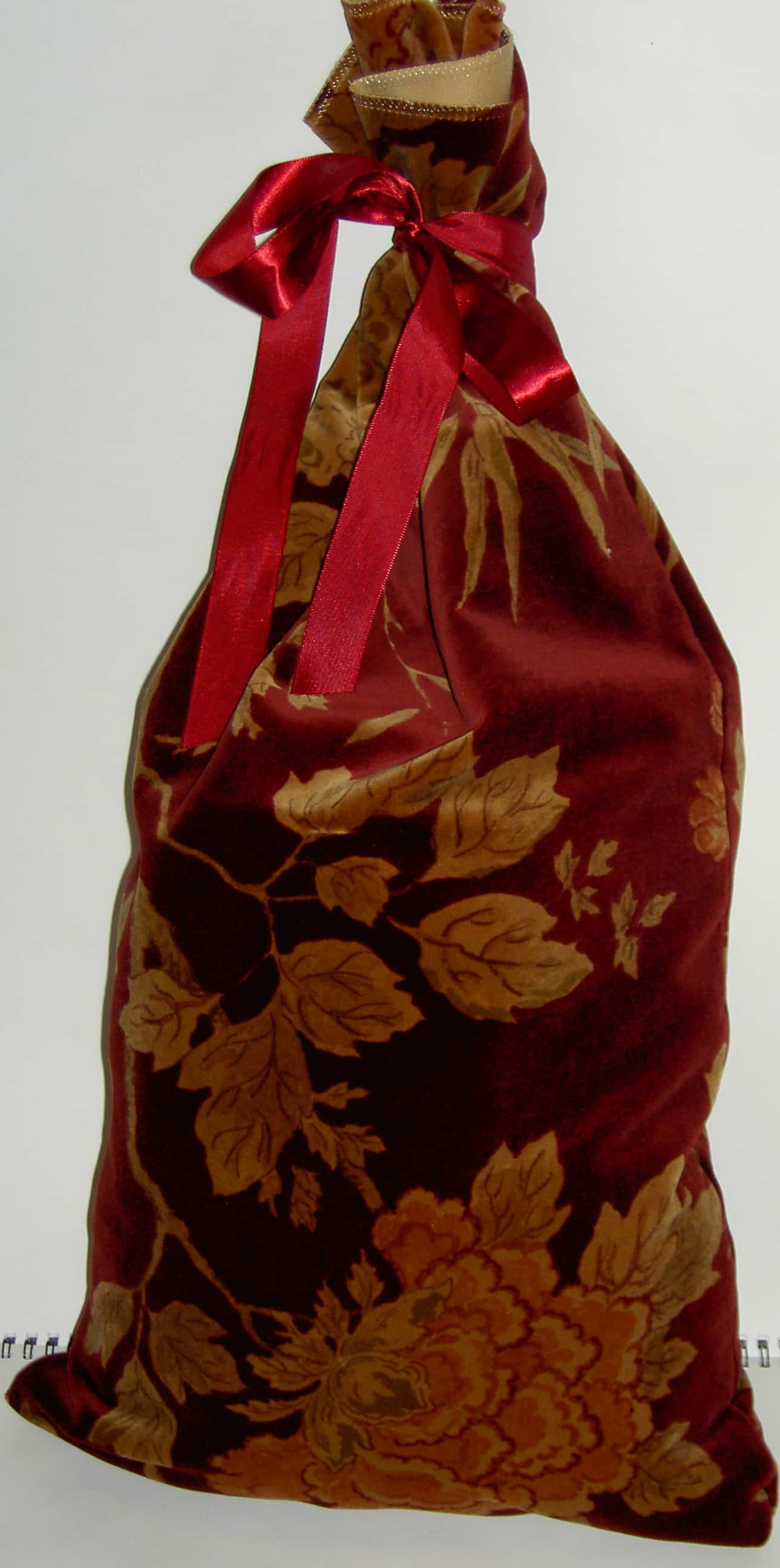
Lush Gift Bag
Lush Gift Bag

Fabric: the amount you need depends on the gift you are wrapping. If you are making some to have on hand, you can make one bag from a half yard or small bags from a fat quarter. Making gift bags is also a great way to use different fabrics such as upholstery fabric, velvet and other lush fabrics you wouldn’t normally use for quiltmaking.

Decorative stitches: This is a good way to get to know the resources required to use your decorative stitches. I made a lot of bags systematically using all the decorative stitches on my machine. This allowed me to know how much thread each one used and how long they took to stitch out.

Instructions:

Press a double hem on the edge of your fabric that will be the top. I often use the selvedge so I can skip this step.

Finish the hem with a decorative stitch. If you do not have decorative stitches on your machine, two straight stitches close together make a nice finish.

Sew first seam on gift bag

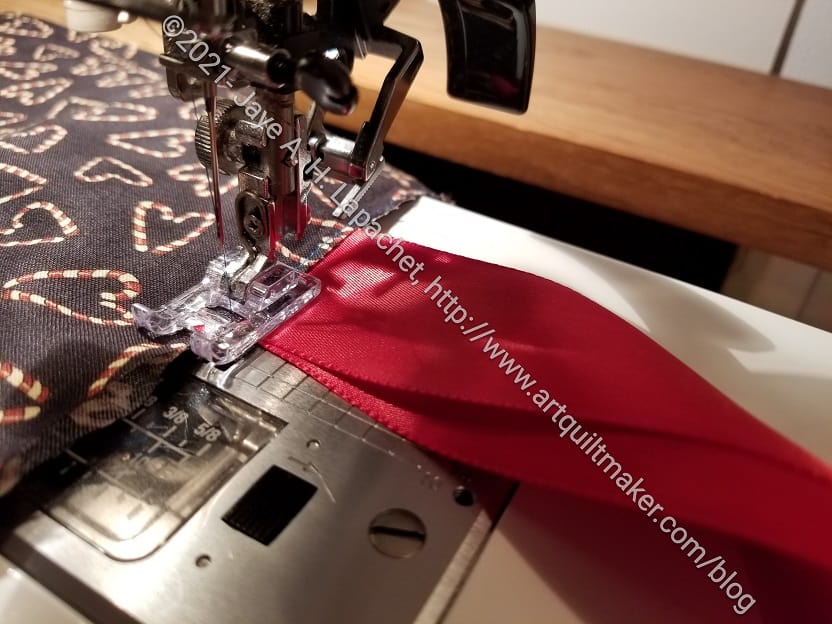
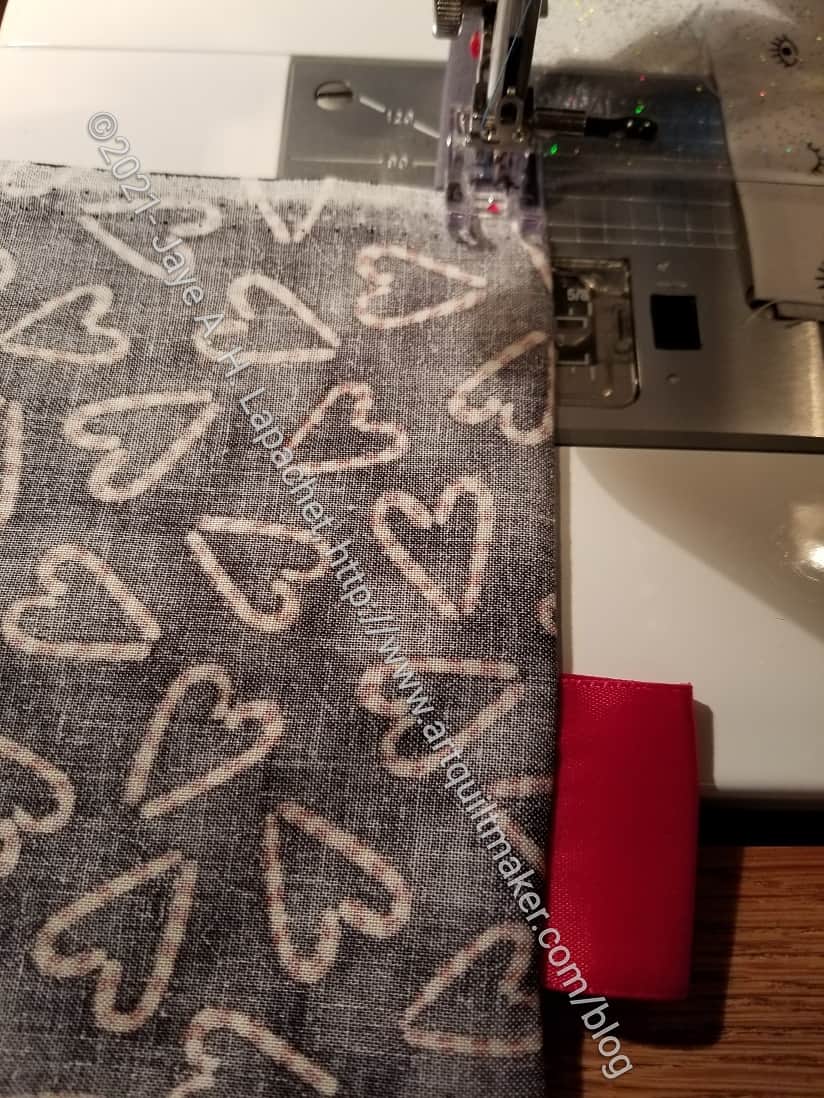
Once done, I fold the piece in half, wrong sides together, aligning the hem at the top. I put a piece of ribbon, folded in half. The end of the ribbon should be sticking out of the piece. Place the ribbon about a quarter of the way down the side.

Stitch down the side, starting with the hem using an 1/8 inch seam allowance. I reinforce the start backstitching over it a few times. I do the same for the ribbon and the end.

After sewing, trim any stray threads. Trim the corners.

Turn the bag wrong side out.

Finish French Seam
Finish French Seam

Stitch using a larger seam allowance. A quarter inch seam allowance may work, but you need to make sure you cover the entire previous seam allowance. Again, I reinforce the start backstitching over it a few times. I do the same for the ribbon and the end.

      • N.B. Be very careful that the end of the ribbon is out of the way.

Turn your bag right side out and poke out the corners carefully.

Hooray! You have finished a gift bag!


UCAB: Separating Zipper Top Tutorial

Art Themed Ultimate Carry All Bag

In order to sew along, you will need to:

You can find more information at the following links:

Additional Supplies**

  • Separating zipper

Notes:

I was not able to find a 12″ separating zipper so I used a 10″ and it worked fine. you might be able to find one the right size at Wawak.

Use E8 pieces for this step. The zipper flanges (fabrics surrounding the zipper) should be exterior fabrics ifyou want them to match the outside of the bag.

Tutorial:

Use a 3/8″ seam allowance for this step.

You will be using the pattern starting on page 20. Use the exterior fabrics for the fabrics surrounding the zipper (E8-zipperr flanges). Match thread to those fabrics.

Take the zipper apart. Keep all the pieces oriented as if you are going to zip them back together.

Clip E8 to the zipper

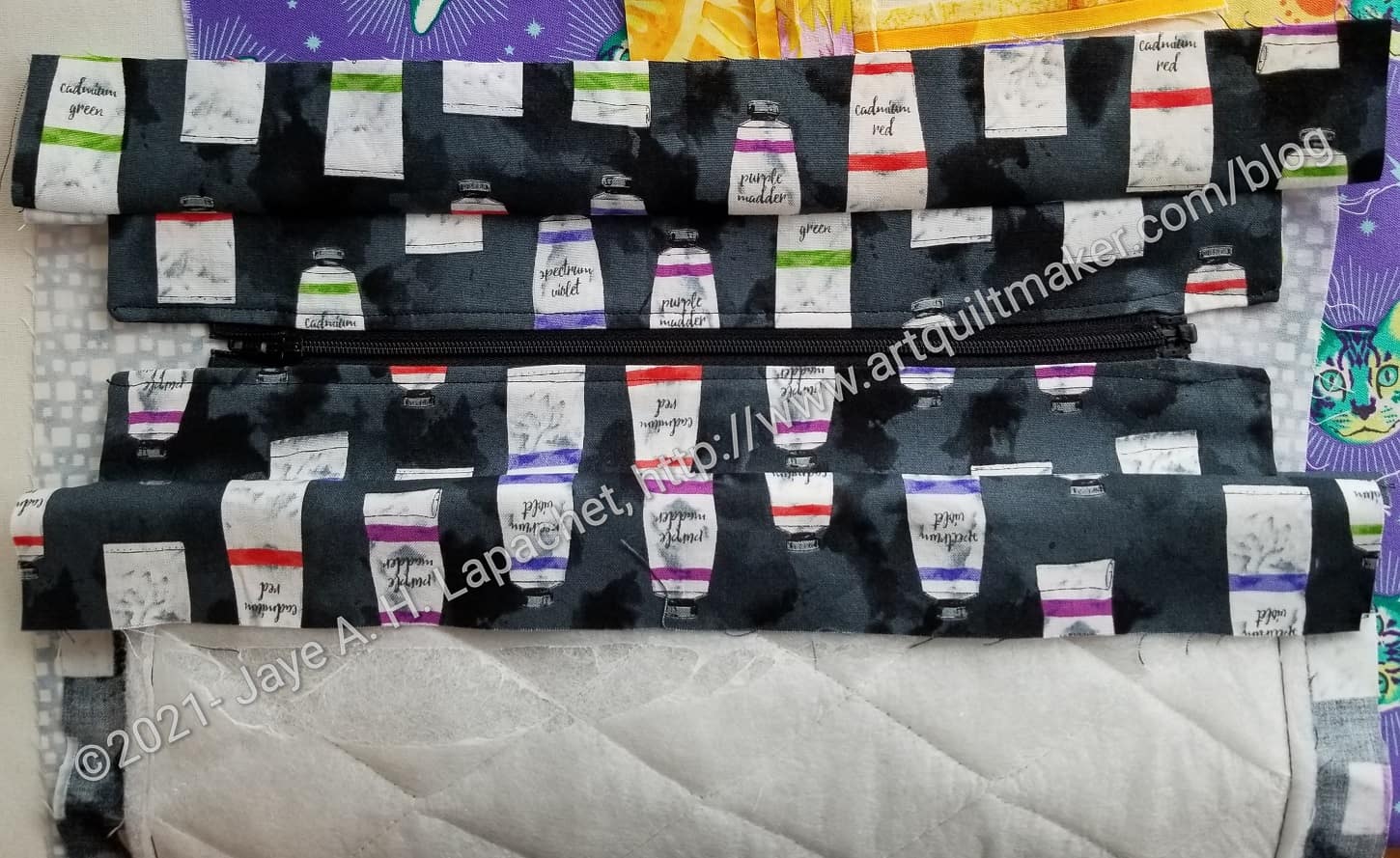
Make a zipper sandwich

    • Lay 1 E8 piece right side up
    • Position the zipper tape along the center of E8 half an inch from the end (see photo above where clips are)
    • Clip fabric to zipper tape
    • Put another E8 piece face down to make the sandwich
    • Reposition the clips on the E8 pieces to encompass the entire zipper sandwich
    • Clip the top of the zipper (side where the stop will be when the bag is closed) so you can veer it and the top of the tape will be hidden. Sew Sweetness has a tutorial on veering a zipper.
    • Follow these directions for the second piece. You want to continuously check that the two pieces of the zipper are lined up so the zipper will work properly.

Look at the images on pg.20 of the pattern as they will help.

Install the zipper. Stitch to the end of the fabric.

Check the zipper
Check the zipper

Stitch both short ends closed. You have, basically, sewn around the zipper lining/edges in a U shape so that the ends are closed and three sides are finished.

Make sure the end of the zipper is OUTSIDE of the seam allowance. You want to stitch as close as you can to the stop, then match the seam allowance on the second side of the zipper.

Turn the piece right sides out and press. Top stitch the U after you have finished the second side.

Throughout this step:                                                                              

  • Remember that this zipper comes apart.
  • Make sure the two sides of the zipper are in the correct orientation and the ends are even the whole time.

Keep checking.


N.B.: Quiltessa Natalie calls these zipper tabs, but I have never heard of zipper tabs being applied to the sides of the zipper. I call them zipper flangesI have also never used a separating zipper, so who knows?)


Separating Zipper installed

Previous Tutorials:

  • Large Pocket #1 pt.1 tutorial
  • Large Pocket #1 pt.2 tutorial
  • Large Pocket #2 Clippy Pocket tutorial (type 2)
  • Large Pocket #2 tutorial pt.2
  • Small Front Pocket Tutorial pt.1 – center section
  • Small Front Pocket Tutorial pt.2 – Clippy pockets (instead of badge holders)
  • Pocket information – post showing additional mesh pockets (not a tutorial)


**Obviously, you should shop at local fabric, knitting shops or quilt shops. However, if you can’t, please know that I use affiliate links. I may be paid for your purchase of an item when you click on an item’s link in my post. There is no additional cost to you for clicking or purchasing items I recommend. I do not recommend items I don’t like. I appreciate your clicks and purchases as it helps support this blog.

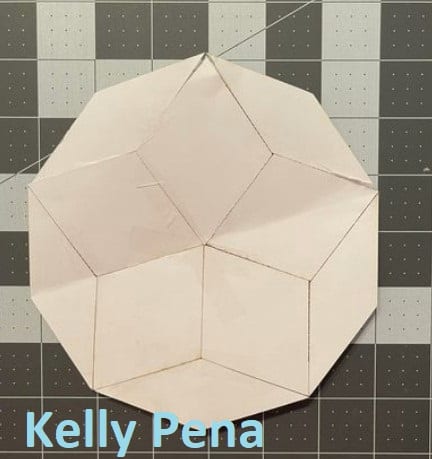
La Pass Center Medallions

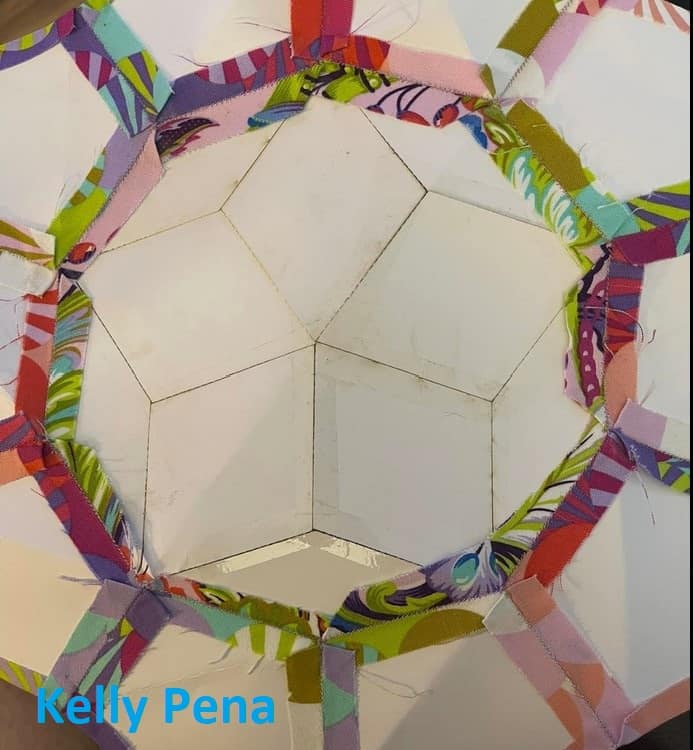
Kelly Pena, a quiltmaker/sewist also working on La Pass and in the private La Pass FB group, creating a basic and an easy to understand tutorial for making center medallions.  She has kindly allowed me to use her photos for this English Paper Piecing technique. This question has come up a few times in our La Pass group. I consulted with Kelly and said that I would write a blog post using her photos so there would be a permanent link to the information. I have added a little bit of additional explanation to Kelly’s already excellent tutorial.

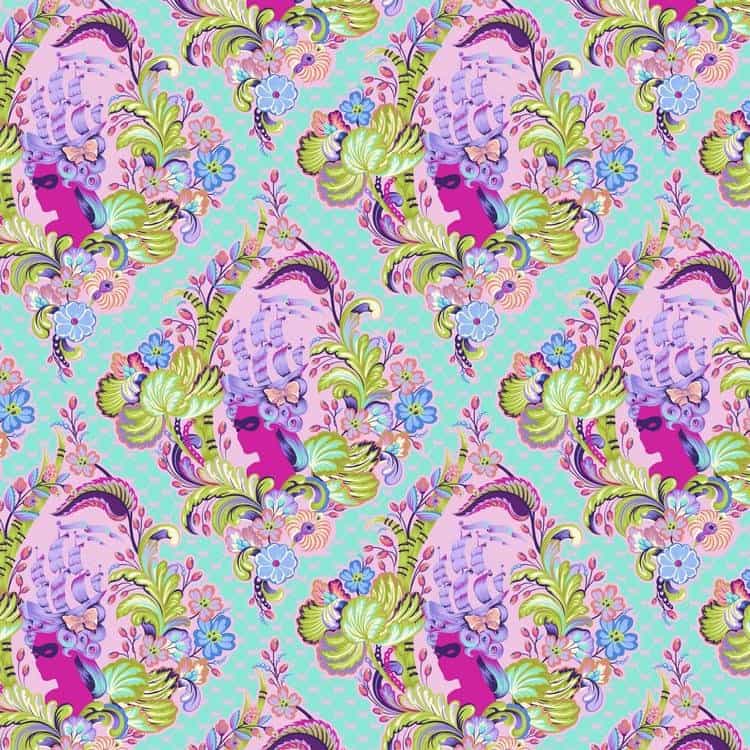
Tula Pink's Parisville Cameo
Tula Pink’s Parisville Cameo

Our La Pass rosettes require certain sized fabric pieces that correspond to the paper we are using to create various rosettes. We fussy cut the fabrics and make cool designs. Sometimes people want to use a larger motif, such as Tula Pink’s Marie Antoinette from Parisville Deja Vu. This motif would be difficult to put together using the various shapes and pieces. Not impossible, but very difficult.

In order to use up, in this case, the entire cameo and not make ourselves completely crazy, we need more ‘paper space’.

Combine papers
Combine papers

1. Find all of the paper pieces you need (want to use) to make the center medallion. Tape the paper pieces together for the final shape. This can vary depending on the shapes making up the rosette and you can adjust the shape by adding or deleting papers until you are satisfied. You can create quite a large shape.

As far as I know, there is no size limit as the paper will be removed at some point anyway. My gut tells me that you may have some issues with the bias if the pieces are too large. As a result, and, as usual, be careful with the bias.

You can configure the papers into any shape that will work for the fabric you have. I tried this technique on one of the Month 4 rosettes and found it moderately successful. In looking at Kelly’s example above, I should have added the long, thin diamonds to my center in my attempt. I think it would have made the process easier. The concave edges around the center diamonds are difficult and the long, thin diamonds make the edge easier to deal with.

Lay combined papers on fabric

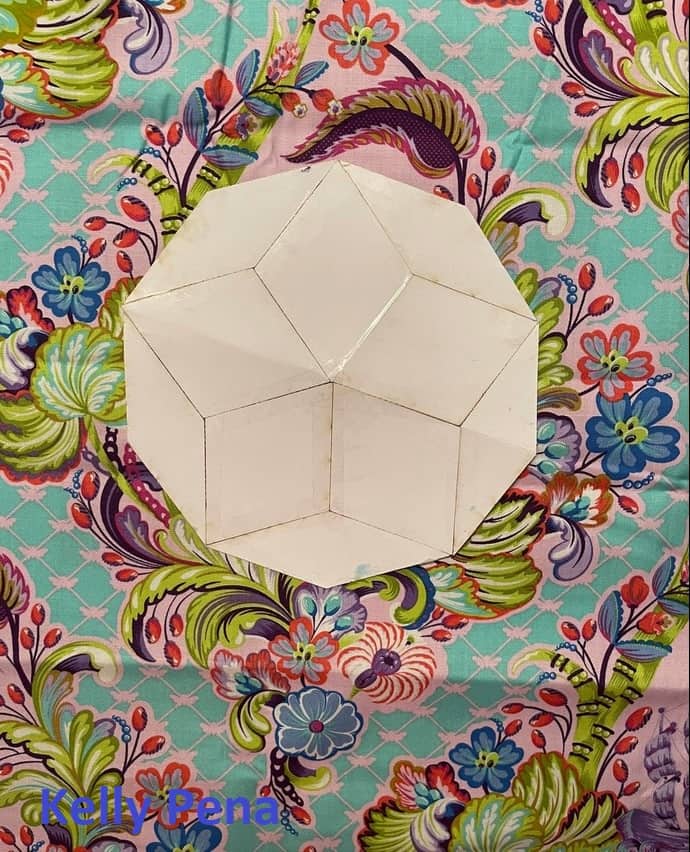
2. Lay the combined and taped papers on the fabric. Adjust the placement until you have the fabric motif you want centered on your papers.

Remember to take seam allowance into account.

You can use a light board or light box** here for more accuracy.


Cut around paper leaving seam allowance

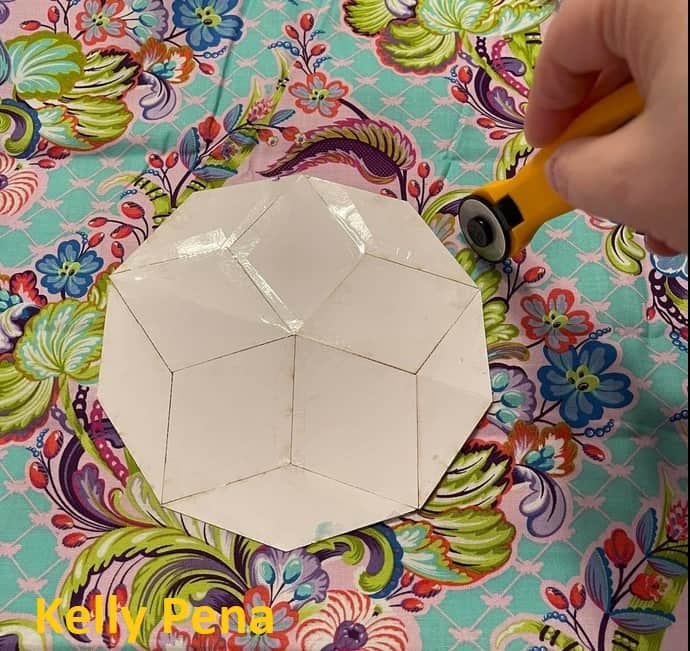
3. Cut around the template allowing for seam allowance.

N.B.: In the image (left), Kelly is cutting freehand. If you are not confident, you can also use a small rotary cutting ruler**. If you use a ruler, you will need to keep moving it around the piece. In this case, a rotating cutting mat** might be helpful.

Cameo/Center Medallion basted

4. Baste as usual. Kelly and I are both using glue for La Pass. I am using thread basting for my Half Hexie Star project. Either method will work with this center medallion technique.

You may find it helpful for circular shapes to cut notches into the seam allowance when basting.

5. Stitch up your new larger piece. The paper shapes used will allow you to sew as if you were stitching all the shapes separately.
 
Thanks, again, to Kelly for allowing me to use her words and photos.


**Obviously, you should shop at local quilt shops, knitting shops or art stores. However, I use Amazon affiliate links. I may be paid for your purchase of an item when you click on that item’s link in my post. There is no additional cost to you for clicking or purchasing items I recommend. I only link to items I like. I appreciate your clicks and purchases as it helps support the costs related to maintaining this blog.

Finishing Bullseye Blocks pt.2

The other day I showed you how to finish the bullseye blocks in preparation for the next circle. I didn’t have all of the photos, but I do now. Until I can write a real, complete tutorial you’ll have to look at both posts and integrate them. I know you can!

This tutorial assumes that you have cut your backgrounds and appliqued your circles to those backgrounds.

Supplies (same as previous post)

  • Bullseye blocks
  • Inspira duckbill applique' scissors
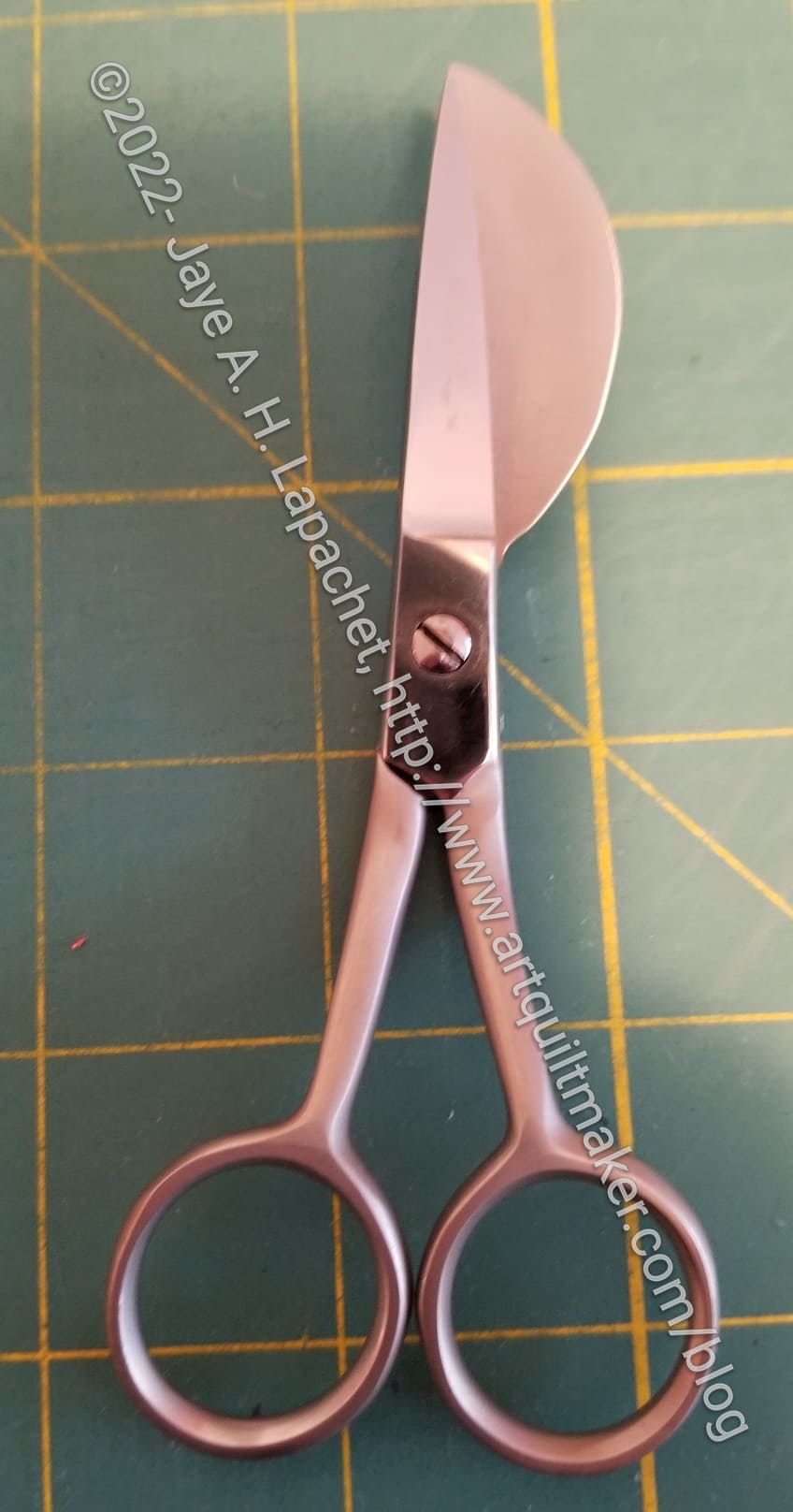
    Inspira duckbill applique’ scissors

    Applique’ scissors** – I have two pair. One is by Gingher, which I have had since the dawn of time. These are maybe 10 inches, but probably 8 inches. The other is a much smaller pair (6?) I bought last year at Cottage Quilting in Medford. The brand is Inspira and they are shown on the Husqvarna/Viking website. I thought they were super cute and I had never seen a pair this size before. N.B. after using them for this project, I really like the Inspira duckbills. The holes are really small, so if  you have large hands, they may be uncomfortable.

  • Cutting mat**

Optional Supplies:

Steps:

As mentioned above, previous steps can be found in the previous post.

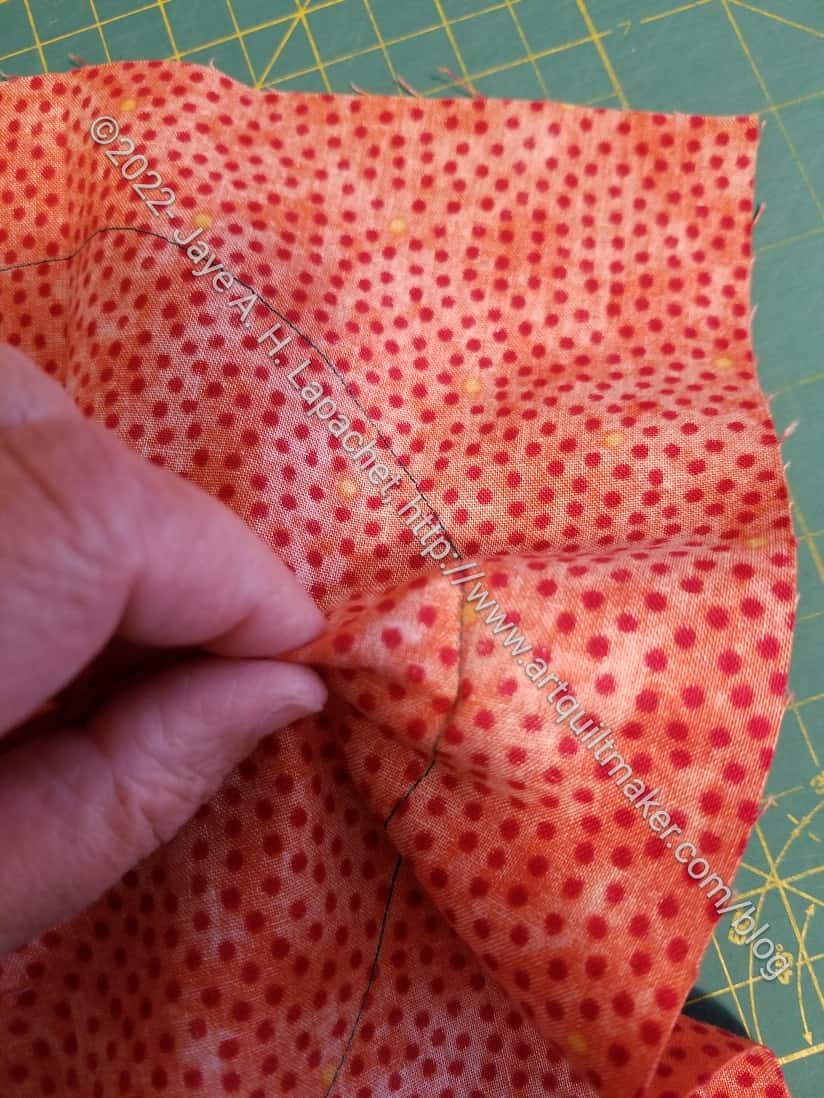
…Your goal is to be able to cut a circle out of the background fabric without harming the front circle.

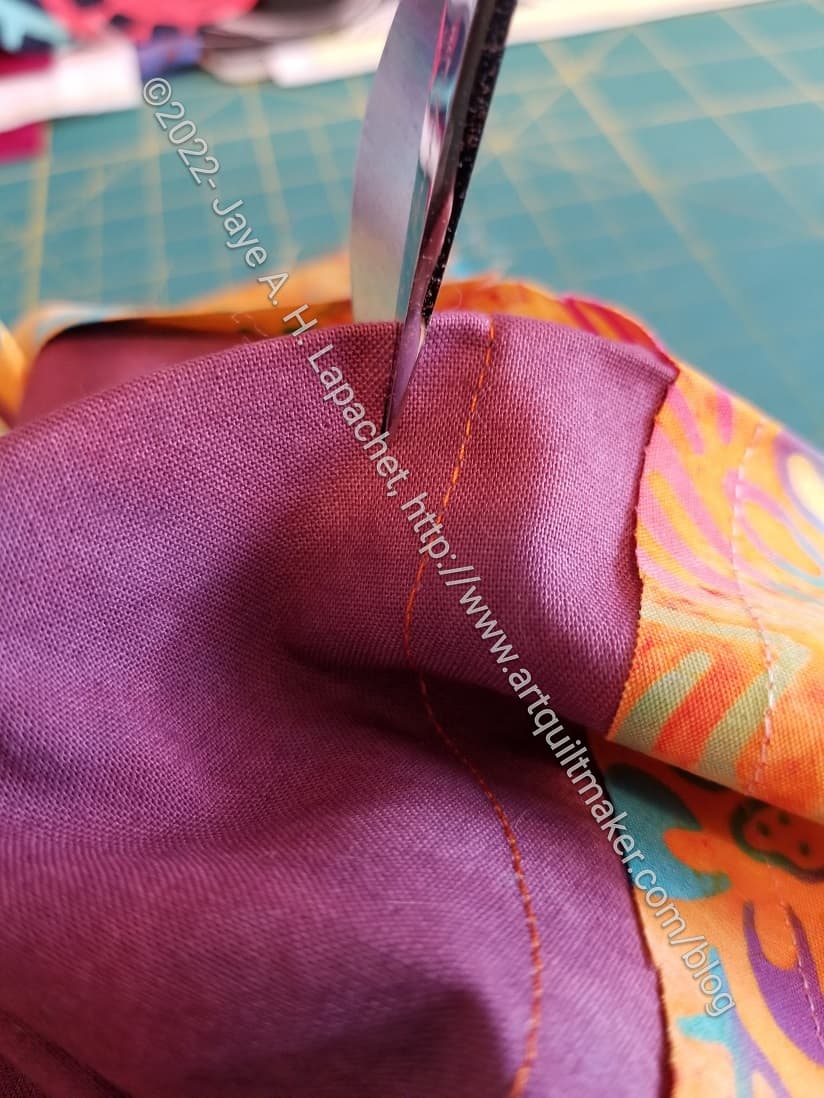
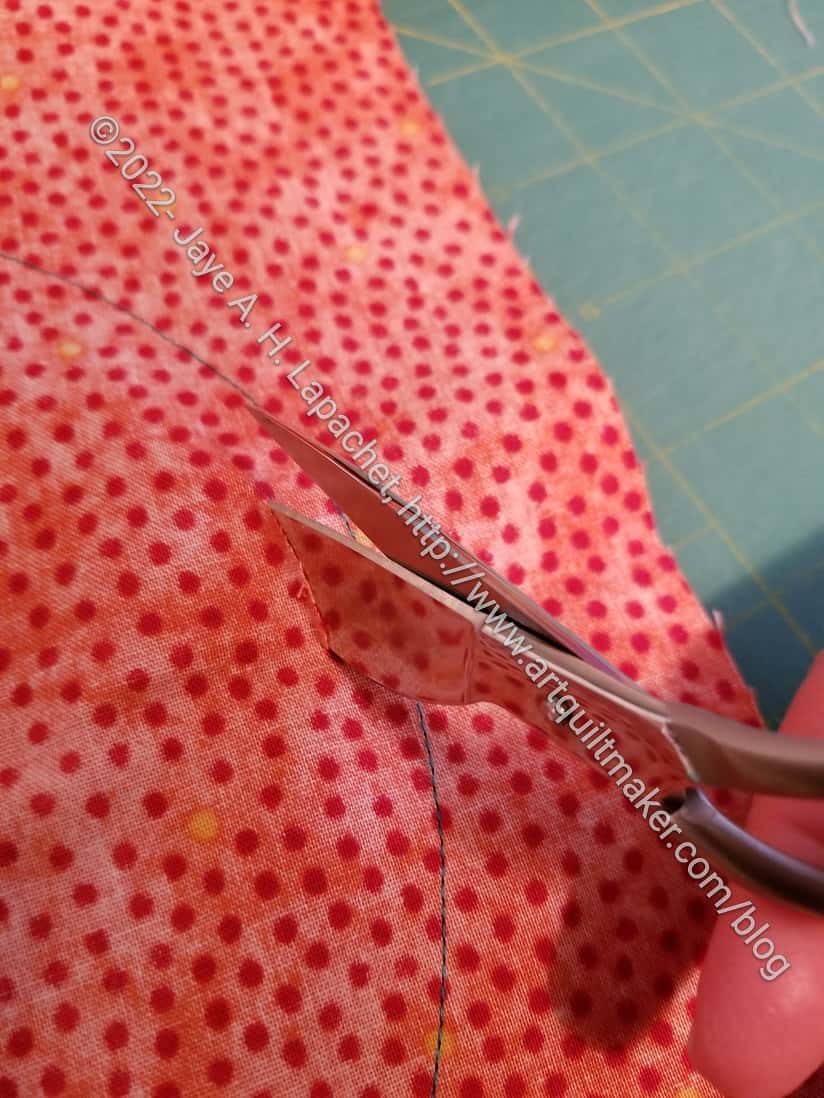
Bullseye: Cut parallel to the line of stitching

Second, cut a slit.  You will need to continue pinching the background layer of fabric away from the front circle. The slit should be cut straight down, parallel to the line of stitching. If it is angled, you will see it right away in the V shaped cut that results. It’s no big deal, but try to keep it straight so it is parallel to the sewing line and makes a neater cut.


Now, continue on to step three in the previous post.


**Obviously, you should shop at local quilt shops. However, I use affiliate links and may be paid for your purchase of an item when you click on an item’s link in my post. There is no additional cost to you for clicking or purchasing items I recommend. I appreciate your clicks and purchases as it helps support this blog.

Finishing Bullseye Blocks

Since I am working on a Bullseye project, I thought it would be a good opportunity to write some tutorials about the process. At the moment, this will not be a full set of step by step tutorials. You’ll have to use the skills you have gained from my Quilt Class tutorials to extrapolate the rest of the process.

This tutorial assumes that you have cut your backgrounds and appliqued your circles to those backgrounds.

Supplies

  • Bullseye blocks
  • Inspira duckbill applique' scissors
    Inspira duckbill applique’ scissors

    Applique’ scissors** – I have two pair. One is by Gingher, which I have had since the dawn of time. These are maybe 10 inches, but probably 8 inches. The other is a much smaller pair (6″) I bought last year at Cottage Quilting in Medford. The brand is Inspira and they are shown on the Husqvarna/Viking website. I thought they were super cute and I had never seen a pair this size before.
  • Cutting mat**

Optional Supplies:

Steps

Bullseye block: facedown on cutting mat

First, take one block and lay it face down on your cutting mat.

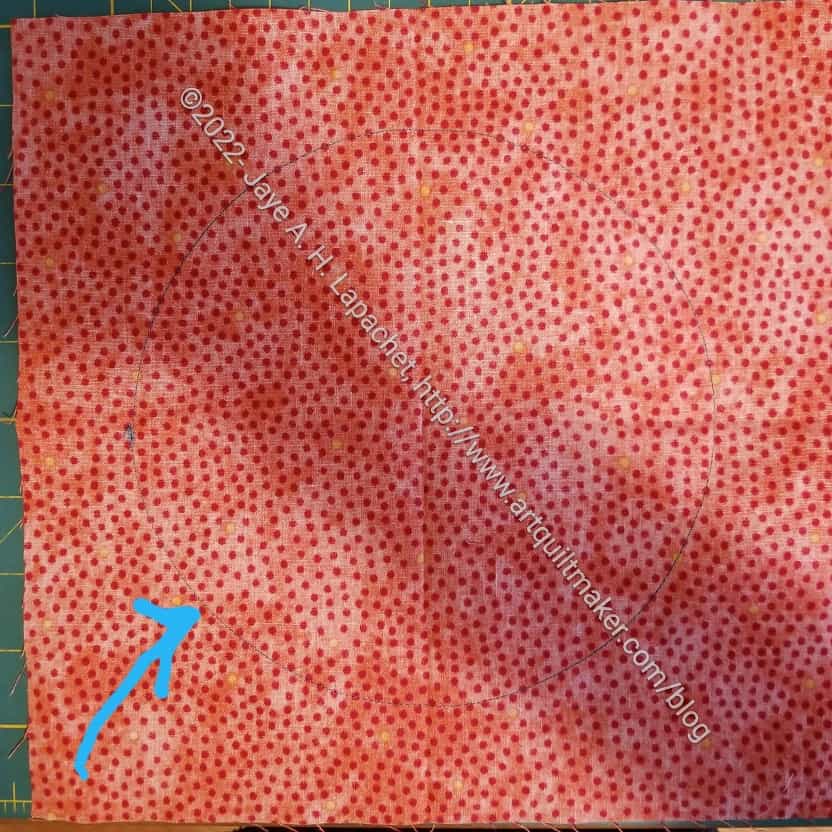
The picture shows the sewing line (arrow is pointing to it; you may need to enlarge the photo). Use the sewing line as a cutting guide. If you want, you can draw in an erasable line to follow for cutting. You don’t need to do that, though. Just eyeball one quarter to a half inch.
Bullseye: Pinch fabric layers away from each other

Pinch the background fabric layers away from the front/circle fabric layer. Your fingers should be about half an inch away from the seam line, as the photo shows.

This is usually a two handed process and you will need to feel around to make sure both layers are well away from each other.

Your goal is to be able to cut a circle out of the background fabric without harming the front circle.

Second, cut a slit.  (no photo) You will need to continue pinching the background layer of fabric away from the front circle. The slit should be cut straight down. If it is angled, you will see it right away. It’s no big deal, but try to keep it straight so it is parallel to the sewing line.

Third, let the fabric layers go back together, e.g. they are not pinched anymore, but, again, laying flat on the cutting mat.

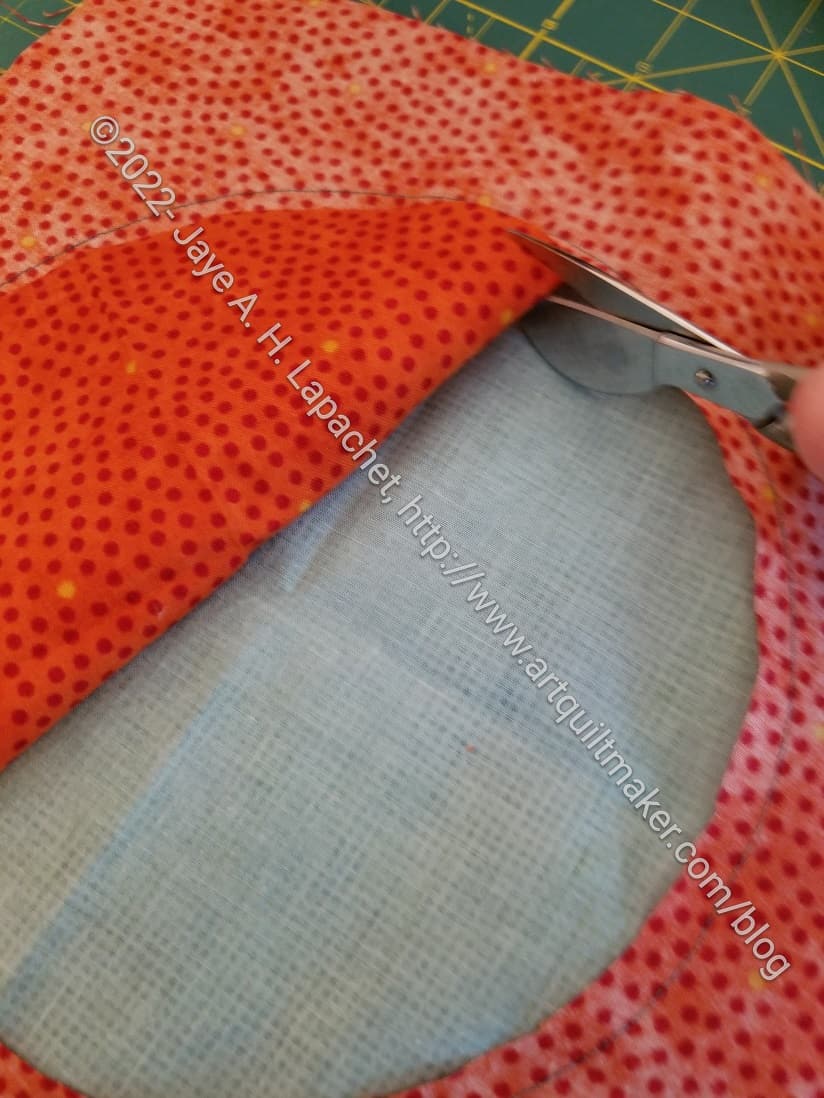
Bullseye blocks: Enlarge the slit

Fourth, carefully stick the duckbill tip of your applique’ scissors into the slit and start cutting away the background layer. Cut one quarter to a half inch away from the seam line.

Be careful to only cut the background layer. The duckbill part of the  scissors should help keep you from cutting the foreground. This doesn’t mean you don’t have to be vigilant. You do!

If I sound like a militant dictator, it is because I have cut through the fronts of appliques and had to do them over.

Be vigilant.

Bullseye: cutting out the background

Fifth, continue cutting carefully around the whole circle. I keep the circle out of the way of the scissors to try and preserve as much fabric as possible. I can cut some of the shapes I need for other projects from the leftovers.

This part of the process becomes easier once you have cut a large enough slit so the front circle fabric shows.

In the photo, left, you can see how the duckbill rests on the front/circle fabric.

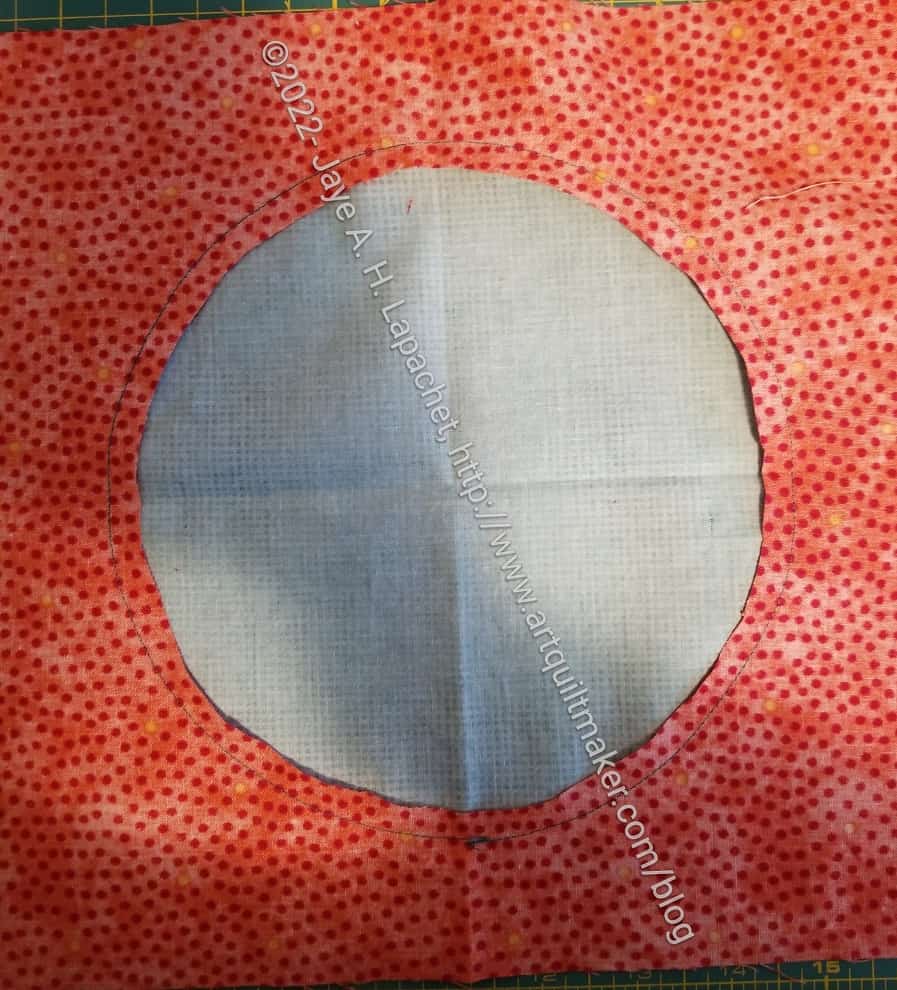
Bullseye: background cut out

When you have cut the whole circle out, you will have a back view to the front fabric.


Repeat for all blocks.


**Obviously, you should shop at local quilt shops. However, I use affiliate links and may be paid for your purchase of an item when you click on an item’s link in my post. There is no additional cost to you for clicking or purchasing items I recommend. I appreciate your clicks and purchases as it helps support this blog.